Naar de inhoud

UFO'S of UAP'S, ASTRONOMIE, RUIMTEVAART, ARCHEOLOGIE, OUDHEIDKUNDE, SF-SNUFJES EN ANDERE ESOTERISCHE WETENSCHAPPEN - DE ALLERLAATSTE NIEUWTJES

UFO's of UAP'S in België en de rest van de wereld
akke.beakke.be
Ontdek de Fascinerende Wereld van UFO's en UAP's: Jouw Bron voor Onthullende Informatie! Ben jij ook gefascineerd door het onbekende? Wil je meer weten over UFO's en UAP's, niet alleen in België, maar over de hele wereld? Dan ben je op de juiste plek! België: Het Kloppend Hart van UFO-onderzoek In België is BUFON (Belgisch UFO-Netwerk) dé autoriteit op het gebied van UFO-onderzoek. Voor betrouwbare en objectieve informatie over deze intrigerende fenomenen, bezoek je zeker onze Facebook-pagina en deze blog. Maar dat is nog niet alles! Ontdek ook het Belgisch UFO-meldpunt en Caelestia, twee organisaties die diepgaand onderzoek verrichten, al zijn ze soms kritisch of sceptisch. Nederland: Een Schat aan Informatie Voor onze Nederlandse buren is er de schitterende website www.ufowijzer.nl, beheerd door Paul Harmans. Deze site biedt een schat aan informatie en artikelen die je niet wilt missen! Internationaal: MUFON - De Wereldwijde Autoriteit Neem ook een kijkje bij MUFON (Mutual UFO Network Inc.), een gerenommeerde Amerikaanse UFO-vereniging met afdelingen in de VS en wereldwijd. MUFON is toegewijd aan de wetenschappelijke en analytische studie van het UFO-fenomeen, en hun maandelijkse tijdschrift, The MUFON UFO-Journal, is een must-read voor elke UFO-enthousiasteling. Bezoek hun website op www.mufon.com voor meer informatie. Samenwerking en Toekomstvisie Sinds 1 februari 2020 is Pieter niet alleen ex-president van BUFON, maar ook de voormalige nationale directeur van MUFON in Vlaanderen en Nederland. Dit creëert een sterke samenwerking met de Franse MUFON Reseau MUFON/EUROP, wat ons in staat stelt om nog meer waardevolle inzichten te delen. Let op: Nepprofielen en Nieuwe Groeperingen Pas op voor een nieuwe groepering die zich ook BUFON noemt, maar geen enkele connectie heeft met onze gevestigde organisatie. Hoewel zij de naam geregistreerd hebben, kunnen ze het rijke verleden en de expertise van onze groep niet evenaren. We wensen hen veel succes, maar we blijven de autoriteit in UFO-onderzoek! Blijf Op De Hoogte! Wil jij de laatste nieuwtjes over UFO's, ruimtevaart, archeologie, en meer? Volg ons dan en duik samen met ons in de fascinerende wereld van het onbekende! Sluit je aan bij de gemeenschap van nieuwsgierige geesten die net als jij verlangen naar antwoorden en avonturen in de sterren! Heb je vragen of wil je meer weten? Aarzel dan niet om contact met ons op te nemen! Samen ontrafelen we het mysterie van de lucht en daarbuiten.

Archief

Maanlander Odysseus stuurt eerste foto’s vanuit de ruimte naar huis

Maanlander Odysseus stuurt eerste foto’s vanuit de ruimte naar huis

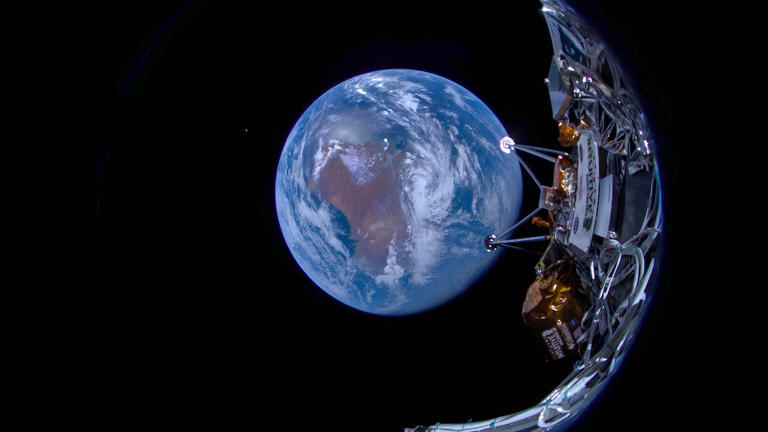
Maanlander Odysseus stuurt eerste foto’s vanuit de ruimte naar huis Image credit: Intuitive Machines via X

De Odysseus-maanlander van Intuitive Machines heeft met succes de eerste beelden vanuit de ruimte naar de aarde gestuurd. Het robotachtige ruimteschip is sinds 15 februari onderweg naar de maan. Kort na de lancering verstuurde de Falcon 9-raket, gebouwd door SpaceX, enkele selfies met de aarde op de achtergrond.

Deze mijlpaal werd aangekondigd door het Amerikaans bedrijf Intuitive Machines via een bericht op X, waarop vier foto’s werden gedeeld. Intuitive Machines met hoofdkantoor in Houston werd opgericht in 2013 door het drietal Stephen Altemus, Kam Ghaffarian en Tim Crain. Het bedrijf verwacht minstens één keer per dag missie-updates te blijven geven op X.

Eerste onbemande maanlanding

Odysseus zal de eerste onbemande Amerikaanse maanlanding zijn sinds de Apollo-missies tussen 1961 en 1972. Het ruimteschip verkeert in perfecte conditie en is op weg naar een geplande landingspoging op 22 februari.

Intuitive Machines gebruikt voor hun motor een combinatie van vloeibare methaan en vloeibare zuurstof. Die combinatie wordt ook gebruikt voor de Raptor-raketmotoren van SpaceX, die de Starship-raket aandrijven. Starship is het ambitieuze project van SpaceX om mensen naar de maan en Mars te brengen.

Doel

Het doel van het bedrijf is het bereiken van een baan om de maan, een zachte maanlanding en communicatie vanaf de maan mogelijk maken. Intuitive Machines heeft ook drie NASA-contracten om ladingen naar het maanoppervlak te transporteren.

Bekijk de beelden hier

{ https://newsmonkey.be/ }

Hoe vind je dit bericht?
Geschreven door peter om 21:14 Stuur door

Maanlander Odysseus stuurt eerste foto’s vanuit de ruimte naar huis

Maanlander Odysseus stuurt eerste foto’s vanuit de ruimte naar huis

Artikel door Victor Peeters 

Maan

Maan
© Aangeboden door Newsmonkey

De Odysseus-maanlander van Intuitive Machines heeft met succes de eerste beelden vanuit de ruimte naar de aarde gestuurd. Het robotachtige ruimteschip is sinds 15 februari onderweg naar de maan. Kort na de lancering verstuurde de Falcon 9-raket, gebouwd door SpaceX, enkele selfies met de aarde op de achtergrond.

Deze mijlpaal werd aangekondigd door het Amerikaans bedrijf Intuitive Machines via een bericht op X, waarop vier foto’s werden gedeeld. Intuitive Machines met hoofdkantoor in Houston werd opgericht in 2013 door het drietal Stephen Altemus, Kam Ghaffarian en Tim Crain. Het bedrijf verwacht minstens één keer per dag missie-updates te blijven geven op X.

Eerste onbemande maanlanding

Odysseus zal de eerste onbemande Amerikaanse maanlanding zijn sinds de Apollo-missies tussen 1961 en 1972. Het ruimteschip verkeert in perfecte conditie en is op weg naar een geplande landingspoging op 22 februari.

Intuitive Machines gebruikt voor hun motor een combinatie van vloeibare methaan en vloeibare zuurstof. Die combinatie wordt ook gebruikt voor de Raptor-raketmotoren van SpaceX, die de Starship-raket aandrijven. Starship is het ambitieuze project van SpaceX om mensen naar de maan en Mars te brengen.

Doel

Het doel van het bedrijf is het bereiken van een baan om de maan, een zachte maanlanding en communicatie vanaf de maan mogelijk maken. Intuitive Machines heeft ook drie NASA-contracten om ladingen naar het maanoppervlak te transporteren.

Bekijk de beelden hier

The post Maanlander Odysseus stuurt eerste foto’s vanuit de ruimte naar huis appeared first on Newsmonkey.

{ https://www.msn.com/nl-be/  }

Hoe vind je dit bericht?
Geschreven door peter om 21:01 Stuur door

Nukes Attract Not Only UFOs but Something Bone-Chilling, Revealed By Ex-Worker At Nuclear Depot In Nevada Desert

UFOs and Nukes

Nukes Attract Not Only UFOs but Something Bone-Chilling, Revealed By Ex-Worker At Nuclear Depot In Nevada Desert

There has been a rise in the number of reported UFO sightings across many places in the United States since 2020. Moreover, officials have expressed concerns regarding the repeated occurrence of UFO sightings over military bases. Is there any possibility that these UFOs are controlling military actions?

Not so long ago, former US Air Force Captain Robert Salas claimed that UFOs are real and interfere in the military’s nuclear program. Additionally, former head of AATIP Luis Elizondo revealed that the U.S. Military created environments to attract UFOs to study them. He noted that there was much data that showed UFOs are interested in nuclear activities and the latest weaponry systems.

The UFO activity over US army bases has been observed since 1948, with the majority of incidents occurring at Malmstrom, Minot, F.E. Warren, Ellsworth, Vandenberg, and Walker AFBs between 1963 and 1996. Other sources stationed at Wurtsmith and Loring AFBs, where B-52 nuclear bombers were based during the Cold War era, also reported incidents.

In 1967, Captain Salas was stationed at Malmstrom Air Force Base in Montana, when he received reports of a red glowing object hovering outside the front gate of the base. A security guard reported that the object had a saucer shape and was constantly hovering near the front gate.

At the same time, the missile system suffered a complete failure, with ten intercontinental ballistic missiles (ICBMs) going offline due to a “No-Go” (inoperable) condition, which caused several alarms to go off. After investigating the incident, a team of engineers from Boeing could not find any significant failures, engineering data, or findings that would explain how the missiles had been knocked off alert.

The cause of the failure remains unknown, but it was suggested that it could have been due to an electromagnetic pulse (EMP) sent from an unknown source. Despite the severity of the situation, Salas believed that the UFO did not have hostile intentions because it could have caused permanent damage to the weapons system if it wanted to.

The incident was reported by a UFO researcher Robert L. Hastings, who collected information from various army personnel, including Staff Sgt. Louis D. Kenneweg, Airman 1st Class David Hughes, Staff Sgt. Joseph M. Chassey, and Lt. Col. Robert Peisher (USAF Ret.) in his 30 years of investigation.

A similar attraction of UFOs toward nuclear bases was noticed in Canada as well. A report from Winnipeg reveals that over 200 years, there have been 2,000 UFO sightings reported in the Canadian province of Manitoba.

In the mid-1970s, there were numerous UFO sightings all along the US-Canadian border, with Manitoba being one of the places where a large number of sightings occurred. These sightings included a high number of cattle mutilations and were often seen over restricted areas where nuclear activities were conducted.

Chris A. Rutkowski, a Canadian UFO researcher, has studied UFO sightings in Canada for over 25 years and concluded that Manitoba has a long history of close encounters with aliens. His UFO research, which contains 30,000 reports, has been donated to the University of Manitoba.

In 2017, author Grant Cameron published a book entitled “Charlie Red Star: True Reports of One of North America’s Biggest UFO Sightings,” in which he described in detail the largest UFO sightings in history witnessed by Manitobans. The province was stunned by the object known as “Charlie’s Red Star,” which was seen almost every night in 1975.

Manitoba ufo

Cameron claims that Manitoba UFO sightings have connections to nuclear weapons because 35 years later, he found out that the government secretly installed nuclear missiles and other weapons in restricted areas just south of the border. He believes that the sightings stopped after the missiles had been removed in November. The author thinks that the nuclear technology that humans possess could be created after extraterrestrial contact. (click here to read the full article

Strange Occurrences Near Nuclear Bases

The Reddit user “BumblebeeExpensive” claimed to have worked at a now-closed nuclear weapons storage depot in Nevada for six years and shared various strange occurrences. “When people say UFOs are attracted to nukes, they are telling the truth. But so much more goes on,” the user writes. (Source)

The user claimed to have seen a ball of light triggering a sensor on the fence line, causing security to respond and witnessed three mutilated donkeys that were dropped off out of nowhere with various organs removed. The user also claimed to have witnessed a figure on the roof of a structure. He writes it was “30 meters from me and 14 other personnel. I took a spotlight and shined it up there and as soon as the light hit the figure it disappeared – we all saw it happen.”

“I heard a man laughing maniacally once, nothing there. Sweep with night vision and thermals revealed nothing, three other witnesses. We wrote it off as the ‘laughing Colonel,’ an urban legend passed down by the security personnel for ages.”

The user and his partner also heard a soft cooing sound coming from a hot pad loaded with 500 lbs bombs, seemingly luring them past the pad and into the pitch-black desert, but they did not pursue. During a training exercise, their machine gun overwatch team spotted two figures on thermals in the desert behind them, but their sweep revealed nothing.

The user claimed to have experienced the weirdest event when they were responding to a truck approaching on the side of a nearby mountain. They visually confirmed the truck on NVGs, but suddenly the headlights disappeared, and they believed the occupants had turned them off and were then approaching on foot. They called for K9 and moved to a blocking position where they waited for ten minutes, but their radios died, and they were out of contact for twice as long as they thought.

“We are there for about ten minutes when one by one patrol members overwatching us from high points on the inside call in lights appearing at our 12, 3, and 9 o’clock- in effect flanking us (with fence line about 300 meters behind us). We see and hear nothing, not even on NVGs or thermals, dog never reacts. Suddenly panicked patrol calls in that the lights are ‘rushing’ us. We are already locked and loaded, I tell my partner to put a grenade in the tube. Nothing happens, dog never indicates. Our radios die and after ten minutes we hike back to fence line only to discover we were out of contact for twice as long as I thought we were. Very paraphrased event cuz on phone, but our radios only started working when we were back at fence line.”

The user claimed that those events, combined with the belief that UFOs are attracted to nukes. He says: “There’s more but these were the highlights or events I’m allowed to speak about. The world is not as normal as you believe it is.”

Many other users found the same story in the video published on “The Infographics Show” YouTube channel in 2020 and began doubting BumblebeeExpensive if he copied the story. But the user later clarified that was his story and added that he is the lead writer of the show. He also claimed to be the writer of the “100-day survival series” on the channel.

“There’s things I can’t talk about as I signed a 30-year non-disclosure contract with pretty stiff penalties- but I’ll say this: I know people think that there’s these big conspiracies with the government hiding knowledge of this or knowledge of that. Truth is, yes there are big secrets. But overwhelmingly, the government isn’t actively hiding knowledge of this or that- it’s literally just ignoring it because it can’t do anything about it or it doesn’t pose a threat. It does spend some time and effort investigating it- you can see that there’s a greatly increased effort to investigate UAPs now. But the truth is that a long time ago a choice was made about certain things: do they affect national security, or could we stop it if it did? If the answer is no, we’ve got bigger or more immediate concerns like the Soviet Union starting a nuclear war,” explains Reddit user BumblebeeExpensive. (Source)

Mr. Elizondo suggested that those interested in more information about this subject read “UFOs and Nukes” by Robert Hastings. The book describes the reality of UFO incursions at American nuclear weapons facilities.

In “UFOs and Nukes,” there are documented incidents of UFO interference at the US nuclear weapons facilities. The book describes incidents where unidentified objects were seen hovering near nuclear facilities, causing malfunctions in nuclear missiles and communication systems.

Some of those incidents date back to as early as January 1945, months before the atomic bombings in Japan. Those events suggest that humans’ most dangerous weapons have been under scrutiny by unidentified observers with advanced technology. The author argues that the UFO-nukes connection is significant and may be the reason for the appearance of mysterious aerial crafts in the skies over the past 70 years. Mr. Elizondo recommends this book to those interested in learning more about this subject.

{ https://www.howandwhys.com/ }

Hoe vind je dit bericht?
Geschreven door peter om 01:34 Stuur door

Bekende oceaanstroom dichterbij instorting dan gedacht. En dat kan een verrassend effect hebben op het weer in Europa

Bekende oceaanstroom dichterbij instorting dan gedacht. En dat kan een verrassend effect hebben op het weer in Europa

f098b5c8-2f69-5061-9779-97ad7859e636.jpg

Bij klimaatverandering denken we vooral aan opwarming, maar in grote delen van Europa zou ook weleens een flinke afkoeling kunnen plaatsvinden als een belangrijke Atlantische oceaanstroom plots tot stilstand komt. Uit nieuwe computersimulaties blijkt dat de kans daarop iets groter is geworden.

We hebben het hier over de AMOC, de Atlantic Meridional Overturning Circulation, waartoe ook de bekende warme Golfstroom behoort. De AMOC maakt deel uit van een grote circulatie van oceaanstromen, waardoor zout en warm water op verschillende dieptes over de aarde wordt verplaatst wat helpt om de temperatuur te regelen. Als deze AMOC tot stilstand komt, wordt er minder hitte uitgewisseld over de hele planeet en dat heeft vooral veel impact op Europa.

Van Groenland naar Zuid-Afrika en terug
De motor achter het systeem bevindt zich voor de kust van Groenland. Doordat er daar meer ijs smelt door klimaatverandering belandt er meer zoetwater in de Noord-Atlantische Oceaan, waardoor de AMOC vertraagt. In het huidige systeem stroomt koud, diep water naar het zuiden langs Noord- en Zuid-Amerika en dan oostwaarts langs Afrika. Ondertussen beweegt zouter, warmer oceaanwater vanuit de Indische Oceaan rond het puntje van Afrika naar Florida via de Amerikaanse oostkust naar Groenland. En zo ontstaat een wereldwijde circulatie van oceaanwater.

Wereldwijde catastrofe
Maar doordat die Groenlandse ijskap dus in hoog tempo aan het smelten is, dreigt de AMOC tot stilstand te komen. Waar dat eerder nog eeuwen leek te duren, blijkt uit de nieuwe computersimulatie dat dit mogelijk nog maar decennia ver weg is. Dat zou het weer overal op aarde veranderen. In Noordwest-Europa kan het 5 tot 15 graden kouder worden, het poolijs komt veel zuidelijker te liggen en op het zuidelijk halfrond wordt het nog warmer. Ook veranderen neerslagpatronen. Sommige wetenschappers denken dat het een ramp wordt die wereldwijd tot grote voedsel- en watertekorten kan leiden.

Maar zo ver is het nog niet. De wetenschappers van de Universiteit Utrecht zien wel dat we dichterbij de instorting van de AMOC komen, maar hoe dichtbij we precies zijn, is nog onduidelijk. Wel gaan we richting een omslagpunt. Dat kan nog een eeuw duren, maar ook enkele decennia. Dat hangt onder meer af van ons eigen gedrag: hoe minder CO2 we uitstoten, hoe langer het zal duren voor het ijs smelt en de AMOC stilvalt.

Op eigen risico
Tot nu toe is duidelijk dat de oceaanstroom vertraagt, maar het probleem ontstaat pas als hij instort. Het VN-klimaatpanel IPCC heeft er ‘medium vertrouwen’ in dat dit niet voor 2100 gebeurt, maar meerdere wetenschappers denken daar anders over. Zo reageert een belangrijke Duitse klimaatwetenschapper dat de nieuwe studie bijdraagt aan de groeiende zorg over de instorting van de AMOC in de niet al te verre toekomst. “We negeren dit op eigen risico”, klinkt het. Een instorting van de AMOC heeft zulke grote gevolgen voor het wereldwijde klimaat, die zo abrupt zijn dat het in sommige gebieden onmogelijk is om aan te passen, reageert ook een Britse wetenschapper. Ook

2200 jaar AMOC
De wetenschappers simuleerden 2200 jaar aan oceaanstromen met daarin de effecten van de huidige opwarming verwerkt. Ze vonden na 1750 jaar ‘een abrupte AMOC-instorting’ maar ze waren tot nu toe nog niet in staat om de gesimuleerde tijdlijn te vertalen naar de werkelijke toekomst van de aarde. Wel zagen ze dat een complexe oceaanstroommeting rond het puntje van Zuid-Afrika cruciaal is om te monitoren. Hoe negatiever die meting is, hoe trager de AMOC gaat. Door klimaatverandering wordt deze waarde negatiever en wanneer hij een bepaald punt bereikt, is er geen langzame stop, maar is het meer alsof je van een klif stort, waarschuwen de onderzoekers.

En waar dit eerst altijd klonk als een ver-van-je-bedshow zou het volgens de nieuwe studie zomaar kunnen dat het nog in ons leven gebeurt, al is er nog veel meer onderzoek nodig om meer te kunnen zeggen over de precieze termijn. Het is dus absoluut geen reden tot paniek, maar zeker wel tot zorg.

Bronmateriaal

{ https://scientias.nl/ }

Hoe vind je dit bericht?
Geschreven door peter om 01:13 Stuur door

EVOLUTIONARY AI TOOL, “DEEP-DRAM,” OPENS DOOR TO DISCOVERING UNPRECEDENTED METAMATERIALS WITH “UNUSUAL PROPERTIES”

vQ3wIPAe?format=jpg&name=900x900

EVOLUTIONARY AI TOOL, “DEEP-DRAM,” OPENS DOOR TO DISCOVERING UNPRECEDENTED METAMATERIALS WITH “UNUSUAL PROPERTIES”

Researchers from Delft University of Technology in the Netherlands have developed a new artificial intelligence (AI) tool known as “Deep-DRAM” to discover and fabricate novel metamaterials with unparalleled ease and accessibility.

The groundbreaking method promises to revolutionize metamaterial development by streamlining the discovery and creation of durable, custom-designed materials with “unprecedented functionalities” and “unusual properties.”  

“Traditionally, designers use the materials available to them to design a new device or a machine. The problem with that is that the range of available material properties is limited. Some properties that we would like to have just don’t exist in nature,” study co-author and professor of biomechanical engineering, Dr. Amir Zadpoor, explained in a press release by Delft University. 

“Our approach is: tell us what you want to have as properties and we engineer an appropriate material with those properties. What you will then get is not really a material but something in-between a structure and a material, a metamaterial.”

Metamaterials are materials engineered to have properties not found in naturally occurring substances. These engineered composites can defy conventional material properties by deriving their unique characteristics from a structure’s geometry rather than molecular composition. 

Metamaterials are currently employed in various industries, serving practical purposes such as improving antenna performance in telecommunications and controlling sound waves for noise reduction or focusing in acoustic engineering. Recent advancements include creating the world’s first genuine “one-way glass,” showcasing metamaterials, versatility, and potential for innovative applications.

In 2006, two research papers published in Science demonstrated that metamaterials could be used to manipulate the propagation and transmission of specified light frequencies and electromagnetic radiation to render an object invisible. 

Recent publications from Sandia National Laboratories, the U.S. Naval Institute, and Northrop Grumman have discussed the military potential of metamaterials, suggesting the possibility of creating real-life versions of the fictional “Klingon Cloaking Device” or “Harry Potter Invisibility Cloak.” However, despite ongoing research efforts, practical metamaterial cloaking technology has yet to be publicly demonstrated thus far.

This most significant challenge in developing novel metamaterials stems from solving the so-called “inverse problem” or calculating the specific geometry needed to produce desired properties.  

“Even when inverse problems were solved in the past, they have been limited by the simplifying assumption that small-scale geometry can be made from an infinite number of building blocks,” lead author Dr. Helda Pahlavani explained. “The problem with that assumption is that metamaterials are usually made by 3D printing and real 3D printers have a limited resolution, which limits the number of building blocks that fit within a given device.”

Enter Deep-DRAM: an AI-driven modular framework combining deep learning models, generative models, and finite element simulations to address these challenges head-on. 

Researchers say Deep-DRAM stands out by tackling the inverse design problem from a new angle, enabling the creation of materials with tailored properties such as double auxeticity (materials that expand in two directions when stretched) and high stiffness. 

Dr. Pahlavani underscored the importance of Deep-DRAM being able to overcome previous constraints, stating, “We can now simply ask: how many building blocks does your manufacturing technique allow you to accommodate in your device? The model then finds the geometry that gives you your desired properties for the number of building blocks that you can actually manufacture.”

In a paper published in the journal Advanced Materials, researchers detailed how the application of Deep-DRAM extends beyond theoretical advancements, showcasing real-world implications through extensive simulations and 3D-printed specimens.

Researchers note that the framework’s ability to generate microarchitectures resistant to fatigue and fracture highlights Deep-DRAM’s potential to produce metamaterials that are not only innovative but also durable and reliable for practical applications.

This focus on durability differs from most existing metamaterial designs, which often fail after repeated use. 

“So far, it has been only about what properties can be achieved,” Dr. Zadpoor described the current processes for developing metamaterials. “Our study considers durability and selects the most durable designs from a large pool of design candidates. This makes our designs really practical and not just theoretical adventures.”

Researchers say that one of the remarkable aspects of Deep-DRAM is its modular design, allowing for the integration of various computational models to solve complex design problems efficiently. This modular approach accelerates the design process and minimizes computational costs, making it an attractive option for a wide range of applications.

The implications of the innovative Deep-DRAM framework extend far beyond the laboratory, offering tangible solutions to real-world challenges. With the ability to tailor durable metamaterials to specific needs, industries ranging from healthcare to aerospace could benefit immensely from this recent marriage of Artificial intelligence and material science. 

Assistant Professor Dr. Mohammad J. Mirzaali, who also served as a corresponding author of the study, says the potential of metamaterials is limitless. However, because their optimal design has historically relied on intuition and trial and error, the metamaterials’ full potential has never been truly realized.  

Yet, researchers believe the AI-driven inverse design process of Deep-DRAM could revolutionize the development of metamaterials, opening avenues for applications such as orthopedic implants, surgical instruments, soft robots, adaptive mirrors, and exosuits.

“We think the step we have taken is revolutionary in the field of metamaterials,” said Dr. Mirzaali. “It could lead to all kinds of new applications.” 

  • Tim McMillan is a retired law enforcement executive, investigative reporter and co-founder of The Debrief. His writing typically focuses on defense, national security, the Intelligence Community and topics related to psychology. You can follow Tim on Twitter: @LtTimMcMillan.  Tim can be reached by email: tim@thedebrief.org or through encrypted email: LtTimMcMillan@protonmail.com 

{ https://thedebrief.org/category/science/ }

Hoe vind je dit bericht?
Geschreven door peter om 00:59 Stuur door

Private Odysseus moon lander beams home 1st photos from space

IM-1, the first NASA Commercial Launch Program Services launch for Intuitive Machines’ Nova-C lunar lander, will carry multiple payloads to the Moon, including Lunar Node-1, demonstrating autonomous navigation via radio beacon to support precise geolocation and navigation among lunar orbiters, landers, and surface personnel. NASA’s CLPS initiative oversees industry development of small robotic landers and rovers to support NASA’s Artemis campaign.

Intuitive Machines’ Nova-C lunar lander
NASA ID: IM_00309
IM-1, the first NASA Commercial Launch Program Services launch for Intuitive Machines’ Nova-C lunar lander, will carry multiple payloads to the Moon, including Lunar Node-1, demonstrating autonomous navigation via radio beacon to support precise geolocation and navigation among lunar orbiters, landers, and surface personnel. NASA’s CLPS initiative oversees industry development of small robotic landers and rovers to support NASA’s Artemis campaign.

Private Odysseus moon lander beams home 1st photos from space

photo showing part of a silver and gold spacecraft with the sphere of earth and the blackness of space in the background.
Intuitive Machines' Odysseus moon lander beamed home this selfie on Feb. 16, 2024, a day after launching atop a SpaceX Falcon 9 rocket. 
(Image credit: Intuitive Machines via X)

A pioneering moon lander has beamed home its first photos from the final frontier.

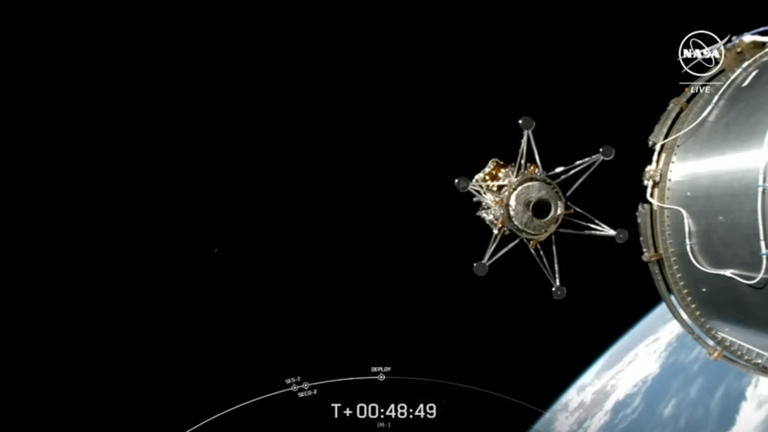
Intuitive Machines’ Odysseus moon lander deploys from the second stage of its Falcon 9 rocket on Feb. 15, 2024.
(Image credit: NASA TV)© Provided by Space

Intuitive Machines' robotic Odysseus spacecraft snapped a few selfies with Earth in the background shortly after its Feb. 15 launch atop a SpaceX Falcon 9 rocket — and we can all check them out.

"Intuitive Machines successfully transmitted its first IM-1 mission images to Earth on February 16, 2024. The images were captured shortly after separation from @SpaceX's second stage on Intuitive Machines' first journey to the moon under @NASA's CLPS initiative," the Houston-based company wrote Saturday (Feb. 17) in a post on X that shared four of the photos.

Related: 


Another selfie beamed home by Odysseus. (Image credit: Intuitive Machines via X)

CLPS is the Commercial Lunar Payload Services program, which puts agency science instruments on private robotic moon landers like Odysseus. These instruments are designed to collect data that will aid NASA's Artemis program, which aims to establish a crewed base near the lunar south pole by the end of the 2020s.

Odysseus is carrying six NASA experiments and technology demonstrations, along with six private payloads, on its current IM-1 mission.

IM-1 wasn't the first CLPS effort to get off the ground. That distinction goes to the debut flight of Peregrine, a moon lander built by Pittsburgh company Astrobotic, which launched last month atop a United Launch Alliance Vulcan Centaur rocket.

That launch went well, but Peregrine suffered a fuel leak shortly after separating from the rocket's upper stage. The lander couldn't reach the moon, so its handlers steered it to a controlled destruction in Earth's atmosphere on Jan. 18. 

Another selfie, apparently taken with a fisheye lens, that Odysseus beamed home on Feb. 16, 2024.  (Image credit: Intuitive Machines via X)

Things have been going better for Odysseus. The lander is healthy and communicating with mission control as it heads toward the moon for a planned Feb. 22 touchdown attempt, Intuitive Machines has said.

Odysseus' various systems are performing normally, including its engine, which just aced a crucial checkout in deep space.

"Intuitive Machines flight controllers successfully fired the first liquid methane and liquid oxygen engine in space, completing the IM-1 mission engine commissioning. This engine firing included a full thrust mainstage engine burn and throttle down-profile necessary to land on the moon," the company said in an X post on Friday evening (Feb. 16).

Success on the upcoming landing try would be historic; no private spacecraft has ever touched down softly on the moon.

Odysseus' liquid methane-liquid oxygen combination, by the way, is also employed by SpaceX's Raptor engines, which power the company's giant new Starship rocket. Starship, which SpaceX is developing to get people to the moon and Mars, is being prepped for its third test flight, which could take place in the coming weeks.

{ https://www.space.com/ }

Hoe vind je dit bericht?
Geschreven door peter om 23:44 Stuur door

Engineers Design Habitats for the Moon Inspired by Terminite Mounds

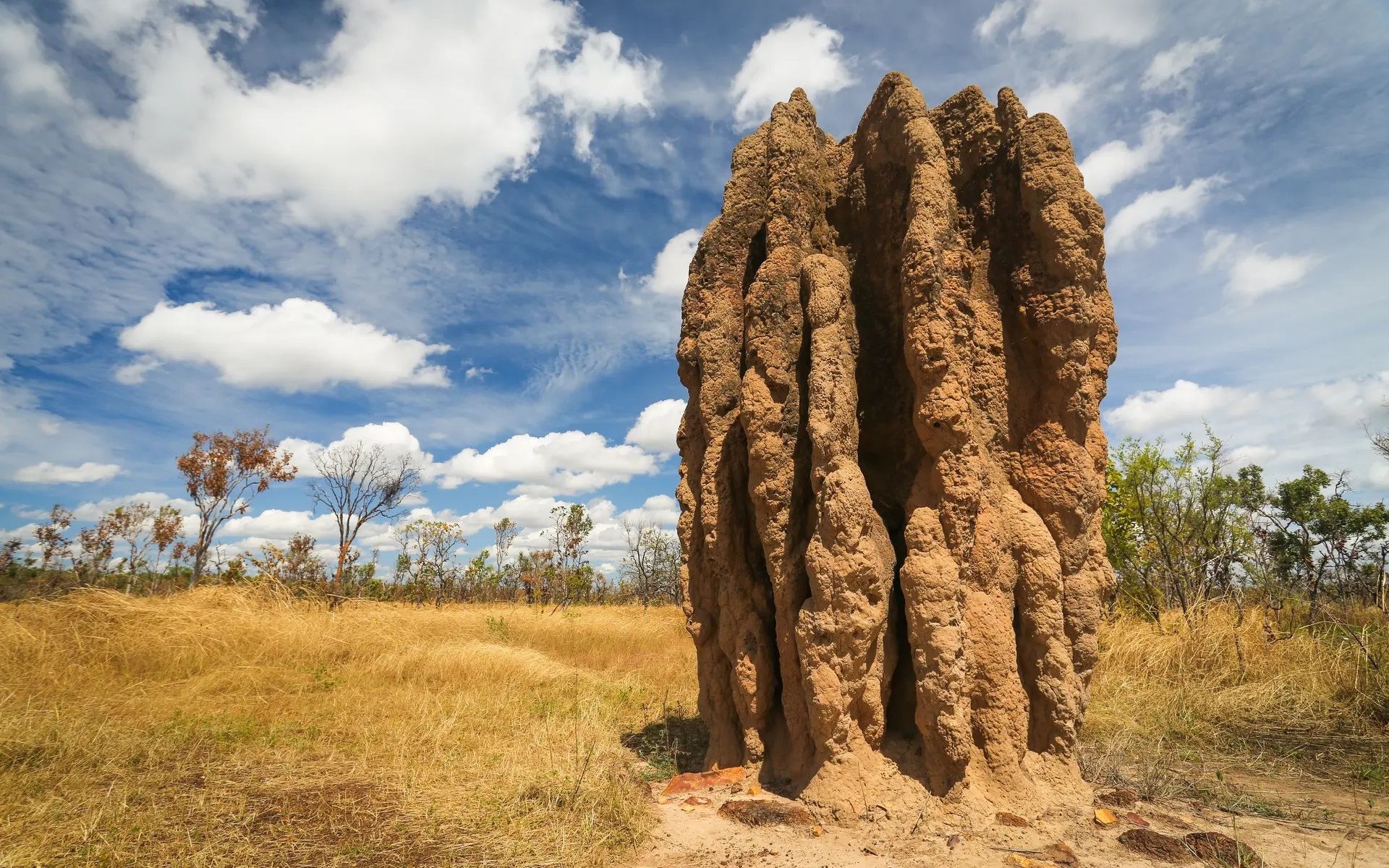
Porous cathedral termite mounds in Kakadu National Park, Australia. Credit: Mother Nature Network

Engineers Design Habitats for the Moon Inspired by Terminite Mounds

Through the Artemis Program, NASA intends to send astronauts back to the Moon for the first time since the Apollo Era. But this time, they intend to stay and establish a lunar base and other infrastructure by the end of the decade that will allow for a “sustained program of lunar exploration and development.” To accomplish this, NASA is enlisting the help of fellow space agencies, commercial partners, and academic institutions to create the necessary mission elements – these range from the launch systems, spacecraft, and human landing systems to the delivery of payloads.

With NASA funding, a team of engineers from the University of Arizona College of Engineering (UA-CE) is developing autonomous robot networks to build sandbag shelters for NASA astronauts on the Moon. The designs are inspired by cathedral termite mounds, which are native to Africa and northern Australia’s desert regions. Their work was the subject of a paper presented at the American Astronautical Society Guidance, Navigation, and Control (AAS GNC) Conference, which took place from February 1st to 7th in Littleton and Breckinridge, Colorado.

The team was led by Associate Professor Jekan Thanga of the UA-CE Department of Aerospace and Mechanical Engineering, who is also the head of the Space and Terrestrial Robotic Exploration (SpaceTREx) Laboratory and the NASA-supported Asteroid Science, Technology and Exploration Research Organized by Inclusive eDucation Systems (ASTEROIDS) Laboratory. He and his team are partnering with NASA’s Jet Propulsion Laboratory and the Canadian space robotics company MDA to create the LUNAR-BRIC consortium, which is developing the technology for the Artemis Program.

Moon base

Illustration of NASA astronauts and the elements of the Lunar Base Camp around the Moon’s south pole. Credit: NASA

Per the Artemis Program, NASA will land astronauts around the lunar south pole with the Artemis III mission, currently scheduled for 2026/27. By the end of the decade, they plan to build the infrastructure for long-duration stays, like the Lunar Gateway and the Artemis Base Camp. The latter element consists of a Foundation Lunar Habitat (FLH), the Lunar Terrain Vehicle (LTV), and a Habitation Mobility Platform (HMB). However, they will also need semi-permanent safe shelters while they search for optimal locations to build permanent habitats.

Consistent with NASA’s vision for future space exploration, a key element in this plan is to leverage local resources for building materials and resources – a process known as In-Situ Resource Utilization (ISRU). For their concept, Thanga and his team investigated whether sandbags filled with lunar regolith could be used instead of traditional building materials to build lunar infrastructure. This includes housing, warehouses, control towers, robot facilities, landing pads, and blast walls to protect lunar buildings as spacecraft conduct takeoffs and landings.

Thanga was first inspired by a YouTube video showing the work of Iranian-born American architect Nader Khalili, best known for designing structures that incorporate unconventional building materials. This includes his development of SuperAdobe sandbag construction to create structures for the developing world and emergency situations. During the 1980s, the late architect proposed building sandbag structures on the Moon and other extraterrestrial locations. Thanga incorporated the concept of insect “skyscrapers” into Khalili’s ideas, specifically the tall-standing cathedral termite mounds.

These mounds are common in African and Australian deserts and are important in regulating the subterranean nest environment. As Thanga described in a UA College of Engineering News release:

“In the case of the termites, it’s very relevant to our off-world challenges. The extreme desert environments the termites face are analogous to lunar conditions. Importantly, this whole approach doesn’t rely on water. Most of the moon is bone-dry desert. Learning about that helped direct me toward distributed systems for construction.”

UA aerospace engineering students (from left) Min Seok Kang, Athip Thirupathi Raj, Chad Jordan Cantin, Sivaperuman Muniyasamy, and Korbin Aydin Hansen display a smart sandbag structure. Credit: University of Arizona College of Engineering

Thanga has long been interested in applying insect social systems to distributed robot networks where machines are organized by swarm intelligence to work cooperatively without human intervention. In their system, the robots embed sensors and electronics in sandbags, fill them with lunar regolith, and then use these to assemble the structures in place. Some sensors provide location data to help the robots place the sandbags, while others provide communication capabilities and environmental information to warn of potential dangers.

These include moonquakes, which result from heating and cooling during every lunar day and night (which last 14 days each). The temperature swings during this cycle are also a potential hazard, ranging from -183 to 107 °C (-298 to 224 °F) between day and night. Because the Moon is an airless environment, there’s also the threat of micro-meteors that bombard the surface at an average speed of 96,560 km/h (60,000 mph). The lack of an atmosphere (and a magnetosphere) also means the lunar surface is exposed to considerably more solar radiation and cosmic rays.

These buildings meet NASA’s requirements for the Artemis Program by reducing the amount of material that must be transported to the Moon while protecting the harsh lunar environment. NASA has granted Thanga and his team $500,000 for lunar surface projects through the agency’s Space Technology Artemis Research program (M-STAR), part of the Minority University Research and Education Project (MUREP). NASA has also provided $1 million annually for UA student research projects over the last five years through a MUREP Institutional Research Opportunity (MIRO). Said Thanga:

“The goal is to raise the participation of underrepresented groups in aerospace. And these are hands-on, student-centric projects. This lab offers me the exact environment – it’s startup culture. I’m leading a team and working with multidisciplinary people. I’m glad I’m here.”

Thanga and Sivaperuman Muniyasamy, an aerospace engineering doctoral student and first author on the paper describing the technology, presented their idea during a classified session of the AAS GNC. “By publishing the paper at the conference, we’re gaining feedback from other experts that really helps us move forward,” said Muniyasamy. “It’s no accident this team has an academic partner, a commercial partner, and a government agency,” Thanga added. “Given the challenges, part of the path is for us to collaborate.”

Artist’s impression of a lunar mining facility harvesting resources from the Moon’s surface. Credit: NASA/Pat Rawlings

Beyond the team’s plans for lunar habitats, the LUNAR-BRIC consortium plans to produce many concepts that will support the creation of a space economy. In addition to leading a team of eight undergraduate and master’s students working on lunar surface projects, Muniyasamy plans to launch a space mining company after completing his Ph.D. As he noted, NASA plans to build facilities for long-term habitation and industry within a few years of the successful landing of Artemis III that will enable (among other things) environmentally responsible lunar and asteroid mining

Thanga and his student team worked with the university commercialization arm (Tech Launch Arizona) to file patents on the robotic system and the distributed computer processing networks that link the proposed structures and robots.

Further Reading: 

Hoe vind je dit bericht?
Geschreven door peter om 22:02 Stuur door

China's Chang'e-8 Mission Will Try to Make Bricks on the Moon

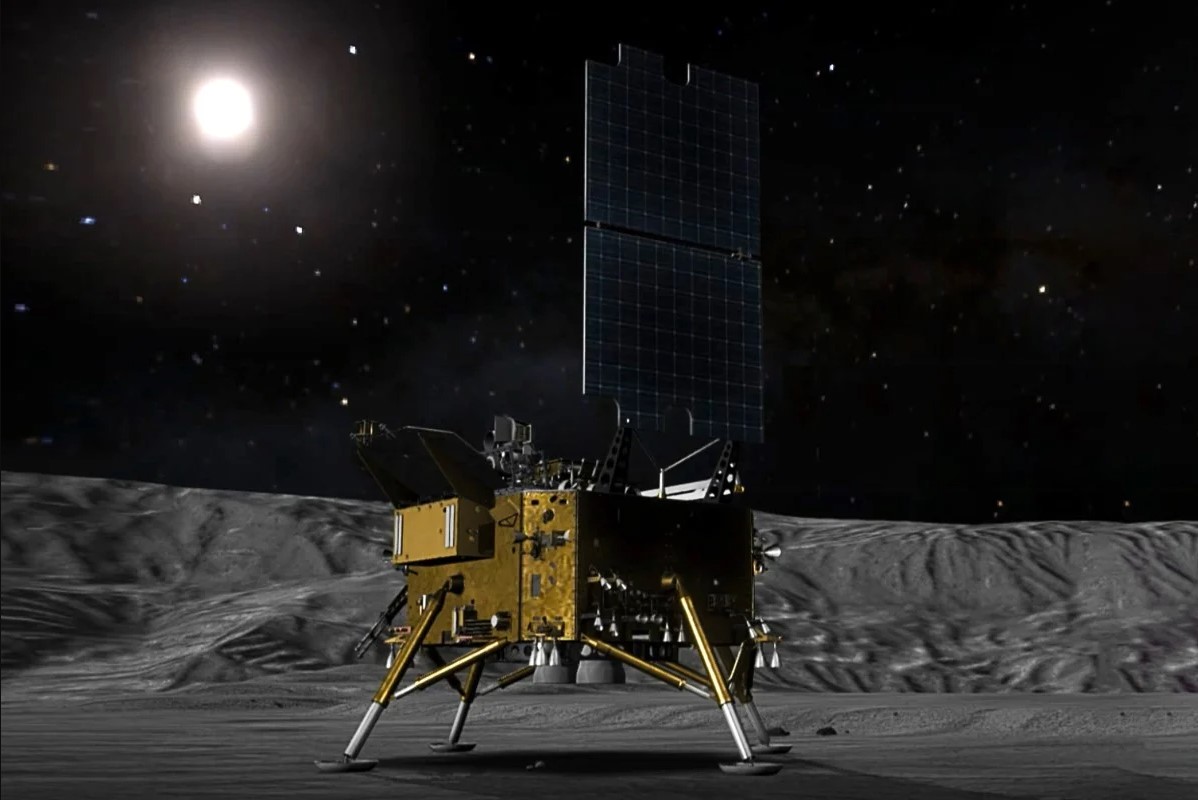
Artist's impression of Chang'e-8. Credit: CNSA.
China's Chang'e-8 Mission Will Try to Make Bricks on the Moon

The China National Space Administration (CNSA) has put out a call for international and industry partners to contribute science payloads to its Chang’e-8 lunar lander, set for launch to the Moon in 2028. The mission, which will involve a lander, a rover, and a utility robot, will be China’s first attempt at in-situ resource utilization on the Moon, using lunar regolith to produce brick-like building materials.

Just like NASA’s Artemis plans, the CNSA’s plans for the Moon are targeted at the Lunar south pole, which is expected to be rich in useable resources, especially water. The presence of these resources will be vital for long-term human activity on the lunar surface.

Possible landing sites for Chang’e-8 include Leibnitz Beta, Amundsen crater, Cabeus crater, and the ridge connecting the Shackleton and de Gerlache craters, according to a presentation by Chang’e-8 chief deputy designer in October 2023.

Chang’e-8 will be the last CNSA robotic mission to be launched before construction begins on the International Lunar Research Station, China’s crewed moonbase being planned in collaboration with Russia’s Roscosmos. That makes Chang’e-8’s attempt to create building materials out of regolith a vital proof-of-concept for their lunar aspirations.

In order to make moon-bricks, the lander will carry an instrument that uses solar energy to melt lunar soil and turn it into useable parts at a speed of 40 cubic cm per hour.

Alongside the regolith processing equipment, the lander will be equipped with an array of science instruments, including cameras, a seismometer to detect moonquakes, and an x-ray telescope. Part of the mission will focus on moon-based Earth observation, with several instruments designed to monitor Earth’s atmosphere and magnetosphere.

The rover, meanwhile, will carry ground penetrating radar, cameras, a mineral analyzer, and tools for collecting and storing samples (leaving open the possibility of future missions to retrieve the samples).

The utility robot is a key piece of the mission, but CNSA isn’t developing it in-house. Instead, the space agency is seeking proposals from partners interested in developing it as a piggyback payload to ride alongside the rest of Chang’e-8.

According to the call for proposals, the 100kg, battery-powered robot will need to be able to “capture, carry and place items, shovel, and transfer lunar soil.” It will also need to be able to travel at 400m per hour.

There is room for an additional 100kg of piggyback payloads besides the robot, for which full proposals are expected to be submitted later this year.

While planning for Chang’e 8 is ongoing, the CNSA has two additional robotic moon missions in the works for the near future. The first, Chang’e-6, will launch this spring, and aims to return a regolith sample from the lunar far side (a never before accomplished feat). The next mission is planned for 2026, when Chang’e-7 will carry out a geological examination of the permanently shadowed craters scattered around the Moon’s south pole.

{ https://www.universetoday.com/ }

Hoe vind je dit bericht?
Geschreven door peter om 21:16 Stuur door

There’s One Last Place Planet 9 Could Be Hiding

Artist's illustration of Planet Nine with the Sun and orbit of Neptune (ring) in the distance. (Credit: ESO/Tomruen/nagualdesign)

There’s One Last Place Planet 9 Could Be Hiding

 A recently submitted study to The Astronomical Journal continues to search for the elusive Planet Nine (also called Planet X), which is a hypothetical planet that potentially orbits in the outer reaches of the solar system and well beyond the orbit of the dwarf planet, Pluto. The goal of this study was to narrow down the possible locations of Planet Nine and holds the potential to help researchers better understand the makeup of our solar system, along with its formation and evolutionary processes. So, what was the motivation behind this study regarding narrowing down the location of a potential Planet Nine?

Dr. Mike Brown, who is a Richard and Barbara Rosenberg Professor of Astronomy at Caltech and lead author of the study, tells Universe Today, “We are continuing to try to systematically cover all of the regions of the sky where we predict Planet Nine to be. Using data from Pan-STARRS allowed us to cover the largest region to date.”

Pan-STARRS, which stands for Panoramic Survey Telescope and Rapid Response System, is a collaborative astronomical observation system located at Haleakala Observatory and operated by the University of Hawai’I Institute of Astronomy with telescope construction being funded by the U.S. Air Force. For the study, the researchers used data from Data Release 2 (DR2) with the goal of narrowing down the possible location of Planet Nine based on findings from past studies.

In the end, the team narrowed down possible locations of Planet Nine by eliminating approximately 78 percent of possible locations that were calculated from previous studies. Additionally, the researchers also provided new estimates for the approximate semimajor axis (measured in astronomical units (AU)) and Earth-mass size of Planet Nine at 500 and 6.6, respectively. So, what are the most significant results from this study, and what follow-up studies are currently being conducted or planned?

“While I would love to say that the most significant result was finding Planet Nine, we didn’t,” Dr. Brown tells Universe Today. “So instead, it means that we have significantly narrowed the search area. We’ve now surveyed approximately 80% of the regions where we think Planet Nine might be.”

In terms of follow-up studies, Dr. Brown tells Universe Today, “I think that the LSST is the most likely survey to find Planet Nine. When it comes online in a year or two it will quickly cover much of the search space and, if Planet Nine is there, find it.”

LSST stands for Legacy Survey of Space and Time, and is an astronomical survey currently scheduled as a 10-year program to study the southern sky and take place at the Vera C. Rubin Observatory in Chile, which is presently under construction. Objectives for LSST include studying identifying near-Earth asteroids (NEAs) and small planetary bodies within our solar system, but also include deep space studies, as well. These include investigating the properties of dark matter and dark energy and the evolution of the Milky Way Galaxy. But what is the importance of finding Planet Nine?

Dr. Brown tells Universe Today, “This would be the 5th largest planet of our solar system and the only one with a mass between Earth and Uranus. Such planets are common around other stars, and we would suddenly have a chance to study one in our own solar system.”

Scientists began hypothesizing the existence of Planet Nine shortly after the discovery of Neptune in 1846, including an 1880 memoir authored by D. Kirkwood and later a 1946 paper authored by American astronomer, Clyde Tombaugh, who was responsible for discovering Pluto in 1930. More recent studies include studies from 2016 and 2017 presenting evidence for the existence of Planet Nine, the former of which was co-authored by Dr. Brown. This most recent study marks the most complete investigation of narrowing down the location of Planet Nine, which Dr. Brown has long-believed exists, telling Universe Today, “There are too many separate signs that Planet Nine is there. The solar system is very difficult to understand without Planet Nine.”

He continues by telling Universe Today that “…Planet Nine explains many things about orbits of objects in the outer solar system that would be otherwise unexplainable and would each need some sort of separate explanation. The cluster of the directions of the orbits is the best know, but there is also the large perihelion distances of many objects, existence of highly inclined and even retrograde objects, and the high abundance of very eccentric orbits which cross inside the orbit of Neptune. None of these should happen in the solar system, but all are easily explainable as an effect of Planet Nine.”

Does Planet Nine exist and where will we find it in the coming years and decades? Only time will tell, and this is why we science!

  • As always, keep doing science & keep looking up!

{ https://www.universetoday.com/ }

Hoe vind je dit bericht?
Geschreven door peter om 20:50 Stuur door

Even Eris and Makemake Could Have Geothermal Activity

worlds-2000x1200.jpg

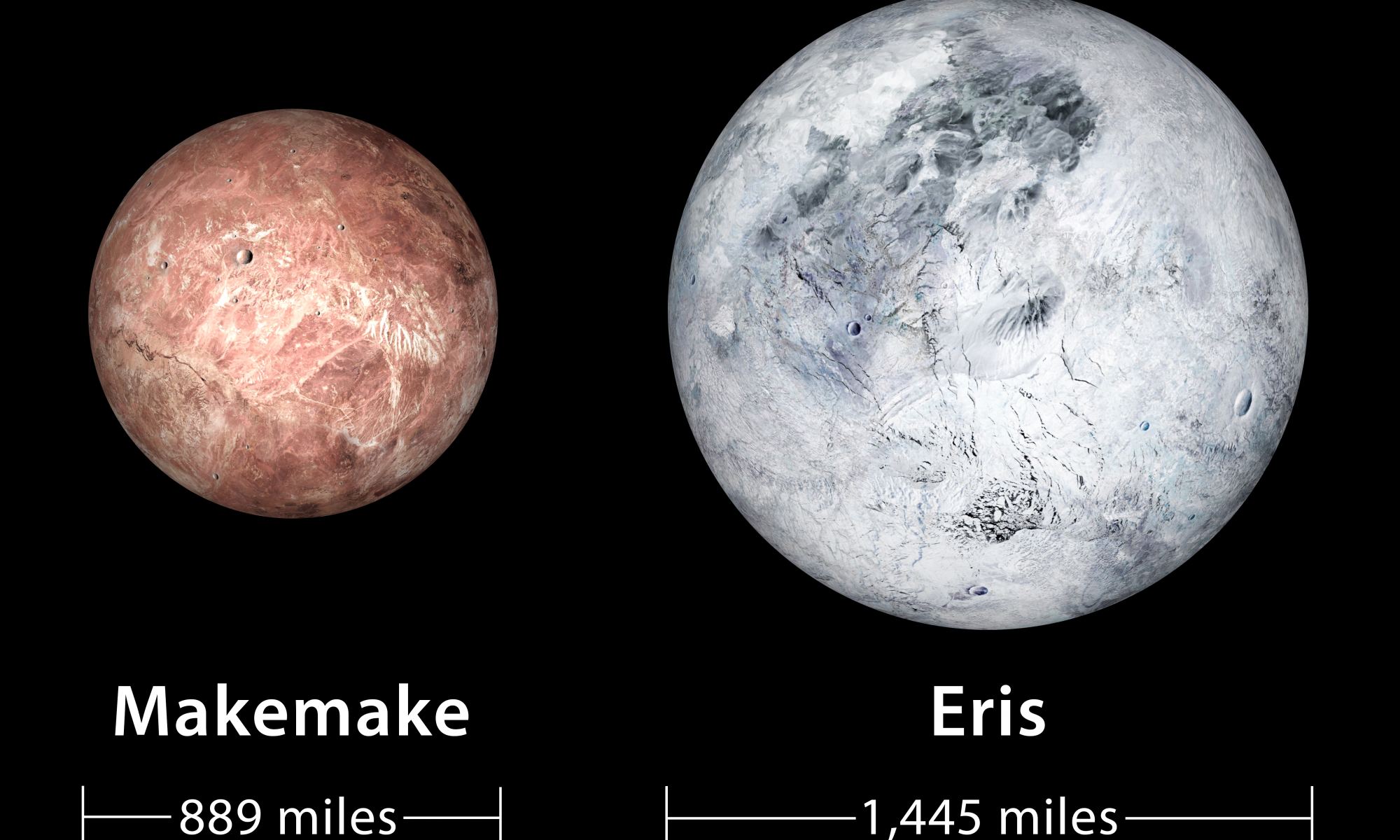
Illustration of the icy dwarf planets Eris and Makemake. Credit: Southwest Research Institute

Even Eris and Makemake Could Have Geothermal Activity

Whether or not you agree that Pluto isn’t a planet, in many ways, Pluto is quite different from the classical planets. It’s smaller than the Moon, has an elliptical orbit that brings it closer to the Sun than Neptune at times, and is part of a collection of icy bodies on the edge of our solar system. It was also thought to be a cold dead world until the flyby of New Horizons proved otherwise. The plucky little spacecraft showed us that Pluto was geologically active, with a thin atmosphere and mountains that rise above icy plains. Geologically, Pluto is more similar to Earth than the Moon, a fact that has led some to reconsider Pluto’s designation as a dwarf planet.

Astronomers still aren’t sure how Pluto has remained geologically active. Perhaps the gravitational interactions with its moon Charon, or perhaps interior radioactive decay. But regardless of the cause, the general thought has been that Pluto is an exception, not a rule. Other outer worlds of similar size and composition are likely dead worlds. But a new study shows that isn’t the case for at least two dwarf planets, Eris and Makemake.

This new study doesn’t rely on high-resolution images like we have for Pluto. Our current observations of Eris and Makemake show them only as small, blurry dots. But we do have spectral observations of these worlds, which is where this study comes in.

The team looked at the spectral lines of molecules on the surface of these worlds, most specifically that of methane. Methane, or CH4 has two important variants. One is composed of standard hydrogen atoms, while the other contains one or more atoms of a type of hydrogen known as deuterium. Deuterium has a nucleus containing a proton and neutron rather than just a proton, and this skews the spectrum of methane a bit. From the spectral observations, the team could measure the D/H ratio for methane on both worlds.

How D/H ratios compare to possible origins. Credit: Glein, et al

Thisratio is determined by the source of the methane. If Eris and Makemake are dead worlds, then the methane they have stems from their origin more than 4 billion years ago, and the D/H level should be on the higher end. On the other hand, if the surface methane was generated through an interior process and vented through active geological processes, then the D/H ratio should be lower. The team found that the ratio is most consistent with thermogenic and abiotic mechanisms, suggesting that both Eris and Makemake are active worlds, or at least were active in geologically recent times.

Eris is about the same size as Pluto, so it isn’t too surprising that it’s a geologically active world given what we now know about Pluto. But Makemake is much smaller, about 60% the size of Pluto. If Makemake is an active world, then it is likely that other dwarf planets such as Haumea are as well. If that’s the case, then most if not all dwarf planets are geologically active. As the authors suggest, it might be worth sending a probe or two to the outer worlds for more study.

Reference: 

{ https://www.universetoday.com/ }

Hoe vind je dit bericht?
Geschreven door peter om 20:33 Stuur door

Meer van UFO'S of UAP'S, ASTRONOMIE, RUIMTEVAART, ARCHEOLOGIE, OUDHEIDKUNDE, SF-SNUFJES EN ANDERE ESOTERISCHE WETENSCHAPPEN - DE ALLERLAATSTE NIEUWTJES

↑ Terug naar de berichten