Naar de inhoud

UFO'S of UAP'S, ASTRONOMIE, RUIMTEVAART, ARCHEOLOGIE, OUDHEIDKUNDE, SF-SNUFJES EN ANDERE ESOTERISCHE WETENSCHAPPEN - DE ALLERLAATSTE NIEUWTJES

UFO's of UAP'S in België en de rest van de wereld
akke.beakke.be
Ontdek de Fascinerende Wereld van UFO's en UAP's: Jouw Bron voor Onthullende Informatie! Ben jij ook gefascineerd door het onbekende? Wil je meer weten over UFO's en UAP's, niet alleen in België, maar over de hele wereld? Dan ben je op de juiste plek! België: Het Kloppend Hart van UFO-onderzoek In België is BUFON (Belgisch UFO-Netwerk) dé autoriteit op het gebied van UFO-onderzoek. Voor betrouwbare en objectieve informatie over deze intrigerende fenomenen, bezoek je zeker onze Facebook-pagina en deze blog. Maar dat is nog niet alles! Ontdek ook het Belgisch UFO-meldpunt en Caelestia, twee organisaties die diepgaand onderzoek verrichten, al zijn ze soms kritisch of sceptisch. Nederland: Een Schat aan Informatie Voor onze Nederlandse buren is er de schitterende website www.ufowijzer.nl, beheerd door Paul Harmans. Deze site biedt een schat aan informatie en artikelen die je niet wilt missen! Internationaal: MUFON - De Wereldwijde Autoriteit Neem ook een kijkje bij MUFON (Mutual UFO Network Inc.), een gerenommeerde Amerikaanse UFO-vereniging met afdelingen in de VS en wereldwijd. MUFON is toegewijd aan de wetenschappelijke en analytische studie van het UFO-fenomeen, en hun maandelijkse tijdschrift, The MUFON UFO-Journal, is een must-read voor elke UFO-enthousiasteling. Bezoek hun website op www.mufon.com voor meer informatie. Samenwerking en Toekomstvisie Sinds 1 februari 2020 is Pieter niet alleen ex-president van BUFON, maar ook de voormalige nationale directeur van MUFON in Vlaanderen en Nederland. Dit creëert een sterke samenwerking met de Franse MUFON Reseau MUFON/EUROP, wat ons in staat stelt om nog meer waardevolle inzichten te delen. Let op: Nepprofielen en Nieuwe Groeperingen Pas op voor een nieuwe groepering die zich ook BUFON noemt, maar geen enkele connectie heeft met onze gevestigde organisatie. Hoewel zij de naam geregistreerd hebben, kunnen ze het rijke verleden en de expertise van onze groep niet evenaren. We wensen hen veel succes, maar we blijven de autoriteit in UFO-onderzoek! Blijf Op De Hoogte! Wil jij de laatste nieuwtjes over UFO's, ruimtevaart, archeologie, en meer? Volg ons dan en duik samen met ons in de fascinerende wereld van het onbekende! Sluit je aan bij de gemeenschap van nieuwsgierige geesten die net als jij verlangen naar antwoorden en avonturen in de sterren! Heb je vragen of wil je meer weten? Aarzel dan niet om contact met ons op te nemen! Samen ontrafelen we het mysterie van de lucht en daarbuiten.

Archief

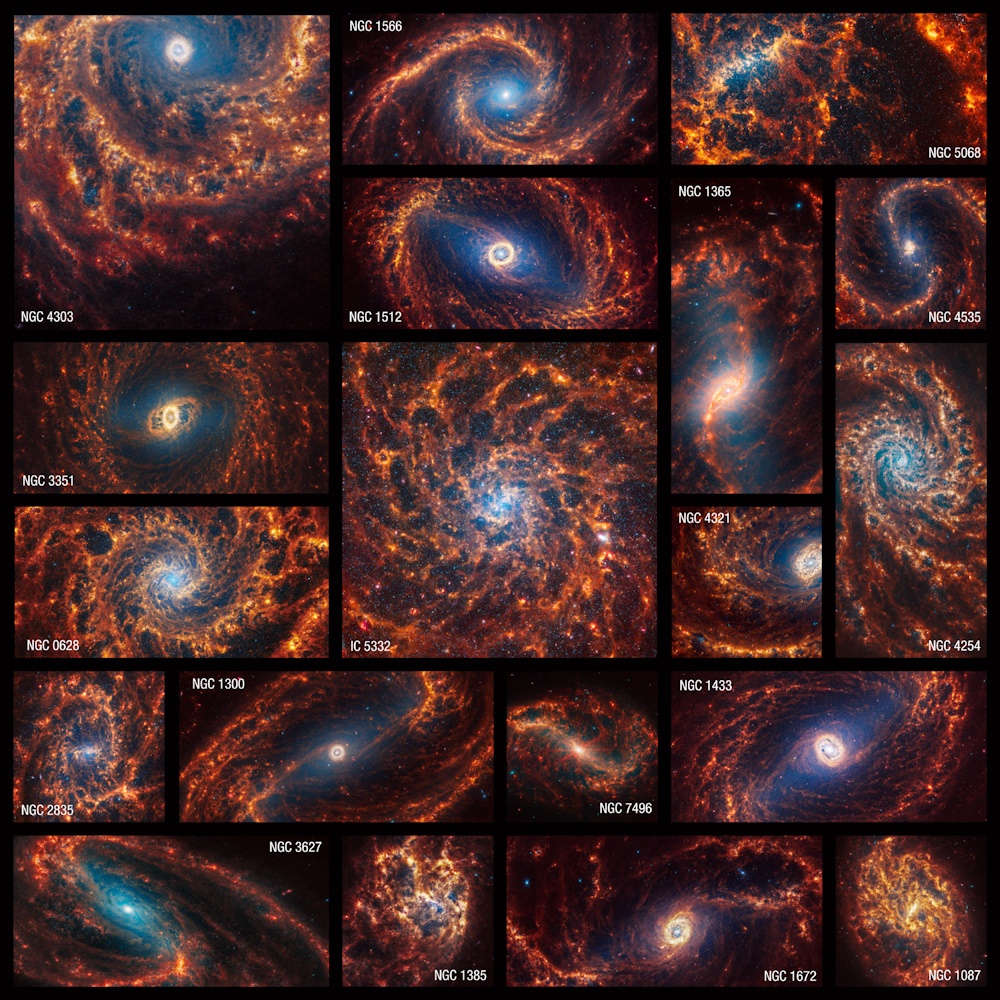
Feast Your Eyes on 19 Face-On Spiral Galaxies Seen by Webb

jan-29-24-STScI-01HM9N87VHDQAQC0EZCCCS6J9Q-1K.jpg

These Webb images are part of a large, long-standing project, the Physics at High Angular resolution in Nearby GalaxieS (PHANGS) program, which is supported by more than 150 astronomers worldwide. Before Webb took these images, PHANGS was already brimming with data from NASA’s Hubble Space Telescope, the Very Large Telescope’s Multi-Unit Spectroscopic Explorer, and the Atacama Large Millimeter/submillimeter Array, including observations in ultraviolet, visible, and radio light. Webb’s near- and mid-infrared contributions have provided several new puzzle pieces. Image Credit: NASA/ESA/CSA

Feast Your Eyes on 19 Face-On Spiral Galaxies Seen by Webb

If you’re fascinated by Nature, these images of spiral galaxies won’t help you escape your fascination.

These images show incredible detail in 19 spirals, imaged face-on by the JWST. The galactic arms with their multitudes of stars are lit up in infrared light, as are the dense galactic cores, where supermassive black holes reside.

The JWST captured these images as part of the Physics at High Angular resolution in Nearby GalaxieS (PHANGS) programme. PHANGS is a long-running program aimed at understanding how gas and star formation interact with galactic structure and evolution. One of Webb’s four primary science goals is to study how galaxies form and evolve, and the PHANGS program feeds that effort. The VLT, ALMA, the Hubble, and now the JWST have all contributed to it.

But Webb’s images are the juiciest.

“Webb’s new images are extraordinary. They’re mind-blowing even for researchers who have studied these same galaxies for decades.”

Janice Lee, Project Scientists, Space Telescope Science Institute.

The JWST can see in both near-infrared (NIR) and mid-infrared (MIR) light. That means it reveals different details, and more details, than even the powerful Hubble Space Telescope, which operates in visible light, UV light, and a small portion of infrared light.

This is NGC 4254 (Messier 99), a spiral galaxy about 50 million light-years away. It has a peculiarity to it, as one spiral arm is normal looking, and one is extended and less tightly wound. Though not a starburst galaxy, it forms stars three times as fast as other similar galaxies. This rapid star formation rate may have been triggered by interaction with another galaxy about 280 million years ago. With the JWST’s help, the PHANGS program will help astronomers understand NGC 4254’s history. Image Credit: NASA, ESA, CSA, STScI, Janice Lee (STScI), Thomas Williams (Oxford), PHANGS Team

In these JWST high-resolution images, the red colour is gas and dust emitting infrared light, which the JWST excels at seeing. Some of the images have bright diffraction spikes in the galactic center, which are caused by an enormous amount of light. That can indicate that a supermassive black hole is active, or it could be from an extremely high concentration of stars.

“That’s a clear sign that there may be an active supermassive black hole,” said Eva Schinnerer, a staff scientist at the Max Planck Institute for Astronomy in Heidelberg, Germany. “Or, the star clusters toward the center are so bright that they have saturated that area of the image.”

The diffraction spike in the center of NGC 1365 is a telescope artifact caused by an enormous amount of light in a compact region. It's caused by either the active supermassive black hole or tightly grouped stars in the galactic centre. NGC 1365 is a double-barred spiral galaxy about 74 million light-years away. Image Credit: NASA, ESA, CSA, STScI, Janice Lee (STScI), Thomas Williams (Oxford), PHANGS Team The diffraction spike in the center of NGC 1365 is a telescope artifact caused by an enormous amount of light in a compact region. It’s caused by either the active supermassive black hole or tightly grouped stars in the galactic centre. NGC 1365 is a double-barred spiral galaxy about 74 million light-years away. Image Credit: NASA, ESA, CSA, STScI, Janice Lee (STScI), Thomas Williams (Oxford), PHANGS Team

Stars near a galaxy’s center are typically much older than stars in the arms. The further a star is from the galactic center, the younger it typically is. The younger stars appear blue and have blown away the cocoon of gas and dust that they spawned in.

This is NGC 2835, a spiral galaxy about 35 million light-years away that has four or five spiral arms. Blue dots are very young stars that have blown away nearby gas and dust with their powerful UV light. Orange/red clumps are where even younger stars reside. They're still surrounded by gas and dust. Several background galaxies are visible in the image. Image Credit: NASA, ESA, CSA, STScI, Janice Lee (STScI), Thomas Williams (Oxford), PHANGS Team This is NGC 2835, a spiral galaxy about 35 million light-years away that has four or five spiral arms. Blue dots are very young stars that have blown away nearby gas and dust with their powerful UV light. Orange/red clumps are where even younger stars reside. They’re still surrounded by gas and dust. Several background galaxies are visible in the image. Image Credit: NASA, ESA, CSA, STScI, Janice Lee (STScI), Thomas Williams (Oxford), PHANGS Team

Orange clumps indicate even younger stars. They’re still wrapped in their blanket of gas and dust and are still actively accreting material and forming. “These are where we can find the newest, most massive stars in the galaxies,” said Erik Rosolowsky, a professor of physics at the University of Alberta in Edmonton, Canada.

The new images were released alongside some of the Hubble’s views of the same galaxies. These highlight how observing different wavelengths of light reveals or obscures different details in the galaxies. In the PHANGS observing program, different telescopes have observed galaxies in visible light, infrared light, UV light, and radio.

A Hubble Space Telescope image of NGC 628 (left) and the same galaxy as imaged by the JWST (right.) Both images are grand and inspiring and full of information, but the JWST image provides more detail. Large bubble-shaped gaps between concentrations of gas and dust are visible. In some of the images, those could be caused by supernovae. Image Credit: NASA, ESA, CSA, STScI, Janice Lee (STScI), Thomas Williams (Oxford), PHANGS Team A Hubble Space Telescope image of NGC 628 (left) and the same galaxy as imaged by the JWST (right.) Both images are grand and inspiring and full of information, but the JWST image provides more detail. Large bubble-shaped gaps between concentrations of gas and dust are visible. In some of the images, those could be caused by supernovae. Image Credit: NASA, ESA, CSA, STScI, Janice Lee (STScI), Thomas Williams (Oxford), PHANGS Team

Since the human eye can’t see infrared, different visible colours are assigned to different wavelengths of light in order to make the images meaningful. In the JWST image of NGC 628 above, the galaxy’s center is filled with old stars that emit some of the shortest wavelengths of light the telescope can detect. They’ve been given a blue colour to make them visible. In the Hubble image, the same region is more yellow and washed out. The region emits the longest wavelengths of light that the Hubble can sense, so it has different colour assignments than the JWST.

Janice Lee is a project scientist at the Space Telescope Science Institute in Baltimore. She spoke for all of us when she said, “Webb’s new images are extraordinary. They’re mind-blowing even for researchers who have studied these same galaxies for decades. Bubbles and filaments are resolved down to the smallest scales ever observed and tell a story about the star formation cycle.”

This is NGC 1672, a spiral galaxy about 60 million light-years away. It may be a type II Seyfert galaxy, though astronomers aren't totally certain. It has both a bright nucleus and a surrounding starburst region. Image Credit: NASA, ESA, CSA, STScI, Janice Lee (STScI), Thomas Williams (Oxford), PHANGS Team This is NGC 1672, a spiral galaxy about 60 million light-years away. It may be a type II Seyfert galaxy, though astronomers aren’t totally certain. It has both a bright nucleus and a surrounding starburst region. Image Credit: NASA, ESA, CSA, STScI, Janice Lee (STScI), Thomas Williams (Oxford), PHANGS Team

These galaxies are all spiral galaxies like the Milky Way, meaning their massive arms define them. The spiral arms are more like waves that travel through space rather than individual stars moving collectively. Astronomers study the arms because they can provide key insights into how galaxies build, maintain, and shut off star formation. “These structures tend to follow the same pattern in certain parts of the galaxies,” Rosolowsky added. “We think of these like waves, and their spacing tells us a lot about how a galaxy distributes its gas and dust.”

The spiral galaxy NGC 1566 is about 60 million light-years away in the constellation Dorado. NGC is interacting with smaller member galaxies in its neighbourhood. It's an active galaxy, meaning its nucleus emits a lot of light that doesn't come from stars. Instead, it probably comes from the supermassive black hole at the center. NGC 1566 is extensively studied due to its proximity, orientation, its strong spiral arms and its active galactic nucleus. Image Credit: NASA, ESA, CSA, STScI, Janice Lee (STScI), Thomas Williams (Oxford), and the PHANGS team The spiral galaxy NGC 1566 is about 60 million light-years away in the constellation Dorado. NGC is interacting with smaller member galaxies in its neighbourhood. It’s an active galaxy, meaning its nucleus emits a lot of light that doesn’t come from stars. Instead, it probably comes from the supermassive black hole at the center. NGC 1566 is extensively studied due to its proximity, orientation, its strong spiral arms and its active galactic nucleus. Image Credit: NASA, ESA, CSA, STScI, Janice Lee (STScI), Thomas Williams (Oxford), and the PHANGS team

Ever since it began science operations, the JWST has given astronomers an overwhelming flow of data that will fuel research for years and decades to come. These beautiful images are just a part of a larger data release that includes a catalogue of about 100,000 star clusters. “The amount of analysis that can be done with these images is vastly larger than anything our team could possibly handle,” said the University of Alberta’s Erik Rosolowsky. “We’re excited to support the community so all researchers can contribute.”

{ https://www.universetoday.com/ }

Hoe vind je dit bericht?
Geschreven door peter om 23:38 Stuur door

ARE SIGHTING CAPTURED IN PHOTOS REVEALS AN OCEAN ‘MONSTER’ YOU’VE NEVER SEEN LIKE THIS

lGqlFxoG?format=jpg&name=900x900

(Unsplash

ARE SIGHTING CAPTURED IN PHOTOS REVEALS AN OCEAN ‘MONSTER’ YOU’VE NEVER SEEN LIKE THIS

In the summer of 2023, Carlos Guana, a wildlife filmmaker and storyteller, and Phillip Sternes, a biology doctoral student at the University of California Riverside, set out on an expedition off the central coast of California to film great white sharks and other wildlife in the Pacific waters near Santa Barbara.

On July 9, 2023, while operating his Mavic 3 Pro aerial drone approximately a quarter mile off the coast of Carpinteria, California, Guana spotted something striking and beautiful moving beneath the ocean surface.

Although the creature was familiar in appearance—a small, almost ghostly pale white shark—neither Guana nor Sternes immediately recognized what the drone’s camera had managed to capture at the time.

It wasn’t until later while rewatching the footage that they noticed something odd about the shark’s appearance.

“Upon close examination of video and photos, the individual’s pale color appears to be a thin white film covering the shark,” Guana and Sternes would later write. “We noted that as the shark was swimming, the whitish film was being sloughed off.”

great white

The infant great white shark Sternes and Gauna observed, as seen from the front

(Carlos Gauna/The Malibu Artist).

Although it seemed possible that the unusual film might have been caused by some kind of skin disorder that neither of the observers recognized, nor could it be found in the available literature on white sharks, a more likely possibility soon presented itself: this might be the remains of intrauterine material left over from the creature’s seemingly very recent birth.

If the latter were true, it would be an unprecedented sighting, given that what Guana and Sternes had filmed was likely a baby great white shark and the first of its kind ever captured on film.

“We enlarged the images, put them in slow motion, and realized the white layer was being shed from the body as it was swimming,” Sternes said in a recent statement about their discovery.

Now, their discovery has been reported in a new paper that appeared in the Environmental Biology of Fishes journal.

Great whites are among the most famous shark species, partially due to their famous, monstrous depiction in films like Jaws. Despite the attention the species has received, many things about them remain mysterious to ocean scientists.

Guana, who is known online as The Malibu Artist, has filmed these and other species of sharks in locations all over the world, documenting an impressive amount of footage of the creatures where they are often shown swimming frighteningly close to beachgoers.

His footage of these enigmatic ocean predators has racked up millions of views online, but the new images could offer scientists new clues about one of the most perplexing mysteries involving great white sharks.

“Where white sharks give birth is one of the holy grails of shark science,” Guana said in a statement. “No one has ever been able to pinpoint where they are born, nor has anyone seen a newborn baby shark alive.”

“There have been dead white sharks found inside deceased pregnant mothers,” Guana says, “But nothing like this.”

great white

The suspected newborn great white shark, observed from the side

(Carlos Gauna/The Malibu Artist).

Like mammals, young great sharks are born live, and it is believed that they might feed on unfertilized eggs while still in the embryonic stage, along with a milky substance secreted within the uterus of the mother that provides additional nourishment.

It is the remnants of this intrauterine milk that Sternes and Guana believe they observed on the shark they filmed last July.

Other key observations also point to the likelihood that what they filmed represents the first imagery of a baby great white shark. While filming in the area, the pair observed several very large—and potentially pregnant—female great whites nearby.

By comparison, the small shark they captured in imagery with Guana’s drone is very small, and its appearance and behavior both suggest a very young creature—perhaps as little as a day, or even just a few hours old.

Also of interest is that the coastal waters of central California had already been put forward in the past as a potential birthing location for great whites. Hence, the pup that Guana and Sternes observed was in the right place, and at the right time, to be a likely match for a newborn great white.

White sharks are a protected species, although Guana and Sternes note in their paper that fishermen do sometimes inadvertently catch these sharks, some of which may die resulting from stress or injuries.

If the central California coast is indeed a breeding ground for white sharks, as opposed to waters much further offshore, as some past studies have suggested, then a greater level of management may be required to help ensure the conservation of the species and their habitat.

Ultimately, Guana and Sternes write that their aerial drone footage “has provided shark science with another interesting set of information,” adding that “future drone observations of sharks in this area will greatly improve our knowledge and understanding of white shark life history.”

Their recent paper, “Novel aerial observations of a possible newborn white shark (Carcharodon carcharias) in Southern California,” can be read online here, along with additional imagery of the white shark they observed in July 2023.

{ https://thedebrief.org/category/science/ }

Hoe vind je dit bericht?
Geschreven door peter om 22:37 Stuur door

There Is 9-Min Video of Biden & Podesta Meeting Aliens; Head of Top Alien-Tech Firm to Testify Soon, Claims UFO Researcher

There Is 9-Min Video of Biden & Podesta Meeting Aliens; Head of Top ...

There Is 9-Min Video of Biden & Podesta Meeting Aliens; Head of Top Alien-Tech Firm to Testify Soon, Claims UFO Researcher

By Vicky Verma

It seems like the waiting time is over, UFO disclosure is imminent. There is growing skepticism and indifference towards whistleblower David Grusch’s claims that the US federal government has hidden information about recovered extraterrestrial spacecraft from Congress. Republican leaders have dismissed potential witnesses, and NASA officials have reportedly withdrawn from an upcoming hearing on UFOs.

However, two Republican lawmakers leading the investigation still intend to hold a public hearing on July 26. US Representative Anna Paulina Luna confirms the hearing date and mentions that the names of witnesses will be released a week before the event.

Luna and Rep. Tim Burchett are facing pressure from the Pentagon and NASA after announcing their investigation into UFOs (also known as UAPs). NASA has stopped cooperating with the investigation, leading to speculation of a cover-up. Despite the challenges, Luna and Burchett remain determined to hold the hearing and promise an impressive lineup of witnesses. If necessary, Burchett is even willing to hold a field hearing in his own front yard. The hearing is scheduled for the last week of July before Congress goes on recess in August.

Meanwhile, Steve Sprague, a UFO researcher who studied the UAP phenomenon for 30 years, claimed that an aerospace executive would come forward and share the information during the upcoming Congressional Hearing on UAPs. This unidentified insider is described as a C-level executive within the United States-based company which, according to Sprague, is a top firm reverse-engineering alien technology. (Source)

“Let me say this unequivocally, without ambiguity, in no uncertain terms, we are not alone, aliens not only exist but have been here for five millennia, if not considerably longer, they are not friendly and humanity is absolutely in danger,” writes Steve Sprague.

According to the insider, aliens not only exist but have been present on Earth for at least five millennia, if not longer. Startlingly, the individual revealed the existence of at least two civilizations currently residing on our planet: humans and a group known as the “Ganzi,” originating from a distant part of our galaxy, roughly forty light years away. The Ganzi are characterized as technologically advanced beings who possess knowledge far surpassing humanity’s capabilities.

One of the most chilling aspects of the disclosure centered around Ganzi’s technological superiority. The insider explained that the technology recovered and possessed by humans is composed of terrestrial components manipulated in a manner that exceeds human understanding. These materials, created by alien processes, involve elements and physics beyond our comprehension. The Ganzi, however, refuse to share their technology with humanity, fearing the dire consequences of us wielding power beyond our current evolutionary stage.

The insider emphasized the vast technological gap between humans and the Ganzi, stating that they are millions of years ahead of us. They warned that humanity’s very existence could be threatened without the proper knowledge to manipulate these advanced materials. Humans were compared to protozoa on the technological scale, highlighting how far we have yet to evolve.

Read also:

Disturbingly, the insider also shared incidents involving encounters with the Ganzi. One notable event involved the disintegration of an F-15 fighter jet by a particle beam technology wielded by extraterrestrial beings. The astonishing video evidence showcased a green beam hitting the side of the aircraft, which subsequently turned to ash without leaving any debris. Further analysis of the footage revealed the presence of extraterrestrial occupants, commonly referred to as Greys, characterized by their small bodies, large heads, and prominent eyes.

While the Ganzi were not described as inherently malevolent, they view humanity as an annoyance, akin to flies. However, the insider cautioned that provoking or interfering with their mission could lead to dire consequences. Reports of lost pilots and destroyed ships in encounters with the Ganzi underscore the potential dangers of crossing paths with these technologically advanced beings.

These shocking revelations come as anticipation mounts for the upcoming Congressional Hearing on UAPs. The insider has promised to come forward and share their information with the public during the event, which is expected to shed further light on the existence of extraterrestrial life and the presence of UFOs.

Sprague writes that the insider revealed to him that the Ganzi can manipulate matter in ways beyond human comprehension. They have a deep understanding of DNA manipulation, enabling them to increase lifespans indefinitely and cure or prevent diseases. It is even speculated that they have experimented on humans, possibly for reasons such as galactic war or slave labor.

Perhaps one of the most chilling revelations shared by the insider relates to nuclear power. They stated unequivocally that the Ganzi vehemently oppose humanity’s use of nuclear weapons. Any attempt to engage in large-scale nuclear conflict would be met with severe consequences, potentially leading to a complete shutdown of human society. The Ganzi have made it clear that they will not tolerate actions that could jeopardize the Earth or their larger objectives.

Moreover, the insider highlighted Ganzi’s superior abilities in manipulating higher dimensions, allowing them to be present anywhere at any time. They operate within the framework of Multi-Dimensional Theory and Brane Theory, concepts that challenge human understanding. This exceptional capability to navigate dimensions and remain undetected unless desired adds a layer of intrigue to the extraterrestrial presence on Earth.

The insider also touched upon significant presidential briefings that have taken place, shedding light on the United States government’s awareness of these developments. On various occasions, President Biden was reportedly briefed on advanced technologies recovered from the Ganzi. The briefings included demonstrations of lasers capable of remarkable feats, such as extracting elements directly from ore and analyzing biological and geological data.

Videos of these briefings purportedly exist, with one showing Biden interacting with three Ganzi beings through a small device placed in his ear. Notably, one of the individuals accompanying the beings was John Podesta, who later assumed the role of Senior Advisor for Clean Energy Innovation. The insider also linked breakthroughs in fusion energy and laser technology to the company’s efforts in reverse-engineering Ganzi technology.

In response to the question of why he was chosen by the insider, Sprague admitted uncertainty but speculated that a mutual friend with military and intelligence background may have facilitated the connection. He highlighted the importance of trust and the fact that he was seen as an outsider to the intelligence and journalistic spheres. Sprague acknowledged that his role in this situation may be that of a blunt instrument serving a specific goal. (Source)

Sprague mentions that his source is currently not in their home state and may or may not testify in front of cameras during the hearings. The source’s identity and their potential employment with a defense contractor remain undisclosed to protect their livelihood and family from potential fallout. However, Sprague asserts that if the hearings do not take place or the source cannot testify publicly, the information he received will still be released, leaving it out of his hands and independent of his involvement.

Sprague dismisses any connection between his information and a post on 4chan, asserting that he had never visited the platform before and had no intention of doing so in the future. He clarifies differences between the accounts, such as the claim of first-hand dealings with the craft, which he states his source did not mention. Regarding the element discussed by Bob Lazar, Sprague mentions that his source considered it pure trash and explained that the craft operated using a theoretical field similar to an Einstein-Rosen bridge or wormhole.

Sprague mentions his need for at least two more parts to cover additional topics, including the F-15 incident and post-disclosure scenarios. He expresses exhaustion after a busy day and indicates that he will engage with readers on Twitter the following day.

{ https://www.howandwhys.com/ }

Hoe vind je dit bericht?
Geschreven door peter om 22:20 Stuur door

There is DVD of US Intelligence Members Communicating with Extraterrestrials, Former US Military Claims

Intelligence Community and Aliens

There is DVD of US Intelligence Members Communicating with Extraterrestrials, Former US Military Claims

Former US intelligence officer David Grusch testified before Congress during the July 2023 UAP hearing, stating that we have numerous spacecraft of non-human origin. If this is the case, one might wonder if any contact has been established between humans and these extraterrestrial species. There have been persistent rumors suggesting that the US government may have signed treaties with these extraterrestrials and has been engaged in collaborative efforts with them over an extended period.

According to a rather extraordinary claim made by former US government consultant Timothy Good, it is alleged that the 34th President of the United States, Dwight D. Eisenhower, had three clandestine meetings with extraterrestrials. Good claimed Eisenhower met aliens at a remote air base in New Mexico in 1954. In more recent times, former Israeli Space Head Haim Eshed stated that aliens and the U.S. government had reached some type of deal to stay quiet about their experiments on Earth and secret facilities on Mars. Eshed went on to claim the existence of a “Galactic Federation” and implied that then-President Trump was on the brink of making significant revelations in this regard.

Video Evidence

During a podcast with former Fox News anchor Clayton Morris on his show Redacted, Joshua Reid, a former United States Navy serviceman with a background in missile weapons defense systems, brought a wealth of knowledge and experience to the table. He opened the conversation by referencing his personal experiences in the Navy, specifically during the years 2004 to 2006. Reid’s background made him intimately familiar with topics related to secret space projects, a subject that has piqued his interest for over two and a half decades.

It is worth noting that Joshua Reid’s extensive research in the field of UAPs and classified information has led him to the inner workings of certain government activities. His extensive four-year investigation revealed a disconcerting pattern. It appeared that military technology, particularly in special access programs, was unintentionally making its way to foreign adversaries, including China. This exchange of classified information seemed to involve universities and professors who were receiving grants to reverse engineer technologies from these programs.

The remarkable twist in this story was that Hillary Clinton’s emails were potentially facilitating the sale of this classified information to China and other foreign entities. China would fund universities, enticing professors to divulge information on special access programs. This enabled them to advance their technology rapidly, potentially reaching parity with the United States.

Former Inspector General I. Charles McCullough III, well-versed in these special access programs, played a crucial role in this unfolding drama. He represented David Grusch and became a central figure in the whistleblower saga. According to Reid, multiple whistleblowers were involved, with two possessing firsthand information and tangible evidence. The fear of repercussions led these individuals to testify in front of congressmen, notably, Indiana Congressman André Carson. However, it was not until these whistleblowers presented video evidence of intelligence community members communicating with extraterrestrials that congressmen took their claims seriously.

The impact of these videos was profound. Congressmen were visibly shaken, with one trembling and another drinking water profusely. This sudden shift in demeanor signified that the evidence was both extraordinary and unsettling. The whistleblowers were introduced to Inspector General McCullough, who had an extensive background in the very special access programs at the center of the controversy.

“I’ve heard that we can confirm this later, but from what I’m hearing, André Carson is this Congressman that they testified in front of, along with a few others. The Congressman didn’t take these guys seriously, but what ended up happening is they pulled out the evidence, a DVD, and they showed these congressmen video evidence of intelligence community members communicating with extraterrestrials. After these videos were shown to congressmen, they were noticeably shaken in fear. One of them was holding a piece of paper and could not stop shaking. Another was drinking water profusely, and this is when they began to take this very, very seriously and introduce these gentlemen to the former Inspector General of the Intelligence Community, McCullough. Hence, he enters the picture as someone who understands these SAP programs, has been read into these programs from back in the day, and is now representing these gentlemen.”

Morris was eager to learn more about the DVDs and the physical evidence related to the astounding claims made by the whistleblowers. He posed the question of where this evidence was currently held and whether the public would ever have the opportunity to view it.

Joshua Reid responded by revealing that the evidence, in the form of DVDs and other materials, was regarded as an “insurance policy.” This meant that the evidence was securely in the hands of two prominent UFO researchers. Furthermore, Reid confirmed that these researchers had not only seen the evidence but also verified its authenticity, which was a significant factor contributing to the growing interest in this matter.

Morris was eager to learn more about the DVDs and the physical evidence related to the astounding claims made by the whistleblowers. He asked Reid where this evidence was currently held and whether the public would ever have the opportunity to view it.

Joshua Reid responded by revealing that the evidence, in the form of DVDs and other materials, was regarded as an “insurance policy.” This meant that the evidence was securely in the hands of two prominent UFO researchers. Furthermore, Reid confirmed that these researchers had not only seen the evidence but also verified its authenticity, which was a significant factor contributing to the growing interest in this matter.

One of the prominent UFO researchers who has been sharing insider knowledge on UAPs is investigative journalist Ross Coulthart. It is quite uncertain if Coulthart possesses this DVD evidence but he did reveal that there exists a huge UFO in the possession of the United States that cannot be moved, and he knows the location of the craft. Ross mentioned the existence of non-human intelligence engaging with Earth for a long time and the recovery of certain objects, but he could not disclose specific details due to concerns about revealing advanced technologies.

Read also:

In a recent episode of “The UFO Podcast,” host Andy engaged in a thought-provoking conversation with Ross. The discussion centered around the secrecy surrounding UFO sightings and government knowledge. Ross, who has deep insights into the matter, shared his perspective on why certain details remain undisclosed.

Andy began by addressing a critical question that has been on the minds of many UFO enthusiasts: the location of the mysterious craft. He asked Ross whether he could reveal where the craft was being held.

Ross responded: “Let me tell you, I can’t tell you the country it’s in; it’s not America. But what I can tell you is that the place where it is kept is used for another purpose that is a laudatory purpose that’s as much in your interests in your country in the UK as it is in mine in Australia and as it is in America. The simple reasons are that there are other uses for the place where this object is stored, and we could end up with a storm Area 51-type scenario if you came out and announced it.”

Ross went on to explain the potential consequences of revealing such information, including international incidents and threats to the safety of personnel at the facilities. He also emphasized the importance of protecting sources, drawing on his experience as a journalist dealing with sensitive intelligence.

Interestingly, Steve Sprague, a UFO researcher who studied the UAP phenomenon for 30 years, claimed that an aerospace executive would come forward and share the information during the July 2023 Congressional Hearing on UAPs. This unidentified insider is described as a C-level executive within the United States-based company, which, according to Sprague, is a top firm reverse-engineering alien technology.

According to the insider, aliens not only exist but have been present on Earth for at least five millennia, if not longer. Startlingly, the individual revealed the existence of at least two civilizations currently residing on our planet: humans and a group known as the “Ganzi,” originating from a distant part of our galaxy, roughly forty light years away. The Ganzi are characterized as technologically advanced beings who possess knowledge far surpassing humanity’s capabilities.

The insider also touched upon significant presidential briefings that have taken place, shedding light on the United States government’s awareness of these developments. On various occasions, President Biden was reportedly briefed on advanced technologies recovered from the Ganzi. The briefings included demonstrations of lasers capable of remarkable feats, such as extracting elements directly from ore and analyzing biological and geological data.

Videos of these briefings purportedly exist, with one showing Biden interacting with three Ganzi beings through a small device placed in his ear. Notably, one of the individuals accompanying the beings was John Podesta, who later assumed the role of Senior Advisor for Clean Energy Innovation. The insider also linked breakthroughs in fusion energy and laser technology to the company’s efforts in reverse-engineering Ganzi technology.

Sprague wrote, “Date 4 – May 19, 2022, Biden is now in Alaska and stopped off to refuel at Joint Base Elmendorf-Richardson. This video is the most incredible of all. Biden meets with three of the Ganzi. Biden puts a small device in his ear and a conversation occurs without sound. The video lasts for nine minutes and then four people enter the area. One of the people is John Podesta. The other three are unknown. The beings leave and the video ends. In September of 2022, Biden names Podesta as the Senior Advisor for Clean Energy Innovation. December 14, 2022, America has a breakthrough in fusion. To achieve this scientific feat – a laser is used. This laser has ‘unique’ properties.” (Source)

Sprague’s claims cannot be verified; however, it is certain that there exists an alien craft, and the United States has successfully accessed its interior. Dr. James Lacatski, a retired DIA intelligence officer who established the UFO program that operated from 2008 to 2010, has confirmed this. He stated that the craft possesses a streamlined configuration suitable for aerodynamic flight but lacks conventional features such as an engine, wings, intakes, exhaust, or fuel tanks.

{ https://www.howandwhys.com/ }

Hoe vind je dit bericht?
Geschreven door peter om 21:56 Stuur door

An In-Depth Look into The Pentagon UFO Files

An In-Depth Look into The Pentagon UFO Files

Pentagon UFO Files

For decades, the subject of Unidentified Flying Objects (UFOs) has captivated the imagination of the public and researchers alike. This fascination reached a new height with the recent disclosure of The Pentagon UFO Files, a collection of information and evidence gathered by the US government. These files, long shrouded in secrecy, offer a rare glimpse into the government’s perspective on what could be one of the most profound discoveries in human history – the existence of unidentified aerial phenomena (UAP) and their implications for humanity.

The Revelation: 

After years of speculation and secrecy, the US government’s acknowledgment of these files marks a significant shift in the discourse surrounding UFOs. The files contain detailed accounts of encounters, expert analyses, and, perhaps most intriguingly, military confirmations of unexplainable aerial phenomena. This disclosure not only challenges our understanding of the skies above but also raises important questions about the nature of these phenomena and their potential impact on national security.

Analysis and Expert Opinions: 

The Pentagon UFO Files encompass a range of sightings and encounters, some dating back several decades. These incidents, often involving highly credible military personnel, display characteristics that defy current technological and scientific understanding. The speeds and maneuverabilities of these UAPs, as observed and recorded, go beyond the capabilities of known human-made aircraft.

Experts from both scientific and military backgrounds have been analyzing these cases, looking for plausible explanations. In some instances, natural phenomena or misidentifications of conventional objects like aircraft and weather balloons were determined to be the cause. However, a significant portion of these sightings remains unexplained, fueling theories about their potentially extraterrestrial or interdimensional origins.

The Role of Government Secrecy and Public Perception: 

The revelation of The Pentagon UFO Files has also brought to light the complex relationship between government secrecy and public knowledge. For decades, projects like Project Blue Book, Project Grudge, and others under the Department of Defense conducted investigations into UFO sightings. These projects, often criticized for their lack of transparency, have contributed to widespread skepticism and conspiracy theories.

The recent disclosure, while groundbreaking, has not been without its critics. Some argue that the released information is still heavily curated, raising questions about what might still be withheld and why. This ongoing secrecy perpetuates public distrust and speculation about the government’s true knowledge of UFOs and their implications.

The Future of UFO Research: 

The Pentagon UFO Files have reignited interest in UFO research, not just within conspiracy circles but also among mainstream scientists and academics. This renewed focus could potentially lead to more systematic and open investigations into UAPs. It also underscores the need for international collaboration and transparency in studying these phenomena, as UFO sightings are a global occurrence with implications that transcend national borders.

VIDEO:

  • The Pentagon UFO Files (FULL DOCUMENTARY) UAO, USA GOVERNMENT, USA MILITARY

The release of The Pentagon UFO Files marks a new era in our quest to understand the unexplained phenomena in our skies. It challenges us to reconsider our place in the universe and invites us to explore possibilities that were once relegated to science fiction. While many questions remain unanswered, one thing is clear: the pursuit of knowledge about UAPs is more important than ever, promising to unlock mysteries that could redefine our understanding of the world and potentially, the cosmos.

{ https://www.latest-ufo-sightings.net/ }

Hoe vind je dit bericht?
Geschreven door peter om 21:30 Stuur door

De ontdekking van Nag Hammadi: zijn dit de verloren boeken van de Bijbel?

De ontdekking van Nag Hammadi: zijn dit de verloren boeken van de Bijbel?

De ontdekking van Nag Hammadi: zijn dit de verloren boeken van de Bijbel?

©iStock

De ontdekking van Nag Hammadi: zijn dit de verloren boeken van de Bijbel?
Ruim zeventig jaar geleden werden in Nag Hammadi, Egypte, verschillende gnostische teksten ontdekt. Deze galerij duikt in de geschiedenis van deze oude boeken en de controverse die hen omringt.

Zouden dit werkelijk de ontbrekende boeken van de Bijbel kunnen zijn? Kijk naar de foto's om erachter te komen.

Wat en wanneer

©iStock

Wat en wanneer
De gnostische evangeliën bestaan ​​uit 52 teksten die in 1945 in Egypte werden ontdekt. ​​Deze teksten werden op papyrus geschreven en verzameld in 13 oude boeken die codices worden genoemd. Ze werden in december 1945 opgegraven door Muhammad 'Ali al-Samman, een Arabische boer, in een begraven pot.

Wat is er met de boeken gebeurd?

©iStock

Wat is er met de boeken gebeurd?
De boeken werden later illegaal verkocht in Caïro. Ondanks de inbeslagname van de meeste boeken door de Egyptische regering, werd één enkele codex discreet uit Egypte getransporteerd en uiteindelijk zijn weg naar Europa gevonden.

Waar staan ​​de teksten nu?

©iStock

Waar staan ​​de teksten nu?
De originele teksten zijn momenteel ondergebracht in het Koptisch Museum in Caïro onder de identificatie NHC (Nag Hammadi Codices).

Gnostici en gnosticisme

©Shutterstock

Gnostici en gnosticisme
De term ‘gnostisch’ is afgeleid van het Griekse woord ‘gnosis’, wat ‘kennis’ betekent. Gnostici hielden vast aan het geloof dat ze verborgen kennis bezaten over God en het goddelijke, vandaar hun naam. Ze hadden verschillende perspectieven op Jezus en zijn leringen. Helaas werden veel van hun teksten uitgeroeid, omdat ze door de vroege kerk als ketters werden bestempeld.

Gnostici en gnosticisme

©iStock

Gnostici en gnosticisme
De gnostici waren geen georganiseerde afzonderlijke religie, maar bestonden in plaats daarvan uit verschillende religieuze en filosofische stromingen die bloeiden van de 2e tot de 4e eeuw na Christus.

Gnostische overtuigingen

©iStock

Gnostische overtuigingen
Gnostici waren van mening dat de materiële wereld slecht was en de spirituele wereld deugdzaam. Explore God legt uit dat gnostici mensen zagen als 'goede geesten die gevangen zaten in kwaadaardige materiële lichamen'.

Hoe zagen gnostici God?

©iStock

Hoe zagen gnostici God?
Gnostici hielden vast aan hun geloof in een Oppergod, transcendent en onbegrijpelijk. Bovendien waren ze van mening dat een mindere God, bekend als Demiurg, en niet de Oppergod, verantwoordelijk was voor de schepping van het universum.

Wat was de gnostische perceptie van Jezus?

©iStock

Wat was de gnostische perceptie van Jezus?
Volgens de gnostici werd Jezus beschouwd als de ‘Verlosser’ wiens doel het was om de waarheid aan de mensheid te onthullen. Terwijl sommigen Jezus als volkomen goddelijk beschouwden en verstoken waren van de menselijke natuur (het fysieke lichaam als inherent slecht beschouwden), geloofden anderen in zijn menselijkheid.

Redding in het gnosticisme

©iStock

Redding in het gnosticisme
Gnostici geloofden dat verlossing niet afhankelijk was van sacramenten of vergeving van zonden. Ze waren van mening dat mensen 'gnosis', geheime kennis, moesten verkrijgen om verlossing te bereiken.

God woont in ons

©iStock

God woont in ons
Het geloof van de gnostici was dat men door zichzelf te begrijpen kennis van God kon verwerven. Een fragment uit het boek 'The Gnostic Bible', gepubliceerd op gnosis.org, legt uit dat gnostici de intermediaire rol van priesters, rabbijnen of andere religieuze figuren niet accepteerden.

Wat is een evangelie?

©iStock

Wat is een evangelie?
Het woord ‘Evangelie’ komt van de Griekse term ‘euaggelion’, die het concept van ‘goed nieuws’ overbrengt. Vroege christenen omarmden deze term om de boodschap van Jezus over te brengen en verslag uit te brengen over zijn leven.

Gnostische Evangeliën

©iStock

Gnostische Evangeliën
De teksten die in het gnosticisme bekend staan ​​als evangeliën onthullen het perspectief van de gnostici ten aanzien van Jezus. Bekende voorbeelden zijn onder meer Thomas, Maria en Judas.

Het Evangelie van Thomas

©Getty Images

Het Evangelie van Thomas
Het Opus Dei stelt dat het Evangelie van Thomas 114 citaten van Jezus bevat, maar er is geen verhaal.

Het Evangelie van Maria

©iStock

Het Evangelie van Maria
Maria vertelt over haar openbaring over de hemelvaart van Christus in het Evangelie van Maria.

Het Evangelie van Judas

©Getty Images

Het Evangelie van Judas
Volgens deze controversiële tekst was Judas eigenlijk een goede apostel, zoals The New York Times betoogt. Er wordt aangenomen dat het evangelie zegt dat Judas zijn verraad aan Jezus op bevel van Jezus zelf uitvoerde.

Zijn de evangeliën betrouwbaar?

©iStock

Zijn de evangeliën betrouwbaar?
De betrouwbaarheid van de teksten is uitgebreid besproken. A Clear Lens benadrukt drie belangrijke tegenargumenten: data, consistentie en historische context

Datum

©iStock

Datum
Hoewel het vele jaren duurde om de Bijbel samen te stellen, werden de canonieke evangeliën ruim vóór de gnostische verspreid.

Samenhang

©iStock

Samenhang
Gezien de talrijke verhalen over Judas in de canonieke teksten van andere apostelen, is het logisch dat de gnostische interpretatie van Judas argwaan kan wekken.

Samenhang

©Getty Images

Samenhang
De canonieke verslagen portretteren de boodschap van Jezus als universeel toepasbaar, terwijl de vertolking van de gnostici suggereert dat hij zijn wijsheid exclusief deelde met een paar uitverkorenen.

Historische achtergrond

©iStock

Historische achtergrond
De misvatting draait om het gebruik door de gnostici van mythen om hun overtuigingen over te brengen, wat betekent dat de teksten mogelijk geen feitelijke details over het leven van Jezus verschaffen.

Betrouwbaarheid

©iStock

Betrouwbaarheid
Professor Francis Watson van de Universiteit van Durham gaat nog verder en beweert dat sommige geschriften nep zijn.

Betrouwbaarheid

©iStock

Betrouwbaarheid
Mark Goodacre, hoogleraar Nieuwe Testament en christelijke oorsprong aan de Duke University, heeft een soortgelijk perspectief.

De Bijbel

©Shutterstock

De Bijbel
Volgens de International Bible Society onderging de Bijbel een langdurig compilatieproces, waarbij verschillende boeken uit de definitieve versie werden weggelaten.

Het Nieuwe Testament

©iStock

Het Nieuwe Testament
De vier evangeliën die voor het Nieuwe Testament zijn gekozen, zijn geschreven door Matteüs, Marcus, Lucas en Johannes, bekend als de officieel aanvaarde canonieke evangeliën.

Wat is de canon?

©iStock

Wat is de canon?
Biblica, de International Bible Society, definieert de canon als de boeken die worden erkend als door God geïnspireerd en gezaghebbend voor geloof en leven.

Waarom werden de gnostische evangeliën uitgesloten van de Bijbel?

©iStock

Waarom werden de gnostische evangeliën uitgesloten van de Bijbel?
Volgens bijbelgeleerde Darrell L. Bock tijdens een interview met Beliefnet "is bij de wortel van deze (canonieke) evangeliën ofwel een apostolische figuur betrokken, ofwel iemand die nauw verbonden is met een apostolische figuur." En dat: "De evangeliën die in de Bijbel terecht zijn gekomen, stammen allemaal uit de eerste eeuw. Geen enkel evangelie uit die [gnostische] lijst dat ik ken, dateert feitelijk uit de eerste eeuw."

De Da Vinci-code

©iStock

De Da Vinci-code
Volgens de National Geographic was het populaire boek van Dan Brown geïnspireerd op de gnostische evangeliën, maar geleerden zijn het niet eens met Browns standpunt.

Waarom zijn deze teksten belangrijk?

©Shutterstock

Waarom zijn deze teksten belangrijk?
De gnostische evangeliën bieden waardevol inzicht in het gnosticisme en het vroege christendom en werpen licht op verschillende besproken ideeën en de interpretatie ervan door de vroege kerk.

  • Zie ook: De meest verontrustende delen van de Bijbel

{ http://starsinsider.com/ }

Hoe vind je dit bericht?
Geschreven door peter om 23:58 Stuur door

Is the Habitable Zone Really Habitable?

Solar flares pose a major hazard to electronics and infrastructure in Low Earth Orbit, but they may have played a role in kick-starting life on Earth. Credit: NASA/SDO/J. Major

Is the Habitable Zone Really Habitable?

The water that life knows and needs, the water that makes a world habitable, the water that acts as the universal solvent for all the myriad and fantastically complicated chemical reactions that make us different than the dirt and rocks, can only come in one form: liquid.

The vast, vast majority of the water in our universe is unsuitable for life. Some of it is frozen, locked in solid ice on the surface of a world too distant from its parent star or bound up in a lonely, wayward comet. The rest is vaporized, existing as a state of matter where molecules lose their electron companions, boundless and adrift through the great nebular seas that dot the galaxies, or ejected completely into the great voids between them. Either way, that water exists only one molecule at a time, at a temperature of over a million degrees yet its density so low that you could pass through it and mistake it for the cold, hard vacuum of space itself.

No, for water to be liquid it must exist in special place around a star, not too cold for it turn to ice, not too hot for it to turn to gas. It must lay within what astronomers call the habitable zone, or, if they’re feeling playful, the Goldilocks zone.

The habitable zone is different for every star throughout the galaxy, because no two stars are alike. The smallest red dwarfs are barely a tenth the mass of the Sun, with luminosities a thousand times weaker. The largest are great beasts, a hundred solar masses or more, so bright they can be seen from thousands of light-years away by the unaided eye. Around each star a simple iron law holds, the fact that the intensity of light, and all the warmth and comfort that light brings with it, diminishes with the square of the distance from the source. An object twice as far away will experience a quarter of the brightness; at a distance of four times that drops to a sixteenth, and so on. That is why Pluto, despite only sitting about 30 times further away from the Sun than the Earth, is forced to experience never-ending dim twilight, even at the height of its day.

Too far from a star and the radiant temperatures are too cold, and any water freezes. Too close, and the water slips its bonds, free to roam as a gas. In between, in a special band determined by the star’s mass, age, and brightness, sits the habitable zone, where a planet is capable – yes, merely capable – of hosting water in its liquid state on its surface.

For our own Sun, the habitable zone stretches from just within the orbit of Venus to just beyond the orbit of Mars. Three planets perfectly situated within the warm embrace of our Sun, and yet only one has life. What happened? What made our planet so special, or so lucky? It’s impossible to say for sure, because the potential of habitability is not a promise.

There is, however, one other place where we know liquid water can exist. Ironically, it’s in the frozen moons of the outer solar system. There, under surfaces of frozen ice a hundred kilometers thick sit globe-spanning liquid water oceans, with more liquid water than exists on the surface of the Earth. There the habitability isn’t given by the rays of the Sun, but from their molten cores emanating heat, driven by the gravitational warping of the giant planets they orbit. Life could certainly find a purchase there, in places of darkness that the Sun never can touch, even though there worlds are not, according to the traditional definition, habitable.

{ https://www.universetoday.com/  }

Hoe vind je dit bericht?
Geschreven door peter om 22:34 Stuur door

port Us Log In Credit: CfA POSTED ONJANUARY 28, 2024 BY PAUL M. SUTTER The Improbable Origins of Life on Earth We do not yet know how, where, or why life first appeared on our planet. Part of the difficulty is that “life” has no strict, unive

Credit: CfA

The Improbable Origins of Life on Earth

We do not yet know how, where, or why life first appeared on our planet. Part of the difficulty is that “life” has no strict, universally agreed-upon definition.

Normally this is not an issue, as the vast majority of life is most definitely alive, and only biologists interested in the extreme edges – viruses, prions, and the like – need to worry about precise classifications. But to study the origins of life we must, by necessity, examine a process that takes non-living matter and fundamentally changes it. Presumably this process happened in stages, with fits and starts along the way, and so the line between uncoordinated chemical reactions and the beginnings of vibrancy must be blurred.

It’s helpful here to present at least a simple working definition of life, not to rewrite the biology textbooks, but so that at least we can properly frame the discussion of life’s origins. And for those purposes a simple statement will suffice: life is that which is subject to Darwinian evolution. That is, life experiences natural selection, that unceasing pressure that chooses traits and characteristics to pass down to a new generation through the simple virtue of their survivability. If the trait contributes in some way, even circuitously, to the survivability of an organism and its ability to reproduce, it persists. All else is discarded (or, at best, gets carried unceremoniously along for the ride).

Earth is the only known place in the solar system, in the galaxy, in the entire universe where Darwinian evolution takes place.

To succeed at evolution and separate itself from mere chemical reactions, life must do three things. First, it must somehow store information, such as the encoding for various processes, traits, and characteristics. This way the successful traits can pass from one generation to another.

Second, life must self-replicate. It must be able to make reasonably accurate copies of its own molecular structure, so that the information contained within itself has the chance to become a new generation, changed and altered based on its survivability.

Lastly, life must catalyze reactions. It must affect its own environment, whether for movement, or to acquire or store energy, or grow new structures, or all the many wonderful activities that life does on a daily basis.

By interacting with its environment, making copies of itself, and storing information (like how to interact with the environment and make copies of itself), life can evolve, growing in complexity and specialization over geologic time, from humble molecules to conscious minds capable of peering into its own shrouded origins.

In the modern era, with billions of years of practice behind it, life on Earth has evolved a dizzying array of chemical and molecular machines to propagate itself – a menagerie so complex and interconnected that we do not yet fully understand it. But a basic picture has emerged. Put exceedingly simply (for I would hate for you to mistake me for a biologist), life accomplishes these tasks with a triad of molecular tools.

One is the DNA, which through its genetic code stores information using combinations of just four molecules: adenine, guanine, cytosine, and thymine. The raw ability of DNA to store massive amounts of information is nothing short of a miracle; our own digital system of 1’s and 0’s (invented because it’s much simpler to tell if a circuit is on or off than some stage in-between) is the closest comparison we can make to DNA’s information density. Natural languages don’t even earn a place on the chart.

The second component is RNA, which is intriguingly similar to DNA but with two subtle, but significant, differences: RNA swaps out thymine for uracil in its codebase, and contains the sugar ribose, which is one oxygen atom short of the deoxyribose of DNA. RNA also stores information but, again speaking only in generalities, has the main job of reading the chemical instructions stored in the DNA and using that to manufacture the last member of the triad, proteins.

“Proteins” is a generic catch-all term for the almost uncountable varieties of molecular machines that do stuff: they snip apart molecules, bind them back together, manufacture new ones, hold structures together, become structures themselves, move important molecules from one place to another, transform energy from one form to another, and so on.

Proteins have one additional function: they perform the job of unraveling DNA and making copies of it. Thus the triad completes all the functions of life: DNA stores information, RNA uses that information to manufacture proteins, and the proteins interact with the environment and perform the self-replication of DNA. This cycle allows living organisms to experience the gift of evolution.

And this cycle is, as I said, gloriously complex and obviously the result of billions of years of fine-tuning and refinement. The interconnected nature of DNA, RNA, and proteins means that it could not have sprung up ab initio from the primordial ooze, because if only one component is missing then the whole system falls apart – a three-legged table with one missing cannot stand.

{ https://www.universetoday.com/  }

Hoe vind je dit bericht?
Geschreven door peter om 22:24 Stuur door

Plants Growing in Space are at Risk from Bacterial Infections

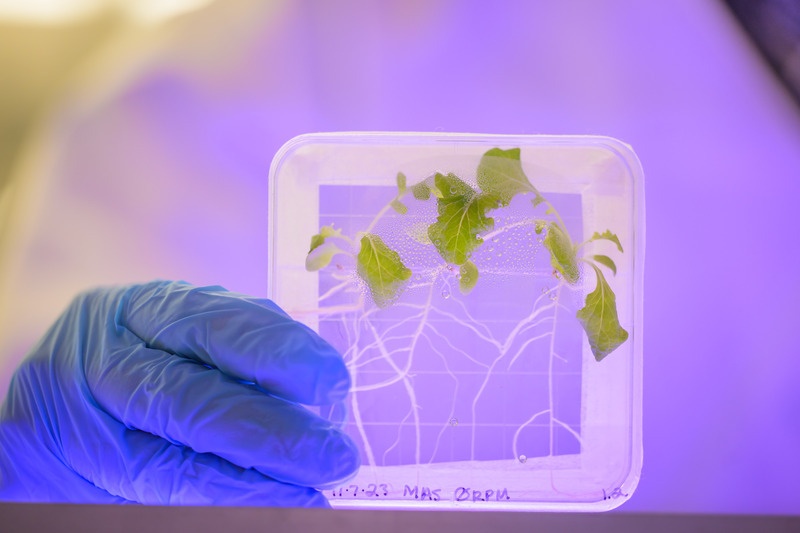
Graduate student Noah Totsline works in the College of Agriculture and Natural Resources lab of Harsh Bais on a NASA-sponsored project looking at how plants grown in space are more prone to infections of Salmonella compared to plants not grown in space or grown under gravity simulations. The microgravity environment of space can be simulated in the lab by rotating the plants at a precise speed that causes the plants to react as if they were in a constant state of free-fall.

Plants Growing in Space are at Risk from Bacterial Infections

I have spent the last few years thinking, perhaps assuming that astronauts live off dried food, prepackaged and sent from Earth. There certainly is an element of that but travellers to the International Space Station have over recent years been able to feast on fresh salad grown in special units on board. Unfortunately, recent research suggests that pathogenic bacteria and fungi can contaminate the ‘greens’ even in space.

It’s been at least three years that astronauts have been able to eat fresh lettuce and other leafy items along with tortillas and powdered coffee.. Specially designed chambers on board allow them to grown plants under carefully controlled temperature, water and lights to ensure a successful harvest.  There is however an issue that the ISS is a relatively closed environment and so it is easy for bacteria and fungi to spread and astronauts to get ill. 

International Space Station The International Space Station stretches out in an image captured by astronauts aboard the SpaceX Crew Dragon Endeavour during a fly-around in November 2021. Credit: NASA

A paper just published in Scientific Reports and NPJ Microgravity and authored by a team led by Noah Totsline explores what happens with lettuce grown under ‘simulated’ weightless environments (the device known as a clinostat rotate them so that plants did not know which way was up or down). This was achieved by being gently rotated. Plants it seems though, are pretty good at sensing gravity using their roots. The team found that plants under these conditions were more prone to infection than those on Earth in particular Salmonella.

One of the main lines of defence for plants is their stomata. These are tiny pores in the leaves, much like the pores in our skin, that close to defend when an environmental stress is detected, such as bacteria.  The team exposed plants in their micro-gravitational environment to find the plants opened the stomata instead of closing them. 

The team went a step further and introduced a natural bacteria known as UD1022 which usually helps to protect plants. In the clinostat however, it failed to help the plant to protect itself from other more harmful bacteria.

The research was not just an interesting scientific problem but does solve real world problems. Space is slowly opening up with more and more non-astronauts becoming astronauts and travelling into space and this is only going to increase. As SpaceX and the like press ahead with the commercialisation of space travel we absolutely must find a way to grow and farm sustainable and healthy food instead of prepackaged snacks if we are to become a truly space fairing civilisation. 

We are some way away from that of course but this is step one in a long journey. Sadly it is not as simple a task as sterilising the seeds since their could easily be microbes in the environment on board the ISS (or other space craft that come in the future) and perhaps it is these that pose the greatest risk. The team are now looking at ways to genetically modify plants to help them cope in the microgravity of space.

Source :

{ https://www.universetoday.com/  }

Hoe vind je dit bericht?
Geschreven door peter om 22:13 Stuur door

NASA Gives us an Update on its Long-term Plans for the Moon and Mars

NASA's plans for exploration of the Moon and Mars are a unified architecture covering all mission, crew, and technology contigencies. Image courtesy NASA.

NASA's plans for exploration of the Moon and Mars are a unified architecture covering all mission, crew, and technology contigencies. Image courtesy NASA.

NASA Gives us an Update on its Long-term Plans for the Moon and Mars

Going to Mars is a major step in space exploration. It’s not a quick jaunt nor will it be easy to accomplish. The trip is already in the planning stages, and there’s a good chance it’ll happen in the next decade or so. That’s why NASA and other agencies have detailed mission scenarios in place, starting with trips to the Moon. Recently, NASA updated its “Moon to Mars Architecture” documents, including a closer look at some key decisions about Mars exploration.

Those decisions cover a wide gamut of challenges to living and working on the Red Planet. NASA planners narrowed them down to these key areas: science priorities, number of crew members on the first trip, how many on each follow-up trip, number of crew members per Mars location, Mars surface power generation technologies, what kinds of missions will be sent (the “target state”), and establishing what they call a “loss of crew risk” posture. That last one involves making the right decisions about missions based on risk to the crew’s health and performance.

NASA Plans for the Moon and Mars

Why create a mission architecture for the Moon and Mars? Essentially, anybody going to these other worlds needs a mutually agreed-upon “roadmap” that plans the explorations and technologies needed. That’s why NASA created its first Moon to Mars objectives in 2022 and has been refining them ever since. The agency’s roadmap includes feedback from a wide swath of society. Members of academia, U.S. industry, international partners, and the NASA workforce all contributed to the project.

“Our new documents reflect the progress we’ve made to define a clear approach to exploration and lay out how we’ll incorporate new elements as technologies and capabilities in the U.S. and abroad mature,” said Catherine Koerner, associate administrator, Exploration Systems Development Mission Directorate at NASA Headquarters in Washington. “This process is ensuring that everything we are doing as an agency and together with our partners is focused on achieving our overarching exploration goals for the benefit of all.”

The Key Decisions Regarding Mars Exploration

In a white paper published along with the Moon to Mars Architecture document, NASA explains key areas of concern when it comes specifically to Mars exploration. The first is science. It’s the main reason for going the both the Moon and Mars, and its needs will drive almost all other considerations. It will determine the resources needed, including crew numbers, payloads, technology deliveries, and power and communications infrastructure, and contingencies for possible accidents or other challenges.

An artist's concept of Mars explorers and their habitat on the Red Planet. Courtesy NASA. An artist’s concept of Mars explorers and their habitat on the Red Planet. Courtesy NASA.

Once the science is determined, planners can decide on crew needs for the first and subsequent missions. As the white paper states, “…a series of focused science exploration missions to different landing sites would favor one architecture. Establishing a permanent, fixed base from which astronauts could conduct many surface missions supporting diverse and evolving exploration activities would favor a very different architecture.”

From there, planners will figure out the “cadence” of the missions and crew deployments. How often do we send missions and how many people will go? Just as an example, let’s say that the first mission will land in Jezero Crater, near the Perseverance rover. NASA could use its data to determine further science exploration at the site. That will drive the best placement for habitats and other infrastructure, and the type of mission will dictate the number of crew members needed.

Those decisions will then drive the infrastructure and technology needed for each step. Science stations need power to do the science, but also to sustain the habitats for the science teams. If those teams travel across the surface, their rovers will need power, fuel, and possibly replacement parts. Crew members themselves will need to be able to grow food, use local resources to extract fuel and water, and otherwise maintain safe living conditions. And, these are just the first steps in the long-term exploration of Mars, enabled by what people learn about living and working on the Moon.

Why Does NASA Want a Moon to Mars Plan?

While it may seem sexy to send people directly to Mars without any intervening stops at the Moon, NASA and other agencies want a measured approach. The idea to use the Moon as a stepping stone to Mars is not new. The Moon makes a good “training base” of sorts where we can “practice” with the technologies and techniques of living on another world. In addition, it offers a unique environment for astronomy and planetary science exploration. Astronauts learn in an environment close to Earth and if something dire happens to them, rescue is not far away.

Artist's impression of astronauts on the lunar surface, as part of the Artemis Program. Credit: NASA Artist’s impression of astronauts on the lunar surface, as part of the Artemis Program. Credit: NASA

These ideas underlie the planning for the upcoming Artemis missions to the lunar surface. There’s supposed to be a gateway orbiting the Moon, to which astronauts and equipment will fly. Then, from there, materials and people head to the Moon to explore various sites, and begin the complex tasks of exploration and habitat construction. That set of missions will establish the foundation for scientific exploration, and land a diverse set of people on the lunar surface, all in cooperation with international partners. Ultimately, everything they learn on the Moon will prepare people for the leap to Mars.

The Moon to Mars mission architectural plans unite both lunar and Mars exploration in one timeline, identifying technologies and capabilities needed to accomplish each step. They are living documents, updated every year to reflect changes in any aspect of mission planning and technology.

For More Information

{ https://www.universetoday.com/  }

Hoe vind je dit bericht?
Geschreven door peter om 21:54 Stuur door

Meer van UFO'S of UAP'S, ASTRONOMIE, RUIMTEVAART, ARCHEOLOGIE, OUDHEIDKUNDE, SF-SNUFJES EN ANDERE ESOTERISCHE WETENSCHAPPEN - DE ALLERLAATSTE NIEUWTJES

↑ Terug naar de berichten