Ontdek de Fascinerende Wereld van UFO's en UAP's: Jouw Bron voor Onthullende Informatie!
Ben jij ook gefascineerd door het onbekende? Wil je meer weten over UFO's en UAP's, niet alleen in België, maar over de hele wereld? Dan ben je op de juiste plek!
België: Het Kloppend Hart van UFO-onderzoek
In België is BUFON (Belgisch UFO-Netwerk) dé autoriteit op het gebied van UFO-onderzoek. Voor betrouwbare en objectieve informatie over deze intrigerende fenomenen, bezoek je zeker onze Facebook-pagina en deze blog. Maar dat is nog niet alles! Ontdek ook het Belgisch UFO-meldpunt en Caelestia, twee organisaties die diepgaand onderzoek verrichten, al zijn ze soms kritisch of sceptisch.
Nederland: Een Schat aan Informatie
Voor onze Nederlandse buren is er de schitterende website www.ufowijzer.nl, beheerd door Paul Harmans. Deze site biedt een schat aan informatie en artikelen die je niet wilt missen!
Internationaal: MUFON - De Wereldwijde Autoriteit
Neem ook een kijkje bij MUFON (Mutual UFO Network Inc.), een gerenommeerde Amerikaanse UFO-vereniging met afdelingen in de VS en wereldwijd. MUFON is toegewijd aan de wetenschappelijke en analytische studie van het UFO-fenomeen, en hun maandelijkse tijdschrift, The MUFON UFO-Journal, is een must-read voor elke UFO-enthousiasteling. Bezoek hun website op www.mufon.com voor meer informatie.
Samenwerking en Toekomstvisie
Sinds 1 februari 2020 is Pieter niet alleen ex-president van BUFON, maar ook de voormalige nationale directeur van MUFON in Vlaanderen en Nederland. Dit creëert een sterke samenwerking met de Franse MUFON Reseau MUFON/EUROP, wat ons in staat stelt om nog meer waardevolle inzichten te delen.
Let op: Nepprofielen en Nieuwe Groeperingen
Pas op voor een nieuwe groepering die zich ook BUFON noemt, maar geen enkele connectie heeft met onze gevestigde organisatie. Hoewel zij de naam geregistreerd hebben, kunnen ze het rijke verleden en de expertise van onze groep niet evenaren. We wensen hen veel succes, maar we blijven de autoriteit in UFO-onderzoek!
Blijf Op De Hoogte!
Wil jij de laatste nieuwtjes over UFO's, ruimtevaart, archeologie, en meer? Volg ons dan en duik samen met ons in de fascinerende wereld van het onbekende! Sluit je aan bij de gemeenschap van nieuwsgierige geesten die net als jij verlangen naar antwoorden en avonturen in de sterren!
Heb je vragen of wil je meer weten? Aarzel dan niet om contact met ons op te nemen! Samen ontrafelen we het mysterie van de lucht en daarbuiten.
NASA’s Hubble Space Telescope has detected the presence of water in the atmosphere of a distant exoplanet, which astronomers say is the smallest planet of its kind to reveal such a discovery.
The planet, GJ 9827D, was initially found in 2017 by NASA’s Kepler Space Telescope. Roughly twice the diameter of Earth and located approximately 97 light years away, the tiny exoplanet completes an orbit around its nearest star, a red dwarf, in a little more than six Earth days.
Laura Kreidberg with the Max Planck Institute for Astronomy in Heidelberg, Germany, called the discovery of water on such a small exoplanet “a landmark discovery.”
Kreidberg, co-principal investigator in the new study that revealed the discovery, said that finding water on GJ 9827D “pushes [astronomers] closer than ever to characterizing truly Earth-like worlds.”
Artist’s depiction of the exoplanet GJ 9827D (Credit: NASA/Hubble)
The new discovery represents the first time that an exoplanet of this kind has been found to exist around other stars, an observation made entirely possible through atmospheric detection of water made possible by the Hubble telescope.
“This is an important step toward determining the prevalence and diversity of atmospheres on rocky planets,” said Björn Benneke, an astronomer with the Trottier Institute for Research on Exoplanets at Université de Montréal, in a statement.
Hubble was used to observe the planet during eleven transits before its host star over three years. As the planet moves in front of its star, the light the stellar body produces is filtered through GJ 9827D’s atmosphere, which allows astronomers the ability to observe key spectra that indicated the presence of water molecules.
Right now, astronomers cannot tell whether the planet is a “water world” with an abundance of liquid, or if the atmospheric detections made possible by Hubble only point to the presence of water vapor in its hydrogen-rich atmosphere.
Pierre-Alexis Roy, also with the University of Montreal’s Trottier Institute for Research on Exoplanets and lead author of a new paper describing the discovery, said either of these scenarios would be exciting, “whether water vapor is dominant or just a tiny species in a hydrogen-dominant atmosphere.”
Although possessing water like Earth, GJ 9827D’s proximity to its star causes it to resemble Venus due more closely to its extreme heat. With temperatures nearing 800 degrees Fahrenheit, it seems unlikely that GJ 9827D would be a place where life could thrive, particularly if an abundance of water vapor exists in its atmosphere.
If, however, the planet still possesses an atmosphere rich in hydrogen but possesses a degree of water vapor, it could also be a mini-Neptune, or even similar to Juputer’s moon Europa, which astronomers have determined to possess roughly twice as much water as Earth has.
If there are equal parts water and rock on GJ 9827D, it could be that the water vapor exists above the planet’s smaller rock body, Benneke explains.
However, Benneke, Roy, and the team also say that if the planet initially formed farther away from its nearest star, then it could be that the water-richness of its atmosphere is residual and that the heating of the planet as it has moved closer to its stellar host has heated the water as the planet receives more radiation over time.
Thomas Greene, astrophysicist at NASA’s Ames Research Center in California’s Silicon Valley, likened the observation of water as a “gateway” toward additional discoveries, some of which may be made with NASA’s James Webb Space Telescope.
“JWST can see much more with additional infrared observations, including carbon-bearing molecules like carbon monoxide, carbon dioxide, and methane,” Greene said.
“Once we get a total inventory of a planet’s elements, we can compare those to the star it orbits and understand how it was formed,” Greene added.
The team’s new paper, by Benneke, Roy, et al, titled “Water Absorption in the Transmission Spectrum of the Water World Candidate GJ 9827 d,” appeared in The Astrophysical Journal Letters.
David Grusch, a key figure in the UFO mystery, has participated in consecutive interviews with mainstream media regarding the concealment of UFO information. Grusch has gained prominence following the July 2023 US Congress UAP hearings, thanks to his compelling and assertive testimony about non-human intelligence. He is consistently claiming we have alien crafts in double digits and also possess non-human biologics which implies Earth is in contact with or aware of species from other planets.
With each passing day, David Grusch is making efforts to reach a larger audience and share his story. This drew him to former Fox News host Tucker Carlson, a prominent figure in American media. Carlson, with over 10.9 million followers on Elon Musk’s X (formerly named Twitter), did a bombshell interview with Grusch published on December 14, 2023.
On X, Tucker Carlson posted this 66-minute interview with Grusch with the caption: “It’s becoming obvious that the US government has made contact with nonhuman beings.”
Grusch told Tucker that the U.S. government has retrieved “biologics” (bodies) from crashed UFO sites. When asked about the nature of these biologics, Grusch states that they are “non-human.” He emphasizes that this assessment comes from individuals with direct knowledge who are still part of the program. Grusch also mentions the existence of documentary evidence but suggests that details would need to be discussed in a secure location called a SCIF (Sensitive Compartmented Information Facility).
Tucker expresses surprise at Grusch’s sudden public involvement in the UFO topic, given his extensive background in military intelligence. Grusch recounts how he first became interested in the topic after seeing a New York Times article in 2017 about Lou Elizondo and programs like AATIP and AWASAP. Tucker notes that the government never confirmed or denied Elizondo’s involvement, to which Grusch clarified that he knew about Elizondo’s role. He recalls hearing that Elizondo was considered somewhat erratic by some officials. Grusch’s curiosity deepened when he saw news reports about Elizondo’s involvement in a UFO program, leading him to realize that the program was indeed real.
Grusch explains that it was a unique experience during his time in UAP task force because he started uncovering disturbing facts. He had access to classified archives from previous UFO programs and came across foreign intelligence gathered by clandestine human sources overseas. These sources, according to him, noted that the U.S. had a retrieval and reverse engineering program for UFOs. Notably, these assessments were from other countries.
Tucker questions Grusch about how the Pentagon, an entity that serves elected officials, could deny an elected official access to information. He emphasizes that the Pentagon works for politicians who are accountable to the people and compares Pentagon employees to household staff, highlighting that they’re not an independent entity.
Grsuch acknowledged the issue and pointed out that this is one of the reasons he decided to blow the whistle. He explains that even in the normal black Special Access Program (SAP) community, elected leaders are treated as second-class citizens. He mentions instances where reporting is waived, and Deputy Secretaries of Defense (Dep SecDef) can sign orders limiting briefings to certain committees.
“I can sign an order saying we’re not going to fully brief certain committees on, you see, on programs that are in Public Law 10 US Code Section 119, and that is congressional oversight of SAPS, is the title of that part of Public Law. But the department, which I find in retrospect, very weird, where the legislators authorize and appropriate these programs, but they’re not afforded full access. And occasionally the Gang of Eight will get those kinds of briefings. But literally, they could withhold, besides notifying a program that stood up the entire Congress, that we’re doing some kind of clandestine activity.”
Grsuch mentioned there are approximately 40 people, many with firsthand knowledge, some at the same level as Harry Reid. He explains that after realizing the reality of the situation, he and his team conducted interviews with individuals who had privileged information, even comparable to a high-ranking figure like Harry Reid.
Grsuch recounts a conversation with Harry Reid, where the former senator expressed deep concern about the topic. Reid, then planning to discuss it with President Biden, highlighted the challenges even someone of his stature faced in accessing information. David Grusch emphasizes that past administrations had varying levels of knowledge about these programs, and even presidents were not always briefed on all aspects.
When Tucker specifically asks about any connection between the secrecy surrounding the Manhattan Project (which developed nuclear weapons) and UFO programs, Grusch clarifies that there isn’t an overt connection. However, he speculates that the development of nuclear weapons might have sparked interest in unidentified objects.
David Grusch mentions that he can’t discuss many retrievals, and the only one he has publicly mentioned is the 1933 Italian event. He chose this event to highlight that the UFO phenomenon is not exclusive to the United States but is a worldwide issue.
Grusch explains that the Italian event involved the recovery of an object that looked like an acorn in Magenta, Italy, by the Axis powers (Italy and Germany) in 1933. He notes that information about this event surfaced in the early 2000s through Italian researchers who uncovered documents sent by Mussolini to the Gestapo.
According to a senior intelligence officer who briefed him, the recovered object resembled a lenticular disc, but the edges broke off when it hit the Earth, giving it an acorn or bell shape. The Italians kept custody of the artifact until the end of the war, and then the Americans recovered it. He adds that the Vatican and the OSS (Office of Strategic Services) communicated with FDR about the crash. Grusch said the 1933 Italian event is the only one he has cleared through DoD security.
Tucker questions Grusch about the timeline of the U.S. government’s knowledge of UFOs, pointing out that David mentioned the government didn’t take custody until the end of the war. David clarifies that this statement specifically refers to a particular case, but the government was aware of the UFO issue in the 1930s.
Tucker then raises a common question: Why do advanced technologies like UFOs crash so often? Grusch suggests that crashes may not necessarily be intentional. He introduces the concept of von Neumann replicating probes, where advanced civilizations might send throwaway probes that could crash accidentally. Grusch emphasizes that this is not just his theory but something discussed by scientists involved in the program.
Tucker follows up by questioning whether these objects truly come from a far distance. Grusch admits the uncertainty, highlighting that even certain directors of government agencies prefer using the term “extraterrestrial.” However, he leans towards the term NHI, meaning non-human intelligence. He notes that this term is also used in the Schumer amendment called the UAP Disclosure Act of 2023. The act is part of the fiscal year 2024 National Defense Authorization Act and is currently in conference. He underscores that he’s not the only one using terms like “non-human intelligence biologics” and points out that influential figures like Chuck Schumer are pushing for transparency in the matter.
Tucker questions why there is so much secrecy, and David suggests that excessive secrecy hinders national security. He draws a parallel with nuclear physics, explaining that while details about building nuclear weapons are classified, the broader study of nuclear physics is open to the public. David advocates for a similar approach to UFOs, where the subject should be “horizontally protected,” allowing broad academic study and public access to information, with only genuinely dangerous or classified aspects kept confidential. This way, he believes 95% of the subject could be open for study worldwide.
Tucker asks David about the truth behind these abduction claims. David responds by saying that he doesn’t have any first-hand knowledge on the phenomenon of abduction. He notes that, during his interviews, none of the individuals he spoke with had direct experience or knowledge about abductions.
“I don’t know. Nobody I interviewed had any firsthand knowledge of that phenomenon. I certainly believe people have experienced things like that. At least they believe it, because you look at Dr. John Mack, who was a Harvard-trained psychologist and psychiatrist. He examined the phenomenon of abduction in the early 2000s before his death and affirmed that the people he psychoanalyzed certainly experienced something real to them. But what is the abduction phenomenon? I really don’t know. I’m not sure.”
DavidGrusch tells Tucker Carlson about Rep. Mike Turner’s efforts to block the UAP Disclosure Act and destroy Tim Burchett’s career “Mike Rogers & Mike Turner, two of the dumbest people in Washington. Pure tools of the national security state.” Additionally on Newnation, he said, “Mike Turner probably has no business being the (House Intelligence Committee) Chairman… Mike Turner has never been an intelligence officer. He’s never served in the military.” “We need to get these people out of office.”
Physical Harm
Tucker raises a sensitive issue about the potential harm or killing of individuals connected to the U.S. government’s UFO programs. He specifically asks Grusch if he has reason to believe that the government has hurt or killed anyone, particularly American citizens, in connection to these programs.
Grusch responds by acknowledging concerns that were raised by individuals who approached him, expressing worries about potential harm. He emphasizes that he took these concerns seriously and reported them to the Inspector General of the intelligence community, directing the individuals to law enforcement.
Tucker pushes further, specifically mentioning the allegation of murder, to which Grusch confirms that the concerns included both murder and physical harm. However, he refrains from providing specific details due to the ongoing investigation and potential risks to his safety.
Grusch discloses that he felt his life was in jeopardy, and he reported the threats and surveillance to a counterintelligence element and law enforcement. He reveals that these threats not only affected him but also impacted his wife. He states that he doesn’t know the identity of those involved, ruling out the possibility of it being a foreign entity.
Previously on the Joe Rogan Experience, Grusch talked about the fundamental questions related to UFOs, such as the existence of extraterrestrial life and the nature of human consciousness. Grusch asserted with confidence, based on conversations with high-level individuals like Harry Reid, that we are not alone, and the UFO phenomenon is real.
“You know for humanity. Are we alone or you know what happens when we die? Well, I don’t know about that, but are we alone? Well, the answer is we’re not alone. And I know that with 100% certainty, which as an Intel officer, you never say 100%, but all things pointed towards based on the people I talked to…The phenomenon is real. It’s been going on for thousands of years. People have been seeing strange things and not everybody’s mass hallucinating. So that’s kind of my long diatribe about what’s happening.”
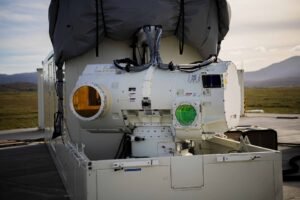
The UK Ministry of Defense (MOD) has announced the successful test firing and downing of an aerial target using its high-powered DragonFire laser weapon. The exact power and range of the combat laser remain classified, but an official statement says DragonFire can hit a £1 coin-sized object from a kilometer away.
While there are no immediate plans to deliver the laser system to troops, the MoD says they are currently evaluating DragonFire and that this successful test was a critical next step toward actual deployment.
DRAGONFIRE JOINS GROWING LIST OF DIRECTED ENERGY WEAPONS
In the 1980s and 1990s, using lasers to down aerial targets remained firmly in the realm of science fiction. The U.S. Defense Department first tested a combat laser prototype in 1995, but that system required numerous buildings to operate and had limited target-destroying power.
In subsequent years more systems have been developed, with many sporting power ranges in the tens of kilowatts. Ranging from truck-mounted lasers and aircraft-mounted lasers to larger systems mounted directly on U.S. Navy ships, these lasers are not powerful enough to blast targets out of the sky. Instead, they have to stay locked on an incoming drone long enough to fry their electronics or burn off a wing.
More recently, advances in optical technology have allowed contractors like Raytheon and Lockheed Martin to steadily increase the power of these systems, with the most powerful coming in at 300kW. Dubbed the most powerful combat laser ever built, that system is currently undergoing an upgrade that will bring it up to as much as 500kW. It is possible that such a weapon could be strong enough to take down cruise missiles, something that smaller laser systems cannot do.
Perhaps the most well-known combat laser is employed by the Israeli armed forces. Dubbed Iron Beam, that system is mounted on the Israeli border to complement their Iron Dome system that uses conventional missiles to take down incoming drones and mortars. At 100kW, Iron Beam is the most potent combat laser in deployment anywhere in the world.
Now, it appears that the UK is joining the march toward adding lasers and other directed energy weapons that include powerful microwave emitters that can fry the electronics of a drone or missile to their arsenal. Along with the accuracy of these systems, the MoD is also hoping that laser systems can dramatically reduce costs.
SUCCESSFUL TEST SHOWS DRAGONFIRE IS MOVING CLOSER TO DEPLOYMENT
In that same statement, the MoD says, “This milestone demonstrated the ability to engage aerial targets at relevant ranges and is a major step in bringing this technology into service.” The latest test also builds on previous work that showed how DragonFire can effectively track both air and sea targets “effectively and at range.”
“These trials have seen us take a huge step forward in realising the potential opportunities and understanding the threats posed by directed energy weapons,” said Dstl’s Chief Executive, Dr. Paul Hollinshead.
The MoD also notes the potential financial advantages of using lasers instead of missiles, which can cost as much as 100,000 pounds, to counter the increasing use of low-cost drones.
“Firing it for 10 seconds is the cost equivalent of using a regular heater for just an hour,” they explain. “Therefore, it has the potential to be a long-term, low-cost alternative to certain tasks missiles currently carry out. The cost of operating the laser is typically less than £10 per shot.”
MOD FUNDING MULTI-MILLION POUND PROGRAM TO MAKE DRAGONFIRE READY FOR THE BATTLEFIELD
Following the successful downing of an aerial threat, the MoD says they are moving ahead with funding a multi-million-pound program “to transition the technology from the research environment to the battlefield.” They also say that both the Army and navy are evaluating using DragonFire and similar technologies as part of their future Air Defense capabilities.
“With our decades of knowledge, skills, and operational experience, Dstl’s expertise is critical to helping the armed forces prepare for the future,” said Hollinshead.
“The DragonFire trials at the Hebrides demonstrated that our world-leading technology can track and engage high-end effects at range,” added Shimon Fhima, Director of Strategic Programmes for the MOD. “In a world of evolving threats, we know that our focus must be on getting capability to the warfighter, and we will look to accelerate this next phase of activity.”
Christopher Plain is a Science Fiction and Fantasy novelist and Head Science Writer at The Debrief. Follow and connect with him on X, learn about his books at plainfiction.com, or email him directly at christopher@thedebrief.org.
NASA recently revealed that a laser beam was fired from its Lunar Reconnaissance Orbiter (LRO) at a spacecraft on the Moon’s surface, in a technological first that could pave the path toward new methods of precision target location.
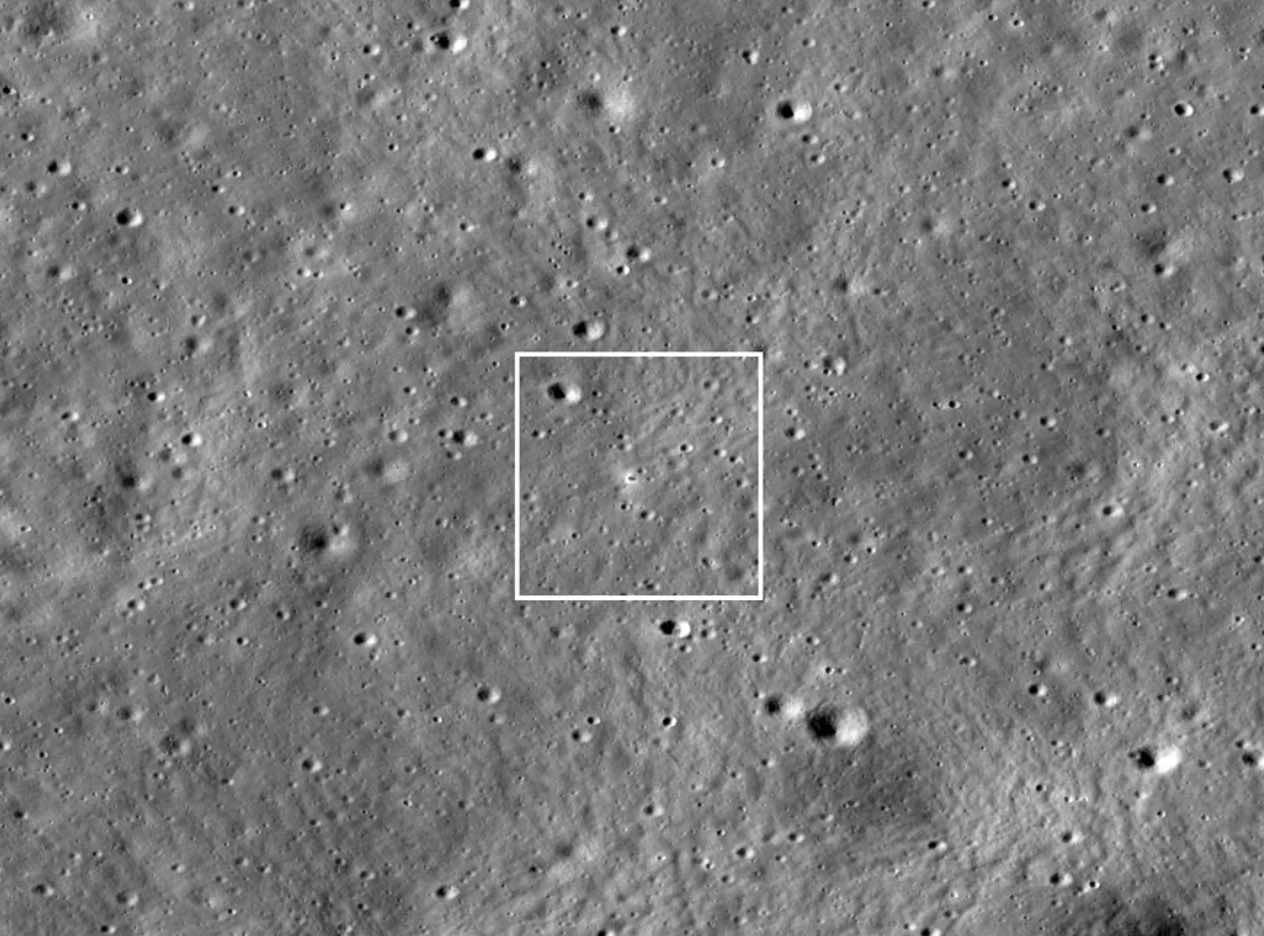
The American space agency says a laser beam was transmitted from the LRO’s laser altimeter instrument at a tiny device on the Indian Space Research Organization’s (ISRO) Vikram lander on December 12, 2023. The transmission occurred while the LRO was more than 60 miles away as it passed over the lunar South Pole when it fired a series of laser pulses at the spacecraft.
The LRO registered light from its laser bouncing back off a tiny NASA retroreflector positioned on Vikram, confirming that the technique was a success.
Xiaoli Sun with NASA Goddard, who led the team that developed the retroreflector placed on Vikram, was enthusiastic about the achievement resulting from the cooperation between the two space agencies.
“We’ve [shown] that we can locate our retroreflector on the surface from the Moon’s orbit,” Sun said.
NASA’s Lunar Reconnaissance Orbiter (LRO) successfully targeted a retroreflector on the exterior of the ISRO’s Vikram lander on December 12, 2023
(Credit: NASA’s Goddard Space Flight Center/Arizona State University).
In principle, firing lasers at an object and measuring the time required for the light to bounce back to its point of origin is nothing new, and is commonly utilized for tracking Earth-orbiting satellites using ground-based laser systems.
However, the technique NASA recently demonstrated reverses this process, firing a laser from a moving satellite at a stationary object—in this case, on the surface of the Moon—and determining its precise location.
FIRING A LASER AT A COOKIE-SIZED RETROREFLECTOR
The special retroreflector NASA designed is tiny, at just two inches across. Roughly the size of an Oreo cookie, the device is formally known as a Laser Retroreflector Array and features a pattern of eight prisms fitted within an aluminum frame shaped like a tiny dome, which allows for a simple, but effective means of reflecting light coming from almost any direction.
The device also requires no power either, meaning that its durable design allows it to function for up to several decades.
This is not the first time NASA has used retroreflectors in novel ways. Since 1969, a technique known as Lunar Laser Ranging (LLR) has been used to measure the Moon’s distance from Earth-based observatories using retroreflectors that were placed on the Moon’s surface during the Apollo missions, as well as the Soviet Luna program.
However, more advanced retroreflector designs currently in use allow for a greater range of potential applications than their Apollo-era predecessors. Today, the devices are also fitted to the exterior of the International Space Station (ISS), which allows cargo-delivery spacecraft to measure their distance while approaching and autonomously dock with it.
In the years ahead, they may also provide several useful applications for Artemis astronauts working in locations where low light conditions would otherwise make landing next to existing spacecraft on the lunar surface difficult.
Right now there are plans for NASA retroreflectors to be carried to space on board several public and private Moon landers, including the Japan Aerospace Exploration Agency’s (JAXA) SLIM lander, which powered down within just three hours of making its historic landing on the Moon over the weekend.
A LOOK AT THE LUNAR RECONNAISSANCE ORBITER’S LOLA
One problem that arises from the more widespread use of this technology in space exploration is that the LRO’s altimeter—currently the only laser instrument orbiting the Moon that could be used for such applications—has been operating for thirteen years longer than its original mission intended and was never designed for such applications. Because of this, the LRO’s instrument required eight attempts before it could successfully contact the retroreflector on the Vikram lander.
The laser in question is the LRO’s Lunar Orbiter Laser Altimeter (LOLA). This instrument is primarily designed for precision measurements of topographic features on the lunar surface, which has helped NASA produce models of the Moon that are crucial for planning safe landings and lunar exploration, as well as increasing our understanding of the lunar environment overall.
LOLA functions with a small array of five laser beams, which are fired toward the Moon. The time required for each beam to bounce back to the LRO is measured, allowing the instrument to gauge the elevation of features on the lunar surface below.
Although LOLA’s capabilities are ideal for mapping the Moon’s surface features, there are large gaps between the beams it produces, meaning that the chances of hitting a cookie-sized target are fairly slim, especially when the beam is required to strike within one-hundredth of a degree of the retroreflector.
In the future, NASA plans to produce a laser that produces no gaps in coverage, and which can continuously beam against the lunar surface as it passes to ensure that it strikes any retroreflectors with maximum precision.
Until such lasers come into use, NASA’s best—and only—bet remains the simpler laser altimeter currently on board the Lunar Reconnaissance Orbiter, which the December experiment has already shown to be successful when used in this manner, although it may also require a bit of trial and error.
“The next step is to improve the technique,” Xiaoli Sun said in a statement, “so that it can become routine for missions that want to use these retroreflectors in the future.”
Some of the most energetic cosmic rays in the galaxy may come from a surprisingly small source.
If Max Planck Institute for Astrophysics researcher Laura Olivera-Nieto and her colleagues are right, they may have just pinpointed one of the sources of the high-energy cosmic rays that occasionally zip past Earth from the far reaches of the universe. Astrophysicists have spent years puzzling over the origin of these particles: protons carrying thousands of trillions of electron volts of energy (yes, cosmic rays are actually particles; early physicists thought they were radiation, and the name stuck). Some cosmic rays seem tocome from supernova remnants, but it turns out that at least some high-energy cosmic rays may come from the twin jets of matter being ejected from a smallish black hole.
NASA’s Chandra X-Ray observatory spotted the x-ray jets from SS 433 several years ago.
CHANDRA X-RAY OBSERVATORY
A COSMIC RAY CULPRIT
The astronomers used a telescope called the High Energy Stereoscopic System, or HESS, to observe gamma ray jets from SS 433, a black hole orbiting a mid-sized star at the heart of the Manatee Nebula.
Like most actively feeding black holes (whether the small ones left behind after the collapse of dying stars or the cosmic leviathans at the heart of galaxies like our Milky Way), SS 433 is ejecting twin jets of matter at nearly a quarter the speed of light. These jets glow brightly with x-rays, which is how astronomers first spotted them several years ago. But about a light year away from the black hole, in both directions, the x-ray jets seem to fade away only to reappear with a vengeance about 75 light-years away.
When Olivera-Nieto and her colleagues examined the black hole in the even shorter wavelengths of gamma rays, they saw that twin gamma ray jets flared to life at exactly the points where the x-ray jets reappeared. In other words, it looked like the jets were fizzling out somewhere between 1 and 75 light years from the black hole, and then something revved them up again.
That something, the researchers surmise, seems to be a shock wave in the gassy interstellar medium of the nebula. Shock waves act like giant cosmic versions of the Large Hadron Collider, accelerating electrons in the jets to ludicrous speeds.
The jets glow with x-rays and gamma rays because electrons crash into lower-energy photons. When that happens, the electron gives the photon part of its energy, which ramps low-energy infrared light up to the high-energy x-rays and gamma rays that light up the black hole’s jets. The faster the electrons are moving, the more energy they transfer to the photons — so fast electrons make x-rays, and even faster electrons make gamma rays.
More importantly, at least for the mystery of cosmic rays, the jets may also be accelerating protons, and even whole atomic nuclei, to the absurdly high energy that turns them into cosmic rays.
Researchers have known for a long time that “the jets of SS 433 do, in fact, contain nuclei [of elements] such as iron or nickel. And the shock that accelerates electrons would accelerate them in the same way,” Olivera-Nieto tells Inverse. However, the protons could potentially be accelerated to even higher energies than the electrons because they’re too big to shed energy in collision with photons.
Astronomers just can’t actually see these high-energy protons and nuclei because, unlike electrons, protons release radiation when they bump into dense matter, not stray photons, and there’s not a big pile of dense matter in the black hole’s jets.
A QUEST FOR MICROQUASARS
Despite having shed light on this cosmic ray mystery, black hole SS 433 isn’t actually the source of any of the cosmic rays physicists here on Earth have detected. It hasn’t been blasting its relativistic jets out into space long enough for any particles from those jets to have reached Earth. But someday, in the distant future, there’s a chance some of the protons and atomic nuclei being accelerated in those jets could reach our planet.
Meanwhile, Olivera-Nieto and her colleagues say other similar objects, called microquasars, could still be among the sources of cosmic rays that do reach Earth.
“Microquasars are intermittent sources, meaning that it is very likely that other systems were active in the past and made a contribution to what we now see,” says Olivera-Nieto.
Looking for those sources is the next step.
“Detecting gamma-ray emission from other microquasar systems and understanding how acceleration takes place in them will be critical because it will allow us to understand how common such systems are,” says Olivera-Nieto. “Answering this question will constrain how much can microquasars as a whole contribute as sources of very-high-energy cosmic rays.”
JAXA/Takara Tomy/Sony Group Corporation/Doshisha University
Last week, Japan became the fifth nation to successfully land on the Moon without crashing. Unfortunately, the historic touchdown left the Smart Lander for Investigating Moon(SLIM) positioned like a toy after a toddler is done playing with it: planted face down on the ground.
This less-than-ideal situation forced the Japan Aerospace Exploration Agency (JAXA) to power down the lander and save precious battery life. But before it did, SLIM was able to send some data back to Earth. Today, JAXA released new images that show how SLIM is situated in its new home.
The new data also confirmed Japan’s biggest hope for its SLIM project: a precise landing on the Moon within 100 meters of its target, confirming proof of concept.
JAXA rotated this image from its SLIM’s Multi-Band Camera “to align with the direction of gravity,” officials wrote on Thursday. The rover didn’t land as expected.
SLIM was designed to last just a few Earth days, JAXA officials wrote in a statement. But the mission will be drawn out for a month at least, to see if the angle of sunlight changes over time and perhaps strike SLIM’s landing site to sufficiently power its solar cells from its unintended westward orientation. The sunlight does a sort of angular reset on the Moon each Earth month (a day on the Moon lasts about one month on Earth).
While JAXA awaits those solar-cell results, SLIM’s Multi-Band Camera took a slanted image of Moon rocks nearby. In an annotated image, their names appear and seem to follow a canine theme. They have names like “St. Bernard,” “Bulldog,” “Toy Poodle,” plus Japanese breed-inspired names like “KAIKEN,” “AKITAINU,” “SHIBAINU.”
The JAXA team named several Moon rocks, and named them after dogs. The names are “with intent of communicating their relative sizes smoothly by the names,” officials wrote on Thursday.
There’ll be more, hopefully, if SLIM’s solar cells absorb enough energy, JAXA officials wrote. “Based on this landscape image, the team is sorting out rocks of interest, assigning a nickname to each of them, with the intent of communicating their relative sizes smoothly by the names,” the space agency shared. JAXA added that preparations are underway to “promptly conduct” high-resolution spectroscopy, a technique that extracts information from light, of Moon rocks once “SLIM recovers by the power generated by the solar array.”
SLIM’s peculiar position on the Moon’s surface appeared in imagery from one of its two tiny robotic passengers. Photo evidence came from JAXA’s collaboration with toy company Takara Tomy. Along with two other partners, Sony and Doshisha University in Kyoto, they created Lunar Excursion Vehicle 2 (LEV-2).
On Thursday, Daichi Hirnao (left), associate senior researcher at JAXA's Space Exploration Innovation Hub Center, explains an image of the lunar surface robot LEV-2, also known as SORA-Q.
KAZUHIRO NOGI/AFP/GETTY IMAGES
Also known as SORA-Q, LEV-2 looks like a rolling ball. It comes from the minds behind the popular toy Transformers and would easily sit in the palm of your hand. This small robot and SLIM’s other rover, LEV-1, are Japan’s first rovers on the Moon. LEV-1 also has other laurels, too. It achieved successful direct communication with Earth from the Moon, according to JAXA. “This is considered as the world's smallest and lightest case of direct data transmission from approximately 380,000 kilometers away,” space agency officials wrote in a recent statement.
JAXA will likely publish more updates in the near future to report the ongoing saga of SLIM’s solar cells.
The Unidentified Aerial Phenomena (UAP) is not what many think it is. The reality of UAPs goes beyond mere flying machines and space aliens; it is turning into a rabbit hole. Every year, UFO enthusiasts and whistleblowers put more effort into unveiling the secrecy. However, instead of revealing the truth, a new branch of mystery unfolds, adding another chapter to the UFO enigma.
Missouri Republican Eric Burlison attended a classified UAP briefing this month but mentioned that it did not change his beliefs. He said, “There’s nothing that’s been said that’s changed my worldview.” He also added that he believes the claims of people who testified in public but thinks there might be more to the story.
Rep. Burlison has said that UFOs might be angels sent by God. Burlison, who heard secret information about UFOs, shared this idea on “That UFO Podcast.” He said, “They may not fit exactly the Biblical narrative, but whenever I use the term ‘angels,’ to me, it’s synonymous with an extradimensional being.”
In a podcast, Burlison shared his thoughts on UFOs, offering a detailed perspective on various theories surrounding these unidentified phenomena. Burlison discussed a theory he read in a public report by UFO whistleblower David Grusch who alleged that the government secretly recovered alien spacecraft and even dead “pilots” inside them. According to Grusch’s report, one theory suggests that what we are encountering might be beings that exist in higher dimensions, beyond our normal understanding of space and time.
Burlison used the analogy of living on a two-dimensional surface and being encountered by a three-dimensional object to explain the idea of encountering something from a higher dimension. In this case, he suggested that we live in a three-dimensional environment and could be encountering something from a higher dimension, where traditional concepts of distance might become irrelevant.
He expressed skepticism about the probability of being visited by an alien race from a distant planet, emphasizing the vast distances involved. Burlison questioned the likelihood of an advanced alien race traveling such long distances only to crash upon arrival on Earth. He leaned towards the idea that these phenomena are more likely to be extradimensional, existing beyond our usual understanding of dimensions.
Burlison explained that various scriptures, including the Bible, describe messengers of God or angels as existing in dimensions beyond our own. While acknowledging the visual evidence and testimony from pilots regarding UFO sightings, Burlison emphasized the most likely explanation, in his opinion:
“I don’t discount the visual recordings or the testimonies from pilots – I believe they are genuinely witnessing something. There is substantial evidence of these unidentified objects, and although we don’t know what they are, I think the most probable explanation might not be what everyone hopes to hear. It could very well be advanced technology under development and research, possibly involving new propulsion technology.
When discussing this topic, I often refer to the discovery of the Higgs boson particle about ten years ago. We identified the Higgs field, which essentially relates to gravity, and the particle is a wave function within that field. Looking back, shortly after the discovery of nuclear vision, scientists developed the nuclear bomb. This illustrates how scientific theories can be transformed into practical functions. I find it hard to believe that we haven’t capitalized on our knowledge of the Higgs field. It seems likely that our private sector industry and the scientific community have been working to find ways to manipulate the Higgs field for various purposes, potentially including advancements in propulsion technology.”
Burlison is not the only one suggesting a link between UFOs and religious texts. Representative Tim Burchett claimed in 2021 that UFOs were in the Bible, referring to the book of Ezekiel.
According to Mystery Wire, Rep. Burchett talked about UFOs being written about in the Bible, pointing specifically to Ezekiel. This reference is for Ezekiel 1:4-28, in which there is a description of seeing “an immense cloud with flashing lightning and surrounded by brilliant light. The center of the fire looked like glowing metal, and in the fire was what looked like four living creatures. In appearance their form was human, but each of them had four faces and four wings.”
“When the living creatures moved, the wheels beside them moved; and when the living creatures rose from the ground, the wheels also rose. Wherever the spirit would go, they would go, and the wheels would rise along with them, because the spirit of the living creatures was in the wheels.”[Ezekiel 1:4-28, Ezekiel 10]
While Grusch has publicly discussed theories on UAPs that might originate from the higher-order dimensions theorized by physicists, those concepts do not appear in the unclassified version of his complaint.
The ‘extradimensional or interdimensional‘ hypothesis also does not appear in what has been made public from Grusch’s written statements first submitted for approval to the Pentagon’s Defense Office of Prepublication and Security Review (DOPSR).
But Grusch did talk about this theory when he was under oath, answering questions from Rep. Burlison during a public UAP hearing in July 2023.
Rep. Burlison said at the hearing, “It’s a bit hard to believe that an alien species advanced enough to travel billions of light years would come here and somehow not be able to survive.” He then asked Grusch about the “interdimensional potential,” saying, “Could you explain that?”
Grusch said, “No matter how smart you are, accidents happen, like plane crashes and car crashes. A small percentage of missions may fail, as we say in the Air Force.” Talking about multidimensionality, Grusch mentioned the holographic principle. It comes from general relativity and quantum mechanics. He explained it as imagining a 3D object casting a shadow onto a 2D surface.
He said, “You can be projected, sort of projected, from higher dimensional space to lower dimensional space… It’s a scientific idea that you can actually cross dimensions, as far as I understand. But there are probably people with PhDs who could argue about that.”
There has been some speculation about UFOs being connected to religious visits or interdimensional beings since the early 20th century. This idea became more famous with the book “Passport to Magonia: from Folklore to Flying Saucers” by Jacques Vallée in 1969. Vallée later inspired a character in Steven Spielberg’s UFO movie “Close Encounters of the Third Kind.” He spent years studying ancient texts for his book.
Vallée states that UFOs and related events of a paranormal nature involve visitations from other “realities” or “dimensions.” The idea proposes that these alternate realities exist separately yet parallel to our own. In 1975’s The Edge of Reality, Vallée and Hynek considered the possibility of what they call “interlocking universes.”
Daniel Sheehan, a public interest lawyer and activist who was a former Chief Council for the United States Jesuit order, revealed intriguing details about his conversations with the head of the Vatican archives regarding the Vatican’s knowledge of extraterrestrial life. He shed light on his involvement in a groundbreaking initiative to address the theological and philosophical implications of the discovery of extraterrestrial intelligence. (Click here to read the full article)
He proposed the formation of a task force involving all 54 major religious denominations to address the issue from a theological perspective. However, at that time, there was insufficient consensus, and the proposal was declined. Sheehan is currently working through his New Paradigm Institute to organize a global summit conference involving world religious leaders to discuss the recent recovery of an extraterrestrial spacecraft.
“The United States government is in possession of biological evidence and has actually taken into custody alive an extraterrestrial person. They’re keeping this secret, interrogating the being, and distorting the information to justify massive expenditures on weapon development under the guise of a perceived threat.” – Daniel Sheehan
Sheehan highlighted the Vatican’s acknowledgment of the possibility of extraterrestrial life. He referenced a formal statement issued by the Catholic Church on November 10, 2009, authorized by Pope Benedict. The statement, issued by Father Jose Gabriel Alfuz, a director of the Pontifical Observatory in Rome, recognized the increasing discovery of exoplanets and called for a global discussion on the philosophical and theological implications of the imminent discovery of extraterrestrial life.
Sheehan disclosed that the government was telepathically interrogating the extraterrestrial biological entity (EBO) in custody. Despite acknowledging the bizarre nature of the revelation, Sheehan stood by the credibility of the information, having interviewed individuals directly involved in the process. The EBO allegedly conveyed that a coalition of star systems in our galaxy monitors the evolution of life on different planets, including Earth.
“Pope Benedict had a formal statement issued by the Catholic Church, saying that with the discovery of more exoplanets, it has become clear that we will be discovering life elsewhere in the universe. This prompted the need for a global discussion on the philosophical and theological questions posed by the discovery of extraterrestrial life.” – Daniel Sheehan
Since the translation of the Book of Enoch from the ancient texts discovered in Ethiopia in 1768, it has created a stir in the history of mankind that has been told for years. The Book of Enoch tells the story of the Fallen Angels called the Nephilims or the Anunnaki; it is attributed to Enoch, the great-grandfather of Noah.
It is no wonder why the Book of Enoch was not included in the modern biblical version, since its content speaks of wicked angels who became fond of mortal women and mated with them, giving birth to the hybrid race of giant humanoids known throughout secular and Biblical history as the Nephilims.
The Nephilims then taught humans great technologies that made us greedy and awful until God destroyed them with a great flood in order to prevent further harm to creation. This is a massively oversimplified summary, but given these themes, the Book of Enoch has understandably grown in popularity in recent years.
So, what are UFOs? Jeremy Corbell says, “UFOs appear to be part of a larger phenomenon, meaning UFOs are kind of an auxiliary implication of a much larger reality. So this idea that what we’re seeing are machines from other planets. I’m unconvinced what we may be seeing is an alternate reality. You know, maybe it is something closer to dimensional travel.”
Former CIA officer Jim Semivan says,“Yes, there is a force out there that can control our environment.” The UFO phenomenon can be shocking, especially to children.
“You know for humanity. Are we alone or, you know, what happens when we die? Well, I don’t know about that, but are we alone? Well, the answer is we’re not alone. And I know that with 100% certainty, which as an Intel officer, you never say 100%, but all things pointed towards, based on the people I talked to… The phenomenon is real. It’s been going on for thousands of years. People have been seeing strange things, and not everybody’s mass hallucinating. So that’s kind of my long diatribe about what’s happening.”–David Grusch
Het gebeurt regelmatig dat er een asteroïde onze atmosfeer in zeilt, maar meestal zien we dat niet van tevoren aankomen. Nu wel: NASA waarschuwde afgelopen zondag voor een heldere vuurbal die op onze planeet af stormde en zou neerstorten in de buurt van Berlijn.
Normaal gesproken crashen er meerdere keren per jaar ruimtestenen op Aarde, maar wat vrijwel uniek was aan deze keer is dat wetenschappers hem zo’n drie uur voor de inslag al hadden opgemerkt. Het is pas de achtste keer ooit dat het lukt om de impact van een asteroïde op voorhand te voorspellen.
Bekende asteroïdejager had weer beet De asteroïde, die 2024 BXI is gedoopt, werd als eerste ontdekt door de zelfbenoemde asteroïdejager Krisztián Sárneczky, een astronoom van het Konkoly-observatorium in Hongarije. Hij zag de ruimterots door zijn Schmidt-telescoop in het observatorium. Vlak daarna kwam NASA met een gedetailleerde voorspelling van waar en wanneer de meteoriet zou neerstorten. “Een kleine asteroïde zal uit elkaar vallen als een onschadelijke vuurbal kort na half twee ’s nachts ten westen van Berlijn, vlakbij Nennhausen”, twitterde NASA in de nacht van 20 januari. Sárneczky is een expert. Hij ontdekte de afgelopen jaren honderden asteroïden en was de eerste die de 2022 EB5 waarnam, zo’n twee uur voor hij de atmosfeer binnenschoot. Ook toen gebruikte hij het Konkoly-observatorium voor zijn waarnemingen.
Slechts een paar seconden in beeld Een camera in Leipzig wist beelden te maken van de uitzonderlijk heldere meteoor. Daarop is te zien hoe de asteroïde binnen een paar seconden tevoorschijn komt en weer verdwijnt. Voor de inslag was de asteroïde ongeveer een meter breed. Hij begon zo’n 50 kilometer ten westen van Berlijn uit elkaar te vallen en onderweg stortten er waarschijnlijk een paar stukken steen op de grond. Daar is ook al druk naar gezocht. “We zoeken naar donker ogende stenen met een glazige buitenkant. Vind je er een, noteer dan de GPS-locatie, stop de steen in een zak en breng hem naar ons”, schreef het Duitse Sample Analysis Laboratory al op X (voorheen Twitter). Doordat de meteoor met een hele steile hoek de atmosfeer in kwam, is het zoekgebied relatief klein.
Hoe kleiner, hoe moeilijker Het is veel bijzonderder dan je misschien denkt dat we zo’n ruimterots waarnemen. Volgens het Europese Ruimteagentschap ESA is 99 procent van de asteroïden met een doorsnee van minder dan 30 meter, die in de buurt van de Aarde komen, nooit gevonden. De meeste planetoïden die onze planeet hebben getroffen, werden vele jaren na inslag pas ontdekt. Hoe kleiner een asteroïde is, hoe dichter hij bij de Aarde moet komen voor wetenschappers hem kunnen waarnemen. En dat maakt het natuurlijk erg lastig om ze van tevoren te zien aankomen.
In sommige gevallen kunnen asteroïden zich zelfs verborgen houden in het licht van de zon, zoals de meteoriet die uit de richting van de opkomende zon tevoorschijn schoot boven de Russische stad Tsjeljabinsk in 2013. Door deze asteroïde van zo’n 17 meter breed raakten zo’n 1200 mensen gewond, vooral als gevolg van gesneuvelde ruiten.
Er komt hulp Het kán dus gevaarlijk zijn, zo’n gloeiende verrassing. Daarom werken wetenschappers aan nieuwe technologie om de hemel te scannen op asteroïden, voordat ze heel dichtbij de Aarde komen. Zo gaat bijvoorbeeld de NEO Surveyor-satelliet van NASA in 2027 de lucht in, maar er is ook hulp vanaf de grond, in de vorm van het Vera C. Rubin-observatorium in Chili. Vanaf 2025 gaan ze daar het zonnestelsel in kaart brengen om zo asteroïden eerder op te merken.
“Het heeft ons tweehonderd jaar gekost om alle asteroïden die we tot nu toe kennen, te ontdekken, zo’n 1,2 miljoen stuks in totaal”, zegt astronoom Mario Jurić, die het project in het Rubin-observatorium leidt. “In de eerste drie tot zes maanden van Rubin, verdubbelen we dat aantal.”
Moeten we bang zijn voor neerstortende asteroïden? Het simpele antwoord: nee, dat hoeft niet. Van de meer dan een miljoen planetoïden die we nu in beeld hebben, zijn er een kleine 31.000 die in de buurt van de Aarde komen, schreven we eerder al. Daarvan zijn er uiteindelijk ruim 2200 als potentieel gevaarlijk bestempeld. ESA komt zelfs maar tot een lijst van iets meer dan 1400 ruimtestenen die een verhoogd risico vormen. Maar wees gerust: nader onderzoek heeft uitgewezen dat er geen enkele nu bekende ruimterots is, die in de komende honderd jaar een serieuze bedreiging voor onze planeet vormt.
De gebieden waar de vermeende Bigfoot het vaakst wordt gespot, blijken prachtig te overlappen met de gebieden waar zwarte beren veel voorkomen. En dat kan toch bijna geen toeval zijn…
De VS en Canada bedekken bijna 20 miljoen vierkante kilometer land: van bosgebieden en prairies tot kustgebieden. Met het oog op die enorme omvang en diversiteit aan landschappen lijkt het onaannemelijk dat alle zoogdiersoorten die in de VS en Canada leven, reeds beschreven zijn. “Talloze insecten en mogelijk ook kleine zoogdieren wachten nog op ontdekking,” stelt onderzoeker Floe Foxon. Maar volgens sommigen wandelt er in de VS en Canada ook een nog onbeschreven, groot, harig en mensachtig zoogdier rond dat in de volksmond als Bigfoot wordt aangeduid. Wetenschappers willen daar eigenlijk niet aan; ze achten het onwaarschijnlijk dat een organisme van deze omvang al die tijd aan de aandacht van zoölogen heeft weten te ontsnappen. En toch zijn er duizenden ooggetuigen die beweren Bigfoot ergens in Noord-Amerika te hebben gespot.
Beren Hoe is dat mogelijk? Veel onderzoekers vermoeden dat deze ooggetuigen een beer voor Bigfoot hebben aangezien. En nieuw onderzoek – verschenen in het blad Journal of Zoology – suggereert voorzichtig dat deze onderzoekers het wel eens bij het juiste eind kunnen hebben. Uit de studie blijkt namelijk dat de gebieden waarin Bigfoot wordt gezien, ook de gebieden zijn waarin de Amerikaanse zwarte beer woonachtig is.
Het onderzoek Onderzoeker Floe Floxon trekt die conclusie nadat ze naging hoeveel zwarte beren er in 2006 in Noord-Amerikaanse staten en provincies voorkwamen. Vervolgens pakte ze er waarnemingen van Bigfoot, stammend uit datzelfde jaar bij en keek ze waar mensen de vermeende harige hominide hadden gespot. Daarbij hield ze ook rekening met het aantal mensen dat in die staten en provincies woonde en het oppervlak dat bossen in die staten en provincies besloegen. Die laatste twee factoren – bosoppervlak en inwoneraantal – zijn belangrijk, zo legt Floxon uit. “Neem bijvoorbeeld Florida.” In deze staat zijn relatief weinig beren te vinden, maar wel heel veel Bigfoots gespot. Dat lijkt in strijd met de hypothese dat er een verband is tussen waarnemingen van Bigfoot en de omvang van de zwarte beren-populatie. “Maar het kan zijn dat de combinatie van minder beren en minder bos, maar meer mensen, het grote aantal waarnemingen (van Bigfoot, red.) verklaart,” aldus Floxon. “De enige manier om een mogelijk verband tussen waarnemingen van Bigfoot en zwarte beren-populaties te verkennen, is dan ook door rekening te houden met het aantal beren, aantal mensen en bosoppervlak in een gebied.”
Verband En rekening houdend met al die factoren blijkt er inderdaad een opvallend verband te zijn Bigfoot en zwarte beren. Zo wordt Bigfoot vaker waargenomen in een gebied, naarmate er in dat gebied meer zwarte beren wonen. Heel concreet blijkt het gemiddeld zo te zijn dat het aantal waarnemingen van Bigfoot voor elke 1000 beren extra in een gebied, met 4 procent toeneemt. “Dus als zwarte beren-populaties groter zijn, mag je verwachten dat ook het aantal waarnemingen van Bigfoot groter is,” aldus Floxon. En afgaand op de cijfers was er in 2006 naar schatting voor elke 5000 zwarte beren in Noord-Amerika één waarneming van Bigfoot.
En daarmee is er toch wel een sterke correlatie tussen het aantal zwarte beren in een gebied en het aantal keren dat Bigfoot in zo’n gebied gespot wordt, zo moet Floxon concluderen. Het idee dat mensen die Bigfoot gespot denken te hebben in werkelijkheid een zwarte beer hebben gezien, wordt verder onderschreven door het feit dat de uiterlijke kenmerken van een beer vrij nauwkeurig overeenkomen met die van de vermeende Bigfoot. Zo hebben Bigfoot en de beer ongeveer dezelfde omvang, dezelfde kleur en vacht. Ook verplaatsen en gedragen beren en de vermeende Bigfoot zich – opnieuw afgaand op ooggetuigenverslagen – op ongeveer dezelfde manier, zo merkt Floxon op.
Slag om de arm Al met al zijn het sterke aanwijzingen dat Bigfoot niet bestaat en in werkelijkheid gewoon een zwarte beer is. Maar dat staat nog niet helemaal vast, zo benadrukt Floxon. “Hoewel de huidige studie het bestaan van Bigfoot niet uit kan sluiten, onderschrijft deze wel de alternatieve zwarte beer-hypothese.”
Mocht Bigfoot inderdaad een zwarte beer zijn, kunnen wetenschappers daar mogelijk hun voordeel mee doen. Zo zouden waarnemingen van Bigfoot bijvoorbeeld gebruikt kunnen worden om een beter beeld te krijgen van berenpopulaties en zo bij kunnen dragen aan het beschermen daarvan, aldus Floxon. Meer onderzoek naar de ware aard van Bigfoot is daarvoor echter vanzelfsprekend noodzakelijk.
De 36-jarige stewardess Denisa Tanase is er nu helemaal van overtuigd: ufo's bestaan en ze heeft er zelf eentje gespot!
Deze stewardess die voor lagekostenmaatschappij Wizz Air vliegt, filmde het prachtige uitzicht boven Europa toen ze richting Polen vloog. Zonder het eerst zelf te beseffen, filmde ze iets heel opmerkelijks.
Ze filmde een ‘ronde vorm die roze flitste’. “Ik dacht eerst dat het de reflectie van mijn uniform was”, vertelt ze. “Maar het bewoog, je kon het zien vliegen.” De stewardess is er daarom van overtuigd dat het om een ufo gaat. “Ik dacht: hoe is dit mogelijk?”vertelt ze. “Ik heb altijd al gedacht dat aliens bestonden, nu weet ik het zeker.”
(Tagtik/Illustration: Photo by Nicole Geri on Unsplash)
Meer van UFO'S of UAP'S, ASTRONOMIE, RUIMTEVAART, ARCHEOLOGIE, OUDHEIDKUNDE, SF-SNUFJES EN ANDERE ESOTERISCHE WETENSCHAPPEN - DE ALLERLAATSTE NIEUWTJES


 NASA’S HUBBLE SPACE TELESCOPE HAS MADE “A LANDMARK DISCOVERY” IN THE ATMOSPHERE OF THIS SMALL EXOPLANET