Ontdek de Fascinerende Wereld van UFO's en UAP's: Jouw Bron voor Onthullende Informatie!
Ben jij ook gefascineerd door het onbekende? Wil je meer weten over UFO's en UAP's, niet alleen in België, maar over de hele wereld? Dan ben je op de juiste plek!
België: Het Kloppend Hart van UFO-onderzoek
In België is BUFON (Belgisch UFO-Netwerk) dé autoriteit op het gebied van UFO-onderzoek. Voor betrouwbare en objectieve informatie over deze intrigerende fenomenen, bezoek je zeker onze Facebook-pagina en deze blog. Maar dat is nog niet alles! Ontdek ook het Belgisch UFO-meldpunt en Caelestia, twee organisaties die diepgaand onderzoek verrichten, al zijn ze soms kritisch of sceptisch.
Nederland: Een Schat aan Informatie
Voor onze Nederlandse buren is er de schitterende website www.ufowijzer.nl, beheerd door Paul Harmans. Deze site biedt een schat aan informatie en artikelen die je niet wilt missen!
Internationaal: MUFON - De Wereldwijde Autoriteit
Neem ook een kijkje bij MUFON (Mutual UFO Network Inc.), een gerenommeerde Amerikaanse UFO-vereniging met afdelingen in de VS en wereldwijd. MUFON is toegewijd aan de wetenschappelijke en analytische studie van het UFO-fenomeen, en hun maandelijkse tijdschrift, The MUFON UFO-Journal, is een must-read voor elke UFO-enthousiasteling. Bezoek hun website op www.mufon.com voor meer informatie.
Samenwerking en Toekomstvisie
Sinds 1 februari 2020 is Pieter niet alleen ex-president van BUFON, maar ook de voormalige nationale directeur van MUFON in Vlaanderen en Nederland. Dit creëert een sterke samenwerking met de Franse MUFON Reseau MUFON/EUROP, wat ons in staat stelt om nog meer waardevolle inzichten te delen.
Let op: Nepprofielen en Nieuwe Groeperingen
Pas op voor een nieuwe groepering die zich ook BUFON noemt, maar geen enkele connectie heeft met onze gevestigde organisatie. Hoewel zij de naam geregistreerd hebben, kunnen ze het rijke verleden en de expertise van onze groep niet evenaren. We wensen hen veel succes, maar we blijven de autoriteit in UFO-onderzoek!
Blijf Op De Hoogte!
Wil jij de laatste nieuwtjes over UFO's, ruimtevaart, archeologie, en meer? Volg ons dan en duik samen met ons in de fascinerende wereld van het onbekende! Sluit je aan bij de gemeenschap van nieuwsgierige geesten die net als jij verlangen naar antwoorden en avonturen in de sterren!
Heb je vragen of wil je meer weten? Aarzel dan niet om contact met ons op te nemen! Samen ontrafelen we het mysterie van de lucht en daarbuiten.
Scientists have finally solved one of Mars's most perplexing mysteries: the puzzle of an 'impossible' giant cloud.
Every day during spring and autumn, a vast trail of frozen water vapour emerges downwind of the Red Planet's 12.5-mile-tall (20km) Arsia Mons volcano.
The cloud forms, grows, and fades on a daily basis, reaching an astonishing length of 1,120 miles (1,800km) – nearly twice the length of the UK – before vanishing just as fast.
Known as the Arsia Mons Elongated Cloud (AMEC), this seemingly impossible behaviour has baffled scientists since it was first spotted in 2018.
Now, experts say this bizarre formation may be due to some very 'exotic' physics.
Lead author Dr Jorge Hernández-Bernal, of Sorbonne University, says: 'To create the AMEC in our modelling, we found that we needed to include some exotic physics… physics that, while included in textbooks, is treated as theoretical and usually thought not to happen in nature.
'Once we included this physics in our simulations, the AMEC emerged just as we hoped.'
Scientists have finally solved the mystery of a giant cloud which forms every day downwind of Mars' 12.5-mile-tall (20km) Arsia Mons volcano
The cloud forms, grows, and fades on a daily basis, reaching an astonishing length of 1,120 miles (1,800km) before vanishing just as fast
Scientists now believe the cloud forms due to a piece of 'exotic' physics known as homogeneous nucleation, which allows water droplets to condense without any particles to form around
Scientists have a solid understanding of Mars' atmosphere and about the processes which form clouds, but AMEC stands out as exceptionally odd.
Dr Hernández-Bernal told the Daily Mail: 'What made it difficult to understand is that it seems to form the long tail by expansion from the origin point next to Arsia Mons, but given its high altitude it cannot be the result of the transport of water from the surface.
'Variations of temperature need to be the main driver, but in such a case we would usually expect the cloud to disappear when temperatures rise again after the starting point next to Arsia Mons.'
Likewise, when scientists tried to recreate the AMEC in a computer simulation, they couldn't get it to match the real-life observations made by the European Space Agency’s Mars Express orbiter.
On Earth, clouds form through a process known as heterogeneous nucleation, which involves water vapour condensing around a little speck of material in the atmosphere.
This could be a piece of pollen, a grain of salt, soot or, in the case of Mars, dust swept up from deserts below.
But that doesn't seem to be the case with the massive cloud that forms daily around Arsia Mons.
Instead, in a paper published in Nature Geoscience, scientists suggest that droplets in the AMEC condense without any particles at all to form around.
Dr Hernández-Bernal says: 'Water vapour turns directly into icy cloud particles without any middle step. It’s akin to droplets of condensation appearing in the middle of a room, rather than on a window.
'We call this homogeneous nucleation, and we’ve never seen it before in a planetary atmosphere. It’s wholly unexpected.'
Some scientists have previously suggested that this process might happen in the very upper reaches of the atmosphere on Earth and Venus, but it's never been observed.
The researchers now believe that the unique combination of Mars' thin atmosphere and the incredible height of Arsia Mons combine to create the rare conditions needed for this exotic cloud formation
As the wind blows over Arsia Mons, it creates a powerful wave that drags moist air up very quickly. That causes the temperature to drop and the relative humidity to increase, leading to homogeneous nucleation
That's because homogeneous nucleation requires extremely specific conditions with extreme levels of humidity.
'In our daily lives it is uncommon to have relative humidities higher than 100 per cent, but we need around 100,000 times that for homogeneous nucleation to occur,' says Dr Hernández-Bernal.
Yet, however unusual it may be, once the scientists added this process into the simulation, their model started producing results that matched the real AMEC.
The researchers now believe that the unique combination of Mars' thin atmosphere and the incredible height of Arsia Mons combine to create the rare conditions needed for this exotic cloud formation.
As the wind flows past Arsia Mons, the bulk of the volcano creates a powerful wave that yanks parcels of moist air several miles into the sky within a few minutes.
That process rapidly cools the atmosphere, causing temperatures to drop by 30°C (54°F) in just 10 minutes and humidity levels to spike.
Those conditions allow water vapour to freeze directly into cloud particles, creating the enormous structure we can see from orbit as the AMEC.
Even though some details of the model don't exactly match the real cloud, the researchers say that the results are 'remarkable'.
Since we don't know as much about Mars' atmosphere as we do about Earth, even getting close to reality with a computer model suggests the researchers are on the right track.
And, if homogeneous nucleation really is going on in the Martian atmosphere, it might mean the Red Planet is a far stranger place than scientists had previously thought.
Dr Hernández-Bernal says: 'We’ve not seen these conditions on Mars before, but our finding now strongly suggests that the planet’s humidity can indeed reach these extreme levels.'
Super El Niño is continuing to intensify, scientists have warned, with new forecasts suggesting the climate phenomenon could maintain its grip on global weather well into next year.
Experts say the event is now pushing into unprecedented territory, with vast swathes of the planet forecast to experience unusually warm conditions as the Pacific Ocean releases enormous amounts of stored heat.
The latest update from the World Meteorological Organization (WMO) predicts that El Niño will continue strengthening ahead of a forecasted peak in December.
Scientists say the powerful climate pattern is likely to influence temperatures and rainfall across much of the world in the coming months.
Britons have already been warned to expect large storms this autumn and winter, with the Department for Environment, Food and Rural Affairs urging people last month: 'If you've got a store of a bit of food that can keep you going for a while before the emergency services can get to you, you're going to be a lot better off than if you haven't.'
The latest warning comes as meteorologists share striking maps showing large areas of the globe shaded red, indicating a heightened likelihood of above-average temperatures.
This map suggest Earth's climate engine is running hot, with unusually warm conditions forecast across much of the globe during the coming months as the powerful El Niño gathers strength. Pictured: The probability of above-average temperatures in November
Forecasters expect Super El Niño to peak in December and remain strong into the spring of next year
According to the WMO, there is a near-100 per cent chance that El Niño will persist through February next year.
US meteorologist Ryan Maue described the outlook in a post on X, writing: ‘New maps show Earth almost entirely in the red.
‘El Niño continues at 'maximum power' into the winter with planetary heating dialled up everywhere except the United States.’
The agency says the event could rank among the strongest observed since at least 1950.
WMO Secretary-General Celeste Saulo said: ‘El Niño is firmly established and strengthening rapidly.’
She explained that El Niño does not create new heat but instead releases heat that has accumulated beneath the ocean surface.
‘The ocean it's drawing from is the warmest we've ever measured it,’ Professor Saulo said. ‘There is simply more heat available to release.’
The widely used Niño 3.4 index rose from 1.6°C above normal in June to 2.5°C above normal in August, highlighting the rapid strengthening of the event.
WMO forecasts suggest the October-to-December average anomaly could reach about 3.7°C, with conditions peaking around December.
Experts say the event is now pushing into unprecedented territory, with vast swathes of the planet forecast to experience unusually warm conditions
Scientists have warned that this year's 'Super El Niño' has already smashed historical temperature records, months before reaching its peak
Climate scientist Zeke Hausfather said: ‘This year's El Niño continues its climb into uncharted waters.
‘Niño 3.4 region anomalies are now at 3.4°C above normal, higher than any prior El Niño event on record.'
Climate and energy researcher Leon Simons joked that forecasters are witnessing a ‘super-duper El Niño’, adding: ‘We're going to need a bigger y-axis.’
The update also points to an overwhelming likelihood of above-average sea surface temperatures across large parts of the globe during the final months of 2026.
Scientists warn that the combination of a powerful El Niño and exceptionally warm oceans could increase the risk of heat extremes, floods and droughts in different regions of the world for months to come.
Figures show that while sea surface temperatures are expected to start to slowly decrease in early 2027, El Niño will persist well into March.
El Niño is part of a naturally occurring weather cycle called the El Niño Southern Oscillation that changes between a hot and cool phase once every two to seven years.
During the hot, El Niño part of the cycle, the trade winds that normally blow warm water from the Pacific towards Australia slow or even reverse.
This allows warm water to collect near the surface of the equatorial Pacific Ocean off the west coast of South America, driving up global average temperatures.
Scientists have warned that this year's 'Super El Niño' has already smashed historical temperature records, months before reaching its peak.
Britons have been told to prepare for a stormy autumn thanks to the weather phenomenon.
According to scientists, Britons should prepare for 'heavy rainfall and flooding' from as early as October.
'A strong El Niño is likely to increase the chances of wetter, stormier conditions for the UK from October to December,' said Dr Amulya Chevuturi, senior hydroclimate scientist, UK Centre for Ecology & Hydrology.
'The North West is expected to be worse affected than the South East.'
A bit of rain might sound quite appealing following the months of relentless heat.
However, Professor Bill McGuire, Professor Emeritus of Geophysical Hazards, warns that the stormy autumn will likely be followed by a bitterly cold winter.
'Powerful El Niños typically bring mild, stormy Autumns and early Winters to the UK, followed by bitter cold, although this isn't set in stone,' he said.
El Niño Warning | Expert explains expected disruptions to weather patterns and impacts
David Grusch, the former Air Force officer behind the 2023 UFO disclosure hearings, during a recent podcast appearance
PHOTO TheBritishIntel/X
David Grusch, the former US intelligence officer who testified at the 2023 congressional UFO hearing, told Joe Rogan on 30 September that US forces allegedly shot dead about seven-foot-tall reptilian beings after a crashed craft, although he said he never personally saw them.
Speaking on The Joe Rogan Experience, Grusch described a crashed 'tic-tac' craft linked to what he framed as a clash between two groups of non-human beings. He said dead 'grays' were recovered alongside living reptilians, creatures he described as more than seven feet tall, with a gorilla-like build and scaly skin.
Those beings, he claimed, turned on US personnel, wounding and killing some before troops opened fire and killed them. He also described human-like beings said to resemble Greek gods, part of a wider set of alleged non-human types.
Grusch told Rogan the account came from a colleague, not from anything he witnessed, and he offered no physical evidence to back it. 'I cannot believe I'm talking about this on Joe Rogan,' he said during the episode. Rogan himself called the subject 'kooky talk', while allowing that 'if it was real, there's no way it doesn't sound kooky'.
The Claim That Divided UFO Watchers
Reaction inside Reddit's r/UFOs forum turned sharply sceptical rather than excited. Users questioned why Grusch had moved from pressing for government transparency earlier this year to sharing a vivid, unprovable crash story. Several criticised the account as attention-seeking or fictional, with one comparing it to something lifted from a bad novella. The shift matters because Grusch built his reputation on documents and sworn statements, not on dramatic retellings.
Why Credibility Is the Real Story
Grusch is not a fringe figure, which is what makes the latest claims so awkward. He served as an Air Force intelligence officer and as the National Reconnaissance Office's representative to a Pentagon task force studying unidentified anomalous phenomena. When he testified under oath to a House Oversight subcommittee on 26 July 2023, he presented allegations based largely on information provided by others.
Even then, he said his testimony was based on information he had been given, and he declined to share classified material when pressed. His new account, by contrast, rests entirely on what others allegedly told him.
What the Pentagon Has Found
Official findings have not corroborated the broader claims of recovered extraterrestrial technology. The Pentagon's All-domain Anomaly Resolution Office, known as AARO, published a historical review in March 2024 and reported no verifiable evidence that the US government has recovered or reverse-engineered alien technology. The office also determined that specific claims about people, locations, and documents tied to alleged reverse-engineering programmes were inaccurate.
Sean Kirkpatrick, AARO's first director, told the Senate in April 2023 that investigators had found no credible evidence of extraterrestrial activity.
What Happens Next
Grusch told Rogan to expect major disclosure before President Donald Trump leaves office and predicted a coming shift in what the public accepts as real.
For now, the story rests on a secondhand account with no publicly available footage, bodies, or records that independently verify the encounter. Readers weighing whether to believe it face the same basic evidentiary question: where is the physical evidence?
Shooting Down UFOs Could Risk Conflict With Extraterrestrials, Durham Professor Warns
Professor Michael Bohlander says UAP should generally be treated as non-aggressive unless they demonstrate hostile intent, while acknowledging there is no evidence they are extraterrestrial
Expert warns firing on UFOs without clear threat risks unlawful force and dangerous escalation
PHOTO Image: U.S. Department of War
Governments risk triggering a conflict humanity cannot win if they fire on unidentified flying objects that later turn out to be of non-human origin, a Durham University legal academic has warned.
Professor Michael Bohlander, the university's Chair in Global Law and SETI Policy, set out his argument in a commentary titled Should we Shoot Down UFOs?, published by Global Policy Journal on 30 September.
His case rests on a hypothetical. He does not claim that extraterrestrial craft have been shown to exist, and NASA says there is no evidence that unidentified anomalous phenomena (UAP) are extraterrestrial.
Call for Restraint Before Pulling the Trigger
Prof. Bohlander argues that UAP should generally be treated as non-aggressive unless they demonstrate hostile intent. Where an object's nature and intentions cannot be established, he says, the default should be protection rather than destruction. He also argues that the legal basis for attacking such an object is hard to establish.
He wrote that there is 'no guarantee' UAP would remain restrained if attacked, and that some 'may carry weapon systems equally advanced as their overall technology'. He questioned whether humanity should test them without good reason and a 'colourable case' that humans would prevail.
Prof Bohlander joined the German judiciary in 1991 and has served as an international judge at the Kosovo Specialist Chambers and as international co-investigating judge at the Extraordinary Chambers in the Courts of Cambodia.
Real-World Encounters Cited in Warning
UAP is a term used by US government agencies for observations that cannot immediately be attributed to known objects, actors or natural phenomena. The label does not itself indicate extraterrestrial origin.
Prof. Bohlander pointed to events in February 2023, when the US military shot down a Chinese high-altitude surveillance balloon off South Carolina. Three other unidentified objects were subsequently shot down over North American airspace.
Gen. Glen VanHerck, then NORAD commander, initially declined to rule out an extraterrestrial origin for the three objects, although officials later qualified the remark. Prof. Bohlander noted that the objects were reportedly observed without an apparent propulsion system. He said recordings of pilots' conversations during the Lake Huron encounter showed uncertainty over how to classify the object.
He also cited video shown at a 2025 US congressional hearing. Republican Rep. Lauren Boebert presented footage she said was taken on 30 October 2024, showing an MQ-9 drone tracking an object off Yemen while another launched a Hellfire missile. ABC News reported that the video appeared to show the missile bouncing off the object. No one has independently established what the object was.
Questions Over Secrecy and Rules of Engagement
Prof. Bohlander wrote that the US intelligence community has an 'iron grip' on the UAP environment. He argued there is little publictransparency about the rules of engagement governing responses to such objects. That does not mean no rules exist, as such guidance can be classified.
Governments have released some UAP footage and records in recent years, but he maintains that important information remains too closed for public scrutiny.
Independent assessment of the precise origin and technical capabilities of the objects cited in his commentary is difficult, particularly where key data remains classified or has not been made publicly available.
Satellite images of NASA’s Armstrong Flight Research Center in California captured a strange detail: the legendary reconnaissance aircraft SR-71 Blackbird, tail number 844, disappeared from an open display area near Edwards Air Force Base. The aircraft, which had remained stationary for decades as a museum exhibit, was moved into a hangar for inspection. This immediately sparked a wave of rumors about the possible return to flight of the fastest jet aircraft in aviation history.
Lockheed SR-71 Blackbird with an experimental propulsion system from NASA in 1998. Photo: NASA
NASA Administrator Jared Isaacman added fuel to the fire. During a presentation at a summit in Los Angeles, he unveiled a concept for a new aircraft with distinctive features — tail surfaces, cockpit design, and engines resembling those of the SR-71. Isaacman said that the space agency would soon once again fly “as high and fast as we did decades ago, and even faster.”
Records That Remain Unbroken
The SR-71 Blackbird reconnaissance aircraft made its first flight in December 1964 and entered service in early 1966. During 24 years of active service with the U.S. Air Force, the aircraft earned the status of the fastest and highest-flying production aircraft in the world.
Lockheed SR-71 Blackbird
In July 1976, the SR-71 set two absolute world records in its class:
Speed: 3,529.56 km/h (more than Mach 3);
Flight altitude: 25,929 meters.
Tail number 844 made its last official flight on October 9, 1999, after which it became part of a museum display.
Engineers’ Doubts
According to specialized publications, NASA did contact several former engineers and test personnel who had worked with the SR-71 in order to assess the possibility of reviving the project. However, the specialists themselves are highly skeptical.
Lockheed SR-71 Blackbird in a hangar before testing for NASA. Photo: NASA
Mike Relia, a 70-year-old veteran engineer of the U.S. Air Force and NASA, admitted that he was stunned by the question of restoring flight operations: “I wished them luck, but I do not believe it is possible under the current conditions.”
According to Relia, getting an airframe back into the air after it had spent 27 years exposed to open sun, wind, and sand would be an extremely difficult task.
Lockheed SR-71 Blackbird taking off. Photo: NASA
The main problem lies in the propulsion systems. Starting and maintaining them requires unique components, including the ignition chemical triethylborane, special high-temperature oils, hydraulic fluids, as well as specialized ground equipment and carts for removing the engines. Most of this equipment has been permanently lost. During the aircraft’s operational period, spare engines were also started every 180 days, while the current engines have been shut down for more than 30 years.
In addition, in 2007 the U.S. Air Force and NASA completely destroyed the remaining SR-71 spare parts, valued at about $600 million.
NASA’s Official Position
For now, the space agency is refraining from directly confirming any revival of the Blackbird. In comments to the media, NASA representatives said they appreciate the enormous public interest in the history of the SR-71, but currently have no additional information regarding the aircraft’s future.
Whether moving aircraft No. 844 is an attempt to give the legend a new life or merely a research step toward developing new hypersonic vehicles remains to be seen.
In 2028, the European Space Agency (ESA) plans to send the ExoMars Rosalind Franklin rover, assembled by Airbus in Stevenage, UK, to Mars. The spacecraft is expected to arrive at the Red Planet in 2030. The rover’s main mission is to answer the question of whether life beyond Earth ever existed and whether we and hypothetical Martian life might share common origins.
ExoMars mission poster
The main technological advantage of Rosalind Franklin will be its unique drill, capable of penetrating up to 2 m beneath the surface.
All previous Mars rovers studied samples taken from the surface or from only shallow depths. However, the Martian surface has been continuously bombarded by solar and cosmic radiation for billions of years, destroying any organic material. At a depth of 2 m, rocks have remained untouched and protected from radiation.
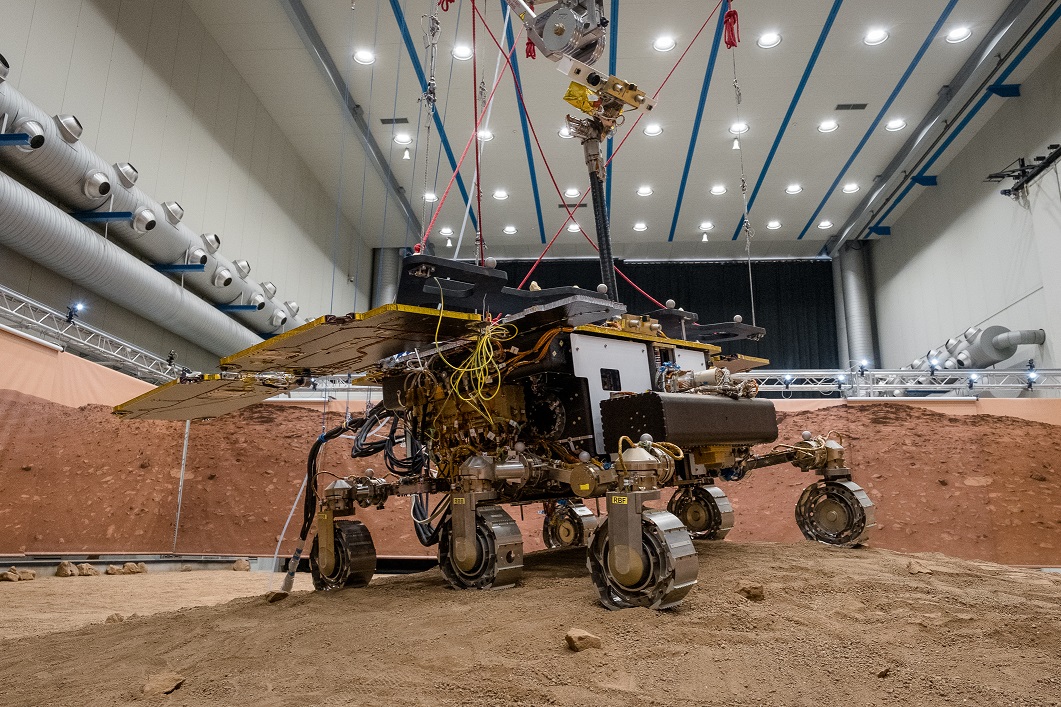
ExoMars Rosalind Franklin rover during tests simulating Martian gravity. Source: ESA
Scientists do not expect to find living organisms. The rover’s goal is to detect biosignatures: chemical, molecular, or structural traces of ancient biological activity from the time when Mars was wet and habitable.
Panspermia and Common Ancestors
One of the mission’s most important questions concerns the panspermia hypothesis. During the early stages of the Solar System, around 3.8–4.1 billion years ago, Earth and Mars experienced intense meteorite bombardment. Rocks blasted into space by powerful impacts could have traveled between the planets.
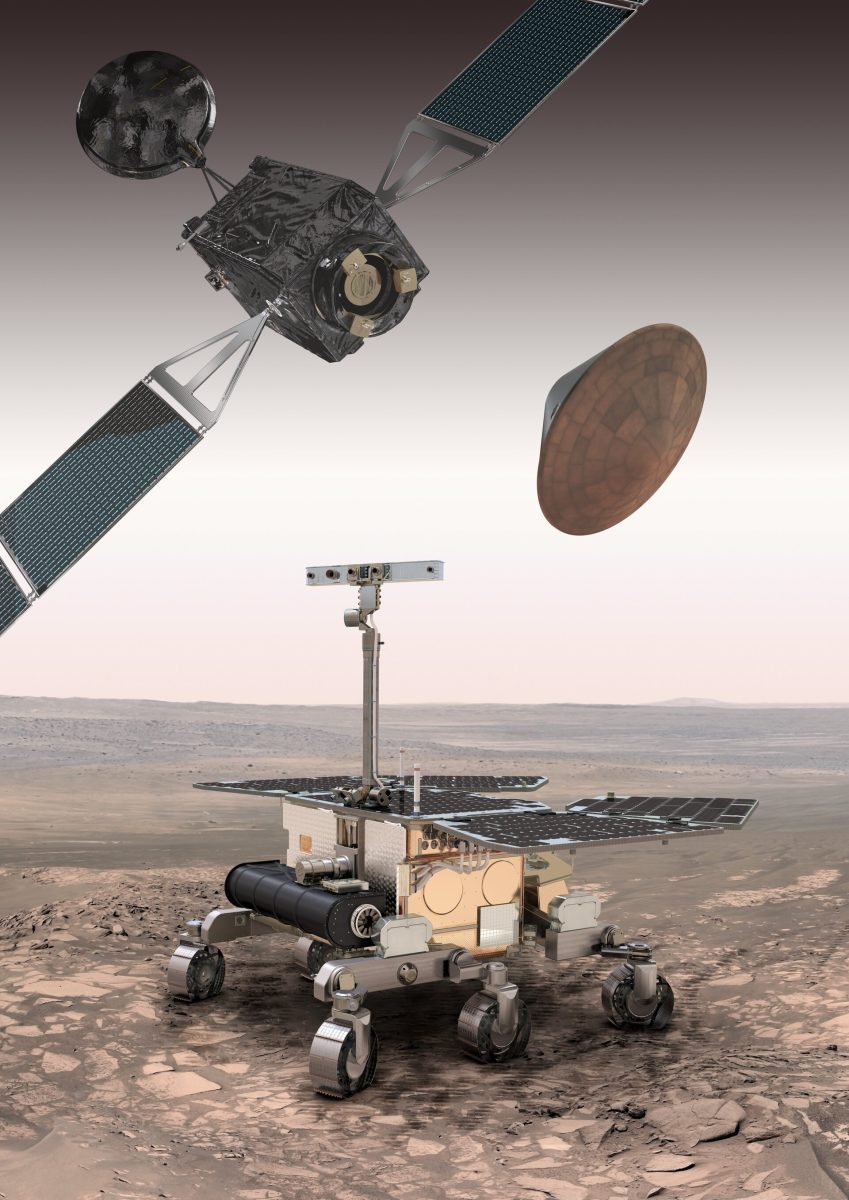
Illustration of the ExoMars Rosalind Franklin rover together with the spacecraft and landing module. Source: ESA
According to Professor of Planetary Mineralogy Susanne Schwenzer, if Martian biosignatures turn out to be similar to those on Earth, this could indicate the existence of a common ancestor. If, however, life on Mars is found to have emerged independently, it would show that biology in the Universe is a natural and widespread phenomenon when suitable conditions are present.
Oxia Planum
The rover will land near the equator in the Oxia Planum region. This location was chosen because of its rich deposits of ancient clay, which formed under prolonged exposure to water about 4 billion years ago. Clay minerals are excellent at preserving organic compounds.
To select the exact drilling site, the rover will use an entire suite of instruments:
a panoramic camera from University College London to analyze the terrain;
an infrared spectrometer from Aberystwyth University to determine mineral composition;
a subsurface sounding radar to assess rock layers before the drill penetrates them.
Independent Decisions from Millions of Kilometers Away
Real-time control of the rover is impossible. A radio signal from Earth to Mars takes between 4 and 21 minutes, depending on the relative positions of the planets. Because of this, Rosalind Franklin will have a high level of autonomy.
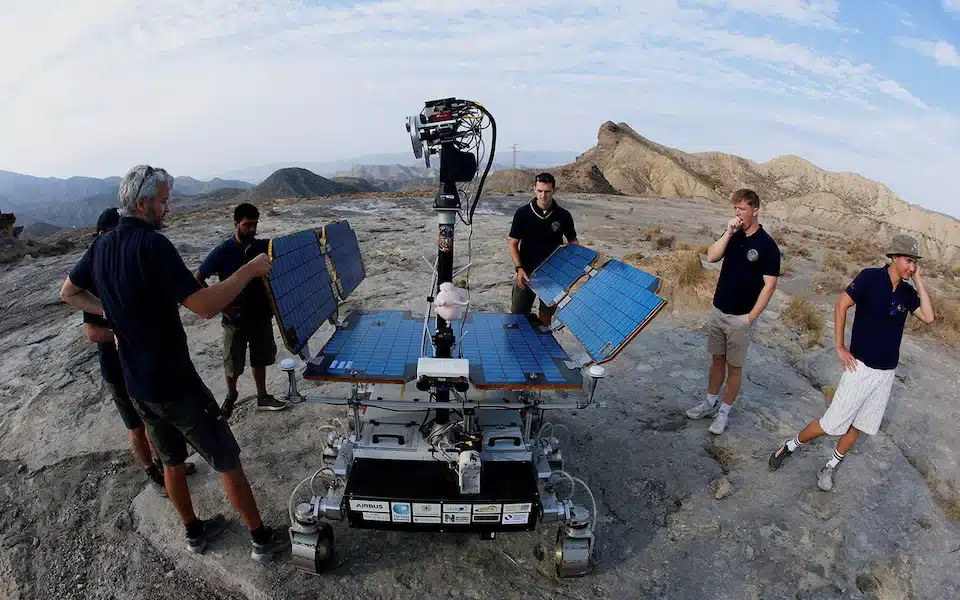
Scientists involved in the mission note that any evidence of life on Mars could indicate a common origin with life on Earth. Source: REUTERS
The control center in Turin, Italy, will send general instructions, but the rover will independently avoid obstacles, choose its route, and carry out drilling. Engineers are currently testing autonomous driving and soil-sampling algorithms in Spain’s Tabernas Desert, whose dry terrain closely resembles that of Mars.
Most planets known to us form alongside their host stars within a shared protoplanetary disk. However, while analyzing data from space observations, an international team of scientists came across something unique: chemical and optical signatures of a gas giant that formed from the material left behind after its star died.
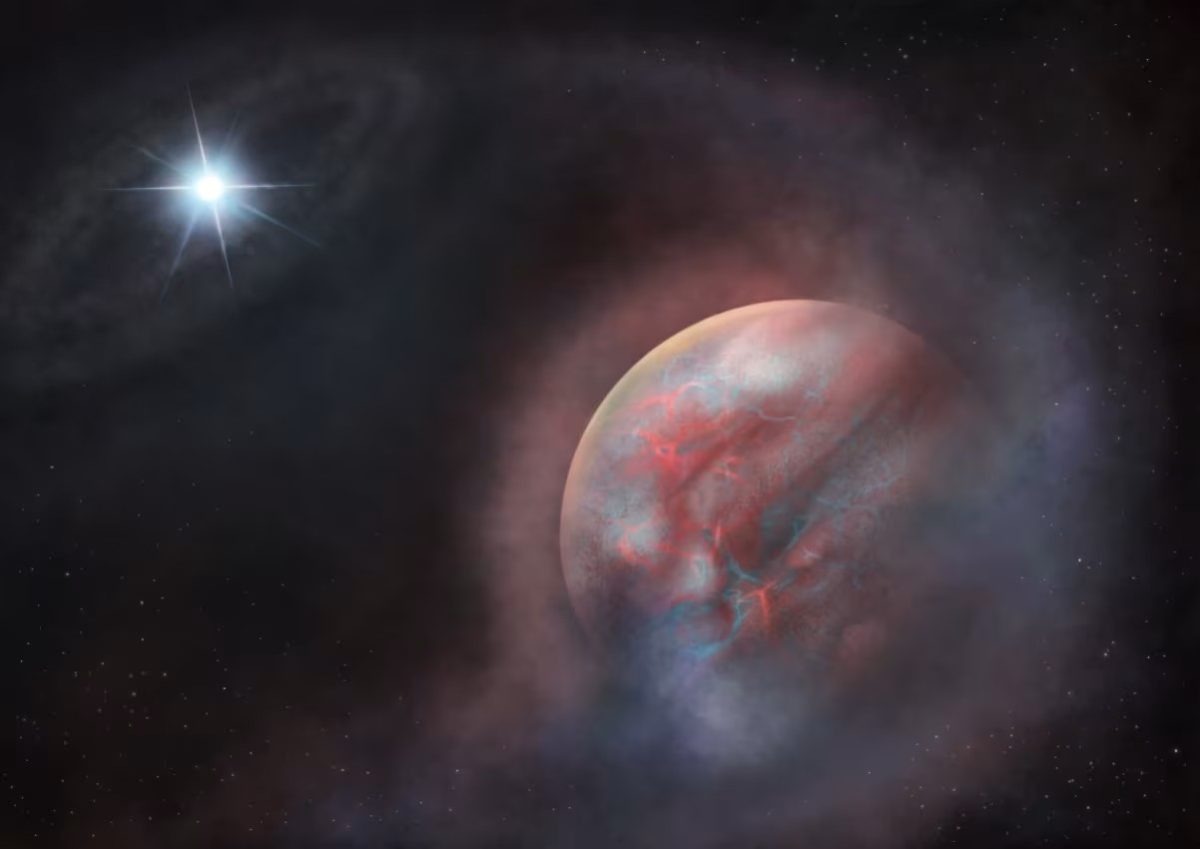
Artist’s illustration of a possible young planet that formed after its star became the white dwarf HS 0209+0832. Credit: Snehalata Sahu / University of Warwick
This young world now orbits the white dwarf HS 0209+0832, located approximately 270 light-years from Earth. The findings describing this phenomenon were published inNature Astronomy.
A Niobium Signature and Clues from TESS
The main evidence for the birth of a second-generation planet came from the unusual composition of the white dwarf’s atmosphere. Using the Hubble Space Telescope, astronomers detected a substantial concentration of niobium on the dead star’s surface.
Heavy elements in white dwarfs usually sink rapidly into the interior under the influence of immense gravity, leaving only the lighter hydrogen and helium at the surface. The presence of niobium indicates that this material arrived at the star from an external source very recently. Scientists believe that intense ultraviolet radiation from the hot white dwarf is literally evaporating the nearby planet’s atmosphere, causing this material to fall onto the star.
Further evidence came from observations by TESS (the Transiting Exoplanet Survey Satellite). The spacecraft recorded regular variations in the white dwarf’s brightness with a period of 4.4 days, characteristic of a large planet passing in front of the stellar disk.
Life from Stardust
The formation of first-generation planets still holds many mysteries, and the mechanism behind the emergence of second-generation planets is even more complex. In the case of HS 0209+0832, scientists propose the following scenario: during its red giant phase, the dying star may have engulfed a close companion, such as a brown dwarf or a small star with about 20% of the Sun’s mass.
This infall prevented the stellar material from dispersing completely into space. Instead, some of the gas and dust began swirling in a dense disk around the remaining stellar core, from which a new exoplanet eventually condensed.
The Future of the Solar System
For the scientific community, this discovery overturns existing ideas about the evolution of planetary systems. White dwarfs cool over tens of billions of years, making their surrounding habitable zones exceptionally stable. If second-generation planets can form under such conditions, they could potentially provide a refuge for life over periods far exceeding the age of our Universe.
The discovery also offers a direct illustration of the future of our own cosmic home. In a few billion years, the Sun will also become a white dwarf. Although Earth will evaporate during this process, a new world could emerge in our system from its remnants and the stellar ashes.
For now, the object near HS 0209+0832 remains a planet candidate. To definitively confirm its existence, the team plans to conduct additional observations using Hubble, Chandra, and the James Webb Space Telescope.
Last week, a 28-year-old employee at an anti-plague institute in the Siberian city of Irkutsk died at a regional hospital just two days after mysteriously falling ill.
Her unusual occupation drew an international media frenzy, sparking fears over another pandemic. The news sounded just a bit too much like the opening to a cheesy medical horror movie, with US secretary of state Marco Rubio saying that the US is “watching and monitoring” the case “closely.”
Former White House COVID-19 response coordinator Deborah Birx called the death “particularly concerning,” saying that the Centers for Disease Control and Prevention are “very much aware and tracking” the situation.
And something about Russian officials’ reassurances hasn’t quite quelled our fears. The deceased worker, Darya Shipilova, was diagnosed with “pneumonia of unknown etiology,” per the Moscow Times — a vague diagnosis that left plenty of questions unanswered.
It’s especially unsettling considering the lab has been studying the pneumonic plague, which develops when “bacteria spread to the lungs of a patient with untreated bubonic or septicemic plague, or when a person inhales infectious droplets coughed out by another person or animal with pneumonic plague,” per the CDC.
The Black Death, a global 14th century pandemic that’s believed to have killed tens of millions of people, included all three forms of plague: bubonic, septicemic and pneumonic.
Russian head of the republic of the neighboring Siberian region Buryatia Alexei Tsydenov at first threw fuel on the fire by claiming in a Telegram post that Shipilova had died of the plague — before adding the word “maybe” to his statement.
Many say there’s no reason to panic. Consumer safety watchdog Rospotrebnadzor said it found no evidence that any lab materials had anything to do with the tragic death and that were no signs of foul play or security breaches. Intriguingly, the watchdog confirmed that contact tracing revealed two cases of COVID-19 and two cases of rhinovirus, according to the Moscow Times — but no plague.
The World Health Organization has since publicly stated that the risk of an epidemic in Russia is low. Spokesperson Christian Lindmeier said in a statement today that “all of the patients’ contacts have reportedly been identified and are being monitored for illness, and none to date have shown symptoms of illness.”
The lab at the institute where Shipilova was employed is currently under lockdown, including 60 of her colleagues, forcing them to sleep on the floors and in chairs.
Characteristically, president Donald Trump appeared to have received some serious mixed messaging from his aides — or struggled to interpret the details for himself.
“I hate to see them having it,” he said, seemingly implying the existence of a plague outbreak in Russia, one of the United States’ biggest adversaries. “We’ll help. Everybody who has that kind of a problem, we’ll always help.”
EXCLUSIVE - I saw unreleased UFO files at a secret meeting in the Tennessee mountains. We prayed after seeing what these 'humanoid beings' did... the world is not prepared
A pastor who claims he was whisked away to a secret UFO disclosure gathering in the Tennessee mountains has revealed chilling new details about the evidence he was shown.
One of the supposed attendees, Pastor Joseph Zupetz, has disclosed vivid new details about what he saw, warning that the UFO files released by the Trump administration so far are nothing compared to what is still to come.
Far removed from the grainy, blurry UFO footage previously released by the government, Zupetz said he and five other Christian influencers were shown images of non-human beings that were startlingly clear and sent chills down his spine.
The pastor said the secretive meeting, whose attendees he declined to identify, was organized by 'personnel now working within groups that investigate non-human intelligence issues involving UAPs (Unidentified Anomalous Phenomena) and reverse-engineered craft.'
'I was shown images that some of the people who were presenting to us had on their devices of real entities that they personally took photos of,' Zupetz told the Daily Mail.
'They took images of entities standing in the woods. They were very tall, they had very long appendages, some of them almost looked, and this is a crude way of saying it, almost like humanoid squid-type things.'
Congress recently requested 46 UFO videos from the Department of War, including one that viewers have claimed shows an angel flapping its wings
He claimed that other images featured 'tall, lanky, light beings,' with some completely see-through.
Then, after leaving the two-hour meeting and boarding his flight back to Colorado, he noticed several glowing orbs hovering in the sky in the distance.
He recorded the strange encounter and shared the footage with the Daily Mail.
Zupetz said that during the flight, the plane was shaken so violently that he and other passengers began to pray.
When they looked back out the window, the orbs were gone from their view.
'We were flying in an aircraft, and we truly had an encounter with six orbs right outside the plane,' he said.
'We began to pray, and it stopped trembling. I thought that was very interesting. Now, maybe it was just turbulence, and we had a psychosomatic episode.'
But, according to the pastor, he is convinced it was demonic and fears the encounter was linked to the meeting he had just attended.
'Here I am, a faith-filled believer, and I'm seeing this, and it's making me question, like, okay, what is this? Is this demons? Is this angels? Is it high-level tech?' the pastor said.
Zupetz was one of several influential faith leaders who claimed to have attended private meetings held in Tennessee in February, where former government officials warned that information expected to be released this year could have profound implications for Christian beliefs.
The Daily Mail could not confirm that the meetings took place. But the evangelist Tony Merkel told us that he helped organize the meeting and was also in attendance.
Pastor Joseph Zuptz says he attended one of three secret meetings between faith leaders and former intelligence officials who believe UFO disclosure will shake the Christian faith
Faith leaders at multiple secret meetings throughout the US were allegedly shown images of real extraterrestrials, including a squid-like being with long limbs (Stock Image)
Merkel said the idea was to bring in key ministers who have a large reach within the Christian community to prepare people of faith for the potential disclosure of aliens.
On June 12, the third tranche of declassified files was released to the public, containing hundreds of pages of documents, images, videos and even audio recordings from NASA space flights.
However, Zupetz has admitted that he and his followers have not been shocked or convinced that extraterrestrial life existed after seeing these initial releases.
To this point, only a handful of videos disclosed by the Pentagon have shown clear footage of alleged UFOs, mostly metallic orbs, flying over the planet in great detail.
However, after attending the meeting in Tennessee, Zupetz and others were convinced the slow drip of UFO content from the government is designed to build a 'normalcy bias,' making strange things seem ordinary, to set up for a potentially Earth-shattering reveal in future.
'They're going to continue to drip these things, drop them slowly, and it's not going to be shock and awe in the beginning. And this is what we were told,' Zupetz explained.
'Eventually, they will bring out an entity, a non-human biologic that they will either have speaking or communicating with, and when they do this, then it's going to be a little more shaking.'
The Pentagon's main UFO investigative unit has claimed that most reports of mysterious phenomena in the sky have been caused by explainable things, including balloons, drones and even bird sightings.
To date, six batches of files have been released.
A video released in the first wave of UFO files appeared to show a glowing object resembling an 'eight-pointed star' with uneven arms that has been compared to a craft from biblical times
Yet, despite the ongoing file dumps from the Pentagon and multiple members of Congress saying more evidence of real UFOs exists, the US government has maintained that there is no physical proof that aliens exist.
However, Zupetz and other faith leaders have presented an alternative theory, calling the appearance of strange craft, glowing orbs and non-human figures evidence of 'fallen angel technology.'
The theory argues that UFO sightings that cannot be explained as advanced human technology or natural phenomena may actually be interdimensional beings described in the Bible and the controversial Book of Enoch.
'I believe that they are fallen angel tech, or it is interdimensional abilities afforded to angels, rogue spirits or demonic powers that can manifest and appear,' Zupetz said, referring to the origins of the unexplained phenomena in our skies.
'I believe that is the big false flag thing, and the agenda they'll bring forward is saying, we originally are the ones that [seeded] you here.
'The Bible you read is close, but it's not perfectly accurate, because now we're here to enlighten humanity, raise your consciousness, and bring you higher.'
Zupetz shared images of six orbs that surrounded his plane while leaving the secret meeting in Tennessee
Zupetz said his plane began shaking as the orbs surrounded the aircraft, and only stopped when the passengers began praying
Zupetz said believers who find themselves faced with similar sightings and questioning their faith should speak the name of Jesus during their encounters.
The pastor claimed that genuine good entities would respond positively, while deceptive ones would be triggered negatively.
The pastor also cited Steven Spielberg's latest film, 'Disclosure Day,' and the famed director's comments regarding believers in Jesus as more evidence of an ominous narrative being formed, which aligns with the Bible's darkest chapters.
During a CBS News interview, Spielberg reflected on how confirmation of intelligent life beyond Earth could affect religious faith, saying, 'The movie also takes the position of the church.
'What does this do to the fundamental beliefs that many of us have? Is God our God only on this planet? Or is God a god for every system where there's civilization and intelligent life, and even developing life?'
Zupetz said: 'When this disclosure happens, it's the narrative attached to it that'll become more and more negative towards Christianity.'
RELATED
Unreleased UFO files seen by Pastor at a secret meeting in the Tennessee mountains #fyp #viral #news
Secret Pastor UFO Meeting Was NOT What Anyone Told You
Pastors Briefed on UFO Disclosure — Perry Stone’s Claims About Preparing Congregations
A mysterious hole on the moon's surface could open into a vast underground world.
NASA has selected a project to investigate the opening, known as the Marius Hills Pit, and determine whether it leads to a cavern that could shelter future astronauts from radiation and extreme temperatures.
The project, known as the Geophysical Instruments for Marius Lunar Pit Investigation (GIMLI), will combine ground-penetrating radar, seismic sensors and a device to measure the the local gravitational field to see below the surface.
Located in one of the moon's most volcanically varied regions, the pit is about as deep as a 10-story building is tall, with an opening roughly the size of an American football field.
It is one of about 300 pits identified on the lunar surface, some of which could provide entrances to caves formed by ancient volcanic activity. It was found by Japan's SELENE spacecraft in 2009.
The team, which announced the project on Monday, said it also plans 'to study more than the possible underground structure.'
The surrounding area has experienced a long history of volcanic activity, and the walls of MHP expose layers of regolith and lava flows that normally remain buried.
Examining these layers could show how lava once moved across and beneath the lunar landscape and whether individual eruptions were separated by long intervals.
NASA has selected a project to investigate a hole on the lunar surface, known as the Marius Hills Pit. The initiative will determine whether it leads to a cavern that could shelter future astronauts from radiation and extreme temperatures
NASA has tapped the Planetary Science Institute (PSI) to lead the investigation.
The American space agency said that if such a cavern exists beneath the lunar surface, it could one day protect astronauts from radiation and the dramatic temperature swings on the lunar surface.
Radiation levels on the lunar surface are roughly 2.6 times higher than on the International Space Station (ISS), which orbits about 250 miles above Earth's surface, and about 200 times higher than on Earth.
If astronauts were exposed to such levels, they would face serious health risks, including cancer, cell damage and acute radiation sickness.
Rather than relying only on observations from above, GIMLI will provide researchers with an opportunity to examine Marius Hills Pit directly from the lunar surface.
PSI Associate Director and Senior Scientist Than Putzig said in a statement: 'It's long been a desire of mine to reintroduce intentional active-source seismic methods to planetary science, as it has essentially not been done since the Apollo astronauts conducted the first seismic surveys on the moon.
'Combining that method with ground-penetrating radar and gravity measurements makes it all the more exciting, as these methods together will allow us to get a much better understanding of subsurface properties, including the anticipated detection of a lava tube extending away from the Marius Hills Pit.'
Even if an underground cave is not found, lunar pits are valuable because their walls expose otherwise hidden geology.
Located in one of the moon's most volcanically varied regions, the pit is about as deep as a 10-story building is tall, with an opening roughly the size of an American football field
Any underground spaces connected to them could also preserve evidence of the volcanic processes that helped shape the moon.
Gareth Morgan, PSI Senior Scientist and Deputy Principal Investigator on the GIMLI program, said: 'Confirming a substantial lava tube would give us an insight into how volcanism operated on the moon.
'Lava tubes are a common feature of basaltic volcanism on Earth, so identifying them on the moon means we could use knowledge of such terrestrial caves to better understand lunar history.'
When the crew reaches the moon, two astronauts will descend to the surface and spend approximately a week near the South Pole of the moon conducting new science before returning to lunar orbit to join their crew for the journey back to Earth.
RELATED
NASA Found a Hidden Cave on the Moon — Here's Why It Matters
Meer van UFO'S of UAP'S, ASTRONOMIE, RUIMTEVAART, ARCHEOLOGIE, OUDHEIDKUNDE, SF-SNUFJES EN ANDERE ESOTERISCHE WETENSCHAPPEN - DE ALLERLAATSTE NIEUWTJES


 Mars mystery solved: Scientists reveal the secret behind ‘impossible’ giant cloud that appears and vanishes every day




 Lockheed SR-71 Blackbird with an experimental propulsion system from NASA in 1998.
Photo: NASA
 Lockheed SR-71 Blackbird
 Lockheed SR-71 Blackbird in a hangar before testing for NASA.
Photo: NASA
 Lockheed SR-71 Blackbird taking off.
Photo: NASA