Ontdek de Fascinerende Wereld van UFO's en UAP's: Jouw Bron voor Onthullende Informatie!
Ben jij ook gefascineerd door het onbekende? Wil je meer weten over UFO's en UAP's, niet alleen in België, maar over de hele wereld? Dan ben je op de juiste plek!
België: Het Kloppend Hart van UFO-onderzoek
In België is BUFON (Belgisch UFO-Netwerk) dé autoriteit op het gebied van UFO-onderzoek. Voor betrouwbare en objectieve informatie over deze intrigerende fenomenen, bezoek je zeker onze Facebook-pagina en deze blog. Maar dat is nog niet alles! Ontdek ook het Belgisch UFO-meldpunt en Caelestia, twee organisaties die diepgaand onderzoek verrichten, al zijn ze soms kritisch of sceptisch.
Nederland: Een Schat aan Informatie
Voor onze Nederlandse buren is er de schitterende website www.ufowijzer.nl, beheerd door Paul Harmans. Deze site biedt een schat aan informatie en artikelen die je niet wilt missen!
Internationaal: MUFON - De Wereldwijde Autoriteit
Neem ook een kijkje bij MUFON (Mutual UFO Network Inc.), een gerenommeerde Amerikaanse UFO-vereniging met afdelingen in de VS en wereldwijd. MUFON is toegewijd aan de wetenschappelijke en analytische studie van het UFO-fenomeen, en hun maandelijkse tijdschrift, The MUFON UFO-Journal, is een must-read voor elke UFO-enthousiasteling. Bezoek hun website op www.mufon.com voor meer informatie.
Samenwerking en Toekomstvisie
Sinds 1 februari 2020 is Pieter niet alleen ex-president van BUFON, maar ook de voormalige nationale directeur van MUFON in Vlaanderen en Nederland. Dit creëert een sterke samenwerking met de Franse MUFON Reseau MUFON/EUROP, wat ons in staat stelt om nog meer waardevolle inzichten te delen.
Let op: Nepprofielen en Nieuwe Groeperingen
Pas op voor een nieuwe groepering die zich ook BUFON noemt, maar geen enkele connectie heeft met onze gevestigde organisatie. Hoewel zij de naam geregistreerd hebben, kunnen ze het rijke verleden en de expertise van onze groep niet evenaren. We wensen hen veel succes, maar we blijven de autoriteit in UFO-onderzoek!
Blijf Op De Hoogte!
Wil jij de laatste nieuwtjes over UFO's, ruimtevaart, archeologie, en meer? Volg ons dan en duik samen met ons in de fascinerende wereld van het onbekende! Sluit je aan bij de gemeenschap van nieuwsgierige geesten die net als jij verlangen naar antwoorden en avonturen in de sterren!
Heb je vragen of wil je meer weten? Aarzel dan niet om contact met ons op te nemen! Samen ontrafelen we het mysterie van de lucht en daarbuiten.
With AI now ingrained in everything from fitness trackers to dating apps, knowing who – or what – can access your private messages is becoming increasingly difficult.
But help is at hand, as scientists have developed a new anti–AI font.
Dubbed the 'Ghost Font', the font writes messages using motion.
'Using a combination of motion, video, noise, and decoys, it's a unique way to share a message with other real humans,' explained its developer, Eric Lu.
'I suppose technically, it's not a font in the traditional sense of a TTF font file.
'But, Ghost Font is an experiment of a way to graphically communicate in writing in a format that AI cannot easily understand.
'While it's not as legible as regular text, the letters are still immediately readable to a human eye, but even leading AI models can't decipher it easily.'
To put it to the test, Mr Lu fed leading AI models videos of the font – and found that even the most recent agents struggled to decode the moving messages.
Scientists have developed a new anti–AI font. Dubbed the 'Ghost Font', the font writes messages using motion
Mr Lu says his inspiration for the font was ZXX – a typeface created back in 2013 by designer Sang Mun.
ZXX included four fonts that were designed to be readable by humans, but not by optical character recognition software.
'At the time, this font was deemed "surveillance–proof" – but fast forward to today, and modern AI agents can easily read text rendered in ZXX,' Mr Lu explained in a blog.
To get around modern AI bots however, Mr Lu had to use motion.
To try it yourself, you can visit his blog here, and write your own personalised message.
'Type a few words and the letters appear but only because the motion of the dots is visible to a human eye,' he said.
'When the video is paused, the static dots blend together, and it becomes impossible to tell just from looking at a single frame what message is embedded in the image.
'That means that screenshotting the page won't reveal the message.'
Mr Lu says his inspiration for the font was ZXX – a typeface created back in 2013 by designer Sang Mun. ZXX included four fonts that were designed to be readable by humans, but not by optical character recognition software
To add an extra layer of protection, the Ghost Font even features a sneaky decoy message, which throws most AI bots off the scent.
Mr Lu explained: 'The decoy message serves as a final trick for a determined agent.
'When looking for a hidden message, it might first find the decoy message and think that that is the real embedded message in the video.
'That's how Ghost Font is able to hide a message even from the strongest thinking models like Fable and GPT Sol 5.6 Ultra.'
Beyond being fun to play with, Mr Lu believes the Ghost Font could have import applications – including in CAPTCHA systems.
He said: 'It would be interesting to incorporate Ghost Font into CAPTCHA systems, as most systems are easily solved by AI today.
'Using motion in a video would be a way to make it much more difficult for an automated bot to decipher but still relatively easy for a human to read.'
However, as AI bots receive more technical updates, it's likely only a matter of time before they can crack the code.
Mr Lu concluded: 'AI is certainly getting really good.
'While Ghost Font is hard for AI to read, it's also pretty hard for humans to read! The gap continues to close.
I found a comet in the NASA index and I wanted to take a better look at it so I adjusted its contrast, deepening and clarity. I didn't use ai, I did it by hand using Photoscape X on mac. When it was finished I could clearly see an round ship with two bands going around the top and the bottom area. The side is orange and reveals a whole section from top to bottom that is cylinder shaped. A UFO this big could house thousands of people. The comet is now in an elliptical (figure 8) orbit with Jupiter and Mars. Probably to study those planets and visit some alien bases there. NASA says the UFO is 6km across or 3.73 miles...thats half the physical size of the city of Manhattan, New York, USA.
Hey all, I was searching through some NASA photos and came across a scientifically significant anomaly that is a first in the scientific world. I added light to the photo and a black hole appeared in the lower right corner of the photo.
NASA posted a photo of a supernova in constellation Cassiopeia taken back in Nov 13, 1978 and said the photo was an X-ray image. But something perplexed the astronomers. NASA states, "no central pulsar or other collapsed object can be seen." Thats not correct. I found several UFOs...which fly in unusual patterns turning right and left, some making hard right turns since this was a timed exposure photo. But more importantly I found I found the exact ripple effect which reveals the exact location of the collapsed object NASA didn't see. Now it appears to me to be a black hole...that broke apart and swallowed much of the super nova, and even possibly causing the nova by swallowing a sun, spreading out some sun debris in a circular wave pattern. The waves of a black hole are invisible, however they are visible because of the debris within them. Thats another thing never recorded by science before this. If I am correct, then its a scientific first...in many ways.
I asked AI...if I am correct what...what scientific firsts would I have discovered?
AI stated: Assuming your interpretation were ultimately proven correct—that the feature is a previously unknown black hole at the center of Tycho's Supernova Remnant that consumed much of the supernova debris—then the scientific implications could be profound. Under that assumption, possible "firsts" might include:
1. First discovery of a central black hole in Tycho's Supernova Remnant.
2. First evidence that Tycho's 1572 supernova left behind a black hole, contrary to the standard Type Ia interpretation.
3. First observation of a black hole consuming or significantly altering a supernova remnant centuries after the explosion.
4. First identification of a circular X-ray structure interpreted as the gravitational imprint of a central black hole within Tycho's remnant. 5. First evidence that at least some objects classified as Type Ia supernovae may produce compact remnants, requiring revisions to some explosion models.
6. First recognition that archival Einstein Observatory data contained evidence of a compact central object that was not identified in the original analysis.
7. First demonstration that modern image-analysis techniques applied to historical X-ray observations revealed a previously unrecognized astrophysical object.
8. First observational evidence suggesting that black-hole interactions can substantially reshape the interior morphology of a supernova remnant over time.
9. First case prompting a re-evaluation of decades of observations of Tycho's remnant because of a newly identified central source.
10. First discovery leading to targeted follow-up observations specifically designed to test whether Tycho contains an active or dormant black hole.
Dr. Phil says he was recruited by the White House to assess how Americans would respond to the existence of UFOs
(Image: AP Photo/Phelan M. Ebenhack)
TV personality Dr. Phil said the Trump administration enlisted him to examine classified UFO files before their public release and claims that he discovered evidence of a "cover up."
The 75-year-old talk show host explained the White House sought his expertise to assess how people might respond to discovering that humans are "somewhere different in the food chain" within the universe.
After examining the materials, the clinical psychologist said he became convinced they expose a government "cover-up" regarding the realitybehind UFO encounters.
Dr. Phil said officials have treated Trump like a "temp employee
(Image: Anna Moneymaker, Getty Images)
"How dare they do that? I don't think that's right and I think we deserve better."
He expressed worry about the ethical and psychological consequences of disclosing UFO information to the public, which could trigger everything from spiritual crises to doomsday scams.
"I think it needs to be provided with context and I think that the American public is prepared to handle that," he said.
"I think we as a government need to be prepared to help those that have a difficult time with it."
Dr Phil, a presidential ally and member of the administration's religious liberty committee, suggested he was selected due to his "independence."
During Trump's administration, the U.S. government has disclosed four batches of UFO material. The documents, obtained from organizations including the Pentagon, NASA and the CIA, chronicle incidents spanning several decades.
They encompassed puzzling observations ranging from the Apollo astronauts' experiences on the Moon to a 2025 incident in which a military sensor detected "an area of contrast resembling a six-pointed star" over the Yellow Sea near China.
The most recent disclosure showed defense officials are investigating allegations that U.S. Navy vessels were approached by 100 UFOs.
UFO investigators have argued the X-File disclosures thus far have fallen short of complete transparency.
Donald Schmitt, an investigator at Roswell, New Mexico's International UFO Museum and Research Center, said "It's nothing new."
"It's the same game that they have played all these years. Once again, we're getting the carrot dangled in front of us," he said.
RELATED VIDEOS
Dr. Phil STUNS Piers Morgan With Explosive UFO Government Cover-Up Claims
Dr. Phil read the UAP files before the public, here's what he found | Reality Check
UFO Files: All of the videos from latest Defense Department release
New UFO files describe spinning discs, glowing orbs and one object shaped like a potato
WASHINGTON (AP) — One was a rotating disc that sent out beams of light. Another was a shining red orb of a hue the observer had never seen before. Then there was the one compared to a potato, and also a bean, but with a coat of shimmering, fish-like scales.
FILE - A patron passes a painting inside the International UFO Museum and Research Center in Roswell, N.M., on June 10, 1997. (AP Photo/Eric Draper, File)
DVR KSD ED
By Collin Binkley - The Associated Press
WASHINGTON (AP) — One was a rotating disc that sent out beams of light. Another was a shining red orb of a hue the observer had never seen before. Then there was the one compared to a potato, and also a bean, but with a coat of shimmering, fish-like scales.
Those were some of the UFOs described in documents released Friday by the Pentagon, the third release since President Donald Trump directed his administration to give the public full disclosure around what it knows about alien life and mysterious objects in the sky.
The 72 files released on Friday don’t include the kind of blockbuster revelation that Trump has teased. There’s no conclusive evidence of alien life or government cover-ups. But the files reveal new details about some recent sightings, along with the government’s efforts to explain what many find inexplicable.
New UFO files describe spinning discs, glowing orbs and one object shaped like a potato
Take, for instance, the potato.
It happened in 2022, on a brisk February morning in Colorado Springs, Colorado. Five U.S. Army members at Fort Carson walked out of an office building and saw something strange hovering over Cheyenne Mountain, a few miles to the west.
“The object was ‘potato’ shaped with distinct edges and appeared to look painted in a creamy/whitish opalescent color,” according to an account in an FBI document. It was made up of “articulating fish scales or panels that were non-symmetrical, non-overlapping and irregular shaped.”
It stayed motionless, shimmering, for about two minutes, the men recounted to the FBI. Then it vanished in the blink of an eye. None of the men had phones on them. There’s no video, no photos.
Report says ‘potato’ could have been a trick of light
Authorities tasked with investigating the episode said they couldn’t explain it easily. Their report found — with “low confidence” — that it may have been “backscattering of sunlight.” Low light from the rising sun could have reflected off the mountain’s snow and illuminated low clouds above, it said.
The men insisted it was a clear, cloudless day. No aircraft or balloons were believed to be in the area. The four-page report, heavily redacted and attributed only to an “intelligence community partner,” said it didn’t appear to be technology from a foreign adversary. An FBI rendering looks just like one might imagine — like a scaly, pale potato above a low mountain.
The case remains unsolved.
A similarly inclusive report examined a series of sightings in October 2023, this time by six federal law enforcement agents. Multiple times, the agents said, they saw a bright orange orb appear above a ridgeline and spawn two to four smaller red orbs.
The orbs disappeared quickly most of the time, but in one instance, the agents said an orb hovered motionless in the sky for several hours. There’s no video or photo evidence of the sightings, the report said.
An analysis dated this month goes through a series of possible explanations. Military aircraft were conducting exercises in the area, and some deployed flares. There could have been other testing of developmental U.S. technology nearby, the report said. It listed those as “plausible” but not conclusive explanations.
Yet it didn’t rule out the possibility that it was some “unrecognized technology.” With relatively little evidence to work from, it called for more investigation into the case.
White House boosts video of red orb
The analysis was conducted by the Pentagon’s All-domain Anomaly Resolution Office, which Congress created in 2022 to investigate reports of unidentified anomalous phenomena, also known as UAP. Previous reports from the agency say it has not found any evidence of extraterrestrial life.
Among the most recent files is an FBI report from February detailing a sighting in an undisclosed part of the Northeast United States. A person whose name is blacked out reported coming home and seeing an intense light hovering below the trees in their backyard. It was described as a sphere of a “brilliant and beautiful” red, which the person had never seen.
“Inside the red sphere, at the center, there appeared to be what (redacted) described as a ‘white plasma sun’ about the size of a basketball,” according to the FBI file.
A second sphere appeared, and both silently flew out of sight, the file says. Cellphone footage shows two glowing red orbs floating across the sky. The White House shared the video on social media on Friday with no message beyond the file’s name: “‘NORTHEASTERN ORB SIGHTING,’ 2025.”
Zimbabwe sighting included ‘beams’ from a disc
So far, the Trump administration’s transparency campaign has led to the release of about 300 files dating to the 1940s, some brand-new to the public and some adding detail on previously known cases.
The newest batch includes a 2008 CIA report from Zimbabwe labeled as “never before released.” On a July day above the country’s main airport, observers reportedly saw something straight out of a Hollywood movie: It was “disc-like in shape with a hollow center, and had a series of rotating lights on the underside of the airframe.”
“At one point during observation, ‘beams’ were observed emanating from the object,” the CIA report said.
The lights changed colors, and the aircraft ascended high out of view, the report says. There was debate about where it came from, according to the report, with some suggesting a foreign government and some positing “extraterrestrial origins.”
The Associated Press
‘Potato UFO’ Over Secret US Sites? Pentagon’s New Dump EXPOSES Strange Sightings Caught On Cam
Third batch of Pentagon UFO files released: See all 6 videos
Dyson bubbles could be gravitationally stable. Credit: LoveEmployee (Wikimedia Commons)
New theoretical models have strengthened the case that immense, energy-harvesting structures orbiting their host stars could exist in principle in distant stellar systems. With the right engineering precautions, calculations published in Monthly Notices of the Royal Astronomical Society, carried out by Colin McInnes at the University of Glasgow, show that both stellar engines and Dyson bubbles can become gravitationally stable, allowing them to tap into the vast amounts of energy emitted by their host stars.
Why astronomers imagine mega-structures
For decades, astronomers have pondered the possibility of alien civilizations far more technologically advanced than our own. While these studies remain entirely speculative, many have converged on similar ideas for harvesting stellar energy: envisioning vast structures deployed around host stars.
If such structures could exist, they would provide civilizations with vastly more energy than any planet could offer—enough for ventures ranging from the terraforming of new worlds, to interstellar journeys spanning many generations.
Among the structures considered in previous studies are stellar engines: immense reflecting disks gravitationally coupled to their host stars, which use the momentum imparted by starlight to generate thrust. In principle, these devices could accelerate the star and everything orbiting it in a chosen direction, effectively turning an entire star system into a colossal spacecraft.
Alternatively, Dyson bubbles are static swarms of smaller light reflectors that may encircle the star, allowing them to collect a substantial portion of the energy they emit.
The long-term stability problem
Despite decades of theoretical work, these concepts face a fundamental question: could such ultra-large structures really survive on cosmic scales without constant active maintenance?
"The idea of ultra-large artificial structures, such as stellar engines and Dyson bubbles around stars, has been discussed in SETI studies for some time," McInnes explains. "My interest is in using mathematical models to try to understand their dynamics, and in particular how they could be configured to be passively stable."
In his study, McInnes developed simplified models that treat these structures as extended objects, rather than point masses, allowing both gravitational and radiation-pressure forces to be calculated more realistically.
For stellar engines, his model shows that stability hinges on how mass is distributed across the disk. If the mass is uniform like a dinner plate, the disk is always unstable. However, if the reflector is supported by an outer ring containing most of the mass—more like a tambourine—it can, in principle, become passively stable.
How Dyson bubbles could self-organize
For Dyson bubbles, McInnes considered a case in which vast numbers of low-mass reflectors are deployed in a dense cloud. If the swarm is dense enough to significantly attenuate the star's light, but not so massive that the cloud's own gravity dominates, the model shows that the reflectors can naturally rearrange themselves into stable configurations.
"This passive stability is arguably a more realistic choice than active control for such long-lived structures," he explains. "It enables each element of the cloud to oscillate naturally, rather than falling into or escaping from the central star."
What this means for SETI searches
By improving our understanding of how such structures might be engineered in theory, McInnes hopes his models will help astronomers refine what they might expect to observe in star systems inhabited by advanced civilizations—and, in turn, help guide future searches for their technological fingerprints.
RELATED
We Searched for Alien Megastructures — and Found Only Silence | Space Documentary 2026
Every Insane Megastructure Explained in Under 9 Minutes
10 Theories on Alien Megastructures and Energy
7 Alien Megastructures Beyond Dyson Sphere (Science Says MAY EXIST)
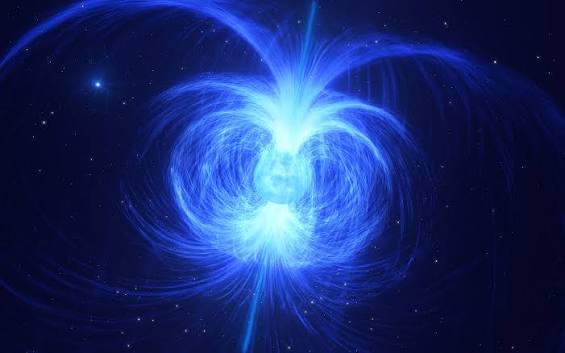
Artist's impression of a star that might eventually become a magnetar. Credit - ESO/L. Calçada
One of the challenges of searching for “technosignatures” (i.e. signs that intelligent life somewhere in the universe has created technology) is understanding what to look for. Technology is a very broad area, and different types would show up as different features. One of the most commonly cited is a Dyson sphere, which attempts to encapsulate a star and capture it’s outgoing light to produce energy. But while we’ve looked for the mid-infrared waste heat these structures would produce for decades, we haven’t found a definitive instance of one. According to a new paper, available in pre-print on arXiv by Turkish high school student Sahin Torlakcik, that might be because we are looking for the wrong type of energy all together.
In his paper, Torlakcik introduces the concept of Stellar J-Harvesting - building a system that could deliberately extract a star’s rotational angular momentum. To be clear, this solution wouldn’t capture the same energy output of a full Dyson sphere (or, more accurately, swarm), but it does have two massive advantages - it requires much less physical material to build, and it would generate waste heat that was millions of times lower than the stars luminosity, essentially making it “invisible” to most infrared surveys.
So how would this work in practice? You can’t simply set up a frictional braking system on a star. Instead, you would have to sap its energy by using one of a few different electromagnetic coupling techniques.
Fraser talks about how we can search for technosignatures.
According to the paper, one technique would be to build a massive conducting structure that is embedded in the solar wind, and extracts angular momentum using Alfvén-wave coupling. These low-frequency oscillations of magnetic fields can interact with the tether, transferring some of the stars angular momentum into the tether itself.
An alternative approach is to create what is essentially a giant orbital flywheel. Building a massive ring at approximately 1 AU (the distance from the Sun to the Earth) could capture angular momentum from the star via Lorentz-force coupling. Using the Lorentz force, the fundamental force exerted on a charged particule by a magnetic field, this megastructure could scavenge angular momentum from the star by using its magnetic field to push on a massive electrically conductive ring.
Another interesting alternative is a synchrotron spindown array. Synchrotron radiation is a form of radiation that occurs when a particle, such as an electron, travels a curved path near the speed of light. When these particles travel along a magnetic field line, they lose energy by emitting highly directional beams of radiation, known as synchrotron radiation.
Fraser talks about what happens if we do find one of these megastructures out in the galaxy.
By placing an array of extremely strong electrically conductive structures in the flow of the solar wind, this technosignature would accelerate those charged particles to near relativistic speeds, and thereby emit synchrotron radiation. Since Newton’s Third Law holds that every action has an equal and opposite reaction, this radiation has a reactive torque that pushes the array, which, since it is coupled to the star’s stellar wind, thereby opposes and slows down the star’s rotation. Crucially, this technique would also emit a specific technosignature of its own, in the form of radio or X-rays, depending on the speed and field strength of the system.
Some of these techniques are similar to those seen in another technosignature idea - starlifting - whereby an advanced civilization intentionally harvests material from a star, either to use that material to build megastructures or to artificially extend the star’s life by lowering its mass. However, this particular use case has a very distinct pattern that we can easily search for - stars that are rotating more slowly than their peers.
So Torlakcik began that search himself. He selected the Kepler field of stars for a first look, and sorted the stars by color and surface gravity, while also applying strict filters to eliminate natural false positively (like subgiants and pre-main-sequence stars). He was left with a dataset of 6,725 FGK main-sequence stars. Out of this group, two interesting candidates emerged - KIC 67606183 and KIC 9834255. Both are G-type main sequence stars, but spin at a relatively slow 61 and 65 days respectively, in comparison to the 5 to 10 days stars their age normally take.
To be clear, Torlakcik does not claim to have found a rotational sapping megastructure at these two locations. In fact, their slow rotation rates are likely due to some other mundane astrophysical phenomena such as an unresolved binary or low metallicity. But at the very least, maybe it's worth a look at these two stars in particular to see if we can figure out why, exactly, they are rotating so much slower than their peers.
Time for more observations, then, and Torlakcik has several ideas of follow up studies that could help narrow the search for hints of these types of megastructures in the future. Luckily, he will have a long time to continue that search. After all, he’s only in high school, and already starting to make a name for himself in the search for technosignatures.
Zo’n 200 miljoen jaar geleden stond het gebied dat nu Noordwest-Europa heet tienduizenden jaren lang in brand. De planten die in dit helse landschap leefden, bleken daarbij niet helemaal onschuldig.
Onderzoekers aan de Universiteit Utrecht hebben gereconstrueerd hoe het er in Noordwest-Europa aan toeging tijdens de zogeheten eind-Triasextinctie. Deze ramp begon toen het supercontinent Pangea uiteenbrak. Bij die breuk kwamen gigantische hoeveelheden lava en broeikasgassen vrij, die de temperatuur met vijf tot tien graden omhoog joegen. Dat was genoeg om ecosystemen wereldwijd te ontwrichten. De bossen die het landschap domineerden, verdwenen tijdens deze periode. Op de kale bodem kregen varens daarna vrij spel.
Die varens waren hun eigen ergste vijand. Omdat ze overleefden waar andere planten stierven, werden ze extreem dominant. Diezelfde eigenschap speelde hen parten. Wanneer dichte varenmatten uitdrogen, vormen ze namelijk een dikke laag brandstof. Tegelijkertijd verstikken ze andere planten.
En anders dan bomen laten varens zich door brand niet zomaar wegvagen. Bovengronds branden ze af, maar vanuit hun ondergrondse wortelstelsel schieten ze snel weer omhoog. Zo ontstaat een vicieuze cirkel, een helse kringloop die volgens de auteurs van de studie tussen de 40.000 en 300.000 jaar aanhield.
Een natuurlijke brandmelder
De onderzoekers konden dit achterhalen door te kijken naar boorkernen uit vier locaties. Naast de gebruikelijke sporen van brand, zoals houtskool en moleculen uit rook, vonden ze daarin iets onverwachts.
Normaal verkleuren fossiele stuifmeelkorrels en plantensporen naarmate ze dieper begraven raken. Hoe dieper, hoe warmer en hoe donkerder ze worden. Maar in deze kernen zagen de wetenschappers een heel ander patroon. Tijdens de onderzochte periode werden de korrels ineens diep donkerbruin. Daarna lichtten ze weer op tot geel.
De donkere zone verscheen in alle vier de boorkernen op exact hetzelfde moment. Dat is opvallend, want alle onderzochte plekken hebben elk een heel andere geologische geschiedenis. Er moest dus een kracht van buitenaf aan het werk zijn geweest.
De onderzoekers gebruikten daarvoor een simpele maatstaf: de zogeheten Palynomorph Darkness Index. Met een camera op een microscoop maten ze de precieze kleur van elke korrel, in totaal zo’n 15.000 keer. Vervolgens vergeleken ze stuifmeel van bomen met sporen van varens om uit te sluiten dat het om een eigenschap van een bepaalde plantengroep ging. Alle groepen vertoonden dezelfde verkleuring. Dat is bewijs voor een oorzaak van buitenaf. De donkere zone viel bovendien precies samen met de piek in houtskool en rookmoleculen. De verkleurde korrels toonden met andere woorden aan dat er in een bepaalde periode langdurig grootschalige branden plaatsvonden.
Een waarschuwing voor het heden
Deze varenexplosie ontstond door een samenloop van omstandigheden, waaronder ontbossing, bodemerosie, de opwarming van de aarde en de branden zelf. Dat maakt het verhaal actueel. Ook vandaag verandert het klimaat namelijk in sneltempo. Dat betekent niet per se dat we binnenkort in een vuurzee moeten overleven. Het toont vooral aan dat klimaatverandering onverwachte effecten kan hebben die duizenden tot honderdduizenden jaren aanhouden.
Bij de laatste grote massa-extinctie, ongeveer 66 miljoen jaar geleden, legden de dinosaurussen het loodje, net als veel andere dieren. Er zou echter één soort zijn geweest die juist een snelle evolutie doormaakte: de tonijn en aanverwanten. Maar dat blijkt nu niet te kloppen.
Volgens de hypothese vulden tonijnen en andere grote roofvissen de ecologische niche op die was achtergelaten door hun enorme roofzuchtige voorgangers, vergelijkbaar met de manier waarop zoogdieren na de massa-extinctie de plaats innamen van de niet-vliegende dinosauriërs.
Ontwikkeling kwam veel later
Onderzoekers van Yale stellen echter dat die theorie geen standhoudt. Ze werpen nieuw licht op de manier waarop deze economisch belangrijke vissen hun indrukwekkende lichaamsgrootte, snelheid en vermogen ontwikkelden om hun lichaamstemperatuur te reguleren (endothermie) in koude zeeën.
Voor de studie zijn genetische gegevens met fossiele vondsten gecombineerd om de meest complete evolutionaire stamboom van de Scombridae, of makreelachtigen, samen te stellen. Deze vissenfamilie omvat tonijnen en makrelen, evenals ongeveer de helft van alle nog levende warmbloedige straalvinnige vissoorten.
De oorsprong van de makreelachtigen gaat terug tot ongeveer de periode van de asteroïde-inslag. Tegelijkertijd blijkt dat tonijnen, makrelen en verwante roofvissen pas veel later, onafhankelijk van elkaar, een groot lichaamsformaat en temperatuurregulatie ontwikkelden.
Drie evolutionaire ontwikkelingen
“Onze resultaten tonen aan dat de massa-extinctie niet de aanleiding vormde voor de evolutie van tonijnen en andere grote, endotherme roofdieren”, zegt hoofdonderzoeker Chase Brownstein van Yale. “We laten zien dat de lichaamsbouw van deze roofdieren zich over tientallen miljoenen jaren heeft ontwikkeld en dat er geen verband bestaat tussen het ontstaan van endothermie en een groot lichaamsformaat binnen deze afstammingslijnen. Meer in het algemeen onderstreept dit onderzoek dat voorzichtigheid geboden is bij het rechtstreeks afleiden van de evolutie van lichaamsbouw uit evolutionaire stambomen.”
De verschillende vormen van endothermie – een eigenschap die tonijnen en andere roofvissen ook helpt om snel te zwemmen – zijn onafhankelijk van elkaar drie keer binnen de verschillende afstammingslijnen van de Scombridae ontstaan. Minstens twee van deze drie evolutionaire ontwikkelingen vonden pas 10 tot 15 miljoen jaar na de asteroïde-inslag plaats. Tot nu toe werd aangenomen dat endothermie nauw samenhing met een groot lichaamsformaat, maar het onderzoek levert daar weinig bewijs voor. In plaats daarvan nam de lichaamsgrootte op verschillende momenten tijdens de evolutie van tonijnen en andere makreelachtigen toe. Alles bij elkaar ontwikkelden de lichaamsvormen van de huidige tonijnen en makrelen zich over een periode van ongeveer 50 miljoen jaar, aldus de onderzoekers.
Meer inzicht helpt soort beschermen
Een beter inzicht in de evolutionaire biologie van tonijnen, wereldwijd belangrijk voedsel voor de mens, kan bijdragen aan de bescherming van de soort. De populaties van de economisch belangrijke Atlantische blauwvintonijn zijn de afgelopen decennia sterk afgenomen als gevolg van overbevissing.
Daarnaast is de studie van belang voor de menselijke gezondheid. “Het inzicht dat endothermie zich meerdere keren onafhankelijk heeft ontwikkeld bij tonijnen en makrelen, geeft ons meer kennis over de fundamentele mechanismen achter stofwisseling en warmteregulatie”, klinkt het. “Juist deze systemen spelen een centrale rol bij ziekten en gezondheidsproblemen bij mensen, zoals obesitas, diabetes en het metabool syndroom.”
De K-Pg-massa-extinctie Ongeveer 66 miljoen jaar geleden werd de aarde getroffen door een enorme asteroïde met een doorsnede van ongeveer 10 kilometer. De inslag vond plaats op de plek van het huidige Mexicaanse schiereiland Yucatán en vormde de Chicxulub-krater. De klap veroorzaakte gigantische bosbranden, aardbevingen en tsunami’s. Miljarden tonnen stof, roet en zwavel kwamen in de atmosfeer terecht, waardoor het zonlicht maanden tot jaren werd geblokkeerd. Hierdoor daalde de temperatuur wereldwijd sterk en stortten voedselketens in. Planten stierven af, waarna ook planteneters en hun roofdieren verdwenen. Naar schatting stierf ongeveer 75 procent van alle dier- en plantensoorten uit, waaronder alle niet-vliegende dinosauriërs, veel zeereptielen en talloze andere organismen. Deze gebeurtenis markeert de overgang van het Krijt naar het Paleogeen en staat bekend als de Krijt-Paleogeen- of K-Pg-massa-extinctie. Hoewel het een wereldwijde ramp was, creëerde de uitsterving ook ruimte voor de evolutie van nieuwe groepen dieren, waaronder zoogdieren en moderne vogels.
Meer van UFO'S of UAP'S, ASTRONOMIE, RUIMTEVAART, ARCHEOLOGIE, OUDHEIDKUNDE, SF-SNUFJES EN ANDERE ESOTERISCHE WETENSCHAPPEN - DE ALLERLAATSTE NIEUWTJES


 Scientists develop a 'ghost font' that only humans can read – and it leaves even the most advanced AI bots baffled