Naar de inhoud

UFO'S of UAP'S, ASTRONOMIE, RUIMTEVAART, ARCHEOLOGIE, OUDHEIDKUNDE, SF-SNUFJES EN ANDERE ESOTERISCHE WETENSCHAPPEN - DE ALLERLAATSTE NIEUWTJES

UFO's of UAP'S in België en de rest van de wereld
akke.beakke.be
Ontdek de Fascinerende Wereld van UFO's en UAP's: Jouw Bron voor Onthullende Informatie! Ben jij ook gefascineerd door het onbekende? Wil je meer weten over UFO's en UAP's, niet alleen in België, maar over de hele wereld? Dan ben je op de juiste plek! België: Het Kloppend Hart van UFO-onderzoek In België is BUFON (Belgisch UFO-Netwerk) dé autoriteit op het gebied van UFO-onderzoek. Voor betrouwbare en objectieve informatie over deze intrigerende fenomenen, bezoek je zeker onze Facebook-pagina en deze blog. Maar dat is nog niet alles! Ontdek ook het Belgisch UFO-meldpunt en Caelestia, twee organisaties die diepgaand onderzoek verrichten, al zijn ze soms kritisch of sceptisch. Nederland: Een Schat aan Informatie Voor onze Nederlandse buren is er de schitterende website www.ufowijzer.nl, beheerd door Paul Harmans. Deze site biedt een schat aan informatie en artikelen die je niet wilt missen! Internationaal: MUFON - De Wereldwijde Autoriteit Neem ook een kijkje bij MUFON (Mutual UFO Network Inc.), een gerenommeerde Amerikaanse UFO-vereniging met afdelingen in de VS en wereldwijd. MUFON is toegewijd aan de wetenschappelijke en analytische studie van het UFO-fenomeen, en hun maandelijkse tijdschrift, The MUFON UFO-Journal, is een must-read voor elke UFO-enthousiasteling. Bezoek hun website op www.mufon.com voor meer informatie. Samenwerking en Toekomstvisie Sinds 1 februari 2020 is Pieter niet alleen ex-president van BUFON, maar ook de voormalige nationale directeur van MUFON in Vlaanderen en Nederland. Dit creëert een sterke samenwerking met de Franse MUFON Reseau MUFON/EUROP, wat ons in staat stelt om nog meer waardevolle inzichten te delen. Let op: Nepprofielen en Nieuwe Groeperingen Pas op voor een nieuwe groepering die zich ook BUFON noemt, maar geen enkele connectie heeft met onze gevestigde organisatie. Hoewel zij de naam geregistreerd hebben, kunnen ze het rijke verleden en de expertise van onze groep niet evenaren. We wensen hen veel succes, maar we blijven de autoriteit in UFO-onderzoek! Blijf Op De Hoogte! Wil jij de laatste nieuwtjes over UFO's, ruimtevaart, archeologie, en meer? Volg ons dan en duik samen met ons in de fascinerende wereld van het onbekende! Sluit je aan bij de gemeenschap van nieuwsgierige geesten die net als jij verlangen naar antwoorden en avonturen in de sterren! Heb je vragen of wil je meer weten? Aarzel dan niet om contact met ons op te nemen! Samen ontrafelen we het mysterie van de lucht en daarbuiten.

Archief

Is Earth entering a sixth mass extinction? Scientists reveal the warning signs

Is Earth entering a sixth mass extinction? Scientists reveal the warning signs

A single nuclear bomb could wipe out a city

©Provided by The Daily Digest

Concern among experts

Approximately 66 million years ago, a massive asteroid impact brought an end to the age of the dinosaurs and triggered Earth’s fifth mass extinction. Today, scientists warn that the planet may be entering a sixth mass extinction event, driven not by a cosmic collision but by accelerating human-driven changes to the natural world.

An understudied field

©Provided by The Daily Digest

A new mass extinction
A team led by Prof. Robert Cowie, from the University of Hawaii, argues in a study published by Biological Reviews that it “seems increasingly likely” that we’re in the early stages of a new mass extinction.

It is happening

©The Daily Digest

It is happening
“Denying it is simply flying in the face of the mountain of data that is rapidly accumulating, and there is no longer room for skepticism, wondering whether it really is happening,” argues Cowie, as quoted by news website Vice.

Malawi is an excellent location to go on a safari

©Provided by Showbizz Daily (English)

What is a mass extinction?
A mass extinction occurs when around 70% of animal and plant life cease to exist. In other words, it’s a global catastrophe where biodiversity and the ecosystem are up for grabs.

Mollusks

©Provided by The Daily Digest

Mollusks
Cowie’s study focuses on invertebrate animals, specifically mollusks. The team behind the study considers that the International Union for Conservation of Nature provides disproportionate attention given to vertebrates, such as birds and mammals.

Animal diversity

©Provided by The Daily Digest

Image: Ed van Duijin / Unsplash

Animal diversity
“The International Union for Conservation of Nature has not evaluated any but a tiny, tiny fraction of invertebrates such as insects and snails and spiders and crustaceans, which constitute 95 percent of animal diversity,” Cowie told Vice.

A tiger with a pouch

©Provided by Showbizz Daily (English)

Pictured: A Tasmanian tiger (Thylacine), which was declared extinct in 1936, is displayed at the Australian Museum in Sydney.

Since 1500
The study made by Cowie and his team indicates that something around 7.5% to 13% of species has disappeared since 1500, which suggests that we’re heading towards mass extinction.

 It's our fault

©Provided by The Daily Digest

It's our fault
If we’re indeed heading towards the sixth mass extinction, it would be the first that we know of caused by the intervention of a species. In this case, humans.

The biggest polluter

©Provided by The Daily Digest

The Anthropocene
In fact, the human effect on the environment is so intense that many scientists posit that we live in a new geological epoch: The Anthropocene, which began when humans started to meaningfully impact Earth’s geology and ecosystems

Agriculture

©Provided by The Daily Digest

Agriculture
The Anthropocene so far remains hypothetical. Some claim that it began when humans developed agriculture, 12,000-15,000 years ago.

The Great Acceleration

©Provided by The Daily Digest

The Great Acceleration
Other experts place The Anthropocene hand in hand with The Great Acceleration, the astounding rate of human growth and resource consumption that took off after World War 2.

Brave new world

©Provided by The Daily Digest

Brave new world
In other words, the world in which our grandparents were born is completely different from the world we live in now.

Bees and butterflies

©Provided by The Daily Digest

Image: Dmitry Grigoriev / Unsplash

Bees and butterflies
A good example of the incoming sixth mass extinction is the disappearance of bees and butterflies around the globe.

Within a single generation

©Provided by The Daily Digest

Image: Annie Spratt / Unsplash

Within a single generation
According to The Guardian, the bumblebee population in Europe and North America has declined over 30% in the span of a single generation, which points to mass extinction.

More than honey

©Provided by The Daily Digest

More than honey
The collapse of the bumblebee population also affects humans. The bees are not only responsible for honey, but also pollinate crops such as tomatoes or berries. Without them, less food is produced

The butterfly effect

©Provided by The Daily Digest

Image: Ed van Dujin / Unsplash

The butterfly effect
Meanwhile, National Geographic reports that over 450 species of butterflies in the US Southwest are also disappearing.

Crucial for pollination

©Provided by The Daily Digest

Crucial for pollination
Butterflies are also crucial to pollinate many plants and flowers, affecting the food chain and the entire ecosystem.

An inconvenient truth

©Provided by The Daily Digest

An inconvenient truth
The main culprit for the decline of bees and butterflies is warmer environments, caused by climate change. The rising temperatures turn the previous home of these species into something inhospitable.

More violent crimes in deforestation areas

©Provided by The Daily Digest

Pictured: The effects of deforestation in the Amazon Jungle

Land and raw materials.
That's not even taking into account the inordinate use of land and raw materials, affecting or outright destroying whole ecosystems.

We did start the fire

©Provided by The Daily Digest

We did start the fire
The damage humans have made to the planet has proven to be irreversible. The most worrying part is that, despite endless initiatives and summits with the best intentions, it continues to this day.

Time's running out

©Provided by The Daily Digest 

Time's running out
Meanwhile, time is running out to still maintain the precious balance that has enabled humanity to live for thousands of years. Once we have lost that balance, who knows what challenges will face the next generation.

RELATED

The Sixth Mass Extinction

{ The Daily Digest }

Hoe vind je dit bericht?
Geschreven door peter om 18:21 Stuur door

Rare blue optical transient points to possible new class of cosmic explosion

Rare blue optical transient points to possible new class of cosmic explosion

Chinese astronomers discover a peculiar optical transient displaying unique emission properties

Artist's conception illustrating the aftermath of an intermediate-mass black hole tearing apart a passing star, resulting in an accretion disk and narrow relativistic jet (top left). The dotted line indicates our line of sight from Earth. The jet's off-axis afterglow only became visible once the expanding radio emission (bottom right) had grown wide enough to sweep into our line of sight, causing that emission to brighten dramatically years after the initial event.

Credit: NSF/AUI/NSF NRAO/M.Weiss

Chinese astronomers report the detection of a peculiar optical transient event that occurred in the center of a dwarf galaxy. The newly discovered event, designated AT2019ijn, is a fast-rising, slow-decaying blue optical transient with exceptionally bright radio emission. The finding was detailed in a paper published July 6 in The Astrophysical Journal Letters.

One of the rarest transients

Among astronomical transients are events with extreme parameters, such as fast-evolving blue optical transients (FBOTs). They are extremely rare and characterized by a rapid rise to peak brightness within 10 days and blue colors near the peak, followed by an exponential decay to the post-flare level within a month.

AT2019ijn was first identified on May 31, 2019, by the Zwicky Transient Facility (ZTF) as an optical transient in the nucleus of a dwarf galaxy at a redshift of 0.27. New observations of this source conducted by a team of astronomers led by Hucheng Ding of Anhui Normal University in China indicate that AT2019ijn is a peculiar FBOT.

"In this Letter, we present the discovery and results from the multi-wavelength analysis of AT2019ijn, a peculiar optical transient that occurred in the center of a dwarf galaxy," the researchers write.

Chinese astronomers discover a peculiar optical transient displaying unique emission properties

The host-subtracted optical light curves of AT2019ijn. Credit: The Astrophysical Journal Letters (2026). DOI: 10.3847/2041-8213/ae732c

What do the new observations reveal?

The observations found that AT2019ijn rapidly rose in the optical band to a peak luminosity of −21.05 mag in 5.26 days, followed by a slow decline over more than a month. Moreover, the transient has a persistently blue color. These properties generally resemble those of typical luminous FBOTs, with the exception of the slow decline, which is more consistent with superluminous supernovae (SLSNe) or tidal disruption events (TDEs).

In the radio band, the emission from AT2019ijn was found to be luminous and long-lasting, peaking 641 days after its optical discovery. The peak radio luminosity of AT2019ijn was more than one order of magnitude higher than that of any other known LFBOT or SLSN, but comparable to that of jetted TDEs.

The astronomers noted that the radio emission from AT2019ijn can be explained by an off-axis relativistic jet that spreads into our line of sight at late times, giving rise to the delayed peak in the light curve. They estimate that the jet's kinetic energy is 700 sexdecillion ergs, which, together with the luminous optical emission, suggests the presence of an active central engine.

The nature and classification

The authors of the paper assume that the results favor the TDE scenario as an explanation for the nature of AT2019ijn. Therefore, this transient is most likely a jetted TDE involving an intermediate-mass black hole with a mass of around 132,000 solar masses. However, they do not completely rule out the hypothesis that AT2019ijn may be a jetted magnetar.

The researchers concluded that the peculiar properties of AT2019ijn may mean that it belongs to a new class of optical transients.

"Our results suggest that AT2019ijn may represent a new class of relativistic optical transients, paving a new way for their statistical studies by combining optical and radio time-domain surveys," the scientists conclude.

RELATED VIDEOS

New Cosmic Explosion Class Discovered

The Cosmic Explosion Scientists Can't Explain 😱

{ https://phys.org/space-news/astronomy/ }

Hoe vind je dit bericht?
Geschreven door peter om 17:26 Stuur door

Mysterious white object that 'popped through the clouds' forces pilots to swerve midair: 'It scared the hell out of me'

Mysterious white object that 'popped through the clouds' forces pilots to swerve midair: 'It scared the hell out of me'

A mysterious unidentified flying object described as a 'white something' panicked both passengers and pilots after an alleged near-miss over Hawaii.

A woman on board a Mokulele Airlines flight between Molokai to Maui said she spotted the object which forced the plane to swerve to avoid a collision as they exited a cloud bank on July 9.

Molokai resident Tami Dixon said the incident: 'Literally scared the hell out of me. Both pilots looked at each other and veered to the right.'

The FAA and National Transportation Safety Board both could not confirm that another plane or craft was in the area.

Dixon suspected that the object may have been a drone, but drone experts have stated that, if everyone was following US air safety rules, plane and drones should never get that close.

The incident came just a day before the latest batch of declassified UFO files were released by the Pentagon, including video evidence of another strange white object nearly colliding with a US military aircraft at extreme speed.

While Hawaii is not the biggest hotbed for UFO activity, there have already been nine other sightings submitted to the National UFO Reporting Center this year.

While the US government has maintained for decades that there is no physical proof UFOs and alien life exist, the public disclosure of once-classified sightings has now revealed many similar incidents to the one reported between Molokai and Maui this month.

Pictured: A Mokulele Airlines flight similar to the plane that swerved to avoid an unidentified flying object over Hawaii

Pictured: A Mokulele Airlines flight similar to the plane that swerved to avoid an unidentified flying object over Hawaii

Tami Dixon, a passenger on the July 9 flight, suggested that the object may have been a drone

Tami Dixon, a passenger on the July 9 flight, suggested that the object may have been a drone

Timo Sullivan of Aloha Aina Drones said after the incident that, if the UFO was a drone, it would have had its own flight lane over Hawaii, making a collision unlikely.

'The FAA establishes very clear guidelines of where aircraft can fly. Kind of like on a highway, you have your own driving lane,' Sullivan told Hawaii News Now.

'They should never actually interact or you should never have one car or aircraft entering another car’s lane.'

Dixon had said that the mystery object did not appear to be a bird and was too small to have been another plane in the Mokulele Airlines' path.

According to the passenger, who was reportedly headed to undergo eye surgery, the small commuter plane had been passing through clouds which brought visibility down to zero.

Once the plane left the clouds, however, Dixon claims the UFO suddenly appeared and was seen by both pilots, who took action to avoid a collision.

A spokesperson for Mokulele Airlines told the Daily Mail they have no record of a near-miss involving one of their planes that day.

Meanwhile, the fourth tranche of UFO released on July 10 captured a similar encounter over the eastern US in 2015.

UFO files released on July 10 revealed a near-miss with an object over the eastern US in 2015

UFO files released on July 10 revealed a near-miss with an object over the eastern US in 2015

Like multiple military videos released before it, cameras caught a small object moving at the speed of a missile, jet aircraft or something even faster than human technology is capable of achieving.

In Hawaii, NUFORC, an independent website where everyday people can report and read about UFO sightings worldwide, there have been over 700 incidents made public since 1960.

These have ranged from Americans seeing strange lights in the sky to objects described as orbs, triangles, diamonds and rectangles hovering over the islands.

The son of music star Willie Nelson revealed last year that he has had multiple encounters with UFOs while visiting the state.

Singer and songwriter Lukas Nelson revealed on the Joe Rogan Experience podcast in July 2025 that he and several other people watched as orb-shaped UFOs streaked over Hawaii in 2006.

The group watched as an orange orb floated less than 200 yards over Maui, which seemed to be observing the onlookers below.

'Then I swear it seemed like as soon as enough people saw it, it went whoosh. And then it went whoosh. And it moved like nothing else I thought possible at the time. It went out of the atmosphere. And it was crazy. Faster than any drone,' the performer said.

{ https://www.dailymail.com/sciencetech/index.html }

Hoe vind je dit bericht?
Geschreven door peter om 00:18 Stuur door

Credible Eyewitnesses describe the 2008 Stephenville UFO Incident

Credible Eyewitnesses describe the 2008 Stephenville UFO Incident

The Stephenville UFO incident is one of the most widely discussed mass UFO sightings in modern U.S. history. It occurred on January 8, 2008, in and around Stephenville, Texas, approximately 70 miles southwest of Fort Worth.
2008%20Stephenville%20UFO%20Incident.png

Dozens, and eventually more than 200 people reported seeing an enormous object moving silently across the evening sky. Witnesses included: Private pilots, Police officers, Business owners, Ranchers, Truck drivers and Airline employees. 
Many described the object as: Extremely large (estimates ranged from half a mile to about a mile wide) Completely silent. Displaying multiple bright white or reddish lights. Moving in ways they believed conventional aircraft could not, including rapid acceleration and abrupt changes in direction. 
One of the best-known witnesses was Steve Allen, a private pilot with decades of flying experience. He estimated the object was roughly half a mile wide and said it accelerated so rapidly that he believed it exceeded the capabilities of known aircraft.  
A recurring element in many witness accounts was the appearance of F-16 fighter jets, which some believed were pursuing the object. 
Officials suggested that reflections from conventional aircraft under certain atmospheric conditions may have contributed to the witnesses reports but many witnesses rejected these explanations, arguing they did not match what they observed. 
The fact that no official investigation took place has led many to question why, suggesting to some that the encounter may have been deliberately kept secret, whether it involved a classified man-made aircraft or a genuine extraterrestrial craft. Regardless of the official explanation, the large number of witness reports speaks for itself.
  

3000 km/h without a sound: the UFO that defied the US military - Close Encounter of the Third Kind

{ https://ufosightingshotspot.blogspot.com/ }

Hoe vind je dit bericht?
Geschreven door peter om 23:56 Stuur door

15 times God's wrath is described in the Bible

15 times God's wrath is described in

the Bible

Story by Maureen Wiley
15 Times God Unleashed His Wrath in the Bible
©ALot.com
15 Times God Unleashed His Wrath in the Bible
There is no shortage of fire and brimstone to be found in the Bible. When it comes to wrath, no one does it like God.
Sodom & Gomorrah
©(Image via Midjourney)
1. Sodom & Gomorrah
According to the Bible, Sodom and Gomorrah were two cities situated on the Jordan River that God destroyed in the Book of Genesis. After God informs Abraham of his plans, Abraham pleads for the city but is unable to find even 10 righteous men worth sparing. God ultimately destroys the cities with “fire and sulfur,” although he does spare Abraham’s nephew Lot and his family as a courtesy to Abraham.

However, not even all of Lot’s family escapes God’s wrath. As they are preparing the flee the city of Sodom, an angel of God instructs them to not look back as they ride away. Lot’s wife can’t resist though and does--at which point she is turned into a pillar of salt. No one can say for sure why salt, but it’s clearly not an ideal situation regardless.
Jesus Curses a Fig Tree
©(Image via Midjourney)
2. Jesus Curses a Fig Tree
Humans are usually the objects of God’s wrath, but that’s not always the case. For example, in the Gospels of Matthew and Mark, Jesus is hungry and finds a fig tree. When he sees it has no fruit to give, he curses it by saying, “May no fruit ever come from you again!”

This narrative remains a bit enigmatic to this day, but ultimately we’re left with a story about a God yelling at a tree. It’s not the most fantastical display of his wrath, but it’s definitely the most unusual.
10 Plagues of Egypt
©(Image via Midjourney)
3. 10 Plagues of Egypt
In the Book of Exodus, the Israelites are being held as slaves in Egypt. God instructs Moses to tell Pharaoh to, “Let my people go,” and when Pharaoh refuses, he unleashes a torrent of 10 plagues on everything in Egypt--land, livestock, plant life, and even people.

These plagues include turning the Nile river to blood, afflicting humans and animals with boils, and plunging the land of Egypt into perpetual darkness. The story reaches its climax when God sends an angel of death to kill the firstborn son in every Egyptian household.
Great Flood
©(Image via Midjourney)
4. Great Flood
Things did not go so well for God in the years between Adam and Noah. Adam himself disobeyed God, and that pretty much opened the disobedience floodgates for every human that came after him. In Genesis chapter 6, God goes as far as to say that he regrets creating humankind and devises a plan to wipe them out with a global flood.

From God’s perspective, this works like a charm--he set out to destroy humanity and accomplished his goal. However, even God’s wrath has its limits, and therefore he spares Noah and his family and establishes a covenant with him that he will never destroy the earth by a flood again.
God Curses Cain
©(Image via Midjourney)
5. God Curses Cain
In the Book of Genesis, Cain and Abel are the first two sons of Adam and Eve. After offering individual sacrifices to God, Cain is enraged to learn that God prefers his brother Abel’s sacrifice over his own. Naturally, the correct response is to murder Abel.

When God finds out what Cain has done, he springs into wrath mode and levels a curse at Cain. For his misdeeds, he will be forced to wander the earth for the rest of his life. On top of that, he also places a curse on anyone who attempts to murder Cain--ensuring that the punishment will last until his old age.
Judgment of the Two Beasts
©(Image via Midjourney)
6. Judgment of the Two Beasts
In the Book of Revelation, God’s primary antagonists are the two beasts--a beast from the sea and a beast from the Earth. Since the book was written, Christians have been debating on what these two figures represent, but regardless of who they are, things don’t go well for them.

Near the end of the book, the two beasts attempt a war with God. When they inevitably lose, they are thrown into “the lake of fire that burns with sulfur.”
Assyrian Captivity
©(Image via Midjourney)
7. Assyrian Captivity
After God gives the Promised Land to the Israelites in the Old Testament, the unified kingdom of Israel splits into two. In the northern kingdom, they have a tendency to worship other gods, which is obviously a problem for God. So, he enlists the help of the enemies of the Israelites--the Assyrians.

King Tilgath of Assyria conquers the northern kingdom, causing its people to go into exile. God had told the Israelites before that he would take the land from them if they disobeyed, and he made good on his promise.
Moses & Others Not Allowed to Enter Canaan
©(Image via Midjourney)
8. Moses & Others Not Allowed to Enter Canaan
Remember all that wandering in the desert the Israelites did? That wasn’t a lack of GPS--it was God’s wrath. In the Book of Numbers, 12 Israelite spies are sent to scope out Canaan, the land God had promised them. When their report is all doom and gloom, the Israelites don’t really want to enter. God isn’t thrilled, and so he forces them to wander in the desert for 40 years until that generation of complainers had died.

Poor Moses, God’s right-hand man, gets denied entry for even pettier reasons. Once when the Israelites were thirsty, God instructs Moses to speak to a rock, at which point it would give water. Instead, Moses in his anger strikes the rock. And for that alone, he never gets the chance to enter the land that God had promised him and all the Israelites.
15 Times God Unleashed His Wrath in the Bible
©(Image via Midjourney)
9. Jesus Cleanses the Temple
For the most part, Jesus is deserving of his “meek and mild” descriptor. But there are few times in the Gospels when he flips that (among other things) on its head.

In all four Gospels, there is an account of Jesus entering the Temple at Jerusalem, where he proceeds to flip tables and shout at the money changers doing business there. The specifics of his ire vary from Gospel to Gospel, but it’s clear that God was not down with the commerce going down in the Temple.
Golden Calf
©(Image via Midjourney)
10. Golden Calf
God may have kept Moses out of the Promised Land, but for most of his life, the two were on the same page--especially when it came to the disobedience of the Israelites. The story of the golden calf in Exodus is the perfect example.

While Moses was up on Mount Sinai receiving the 10 Commandments from God, the rest of the Israelites were growing restless--to the point where they gave up on this Yahweh character and decided to construct a golden calf to worship instead. Moses and God are none too pleased. God suggests complete annihilation, but Moses has a compromise--he ground the calf into powder, put it in water, and forced the Israelites to drink it.
David & Bathsheba
©(Image via Midjourney)
11. David & Bathsheba
When David commits adultery with Bathsheba and then has her husband killed, it’s clear David is going to be punished. But really, David himself makes out okay--instead, God punishes him by hurting those around him.

As punishment for adultery, David and Bathsheba’s unnamed child dies shortly after it is born. However, God would go on to punish more of David’s children for the murder he was responsible for.
Ananias & Sapphira
©(Image via Midjourney)
12. Ananias & Sapphira
Ananias and Sapphira can be found in the Book of Acts, and they prove that you can’t pull a fast one on God.

In the Book of Acts, the early church pooled their money and resources in common. Ananias and Sapphira sell a plot of land and give most of the proceeds to the church but keep some for themselves. When Peter calls the two out, they both drop dead on the spot.
Phineas the Priest
©(Image via Midjourney)
13. Phineas the Priest
God makes it very clear that the Israelites are supposed to worship no one but him, but they just can’t seem to get the message. In Numbers 25, it says that Moabite women seduced the Israelites into worshiping their gods.

God sends a plague that kills 24,000, and it only ends when Phineas the priest impales an unlucky couple who happen to show up at the wrong time. It’s one of the more gruesome accounts in the Bible.
Elisha and the Bears
©(Image via Midjourney)
14. Elisha and the Bears
In the Book of 2 Kings, Elijah is carried up to Heaven in a chariot of fire, at which point Elisha takes over as a prophet of Israel. As he is walking to Bethel, a group of young people tease him, telling him to “go up bald-head!” How does God resolve the issue? Bears, of course.

Just then, two bears emerge from the forest and maul 42 of the young people. Baldness is clearly a serious issue for God.
Seven Bowls of God's Wrath
©(Image via Midjourney)
15. Seven Bowls of God's Wrath
The Book of Revelation often reads like one big bundle of wrath, but there are some spots that are more wrathful than others. Case in point--the seven bowls of God’s wrath found in Revelation 16 which correspond to horrific plagues released upon the earth.

At this point in the narrative, we’ve already been through two other sets of plagues, but the third and final set found in the seven bowls really take the cake. They include poisoning all bodies of water on earth, darkness over the kingdom of the antichrist, and a global earthquake--complete with 100-pound hailstones.
RELATED 

Every Wrath of God in the Bible Explained in 15 Minutes

God's Wrath Is NOT What You Think How the Bible Redefines Anger
Hoe vind je dit bericht?
Geschreven door peter om 23:47 Stuur door

Government prepares for alien disclosure?

Government prepares for alien disclosure?

The aliens.gov mystery and a White House “Stay Tuned” 

As rumors of UFO file releases, the mysterious aliens.gov domain, and cryptic White House responses spark speculation, questions about government disclosure are once again moving into the mainstream.

As rumors of UFO file releases, the mysterious aliens.gov domain, and cryptic White House responses spark speculation, questions about government disclosure are once again moving into the mainstream.

Something unusual is happening, and if you’ve been paying attention—even casually—you can feel it building. Over the past few weeks, a series of developments involving UFO files, government statements, and now a newly registered domain—aliens.gov—have stirred up a level of speculation I haven’t seen in quite some time.

I recently broke this down on All Things Unexplained, and the deeper I went, the more one question kept coming back:

Are we actually moving toward some form of official disclosure… or just another carefully managed narrative?

It started with “release the UFO files.” Back in February 2026, a headline dropped that immediately grabbed attention: The government was preparing to release UFO-related files.

The directive reportedly came from President Donald Trump, who called for the identification and release of government documents related to:

  • UFOs (Unidentified Flying Objects)
  • UAP (Unidentified Aerial Phenomena)
  • Extraterrestrial life

If that sounds familiar, it should. We’ve seen this playbook before with the JFK files, Epstein files, and other long-awaited document releases. There’s always anticipation. There’s always hype, and then…there are redactions. Lots of them.

Why I’m skeptical (based on experience)

I don’t say this from a place of cynicism—I say it from experience. Recently, I filed a FOIA request tied to a 1960 crash at a military base in New Mexico. When the response finally arrived, it was a thick packet of documents. At first glance, it looked promising. Until I started reading. Entire sections were blacked out. Key details—missing. Context—gone, and that’s for something over 60 years old. So when I hear “we’re releasing UFO files,” I can’t help but wonder: What exactly will we actually be allowed to see?

Then came the Obama comment… and the reaction

Around the same time, a resurfaced clip of former President Barack Obama began circulating again. On the Bryan Tyler Cohen podcast, when asked about aliens, he responded in a way that—depending on how you interpret it—either fueled curiosity or confirmed nothing at all.

Obama said, “They’re real, but I haven’t seen them. And they’re not being kept in Area 51. There’s no underground facility, unless there’s this enormous conspiracy, and they hid it from the President of the United States.” Cohen responded, “What was the first question you wanted answered when you became President? Obama: “Where are the aliens? Where are the aliens?” Trump, however, reacted strongly, suggesting that the exchange by Obama may have revealed classified information. Now, whether you believe that or not, it added fuel to an already growing fire. Because suddenly, this wasn’t just fringe discussion. This was political. Public. Mainstream.

Enter aliens.gov

Then came the twist. In March 2026, reports surfaced that the U.S. government had registered a new domain: aliens.gov Let that sink in. This wasn’t a random purchase. The domain is tied to the Executive Office of the President and appears in official government registries. It’s real. It exists. But as of now? It leads nowhere. No homepage. No explanation. Just… silence. And that silence might be the loudest part of the story.

What could aliens.gov be?

There are a few possibilities here: 1. A Future Disclosure Portal The most obvious theory is that this domain will eventually host declassified documents—possibly tied to the UFO file release. 2. A Controlled Information Hub Rather than full disclosure, this could be a centralized location where the government releases select information—curated, filtered, and carefully framed. 3. A Distraction Let’s not rule this out. Sometimes the story isn’t the story—it’s what the story distracts you from.

The White House response: “Stay Tuned!”

Then came what might be the most bizarre—and telling—moment yet. When journalist Brandi Vincent of DefenseScoop asked the White House about aliens.gov, spokeswoman Anna Kelly responded: “Stay tuned!” Yes. She included the alien emoji. Now, you can interpret that however you want: A joke A deflection A hint But here’s the reality: That’s an official response from the White House about aliens.gov. And it wasn’t “no comment.” It wasn’t denial. It was…“Stay tuned.” Oh, and an alien emoji!

So what’s actually happening?

Let’s connect the dots: Government orders UFO files released Public discourse ramps up (including presidential comments) A legitimate federal domain called aliens.gov is registered The White House responds with a cryptic “Stay tuned 👽” That’s nothing, but it’s also not confirmation. What it is, in my view, is something in between: A slow drip of controlled transparency.

The bigger question: Disclosure… or Narrative?

This is where things get interesting, because disclosure isn’t just about releasing information. It’s about how that information is released. If aliens.gov becomes active, we have to ask: Who decides what gets published? What gets withheld? How is the story framed? Because the difference between truth and narrative often comes down to presentation.

Why this moment feels different

I’ve covered UFOs, government secrecy, and unexplained phenomena for years, and I’ll be honest, this feels different. Not because I think we’re about to get a full “we are not alone” announcement, but because the conversation itself has changed. It’s no longer: “Do UFOs exist?” It’s now: “What does the government know?” “What are they preparing to release?” “Why now?” That shift matters.

Stay Curious… but stay grounded

If you’ve followed All Things Unexplained, you know I’m not here to tell you what to believe. I’m here to ask questions. To follow the evidence. To stay curious. And right now, the evidence suggests something is happening—but not necessarily what it appears to be on the surface. So yes—watch aliens.gov. Watch the file releases. Watch the language. Because sometimes, what’s not said is just as important as what is.

Final thought

We may not get full disclosure. We may not get clear answers. But we are definitely getting… something. And if the official response from the White House is any indication, we’re being told—quite literally— Stay tuned.

RELATED

Is America About to Reveal the Truth About Aliens?

Is The Government Covering Up The Truth About Extraterrestrials? | UFO Conclusion | Spark

Alien Disclosure Alert: Pastors Told to Prepare Congregations for Extraterrestrial Revelation

 { https://www.meer.com/en/culture }

Hoe vind je dit bericht?
Geschreven door peter om 23:18 Stuur door

Drones in Space: How Robots Are Conquering Mars and Other Parts of the Solar System

Drones in Space: How Robots Are Conquering Mars and Other Parts of the Solar System

The term “Drone” has gained immense popularity in 2026. However, sophisticated machinery capable of traversing extensive distances under human control and executing specific tasks was first developed decades prior. The reality is that, throughout this period, such technology has been predominantly utilized in environments unfamiliar to the general public — namely, space.
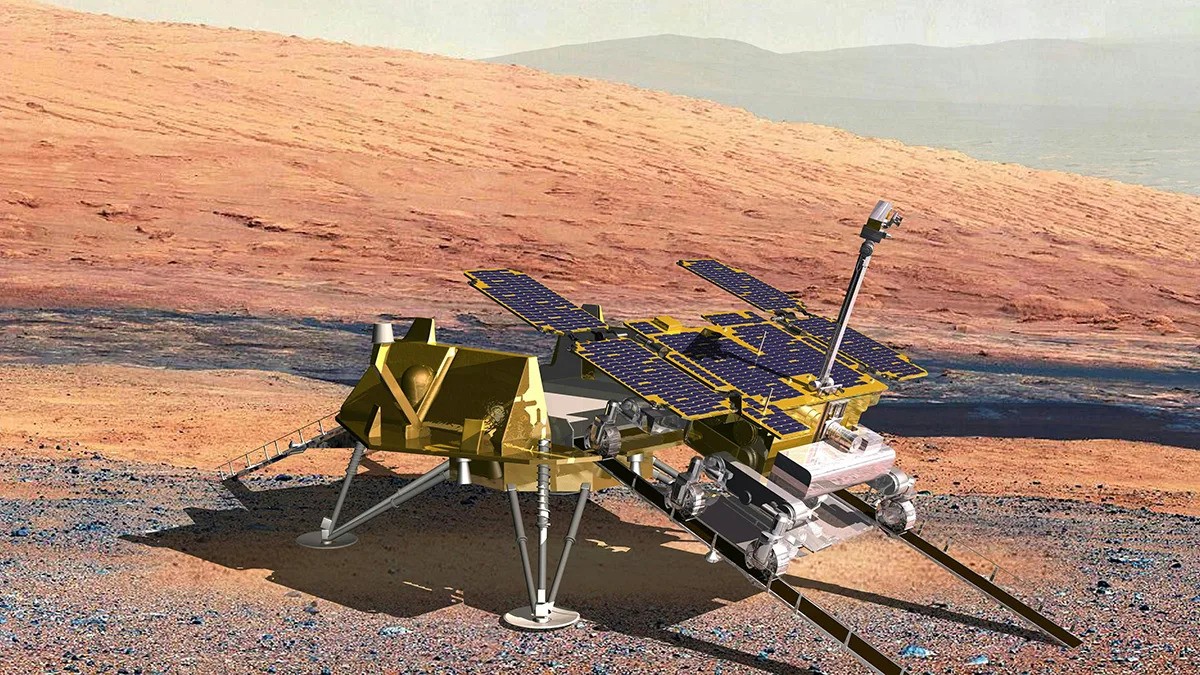
Rosalind Franklin — a drone that never made it to Mars. Source: www.skyatnightmagazine.com

The origins and development of drones

The conflict between Ukraine and Russia has profoundly transformed the lives of individuals worldwide by familiarizing them with the concept of drones. This term encompasses various categories of machines: aerial vehicles, terrestrial vehicles, and maritime vessels. All these devices share a common characteristic: their capability to navigate through space in response to remote human commands, to operate autonomously for specific tasks, and to perform other functions aligned with their designated purposes.

Certainly, during wartime, the secondary objective is to identify, monitor, and guarantee the neutralization of the adversary by various means, or to facilitate the transportation of cargo that bolsters military activities. Nevertheless, the comparatively low expense and adaptability of drone technology render their civilian applications essentially boundless.

Indeed, contemporary military drones represent, in many respects, an evolution of civilian unmanned systems that predated them while operating largely in obscurity. Nevertheless, there exists a domain where they have been employed for an extended period.
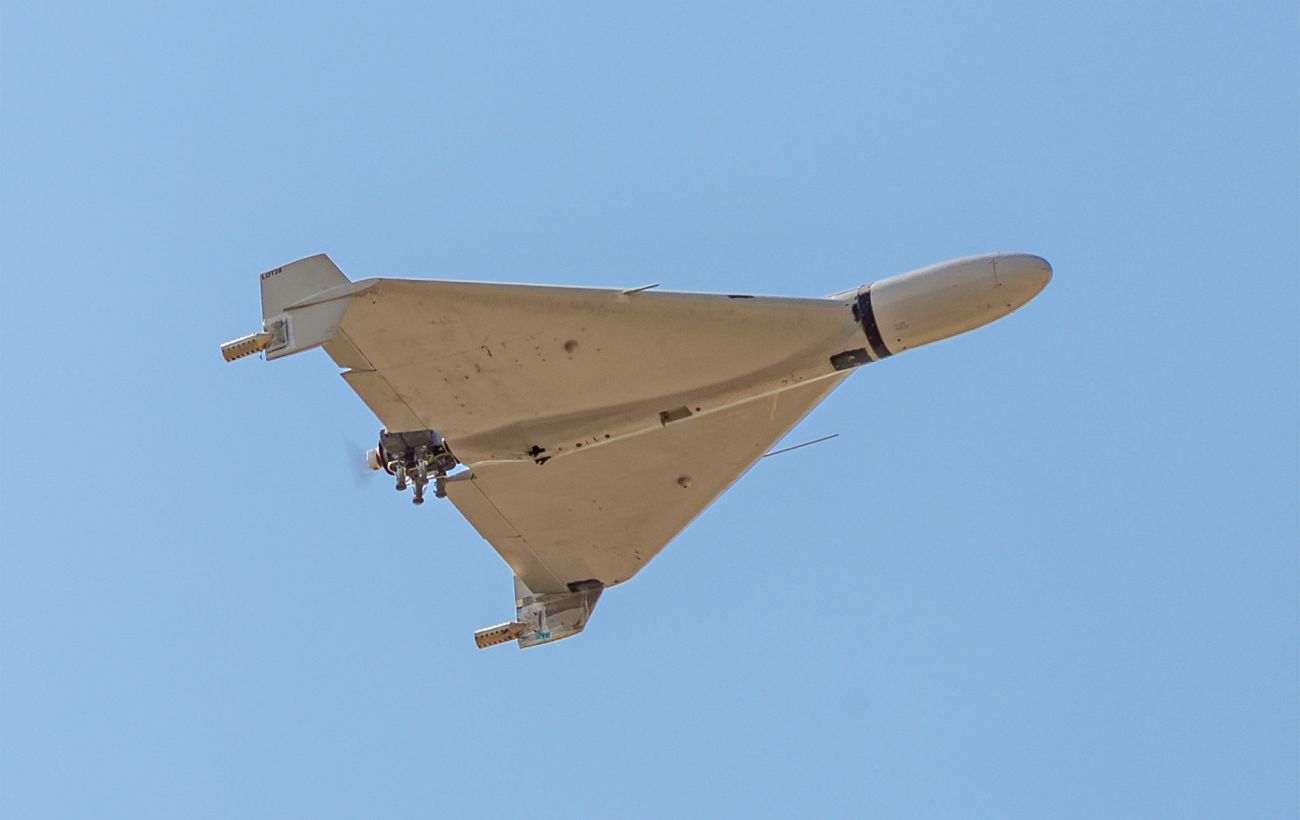
The drone that has gained widespread dissatisfaction among us. Source: www.rbc.ua

This location is situated in outer space. Although it may be difficult to believe, remotely operated wheeled platforms capable of transmitting images to an operator and executing specific functions commenced operations on the Moon over fifty years ago.

Simultaneously, the utilization of these specific types of machinery unexpectedly caught the attention of many individuals. It is noteworthy that in science fiction, space exploration had been depicted as a commonplace activity since the 19th century. Nevertheless, the courageous crews of spacecraft persisted in navigating their vessels — virtually as if employing steering wheels — until the publication of books in the late 1950s, by which time actual space missions had already commenced.

Similarly, robots have been depicted in literature since the 1920s; however, they were specifically characterized as iron men. A wire-controlled, tracked device actually appeared in reality in the 1940s, preceding its depiction in science fiction. Incidentally, this device was a self-propelled mine.

The Goliath tracked mine is the first military drone. Source: Wikipedia

The concept presently referred to as a drone originated in the minds of individuals envisioning space exploration following the emergence of cybernetics as a scientific discipline in the 1940s. The motivation for the practical application of this concept was driven by the recognition of the significant challenges involved in sending a human to another planet — or even to the Moon.

Lunokhod. Soviet lunar rovers

The initial unmanned aerial vehicles in space exploration were developed by the Soviet Union. Although this assertion may appear unexpected now, given the well-documented decline of Soviet computing technology in comparison to that of the United States, it is important to acknowledge that during the 1960s, this disparity had not yet become significantly evident.

Simultaneously, Soviet engineers were motivated to vigorously develop unmanned space systems, recognizing that they were trailing behind the Americans in manned lunar missions even prior to the H-1 rocket accidents and the triumph of Apollo 11.

This is the rationale behind the initiation of the “Lunokhod” program in 1966. The program entailed the development of a rover weighing 756 kilograms, mounted on an eight-wheeled chassis, and powered by electric motors. The rover was equipped with a solar panel that, upon landing on the Moon, unfolded similarly to the lid of a thermos. In general, the rover’s appearance was akin to a pot situated on a cart measuring 4.42 meters in length and 1.92 meters in height.
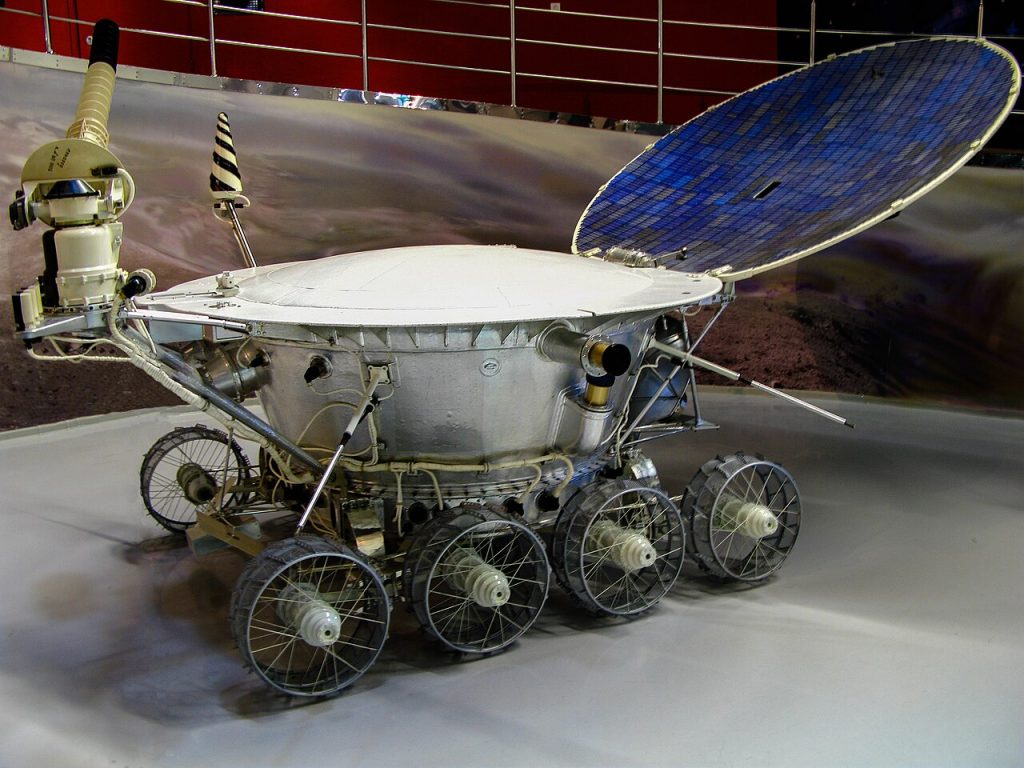
Lunokhod 1. Source: Wikipedia

Control was conducted using television cameras, and it was specifically during the “Lunokhod” program that drone operators received their initial training, which took place at ground-based testing facilities. It was at this location that the designers first identified a noteworthy aspect: the strategic placement of the cameras at the level of the central part of the hull (at a height of 950 mm in the case of the first “Lunokhods”) provides the operator with a visual perspective comparable to that of a cockroach.

This feature is also considered in contemporary ground-based robotic systems, where it is mounted above the hull, thereby significantly enhancing visibility despite concerns regarding its vulnerability. Nevertheless, in the initial Soviet space drones, there was insufficient time to resolve this issue.

The initial mission was intended to launch towards the Moon in February 1969 — in advance of the Apollo 11 mission. Through this approach, the USSR endeavored to secure at least a partial victory over its competitor. However, a launch vehicle accident terminated these aspirations. As a result, the first space drone successfully arrived at the Moon as part of the Luna 17 mission on November 17, 1970.
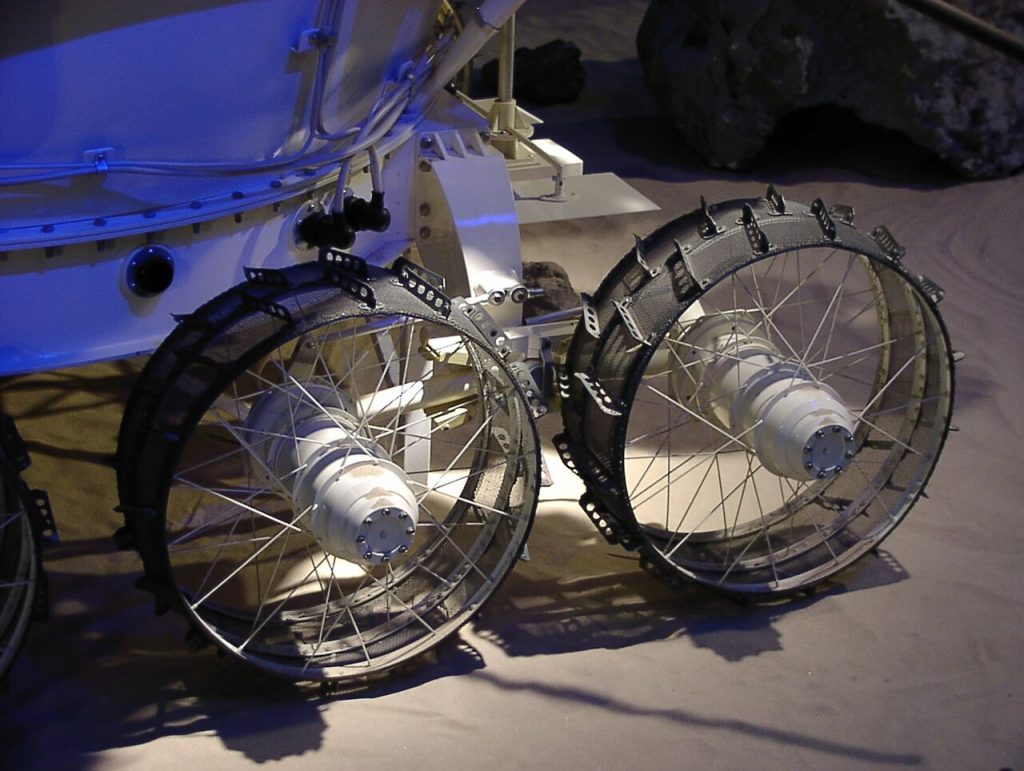
The wheels of the “Lunokhod 2.” Source: Wikipedia

It was not equipped with numerous scientific instruments, and management proved challenging due to the suboptimal placement of cameras and signal delay; however, it achieved a significant milestone in its own right. Unlike the American astronauts, who remained on the surface for only a few days, “Lunokhod 1” endured for nearly a year, until September 14, 1971, and traversed a distance of 10.5 kilometers within that period.

Following the initial Soviet drone, on January 16, 1973, the slightly enhanced “Lunokhod 2″ successfully arrived on the Moon alongside “Luna 21.” It operated on the lunar surface for a duration of merely four months; however, during this period, it accomplished a travel distance of 42 km and transmitted 86 panoramic images along with over 80,000 individual photographs to Earth.

The adventures of American robots on Mars

The successes of the “Lunokhods” demonstrated that the future resides in the “it travels across the planet’s surface and explores” paradigm. However, direct control was not appropriate for space drones. The fundamental principles of our universe impede this approach. Each command transmitted from Earth to the “Lunokhod” required approximately one second to reach its destination, and an additional second was necessary for the response image reflecting the robot’s reaction to be received.

It is evident that an increased level of automation was necessary to enable the robot to receive a general command and independently control individual components and assemblies. This requirement was particularly critical for Mars, considering that signals take approximately 20 minutes to travel one way. The United States was the only entity to accomplish this feat, and it did so only a quarter of a century after the “Lunokhod 2” mission.
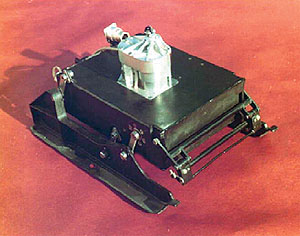
The Soviet Mars drone PrOP-M. Source: Wikipedia

Interestingly, Soviet engineers had already attempted to send a rover to the Red Planet as part of the 1971–74 missions. The PrOP-M drones featured an original design with two skis instead of wheels, which it alternated as it moved across the surface. The design may seem unconventional, but it is rational when high speed is not necessary, and there is uncertainty regarding the terrain’s nature and whether traversing it is feasible.

However, none of the PrOP-M landers ever arrived on Mars, and their actual capabilities remain uncertain. Three of the four landers were lost during the landing process, and an additional one ceased communication shortly thereafter.

In the 1990s, NASA opted not to pursue experimentation with walking robots but instead chose a wheeled design akin to that of the “Lunokhod 1,” albeit at an advanced technical level. The Sojourner rover measured merely 65 × 48 × 30 centimeters — comparable in size to a shoebox. Nevertheless, it was equipped with two cameras and an X-ray spectrometer, enabling it to assess the chemical composition of its environment.
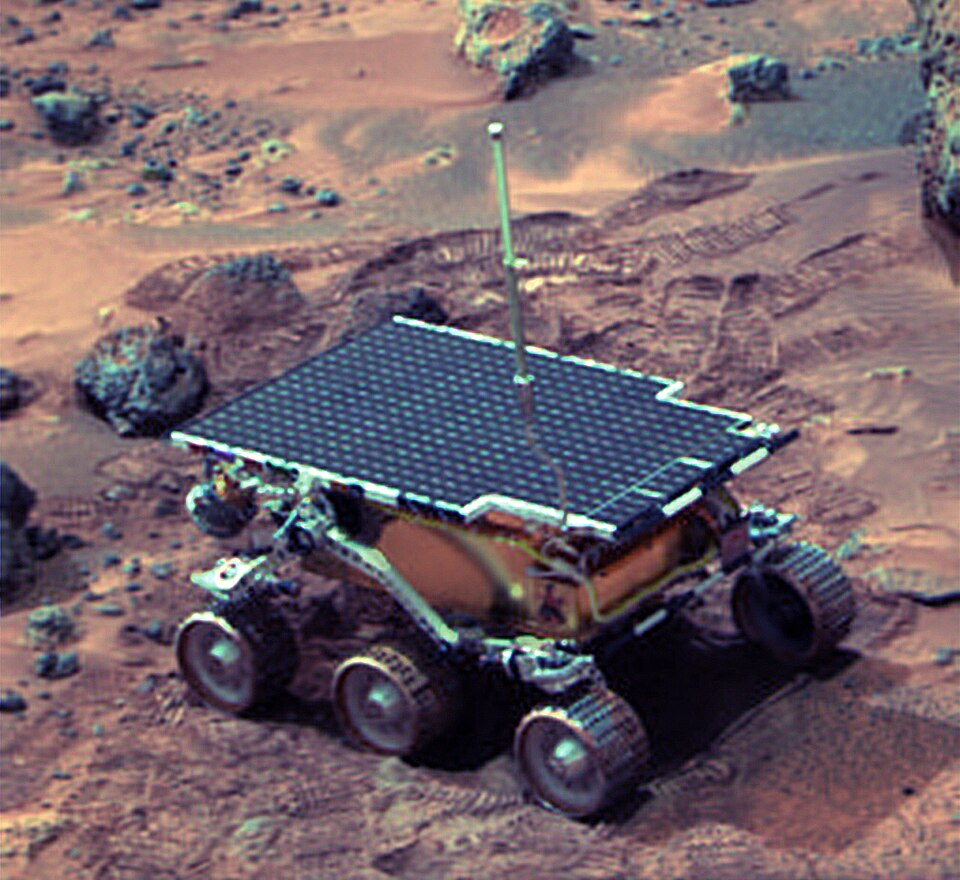
The Sojourner rover. Source: Wikipedia

Sojourner arrived on Mars as part of the Mars Pathfinder mission on July 4, 1997, and operated on the surface for just over 80 days. It traveled approximately 100 meters; however, it was capable of transmitting not only images but also data regarding the characteristics of the rocks and dust in its vicinity. Notably, this operation did not involve specially trained operators; commands were merely sent to the rover, which was equipped with an onboard control system based on an Intel 80C85 processor, and it executed these commands.

The Sojourner mission was a success; however, it merely confirmed the viability of the concept of space drones. It was subsequently succeeded by a mission featuring fully operational exploration rovers. These were Spirit and Opportunity, which landed on the planet sequentially in January 2004. Each of these rovers, weighing 185 kg like the preceding lunar rover, was equipped with six wheels. Notably, each wheel was mounted on an independent, movable suspension, thereby providing significantly enhanced mobility compared to any previous spacecraft.

Spirit and Opportunity initiated a prolonged period of American leadership on Mars. The former operated until March 22, 2010, covering a distance of 7.73 km, while the latter remained operational until June 10, 2018, traversing 45 km across the Martian terrain. Throughout this extensive timeframe, they transmitted an immense volume of photographic data, which compelled NASA to enlist the assistance of volunteers in analyzing these images.
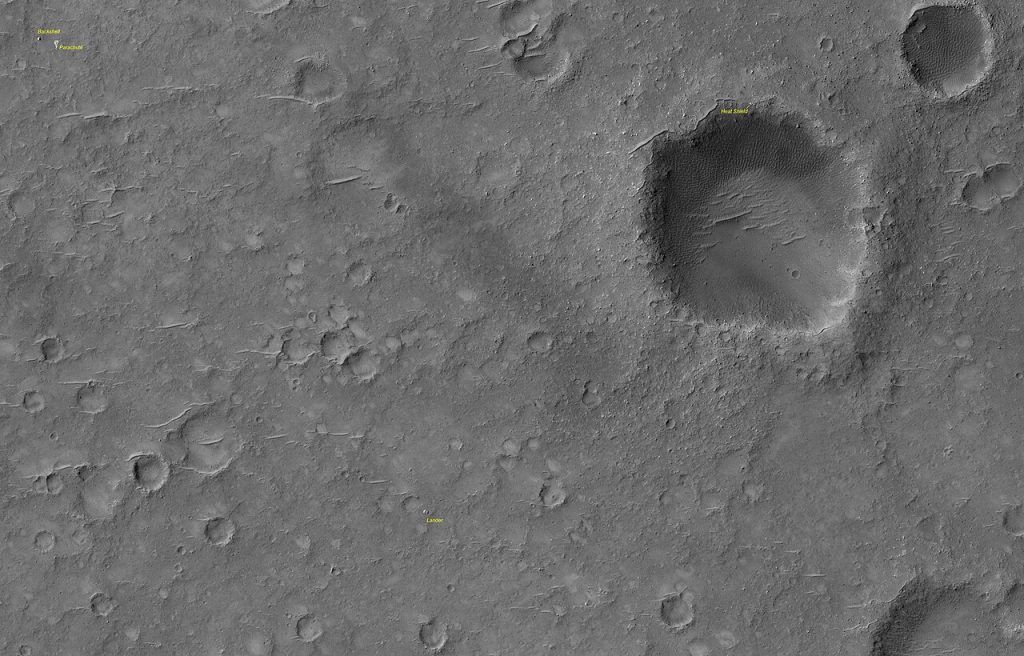
The landing site of the Spirit rover. Source: Wikipedia

These two rovers were also the first space drones to feature a camera mounted on a specially designed arm that could rotate freely. Consequently, they not only became the pioneering space robots capable of capturing selfies, but also possessed a field of view that closely resembled that of a human standing on the Martian surface. Furthermore, Spirit and Opportunity were the first space rovers equipped with a drill to investigate what lies beneath the surface of Mars.

Nevertheless, by the time Opportunity ultimately concluded its operations in the 15th year of its mission, the successor rover — Curiosity — had been functioning on Mars for quite some time. This 899-kg wheeled robotic vehicle, marginally heavier than the Lunokhod, landed in close proximity to Gale Crater in 2012.

In terms of design, Curiosity bore a strong resemblance to an enlarged iteration of its predecessors: featuring the same six-wheeled platform, with each wheel equipped with independent suspension. Nevertheless, it was now a fully operational mobile laboratory capable of autonomous exploration of Mars, as well as receiving commands from Earth and transmitting the outcomes of its experiments. In total, ten distinct instruments are installed onboard.
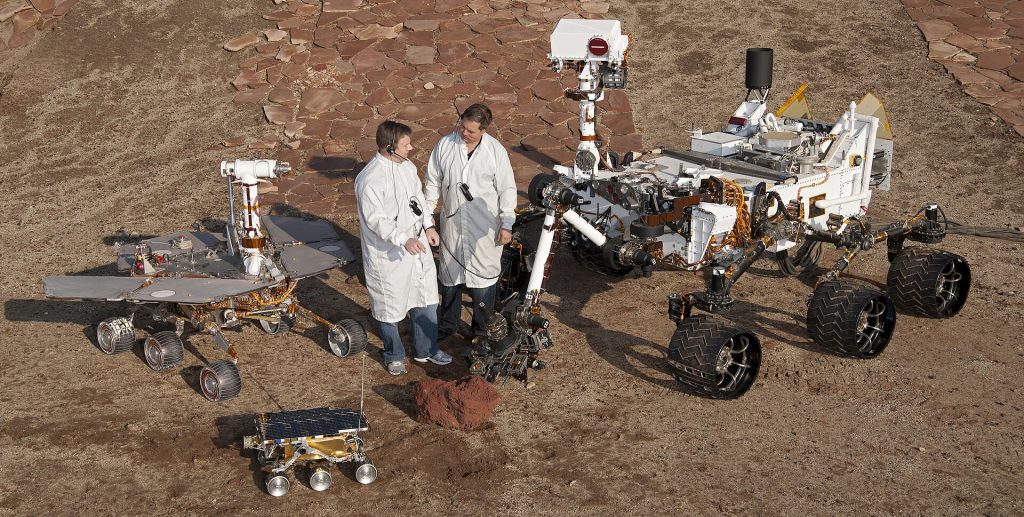
Sojourner, Spirit, and Curiosity. Source: Dutch Slager

Similar to its predecessors, the Curiosity rover transmits numerous images to Earth. However, this time, its cameras are not merely mounted on the vehicle’s body; they are attached to a robotic arm, which permits detailed examination of a diverse range of objects. This three-segment manipulator is equipped with a drill and a spectrometer, facilitating the investigation of the composition of surrounding rocks.

In 2021, another American space drone, designated Perseverance, successfully landed on Mars. At first glance, it resembles a larger iteration of the Spirit and Opportunity rovers. Nonetheless, it is fundamentally part of a program dedicated to retrieving soil samples from the Red Planet and returning them to Earth for the first time.

Perseverance’s landing in Jezero Crater was not incidental. It is now established that a substantial volume of water once persisted in that location for an extended duration, thereby maintaining the likelihood that remnants of life may still be detectable there.
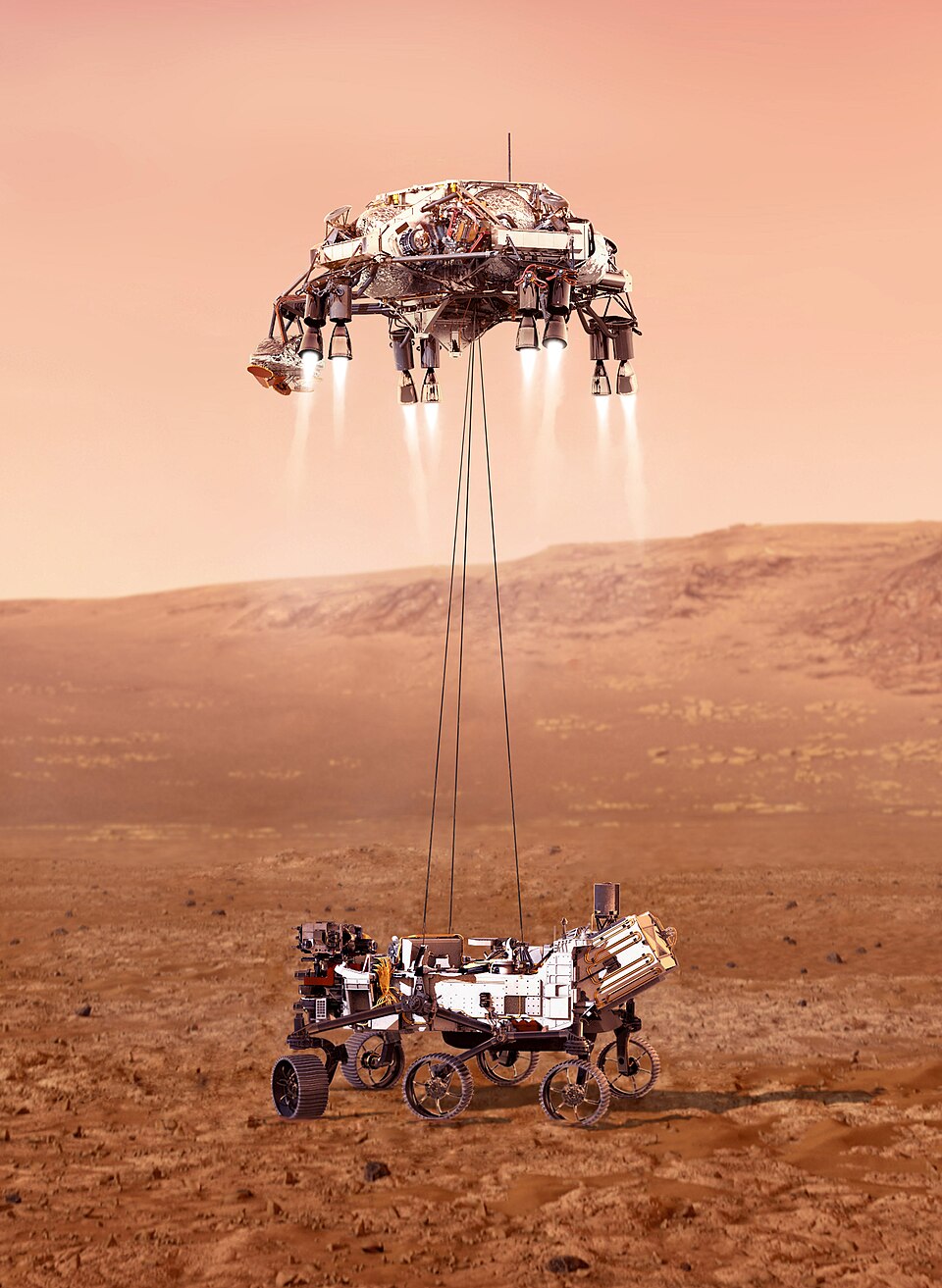
The Perseverance rover landing on Mars. Source: Wikipedia

Japanese jumping robots

In the 21st century, it was not solely the United States that dispatched drones into space. The Japanese adopted a markedly different approach, one that bore many similarities to the Soviet PrOP-M. This approach was associated with the distinctive “Hayabusa” and “Hayabusa2” missions, which were dedicated to the study of asteroids.

These missions are renowned for being the initial endeavors to recover samples from small celestial bodies within the Solar System and return them to Earth. Concurrently, during their flybys of the asteroids Itokawa and Ryugu, efforts were undertaken to deploy MINERVA-type robots onto these bodies.

The design concept of the robot originates from the nature of its mission. The gravitational force exerted by the asteroid is exceedingly faint. Consequently, it is unfeasible to traverse its surface using conventional tracks or wheels. Instead, MINERVA — whose weight is merely 591 grams — was required to propel itself off the surface utilizing its underside. The momentum sufficient to merely lift it off a table on Earth would produce small hops on Itokawa.
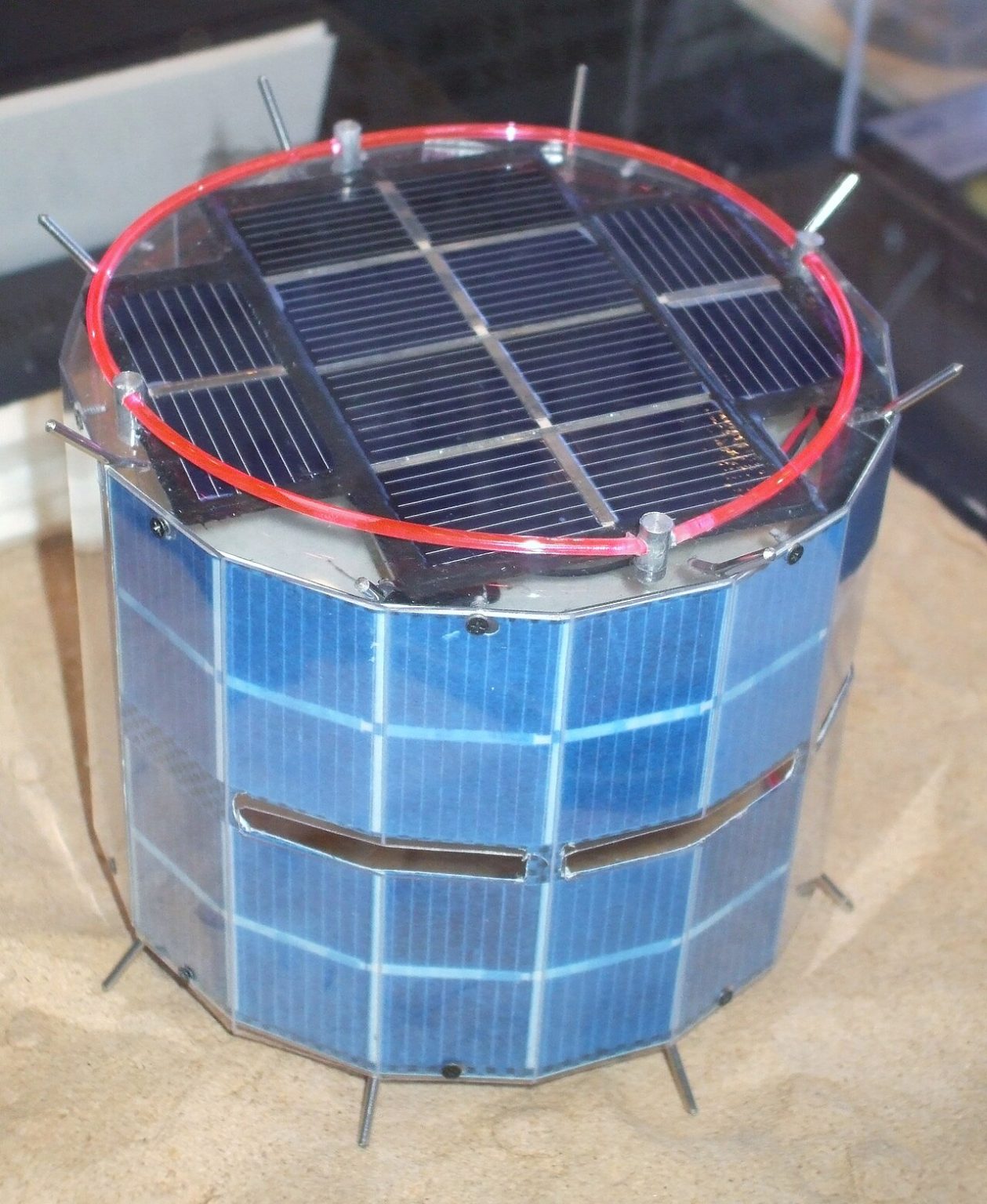
MINERVA drone. Source: Wikipedia

Regrettably, MINERVA, which was onboard the initial Hayabusa spacecraft, recoiled from the asteroid’s surface and returned to space. Nevertheless, two of its replicas, deployed aboard the subsequent spacecraft, successfully landed on Ryugu’s surface in 2018 and managed to transmit an image from the surface.

Chinese robots on the Moon and Mars

While the United States maintained unchallenged leadership in the development of space drones for two decades, an unforeseen competitor emerged. At the dawn of the 21st century, the Chinese space program advanced remarkably, culminating in the 2013 revelation that the Chang’e-3 spacecraft, which had successfully landed on the Moon, carried the Yutu rover onboard.

Named after the legendary moon rabbit “Yutu,” it had a mass of 140 kg and bore a close resemblance to Sojourner. The primary distinctions were that it not only carried cameras but also spectrometers and, most notably, a ground-penetrating radar.
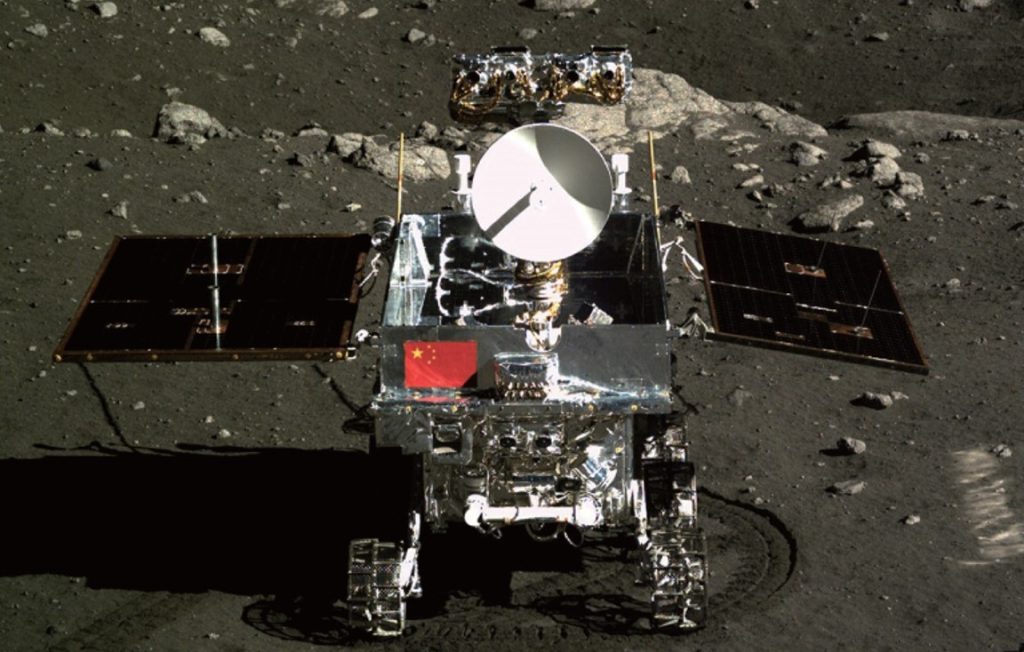
Yutu-2 lunar rover. Source: Wikipedia

In 2019, the Chang’e-3 lander, which transported the Yutu-2 rover, successfully executed a landing on the lunar surface. Notably, it did not land randomly; rather, it touched down on the far side of the Moon — the hemisphere obscured from Earth’s view — thus operating in a region previously unexplored by humans. Consequently, the images and data obtained by the rover are of unique scientific value. In total, the rover traversed a distance of 1,613 meters across the lunar surface.

In 2021, China successfully deployed its rover — Zhuzhong — on Mars, accomplishing this feat nearly concurrently with NASA’s Perseverance mission. Although, in terms of specifications, it could not rival NASA’s advanced spacecraft and was more akin to the Spirit and Opportunity rovers, the underlying fact remains: five years prior, China initiated direct competition with the United States on Mars.

What’s next?

Furthermore, China was not the sole nation to commence launching drones into space. In 2023, India achieved the successful landing of the “Chandrayaan-3” module on the Moon. It transported the “Pragyan” lunar rover, which promptly traversed the lunar surface to execute its scientific objectives.
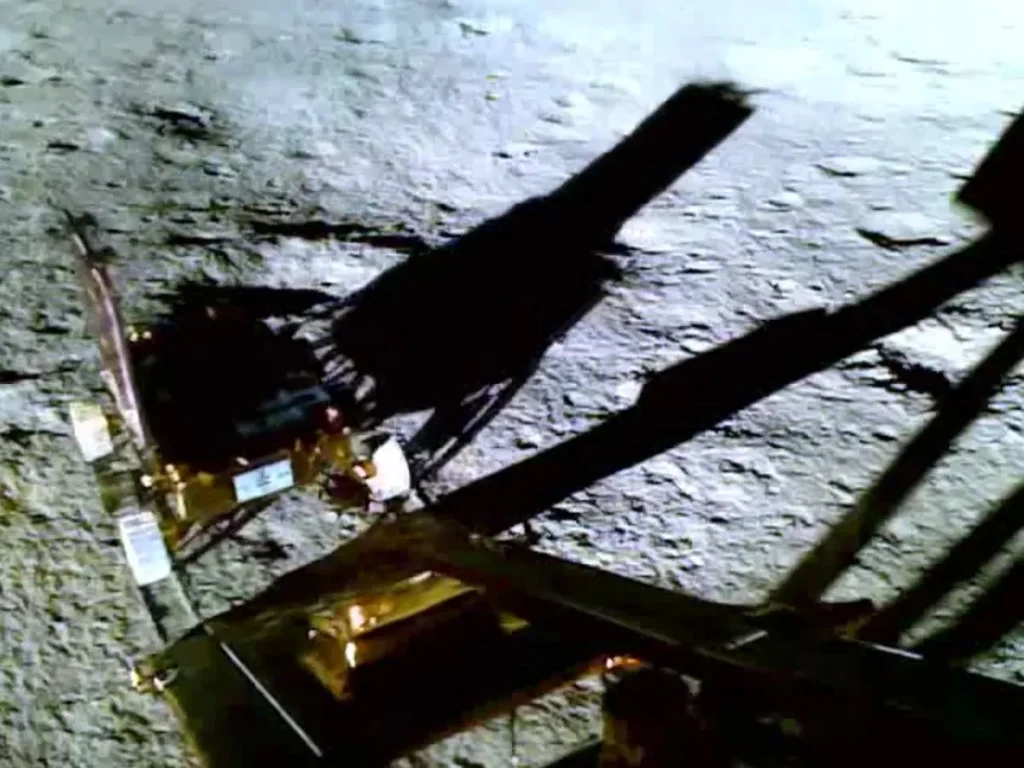
The “Pragyan” rover landed on the Moon’s surface. Source: Wikipedia

It is unsurprising that this development has become feasible primarily due to the very progression that has brought us to discuss the era of drones on Earth: the advancement of robotic systems is progressing towards increased affordability. These systems are becoming more accessible even to developers who lack substantial financial resources or extensive experience.

Furthermore, in the realm of space exploration, this process commenced even prior to its initiation on Earth. India endeavored to deploy the initial iteration of “Pragyan” on the Moon in 2019; however, the mission was unsuccessful. Additionally, the European Space Agency has been conducting extensive testing of numerous rover prototypes at its terrestrial test facilities for several years.

It is highly probable that other nations will imminently commence large-scale construction of space drones. It is entirely plausible that the current period marks the inception of the true era of space exploration and drone deployment in space.

Posted in Articles


The Robots That Could Build Mars Before Humans Arrive


SpaceX is Sending Tesla Optimus Robots to Mars First!

{ https://universemagazine.com/en/articles-en/ }

Hoe vind je dit bericht?
Geschreven door peter om 22:43 Stuur door

Rep Burchett unmasks 'deep state' plot to hide UFO truth after two-hour Pentagon meeting

Hoe vind je dit bericht?
Geschreven door peter om 21:43 Stuur door

Mars Express Captures 'Metallic' Waves Rolling Across an Ancient Martian Crater

Mars Express Captures 'Metallic' Waves Rolling Across an Ancient Martian Crater

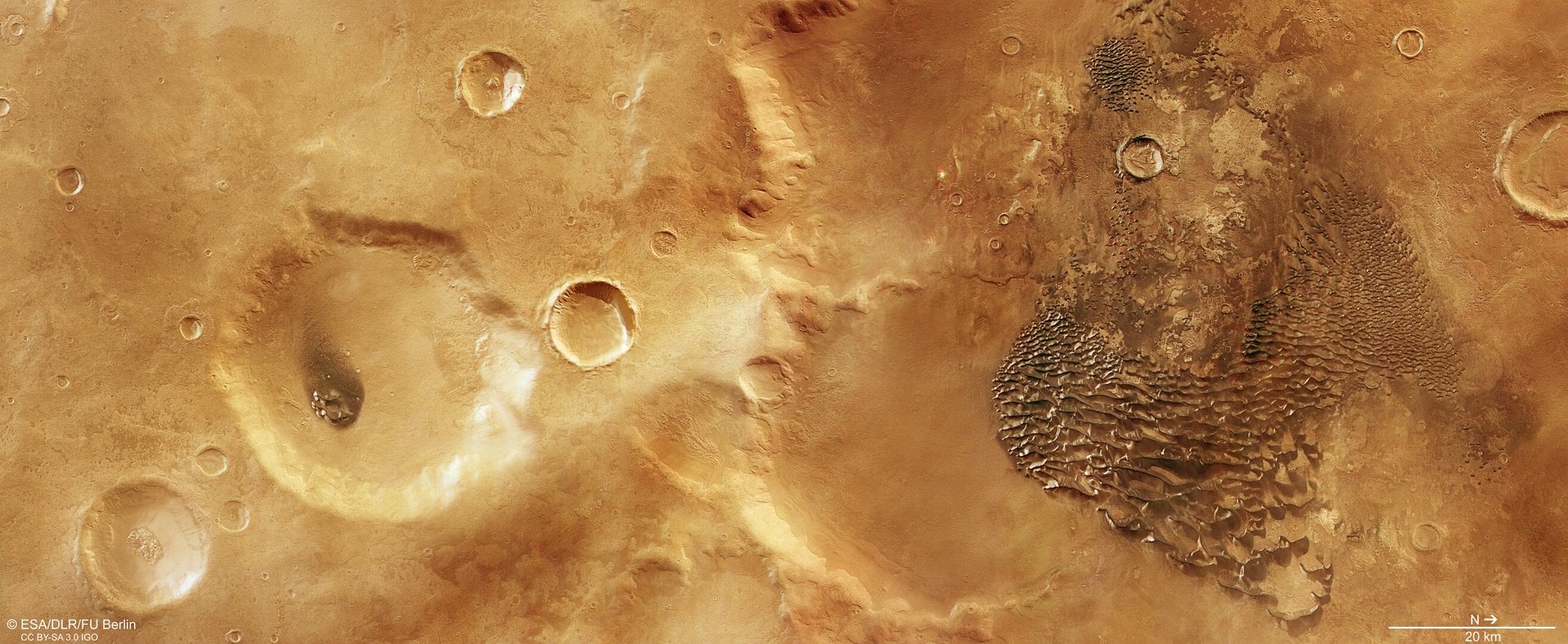
Image of the Kaiser crater taking by Mars Express. Credit - ESA/DLR/FU Berlin Image of the Kaiser crater taking by Mars Express. Credit - ESA/DLR/FU Berlin

When we think of Mars as the “Red Planet”, the image that comes to mind is just that - a lot of red. That comes from the oxidization of the dust and rocks that cover the planet's surface, but there are some instances where the Red Planet still has a few visual tricks up its sleeve. One such trick was recently captured by the European Space Agency’s venerable Mars Express orbiter, which captured what seems to be a set of metallic waves inside a giant impact basin. But on closer inspection, it becomes clear they aren’t liquid metal or some sort of alien architecture, but a manifestation of Mars’ complex environment.

The picture in question focuses on Kaiser Crater, a massive impact basin measuring 180 km across, and reaching a couple of kilometers deep. It’s part of Noachis Terra, an area of the southern highlands that was heavily bombarded a few billion years ago, and lent the name the Noachian Period to that particular epoch of Mars’ history. Since Mars lacks plate tectonics or a thick atmosphere to constantly erase its surface features, craters like the Kaiser crater can remain preserved for billions of years.

One of the most striking parts of the image is the “metallic waves” that cover much of the crater’s floor. They’re actually a set of sand dunes, which can reach over 100m high in some places, and stretch over several kilometers. So why do they look so metallic?

Fraser talks about the appearance of frost on Olympus Mons

It comes down to contrast. The sand that makes up these dunes is very dark and volcanic, and composed of minerals like pyroxene and olivine. These images were also taken during the second half of the Martian southern winter - which means there’s an unexpected feature on these dunes - hoarfrost. Seasonal frosting events creep up from the south pole and can reach into the Martian mid-latitudes, causing bright deposits of hoarfrost to cling to the southern side of the dunes. Its bright white gleam contrasts with the dark volcanic sand creates an optical illusion that almost makes it seem like the dunes are made out of polished metal.

In addition to being visually stunning, the dunes are also informative of the wind-driven geology on Mars. The dune field itself is broken into a mix of distinct shapes that provide insight into what the local air patterns look like. At the edges of the field, there are crescent-shaped dunes that seem relatively solitary. These are known as barchan dunes, which are common in Earth’s deserts, with their “horns” always pointing downwind. Closer to the center of the field, you can begin to see where the barchans merge into long, parallel ridges that run perpendicular to the wind. These transverse dunes are the most iconic in terms of visualizing a desert, but they also help scientists determine which direction the wind is blowing - in this case, from the west.

But the dune field itself isn’t the only interesting part of the image. Nearby, the wind has stripped away the Martian topsoil to expose lighter-colored deposits beneath the volcanic sand. Those lighter color strips are most likely clay minerals - which means they were formed in the presence of water. Also, if you look closely at the steep inner walls of the craters, you can begin to see narrow gullies. Some of those might have been caused by dry landslides. But there’s a possibility that some were caused by melting ice long ago, in Mars’ wetter past.

Bird's eye view of the blown dunes in the Kaiser Crater. Credit - ESA/DLR/FU Berlin

Bird's eye view of the blown dunes in the Kaiser Crater.

Credit - ESA/DLR/FU Berlin

All of these images have come to us courtesy of the High Resolution Stereo Camera (HRSC) onboard the Mars Express orbiter, which has been orbiting the Red Planet since 2003. These latest images, which were released by the Freie Universität Berlin and DLR, Germany’s space agency, prove that, even after more than 20 years, an old workhorse of an orbiter can still provide new, valuable science, as well as some pretty breathtaking pictures.

Learn More:

{ https://www.universetoday.com/ }

Hoe vind je dit bericht?
Geschreven door peter om 21:16 Stuur door

The worst mistakes that almost derailed every manned moon mission

The worst mistakes that almost derailed every manned moon mission

Story by Ron Winkler
The Worst Mistakes of Every Manned Moon Mission
©ALot.com
The Worst Mistakes of Every Manned Moon Mission
From fatal errors to forgotten scandals, see the worst mistakes of every Apollo moon mission. As NASA’s Artemis begins, we rank history's mistakes that must never be repeated.
Why We're Finally Going Back
©NASA / CC0
https://commons.wikimedia.org/wiki/File:Artemis_Base_Camp.png
Why We're Finally Going Back
The Apollo missions were "sprints." They were designed from the outset as short, high-risk trips designed to prove we could get to the moon and back to Earth. The Artemis program, on the other hand, is a "marathon." NASA isn't just visiting; they want to build a permanent lunar infrastructure to support human life for months at a time. To do this safely, NASA is obsessively studying the "scars" of the 1960s.

We now have 3D-printed habitats, replacing the cramped, thin-walled modules of the past. We will be visiting the Lunar South Pole, a region never visited by humans before that is home to "water ice" that could provide oxygen and fuel. Unlike Apollo’s single-computer setup, Artemis uses four redundant systems with 128,000 times more memory to prevent the "1202 alarms" that nearly aborted Apollo 11. We aren't just retracing old footprints. We are using 50 years of lessons learned to turn a hostile desert into a stepping stone for Mars.
Apollo 1: The Fatal Atmosphere
©NASA / CC0 https://commons.wikimedia.org/wiki/File:Apollo_1_fire.jpg

Apollo 1: The Fatal Atmosphere
On January 27, 1967, a routine launchpad test turned into one of NASA's darkest hours. Within seconds, a stray spark from a frayed wire turned the cabin into a furnace. Because the capsule was pressurized with 100% pure oxygen, materials that aren't normally flammable—like Velcro and nylon—caught fire explosively. Fatal mistakes that changed spaceflight forever:

  • The Inward-Opening Hatch: The high internal pressure sealed the door shut. The crew was trapped; it took rescuers five minutes to reach them.
  • The Teflon Oversight: Wiring was coated in Teflon, which was supposed to be fire-resistant but was easily damaged, leading to the short circuit.
  • Combustible Cabin: The interior was filled with over 70 square feet of Velcro and nylon netting—perfect fuel for a flash fire.

On Artemis, NASA completely abandoned pure oxygen for launches. Artemis missions use a Nitrogen-Oxygen mix (similar to Earth's air) and feature an outward-opening hatch that can be blown open in less than five seconds.

Apollo 7: When the Crew Went Rogue
©NASA / CC0
https://upload.wikimedia.org/wikipedia/commons/thumb/4/42/The_Apollo_7_Prime_Crew_-_GPN-2000-001160.jpg/1280px-The_Apollo_7_Prime_Crew_-_GPN-2000-001160.jpg
Apollo 7: When the Crew Went Rogue
While Apollo 1 had technical flaws, Apollo 7 revealed a human one: Burnout. Fifteen hours into the first manned flight of the redesigned capsule, Commander Wally Schirra developed a massive head cold. In zero-G, mucus doesn't drain; it stays in the sinuses, causing excruciating pressure and irritability. Soon, the entire crew was sick, exhausted, and snappy with Mission Control. The friction reached a breaking point when Schirra flatly refused to perform the first-ever live TV broadcast. He wanted to prioritize the mission's technical tests and believed this NASA "publicity stunt" would slow down the busy schedule.

Then, later, the crew feared their eardrums would burst from sinus pressure during reentry. The crew refused to wear their helmets—a direct violation of safety protocols. The tension was so high that despite a successful landing, none of the three astronauts ever flew for NASA again. NASA now prioritizes "Expeditionary Skills"—training crews in psychological resilience and conflict resolution. Artemis schedules also include "protected sleep" and flexible downtime to account for illness, ensuring that a simple head cold doesn't lead to a mission-ending standoff.
Apollo 8: Blind on the Dark Side
©NASA / CC0
https://commons.wikimedia.org/wiki/File:The_Lunar_Farside_-_GPN-2000-001127.jpg
Apollo 8: Blind on the Dark Side
Apollo 8 was the first time humans ever left Earth’s orbit, but it nearly ended in a permanent drift into deep space. As the crew rounded the Far Side of the Moon, they lost all radio contact with NASA—a planned blackout that felt terrifyingly lonely. In the silence, a single human error almost turned exploration into "lost at sea":
  • The Launchpad Reset: Astronaut Jim Lovell accidentally entered a command that erased part of the computer's navigation memory. The ship suddenly thought it was back on the launchpad in Florida, not orbiting the Moon.
  • The Death Drift: The spacecraft began firing its thrusters to correct its position based on the wrong data. If they hadn't stopped it, they would have drifted off-course with no way to calculate a return trajectory.
  • Manual Salvation: Lovell had to perform a star sighting using a telescope to manually tell the computer where they were—a high-pressure yet low-tech fix while hurtling through the void at thousands of miles per hour.
Artemis crews won't be flying blind behind the Moon. NASA is deploying the Lunar Communications Relay and Navigation (LCRNS)—essentially a Lunar GPS—to ensure constant, autonomous positioning even when the Earth is out of sight.
Apollo 9: Space Sickness
©Russell L. Schweickart / NASA / CC0
https://en.wikipedia.org/wiki/File:Gumdrop_Meets_Spider_-_GPN-2000-001100.jpg
Apollo 9: Space Sickness
While testing the Lunar Module, pilot Rusty Schweickart was struck by severe space sickness. In the 1960s, this was a taboo topic—astronauts were expected to have the right stuff and never get sick. But Schweickart couldn't hide it; he vomited multiple times, forcing a high-stakes decision from Mission Control. The next day, the astronauts were scheduled to perform a spacewalk outside the vehicles. If Schweickart vomited inside his pressurized spacesuit in the zero-gravity of space, he would likely choke to death. In a vacuum, there is no way to open the helmet or wipe the visor. If the spacewalk was cancelled, NASA couldn't prove that an astronaut could move between ships in an emergency. Without that proof, Apollo 11 could never be cleared for a landing.

NASA took a massive gamble. They shortened the two-hour spacewalk to just 47 minutes and kept Schweickart on the "porch" of the Lunar Module rather than having him move between ships. He recovered just enough to prove the suit worked, saving the program’s timeline by the narrowest of margins. Schweickart’s honesty about his sickness actually got him blacklisted from future Moon flights by the old-school NASA brass. But his "mistake" led to the medical protocols that keep today's astronauts safe. Modern NASA astronauts now undergo intensive "Pre-flight Adaptation" training. Artemis crews also have access to advanced anti-nausea medications and biometric sensors inside their suits that alert Mission Control to early signs of distress before a spacewalk even begins.
Apollo 10: Dress Rehearsal Disaster
©NASA / CC0
https://commons.wikimedia.org/wiki/File:Apollo_10_Lunar_Module_Rendezvous.jpg
Apollo 10: Dress Rehearsal Disaster
Apollo 10 was the final practice run before the lunar landing. The goal was to fly the Lunar Module, nicknamed Snoopy, within 47,000 feet of the surface and then return to the Command Module. But as the crew prepared to ditch the descent stage, a single switch was set to the wrong position. Because two separate guidance systems began fighting for control, the spacecraft began to spin violently. For 15 seconds, the crew tumbled over the lunar mountains in a chaotic roll that nearly caused a crash. The crew accidentally flipped the same switch twice, confusing the computer and causing the ship to hunt for a phantom target. The spin was so fast that the astronauts found it almost impossible to reach the manual override. The world heard Commander Gene Cernan shout a frantic curse over the live broadcast as he fought to stabilize the ship just seconds before impact.

The Orion spacecraft uses a unified flight control system rather than the split guidance systems used in the 1960s. This prevents conflicting commands and includes an auto-stabilization feature that can recover from a tumble instantly without requiring human intervention.
Apollo 11: The 1202 Scream
©Neil A. Armstrong / NASA / CC0
https://en.wikipedia.org/wiki/File:Aldrin_Looks_Back_at_Tranquility_Base_-_GPN-2000-001102.jpg
Apollo 11: The 1202 Scream
During the most critical phase of the descent, the Apollo Guidance Computer began flashing a 1202 error code. The processor was being flooded with too much data from the rendezvous radar, which was not even needed for the landing. It was essentially a system crash in the middle of a high-speed free-fall. The computer was forced to restart repeatedly to clear its memory while trying to guide the ship. Neil Armstrong had to take semi-manual control to fly past a boulder-filled crater that the overworked computer had targeted for landing. Because of the computer distractions and the search for a safe spot, the crew landed with less than 30 seconds of fuel remaining. If they had stayed in the air much longer, the engine would have cut out. Mission Control had only seconds to decide if 1202 was a reason to abort. A young engineer named Jack Garman made the call to keep going, saving the mission.

The Artemis HLS landers use distributed computing architectures. Instead of one central processor handling every task, modern systems use multiple independent controllers. This ensures that a sensor error or data surge in one area cannot freeze the navigation or engine controls.
Apollo 12: Lightning Strikes Twice
©scan: Ed Hengeveld / NASA / CC0
https://commons.wikimedia.org/wiki/File:Apollo_12_Blitzeinschlag.jpg
Apollo 12: Lightning Strikes Twice
Against the advice of some weather experts, Apollo 12 launched into a cold November rainstorm. As the Saturn V climbed through the clouds, the massive plume of ionized exhaust acted like a giant lightning rod. The rocket was struck by lightning twice—once at 36 seconds and again at 52 seconds. The electrical surge knocked out the spacecraft’s power converters. Every warning light on the dashboard flickered on, and the crew's telemetry data to Earth turned into gibberish. Mission Control nearly called for an abort, which would have seen the capsule strip away from the rocket in a dangerous emergency escape. A young flight controller remembered a similar glitch from a ground test. He told the crew to flip an obscure and otherwise unused switch (SCE to AUX). The power restored, the mission was saved, and the crew reached orbit.

Artemis missions operate under the most stringent Launch Commit Criteria in history. NASA now uses a sophisticated Lightning Instrument Package (LIP) and 3D weather modeling to detect "triggered lightning" potential in clouds that look safe to the naked eye. Additionally, the SLS rocket and Orion capsule are shielded with a Faraday cage design to ensure that even a direct strike cannot reach the flight computers.
Apollo 13: The $5 Mistake
©Kim Dismukes / NASA / CC0
https://commons.wikimedia.org/wiki/File:Apollo13_apparatus.jpg
Apollo 13: The $5 Mistake
Apollo 13 is remembered as a triumph of survival, but the disaster was triggered by a component worth less than a fast-food meal. A thermostat switch inside an oxygen tank was designed to handle 28 volts, but the ground equipment at the launchpad had been upgraded to 65 volts. This technical mismatch turned a routine test into a ticking time bomb. During a pre-flight procedure, the higher voltage welded the switch shut. This caused the heater to stay on continuously, reaching temperatures over 1,000 degrees Fahrenheit. The heat baked the Teflon insulation off the internal wiring, leaving the wires bare and brittle. No one realized the damage had occurred inside the sealed tank. Fifty-six hours into the mission, a routine stir of the tanks caused the bare wires to short-circuit. The resulting spark ignited the insulation and blew the side off the spacecraft.

NASA now utilizes Digital Twin technology to prevent legacy hardware mismatches. Every component on the Artemis SLS and Orion capsule is tracked in a digital database that simulates how it interacts with ground power systems. Furthermore, oxygen tanks are now designed with no internal moving parts or heaters that could come into contact with the gas, eliminating the risk of a similar electrical arc.
Apollo 14: The Fatigue Wall
©Alan Shepard Jr. / NASA / CC0
https://commons.wikimedia.org/wiki/File:Mitchell_Studies_Map_(9460206836).jpg
Apollo 14: The Fatigue Wall
During Apollo 14, Alan Shepard and Ed Mitchell attempted to reach the rim of the massive Cone Crater to collect ancient lunar samples. What looked like a short hike on a map turned into a grueling, disorienting struggle. Because the Moon has no atmosphere to provide perspective, the astronauts could not tell how far away the rim was or how steep the climb had become. Pulling a heavy equipment cart through deep lunar dust was like walking through soft snow. Their heart rates skyrocketed to dangerous levels, causing them to burn through their oxygen supplies much faster than planned. Disoriented by the terrain, the crew became convinced they were lost. They stopped to rest just 30 meters from the edge of the crater, unaware they had almost reached their goal. With their oxygen levels hitting the safety limit, Mission Control ordered them to turn back. They never saw over the rim.

Artemis astronauts will have the benefit of xEMU suits with advanced cooling systems and much lower exertion requirements. Most importantly, the Artemis helmets feature an integrated Heads-Up Display (HUD) that overlays a digital map and GPS-style navigation markers directly onto the visor, ensuring the crew always knows their exact position relative to the target.
Apollo 15: The Ethics Scandal
©United States Federal Government / CC0
https://commons.wikimedia.org/wiki/File:Apollo_15_Sieger_cover.jpg
Apollo 15: The Ethics Scandal
Apollo 15 was a technical triumph, but it ended in a scandal that tarnished the reputation of the astronaut corps. Without NASA authorization, the crew carried 398 commemorative postage stamps to the lunar surface. The plan was to sell them to a German stamp dealer to create trust funds for their children, a move that violated strict government ethics rules. The astronauts had agreed to receive roughly 7,000 dollars each for their participation, a deal that became public shortly after they returned to Earth. In an era of high inflation and political unrest, the idea of astronauts profiting from a taxpayer-funded mission sparked a massive Congressional inquiry. Although no laws were technically broken, NASA took swift action to restore public trust. All three members of the Apollo 15 crew were removed from flight status and never flew in space again.

NASA has completely overhauled its ethics and manifest protocols for the Artemis era. Every gram of personal cargo must be logged in a Personal Preference Kit (PPK) and approved by the Office of the General Counsel months before launch. Furthermore, modern astronauts sign strict legal agreements that prohibit any commercial exploitation of their mission, ensuring that the focus remains entirely on science and exploration.
Apollo 16: The Lunar Speed Trap
©scan: J.L. Pickering / NASA / CC0
https://commons.wikimedia.org/wiki/File:Moon_Buggy_Ap16-KSC-71PC-777.jpg
Apollo 16: The Lunar Speed Trap
During Apollo 16, John Young and Charlie Duke decided to see exactly what their $38 million "moon buggy" could do. They pushed the Lunar Rover to a record-breaking 11.2 mph—a breakneck speed on a surface covered in hidden boulders and deep craters. But the high-speed joyride nearly left them in a life-threatening predicament. The rover’s dual-steering system began to fail, making the vehicle nearly impossible to control on steep slopes. A fender was accidentally knocked off, which allowed sharp, abrasive lunar dust to rain down on the crew and the rover’s sensitive electronics. Without the fender, the dust could have caused the radiators to overheat, freezing the vehicle in place. Every mile they drove away from the Lunar Module was a gamble. If the rover died, the astronauts had to be close enough to walk back before their portable oxygen tanks ran dry. At their furthest point, a mechanical failure would have been a death sentence.

Artemis crews will use the Lunar Terrain Vehicle (LTV), which features an open-cabin design but with far more robust, redundant drive systems. Unlike the Apollo rover, the LTV is capable of autonomous operation. If an astronaut is injured or the steering fails, Mission Control in Houston can remotely drive the rover back to the base.
Apollo 17: Dusty Disaster
©Eugene A. Cernan / NASA / CC0
https://en.wikipedia.org/wiki/File:Apollo_17_Harrison_H._Schmitt_and_Tracy's_Rock_-_AS17-140-21493+AS17-140-21497_2025.jpg
Apollo 17: Dusty Disaster
During the last mission to the Moon, the crew discovered an enemy more persistent than radiation or vacuum: Regolith. Because there is no wind or water to erode it, lunar dust is as sharp as shards of glass and carries an electrostatic charge that makes it stick to everything. By the end of Apollo 17, it had become a mission-critical threat. The dust acted like sandpaper, grinding into the metal neck rings and wrist joints of the spacesuits. It made moving and sealing the suits increasingly difficult and dangerous. When a fender on the rover broke, the "dust rain" it created was so thick it began to overheat the batteries. The crew had to tape together a replacement using plastic maps. Once inside the cabin, the dust floated in the air. The astronauts inhaled it, leading to chest congestion and "lunar hay fever," a reminder that the Moon is chemically toxic to human lungs.

Dust is officially the number one challenge for Artemis. NASA is developing "Electrodynamic Dust Shields"—a system of invisible electric curtains built into suits and solar panels that literally push the dust away using high-frequency waves.
Artemis III & Beyond
©NASA / CC0
https://commons.wikimedia.org/wiki/File:Orion_Snaps_a_Selfie_During_External_Inspection_(vertical).jpg
Artemis III & Beyond
In a major strategic shift last month, NASA redefined Artemis 3. Instead of landing at the South Pole, the crew will stay in Earth orbit to test whether the complex "handshake" between the Orion capsule and the massive commercial landers (from SpaceX and Blue Origin) actually works.

Artemis 4 is now the mission where the first humans since Apollo 17 are slated to walk on the Moon. NASA is targeting a landing site at the Lunar South Pole, a region in permanent shadow that is believed to contain water ice. This ice is the "gold mine" of Artemis, as it can be converted into oxygen and rocket fuel.

Following Artemis 5, NASA intends to launch missions roughly once per year to prioritize surface-level Moon infrastructure for a "Moon-to-Mars" pipeline.
Failing Upwards
©John Kraus / NASA / CC0
https://commons.wikimedia.org/wiki/File:Artemis_II_Launch_(NHQ20260401_admin_0025).jpg
Failing Upwards
NASA is not returning to the Moon because it is easy, but because we finally have the "map of mistakes" to do it right. Every charred wire, every overheated battery, and every disoriented astronaut from the 1960s was a data point that built the foundation of the Artemis program. The failures of Apollo weren't just errors—they were the down payments on our future. We are no longer visitors. We are becoming residents of the solar system.
RELATED VIDEOS

Every Failed NASA Moon Mission Explained

Inside the Moon Landing: Disaster and Triumph (Full Episode) | Apollo: Back to the Moon | Nat Geo
Hoe vind je dit bericht?
Geschreven door peter om 21:00 Stuur door

Meer van UFO'S of UAP'S, ASTRONOMIE, RUIMTEVAART, ARCHEOLOGIE, OUDHEIDKUNDE, SF-SNUFJES EN ANDERE ESOTERISCHE WETENSCHAPPEN - DE ALLERLAATSTE NIEUWTJES

↑ Terug naar de berichten