Ontdek de Fascinerende Wereld van UFO's en UAP's: Jouw Bron voor Onthullende Informatie!
Ben jij ook gefascineerd door het onbekende? Wil je meer weten over UFO's en UAP's, niet alleen in België, maar over de hele wereld? Dan ben je op de juiste plek!
België: Het Kloppend Hart van UFO-onderzoek
In België is BUFON (Belgisch UFO-Netwerk) dé autoriteit op het gebied van UFO-onderzoek. Voor betrouwbare en objectieve informatie over deze intrigerende fenomenen, bezoek je zeker onze Facebook-pagina en deze blog. Maar dat is nog niet alles! Ontdek ook het Belgisch UFO-meldpunt en Caelestia, twee organisaties die diepgaand onderzoek verrichten, al zijn ze soms kritisch of sceptisch.
Nederland: Een Schat aan Informatie
Voor onze Nederlandse buren is er de schitterende website www.ufowijzer.nl, beheerd door Paul Harmans. Deze site biedt een schat aan informatie en artikelen die je niet wilt missen!
Internationaal: MUFON - De Wereldwijde Autoriteit
Neem ook een kijkje bij MUFON (Mutual UFO Network Inc.), een gerenommeerde Amerikaanse UFO-vereniging met afdelingen in de VS en wereldwijd. MUFON is toegewijd aan de wetenschappelijke en analytische studie van het UFO-fenomeen, en hun maandelijkse tijdschrift, The MUFON UFO-Journal, is een must-read voor elke UFO-enthousiasteling. Bezoek hun website op www.mufon.com voor meer informatie.
Samenwerking en Toekomstvisie
Sinds 1 februari 2020 is Pieter niet alleen ex-president van BUFON, maar ook de voormalige nationale directeur van MUFON in Vlaanderen en Nederland. Dit creëert een sterke samenwerking met de Franse MUFON Reseau MUFON/EUROP, wat ons in staat stelt om nog meer waardevolle inzichten te delen.
Let op: Nepprofielen en Nieuwe Groeperingen
Pas op voor een nieuwe groepering die zich ook BUFON noemt, maar geen enkele connectie heeft met onze gevestigde organisatie. Hoewel zij de naam geregistreerd hebben, kunnen ze het rijke verleden en de expertise van onze groep niet evenaren. We wensen hen veel succes, maar we blijven de autoriteit in UFO-onderzoek!
Blijf Op De Hoogte!
Wil jij de laatste nieuwtjes over UFO's, ruimtevaart, archeologie, en meer? Volg ons dan en duik samen met ons in de fascinerende wereld van het onbekende! Sluit je aan bij de gemeenschap van nieuwsgierige geesten die net als jij verlangen naar antwoorden en avonturen in de sterren!
Heb je vragen of wil je meer weten? Aarzel dan niet om contact met ons op te nemen! Samen ontrafelen we het mysterie van de lucht en daarbuiten.
UFOs or UAP have been recorded in every part of the globe, in all kinds of regions, including space. Richard interviews filmmaker Darcy Weir about his new documentary treatment of space-based UFOs, titled "Secret Space UFOs: Fastwalkers."
“Fastwalker” is a term used by NORAD and branches of armed forces to describe unidentified aerial phenomena moving and/or changing directions at high speed far beyond what current aerospace technology is capable of.
Darcy talks about the various theories that have been put forth to explain these sightings. He also provides some riveting accounts from astronauts who have seen UFOs in space with their own eyes. These stories provide unique insight into this phenomenon and all its implications. This interview also features fascinating images from the film.
These objects are not only observed in space, these fastwalkers also fly at an enormous speed through our sky. Check out our label: Fastwalker
The second video below shows such a space-based UAP or fastwalker (at 1:48) sequence.
Logan Paul, a name known to millions, has long been a controversial figure in the digital age. He’s a social media superstar, vlogger, and podcast host, who gained fame through the now-defunct video platform, Vine, before transitioning to YouTube and other forms of entertainment. Known for his brash style and headline-grabbing antics, Paul is a significant figure in the world of digital content creation. But he’s not just about humor and outrageous behavior; recently, he has found himself in the midst of a cosmic controversy — a supposed UFO footage.
Paul first made his name in the early 2010s with a series of viral videos, leveraging his popularity into a successful YouTube channel that now boasts millions of subscribers. After weathering several controversies, including a particularly notable incident involving a video from Japan’s Aokigahara forest, he has managed to maintain his relevance in the ever-changing digital landscape. He’s even transitioned into traditional media and sports, participating in high-profile boxing matches and making an appearance in the WWE.
In May 2023, Paul made headlines again, this time for a very different reason. During an episode of his podcast, ‘Impaulsive’, he claimed to be in possession of a potentially ground-breaking UFO footage that could prove the existence of extraterrestrial life.
The footage in question reportedly originated from Chuck Clark, a UFO enthusiast. It was allegedly captured in the Nevada desert around 1995 and has been considered by some to be the “most compelling” UFO sighting ever. The video purportedly shows a UFO hovering fluidly in the air, a movement Paul claims might not have been possible with the video effects technology available in the mid-90s.
Paul’s acquisition of this footage is where the story takes an intriguing turn. According to the accounts, Paul offered Clark $100,000 for the video, but Clark refused to sell it. Instead of walking away empty-handed, Paul secretly recorded the footage during a private viewing using a hidden camera.
Paul’s possession of the footage has stirred debates, with some questioning the morality and legality of his actions. However, Paul defended his actions, arguing that the footage, given its potential significance, should not be hidden away from the world. He believes that it’s a disservice to keep such potential proof of extraterrestrial life hidden.
As of now, Paul has yet to release the footage publicly. He mentioned that he’s waiting for the “right moment,” adding that he wants to consult with Bob Lazar, a self-proclaimed physicist known for his claims about reverse-engineering alien technology, to validate the footage’s authenticity.
While we wait for the release, the question remains: Does the footage indeed provide proof of extraterrestrial life, or is it another chapter in the lore of UFO sightings and hoaxes? Whatever the outcome, this episode adds a new layer to the continually evolving narrative of Logan Paul – from social media provocateur to a figure at the center of a potential extraterrestrial revelation.
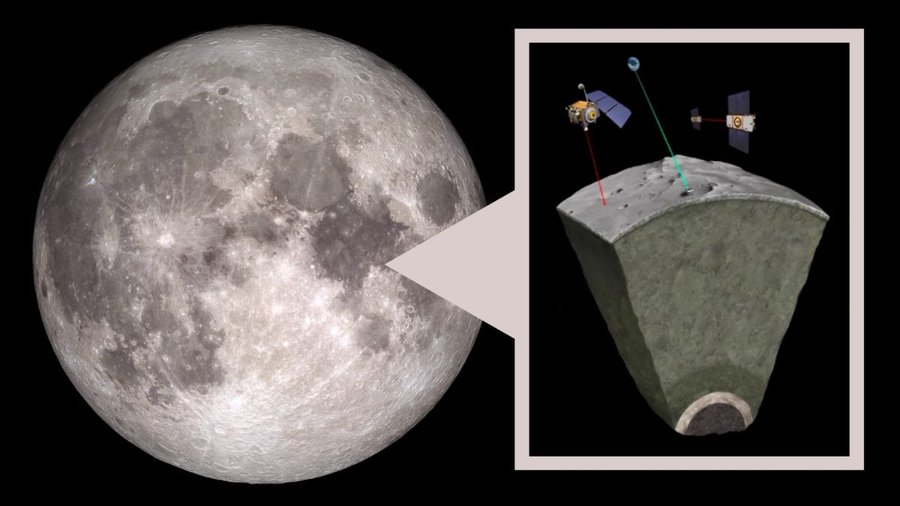
Around 20 years ago, scientists were able to use the rotation of the moon to determine it had a fluid outer core, but the relatively small size of the inner core made it harder to investigate.
Now, new research has revealed the heart of the moon as never seen before, demonstrating that it has a solid core that is composed of iron like Earth. The findings uncover details of the internal structure of the moon that were previously hidden and could explain why iron-rich materials are present in the lunar crust.
The investigation of the moon's deep interior was conducted by scientists from the CNRS, Université Côte d'Azur, the Côte d'Azur Observatory, Sorbonne Université, and the Paris Observatory-PSL and follows in the footsteps of the Apollo 11 mission, which half a century ago paved the way for geological surveys of the moon.
The formation and evolution of Earth's natural satellite is still something of a puzzle to scientists, and debates still surround the nature of its deeper layers — debates that this study could settle.
Using data from several space missions and from a process called laser ranging which precisely measures the distance between Earth's surface and that of the moon, the team behind this research found that the moon's outer core exists over a solid inner core. This inner core appears to be composed of metal with a density resembling that of iron and is around 310 miles (500 kilometers) wide, making it around 15% the size of the moon.
In addition to this discovery, the researchers also found evidence that supports the idea that material in a layer between the moon's core and its crust called the mantle moved around as the moon has evolved since its formation.
The process, which is called lunar mantle overturn, could explain why iron-rich elements are found at the surface of the moon, as the mantle material would be carried upwards as volcanic rock left in the lunar crust. The materials in this rock that were too dense would then sink back through the lighter crust material to the core-mantle boundary.
The findings may eventually help solve another mystery surrounding the evolution of the moon, namely what caused the moon's magnetic field, once 100 times stronger than that of Earth's today, to almost completely dissipate.
"Our results question the evolution of the moon's magnetic field thanks to its demonstration of the existence of the inner core and support a global mantle overturn scenario that brings substantial insights on the timeline of the lunar bombardment in the first billion years of the solar system," the team writes in a paper published on May 3 in the journal Nature.(opens in new tab)
Join our Space Forums to keep talking space on the latest missions, night sky and more! And if you have a news tip, correction or comment, let us know at: community@space.com.
To Live on Mars, Human Architecture Has to Combine Science and Sci-Fi
Human habitats on other planets could be as striking as it could be weird.
BY TATYANA WOODALL
Our homes are the places that define us; those warm private spaces that we depend on for work, respite, and haven from the harsh realities of the wider world. On Earth, the buildings and dwellings humans spend the majority of their lives in serve as reflections of our society’s culture, beliefs, and values. So if the shelters we make for ourselves truly mirror and influence our everyday lives, how might that sentiment be translated to living in space?
The kinds of structures future explorers might live in on other planets may be more critical to space exploration than sci-fi depictions of cities and homes in a galaxy far, far away suggest. As NASA’s desire for long-term human space colonization comes to fruition with planned crewed missions to Mars, establishing safe and well-made human settlements for life off-Earth is one of the agency’s most urgent tasks.
Putting down roots on Mars is an extremely ambitious goal to accomplish this century — but the reason why isn’t to do with rockets, necessarily. Rather, it is because any human settlement on the Red Planet will have to fight tooth and nail to experience even a modicum of ecological success.
One of the most accurate parts of the 2015 movie The Martianis that when Matt Damon ends up stranded on Mars, everything about the planet is trying to kill him and his habitat holding up is his only hope of survival. Human dwellings on Earth have evolved to thrive by taking advantage of the surrounding environment, but astronauts on Mars have no such advantages.
In The Martian, Mark Watney’s habitat’s design is what ultimately helps him survive.
20TH CENTURY FOX/MOVIESTORE/SHUTTERSTOCK
Instead, like Mark Watney, they will have to deal with various ill-fated conditions for life, including a complete lack of natural resources, harsh weather including dust storms and freezing temperatures, low gravity, and high levels of dangerous deep-space radiation.
Yet some sci-fi classics like Star Wars also offer alternative, less bleak visions of humanity’s future off-Earth. Can any of these fantasies become reality? It might be more possible than you think.
COSMIC UTOPIA
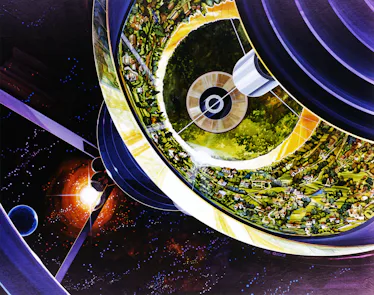
The Bernal Sphere is one of the many potential space habitats imagined by NASA artists in the height of the Space Age.
NASA AMES RESEARCH CENTER
If the history of humanity has taught us anything, it is that we are motivated by the idea of founding our own Eden — whether on a new continent or merely a new town. A similar philosophy drives one of the most popular science-fiction tropes ever: Humans going out to create a thriving utopia in space. Scientists and sci-fi authors alike have devoted years of their lives to imagining what innovative space settlements could look like, from spacecraft that resemble the doughnut-like Torus designs pioneered by German-American aerospace engineer Werner Von Braun — which could soon be the working model for future space hotels — to the more well-known interstellar Bernal Sphere, first proposed in 1929 by Irish physicist John Desmond Bernal.
Like Von Braun’s concept, many early space habitat designs started as idealized versions of space stations or lunar bases. One of the most serious efforts was the 1959 U.S. Army study Project Horizon. The army’s plan involved building a military facility that would be buried under lunar regolith in a bid to protect humans from radiation, freezing temperatures, and micrometeoroid and space debris impacts. The idea was eventually nixed when NASA’s Apollo missions in the ’60s and ’70s revealed how tough lunar soil is and how difficult it would be to burrow into it.
In 1989, Gary Kitmacher, former architectural manager for man-systems on the International Space Station, took a shot at an alternative: He designed an inflatable habitat that could accommodate the needs of about a dozen astronauts living on the surface of the Moon. The sleek, dome-like structure included a bevy of different mission-related and personal rooms, such as a fully equipped science lab, exercise rooms, hydroponic gardens, and private crew quarters.
Of course, neither project came to be, but these and several other fledgling space habitat projects have gone on to inspire similar present-day concepts that have evolved in scale, creativity, and feasibility. In fact, one particular Mars habitat concept started out as an alternative module for the ISS.
A computer-simulated cutaway view of the TransHab concept.
In the late 1990s, American architect Constance Adams worked with NASA to design TransHab, a large-scale inflatable spacecraft that would have increased the crew’s living space. While there are many advantages to using lightweight inflatable habitats, Adams once noted that before her creation, the biggest challenges facing space inflatable tech were strength, safety, and their need for a firm structure to maintain the form. With a soft inflatable shell, hard inner structural core, and three roomy levels, TransHab was the first hybrid structure that could be used for a pre-deployable Mars habitat. Although NASA did create a prototype, the project never received the funding it needed to get off the ground.
Space agencies need off-world homes to be pleasant for astronauts to live in. There are at least five aspects that every successful human habitat for long-term space exploration must have, Manoranjan Majji, an associate professor at Texas A&M University who studies aerospace robotics, tells Inverse:
A protective radiation-proof shell
Artificial gravity
Sustainable food and water
Robotic systems, including the ability to manufacture bots
The ability to grow
“Protection against extreme environments is very important,” Majji says. “Almost every part of engineering needs to contribute to that.” If you manage to overcome the cosmic ray problem, then astronauts will need artificial gravity and sustainable food and water to survive. Ultimately, Majji says, a combination of robotic systems and tools like 3D-printing will make these architectural obstacles easier for future explorers to overcome.
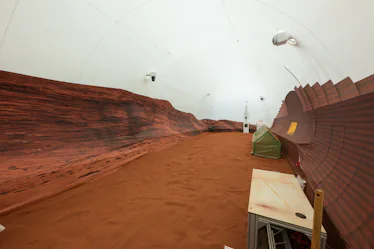
This is the inside of an experimental habitat, known as the CHAPEA, on Earth meant to simulate what it would be like to live on Mars.
NASA
Future settlements will also need to be capable of growth and even generate some commercial value while manufacturing and demonstrating these future technologies. This will be as true for building astronaut labs and quarters as it is for creating scenic regions and hotels for space tourists.
Combined, these needs show why having a diversity of space habitat design concepts is so vital, Majji says. “If we have flexibility in terms of the architectural elements,” he explains, “we will have a lot more freedom in terms of what we can efficiently realize.”
But what kinds of freedoms will the space habitats of the future offer us?
FLASHING FORWARD
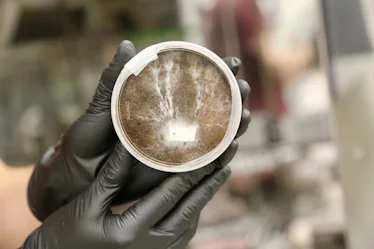
Mycoarchitecture could solve a huge issue with interplanetary colonization. This image shows mycelia growing in simulated Martian soil.
Ferrying resources from Earth to other planets takes a massive amount of time and energy, but these costs could be mitigated by using materials grown in space to build the next generation of multi-planetary structures. One concept, called myco-architecture is being tested at NASA’s Ames Research Center in California. The project imagines astronauts living in structures made out of fungi. Mycelia can create precise, complex threads and is easily scaled up. The organisms can also be coaxed into making leather-like materials as well as large-scale, durable habitats. Scientists could one day create other forms of biomaterial, medicine, and even food needed to sustain astronauts for the duration of their missions using similar bioengineering techniques.
In fact, most habitat designs, including one that would rely on the power of fungi, seem to favor a circular resource economy, one where nearly everything is recycled and used to power other systems or needs. Hopefully, such advances could offer explorers a greater variety of produce and materials than what fictional astronaut Mark Watney had to in The Martian.
And as humanity moves ever-closer to becoming a space-faring species, other nations are ramping up efforts in space architecture design. In 2017, the United Arab Emirates announced that it would aim to colonize Mars within the next 100 years, putting a rush on Dubai’s Mars Science City, a project whose goal is to create the first stable human settlement among the stars. Using a combination of 3D printing and sand, the concept imagines a sea of interconnected domes that will stretch across more than 176,000 square meters of Emirati desert — a project that could span the length of about 30 football fields. The city hopes to be fully operational by 2024.
NASA is one of many space agencies actively planning to house astronauts on other worlds, including the Moon and Mars.
“Most architectural models that I’ve seen use Martian rock materials to build modular spaces that blend in with the natural landscape,” Paul Weiner, a Denver-based contemporary artist whose hobbies include conceptualizing Martian aesthetics, tells Inverse. He agrees with the theory that local Martian materials (like sand) might be combined with 3D printed ones to create durable habitats and says even interior design might “similarly be optimized for robotic printing.” NASA, too, is also deeply invested in using 3D-printing technologies as a promising method to create sustainable deep space habitats, as it has held multiple competitions to energize and educate the public on the topic.
Still, keeping humans happy and healthy during a long-duration space mission is more challenging than it sounds. On a yearslong trip heading toward an environment far removed from everything humans are familiar with, every aspect of their refuge has to be carefully cultivated. Senior designer Chris Lawson, whose United Kingdom-based architectural firm CK Architectural has envisioned several kinds of futuristic habitats, tells Inverse that when designing these places, he often thinks about how to create spaces that combat isolation and feelings of reclusiveness. One way he likes to do this is find ways to create green areas, or places that remind people of nature.
“We all get lonely, and you try and imagine how loneliness feels that far away, that unconnected in a hostile environment,” Lawson says. “It’s going to be a long, long time until you’ve got cities [on] Mars.”
Although current astronauts have only been sent on relatively short trips to space, the ISS has served as an important test bed in investigating what kinds of structures might allow astronauts to accomplish their missions in comfort. Some of these tricks include ensuring that the interiors of these spaces do as much from the inside as these structures do from the outside. Aboard the ISS, NASA for example, uses LED lighting to keep crew members from feeling depressed and to regulate their circadian rhythms, which promotes good sleeping habits. We’re still decades away from having to prepare travel accommodations on Mars, but at least for some, helping to bring to life concepts people have previously only dreamed of is as exciting as it is alien.
“There’s a moment of emotion when presenting something that’s not been thought [of] or conceived by a client,” Lawson says. “When we’re able to show things that they’re not able to imagine, that spark joy and emotion, it’s something beyond words.”
Russian scientists found 'tiny spheres like cosmic sperm' at UFO crash sites
The Soviet Union officially dismissed all UFO reports as 'western propaganda' – but a group of Russian scientists working in secret made some hair-raising discoveries
George Knapp says he was handed a few of the mysterious orange spheres found at a UFO landing site
(Image: WireImage)
Russian scientists found tiny "spheres" like "cosmic sperm" at supposed UFO crash sites, a journalist has claimed.
George Knapp revealed that he had taken advantage of the confusion following the collapse of the Soviet Union to gain access to secret Russian military research into UFOs.
In some cases he even managed to obtain copies of classified documents relating to the phenomenon.
George said that while officially, the Soviet government dismissed reports of alien visitations as “western propaganda,” behind the scenes there was a desperate attempt to gather as much information as possible about the unexplained phenomenon.
George claimed scientists analysed two UFO crash sites in Russia (stock image)
“We know that from Stalin on they wanted to duplicate the technology to figure out how UFOs worked,” George told Jeremy Corbell on the Weaponised podcast..
“We knew they weren't ours they knew they weren't Russian, they were from somewhere else… this is advanced technology and if they could figure it out and duplicate it they could beat us in terms of stealth.”
Dr Felix Ziegel, a Cosmology specialist at the Moscow Aviation Institute, became the co-founder of the first officially approved Soviet UFO research group in the 1960s.
Dr Felix Ziegel holding a drawing of a UFO by alleged witnesses in 1977
Most intriguing, however, was Simakov’s discovery of tiny, glass-like balls recovered from soil inside the “crop circle”-like landing sites.
“They may be the result of transmutation when oxygen was converted to sodium under the influence of the UFO,” Dr Simakov reportedly said.
Or, he added, “they may be containers to carry life from one planet to another”.
George explained: “The impressions they made of the soil were pretty dramatic and it doesn't look like anything that we fly, and he shared that with us he gave us all that information and then he had found these little orbs.
“These little tiny perfect spheres… they were opaque.
"They were sort of reddish orangish colour and he called them ‘cosmic sperm’ – he thought they were some kind of a biological mechanism, some kind of seeds, and he gave me half of the world's known supply of cosmic sperm and I brought them back”.
Stalin officially dismissed UFOs as a western hoax – but behind the scenes ordered every report to be investigated(Image: Corbis via Getty Images)
Mysterious difficulties are still preventing the release of information related to the government’s hoarding and suppressing data about the first known interstellar object to land on Earth, nearly a year after U.S. Space Command confirmed that scientists had correctly identified it. Whereas, scientists provide an explanation for the trajectory of the most controversial “Oumuamua.”
Scientists Jennifer Bergner and Darryl Seligman submitted a paper, concluding that Oumuamua contained water and molecular hydrogen, which froze into ice due to the extreme cold of deep space. When the interstellar object entered the inner solar system and warmed up, the ice converted to its crystalline state, causing the H2 to be forced out and provide the propulsive push that explained the acceleration. The scientists ruled out nitrogen and carbon monoxide as possible explanations for the outgassing and acceleration because their levels were too low.
Dr. Avi Loeb said: “Oumuamua was not a Hydrogen-Water iceberg.” He submitted a new paper in collaboration with Thiem Hoang, challenging the surface temperature calculation of Oumuamua made by Bergner and Darryl in their recent paper published in Nature. He and Hoang argue that the calculation ignored the cooling effect of evaporating hydrogen, leading to an overestimation of the surface temperature by a factor of 9. The decrease in surface temperature limits the thermal annealing of water ice, further challenging the original model’s credibility.
Additionally, Dr. Loeb argues that Oumuamua’s lack of a visible coma, absence of carbon-based molecules or dust, and its unusual elongated shape, are all inconsistent with it being a generic comet. Dr. Loeb has previously proposed the possibility that Oumuamua is artificial in origin, which has sparked debates among experts.
In 2019, Amar Siraj and Dr. Loeb discovered an interstellar meteor near Papua New Guinea in 2014 and attempted to confirm their discovery. Relevant data had been collected by Department of Defense sensors, which were used to track nuclear explosions and was classified. In 2022, after delays, Space Command confirmed the researchers were correct about the meteor’s origin. This raised questions about why the government had suppressed information about the discovery for years.
According to this report, Motherboard filed a request under the Freedom of Information Act with different federal agencies seeking insight into why the government was not sharing data about alien bodies transiting our solar system. One request was filed with the Department of Energy in April 2022, and sought emails from two scientists at Los Alamos National Laboratory, who mentioned the terms asteroid, meteor, or debris. Motherboard requested expedited processing due to the public’s interest in the topic.
The Department of Energy informed Motherboard that the request had been forwarded to the National Nuclear Security Administration, and a government information specialist later informed Motherboard that they had not demonstrated a compelling need for expedited processing. The request’s estimated completion date was moved several times, and Motherboard was ultimately told there is no estimated completion date due to “a few difficulties that the NNSA’s Los Alamos Field Office and/or Lab will have to work out.”
There is no definite answer to why mainstream scientists are trying to diminish Dr. Loeb’s discovery of Oumuamua and his bold acceptance of extraterrestrials. However, in his recent blog post, he mentioned that he was visited by two government representatives from Washington DC, who assumed he was on the right path. Perhaps, he is right about some UFOs might be extraterrestrial. (Source)
“‘Am I wasting my time?’ I asked the two visitors who came all the way from Washington DC to my home a couple of days ago. ‘Not at all,’ they assured me,” writes Dr. Loeb. He further added: “There is, of course, a lingering possibility that I am naïve and UAP are smoke and mirrors. In that case, we will find out soon enough. This is why I asked my guests from DC whether I may be wasting my time. I have no access to classified data and the publicly available data is not convincing. But the known facts are intriguing enough to get me going. Just as the nature of dark matter inspired me to write many scientific papers as a theoretical astrophysicist.”
Dr. Loeb has written extensively about dark matter and other cosmic phenomena. However, he is now leading the Galileo Project, which aims to investigate unident ified aerial phenomena (UAP) and determine if any have an extraterrestrial technological origin. The author notes that the scientific community has not been open to exploring UAP in the same way they have been with dark matter, and that this is a problem.
He argues that new scientific knowledge is gained through high-quality data, and the path to this knowledge should not be hindered by academic intolerance or low-quality data. He also notes that UAP research is often hindered by unsubstantiated claims and low-quality data, and that the focus should be on collecting new high-quality data to determine the nature of UAP.
A recent poll conducted by Professor Brian Keating from the University of California, San Diego, shows that 51.1% of respondents believe that the first Oumuamua was of extraterrestrial technological origin, despite inconclusive scientific evidence.
According to Dr. Loeb, “three of the known four interstellar objects (ISOs) appear anomalous, namely the meteors IM1 and IM2 in their high material strength and Oumuamua in its non-gravitational acceleration without a visible cometary tail, is intriguing for those who maintain their childhood curiosity or beginner’s mind (Shoshin) of Zen Buddhism. This evidence is not intriguing for everyone. Some science journalists celebrated a Nature paper last week and chose to ignore a follow-up paper which demonstrated that the Nature paper violated energy conservation, in order ‘not to confuse their readers.'”
On March 7, 2023, Avi Loeb presented a paper co-authored with Dr. Sean Kirkpatrick, Director, All-domain Anomaly Resolution Office (AARO) of the Pentagon, stating that some UAPs could be small probes from an alien mothership. The paper describes physical constraints on UAPs using known forms of matter and radiation and states that the lack of radio signatures could indicate inaccurate distance measurements.
Dr. Loeb suggests that an artificial interstellar object could release many small probes during its close passage to Earth, which could reach Earth or other Solar system planets for exploration, and would be undetectable for existing survey telescopes but could be detected by deep space radars and space fences. The changes in arrival time and distance of the closest approach to Earth would manifest due to a small ejection speed far away, leading to a large deviation from the trajectory of the parent craft near the Sun.
In conclusion, the idea that Oumuamua and some UAPs could be of alien origin is a topic that continues to intrigue and spark debate among scientists and the general public. While some believe that the inconclusive scientific evidence does not support this claim, others like Dr. Loeb and Dr. Sean Kirkpatrick have presented research and theories that suggest the possibility of alien probes. As technology advances, it will be interesting to see if we can detect more evidence that could provide answers to this ongoing mystery.
Defence officials are investigating footage that shows ‘a fleet of UFOs being chased’
(Image: GETTY)
Defence officials are investigating radar footage showing a fleet of UFOs being chased by fighter jets.
In 2008, up to 300 people witnessed the two F-16 jets chasing up to 12 of the unidentified objects.
The implausible claim became plausible to those who saw it when the US Air Force denied it had jets in the air, only to later concede its aircraft was in the sky.
Despite what they called an internal communications error, military chiefs refused to acknowledge the mile-wide line of purported UFOs near the remote town of Stephenville, Texas.
In 2008, up to 300 Stephenville residents witnessed two F-16 jets chasing ‘a dozen UFOs’
(Image: GETTY)
Now, 15 years later, footage from the incident is being probed by the All-domain Anomaly Resolution Office on behalf of the the US Defense Department.
National Geographic’s new series UFOs: Investigating The Unknown confirmed the existence of the radar footage and also had an eyewitness describe the close encounter.
Lee Roy Gaten, a police officer, said he looked out of his car and saw 10 to 12 fluorescent orbs.
He said: “They were moving really quickly and then they stopped and then all of a sudden they shot off."
A witness said lights on the object flickered then went solid, shaping into a massive arch
(Image: GETTY)
Private airline pilot Steve Allen, who was camping out with pals nearby, also told the series he "noticed some lights coming at us at a very high rate of speed".
He added: “We saw craft coming from the east going west. They had extremely large lights like a magnesium flare. It almost burnt your eyes to look at it.
“It was moving extremely fast - faster than any normal aircraft.
“As we watched it we saw there were two F-16 jets in hot pursuit after it chasing it.
“It was unbelievable. It left us all in shock. It was out of this world.”
The US Air Force denied it had jets in the air, only to later concede its aircraft was in the sky
(Image: GETTY)
Speaking to NPR at the time, Claudette Odom said she, her husband and two friends were clearing brush near her home in Stephenville at around 6pm.
While standing on top of a hill with good visibility, Odom said she saw an object approach out of the west.
"I've never seen anything that fast. Maybe a rock or a missile or something," she told the broadcaster.
She then claimed the group watched the aircraft approach Stephenville and then silently hover outside the outskirts of town.
Odom added lights on the aircraft flickered then went solid, shaping into a massive arch, before forming a single bright vertical line that split into two.
She added: “They were extremely, extremely bright. Like an arc on a welder, they were that sharp.”
After the military’s denial and subsequent concession about the fighter jets, she said: “I don't know what they're trying to cover up.
We saw what we saw. I knew they were fighter jets.”
Comet 238P/Read is a strange rock. Its location just past Mars in the main asteroid belt is an unusual spot for a comet in our Solar System. And it’s missing frozen carbon dioxide, frequently found on comets. Comet Read’s most compelling quirk, however, is that it definitely has water.
In a new study published Monday in the journal Nature, astronomers directed the $10 billion James Webb Space Telescope (JWST or Webb) to study Comet 238P/Read using its Near-Infrared Spectrograph (NIRSpec). This instrument is one-fourth the science arsenal of the telescope, and is designed to help scientists take apart information contained within the light of an object to learn more about what it’s made of. The composition of this cometary oddity, and others like it, may reveal one of the Universe’s biggest secrets.
The Near-Infrared Camera (NIRCam) on the NASA/ESA/CSA James Webb Space Telescope took this image of Comet Read on September 8, 2022.
If a pin is dropped at random from high above Earth’s surface, it will fall onto water 7 times out of 10. Water is abundant and essential to the planet, and life thrives thanks to its presence. But look around at the other members of the Solar System, or at the light spectra of exoplanets, and many come up dry. It’s still a mystery how Earth got its water.
Comets might have been the key. And by mapping out where comets are present throughout the Solar System, astronomers know where its frozen material has been present, too. And in addition to learning our own history, this framework could elucidate what happens to faraway planets around other stars.
Most of the known population of comets originates from the Kuiper Belt or Oort Cloud, located far beyond Neptune’s orbit. But Comet 238P/Read is one of at least three oddballs found just beyond Mars, in the main asteroid belt. The study authors write that main-belt comets are “currently unrepresented in observations of classical comets and the meteoritic record,” which makes them important for understanding the early Solar System, and how Earth got water.
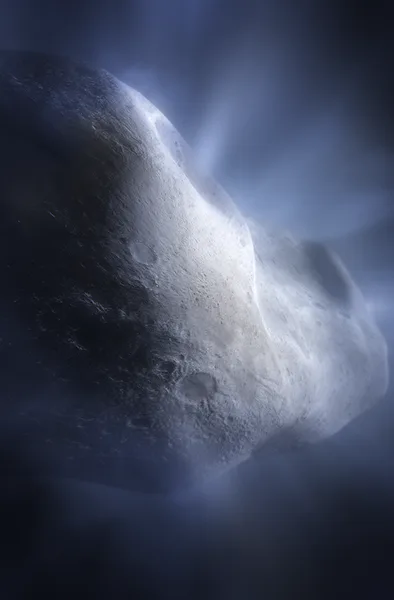
In this illustration of Comet Read, the icy object is sublimating. That’s when water, in the form of ice, vaporizes and forms a halo.
In addition to its cache of water, Comet 238P/Read’s lack of frozen carbon dioxide is also interesting. It could hint that it was part of a formation or evolutionary track that is different to that of classical comets. And it’s not a comet that recently lost its way. Astronomers think Comet Read and others like it have been in the main asteroid belt for a while. “It is unlikely to be a recent asteroid belt interloper from the outer Solar System,” according to the study.
“Main-belt comets themselves are a fairly new classification,” JWST mission officials write in a statement explaining the research. “Frozen material that vaporizes as they approach the Sun is what gives comets their distinctive coma and streaming tail, differentiating them from asteroids. Scientists have long speculated that water ice could be preserved in the warmer asteroid belt, inside the orbit of Jupiter, but definitive proof was elusive — until Webb.”
When NIRSpec pulled information about the light reflecting off Comet Read’s vapor, astronomers found evidence of frozen water there. “In the past, we’ve seen objects in the main belt with all the characteristics of comets, but only with this precise spectral data from Webb can we say yes, it’s definitely water ice that is creating that effect,” study lead author Michael Kelley says in the JWST statement.
This summer, the telescope will celebrate its first year of science. Perhaps next year will continue our exploration into how Earth got its breathtaking colors of cerulean and azure.
UFO Spotted Moments Before Popcatepetl Volcano Eruption. May 15, 2023
This object was spotted on the live cam just second before the massive eruption that took place on May 15, 2023 at 5:12am. In the footage we see this UFO in a downward flight patten as if it's heading straight for the volcano's crater but the object could have flown by the side of it. Either way the object seem very close to the eruption.
RELATED VIDEO
No Theory Can Explain Terrifying Cosmic Explosion Called Scary Barbie
Stratolaunch's massive Roc carrier plane completes hypersonic vehicle separation test
Stratolaunch's Roc carrier plane took to the skies with a Talon-A hypersonic separation test vehicle (Talon-O or TA-1) on May 13, 2023. Talon-O successfully separated from Roc and flew into the Pacific Ocean, as planned.
Credit: Space.com | footage courtesy: Stratolaunch / Christian Turner | edited by Steve Spaleta (https://twitter.com/stevespaleta)
Amazing stellar nursery views created from '1 million images'
ESO’s Visible and Infrared Survey Telescope for Astronomy (VISTA) has delivered amazing imagery of nearby stellar nurseries. The views were created by "piecing together more than one million images," according to the European Souther Observatory.
Star forming regions Orion, Ophiuchus, Chamaeleon, Corona Australis and Lupus constellations are featured.
Credit:ESO
Is This Proof Of Underwater UFO Bases In Alaska? | The Alaska Triangle
With only 5% of the Earth’s waters explored, the possibility of a secret underwater alien base has been speculated for decades. A US Naval Communications Officer recalls the 1969 UFO incident that changed his life forever.
Ancient Aliens: CIA Analyst Discovers UFO Base In Alaska (S19)
Was this CIA member killed because he wasn't supposed to see something at the base of Mt. Hayes in Alaska? See more in this scene from Season 19, Episode 8, "The Mysteries of Alaska."
Watch your favorite episodes of Ancient Aliens on The HISTORY Channel website at http://history.com/schedule.
Triangular Shaped UFO Filmed By Night Vision Camera Over L'Alfàs del Pi, Spain. May 8, 2023
This was sighted on May 8, 2023 from L'Alfàs del Pi in Spain, near Mount Puig Campana. The camera that was used was an NVG10. The witness believes the area around the mountain to be a UFO hotspot for sighting and activities with this footage as proof.When the witness was asked why you didn't film the object for longer, he replied "Because i couldn't follow it any further from that position (I had the tripod tilted on 1 leg just to keep following it and would have to turn the whole tripod and find it again (in the dark and disoriented as to where it was at that moment). I lost it there and then but I was excited enough with what I captured."
RELATED
Metallic Sphere Shaped UFO Shown To Congress By Dr. Sean Kirkpatrick. April 19, 2023
Today (April 19, 2023) The director of the All-domain Anomaly Resolution Office, Sean M. Kirkpatrick, was testifying before the Senate Armed Services Subcommittee on Emerging Threats and Capabilities on the AARO's mission and budget, with some senators expressing concerns over whether the Pentagon's effort is getting adequately funded. At the meeting he produced this incredible footage of this UFO "Orb" From Mission report: 7750816, which took place on July 12, 2022.
Just Discovered: The James Webb Space Telescope Has Just Found a 200 Million-Year-Old Structure!
The future of modern space exploration has a name: The James Webb Telescope! On December 25, 2021, the most powerful space telescope of all time will set out into the gigantic expanses of space and revolutionize our knowledge of the universe in the coming years.
This is an ambitious goal, but one that the 10-billion-dollar telescope is already meeting with flying colors: The Webb images give us a detailed insight into those areas of the cosmos that were still the great unknown in the past. But what things has the James Webb Space Telescope already been able to detect?
What exciting aspects will it address in the near future? And what's the deal with the spectacular structure Webb recently added to the star charts? Are you ready to join us on a journey to the greatest mysteries of the universe? Then get something to munch on, sit back, and be sure to watch our video all the way to the end!
Sound Waves and Audio Recorders Could Be The Real Keys to Discovering Alien Life Forms
Paul Seaburn
The Perseverance rover on Mars is searching for chemical and biological signs of life on the Red Planet by digging into the soil to both analyze it and store it in canisters for pick-up by a future mission to be further studied back on Earth. It is also searching for visible signs of life by launching the Ingenuity helicopter, which has flown at least 50 times at high and low altitudes looking for tracks, fossils, river beds, unusual rocks and any other signs of Martian life. The Perseverance Rover is also listening for signs of life – it has two microphones which have captured the sound of Martian winds, the crunching of the rover’s own wheels and other noises. It is that last method which interested Timothy G. Leighton, a professor of ultrasonics and underwater acoustics at the University of Southampton in the U.K.. Leighton is studying future sounds – he’s developed a software program which simulates how the human voice will sound on other planets and moons … a good thing to know if an astronaut needs to call for help. Leighton is now convinced that his program will also help us listen for alien life forms and thinks it is a more efficient way to find them.
Sound waves may be our first sign of extraterrestrial life.
“For decades, we have sent cameras to other planets in our solar system and learned a great deal from them. However, we never really heard what another planet sounded like until the very recent Mars Perseverance mission.”
It turns out the movie “Alien” was wrong – in space, someone CAN hear you scream … but they may not necessarily hear the same sound one would hear on Earth. Leighton wondered exactly what the differences might be, especially after hearing the sounds recorded by the Perseverance Rover on Mars. While we know what a tire moving on dirt and rocks should sound like, we know less about what noises a Martian wind blowing across the ground might make. And we know nothing about how a human voice would sound.
In the press release announcing Leighton’s demonstration of his software program at the recent 184th Meeting of the Acoustical Society of America, a reference is made to the very first sound recording from another planetary body. That event happened in 2005 when the Huygens atmospheric entry robotic space probe landed successfully on Saturn's moon Titan – making it the first to land on a moon other than our own and the farthest landing from Earth a spacecraft has ever made. The sounder instrument was activated near the end of the lander’s descent and measured the speed of sound in order to determine the distance to the surface, rate of descent and the surface roughness. Those ‘speed of sound’ measurements also gave an indication of the composition of Titan’s atmosphere.
The next big sound advance in space came from the Mars InSight Lander which touched down on November 26, 2018. Just a few days later, on December 7, 2018, InSight recorded the sounds of Martian winds with the Seismic Experiment for Interior Structure (SEIS) instrument – the vibrations of the wind were within human hearing range at about the level of the sounds emitted by a subwoofer, and were sent back to Earth for analysis. These also provided data for Leighton’s software program. The acoustic recordings the Huygens lander’s descent, the Mars InSight wind recordings and Perseverance Rover’s audio pick-ups of wind and the movements of the rover itself were then combined with data from other active and passive acoustic sensors which operated over a wide spectrum of sounds from very low frequency infrasounds below the human hearing threshold to ultrasounds above human hearing.
The end results of Leighton’s other world sound experiments are twofold. First, they will help develop precise sound equipment for various planets and moons. The recording from InSight and Perseverance show that the thin, carbon dioxide-rich Martian atmosphere absorbs more sound than Earth’s, so distant noises appear fainter. Thicker atmospheres will have a different impact on sound speed and absorption. Now, lander engineers can use that data to design and calibrate microphones and speakers for each planet and moon’s special conditions so they – and future astronauts – can discern exactly what they are hearing no matter the location or conditions.
“The idea of sending a probe on a seven-year trip through space, then drilling or melting to the seabed, poses mind-boggling challenges in terms of finance and technology. The ocean on Europa is 100 times deeper than Earth’s Arctic Ocean, and the ice cap is roughly 1,000 times thicker.”
The second benefit of the sound simulation software will help in the search for extraterrestrial life on planets and moons more hostile than Mars. Jupiter’s moon Europa is a target for future missions but its thick layer of surface ice will be difficult to physically penetrate the ice to reach Europa’s ocean and the life forms that might be swimming in it with the limited instruments which can be packaged into a small lander.
“However, instead of sending a physical probe, we could let sound waves travel to the seabed and back and do our exploring for us.”
It’s not like yelling “Is anybody home?” and hoping to pick up a response or an echo (shades of Captain Kirk and the Enterprise landing parties?), but designing sound instrument for the conditions on Europa – and other planets and moons – is obviously a much better idea with a greater chance of success. Finally, Leighton’s software could make for more realistic Star Trek movies and other science fiction films, which can now show how voices and vehicles might really sound on other planets. In fact, entertainment is the first area where Leighton’s software will be used. Demonstrations, which will include both simulations plus actual sounds recorded on Titan and Mars by both NASA and China’s Zhurong mission, are being scheduled to be played at planetariums and museums around the world.
Will this be the first alien sound we hear?
In space, new instruments CAN hear you scream, and now we have the software to figure out if you need help, are screaming for joy, or are yelling out the lyrics of a song with your new extraterrestrial friend.
Meer van UFO'S of UAP'S, ASTRONOMIE, RUIMTEVAART, ARCHEOLOGIE, OUDHEIDKUNDE, SF-SNUFJES EN ANDERE ESOTERISCHE WETENSCHAPPEN - DE ALLERLAATSTE NIEUWTJES


 FASTWALKERS: The secret Space-Based UFOs