Ontdek de Fascinerende Wereld van UFO's en UAP's: Jouw Bron voor Onthullende Informatie!
Ben jij ook gefascineerd door het onbekende? Wil je meer weten over UFO's en UAP's, niet alleen in België, maar over de hele wereld? Dan ben je op de juiste plek!
België: Het Kloppend Hart van UFO-onderzoek
In België is BUFON (Belgisch UFO-Netwerk) dé autoriteit op het gebied van UFO-onderzoek. Voor betrouwbare en objectieve informatie over deze intrigerende fenomenen, bezoek je zeker onze Facebook-pagina en deze blog. Maar dat is nog niet alles! Ontdek ook het Belgisch UFO-meldpunt en Caelestia, twee organisaties die diepgaand onderzoek verrichten, al zijn ze soms kritisch of sceptisch.
Nederland: Een Schat aan Informatie
Voor onze Nederlandse buren is er de schitterende website www.ufowijzer.nl, beheerd door Paul Harmans. Deze site biedt een schat aan informatie en artikelen die je niet wilt missen!
Internationaal: MUFON - De Wereldwijde Autoriteit
Neem ook een kijkje bij MUFON (Mutual UFO Network Inc.), een gerenommeerde Amerikaanse UFO-vereniging met afdelingen in de VS en wereldwijd. MUFON is toegewijd aan de wetenschappelijke en analytische studie van het UFO-fenomeen, en hun maandelijkse tijdschrift, The MUFON UFO-Journal, is een must-read voor elke UFO-enthousiasteling. Bezoek hun website op www.mufon.com voor meer informatie.
Samenwerking en Toekomstvisie
Sinds 1 februari 2020 is Pieter niet alleen ex-president van BUFON, maar ook de voormalige nationale directeur van MUFON in Vlaanderen en Nederland. Dit creëert een sterke samenwerking met de Franse MUFON Reseau MUFON/EUROP, wat ons in staat stelt om nog meer waardevolle inzichten te delen.
Let op: Nepprofielen en Nieuwe Groeperingen
Pas op voor een nieuwe groepering die zich ook BUFON noemt, maar geen enkele connectie heeft met onze gevestigde organisatie. Hoewel zij de naam geregistreerd hebben, kunnen ze het rijke verleden en de expertise van onze groep niet evenaren. We wensen hen veel succes, maar we blijven de autoriteit in UFO-onderzoek!
Blijf Op De Hoogte!
Wil jij de laatste nieuwtjes over UFO's, ruimtevaart, archeologie, en meer? Volg ons dan en duik samen met ons in de fascinerende wereld van het onbekende! Sluit je aan bij de gemeenschap van nieuwsgierige geesten die net als jij verlangen naar antwoorden en avonturen in de sterren!
Heb je vragen of wil je meer weten? Aarzel dan niet om contact met ons op te nemen! Samen ontrafelen we het mysterie van de lucht en daarbuiten.
Einstein’s Genius Shines Bright: Star’s Enigmatic Path around Black Hole Validates Theory
Albert Einstein’s general theory of relativity has passed another test. Researchers have discovered a slight adjustment in the orbit of the nearest known star to the supermassive black hole at the heart of the Milky Way after almost three decades of monitoring—and the movement exactly confirms Einstein’s prediction.
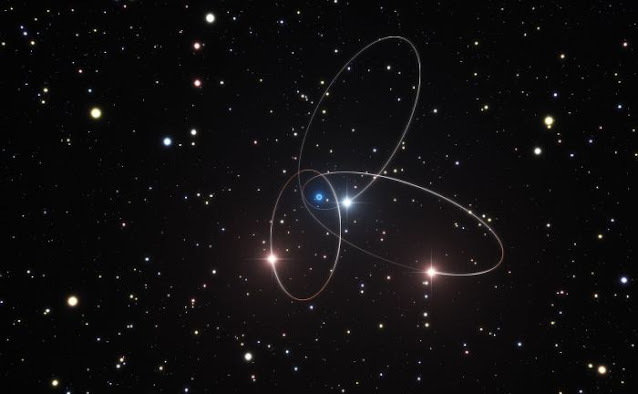
The star, known as S2, has a 16-year elliptical orbit. It came near 20 billion kilometers of our black hole, Sagittarius A*, last year. If Isaac Newton’s traditional definition of gravity is correct, S2 should then continue on its previous orbit’s course through space. But it didn’t work.
Instead, it took a slightly divergent route, with the axis of its ellipse altering slightly, according to research published today in Astronomy & Astrophysics by a team employing the European Southern Observatory’s Very Large Telescope. As predicted by general relativity, the process known as Schwarzschild precession will eventually force S2 to trace out a spirograph-like floral pattern in space (as illustrated above).
The researchers claim that their comprehensive monitoring of S2 will let them analyze how much unseen material, including dark matter and smaller black holes, exists near Sagittarius A*, in addition to another demanding test of relativity. This might aid them in understanding how such behemoths develop and evolve.
Scientists Puzzled Because James Webb is Seeing Things that are Unexpected.
Astronomers have used the James Webb Space Telescope to peer back in time to the early days of the universe — and they spotted something unexpected.
NASA's super-powerful James Webb Telescope has provided the most distant glimpses of the universe ever since its launch.
It has given answers to questions that were still unresolved. But, this raised other questions as well.
Until now, astronomers believed that galaxies arose during the early universe (after the Big Bang) would be small in size and irregular in shape.
But James Webb Telescope disproved this hypothesis of astronomers.
The JWST has revealed these galaxies to be astonishingly massive as are well-balanced and well-shaped.
It is a discovery that challenges existing beliefs about the origin of the universe and stresses the need to change the current understanding of the origin of the infant universe.
"The models just don't predict this" Garth Illingworth, an astronomer at the University of California at Santa Cruz, told Washington Post.
"How do you do this in the universe at such an early time? How do you form so many stars so quickly?"
Old images of the universe taken by the Hubble Telescope, showed that early galaxies were misshapen and chaotic.
But the James Webb Telescope (JWST) debunks this assumption – those findings were an illusion based on the limited capabilities of the Hubble Telescope.
"We thought the infant universe was the chaotic place where there's all these clumps of star formation, and things are all a-jumble" the Space Telescope Science Institute's Dan Coe told WaPo.
Adding later that, before the JWST was launched into the orbit, Hubble Telescope's imagery was "missing all the colder stars and the older stars. We were really only seeing the hot young ones."
Although the findings from James Webb surprised astrophysicists, technological advances have a long history of leading to a period of large-scale scientific research into astronomy or beyond.
Discoveries made today can lay the foundation for future successes.
JWST is doing exactly what astronomers tell it to do.
It is exploring the exciting objects of the vast universe, while simultaneously answering old questions and generating new ones.
Perseverance is Turning Into That Friend That's Always Picking Up Rocks
On Thursday, March 30th, NASA’s Perseverance rover drilled and stored the first rock core sample of its newest science campaign. This is the sixteenth sample the rover has taken as part of the ambitious Mars Sample Return (MSR) mission, a collaborative effort between NASA and the European Space Agency (ESA) to retrieve Perseverance’s samples and bring them back to Earth. Once they arrive (expected to happen by 2033), scientists will analyze them using state-of-the-art machinery too heavy and cumbersome to send to Mars as part of a robotic mission.
Collecting samples as part of the first sample-return mission from Mars is one of the main objectives of NASA’s Mars Science Laboratory (MSL) program. It is hoped that these samples will provide new insight into the planet’s environment and the water cycle that shaped the surface and interior of Mars. Of particular interest is how Mars evolved from a warmer, wetter environment – as it was during the Noachian Era (ca. 4.1 – 3.7 billion years ago) – to the cold and dedicated place we see today. It is theorized that life could have emerged during this period. If true, then the analysis of these core samples could provide the first evidence that life once existed on Mars (and might still be there today).
Perseverance has also collected three witness tubes, similar to sample tubes but designed to capture molecular and particulate contaminants. These tubes are opened close to sample collection sites to “witness” the ambient environment, helping scientists to characterize the location where samples are obtained. Earlier this year, the rover deposited ten tubes as a backup cache on the Martian surface for retrieval by the MSR campaign. For this latest campaign, the rover is exploring a new formation at the top of the delta formation in the Jezero Crater.
Scientists have named this formation “Berea,” which they believe formed from rock sediment carried by a stream that once flowed into the crater. This stream was responsible for forming the fan-delta, which means that the material in this formation could have come from far beyond the Jezero Crater. This is one of the reasons why the science team considers it to be so promising. But as Katie Stack Morgan, the deputy project scientist for Perseverance at NASA’s Jet Propulsion Laboratory (JPL), related in a NASA press release, there is another reason why the spot is attractive.
“The second reason is that the rock is rich in carbonate,” she said. “Carbonate rocks on Earth can be good at preserving fossilized lifeforms. If biosignatures were present in this part of Jezero Crater, it could be a rock like this one that could very well hold their secrets.”
Carbonates are a type of sedimentary rock that forms from chemical interactions between minerals and water. The presence of these and other minerals that form in the presence of water is why the Jezero Crater and the Gale Crater (where Curiosity is currently exploring) were selected as landing sites. Essentially, these mineral deposits could provide scientists with a record of what the climate once looked like, allowing them to create a more complete geological record of Mars. Said Ken Farley, the W.M. Keck Foundation Professor of Geochemistry at Caltech and Perseverance’s project scientist:
“The Berea core highlights the beauty of rover missions. Perseverance’s mobility has allowed us to collect igneous samples from the relatively flat crater floor during the first campaign, and then travel to the base of the crater’s delta, where we found fine-grained sedimentary rocks deposited in a dried lakebed. Now we are sampling from a geologic location where we find coarse-grained sedimentary rocks deposited in a river. With this diversity of environments to observe and collect from, we are confident that these samples will allow us to better understand what occurred here at Jezero Crater billions of years ago.”
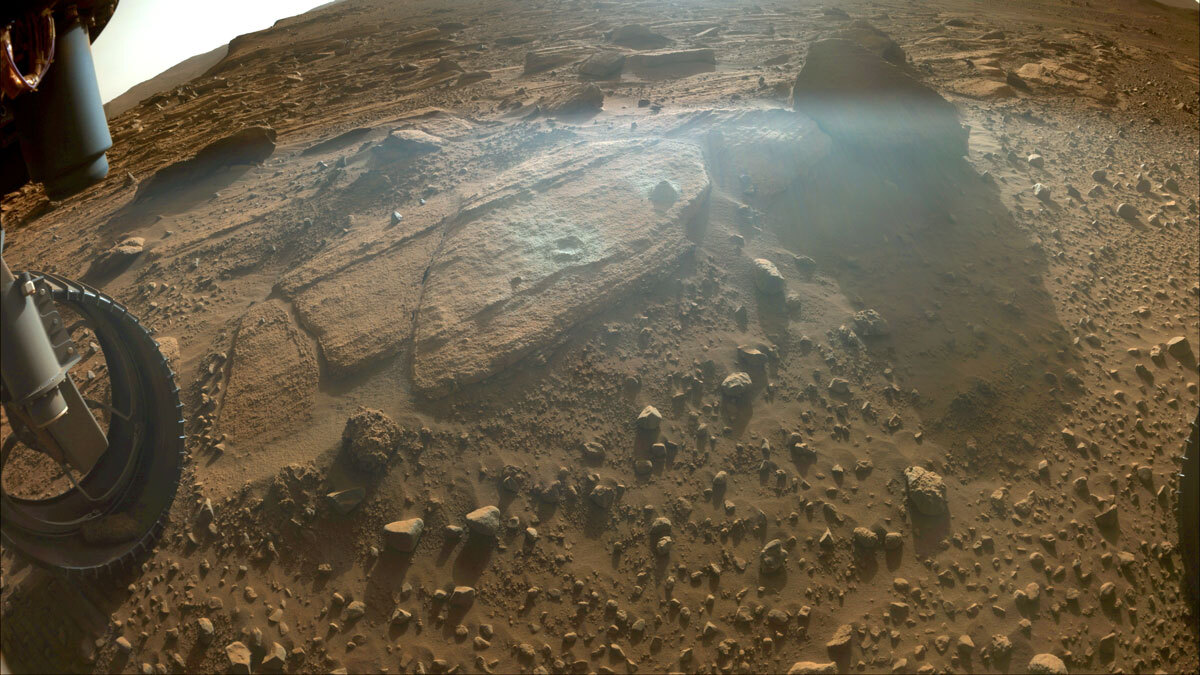
This image shows the rocky outcrop the Perseverance science team calls “Berea” after the NASA Mars rover extracted a rock core (right) and abraded a circular patch (left).
Credit: NASA/JPL-Caltech
Now that the Berea sample has been cored and placed into the rover’s internal cache, Perseverance will move to its next drill site along the delta fan – a place the science team has named “Castell Henllys.” In addition to the 16 samples it has collected, Perseverance has also collected rock samples with its wheels. In February of 2022, the science team noticed that the rover’s left front wheel had picked up a “pet rock” and managed to hold onto it for months! The entire sample cache will be retrieved starting in 2030 with the arrival of the NASA MSR elements.
This includes the Sample Retrieval Lander, which Perseverance will deliver all the samples contained in its cache. A pair of Sample Recovery Helicopters (the same design as Ingenuity) will gather the samples the rover left on the surface. Once loaded aboard the Lander, the samples will be sent into orbit via the Mars Ascent Vehicle (MAV) and then collected by the ESA’s Earth Return Orbiter (ERO). This spacecraft will return the sample cache to Earth (by 2033 at the earliest) for analysis. The results will lead to all kinds of scientific breakthroughs and even demonstrate that life did exist on Mars billions of years ago.
Perseverance Cores 'Berea': This animation shows NASA’s Perseverance Mars rover collecting a rock sample from an outcrop the science team calls “Berea” using a coring bit on the end of its robotic arm. Credits: NASA/JPL-Caltech. Download video ›
Fingers crossed, the data could also help resolve where Mars’ water (and any remaining life forms) can be found today!
Cassiopeia A (Cas A) is a supernova remnant. It has been observed many times. This new image uses data from Webb’s Mid-Infrared Instrument (MIRI) to reveal Cas A in a new light. Credits: NASA, ESA, CSA, D. D. Milisavljevic (Purdue), T. Temim (Princeton), I. De Looze (Ghent University). Image Processing: J. DePasquale (STScI)
It’s Time for Supernova Remnant Cassiopeia A to Get the JWST Treatment
Ready for another stunning image from JWST? How about a peek inside a supernova remnant? Not just any stellar debris, but a highly detailed view of the leftovers from the explosion that created Cassiopeia A. The latest image is giving astronomers an up-close and personal look at what happened to a supermassive star some 11,000 light-years away from us. It may also help answer questions about the existence of cosmic dust, particularly in the early Universe.
The Cassiopeia A supernova remnant has been studied a lot. But, the new JWST view shows a great deal more detail that astronomers haven’t seen in other observations. And, that detail is opening up new windows on this stellar event. “Cas A represents our best opportunity to look at the debris field of an exploded star and run a kind of stellar autopsy to understand what type of star was there beforehand and how that star exploded,” said Danny Milisavljevic. He’s the principal investigator of the observing program that captured this view.
Exploring the Damage
This image tells a tale of sequential destruction when the supermassive star at the heart of Cas A died. First, as the aging star began its death process, it consumed heavier and heavier fuels in its core. That heated it up and the star expanded. It also ejected clouds of warm dust. They expanded slowly outward from the event. Then, when the star’s core began to consume iron, it took more energy than the star could supply. Burning stopped and the core collapsed. That brought the rest of the star inward. Then, it all rebounded, sending tendrils of stellar material racing away from the core. Eventually, that material collided with the slower-expanding dust shell.
All the colors in the image indicate the various parts of the explosion. The scene is pretty confusing at first. Astronomers are still working to figure out all the different sources of emissions in the remnant. The orange and red-hued material indicates emission from the warm outer shell. The tendrils are the starstuff rushing away from the collapsed core. They are bright pink and studded with knots and clumps. There’s a mix of elements generated in the star and by the explosion—including oxygen, neon, and argon. There is a collection of wispy star material closer to the center of the explosion site. The most prominent is a giant green loop that the team nicknamed the “Green Monster”. It’s an unexpected feature and nobody’s quite sure how or why it formed.
A closeup of the “Green Monster” (named after Boston’s Fenway Park). The JWST view shows incredible detail in this and other filaments at the heart of Cas A. Credits: NASA, ESA, CSA, D. D. Milisavljevic (Purdue), T. Temim (Princeton), I. De Looze (Ghent University). Image Processing: J. DePasquale (STScI)
The Cas A Supernova Remnant and Cosmic Dust
Supernovae scatter huge amounts of dust in their wakes. So, this raises a question. Since astronomers see dusty galaxies in the early Universe, did supernovae make them that way? The answer is complicated. Certainly, the first supermassive stars existed pretty early in cosmic history. And, they died in supernova explosions. So, it might make sense to assume that they’d scatter dust as they died. Yet, observations of more “modern” supernovae and their dust output don’t always explain the huge amounts of dust in early times. So, where did the early dust come from, if not from supernovae?
The answer may be that they did provide all that dust. We just need the high-resolution infrared views that JWST is able to provide to find the evidence for that. “In Cas A, we can spatially resolve regions that have different gas compositions and look at what types of dust were formed in those regions,” said Temim. That means JWST can “see” what astronomers haven’t been able to detect using many other telescopes in the past.
Exploring supernova remnants like Cas A gives astronomers more than a view of what a dying star does to its environment. Doing it in high-resolution detailed infrared views allows astronomers to “see inside” dusty objects such as Cas A. Not only that, but it provides a window to the past. “By understanding the process of exploding stars, we’re reading our own origin story,” said Milisavljevic. “I’m going to spend the rest of my career trying to understand what’s in this data set.”
Past Views of Supernova Remant of Cas A
Cassiopeia A lies only about 11,000 light-years from us and stretches across 10 light-years of space. It was probably first observed in the late 1600s from Earth. With the advent of modern telescopes, it has been seen in visible light from the ground, as well as through radio observations, and from space by the Hubble Space Telescope, the Chandra X-ray Observatory, NuSTAR, and others.
This Chandra X-ray Observatory image of Cas A shows chemical elements in the supernova remnant. The different colors mostly represent iron (orange), oxygen (purple), and the amount of silicon compared to magnesium (green). Titanium (light blue) detected previously by NASA’s NuSTAR telescope at higher X-ray energies is also shown. These Chandra and NuSTAR X-ray data have been overlaid on an optical-light image from the Hubble Space Telescope (yellow). Credit: Chandra: NASA/CXC/RIKEN/T. Sato et al.; NuSTAR: NASA/NuSTAR; Hubble: NASA/STScI
This lopsided stellar remnant itself is speeding out from the explosion site at a velocity between 4000-6000 kilometers per second. HST images showed knots and other ejecta moving away at up to 14,500 kilometers per second. Spitzer Space Telescope and the Infrared Astronomical Satellite (both predecessors to JWST) detected an infrared echo from the explosion on nearby gas clouds.
All of these observations point to Cas A being a perfect target for further studies of supernova explosions and their role throughout cosmic time.
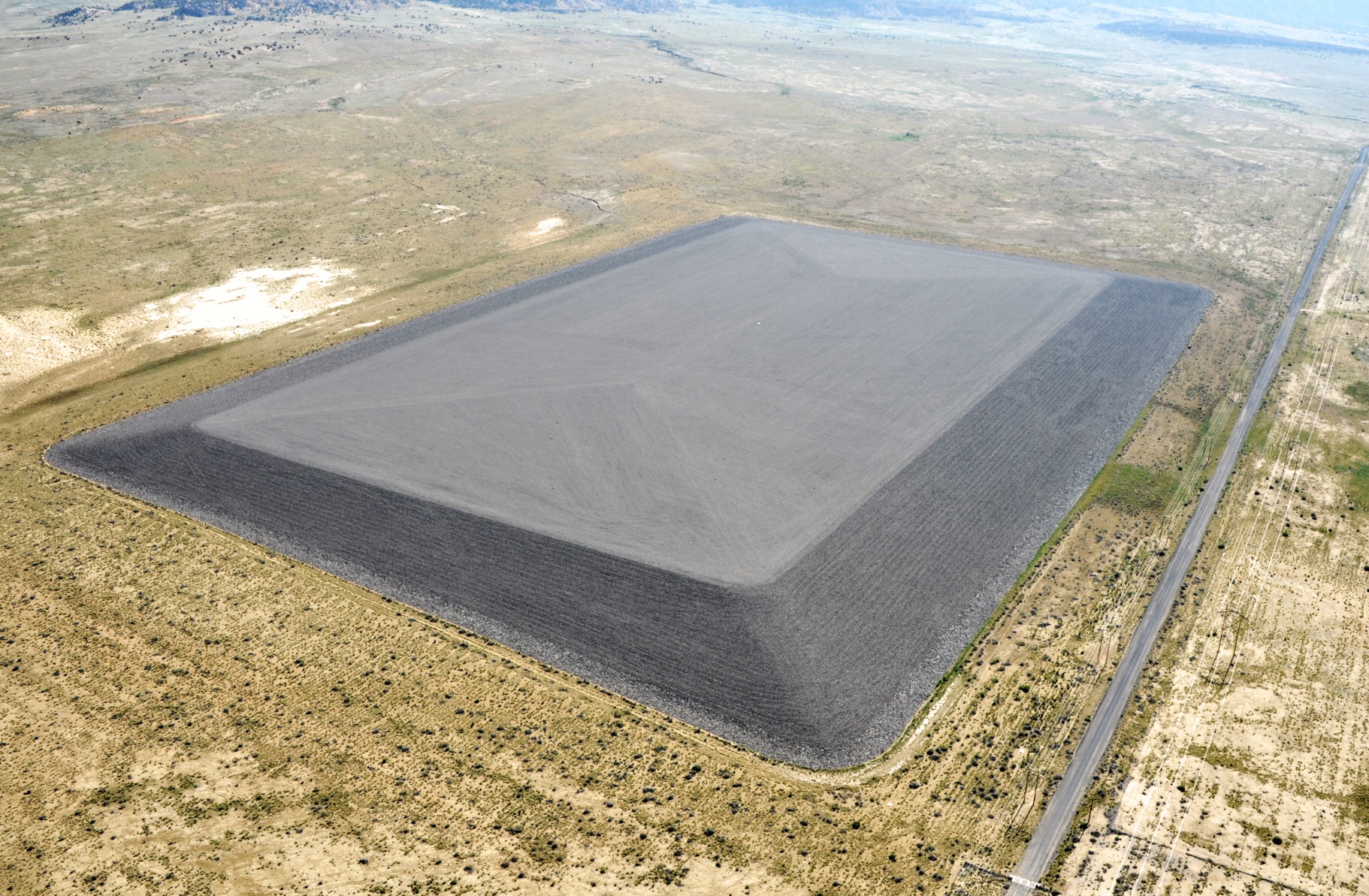
Inside this geometric structure is a demolished uranium mill and its radioactive tailings. Buried in 1992 by the Department of Energy, this mill near Grants, N.M. is one of about 20 uranium mill tailings sites in the U.S. that were remediated as part of the Uranium Mill Tailings Remedial Action project (UMTRA).
Astronomers have developed a way to cheaply and easily measure the radiation exposure experienced by airline crews over Africa.
Cosmic radiation constantly bombards our atmosphere. Composed of tiny particles traveling at nearly the speed of light, cosmic rays originate from a variety of high energy processes throughout the universe, like quasars and supernovae.
These cosmic rays are a source of cancer in all living beings. The cosmic rays can slip between our cells and snip apart strands of DNA, which can lead to replication errors. We are safest on the ground because our atmosphere acts as an excellent safety blanket, blocking and absorbing all but the highest energy forms of cosmic rays.
But passengers on high-altitude flights suffer a slightly higher level of exposure. While casual passengers face no considerable additional risk, the same is not true for frequent travelers and especially for airline personnel. The governments of the United States and Europe have outlined safety standards for the maximum allowable radiation dose that aircraft crew can receive. Those governments have also set up monitoring systems over their airspaces to ensure that the cosmic ray environment does not pose a significant health hazard.
But the same is not true for Africa. We actually have no idea what the level of radiation risk is over that continent. To fix this, a team of astronomers tested a new idea. They mounted an especially sensitive Geiger counter to aircraft traveling from Germany to South Africa. They monitored the radiation level experienced by the aircraft during the long-haul flight.
Their initial measurements revealed that, thankfully, the radiation environment in the African skies was not unusually high. But this is just a test and the first development of a prototype. The researchers hope to deploy many more such instruments and piggyback on commercial aviation to build a much more robust map of the African radiation environment. This will ensure the health and safety of all the crews and passengers flying over that continent.
Unraveling the Mystery of the Purple Light Beam in Alaska
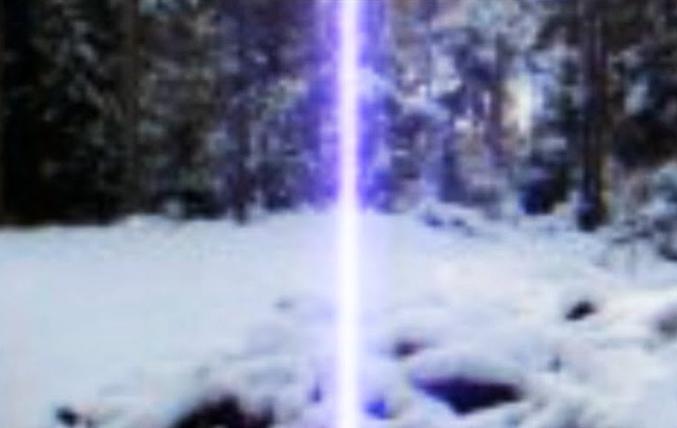
In a recent video from Anchorage, Alaska, a viewer captured an unusual purple light beam while filming the snow around his house. Although the region is known for its mysterious occurrences and numerous unexplained disappearances within the so-called Alaska Triangle, experts have now shed light on the true cause of the enigmatic purple beam.
Astrophysicist Hakima Lucia initially considered the possibility that the light beam was a spectrum of light captured by the camera sensor but not visible to the human eye. However, upon further examination, she concluded that the effect would likely be different if it were an invisible energy discharge.
Photography expert Andrew McCarthy provided a more plausible explanation, attributing the phenomenon to overexposure on the camera’s digital sensor. He pointed out that when a pixel on a digital camera sensor processes an exceptionally bright part of an image, it can overload and bleed into neighboring pixels, creating a line of light. The camera’s age, dating back to 2004, also played a role, as the sensor technology at that time was less advanced than today’s models.
n conclusion, the purple light beam captured in the video is likely a result of overexposure on the camera’s digital sensor and not directly related to the strange occurrences in the Alaska Triangle. Nonetheless, the region’s high rate of disappearances continues to intrigue and mystify.
Apocalypse 536 AD: The Catastrophic Event That Plunged the World into Darkness (Video)
In the year 536 AD,a mysterious event plunged the world into darkness for a year and a half. Constantinoplewriters of the time described the sun as dimmed and blotted out, causing crop failures, famine, and social upheaval across the globe.
Recent research suggests that a massive volcanic eruption , or series of simultaneous eruptions may have caused the catastrophic event, which created a volcanic winter and drastically changed the Earth's climate. The event is suggested to have been everything from the collapse of empires to the Plague of Justinian. However, the source of the eruption remains unknown, leaving scientists to unravel the mystery of one of the most significant environmental events in human history.
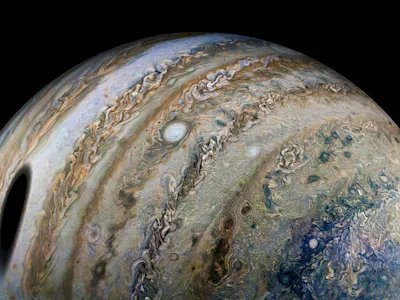
Jupiter is like an ogre, with one arm made of gravity, and the other made of radiation. These metaphorical arms stretch, squeeze, and bathe the menagerie of objects orbiting the giant planet. A pair of missions will soon go towards this planet to study ice-encrusted moons within its grasp that may harbor oceans where life might be huddled away — but will each use different strategies to avoid the ogre arms.
First up is the European Space Agency (ESA) JUICE mission, short for Jupiter Icy Moons Explorer, which launches Thursday. After a seven-year-long trip to the outer Solar System, it will characterize the moons Callisto and Europa, and put its major focus on Ganymede, the largest moon in the Solar System. Then next year, NASA’s Europa Clipper will launch toward the system to learn about Europa, the best Jovian candidate for life.
The missions will be able to complement each other in ways that will help us understand the origins of life on Earth, and if those conditions persist elsewhere.
.
This NASA animation shows the space agency’s Europa Clipper spacecraft performing a flyby of Jupiter's moon Europa. The spacecraft will launch next year.
With the launch of JUICE just days away, Claire Vallat, operations scientist of the soon-to-fly JUICE mission and former scientist on Europe’s unprecedented 2014 comet mission Rosetta, eagerly awaits takeoff.
She describes JUICE’s two big goals. The first is putting Jupiter and its worlds in a broader perspective of the rest of the Milky Way, and, in turn, the Universe at large. Jupiter is a “mini-Solar System” that scientists can use as a laboratory to see how planetary formation works, she says. “With all the exoplanets that have been discovered in the past 20 or 30 years, there are a lot of Jupiter-like planets, so understanding how the Jovian system works will help us also to understand how other exoplanet systems might work,” Vallat tells Inverse.
JUICE’s other objective is related: honing in on “the emergence of habitable worlds” in particular, Vallat says. They’re gathering data on Europa, Ganymede, and Callisto to compare them to one another.
“Despite being born in the same kind of neighborhood, they have evolved completely differently,” Vallat says. Callisto is a battered shell, and Europa is relatively smooth. Ganymede is somewhere in between, meaning it has an intermediate level of activity, which shows in its so-so ability to fix superficial deformities. The surface features correspond, potentially, to the ability of any subsurface ocean to “repair” the surface.
This makes Ganymede valuable to science, according to Vallat. Europa likely has an ocean about 10 to 15 miles under its surface, while Ganymede likely has one 95 miles down. Callisto is believed to either have no ocean or one very, very far down. “Ganymede can give you an open book to the different stages that have taken place from the Jovian system formation to quite recently,” she says.
Ganymede stands out in the planetary rolodex in another major way: It is the only moon in the Solar System with its own magnetic field, capable of making auroras like Earth. But when it comes to resembling Earth for its most exceptional characteristic, the ability to host life, Europa comes closest. It’s why Clipper has dedicated its mission to this moon.
“Europa is super special,” Don Blankenship, senior research scientist at the Institute for Geophysics at the University of Texas, tells Inverse. He is principal investigator of Clipper’s Radar for Europa Assessment and Sounding: Ocean to Near-surface (REASON) instrument, and a science team member of JUICE’s Radar for Icy Moon Exploration (RIME) instrument.
Blankenship says Europa has the right conditions to support anaerobic life, the sort that lives in oxygen-free environments. “What people are not really picking up on is how close Europa really is to things that exist on Earth now,” Blankenship says. According to him, there are ice shelves in Antarctica with pressure, temperature, and salt environments that are similar to what scientists predict exists below Europa’s frozen surface. Ganymede is less likely to harbor life. But it's a robust world that might help explain exoplanets around other stars.
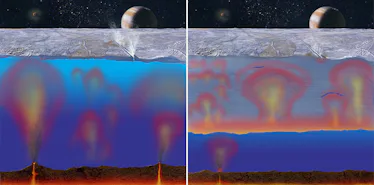
These illustrations offer two possibilities for Europa’s ice thickness. In both, the subsurface ocean is depicted in direct contact with the silicate layer, allowing heat to move through the water through hydrothermal vents, and cause changes to Europa’s icy surface.
To learn about Europa’s possible lifeforms, the spacecraft must survive the most hazardous radiation belts in the Solar System, which are found around Jupiter.
Another way Juno sails as unscathed as possible is that it “threads the needle” just a few thousand kilometers above the gas giant’s clouds, principal Juno mission investigator Scott Bolton tells Inverse. Juno circles Jupiter’s poles rather than its middle section, a beneficial tactic because it evades the strongest radiation blows near Jupiter’s equator, Bolton says.
Juno may help guide both missions. “We're going through the regions now that both of those spacecraft will visit … that may also inform them, help them understand the radiation environment that they're going to experience, and how they might need to adjust science observation strategies or orbits to accommodate radiation as a formidable foe,” Bolton says.
Blankenship says Europa Clipper gets its name from the 50 radiation-defying dives it’ll take past Europa — effectively clipping the moon — as the spacecraft orbits Jupiter. Without this approach, “the radiation at Europa can be pretty dramatic and it's very difficult for spacecraft to survive for long periods,” Blankenship says.
JUICE, however, will endeavor to enter into a Ganymede orbit. Jupiter’s gravity will warp this path over time, according to ESA. But JUICE will make history when it does: the mission will become the first spacecraft to orbit another planet’s moon. JUICE saved the most radiation-intense segments of the trip — when it orbits Ganymede — for the end. It will fly an ambitious mission, and for that reason, the mission will last just four years. Justin Byrne, the head of ESA’s Science Programs at Airbus Defence and Space (which led the consortium building the JUICE spacecraft), told Space.com that JUICE will not survive 10 years like many other missions do.
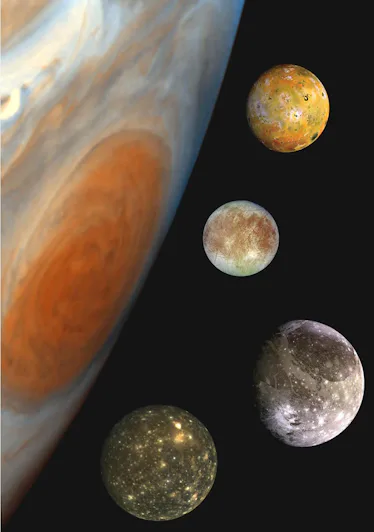
A family portrait of Jupiter and the four Galilean moons. Distances are not to scale. At the top is the volcanic moon Io. Below it, to the right of Jupiter’s Great Red Spot, is Europa. Bottom right shows Ganymede, the largest moon in the Solar System and where JUICE will orbit next decade. Bottom left shows the battered and unhealed surface of the icy moon Callisto.
Jupiter is harsh, but this could be what makes Europa habitable.
Its gravity, for instance, could be exerting so much damage on a nearby moon — the barren, volcanically active moon Io — that it spouts ingredients for life that reach other moons.
“Tidal forces are responsible for small deformations in the shape of the [moons], particularly for Io, which is so heated by this deformation that it generated interior heat … and multiple sets of sulfur-spewing volcanoes all over Io’s surface,” Glenn Orton, Juno co-investigator at NASA’s Jet Propulsion Laboratory in California, tells Inverse.
After the volcanoes release the sulfur, a chemical element that anaerobic microbes metabolized before Earth’s atmosphere became oxygenated, the particles travel through space and “get pasted all over the surface of Europa,” Blankenship says.
The ice of Europa creates a haven. Not only does it act like a barrier against Jupiter’s radiation, but it might be delivering these nutrients to the ocean below it. Clipper and JUICE may help to characterize the ice and ocean interplay.
Jupiter’s hefty influence could induce hydrothermal vents in Europa's silicate rock below the ocean, too, not unlike the ones found on our planet. “Learning more about oceans on the moons of Jupiter will provide a different perspective on vents here on Earth,” Brendan Smith, a Ph.D. candidate in acoustical oceanography at Dalhousie University in Canada, tells Inverse.
Smith says that Earth’s deep ocean is home to hydrothermal vents. It’s here that bacteria have developed the ability to make energy without sunlight. The process is called chemosynthesis, akin to photosynthesis, but substituting chemicals for light.
“It is hypothesized that these types of chemosynthetic bacteria may have been some of the first life to develop on Earth, and that this could have originated at hydrothermal vents,” Smith says. “As a result, the prospect of hydrothermal vents elsewhere in the Solar System provides an opportunity to investigate whether there could be similar chemosynthetic life outside Earth.”
Imagery from NASA’s Juno spacecraft are put to music and in sequence. This data comes from Juno’s flyby of Ganymede and Jupiter in June 2021.
WHEN THEY LAUNCH
JUICE will fly into space aboard an Ariane 5 rocket from Europe’s Spaceport, which is based near Kourou, French Guiana. The launch is scheduled for 8:15 a.m. Eastern on Thursday, April 13. It will arrive at Jupiter in 2031.
Europa Clipper will leave later, currently set to launch in October 2024, but will reach Jupiter earlier, in 2030. JUICE will cruise past several inner Solar System planets to gain the necessary gravity assists to reach Jupiter. Clipper will do a Mars-Earth gravity assist, skipping JUICE’s Venus flyby, to reach Jupiter.
To watch the JUICE launch, you can tune in to the ESA Web TV YouTube channel. The broadcast begins at 7:15 a.m. Eastern. On Twitter, ESA will share updates using the #ESAJuice hashtag and the @ESA_JUICE @esaoperations @ESA_STS and @esascience accounts, too.
NASA's Perseverance Collects First Mars Sample of New Science Campaign
Perseverance Samples 'Berea': This image shows the rocky outcrop the Perseverance science team calls “Berea” after the NASA Mars rover extracted a rock core (right) and abraded a circular patch (left).
The rover continues its hunt for rocks worthy of bringing to Earth for further study.
NASA’s Perseverance rover cored and stored the first sample of the mission’s newest science campaign on Thursday, March 30. With each campaign, the team explores and studies a new area. On this one, the rover is exploring the top of Jezero Crater’s delta. Perseverance has collected a total of 19 samples and three witness tubes, and it recently deposited 10 tubes as a backup cache on the Martian surface as part of the NASA-ESA (European Space Agency) Mars Sample Return campaign.
Scientists want to study Martian samples with powerful lab equipment on Earth to search for signs of ancient microbial life and to better understand the water cycle that has shaped the surface and interior of Mars.
Perseverance Cores 'Berea': This animation shows NASA’s Perseverance Mars rover collecting a rock sample from an outcrop the science team calls “Berea” using a coring bit on the end of its robotic arm. Credits: NASA/JPL-Caltech. µDownload video ›
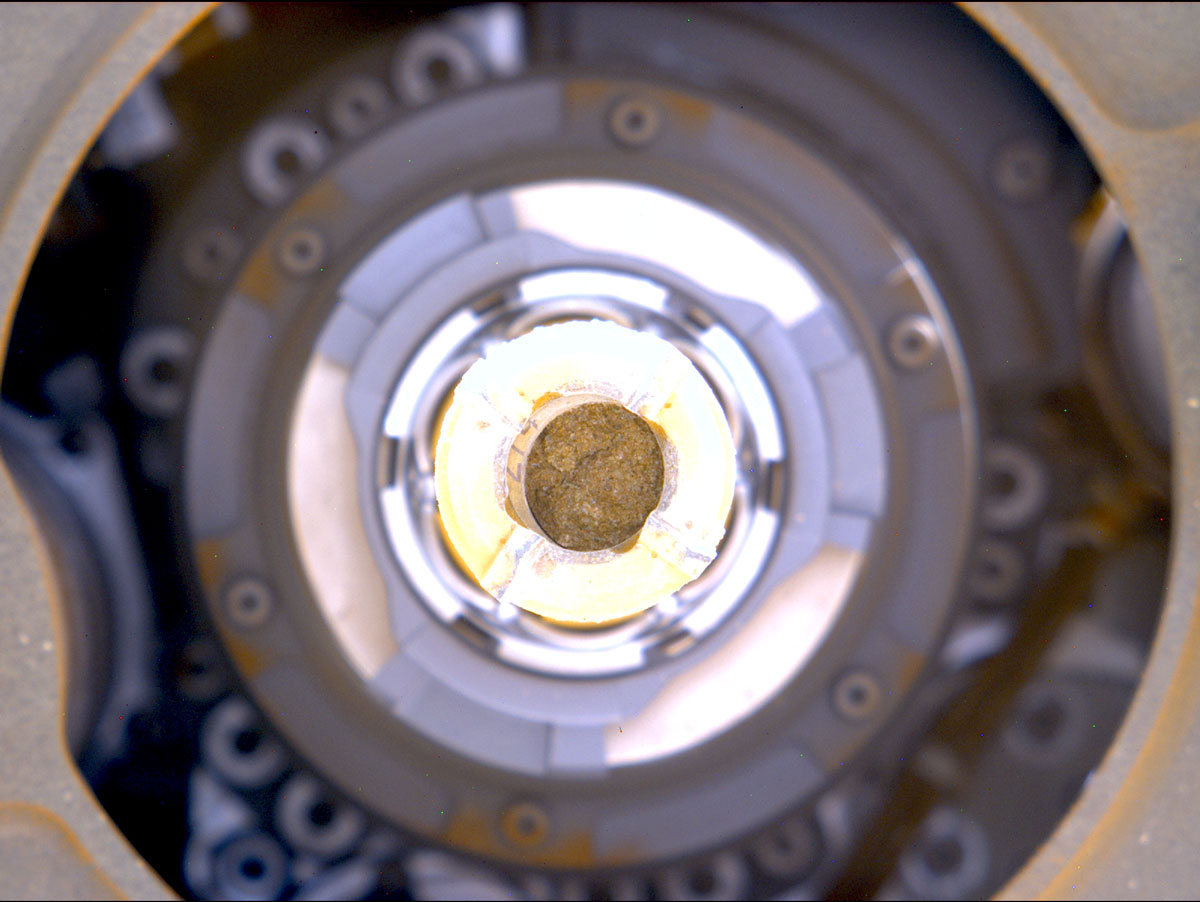
Cored from a rock the science team calls “Berea,” this latest sample is the 16th cored rock sample of the mission (there are also samples of regolith – or broken rock and dust – as well as Mars atmosphere; read more about the samples). The science team believes Berea formed from rock deposits that were carried downstream by an ancient river to this location. That would mean the material could have come from an area well beyond the confines of Jezero Crater, and it’s one reason why the team finds the rock so promising.
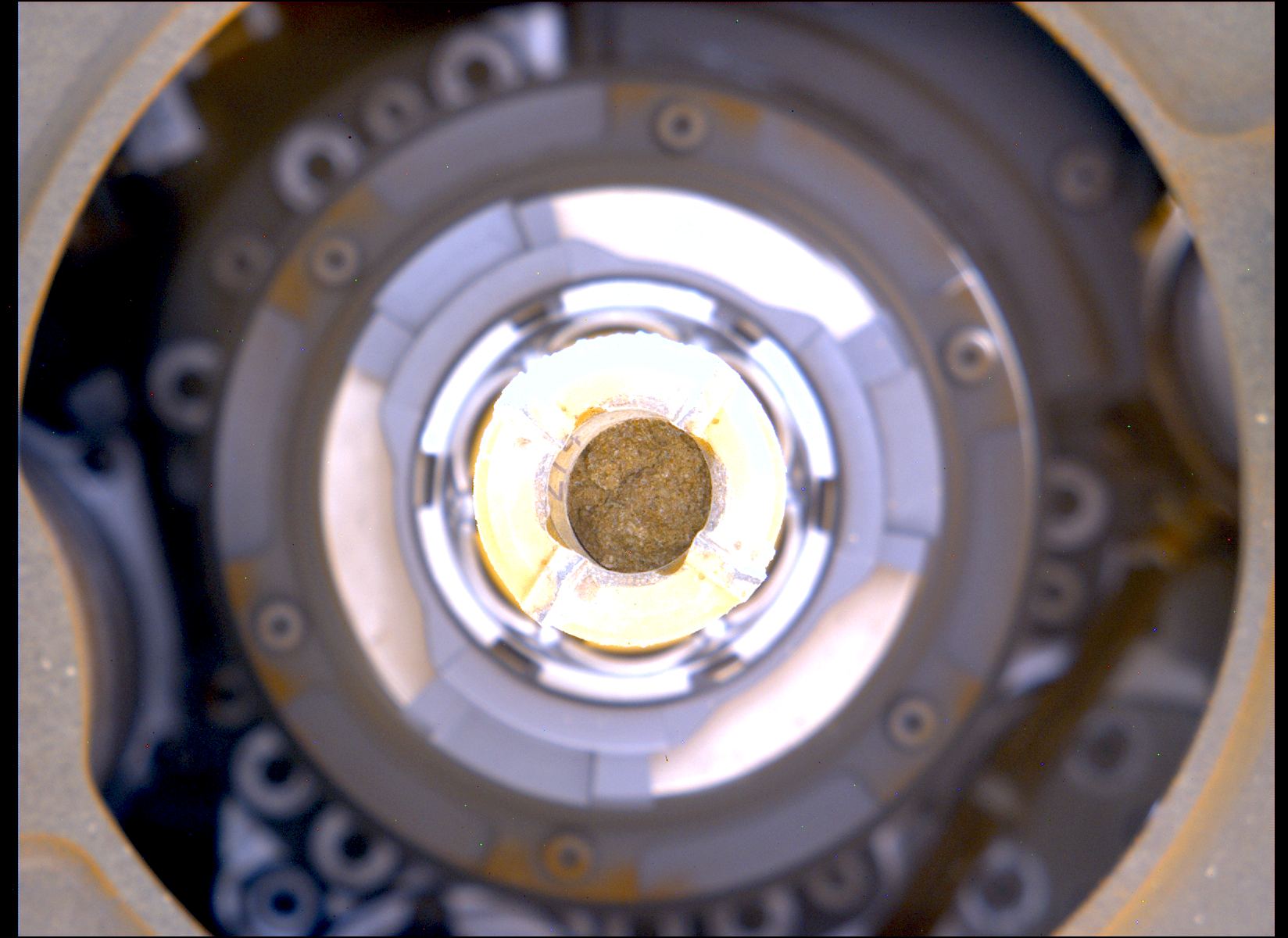
Perseverance's Rock Core From 'Berea' Outcrop: This image shows the rock core from “Berea” inside inside the drill of NASA’s Perseverance Mars rover. Credits: NASA/JPL-Caltech/ASU/MSSS. Download image ›
“The second reason is that the rock is rich in carbonate,” said Katie Stack Morgan, deputy project scientist for Perseverance at NASA’s Jet Propulsion Laboratory in Southern California. “Carbonate rocks on Earth can be good at preserving fossilized lifeforms. If biosignatures were present in this part of Jezero Crater, it could be a rock like this one that could very well hold their secrets.”
A Climate Puzzle
One big puzzle is how Mars’ climate worked back when this area was covered with liquid water. Because carbonates form due to chemical interactions in liquid water, they can provide scientists a long-term record of changes in the planet’s climate. By studying the carbonate in the Berea sample, the science team could help fill in the gaps.
“The Berea core highlights the beauty of rover missions,” said Perseverance’s project scientist, Ken Farley of Caltech in Pasadena. “Perseverance’s mobility has allowed us to collect igneous samples from the relatively flat crater floor during the first campaign, and then travel to the base of the crater’s delta, where we found fine-grained sedimentary rocks deposited in a dried lakebed. Now we are sampling from a geologic location where we find coarse-grained sedimentary rocks deposited in a river. With this diversity of environments to observe and collect from, we are confident that these samples will allow us to better understand what occurred here at Jezero Crater billions of years ago.”
With this latest sample stored safely in a sample tube in the rover’s belly, the six-wheeler will continue to climb Jezero’s sedimentary fan toward the next bend in the dry riverbed, a location the science team is calling “Castell Henllys.”
More About the Mission
A key objective for Perseverance’s mission on Mars is astrobiology, including caching samples that may contain signs of ancient microbial life. The rover will characterize the planet’s geology and past climate, pave the way for human exploration of the Red Planet, and be the first mission to collect and cache Martian rock and regolith.
Subsequent NASA missions, in cooperation with ESA, would send spacecraft to Mars to collect these sealed samples from the surface and return them to Earth for in-depth analysis.
The Mars 2020 Perseverance mission is part of NASA’s Moon to Mars exploration approach, which includes Artemis missions to the Moon that will help prepare for human exploration of the Red Planet.
JPL, which is managed for NASA by Caltech, built and manages operations of the Perseverance rover.
More highlights of Perseverance’s first two years on Mars:
How Mars Rock Samples Would Make Their Way to Earth
How on Earth will we get rock samples from Mars back to our planet? Find out how multiple spacecraft would work together to get the job done.
New video released today shows how NASA and the European Space Agency (ESA) are planning to bring the first samples of Mars material back to Earth for detailed study. The Mars Perseverance rover is the first leg of this international interplanetary relay team. Its job is to collect and cache samples on Mars. A Sample Return Lander would land near or in Jezero Crater, bringing a small rocket on which the samples collected by Perseverance would be loaded.
Two Ingenuity-like helicopters would provide a secondary capability to retrieve samples on the surface of Mars. Once the sample cache is launched off the Red Planet, another spacecraft would capture it in Mars orbit, and then bring it back to Earth safely and securely in the early to mid 2030s. These first collected and returned samples could answer a key question: did life ever exist on Mars? Only by bringing the samples back can we truly answer the question by using the most sophisticated, state-of-the-art labs, at a time when future generations can study them using techniques yet to be invented.
Who’s at work on the quest to return Mars samples to Earth? Explore this interactive map to see which institutions around the world are teaming up for this enormous challenge.
Meer van UFO'S of UAP'S, ASTRONOMIE, RUIMTEVAART, ARCHEOLOGIE, OUDHEIDKUNDE, SF-SNUFJES EN ANDERE ESOTERISCHE WETENSCHAPPEN - DE ALLERLAATSTE NIEUWTJES


 Einstein’s Genius Shines Bright: Star’s Enigmatic Path around Black Hole Validates Theory