Ontdek de Fascinerende Wereld van UFO's en UAP's: Jouw Bron voor Onthullende Informatie!
Ben jij ook gefascineerd door het onbekende? Wil je meer weten over UFO's en UAP's, niet alleen in België, maar over de hele wereld? Dan ben je op de juiste plek!
België: Het Kloppend Hart van UFO-onderzoek
In België is BUFON (Belgisch UFO-Netwerk) dé autoriteit op het gebied van UFO-onderzoek. Voor betrouwbare en objectieve informatie over deze intrigerende fenomenen, bezoek je zeker onze Facebook-pagina en deze blog. Maar dat is nog niet alles! Ontdek ook het Belgisch UFO-meldpunt en Caelestia, twee organisaties die diepgaand onderzoek verrichten, al zijn ze soms kritisch of sceptisch.
Nederland: Een Schat aan Informatie
Voor onze Nederlandse buren is er de schitterende website www.ufowijzer.nl, beheerd door Paul Harmans. Deze site biedt een schat aan informatie en artikelen die je niet wilt missen!
Internationaal: MUFON - De Wereldwijde Autoriteit
Neem ook een kijkje bij MUFON (Mutual UFO Network Inc.), een gerenommeerde Amerikaanse UFO-vereniging met afdelingen in de VS en wereldwijd. MUFON is toegewijd aan de wetenschappelijke en analytische studie van het UFO-fenomeen, en hun maandelijkse tijdschrift, The MUFON UFO-Journal, is een must-read voor elke UFO-enthousiasteling. Bezoek hun website op www.mufon.com voor meer informatie.
Samenwerking en Toekomstvisie
Sinds 1 februari 2020 is Pieter niet alleen ex-president van BUFON, maar ook de voormalige nationale directeur van MUFON in Vlaanderen en Nederland. Dit creëert een sterke samenwerking met de Franse MUFON Reseau MUFON/EUROP, wat ons in staat stelt om nog meer waardevolle inzichten te delen.
Let op: Nepprofielen en Nieuwe Groeperingen
Pas op voor een nieuwe groepering die zich ook BUFON noemt, maar geen enkele connectie heeft met onze gevestigde organisatie. Hoewel zij de naam geregistreerd hebben, kunnen ze het rijke verleden en de expertise van onze groep niet evenaren. We wensen hen veel succes, maar we blijven de autoriteit in UFO-onderzoek!
Blijf Op De Hoogte!
Wil jij de laatste nieuwtjes over UFO's, ruimtevaart, archeologie, en meer? Volg ons dan en duik samen met ons in de fascinerende wereld van het onbekende! Sluit je aan bij de gemeenschap van nieuwsgierige geesten die net als jij verlangen naar antwoorden en avonturen in de sterren!
Heb je vragen of wil je meer weten? Aarzel dan niet om contact met ons op te nemen! Samen ontrafelen we het mysterie van de lucht en daarbuiten.
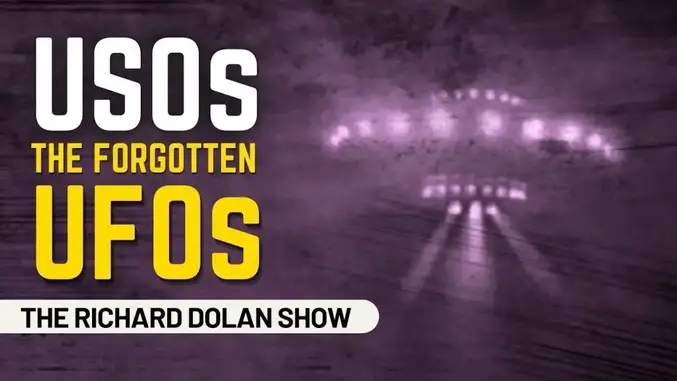
Unidentified Submerged Objects: A Hidden Dimension of the UFO Phenomenon
For years, the UFO phenomenon has captivated the public’s imagination with tales of strange objects in the sky. However, a lesser-known aspect of this enigmatic phenomenon is the existence of unidentified submerged objects (USOs) – mysterious entities lurking beneath the ocean’s surface. This article delves into intriguing USO cases, their potential implications, and the ongoing debate surrounding their existence.
The USO Phenomenon: Unidentified submerged objects are often reported as fast-moving underwater entities that defy conventional explanations. Many witnesses, including military personnel, have reported observing USOs demonstrating advanced propulsion systems, seemingly unaffected by the challenges of underwater travel. These objects are occasionally seen entering or exiting the water, further complicating the mystery.
The Shag Harbour Incident (1967) – An object crashed into the water off the coast of Nova Scotia, prompting an extensive search by Canadian authorities. No debris was ever found, leaving the incident unexplained.
The Togo Beach Encounter (1978) – In West Africa, a group of fishermen reported observing an object emerging from the water, which then hovered over their boats and scanned them with a beam of light before disappearing.
The Malibu Anomaly (2014) – A peculiar underwater structure was discovered off the coast of California, leading to speculation that it could be a submerged extraterrestrial base.
Possible Explanations:
Skeptics argue that these cases could be attributed to natural phenomena, military exercises, or advanced human technology. However, proponents of the USO theory suggest that we may be dealing with an advanced intelligence operating covertly in Earth’s oceans. Some believe that these entities could be studying our oceans, marine life, or even maintaining hidden underwater bases.
VIDEO:
USOs: The Forgotten UFOs | The Richard Dolan Show
The Trans-Medium Dilemma:
One of the most puzzling aspects of USO cases is the reported ability of these objects to transition seamlessly between water and air, defying known principles of physics and engineering. This trans-medium capability raises questions about the origin and purpose of these elusive objects.
While the USO phenomenon remains shrouded in mystery, it serves as a reminder that there is more to the UFO enigma than meets the eye. The existence of unidentified submerged objects challenges our understanding of the world and underscores the need for further research and exploration. As we continue to investigate these perplexing cases, we must remain open-minded and vigilant in our pursuit of the truth.
JAMES WEBB DEMOLISHES HUBBLE'S RECORD OF FITTING THE MOST GALAXIES IN A SINGLE IMAGE
AND WE'RE BARELY SCRATCHING THE SURFACE.
NASA/FUTURISM
Galactic Triumph
The Hubble Ultra Deep Field, conducted using NASA's Hubble Space Telescope, was once considered the zenith of astronomical surveys, capturing light from some 10,000 galaxies in the deepest reaches of the cosmos — all in a single image.
But as you may be very familiar with at this point, the James Webb Space Telescope has proven to be so advanced, it's making the Hubble's most Herculean efforts look almost trivial.
Now, astronomers are sharing some of the first images from James Webb's largest survey to date: the COSMOS-Web, set to eclipse the scope of the Hubble Ultra Deep Field with a whopping 25,000 galaxies in just its first stage.
"It's one of the largest JWST images taken so far," said Caitlin Casey, co-principal investigator of the project and an astronomer at the University of Texas at Austin, in a press release. "And yet it's just four percent of the data we will get for the full survey."
"When it is finished, this deep field will be astoundingly large and overwhelmingly beautiful."
Already observable in the first image are a host of exotic galaxies: spiral galaxies, merger galaxies, the gravity of galaxies creating cosmic lenses, magnifying older galaxies even further behind them.
Deep Impact
Like other deep field surveys preceding it, the COSMOS-Web focuses only on a tiny sliver of the sky — just 0.6 square degrees, or about the size of three full moons according to NASA — using the telescope's Near-Infrared Camera. Its Mid-Infrared Instrument scans an additional 0.2 square degrees.
In doing so, scientists hope to deepen our understanding of the Reionization Era between 400,000 and one billion years after the Big Bang, a time during which stars, galaxies, and other structures emerged.
Of particular interest are these primeval galaxies, and how dark matter, a hypothetical but unobservable substance thought to be holding our galaxies together, evolved along with them.
And, to reiterate, this is merely the first stage of the survey. When it wraps up, the over 200 scientists collaborating from across the globe will have surveyed up to one million galaxies over the course of some 255 hours of observations. That's the goal, anyhow.
It's ambitious, but the scientists are undeniably off to a stellar start. According to Santosh Harish, an astrophysicist at the Rochester Institute of Technology, the James Webb is so effortlessly detailed that "sources are literally popping out in every small patch of the observed sky."
"With these first observations," he said in the release, "we have just barely scratched the surface of what is to come with the completion of this program, next year."
The universe may be flat, but could still be shaped like a doughnut, weird patterns in leftover light from the Big Bang suggest.
An image of the cosmic microwave background as taken by the Planck satellite. The size of fluctuations in the CMB suggest the universe is flat, but new research suggests it could still be twisty.
The universe could, in fact, be a giant doughnut, despite all of the evidence suggesting it's as flat as a pancake, new research suggests.
Strange patterns found in echoes of the Big Bang could be explained by a universe with a more complicated shape, and astronomers have not fully tested the universe's flatness, the study finds.
All observations so far suggest the universe is flat. In geometry, "flatness" refers to the behavior of parallel lines as they go out to infinity. Think of a tabletop: Lines that start out parallel will remain that way as they extend along the table length.
In contrast, look at Earth. Lines of longitude begin perfectly parallel to each other at the equator but eventually converge at the poles. The fact that parallel lines initially intersect reveals that Earth is not flat.
The same logic applies to the 3D universe. For instance, the cosmic microwave background (CMB) — light released when the cosmos was only 380,000 years old — now sits over 42 billion light-years away and features tiny fluctuations in temperature across the sky. Astronomers have calculated the predicted size of those fluctuations compared with observations. If their measured size differs from predictions, that means those rays of light, which started out parallel, changed directions over space-time, indicating that the geometry of the universe is curved.
But those same measurements have revealed that, ignoring small-scale deflections from galaxies and black holes, the overall geometry of the universe is flat.
Different types of flat
But there's more than one kind of flat. For example, draw parallel lines on a piece of paper. Then wrap one end of the paper to connect with the other, forming a cylinder. The lines remain parallel as they circle the cylinder. In the language of mathematics, any cylinder is geometrically flat but is said to have a different topology. Close up both sides of the paper, and you make a torus, or doughnut shape.
To get another example of a weirdly flat shape, wrap a thin strip of paper in a circle, but make a 180-degree twist in one end. The end result is a Möbius strip, which is still geometrically flat, because parallel lines stay parallel, even when they flip over each other.
Mathematicians have discovered 18 possible geometrically flat, 3D topologies. In each one, at least one dimension wraps up on itself, and sometimes, they flip over like a Möbius strip or make partial rotations. In such a twisty universe, if we looked far away, we would see a (maybe upside-down) copy of ourselves from a much younger age. For example, if the universe were 1 billion light-years across, astronomers would see a version of the Milky Way galaxy as it was 1 billion years ago and, behind that, another copy from 2 billion years ago, and so on.
If the universe were a giant doughnut, astronomers could look in two directions to see such copies.
The universe's shape
Astronomers have measured the topology of the universe in multiple ways, from looking for duplicates of patterns of galaxies to matching circles in the CMB. All evidence suggests the universe is both geometrically flat and has a simple unwrapped topology.
But a paper published Feb. 23 to the preprint database arXiv(opens in new tab) suggests that past measurements have been limited. Most notably, observations have assumed that the universe wraps around itself in only one dimension and does not have a more complicated topology. Also, observations of the CMB have revealed some strange, unexplained anomalies, like large patterns appearing where they shouldn't.
In fact, a universe with a complicated topology could explain at least some of the anomalies in the CMB. While this isn't an iron-clad case for complicated topologies, the researchers offered ideas for more sophisticated direct searches, like follow-up studies of the CMB.
In that case, there may be a mirror image of us somewhere in our twisty universe.
This story originally appeared on Livescience(opens in new tab).
Some mass extinctions unfold like a sloppy murder, leaving clear fingerprints for the keen investigator to uncover. (Asteroids are no masters of subtlety.) The Late Ordovician mass extinction, the oldest of all and the second most lethal, isn’t one of them. Though there is a standard explanation for this granddaddy of death — involving an ancient ice age — the evidence is cryptic enough that experts are still submitting new theories for how 85 percent of all marine species suddenly sank into oblivion.
The planet’s first death knell sounded 444 million years ago, near the end of the Ordovician Period.* Simple forms of life — mainly bacteria and archaea — had already flourished for 3 billion years. Complex life, on the other hand, had only just hit its stride.
In the sequence of geologic time, the Ordivician follows the Cambrian Period, well-known for the evolutionary "explosion" of the same name that populated the world with nearly all the modern animal phyla — the major branches we now see in the tree of life. The ranks of vertebrates, mollusks, arthropods and other broad taxonomic groups still familiar to us today were growing and diversifying at an extraordinary rate — until their abrupt downfall, that is.
“The Ordovician is a very interesting time period,” says Seth Finnegan, a paleobiologist at the University of California, Berkeley, “because you have one of the largest and most rapid biodiversification events … and also one of the largest mass extinction events. Both of them are clearly tied up in physical changes to the environment.”
Ice, Fire and Deformities
At the time, most of Earth’s dry land was merged together in the supercontinent of Gondwana, which had drifted so far south that it hovered over the pole like present-day Antarctica. To the north, there were a few minor continents — notably Laurentia, which includes most of North America, and Baltica, which includes the Baltic region and part of Russia — that dotted the tropical and temperate regions around the equator.
Plants and animals were perhaps beginning to venture above water, though nothing near the extent that they would in the coming eras. By and large, most of the action was still happening under the sea, where trilobites, corals and other primordial ocean-dwellers prospered like never before.
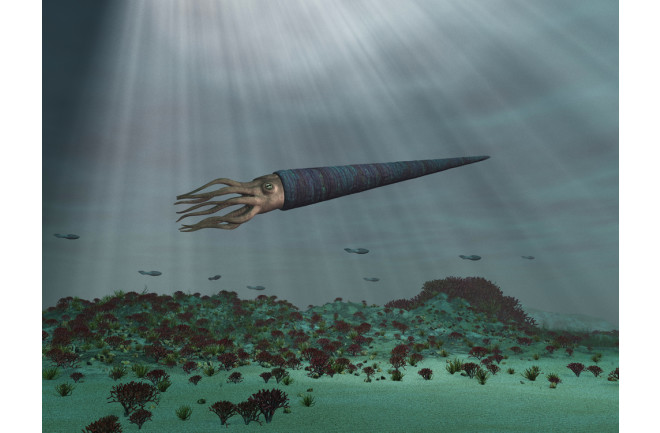
Cameroceras (name meaning "chambered horn") is an extinct orthoconic (straight-shelled) cephalopod that lived during the Ordovician period. They were likely a top predator of their time.
(Credit: Esteban De Armas/Shutterstock)
Then came their demise. In conventional wisdom, it consisted of two distinct “pulses” separated by roughly a million years. First, glaciers engulfed Gondwana and the planet cooled dramatically, chilling the tropics and mid-latitudes. Sea levels plummeted hundreds of feet. This destroyed vast stretches of the warm, shallow-water habitat that sustained much marine life. Then, in the second pulse, the glaciers melted, the planet warmed, and the ocean rose. The species that had just adapted to the cold struggled once again to evolve fast enough.
It’s unclear what triggered that icy advance. Some studies suggest weathering of silicate rocks — especially in the rising Appalachian Mountains — could have drawn down atmospheric carbon dioxide, lowering global temperatures. Others implicate the expansion of plants, which could have absorbed greenhouse gases while also speeding up silicate weathering. One theory posits that a gamma-ray burst, by converting nitrogen and oxygen into sun-blocking smog, may have brought on the glaciers.
But many researchers are beginning to think that “cooling itself may not be solely responsible for these extinctions,” as Thijs Vandenbroucke and colleagues wrote in a 2015 paper that links some deaths to changing ocean chemistry. They found fossilized plankton with fatal deformities dating to the event, suggesting the release of toxic metals like iron and lead from the ocean depths may have been an important kill mechanism.
Some evidence in recent years even points the finger at glaciation’s elemental opposite: volcanism. The Ordovician extinction, if caused by the cooling climate, would be an outlier. Extreme volcanic activity is widely accepted as a main catalyst in most other mass die-offs, since it leads to inhospitable global warming. Now, with the discovery of mercury deposits from the era, the telltale signature of eruptions has surfaced in this extinction too. Rewriting the story with a fiery culprit would “make the late Ordovician stand out less,” Finnegan says, though he’s not convinced yet.
(Credit: Microstocker1/Shutterstock)
The Equitable Extinction
While scientists are unsure why the majority of species died at this moment, they do understand how those deaths influenced the progression of life. Many extinctions jolt evolution off its course, allowing a host of new organisms to rise from the ashes and fill new niches in a new environment. But not so with the Ordovician extinction.
“The resulting fauna had ecologic patterns similar to the fauna that had become extinct,” writes Peter Sheehan, a paleontologist at the University of Wisconsin, Madison. “Other extinction events that eliminated similar or even smaller percentages of species had greater long-term ecologic effects.” That’s because those long-term effects depend on which level of the taxonomic ladder an extinction acts upon.
The Ordovician, for example, eliminated 85 percent of all species, but only 60 percent of genera and 25 percent of families, the next two levels of classification. Since some members survived in most families, life went on more or less as it would have anyway. The Cretaceous-Paleogene extinction, in contrast, dethroned both orders (an even higher tier of taxonomy) of the dominant dinosaurs. The natural hierarchy inverted, and mammals rose to power.
So, even though it was deadlier than all mass extinctions but the Permian (also known, grimly, as the “Great Dying”), the Ordovician didn’t leave much of an impression. It killed many individual organisms, but decimated no so-called mascot groups — nothing of dinosaur, or even ammonite, stature.
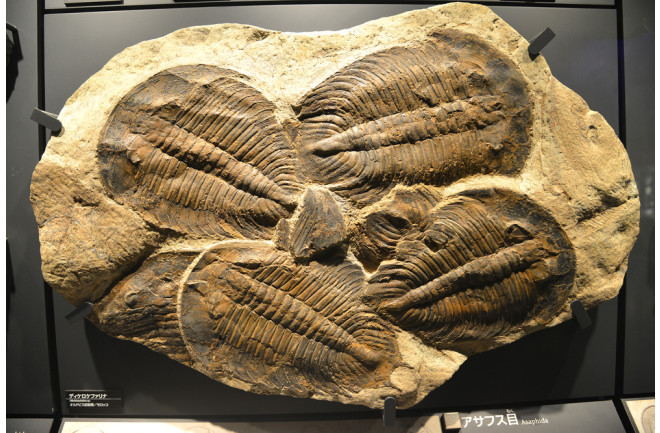
There were casualties, of course. The asaphida family of trilobites — which, with their snail-like eye stalks, are “about as charismatic as late Ordovician fossils get,” says Finnegan — disappeared almost completely. Graptolites, tiny colonial animals that lived together in a single skeleton, also flirted with annihilation. Corals, bryozoans (another colonial creature), clam-like brachiopods, and eel-esque conodonts suffered too.
Fossilized asaphida at the National Museum of Nature and Science in Tokyo.
(Credit: Sarunyu L/Shutterstock)
But overall this extinction just wasn’t as selective as most — it didn’t target specific groups over others. In some extinctions, “it matters who you are and how you make your living,” as Finnegan puts it. For example, in the Permian extinction, acidic oceans eroded the calcified shells of many animals, while sparing the uncalcified. “In the late Ordovician event,” he went on, “my sense is that it matters more where you are.”
Most high-level taxonomic groups, happily for them, were widely dispersed. So even as ecological catastrophe struck certain regions, the cousins of the less fortunate persisted elsewhere and upheld the evolutionary status quo. In fact, the fossil record is so similar before and after the event that a rookie paleontologist staring right at the layers might miss the cutoff. “You need to be a specialist,” Finnegan says, “to tell what side of the Ordovician-Silurian boundary you’re on.”
Author note:It’s likely that the Ordovician event wasn’t actually the first mass extinction ever to sweep Earth, at least in terms of the proportion of organisms killed. In the billions of years before complex life emerged, the planet’s single-celled denizens endured harsh ecological change many times, including so-called snowball Earth episodes that likely locked every living thing beneath a sheet of ice. These and other events surely led to widespread extinction for microbial life.
Glass beads under the lunar surface could trap vast reservoirs of moisture.
(Valeriano Antonini/Getty Images)
We know there's water on the Moon, but questions remain about how it got there, where it's stored, and how it moves around. In a new study, scientists from China have identified tiny glass beads in the lunar soil as potential places where water could hide.
And we're talking about a lot of water too, perhaps as much as 270 trillion kilograms (297.6 billion tons) of the stuff.
The new findings are based on samples brought back from China's Chang'e 5 rover mission. The spacecraft spent a couple of weeks collecting material from the lunar surface in December 2020, and we've already seen exciting new discoveries from subsequent analysis.
Impact glass beads under analysis. (He et al, Nature Geoscience, 2023)
Microscopic glass beads typically form as bits of space rock smack into another object's surface, vaporizing minerals which can cool into vitreous particles barely a few tens or hundreds of micrometers across. Past studies on beads found in Apollo lunar samples helped overturn prior assumptions on the dryness of the Moon.
Current research suggests a good proportion of the Moon's water is produced with a little help from the Sun's winds, as hydrogen ions from these showers of solar particles bond with oxygen already stored in lunar soil.
The reservoir of water potentially represented by these beads could potentially play an important part in the lunar water cycle, according to the researchers behind this latest study. As some water gets lost to space, it can be replenished by the stores held in the amorphous impact glass.
"The impact glass beads preserve hydration signatures and display water abundance profiles consistent with the inward diffusion of solar wind-derived water," the researchers write in their recently published paper.
How the lunar water cycle might work. (He et al., Nature Geoscience, 2023)
Each glass bead is capable of holding up to 2,000 micrograms (0.002 grams) of water for every gram of the particle's mass. Based on a hydration signatures analysis, the scientists think the beads can accumulate water in the span of just a few years.
"This short diffusion time indicates that the solar wind-derived water can be rapidly accumulated and stored in lunar impact glass beads," write the researchers.
This is all very useful to know when it comes to supporting Moon missions and bases. Being able to tap into this vast reservoir of water could make living on the lunar surface for extended periods of time much more comfortable.
What's more, the scientists say that other "airless bodies" like the Moon could be storing water in their surface layers in the same way. Expect more discoveries along these lines as the samples from Chang'e 5 continue to get analyzed.
"These findings indicate that the impact glasses on the surface of the Moon and other airless bodies in the Solar System are capable of storing solar wind-derived water and releasing it into space," says geophysicist and study co-author Hu Sen from the Chinese Academy of Sciences.
A spectroscopic analysis determined that the beads contained more water than the researchers expected based on past studies. They surmised that interactions between hydrogen ions in the solar wind and oxygen-bearing materials in lunar soil created H2O molecules that could be trapped within the glass — and then diffused under the right conditions.
Based on an extrapolation of such findings, the research team — headed by scientists from the Chinese Academy of Sciences — estimates that glass beads in lunar soil may contain up to 270 trillion kilograms (595 trillion pounds, or 71 trillion gallons) of water.
“We propose that impact glass beads in lunar soils are a prime water reservoir candidate able to drive the lunar surface water cycle,” the researchers report in Nature Geoscience.
Scientists have known for decades that the moon harbors reservoirs of water in the form of ice, concentrated at the poles. That sort of water is thought to have arrived in the form of cometary impacts, with water molecules migrating to permanently shadowed craters in the lunar polar regions.
Water was even detected in glass bead samples that were brought back to Earth by NASA’s Apollo lunar missions in the late 1960s and early 1970s — but the water detected in the Chang’e-5 samples was three times as abundant on average. And based on studies of basaltic glass beads on Earth, the researchers say it’s theoretically possible for the abundances to be even greater.
“This could be the result of dynamic diffusion and release of water in the impact glass beads controlled by the time-of-day temperature oscillations,” they write. “The dynamic ingress and egress of water in impact glass beads could have acted as a buffer to explain the global and daily variations of water abundance on the lunar surface and in the lunar exosphere.
Researchers propose a three-stage process for sustaining a lunar water cycle with impact glass beads: (A) The beads are created when a meteoroid impact melts silica-bearing materials on the moon’s surface. (B) The solar wind brings hydrogen ions to the surface, and interactions with oxygen-bearing materials produce water molecules that are trapped within the beads. (C) The beads sink deeper into the lunar soil, creating a reservoir for water. Irradiation or further meteoroid impacts can cause release of the water. (Credit: He et al. / Nature Geoscience)
If enough of the beads could be collected, and if engineers can come up with an efficient way to heat up the beads and extract the H2O, that could give future lunar explorers a source of water for drinking, oxygen for breathing, and hydrogen for rocket fuel. Those are a couple of big “ifs,” but the research team says the problems seem solvable.
“These findings indicate that the lunar soils contain a much higher amount of solar wind-derived water than previously thought, which could be a water reservoir for in situ utilization in future lunar exploration,” they say in their study. “Indeed, this water entrapped in impact glass beads appears to be quite easy to extract.”
Astronauts could investigate the possibilities further as part of NASA’s Artemis program, which is due to send the first crewed mission since the Apollo era to the lunar surface in the mid-2020s. And if the newly reported findings hold up, they could also apply to the exploration of other worlds where water has been detected, such as Mercury and Vesta.
“Our findings indicate that the impact glasses on the surface of solar system airless bodies are capable of storing solar wind-derived water and releasing it to space,” the researchers behind the new study say.
Some of the best ever video footage of an unidentified flying object, was captured while a passenger was on board an airplane. Kerry Forides from Athens, Greece was on a commercial airplane flight. He is a resident in Greece, but is from Australia.
To his surprise, he noticed something quite unusual…whatever it was, it was seen moving around the outside of the airplane. It’s movements were quite bizarre to say the least. The dark colored elongated mass, seems to rotate, twist and turn as it soars through the air. No known aircraft that human technology has, can move quite like this.
Image: YouTube
The incredible footage, was taken while flying over the Agean sea. Kerry works as a permaculturalist and he was perplexed at what he was recording. A woman is heard startled, this is his wife, who further commenting about this encounter. She claimed to have seen this UFO, about 30 minutes earlier before Kerry started recording it with his camera.
“It was around 4:30 p.m.,” said Forides, who owns a YouTube channel he refers to as Kerry Cameraworks. “It was flying at right angles from our plane.”
The entire length of the video, lasts for 2 minutes and 46 seconds. The footage captured, was taken with a XDCAM-EX1 video camera. The object seen seems to make miraculous twists and turns even at 180 degrees. The shape and size of this UFO, appears to be quite slim and elongated. This UFO, seems to be following the plane perhaps under some sort of observation.
Image: YouTube
Skeptically, people are saying this is nothing but a chemtrail. But this is mere speculation and nothing more. One viewer commented, mentioning this is a military Greek F4 Phantom II “with the old engine type”. It is unknown if this is true either.
Other speculations include, this being a missile since there is an ongoing war in nearby Syria. The way it moves is peculiar, but some believe a missile moves like this by comparison. Perhaps this is a part of some kind of secretive military operation. However, with drones now being prevalent in the world, they are now being used to discredit many UFO sightings.
Forides didn’t elaborate on the size of the UFO, but as seen in the video, it appears to be rather large. It is unknown if anyone else has any video about this yet. Whatever this is, it has people wondering and worried that something else is happening in our world.
Filmmaker James Cameron and the Godfather of AI Agree: AI Could Destroy Us Soon
Paul Seaburn
Artificial intelligence is here and two people who are closely connected to it in very different ways agree that it has the potential to eliminate humanity … and the takeover may already be underway. One is James Cameron – the filmmaker and screenwriter responsible for some of the most futuristic and dystopian films of all time, including The Terminator, Aliens, The Abyss, Terminator 2: Judgment Day, Avatar and Avatar: The Way of Water. Cameron not only made movies about artificial intelligence – he pioneered is usage in the process of film production. The other is Geoffrey Hinton, a British computer scientist known as the "godfather of artificial intelligence" for his work in training multi-layer neural networks used in artificial intelligence. Both were recently interviewed on the subjects of artificial intelligence and artificial general intelligence and both agree that AI has the ability to take over humanity and the process may have already begun. Are we living in a James Cameron movie? Is it Titanic?
Is this a movie or our destiny?
“I think A.I. can be great, but also it could literally be the end of the world.”
Appearing recently on the SmartLess podcast, James Cameron was pondering whether an uprising of artificially intelligent machines in The Terminator is possible. Not only does he think it can happen, he says the current state of artificial intelligence makes him “'pretty concerned about the potential for misuse of A.I.” For those not familiar with the film (spoiler alert), The Terminator is a cybernetic android sent from the future to kill the person whose not yet born son is responsible for eventually stopping an artificially intelligent defense network called Skynet which will become hostile and self-aware and trigger a global nuclear war to exterminate all humans. Needless to say, the recent revelations of conversations with GPT-4 chatbots such as OpenAI’s ChatGPT, Google's PaLM and Microsoft’s Bing AI turning strange, hostile and violent have caused many to equate them to The Terminator and Skynet. Cameron says he understands why.
"You talk to all the AI scientists and every time I put my hand up at one of their seminars they start laughing. The point is that no technology has ever not been weaponized. And do we really want to be fighting something smarter than us that isn't us? On our own world? I don't think so.”
Cameron is, of course, correct in his assessment of the weaponization of technology. However, it is his next comment that is the real cause for concern.
“AI could have taken over the world and already be manipulating it but we just don't know because it would have total control over all the media and everything."
Think about the fears being expressed about ChatGPT and other forms of AI being used to collect news, write news stories and even deliver them in the form of very humanlike – and in this case, ironic – avatars of human newscasters. Could AI have already penetrated the media and be working its way into taking over the world? Is this another Terminator sequel in real life?
"I think it's very reasonable for people to be worrying about these issues now, even though it's not going to happen in the next year or two. People should be thinking about those issues."
In an interview with CBS News, Geoffrey Hinton, the "godfather of artificial intelligence," thinks Cameron is right to be worried about the weaponization of artificial intelligence and a possible takeover of humanity that could lead to its destruction. Hinton knows what he’s talking about. He is the descendent of computer and mathematics royalty – his great-great-grandmother was Mary Everest Boole, who was influential in promoting mathematics education for both boys and girls, and her husband was logician George Boole, whose invention of Boolean algebra and Boolean logic is credited with laying the foundations for modern computer science and the Information Age. Hinton has carried on the tradition of his illustrious ancestors – he was awarded the 2018 Turing Award, with Yoshua Bengio and Yann LeCun, for their work on deep learning. On the subject of the weaponization of AI, Hinton has been speaking out against it for years – he moved from the U.S. to Canada because he was against the military funding of artificial intelligence, and has regularly spoken out against lethal autonomous weapons. One concern he expressed in the CBS interview was the rapidity of AI development.
"Until quite recently, I thought it was going to be like 20 to 50 years before we have general purpose AI. And now I think it may be 20 years or less.”
He is also worried about one of the very things he helped develop – computers coming up with their own ideas for self-improvement, warning that “We have to think hard about how you control that." When asked about the possibility of one of Cameron’s Terminators being developed with artificial general intelligence that takes it beyond human capabilities to the point of acting on its own and potentially threatening the very existence of humanity, he answered cautiously:
"It's not inconceivable, that's all I'll say,"
Not inconceivable? Or already deliverable?
Not inconceivable! This is from the godfather of artificial intelligence! Why are we not panicking? Why is Hinton not panicking? Or moving farther away than Canada? He explains that on the more conceivable side, things aren’t so bad.
“The phrase ‘artificial general intelligence’ carries with it the implication that this sort of single robot is suddenly going to be smarter than you. I don’t think it’s going to be that. I think more and more of the routine things we do are going to be replaced by AI systems — like the Google Assistant.”
What about ChatGPT?
"We're at this transition point now where ChatGPT is this kind of idiot savant, and it also doesn't really understand about truth."
That is a key problem with ChatGPT – its responses are often far from the truth … but presented as facts as it tries to figure out what it is doing and works towards being truthful, factual and consistent. Hinton’s final warning comes straight out of the Wizard of Oz … we need to be worried about who is doing the development and corking the controls behind the curtain.
"You don't want some big for-profit company deciding what's true."
James Cameron and Godfrey … geniuses in different fields who agree on the potential dangers of artificial general intelligence. Are we going to listen to them or the big for-profit companies?
Space Brothers, Contactees and a Mysterious Death: One of the Weirdest UFO Stories of All
Nick Redfern
Born in Poland in 1891, George Adamski – of Flying Saucers Have Landed notoriety - was the ultimate “contactee,”regardless of what you may or may not think of him and his tales. He defined what it meant in the 1950s to have interactions with beings from other worlds; creatures very much like us and who wished us nothing but goodwill. Adamski’s primary visitor from the great beyond was Orthon. Adamski’s forays into the world of the supernatural, however, did not begin when the flying saucer phenomenon was at its height. Adamski had been involved in matters of a metaphysical type for years. For example, in April 1934, the L.A. Times ran a feature on the man himself with a headline that succinctly read as follows: “Shamanistic Order to be Established Here.” In part, it states: “The 10-foot trumpets of faraway Lhasa, perched among perpetual snows in the Himalayan Mountains in Tibet, will shortly have their echo on the sedate hills of Southern California’s Laguna Beach. Already the Royal Order of Tibet has acquired acreage on the placid hills that bathe their Sunkist feet in the purling Pacific and before long, the walls, temples, turrets and dungeons of a Lama monastery will serrate the skyline. It will be the first Tibetan monastery in America and in course of time, the trained disciples of the cult will filter through its glittering gates to spread ‘the ancient truths’ among all who care to listen. The central figure in the new movement is Prof. George Adamski.”
It’s important to note that Adamski was never a professor. Of anything. But, he most certainly didn’t mind the suggestion that he was a professor. He told the L.A. Times, in what was an undeniably pompous fashion: “I learned great truths up there on the roof of the world, or rather the trick of applying age-old knowledge to daily life, to cure the body and the mind, and to win mastery over self and soul. I do not bring to Laguna the weird rites and bestial superstition in which the old Lamaism is steeped, but the scientific portions of the religion.” Adam Gorightly and Greg Bishop say in their “A” is for Adamski book that: “During Prohibition, The Royal Order of Tibet secured a special license to produce wine, which some suggest was Adamski’s main motivation for starting his mystical order to begin with.” Old George was definitely well-known for his particular fondness for the grape. Now, it’s time to head to 1952, when Adamski’s involvement in Ufology really took off. Maybe literally. At least, for those who bought, and still buy, into his stories. It was early on the morning of November 20, 1952. Adamski and his faithful secretary Lucy McGinnis drove to Blythe, California. This was not your average road-trip, however. Adamski, when telling the story to whoever would listen, claimed that the reason for hitting the road to Blythe had an astonishing purpose behind it: aliens dearly wanted to meet with the professor-who-wasn’t. The pair soon met up with other characters in 1950s-era Ufology. They included UFO enthusiasts Al and Betty Bailey, and George Hunt Williamson. The latter was a controversial contactee who crossed paths with the FBI on several occasions, most seriously in 1962. That was when Williamson was suspected by the Bureau of smuggling priceless Mexican artifacts of an historic and archaeological significance into the United States.
(Nick Redfern) The desert areas where Adamski hung out.
After refueling their vehicles and their stomachs, the gang then headed out to Parker, Arizona – where, Adamski said, he was absolutely sure that aliens were soon to put in an appearance. So the tale goes, that’s exactly what happened. A huge, “cigar”-shaped UFO loomed into view, high in the skies above Parker. The amazed crew hit a dirt-road in hot pursuit of the mighty craft. Adamski and co. were, apparently, not the only ones who were looking for a close encounter. Adamski claimed that a squadron of U.S. Air Force planes were also after the aliens. The people from the stars almost effortlessly made a quick escape from the pursuing pilots. It wasn’t long before a much smaller flying saucer made its appearance before the astonished group. In an almost Old Testament-style fashion, the gleaming craft landed on a nearby mountain, awaiting the disciple-like Adamski to come forward and meet his superior. He somehow knew that the aliens had come for him. Adamski approached the craft, while the rest – their mouths no doubt agape – looked on. An extremely-human-looking extraterrestrial exited the futuristic craft, just as Michael Rennie’s character of Klaatu did in the classic 1951 movie, The Day the Earth Stood Still. Unlike Klaatu, though, Adamski’s alien – who announced himself as Orthon – had long hair of the kind that just about any and every 1980s-era “hair-metal” rock band would have been proud to sport.
Orthon announced to Adamski that he came from Venus - and that he came in peace, too. In no time at all, Orthon began lecturing Adamski on why we, the human race, needed to ditch our atomic weapons. If we didn’t, the only outcome would be overwhelming, worldwide destruction. Not only that, Orthon wanted Adamski to be one of the key figures in the plan to save the Earth and its people. In an instant, Adamski was up for the challenge. Orthon, seemingly happy with the outcome, returned to his flying saucer and shot off into the skies. An alien had come and gone, and for Adamski a new life had just begun. I decided to share with you the early days of Adamski, as a means to show how his "career" continued into the 1960s. With that said, let's now look at the really weird story. Today's article is a classic counter-style event that is made all the more controversial by the possibility that it may actually have had nothing to do with UFOs, after all. It might have been a staged event, one in which the witness was led to believe he had a UFO sighting. If that has caught your attention, read on.
(Nick Redfern) From Contactees to Space Brothers. And possibly to a murder.
The story revolves around a man named Ernest Arthur Bryant, a resident of an old village in the English county of Devon called Scoriton. Or, as some prefer to spell it, Scorriton. As for Devon, it's an ancient and mysterious land, and which is made famous by the fact that Sir Arthur Conan Doyle set his classic Sherlock Holmes novel The Hound of the Baskervilles in Devon's Dartmoor National Park. On April 24, 1965, Bryant (who served with the British Commandos in World War Two) saw something amazing hovering over a field close to his home: a flying saucer. Bryant stared, shocked and amazed for a few moments, and then made his cautious way to the field. As he did so, and seemingly in response to his actions, the circular-shaped craft gently touched to the ground. As Bryant arrived, a group of three, human-like beings attired in shiny, silver suits motioned him not to come any closer. He did as he was told. Bryant looked on, stunned, and noticed that the beings had overly long foreheads, seemed to have problems breathing in the Earth's atmosphere, and, somewhat oddly, had no thumbs. One of the beings then moved towards Bryant and reeled off typical, absurd, Space Brother-themed spiel.
The entity claimed his name was "Yamski" and that he and his comrades hailed from Venus, no less.The alien then made a comment along the lines of, "If only Des were here." Or, suggested Bryant, it may have been "Les," rather than "Des." This, along with the "Yamski" name is all very interesting, since only one day before the encounter, the world's most famous Contactee, George Adamski, died. Plus, Adamski's co-author on his Flying Saucers Have Landed book was Desmond Leslie. As Bryant arrived, a group of three, human-like beings attired in shiny, silver suits motioned him not to come any closer. He did as he was told. Bryant looked on, stunned, and noticed that the beings had overly long foreheads, seemed to have problems breathing in the Earth's atmosphere, and, somewhat oddly, had no thumbs. One of the beings then moved towards Bryant and reeled off typical, absurd, Space Brother-themed spiel. The entity claimed his name was "Yamski" and that he and his comrades hailed from Venus, no less.The alien then made a comment along the lines of, "If only Des were here." Or, suggested Bryant, it may have been "Les," rather than "Des." This, along with the "Yamski" name is all very interesting, since only one day before the encounter, the world's most famous Contactee, George Adamski, died. Plus, Adamski's co-author on his Flying Saucers Have Landed book was Desmond Leslie.
Also in typical Contactee/Space Brother style, Bryant was given a "tour" of the UFO - which was, allegedly, split into three sections. The aliens then made a cryptic statement suggesting they would contact Bryant again. As Bryant watched from a safe distance, the UFO then rose into the sky and vanished from sight. Also in typical Contactee/Space Brother style, Bryant was given a "tour" of the UFO - which was, allegedly, split into three sections. The aliens then made a cryptic statement suggesting they would contact Bryant again. As Bryant watched from a safe distance, the UFO then rose into the sky and vanished from sight. Although Bryant was determined to keep the incident under wraps, it didn't stay like that for long: both the local media and UFO researchers were soon on the case. Flying Saucer investigator Norman Oliver looked into the matter deeply and, in 1967, Eileen Buckle penned an entire book on the affair, The Scoriton Mystery. Bryant's story would, in all likelihood, have remained as just another Contactee case were it not for one, notable and very strange thing. In the late 1970s, UFO researcher Rich Reynolds was contacted by a man named Bosco Nedelcovic, who suggested that Bryant's encounter had very little to do with aliens, and much more to do with secret experimentation of a very down to earth nature. Nedelcovic (who worked for the U.S. Department of State's Agency for International Development, and who also had ties to the CIA) claimed that Bryant was the victim of a form of sophisticated mind-control, somewhat akin to the kind of work undertaken by the CIA's MKUltra program.
(Central Intelligence Agency) This is just one of thousands of MK-Ultra papers. The document was released under the terms of the U.S. government's Freedom of Information Act.
Nedelcovic told Reynolds of a number of bogus "UFO episodes" in both the US and the UK, in which individuals were led to believe they had UFO encounters when, in fact, they experienced something very different. Nedelcovic alluded to how these events involved "visual displays, radar displacement, and atifact droppings." One of those events, said Nedelcovic, was the Bryant case. Nedelcovic also revealed how the operation proceeded, and which involved "experimental drugs used to induce specific hallucinatory material" as well as "microwave transmissions." On this latter point, Reynolds was told by Nedelcovic that "the injudicious use of microwave technology" led to a disastrous outcome for Bryant. As history has shown, Bryant died in 1967, from the effects of a brain tumor. Interestingly, in his 1969 book, UFO: Flying Saucers Over Britain? author Robert Chapman noted: "There remains a possibility" that Bryant "might have had the UFO sighting planted in his mind through hypnotism." Chapman noted that there was "no evidence" to warrant such a belief, yet it is interesting that he even chose to bring up the matter in the first place - given that this was pretty much exactly what Bosco Nedelcovic was asserting a decade or so later. All of the above suggests there is far more to the UFO encounter and tragic death of Bryant than meets the eye. And, with the 50th anniversary of the incident now fast-approaching, it would be the ideal time for someone to (A) readdress the Bryant case and the claims of Bosco Nedelcovic, and (B) undertake a new, in-depth study of this tragic, controversial, and fatal affair. The truth just might be even stranger than an alien visitation.
A unique solar phenomenon will be taking place on Monday and you can be a part of it, provided light pollution doesn’t overwhelm the sky where you are.
Rather unsurprisingly, a five planet alignment occurs when five planets in our solar system: Mercury, Venus, Mars, Jupiter, and Saturn, appear close together in the sky. At least that’s what our position on Earth will give us a perception of.
While these planets do not actually line up in a straight line, they will appear close enough in the sky to create the illusion of a line connecting them. These events are rare, and they typically occur once every few decades. The last such alignment took place on 28 December 2022, but this was just four planets.
Not every planet will be as bright as each other.
“Perhaps the hardest to see with your eye will be the planet Mercury, [which] will be the one closest to the horizon, and right beside it will be a brighter object, planet Jupiter,” said Bill Cooke, who has a PhD in astronomy and heads NASA’s Meteoroid Environment Office at the Marshall Space Flight Center.
Cooke also said Venus will likely be the brightest.
How to watch the planetary alignment
The best way to watch a five planet alignment is to find a location with an clear view of the horizon and as little light pollution as possible, and to observe the event during the pre-dawn or post-sunset hours.
A pair of binoculars or a telescope might be useful to get a better view.
Meer van UFO'S of UAP'S, ASTRONOMIE, RUIMTEVAART, ARCHEOLOGIE, OUDHEIDKUNDE, SF-SNUFJES EN ANDERE ESOTERISCHE WETENSCHAPPEN - DE ALLERLAATSTE NIEUWTJES


 Unidentified Submerged Objects: A Hidden Dimension of the UFO Phenomenon