Naar de inhoud

UFO'S of UAP'S, ASTRONOMIE, RUIMTEVAART, ARCHEOLOGIE, OUDHEIDKUNDE, SF-SNUFJES EN ANDERE ESOTERISCHE WETENSCHAPPEN - DE ALLERLAATSTE NIEUWTJES

UFO's of UAP'S in België en de rest van de wereld
akke.beakke.be
Ontdek de Fascinerende Wereld van UFO's en UAP's: Jouw Bron voor Onthullende Informatie! Ben jij ook gefascineerd door het onbekende? Wil je meer weten over UFO's en UAP's, niet alleen in België, maar over de hele wereld? Dan ben je op de juiste plek! België: Het Kloppend Hart van UFO-onderzoek In België is BUFON (Belgisch UFO-Netwerk) dé autoriteit op het gebied van UFO-onderzoek. Voor betrouwbare en objectieve informatie over deze intrigerende fenomenen, bezoek je zeker onze Facebook-pagina en deze blog. Maar dat is nog niet alles! Ontdek ook het Belgisch UFO-meldpunt en Caelestia, twee organisaties die diepgaand onderzoek verrichten, al zijn ze soms kritisch of sceptisch. Nederland: Een Schat aan Informatie Voor onze Nederlandse buren is er de schitterende website www.ufowijzer.nl, beheerd door Paul Harmans. Deze site biedt een schat aan informatie en artikelen die je niet wilt missen! Internationaal: MUFON - De Wereldwijde Autoriteit Neem ook een kijkje bij MUFON (Mutual UFO Network Inc.), een gerenommeerde Amerikaanse UFO-vereniging met afdelingen in de VS en wereldwijd. MUFON is toegewijd aan de wetenschappelijke en analytische studie van het UFO-fenomeen, en hun maandelijkse tijdschrift, The MUFON UFO-Journal, is een must-read voor elke UFO-enthousiasteling. Bezoek hun website op www.mufon.com voor meer informatie. Samenwerking en Toekomstvisie Sinds 1 februari 2020 is Pieter niet alleen ex-president van BUFON, maar ook de voormalige nationale directeur van MUFON in Vlaanderen en Nederland. Dit creëert een sterke samenwerking met de Franse MUFON Reseau MUFON/EUROP, wat ons in staat stelt om nog meer waardevolle inzichten te delen. Let op: Nepprofielen en Nieuwe Groeperingen Pas op voor een nieuwe groepering die zich ook BUFON noemt, maar geen enkele connectie heeft met onze gevestigde organisatie. Hoewel zij de naam geregistreerd hebben, kunnen ze het rijke verleden en de expertise van onze groep niet evenaren. We wensen hen veel succes, maar we blijven de autoriteit in UFO-onderzoek! Blijf Op De Hoogte! Wil jij de laatste nieuwtjes over UFO's, ruimtevaart, archeologie, en meer? Volg ons dan en duik samen met ons in de fascinerende wereld van het onbekende! Sluit je aan bij de gemeenschap van nieuwsgierige geesten die net als jij verlangen naar antwoorden en avonturen in de sterren! Heb je vragen of wil je meer weten? Aarzel dan niet om contact met ons op te nemen! Samen ontrafelen we het mysterie van de lucht en daarbuiten.

Categorie: ASTRONOMIE / RUIMTEVAART

White Dwarfs Are Actually…Yellow, Green, Pink, and Purple?

White Dwarfs Are Actually…Yellow, Green, Pink, and Purple?

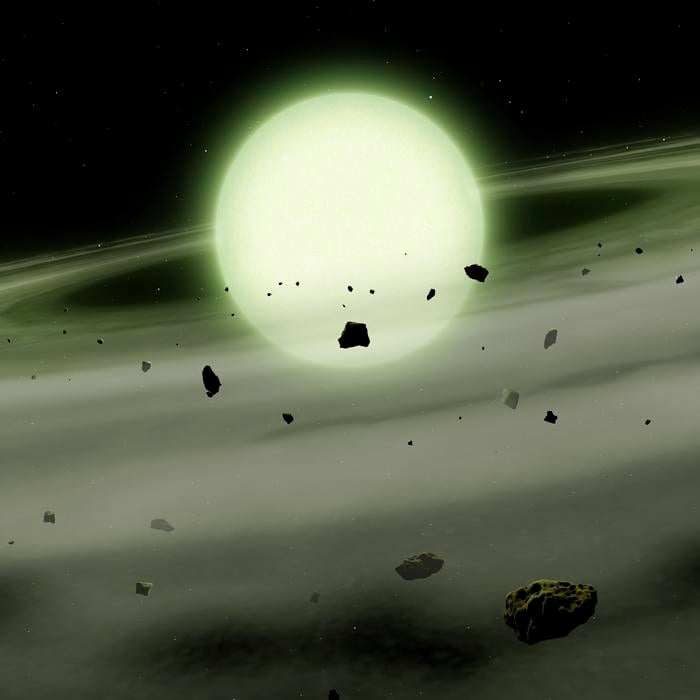
Artist’s illustration of a white dwarf appearing greenish from the sodium-rich planetary debris that enriches its atmosphere. (Credit: Mark A Garlick/University of Warwick) Artist’s illustration of a white dwarf appearing greenish from the sodium-rich planetary debris that enriches its atmosphere. (Credit: Mark A Garlick/University of Warwick) The universe hosts a myriad of star types, including supergiants, giants, main sequence, red dwarfs, brown dwarfs, white dwarfs, and neutron stars. What makes these stars stand out are just their sizes, but their colors, as each one hosts a distinct color based on their surface temperature, specifically orange, red, blue, and white based on cooler to hotter temperatures. While the correlation between star colors and surface temperatures has long been known throughout astronomy, what if star colors could change based on specific criteria, including their atmosphere?

Now, a team of researchers led by the University of Warwick might have introduced a new way to literally look at stars, as they revealed new evidence for white dwarfs to exhibit colors other than what their name implies. These findings were recently published in RAS Techniques and Instruments and could provide new insights into the formation and evolution of stars throughout the cosmos. This is because stars are referred to as “perfect radiators”, also called blackbody objects, meaning they absorb all electromagnetic radiation and reflect nothing. In a nutshell, their glow is entirely dependent on temperature.

“As an object gets hotter it will emit more light at optical wavelengths, changing from red to orange (think of a blacksmith working on a piece of hot metal),” Dr. Mark Hollands, who is a postdoctoral researcher at the University of Warwick and the study’s lead author, tells Universe Today. “Eventually these orange hues will become paler, and by 6000K a black body will appear will just appear white as most of its radiation will spread across optical wavelengths. For even hotter temperatures an object will start to glow pale blue as the majority of its light will become emitted in the ultraviolet. This set of red/orange/white/blue are the only colors that are possible for a true blackbody.”

For the study, the researchers used a series of computer models to study 151 white dwarfs with 20 parsecs (65 light-years) from Earth and how white dwarfs might challenge the longstanding understanding of stars being blackbodies. The reason white dwarfs were chosen was due to their extreme characteristics compared to main-sequence stars like our Sun, most notably white dwarfs having much denser atmospheres. The researchers aspired to learn if the presence of certain elements like carbon, calcium, or sodium in their dense atmospheres could influence the glow of white dwarfs.

In the end, the researchers found that a total of five white dwarfs of the 151 sampled showed that a combination of a white dwarf’s dense atmosphere with certain elements could cause these five white dwarfs to glow pink and yellow, specifically two yellow and three pink. This indicates about 3.3 percent of white dwarfs in the cosmos could exhibit different colors aside from white.

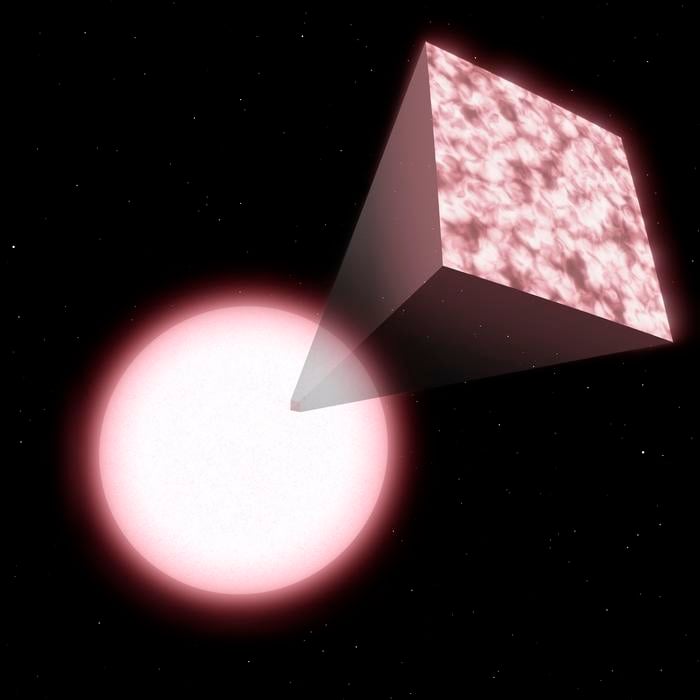
A white dwarf whose atmosphere is comprise of carbon appearing pink. (Credit: Mark A. Garlick/University of Warwick)

A white dwarf whose atmosphere is comprise of carbon appearing pink.

(Credit: Mark A. Garlick/University of Warwick)

“One in thirty might not sound like a huge fraction, but across the entire population of white dwarfs in the Universe, that is still a lot of oddly colored stars out there,” said Dr. Boris Gänsicke, who is a professor in the Department of Physics at the University of Warwick and a co-author on the study. “Yet if we take the median across a representative population of white dwarfs, we found that the average white dwarf really is white."

Regarding the specific elements responsible for altering the white dwarf’s colors, the researchers found that carbon causes white dwarfs to appear pink or purple while cooler white dwarfs with hydrogen and helium tend to be cyan or blue. Additionally, the researchers found that white dwarfs whose atmospheres have debris from their original planetary system are typically green.

As noted, star colors are typically determined by their surface temperatures, with hotter stars to cooler stars ranging in several colors, including blue, blue-white, white, yellowish white, yellow (our Sun), orange, and red. The larger the star, the hotter and bluer it is. But while this study demonstrates there could be exemptions to this longstanding notion, could other stars also exhibit unexpected colors?

“The other class of object that can disobey the rule are brown dwarfs," Dr. Hollands tells Universe Today. "These are substellar objects that are too cool to fuse hydrogen in their cores, but can fuse deuterium instead. Because these are quite cold objects (compared to normal stars) most of their radiation is in the infrared, but some still comes out at optical wavelengths. And because brown dwarfs also can have dense atmospheres, absorption from sodium, potassium, and molecules like titanium oxide can also alter their colors away from blackbody colors. Some astronomers who study brown dwarfs have looked into their appearance in the past and concluded that they can appear violet in color!”

What new insights into white dwarfs and other star colors will researchers make in the coming years and decades? Only time will tell, and this is why we science!

As always, keep doing science & keep looking up!

{ https://www.universetoday.com/ }

Hoe vind je dit bericht?
Geschreven door peter om 18:39 Stuur door

A Stubborn Question Answered: New Research Reveals How the Milky Way's Disk Formed

A Stubborn Question Answered: New Research Reveals How the Milky Way's Disk Formed

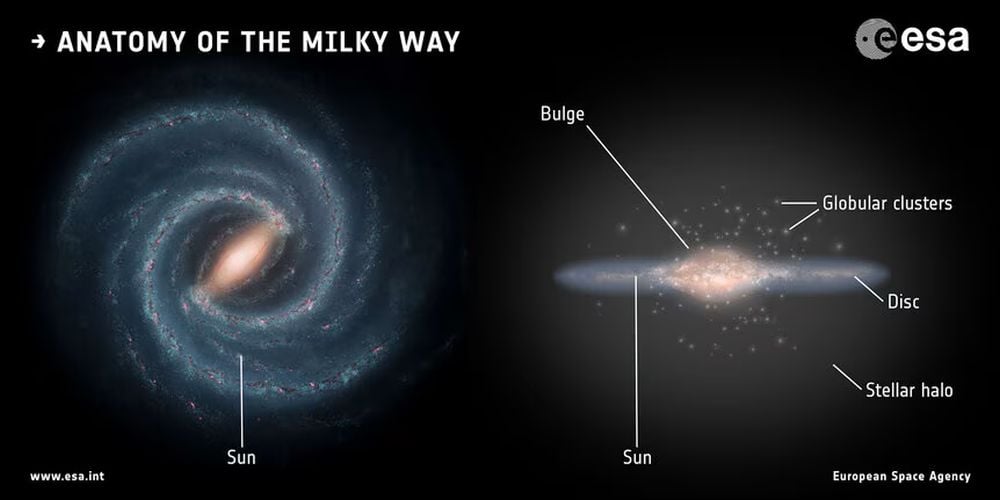
The Milky Way is a spiral galaxy, and its spiral arms are its defining features. But our galaxy has a disk, and it is divided into two parts: a thin disk where young stars form, and a thick disk, which is more diffuse and is home to ancient stars. What process lies behind the formation of these disks is a big question in astronomy. Image Credit: Left: NASA/JPL-Caltech; Right: ESA; Layout: ESA/ATG medialab The Milky Way is a spiral galaxy, and its spiral arms are its defining features. But our galaxy has a disk, and it is divided into two parts: a thin disk where young stars form, and a thick disk, which is more diffuse and is home to ancient stars. What process lies behind the formation of these disks is a big question in astronomy.. Image Credit: Left: NASA/JPL-Caltech; Right: ESA; Layout: ESA/ATG medialab The Milky Way is home to hundreds of billions of stars arranged in a glorious spiral pattern. But beyond the obvious spiral, our galaxy has other physical characteristics. It's divided into a galactic bulge, a galactic disk, and a galactic halo.

The disk is further divided into a thin disk and a thick disk. They're not only structurally different, but their stellar populations and other characteristics are different.

The thin disk contains young stars, and middle-aged stars like our Sun. It holds the spiral arms, where our Solar resides and also holds most of the Milky Way's gas and dust and is where young stars form. It also has higher metallicity, generated by previous generations of stars that have lived and died.

The thick disk is more puffy and diffuse than the thin disk. It holds ancient stars, and almost no new stars form there. It has much lower metallicity than the thin disk, and astronomers sometimes refer to it as a kind of stellar fossil record.

Astronomers wrestle with understanding the formation of these disks, and the Milky Way as a whole. Observations have led to a multiple explanations. In one, stars are born in the thin disk, and over time, encounters with gas clouds, the spiral arms, or even the central bar, perturb some of these stars. Dynamical scattering drives them away from the plane of the thin disk.

Another explanation says that as stars form in the inner disk, the gas they form from settles down into an even thinner disk. In this scenario, each successive generation of stars forms in an increasingly thin disk.

Astronomers have difficulty distinguishing between these competing explanations. It relies on accurate measurements of the ages of individual stars. That's difficult to achieve, especially for the oldest stars.

New research in The Astrophysical Journal Letters used Gaia data to tackle the issue. It's titled "A Two-stage Settling of the Milky Way Disk Revealed by Precise ChronoGal Ages," and the lead author is David Mirabal. Mirabal is a pre-doctoral researcher at the Instituto de Astrofisica de Canarias (IAC).

"The spatial distribution of Galactic disk stars of different ages and metallicities encodes its dynamical evolution history and formation pathways," the authors write in their research letter. "The lack of precise ages for large, representative samples of stars has traditionally been a drawback for securely differentiating among formation scenarios proposed to explain the vertical properties of the Milky Way disk."

This work is based on data in Gaia Data Release 3 (DR3), released in June, 2022. This research is one of multiple papers released by a collaboration of researchers, aimed at deciphering stellar ages in the populations of the thin and thick disks. In this one, the authors employed colour-magnitude diagram fitting of the Gaia data. From that, they derived age-metallicity distributions for the stellar populations. They also studied their vertical profile, their position in either disk.

Earlier in the Universe's history, the gas in the Milky Way was more turbulent and the galaxy was more puffed up vertically, as if it was one thick disk. Stars were born orbiting in the thick disk. As the gas calmed over time and became less turbulent, it cooled down and shrank down, creating a thinner disk inside the thick disk. There was a significant change about 10.8 billion years ago, a couple of billion years after the Big Bang, as the thin disk formed, with the older stars maintaining their orbits in the thick disk.

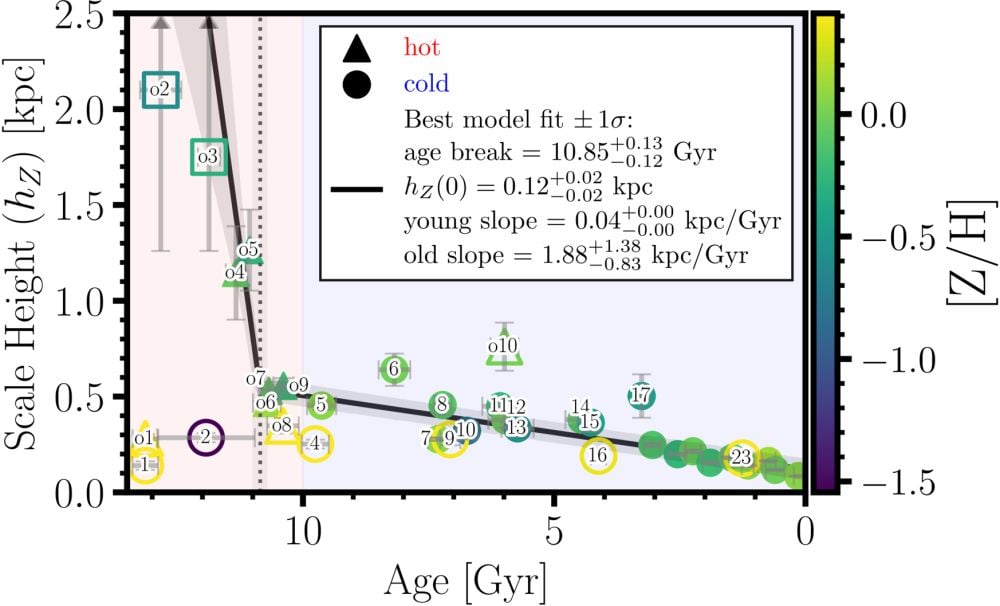
The existence of a clear break in the process about 10.8 billion years ago is the main argument in this research. The rate of vertical settling changed drastically at around this time.

"We find evidence that the scale height decrease rate changed drastically (~10.85) Gyr ago: at older ages, the evolution is very steep, with hZ (vertical scale height) dropping from over 1.26 to ∼0.5 kpc in merely 2 Gyr; subsequently, the thinning is very gradual, with hZ ∼ 0.1 kpc for the youngest populations," the authors write.

So before about 10.85 Gyr ago, the disk flattened rapidly. In only about 2 billion years, it thinned from about 4,100 light years thick down to only about 1,600 light years thick. After that, the thinning was much more gradual, reaching a thickness of only about 400 light years.

This figure from the research is packed with information that wrinkly astrophysicist brains can decipher. For the rest of us, the important part is the sharp drop in hZ, or vertical scale height, about 10.8 billion years ago. This is when the disk stopped thinning so drastically, leaving ancient stars on orbits in the thick disk, well above or below the remaining thin disk. Image Credit: David Mirabal et al 2026 ApJL 1010 L38

This figure from the research is packed with information that wrinkly astrophysicist brains can decipher. For the rest of us, the important part is the sharp drop in hZ, or vertical scale height, about 10.8 billion years ago. This is when the disk stopped thinning so drastically, leaving ancient stars on orbits in the thick disk, well above or below the remaining thin disk.

Image Credit: David Mirabal et al 2026 ApJL 1010 L38

This means the vertical structure of the disk components grew from the thick layer inward, an upside-down scenario. Ancient stars in the thick disk weren't scattered there by interactions with gas clouds, spiral arms, or other things; they were born there when the disk was much thicker overall. As time passed, generations of stars were born in a successively thinner disk.

"The extremely rapid early vertical settling of the disk points to a fundamentally upside-down formation process at early times, when the thick disk component is basically formed," the researchers explain. "Enabled by precise ages and high completeness, our results exhibit two clear, time-dependent evolutionary phases for the Galactic disk, which allow piecing together a comprehensive picture of the physical processes responsible for a two-phase assembly history of the Galactic disk."

This created what we see today. The thick disk has older, metal-poor stars and almost no gas for new star formation. The thin disk has younger stars, is the site of most star formation, and holds most of the gas for new stars.

"We thus strongly support an evolutionary scenario defined by two distinct temporal phases: an initial, highly turbulent epoch that gave birth to the thick disk, and a subsequent more quiescent period of secular evolution and gradual gas settling, which formed the thin disk," the authors write.

“This result resolves a classic problem in astrophysics,” lead author Mirabal said in a press release. “In the simulations, both disc formation models were possible, but there was a lack of observational evidence to determine which one occurred in the Milky Way. This is the first clear observational evidence favouring one of the two models for the Galaxy’s early stage. And it has been possible thanks to the high precision we achieved for the older ages,” he said.

RELATED

The Milky Way Just Got Way More Mysterious!
Finding the Edge of the Galaxy and Other Milky Way Updates

{ https://www.universetoday.com/ }

Hoe vind je dit bericht?
Geschreven door peter om 21:31 Stuur door

How Inversion and NASA Plan to Unlock Interplanetary Aerocapture

How Inversion and NASA Plan to Unlock Interplanetary Aerocapture

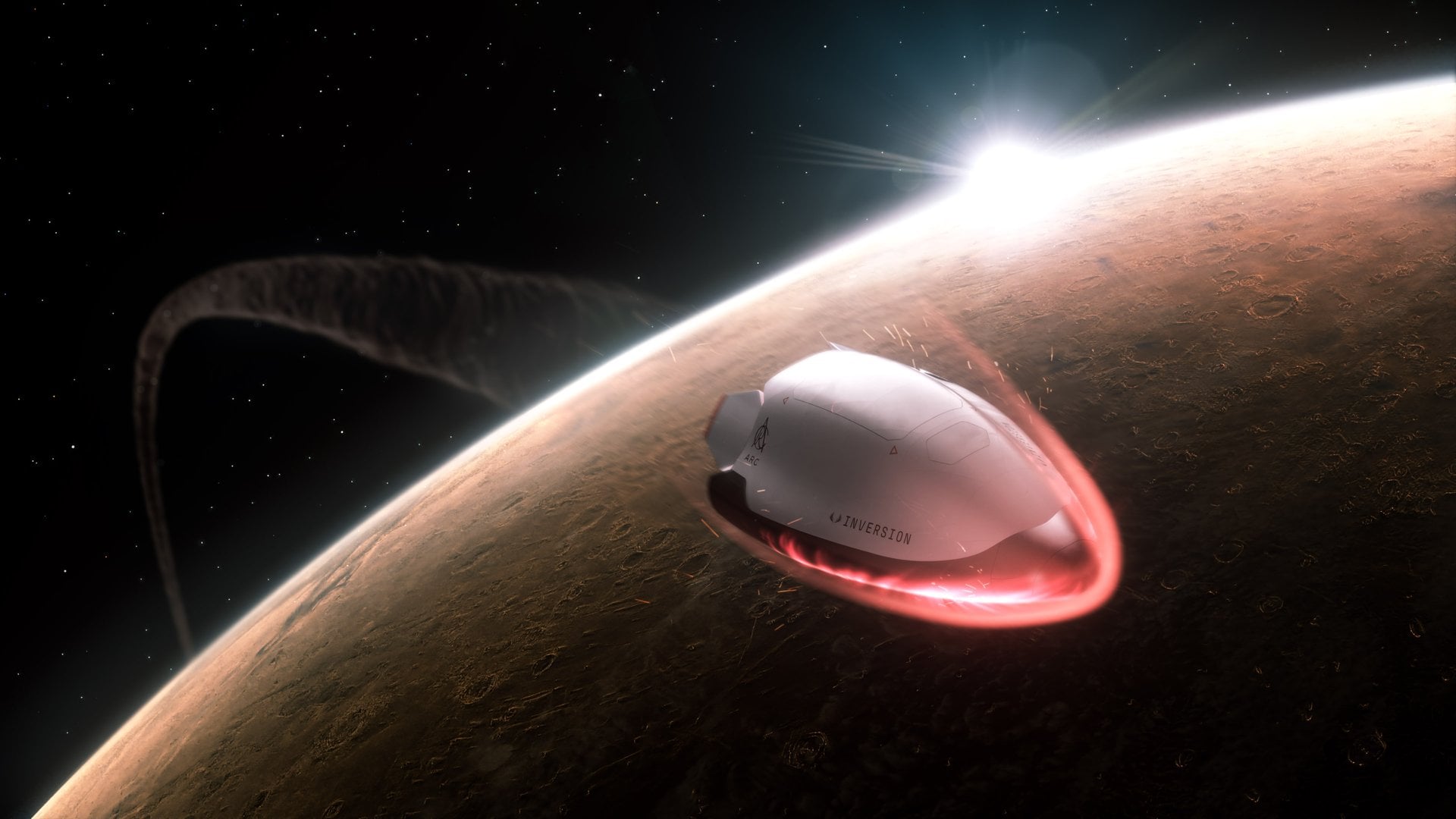
Artist's depiction of the Arc spacecraft performing an aerocapture maneuver. Credit - Inversion Space

Artist's depiction of the Arc spacecraft performing an aerocapture maneuver.

Credit - Inversion Space

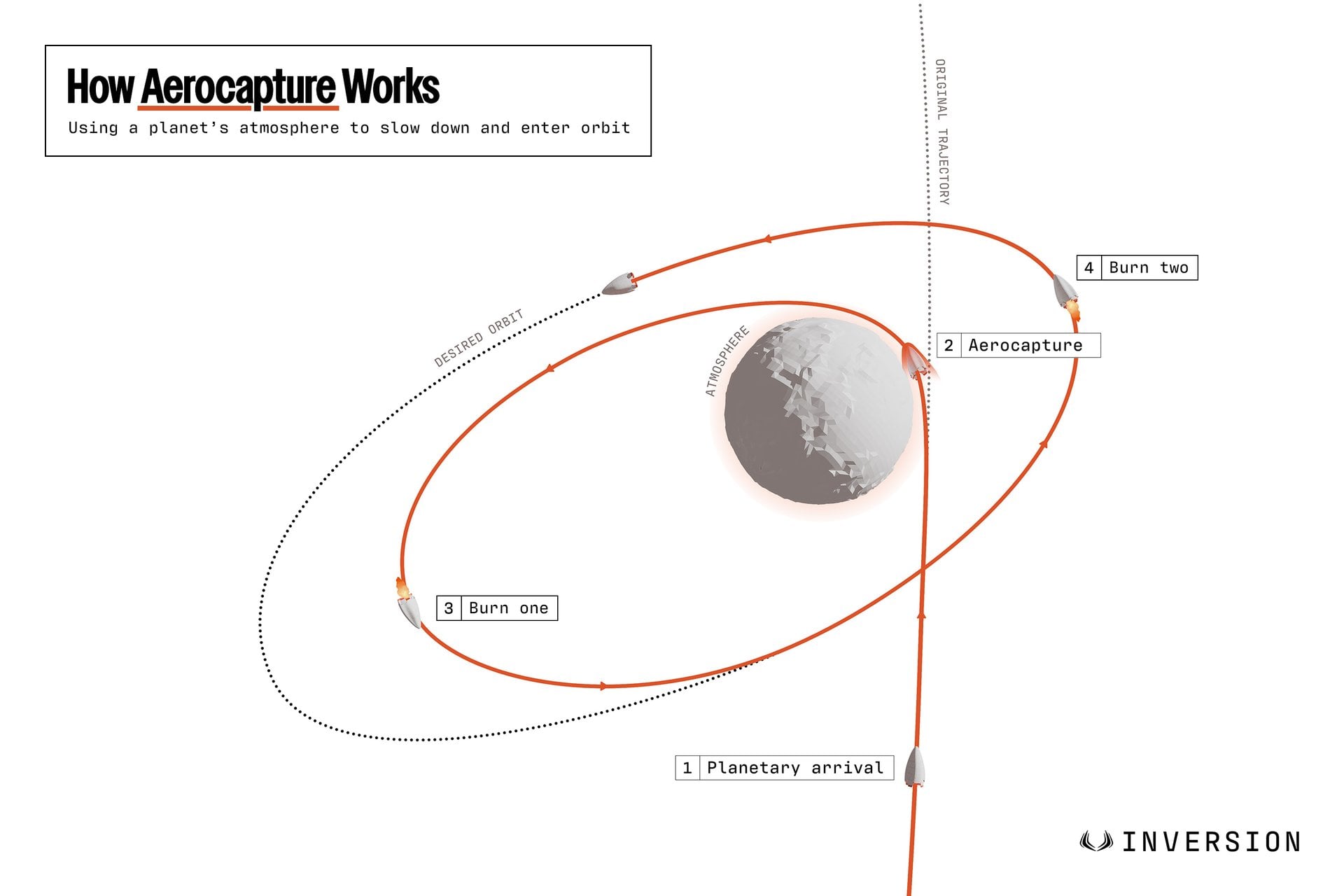
Using a planet’s atmosphere to secure a satellite’s place in orbit, a process known as “aerocapture”, has been the dream of flight engineers for decades. The only problem? It’s really hard to actually do. It requires control systems, thermal management, and orbital mechanics to all coordinate in a dance that allows a spacecraft to not just slow down while passing by another planet (or moon in some cases) but to start to orbit it without the use of lots of additional propellant. For now, that remains a dream, but a recent NASA contract to a California start-up called Inversion is another step towards making it a reality.

Inversion itself was started by former engineers from SpaceX and ABL Space to design orbital reentry vehicles - specifically ones that are designed to deliver mission critical cargo, such as vaccines or biological samples, or key military equipment to an isolated area, that would benefit from the much shorter travel times that orbital flight allows. Their business model would have saved Balto and companion sled dogs a harrowing trip to Nome if it was available 100 years ago.

Currently the company is working on a spacecraft they call Arc, which is designed to be the exact kind of reentry vehicle that enables those mission critical deliveries. Arc is designed to attach to one of the modern launch systems, the release into a Low Earth Orbit, which would enable short trips between almost any two points on the surface of the planet.

Graphic describing the aerocapture process. Credit - Inversion Space

Graphic describing the aerocapture process.

Credit - Inversion Space

Arc itself has three different control stages. It has traditional chemical propellants for orbital maneuvering. Once it reaches close to its desired trajectory, it switches to a cold gas system that uses smaller thrusters to optimally position the spacecraft. But where the real magic happens is when it actually begins reentry. At that point, control flaps designed to withstand the thermal and mechanical stresses of reentry at a high speed take over, guiding the spacecraft to exactly the place it intends to be.

The system itself isn’t designed to be reusable. But, according to Inversion’s CEO Justin Fiaschetti, it doesn’t have to be. It uses traditional heat shields and parachutes to slow its descent and is not intended to be refurbished. The key feature the company has to demonstrate is thermal management. The more heat Arc is able to take, the more customers it has for delivery. So the company has been focusing on thermal protection systems and other novel ways of dealing with that problem.

But one other area where that thermal management would come in handy is aerocapture. And Arc’s controllability under such extreme circumstances makes it ideal for that use case. While that would mean the spacecraft would stay in orbit rather than descending to a specific landing point, the physics principles of managing heat and maneuvering during atmospheric entry remain the same.

Video showcasing the Arc craft.

Credit - Inversion YouTube Channel

Assumedly that’s why NASA saw the potential in Arc. The plan isn’t to immediately send the spacecraft to Mars for its first attempt, but simply try an aerocapture on Earth itself. Under the contract, Inversion will study and demonstrate the “mission design, aerodynamics, trajectory analysis, and vehicle definition” according to a Medium post from the company announcing the contract.

According to Fiaschetti, the company’s plan isn’t to have this contract lead to a ten year development cycle typical of early-stage NASA contracts. In an interview with UT, he mentioned wanting to launch a demonstration vehicle as quickly as possible, though the exact timeline of that remained vague, and NASA hasn’t yet signed on to that commitment. But the company has form for delivering quickly - last year they launched Ray, their first prototype spacecraft, only four years after starting as a company.

Obviously the main use cases for aerocapture won’t be Earth - we can launch into pretty much whatever orbit we want on our own planet without the challenge of slowing down. It’s also not particularly useful on the Moon, as there’s no atmosphere to speak of to slow the craft down. But going either farther out or in, such as to Mars, Venus, or, hopefully, Titan, is where that capability would really shine. Admittedly, we might be decades away from seeing that sort of controllable aerocapture technology in use around other worlds, but it has to start somewhere. And in this case, it's starting with a contract.

Learn More:

{ https://www.universetoday.com/ }

Hoe vind je dit bericht?
Geschreven door peter om 21:19 Stuur door

World’s first round-trip mission to Mars has launched ‪—‬ why it could be a ‘transformative leap’ for science

TD5CWTJdChfyTRHXMXXVEQ-2400-80-860x484.jpg

World’s first round-trip mission to Mars has launched ‪—‬ why it could be a ‘transformative leap’ for science

On Monday (Oct. 19), Japan’s space agency launched a first-of-its-kindsample-return mission to Mars. The historic endeavor marks another major step toward humanity’s shared goal of understanding — and perhaps eventually colonizing — one of our closest planetary neighbors, experts say.

The Japan Aerospace Exploration Agency’s (JAXA) Martian Moons Exploration (MMX) probe is an international effort, constructed with help from NASA, the European Space Agency (ESA) and others. Over the next few years, it will closely study the Red Planet’s twin moons, Phobos and Deimos. The spacecraft will snap close-up photos of the pair before attempting to land on the larger satellite, Phobos, to scoop up rocky material that will hopefully be carried back to Earth in around five years.
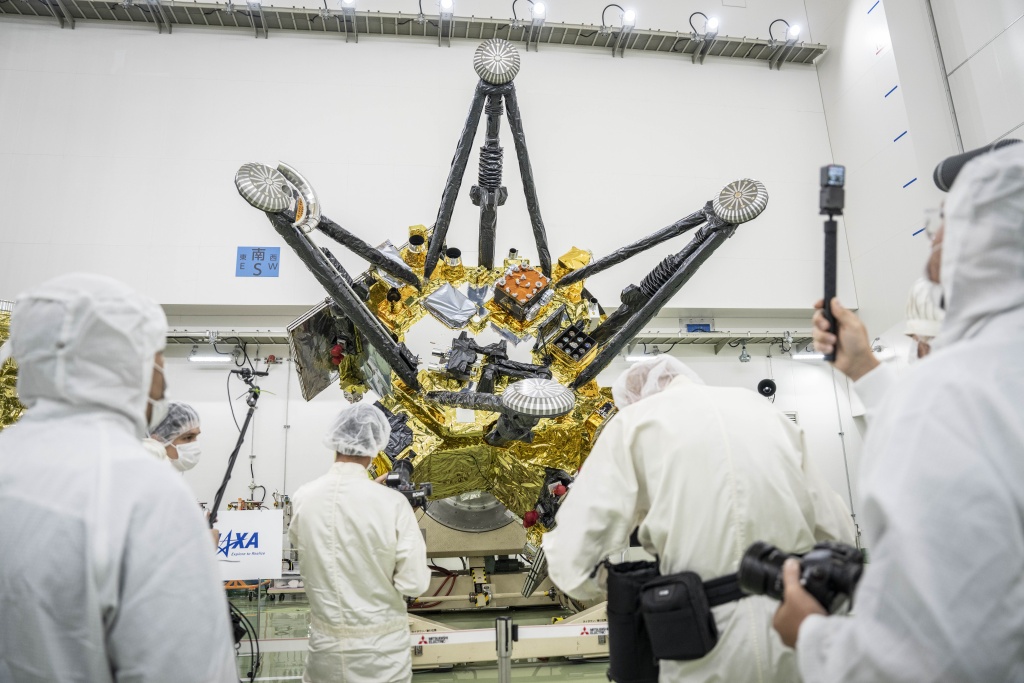
Members of the media film Exploration and Return Modules, making up the Martian Moons eXploration (MMX) spacecraft, at the Tanegashima Space Center in Minamitane, Kagoshima prefecture on August 13, 2026 — Yuichi YAMAZAKI / AFP

Members of the media film Exploration and Return Modules, making up the Martian Moons eXploration (MMX) spacecraft, at the Tanegashima Space Center in Minamitane, Kagoshima prefecture on August 13, 2026 

 Yuichi YAMAZAKI / AFP

If the mission is successful, the returned samples will finally settle a decades-old mystery about the origins of both moons. The findings could also help paint a picture of Mars’ ancient history and provide clues about what the early solar system was like.

“This mission marks a transformative leap in our capacity to investigate the Martian system,” Sonia Fornasier, an astronomer at the Paris Observatory who has studied Phobos and Deimos extensively and is a project scientist for MMX’s infrared spectrometer instrument (MIRS), told Live Science. It “ranks very high” among the missions we have sent to the Red Planet so far, she added.

What will MMX do?

JAXA launched the MMX probe on board an H3 rocket, which lifted off from Tanegashima Space Center in Kagoshima prefecture at 3:41 p.m. EDT Monday (4:41 a.m. Tuesday local time), Live Science’s sister site Space.com reported. (The mission was initially scheduled to launch in 2024, but it was delayed due to initial concerns about the H3 rocket.)

The camper-van-sized spacecraft successfully separated from the rocket’s fairing just over an hour later, and on Wednesday (Oct. 21), JAXA announced that the mission had passed the “initial critical operations phase,” meaning the probe is now locked into its roughly 140 million-mile-long (225 million kilometers) journey to Mars, which will take around 10 months.

“MMX took its first step today,” Naoki Murakami, general manager of Mitsubishi Electric’s space division, which led the design of the MMX probe, said in a postlaunch news conference early Tuesday morning (Oct. 20), according to The Japan Times. “This marks the beginning of a long, five-year journey.”
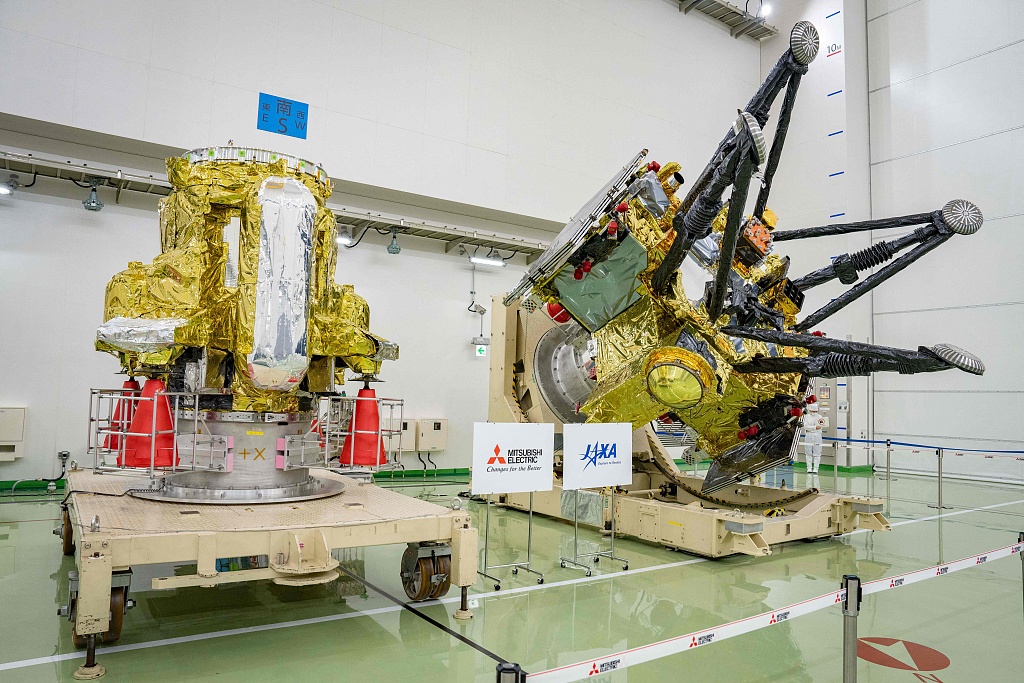
A Propulsion Module (L) and Exploration and Return Modules (R), making up the Martian Moons eXploration (MMX) spacecraft, are seen at the Tanegashima Space Center in Minamitane, Kagoshima prefecture on August 13, 2026. /VCG

A Propulsion Module (L) and Exploration and Return Modules (R), making up the Martian Moons eXploration (MMX) spacecraft, are seen at the Tanegashima Space Center in Minamitane, Kagoshima prefecture on August 13, 2026. /VCG

Once the probe arrives at the Red Planet in August 2027, it will insert itself into a “quasi-satellite orbit” around Phobos. In other words, MMX will circle Mars alongside the moon but will not be gravitationally bound to it, similar to around half a dozen “quasi-moons” that currently accompany Earth around the sun.

This mission marks a transformative leap in our capacity to investigate the Martian system

Sonia Fornasier, Paris Observatory

After collecting data from a distance for a few months, MMX will swoop down and attempt to land on the surface of Phobos ‪—‬ not once, but twice.

During the first landing, MMX will hover just above the moon and deploy a mini rover, dubbed Idefix, onto the moon’s surface. The wandering robot, built by the French and German space agencies, will have to contend with extremely weak gravity as it trundles across the surface of Phobos: The rover weighs around 55 pounds (25 kilograms) on Earth but will weigh only around half an ounce (15 grams) on Phobos, according to ESA.

Once Idefix has completed its initial assessment of the moon’s surface, the entire MMX probe will set down on Phobos, on top of the spacecraft’s four-legged lander module. Mission scientists hope this goes a lot more smoothly than the attempted landings of Japan’s “Moon Sniper” and Resilience lunar landers, which crash-landed on Earth’s moon in 2024 and 2025, respectively.

Two of the MMX lander’s legs contain built-in sampling devices ‪—‬ one that will drill into Phobos and another that will hoover up surface material. The second device, dubbed the Pneumatic Sampler (or P-Sampler), was built by the Blue Origin-owned private company Honeybee Robotics on behalf of NASA and will collect its material in a “matter of seconds,” Kris Zacny, vice president of the Exploration Technology Group at Honeybee Robotics, said at an Oct. 15 NASA news conference. “You blink, and it’s all done.”

In total, JAXA aims to collect around a third of an ounce (10 grams) of material from Phobos. That would be around twice as much material as the space agency managed to snag on its most recent sample-return mission, Hayabusa2, which collected samples from the “spinning-top” asteroid Ryugu in 2019, finding materials rich in surprising organic compounds.

Once the samples have been acquired, at some point between late 2028 and early 2029, the probe will conduct a series of close flybys of Mars’ smaller moon, Deimos, before beginning the long trip back to Earth in late 2030 — the first return flight ever attempted by a spacecraft sent to Mars.

When the probe returns to Earth in 2031, it will release its samples in a 20-inch-wide (60 centimeters) container that will fall back to our planet’s surface, most likely somewhere in Australia, according to ESA.

What could we learn about Phobos and Deimos?

Mars’ twin satellites, which were first spotted by American astronomer Asaph Hall in 1877, are nothing like Earth’s constant companion. For starters, they are much smaller; Phobos is around 14 miles (22 km) across, while Deimos is just 7.5 miles (12 km) wide. The duo also have lopsided shapes and are between 12 and 64 times closer to Mars than the moon is to Earth. (Phobos, meaning “fear,” and Deimos, meaning “terror,” are named after the sons of the Greek war god Ares, the counterpart to the Roman war god Mars.)

Phobos is dominated by the 6-mile-wide (10 km) Stickney crater, which was left by an ancient asteroid impact. The larger moon is also slowly falling toward Mars and may eventually be ripped apart before it reaches the Red Planet’s surface.

Other Martian spacecraft, such as the Emirates Mars Mission orbiter, have flown close to the moons, and NASA’s Mars rovers have frequently looked up to see the satellites eclipsing the sun in Mars’ sky (sometimes both at the same time). Yet many mysteries remain about the pair.

“Mars is right in our cosmic backyard, and yet we haven’t explored the planet’s moons,” Nancy Chabot, a space exploration expert at the Johns Hopkins Applied Physics Laboratory in Maryland and the deputy principal investigator of NASA’s MEGANE instrument on board MMX, told Live Science in an email. “MMX will do this!”

The biggest mystery surrounding Phobos and Deimos is their origin. Some researchers suspect the satellites are asteroids, or maybe even comets, that have been captured by Mars’ gravity, while others think the moons emerged from the debris of an ancient impact on the planet’s surface, similar to how Earth’s moon formed.

Neither theory is conclusive, meaning the moons’ origins “remain enigmatic,” Christopher Edwards, a planetary scientist at Northern Arizona University and one of NASA’s participating scientists for MMX, told Live Science.

For example, explaining how Mars captured the moons is “quite hard from an orbital mechanics perspective,” but if they did form from a debris disk from an ancient impact, they should have coalesced into better-defined spheres, Edwards said.

“MMX will solve this debate thanks to the spacecraft observations and the detailed analysis of the samples of Phobos on Earth,” Fornasier said. The data the probe collects from its flybys of Deimos will also allow researchers to generate a “full characterization of this body,” she added.

Fornasier is “particularly excited” by the possibility that the moons are captured asteroids because that would mean they would likely contain “organic and hydrated materials,” which would have a big “astrobiological implication” and would shed light on what the early solar system was like.

What could we learn about Mars itself?

Regardless of how the twin moons formed, researchers also stand to learn a lot about Mars and how planets form and evolve.

“Phobos and Deimos are interesting, but not just in their own right,” Tom Statler, an MMX program executive and scientist in NASA’s Planetary Science Division, said at the Oct. 15 news conference. “Their presence is a key piece of the larger story of the Mars system. By uncovering the moons’ origin, we’ll gain new insights into the history of both Mars and Earth.”

If the moons did form via an impact scenario, the samples MMX collects may also contain actual pieces of Mars for researchers to study.

“If these objects are in fact pieces from the Martian surface that have coalesced moons, we’ll collect the best-preserved samples of the Martian surface,” Edwards said. Other fragments of Mars have already reached Earth as meteorites. However, entry into Earth’s atmosphere can transform them.

If Phobos is a chunk of Mars, that would be a real boon to NASA, which canceled its Mars Sample Return program — a mission that would have retrieved samples collected by the Perseverance rover — earlier this year. The agency’s researchers will receive up to 15% of the MMX samples to analyze.

During its three-year stay in the Red Planet’s system, the Japanese probe will also collect lots of data on Mars that could contribute to a wide range of future findings. “MMX will conduct in-depth studies of the Martian atmosphere, with a particular emphasis on dust and water transport mechanisms and the escape processes shaping Mars’ atmospheric dynamics,” Fornasier said.

This atmospheric data could temporarily fill a gap left by the recent death of NASA’s iconic MAVEN spacecraft, which stopped sending data back to Earth late last year.

Analysis of craters on the Martian moons could also provide clues about other events in Mars’ history. For example, some researchers think the Red Planet may have once had rings like Saturn or a larger moon.

Other experts are hopeful that the MMX findings could help lay the groundwork for future missions to explore ‪—‬ and perhaps colonize ‪—‬ Mars. “The samples from MMX will bring forth paradigm-shifting science on the Mars system for generations to come, especially as NASA prepares to send the first humans to Mars,” Nicky Fox, associate administrator for NASA’s Science Mission Directorate, said in a recent statement.

The next sample-return trip to Mars will be China’s Tianwen-3 mission, which is scheduled to launch in 2028 and will aim to land on and retrieve samples directly from the Red Planet’s surface, according to Space.com.


Since landing its first rover on Mars in 1997, NASA has pushed the boundaries of exploration with increasingly larger and more sophisticated robotic explorers. Each mission builds on the lessons learned from the Red Planet, leading to breakthroughs in technology and our understanding of Mars. From the microwave-sized Sojourner to the SUV-sized Perseverance—and even taking flight with the groundbreaking Ingenuity helicopter—these rovers reflect decades of innovation and the drive to answer some of science’s biggest questions.

{ https://scienceglobal.academy/category/space/ }

Hoe vind je dit bericht?
Geschreven door peter om 22:51 Stuur door

On Hostile Alien Worlds, Water Unexpectedly Behaves Like a Bizarre Chemical Shapeshifter

Water lab

Credit: Josh Hawkins

On Hostile Alien Worlds, Water Unexpectedly Behaves Like a Bizarre Chemical Shapeshifter

Water behaves strangely under extreme conditions beyond Earth, according to new research highlighting the unexpected realities that may one day greet future astronauts.

In a recent paper published in Communications Chemistry, a team of scientists from the University of Nevada, Las Vegas, describes their laboratory experiments subjecting water to the harshest conditions found on other planets.

Their laboratory work revealed that water’s atomic structure, appearance, and other properties change under these extreme conditions. With such environments presently still out of reach, the new laboratory work offers a unique window into what may lie beneath the surfaces of distant worlds.

Asymmetrical Water on Other Planets

One of the primary discoveries made in the new research was that, under extreme pressure, water ice can begin to lose its symmetry.

“Water beyond Earth-like conditions has more complex behavior than we ever previously imagined,” said lead author Ashkan Salamat, research lead and director of UNLV’s Nevada Extreme Conditions Lab. “It’s amazing how water can behave under pressure.”

Under normal conditions, compression forces atoms into closer proximity, thereby reducing a material’s volume. In many materials, increasing pressure can also favor more symmetrical atomic arrangements. Yet the UNLV team observed an unexpected departure from this behavior: the atomic structure of water ice became less symmetrical under extreme pressure.

Squeezing Water in the Lab

In an attempt to recreate the intense conditions found deep inside worlds such as Neptune and Uranus, the UNLV team subjected water ice to pressures reaching approximately 35 million pounds per square inch (PSI). For comparison, a typical car tire is inflated to around 30 PSI.

Worlds with such high internal pressures are truly alien environments compared to Earth. No probe has ever entered the deep interiors of Neptune or Uranus to provide firsthand measurements, although Voyager 2 flew past both planets in the 1980s. These ice giants are believed to contain substantial amounts of water, ammonia, and methane deep within their interiors, where extreme pressures and temperatures may produce exotic states of matter.

“We can’t enter the crust or atmospheres of these planets because of distance, but we have data from things like the Voyager program,” said Salamat. “We have an idea of their compositions, and interior pressure and temperatures. And in labs like mine, we can mimic the chemistry and experiment with what could be occurring inside these planets.”

An Unexpected Chemical Shapeshifter

The effects of these simulated planetary conditions were examined using spectroscopy, while two diamonds exerted intense pressure on samples of ice X, an unusual form of water ice that exists under high-pressure conditions. Researchers also used X-ray techniques to investigate the material’s atomic structure.

In replicating these exotic environments, the UNLV team discovered unexpected behavior in water ice. Their findings suggest that, under pressures vastly greater than those encountered at Earth’s surface, the material can undergo structural changes that depart from the symmetrical arrangements previously expected at such extremes.

“Understanding the mechanisms of our solar system and our observable universe is critical for the endeavor of human knowledge,” Salamat concluded. “When we eventually get to these worlds, what are we going to see? We’re really the initial pioneers in trying to answer these questions in the laboratory.”

The paper, “Evidence for Symmetry-Reduction in Solid H2O Above 222 GPa,” appeared in Communications Chemistry on October 20, 2026.

  • Ryan Whalen covers science and technology for The Debrief. He holds an MA in History and a Master of Library and Information Science with a certificate in Data Science. He can be contacted at ryan@thedebrief.org, and follow him on Twitter @mdntwvlf.

{ https://thedebrief.org/category/astronomy/ }

Hoe vind je dit bericht?
Geschreven door peter om 23:07 Stuur door

Hera probe starts slowing down ahead of its encounter with the asteroid Dimorphos

Hera probe starts slowing down ahead of its encounter with the asteroid Dimorphos

In September 2022, a NASA spacecraft deliberately crashed into a small asteroid. It was humanity’s first test of planetary defense technology. Now, a new probe is heading toward the resulting debris to examine the scene of the cosmic collision up close.

hera_glides_past_didymos_to_dimorphos.jpg

The European Space Agency’s Hera mission, which will send humanity’s first probe to rendezvous with the binary asteroid system Didymos and Dimorphos. Source: ESA

On October 7, 2024, the European Space Agency (ESA) launched the Hera mission as a crucial follow-up to DART—the first attempt to alter a celestial body’s orbit. The small, car-sized spacecraft recently performed a braking maneuver to slow down ahead of its first close approach to the binary asteroid system, scheduled for early November.

Hera_braking_pillars.gif

Hera will thoroughly investigate the aftermath of the impact. The scientists’ main goal is to turn a one-off space experiment into a reliable, well-understood planetary defense technique while also learning more about how asteroids form.

Anatomy of a Cosmic Impact

During the DART test, the 607-kilogram spacecraft slammed at tremendous speed into Dimorphos, a 170-meter space rock orbiting its larger, 800-meter companion, Didymos. Ground-based observations showed that the collision shortened Dimorphos’s orbital period from 11 hours and 55 minutes to 11 hours and 23 minutes.

Hera_mission_timeline_pillars.png

An infographic outlining the Hera mission, from its launch from Earth to the completion of its nominal mission near the asteroid Didymos

The mission was declared an unequivocal success: it demonstrated that we can deliberately change asteroids’ trajectories. But hitting a target and understanding all the underlying consequences of the impact are different things. To assess the method’s true effectiveness, scientists needed an on-site investigation.

Investigating the “Crime Scene”

ESA estimates that current ground-based observations have an uncertainty of approximately 10%, while existing computer models still cannot precisely determine Dimorphos’s mass and composition. This is where Hera comes in, carrying an array of scientific instruments.

Hera_separated_from_its_launcher.jpg

The Hera spacecraft photographed after separating from the upper stage of its SpaceX Falcon 9 launch vehicle on October 7, 2024. The underside of the spacecraft is visible, including its circular launch vehicle interface and the surrounding thrusters used for orbital control. Part of the spacecraft’s high-gain antenna can be seen on the right.

Once the spacecraft reaches Dimorphos, it will not only inspect the “crime scene” but also precisely measure the space rock’s mass and its altered orbit. The probe will conduct the most detailed survey yet of a binary asteroid system. Although such objects account for approximately 15% of all known asteroids, none has ever been studied at such close range.

Miniature Helpers

Earlier this month, Hera captured its first images of its target. The spacecraft photographed the Didymos system from approximately 236,500 kilometers away. On October 15, the probe adjusted its trajectory and fired its thrusters to match its velocity with that of the asteroids.

In early November, the robotic explorer will approach to within 30 kilometers of the space rocks and begin collecting data. Hera will subsequently move even closer and, in January 2027, deploy a pair of miniature CubeSats, each about the size of a shoebox: Milani and Juventas. Milani will analyze the composition of Dimorphos’s surface, while Juventas will use radar to probe its interior.

Following its two-year journey through space, Hera is expected to spend at least six months in the Didymos system, collecting data vital to our planet’s future safety.

We previously reported on how scientists questioned the causes of the asteroid Dimorphos’s unusual behavior.

  • Based on material from ESA.

RELATED

Hera Asteroid Mission: Europe Visits NASA’s Crash Site
Can We Actually Stop an Asteroid? Hera Is About to Find Out
Hera’s Close-Up Asteroid Investigation

{ https://universemagazine.com/en/articles-en/ }

Hoe vind je dit bericht?
Geschreven door peter om 20:52 Stuur door

Forgotten elementary particles may explain the existence of the Universe

Forgotten elementary particles may explain the existence of the Universe

Usually, discussions of neutrinos refer to their three most common types. This year’s Nobel Prize was awarded for developing methods to detect these particles. However, the research team found that another often-overlooked “relative,” known as a “decoupled” heavy neutrino, could have helped matter dominate its opposite.

Study author Dr. Rishav Roshan of Southampton said: “This decoupled heavy neutrino has long been regarded as an unimportant background element in particle physics. Yet it decays incredibly slowly. As the cosmos cooled after the Big Bang, the particle survived long enough to temporarily dominate the Universe’s energy density and trigger a period of matter domination.”

Asymmetry Between Matter and Antimatter in the Early Universe

Most theories explaining why matter prevailed over antimatter ignored the decoupled heavy particle because experts considered its interactions too weak to influence other particles, Roshan added.

However, the researchers from Southampton and Kanpur found that the overlooked particle could affect the asymmetry between particles and antiparticles that is essential to our existence. “The very fact that we are here proves that an asymmetry arose between matter and antimatter,” Roshan added.

The physicists say the decoupled neutrino changed the temperature in the early Universe at which fundamental particles, such as electrons and other leptons, interacted with their antiparticles through the Standard Model’s Higgs boson. This temperature acted as a switch, shaping how the imbalance between matter and antimatter emerged.

Traces in Primordial Gravitational Waves

Study co-author Dr. Sudip Jyoti Show of Kanpur said the findings change our understanding of how the early Universe expanded so rapidly after the Big Bang.

He added: “This gives us a new explanation for how matter prevailed. A dramatic shift in the early expansion of the cosmos leaves distinct, detectable imprints of change, for example, on primordial gravitational waves.”

These gravitational-wave signatures open up new opportunities to unravel the evolution of the early Universe after the Big Bang.

Why Our Existence Doesn’t Really Make Sense

{ https://universemagazine.com/en/articles-en/ }

Hoe vind je dit bericht?
Geschreven door peter om 18:55 Stuur door

Mission to Mars! Japanese spacecraft begins epic five-year quest to bring Martian moon samples back to Earth for the first time

A rocket is set to blast off towards one of Mars's moons tonight in an ambitious £262million mission.

The Japanese spacecraft, known as Martian Moons Exploration (MMX), will this evening begin its 300million-mile mission to Phobos - the larger of the Red Planet’s two satellites.

Its aim is to collect at least 10g of dust and rock from the moon's surface, before heading back to Earth.

The mission is expected to return the first-ever samples collected from the vicinity of Mars, with tiny grains of material believed to contain a wealth of scientific information.

Experts hope the samples will finally settle a decades-old debate over whether Phobos is an asteroid that was 'captured' by Mars's orbit, or the remains of a giant collision involving the Red Planet.

'Through detailed observations and analysis of the samples obtained from Phobos, this mission seeks to clarify the formation of the Martian sphere and the Solar System, explore how life began, and pave the way for future deep-space exploration,' the Japan Aerospace Exploration Agency (JAXA) said.

Phobos, the largest of the Red Planet's two moons, is the ambitious mission's set destination

Phobos, the largest of the Red Planet's two moons, is the ambitious mission's set destination

The spacecraft's aim is to touch down on Phobos and scoop up at least 10g of dust and rock from the moon¿s surface before beginning the long journey back to Earth (artist impression)

The spacecraft's aim is to touch down on Phobos and scoop up at least 10g of dust and rock from the moon’s surface before beginning the long journey back to Earth (artist impression)

MMX is set to launch on an H3 rocket at 8.41pm (BST) today, from the country's Tanegashima Space Centre.

The spacecraft consists of three components with specific functions, including a propulsion module to get MMX to Mars, an exploration module with sample collection gear and a return module to deliver the sample to Earth.

After takeoff, the rocket will spend several years travelling through deep space before orbiting Phobos.

In early 2029, a small microwave-sized rover will drop down on to the moon’s surface and spend 100 days exploring its landscape.

Its findings will inform the exact area where the exploration module should land.

Once confirmed, the spacecraft will descend to the surface of Phobos then spend  two-and-a-half hours collecting material.

Scientists hope to gather samples from one or even two separate locations, giving them a better understanding of the moon's composition.

To do this, MMX will use one of two collection systems. The primary option is the C-sampler, which can drill up to 0.8 inches (2cm) beneath the surface and retrieve material that has been shielded from the sun's radiation.

A second system, known as the P-sampler, uses a burst of nitrogen gas to blast dust and small rocks into a collection chamber.

In early 2029, a small microwave-sized rover will drop down on to the moon¿s surface

In early 2029, a small microwave-sized rover will drop down on to the moon’s surface

The spacecraft will spend two-and-a-half hours collecting samples from Phobos for research

The spacecraft will spend two-and-a-half hours collecting samples from Phobos for research 

In total, the spacecraft is equipped with 13 scientific instruments that will be used to examine Phobos in unprecedented detail.

High-resolution cameras, called Tengoo and Orochi, will photograph and map the moon's surface, while a laser altimeter will create a detailed 3D picture of its shape and terrain.

Another instrument, called MIRS, will analyse the moon's minerals, and a gamma-ray and neutron detector known as Megane will help reveal its chemical makeup.

The mission will also study Mars's smaller moon, Deimos, from afar.

After it has gathered at least 10g of material, the spacecraft will then leave the Martian system and travel back home, arriving in 2031.

As the spacecraft approaches Earth, it will release a capsule carrying the precious samples.

The capsule will plunge through the atmosphere before descending by parachute into the Australian outback, where it will be recovered and flown to Japan for analysis.

Martian Moons Exploration is to launch at 8:41pm (BST) today from a Japanese space centre

Martian Moons Exploration is to launch at 8:41pm (BST) today from a Japanese space centre

Experts hope the samples will finally settle a decades-old debate over whether Phobos is a captured asteroid or the remains of a giant collision involving the Red Planet itself

Experts hope the samples will finally settle a decades-old debate over whether Phobos is a captured asteroid or the remains of a giant collision involving the Red Planet itself

Studying material directly in laboratories on Earth will allow far more detailed analysis than is possible in space.

‘Mars is a planet that shares many similarities with Earth, yet today it has only a thin atmosphere and a cold environment,’ JAXA said.

‘To unravel the mystery of how Mars evolved into its present state, scientists would ideally study Mars itself.

‘However, the planet's strong gravity presents significant technical challenges for landing and sample return missions.

‘For this reason, MMX has selected Phobos, one of Mars's moons, as the exploration target.’

Scientists are also hoping the samples may contain tiny fragments of Mars itself.

Because Phobos orbits so close to the planet, debris blasted from the Martian surface by asteroid impacts may have become embedded in the moon over billions of years.

The European Space Agency (ESA) has provided the spacecraft’s deep space communication equipment.

‘The data and samples returned by MMX are a window to study the evolution of Mars and the Solar System,’ Elliot Sefton-Nash, ESA MMX Project Scientist, said.

‘Bringing samples to our most sophisticated labs here on Earth is a multiplier for discoveries, because our most precise instruments are too large, complex or sensitive to send to space.

‘Even after the mission has been completed, future generations of scientists will study the Phobos samples with even more advanced instruments – samples brought to Earth are the gift that keeps on giving.’

RELATED

NASA’s Ambitious Mission to Bring Martian Samples to Earth

{ https://www.dailymail.com/sciencetech/index.html }

Hoe vind je dit bericht?
Geschreven door peter om 16:07 Stuur door

A new star has been discovered – one scientists thought was ‘impossible’

Image

Enjoy the solar rainbow (Picture: Getty Images/Mark Hollands/University of Warwick)

A new star has been discovered – one scientists thought was ‘impossible’

When you look up at the stars, these tiny pinpricks of light all look the same colour.

But these cosmic radiators actually shine all sorts of colours depending on how hot they are.

Scorching solar newborns are blue, lukewarm ones are yellow and elderly stars shine orange and red.

‘Any other colours, green included, are not possible,’ Mark Hollands, an astrophysicist at the University of Warwick, tells Metro.

Well, that is until Hollands and his team found one.

Why is this star green?

SEI_317321760-67f5.jpg?quality=90&strip=all&w=646

WDJ1330+6435, which is about 4,000°C, glows a ghostly green (Picture: Mark Hollands, University of Warwick)

Astronomers have long thought white dwarves, the embers left behind when a star dies, follow the same temperature colour rule. They’re hot, so they are a bluish white, hence the name.

But as Holland and his co-authors wrote in their paper published in the journal RAS Techniques and Instruments, these solar husks can actually be colours never seen in other stars.

Researchers calculated what colour 151 white dwarfs would look like to the human eye. Of them, 146 live up to their name.

Yet WDJ1330+6435, a dead star 280 light-years from Earth, or about 165trillion miles away, ​in the constellation Draco, glows green.

This white dwarf has been absorbing iron-, magnesium-, and sodium-rich slush from the rocky planets that once orbited it.

‘Think of something like asteroids or minor planets that have ventured too close to the white dwarf, have been shredded into dust by tidal forces and then rained down onto the stellar surface where they get mixed in,’ Hollands says.

EMBARGOED TO 1600 WEDNESDAY 13 Undated handout image issued by Springer Nature of a new gas giant planet found orbiting a white dwarf star. Issue date: Wednesday October 13, 2021. PA Photo. New research indicates the gas-giant, Jupiter-mass planet is orbiting a white dwarf star in a wide orbit in the Milky Way. See PA story SCIENCE Planet. Photo credit should read: W. M. Keck Observatory/Adam Makarenko/PA Wire NOTE TO EDITORS: This handout photo may only be used in for editorial reporting purposes for the contemporaneous illustration of events, things or the people in the image or facts mentioned in the caption. Reuse of the picture may require further permission from the copyright holder.

White dwarves, while very hot, shine dimly (Picture: PA)

Chemical elements – the things in the periodic table – absorb different colours of light and spit out the rest. Sodium’s favourite colour is orange, which is why sodium street lamps glow a dull yellow.

WDJ1330+6435 is so dense that the star’s helium plasma, the gooey fourth state of matter, makes the sodium soak orange, yellow and red light.

‘This absorbed radiation is then re-radiated at other wavelengths, with the emergent spectrum having a beautiful green colour,’ Hollands says.

If our sun – which, as Hollands says, is white, not yellow – were replaced with WDJ1330+6435, Earth wouldn’t be the same.

Hollands says the star would be tiny in the sky as it’s 100 times smaller. Earth would have a wider orbit as the white dwarf’s gravity isn’t as strong.

‘Even if we could move the Earth closer in somehow, so that the star appeared bigger in the sky, plant life on Earth absorbs mostly violet and red light, reflecting the green, to grow,’ he adds.

‘With some of these wavelengths missing from WDJ1330+6435, that certainly wouldn’t be good news for us.’

Are there other coloured stars?

SEI_317321752-ff5a.jpg?quality=90&strip=all&w=646

White dwarves are like giant cotton wool balls, tinted by the material they absorb (Picture: Mark Hollands/University of Warwick

WDJ1330+6435 is the first known genuinely green star in the Milky Way.

It’s one of five white dwarf stars the astronomers found that glow an odd colour because of the material in their atmospheres.

Hydrogen- and helium-filled wisps were cyan or ​a pale blue and stars that swallowed asteroids or rocky planets were yellowish or, in the case of WD J1330+6435, chartreuse.

Carbon-rich ones were pink or purple, like WD J1011+2845, which is 48 light-years from Earth in the constellation Leo ​Minor.

The star glows a salmon-pink hue because its convection zone – layers of hot and cold slush – is so deep that carbon leaks from inside it.

‘We also found some of these carbon-rich white dwarfs to be pale purple as well, if the stellar temperature is a bit higher and the abundance of carbon a bit lower,’ says Hollands.

SEI_317321740-3689.jpg?quality=90&strip=all&w=646

Another white dwarf, WD J1011+2845, that would appear pink to the human eye (Picture: Mark Hollands/University of Warwick)

As white dwarf stars can’t be seen directly from Earth, the astronomers deduced their colours using star spectrum data, the ‘fingerprint’ left when starlight is split apart by wavelength.

Hollands says that while the findings don’t change how we see white dwarf stars – no pun intended – they show just how colourful the universe is.

Even brown dwarf stars, failed stars too small to attain the gravity needed to get their hydrogen motors running, can sparkle.

‘Most of their light is radiated in the infrared, but a small amount is still emitted at visible wavelengths, with absorption from sodium, potassium, and titanium oxide affecting their perceived colours,’ Hollands says.

‘Other people have in the past worked out the colours of brown dwarfs from their spectra and determined that they would be violet or purple.’

RELATED

Scientists Just Found the First GREEN Star, and It Ate Its Own Planets
Scientists Found a Green Star — But Stars Aren’t Supposed to Be Green
James Webb Found an Impossible Star

 { https://metro.co.uk/news/ }

Hoe vind je dit bericht?
Geschreven door peter om 15:09 Stuur door

ExoMars probe has been operating in Mars orbit for 10 years

ExoMars probe has been operating in Mars orbit for 10 years

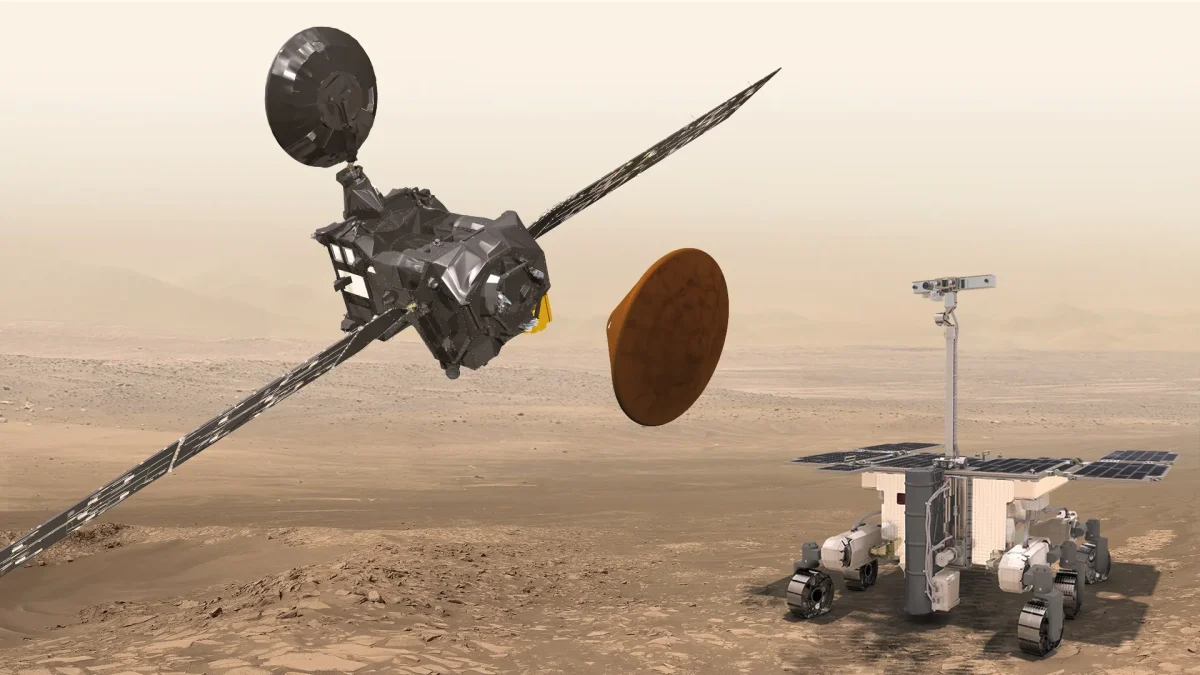
The next stage of the program was to be the Rosalind Franklin rover, which, according to plans drawn up in 2016, was scheduled to launch as early as 2018. The launch was postponed several times, and in March 2022, ESA suspended the joint program with Russia following its full-scale invasion of Ukraine.

eyes_on_mars_pillars.png

Artist’s illustration of the Rosalind Franklin rover at Oxia Planum, the ExoMars landing site. Credit: ESA/Mlabspace. Source: esa.int

Following the split, ESA replaced the Russian landing platform with its own, while NASA undertook to provide the launch vehicle, braking engines for landing, and radioisotope heater units. The rover is now scheduled to launch in 2028 and land in 2030.

The Mystery of Martian Methane

Methane on Mars has long puzzled scientists. On Earth, most of this gas is produced by living organisms, while on Mars, solar ultraviolet radiation destroys its molecules within a few centuries. So if methane is present there, some source—biological or geological—must be continually replenishing it.

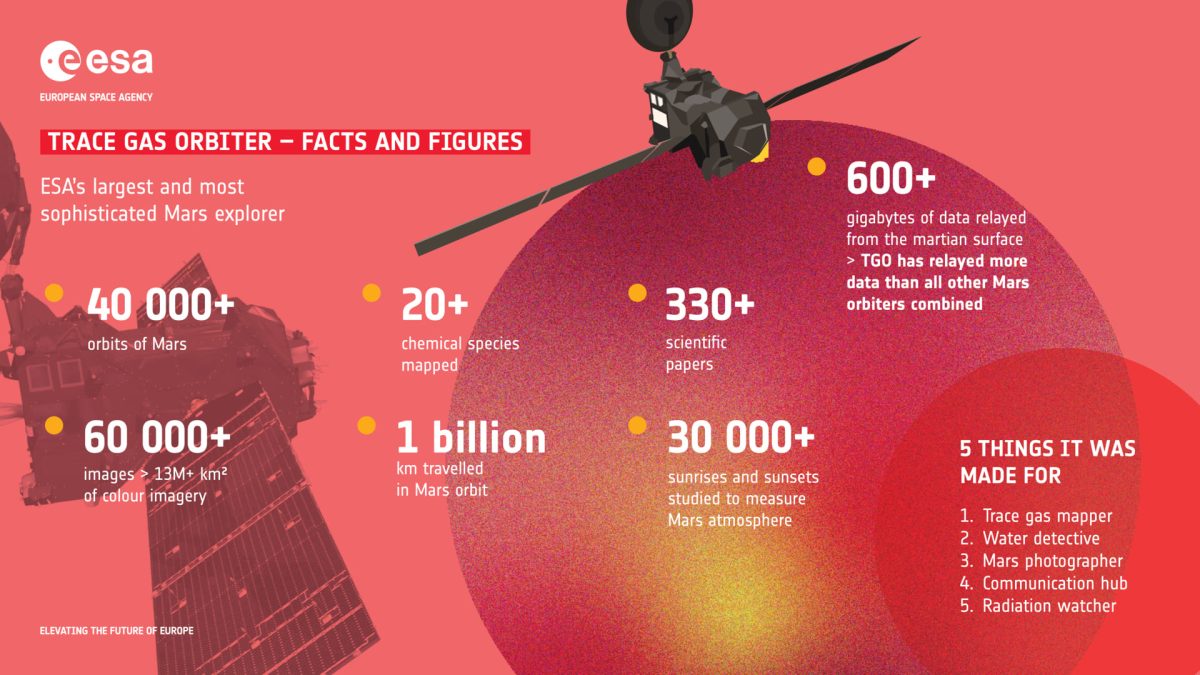
To find even traces of the gas, researchers used the spacecraft’s spectrometers to study more than 30,000 sunrises and sunsets. At these moments, sunlight passes tangentially through the planet’s atmosphere, and each gas absorbs its own characteristic wavelengths. This allowed researchers to map more than 20 chemical species.

promethei-1536x1127.jpg

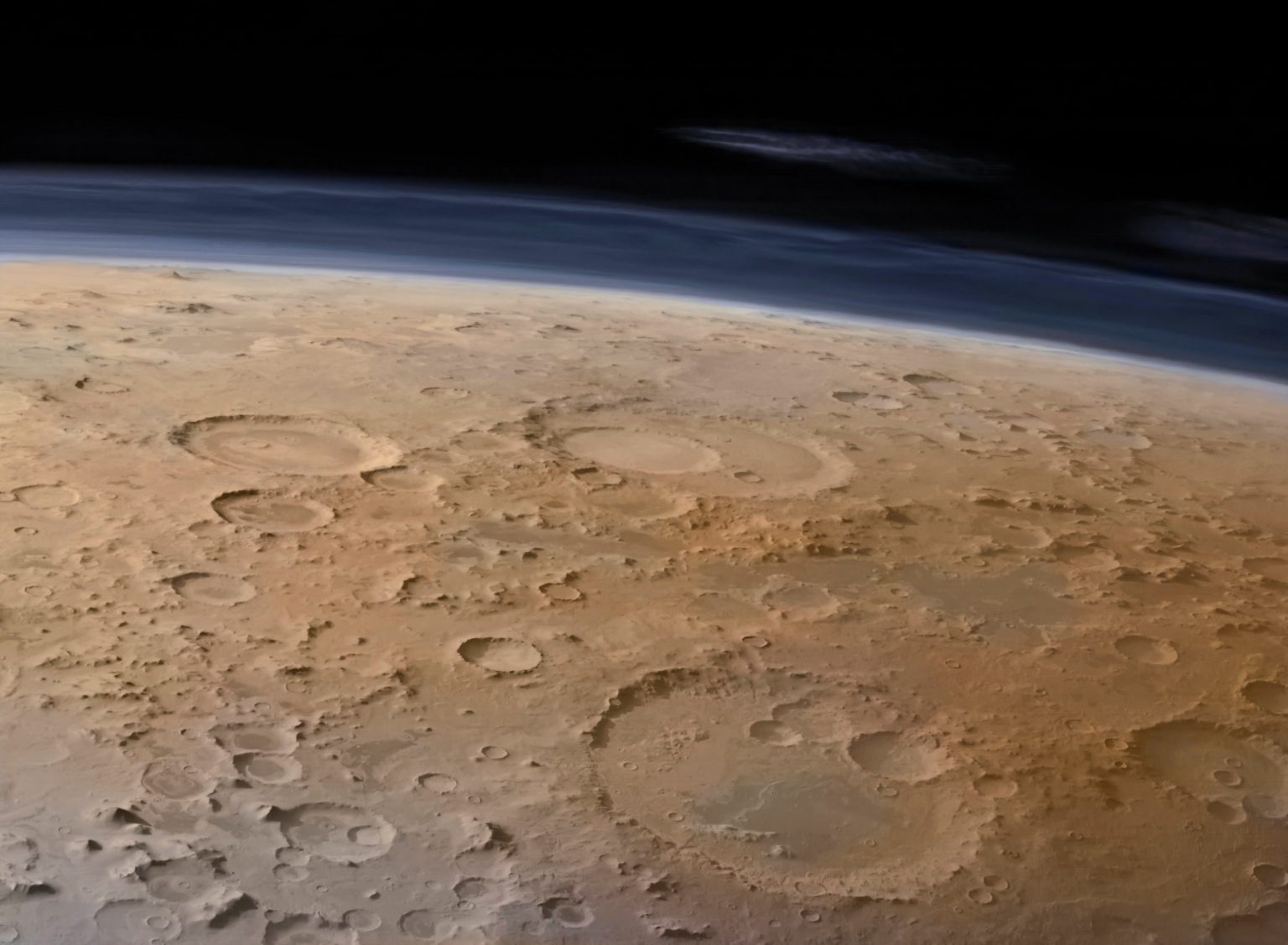
The atmosphere of Mars.

Image: ESA / DLR

No methane was detected in these spectra. According to the peer-reviewed journal Astronomy & Astrophysics, the upper limit of its abundance is 20 molecules per trillion. Yet the Curiosity rover has repeatedly detected methane near the surface. Researchers still cannot explain why the gas is not detected higher up.

Unexpected Hydrogen Chloride

During the global dust storm of 2018, the spacecraft’s instruments detected hydrogen chloride in the Martian atmosphere for the first time. On Earth, volcanoes emit this gas, so the discovery was initially interpreted as a possible sign of present-day volcanic activity.

Subsequent observations weakened this explanation. The gas appears each year alongside dust in both hemispheres, suggesting that it is probably produced by chemical reactions within the atmosphere itself under the influence of sunlight, rather than coming from the planet’s interior.

However, observations from orbit reveal only gases in the atmosphere. Organic molecules that could indicate life will have to be sought on the planet itself. The Rosalind Franklin rover’s drill will reach a depth of two meters, beyond the reach of solar ultraviolet radiation that destroys such molecules near the surface. Samples will be analyzed in the rover’s onboard laboratory, without being returned to Earth.

10 Years On Mars: The Full Journey

{ https://universemagazine.com/en/articles-en/ }

Hoe vind je dit bericht?
Geschreven door peter om 18:21 Stuur door

Meer van UFO'S of UAP'S, ASTRONOMIE, RUIMTEVAART, ARCHEOLOGIE, OUDHEIDKUNDE, SF-SNUFJES EN ANDERE ESOTERISCHE WETENSCHAPPEN - DE ALLERLAATSTE NIEUWTJES

↑ Terug naar de berichten