Naar de inhoud

UFO'S of UAP'S, ASTRONOMIE, RUIMTEVAART, ARCHEOLOGIE, OUDHEIDKUNDE, SF-SNUFJES EN ANDERE ESOTERISCHE WETENSCHAPPEN - DE ALLERLAATSTE NIEUWTJES

UFO's of UAP'S in België en de rest van de wereld
akke.beakke.be
Ontdek de Fascinerende Wereld van UFO's en UAP's: Jouw Bron voor Onthullende Informatie! Ben jij ook gefascineerd door het onbekende? Wil je meer weten over UFO's en UAP's, niet alleen in België, maar over de hele wereld? Dan ben je op de juiste plek! België: Het Kloppend Hart van UFO-onderzoek In België is BUFON (Belgisch UFO-Netwerk) dé autoriteit op het gebied van UFO-onderzoek. Voor betrouwbare en objectieve informatie over deze intrigerende fenomenen, bezoek je zeker onze Facebook-pagina en deze blog. Maar dat is nog niet alles! Ontdek ook het Belgisch UFO-meldpunt en Caelestia, twee organisaties die diepgaand onderzoek verrichten, al zijn ze soms kritisch of sceptisch. Nederland: Een Schat aan Informatie Voor onze Nederlandse buren is er de schitterende website www.ufowijzer.nl, beheerd door Paul Harmans. Deze site biedt een schat aan informatie en artikelen die je niet wilt missen! Internationaal: MUFON - De Wereldwijde Autoriteit Neem ook een kijkje bij MUFON (Mutual UFO Network Inc.), een gerenommeerde Amerikaanse UFO-vereniging met afdelingen in de VS en wereldwijd. MUFON is toegewijd aan de wetenschappelijke en analytische studie van het UFO-fenomeen, en hun maandelijkse tijdschrift, The MUFON UFO-Journal, is een must-read voor elke UFO-enthousiasteling. Bezoek hun website op www.mufon.com voor meer informatie. Samenwerking en Toekomstvisie Sinds 1 februari 2020 is Pieter niet alleen ex-president van BUFON, maar ook de voormalige nationale directeur van MUFON in Vlaanderen en Nederland. Dit creëert een sterke samenwerking met de Franse MUFON Reseau MUFON/EUROP, wat ons in staat stelt om nog meer waardevolle inzichten te delen. Let op: Nepprofielen en Nieuwe Groeperingen Pas op voor een nieuwe groepering die zich ook BUFON noemt, maar geen enkele connectie heeft met onze gevestigde organisatie. Hoewel zij de naam geregistreerd hebben, kunnen ze het rijke verleden en de expertise van onze groep niet evenaren. We wensen hen veel succes, maar we blijven de autoriteit in UFO-onderzoek! Blijf Op De Hoogte! Wil jij de laatste nieuwtjes over UFO's, ruimtevaart, archeologie, en meer? Volg ons dan en duik samen met ons in de fascinerende wereld van het onbekende! Sluit je aan bij de gemeenschap van nieuwsgierige geesten die net als jij verlangen naar antwoorden en avonturen in de sterren! Heb je vragen of wil je meer weten? Aarzel dan niet om contact met ons op te nemen! Samen ontrafelen we het mysterie van de lucht en daarbuiten.

Categorie: UFOs , UAPs , USOS

Top 10 Most Famous UAP Hoaxes
Top 10 Most Famous UAP Hoaxes
Top 10 Most Famous UAP Hoaxes

Overview

The new Space Economy’s latest feature, produced in partnership with the UAP News Center, surveys the ten most infamous UAP hoaxes ever recorded. While the term “UFO” still dominates popular imagination, the article deliberately uses UAP (Unidentified Anomalous Phenomena) to align with the language adopted by contemporary scientific and defense communities. The list is framed as a historical lens, showing how each fabrication mirrors the cultural anxieties of its era and how rigorous scientific review repeatedly dismantles the supposed evidence.

The Maury Island Incident – A Blueprint for Modern Myths

The series opens with the Maury Island Incident (1947), often eclipsed by Kenneth Arnold’s famous “flying saucers” sighting but arguably more influential in shaping UFO folklore. According to the original claim, Harold Dahl reported six massive, donut‑shaped objects hovering over his patrol boat, one of which allegedly ejected a stream of metallic debris that damaged the vessel and injured his son. Dahl asserted he captured photographs, yet investigators later reported the images were “fogged or ruined,” a detail that has fueled skepticism for decades. The episode also introduced the now‑iconic “Men in Black” figure—a mysterious, black‑clad emissary who allegedly warned Dahl to keep silent. Subsequent analyses by the U.S. Army Air Forces and later civilian researchers concluded the story was a fabricated narrative designed to attract media attention and, possibly, financial gain.

Other High‑Profile Hoaxes

While the article’s full list is behind a paywall, it references several other cases that have repeatedly resurfaced in public discourse:

  • The 1950 “Great Falls” hoax, in which a local photographer staged a night‑time light display using aircraft navigation lamps, later exposed by a university physics department.
  • The 1994 “Phoenix Lights” video, later identified as a combination of military flares and a misinterpreted advertising aircraft, with the original footage digitally altered to enhance the “mystery” effect.
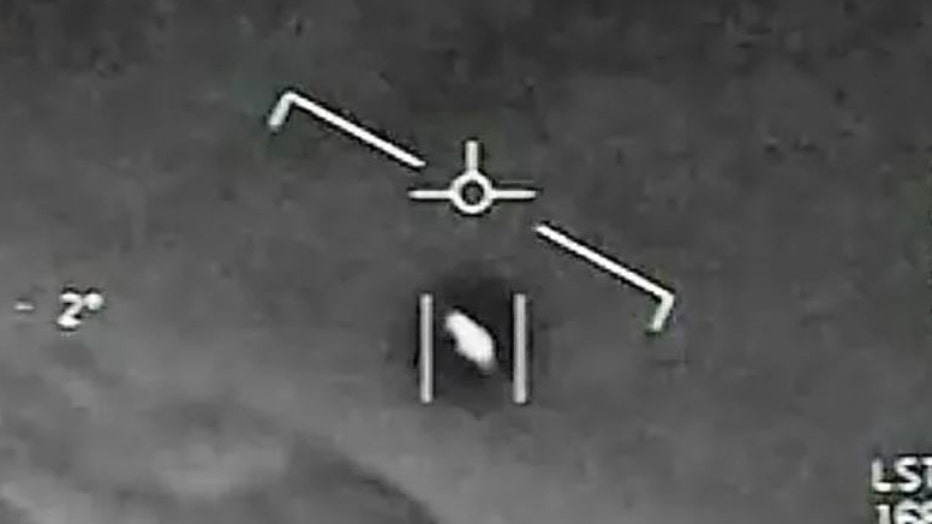
  • The 2007 “Mogul” (or “Tic‑Tac”) video, released by the Pentagon, which skeptics argue was a misidentified balloon or sensor glitch, a claim reinforced by independent radar analyses.

Each example follows a similar pattern: an eye‑catching visual claim, limited physical evidence, and eventual debunking through photometric testing, radar cross‑section analysis, or eyewitness cross‑verification.

Common Threads in Fabricated UAP Claims

The article’s “Key Takeaways” highlight three recurring motifs:

  1. Cultural Anxiety – During the Cold War, many hoaxes featured metallic, disc‑shaped craft, echoing fears of foreign technology. In the digital age, hoaxes increasingly exploit deep‑fake software, reflecting contemporary concerns about misinformation.
  2. Erosion of Physical Evidence – Photographs, video clips, and alleged debris consistently “fail under scientific scrutiny,” either because they are deliberately altered or because the materials cannot be reproduced in a lab.
  3. Motivation of Fabricators – Financial reward, personal fame, or a desire to “expose gullibility” are repeatedly cited by investigators as the primary drivers behind these deceptions.

These patterns underscore why the scientific community stresses transparent methodology and peer‑reviewed verification when evaluating any new UAP report.

Impact on Public Perception and Policy

Even as hoaxes are exposed, they leave a lasting imprint on public opinion. Polling data from the Pew Research Center (2024) shows that nearly 60 % of Americans still believe extraterrestrial life has visited Earth, a figure that has remained stable despite repeated debunkings. This persistence influences policy debates, prompting legislators to allocate funding for UAP research while simultaneously demanding stricter standards for evidence. The article notes that recent congressional hearings have cited past hoaxes as cautionary tales, urging agencies to distinguish genuine anomalies from manufactured spectacles before allocating resources.

Looking Forward

The New Space Economy piece serves as both a historical catalog and a reminder that rigorous scientific inquiry remains the antidote to sensationalism. By dissecting the narratives behind the ten most famous UAP hoaxes, the article equips readers with the context needed to evaluate future claims—whether they emerge from a backyard enthusiast’s drone footage or a classified military sensor. As the field evolves, the hope expressed by the UAP News Center is that transparency, reproducibility, and critical analysis will continue to separate genuine anomalous phenomena from the allure of well‑crafted hoaxes.

RELATED VIDEOS

{ https://usubjects.com/ }

Hoe vind je dit bericht?
Geschreven door peter om 20:49 Stuur door

'No easy explanation': Scientists are debating a 70-year-old UFO mystery as new images come to light

'No easy explanation': Scientists are debating a 70-year-old UFO mystery as new images come to light

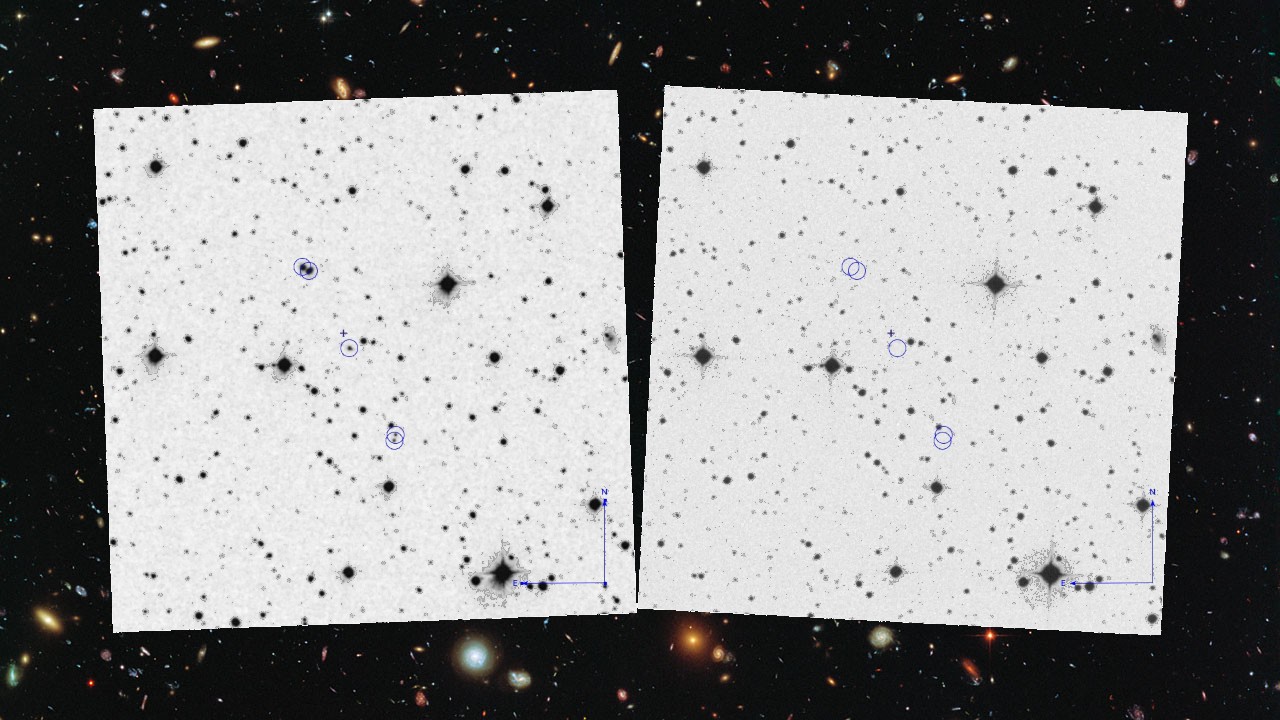
One night in 1952, five transient objects (blue circles) appeared and disappeared within an hour, archival sky surveys show. Scientists are digging into the decades-old mystery.

One night in 1952, five transient objects (blue circles) appeared and disappeared within an hour, archival sky surveys show. Scientists are digging into the decades-old mystery. 
(Image credit: Villarroel et al. / Publications of the Astronomical Society of the Pacific; Hubble Space Telescope (background))

More than 70 years ago, astronomers at the Palomar Observatory in California photographed several star-like flashes that appeared and vanished within an hour — years before the first satellite, Sputnik 1, was launched into orbit.

New peer-reviewed research revisiting those midcentury sky plates reports that these fleeting points of light, called transients, appeared on or near dates of Cold War nuclear weapons tests and coincided with a spike in historical UFO reports. Could these things all be related? Researchers are trying to find out.
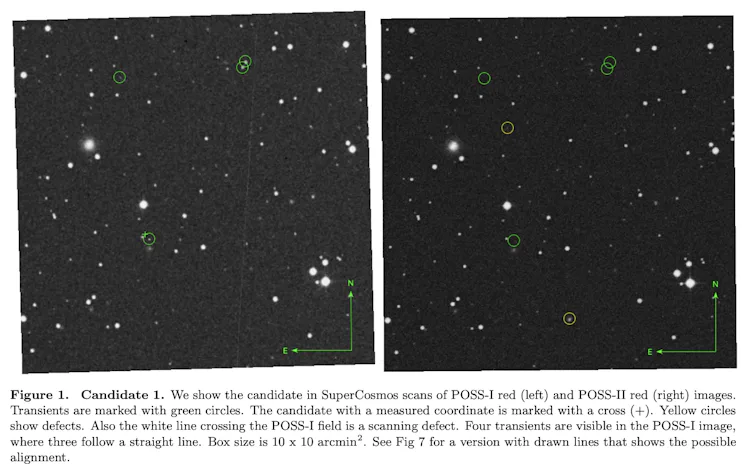
two images side by side, with green circles on the left showing space objects, and the circles on th...

One of several plates with disappearing point sources. 

Villarroel et al

While such flashes can sometimes be traced to natural phenomena such as variable stars, meteors or instrumental quirks, several of the Palomar events share distinctive features — including some sharp, point-like shapes that appear to line up in straight rows — that the authors of the new research say defy known natural or instrumental causes.
You may like
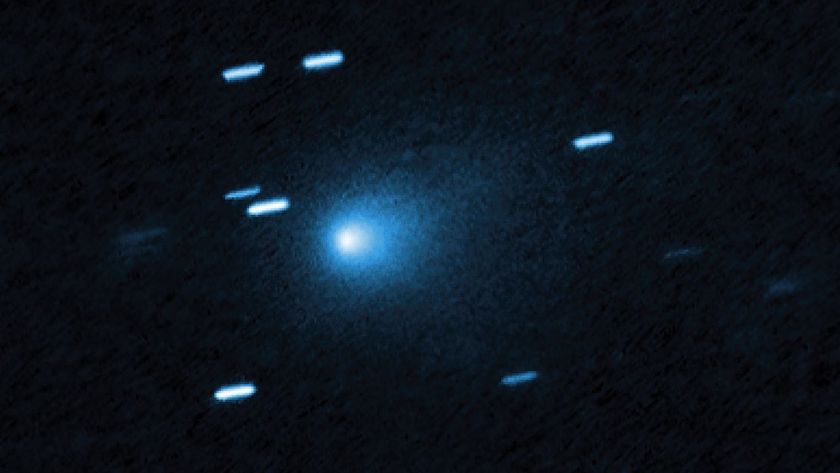
  • A blurry image of a blue comet streaking through outer space

Is it aliens? Here's why that's the least important question about 3I/ATLAS.

  • The glow of hundreds of fireflies in a forrest

Advanced alien civilizations could be communicating 'like fireflies' in plain sight, researchers suggest
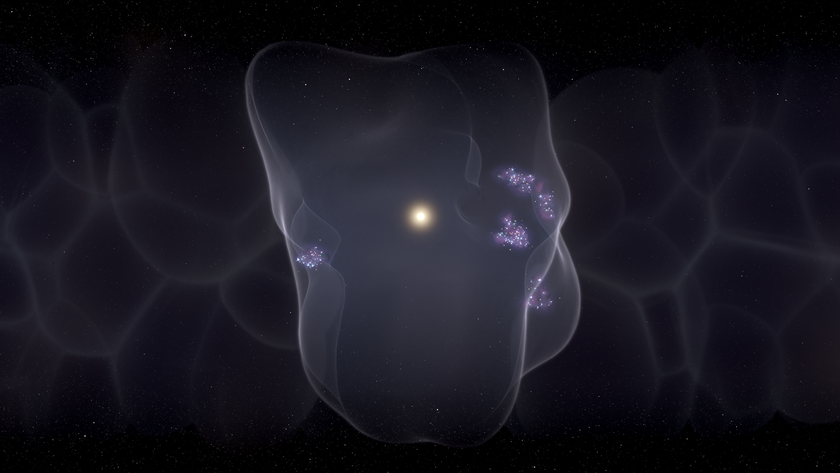
  • This artist illustration shows the Local Bubble surrounding the Sun.

Mysterious, irradiated 'scar' in our galaxy may finally have an explanation

"We've ruled out some of the prosaic explanations, and it means we have to at least consider the possibility that these might be artificial objects from somewhere," study co-author Stephen Bruehl, an anesthesiologist at the Vanderbilt University School of Medicine in Tennessee who is interested in UFOs, told Live Science. Bruehl co-authored two recent papers with Beatriz Villarroel, an astronomer at the Nordic Institute for Theoretical Physics in Sweden.

"If it turns out that transients are reflective artificial objects in orbit — prior to Sputnik — who put them there, and why do they seem to show interest in nuclear testing?" Bruehl added.
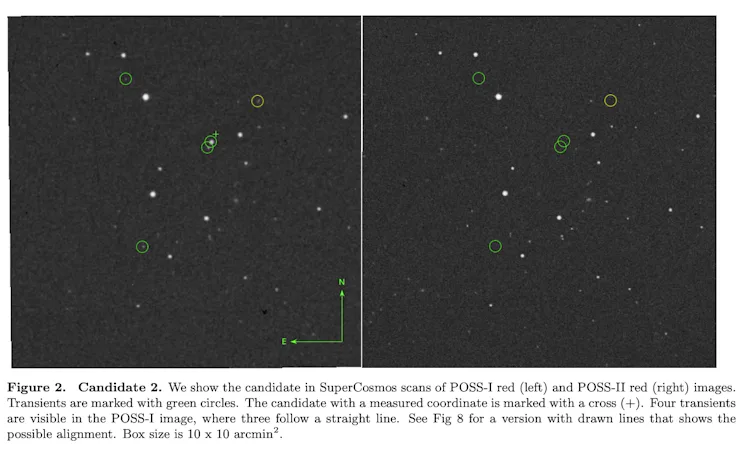
two side by side photos with green circles indicating disappearing objects.

A second plate with “missing” transients. 

Villarroel et al

Not all researchers agree with this interpretation of the images, however — with some experts noting that technological restrictions of the time make this data very hard to interpret with any certainty. Michael Garrett, director of the University of Manchester's Jodrell Bank Centre for Astrophysics in the U.K. who was not involved with the new studies, praised Villarroel's team for their creative use of archival data but cautioned against interpreting these results too literally.

"My main worry is not the quality of the research team but the quality of the data at their disposal," he said. Before Sputnik, the data are poor — especially the anecdotal UFO, or UAP (Unidentified Anomalous Phenomenon) reports, which Villarroel's team acknowledges it did not assess for validity.

"The scientific method is well suited to investigating such anomalies, but it takes time, replication and patience," Garrett told Live Science. "I suspect that with better data, these apparent correlations would go away."

Vanishing lights in the sky
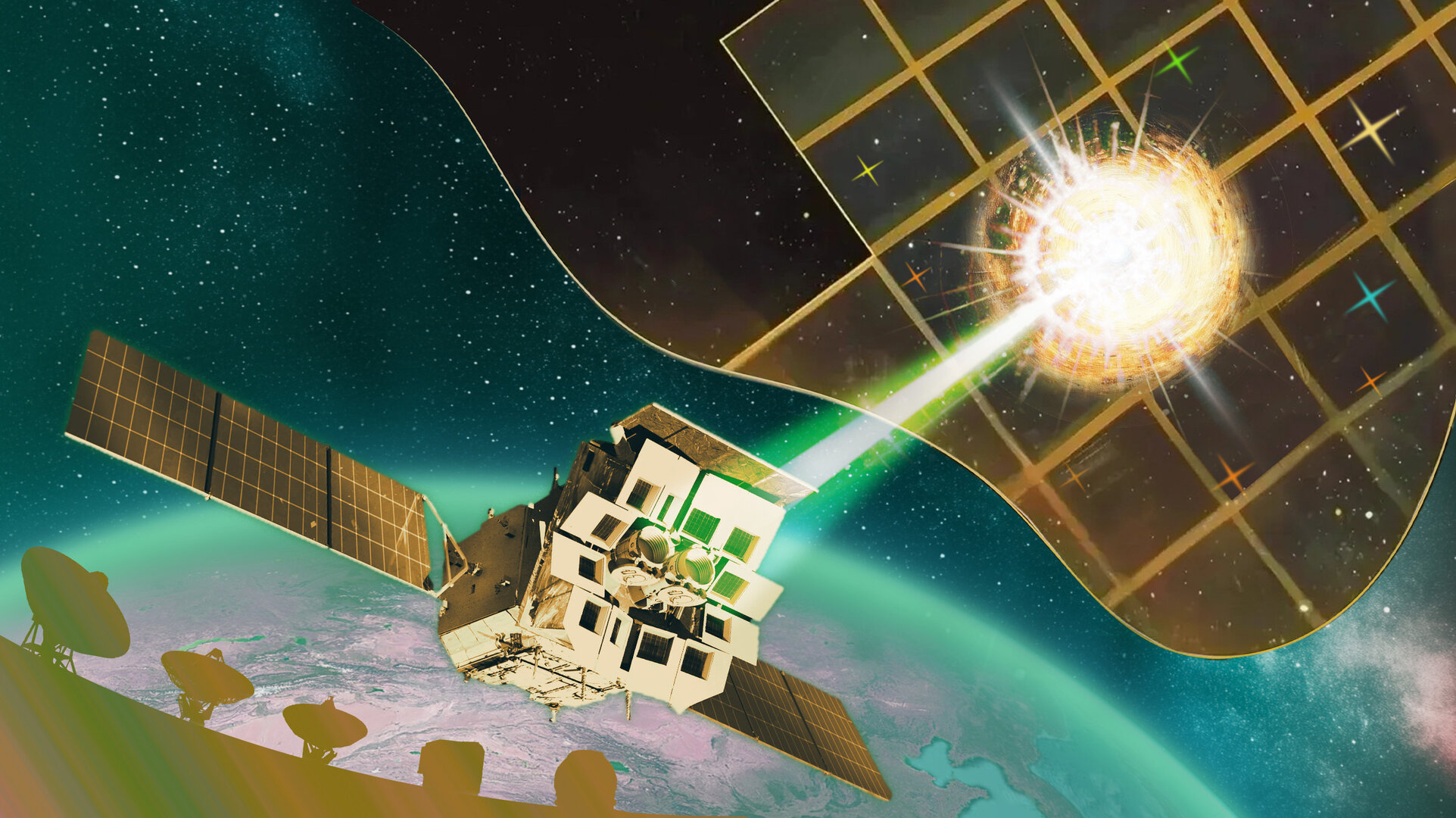
An illustration of ESA's Einstein probe detecting a transient X-ray event, likely from an exploding star.

An illustration of ESA's Einstein probe detecting a transient X-ray event, likely from an exploding star.  (Image credit: OPENVERSE/Einstein Probe Science Center)

Transient objects are a recurring phenomenon in astronomy. Modern sky surveys such as the Zwicky Transient Facility in California and the Pan-STARRS in Hawaii have already detected thousands of these fleeting events, and the upcoming Vera C. Rubin Observatory is expected to identify millions each night over the next decade.

Many of these transients have been successfully linked to known astrophysical processes, including sudden flares from comets and asteroids, explosive deaths of stars, variability in accreting black holes, and neutron-star mergers that produce kilonova afterglows.

To search for such events in the pre-space-age sky, the new research examined digitized images from the first Palomar Observatory Sky Survey (POSS-I), conducted between 1949 and 1958. That survey relied on about 2,000 photographic glass plates, each coated with a light-sensitive emulsion that reacted to incoming light, preserving an imprint of stars, galaxies and other celestial objects. These were manually loaded into the Samuel Oschin Schmidt Telescope for 50-minute exposures that captured broad stretches of the northern sky, and were later scanned and converted into a digital archive.

Villarroel's team examined 2,718 days of survey data and found transient sky events on 310 nights, with as many as 4,528 flashes appearing on a single day across multiple locations but absent from images taken immediately before or after the events, and from all later sky surveys.

When compared with the UFOCAT database of historical UFO reports, the researchers found that transients were 45% more likely to occur within 24 hours of aboveground nuclear tests conducted by the U.S., Soviet Union and Great Britain, and that each additional UAP report on a given day corresponded to an 8.5% rise in transients.

The analysis, published Oct. 20 in the journal Scientific Reports, describes these as "associations beyond chance" between transients, nuclear testing and UAP reports. A companion study the team published Oct. 17 in the journal Publications of the Astronomical Society of the Pacific suggests that some transients appeared in aligned groups and dropped by about 30 percent in sky regions within Earth's umbral shadow — a pattern the authors argue is best explained by sunlight glinting off unknown reflective objects in high, potentially geosynchronous, orbit.

Animation to show the difference between plates. 

Villarroel et al

According to the researchers, this finding echoes long-standing speculations that extraterrestrials might be drawn to human nuclear activity, though the authors emphasize that the data do not prove any causal link.

But what if it’s the opposite? A more straightforward explanation, some experts say, is that the flashes, and perhaps some of the reported UFOs, were by-products of the nuclear detonations themselves. Michael Wiescher, a nuclear astrophysicist at the University of Notre Dame in Indiana, told Scientific American that such explosions can inject metallic debris and radioactive dust into the upper atmosphere, where they might appear as brief, star-like bursts of light through a telescope.

Villarroel and Bruehl said they considered that possibility but countered that radiation-induced glows or fallout contamination would produce diffuse smudges or streaks, not the star-like points seen on Palomar's sky plates. And if the flashes were fragments of bomb casings hurled into orbit, those objects would need to reach roughly 22,000 miles (35,000 kilometers) above Earth, where modern geostationary satellites reside, to appear motionless over a 50-minute exposure.

Such a scenario seems implausible "unless a miracle occurred," Bruehl told Live Science. "There's no easy explanation for what these transients are and why they show up at nuclear tests."

The imperfect past
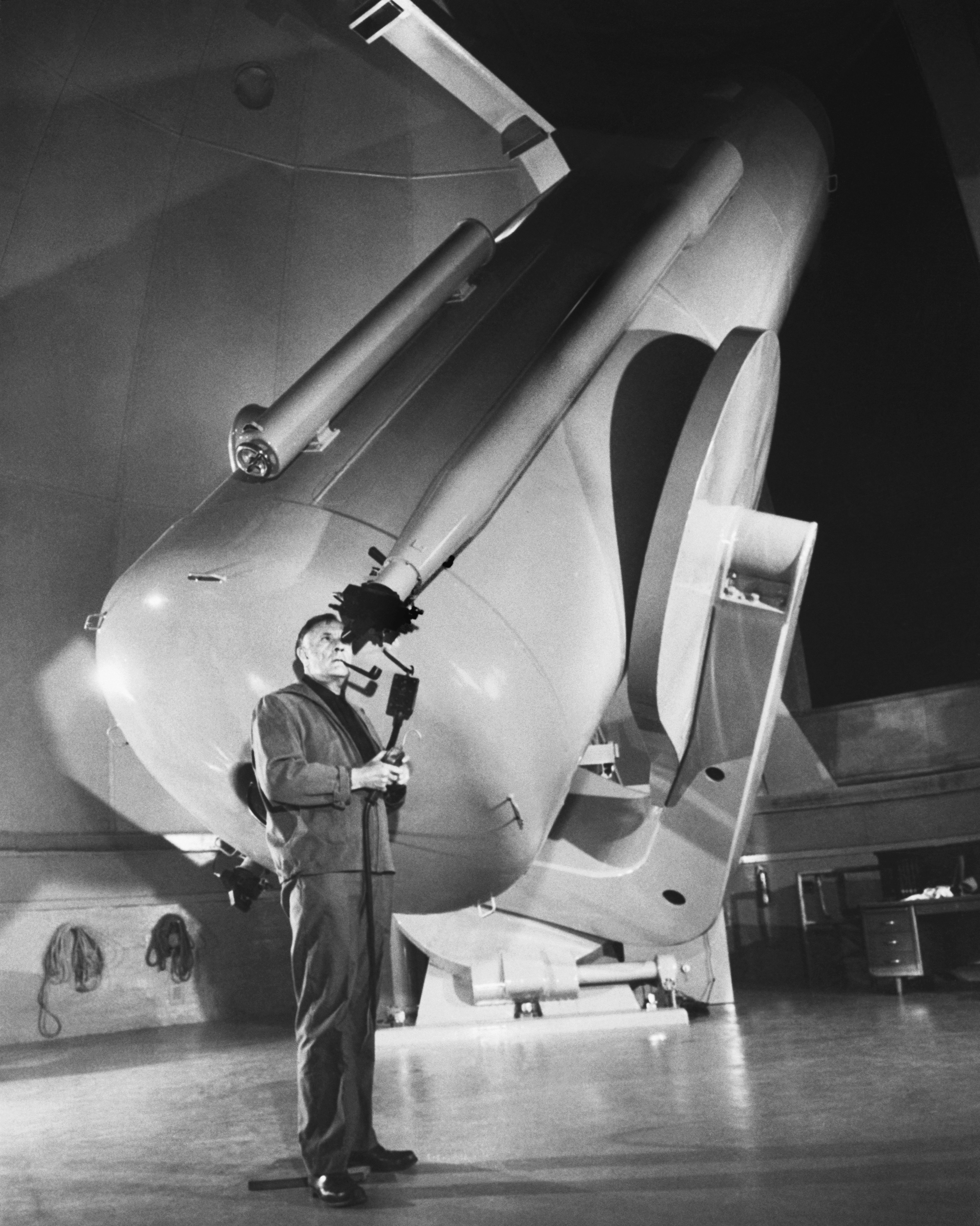
Edwin Hubble looks through a telescope at Palomar Observatory in 1949

Astronomer Edwin Hubble looks through a telescope at Palomar Observatory in 1949.  (Image credit: Getty Images)

Several other astronomers suggest that the mystery likely lies not in the skies but in imperfect photographic plates and error-prone records of the time.

Robert Lupton, an astronomer at Princeton University who develops algorithms to extract meaning from optical data and was not involved with the papers, noted that astronomy has a long history of misinterpreting apparent alignments — including early debates over quasars, when astronomers once thought their apparent pairings in the sky meant they were physically connected, only to later learn they were chance alignments.

"The thing that's hard is to know what the anomalies in the data really look like, and the number of other weird things that we could have seen," Lupton told Live Science. "I thought that using pre-Sputnik data was clever, but hard."

Apparent alignments like those seen in the Palomar Observatory data may stem from imperfections in the photographic material itself, said Nigel Hambly, a survey astronomer at the University of Edinburgh in the U.K. who examined this issue in a 2024 paper. Spurious linear features, he said, can arise from mundane causes — diffraction spikes from bright stars that look like lines, dust, hair and other debris adhered to the emulsion that mimic aligned transients. In some cases, scratches introduced during the copying or digitization of old photographic plates can also create such artifacts, he said.

These problems are especially common when researchers work with copies rather than the originals, as was the case with Villarroel's team, because flaws can persist through generations of reproductions, Hambly said.

A turning point in UFO studies?
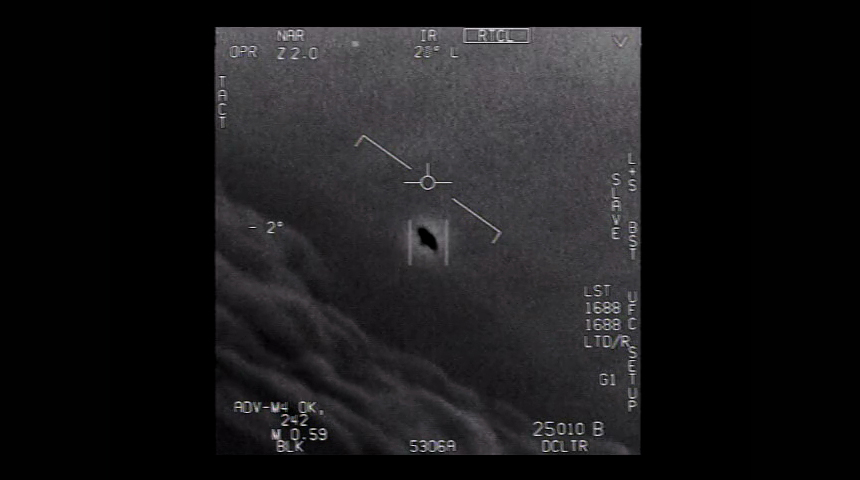
U.S. Navy videos of alleged UFO sightings were previously available but had not been officially declassified.

Mainstream interest in UFOs was recently revived after several high-profile inquiries into U.S. Navy videos that purported to show unidentified anomalous phenomena (UAP).  (Image credit: U.S. Navy)

Researchers interviewed for this story agree that independent analyses are essential, and several proposed reexamining the same historical data and other archives of scanned plates from observatories active before 1957, ideally from the Northern Hemisphere and with complete, time-series images like those from the Palomar Mountain. Revisiting the original Palomar plates themselves and conducting a microscopic "forensic" examination could help determine whether the reported transients truly appear on the originals or were introduced later, Hambly added.

Inspecting the plates by eye can often reveal the difference between a genuine detection and a spurious blemish in the emulsion "at a level of detail that is lost in the digital scans, even with very high-resolution imaging," Hambly said.

Whether these mysterious flashes prove to be evidence of UAPs, classified military technology, or simply artifacts of a bygone imaging process, the ongoing debate underscores how science probes the unknown and tests the extraordinary.

"I suspect that we may eventually look back to see the publication of these results as a turning point for mainstream acceptance of UFOs as a legitimate research topic, worthy of academic scientific investigation and earnest coverage in the media," David Windt, a research scientist at Columbia University who was not involved with the papers, told Live Science.

  • Editor's note: This article was updated on Dec. 2 to include a description of the authors' companion paper, published Oct. 17.
{ https://www.livescience.com/space/extraterrestrial-life }

Hoe vind je dit bericht?
Geschreven door peter om 21:34 Stuur door

Most People Have Never Heard of This Valley That Keeps Capturing UFOs! | Project Hessdalen

Most People Have Never Heard of This Valley That Keeps Capturing UFOs! | Project Hessdalen

Most People Have Never Heard of This Valley That Keeps Capturing UFOs! | Project Hessdalen

Overview

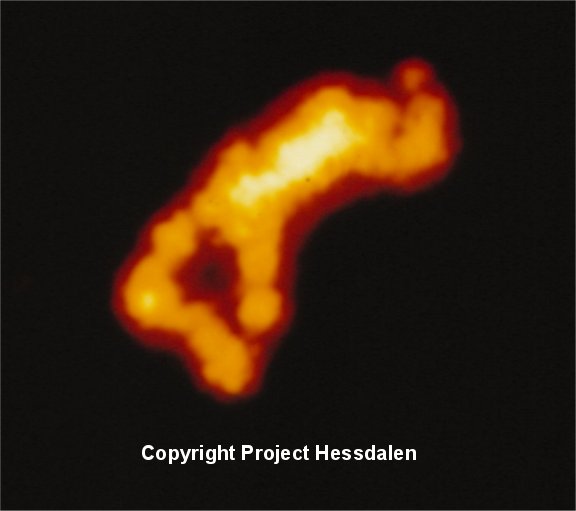
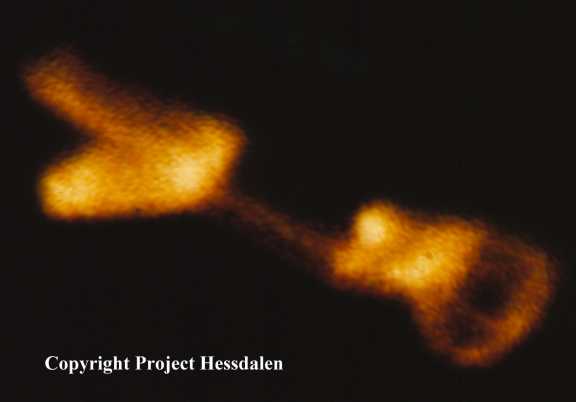
Nestled in the remote Hessdalen Valley of Norway, a persistent mystery has captivated scientists and enthusiasts for over four decades. Project Hessdalen, an internationally recognized research initiative, has dedicated itself to studying the unexplained light phenomena that continue to appear above this quiet landscape. Since the early 1980s, locals and visitors have regularly reported seeing strange orbs, luminous anomalies, and inexplicable lights dancing across the night sky.

These sightings often occur with startling consistency, sometimes as frequently as 20 to 30 times per week, highlighting the persistent and puzzling nature of the phenomena. Despite numerous investigations, camera recordings, and scientific studies, the true origin and nature of the lights remain elusive and unexplained. Researchers have considered numerous theories, ranging from natural atmospheric phenomena to experimental aircraft or even extraterrestrial activity, but no definitive explanations have been confirmed. The Hessdalen lights have attracted researchers from around the world, eager to understand their mysterious origin. The local community has been both intrigued and impacted by these ongoing sightings, with tourism increasing as visitors come hoping to witness the phenomenon firsthand. Overall, the Hessdalen lights continue to challenge our understanding of atmospheric and environmental science, inspiring ongoing scientific exploration and debate. This enduring mystery keeps Hessdalen at the forefront of paranormal and scientific research, fueling curiosity and investigation into one of the most intriguing natural phenomena in modern times.

The Origins of Project Hessdalen

The origins of Project Hessdalen can be traced back to the early 1980s, specifically to the years 1981 and 1982, when Norwegian media outlets first began reporting on the mysterious lights appearing in the Hessdalen Valley. At that time, the sightings were primarily considered a local curiosity—something intriguing yet unworthy of serious scientific inquiry. The reports consisted of vivid descriptions of glowing orbs and strange luminous phenomena that seemed to dance across the night sky, capturing the imagination of local residents and visitors alike. These reports sparked curiosity and interest among the residents and gave rise to a sense of wonder surrounding the Hessdalen lights.

Picture of a flashing light

- Photo taken by Kurt Anderssen in 1982. It is taken close to the main road in Hessdalen, towards a flashing light above the mountain Finnsåhøgda. Kurt used a camera standing on a tripod, equipped with a 2000 mm lens, which he had borrowed from Arne P.Thomassen. Kurt managed to take a picture just when the light got in the view of the camera.

As local reports grew more frequent and consistent, the phenomenon began to attract the attention of scientists and researchers, who saw an opportunity to investigate a genuinely unusual natural occurrence. Fred Palisen, who is now the CEO of Project Hessdalen, recalls a pivotal experience from 1983. He explains, “In 83, there were two cars—maybe like six people—who went up the mountain to observe. Just one hour after they had parked and set up camp, they saw something extraordinary: a powerful light moving back and forth, sometimes dipping below the horizon, emitting beams, then moving again.” The sighting was so compelling that it encouraged further investigation.

This first-hand account underscored the need for systematic study rather than dismissing the phenomenon as mere hallucination or urban legend. An observer at the time insisted, “We are scientists. We should study this.” That statement marked a turning point; it demonstrated a shift from casual observation to a scientific approach. Despite initial skepticism from some academics who questioned whether such unexplained lights could be scientifically studied, these early explorers persisted in their efforts, driven by curiosity and a desire to understand what they had witnessed.

The commitment to rigorous observation laid the foundation for the eventual establishment of an ongoing research project in Hessdalen. Over the years, scientists and engineers have deployed sophisticated equipment, including cameras, spectrometers, and radar systems, to monitor and analyze the phenomenon. The project has grown into a collaborative effort involving local residents, international researchers, and technology experts. Today, Project Hessdalen continues to document the lights, striving to find scientific explanations for their origins—whether natural, electrical, or something currently beyond our understanding.

In summary, the origin of Project Hessdalen is rooted in early media reports, local curiosity, and a committed group of investigators who recognized the importance of studying these mysterious geological phenomena. Their efforts have transformed what was once considered a local curiosity into a serious scientific investigation that continues to intrigue researchers worldwide.

Scientific Methods and Technology

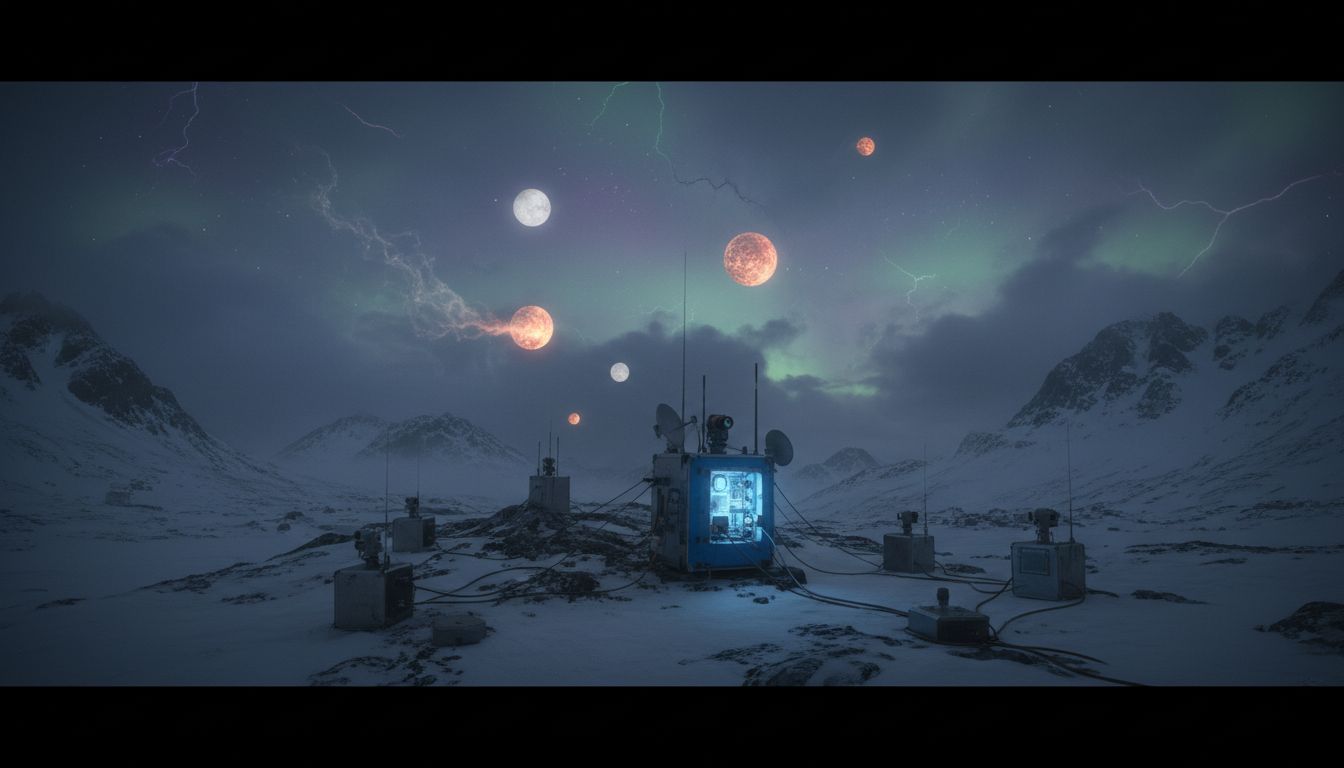
Central to Project Hessdalen’s mission is its unwavering dedication to collecting measurable and verifiable data. Since its inception in 1998, the project has pioneered innovative technological solutions to monitor and study the mysterious phenomena observed in the Hessdalen Valley in Norway. One of its most significant advancements is the development and deployment of the "Blue Box," a state-of-the-art autonomous multi-sensor anomaly detection system. This device is regarded as the world's first of its kind, capable of continuously surveilling the sky above Hessdalen without human intervention.

The Blue Box integrates various sensors—such as electromagnetic detectors, spectrometers, and infrared cameras—to capture a comprehensive dataset across multiple spectrums. This continuous monitoring enables researchers to track unusual light sightings, analyze their characteristics, and distinguish between natural and artificial phenomena. The data collected are stored in real-time and can be analyzed later to identify patterns or recurring behaviors, providing vital insights into the bizarre lights that have baffled scientists for decades.

As Palisen, a key researcher involved with the project, explains, the overarching goal is to promote "open science" — where all collected data can be shared openly with scientists worldwide and made accessible to the public. This transparency encourages collaboration and transparency, fostering a global scientific community that can verify findings and explore hypotheses without proprietary restrictions.

The project's approach combines cutting-edge technology with collaborative, hands-on research efforts. In addition to the Blue Box, the team utilizes high-definition video cameras strategically positioned around the valley to capture the phenomena from multiple angles. These video recordings, synchronized with sensor data, allow for detailed analysis of the phenomena in real time and after the events occur.

Moreover, the project actively engages students and international research teams through organized fieldwork, such as science camps and collaborative expeditions. These initiatives not only help gather diverse insights but also promote educational outreach and inspire the next generation of scientists. Overall, the combination of innovative sensors, video monitoring, and a collaborative scientific ethos forms the backbone of Project Hessdalen’s efforts to uncover the truth behind these enigmatic lights.

Theories and Global Interest

The persistent and enigmatic light phenomena observed in Hessdalen have captivated researchers, scientists, and enthusiasts worldwide for decades. These luminous displays, which often appear as bright, rapidly moving or stationary lights in the night sky, have inspired a diverse array of hypotheses attempting to explain their origin. At the more scientifically grounded end, some experts propose that these lights are caused by natural plasma formations resulting from unique atmospheric conditions. Others suggest they may be due to unusual electromagnetic phenomena, possibly related to ionization events in the Earth's ionosphere or interactions between meteorological processes and mineral-rich terrains in the valley.

Additionally, some researchers have explored the possibility that these lights originate from natural atmospheric discharges, similar to ball lightning or other rare electrical phenomena. These ideas are supported by observations of the lights changing speed, shape, and color, sometimes correlating with local weather patterns or atmospheric changes. Conversely, more speculative theories propose extraterrestrial origins, suggesting that the lights could be manifestations of UFO activity or alien visitors observing Earth. These claims, though popular in sensational media, remain fringe within the scientific community, which emphasizes thorough investigation and empirical evidence.

Hessdalen, picture no.2 from the 25.September 1982

Photo taken by Arne P. Thomassen the 25. September 1982 between 19.00 and 20.00. It is taken from the mountain Finnsåhøgda south, towards east. This photo shows the same phenomena as in this picture, but it was taken some minutes after.

Despite the variety of hypotheses, the researchers involved in the Hessdalen project emphasize a cautious, scientific approach. They are committed to understanding the phenomena through material evidence rather than sensationalism. The core of their work involves extensive observation, data collection, and analysis of the lights using a combination of high-resolution cameras, spectrometers, and sensor arrays. To foster international cooperation and enhance their understanding, the team regularly hosts workshops and conferences that attract experts from around the world. These gatherings provide a platform for sharing footage, sensor readings, and hypotheses, encouraging interdisciplinary collaboration among physicists, meteorologists, astrophysicists, and engineers.

Over the years, peer-reviewed studies have been published based on data collected in Hessdalen, establishing a scientific framework to describe the events, even though the phenomenon itself remains elusive and not fully understood. This ongoing research aims to uncover the underlying causes of the lights, bridging the gap between curiosity and scientific rigor, and maintaining Hessdalen’s reputation as a unique natural laboratory for studying unexplained atmospheric phenomena on a global scale.

Community and Continued Mystery

For Fred Palisen and many involved in Project Hessdalen, the initiative is as much about community engagement as it is about scientific research. He describes his own entry into the project as almost incidental—a joke during a workplace presentation about conspiracy theories led to an unexpected leadership role. Yet, despite the humorous beginnings, the dedication of those involved remains unwavering. The lights of Hessdalen, with their mesmerizing and sometimes haunting displays, continue to inspire both skepticism and wonder. Palisen recalls observing the lights firsthand: "This is a light that was so strong. So it was obviously not a star... It was moving sideways and up and down and sometimes stopping, and then you would have a beam coming down." Such accounts fuel ongoing curiosity about what exactly causes these mesmerizing displays.

Despite decades of observation and technological advancements, the true nature of the Hessdalen lights remains unresolved. Some scientists postulate natural explanations, while others keep an open mind toward extraterrestrial hypotheses. The ongoing efforts of Project Hessdalen exemplify the enduring value of open-minded scientific investigation—demonstrating how persistent curiosity and rigorous methodology can keep a mystery alive. Ultimately, Hessdalen stands as a testament to humanity’s fascination with the unknown and the importance of exploring phenomena that challenge conventional understanding.

In essence, Hessdalen’s unexplained lights serve as a reminder that, sometimes, nature still holds secrets waiting to be unlocked—and that scientific curiosity remains a vital tool in uncovering the truth behind inexplicable mysteries.

{ PETER2011 }

Hoe vind je dit bericht?
Geschreven door peter om 22:32 Stuur door

UAP-Gevecht in de Rode Zee: Een Kritische Analyse van de recente betrokkenheid bij onverklaarde luchtverschijnselen

Video shown at House UAP hearing appears to show missile fired at object near Yemen

Inleiding

In de afgelopen jaren is de discussie over onverklaarde luchtverschijnselen (UAP's, Unidentified Aerial Phenomena) sterker dan ooit in de schijnwerpers gekomen. Wat begon als een onderwerp voor een select gezelschap binnen de wetenschappelijke en militaire kringen, is uitgegroeid tot een wereldwijd fenomeen dat politiek, veiligheid en wetenschap diepgaande vragen stelt. Recentelijk heeft een incident in de Rode Zee, nabij Jemen, de aandacht getrokken en voor nieuwe debatten gezorgd. Tijdens een besloten sessie van de Tweede Kamercommissie voor Natuurlijke Hulpbronnen en Herziening (een vertaling van de Engelse term ‘Reform’), werd een korte maar veelzeggende video getoond die de gebeurtenis documenteert. Deze beelden tonen een incident waarvan de aard en de interpretatie nog immer onderwerp van discussie zijn. Het incident heeft niet alleen de nieuwsgierigheid gewekt van politici en defensie-autoriteiten, maar ook de kritische wetenschappelijke wereld, die zich afvraagt wat de implicaties zijn voor onze kennis over onverklaarde luchtverschijnselen en de mogelijke exotische technologieën die achter deze gebeurtenissen schuil kunnen gaan.

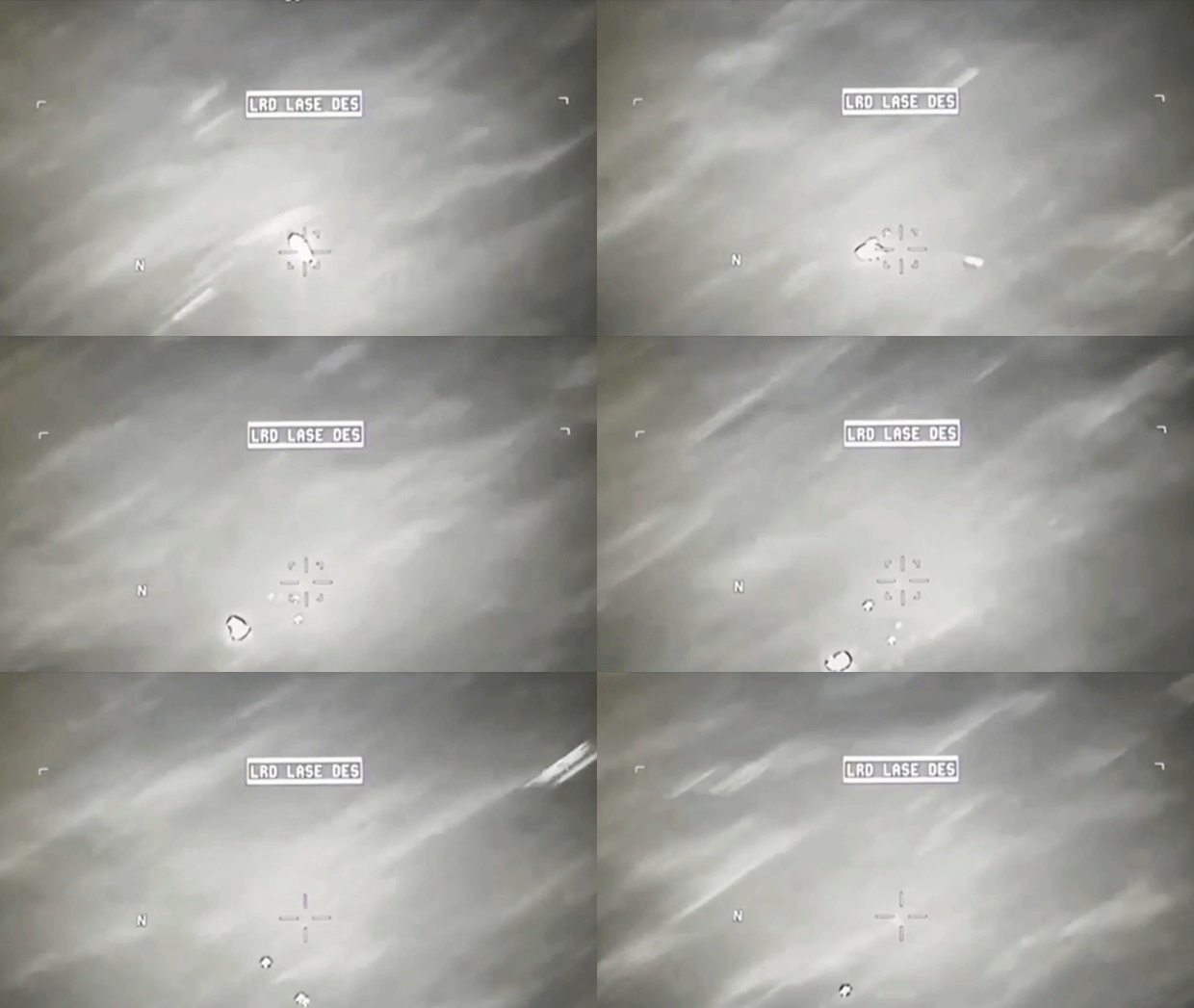
De video toont hoe een raket op een bolvormig object wordt afgevuurd, dat zich beweegt in een wartaalachtige beweging boven de wateren van de Rode Zee, vlakbij het conflictgebied rond Jemen. Het contrast tussen de ogenschijnlijk onschuldige beelden en de potentiële veiligheidsrisico’s die eruit voortvloeien, roept vragen op over de aard en herkomst van deze fenomene. Daarbij wordt vooral de rol van de Amerikaanse militaire en inlichtingendiensten onder de loep genomen, die in toenemende mate bereid lijken te zijn om dergelijke onverklaarde incidenten niet langer te negeren of te minimaliseren. Dit artikel biedt een uitgebreide analyse van het incident, de bewijskracht van de beelden, de reactie vanuit de politiek, de geopolitieke en militair-strategische context en de bredere implicaties voor ons begrip van UAP's.

De bewijskracht van het filmpje

De kern van elke discussie over onverklaarde luchtverschijnselen wordt gevormd door het beschikbare bewijs. In dit geval betreft het een video van slechts twaalf seconden, waarvan de authenticiteit en interpretatie onder grote omstandigheden staan. De beelden, afkomstig van een door de Amerikaanse marine gebruikgemaakt platform in de Golf van Aden, laten zien hoe een helder, bolvormig object op hoge hoogte beweegt, met onregelmatige en wartaalachtige bewegingen die voor velen moeilijk te verklaren zijn. Achterin de vertelling zien we dat kort na de waarneming een explosie plaatsvindt, veroorzaakt door een vuurzee van een nabijgelegen vaartuig dat een raket lanceert. Dit wijst op een mogelijke defensieve reactie door de marine, bijvoorbeeld een surface-to-air raket, die wordt gelanceerd om het object te neutraliseren.

Wat de beelden nog intrigerender maakt, is dat het object ondanks de explosie in beweging blijft en zich uiteindelijk lijkt terug te trekken met een dunne condensatiespoor. Analisten die door het comité werden geraadpleegd, hebben bevestigd dat de vluchtweg van de raket en de bewegingen van het object overeenkomen met militaire antiair-raketreacties. Echter, er kan niet met zekerheid worden vastgesteld of het doelwit een vijandelijk apparaat was, bijvoorbeeld een drone of ander onconventioneel luchtvaartuig, of dat het object wellicht een niet-geïdentificeerd fenomeen was dat buiten ons huidig begrip valt. De Amerikaanse marine heeft in haar officiële verklaring benadrukt dat de beelden “onbevlekte beelden van een luchtverschijnsel tijdens routine-operaties” tonen, maar heeft verdere details over de gebruikte wapensystemen of de context achter de incidenten niet vrijgegeven.

Het ontbreken van gedetailleerde informatie benadrukt de complexiteit van het verifiëren en interpreteren van dergelijke incidenten. Het feit dat de beelden worden vrijgegeven in een besloten setting, terwijl er tegelijkertijd politieke druk bestaat om meer transparantie te bieden, onderstreept de uitdaging waarmee de autoriteiten worden geconfronteerd. De bewijskracht van zulke korte clips is beperkt, omdat ze niet altijd de volledige context bieden, zoals radargegevens, satellietbeelden of getuigenverslagen. Desalniettemin kunnen dergelijke beelden waardevolle aanwijzingen leveren en een startpunt vormen voor een breder onderzoek.

Hellfire missile versus UAP

Leden van een subcommissie van het Huis bekeken op 9 september 2025 een video van een Hellfire-raket die afketste op een UAP.

(Fox News)

Reactie vanuit het Amerikaanse politiekerskorps

De reactie vanuit de Amerikaanse politiek, vertegenwoordigd door parlementariërs en beleidsmakers, onderstreept de ernst die wordt gehecht aan incidenten als deze. Rep. Bill Burlison benadrukte dat het afvuren van een raket op een onbekend object ernstige vragen oproept over de veiligheid van de Amerikaanse strijdkrachten en de bestaande regels over het gebruik van geweld in de virtuele en letterlijke luchtruimtes. “Wanneer een raket wordt afgevuurd op een onbekend object, moeten we ons afvragen of we voldoende informatie hebben om zulke beslissingen te nemen,” stelde Burlison. andere invloedrijke politici, zoals Republikein Mike Gallagher en Democraat Katherine Clark, riepen op tot meer openheid en transparantie.

Zij drongen aan op het vrijgeven van sensor- en radargegevens, die de incidenten meer context kunnen geven en mogelijk de aard van de waargenomen objecten kunnen verduidelijken. Deze oproepen voor openheid volgen op het rapport van het Pentagon uit 2022, waarin werd aangekondigd dat de Amerikaanse overheid actief onderzoek doet naar UAP's en dat de geheime houding rondom dergelijke fenomenen niet langer houdbaar is. Het rapport benadrukte dat er nog steeds veel datapunten onverklaard blijven, en dat het belang van transparantie en internationale samenwerking groot is om de mysteries te ontrafelen.

De politieke discussies lopen vooruit op de verdere onderzoeksinitiatieven die het congres wil initiëren. De mogelijkheid dat onverklaarde luchtverschijnselen mogelijk een externe inlichtingendienst, technologische verrassing of zelfs onbekende buitenlandse macht kunnen zijn, maakt dat de discussie niet slechts een technische aangelegenheid is, maar ook een strategisch en geopolitiek vraagstuk. De politieke en militaire leiders erkennen dat het begrijpen van deze fenomenen essentieel is voor het waarborgen van de nationale veiligheid en het voorkomen van mogelijke crises.

UAP witnesses

De Amerikaanse luchtmachtveteraan Jeffrey Nuccetelli, de senior chief petty officer van de Amerikaanse marine Alexandro Wiggins, journalist George Knapp, de Amerikaanse luchtmachtveteraan Dylan Borland en senior beleidsadviseur van het Project On Government Oversight Joe Spielberger worden beëdigd om te getuigen tijdens een hoorzitting van de Amerikaanse Huiscommissie voor Toezicht en Hervorming over "Het herstellen van het publieke vertrouwen door UAP-transparantie en klokkenluidersbescherming" op Capitol Hill in Washington, D.C., op 9 september 2025.

(Elizabeth Frantz/Reuters)

Militair en regio‑context

De locatie van het incident, in de strategisch belangrijke wateren van de Rode Zee, speelt een cruciale rol in de interpretatie ervan. Deze regio, die zich uitstrekt tussen Afrika, het Midden-Oosten en Azië, verbindt de Middellandse Zee via het Suezkanaal met de Indische Oceaan. Als zodanig is het een cruciaal knooppunt voor wereldwijde maritieme handel, energievoorziening en militaire operaties. De wateren rond Jemen, waar het incident plaatsvond, worden al jaren gekenmerkt door voortdurende conflicten tussen Houthi-rebellen en internationale coalities, waaronder de Verenigde Staten en Arabia. Het kustgebied dient als een voedingsbodem voor strijdende partijen die onconventionele tactieken en moderne technologieën inzetten.

De Amerikaanse marine en het Centraal Commando (CENTCOM) patrouilleren deze wateren frequente, omdat ze zich zorgen maken over raketaanvallen, drone-aanvallen en de aanwezigheid van meerdere buitenlandse actoren. Sinds de escalatie van de Jemenitische oorlog worden meldingen gedaan van opvallende luchtverschijnselen die moeilijk te plaatsen zijn binnen de bestaande militaire of commerciële technologieën. Sommige analisten suggereren dat het hier mogelijk gaat om niet-geïdentificeerde drones, geheimzinnige satellietoperaties of sophisticated sensorsystemen die buiten de reguliere militaire programma's lijken te vallen. De aanwezigheid van een raketlancering, zoals in de videobeelden wordt getoond, verhoogt de spanning, omdat het de mogelijkheid opent dat er sprake is van een vorm van onconventionele dreiging – mogelijk van een buitenlandse mogendheid die probeert te opereren in de chaos van een conflictgebied.

Het feit dat militaire operatoren het object als potentieel bedreigend zagen en daarop reageerden met een raketlancering, wijst op een gevaarlijke situatie waarbij de grenzen tussen routineoperaties en potentieel destabiliserende incidenten vervagen. Er bestaat de onderliggende vraag of er meer onverklaarde fenomenen in de regio voorkomen, en of deze incidenten een teken zijn van technologische innovaties of externe invloeden die de veiligheid van de regio en internationale scheepvaart in gevaar brengen. Zonder voldoende data blijven veel van deze incidenten een mysterie, dat cruciaal is voor de strategische planning en risicobeheer.

Journalist George Knapp

KLAS-TV-journalist George Knapp uit Las Vegas neemt plaats voor de hoorzitting van de Subcommissie voor de Openbaarmaking van Federale Geheimen van de Taskforce van de House Oversight and Government Reform Committee over "Het Herstellen van Publiek Vertrouwen door UAP (Ongeïdentificeerde Anomale Fenomenen) Transparantie en Klokkenluidersbescherming" in het Capitol Visitor Center op dinsdag 9 september 2025.

(Bill Clark/CQ-Roll Call, Inc via Getty Images)

Toekomstperspectieven en beleidsreacties

De voortdurende discussie over UAP's en de incidenten in de Rode Zee leiden tot beleidsinitiatieven en verdere onderzoeksverplichtingen. Het Amerikaanse Huis van Afgevaardigden heeft een subcomité opgericht dat later dit jaar aanvullende datapunten, radargegevens en signalenuitwisseling zal bekijken. Het Ministerie van Defensie benadrukt dat men zich inzet voor het verbeteren van de dataverzameling, analyse en transparantie rond UAP-incidenten. In reactie op de publieke en politieke druk onderstrepen ze dat nationale veiligheid en operationele paraatheid de hoogste prioriteit blijven, terwijl men tegelijkertijd erkent dat er een grote behoefte bestaat aan een objectievere en multidisciplinaire aanpak.

Het groeiende belang van objectieve wetenschap komt steeds meer onder de aandacht. Verschillende groepen, zoals het UAP Transparency Project, pleiten voor onafhankelijk onderzoek door experts uit verschillende disciplines: luchtvaarttechniek, atmosferische wetenschappen, radar- en sensortechnologie, evenals inlichtingenanalyses. Het doel is om een samenhangend en wetenschappelijk onderbouwd beeld te krijgen van deze fenomenen, zonder voorafgaande aannames of classificaties die het onderzoek kunnen beïnvloeden.

Bovendien groeit de roep om internationale samenwerking, omdat UAP's geen beperken zich tot nationale territoria. De waarnemingen in conflictgebieden zoals de Rode Zee, en vergelijkbare incidenten elders, suggereren dat deze fenomenen wereldwijd voorkomen en een risico vormen voor zowel civiele als militaire operaties. Tegelijkertijd wordt ook nagedacht over de ontwikkeling van nieuwe technologieën en standaarden voor het detecteren en analyseren van dergelijke verschijnselen, waarbij experts uit diverse vakgebieden betrokken worden.

Implicaties voor de nationale en internationale veiligheid

Het blootleggen van dit soort incidenten onderstreept de noodzaak dat overheden en militaire organisaties een meer open en analytische houding aannemen. Het niet weten door gebrekkige data of ongewenste geheimhouding kan strategisch nadelig zijn en het risico vergroten dat onbekende invloeden onopgemerkt blijven. Dit geldt vooral in een regio waar geopolitieke spanningen hoog zijn en meerdere landen mogelijk opereren met onbekende of niet geverifieerde technologieën.

Voor de internationale gemeenschap ligt hier een grote uitdaging. Hoe kunnen landen samenwerken aan het verzamelen en delen van betrouwbare gegevens over UAP's? Welke veiligheidsprotocollen moeten worden ontwikkeld om incidenten te analyseren zonder paniek te zaaien of ongefundeerde conclusies te trekken? Een transparante en wetenschappelijke aanpak is essentieel om vertrouwen te scheppen en gezamenlijke strategieën te ontwikkelen.

Ten slotte is de invloed van dergelijke incidenten niet beperkt tot de militaire sfeer. Ze raken ook de bredere maatschappelijke perceptie, wetenschap en zelfs het publieke debat over de aard van het universum en de mogelijkheid van buitenaardse intelligentie. In die context wordt steeds duidelijker dat de zoektocht naar antwoorden niet slechts een technologische of militaire aangelegenheid is, maar ook een fundamentele menselijke zoektocht naar kennis en begrip.

Conclusie

De recente incidenten in de Rode Zee, waarbij mogelijk een raket werd gelanceerd op een ongedefinieerd en onbegrepen object, illustreren de complexiteit en het belang van een uitgebreide, open en wetenschappelijk onderbouwde aanpak van onbegrepen luchtverschijnselen. Een dergelijke gebeurtenis onderstreept niet alleen de noodzaak voor meer transparantie vanuit overheidsorganisaties, maar ook voor een multidisciplinaire samenwerking tussen wetenschappers, defensie en internationale partners. Hoe deze gebeurtenissen zich verder ontwikkelen en of ze kunnen bijdragen aan een dieper inzicht in de aard van UAP's, zal bepalend zijn voor toekomstige veiligheids- en strategische beleidslijnen.

Binnen een wereld waarin geopolitieke spanningen blijven toenemen en technologische innovaties voortdurend nieuwe dreigingen en mogelijkheden creëren, vormen onverklaarde luchtverschijnselen een fundamenteel strategisch vraagstuk. Het is daarom van groot belang dat de wereldgemeenschap, en vooral de landen met de meest geavanceerde technologische capaciteiten, gezamenlijk werken aan een transparante en evidence-based aanpak. Alleen zo kunnen we hopen om de mysteries van de lucht te ontrafelen, risico’s te minimaliseren en mogelijk zelfs nieuwe technologische vaardigheden te ontdekken die de mensheid verder kunnen brengen in haar voortdurende zoektocht naar kennis.

{ PETER2011 }

Hoe vind je dit bericht?
Geschreven door peter om 16:18 Stuur door

Two Ancient Books Talk About Aliens, UFOs & Robots, Written In 2nd & 17th Century

Ancient Book On Aliens UFOs

Two Ancient Books Talk About Aliens, UFOs & Robots, Written In 2nd & 17th Century

There are various controversial ancient texts that hint at the interaction between humans and the beings that arrived on Earth from another place. Although there is no definite evidence to support this theory, many credible personalities have given credence to it. In the midst of this, there are two ancient  books that discuss aliens, UFOs, and life on other planets. This evidence clearly states that humans believed in the existence of aliens for thousands of years.

Ancient Novel About Aliens, UFOs, and Robots Written in the 2nd Century

Lucian of Samosata, a Syrian satirist and rhetorician, is credited with introducing the world to science fiction almost 2,000 years before Jules Verne and H.G. Wells. As one of the earliest novelists in Western Civilization, he envisioned a future where humankind would encounter alien life, engage in interplanetary warfare, and create artificial life.

Lucian covered topics such as extraterrestrials, spaceships, and robots in the Greek language long before the works of Verne and Wells. Many scholars consider him to be the father of science fiction, as his stories laid the groundwork for the genre as we know it today, even though they were written two millennia ago.

In his novel “A True Story,” Lucian narrates the adventures of Lucian and his crew, all of who were cosmonauts, flying ships, television projections, talking machines, artificial intelligence, encounters with aliens, space battles, UFOs, humanoids, as well as cities erected inside a living organism.

Lucian’s work, written centuries ago, foreshadowed many contemporary science fiction motifs. Lucian and his fellow travelers embark on their journey beyond the Pillars of Heracles, but their plans are disrupted by a fierce storm that blows them off course. Eventually, they arrive at an island with a remarkable river of wine that is teeming with fish and bears. Despite the island’s wonders, they do not stay long and continue on their way, only to be swept up by a powerful whirlwind that carries them all the way to the moon.

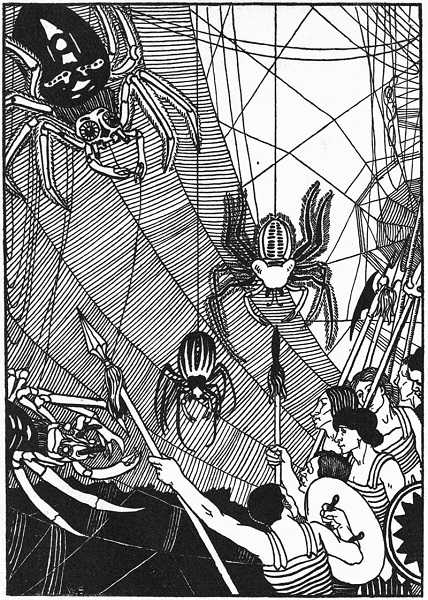
Ancient Book On Aliens UFOs Illustration by William Strang from the 1894 edition of Lucian’s True History; colossal lunar spiders spin a web in the air between the Moon and the Morning Star. Image Credit: Wikimedia Commons

They arrive in the midst of a conflict between the rulers of the moon and sun, battling for control over the “Morning Star.” The armies are comprised of hybrid creatures, part mechanical and part biological, with strange forms. The Sun army prevails, leading to a treaty of peace. Lucian provides insight into the disparities between life on Earth and the other planets.

Upon their return to Earth, Lucian and his travelers are engulfed by a colossal whale spanning 200 miles. Inside, they discover a diverse population of fish people.

After engaging in a war with enigmatic creatures, they eventually triumph over the whale after starting a bonfire within its body. Finally, they succeed in unlocking its jaws and making a daring escape. As they continue on their voyage, they chance upon a colossal oceanic abyss but manage to navigate its edge, leading to the discovery of a distant continent that they decide to explore.

Lucian abruptly concludes his writing by indicating that their forthcoming adventures will be chronicled in the following sequels, all of which remained unpublished. In addition, Lucian’s work encompasses tales of incredible shipwrecks and voyages to extraordinary lands, such as an island of dreams, and wondrously traversing through interstellar forests and landscapes.

Read also:

Being the first writer to distinguish between reality and fiction, Lucian made a significant contribution to literature, albeit not a widely recognized one in his time. Moreover, “A True Story” is an early example of the idea of traveling across the Atlantic Ocean and the exploration of unknown lands, predating Columbus’s journey by approximately 1,400 years.

Rare 17th-century book on alien life discovered

Due to the hard work of books valuer Jim Spencer, there is a discovered  book about what life might be like on other planets, entitled “The Celestial World Discover’d: Or, Conjectures Concerning the Inhabitants, Plants and Productions of the Worlds in the Planets ” by Christiaan Huygens. Spencer found the book at a free antique valuation event in Gloucestershire, UK. Published in 1698, the book offers a unique view of how people of the time perceived the possibility of extraterrestrial life.

Ancient Book On Aliens UFOs The 324-year-old book concludes that extra-terrestrial beings must exist

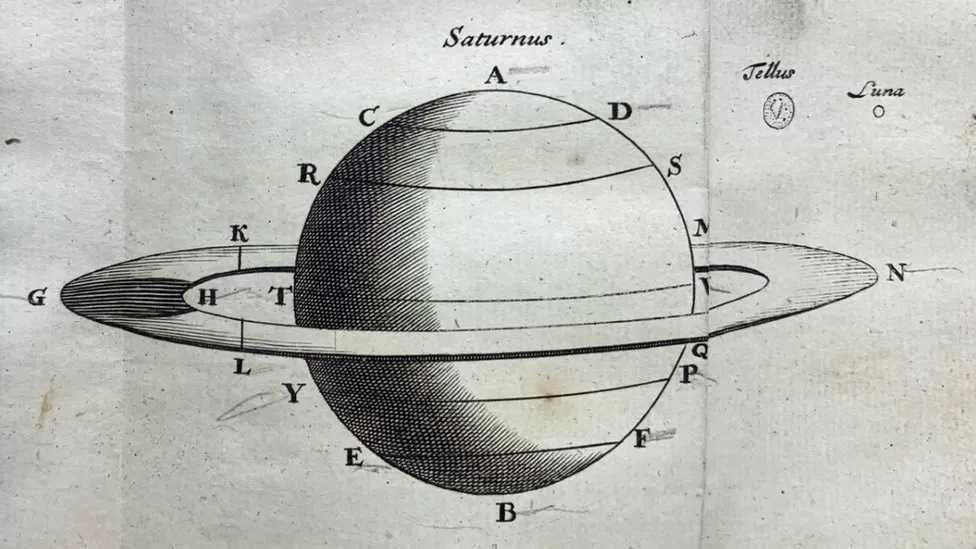
Christiaan Huygens, a prominent Dutch scientist who excelled in the fields of astronomy, mathematics, physics, and invention, is renowned as one of the greatest scientists of all time. In addition to his pioneering work on the pendulum clock, the wave theory of light, and the discovery of the true shape of Saturn’s rings, it has been revealed that Huygens believed in the existence of extraterrestrial life, as evidenced by a rare book recently unearthed.

The book, which includes five folding plates, presents Huygens’ argument that it is unlikely that God would have created other planets solely to be observed from Earth, suggesting that there must be a greater purpose. Spencer commented on the discovery in a statement:

“It’s fascinating to think who turned these pages in 1698, what they must’ve felt when reading these descriptions of life on Jupiter or Saturn before gazing up at the night sky. The book tries to describe what extraterrestrial beings might look like, how they spend their time, even what their music sounds like. It seems almost comical, but it’s informed by scientific reasoning, and who knows how our own thoughts on these matters will appear to people looking back in 324 years.” (Source)

Such weird and wonderful musings include Huygens concluding aliens must have hands and feet, writing in the book:

“Aliens must have hands and feet like humans because of their “convenience,” writing: “What could we invent or imagine that could be so exactly accommodated to all the design’d uses as the Hands are? Shall we give them an Elephant’s Proboscis.”

And that “‘celestial beings’ must have feet ‘[unless] they have found out the art of flying in some of those Worlds.’” Not to mention that Huygens believed: “aliens enjoyed astronomy and observation, sailed boats and listened to music” but also suffered misfortunes, wars, afflictions and poverty “because that’s what leads us to invention and progress. Aliens! Who sail boats and listen to tunes! They’re just like us.”

Rare Book From 1698 Reveals Belief In Extraterrestrial Life On Saturn And Jupiter Saturnus, where alien life was living happily enough. Image credit: Hansons Bookshelves

Huygens shared the belief that aliens, just like humans, must experience difficulties in order to drive innovation and advancement. “If Men were to lead their whole Lives in an undisturb’d continual Peace, in no fear of Poverty, no danger of War, I don’t doubt they would live little better than Brutes, without all knowledge or enjoyment of those Advantages that make our Lives pass on with pleasure and profit.”

Although some of Huygens’ conclusions may seem absurd to modern readers, Spencer finds the book captivating because of the many unanswered questions about the cosmos that still exist today. He notes that the subject matter seems futuristic or like science fiction, yet the writer is speaking to us from the past.

Despite the increased understanding of space and our own planet nowadays, Huygens’ book still draws our attention to the mystery of the universe. Spencer sees the book as a source of amusement and wonder, as it reminds us of how much we still do not know about the cosmos. Ultimately, he views it as a remarkable discovery that is truly out of this world.

{ https://howandwhys.com/ }

Hoe vind je dit bericht?
Geschreven door peter om 22:43 Stuur door

Exploring the Truth Behind UFO Sightings: Fact or Fiction?

Exploring the Truth Behind UFO Sightings: Fact or Fiction?

 Exploring the Truth Behind UFO Sightings: Fact or Fiction?

Overview

In recent years, the phenomenon of Unidentified Aerial Phenomena (UAP), commonly known as UFOs, has moved from the realm of science fiction and conspiracy theories into mainstream scientific and governmental discussions. The increased frequency of sightings, combined with technological advancements in imaging and sensors, has fueled a renewed global interest in understanding these unexplained phenomena. As governments, military agencies, scientists, and private individuals analyze new evidence, questions abound: Are these sightings evidence of extraterrestrial visitors, advanced human-made technology, or mere natural or human-made misinterpretations?

In this comprehensive examination, we delve into recent sightings, analyze available evidence, consider scientific and skeptical viewpoints, and explore the ongoing efforts to demystify these enigmatic events. Our goal is to facilitate a fact-based assessment that separates credible sightings from hoaxes, optical illusions, or atmospheric anomalies, ultimately seeking to determine whether these unexplained encounters reveal new physical phenomena, hidden terrestrial technologies, or are simply perceptual errors.

Recent Sightings and Eyewitness Accounts

Between March and September 2025, several high-profile UAP incidents captured widespread media attention, supported by an array of data including pilot logs, video footage, radar returns, and sensor readings. These incidents exemplify the complexity and diversity of recent sightings, illustrating the varied nature of the evidence and the challenges faced in establishing their origins.

  • The March 12 Incident: Denver to Seattle On the morning of March 12, a commercial flight operated by SkyHigh Airlines, traveling from Denver International Airport to Seattle-Tacoma International Airport, reported an extraordinary visual encounter. According to pilot logs, the crew observed a luminous, metallic-looking disc hovering silently at approximately 20,000 feet altitude. The captain’s official report describes it as “a bright, metallic disk, silent and stationary in the sky.”

The on-board camera footage corroborates this account, showing a glowing circular object that appeared to hold its position relative to the aircraft. The footage indicates the object remained stationary for about 45 seconds before suddenly accelerating at an incredible rate and disappearing from view. Notably, the aircraft's radar systems registered no other aircraft nearby, and weather conditions at the time were clear, ruling out common meteorological phenomena such as lenticular clouds or meteorite activity.

Analysis by independent experts confirmed the unusual nature of the sighting. The object exhibited neither standard aircraft lights nor identifiable flight patterns consistent with known technology. Further, calculations based on the video and radar data suggest the object’s acceleration exceeded typical human-made aerial vehicles, raising questions about its propulsion and energy source. While some skeptics have proposed optical illusions or camera anomalies, rigorous spectral analysis and multiple corroborating sources have reinforced the authenticity of the footage.

  • The May 27 Encounter Near Tucson, Arizona A different kind of sighting emerged on May 27, captured by an amateur astronomer collective operating out of the Tucson Observatory. Using a high-resolution 4K telescope equipped with infrared filters, they recorded a striking video of an anomalous object exhibiting “Tic-Tac-like” characteristics—a reference to a famous U.S. Navy sighting.

The object displayed rapid, highly irregular maneuvers—abrupt accelerations, sudden dips, and quick directional changes—behaviors that defy conventional aerodynamics at high altitudes. It appeared to emit its own light, rather than solely reflect ambient solar radiation. The motion profile and optical characteristics prompted analyses from multiple scientific bodies.

The National Institute for Aerospace Studies (NIAS) conducted an in-depth review, concluding that the object's movement was inconsistent with drones, weather balloons, or known aircraft. It exhibited acceleration rates that violated physical constraints of current aerospace technology. Skeptics have posited potential optical artifacts—lens flare, reflections, or camera glitches—but spectral and multispectral analyses dismissed these as explanations. The multiple layers of analysis, including cross-validation with different cameras and filters, pointed toward a genuine phenomenon.

  • The August 9 Incident Over the Gulf of Mexico On August 9, during a routine U.S. Navy training operation over the Gulf of Mexico, radar operators detected a high-RCS (radar cross-section) target at approximately 15,000 feet altitude. The object was tracked for about 30 seconds, displaying stable radar returns before disappearing abruptly. Infrared sensors on the aircraft recorded a brief but substantial temperature spike synchronizing with the radar detection.

This event resembles the seminal “Tic Tac” incident encountered by U.S. Navy pilots in 2004, which famously contributedto enhanced governmental interest and subsequent declassified reports. The Gulf event, however, involved a smaller, more localized object, with no visual confirmation from aircraft cameras at the time, suggesting a purely sensor-based encounter. Analysts point out that the radar signature was anomalous and did not match known aircraft or missile profiles, and the infrared spike indicates some form of high-energy activity or propulsion.

vlcsnap-2024-10-28-15h28m38s280.png?w=900

In Dec. 2017, the Tic Tac became worldwide news as the centerpiece of a front-page story in the New York Times. The article revealed the existence of previously unknown Department of Defense programs looking into UFOs. The video of the Tic Tac alongside Fravor’s account was, and still is, viewed as solid proof that genuine unknowns have continued to perplex the world’s most powerful military.

Scientific and Skeptical Perspectives

The diversity and often inexplicability of recent sightings have prompted vigorous debate among scientists, skeptics, and UFO researchers. Skeptics emphasize the importance of mundane explanations—optical illusions, camera artifacts, misidentified atmospheric phenomena such as ball lightning, or even drone activity. They argue that the pressure to find extraterrestrial origins can lead to premature conclusions, especially given the current limitations in sensor data and environmental context.

Conversely, many researchers emphasize the extraordinary nature of the observed accelerations, energy signatures, and flight characteristics that challenge conventional aircraft physics as known today. The consistent corroboration across multiple independent sources—including eyewitness testimonies, multiple sensor types, and high-resolution imagery—strengthens the case for genuine unexplained phenomena. They argue that extraordinary claims require extraordinary evidence, and current data, though compelling, still demand rigorous verification.

Ongoing Efforts and Future Directions

To advance understanding, agencies worldwide are investing in dedicated UFO research programs. The U.S. Department of Defense’s Unidentified Aerial Phenomena Task Force (UAPTF) has integrated these recent findings into their analyses, aiming to declassify and disseminate findings transparently. Similar initiatives are underway in other countries, emphasizing scientific rigor and interoperability of data.

Innovations in sensor technology, machine learning, and international data sharing are poised to provide clearer insights. The eventual goal is to develop a unified, evidence-based framework that can distinguish between natural atmospheric, human-made, and potentially extraterrestrial phenomena. Such efforts are crucial not only for security and aerospace safety but also for understanding whether these sightings represent undiscovered natural phenomena or advanced technology.

Conclusion

The recent wave of UAP sightings presents an unprecedented opportunity to explore phenomena that extend beyond our current scientific understanding. While skepticism remains essential to avoid jumping to conclusions, dismissing all observations as mere hallucinations or hoaxes ignores the consistency, corroboration, and scientific analysis supporting many cases. Determining whether these objects are terrestrial or extraterrestrial is still a work in progress, but the mounting evidence encourages open-minded investigation and scientific inquiry. Through meticulous research, technological advancements, and international collaboration, we are gradually peeling back the layers of mystery surrounding UFO sightings. The truth, perhaps, lies somewhere in the confluence of natural phenomena, advanced terrestrial technology, or genuine extraterrestrial visitation—each possibility deserving careful, unbiased exploration. Only with sustained scientific rigor can we hope to uncover the reality behind these perplexing encounters and separate fact from fiction, ultimately expanding our understanding of the universe and our place within it.

RELATED VIDEOS

4 Hours Of Incredible UFO and Aliens Stories With Richard Doty Dive into 4 hours of mind-blowing UFO and alien stories...

UFOS: Investigating the Unknown 0:00:01 Secret Pentagon Program The truth behind the U.S. Government's secret ...

{ PETER2011 }

Hoe vind je dit bericht?
Geschreven door peter om 22:23 Stuur door

The Saas Fee Picture – A UFO Encounter In The Swiss Alps?

The Saas Fee Picture – A UFO Encounter In The Swiss Alps?

The Saas-Fee Picture – A UFO Encounter in the Swiss Alps?

Overview

In July 1975, amidst the breathtaking vistas of the Swiss Alps, an intriguing photographic mystery emerged, capturing the imagination of UFO enthusiasts and skeptics alike. A black-and-white photograph, known as the “Saas-Fee picture,” depicts what appears to be a circular, metallic object hovering above the serene Swiss village of Zwischbergen. Decades later, this image has resurfaced on social media platforms such as #ufotwitter, igniting fresh debates about its authenticity and the potential existence of extraterrestrial visitors. The photograph’s provenance, combined with the enduring testimony of its witnesses, has made it a compelling subject in the history of UFO research. While some experts dismiss it as a cleverly staged hoax, others regard it as an authentic sighting that challenges our understanding of the universe. As the debate continues, the Saas-Fee image stands as a symbol of the enduring allure of the unexplained and the ongoing quest for truth in the realm of unidentified flying objects.

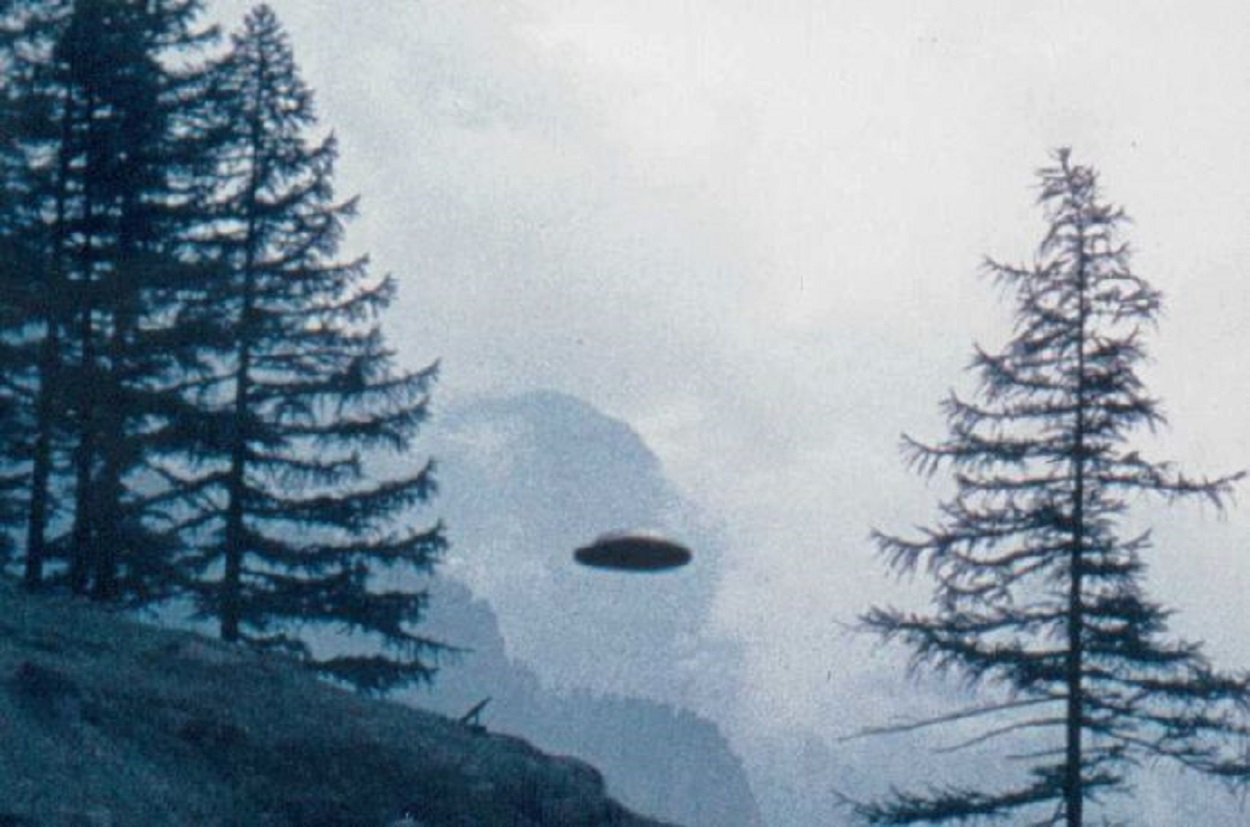
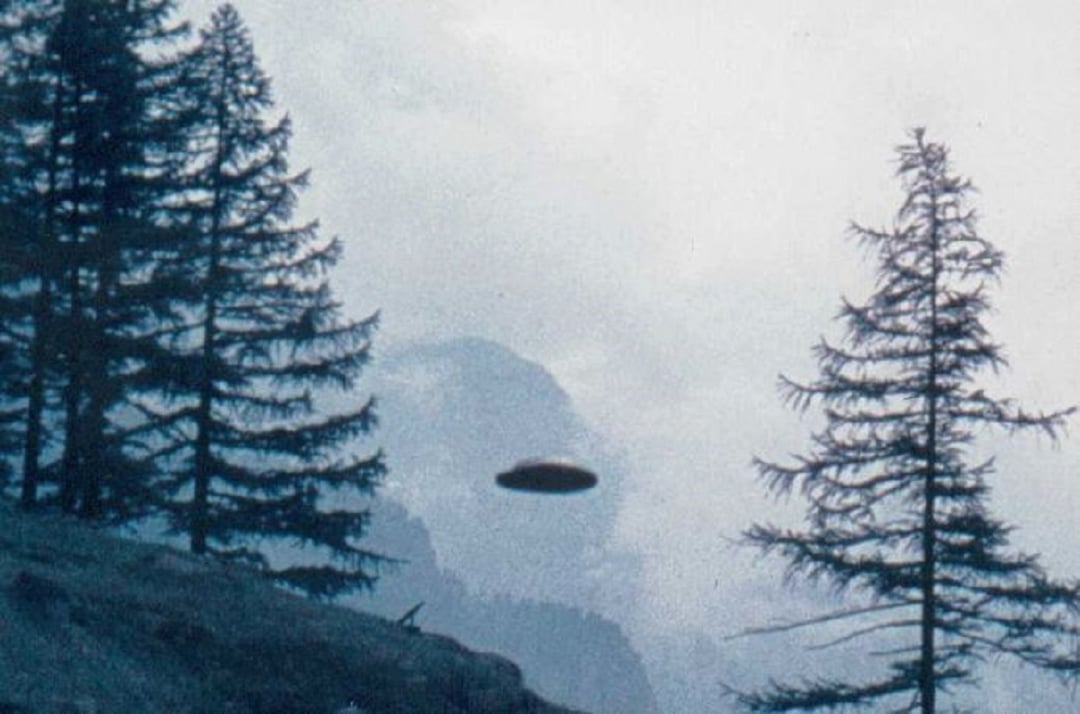
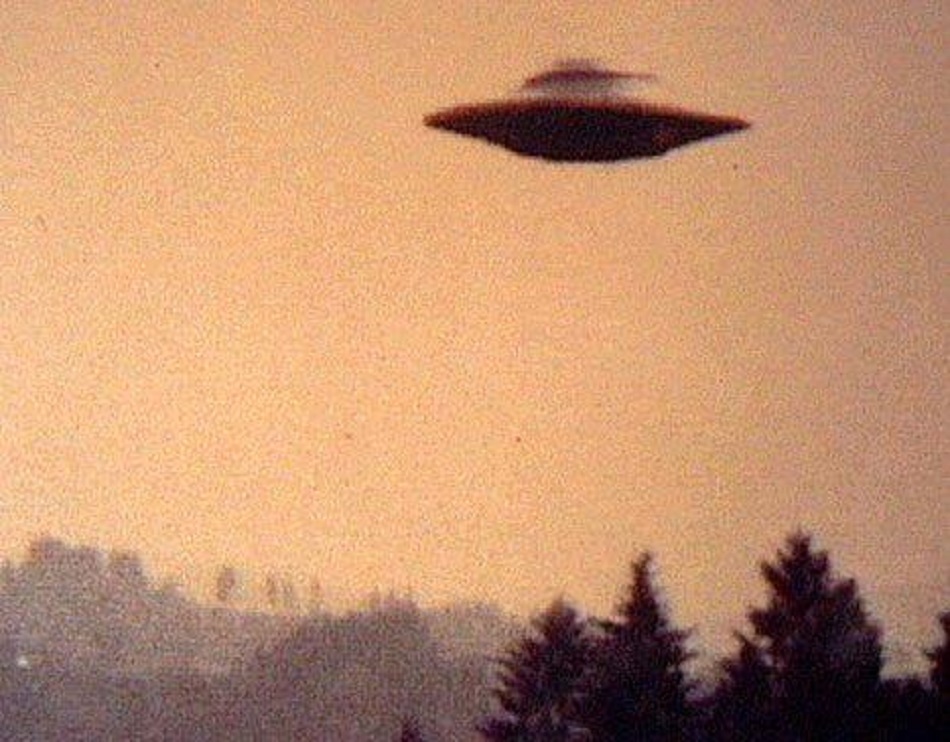
Close-up of the Saas-Fee UFO picture

Close-up of the Saas-Fee UFO picture

The much publicized "Saas Fee" photo from 1975. The picture, taken not in Saas Fee but near the village of Zwischbergen, is a stereotype image of a "flying saucer"-type UFO from the seventies.

Incident Details

The origins of the Saas-Fee photograph trace back to a casual hiking adventure undertaken by three young men—two Dutch brothers identified only by the initials B and H, alongside their friend M. According to their accounts, during their second day of trekking in the Swiss Alps, around 3:00 p.m., they encountered an extraordinary phenomenon. The trio reported observing a “circular object” approximately 15 meters across, hovering at a distance estimated between 100 and 500 meters from their vantage point. The object’s description emphasized its dull grey, solid-metal exterior—a striking detail given the typically unpredictable atmospheric conditions of the Alpine region. The witnesses recounted that the craft did not seem to be affected by the wind or temperature fluctuations, adding a layer of mystery to their sighting.

The trio watched the object for several minutes, during which time they observed its movements and appearance before B decided to document the phenomenon with his camera. As B pressed the shutter button, he captured the now-famous black-and-white image. Interestingly, B recalled that immediately after the photograph was taken, the object abruptly moved, disappearing behind the mountain’s treetops. This rapid departure echoes many UFO encounter reports where the act of recording or observing the craft seems to prompt its swift departure. The witnesses have maintained their story steadfastly over the years, asserting that their experience was genuine and unaltered by external pressures or incentives. This consistency has distinguished their account from many other alleged sightings, fostering both intrigue and skepticism.

Several decades later, in multiple interviews, the witnesses reaffirmed their belief that what they saw was not a natural phenomenon, nor a man-made aircraft, but something extraordinary. Their firsthand account remains a cornerstone of the incident’s credibility among certain UFO aficionados. However, skeptics argue that initial impressions alone cannot determine the nature of the event, prompting the need for detailed analysis of the photographic evidence and contextual factors surrounding the sighting.

Photographic Examination

Since its circulation in the late 20th century, the Saas-Fee photograph has been the subject of numerous technical analyses, with researchers attempting to establish its authenticity. The image, taken with a standard 35 mm SLR camera—a common device during the 1970s—shows a clear circular shape with defined borders and uniform shading, suggesting a metallic surface. Experts have scrutinized various aspects, such as grain structure, exposure levels, and shadowing, to determine whether the photograph was manipulated or staged.

click for a more detailed image

A closer view of the unidentified object.

One line of investigation focuses on the ambient lighting conditions and the physical environment captured in the image. The scene appears to have no obvious signs of digital alteration, which is unsurprising given the pre-digital era in which it was taken. Yet, some investigators argue that the background appears somewhat artificial or blurred, lacking the detailed depth expected from a genuine alpine landscape. This observation has led some to posit that the background could be a painted backdrop or a composite image, possibly inserted to lend credibility to the object.

Attempts to replicate the scene using period-appropriate equipment and models have yielded mixed results. In a notable 2005 experiment conducted by a European photographic society, researchers created a replica of the craft using a metal disc mounted on a remotely controlled drone or kite. The resulting images bore a striking resemblance to the original, but they also displayed a luminous halo of light around the replica, a feature not present in the original photograph. This discrepancy highlights the difficulty in conclusively determining whether the original was genuine or a skillful hoax.

Further analysis has involved examining the negative or print quality. High-resolution scans have failed to uncover any signs of digital or manual tampering, but the resolution and aging of the original negatives limit definitive conclusions. The lack of discernible background detail—such as the landscape’s texture or natural features—remains a significant point of debate among forensics experts. Some suggest that the photograph’s consistency with known period-correct film grain and exposure supports its authenticity, while others argue that it could be a carefully crafted model photograph taken under controlled conditions.

Photographers and image analysts continue to debate whether the level of detail, lighting, and composition points toward an authentic extraterrestrial craft or just an elaborate hoax. Without the original negatives or additional supporting evidence, the photograph’s true origin remains shrouded in ambiguity, embodying what Dr. Elena Marquez, a photographic historian at the University of Zurich, describes as “a perfect example of the gray zone in photographic validation—neither wholly convincing nor completely dismissible.”

b9cz2qbdb11f1.jpg

rzkaopodb11f1.jpg

a1hoiiydb11f1.jpg

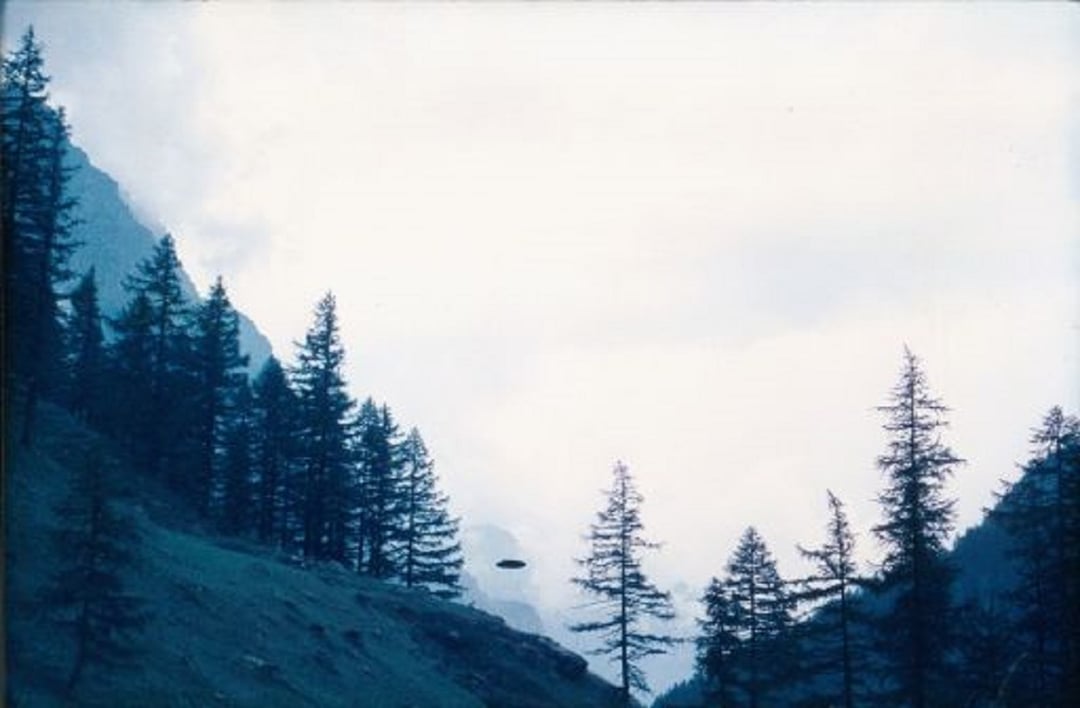
Super clear UFO photo taken in Saas-Fee, Switzerland on July 26, 1975.

by NetOne613

Expert Opinions

The contrasting perspectives surrounding the Saas-Fee photograph highlight the complex interplay between credulity and skepticism in UFO research. On one side, enthusiasts argue that the consistency in witness testimonies—despite the passage of almost fifty years—and the detailed description of the object lend credibility to the sighting. They point out that the witnesses have refused monetary offers to recant or alter their story, suggesting genuine conviction. The fact that these individuals have maintained their account despite public ridicule and the potential social pressures increases their credibility among believers.

Moreover, proponents emphasize the historical context of UFO sightings in the 1970s. The era was rife with media sensationalism, coinciding with a cultural fascination with “flying saucers” fueled by movies, books, and popular science fiction. This environment led some skeptics to argue that such sightings, including the Saas-Fee incident, could be attributable to hoaxes or imaginative interpretations of ordinary objects—such as aircraft, natural phenomena, or optical illusions—amplified by media influence. Nevertheless, proponents counter that the specific details of the sighting—such as the sudden disappearance upon photographing and the metallic symmetry—are atypical of mundane explanations.

Skeptics, including Dr. Hans Keller of the Swiss Institute for Critical Inquiry, stress the importance of applying rigorous scientific standards when evaluating such evidence. Keller points out that the visual style of the Saas-Fee image aligns with the sci-fi media prevalent during the 1970s, raising the risk of deliberate or subconscious mimicry. “The aesthetics of many purported UFO images from that era often resemble science fiction motifs,” Keller notes, “which complicates their authenticity unless corroborated by other data such as radar logs or physical traces.”

In contrast, some experts and investigators champion the credibility of part of the witnesses’ story, especially given their long-standing refusal to profit from their account. The Dutch UFO researcher Jan de Vries echoes this sentiment, stating, “The consistency over decades and their outright rejection of financial gain suggest they truly believed what they saw.” Yet, others caution that eyewitness accounts, no matter how steadfast, are inherently subjective and vulnerable to memory distortions, especially after so many years.

This divergence in expert opinions underscores the central challenge of UFO investigation: distinguishing genuine anomalous phenomena from artifacts of perception, fabrication, or cultural influence. The Saas-Fee case exemplifies this dilemma, illustrating how subjective witness testimony and limited photographic evidence can perpetuate ambiguity. Ultimately, most scientists advocate for a cautious approach, emphasizing the need for corroborative physical data—such as radar recordings, radar-visual matches, or physical traces—to substantiate or refute the sighting’s extraterrestrial nature.

Ongoing Debate

The Saas-Fee photograph remains a focal point in contemporary UFO discourse, serving as a testament to the enduring human fascination with the unknown. Its renewal on social media and in investigative circles has revitalized interest, prompting discussions about the nature of evidence and the limitations of photographic analysis. The core difficulty lies in determining whether this single image, taken with period-appropriate equipment and accompanied by consistent witness accounts, constitutes compelling proof of extraterrestrial visitation or if it is a product of hoax, misinterpretation, or coincidence.

One of the fundamental challenges in evaluating the photograph is the scarcity of supporting data. No original negatives are publicly available, and there are no accompanying radar logs, physical traces, or contextual information to verify the encounter. This absence restricts analysis and leaves open many possibilities. Some researchers have called for a thorough archival review—hoping that original film negatives, if they exist in any private collection, could shed light on the authenticity. Similarly, attempts to locate any physical remnants or traces in the area where the sighting occurred have been inconclusive.

The incident exemplifies a broader issue in UFO research: the reliance on anecdotal evidence and photographs that are prone to manipulation or misinterpretation. As technology advances, digital forensics provide new methods of analysis, but aged materials often lack the resolution or integrity needed for definitive conclusions. Meanwhile, the phenomenon persists—be it extraterrestrial, natural, or man-made—challenging the scientific community’s capacity to differentiate fact from fiction.

As the debate rages on, proponents advocate for a cautious but open-minded approach, emphasizing the importance of transparency, interdisciplinary research, and the search for corroborative physical evidence. Critics argue that without additional data, the photograph remains an intriguing anomaly but cannot be considered proof of an extraterrestrial craft. The debate exemplifies the tension at the heart of UFO investigations: a desire to uncover profound truths versus the necessity of empirical rigor.

Until new evidence surfaces—such as original negatives, radar logs, or possible physical artifacts—the Saas-Fee picture will likely continue to be debated, representing “a case too close to call” in the annals of UFO history. Its enduring mystery encapsulates the human desire to know the unknown and the careful skepticism needed to separate genuine phenomena from illusions or hoaxes. As such, the incident continues to inspire curiosity, investigation, and skepticism, highlighting the complex interplay between human perception, technological limitations, and the pursuit of truth in the cosmic frontier.

CONCLUSION

The Saas Fee photograph, purportedly capturing an unidentified flying object (UFO) in the Swiss Alps, has garnered significant attention both from the public and the scientific community. To analyze this phenomenon scientifically, one must consider various factors including image analysis, atmospheric conditions, natural and human-made objects, and the limitations of photographic evidence.

Saas-Fee, Valais, Switzerland UFO

During a hunting expedition, a group of individuals encountered a low-hovering craft that glided quietly among the nearby trees. One member managed to capture a photograph of the object. Skeptic Wim Van Utrecht contended that the image might be fabricated.

Firstly, the object depicted in the photograph can be subjected to rigorous image analysis to determine its physical characteristics, such as shape, size, and movement. Advanced software can help identify anomalies or inconsistencies suggestive of tampering or digital manipulation. If the object appears to have features inconsistent with known aircraft or natural phenomena, further scrutiny is warranted.

Secondly, understanding the environmental context is essential. The Swiss Alps' weather conditions often cause optical illusions, such as lens flares, reflections, or atmospheric phenomena like clouds or ice crystals, which can produce visual artifacts resembling unidentified objects. High-altitude glaciers and snowfields can also reflect sunlight, creating bright spots or unusual shapes in photographs.

Thirdly, human-made objects should be considered. The region is frequented by helicopters, drones, or aircraft which, at certain angles and lighting conditions, can resemble UFOs. Additionally, the presence of military or scientific equipment, such as weather balloons or research balloons, can create similar visual signatures in aerial photographs.

Furthermore, photographic artifacts and camera limitations can generate optical illusions. For instance, lens aberrations, reflections within the camera lens, or digital artifacts arising from the image processing can produce unexpected shapes or anomalies. Such artifacts are often mistaken for genuine unidentified objects.

Evaluation of the original photographic data, including metadata and high-resolution scans, helps determine authenticity and identify possible causes of anomalies. If the image is a composite or has undergone digital editing, this diminishes its credibility as evidence of a UFO encounter.

Importantly, no verifiable physical evidence supports the existence of extraterrestrial craft in this region. The absence of corroborating observations, radar data, or sensor readings further constrains the hypothesis that the object is an extraterrestrial spacecraft.

In summary, the "UFO" in the Saas Fee image can most plausibly be attributed to natural atmospheric phenomena, reflections, human-made objects, or photographic artifacts. Without concrete physical evidence or corroborating data, these explanations align with the scientific principle of parsimony, favoring natural or human-related causes over extraordinary ones. Thus, the photograph is best understood as an intriguing optical or photographic artefact rather than definitive proof of extraterrestrial activity.

{ PETER2011 }

Hoe vind je dit bericht?
Geschreven door peter om 21:46 Stuur door

Het Laatste Decennium: 10 jaar Onverklaarde UFO-gevallen uit Project Blue Book

Het Laatste Decennium: 10 jaar Onverklaarde UFO-gevallen uit Project Blue Book

A superimposed picture of a UFO against a depiction

De jaren 60 waren een stuk rustiger voor Project Blue Book

Inleiding

Tegenwoordig is de interesse in UFO’s (Unidentified Flying Objects) en de mogelijkheid van buitenaardse aanwezigheid opnieuw toegenomen. Hoewel deze onderwerpen vaak worden afgedaan als complottheorieën of pseudowetenschap, is de geschiedenis van UFO-onderzoeken rijk aan mysterieuze incidenten die nog altijd vragen oproepen. Een van de meest bekende nationale onderzoeken naar UFO’s uit de Verenigde Staten is Project Blue Book (1952-1969). Dit overheidsinitiatief probeerde de vele rapportages over vreemde objecten in de lucht te onderzoeken en te classificeren. Maar ondanks de uitgebreide documentatie en officiële rapporten blijven veel gevallen onverklaard.

In dit artikel onderzoeken we de onverklaarde gevallen uit het laatste decennium van Project Blue Book, met focus op voorbeelden uit de jaren zestig, en we plaatsen deze in een bredere historische en contextuele kader. Daarbij belichten we ook de zienswijzen, de methodologie van het onderzoek en de mogelijke patronen die uit deze gevallen kunnen worden afgeleid. We bouwen verder op de basis van de originele rapporten, brengen voorbeelden met details, en analyseren de betekenis van deze incidenten binnen het grotere UFO-onderzoek.

Het doel is om niet alleen de feiten te presenteren, maar ook een gestructureerde en uitvoerige analyse te bieden die de lezer een helder inzicht geeft in de complexiteit en de raadsels die de menselijke lucht boven ons blijven bedekken.

A depiction of a UFO

Veel UFO-waarnemingen bereikten Project Blue Book niet

Hoofdstuk 1: Het Achtergrondverhaal van Project Blue Book

1.1 Het ontstaan en de doelstellingen van Blue Book

Project Blue Book werd in 1952 gestart onder leiding van het Amerikaanse ministerie van defensie. Het hoofddoel was het onderzoeken van UFO-meldingen die werden gedaan door militaire personeel, piloten, burgerwachten en gewone burgers. Men wilde bepalen of deze verschijnselen een bedreiging vormden voor de nationale veiligheid en of ze technisch verklaarbaar waren.

De onderzoekers probeerden een systematisch aanpak te hanteren: ze verbruikten getuigenverslagen, deden radarbezoeken, en vergeleken waarnemingen. Aanvankelijk was het een serieuze poging om bewijs voor buitenaardse technologie te vinden. Echter, vanaf het begin was er ook sprake van politieke en propagandistische belangen. Men wilde de publieke angst beperken, en rapportages werden soms onderdrukt of aangepast.

1.2 De leiding en de controverse

De eerste leiding van het project was onder leiding van Captain Edward Ruppelt, die bekendstaat als een objectieve en kritische informant over het werk van Blue Book. Ruppelt probeerde de geloofwaardigheid van het onderzoek te behouden en was ervan overtuigd dat er daadwerkelijk onverklaarbare incidenten waren. Nadat Ruppelt in 1953 vertrok, verslechterde de situatie: rapporten werden veel makkelijker afgewezen, en er ontstond een sfeer van onderdrukking en desinformatie.

Bepaalde rapporten werden verwijderd, gecensureerd of neergezet als natuurlijke fenomenen zoals weerballonnen, sterren, sterrenbeelden, of menselijke fouten. Openbare verklaringen werden minder serieus toen duidelijk werd dat het project vooral bedoeld was om de publieke angst te temperen, in plaats van wetenschappelijk onbevooroordeeld te worden.

A picture claiming to show a real UFO

Toont deze foto een echte UFO?

1.3 De invloed van politieke en militaire belangen

De jaren zestig markeerden een periode van toenemende militaire spanning, met de Koude Oorlog en de Space Race. In die context waren sommige UFO-incidenten mogelijk militaire geheimen of gevechtsvliegdekschepen. De vraag bleef of er soortgelijke verschijnselen technisch verklaarbare oorzaken hadden, of dat ze echt iets bovennatuurlijks of buitenaards waren.

Er was ook sprake van een soort ‘disinfo’ strategie, waarbij men gegevens technische en mysterieus hield om te voorkomen dat vijanden of oppositie zich een beeld konden vormen van nieuwe technologieën of bedreigingen. Veel incidenten konden niet worden verklaard, zelfs niet door geavanceerde radar en sensorische apparatuur.

Kortom, ze sluimerden onder de oppervlakte, en de officiële documenten tonen dat veel rapportages verduisterd of afgewezen werden zonder adequate verklaring.

BlueBookLast4.jpg

Hoofdstuk 2: De jaren zestig – Een Bloei van Onverklaarbare Incidenten

2.1 De algemene kenmerken van de waarnemingen

De jaren zestig blijken een bijzonder rijke periode te zijn in termen van UFO-waarnemingen. Uit de rapporten blijkt dat veel waarnemingen zich herhaalden: opvallende lichten, ongewone vormen, grote objecten die stilhielden of plotseling snelheden bereikten die klassieke technologie niet kon halen.

De getuigen variëren van militairen en piloten tot gewone burgers, zoals boeren, studenten, en politieagenten. Betrouwbare getuigen zoals piloten en ervaren militairen meldden incidenten die met radar en visuele waarnemingen werden ondersteund. Dat maakt deze gevallen extra interessant, omdat zij de mogelijkheid bieden om waarnemingen vanuit verschillende bronnen te vergelijken.

A depiction of a UFO near the full moon

Veel UFO-waarnemingen hadden meerdere getuigen

2.2 Voorbeelden van opmerkelijke incidenten uit de jaren zestig

Laten we enkele incidenten in detail bekijken.

a) Het geval van de grote driehoek in Kansas (1961)

In de nacht van 3 januari 1961 meldde een politieagent in Kansas een indrukwekkende driehoekvormige ufo die stil zweefde boven de snelweg. De ufo was ongeveer 200 voet breed, draaide langzaam en leek geen geluid te maken. Toen de agent naderbij kwam, sloeg het object plotseling snel weg en verdween. Het had een glanzend oppervlak en leek uit meerdere lagen te bestaan.

Wat dit incident uniek maakt, is dat het niet alleen visueel werd waargenomen, maar ook radarbevestiging kreeg. Verschillende radarvelden registreerden de bewegingen van het object, wat de onbevooroordeelde wetenschappelijke waarde verhoogt. Het werd ook bevestigd door meerdere getuigen in de omgeving. Dit soort gevallen, waarbij radar- en visuele gegevens overeenkomen, wordt beschouwd als zeer moeilijk te verklaren.

b) Het waarnemingsincident van Michigan (1966)

In Michigan werden meerdere mensen tegelijkertijd getuige van een groot, ringvormig object dat traag door de lucht bewoog. Het object had een halo effect en leek een blauwachtige gloed uit te stralen. Sommige getuigen rapporteerden dat het object zich splitste in kleinere delen en verdween achter de bomen of zich snel vervolmaakte naar een punt.

Het interessante was dat dit fenomeen meerdere keren werd gemeld door olika mensen in korte tijd, en dat enkele waarnemingen werden ondersteund door radardata van nabijgelegen luchthavens. Het verband tussen visuele waarnemingen en radarvermeldingen suggereert dat er werkelijk een fysiek object aanwezig was dat op de een of andere manier niet bekend was.

2.3 Sporen en fysieke effecten

Veel onverklaarde waarnemingen gaan gepaard met fysieke effecten, zoals intense hitte, elektromagnetische verstoringen, en zelfs schade aan apparatuur. Bijvoorbeeld, in een incident in Oklahoma (1962) werd een klein vliegtuig achtervolgd door een rood-oranje vuurbol die zich snel door de lucht bewoog. De piloot meldde dat zijn navigatiesysteem stoorde en dat er een warmtegevoel op de huid was. Sommige onderzoekers vermoeden dat dergelijke fenomenen antimagnetische of energiewaardevolle eigenschappen bezitten.

A depiction of a UFO above a road

Wat hebben de twee getuigen die avond precies gezien?

2.4 Voorbeelden van andere opvallende gevallen

  • De ‘lighthouse’ in New York (1962): meerdere getuigen meldden een grote, heldere lichtbron die boven de skyline hing. De lichtsterkte deed denken aan een kustlamp, maar bevond zich op een plaats waar geen natuurlijke lichtbronnen bekend waren.

  • De landingspoging van een klein object in Oklahoma (1962): getuigen zagen dat een klein, dik object leek te landen en dat er uit het object een man uit een voertuig stapte die zich vreemd gedroeg. Dit soort ‘bijzondere’ waarnemingen roept vragen op over buitenaardse en menselijke factoren.

Hoofdstuk 3: Analyse van de patronen en kenmerken

3.1 De herhaling van kenmerken en patronen

Een belangrijke bevinding uit de verzamelde rapporten is de consistentie: vele waarnemingen delen kenmerken zoals:

  • Lichtfenomenen die in verschillende vormen verschijnen: cirkels, driehoeken, cilinders, en kubussen.
  • Snelle bewegingen en plotselinge snelheden die de technologische mogelijkheden van de jaren zestig overtreffen.
  • Stilstaande of langzaam bewegende objecten, vaak met het vermogen om van vorm te veranderen.
  • Felle lichten die van kleur variëren, vooral rood, geel, blauw en groen.
  • Geluiden die vaak ontbreken of erg zacht zijn, hoewel sommige getuigen zingen dat ze harde kreunen of sissende geluiden hoorden.

3.2 Radar- en sensorwaarnemingen

De combinatie van visuele waarneming met radarbevestiging is een belangrijke indicator voor de objectiviteit van sommige incidenten. Vooral in militaire en luchthavendossiers blijkt wel dat bepaalde objecten niet alleen visueel, maar ook via radar werden gevolgd en dat ze zich niet konden aanpassen aan bestaande technologie of natuurlijke verschijnselen.

A depiction of a UFO

Meldingen van UFO-waarnemingen bleven afnemen voor Blue Book naarmate de jaren '60 vorderden

3.3 fysieke en elektromagnetische effecten

Veel incidenten tonen dat objecten elektromagnetische verstoringen kunnen veroorzaken. Dit viel op in gevallen waar vliegtuigen en communicatieapparatuur uitvallen bij de waarneming van de UFO. Daarnaast worden lichaamseffecten gerapporteerd, zoals warmte, tintelingen en waterige ogen. Sommige onderzoekers vermoeden dat deze verschijnselen te maken hebben met energiegolven die door de objecten worden uitgezonden.

3.4 De rol van de publieke en militaire perceptie

In de jaren zestig was de publieke belangstelling voor UFO’s groot, vooral met de opkomst van de televisiekunst en de nieuwe media. Overheidsrapporten proberen vaak de incidenten te ‘verdammen’ door ze te labelen als natuurlijke fenomenen, menselijke fouten, of ballon- en weerballonnen. Maar de herhaalde onverklaarbare incidenten wijzen op een complex samenspel van natuurlijke en technologische factoren die nog niet volledig zijn begrepen.

Hoofdstuk 4: Conclusies en Reflecties

4.1 De blijvende onverklaarbaarheid

Ondanks de inspanningen van Project Blue Book en de technologische vooruitgang, blijven veel incidenten onverklaard. Vaak wordt er gesuggereerd dat bepaalde fenomenen een bewijs vormen voor buitenaardse intelligentie, terwijl andere mogelijk natuurlijke of menselijke oorzaken hebben.

A depiction of a UFO in the daylight sky

Ondanks dat er een UFO-golf was, kwamen er in 1964 weinig meldingen bij Blue Book binnen

4.2 Het belang van herziening en onderzoek

Veel gevallen uit de jaren zestig worden nog steeds bestudeerd door UFO-onderzoekers en historische wetenschappers. Het herzien van oude dossiers kan patronen blootleggen die voorheen niet zichtbaar waren, en kan zelfs nieuwe technologieën behulpzaam maken bij de analyse van historische waarnemingen.

A depiction of a UFO

In 1966 nam het aantal Blue Book-onderzoeken toe

4.3 De vraag of we echt alleen zijn

De confrontatie met onverklaarbare incidenten benadrukt dat de lucht en de ruimte boven ons vol raadsels blijven. Of deze verschijnselen nu buitenaards, natuurlijke, of door menselijke technologieën veroorzaakt zijn, ze blijven mysterieus en relevant voor de menselijke nieuwsgierigheid en wetenschap.

4.4 Toekomstperspectief

Met de huidige toename aan technologie en sensoren, en de hernieuwde belangstelling van overheden zoals de Amerikaanse Pentagon en NASA, wordt aangenomen dat er meer data en inzichten zullen komen. Openbare transparantie en wetenschappelijk onderzoek kunnen uiteindelijk bepalen of we ooit het antwoord vinden op de vraag: Zijn we echt alleen in de kosmos?

A depiction of a UFO above the clouds

Het verhelderende auto-incident is een van de meest intrigerende die ooit is vastgelegd

Slotwoord

De afgelopen tien jaar laten zien dat de onverklaarde UFO-gevallen niet enkel een fascinerende verzameling raadsels vormen, maar ook een venster bieden op de limieten van onze kennis. Door de historische incidenten te bestuderen en patronen te zoeken, kunnen we misschien op termijn meer begrip krijgen van deze mysteries die ons al decennia lang uitdagen. Het blijft een boeiende uitdaging voor wetenschappers, overheden en nieuwsgierigen om verder te kijken dan de horizon en de waarheid boven tafel te krijgen.

De korte video hieronder onderzoekt de mogelijkheid van UFO's en buitenaards leven.

{ PETER2011 }

Hoe vind je dit bericht?
Geschreven door peter om 23:01 Stuur door

Pentagon planted UFO myths to hide secret weapons programs, report finds

Pentagon planted UFO myths to hide secret weapons programs, report finds

Hoe vind je dit bericht?
Geschreven door peter om 22:38 Stuur door

Here are the 5 most memorable moments from Congress’ UFO hearing

Here are the 5 most memorable moments from Congress’ UFO hearing

Former military officials made a series of mystifying claims about unidentified aerial phenomena under oath at Wednesday's congressional hearing.

Three former military officials told Congress Wednesday that they believe the government knows much more about UFOs than it is telling the public.

A House Oversight subcommittee held a hearing on UFOs — officially known as unidentified aerial phenomena or UAPs — and heard mystifying testimony about unexplained object sightings and government possession of “nonhuman” biological matter.

Lawmakers on the committee, baffled by some of the testimony, repeatedly noted that UAP sightings are an issue of bipartisan concern and raise national security questions. Separately, some accused the federal government of endeavoring to conceal key UFO-related information from the public, though they did not provide evidence to support those allegations.

“The sheer number of reports, whistleblowers and stories of unidentified anomalous phenomena should raise real questions and warrant investigation and oversight. And that’s why we are here today,” Rep. Robert Garcia, the top Democrat on the subcommittee, said in his opening statement. "UAPs, whatever they may be, may pose a serious threat to our military or civilian aircraft. And that must be understood."

These UAP sightings, experts say, might be attributable to balloons, drones, optical illusions or even the blinking lights of a commercial airliner. The Pentagon has said they have seen no evidence linking UAPs to alien activity, though they have not ruled out that explanation.

Here are five of the witnesses' main claims from the hearing:

1. Government is ‘absolutely’ in possession of UAPs

David Grusch, a former U.S. intelligence official, told the panel that he is “absolutely” certain that the federal government is in possession of UAPs, citing interviews he said he conducted with 40 witnesses over a four-year period.

The former U.S. intelligence official said he led Defense Department efforts to analyze reported UAP sightings and was informed of a “multidecade” Pentagon program that endeavored to collect and reconstruct crashed UAPs.

Asked by Rep. Jared Moskowitz, D-Fla., how such a program is funded, Grusch claimed that the effort is "above congressional oversight" and bankrolled by a "misappropriation of funds."

"Does that mean that there is money in the budget that is set to go to a program but it doesn't and it goes to something else?," Moskowitz asked.

"Yes. I have specific knowledge of that," Grusch said, though he did not provide more details, claiming the information remains classified.

2. ‘Nonhuman biologics’ were found at a crash site

Grusch, who underscored that he has not personally spotted a UAP, told the panel that he knows of "multiple colleagues" who were injured by UAPs. He also said he has interviewed individuals who have recovered "nonhuman biologics" from crashed UAPs.

Grusch said he prefers to use the term "nonhuman" rather than alien or extraterrestrial.

Asked by Rep. Eric Burlison, R-Mo., to substantiate the crashed UAPs claim, the former intelligence official said he could not divulge specific details, once again claiming the information was too sensitive to share with the public.

He did, however, describe the nature of what he saw: "I have to be very careful here ... [but] what I personally witnessed, myself and my wife, was very disturbing."

A Pentagon spokesperson told NBC News that Grusch's claims are false.

3. Officials must establish a 'safe and transparent reporting process'

Some lawmakers and witnesses pushed the federal government to establish clear channels to communicate UAP information with both the public and the military, and said the military should establish a comprehensive reporting process for unidentified objects sightings.

Ryan Graves, a former Navy pilot, told the panel that military pilots do not feel adequately briefed on UAPs, which he said leaves them unprepared to respond to UAP encounters. 

The former Navy pilot claimed that commercial airline pilots have spotted UAPs too.

"There has to be a safe and transparent reporting process for pilots both on the commercial side and the military side to be able to report UAPs," Garcia said.

Ryan Graves, executive director of Americans for Safe Aerospace, testifies on July 26, 2023.
Ryan Graves, executive director of Americans for Safe Aerospace, testifies Wednesday.  Drew Angerer / Getty Images

Rep. Virginia Foxx, R-N.C., echoed the calls for more transparency. She noted that Dr. Sean Kirkpatrick, the director of the Pentagon's All-Domain Anomaly Resolution Office, had previously told Congress that there was “no credible” evidence of extraterrestrial life.

Grusch objected to Kirkpatrick's claim, prompting Foxx to say that "contradiction is a perfect example of why we need to inject transparency into our government."

4. Stigma associated with sightings 'silences' possible witnesses

Some witnesses and lawmakers at the hearing argued that the stigma associated with reporting UFO sightings — as well as the alleged harassment of those who work to investigate them — may be hindering efforts to determine their origins.

Graves told the panel that stigma "silences" pilots who fear "professional repercussions," which he said is "compounded by recent government claims questioning the credibility of eyewitness testimony."

The Federal Aviation Administration has no mechanism for pilots to report UAPs, and instead directs them to civilian groups that are often dismissed as the domain of cranks and conspiracy theorists.

Those institutional hurdles led Graves to form a first-of-its-kind group that pushes for policy changes, serves as a hub for pilot whistleblowers and advocates for more disclosure by the military and other government agencies.

Lawmakers said they hoped the hearing could help assuage pilots' fears of speaking out.

"This hearing will not be the end of this discussion, but a new chapter and start. We should encourage more reporting, and more study of UAPs," Garcia said. "The more we understand, the safer we are."

5. UFO spotted accelerating to 'supersonic speeds'

David Fravor, a former Navy commander, said he and three fellow military pilots spotted a white Tic-Tac-shaped object in 2004, hovering below their jets and just above the Pacific Ocean.

As he descended to inspect the sighting, he claimed the unidentified aircraft — which he said bore no visible rotors, wings or exhaust — began to ascend and approach his fighter jet.

He claimed that the UAP then vanished, only to reappear a few seconds later, but this time it was spotted 60 miles away.

Fravor told the committee that the technology he and his team encountered defies logical explanation.

"The technology that we faced is far superior to anything that we had," Fravor claimed. "And there’s nothing we can do about it, nothing

Hoe vind je dit bericht?
Geschreven door peter om 22:21 Stuur door

Meer van UFO'S of UAP'S, ASTRONOMIE, RUIMTEVAART, ARCHEOLOGIE, OUDHEIDKUNDE, SF-SNUFJES EN ANDERE ESOTERISCHE WETENSCHAPPEN - DE ALLERLAATSTE NIEUWTJES

↑ Terug naar de berichten