Naar de inhoud

UFO'S of UAP'S, ASTRONOMIE, RUIMTEVAART, ARCHEOLOGIE, OUDHEIDKUNDE, SF-SNUFJES EN ANDERE ESOTERISCHE WETENSCHAPPEN - DE ALLERLAATSTE NIEUWTJES

UFO's of UAP'S in België en de rest van de wereld
akke.beakke.be
Ontdek de Fascinerende Wereld van UFO's en UAP's: Jouw Bron voor Onthullende Informatie! Ben jij ook gefascineerd door het onbekende? Wil je meer weten over UFO's en UAP's, niet alleen in België, maar over de hele wereld? Dan ben je op de juiste plek! België: Het Kloppend Hart van UFO-onderzoek In België is BUFON (Belgisch UFO-Netwerk) dé autoriteit op het gebied van UFO-onderzoek. Voor betrouwbare en objectieve informatie over deze intrigerende fenomenen, bezoek je zeker onze Facebook-pagina en deze blog. Maar dat is nog niet alles! Ontdek ook het Belgisch UFO-meldpunt en Caelestia, twee organisaties die diepgaand onderzoek verrichten, al zijn ze soms kritisch of sceptisch. Nederland: Een Schat aan Informatie Voor onze Nederlandse buren is er de schitterende website www.ufowijzer.nl, beheerd door Paul Harmans. Deze site biedt een schat aan informatie en artikelen die je niet wilt missen! Internationaal: MUFON - De Wereldwijde Autoriteit Neem ook een kijkje bij MUFON (Mutual UFO Network Inc.), een gerenommeerde Amerikaanse UFO-vereniging met afdelingen in de VS en wereldwijd. MUFON is toegewijd aan de wetenschappelijke en analytische studie van het UFO-fenomeen, en hun maandelijkse tijdschrift, The MUFON UFO-Journal, is een must-read voor elke UFO-enthousiasteling. Bezoek hun website op www.mufon.com voor meer informatie. Samenwerking en Toekomstvisie Sinds 1 februari 2020 is Pieter niet alleen ex-president van BUFON, maar ook de voormalige nationale directeur van MUFON in Vlaanderen en Nederland. Dit creëert een sterke samenwerking met de Franse MUFON Reseau MUFON/EUROP, wat ons in staat stelt om nog meer waardevolle inzichten te delen. Let op: Nepprofielen en Nieuwe Groeperingen Pas op voor een nieuwe groepering die zich ook BUFON noemt, maar geen enkele connectie heeft met onze gevestigde organisatie. Hoewel zij de naam geregistreerd hebben, kunnen ze het rijke verleden en de expertise van onze groep niet evenaren. We wensen hen veel succes, maar we blijven de autoriteit in UFO-onderzoek! Blijf Op De Hoogte! Wil jij de laatste nieuwtjes over UFO's, ruimtevaart, archeologie, en meer? Volg ons dan en duik samen met ons in de fascinerende wereld van het onbekende! Sluit je aan bij de gemeenschap van nieuwsgierige geesten die net als jij verlangen naar antwoorden en avonturen in de sterren! Heb je vragen of wil je meer weten? Aarzel dan niet om contact met ons op te nemen! Samen ontrafelen we het mysterie van de lucht en daarbuiten.

Categorie: André's Hoekje (ENG)

Who Will Win The Rosetta Stone Award? The Russian Linguist Or The American/Canadian Scientist?

Who Will Win The Rosetta Stone Award? The Russian Linguist Or The American/Canadian Scientist?

I will have Pastrami with that Debate

Stanton Friedman has reiterated calling my book The Rosetta Deception disinformation even though he hasn't bothered to read it. He also said that I am full of baloney and puts forward an article he wrote for the MUFON Journal in 2010 as the basis for his comments. What he doesn't yet realize (because he hasn't read my book) is that his 2010 comments only bolster the book's theory and do no not detract from it.

I didn't respond back in 2010 but since Stan decided to dredge up his article, it is time I set the record straight. I won't address his comments on Roswell because my book is NOT about Roswell. If he had bothered to read it, he probably would have tempered his comments accordingly. Instead, I will focus on Stanton's comments on the subject of disinformation.

Stan says: 

  • "I am definitely in agreement with James that disinformation is a very important aspect of hot and cold war activities. Certainly New Mexico is no stranger to disinformation and intentional misinformation. When the extraordinary first nuclear explosion was set off at Trinity site on the White Sands Missile Range on July 16, 1947, at 5:29 AM, it was seen by people as far as 100 miles away. Many calls were made to Sheriff's offices, police forces, etc. In a few days a totally false story was released indicating that an ammunition dump had blown up and that fortunately nobody was injured. It was only after the nuclear detonations on Hiroshima and Nagasaki, Japan, on August 6 and 9, that the true story came out. The city of Los Alamos, NM, where the scientific work connected with the development of those weapons was conducted was a totally secret city. Nobel prize winning scientists travelled under assumed names. And there were many more examples. A very distressing disinformation release occurred on Sept.12, 1945, when the New York Times quoted General T.F. Farrell, Chief of the War Departmentís mission to Hiroshima, saying that the bomb produced no long lived radioactivity. That was known to be totally false as a result of medical observations of very sick people in Hiroshima a month after the blast."

Thanks Stan for confirming that the NY Times was a conduit for disinformation. I highlight the NT Times complicity in disinformation in my book on page  169.

Stan continues:

  • "During World War II there were many examples of Disinformation. The allies made a very elaborate and subtle effort to convince Hitler that the expected invasion of Germany would take place near Calais, France, under General Patton. Instead Normandy was the location. Hitler was fooled and withheld his reserve troops not knowing that Normandy was just a feint. It was too late when he finally responded."

Thanks Stan for mentioning the WW2 disinformation operations that were conducted as strategic deception against the Axis powers. The deception planners that designed and conducted those disinformation operations were the London Controlling Section in the UK and Joint Security Control in the United States. The perpetrators of the 1946 Ghost Rockets just so happened to be the successor members of these two deception planning organizations. On the American side, these included Joint Security Control members  General Hoyt Vandenberg, General George McDonald, General Stephen Chamberlin and General Clayton Bissell, among others. If you read the book you will find extensive footnotes that point to the official documents that show the involvement of these characters.

Stan further asserts:

  • "James goes on at some length about a Project Seal supposedly conducted in secrecy by New Zealand, the USA and the United Kingdom towards the end of WW II. The idea was to see if an artificial Tsunami could be created using underwater explosives and causing a huge tidal wave to wash away the Japanese troops on Pacific Islands. He focused on articles appearing in Mid-June 1947 suggesting the project had been working on something as powerful as the atomic bomb and makes much of the timing of one of the articles being in a newspaper next to one about Kenneth Arnold's sighting. For reasons unknown the articles named 2 professionals involved in the project. James is right to ask what that was all about. Was it to tantalize the Russians? But he provides no link between that story and Roswell or the Soviets.
There is no "supposedly" about it. Project Seal was a wartime classified project. I have posted the declassified project documents on my blog http://rosettadeception.blogspot.com.
What you failed to mention to your readers is that the project was terminated in 1945 but promoted as ongoing in 1947 by the original scientists working on the project. These scientists were purposely telling lies but packaging it as  truth - that is called disinformation. 

You also failed to mention that the press in 1947 did not know that the already terminated project was a tsunami creator as the project wasn't declassified till much later. Instead the speculation two weeks before Kenneth Arnold had his sighting was that the super secret weapon was an airborne weapon.
When you read my book you will see the connection this story has with the Soviets.

What is that debunking tactic you really hate others using? Oh yes - "What the Public doesn't know, don't tell them

Stan acts surprised when:

  • "Carrion doesn't mention the story told by Professor Valery Burdakov of the Scientific Geoinformation Center of the USSR Academy of Sciences in a large article in Rabochhaya Tribuna (the Workers Tribune) in August 1991, Professor Burdakov told how he had been told by Sergey Korolyev, the Soviet Union's top rocket designer,that Josef Stalin had ordered Korolyev to spend time in secret reviewing a number of foreign articles about UFOs including about Roswell. Several Translators were provided."

You won't be surprised Stan to see in my book that this is exactly what the Rosetta Deception was about - to get the Soviets interested first in the Ghost Rockets and later Flying Saucers for a mundane although highly important reason that had nothing to do with ET.  The book will explain how important those foreign articles were to pulling off the deception.

And most importantly Stan, thank you for mentioning that:

  • "Korolyev told Stalin the saucers seemed to be real, but were not a security threat to the USSR. Stalin said other scientists had provided the same opinion. Burdakov was asked about the source of the information. His answer was from Spies. We now know, of course that there were, in 1947, Russian spies such as the Rosenbergs and Klaus Fuchs working at Los Alamos."

Yes Stan, the source were Soviet spies because the Rosetta Deception is intimately tied to the Venona Project, the highly secret counterintelligence program that was being conducted from 1946 onward to expose those very spies.

So Stan, thank you for bolstering my book precognitively in 2010. It is too bad your precognitive abilities failed you when you predicted before reading the book, that the Rosetta Deception itself is just disinformation. If you still stand by that comment, then you won't object to a public debate where you present evidence disputing that my book presents anything other than factual evidence backed up by documented sources. 

Hoe vind je dit bericht?
Geschreven door peter om 16:45 Stuur door

Mirror, Mirror, On The Wall, Who Is The Smartest Of The Class? Stan Or James?

Mirror, Mirror, On The Wall, Who Is The Smartest Of The Class? Stan Or James?

1:11:27:
"Well, I can say I haven't read it [James Carrion's The Rosetta Deception] and I will order it now that you tell me  it is on Amazon ... when I looked the first time I couldn't find it .... the fact that there is disinformation and there has been loads of it doesn't mean it's all baloney ... the stuff about Roswell or the stuff about aliens. He and I have tangled a couple of times at meetings and he even ignored some of the data his own people had but anyway I'll write a column ... I write a monthly column for the MUFON Journal and as soon as I get the book I will read it and write a column and judging on the past unless James Carrion has changed a great deal which I doubt I think we'll find that the book itself is disinformation ... how's that for a prediction? ... I haven't really gone into any detail yet because I haven't read the book and I don't dare to [I didn't hear this part very well but I think Stan said dare to] until I read the book ... I've only gone by past history."
The Paracast Logo

Stanton Friedman - Look In the Mirror

Recently, Stan Friedman was interviewed on the Paracast and was asked about my recently released book "The Rosetta Deception". You can hear his interview here http://www.theparacast.com/podcast/now-playing-august-3-2014-stanton-t-friedman/ 

I will answer Stanton’s comments on the Rosetta Deception by using Stanton Friedmanisms: "Don’t bother with me the facts, my mind is made up and if you can’t attack the data, attack the person."

All of my Rosetta Deception research is based on facts that are well documented in the book. Stanton admits he hasn't yet read the book but then categorically says I am full of baloney. Stanton later says he will read the Rosetta Deception and write an article for the MUFON journal on it but then states that he “predicts the book will be disinformation.”

Astoundingly, later on in the interview when asked to offer an opinion on Stan Romanek, he says “I don’t have enough information to have a reasonable opinion”. When asked about some alleged new Roswell related material recently found in some attic, Stan states, “I don’t know enough to have an opinion” and “why should I replace facts with conjecture?” Uh? Did you not just do that Stan by calling my research baloney and disinformation when you still have not read the book?

So Stanton, here is my response to your penchant at contradicting yourself: Practice what you preach and do your homework and get your facts straight before you commit to an opinion.

The things Stanton said in the interview we can agree on and which should stick out to him when he reads the book and as he is penning his MUFON journal article:

  • How easy it is to keep secrets and how important “need to know” is in the
    intelligence community
  • The tremendous amounts of money earmarked for the intelligence
    community
  • Disinformation is a well-known Government activity and was used heavily in WW2
  • The importance of code breaking during WW2, “Thank God for Enigma and
    Purple”
  • The enemy reads American newspapers too
Hoe vind je dit bericht?
Geschreven door peter om 22:54 Stuur door

Americans Aren't Sure If Trying To Contact Aliens Is Such A Great Idea

Americans Aren't Sure If Trying To Contact Aliens Is Such A Great Idea


Hi all:

I would like to substitute "Americans" with "Aliens" and "Aliens" with "Humans" (Aliens Aren't Sure If Trying To Contact Humans Is Such A Great Idea) because our own history has shown us that it will almost invariably be the superior societies which make first contact with inferior (primitive) societies and not the other way round with often devastating consequences for the inferior societies. It wasn't the (Papua) Indians or other isolated tribes who first contacted or discovered the "White Gods", viz. the technologically superior humans. On a cosmic scale we, Earthlings, are like these isolated tribes who once thought that nobody was out there or exploring their territories. As Stanton Friedman stated, we are out in the boondocks with no other star close by and because we are so remote from others, we have a feeling of loneliness.
People should wake up and face the bigger picture of reality, which is that there are with high certainty (many) others out there based on the latest cosmological findings re the number of suns and (habitable) planets in our milky way and the universe and some have most likely reached a technological and spiritual level beyond our wildest dreams to whom space travel has become as common as air travel has become to us. Here on Earth the compiled evidence re UFOs clearly shows that unknown, puzzling vessels have been traversing our skies with impunity and beyond our grasp (?)  and now and then strange creatures have been observed near these vessels and "contact" may have been happening through weird, incomprehensible  abductions (if true and
not imagined) or perhaps (unproven) private meetings. So, if these vessels and beings are from out there, they have known of our existence for a very long time and contact has already been made (in small, gradual steps) but not in the way as humans like to interpret contact, viz. (immediate) contact on a massive, earthly scale.
This hasn't happened yet probably with goods reasons. And what hasn't also happened yet is that we haven't been wiped out and we are still living ... our daily lives.

Kind regards.
André

Americans Aren't Sure If Trying To Contact Aliens Is Such A Great Idea

ARICEBO

Humans have been searching for signs of life on other planets at least since the 1960s, when scientists began scanning the heavens for radio signals that might be evidence of extraterrestrial beings. Scientists even have tried to reach out to aliens by sending out radio messages, beginning with transmissions made in 1974.

But does it make sense for us to try to establish contact with alien life? A new HuffPost/YouGov poll shows that many Americans have their doubts.

It's not that Americans don't think intelligent life exists beyond Earth. Fifty percent think intelligent life is out there somewhere, the poll shows. Nineteen percent think there's no intelligent alien life, and 31 percent say they're not sure.

And 46 percent think it would be possible for humans to contact intelligent aliens. But only 37 percent think it's a good idea to try. Twenty-seven percent said it's a bad idea, while 36 percent aren't sure whether it's a good or bad idea.

Americans who think attempting to contact alien life is a bad idea had differing reasons for saying so. Eight percent of all Americans said it would be a waste of time to try because intelligent life is unlikely to exist. Another 8 percent said they think it might be dangerous, because our efforts might alert unfriendly aliens to our presence.

Five percent said an alien contact program would be a waste of money even if it did work, and 2 percent said it would be too difficult because we lack the necessary technology. Another 2 percent said it would be a bad idea for some other reason.

slide_200875_538808_free.jpg

slide_200875_538806_free.jpg

The poll shows that men are more likely than women to believe intelligent life exists elsewhere in the universe (58 percent to 43 percent) and to think that it would be possible to contact extraterrestrial life (53 percent to 40 percent). Forty-one percent of men and 33 percent of women said it's a good idea to try to contact other intelligent life forms, but those who said it was a bad idea gave similar reasons for why.

The HuffPost/YouGov poll was conducted July 17-19 among 1,000 U.S. adults using a sample selected from YouGov's opt-in online panel to match the demographics and other characteristics of the adult U.S. population. Factors considered include age, race, gender, education, employment, income, marital status, number of children, voter registration, time and location of Internet
access, interest in politics, religion and church attendance.

The Huffington Post has teamed up with YouGov to conduct daily opinion polls. You can learn more about this project and take part in YouGov's nationally representative opinion polling. Data from all HuffPost/YouGov polls can be found here.

Hoe vind je dit bericht?
Geschreven door peter om 22:57 Stuur door

Edgar For Mars!

Edgar For Mars!

A Grumman Aerospace Corporation artist's concept of Apollo 14 crewmen, astronauts Alan B. Shepard Jr., commander, and Edgar D. Mitchell, lunar module pilot, as they set out on their first traverse.

Apollo 14 plus 41: The unexpected benefit of Edgar Mitchell

Larry D. Lowe
Dr. Edgar D. Mitchell's formal NASA portrait for Apollo 14.

On January 31, 1971 at 4:04:02 pm local time, Apollo 14 lifted off from Cape Kennedy, carrying Alan Shepard, Stuart Roosa and Edgar Mitchell into history. When the Command Module Kitty Hawk splashed down in the South Pacific on February 9, the world changed, but not for a reason anyone other than Ed Mitchell could realize at the time.

In the ensuing 41 years, the travails and accomplishments of Apollo 14 have become the stuff of American aerospace legend: the difficulty docking with the LEM prior to translunar injection, Mitchell’s emergency reprogramming of the LEM flight computer, the most precise lunar landing to date, the heartbreaking decision to deploy the second EVA research package 30 meters short of the unseen rim of Cone Crater, the first lunar Olympics, a successful completion of the nearly disastrous Apollo 13 mission profile.

It was a story that epitomized the can-do legerdemain with which the Apollo program gave America a world cultural identity in the late ’60’s and early ’70‘s. It was a triumph of engineering, science, training and ‘right stuff’ grace under pressure. At the time, the ramifications of the mission to the understanding of human consciousness were the furthest thing from anyone’s mind. Except the mind of Edgar Mitchell.

Shepard and Roosa are gone, leaving Mitchell as the last living member of the crew. Which is a good thing for humanity, because in the post Apollo years, he has dedicated his life to a far more complex journey.

And therein lies a story of the unexpected benefits of exploration.

A ‘Nobel Prize’ for Thinking.

The sixth man to walk upon the moon became the seventh person inducted into the prestigious Leonardo da Vinci Society for the Study of Thinking during an induction ceremony at the University of Advancing Technology in Tempe, Arizona in June of last year.

Cosmologist and Astronaut Dr. Edgar Mitchell, whose academic credentials include a doctorate in Aeronautics and Astronautics from MIT, joined physicist Dr. Michio Kaku and technologist-futurist Ray Kurzweil in the exclusive society.

Mitchell is best known for his exploration of the Fra Mauro highlands. His investiture in the Da Vinci Society, however, was earned for accomplishments after leaving NASA in 1972. These include founding the Institute of Noetic Sciences and more recently Quantrek. Most significantly,
Mitchell has developed a new cosmology that holds promise for an evolution in how we see ourselves in relation to reality around us.

At Quantrek Mitchell assembled a stellar interdisciplinary team of degreed scientists including Dr. Gary Schwartz, Dr. Walter Schempp and long time colleague Dr. Hal Puthoff to detail that cosmology.

The induction ceremony took place during a colloquium and luncheon in the main hall of the UAT in Tempe. UAT founder, Domnic Pistillo, is also the visionary force behind the Da Vinci society.

In welcoming remarks to the attendees, Tempe Mayor Hugh Hallman commended the UAT for its innovative approach to education. He concluded by reading proclamation declaring June 3, 2011 as the Leonardo da Vinci Society for the Study of Thinking Day.

The presentation of the award was done by former Phoenix area broadcaster and noted author Charles Goyette, after which Mitchell addressed the audience. He delivered a low-key but powerful assessment of his life's work after Apollo.

Dr. Mitchell's selection as one of the great thinkers of our time is not an honorary degree. His goal is correcting what he sees as a flaw in man’s approach to thinking induced in the 17th century. This mistake placed western scientific thinking within a box of materialist context. That, in turn, precludes complete understanding of the laws of the universe.

From Edgar Mitchell's perspective, the best minds of our civilization are not thinking comprehensively. Until they are, we as a species won't likely get where evolution beckons us.

A host of observed, but very basic human phenomena, including consciousness itself, have eluded rigorous scientific description by all disciplines of science. This is true, not because of insufficient evidence for a particular phenomenon's existence, but rather for lack of a theoretical construct which could fit within the prevailing paradigms of science.

— Nature's Mind, Edgar Mitchell, ScD

The Da Vinci Society was established in 2005 when renown expert on lateral and parallel thinking Dr. Edward de Bono was inducted as the inaugural chair. Debono's work explored the way we think. Subsequent inductees have been selected on the basis of what they thought about. Mitchell's unique contribution is to attempt to reconcile what is doing the thinking (mind) with what is being thought about (matter).

René Descartes famously said "I think, therefore I am."

Edgar Mitchell seems to be saying "As I think, therefore reality is."

With his induction into the Society for the Study of Thinking, Mitchell joins a group of thoughtful people. Prior Da Vinci inductees include Dr. de Bono; Dr. Margaret J. Wheatley who investigates speed and change in our society; Dr. Fritjof Capra, author of The Tao of Physics; Dr. Kaku, once called a ‘superhero of the incomprehensible’; Kurzweil, who popularized the concept of a technological singularity; and Dr. Lynn Margulis, a leading proponent of Gaia Theory.

Edgar Mitchell’s cosmology, which he calls the Dyadic Model of Consciousness, fits right into this body of thought. A key component of it is the concept of the Quantum Hologram, derived in 1992 by the German mathematician Dr. Walter Schempp.

The quantum hologram is the first energy phenomenon that directly links all macro-scale matter with the quantum world. For most of the last century, quantum nonlocality was considered a vexing artifact of particle interactions, but with no application to the macro scale world. Nonlocal information was not considered useable. It is now clear that in the proper circumstances that quantum information is both available and useable.
— Consciousness, Quantum Physics, the Zero Point Field and the Quantum Holographic Model, Edgar Mitchell, ScD.

The division of Church and Science

According to Mitchell, the origin of an intellectual catch-22 was a deal cut in the 17th century that denies science a complete mathematical description of reality. Western European civilization had been held together during the dark ages by the church. Religion was the fundamental organizing principle of society. Intellectuals were subject to persecution if they discussed ideas at odds with religious doctrine.

The well spring of our current technological society was hopelessly mired in religious dogma. Strict adherence to biblical tenants and religious orthodoxy made attempts to deduce the underlying principles of the real world perilous.
When Galileo used his telescope to gain observational evidence that supported Copernicus's heliocentric thesis, not only did the church officials refuse to even look through the telescope at the evidence, they tried him for heresy.

As a result, scientific thought was imprisoned.

The emerging rational mind was not to be denied, but there had to be a compromise. In the establishment of scientific thinking as acceptable behavior, the reformists cut a deal with the church.

This agreement was actually a faustian bargain. The philosophical dividing line left consciousness exclusive to religion in exchange for science getting the freedom to investigate everything else. Science got chemistry, physics, mathematics, geology, biology and other disciplines which have shaped western technological civilization. The church got spirits, miracles, prayer and an unseen presence that oversees everything.

The dividing line came to be known as Cartesian Duality, the notion that mind and matter do not interact and hence could be considered separately. It was a fatal reductionism that would preclude holistic understanding for centuries.

For over 400 years a fundamental if intangible aspect of the universe was outside the bounds of hard technical science. The catch-22 is that while you cannot understand everything scientifically until you take consciousness into account, if you are a scientist you can’t take consciousness into account.

Thanks to the separation of church and science along the lines of mind and matter, observable phenomenon that are ‘normal’ in the sense that they reasonably derive from a quantum hologram model, got erroneously labeled 'paranormal'. The implied stigma associated with the 'paranormal' prevented scientific minds from investigating a significant subset of the reality they were working so hard to understand.

The distinction between mind and matter lasted until the early 20th century, when quantum mechanics emerged out of classical mechanics. Even so, hard science clung to the notion of Cartesian Duality. Consciousness is still left out of serious scientific consideration for the most part.

Part of the problem is that Newtonian physics explains everyday experience.
It was Newton's equations that enabled a precision landing at Fra Mauro. In addition, the subjective nature of consciousness makes it a difficult phenomenon to study.
It's no wonder the bargain held so long.

An epiphany in space.

Science’s trusty sidekick engineering designed and built the massive Saturn V launch vehicle that injected Shepard, Mitchell and Roosa into low earth orbit over four decades ago.

Ironically, the technology of Apollo afforded Edgar Mitchell the epiphany that would propel him for the rest of his life. On the return trip, Mitchell was no longer preoccupied with the operational checklist. He sat in the capsule and watched the universe slowly drifting outside the window. The capsule was spun to equalize the fierce heat of sunlight and intense cold of deep space.

In a thoughtful frame of mind, Mitchell watched the earth, sun and moon drift past his view in metronomic progression. He had a 'sudden and profound' realization that connected his consciousness with that of the universe around him.

Consider the experience of the nirvikalpa samadhi which is described similarly in different traditions. In this experience the sense of Self merges with the cosmos and reality is experienced as unity of Self with All-That-Is.
The experience is accompanied by intense ecstasy, a sense of eternity and a complete loss of fear. The experience is ineffable in the sense that description is inadequate to convey the experience and the description alone does not assist others in attaining the experience.
— Dyadic Model of Consciousness, Edgar Mitchell, ScD

Upon his return from the moon, Mitchell began a search for an explanation for that moment of profound realization. The search would lead him deep into physics theory.

The holy grail of physics is a unified field theory, a 'theory of everything'. The goal is one set reliable of equations that explain all science can observe and measure.
These are currently based on the interactions of four fundamental forces that underly all physical matter: electromagnetism, the strong interaction, the weak interaction and gravitation.

Mitchell thought there must be more to it than that. The answer, Mitchell now believes, lies in thinking outside The Standard Model of physics, the closest current theory set that can explain everything.

Integrating consciousness into the theory of everything would go a long way towards explaining a range of so-called 'paranormal' occurrences, spoon bending,
telepathy, precognition, the apparent teleportation of objects and similar phenomena described in Mitchell's book The Way of the Explorer.

That integration is intrinsically difficult. The mathematics of consciousness are far more complex than those needed to get from Cape Kennedy to Fra Mauro.
The forces that physics grapples with are invisible, however their effects are measurable. Consciousness is both invisible and unmeasurable.

"Fundamentally, I'm a cosmologist." Mitchell says, "And the question is: 'How did all of this come about? How does mind and matter interact? How can we write the equations for intentionality?’" The last question is an example of Mitchell’s thought process.

In English we describe intuition as our 'sixth sense'. The fact that such information derives from the quantum description of reality suggests it should be called our 'first sense' as the quantum world precedes the formation stars systems, planets, galaxies, and so forth, from which our usual sensory experience derive. — Edgar Mitchell, ScD

The path to those answers begins, he believes, with understanding Zero Point Energy. Zero Point Energy is the energy that remains when all other energy is removed from a system.

The Zero-Point Energy (ZPE) field as electromagnetic quantum fluctuations is an accepted mainstream concept of quantum mechanics and takes place even at zero degrees Kelvin. It represents an almost unlimited, ubiquitous energy source that permeates and sustains all matter and exists everywhere (even the vacuum of outer space). — Quantrek website.

The direction from there became apparent when Mitchell came across Schempp’s work, which used the notion of a holographic mechanism for conveyance of nature’s information. Reading Schempp's paper, Mitchell had another epiphany.

“My God,” he remembers thinking, “this is what consciousness is about.”

The notion of a Quantum Hologram, Mitchell realized, was the means to include consciousness in the quest for a unified theory. Finally, a mathematical hook was in place to allow consciousness to be part of the equation of everything.
Exactly how remains to be derived, although Mitchell is excited with the initial progress made.

“We have to find a good definition of ‘consciousness’ within the scientific rubric.” Mitchell says, “We think we have a start on it but it's not fully developed."

"Now that we know that consciousness is fundamentally a quantum phenomenon,” he continues, “we can start to look at all of these areas, including alternative methods of healing and on and on."

The Quantum Hologram model may be the missing link between quantum mechanics and general relativity. It is the holistic thread that weaves these two schools of thought together, providing an unprecedented integration of cosmic scale and atomic scale phenomena. Further, early explorations with the mathematics of Quantum Hologram have already led to progress in developing a quantum cosmology, in resolving some of the conflicts between quantum mechanics and relativity, and in suggesting how matter might arise ex nihilo from the field of quantum fluctuations.
— About the Quantum Hologram, Edgar Mitchell, ScD

Building on the realization that the Quantum Hologram model might be able to link General Relativity and Quantum Mechanics through the Zero Point Energy field, Mitchell developed what he calls the Dyadic Model of Consciousness. It is this new model of consciousness that attempts the unification of understanding of mind and matter.

That is the unexpected benefit of Apollo 14.

Path to a new cosmology.

Mitchell's goal is to provide science with a means of understanding the thing that is doing the thinking—our consciousness. In order to do so, he has developed a cosmology that proposes to integrate Schempp's model of the Quantum Hologram into the quest for a unified field theory.

In order to understand this and take the ‘small step for mankind’ from the Quantum Hologram to the Dyadic Model of Consciousness, we must take a brief tour through the history of physics.

Gravitation.

The parable used to illustrate the dawn of the age of reason is of an apple falling from a tree. It hits the head of Issac Newton and a realization strikes him that gravity must be a force acting on an object.

What became known as Classical Mechanics begins with Newton's 1687 publication of his Principia Mathematica. That work put forth the notion of universal gravitation and three laws of motion. This served to explain the observations of Tycho Brahe and Galileo Galilei.

Newton's Principia Mathematica is revered not only for its scientific content but the standard it set for scientific publication. It began a precise dialog that continues to this day, wherein new principles and concepts are described in exacting context of prior work and supported by observational results.

Newton's work would evolve in one direction into orbital mechanics, by which the trajectory of Apollo 14 could be directed to ultimately arrive at a specific location on the surface of the moon. Buzz Aldrin's thesis at MIT was on orbital mechanics. Before that, in 1738, the Dutch-Swiss mathematician Daniel Bernoulli, used it to define Bernoulli's principle, a foundation of aerodynamics.

Newton's work triggered a long list of papers that defined such things as differential equations, generalized forces, the conservation of energy and the canonical equations of motion.

All of this work gave us the foundation to understand gravitation. It is a force working on macroscale objects, things we can handle and identify. These include a spinning baseball that curves in to nip the inside corner of the strike zone or, at astronomical scale, the earth, moon or even a spacecraft in spaceflight.

Thanks to Isaac Newton and a host of successor thinkers, we have gravitation as a fundamental that must be accounted for in a unified theory. Gravitation interacts on all particles that have mass, has infinite range, cannot (to our present understanding) be transformed or shielded against, always attracts and never repels. Gravitation was the first of these fundamental forces to be described mathematically, the litmus test for inclusion in scientific theory.

Electromagnetism.

With the publication of James Clerk Maxwell's 1873 Treatise on Electricity and Magnetism in which the interactions of positive and negative charges were shown to be regulated by one force, the concept of electromagnetism emerged.
Electromagnetism is the force that governs interaction between electrically charged particles. It is also the force that is responsible for observable phenomenon of daily life, beyond those attributable to gravity.

Maxwell's theoretical unification of electricity and magnetism, confirmed by Michael Faraday is described as "one of the key accomplishments of 19th century mathematical physics."

The harnessing of electromagnetism was to the early 20th century what harnessing the steam engine (another result of Bernoulli's work) was to the 19th century. A profound motive force in our society, electromagnetism provided us with the electric light, the electric motor, radio, radar, television.

Understanding electromagnetism was as essential to Mitchell’s journey as understanding gravitation. With the advent of the transistor and its ability to express Boolean logic came the computer chips that performed the calculations that guided Apollo 14 to landing on the moon.

Quantum Mechanics.

As physics probed deeper into the unseen forces that affect matter, it found a realm where bizarre, counter-intuitive effects are at work. This gave rise to notions such as the non-locality of quantum entanglement, wave-particle duality and the uncertainty principle.

A who’s who of famous physicists, among them Max Plank, Albert Einstein, Niels Bohr, Werner Heisenberg, Erwin Schrödinger and others contributed to quantum mechanics which, as Richard Feynman remarked, deals with "nature as she is — absurd."

The Weak Force.

The 1930's saw the arrival of Enrico Fermi's description of what became known as the weak Force. It's at this point that physics gets down to business difficult to associate with daily life. The weak force affects sub-atomic particles known as fermions, is responsible for radioactive decay and triggers fusion that powers stars. It is measurable over a very short range and is several orders of magnitude less powerful than electromagnetism.

The Strong Force.

Physics become even less tangible to common experience with the arrival of the theory of the strong force, that has tremendous power over a vanishingly short range. When John Dalton's atomic model was reduced to protons, electrons and neutrons in 1908, there needed to be a force to counter the electrostatic repulsion that would otherwise rip apart the nucleus of the atom. This is the strong force.

From the 1940's through the 60's a cavalcade of exotic sub-atomic particles with whimsical names such as muon, pion, hadron and boson were discovered as theoretical physics went down a rabbit-hole into a world where things got curiouser and curiouser.

By now, it was taking teams of minds to advance understanding. In the early 1970's Murray Gell-Mann and Harald Fritsch proposed a theory that David Gross, Frank Wilczek, and David Politzer extended to allow comparison to experimental evidence, and the theory of quantum chromodynamics solidified.

All that was left, it seemed was to figure out the equations that would wire these four theories together and a theory of everything could emerge.

Steps to unification.

In 1979, Abdus Salam, Sheldon Glashow and Steven Weinberg won the Nobel Prize in Physics for defining the electroweak interaction, which unified electromagnetism and the weak force. With just three puzzle parts to fit together, what became known as the Standard Model emerged, which described a reasonably sensible relationship between the electrowesk, gravitation and strong nuclear interactions. The Standard Model can be thought of as the theory of almost everything. If its component can be melded successfully, physics hopes to arrive at grand unification and understand how everything works.

Relativity, special and otherwise.

In 1905, Albert Einstein published a paper that presented Special Relativity. In it, he generalized Galileo’s principle of relativity, that all uniform motion is relative, from classical mechanics to all the laws of physics. With it came the principle that the speed of light is the same for all observers, regardless of velocity relative to the source. In exchange for that certainty, Einstein introduced seemingly bizarre consequences such as time-dilation and length contraction at excessive speed.

All of this applied to a special case based on the frame of reference where the speed of the observer is constant. Einstein removed that limitation in 1916, with the theory of General Relativity.

There things stand, with science on an increasingly expensive quest to derive experimental evidence that would vindicate one of a number of competing theories as to what exactly goes on at the sub-atomic level.

“The real dilemma in physics these days,” Mitchell says, “is to bring general relativity and the non-locality of quantum physics into synthesis. We still don’t know how to do it. But physics will not be complete until we do.”

Enter the Quantum Hologram

A hologram in popular understanding is a record of a three-dimensional object’s light emissions captured through the process of holography. Projecting a hologram reconstructs the three-dimensional appearance of the object in the perception of the observer, even though the object is no longer there.

Imagine, as Schempp did, a dynamic hologram, produced with Planck’s Black Body Radiation which, Mitchell explains, is “a property of every physical object, has photon emissions that are nonlocal, quantum entangled and carry information about the emitting object that can be recovered and used by perceptive minds.”

The result would be something akin to 'The Force' in Star Wars, an 'energy field created by all living things, that surrounds and penetrates living beings and binds the galaxy together.' It would provide, Mitchell says, “a mechanism for the ancient concept of the Akashic Record which the ancients believed was the inherent record of everything that happens in Nature.” It would also explain Rupert Sheldrake’s theory of morphic resonance, along with a host of paranormal phenomena and a variety of loosely defined new-age concepts.

The reason for this optimism is that the Quantum Hologram theory extends the reach of the spooky effects of quantum mechanics to the macroscale range of everyday life. That would explain many reports once considered religious or spiritual phenomenon, intuition and intention. Lynne McTaggart is  experimenting with intention in search of scientifically valid results.

It’s possible that practical application of the Quantum Hologram effects have been known all along without anyone realizing it. Psychologist Dr. Alberto Villoldo is effectively teaching western minds abilities along these lines derived from knowledge he gained from descendants of the Inca and Q’ero of Peru.

In that context, what Mitchell is seeking might be termed the reunification of mind and matter.

Interdisciplinary investigations.

One of the remaining tasks is to define the means of perception in the brain which translates the projections of the Quantum Hologram into the mind of the perceiver.

Which leads to a discussion of neurophysiology beyond the scope of this article.

The interdisciplinary nature of the investigations Mitchell and the Quantrek team are engaged in is such that it’s easy for skeptics to discount his ideas as preposterous. Like the blind man trying to describe an elephant by feeling its leg, many don’t have a broad enough understanding of the complex puzzle Mitchell is piecing together. Copernicus's heliocentric thesis was considered outrageous 400 years ago, but is now accepted as fact.

Ever patient, Mitchell presses on, despite the controversy inherent in the realm of thought so far removed from what seems to be consensus experience. Consensus experience, however, is still bound by the confines of the box of context that science was confined to at the dawn of the age of reason.

Although popular appreciation of his work remains elusive, progress is being made on the theoretical front, one small step at a time. Mitchell points to a paper done by Weili Lou (a member of the Quantrek scientific team) on Intrinsic Awareness, in which she postulates a form of basic awareness upon which consciousness is built.

The intrinsic awareness (IA) that we all have is a universal phenomenon among all living beings. IA is the ground state of our conscious experiences that is timeless and irreducible. The non-applicability of reductionism to study of IA challenges the current “theories of everything” in which consciousness is ignored. — Intrinsic Awareness, Weili Lou, PhD

Dyadic Model of Consciousness.

At the end of this long trail of increasingly sophisticated models of what is, the summation of Mitchell’s quest, is his cosmology, which he presents in a four page paper at the Quantrek website. It’s demanding reading. The essence is that the Cartesian Dualism is an artificial distinction and that no true 'theory of everything' can stake claim to success unless it accounts for the integration of a theory of mind with a theory of matter. Therefore a new, truly unified model is
required.

The dyadic model assumes that all human experience, including the mystical experience, has a valid informational basis, that is information (patterns of energy) is the root of all perception. It accepts the sciences from quantum science through paleontology have produced valid bodies of information.

Applying the model to problems in cosmology results in a self-organizing, learning, volitional universe that looks like the three dimensional universe we seem to inhabit. Applying the model to problems in science suggests that many paradoxes in science result from not rigorously observing the subtle interactions between “existence” and “knowing”, that is to say confusing the map with the territory. Applying the model to subjective experience suggests that all interpretations, the “meaning” of experience changes as additional information is added. In the dyadic model both science and religious experience are just two different ways of “knowing” that employ different functions of the brain and are dyadically coupled.

– Edgar Mitchell, ScD

Cosmological relevance.

What has all of this to do with UFO's

Two things:

  • One is the tantalizing prospect that understanding how the ephemeral awareness of consciousness interacts with classical and quantum physics might lead to an explanation of the fantastic and unbelievable behavior of certain observable phenomena that are lumped into the category of UFO’s. Recent developments suggest that electromagnetism may play an unrealized role in the manifestation of the phenomenon, beyond the notion that the propulsion and control systems might be based on an undiscovered interaction of electromagnetism and gravity.
  • Another more pragmatic connection is that Edgar Mitchell is part of a growing demographic: intelligent, thoughtful individuals who have read the valid literature, done their own thinking and come to the conclusion that humanity is faced with an enigmatic phenomenon that represents consciousness so advanced that it often appears, as Arthur C. Clarke put it, 'indistinguishable from magic'. The observed behavior reported is often dismissed out-of-hand by scientists too hamstrung by the tenets laid out at the beginning of the age of reason and too confident in their hard-earned intellectual prowess to acknowledge the implications of evidence they either won't consider or can’t rationalize away. Mirroring the range of life on earth, there is a wide range of exoconsciousness interacting with humanity, with varying methods and motives. It does so in a covert and enigmatic fashion and thus is dismissible by many who don’t look too closely at the evidence. Western technological civilization, or at least its political, media, academic, scientific and military establishments are content ignoring or denying this fact of everyday life.

In both his remarks to a student assembly the day before the induction ceremony and during his acceptance speech, Dr. Mitchell made a brief and direct comment that he believes advanced intelligence exists in the vast universe.
Further, he said, it is already interacting with humanity. Elements of the U.S. Government and industry are aware of this, he said, but are keeping what they know from the understanding of the population by controlling the message of the media and steadfastly refusing to discuss or admit the situation. Ridicule remains an effective weapon in their arsenal, although it grows increasingly strained.

The reason for secrecy and denial of this is traditionally ascribed to concern the public might panic. But more likely an admission that advanced intelligence is already here on earth would challenge the stature of the minority in power in political, media and military establishments. There may be other reasons as well, given how little is actually known about the advanced intelligences and their motives.

Mitchell is as matter-of-fact about the existence of advanced intelligence operating in earth's biosphere as he is about having been to the moon. It would
be a mistake to underestimate his conviction based on the tenor of his presentation. His soft spoken demeanor belies the daring yet thoughtful nature of the test pilot he once was, and at heart, still is.

While others, such as the largely ineffectual exopolitical community, loudly decry the lack of 'disclosure' to little or no avail, Mitchell prefers to simply and quietly educate those he meets to the extent he estimates they are prepared to listen.

Towards an advanced civilization.

If Rupert Sheldrake’s theory of the morphogenic field holds true for humanity, and it certainly must if it is true at all, then when a critical mass of human quantum biocomputers (our brains) start operating with an understanding of how we are all connected, the whole human race will ‘get it’.

That would revolutionize our value system. It would free us from the twin chains of a purely materialistic world view and a religious world view divorced from evidential reality. This duality vexes our civilization and is at the heart of conflict over resources and our lack of stewardship of the ecology, among other things.

Mitchell’s efforts to break the ideological logjam and open up western minds to the point where contact can occur in a more open and official manner are based on two realizations:

Humanity cannot advance to a point where it can join the cosmic ecosystem until such time as it gets past a crippling dependence on dwindling supplies of petrochemical based energy. Or the alternative, the remarkably dangerous practice of generating power through the expensive high-wire act of maintaining controlled nuclear fission to generate electricity.

Nor is it likely advanced intelligences would consider widespread, open contact until humanity evolves spiritually past Cartesian Dualism and out of the ego-based, materialist isolation. Perhaps contact is not possible unless the human mind has learned to operate in a truly Dyadic fashion.

To address the first, Quantrek is actively engaged in research to enable widespread utilization of Zero Point Energy, a process involving nano-scale fabrication of massive diode arrays that could extract virtually limitless amounts of motive power from the quantum level foaming of atomic structure.

To address the second, Mitchell presents his cosmology whenever possible. He realizes the power of the morphogenic field of mass human consciousness. A collective adoption of the Dyadic Model of Consciousness could end the duality between the indigenous people’s belief systems and western technological civilization.

In retrospect, Mitchell's hard scientific data gathered on the moon, while significant and valuable, pales in comparison with his realization of nature of the universe and reality.

If he can get his message into enough minds, something marvelous may be in the offing. Waiting in the wings somewhere beyond 2012 is an evolutionary leap, a revolution in consciousness.

Edgar Mitchell, now past 80, is still a man on a mission.

His mission is not continue to explore the physical cosmos, although he is complementary of the efforts of the New Space community. He is wistfully serious about wanting to break John Glenn's record for the oldest person to go orbit.

His mission is to give human consciousness the means to understand itself.

This article is copyright © 2012 Larry D. Lowe and can not be copied to in its entirity to other websites or email lists without author's written permission.

Permission is granted to include short extracts of this article on websites and email lists with a link to this original work.


Hoe vind je dit bericht?
Geschreven door peter om 22:31 Stuur door

"Aliens" Lived Among Us ;)

"Aliens" Lived Among Us ;)

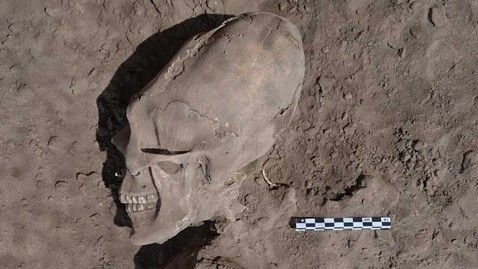
‘Alien’-Like Skulls Found in Mexico

ht deformed skull mexico ll 121221 wblog Alien Like Skulls Found in Mexico

Cristina Garcia/INAH

Dec 21, 2012 3:17pm

Archaeologists in Mexico have uncovered 25 “alien”-looking human skulls with in a cemetery in the northwest state of Sonora, they said today.

Some of the skulls showed “deformities,” said Cristina Garcia Moreno, who worked on the excavation project with Arizona State University, which analyzed the bones. The bones are about 1,000 years old, dating from 945 A.D. to 1308 A.D.

“This was an Hispanic cemetery with 25 skulls, and 13 of them have deformed heads,” Moreno told ABC News today. “We don’t know why this population specifically deformed their heads."

Moreno said that scientists had found skulls in other parts of Mexico, including Guasave, south of Sonora that also showed similar deformities in certain groups of people. Scientists believe they put beams of wood on the front and back of individuals’ heads and wrapped the wood with bands to exert pressure on the skull, Moreno said.

“We know that in some parts of Mexico, people deformed their heads because they wanted to distinguish important people or they wanted to distinguish people from one group from another,” she said.

Moreno said that skulls like this had never before been found in Sonora, and that many of the skeletons in the cemetery were those of children.

Hoe vind je dit bericht?
Geschreven door peter om 15:14 Stuur door

An Improved Copy Of Condon ...

An Improved Copy Of Condon ...

What's to lose at this point?

Don Berliner, former NICAP investigator and director of the mostly dormant Fund For UFO Research, has some ideas on how to jump-start a sober re-evaluation of The Great Taboo that doesn't involve new research: Declassify all the Project Blue Book files (yes, some are still censored more than 40 years later), assemble a team of independent credentialed scientists to render evaluations on the true unknowns, case by case, and air them out in the contemporary public arena.  No doubt the effort would run into some bucks, but the cases would come from official government files. And non-government panelists wouldn't likely shy away from criticizing the slipshod work of another federal agency.

De Void rarely features guest bloggers, but at 84, Berliner merits some space here, meager though it be. So here's Don:

xxxx/CREDIT: paranormalknowledge.com

Why not use original government data to get it right the second time around?/CREDIT: paranormalknowledge.com

For the past several decades, the private UFO community hasn't moved one inch closer to solving the greatest mystery of the past century. Even worse, we've lost almost all our ability to influence the opinions of members of the scientific community, the mainstream media and most of the governments of the world.

We reached our peak in the mid-1960's when the 14,000-member National Investigations Committee on Aerial Phenomena (NICAP), under the inspired leadership of Donald Keyhoe and Richard Hall, had established highly effective relationships with those vital elements of our society. The media, in particular, regularly came to NICAP for facts and guidance. Today, with two national organizations each collecting more than 500 UFO/UAP reports a month, it would be hard to find a reporter who has any clue that such is happening, with the result being that the public has no idea that strange craft are still being seen.

NICAP's facts were produced by the highly qualified and experienced members of carefully selected investigative sub-committees who went out into the field to find out what had actually happened, not to reinforce anyone's preconceived opinions nor to add to anyone's collection of allegedly unexplained events.

There are changes that can be made to improve the situation:

  • 1. Get rid of "UFO", which to most people means "flying saucer," and that means alien spacecraft. In other words, "UFO" is a conclusion, when it should be no more than a starting point. A replacement is ready and waiting: "UAP," meaning Unexplained Aerial Phenomena. Many of the scientists in the private UFO community have been using this for years.
  • 2. Get rid of "Ufology" and "Ufologist," which strongly imply that the collecting of information and the subsequent study of it constitute a science.
    It will remain no more than a hobby until we make drastic changes in the way we view the subject and our own involvement.
  • 3. While we're at it, let's add "sincere" to our list of words to be dropped.
    The category of people most needing to be considered sincere is "con-artist."
    And while we certainly aren't suggesting that more than an occasional sighting witness deserves to be in that group, using it to describe someone who hasn't been subjected to an extensive background investigation is passing judgement on the basis of emotion, rather than logic.
  • 4. Stress the need for field investigators having advanced educations and/or practical experience in appropriate scientific fields. By including hobbyists and "saucer fans," we are actively discouraging the participation of the very
    people we need most. Imagine a curious scientist joining a field investigation, only to find himself working alongside someone who is in serious danger of flunking freshman chemistry. The scientist won't be back, while the marginal student will.
  • 5. Forget about trying to influence the U.S. Congress as a way to force the release of a large quantity of withheld government information. Members of Congress lack both the will and the motivation needed to risk their jobs over an issue that promises little beyond embarrassment. Let's face it: one of the easiest ways to replace a sitting member is to accuse him of believing in flying saucers. He or she may be able to withstand personal attacks based on financial or sexual misconduct, but not on something viewed by peers as suggesting a serious lack of common sense.
  • 6. Start using the Hynek "Strangeness/Credibility Scale" to pin-point UFO/UAP reports having the potential for adding to the accumulated knowledge of UFOs/UAPs. Cramming filing cabinets with sightings of meandering night lights amounts to nothing more than wasting time on trivia. It is the quality of cases that will eventually pay off, not the quantity.
  • 7. Perhaps the biggest step we can take in the near-term is to stop behaving like the mystery has been solved and all that remains is to lay out the evidence for the ignorant masses to absorb. In fact, the UFO mystery has not been solved, nor will it be until we have acquired proof, not merely debatable evidence. Just because we haven't been able to come up with logical, non-alien explanations for hundreds of baffling cases doesn't mean that there aren't any. Maybe we have overlooked something subtle that could change the picture.

Just what will constitute proof?

  • 1. Clear, sharp photographs that can be scientifically verified and which show sufficient detail so that they could not possibly be of anything terrestrial.
  • 2. Government documents that can be scientifically confirmed as original (not photocopies), and which include specific information whose authenticity can be checked.
  • 3. Physical evidence such as obviously unusual debris from one or more crashes, whose origins can be traced with confidence and whose properties do not resemble anything found on Earth. The professional scientists or scientific organizations doing the analyses must be willing to sign their names to any reports.

We aren't going to get any of the above by sending out "saucer fans" to interview people who claim to have seen funny lights. We have to start taking the mystery as a serious challenge, and not as entertainment or a way to attract attention to ourselves.

[Got any ideas for Don Berliner? rofuf@konsulting.com -- De Void]

Be Sociable, Share!

Hoe vind je dit bericht?
Geschreven door peter om 22:52 Stuur door

Jacques to the Rescue ...

Jacques to the Rescue ...

America, The Cause and Solution to UFO Research: Jacques Valle to the Rescue

You are here: Home / Paranoia / Aliens / America, The Cause and Solution to UFO Research: Jacques Valle to the Rescue

GFC-2011-Jacques-Vallee-thumbgeorgeknapp

The problem with American UFO Research: Jacques Vallee has a
Solution

At 1am eastern on July 28th, 2014 we all were able to tune in to one of the most important 2 hours of the year in talk radio, in my opinion of course. George Knapp, long time weekend host for the overnight juggernaut we know and love as Coast to Coast Am, had Jacques Vallee on as a special guest. Jacques sounded well, upbeat and as always full of knowledge that you will not find at your local conference or internet radio show and realistically not on my weekly show either but, we can dare to dream. The fact is if you had to create your own version of a Mount Rushmore of UFO/UAP researchers mine would have Jacques Vallee on it 4 times. You didn’t really expect me to rattle off 3 other researchers did you? It is a fantasy Mount Rushmore and mine will have the same person on it that I know for a fact is not in the field of research for fame, big money or fabulous prizes. The man is a venture capitalist, need I go further in dispelling any idea he is here for money? No? Good. As for the fame and fabulous prizes, he has already had that 40 years ago. I don’t need to go into detailed defenses on a mans credibility because Jacques Vallee is the only one for sure that is not lying to me.

American UFO research is predicated on a few things and one of which that holds up the entire field is the propriety of collected data. That’s right, the data that various research organizations, feel free to name your own alphabet soup group if you wish to fill in the blank, is locked away for safe keeping or worse minimized. Why? Well, there are various legalities that can be trotted out about how it’s a step to protect the abductee/witness which is of course necessary. What happens next is a side effect that not many intended and has been perpetuated for decades. The data dies a slow death in a hard drive or folder creating what I call a Mind Cemetery, literally. The events, ideas, thoughts, feelings and facts get hidden from the world. Most importantly, other research organizations.

When I call the data from cases collected proprietary then I mean it becomes theirs to do so as they wish. Most organizations, big & small alike hold onto the data for the purpose up pitching it to a production company as a way to get more exposure/interest/memberships. In the cases of individual researchers it seems that the case data slides right into whatever narrative that researcher is promoting. This is where it gets greasy. This is the breeding ground of the mentally disturbed, ever vigilant, never questioning and always praising… fan or the long version fanatic.  Now, a symbiotic relationship exists that must be feed, nurtured to grow bigger and inevitably less intelligent, like a mindless rabble. It pays well to have a big tent. It pays well to play to an already paranoid base by blaming the same Gub’ment boogy-man. It’s safe and we all hate the boogy-man.

The solution that Jacques Vallee spoke of is simple: Develop an international database, Yes this means you too America. 

A one-stop shop internet database of every piece of digital or soon to be digitally converted data from all UFO/UAP research organizations in America. Lofty? More like impossible. With the field the way it is now and the same old language being used it’s looking more and more like researchers using Unidentified Aerial Phenomena are on the right track. The less people who keep using pseudoscience labels such as Ufologist the better.  Change the language, open the faults and increase the collective knowledge. Forget the fantasy of Disclosure. That ship has sail and caught fire like a viking funeral. If any alien visitor et al. wanted to let you know they were here they would do so themselves. Asking a congressperson to watch a DVD and then bring it to the floor for discussion is career suicide in/out of election years. These things we know to be obvious but, for some reason the band plays on. Propriety.

Ask, Why?

Ask your favorite UAP research organization, be it one you are in or one you follow closely, because they gained your trust. Is this organization willing to participate in an international data base? If not, why? I bet you hear about witness/abductee confidentiality concerns which are very real and should not be taken lightly. That is unless you get some cash flashed at you then the books come flying open. That was proven the fact with a highly popular organization and an independent space pioneer. Notice how the concerns for the public’s best interests melt away with cool cash. I leave it up to the community, the culture that we have right now and the people most interested in the subject to call their local researcher tell them you want your case to be apart of a national database like Jacques Vallee has discussed. I understand the server requirements, logistics and such need to be worked out. They get worked out a lot sooner the more interest that comes Jacques Vallee’s way.

Be proactive and push the UAP researchers as individuals and organizations to work with Jacques Vallee.

Jacques Vallee is worthy of the communities trust.

Listen LIVE! Every Monday from 9-11pm eastern on The UFO Paranormal Radio Network

Follow Mind Cemetery on Twitter @mindcemeter

Like Mind Cemetery on Facebook

Archives of the show can be found at Soundcloud.com/uprn

Related Posts:

Hoe vind je dit bericht?
Geschreven door peter om 21:49 Stuur door

Careful What You Ask For

Careful What You Ask For

Hi all:
What a coincidence! As to refereed journals and ufos I recently informed Seth Shostak of Dr. Bruce Maccabee's paper "Still In Default", notably "Non-publication of Scientific Papers" (pp 12-20) and the scientific article "Inflation-Theory Implications for Extraterrestrial Visitation" by Dr. J. Deardorff, Dr. B. Haisch, Dr. B. Maccabee and Dr. H.E. Puthoff, which was published in the Journal
of the British Interplanetary Society (JBIS) in 2005 (http://www.ufoskeptic.org). So, when I found this article yesterday  it sounded very familiar to me. ;)
Kind regards.
André Skondras
 
ABSTRACT (from Still In Default, updated version 1998/2004)
  • "For nearly 40 [more than 50] years, the science establishment has ignored the UFO problem,relegating it to the domain of "true believers and mental incompetents" (a.k.a. "kooks and nuts"[according  to former editor John Howard of Applied Optics magazine]). Scientists have participated in a "self-cover-up" by refusing to look at the credible and well reported data. Furthermore, some of those   few scientists who have studied UFO data have published explanations which are unconvincing or just plain wrong and have "gotten away with it" because most of the rest of the scientific community   has not cared enough to analyze these explanations. The general rejection of the scientific validity of UFO sightings has made it difficult to publish analyses of good sightings [in refereed        journals of establishment science]. Examples are presented of the scientific-self-cover-up involving erroneous explanations, refusal to look at the data, and rejection of papers for publication.    How long wi ll this situation last? Forty [fifty] years is long enough [too long]."

Careful what you ask for

by Billy Cox, Herald-Tribune


Radioastronomer Seth Shostak, last making headlines in May alongside colleague Dan Wertheimer by appearing on Capitol Hill to appeal for congressional SETI funding, is one of the nicest, brightest and most approachable scientists you’ll ever want to meet. Even during disagreements over
The Great Taboo, the SETI Institute’s senior astronomer is unfailingly cordial.
So when British chemist Erol Faruk tuned into a podcast in which  Shostak asked listeners to send him “just one good example” of UFO evidence, Faruk took him at his word.

Sometimes it doesn't matter how prepared you are .../CREDIT: www.pintinterest.com

Sometimes it just doesn't matter how prepared you are .../CREDIT: www.pintinterest.com

The results of Faruk’s quixotic quest for a fair hearing from Shostak and mainstream science have just been released in his self-published ebook on Amazon. It pretty much strips away the myth that institutional scholars would welcome Great Taboo data if Only They Had Decent Stuff To Study. Its title is a mouthful - The Indisputable Scientific Evidence for a UFO Landing and Deposition (aka The Delphos Case) that was denied Publication by Scientific journals — but it’s a relatively succinct reiteration of the hallmark timidity that characterizes — or more aptly, impedes — America’s learning curve into terra incognita.

First, Erol Faruk has what exclusive groups like to call standing. He has a PhD in chemistry, worked research posts at Oxford and Nottingham universities, and became a development chemist at the corporation that became GlaxoSmithKline Pharmaceuticals. He has published peer-reviewed papers in arcane industry journals such as Helvetica Chimica Act, and The Journal of Antibiotics. He holds several formula patents. He speaks the language.

Years ago, Faruk got interested in the 1971 Delphos, Kan., UFO case. No need to rehash the whole thing here, you can read all about it online, but what sucked him in was the ring of glowing soil it left behind.
The family took pictures moments after the UFO took off, local media and law enforcement converged on the scene, and the ring scars lingered long afterwards.
Fungal growth was the chief suspect at the top of the conventional explanations list, but it couldn’t account for the temporary blindness alleged by one witness, nor the numbing sensation reported by another who touched the glowing earth when it was still fresh.

Faruk, years later, subjected several grams of affected soil to chemical analysis and discovered some puzzling behaviors in the sample compounds, including an apparent paradox in water soluble and water repellent properties.
Most intriguing to him was how, as he would later write, the UFO “appears to have contained within its periphery an aqueous solution of an unstable compound whose likely sole function would be light emission.” Many UFOs are reported to glow. Maybe these trace effects held implications above and beyond this single event.

Faruk’s research was published in the Journal of UFO Studies in 1989.
Analytical chemist Phyllis Budinger later weighed in with her own study.
Budinger interpreted some of Faruk's findings differently, but she also discovered complexities that he had missed. JUFOS published Budinger's work in 2002.

Their combined efforts vanished with little comment. Faruk figured maybe that was because they were circulated in narrow-niche publications, and that it needed more eyes. So he decided to approach mainstream science journals, starting with Nature, the bible, in 2012. Maybe the exercise was doomed from the beginning, given the title of his paper — “The search for signs of extraterrestrial intelligence on earth; strong chemical and physical evidence for the existence of an unconventional luminescent aircraft (commonly called a UFO) observed by multiple witnesses at a farm in Delphos, Kansas, USA.” Ugh, that acronym again. But this is where things get interesting.

After being initially rejected outright since his work had been previously published, Faruk explained how the paper could be reworked to satisfy Nature’s exemptions to that rule. But the Nature editor declined to even run it past journal  referees. He said he was “unable to conclude that the work provides the sort of firm advance in general understanding that would warrant
publication.”

(De Void will interject at this point that De Void would have run with the editors’ names. Faruk stated in an email “I didn't wish to put any names on journal editors, since this isn't a personal issue. Each of the editors have to watch their own backs anyway, and aren't likely to risk their own careers by publishing material their bosses might not be happy about.” De Void would rgue the unnamed editors could earn brownie points among fraternal colleagues by being recognized for standing firm against The Great Taboo, but whatever ...)

Anyhow, Faruk shopped it to the Journal of the British Interplanetary Society, which informed him “the subject matter is not within the [journal’s] publication scope.” When Faruk reminded the editor a UFO-related paper had been published in its ostensibly unsullied pages seven years earlier, the editor retorted that was under another regime. “As I am Editor of JBIS,” he assured Faruk, “it is not my policy to promote the publication of UFO report papers.”
The same editor admitted he hadn’t even read Faruk’s paper, “although I am sure it is a good read.” And oh, btw, “This is not to say it isn’t a worthwhile ‘phenomenon’ to study, I just don’t believe JBIS should be the home of such studies, where a higher standard of scientific rigor is required.”

Ouch. And without even reading it. Faruk would later discover JBIS had run yet another UFO article — alien abductions, actually — in 2010. JBIS declined to respond to Faruk's subsequent appeals for additional discourse.

Enter Seth Shostak’s encouraging podcast solicitation for UFO evidence. So Faruk forwarded his material to the guy. “I’m not a chemist, so can’t really speak to how unusual this ring was,” Shostak wrote back. “... And beyond that, the SETI Institute doesn’t investigate UFO sightings (we don’t have the staff ... we’re a very small group.”)

Oy vay!

We can solve this riddle -- but first we have to know the category/CREDIT: braininjurysociety.com

We can solve this riddle -- but first we have to know it's in the approved category/CREDIT: braininjurysociety.com

Faruk wrote back with emphasis on the “potentially chemiluminescent substance” that could put the evidence into a “special category.” Shostak responded that “Odd arrangements (of) unusual material ... could have prosaic explanations” falling far short of a smoking gun. Faruk wrote that was the whole point, to put it out there to encourage more investigation: “The only thing I can think of as a ‘clincher’ is to do an isotopic analysis of the precipitated soil compound and check for anomalies.

Shostak’s riposte: “What I would suggest is that you submit this to a refereed journal.”

(De Void: EEEEEEEEE!!)

Faruk told Shostak he’d already been rebuffed by JBIS. Shostak wrote “Too bad, Erol. JBIS would have been one of those I would have recommended.”

So, eight months after telling it to the hand, Faruk approached JBIS again, going through its website channels. Same editor, same response: “Please don’t take the rejection personally. It is simply my editorial policy to not publish UFO papers. This is not because I don’t think that field of study is worthy but because I think there are other more fitting journals which specialise in this area and JBIS does not, by my choice.” Said editor referred him to other UFO magazines.

Faruk protested again. The editor restated his policy, and that of his advisory board, none of whom had read Faruk’s article, either. “I agree it’s one of the biggest scientific problems,” conceded the JBIS boss. “Keep in mind that NASA and ESA scientists publish in JBIS. How would they feel about it? It’s a tough one. Need to maintain academic credibility. But I say again, this doesn’t devalue the worth of your work. Keep doing it.”

Shostak actually seemed to sympathize with Faruk, and added, “I know that it sounds as if the world is against this, but that’s really not true. The International Journal of Astrobiology publishes stuff that’s controversial if the referee feels that the evidence presented is decent.”

So Faruk went to the IJA. The IJA editor replied “This is not a rigorous research paper.” Faruk asked for clarification. “We need detailed chemical analyses not just morphological analyses,” the editor countered. “In my opinion you have the ground for the formation of a hypothesis, but not the proof.
Suggest a few alternative hypotheses and test them experimentally as well.”

Faruk: “If there is someone out there who could suggest another explanation, I would be interested to hear it. But in order to do that, the paper needs to be published to allow alternative explanations to be forwarded. I cannot myself — in all honesty — suggest an alternative hypothesis.” The IJA locked the door this time.

Faruk approached yet another journal, called simply Astrobiology. Response: “We are unable to publish your manuscript as UFO’s do not fall within the scope of our Journal.”

Faruk continued to bounce ideas off Shostak, who was clearly at the end of his rope with Faruk’s persistence: “You could always go for a self-published book. I have a stack of those, actually ... so yours wouldn’t necessarily stand out, unless what you say is quite different.” Bottom line, Shostak declined altogether any further speculation with Faruk on the Delphos mystery.

Wonder if that podcast offer to evaluate UFO data still stands ...

Be Sociable, Share

  • more.png
Hoe vind je dit bericht?
Geschreven door peter om 11:12 Stuur door

When Fact Becomes Fiction ...

When Fact Becomes Fiction ...

Rare TV interview with Admiral Richard E Byrd 'There is a secret land mass the size of the US'


Admiral+Byrd+Hollow+Earth+Arctic.jpg
Admiral s two flights over both Poles prove that there is something strange about the shape of the Earth in both polar areas.
Byrd flew to the North Pole and went for 1,700 miles beyond it. Due to his gasoline supply running low he turned back to his Arctic base.
Admiral Byrd starts the conversation by explaining that there is a secret land mass the size of the United States that has never been seen by anyone.
Hoe vind je dit bericht?
Geschreven door peter om 19:57 Stuur door

Looking Down From An Alien Perspective

Looking Down From An Alien Perspective

Astronaut Spots Explosions over Israel and Gaza from Space (Photos)

By Megan Gannon, News Editor

Date: 23 July 2014 Time: 04:31 PM ET

Alexander Gerst
My saddest photo yet. From the International Space Station we can actually see explosions and rockets flying over Gaza and Israel.

 ESA astronaut Alexander Gerst posted this photo of Israel and Gaza on July 23, 2014, as seen from a window of the International Space Station.
CREDIT: Twitter/Alexander Gerst

As fighting continues in Israel and Gaza, astronauts living aboard the International Space Station can see signs of the deadly conflict from space.

Alexander Gerst, a German astronaut with the European Space Agency, posted
photos to Facebook and Twitter today (July 23) showing Israel and the Gaza Strip alongside a grim caption.

"My saddest photo yet. From the International Space Station we can actually
see explosions and rockets flying over Gaza and Israel," Gerst wrote on Facebook underneath two nighttime views of the region.

Israeli troops and Hamas militants have been embroiled in conflict for more than two weeks, exchanging heavy fire that has left 680 Palestinians and 34 Israelis dead so far, according to the Associated Press. U.S. Secretary of State John Kerry and U.N. Secretary-General Ban Ki-moon went to Jerusalem in an attempt to help broker a ceasefire, but as of Wednesday afternoon, no such deal had been struck.

"We have certainly made some steps forward and there's still work to be done," Kerry said in remarks today before his meeting with Ban.

For all their risky and difficult work, the astronauts living on the space station are rewarded with a rare view of the planet. They see neon green auroras hovering over the curvature of Earth and the floodlit veins of big cities at night. But not every vista inspires wonder and appreciation, and Gerst is hardly the first astronaut whose view has been tarnished by destruction, both natural and manmade, on the ground.

On Sept. 11, 2001, NASA astronaut Frank Culbertson captured a photo of a plume of smoke billowing from the World Trade Center after two hijacked planes crashed into New York City's twin towers. From an altitude of 220 miles (350 kilometers), Expedition 26 astronauts could see the lingering floodwaters from the devastating tsunami that swept over Japan on March 11, 2011, after a huge 9.0-magnitude earthquake. Another group of astronauts aboard the space station photographed the damage and flatted buildings in Port-au-Prince in the days after a massive earthquake struck Haiti on Jan. 12, 2010.

Follow Megan Gannon on Twitter and Google+.
Follow us
@Spacedotcom, Facebook or Google+.
Originally published on 
Space.com.

Hoe vind je dit bericht?
Geschreven door peter om 19:23 Stuur door

Meer van UFO'S of UAP'S, ASTRONOMIE, RUIMTEVAART, ARCHEOLOGIE, OUDHEIDKUNDE, SF-SNUFJES EN ANDERE ESOTERISCHE WETENSCHAPPEN - DE ALLERLAATSTE NIEUWTJES

↑ Terug naar de berichten