Naar de inhoud

UFO'S of UAP'S, ASTRONOMIE, RUIMTEVAART, ARCHEOLOGIE, OUDHEIDKUNDE, SF-SNUFJES EN ANDERE ESOTERISCHE WETENSCHAPPEN - DE ALLERLAATSTE NIEUWTJES

UFO's of UAP'S in België en de rest van de wereld
BerichtenArchiefGastenboekContact
akke.beakke.be
Ontdek de Fascinerende Wereld van UFO's en UAP's: Jouw Bron voor Onthullende Informatie! Ben jij ook gefascineerd door het onbekende? Wil je meer weten over UFO's en UAP's, niet alleen in België, maar over de hele wereld? Dan ben je op de juiste plek! België: Het Kloppend Hart van UFO-onderzoek In België is BUFON (Belgisch UFO-Netwerk) dé autoriteit op het gebied van UFO-onderzoek. Voor betrouwbare en objectieve informatie over deze intrigerende fenomenen, bezoek je zeker onze Facebook-pagina en deze blog. Maar dat is nog niet alles! Ontdek ook het Belgisch UFO-meldpunt en Caelestia, twee organisaties die diepgaand onderzoek verrichten, al zijn ze soms kritisch of sceptisch. Nederland: Een Schat aan Informatie Voor onze Nederlandse buren is er de schitterende website www.ufowijzer.nl, beheerd door Paul Harmans. Deze site biedt een schat aan informatie en artikelen die je niet wilt missen! Internationaal: MUFON - De Wereldwijde Autoriteit Neem ook een kijkje bij MUFON (Mutual UFO Network Inc.), een gerenommeerde Amerikaanse UFO-vereniging met afdelingen in de VS en wereldwijd. MUFON is toegewijd aan de wetenschappelijke en analytische studie van het UFO-fenomeen, en hun maandelijkse tijdschrift, The MUFON UFO-Journal, is een must-read voor elke UFO-enthousiasteling. Bezoek hun website op www.mufon.com voor meer informatie. Samenwerking en Toekomstvisie Sinds 1 februari 2020 is Pieter niet alleen ex-president van BUFON, maar ook de voormalige nationale directeur van MUFON in Vlaanderen en Nederland. Dit creëert een sterke samenwerking met de Franse MUFON Reseau MUFON/EUROP, wat ons in staat stelt om nog meer waardevolle inzichten te delen. Let op: Nepprofielen en Nieuwe Groeperingen Pas op voor een nieuwe groepering die zich ook BUFON noemt, maar geen enkele connectie heeft met onze gevestigde organisatie. Hoewel zij de naam geregistreerd hebben, kunnen ze het rijke verleden en de expertise van onze groep niet evenaren. We wensen hen veel succes, maar we blijven de autoriteit in UFO-onderzoek! Blijf Op De Hoogte! Wil jij de laatste nieuwtjes over UFO's, ruimtevaart, archeologie, en meer? Volg ons dan en duik samen met ons in de fascinerende wereld van het onbekende! Sluit je aan bij de gemeenschap van nieuwsgierige geesten die net als jij verlangen naar antwoorden en avonturen in de sterren! Heb je vragen of wil je meer weten? Aarzel dan niet om contact met ons op te nemen! Samen ontrafelen we het mysterie van de lucht en daarbuiten.

Categorie: Diversen (Eng, NL en Fr)

Woensdag 2 september 2026

A Discovery Hidden in Antarctica’s Soil is Unlike Anything Found Elsewhere on Earth, Challenging Past Assumptions

Noah Fierer collects samples at the Shackleton Glacier, near the Ross Ice Shelf.
Image Credit: Byron Adams.

A Discovery Hidden in Antarctica’s Soil is Unlike Anything Found Elsewhere on Earth, Challenging Past Assumptions

Christopher Plain

Scientists at the University of Colorado at Boulder’s Cooperative Institute for Research in Environmental Sciences (CIRES) have discovered that some microbes in Antarctica’s soil don’t exist anywhere else on Earth, upending the long-held belief that microbes move freely around the planet and inhabit many regions.

The researchers behind the discovery said understanding that some microbes are endemic to Antarctica’s soil challenges previous assumptions and offers valuable insights for future research and present-day conservation efforts.

Microbes in Antarctica’s Soil Live in an Extreme Environment

Announcing the findings, study leader and postdoctoral researcher Nick Dragone and co-author Noah Fierer, a CIRES Fellow and Director of the Center for Microbial Exploration, noted that scientists have always assumed that microbial species were widespread.

“There is a long-standing assumption in microbiology that ‘everything is everywhere,’” Dragone explained.

That’s because, unlike plants and animals, which are generally restricted to certain global zones or latitudes, microbes are highly mobile. For example, a simple updraft could propel microbes into an atmospheric jet stream, then deposit them hundreds or even thousands of miles away.

Still, Dragone and Fierer propose that, given Antarctica’s remote location, if there were a spot on Earth containing species unlike the rest of the globe, it would be on the planet’s southernmost continent.

“If we do find we’re looking for endemic microorganisms, a good place to start is Antarctica, because it’s an entire continent that is geographically isolated, ” Fierer said.

The study coauthor also noted that the unique conditions found in Antarctica’s soil aren’t usually found in other soil environments. “[Being] cold is the obvious one,” Fierer said, “but also super dry; Antarctica is a desert.”

Comparing 100 Antarctic Strains with 500 Worldwide Strains

Instead of starting with any microbial species, the CIRES team focused on bacterial strains within the Arthrobacter group. First, these strains grow well in lab conditions, which was critical to the team’s experiments. Second, Arthrobacter group bacterial strains are found in diverse environments ranging from the tropics to Colorado, and most critically, to Antarctica’s soil.

Byron Adams, professor of biology at Brigham Young University and a co-author of the study, said the species is widespread, but also diverse.

“Arthrobacter as a group may be found all over the planet, but when we look closely at individual strains, just like penguins, Antarctica clearly has its own distinctive biological history,” the professor explained.

To start, the team collected soil samples from Antarctica. They also collected comparison samples from similarly cold, arid regions like the Tibetan Plateau, Svalbard in the Arctic, and Chile’s Atacama Desert.

When examining the sampled soils, the team tested over 100 Antarctic bacterial strains and 500 worldwide strains.

Dragone and Fierer both noted that the research was made possible by “long-term collaborations among international research teams who have spent decades collecting samples across the continent for various projects.”

Genetic Sequencing Finds 90% of Antarctic Microbes are Endemic

After sequencing the genomes of the Arthrobacter strains found in samples from Antarctica’s soils, the team compared them with worldwide strains. For the worldwide species, the team obtained genomes from international research databases.

As hoped, the genetic comparison found species in Antarctica’s soil that were not found anywhere else in the world. Perhaps even more shocking, 90 percent of the Antarctic strains they’d sequenced were completely endemic, with no matches anywhere in the world.

Fierer said previous studies had identified “a few endemic microbes found in very specific environments.” However, the researcher also noted that finding such a large and unexpected number of endemic microbial species “does suggest there could be some in other locations.”

“[Determining] whether other microbial groups show these patterns is a good direction to go,” Fierer added.

  • paranormal beliefs
See Also

Are Paranormal Beliefs and Cognitive Function Linked?

Next, the team ran a follow-up experiment to see whether the endemic Antarctic strains showed signs of adaptation to the local, extreme environment. This included growing strains of the collected Antarctic Arthrobacter strains in the laboratory. Critically, the team mimicked the continent’s harsh environmental conditions.

First, the experiments showed that the strains collected from Antarctica’s soil were extremely resilient. They also grew more slowly than non-endemic strains. The team suspects these results show that Arthrobacter strains “are uniquely adapted to Antarctica.”

“We already knew that a broad diversity of microbes can survive the inhospitable conditions of Antarctica,” Fierer said. “Now we know that some of those microbes are also unique to Antarctica and are uniquely adapted to life on the southern continent.”

“Some of Antarctica’s Most Distinctive Species are Microscopic”

When discussing the implications of their findings, Adams pointed to a potential shift in public perception of what species diversity means.

“We tend to think of biodiversity in terms of penguins, seals, and whales, the researcher explained, “but this shows that some of Antarctica’s most distinctive species are microscopic.”

Along with the study’s scientific and public relations value, the team said it “sets the stage for future research on microbial life in Antarctica.” They also noted that the findings will aid efforts to preserve Antarctica’s biological diversity, including its microbial species.

“Protecting Antarctic biodiversity also means protecting the biological history contained in a handful of soil,” Adams concluded.

The study, “Evidence for endemism and local adaptation in Antarctic soil bacteria,” was published in the Proceedings of the National Academy of Sciences. 

  • Christopher Plain is a Science Fiction and Fantasy novelist and has spent the last six years as Associate News Editor and Head Science Writer at The Debrief. Follow and connect with him on X, learn about his books at plainfiction.com, or email him at christopher@thedebrief.org.

{ https://thedebrief.org/category/science/ }

Diversen (Eng, NL en Fr)

Hoe vind je dit bericht? 0 stemmen
Geschreven door peter om 22:13 Stuur door
Vrijdag 28 augustus 2026

Nepal's flood could just be the beginning: Maps reveal the glaciers around the world at risk of a similar disaster - with 15 million people in the danger zone

Nepal's flood could just be the beginning: Maps reveal the glaciers around the world at risk of a similar disaster - with 15 million people in the danger zone

  • READ MORE: Scientists blame climate change for Nepal's flash flood

By WILIAM HUNTER, SENIOR SCIENCE & TECHNOLOGY REPORTER

Hundreds of people have been killed, and more than 1,500 are still missing after devastating flash floods swept through the Nepal–Tibet border.

Scientists believe the disaster was triggered by the collapse of a glacier on the Langtang–Lirung mountain, which registered as a magnitude 5.2 earthquake.

Although it may take months of research to uncover the exact story, experts are already warning that this is 'not a one–off event'.

Dr Jonathan Carrivick, an expert on glacial flooding from the University of Leeds, told the Daily Mail: 'Climate change is warming the mountains, causing permafrost and glaciers to melt.'

According to the expert, this makes 'the likelihood of these sorts of events – possibly bigger – more frequent.'

Overall, researchers estimate that a whopping 15 million people worldwide are living in danger zones. 

While the Himalaya, Karakoram, Hindu Kush and neighbouring ranges in Asia are most at risk, people living in the US and Canada are also in danger.

'North America could experience something similar to what we see in Nepal today,' Dr Carrivick warned. 

As rescue efforts continue in the flood-hit regions of Nepal and Tibet, scientists have mapped which glaciers around the world could be at risk of a similar disaster. Pictured: Red regions show areas of high Glacial Lake Overflow Flood risk

As rescue efforts continue in the flood–hit regions of Nepal and Tibet, scientists have mapped which glaciers around the world could be at risk of a similar disaster. Pictured: Red regions show areas of high Glacial Lake Overflow Flood risk

High Mountain Asia is the most threatened region because it is rapidly warming, and hosts rapidly melting glaciers, growing meltwater lakes and some of the world's steepest mountains

High Mountain Asia is the most threatened region because it is rapidly warming, and hosts rapidly melting glaciers, growing meltwater lakes and some of the world's steepest mountains 

Hundreds of people have been killed, and more than 1,500 are still missing after devastating flash floods swept through the Nepal-Tibet border

Hundreds of people have been killed, and more than 1,500 are still missing after devastating flash floods swept through the Nepal–Tibet border

Although scientists are still scrambling to understand the disaster, the current evidence suggests that Nepal's deadly floods are the consequence of glacial collapse.

Dr Carrivick says: 'This Nepal event appears to have been a massive rock failure that took a large part of the glacier with it.'

According to the research group Antarctic Glaciers, which combines the efforts of about 50 leading experts, initial analysis shows that there was a landslide and glacier collapse shortly before the flood.

This sent ice and rock cascading down the mountain, mixing with sediment left by previous floods, and temporarily blocking the Lhende Khola River.

That caused a large lake to temporarily form before it broke through in a devastating flood.

Deadly events exactly like this have happened in the past and are likely to keep happening with increasing regularity as climate change continues.

For example, in 2021, a massive rock and ice triggered a deadly debris flow that killed over 200 people and damaged two hydroelectric power plants.

Meanwhile, in Canada, a rockslide in 2020 saw 18 million cubic metres of stone cascade into a glacial lake, sending 100–metre–tall waves that scoured a 6–mile (10km) channel.

Outside of Asia, glaciers in the Alps are also putting many areas at high risk of Glacial Lake Outburst Floods

Outside of Asia, glaciers in the Alps are also putting many areas at high risk of Glacial Lake Outburst Floods 

The researchers note that the Andes is an area of risk that might have been greatly underappreciated in previous research

The researchers note that the Andes is an area of risk that might have been greatly underappreciated in previous research

Scientists say that Nepal's flooding was not caused by a Glacial Lake Overflow Flood, but warn that this related risk is increasing all over the world. Pictured: Distribution of people at risk of glacial flooding

Scientists say that Nepal's flooding was not caused by a Glacial Lake Overflow Flood, but warn that this related risk is increasing all over the world. Pictured: Distribution of people at risk of glacial flooding 

What caused the flooding in Nepal and Tibet?

Scientists say that initial analysis the day after the flooding indicates a landslide and glacier collapse from the Langtang–Lirung mountain.

Ice and rock then cascaded down the mountain, mixing with further sediment and water as it travelled down–valley.

The landslide temporarily blocked the Lhende Khola River, causing a large lake to build before it broke through the dam and unleashed a massive flood.

Early reports suggested an earthquake was the trigger, but data now shows that a major rockfault leading to glacial collapse was the cause. 

Source: Antarctic Glaciers 

Scientists have also raised the alarm that mountainous regions are becoming increasingly at risk of a similar threat, known as a glacial lake outburst flood (GLOF).

This occurs when meltwater from a glacier forms a large lake at its base that is held back by a thin, unstable natural dam.

If the glacier collapses or the meltwater gets too high, that barrier can break, releasing a devastating cascade of water downhill.

Scientists do not currently believe that the deadly floods in Nepal and Tibet were caused by a GLOF, since satellite images do not show any major lakes forming in the area prior to the landslide.

However, glaciers around the world are now putting more people in danger of this form of flooding, which could prove just as, if not more, deadly than what has been seen in Nepal.

In their paper, published in Nature Communications, researchers used the latest modelling to map where this risk was highest.

They found that more than half of the 15 million people threatened by GLOFs live in just four countries: India, Pakistan, Peru, and China.

Populations in High Mountain Asia (HMA), which includes the Himalaya, Karakoram, Hindu Kush and neighbouring ranges, are most at risk.

Scientists currently believe that the floods were triggered by a rock slide that led to glacial collapse on the Langtang-Lirung mountain

Scientists currently believe that the floods were triggered by a rock slide that led to glacial collapse on the Langtang–Lirung mountain

Geological factors in the Himalayas lead to 'hazard cascades', chain reactions that release huge volumes of ice and water into populated areas - just like the recent disaster in Nepal

Geological factors in the Himalayas lead to 'hazard cascades', chain reactions that release huge volumes of ice and water into populated areas – just like the recent disaster in Nepal

The countries most at risk of Glacial Lake Outburst Flooding

  1. China
  2. Pakistan
  3. Peru
  4. Canada
  5. India
  6. USA
  7. Chile
  8. Italy
  9. Nepal
  10. Columbia

Here, people are the most exposed on average and live closest to glacial lakes, with more than a million people living less than six miles (10km) from one.

This region is home to 62 per cent of all people exposed to GLOFs, with three million in India and two million in Pakistan.

Co–author Dr Matt Westoby, Associate Professor of Physical Geography at the University of Plymouth, told the Daily Mail: 'High Mountain Asia is one of the fastest warming regions globally.

'It hosts rapidly melting glaciers, growing meltwater lakes and some of the world’s steepest mountains.

'As the climate warms, shrinking glaciers and thawing frozen ground can destabilise mountain slopes, increasing the risk of rockfalls, landslides and avalanches.'

Dr Westoby adds that these can cause 'hazard cascades', chain reactions that release huge volumes of ice and water into populated areas – just like the recent disaster in Nepal.

However, the researchers note that the Andes is an area of risk that might have been greatly underappreciated in previous research.

The number of glacial lakes in this region has increased by 93 per cent since 1990, compared with just 37 per cent in HMA.

Peru ranks as the third most dangerous country globally, and two of the world's three most hazardous river basins are in the Andes: the Santa basin in Peru and the Beni basin in Bolivia.'

Co–author Professor Rachel Carr, a glaciologist from Newcastle University, told the Daily Mail: 'It is important to note that it’s not just rural populations at risk: major cities draw their water from Andean glaciers,' says Professor Carr.

But it isn't just these highly exposed regions that are at risk, as the researchers show that North America, particularly the Pacific Northwest and Canada, and the Alps are threatened by GLOFs.

Even though there is debate over whether GLOFs are becoming more frequent, it is certain that they are becoming more dangerous.

Read More

LIVE
  •  Nepal flood LIVE: Fears of second tsunami as lake breaks its banks and locals run for high ground 

article image

This is because the downstream populations are growing, putting more people and critical infrastructure at risk.

Part of what makes this so dangerous is that experts cannot say exactly where or when the next devastating flood will strike.

Professor Carr says: 'Usually, larger events are rarer and smaller events happen more frequently, but there is a random nature to them, especially when they are triggered by events such as landslides.

'Thus it’s likely one of a similar scale [to Nepal] will occur in the future, but when and where is much harder to say.'


NEW DETAILS: Glacial collapse triggers CATASTROPHIC floods near China-Nepal border

Nepal Flash Floods: Himalayas In Crisis, Melting Ice, Flash Floods And A Climate Warning

{https://www.dailymail.com/sciencetech/index.html }

Diversen (Eng, NL en Fr)

Hoe vind je dit bericht? 0 stemmen
Geschreven door peter om 14:51 Stuur door
Vrijdag 21 augustus 2026

Europe's never–ending scorching summer: Timelapse reveals the vast swathes of the continent that have hit 40°C over the last four months

Europe's never–ending scorching summer: Timelapse reveals the vast swathes of the continent that have hit 40°C over the last four months

  • READ MORE: Area affected by wildfires in Europe will TRIPLE by 2100

BySHIVALI BEST, SCIENCE & TECHNOLOGY EDITOR 

A timelapse video has revealed just how long–lasting Europe's scorching summer has been. 

Created using data from NASA's Goddard Earth Observing System (GEOS), the timelapse shows the daily maximum surface air temperature across Western Europe from 1 May to 19 August. 

The darkest areas on the map indicate temperatures that met or exceeded 40°C (104°).

As the timelapse progresses, the dark red areas become more and more widespread across the continent.  

'Western Europe got its first hint of an unusual summer in May 2026, when a heat dome produced exceptional temperatures that shattered records in several countries,' NASA explained. 

'Remarkable as it was, that early heat wave turned out to be only the opening salvo.

'By mid–August, Europeans were sweating through their fifth heat wave of the season, with the latest onslaught pushing temperatures well above 40 degrees Celsius (104 degrees Fahrenheit) across a broad area. 

'During these bouts of extreme weather, high temperatures were often unrelenting, persisting for several days and sometimes weeks on end, and remaining overnight.'

Created using data from NASA's Goddard Earth Observing System (GEOS), the timelapse shows the daily maximum surface air temperature across Western Europe from 1 May to 19 August

Created using data from NASA's Goddard Earth Observing System (GEOS), the timelapse shows the daily maximum surface air temperature across Western Europe from 1 May to 19 August

The timelapse starts on 1 May, at which point only small patches of the map are even light orange

The timelapse starts on 1 May, at which point only small patches of the map are even light orange

The timelapse – which you can view here – starts on 1 May, at which point only small patches of the map are even light orange. 

However, by 22 May, you can see huge parts of the continent – including Portugal, Spain and Ukraine – darkening in colour. 

Fast–forward to mid–June, and several countries are dark red on the map, indicating temperatures of at least 40°C (104°).

Over the entire summer, heat records have been broken across the continent.

Back in May, temperatures in the UK hit 35.1°C (95.2°F), smashing the previous May record by a staggering 2.3°C (4.1°F).

In June, Bordeaux, France, broke its maximum–temperature record on three consecutive days, hitting 42.5°C.

By August, Slovakia set a new national records for both daytime and nighttime highs.

These scorching temperatures have taken their toll on people, animals, landscapes and infrastructure.


Greece, France, Spain, Belgium, Portugal and Croatia have all been hit by wildfires that have displaced thousands of people. Pictured: a fire in Belgium on August 15

Greece, France, Spain, Belgium, Portugal and Croatia have all been hit by wildfires that have displaced thousands of people. Pictured: a fire in Belgium on August 15

The UK's hottest days on record

40.3°C – 19 July 2022 in Coningsby, Lincolnshire

38.7°C – 25 July 2019 in Cambridge, Cambridgeshire

38.5°C – 10 August 2003 in Faversham, Kent

38.2°C – 18 July 2022 in Pitsford, Northamptonshire

37.8°C – 31 July 2020 at Heathrow, London

Greece, France, Spain, Belgium, Portugal and Croatia have all been hit by wildfires that have displaced thousands of people.

Last week, a blaze spread rapidly across the Hautes Fagnes natural park in eastern Belgium, near the border with Germany.

It is the biggest fire on record for the nation, surpassing a blaze in 2011 that burned nearly 1,400 hectares, data from the European Forest Fire Information System showed.

Meanwhile, hundreds were evacuated from a beach resort in northern Greece and from a village in southwest France.

Likewise, the UK has now seen its worst fire season on record, with firefighters responding to over 1,132 blazes across the UK.

Preliminary reports suggest that heat may have been associated with as many as 10,000 excess deaths, including thousands of people in the UK, France, Germany, and Belgium.

'For a region accustomed to relatively mild summers, the heat upended everyday life. Hospitalizations and heat–related deaths spiked,' NASA said.

'Highways and train tracks buckled, forcing road closures and service disruptions.

Fast–forward to mid–June, and several countries are dark red on the map, indicating temperatures of at least 40°C (104°)

Fast–forward to mid–June, and several countries are dark red on the map, indicating temperatures of at least 40°C (104°)

arge and destructive wildfires raged in areas where they were once rarely seen.

'The heat also worsened the severe drought that has gripped the region for months, contributing to record–low river water levels and disrupting water and power supplies, transportation routes, and agriculture.'

READ MORE

  • Think this is bad? Study warns the area affected by wildfires in Europe will TRIPLE by 2100

article image

Worryingly, scientists predict that future summers will be even hotter and drier, thanks to climate change. 

{ https://www.dailymail.com/sciencetech/index.html }

Diversen (Eng, NL en Fr)

Hoe vind je dit bericht? 0 stemmen
Geschreven door peter om 23:54 Stuur door
Vrijdag 21 augustus 2026

What colours do you see? Mind-boggling optical illusion tricks your brain into seeing red and blue in a black and white spinning wheel

What colours do you see? Mind-boggling optical illusion tricks your brain into seeing red and blue in a black and white spinning wheel

  • READ MORE: Mind-boggling mirage off the coast of Cornwall baffles locals

By XANTHA LEATHAM, EXECUTIVE SCIENCE EDITOR

A bizarre optical illusion tricks your brain into seeing colours in a black and white spinning disk.

The phenomenon, which has baffled scientists for hundreds of years, fools viewers into thinking they can see colours such as red and blue when they are not present.

The most famous example of this is 'Benham's top' – a disk painted in a black and white pattern which was initially sold as a toy.

When it is stationary, the opposing pigments appear unremarkable.

But when the top is spun, arcs of pale colour are visible at different places on the disk.

'When a pattern drawn only in black and white is rotated, people sometimes perceive colours that are not actually present,' researchers, from the National Institute for Basic Biology in Japan, said.

'This phenomenon is known as "subjective colour" and has been studied for approximately 200 years as one of the remarkable mysteries of vision.'

So, can you see the different colours in the video below?

When Benham's top is stationary, the black and white colours appear rather unremarkable. But when it is spun, colours such as red and blue can appear

When Benham's top is stationary, the black and white colours appear rather unremarkable. But when it is spun, colours such as red and blue can appear

As part of a new study, scientists wanted to work out the mechanism underlying this phenomenon.

They presented a black and white Benham's top to an AI model that had been trained to predict 'what kind of image will come next' after viewing a range of nature videos.

Although the input images contained no colour information at all, faint colours appeared in the images predicted by the AI.

The artificially generated colours were found to change depending on the colours of moving objects contained in the video used to train the AI.

This indicates that learning a link between movement and colour may be one factor that enables colours to emerge from black and white simulations, the researchers explained.

'This study suggests that subjective colour may not be a phenomenon completed solely within the retina, but may also be related to the brain's function of predicting future visual input based on past experience,' the team said.

'By using AI, the study provides a new clue to the classical mystery of why colours are perceived from a black-and-white spinning top.'

The conclusion, published in the journal Scientific Reports, reads: 'This framework provides a clear explanation for why colours appear on Benham's top arcs when they are conceptualized as moving objects.'

For the study, researchers presented a black and white Benham¿s top to an AI model that had been trained to predict ¿what kind of image will come next¿ after viewing natural videos

For the study, researchers presented a black and white Benham's top to an AI model that had been trained to predict 'what kind of image will come next' after viewing natural videos

This image plots the perceived hues that participants in a previous study reported. This phenomenon is known as 'subjective colour'

This image plots the perceived hues that participants in a previous study reported. This phenomenon is known as 'subjective colour'

Read More

  • How good is YOUR colour perception? Deceptively difficult test tasks you with matching two shades within 10 seconds - so, how far can you get? 

article image

Benham's top was first developed in 1894 by British inventor Charles Benham, who created a black-and-white patterned spinning disc that produced the surprising illusion of coloured rings when rotated.

The effect became known as Fechner-Benham colours, or pattern-induced flicker colours, and quickly attracted the attention of scientists studying how the eye and brain perceive colour.

Over the following decades, researchers used the spinning disc in experiments investigating whether the colours were generated by the retina, the visual cortex, or interactions between different parts of the visual system.

Experiments found that the colours can change depending on the speed and direction of rotation, providing clues about how the visual system processes the timing and phase of light signals.

WHAT IS THE DELBOEUF ILLUSION?

The Delboeuf illusion is one type of visual illusion where a dot surrounded by a large ring is typically perceived to be smaller than the same-sized dot surrounded by a small ring.

This optical trick works because your brain perceives the dot in the context of the outer ring.

It was named after the Belgian philosopher and mathematician Joseph Remi Leopold Delboeuf (1831 – 1896), who created it in 1865. 

The Delboeuf illusion is one type of visual illusion where a dot surrounded by a large ring is typically perceived to be smaller than the same-sized dot surrounded by a small ring

The Delboeuf illusion is one type of visual illusion where a dot surrounded by a large ring is typically perceived to be smaller than the same-sized dot surrounded by a small ring

In terms of plate size, the theory goes that having a smaller plate tricks people into thinking they have more food.

However, new research suggests that when people are hungry, they are able to identify food portion accurately, no matter how it is served.

According to the researchers, this indicates that hunger stimulates stronger analytic processing that is not as easily fooled by the illusion.

However, the Delboeuf illusion is widely believed to work in other contexts.


🧠 This Optical Illusion Will Trick Your Brain! What Did You See First? 👀🤯

I found one of THE BEST Optical Illusions 😵 #shorts

{ https://www.dailymail.com/sciencetech/index.html }

Diversen (Eng, NL en Fr)

Hoe vind je dit bericht? 0 stemmen
Geschreven door peter om 22:38 Stuur door
Woensdag 19 augustus 2026

Dolphins caught on video displaying never-before-seen ability that shocks marine scientists: 'I was screaming'

Dolphins caught on video displaying never-before-seen ability that shocks marine scientists: 'I was screaming'

  • MORE: Scientists uncover terrifying way 'ultimate apex predator' tears out sharks' livers

By CHRIS MELORE, US DEPUTY SCIENCE EDITOR

Dolphin researchers have spotted the intelligent mammals teaching each other to hunt for food in a way that has never been seen before along Australia's east coast.

A team from the University of the Sunshine Coast in Australia captured video of bottlenose dolphins using large shells like a bucket to scoop up fish and eat them.

Moreover, researchers watched as one dolphin's offspring picked up a shell and copied their mother's clever new hunting hack - known as shelling.

The tool-using dolphins were seen catching fish along Australia’s east coast in both July and October 2025, showing researchers that this was a consistent behavior and not a fluke.

The only other time scientists have ever recorded dolphins picking up an empty shell to scoop food with was a group living in Shark Bay on Australia's west coast, nearly 20 years ago and 3,700 miles away.

Although the team noted that there had been stories and reported sightings of dolphins using tools to fish with in the 1990s, scientists have never captured images or video of the animals doing this outside of that group of 19 bottlenoses in Shark Bay.

Dr Alexis Levengood, a marine mammal expert who led the new study, said in a statement: 'Our observations in Queensland show that dolphins on opposite sides of Australia have learned to use tools in the exact same way, independent of one another.'

The scientists added that the images of the young dolphin, nicknamed Bentley, copying its mother, Maserati, were also groundbreaking, as it proved dolphins not only copy their peers in the ocean, but also take after their parents as well.

Bottlenose dolphins along Australia's east coast were spotted using shells as tools to fish with for the first time in history in 2025

Bottlenose dolphins along Australia's east coast were spotted using shells as tools to fish with for the first time in history in 2025

The behavior, known as shelling, involves the dolphins taking large empty shells and scooping up fish. They then empty the water, leaving the fish to flop out an be eaten

The behavior, known as shelling, involves the dolphins taking large empty shells and scooping up fish. They then empty the water, leaving the fish to flop out an be eaten

The researchers made two direct observations in 2025 during boat surveys along Australia's eastern shores.

On July 6, an adult female nicknamed Stevie Nicks was seen lifting a large empty bailer shell out of the water several times while maneuvering it with her mouth, although rain made it hard for the team to see if Stevie Nicks scooped up a fish on that attempt.

'We were on a research boat off Hervey Bay when we spotted a dolphin raising something large out of the water. I started screaming because I know what shelling looks like,' Levengood said in a university release.

However, on October 1, 2025, the mother dolphin named Maserati brought a shell to the surface while scientists were recording.

The dolphin was spotted draining at least one fish from the shell, dropping the bucket and chasing after the fish.

Minutes later, her calf Bentley picked up the same shell, held it the same way and slapped it on the surface - revealing a fish inside waiting to be eaten.

'Our footage provides the first potential evidence of maternal social transmission - a process by which offspring learn behavior by observing the actions of its mother. It challenges the belief that dolphins learn this tool use from their peers,' the study author explained.

Although bottlenose dolphins are a common sight along the US East and West Coasts, as they regularly migrate between warm water locations, scientists have not seen any of these mammals learning to shell yet.

Dolphins in the US have never been seen shelling (Pictured) like the bottlenose population in Australia

Dolphins in the US have never been seen shelling (Pictured) like the bottlenose population in Australia

Dolphins were thought to learn most of their behaviors from peers. The new study finds they also learn from their parents (Stock Image)

Dolphins were thought to learn most of their behaviors from peers. The new study finds they also learn from their parents (Stock Image)

Read More

EXCLUSIVE
  • Urgent warning as sharks move into unexpected US waters: See the beaches where predators are lurking 

article image

Levengood noted that tour boats in Australia may have photographed more instances of shelling in 2013 and 2019, but scientists did not learn about those sightings until this study, published in the journal Marine Mammal Science.

The scientists added that this new skill has not been learned by every dolphin in the area yet, however, it could be easy enough for all of these mammals to pick it up once they see enough of their peers doing it.

'We know they don't all do it. It takes some skill, it takes some knowledge of where to find these empty shells, how to maneuver those shells, and how to be successful in getting the fish out,' Levengood told ScienceAlert.

'All it takes is one dolphin doing something clever that is easily learnable for it to spread.'

RELATED

Are dolphins smarter than humans? The surprising truth

Scientists SHOCKED as Dolphins Filmed Using Shells to Trap Prey for the First Time

Scientists capture footage of a dolphin using a seashell to fish

{ https://www.dailymail.com/sciencetech/index.html }

Diversen (Eng, NL en Fr)

Hoe vind je dit bericht? 0 stemmen
Geschreven door peter om 12:24 Stuur door
Donderdag 13 augustus 2026

Arctic fossil abandoned in 1948 proves to be record-size Triassic hunter

Arctic fossil abandoned in 1948 proves to be record-size Triassic hunter

by Sandee Oster, Phys.org

edited by Gaby Clark, reviewed by Robert Egan

Fossil abandoned in the Arctic in 1948 identified as new species of giant plagiosaurid

What the fossil of Arctobatrachus urdensis looked like in 1948 (A–C), the skull today (D), and a reconstructed drawing (E). Scale bar = 10 cm. Credit: Schoch et al. 2026

Nearly 80 years ago, a British expedition discovered the battered remains of a giant fossil on the peak of an Arctic island. Unable to take it with them, they snapped some pictures, took some bones and left the fossil to be ravaged by the icy winds and rain. Little did they know it would be found again decades later and turn out to be the first of its kind and a giant among its peers.

The fossil found on Bjørnøya (Bear Island) all those years ago has now been identified as a new species of ancient amphibian-like creature, a plagiosaurid, researchers reported in a study published in Papers in Palaeontology. Named Arctobatrachus urdensis, the creature was a giant, roughly 2.7 m (about 8.9 feet) long, making it by far the largest plagiosaurid ever discovered.

"This species was one of many winners of an extremely hot period that caused a huge extinction a few million years earlier," said Rainer Schoch, a paleontologist at the State Museum of Natural History Stuttgart.

A fossil forgotten in the Arctic

Plagiosaurids were a group of extinct bottom-dwelling, flat-bodied creatures that lived during the Triassic period (~251 to 201 million years ago). What set them apart was their extremely bizarre body shape. "The skull was much wider than long, and its outline resembles a boomerang," Schoch said.

Fossil abandoned in the Arctic in 1948 identified as new species of giant plagiosaurid

Arctobatrachus urdensis skull (A) compared to those of various other plagiosaurid species. Scale bar = 5 cm. Credit: Schoch et al. 2026

According to the study, these creatures lived at the bottom of rivers, lakes and seas, where they would lie in wait for anything that came too close, sucking in their prey through wide, gaping mouths lined with tiny teeth.

Their fossils have been discovered across the ancient world, from Brazil to China, but one fossil, discovered in 1948, would not be recovered until decades later. Assuming the harsh Arctic winters wouldn't allow the fossil to survive, researchers had long given up on it until a Norwegian field party made a chance rediscovery in 1984.

In the 37 years since it was last seen by human eyes, the fossil had been thoroughly beaten, and various cracks and missing bones told a tale of decades exposed to Mother Nature's harsh climate.

After a weeklong excavation, it was finally retrieved, yet it would sit mostly unexamined for a few more decades until it was fully prepared at the Stuttgart museum for the current study.

A giant predator of the Triassic seas

Using photographs taken in 1948, the researchers reconstructed the missing portions of the skull. The skull alone was a whopping 70 cm (~27.6 inches) wide, but only around 21 cm (~8.3 inches) long, giving it an unusual shape. The skull was much wider than long, and its outline created a near-perfect semicircle.

Its massive size, large teeth and unusually wide mouth all suggested it had been an active hunter and possibly a top predator. In addition, its features were unlike any other, suggesting it was an entirely new species. They named it Arctobatrachus urdensis.

Analysis of its position in the family tree revealed it was one of the earliest members of the plagiosaurids, giving researchers a rare window into what the ancestors of this bizarre lineage may have looked like. Initially, these creatures were more active swimmers with less flat bodies before evolving into more sedentary, flatter-bodied animals.

The discovery adds to the growing understanding of these elusive marine creatures.

"Many people are fascinated by our past," Schoch said. "What did the planet, its climate and life look like, say 240 million years ago?" Fossils like this giant flat-headed plagiosaurid offer a glimpse into that ancient world.

Written for you by our author Sandee Oster, edited by Gaby Clark, and fact-checked and reviewed by Robert Egan—this article is the result of careful human work. We rely on readers like you to keep independent science journalism alive. If this reporting matters to you, please consider a donation (especially monthly). You'll get an ad-free account as a thank-you.

Publication details
  • Rainer R. Schoch et al, A giant plagiosaurid temnospondyl from Bjørnøya (Svalbard, Norway) and the origin of the plagiosaurid body plan, Papers in Palaeontology (2026). DOI: 10.1002/spp2.70115

Journal information: 

  • Papers in Palaeontology 

{ https://phys.org/biology-news/paleontology/ }

Diversen (Eng, NL en Fr)

Hoe vind je dit bericht? 0 stemmen
Geschreven door peter om 17:05 Stuur door
Donderdag 13 augustus 2026

Mysterious 'demon' creature discovered lurking beneath Alabama's 'Area 51'

Mysterious 'demon' creature discovered lurking beneath Alabama's 'Area 51'

  • MORE: 'Wall demon' discovered on Jupiter's moon likely to harbor off-world life

ByCHRIS MELORE, US DEPUTY SCIENCE EDITOR

A new species has been discovered under a secretive military base known as Alabama's Area 51.

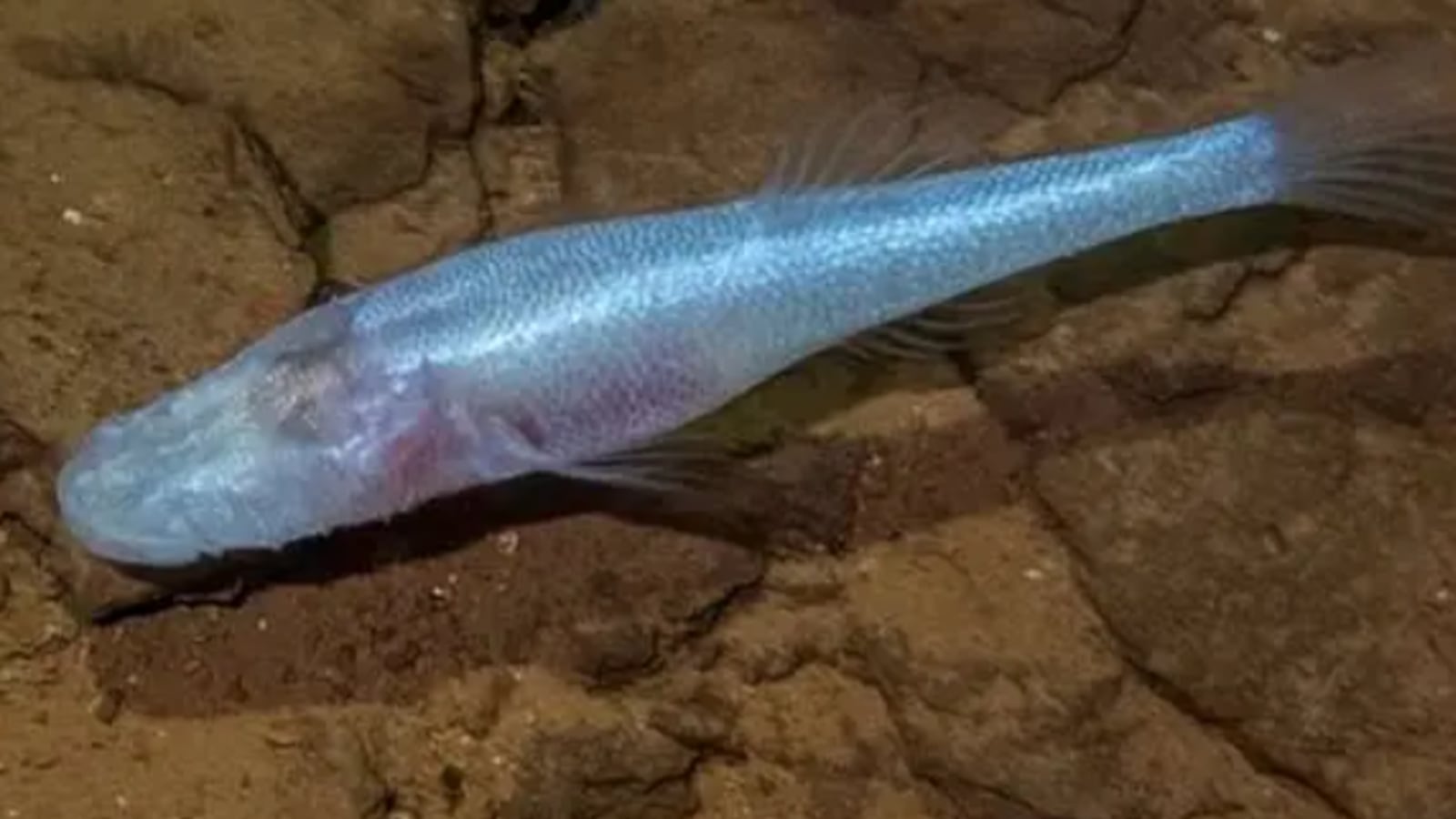
Researchers in Huntsville named it Demogorgonichthys arcanus, or 'demon cavefish,' and revealed that the creature has no eyes, no skin color, grows to just two inches in length and lives in one tiny pool in an underground cave below the US Army's Redstone Arsenal.
demon fish

Matthew L. Niemiller, Niemiller Nature LLC

While the new lifeform is not from another world, this tiny, otherworldly species was discovered by a University of Alabama team exploring the space under a military facility linked to UFOs and classified research into missiles, rockets and space-related technology.

DNA tests showed the fish is related to other North American cavefish but appeared to diverge from other similar species about 11.6 million years ago.

It completely adapted to life underground, shedding its eyes and growing special sensory organs all over its body over millions of years of evolution.

The team said that the fish is so genetically unique compared to other known cavefish that they placed it in a new biological subgroup.

For example, the team found a gene normally used for eyesight that had been badly broken in the demon fish. Scientists expected to find this in the animals because they live in total darkness and no longer need sight.

However, the team was completely surprised to find this new creature had evolved side-by-side in the same pools with the Southern Cavefish, known as Typhlichthys subterraneus, taking a completely different evolutionary path despite living in the same place.

Scientists have discovered a new species underneath a base tied to UFO conspiracies in Huntsville, Alabama

Scientists have discovered a new species underneath a base tied to UFO conspiracies in Huntsville, Alabama

The 'demon cavefish' (Demogorgonichthys arcanus) is similar in appearance to other cavefish scientists have found but is said to be genetically unique

The 'demon cavefish' (Demogorgonichthys arcanus) is similar in appearance to other cavefish scientists have found but is said to be genetically unique

Scientists revealed that while finding independent evolutionary paths among different cavefish species has happened before, uncovering a unique creature adapting in its own way in the exact same pool alongside other cavefish is very rare.

Dr Matthew Niemiller, associate professor of biological sciences, said in a press release: 'This is one of the last places we'd have bet on it.'

'Finding an entirely unknown, new genus of freshwater fish in eastern North America today is a little like finding a new kind of big cat. The group is so well known, we thought the big surprises were behind us. To have one turn up in a cave we've watched for three decades is a real reminder to stay curious. It was genuinely surprising.'

Only a handful of the demon fish were seen in the team's observations between 2019 and 2025, which were published in Scientific Reports.

The fish has only been found in this one small aquifer system, and it is believed to have a very small habitat underneath Redstone Arsenal.

Since the fish, which is less than two inches long, lives in such a tiny area of the cave and depends on groundwater to survive, Niemiller's team considers it highly vulnerable to pollution, changes in water flow, droughts and floods - making it critically imperiled and possibly a critically endangered species.

The fact that the cave is under Redstone Arsenal is believed to have given the fish some protection from extinction, since base restrictions have kept the public from building on the site and destroying the cave.

Although the base's cave is protected from the public, scientists found that the environment the fish were living in was still contaminated - apparently with residue from chemical weapons.

The fish was found in a cave under Redstone Arsenal, a US Army base that also houses US Space Command

The fish was found in a cave under Redstone Arsenal, a US Army base that also houses US Space Command

Scientists found that the cave was contaminated with materials used in both conventional and chemical weapons

Scientists found that the cave was contaminated with materials used in both conventional and chemical weapons

Read More

EXCLUSIVE
  • Trump's inner circle have shown me the real UFO disclosure: The President has his speech written 

article image

'Trace metals, including cadmium, chromium, and lead, have been detected at elevated concentrations in water samples from Bobcat Cave over the past two decades,' the team wrote in their study.

Niemiller's team said the most likely reason for the pollution was that Bobcat Cave sits under an old industrial part of Redstone Arsenal where the Army used to dispose of both regular and chemical explosives.

Some of those materials seem to have slowly leaked into the underground water that flows into the cave.

Cadmium, chromium and lead are all metals that can be harmful to living things even in small amounts. 

Lead has served as the main metal in most bullets and projectiles. Lead compounds have also been used in primers, the part that starts the explosion when the trigger is pulled.

Meanwhile, both chromium and cadmium have been used by the military as a protective plating that resists rust and corrosion.

Redstone Arsenal has been called the Area 51 of Alabama

Redstone Arsenal has been called the Area 51 of Alabama

Unproven claims have alleged that recovered UFOs were taken to Redstone Arsenal in 2026

Unproven claims have alleged that recovered UFOs were taken to Redstone Arsenal in 2026

The mysterious base opened in 1941 to support the US during World War II, and it now has a workforce of more than 45,000 military personnel, civilian employees and contractors.

According to a government fact sheet about Redstone: 'The installation is the birthplace of NASA and has grown to include more than 65 diverse and distinct organizations.'

However, the base's newest task - becoming the home for US Space Command - has revived decades-old UFO conspiracy theories tied to Redstone Arsenal.

In fact, just a month after US Space Command officially transferred its operations to Redstone, unproven allegations began spreading online claiming that non-human craft being held at Area 51 in Nevada were being moved to Alabama.

In 2020, Amy Eskridge, a researcher working on anti-gravity technology in Huntsville, claimed during an explosive interview that the source of UFO and alien disclosure would be Redstone Arsenal.

Eskridge, who died in 2022, said: 'Redstone Arsenal in Huntsville, Alabama is the biggest f****** deal that you've never heard of.'

RELATED

Scientists Found a “Demon Fish” Hiding Beneath Alabama — And It Has No Eyes

The Eyeless Demon Cavefish Beneath a Military Base #CreepyNature #Science

{ https://www.dailymail.com/sciencetech/index.html }

Diversen (Eng, NL en Fr)

Hoe vind je dit bericht? 0 stemmen
Geschreven door peter om 14:50 Stuur door
Dinsdag 11 augustus 2026

Scientists warn 'biblical flood' scenario threatens millions in California: 'We are not prepared'

Scientists warn 'biblical flood' scenario threatens millions in California: 'We are not prepared'

  • READ MORE: Urgent warning to brace for catastrophic 'Ring of Fire' disaster as global megaquake chain reaction sparks fears for MILLIONS in its path

By STACY LIBERATORE, US SCIENCE & TECHNOLOGY EDITOR

Scientists have warned that a ‘biblical flood’ capable of turning vast stretches of California into an inland sea could strike during any winter.

The threat comes from ARkStorm 2.0, a scientifically plausible scenario involving a relentless chain of extreme storms unlike anything the state has experienced for nearly 200 years.

Researchers cannot predict when it will happen, saying it could arrive this year or remain decades away, and no such storm is currently forming.

The disaster would unfold as multiple atmospheric rivers slammed into the West Coast over approximately 30 days, dumping extraordinary amounts of rain and snow across California.

Climate change is making the scenario increasingly dangerous because warmer air holds more moisture while rising snowlines cause precipitation to fall as rain and rush immediately into rivers.

Floodwater could reach 20 feet in some communities, force more than 1.5 million people to evacuate and leave populated areas between San Francisco and Los Angeles submerged.

The resulting destruction could exceed $1 trillion, potentially making it one of the costliest natural disasters in global history.

California’s Central Valley would face the greatest danger, but flooding, landslides, power failures and transportation disruptions could affect every county in the state.

Floodwater could reach 20 feet in some communities, force more than 1.5 million people to evacuate and leave populated areas between San Francisco and Los Angeles submerged (stock)

Floodwater could reach 20 feet in some communities, force more than 1.5 million people to evacuate and leave populated areas between San Francisco and Los Angeles submerged (stock) 

‘It was always a when, not if,’ Dr Daniel Swain, a UCLA climate scientist who coauthored the ARkStorm 2.0 study, told BBC Science Focus. ‘Before global warming, that “when” might have been centuries away. Now it’s quite likely to be within my own lifetime.’

ARkStorm stands for ‘Atmospheric River 1,000-year Storm’ and was created to help officials prepare for an extreme but realistic weather disaster.

Atmospheric rivers are long, narrow corridors of water vapor flowing through the sky from the tropics toward higher latitudes.

When they reach California and collide with coastal mountains or the Sierra Nevada, the vapor condenses and falls as heavy rain or snow.

These systems are not inherently destructive and provide up to half of California’s annual precipitation, making them essential to the state’s water supply.

But when one stalls, or several arrive in rapid succession, they can trigger catastrophic flooding, landslides and reservoir overflows.

The strongest atmospheric rivers can transport approximately 15 times as much water as the Mississippi River carries at its mouth.

The original ARkStorm scenario was developed by the US Geological Survey (USGS) and a team of federal, state and academic experts in 2010.

California’s Central Valley would face the greatest danger, but flooding, landslides, power failures and transportation disruptions could affect every county in the state

California’s Central Valley would face the greatest danger, but flooding, landslides, power failures and transportation disruptions could affect every county in the state

It was modeled partly on California’s Great Flood of 1861-62, when storms battered the state for approximately 45 days and transformed the Central Valley into a lake nearly 300 miles long.

Towns, farms and roads disappeared beneath the water, and the state capital was temporarily moved from Sacramento to San Francisco.

Geological evidence indicates that six storms more severe than the 1861-62 disaster struck California during the past 1,800 years, demonstrating that the historic flood was not an isolated event.

Researchers updated the scenario in 2022 to examine how a similar sequence would behave in a warmer climate.

The first major change is what Swain described as the ‘expanding atmospheric sponge effect.’

For every 1.8 degrees Fahrenheit of warming, the atmosphere can hold approximately seven percent more water vapor, providing storms with additional fuel.

Read More

  • Where the 'Big One' will hit... as back-to-back earthquakes raise fears of a catastrophic chain-reaction rupture: See America's 'time bombs' 

article image

‘You can essentially just imagine an ordinary kitchen sponge that grows progressively larger with warming,’ Swain said. ‘It has the capacity to absorb much more water.’

When that swollen atmospheric sponge is wrung out over California, it can release far more rain.

The second danger comes from a rising snowline in the Sierra Nevada.

Precipitation that once would have remained frozen in the mountains increasingly falls as rain, while warm rainfall can melt existing snow and send additional water racing downhill.

‘You get increased precipitation intensity, but also a large shift from snow to rain,’ Swain said.

The combined ‘double whammy’ could increase runoff in parts of the southern Sierra Nevada by between 200 and 400 percent compared with historical megastorms.

The water would funnel into the Sacramento and San Joaquin river systems before spreading through the Central Valley, home to millions of people and some of the country’s most productive farmland.

‘The San Joaquin Valley in particular really stands out to me as being of great concern,’ Swain said, noting that the region also contains critical infrastructure supplying water to Southern California.

Scientists have been studying a hypothetical disaster scenario called an ARkstorm, which was patterned after the 'Great Flood of 1862' that left a 300-mile-long stretch of the state submerged under water. Pictured is K Street, Sacramento during the Great Flood

Scientists have been studying a hypothetical disaster scenario called an ARkstorm, which was patterned after the 'Great Flood of 1862' that left a 300-mile-long stretch of the state submerged under water. Pictured is K Street, Sacramento during the Great Flood

Hundreds of miles of aging levees, canals and pumping stations protect the valley, but many were constructed for a climate in which more winter precipitation remained locked in mountain snow.

The USGS has warned that California’s existing flood defenses were not designed to withstand the water volumes envisioned in an ARkStorm.

Approximately one-quarter of buildings in the state could experience some flooding, while millions of property owners may lack adequate insurance to rebuild.

Researchers estimate climate change has already more than doubled the likelihood of a storm sequence capable of producing a megaflood compared with the early 20th century.

Without major emissions reductions, events previously expected once every two centuries could occur three times per century by around 2060.

California is strengthening levees, restoring floodplains and improving emergency planning through the Central Valley Flood Protection Plan, which could cost up to $30 billion over 30 years.

Officials are also developing high-resolution maps showing how floodwater would move through communities and interact with dams, levees and highways.

But experts warned that the work is moving too slowly.

‘There’s a lot more that needs to be done. We are not prepared,’ said Dr Christine Albano of the Desert Research Institute.

Unlike an earthquake, an approaching megastorm could be detected days or potentially weeks in advance, providing authorities time to order evacuations and move equipment.

That warning would offer California its best chance to prevent an extreme weather event from becoming an unprecedented human catastrophe.

‘Statistically, it could happen this year, or it might not happen for 70 years, if we get lucky,’ Swain said.


Scientists Warn California Faces Catastrophic 'Biblical Flood' Risk

{ https://www.dailymail.com/sciencetech/index.html }

Diversen (Eng, NL en Fr)

Hoe vind je dit bericht? 0 stemmen
Geschreven door peter om 18:43 Stuur door
Maandag 3 augustus 2026

Scientists reveal the most scientifically accurate VOLCANO movies ever made - with Dante's Peak topping the list

Scientists reveal the most scientifically accurate VOLCANO movies ever made - with Dante's Peak topping the list

  • READ MORE: Even small volcanic eruptions can spread ash thousands of miles

By WILIAM HUNTER, SENIOR SCIENCE & TECHNOLOGY REPORTER

Much to volcanologists' dismay, Hollywood's enthusiasm for special effects often gets in the way of scientific accuracy when it comes to making a volcano movie.

But experts say that some epic disaster movies do manage to get some surprising details correct.

Now, researchers have revealed the most scientifically accurate volcano movies ever made.

And it's great news if you've been looking for an excuse to re-watch the 1997 classic, Dante's Peak.

In a new paper, published in the Bulletin of Volcanology, a team of British scientists watched through 20 movies featuring volcanoes to see how they square up with real eruptions.

They found that the most important thing these films get wrong is not the eruption itself, but the build-up to the explosion and how scientists try to predict it.

Most volcano movies dramatically shorten the real timeline, condensing weeks or months of uncertainty into hours or days of intense action.

However, Co-author Professor Jenni Barclay, a volcanologist from the University of Bristol, told the Daily Mail that Dante's Peak 'had a real attempt to demonstrate the uncertainties around an eruption and some of the elements of the eruption were pretty well portrayed.'

Scientists say that the 1997 classic Dante's Peak is one of the most scientifically accurate volcano movies ever made, but it still gets a lot wrong

Scientists say that the 1997 classic Dante's Peak is one of the most scientifically accurate volcano movies ever made, but it still gets a lot wrong 

After watching volcano movies spanning the last 60 years of cinema, starting with 1942's Superman vs Volcano, the researchers found that most movies get some core scientific details wrong.

Most importantly, they say that the timelines seen in volcano movies can be about ten times shorter than real eruptions.

Professor Barclay says the least realistic films they watched were 'where the volcano goes from 0 to 10,000 miles per hour dramatically fast'.

While volcanoes in the movies have a clear onset, rapid progression, and obvious resolution point, this is far from the case for real eruptions.

The researchers also bemoaned the almost ubiquitous presence of sudden, fast-flowing streams of lava which 'move like rivers in spate'.

Co-author Dr Bridie Davies, of the University of Manchester, told the Daily Mail that this is a particularly egregious blunder given the other classic features of a Hollywood volcano.

The classic on-screen eruption features a large cone-shaped volcano, which is scientifically known as an arc stratovolcano.

Dr Davies says the occurrence of 'runaway lava flows' alongside large, ashy explosive eruptions of stratovolcanoes is one of the most glaring scientific errors because 'these two eruption styles are unlikely to coexist in the real world'.

The biggest issue most volcano movies have is that the eruption accelerates too quickly from initial signs of unrest to an abrupt stop

The biggest issue most volcano movies have is that the eruption accelerates too quickly from initial signs of unrest to an abrupt stop

Researchers say that the 1997 movie Volcano is much less realistic than Dante's Peak due to its bad choice of Los Angeles as the site of an eruption and excessive use of fast-flowing lava

Researchers say that the 1997 movie Volcano is much less realistic than Dante's Peak due to its bad choice of Los Angeles as the site of an eruption and excessive use of fast-flowing lava 

The most and least scientifically accurate volcano films, according to the experts

Most accurate

* Dante's Peak

* Krakatoa: The final Days

* Pompeii: The Last Day

Least accurate

* Volcano 

* Joe Versus the Volcano 

* Pompeii 

* Krakatoa: East of Java 

* Apocalypse Pompeii 

Arc stratovolcanoes are much more likely to create deadly pyroclastic flows, fast-moving avalanches of superheated ash and rock, but these natural terrors very rarely make an appearance in cinema.

The researchers' dedicated watching also helps to settle a question that has divided film fans for the last 30 years.

1997 saw the back-to-back release of two classics of the volcano disaster genre: Volcano starring Tommy Lee Jones, and Dante's Peak with Pierce Brosnan.

Now we can finally say that, as far as scientific accuracy is concerned, Dante's Peak was the far superior flick.

Dr Davies says: 'Volcano does show some of the key signs of volcanic unrest we would look for, such as increased temperatures and gas levels.

'But the runaway lava flow apocalypse in Volcano and the poorly chosen location of downtown LA for a large hidden volcanic threat are difficult to overlook.'

On the other hand, Dr Davies says that Dante's Peak 'gives more screen time to unrest phenomena and does a better job at representing the wide range of scientists involved in monitoring volcanic hazard.

'We just have to overlook the scene where Pierce Brosnan drives for several minutes over a red-hot lava flow without his tyres popping.' 

Real eruptions have a much longer period of uncertainty before the eruption, sometimes lasting days or months

Real eruptions have a much longer period of uncertainty before the eruption, sometimes lasting days or months 

What are arc stratovolcanoes?

Arc stratovolcanoes are tall, steep-sided volcanoes built from alternating layers of lava, ash and volcanic rock. 

They form in curved chains called volcanic arcs, usually where one tectonic plate is forced beneath another.

Their magma is generally thick and rich in silica, which can trap gases and produce powerful, explosive eruptions. 

The main hazards include ash clouds, lava flows, fast-moving pyroclastic flows and volcanic mudslides.

Famous examples include Mount Fuji, Mount St Helens and Mount Vesuvius. They are particularly common around the Pacific Ring of Fire and in the Mediterranean region. 

Likewise, co-author Professor David Pyle, of the University of Oxford, told the Daily Mail: 'Dante’s Peak is geologically much more realistic, starting with the volcanic setting, which is clearly reminiscent of Mt St Helens, which erupted in 1980.

'The film does try to cram in far too many effects, but the inspiration is very much taken from things that have been seen in eruptions.'

Outside of the typical blockbuster movie, the researchers praised the accuracy of the 2006 BBC docudrama Krakatoa: The Last Days.

This is a partially fictionalised account of the 1883 Krakatoa eruption, based on eyewitness accounts, particularly the writings of Dutch geologist Rogier Verbeek.

The researchers say this film did a great job capturing the catastrophic effects of the blast, such as the tsunami waves and avalanches of volcanic ash, as well as the reality of the eruption timeline.

When it comes to the least scientifically accurate films, Professor Pyle singled out many of the disaster films that take inspiration from the 79 AD eruption of Vesuvius, such as 2014's Pompeii, starring Kit Harington.

Professor Pyle says these films 'run away with their imaginative dramatisations of the catastrophe'.

He adds: 'More often than not, the motivation is to show off the special effects to the max, rather than to be more faithful to what might have happened.'

Experts say that films about Pompeii, including the 2014 flop Pompeii, are the least scientifically accurate

Experts say that films about Pompeii, including the 2014 flop Pompeii, are the least scientifically accurate 

The most accurate piece of volcano media is the 2006 docudrama Krakatoa: The Last Days, which used eyewitness accounts to closely match the progress of the real eruption (illustrated)

The most accurate piece of volcano media is the 2006 docudrama Krakatoa: The Last Days, which used eyewitness accounts to closely match the progress of the real eruption (illustrated) 

However, besides the details of the eruptions themselves, one massive thing that all of these movies get wrong is the role of local communities and emergency responders.

While these movies usually show the local population 'running around and panicking', the reality is that people who live near volcanoes play a key role in preventing disasters.

Read More

  • Scientists find 73 volcanoes across the ocean floor - and some could erupt at any moment 

article image

Local groups help scientists to monitor the signs of an impending eruption and make plans for evacuations in case of an emergency,

Dr Davies says: 'I would love to see greater value placed on the stories, knowledge and often extremely pro-social responses of local communities before, during and after volcanic eruptions.

'The relationships built between scientists, local communities, leaders and emergency managers are complex and their combined efforts during times of volcanic crisis provide compelling stories of the power of the human spirit and community collaboration at its best.

'Something we could all use more of these days.'

HOW CAN RESEARCHERS PREDICT VOLCANIC ERUPTIONS?

According to Eric Dunham, an associate professor of Stanford University's School of Earth, energy and Environmental Sciences, 'Volcanoes are complicated and there is currently no universally applicable means of predicting eruption. In all likelihood, there never will be.'

However, there are indicators of increased volcanic activity, which researchers can use to help predict volcanic eruptions. 

Researchers can track indicators such as: 

* Volcanic infrasound: When the lava lake rises up in the crater of an open vent volcano, a sign of a potential eruption, the pitch or frequency of the sounds generated by the magma tends to increase.

* Seismic activity: Ahead of an eruption, seismic activity in the form of small earthquakes and tremors almost always increases as magma moves through the volcano's 'plumbing system'.

* Gas emissions: As magma nears the surface and pressure decreases, gases escape. Sulfur dioxide is one of the main components of volcanic gases, and increasing amounts of it are a sign of increasing amounts of magma near the surface of a volcano. 

* Ground deformation: Changes to a volcano's ground surface (volcano deformation) appear as swelling, sinking, or cracking, which can be caused by magma, gas, or other fluids (usually water) moving underground or by movements in the Earth's crust due to motion along fault lines. Swelling of a volcano cans signal that magma has accumulated near the surface.  

Source: United States Geological Survey

RELATED

DANTE'S PEAK (1997): Why it's the ultimate volcano movie
🌋 Most Powerful VOLCANIC ERUPTIONS Ever 🌋💥 Size Comparison

The Lost Supervolcano: The Biggest Eruption in Human History - Full Documentary

{ https://www.dailymail.com/sciencetech/index.html }

Diversen (Eng, NL en Fr)

Hoe vind je dit bericht? 0 stemmen
Geschreven door peter om 18:28 Stuur door
Zondag 2 augustus 2026

Monster 'Sharkzilla' leaves trail of carnage off New York coast as scientists probe nuclear mutant theory

Monster 'Sharkzilla' leaves trail of carnage off New York coast as scientists probe nuclear mutant theory

  • READ MORE: Urgent warning as sharks move into unexpected US waters: See the popular beaches where predators are now lurking

By STACY LIBERATORE, US SCIENCE & TECHNOLOGY EDITOR

A mysterious predator lurking off the coast of New York has sparked a dangerous hunt for a monster shark capable of tearing apart some of the ocean's largest animals.

A humpback whale was discovered with a 24-inch bite mark, while a gray seal suffered a 22-inch wound and a 400-pound tuna was found ravaged in the water.

The trail of carnage has turned Montauk into ground zero for a real-life hunt featured in the Discovery Channel's Shark Week episode Sharkzilla Takes New York, airing on Friday at 9pm ET.

Local shark scientist Craig O'Connell believes the brutal attacks could signal the return of enormous predators once thought to have vanished from the region.

But he also raised a more disturbing possibility: that decades-old barrels of leaking nuclear waste could have affected wildlife inside a vast underwater canyon off the coast.

If his controversial theory were true, the team could be hunting a genetically altered shark that is faster, stronger and deadlier than an ordinary predator.

With a storm rapidly approaching, O'Connell and his crew had just 30 hours to find the creature, tag it and collect tissue for radioactive testing.

They called the suspected monster 'Sharkzilla.'

The trail of carnage has turned Montauk into ground zero for a real-life hunt featured in the Shark Week episode Sharkzilla Takes New York, airing on Friday at 9pm ET

The trail of carnage has turned Montauk into ground zero for a real-life hunt featured in the Shark Week episode Sharkzilla Takes New York, airing on Friday at 9pm ET

O'Connell launched the investigation on September 20, 2025, following reports of large marine animals being attacked off Long Island.

Montauk was once famous as a destination where fishermen could encounter exceptionally large sharks, but years of intense fishing devastated their numbers.

O'Connell said: 'In the past, this is the place you came to catch monster sharks. There are so many records right here off the shores of Montauk.

'All these monster sharks were completely fished out. They're gone.

'But all the evidence we are seeing is telling me that all these big sharks might be back. I know those big sharks are out there, and we are going to find them.'

His search led the team approximately 100 miles off Montauk to the Hudson Canyon, a gigantic underwater gorge that begins at a depth of roughly 900 feet before plunging to around 4,000 feet.

Comparable in scale to the Grand Canyon, the dark chasm provides a potential hiding place for some of the Atlantic Ocean's largest predators. It also has a haunting history.

'In the late 1960s, they dumped 15,000 barrels of nuclear waste in the Hudson Canyon,' O'Connell said. 'Ten years later, they went out to check on these barrels, and they were all leaking.'

The team launched  a hunt to 100 miles off Montauk to the Hudson Canyon, a gigantic underwater gorge that begins at a depth of roughly 900 feet before plunging to around 4,000 feet

The team launched  a hunt to 100 miles off Montauk to the Hudson Canyon, a gigantic underwater gorge that begins at a depth of roughly 900 feet before plunging to around 4,000 feet

Read More

EXCLUSIVE
  • Urgent warning as sharks move into unexpected US waters: See the popular beaches where predators are now lurking 

He starticle imageressed that his theory linking the waste to the predator was controversial and unproven.

'Radioactive leaks could be impacting wildlife, even top predators,' O'Connell said.

'If animals are subjected to nuclear waste, this could cause genetic mutations and abnormal growth. If this predator is genetically altered, it could be faster, stronger and deadlier than any predator on Earth. We are calling it Sharkzilla.'

O'Connell and his team packed their boat with bait and headed toward the canyon, hoping to lure sharks close enough to attach tracking tags and collect tissue samples.

The tags would reveal where the animals traveled, while laboratory tests could determine whether their bodies showed signs of radioactive contamination.

The team reached the canyon's edge at 4am and lowered a baited camera into the darkness.

Six hours later, they pulled it back to the surface and examined footage captured more than 600 feet underwater in the dimly lit region known as the ocean's 'twilight zone.'

The team entered the water to hand-feed the sharks, placing themselves within striking distance as they attempted to tag the animals and secure tissue samples.

The team entered the water to hand-feed the sharks, placing themselves within striking distance as they attempted to tag the animals and secure tissue samples.

A huge mouth suddenly emerged from the darkness and attempted to bite the camera.

'That is an absolutely massive great white shark,' O'Connell said after seeing the animal, which he identified as a large female.

Another formidable predator then appeared, a mako shark.

O'Connell and his team entered the water to hand-feed the sharks, placing themselves within striking distance as they attempted to tag the animals and secure tissue samples.

A 10-foot female mako soon made a beeline toward the divers.

Makos are the fastest sharks in the ocean and are capable of moving at speeds exceeding 40 miles per hour, leading O'Connell to suspect that Sharkzilla could be one of them.

The team then deployed a decoy dolphin named Hudson, which was fitted with a large piece of tuna intended to draw the predator closer.

The team entered the water to hand-feed the sharks, placing themselves within striking distance as they attempted to tag the animals and secure tissue samples.

The team entered the water to hand-feed the sharks, placing themselves within striking distance as they attempted to tag the animals and secure tissue samples. 

Makos are the fastest sharks in the ocean and are capable of moving at speeds exceeding 40 miles per hour, leading O'Connell to suspect that Sharkzilla could be one of them

Makos are the fastest sharks in the ocean and are capable of moving at speeds exceeding 40 miles per hour, leading O'Connell to suspect that Sharkzilla could be one of them

Two makos emerged from the depths, an unusual sight because the animals are generally solitary hunters.

They then vanished without warning, raising fears that something much larger had frightened them away.

An enormous shadow eventually appeared, cruised near the team and disappeared into the darkness before they could identify it.

With time running out, the researchers created what they called a 'blubber blaster,' designed to mimic the aftermath of a dead whale bursting at the surface and releasing a feast capable of attracting sharks.

Just as the sun began to set, a giant female mako charged toward the boat.

'This is Sharkzilla,' O'Connell screamed.

Measuring nearly 12 feet long, the mako appeared powerful enough to have inflicted the enormous wounds found on animals off Long Island.

The monster in question appeared later during the search, measuring nearly 12 feet. The team captured tissue samples, finding no traces of radiation. They did find a mako birthing ground, suggesting that was why the shark was causing chaos in the area

The monster in question appeared later during the search, measuring nearly 12 feet. The team captured tissue samples, finding no traces of radiation. They did find a mako birthing ground, suggesting that was why the shark was causing chaos in the area

When she refused to approach the cage, O'Connell swam outside and attempted to attach a tracking tag. The first tag bounced off her body, and she disappeared.

Despite fading daylight making the dive increasingly dangerous, O'Connell remained convinced that she would return.

When the mako reappeared, he successfully attached the tag and obtained a tissue sample before the team headed back to Montauk.

Signals from the tracker revealed that Sharkzilla was traveling in the same direction.

Tests ultimately found no evidence that the mako had radioactive mutations, destroying the team's most alarming theory.

However, the investigation indicated that the waters served as a breeding ground for makos, offering a more natural explanation for the carnage: the predators were hunting to feed their developing pups.

Sharkzilla was not a radioactive mutant, but a huge pregnant mako, an exceptionally fast and formidable predator patrolling the waters off New York.


Shark Week | Sharkzilla : terreur sur New-York

{ https://www.dailymail.com/sciencetech/index.html }

Diversen (Eng, NL en Fr)

Hoe vind je dit bericht? 0 stemmen
Geschreven door peter om 17:54 Stuur door
‹ Nieuwere berichten Meer berichten

Meer van UFO'S of UAP'S, ASTRONOMIE, RUIMTEVAART, ARCHEOLOGIE, OUDHEIDKUNDE, SF-SNUFJES EN ANDERE ESOTERISCHE WETENSCHAPPEN - DE ALLERLAATSTE NIEUWTJES

 FORUM 

Kan een afbeelding zijn van vuur

Kan een afbeelding zijn van hond

5 juni 2025 , DAN BESTAAT MIJN BLOG AL 14 JAAR!!!

Carl Sagan Space GIF by Feliks Tomasz Konczakowski

X Files Ufo GIF by SeeRoswell.com

1990: Petit-Rechain, Belgium triangle UFO photograph - Think AboutIts

Ufo Pentagon GIF

Alberta_meteor_GIF_%283%29.gif

Asteroid_sitecard.gif

ufo abduction GIF by Ski Mask The Slump God

Flying Sci-Fi GIF by Feliks Tomasz Konczakowski

Season 3 Ufo GIF by Paramount+

DEAR VISITOR,


MY BLOG EXISTS TODAY 6 - 10 - 2026 15 YEARS AND 4 MONTHS  = 5.622 days.

ON 06/10/2026 MORE THAN 4.434.000 bezoekers..

VISITORS FROM 135 DIFFERENT NATIONS ALREADY FOUND THEIR WAY TO MY BLOG.

THAT IS AN AVERAGE OF 789 GUESTS PER DAY.

THANK YOU FOR VISITING  MY BLOG AND HOPE YOU ENJOY EACH TIME.


Goodbye and thanks
PETER2011

De bronafbeelding bekijken

De bronafbeelding bekijken

Beste bezoeker, bedankt voor uw bezoek.

Dear visitor, thank you for your visit.

Cher visiteur, je vous remercie de votre visite.

Liebe Besucher, vielen Dank für Ihren Besuch.

Estimado visitante, gracias por su visita.

Gentile visitatore, grazie per la vostra visita.

Inhoud blog

  • The Best Space Games from a Scientific Perspective
  • An anomalous chemical signature detected in the interstellar comet 3I/ATLAS
  • Cattle Mutilations; Strange Deaths 1970s-1980s, Investigations, & Extraterrestrial Involvement?
  • Dems gearing up to seize UFO disclosure issue from GOP after midterms
  • 'Black triangle' UFOs swarm British skies as they're seen gliding over housing estates
  • Former Pentagon UFO chief disputes FBI black triangle sighting, says reports lack evidence
  • Is the truth really out there? Studying UAP sightings
  • Town-terrorising 'werewolf' connected to UFOs 'exposed' in 13-year-long investigation
  • UK UFO sightings mapped as 'black triangles' worry Pentagon officials
  • “These Small Ones Dominate the Risk”: Are Deadly ‘Halloween Fireballs’ Just Media Ghost Stories, or is the Cosmic Airburst Threat Real?
  • Life after death mystery deepens as scientists find signs of consciousness in 'clinically dead' patients
  • NASA celebrates Halloween with its spookiest photos of the universe, including a jack-o'-lantern sun and an evil eye nebula
  • UFO Nearly Hits Space Station, Seen From DragonX Capsule Oct 13, 2026, UAP Sighting News.
  • NASA Astronaut Winston Scott Convinced Alien Life Exists but Warns of an Impending Space Military War
  • UFO Researcher Finds a 3,000-Foot Hole Near the Canadian Coast and Claims It Is an Alien Base Entry
  • Astronauts’ Greatest Fears
  • Newly Declassified Pentagon Documents Suggest Popular California Tourist Spot Was Once Hub for UFO Sightings
  • Aliens, Bigfoots, and Monsters… Remembering the Age of the Weirdumentary
  • Tunguska's Evil Twin on Halloween: Real Threat or Clickbait Experiment?
  • UK's top UFO expert says government 'hiding truth about aliens' in final ever interview

Categorieën

  • ALIEN LIFE, UFO- CRASHES, ABDUCTIONS, MEN IN BLACK, ed ( FR. , NL; E ) 3750
  • André's Hoekje (ENG) 745
  • André's Snelkoppelingen (ENG) 383
  • ARCHEOLOGIE ( E, Nl, Fr ) 2084
  • ARTICLES of MUFON ( ENG) 478
  • Artikels / PETER2011 (NL EN.) 174
  • ASTRONOMIE / RUIMTEVAART 14022
  • Before it's news (ENG.) 5702
  • Belgisch UFO-meldpunt / Frederick Delaere ( NL) 23
  • Diversen (Eng, NL en Fr) 4378
  • FILER FILES - overzicht met foto's met dank aan Georges Filer en WWW.nationalUFOCenter.com (ENG) 930
  • Frederick's NEWS ITEMS (ENG en NL) 112
  • HLN.be - Het Laatste Nieuws ( NL) 1717
  • INGRID's WEETJES (NL) 6
  • Kathleen Marden 's News about Abductions... ( ENG) 36
  • LATEST ( UFO ) VIDEO NEWS ( ENG) 12013
  • Michel GRANGER - a French researcher ( Fr) 22
  • MYSTERIES ( Fr, Nl, E) 2265
  • MYSTERIES , Complot Theories, ed ( EN, FR, NL ) 519
  • Myths, legends, unknown cultures and civilizations 231
  • National UFO Center {NUFOC} 110
  • News from the FRIENDS of facebook ( ENG ) 6019
  • NIEUWS VAN JAN ( NL) 42
  • Nieuws van Paul ( NL) 17
  • NineForNews. nl ( new ipv NIBURU.nl) (NL) 3711
  • Oliver's WebLog ( ENG en NL) 118
  • Paul SCHROEDER ( ENG) 98
  • Reseau Francophone MUFON / EUROPE ( FR) 87
  • références - MAGONIE (Fr) 486
  • Ruins, strange artifacts on other planets, moons, ed ( Fr, EN, NL ) 655
  • SF-snufjes }, Robotics and A.I. Artificiel Intelligence ( E, F en NL ) 978
  • UFO DIGEST / a Weekly Newsletter - thanks that I may publish this on my blog (ENG) 125
  • UFOs , UAPs , USOS 3191
  • Vincent'snieuws ( ENG en NL) 5
  • Who is Stanton FRIEDMAN - follow his news (ENG) 16
  • WHO IS WHO? ( ENG en NL) 5

Zoeken in blog

Beoordeel dit blog

Bekijk de resultaten

1:41:29 PM

Goede namiddag op m'n blog!

Er is nu 1 bezoeker op dit blog.
Record tot nu toe: 845

Maandag2november2026

The purpose of  this blog is the creation of an open, international, independent and  free forum, where every UFO-researcher can publish the results of his/her research. The languagues, used for this blog, are Dutch, English and French.You can find the articles of a collegue by selecting his category.
Each author stays resposable for the continue of his articles. As blogmaster I have the right to refuse an addition or an article, when it attacks other collegues or UFO-groupes.
 

Archief per maand

  • November 2026
  • Oktober 2026
  • September 2026
  • Augustus 2026
  • Juli 2026
  • Juni 2026
  • Mei 2026
  • April 2026
  • Maart 2026
  • Februari 2026
  • Januari 2026
  • December 2025
  • November 2025
  • Oktober 2025
  • September 2025
  • Augustus 2025
  • Juli 2025
  • Juni 2025
  • Mei 2025
  • April 2025
  • Maart 2025
  • Februari 2025
  • Januari 2025
  • December 2024
  • November 2024
  • Oktober 2024
  • September 2024
  • Augustus 2024
  • Juli 2024
  • Juni 2024
  • Mei 2024
  • April 2024
  • Maart 2024
  • Februari 2024
  • Januari 2024
  • December 2023
  • November 2023
  • Oktober 2023
  • September 2023
  • Augustus 2023
  • Juli 2023
  • Juni 2023
  • Mei 2023
  • April 2023
  • Maart 2023
  • Februari 2023
  • Januari 2023
  • December 2022
  • November 2022
  • Oktober 2022
  • September 2022
  • Augustus 2022
  • Juli 2022
  • Juni 2022
  • Mei 2022
  • April 2022
  • Maart 2022
  • Februari 2022
  • Januari 2022
  • December 2021
  • November 2021
  • Oktober 2021
  • September 2021
  • Augustus 2021
  • Juli 2021
  • Juni 2021
  • Mei 2021
  • April 2021
  • Maart 2021
  • Februari 2021
  • Januari 2021
  • December 2020
  • November 2020
  • Oktober 2020
  • September 2020
  • Augustus 2020
  • Juli 2020
  • Juni 2020
  • Mei 2020
  • April 2020
  • Maart 2020
  • Februari 2020
  • Januari 2020
  • December 2019
  • November 2019
  • Oktober 2019
  • September 2019
  • Augustus 2019
  • Juli 2019
  • Juni 2019
  • Mei 2019
  • April 2019
  • Maart 2019
  • Februari 2019
  • Januari 2019
  • December 2018
  • November 2018
  • Oktober 2018
  • September 2018
  • Augustus 2018
  • Juli 2018
  • Juni 2018
  • Mei 2018
  • April 2018
  • Maart 2018
  • Februari 2018
  • Januari 2018
  • December 2017
  • November 2017
  • Oktober 2017
  • September 2017
  • Augustus 2017
  • Juli 2017
  • Juni 2017
  • Mei 2017
  • April 2017
  • Maart 2017
  • Februari 2017
  • Januari 2017
  • December 2016
  • November 2016
  • Oktober 2016
  • September 2016
  • Augustus 2016
  • Juli 2016
  • Juni 2016
  • Mei 2016
  • April 2016
  • Maart 2016
  • Februari 2016
  • Januari 2016
  • December 2015
  • November 2015
  • Oktober 2015
  • September 2015
  • Augustus 2015
  • Juli 2015
  • Juni 2015
  • Mei 2015
  • April 2015
  • Maart 2015
  • Februari 2015
  • Januari 2015
  • December 2014
  • November 2014
  • Oktober 2014
  • September 2014
  • Augustus 2014
  • Juli 2014
  • Juni 2014
  • Mei 2014
  • April 2014
  • Maart 2014
  • Februari 2014
  • Januari 2014
  • December 2013
  • November 2013
  • Oktober 2013
  • September 2013
  • Augustus 2013
  • Juli 2013
  • Juni 2013
  • Mei 2013
  • April 2013
  • Maart 2013
  • Februari 2013
  • Januari 2013
  • December 2012
  • November 2012
  • Oktober 2012
  • September 2012
  • Augustus 2012
  • Juli 2012
  • Juni 2012
  • Mei 2012
  • April 2012
  • Maart 2012
  • Februari 2012
  • Januari 2012
  • December 2011
  • November 2011
  • Oktober 2011
  • September 2011
  • Augustus 2011
  • Juli 2011
  • Juni 2011

Rondvraag / Poll

Bestaan UFO's echt? Are UFOs real?Les OVNIS existent-ils vraiement?

Bekijk resultaat

Rondvraag / Poll

Denk Jij dat UFO's buitenaards zijn? Do You think that UFOs are extraterrestrial? Les OVNIS sont- ils ET?

Bekijk resultaat

E-mail mij

Druk oponderstaande knop om mij te e-mailen.
E-mail mij!

Zoeken in blog

Deze blog is opgedragen aan mijn overleden echtgenote Lucienne.

In 2012 verloor ze haar moedige strijd tegen kanker!

In 2011 startte ik deze blog, omdat ik niet mocht stoppen met mijn UFO-onderzoek.

BEDANKT!!!

Een interessant adres?

Hello GIFs – Fun Animated Images to Greet Anyone - Funimada.com

Item preview, Colorful UFO Design with Hello Text designed and sold by Rue Market.

Ufo GIFs | Tenor

De bronafbeelding bekijken

MUFON’s New Social Network

full-blackMUFON-logo-copy.png

Mijn favorieten

  • Verhalen TINNY * SF
  • IFO-databank van Belgisch UFO meldpunt
  • Belgisch UFO meldpunt
  • The Black Vault
  • Terry's Theories UFO Sightings. Its a Youtube Channel thats really overlooked, but has a lot of great and recent sightings on it.
  • . UFO Institute: A cool guy who works hard
  • YOUTUBE kanaal van het Belgisch UFO-meldpunt
  • LATEST UFO SIGHTINGS

DES LIENS AVEC LE RESEAU FRANCOPHONE DE MUFON ET MUFONEUROP

  • BELGISCH UFO-NETWERK BUFON
  • RFacebook BUFON
  • MUFONFRANCE
  • MUFON RHÔNE-ALPES
  • MUFON MIDI-PYRÉNNÉES
  • MUFON HAUTE-NORMANDIE
  • MUFON MAROC
  • MUFON ALSACE LORRAINE
  • MUFON USA
  • Site du REUB ASBL

Other links with friends / bloggers # not always UFOs

  • PANGRadio MarcSima
  • Blog 2 Bernward
  • Nederlandse UFO-groep
  • Ufologie Liège
  • NIBURU
  • Disclose TV
  • UFO- Sightings - HOTSPOT
  • Website van BUFON ( Belgisch UFO-Netwerk)
  • The Ciizen Hearing on Disclosure
  • Exopolitics Finland: LINKS

LINKS OF THE BLOGS OF MY FACEBOOK-FRIENDS

  • ufologie -Guillaume Perrot
  • UFOMOTION
  • CENTRE DE RECHERCHE OVNI PARASPYCHOLOGIE SCIENCE - CROPS -
  • SOCIAL PARANORMAL Magazine
  • TJ Morris ACO Associations, Clubs, Organizations - TJ Morris ACO Social Service Club for...
  • C.E.R.P.I. BELGIQUE
  • Attaqued'un Autre Monde - Christian Macé
  • UFOSPOTTINGNEDERLAND
  • homepage UFOSPOTTINGNEDERLAND
  • PARANORMAL JOURNEY GUIDE
WELCOME TO THIS BLOG! I HOPE THAT YOU ENJOY THE LECTURE OF ALL ISSUES. If you did see a UFO, you can always mail it to us. Best wishes.

Beste bezoeker,
Heb je zelf al ooit een vreemde waarneming gedaan, laat dit dan even weten via email aan Frederick Delaere op
 www.ufomeldpunt.be. Deze onderzoekers behandelen jouw melding in volledige anonimiteit en met alle respect voor jouw privacy. Ze zijn kritisch, objectief  maar open minded aangelegd en zullen jou steeds een verklaring geven voor jouw waarneming!
DUS AARZEL NIET, ALS JE EEN ANTWOORD OP JOUW VRAGEN WENST, CONTACTEER FREDERICK.
BIJ VOORBAAT DANK...

Laatste commentaren

  • crop cirkels (herman)
    op UFO'S FORM CROP CIRCLE IN LESS THAN 5 SECONDS - SCOTLAND 1996
  • crop cirkels (herman)
    op UFO'S FORM CROP CIRCLE IN LESS THAN 5 SECONDS - SCOTLAND 1996
  • Een zonnige vrijdag middag en avond (Patricia)
    op MUFON UFO Symposium with Greg Meholic: Advanced Propulsion For Interstellar Travel

Gastenboek

  • Nog een fijne avond
  • Hallo Lieverd
  • kiekeboe
  • Een goeie middag bezoekje
  • Zomaar een blogbezoekje
Druk op onderstaande knop om een berichtje achter te laten in mijn gastenboek Alvast bedankt voor al jouw bezoekjes en jouw reacties. Nog een prettige dag verder!!!
Voeg berichtje toe!

Over mijzelf

Ik ben Pieter, en gebruik soms ook wel de schuilnaam Peter2011.
Ik ben een man en woon in Linter (België) en mijn beroep is Ik ben op rust..
Ik ben geboren op 18/10/1950 en ben nu dus 76 jaar jong.
Mijn hobby's zijn: Ufologie en andere esoterische onderwerpen.

Op deze blog vind je onder artikels, werk van mezelf. Mijn dank gaat ook naar André, Ingrid, Oliver, Paul, Vincent, Georges Filer en MUFON voor de bijdragen voor de verschillende categorieën... Veel leesplezier en geef je mening over deze blog.

Zoeken in blog

LINKS NAAR BEKENDE UFO-VERENIGINGEN - DEEL 1

  • http://www.ufonieuws.nl/
  • http://www.grenswetenschap.nl/
  • http://www.beamsinvestigations.org.uk/
  • http://www.mufon.com/
  • http://www.ufomeldpunt.be/
  • http://www.ufowijzer.nl/
  • http://www.ufoplaza.nl/
  • http://www.ufowereld.nl/
  • http://www.stantonfriedman.com/
  • http://ufo.start.be/

LINKS NAAR BEKENDE UFO-VERENIGINGEN - DEEL 2

  • www.ufo.be
  • www.caelestia.be
  • ufo.startpagina.nl.
  • www.wszechocean.blogspot.com.
  • AsocCivil Unifa
  • UFO DISCLOSURE PROJECT

Een interessant adres?

Mijn favorieten

  • Verhalen
↑ Terug naar de berichten
SeniorenNet BlogsEen blog op SeniorenNet
Maak ook een blog Mijn blog
RSSAtom JavaScript Meld misbruik Privacy