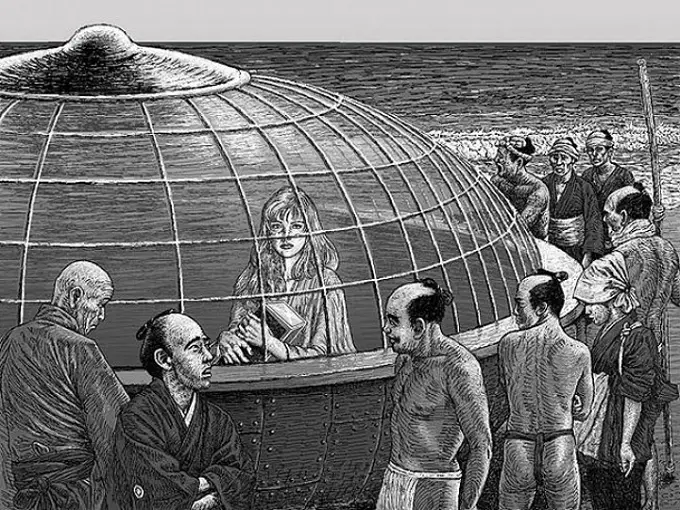
Het bestaan van buitenaards leven en ufo's wordt door de Amerikaanse regering achter gehouden, zo beweert de voormalige NASA-astronaut en zesde man op de maan, Edgar Mitchell. Dat meldt CNN.
"We zijn niet alleen", zegt de 78-jarige Mitchell. "Aliens bestaan weldegelijk, maar de waarheid wordt toegedekt door de Verenigde Staten."
De ex-astronaut, die deel uitmaakte van de Apollo 14-maanmissie in 1971, deed zijn uitspraken op de vijfde editie van de jaarlijkse X-Conference, een bijeenkomst van mensen die geloven in ufo's en buitenaardse vormen van leven.
"Wij zijn voorbestemd om te leven in een planetaire gemeenschap. We moeten bereid zijn om ver buiten onze planeet en ons zonnestelsel te kijken om te weten wat er zich daar echt afspeelt."
De astronaut beweert ook dat hij een poging ondernam om het 'Roswell-incident' uit 1947 te onderzoeken. Roswell in de staat New Mexico, waar Mitchell opgroeide, was volgens believers de plaats waar in 1947 een UFO crashte. Volgens Mitchell werden de inwoners door het leger aangemaand om daarover te zwijgen. Een admiraal bij het Pentagon zou de ufotheorie hebben bevestigd, maar hij trok later zijn verklaringen weer in.
De NASA beweert dat de organisatie "niet betrokken is bij eender welke geheimhouding over buitenaards leven, op deze planeet of ergens anders".
 Comet Facts

Comet Facts
Comet ISON – stardustobservatory.org/images.php?page=details&id=363
What is a Comet?
A comet is a very small solar system body made mostly of ices mixed with smaller amounts of dust and rock. Most comets are no larger than a few kilometres across. The main body of the comet is called the nucleus, and it can contain water, methane, nitrogen and other ices.
When a comet is heated by the Sun, its ices begin to sublimate (similar to the way dry ice “fizzes” when you leave it in sunlight). The mixture of ice crystals and dust blows away from the comet nucleus in the solar wind, creating a pair of tails. The dust tail is what we normally see when we view comets from Earth.
A plasma tail also forms when molecules of gas are “excited” by interaction with the solar wind. The plasma tail is not normally seen with the naked eye, but can be imaged. Comets normally orbit the Sun, and have their origins in the Oort Cloud and Kuiper Belt regions of the outer solar system.
Comet Naming
Comets come in several categories. The most common are periodic and non-periodic.
In the past, comets were named for their discoverers, such as Comet Halley for Sir Edmond Halley. In modern times, comet names are governed by rules set forth by the International Astronomical Union (IAU). A comet is given an official designation, and can also be identified by the last names of up to three independent discoverers.
Here’s how it works. Once a comet has been confirmed, the following naming rules are followed. First, if the comet is a periodic comet, then it is indicated with a P/ followed by the year of its discovery, a letter indicating the half-month in which it was discovered, followed by a number indicating its order of discovery. So, for example, the second periodic comet found in the first half of January, 2015 would be called P/2015 A2.
A non-periodic comet would be indicated with a C/ followed by the year of its discovery, a letter indicating the half-month in which it was discovered, followed by a number indicating its order of discovery.
If a comet is independently discovered by three people named Smith, Jones, and Petersen, it could also be called Comet Smith-Jones-Petersen, in addition to its formal designation. Today, many comets are found through automated instrument searches, and so the formal designations are more commonly used.
Famous Comets
Well-known comets include the non-periodic comets Hale-Bopp (C/1995 O1), Hyakutake (C/1996 B2), McNaught (C2006 P1), and Lovejoy (C/2011 W3). These flared brightly in our skies and then faded into obscurity.
In addition, Comet Shoemaker-Levy 9 (D/1993 F2) was spotted after it had broken up after a close call with Jupiter. (The D in its proper designation means it has disappeared or is determined to no longer exist). More than a year later, the pieces of the comet crashed into Jupiter.
The periodic Comet Halley (1P/Halley) is the most famous in history. It returns to the inner solar system once every 76 years. Other well-known periodic comets include 2P/Encke, which appears ever 3.3 years and 9P/Tempel (Tempel 2), which was visited by the Deep Impact and Stardust probes, and makes perihelion around the Sun every 5.5 years.
Facts about Comets
There are many misconceptions about comets, which are simply pieces of solar system ices travelling in orbit around the Sun. Here are some fascinating and true facts about comets.
- The nucleus of a comet is made of ice and can be as small as a few meters across to giant boulders a few kilometres across.
- The closest point in a comet’s orbit to the Sun is called “perihelion”. The most distant point is called “aphelion”.
- As a comet gets closer to the Sun, it begins to experience heat. That causes some of its ices to sublimate (similar to dry ice sizzling in sunlight). If the ice is close to the comet’s surface, it may form a small “jet” of material spewing out from the comet like a mini-geyser.
- Material streams from comets and populates the comet’s orbit. If Earth (or another planet) happens to move through that stream, those particles fall to Earth as meteor showers.
- As a comet gets close to the Sun, it loses some of its mass due to the sublimation. If a comet goes around enough times, it will eventually break up. Comets also break up if they come TOO close to the Sun or another planet in their orbits.
- Comets are usually made of frozen water and supercold methane, ammonia and carbon dioxide ices. Those are mixed with rock, dust, and other metallic bits of solar system debris.
- Comets have two tails: a dust tail (which you can see with the naked eye) and a plasma tail, which is easily photographed but difficult to see with your eyes.
- Comet orbits are usually elliptical.
- Many comets formed in the Oort Cloud and Kuiper Belts, two of the outermost regions of the solar system.
- Comets are not spaceships or alien bases. They are fascinating bits of solar system material that date back to the formation of the Sun and planets.
Related pages:
Comet ISON Facts What is a Comet? Comets are comprised of ice, rock and frozen gases like carbon monoxide left over from the formation of the solar...
Kuiper Belt Facts What is the Kuiper Belt? The Kuiper Belt (sometimes referred to as the Kuiper-Edgeworth Belt) is an area of the outer solar system that...
Meteor Shower Facts What is a meteor shower? A meteor shower occurs when a number of meteors flash seem to radiate (or shoot out from) the same...