Ontdek de Fascinerende Wereld van UFO's en UAP's: Jouw Bron voor Onthullende Informatie!
Ben jij ook gefascineerd door het onbekende? Wil je meer weten over UFO's en UAP's, niet alleen in België, maar over de hele wereld? Dan ben je op de juiste plek!
België: Het Kloppend Hart van UFO-onderzoek
In België is BUFON (Belgisch UFO-Netwerk) dé autoriteit op het gebied van UFO-onderzoek. Voor betrouwbare en objectieve informatie over deze intrigerende fenomenen, bezoek je zeker onze Facebook-pagina en deze blog. Maar dat is nog niet alles! Ontdek ook het Belgisch UFO-meldpunt en Caelestia, twee organisaties die diepgaand onderzoek verrichten, al zijn ze soms kritisch of sceptisch.
Nederland: Een Schat aan Informatie
Voor onze Nederlandse buren is er de schitterende website www.ufowijzer.nl, beheerd door Paul Harmans. Deze site biedt een schat aan informatie en artikelen die je niet wilt missen!
Internationaal: MUFON - De Wereldwijde Autoriteit
Neem ook een kijkje bij MUFON (Mutual UFO Network Inc.), een gerenommeerde Amerikaanse UFO-vereniging met afdelingen in de VS en wereldwijd. MUFON is toegewijd aan de wetenschappelijke en analytische studie van het UFO-fenomeen, en hun maandelijkse tijdschrift, The MUFON UFO-Journal, is een must-read voor elke UFO-enthousiasteling. Bezoek hun website op www.mufon.com voor meer informatie.
Samenwerking en Toekomstvisie
Sinds 1 februari 2020 is Pieter niet alleen ex-president van BUFON, maar ook de voormalige nationale directeur van MUFON in Vlaanderen en Nederland. Dit creëert een sterke samenwerking met de Franse MUFON Reseau MUFON/EUROP, wat ons in staat stelt om nog meer waardevolle inzichten te delen.
Let op: Nepprofielen en Nieuwe Groeperingen
Pas op voor een nieuwe groepering die zich ook BUFON noemt, maar geen enkele connectie heeft met onze gevestigde organisatie. Hoewel zij de naam geregistreerd hebben, kunnen ze het rijke verleden en de expertise van onze groep niet evenaren. We wensen hen veel succes, maar we blijven de autoriteit in UFO-onderzoek!
Blijf Op De Hoogte!
Wil jij de laatste nieuwtjes over UFO's, ruimtevaart, archeologie, en meer? Volg ons dan en duik samen met ons in de fascinerende wereld van het onbekende! Sluit je aan bij de gemeenschap van nieuwsgierige geesten die net als jij verlangen naar antwoorden en avonturen in de sterren!
Heb je vragen of wil je meer weten? Aarzel dan niet om contact met ons op te nemen! Samen ontrafelen we het mysterie van de lucht en daarbuiten.
Vrijdag 22 januari 2016
UK Hacker Gary McKinnon Who Saw Off World Soldiers & Ships On US Gov Computers Had Extradition Blocked!
UK Hacker Gary McKinnon Who Saw Off World Soldiers & Ships On US Gov Computers Had Extradition Blocked!
It's not often a pure soul comes along with such knowledge and skills and turns the world of UFO research upside-down over night, but the valiant Gary McKinnon (The Peoples Champion) has done just that. The US Gov has deviously tried to get Gary extradited out of the UK and sent to the US to face an American trial…more like a witch hunt. But today the US Gov lost! The people won! The UK Blocked extradition of hacker Gary Mckinnon. Also note, hacking in the UK at that time was only a misdemeanor…not a serous crime.
Why did the US want Gary so badly? That's easy, on some of the computers he hacked into, he discovered files about twenty to thirty non-terrestrial officers (off world). He saw their ranks, and ship to ship transfers off world. He believes the US gov is using reverse-engeneered technology that they recovered from UFO crashes. Gary was fearless as he hacked into the Army, Navy, Air Force, DOD (Dept. of Defense) and NASA.
Check out the two videos below and hear it in his own words. I made the videos myself as a tribute to him, so go easy on me for that. SCW
Ce que l'on sait sur la potentielle neuvième planète de notre système solaire
Des scientifiques affirment avoir des preuves de l'existence d'une neuvième planète dans notre système solaire.
Des scientifiques américains ont publié, mercredi 20 janvier 2016, des éléments laissant penser à l'existence d'une neuvième planète dans notre système solaire. (MENDOWONG PHOTOGRAPHY / MOMENT RM / GETTY)
Par Camille Adaoust
Et si notre système solaire était plus vaste que nous ne le pensions ? Deux astronomes de l'Institut de technologie de Californie (Caltech) ont trouvéplusieurs éléments accréditant l'existence d'une neuvième planète, comme ils le démontrent mercredi 20 janvier dans The Astronomical Journal (en anglais). "Il n'y a eu jusqu'à présent que deux planètes découvertes dans notre système solaire depuis l'Antiquité et ce serait dans ce cas la troisième", a déclaré Michael Brown, professeur d'astronomie planétaire et coauteur de l'étude. Francetv info fait le point sur ce que l'on sait de cette planète mystérieuse.
Une planète géante et fort, fort lointaine
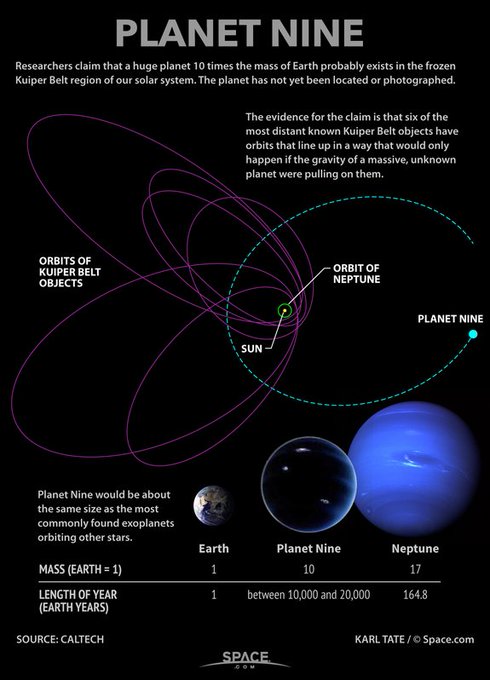
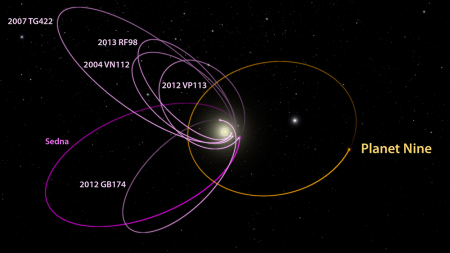
Si la "Planète 9" existe, elle est énorme", assure le Washington Post (en anglais).Elle serait même la cinquième plus grosse planète de notre système, derrière Jupiter, Saturne, Uranus et Neptune. Selon les scientifiques, il s'agirait en effet d'une planète géante qui serait dix fois plus massive que la Terre.
Son orbite serait en moyenne vingt fois plus lointaine que celle de Neptune, déjà à 4,5 milliards de kilomètres du Soleil. Elle ferait donc le tour du Soleil en 10 000 à 20 000 ans.
S'il y a bien une 9e planète dans le Système solaire, voilà vers où il va falloir la chercher. A plus de 600 UA...
View translation
Cette découverte est un pur hasard
Dans un premier temps, Scott Sheppard et Chad Trujillo avaient, en 2014, publié un article parlant de l'existence d'une potentielle neuvième planète. "On pensait que leur idée était folle", a expliqué Michael Brown. Le chercheur a pourtant vite changé d'avis. Alors qu'il travaillait avec Konstantin Batygin sur le mouvement de planètes naines et d'autres petits objets, ils se sont aperçus que la gravité d'une planète devait influencer le trajet de ces objets.
"Jusque-là, nous ne croyions pas vraiment nos résultats nous-mêmes. Nous pensions tout simplement que ça n'avait pas de sens", explique Michael Brown dans leWashington Post. "Mais leur modélisation a montré qu'une planète à la masse dix fois plus importante que celle de la Terre influencerait l'orbite des plus petits corps, les empêchant de se rapprocher du Soleil comme ils devraient le faire", ajoute le journal.
Rien n'est confirmé
Cette planète n'a pas été observée directement. Mais Michael Brown et KonstantinBatygin sont formels. Pour eux, la probabilité que le mouvement de ces objets soit dû au hasard est de 0,007%. "La chasse à la neuvième planète est désormais officiellement ouverte", note 20 Minutes. L'observer directement relèverait de l'exploit, la planète étant environ 10 000 fois moins brillante que Pluton.
"Mais Mike Brown estime que des télescopes sur Terre sont assez puissants pour toucher le gros lot, avec de la chance", continue le site. Les chercheurs s'étonnaient, de plus, de l'absence de ce type de planète – courante dans l'Univers – au sein de notre système solaire.
Nibiru a largement inspiré Melancholia, la planète errante du film homonyme de Lars Van Trier.
L'annonce de la probable découverte d'une neuvième planète aux confins du Système solaire donne un second souffle aux théories jugées fantaisistes sur l'existence de Nibiru, une planète mythique et menaçante qui reviendrait régulièrement semer la désolation sur la terre.
Quelles sont les limites du système solaire ? En septembre 2013, la NASA a annoncé avec tambours et trompettes que la sonde Voyager 1, lancée en 1977, avait quitté le Système solaire. C’était aller un peu vite en besogne: en réalité, Voyager a bel et bien dépassé Pluton mais pas la zone d’influence gravitationnelle du Soleil qui s’étend encore à 20 000 années lumière au-delà de la planète naine… La plus vaste partie du Système Solaire tient plus de l’immense foire à tout que des images des livres scolaires où les planètes apparaissent sagement rangées autour du soleil.
La quête de la neuvième planète En 1846, lors de la découverte de Neptune par le Français Urbain Le Verrier, de nombreux astronomes se disent qu’il n’y a aucune raison de s’arrêter là et redoublent d’efforts pour dénicher d’autres planètes après la géante glacée. Parmi les plus acharnés, l’Américain Percival Lowell. L’astronome délaisse l’étude ingrate des inexistants canaux martiens pour rechercher, sans plus de succès, l’hypothétique Planète X, selon le nom que lui attribue Percival Lowell. C’est cet astre introuvable qui serait à l’origine des anomalies dans les orbites d’Uranus et Neptune.
Pluton, planète née sous X Pluton, découverte en 1930 par Clyde W. Tombaugh, fait figure d’excellente candidate au titre de Planète X. Mais, au fil des années, la masse de Pluton est sans cesse revue à la baisse jusqu’à l’humiliation finale de sa relégation au rang de planète naine. Pluton ne peut pas être responsable des contradictions dans les orbites des planètes géantes.
DE NÉMÉSIS À NIBIRU
Au cours des 40 dernières années, la Planète X est devenue l’Arlésienne de l’astronomie. Son existence, toujours supputée mais jamais démontrée, s’apparente désormais à un mythe moderne : parmi les théories scientifiques les plus originales, celle de Richard A. Muller, de l’université de Californie, décroche la palme. Il postule l’existence de la planète Némésis, du nom de la déesse grecque de la colère des dieux. Cet astre à l’orbite capricieux reviendrait régulièrement dans nos parages pour semer la mort et la désolation sur terre avec les météorites qu’elle traîne dans son sillage. Némésis serait responsable, entre autres, de la disparition des dinosaures. Cette sinistre planète rappelle par bien des aspects la mythique Nibiru, popularisée par l’écrivain Zecharia Sitchin.
Nibiru, planète pas nette Avec Zecharia Sitchin, écrivain d’origine russe décédé en 2010 à l’âge de 90 ans, on quitte les rivages de la science pour arriver dans le grand n’importe quoi. En s’appuyant sur les tablettes cunéiformes de l’époque sumérienne, qu’il prétend avoir traduites, Sitchin affirme que l’humanité aurait été crée par une race extraterrestre, les Annunaki, révérés comme des dieux par les Sumériens.
Le bas-relief sumérien sur lequel Sitchin croit avoir trouvé la preuve de l'existence de Nibiru, la neuvième planète.
Dans la cosmogonie de Zecharia Sitchin, la Terre a été formée par la collision de deux planètes, Tiamat et de Nibiru. Tiamat a été détruite, mais Nibiru, manifestement plus résistante, continue à rôder dans notre système solaire et revient tous les 3600 ans pour, à l’instar de Némésis, déclencher de terribles cataclysmes. Dans l’espèce de syncrétisme loufoque qui caractérise les théories apocalyptiques, c’est d’ailleurs Nibiru qui, en 2012, aurait dû provoquer la fin du monde annoncée par les Mayas.
La home de Planet X NewsDR
Mais ce n’est sans doute que partie remise. Nibiru est si présente dans la culture populaire qu’on ne compte plus, sur Internet, les photos et les vidéos de cette planète fantôme repérée par des prophètes à la petite semaine. Tous les sites et les blogs consacrées à la menace Nibiru font leur « une » sur l’annonce de la découverte de la planète X sur l’air de « on vous l’avait bien dit ». Difficile de leur jeter la pierre…
Japanese astronomers have detected what may be an intermediate-mass black hole within a molecular cloud near the galactic center. If proven, its existence may hold clues to the formation of supermassive black holes at the center of our own galaxy and others.
A CLOUD-SHROUDED MYSTERY
The existence of supermassive black holes, with masses millions to billions of times that of the Sun, commonly exist in the centers of large galaxies like our own; but what is less understood is how such monstrous astrophysical objects came to be in the first place.
Some theories have been proposed that suggest a kind of “snowball effect”—an effect in which a black hole of more modest size, perhaps only tens to hundreds of times more massive than the Sun, grows through the steady accretion of matter from gas clouds, ripped-apart stars, or whatever else strays too near.
Another theory holds that larger black holes, between ten and a hundred thousand times more massive than the Sun, are created through stellar collisions and eventually coalescence at the centers of compact star clusters. Ultimately, it is argues that these so-called “intermediate-mass black holes” form the seeds whence the larger, supermassive varieties grow.
Problem is, no intermediate-mass black hole has ever actually been detected.
That is, until now—if the findings made by a team of Japanese astronomers, led by Tomoharu Oka of Keio University, prove correct. Using the Nobeyama Radio Observatory 45 m radio telescope, together with the ASTE telescope in Atacama, Chile, they investigated a compact gas cloud called CO-0.40-0.22, located only 200 light years from the galactic center.
What they discovered is that the cloud exhibited a curious dichotomy in the velocity of its gases: a small area of high velocity, and another, larger component with a low velocity. Further analysis in the infrared and x-ray wavelengths revealed no compact sources, suggesting the influence of something massive and invisible.
Oka and his team performed a simulation showing that a black hole of 100,000 solar masses, occupying an area with a radius of only 0.3 light years (with an event horizon about 4 times the diameter of Jupiter), best fits the observed data. In this scenario, the black hole attracts the surrounding gas, accelerating it to a high velocity at nearest approach; the material subsequently slows as its distance from the black hole increases.
Image of the gas cloud CO-0.40-0.22 in relation to the center of the galaxy, together with radio and velocity maps of the cloud. Credit: Tomoharu Oka (Keio University), NAOJ
THE BUILDING-BLOCKS OF MONSTER BLACK HOLES
If CO-0.40-0.22 truly does harbor an intermediate-mass black hole, it lends credence to the theory that such objects might be fairly common in large galaxies, and through accretion and coalescence gradually swell to the immense black holes that anchor the very largest galaxies.
Recent studies have shown that there are a number of other gas clouds within the galaxy that exhibit the same sort of velocity disparities as CO-0.40-0.22, indicating that there may be many more intermediate-mass black holes lurking out there…somewhere. Stay tuned for more discoveries to come.
Astrobiologists have a new theory for why we haven't found aliens: They're all extinct
Alexander Gerst / ESA via Getty Images
Astrobiologists from the Australian National University Research School of Earth Sciences suggest that the reason why we haven't encountered alien life is because all the aliens are extinct, the university reported Thursday. In studying how life might develop on other planets, the scientists realized that early critters likely had a hard time quickly evolving to their heating or cooling planets and did not survive.
"Early life is fragile, so we believe it rarely evolves quickly enough to survive. Most early planetary environments are unstable. To produce a habitable planet, life forms need to regulate greenhouse gases such as water and carbon dioxide to keep surface temperatures stable," Dr. Aditya Chopra said in the paperpublishing the astrobiologists' findings.
"Life on Earth probably played a leading role in stabilizing the planet's climate," co-author Associate Professor Charley Lineweaver said.
The paradox of astrobiology is that many planets likely check all the boxes for being habitable for life, but we have yet to discover any. The researchers have named their solution to this paradox the "Gaian Bottleneck." "One intriguing prediction of the Gaian Bottleneck model is that the vast majority of fossils in the universe will be from extinct microbial life, not from multicellular species such as dinosaurs or humanoids that take billions of years to evolve," Lineweaver said.Jeva Lange
Hij blijkt toch te bestaan: de mysterieuze negende planeet. Nog niemand heeft de nieuwkomer gezien, ook de twee Amerikaanse ontdekkers niet. Maar de astronomen hebben wel sterke bewijzen: achter Pluto, een heel eind verder zelfs, ligt nog een planeet. In een verre uithoek van ons zonnestelsel cirkelt, volgens de knappe koppen, een hemellichaam rond dat 10 keer groter is dan de aarde.
Planeet 9 'Planeet 9' of 'Planeet X', zoals de geheimzinnige planeet voorlopig is gedoopt, zou twintig keer de massa van onze aarde moeten hebben en ongeveer 15.000 jaar over een rondje om de zon doen. De ontdekkers leggen het uit in de nieuwste editie van het belangrijke wetenschapsblad The Astronomical Journal, dat woensdag is uitgekomen. Ook het tijdschrift Science wijdt er een artikel aan.
"Dit keer gelijk" Over de aanwezigheid van de verre planeet wordt al langer gekissebist, al eeuwen om wat preciezer te zijn. Geen enkele theorie heeft tot nu toe iets opgeleverd. Konstantin Batygin en Mike Brown, van het California Institute of Technology in Pasadena, denken echter beet te hebben en komen met een ijzersterke claim. "Als je zegt bewijs te hebben voor planeet X, reageert vrijwel iedere astronoom met 'alweer?','' zegt Brown. "Dat zou ik zelf ook zeggen.'' Waarom zou het deze keer anders zijn? "Omdat we dit keer gelijk hebben'', is het zelfverzekerde antwoord.
Gedetailleerde analyses Batygin en Brown hebben zich goed voorbereid op de onvermijdelijke golf van scepticisme, en komen met gedetailleerde analyses van de banen van andere verstaande ruimteobjecten. Ze draaiden daartoe maandenlange computersimulaties. Achter Pluto ligt de zogeheten Kuipergordel, vernoemd naar de Nederlandse astronoom Gerard Kuiper. De band bestaat uit miljarden rotsblokken. Die rotsblokken blijken in groepjes rond de zon te draaien. De kracht die planeet X uitoefent, zou die groepen kunnen verklaren. Meer nog: de banen en bewegingen van de ruimtekeien vallen alleen te verklaren door de effecten van een groter object, nog verder weg.
"Mijn dochter is nog altijd boos dat Pluto door mijn werk geen planeet meer is. Ze heeft gezegd dat ze me pas vergeeft als ik een nieuwe planeet ontdek. En dat hebben we nu gedaan"
Weggestoten De planeet zelf zou, gedurende het onstaan van ons zonnestelsel, zo'n 4,5 miljard jaar geleden, uit het gebied zijn gestoten waar de overige planeten, waaronder onze eigen aarde, zijn ontstaan. Gaswolken zouden de planeet uiteindelijk hebben vertraagd en hem in een vergelegen omloopbaan om de zon hebben gebracht.
Nog nooit gezien En daar, in de verre uithoeken van het ons bekende zonnestelsel, draait planeet X volgens de wetenschappers zijn rondjes. Gezien heeft niemand de planeet ooit en er is, volgens Batygin en Brown, nog veel onderzoek nodig. Alle ruimtefanaten die in 2006 een traantje plengden, toen Pluto werd afgeserveerd als planeet en het sindsdien met het predicaat dwergplaneet moet doen, hebben iets om naar uit te kijken.
Dochter Brown is trouwens de ontdekker van diverse dwergplaneten van de grootte van Pluto. Het zijn zijn ontdekkingen die er onder meer toe geleid hebben dat Pluto niet meer wordt beschouwd als de negende planeet, omdat hij te klein is. "Mijn dochter is daar nog altijd kwaad over", vertelt hij aan de Washington Post. "Ze heeft gezegd dat ze me pas vergeeft als ik een nieuwe planeet ontdek."
Telescoop Als de negende planeet werkelijk bestaat zullen wetenschappers meer objecten vinden die, door de invloed van X, in langgerekte banen om de zon heen draaien. Brown zelf houdt er rekening mee dat, ondanks dit soort aanwijzingen, men pas in het bestaan van de planeet zal geloven als hij te zien is met een telescoop. "Tot er een directe waarneming is, blijft het een hypothese'', zegt de astronoom. "Zelfs al is het een heel goede hypothese.'' Om hun claim kracht bij te zetten, hebben Batygin en Brown tijd gekregen op een van de grootste telescopen van het observatorium van Mauna Kea op Hawaï.
STRANGE ALIEN OBJECT ENCOUNTER IN SOUTHERN AUSTRALIA
JANUARY 5, 2016 …………. HACKHAM AUSTRALIA
Hey all, please no ridicule, I’m telling not one word of a lie.. I still can’t fathom what the hell I witnessed. I’m writing this in hope that someone that night witnessed something, as I was alone, just my dog & I in my car. I’m from South Australia. Last night at around 10:50-11:00PM driving down South in Onkaparinga /Hackham driving along States Rd /Penny’s Hill Rd, I witnessed a massive weird shaped object on a vertical angle. I pulled over & watched it just suspended there with Clear glowing white bright lights under neath it, made absolutely no sound. It looked very very overwhelmingly large sinister looking, sort of dark metallic ripple look.
Nothing what I would have suspected a UFO would appear to look like. It was suspended there not that far above the housing suburb maybe 6 streets away and looked around 3-4 houses large if not much wider.
My brain was pushing that much adrenaline/anxiety all at once, couldn’t comprehend what the hell I was witnessing. Once it flew away, I drive quick down Penny’s Hill following its view .
It flew very gracefully with elegance like a plane, but simultaneously at a very quick speed North/West. No sound still the whole time. Once it moved on, was out of view in about 20 seconds. Felt like minutes and my heart was racing like hell. I’m hoping someone witnessed this & not just myself . I know exactly what others probably think , but trust me , I still having trouble grasping this I was hoping you guys may have a photo of what you may think it could of been. As if all happened in under a minute & it was a hell of a lot to mentally take in, when it’s so far out from reality of the norm. Thanks this is very important to me.
NOTE:The above image is a rendering.
Special thanks to Matt H. for this exciting account.
The 21st century could be the last one for humans, Seth Shostak of the SETI (Search for Extraterrestrial Intelligence) Institute said. The vast scientific advancements may someday take a toll on humans with alien species to replace them by 2100.
Photo: Jeff Keyzer | Flickr
The 21st century could be the last one for humans, warns a senior astronomer. The vast scientific advancements may someday take a toll on humans with alien species to replace them by 2100.
Seth Shostak of the SETI (Search for Extraterrestrial Intelligence) Institute in Mountain View, California argues that designer babies and artificial intelligence (AI) will lead to the creation of a new dominant species. The advancements in the two fields may lead to the emergence of "alien species" in the next century.
On Jan. 15, 2016, Shostak wrote a post titled, "Could This Be Humanity's Last Century?" which is a less-than-sunny concept about Earth and humanity's fate in the coming century, as shaped by happenings in the past millennium.
"But what about the 21st century? What will your kids and grandkids do that will still be important a thousand years from now?" he argued. He added that his argument is not about the numerous threats present today such as climate change or terrorism.
Shostak mentioned three things that can happen in the next 100 years. First, he talked about people's understanding of DNA sequences and the molecular level of biology. With advancements in science, technology and medicine, scientists in the future may be able to cure diseases that are deemed incurable today.
"But our efforts won't be limited to merely fixing ourselves; we'll also opt for improvement. You may hesitate to endorse designer babies, but hot-rodding our children is as much on the horizon as the morning sun," Shostak said referring to biotechnology and gene editing. Re-engineering future children will transform them into something different from humans in many aspects like how dogs are from gray wolves after domestication.
The second development he mentioned is human expansion into outer space to explore other resources. Scarce resources like metals and minerals can be extracted from asteroids and humans may soon establish settlements on Mars or the Moon.
"The third thing you can expect before the year 2100 is the development of generalized artificial intelligence," Shostak said. He believed that the rise of artificial intelligence will be the biggest influence on the future of humanity.
Machines of the future will not just play games in computers but can do more than that. These machines can perform the thinking on behalf of humans. The development of AI is more than just improving future children but entails substituting them with engineered successors.
Humans may rely on AI to do the work for them. With scientific advancements like these, the Homo sapiens that walked the Earth for 50,000 years might be unrecognizable in the next 100 years. He added that these changes may not happen in this century but it may happen in the next 1,000 years.
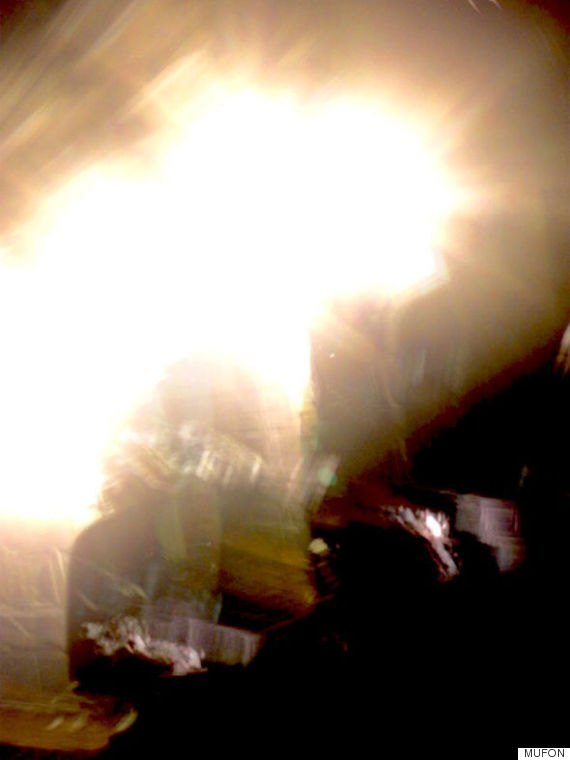
A 40-year-old woman who believes she was abducted by aliens has sent in images, allegedly captured on her phone, to the Mutual UFO Network (MUFON) - an organisation dedicated to the study of UFO, aliens and paranormal activity.
In an attempt to convince the network that the pictures are real, the photographers appear to have used several filters to show viewers a blurry amalgamation of human-like features that apparently belong to extraterrestrial beings.
While these shots were most likely taken on an earthly location (such as a garage), the unnamed woman is a firm believer that she was a victim of an abduction.
The story, first reported by the Express, cites her conversation with MUFON in which she said: "I believe I was abducted that night."
The Illinois resident said her boyfriend was sleeping in his van in the driveway, as the couple had an argument at the time.
"I was lighting a cigarette on the stove and had a scratch off ticket in my hand," she added.
"The next thing I know I'm waking up on the floor of my bathroom in foetal position.
"The cigarette I had and ticket were on the floor in the kitchen apparently I'd dropped them."
In response to those who accused her story of being fake, she said: "When you truly look at the detail you see they are other worldly and cannot be faked."
MUFON's lead investigator for "alien experiences" Kathleen Marden described the types of people who often file alien reports to the network.
In an interview with VICE she said: "A very small percentage of experiencers who request an investigation and file a report have done so in order to attempt to pull off a deception."
However, she also added "if they bring publicity to themselves, it's of a negative type. They're criticised by the public and by skeptics, and nobody makes a lot of money doing this."
Planeet X? Mysterieuze planeet die vier keer zo groot is als de aarde ontdekt achter Pluto
Astronomen van over de hele planeet zijn in de zevende hemel. Volgens twee Amerikaanse wetenschappers staat ver achter Pluto aan de rand van het zonnestelsel een nog onbekende planeet.
Omdat er acht planeten in het zonnestelsel bekend zijn, hebben de twee astronomen van de Technische Universiteit in Californië de onbekende planeet ‘Planeet Negen’ gedoopt.
Het bewijs voor het bestaan van de planeet is gebaseerd op berekeningen. Uitgangspunt voor die berekeningen is een groep kometen en andere objecten die zich in de Kuipergordel bevinden. Die bestaat uit een verzameling van allerlei objecten.
Sluitend model
De manier waarop enkele van die objecten zich bewegen, zou het bestaan van de negende planeet kunnen verklaren. De planeet zou volgens de berekeningen tot 10 keer zo zwaar en vier keer zo groot moeten zijn als de aarde en er 20.000 jaar over doen om rond de zon te draaien.
Er wordt al langer geschreven over het bestaan van de planeet, maar deze wetenschappers hebben voor het eerst een sluitend theoretisch model gepresenteerd dat het bestaan kan verklaren.
Planeet X
“Als je zegt bewijs te hebben voor Planeet X, reageert vrijwel iedere astronoom met ‘alweer?’, zegt Mike Brown, één van de astronomen. “Dat zou ik zelf ook zeggen.” Waarom is het deze keer anders? “Omdat we gelijk hebben,” zegt hij zelfverzekerd.
Er wordt nu tussen astronomen een informele competitie verwacht om zo snel mogelijk de nieuwe planeet te lokaliseren. Als blijkt dat Planeet Negen daadwerkelijk bestaat, moeten we alle handboeken astronomie herschrijven.
While the Martian conspiracy thickens, an unanticipated clue emerges from the planet’s “soft soil”. Is this the evidence that proves NASA lied to us all along?
In 2003, the renowned space agency launched its robotic Spirit rover towards Mars. After a successful landing on the Red Planet in 2004, the rover collected precious data until it got stuck in mud. Yes, you heard it well – mud or soft soil on the dusty, arid planet. From 2009 to 2010 NASA tried to free the captive wheels of their precious Spirit, but without success.
In their attempt to unlock the rover however, the assigned team of scientists stumbled upon the most curious find – traces of water and ice. Yes, NASA already knew about the wet past of Mars, they might even know about the former civilization that inhabited the planet in its distant past for all I know. Check out the picture below showing the trail left behind by Spirit rover stuck in the so-called “soft sand”.
A white trail is also seen behind the robot. Could it be ice, or is it something else? Well, according to scientists, the white substance is in fact silica, a chemical compound usually found in nature as quartz crystals, but also in various living organisms.
Albert Yen, a Curiosity science team member at NASA’s Jet Propulsion Laboratory explained how the silica ended up there, after Curiosity rover discovered a high concentration of it at some of the investigated sites on Mount Sharp.
"These high-silica compositions are a puzzle. You can boost the concentration of silica either by leaching away other ingredients while leaving the silica behind, or by bringing in silica from somewhere else, Yen said.
Either of those processes involve water. If we can determine which happened, we’ll learn more about other conditions in those ancient wet environments.”
This proves NASA knew about water on Mars and its distant and probably inhabited wet environment for at least 6 years, when the first photos from the Spirit rover arrived. As reported in an official article, the discovery came as a surprise, leaving room for heated debate regarding its origins.
"Apart from presenting a puzzle about the history of the region where Curiosity is working, the recent findings on Mount Sharp have intrigued threads linked to what an earlier NASA rover, Spirit, found halfway around Mars."
Other pictures prove the same – the existence of ancient Martian lakes. So why did they admit about water only recently if they knew about it for so many years? Is the white trail silica, or could it be something else such as permafrost? Are they preparing us for a far greater discovery?
The desert peninsula of Paracas is located on the southern coast of one of South America’s most enigmatic countries: Peru. It is there, in this barren landscape where Peruvian archeologist Julio Tello made one of the most mysterious discoveries in 1928. During excavations, Tello uncovered a complex and sophisticated graveyard under the harsh soil of the Paracas desert.
In the enigmatic tombs, Tello discovered a set of controversial human remains that would forever change how we look at our ancestor and our origins. The bodies in the tombs had some of the largest elongated skulls ever discovered on the planet, called the Paracas skulls. The Peruvian archeologist discovered over 300 mysterious skulls which are believed to be at least around 3000 years old.
As if the shape of the skulls wasn’t mysterious enough, a recent DNA analysis performed on some of the skulls presented some of the most enigmatic and incredible results that challenge everything we know about the origin and human evolutionary tree.
Skull Deformation: An Ancient religious practice
While several cultures around the globe practices skull deformation (elongation), the techniques used were different, meaning the results were also not the same. There are certain South American tribes that used to ‘bind infants skulls’ in order to change their shape, resulting into a drastically elongated cranial shape that resembled anything but ordinary humans. By applying constant pressure over a long period of time with the use of pieces of mood, the ancient tribes would achieve a cranial deformation which can also be found in ancient cultures from Africa. However, while this type of cranial deformation changed the shape of the skull, it did not alter the size, weight or cranial volume, all of which are characteristic traits of regular human skulls.
This is where the details about the Paracas skulls gets interesting. The Paracas skulls are anything but ordinary. The cranium of the Paracas skulls is are least 25 % larger and up to 60% heavier than the skulls of regular human beings. Researchers firmly believe that these traits could not have been achieved through head bindings as some scientists suggest. Not only are they different in weight, the Paracas skulls are also structurally different and only have one parietal plate while ordinary humans have two.
These strange characteristics have further deepened the decade-old mystery surrounding the Paracas skulls and researchers still have no idea what they were in the past.
Further Testing
The director of the Paracas Museum of History sent five samples of the Paracas skulls to undergo genetic testing, and the results were mesmerizing. The samples which consisted of hair, skin teeth and some fragments of cranial bones gave incredible details that have fueled the mystery surrounding these anomalous skulls. The genetic laboratory to where the samples were sent was not informed of the origin of the skulls in order to avoid ‘influenced results’.
Interestingly, the mitochondrial DNA, which is inherited from the mother, showed mutations that were unknown to any man, primate or animal found on planet Earth. The mutations present in the samples of the Paracas skulls suggest that researchers were dealing with a completely new ‘human-like being’, very different from Homo sapiens, Neanderthals or Denisovans.
Brien Foerster reported the following on the geneticist’s findings:
It had mtDNA (mitochondrial DNA) with mutations unknown in any human, primate, or animal known so far. But a few fragments I was able to sequence from this sample indicate that if these mutations will hold we are dealing with a new human-like creature, very distant from Homo sapiens, Neanderthals, and Denisovans.
According to reports, the individuals from the Paracas skulls were so biologically different that it would have been impossible from humans and them to ‘interbreed’. “I am not sure it will even fit into the known evolutionary tree,” the geneticist wrote.
Who were these mysterious beings? Did they evolve separately on Earth? What cause
d them to have such drastic differences from ordinary humans? And is it possible that these beings are actually not from Earth? All of these possibilities are theories that cannot be overruled given the current testing. The only thing that we know so far is that there are many things out there that go far beyond the understanding of researchers, historians, and scientists. It is possible that after all, the question to whether we are alone in the universe can be answered thanks to the Paracas skulls.
You don’t have to believe what you are watching on this video. Take your time to think in the posibility of this hapening nowadays. Take your own conclusions. “The reptilians are all over the planet, you find the ancient legends and accounts of “gods” from another world who interbred with humanity to create a hybrid network of bloodlines.”
The Old Testament, for example, talks about the “Sons of God” who interbred with the daughters of men to create the hybrid race, the Nefilim.
Before it was translated into English, that passage read “the sons of the gods”, plural. But the Bible accounts are only one of so many that describe the same theme.
The Sumerian clay tablets, found in what we now call Iraq in the middle of the 19th century, tell a similar story. It is estimated they were buried around 2,000 BC, but the stories they tell go back long before that. The tablets talk of a race of “gods” from another world who brought advanced knowledge to the planet and interbred with humans to create hybrid bloodlines.
These “gods” are called in the tablets, the “Anunnaki“, which apparently translates as “those who from heaven to earth came.”
The ancient accounts tell us that these hybrid bloodlines, the fusion of the genes of selected humans with those of the “gods“, were put into the positions of ruling royal power, especially in the ancient Near and Middle East, in advanced cultures like Sumer, Babylon, and Egypt.
But it happened elsewhere, also, as you will find, for example, in the amazing information provided on this site by the African Zulu shaman, Credo Mutwa, and in the incredible Credo videos, Reptilian Agenda, parts one and two.
He tells the same story from the black African tradition that I have uncovered elsewhere in the world.
The accounts of the “serpent race” in ancient cultures are simply endless wherever you look and the serpent, reptilian, symbolism in relation to the Anunnaki and other versions of these “gods” is equally widespread. We see this in the Bible, for instance, with the serpent in the “Garden of Eden”- a story which clearly comes from the Sumerian accounts, as does the story of Moses in the bulrushes, a story told about a Sumerian king long before the Bible.
This is why I found it so astounding when I was told by Zecharia Sitchin, the best-known translator of the Sumerian tablets, that there was no evidence of a serpent race in the ancient world. Of course there is.
He also strongly advised me in relation to the serpent race… “Don’t go there”.
Why, when the evidence, ancient and modern, is so enormous?
David Icke “If you are new to my work, the most bizarre information you will find on this site is that concerning the reptilian connection. I understand that. It is quite something to absorb from our conditioned version of reality. But, then, that is the very point. If you want to keep something from the people, give them a version of reality and possibility that is so far from what is really going on that even if the truth comes to light it will seem far too ludicrous and extreme for most people to believe it.
Indeed, if you do your job well enough, the people will laugh at the truth, call it insane, and ridicule anyone who promotes it. To truly understand how all the information on this site fits together into one coherent whole (which it does), read my book, The Biggest Secret. But for those who have not yet done so, here is some basic background.
When I reached the point some years ago where I had put together the structure through which a few people control the direction of the world (see And The Truth Shall Set You Free), it was clear that this network of secret societies and covert groups manipulating global politics, business, banking, military, media, and so on, could not have been put together in a few years or decades. It had to go back a very long time.
So I began to trace it back into what we call history. I did this in the knowledge that, for some reason, bloodline and genetics were vitally important to these manipulators, the Illuminati or Illuminated ones – illuminated into knowledge that the public never see.
I followed the trail back comfortably to the time of the Crusades in the Middle East, the 12th and 13th centuries, that kind of period, and on it went far back into the ancient world and pre-history.
From these bloodlines has come the origin of the “divine right of kings”, the belief that only certain bloodlines have the god-given right to rule. In truth this is not the “divine” or “God” at all. It is the right to rule from the reptilian “gods” by way of your hybrid genetics.
These bloodlines later became the royal and aristocratic families of Europe and, thanks to the “Great” British Empire and the other European empires, they were exported to the Americas, Africa, Australia, New Zealand, and right across into the Far East, where they connected with other reptilian hybrid bloodlines, like those, most obviously, in China, where the symbolism of the dragon is the very basis of their culture.
These reptilian-human hybrid lines became the political and economic rulers of these lands occupied by the European empires and they continue to rule these countries to this day.
The United States of America has been home to hundreds of millions of people since 1776. What’s more, these people came from an amazingly diverse genetic pool. And yet, wait for this, the 42 who have become Presidents of the United States are all related!!! Thirty-Three of them alone go back to Charlemagne, one of the most famous monarchs of what we call France.
He just happens to be a major figure in the story of these bloodlines and their expansion out of Britain, France, Germany, and elsewhere.
The Rothschilds, Rockefellers, the British royal family, and the ruling political and economic families of the US and the rest of the world come from these SAME bloodlines.
This is why the so called Eastern Establishment families of the United States interbreed with each other as obsessively as the European royal and “noble” families have always done. And similar families across the world. It is not because of snobbery, it is to hold as best they can a genetic structure – the reptilian-mammalian DNA combination which allows them to “shape-shift”.
You will also see references on the site to “shape-shifting”, the phenomena in which witnesses have reported seeing people (most often those in positions of power), transform before their eyes, from a human form to a reptilian one and then back again.
You will find much about this in The Biggest Secret and Credo Mutwa confirms exactly the same experience in black Africa. Once again, ancient and modern accounts support each other.
The ancient gods of the Indus Valley, the Nagas, were said to have been able to take either human or reptilian form.
Former US president, George Bush, incidentally, is mentioned more than any other person in my experience in relation to shape-shifting. This is why his son is being brought through in the 2000 presidential election.
Presidents are not EL-ected by ballot, they are SEL-ected by blood. Al Gore, his “Democratic” opponent in the one-party state, is also from this bloodline. Look almost anywhere in the world in a position of significant power and you will find the same.
The reptilian symbolism you see around you with gargoyles, in coats of arms, in advertising, and so on, is all part of this.
These “gods” could not take over the planet openly because there are not enough of them, so they are doing it covertly by appearing human. Movies like They Live, The Arrival (the first, not the sequel), and the US television series, V, tell the story of what is REALLY going on.
I urge you to think about watching these movies to get up to speed if you are new to all of this.
New World Order and conspiracy researchers also have political and religious belief systems to defend and while they uncover one level of the conspiracy, most reject and even ridicule what I am saying about the reptilian connection. That’s fine, but unless they encompass this bigger picture they will never, in my view, understand what is truly happening all around us.
As Ghandi said: “Even if you are in a minority of one, the truth is still the truth”.
And as a result of the waves The Biggest Secret has caused, and the new information, experiences, and accounts the book and this website have attracted from all over the world, there is a growing understanding that this apparently bizarre, crazy, story is actually true.
That the world may indeed be controlled by reptilian bloodlines that hide behind apparently human form and it is this understanding which pulls together all the apparently unconnected information on this site into a very much connected whole.
Here are some examples:
RELIGION
If you wish to control a mass population, you have to disconnect them from the true knowledge of who they are and their own infinite potential to manifest their own destiny and control their own lives. You have to persuade them that they are insignificant and powerless so they will live their lives in accordance with that.
This is where religion has been one of the most effective weapons of the Illuminati and the reptilian bloodlines. It fills people with fear of a judgmental God and tells them that unless they believe that the “truth” of all that is can be found in one book or belief system, they are going to hell or will experience other extremely unpleasant consequences.
Different religions have also been wonderful vehicles for dividing and ruling the people through arrogant, self-righteous, inter-religious conflict. The reptilians created the religions for this reason and the key players within them do not even begin to believe the nonsense they parrot to their followers. They just want the population to believe it, so they will be easy to control.
This is why you find so many famous “Christian” evangelists, for example, are actually Satanists. Their “Christianity” is just a smokescreen.
MEDICINE AND MEDIA
The suppression of the true knowledge of healing and the domination of drug and surgery-based “medicine” ensures that the human physical body operates at far less than its optimum potential.
This is the reason for the blatant misrepresentation and suppression of the so-called “alternative” forms of healing which have been around for thousands of years longer than modern “medicine”.
Food additives, fast food, flouride in the water supplies, the poisons we put on the land and therefore eat in our food and drink in our water, are all suppressing not only our physical health and vibrance, but, most crucially, our brain functions and intellect. A fully awake, mentally sharp, population is the last thing you need if you want to control them.
Thus the reptilian bloodlines also put so much emphasis on controlling “education“ and the media. This allows them to feed us a constant diet of brainless crap, like game shows, while the “news” media tells us what the controllers want us to think.
Most journalists are so brain-dead themselves, so lacking in understanding of what they are part of, that they, like most of the population, play a part in advancing an agenda they do not even know exists.
MIND CONTROL
This is obviously very related to religion, which is, for me, the greatest form of mass mind control yet invented.
So is advertising and television. But mind control goes much deeper than that. The Illuminati-reptilian mind-control projects have produced literally millions of mind-controlled robots in endless walks of life, who are programmed to carry out the Illuminati agenda.
There are many electronic ways that this is done today, but one of the key methods is trauma-based mind control. This is where people are traumatized through sexual abuse, violence, being forced to witness and take part in human sacrifice rituals, and countless other horrors. Such experiences activate the mechanism in the mind which shuts out memories of extreme trauma.
One expression of this, which many people have experienced, is when they cannot recall the memory of a bad car crash. They can remember before and after, but not the impact. The mind puts an amnesic barrier around the memory so we do not have to keep re-living it.
This is a good thing, but the Illuminati have developed methods of using this technique to traumatize a mind over and over until it fragments into a honeycomb of disconnected amnesic barriers. They then program these different fragments of mind (altars as they call them) with different tasks. The tasks are pre-programmed to be activated with a “trigger” word, color, sound, or whatever. Once the trigger is given that programming locks in and the person will do whatever they have been programmed to do.
This can be to have sex with a famous politician, which they will not remember; to assassinate someone like John Lennon; to go crazy with a gun in a school, which leads to gun control etc.
The concentration camps of Nazi Germany under the supervision of the “Angel of Death”, Josef Mengele, were one of the major centers for such experimentation. Mengele was taken to the United States and South America after the war by the Illuminati under the name Doctor Green or Greenbaum to continue his horrific “work”.
This manifested as the notorious mind-control project, MK Ultra. The China Lake Naval Weapons Center in the California desert was one of his premier bases of operation.
The most effective time to start this process of creating human robots is before the age of five or six. Hence you have the colossal child abuse networks and the Satanic ritual abuse of children exposed on this site and in my books.
THE ABUSE AND SATANIC RITUAL ABUSE OF CHILDREN, AND HUMAN SACRIFICE CEREMONIES IN GENERAL
Staggering as it may seem, all of the above are massively widespread all over the world.
It is happening in your community now, I don’t care where you are. I, and others, have been highlighting this for years and now, as you will see on this site, the scale of it, and the famous people involved, are coming to light at last.
Partly these rituals and abuse networks are to do with traumatizing people, especially children, but it is far more than just that. Follow the Illuminati-reptilian bloodlines from the ancient world to now and they have ALWAYS taken part in human sacrifice ceremonies and blood-drinking. The sacrifices to “the gods” in the ancient accounts were literally sacrifices to the reptilians and their hybrid bloodines.
The story of the blood-drinking Dracula is symbolic of these reptilian “vampires”. One of the locations of this reptilian group would appear to be the star-system known as Draco and “draconian” certainly sums up the Illuminati.
To hold their human form, these entities need to drink human (mammalian) blood and access the energy it contains to maintain their DNA codes in their “human” expression. If they don’t, they manifest their reptilian codes and we would all see what they really look like. “Oh, my God, Mr. President, do you always eat your breakfast from across the room?”.
From what I understand from former “insiders”, the blood (energy) of babies and small children is the most effective for this, as are blond-haired, blue-eyed people. Hence these are the ones overwhelmingly used in sacrifice, as are red- haired people also, it appears.
This is why people like George Bush, Henry Kissinger, and a stream of the other Illuminati “big names” are exposed in my books and on this site as reptilian shape-shifters who take part in human sacrifice and blood drinking. The two go together.
There also appears to be a very significant emphasis among the Illuminati-reptilians and their offshoots with pedophilia, which is rampant on this planet.
I would emphasize also before I end here that I am exposing certain reptilian GROUPS behind the Illuminati, not the reptilian genetic stream in general.
There are many of reptilian origin who are here to help humanity to free themselves from this mental and emotional bondage. Indeed, every one of us has a body with much reptilian genetics, including part of the brain called the R-complex, the reptilian brain. It is merely a matter of degree.
I trust this brief summary will help you to see the relevance of all the articles and information you will find on this site. In the end all these apparently unconnected “conspiracies” are part of ONE conspiracy designed to introduce ONE agenda.
The final flight of the prototype space shuttle Enterprise apparently made a big impression on late actor Leonard Nimoy.
A newly released video shows Nimoy — best known to legions of dedicated "Star Trek" fans as Mr. Spock — calling the ferry flight that brought the shuttle Enterprise to New York City for museum display the "most thrilling, amazing sight."
Nimoy, who died last year, was on hand at New York's John F. Kennedy Airport when Enterprise, riding atop NASA's shuttle carrier aircraft, landed there in April 2012. It was Enterprise's last stop before being shipped to the Intrepid Sea, Air & Space Museum, which is now the spacecraft's permanent home. (NASA's space shuttle fleet was grounded in 2011.) [Final Voyage of Space Shuttle Enterprise (Photos)]
The shuttle Enterprise was named after the starship Enterprise, which Spock, Capt. James T. Kirk and other crewmates used in "Star Trek."
The newly released video, which is part of an upcoming film on Nimoy's life, was provided exclusively to Space.com. Nimoy's family is creating the new documentary called "COPD: Highly Illogical" to talk about Nimoy's life and the disease that claimed his life.
The Enterprise-related footage shows Nimoy reminiscing about his 2012 visit to New York. He went there with his wife to see friends and family, and also to visit some contemporary-art galleries, a hobby of Nimoy's. While he was in the city, Nimoy heard a news report saying the space shuttle would be landing there that week.
"I contacted the Inteprid people and asked them if we could get on the Intrepid to watch the flyby," Nimoy said in the video. "They came right back and said, 'Why don't you come up to JFK where it will be landing, and, if you'd like to, you could say a few words.' So I said, 'OK.'"
Leonard Nimoy of "Star Trek" fame speaks after NASA's prototype space shuttle Enterprise landed at New York City’s John F. Kennedy Airport on April 27, 2012. Credit: Tariq Malik/Space.com
Along with a small crowd of spectators, Nimoy watched the shuttle and its modified 747 carrier aircraft zoom by at 500 feet (150 meters) from the ground, leave for a planned loop around Manhattan and return for a final touchdown.
"It was cold and windy. It was freezing!" Nimoy said with a laugh. "But it was exciting, really exciting to be there, and I was thrilled we were able to work it out."
Most castmembers of the original "Star Trek" TV series, including Nimoy, were on hand for the shuttle Enterprise's unveiling in 1976. The vehicle was used for test flights in 1977; it did a world tour after testing was completed, and was eventually restored and displayed at the Steven F. Udvar-Hazy Center, part of the Smithsonian Institution's National Air and Space Museum.
But NASA awarded the space-flown shuttle Discovery to the Smithsonian after the program's retirement, leading to the Enterprise's move to New York in 2012.
Nimoy died of chronic obstructive pulmonary disease (COPD), an inflammatory lung disease most commonly present among smokers. Nimoy quit smoking decades before he developed the disease. After Nimoy made his medical diagnosis public, he tweeted occasionally about the dangers of smoking.
Fundraising is ongoing for the film. After a campaign at FirstGiving.com that concluded last year, Nimoy's family is now raising money through Indiegogo.
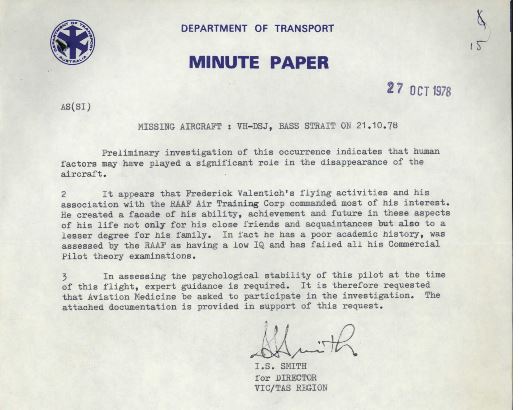
On 28 June 2012 I wrote a blog piece about the discovery of two Australian government files relating to the disappearance, in 1978, of pilot Frederick Valentich, over Bass Strait, Australia.
Last year, in September, while randomly checking the National Archives of Australia's RecordSearch database, I found a two part file which also relates to the disappearance.
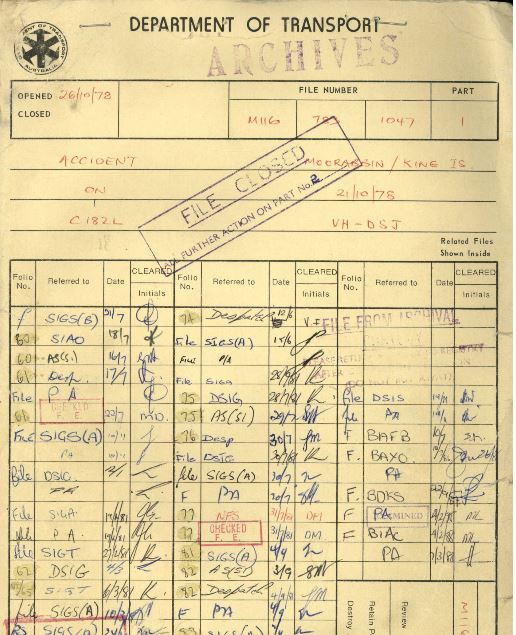
The new file is NAA file series B638, control symbol M116/783/1047 parts 1 and part 2; barcodes 10499635 and 10499636. Series B638 is comprised of 299 air safety, accident and incident files, where M stands for Melbourne.
I immediately requested that the files, whose status was "Not yet examined" be examined. On 18 December 2015, I was advised that both parts of the file were now "open." I then submitted a request to have the file digitised, and paid the relevant fee.
The file, when "open" is titled "Accident on C182L - Moorabbin Vic/King Island Tas - 21 October 1978. VH-DSJ [including multiple newspaper cuttings regarding incident folder contains two piles.]"
The file had just been digitised.
What is on the file?
Perhaps firstly, the question is, where did this new file originate? We know that the already known file, NAA file series B1497 control symbol V116/783/1047, was owned by the Department of Civil Aviation, Victoria-Tasmania region. However, this new file NAA file series B638 control symbol M116/783/1047 was owned by the Department of Civil Aviation, Central Office.
Part one of the file is 200 pages, with part two being 139 pages long. Between the two, there are:
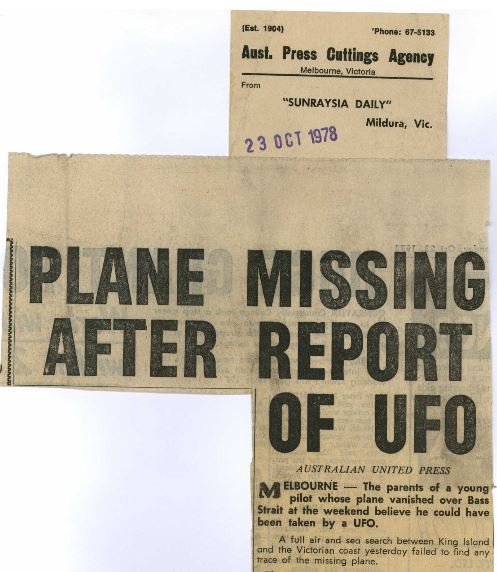
* dozens and dozens of newspaper clippings about the disappearance, perhaps the largest collection of articles I have come across
* numerous documents where statements were taken from individuals such as aircraft refuellers; pilots; and briefing officers. We have previously seen all of these statements on NAA file series A4703 control symbol 1978/1205 and NAA file series B1497 control symbol V116/783/1047
* a few, previously unseen typed and handwritten official minutes between individuals. However, even these really add very little to the debate as to what caused the disappearance.
One interesting set of papers is a letter from Allan Brunt, Regional Director for South Australia for the Bureau of Meteorology. Allan was open to taking a look at UFO reports, and he and I had a series of discussions about specific sightings, such as the 1988 Knowles car lift case.
On 3 August 1982 Allan forwarded a three page letter to the Department of Transport about the disappearance. Amongst his comments was one in regards to the fact that the UFO reported by Valentich was not seen continuously but on three separate occasions. Allan wrote "This type of sighting is consistent with a multiple meteor observation or a "meteor shower" with not just one, but several phenomena in procession. From the evidence available, I am unable to rule out the possibility that the pilot of VH-DSJ was frightened by the appearance of one or more meteors and, fearing a collision, took evasive action, or being seriously distracted by the frightening phenomena, flew into the sea."
You can view the file
To take a look at the file for yourself, or to download the file's PDF, go to http://www,naa.gov.auand on the home screen type "dsj" into the "search the collection" window, and click on "go."
Finally, yet another Valentich file revealed
We now know of three Australian government files relating to the disappearance of Valentich. However, the latest file's inside cover reveals yet another, unknown file. This is a Department of Transport file number 123/1/30 titled "ASIB requests for information regarding accident to Cessna 182L aircraft VH-DSJ on 21/9/78." (This date of 21/9/78 is incorrect, it should be 21/10/78.) I checked the NAA's RecordSearch and this fourth file is not listed. I checked using words within its title, but found no trace of it in RecordSearch. Yet another mystery.
UFO Passes Very Quickly Over El Cajon, Jan 14, 2016, Video, UFO Sighting News.
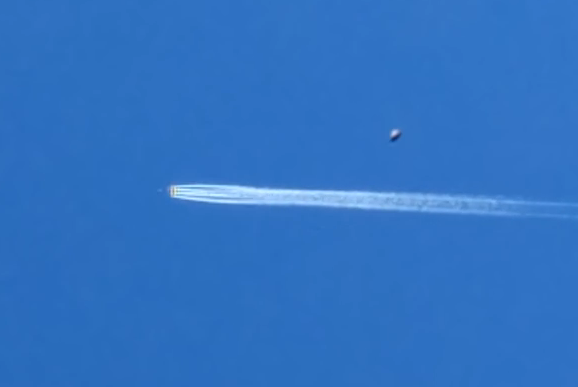
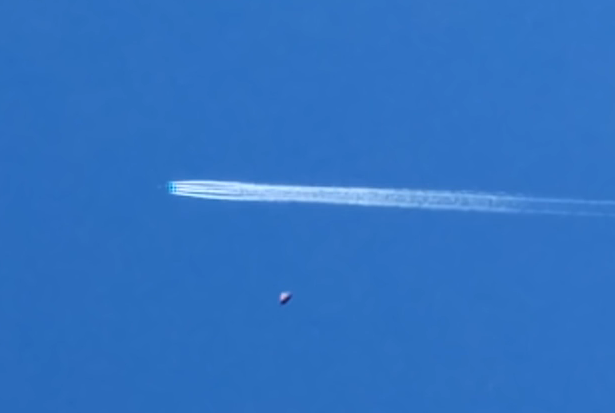
Date of sighting: January 14, 2016 Location of sighting: El Cajon, California, USA Source: MUFON #73895 Here is a great catch of a UFO shooting past a contrail of a jet to investigate it. UFOs monitor the closest things to them, and things that fly interest them a lot. I have tried similar techniques of recording planes and have caught UFOs fly past a few times. Its more common that you know. Scott C. Waring www.ufosightingsdaily.com Eyewitness states: I was getting ready to go to work at about 11:30 am. I noticed a plane or jet heading straight up which got my attention. I started recording the jet till it was out of range of the camera. I later came home from work to see the video when I noticed a very fast object me and my girlfriend didn't see during the time I was recording. It was at about 0:10-0:11 seconds into the video when I saw a object past extremely fast from the right side of the video and head to the left side of the video. I took screenshots to analyze it a bit better. It looks like something I've never seen. Not a bug or bird. When I saw it more clearly I was excited and sort of skeptical, but I then uploaded it to YouTube so my friends and family can see it and give me their opinion and most said its definitely a ufo. I'm not sure what it is but I want to share this video with MUFON and maybe I can get a answer or maybe you guys can have more evidence of real UFOs. This is not faked or tampered in any way. I appreciate your time.
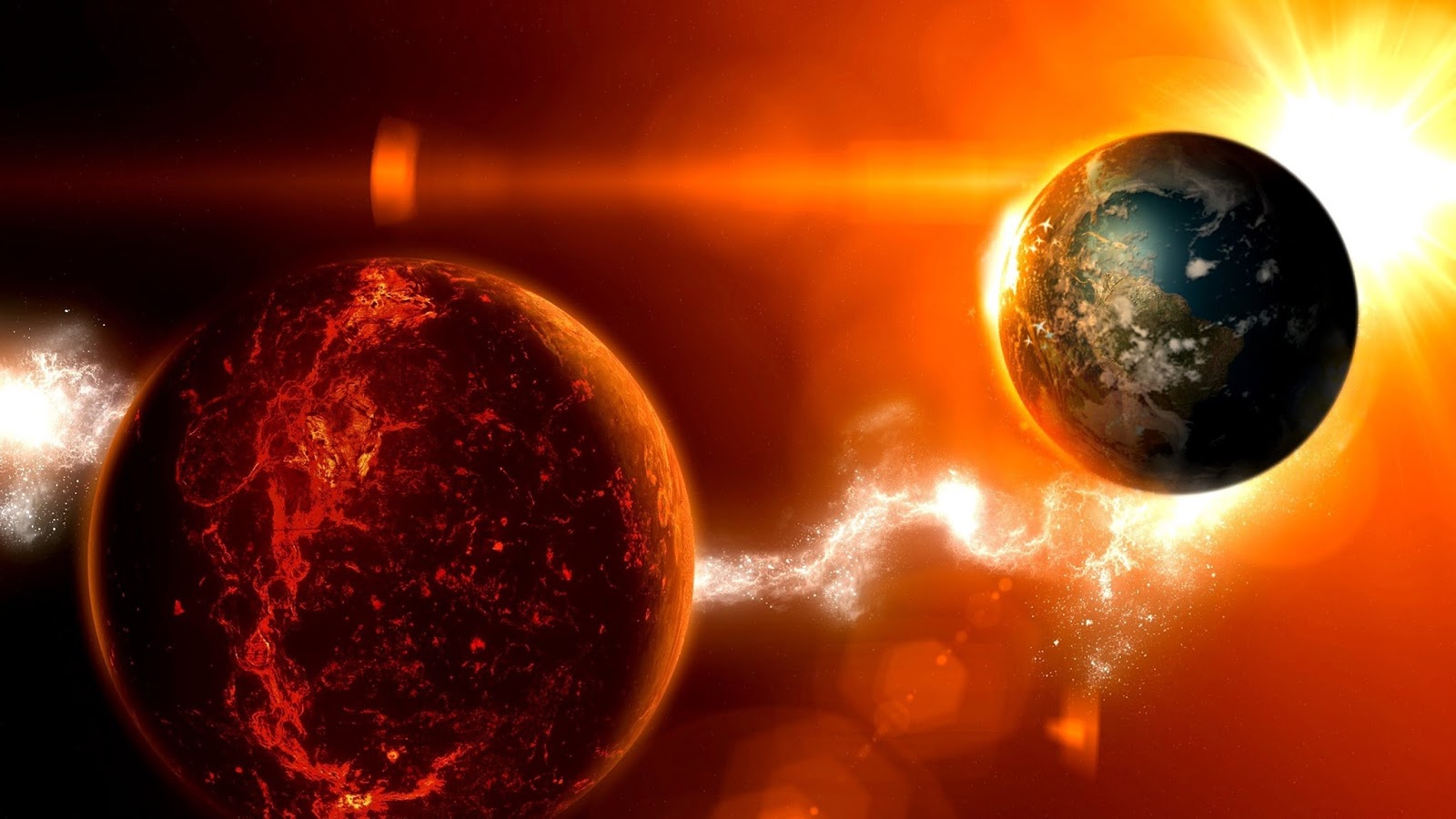
Planet X is real, we all knew that already. NASA evidence points to it. Today scientists declared they believe a hidden 9th planet to exist in our solar system. Some people believe the planet is teaming with alien life and is responsible for reading humans on this planet. But the concern is, why did they create humanity? Some worry that humans will be harvested like cattle when Planet X comes back around. Me...I think they will just have a closer eye on their experiment and continue to be observers. SCW News states: CAPE CANAVERAL, Fla. (AP) — Scientists reported Wednesday they finally have "good evidence" for Planet X, a true ninth planet on the fringes of our solar system. The gas giant is thought to be almost as big as Neptune and orbiting billions of miles beyond Neptune's path — distant enough to take 10,000 to 20,000 years to circle the sun. This Planet 9, as the two California Institute of Technology researchers call it, hasn't been spotted yet. They base their findings on mathematical and computer modeling, and anticipate its discovery via telescope within five years or less. The two reported on their research Wednesday in the Astronomical Journal because they want people to help them look for it. "We could have stayed quiet and quietly spent the next five years searching the skies ourselves and hoping to find it. But I would rather somebody find it sooner, than me find it later," astronomer Mike Brown told The Associated Press. "I want to see it. I want to see what it looks like. I want to understand where it is, and I think this will help." Once it's detected, Brown insists there will be no Pluto-style planetary debate. Brown ought to know; he's the so-called Pluto killer who helped lead the charge against Pluto's planetary status in 2006. (It's now officially considered a dwarf planet.) More at source.
Interesting daytime sighting over El Cajon, California 14-Jan-2016
Here’s one new interesting footage of an unidentified flying object flying near a plane. This happened over El Cajon in California on 14th January 2016.
Witness report:I was getting ready to go to work at about 11:30 am. I noticed a plane or jet heading straight up which got my attention. I started recording the jet till it was out of range of the camera. I later came home from work to see the video when I noticed a very fast object me and my girlfriend didn’t see during the time I was recording. It was at about 0:10-0:11 seconds into the video when I saw a object past extremely fast from the right side of the video and head to the left side of the video. I took screenshots to analyze it a bit better. It looks like something I’ve never seen. Not a bug or bird. When I saw it more clearly I was excited and sort of skeptical, but I then uploaded it to YouTube so my friends and family can see it and give me their opinion and most said its definitely a ufo. I’m not sure what it is but I want to share this video with MUFON and maybe I can get a answer or maybe you guys can have more evidence of real UFOs. This is not faked or tampered in any way. I appreciate your time.
Meer van UFO'S of UAP'S, ASTRONOMIE, RUIMTEVAART, ARCHEOLOGIE, OUDHEIDKUNDE, SF-SNUFJES EN ANDERE ESOTERISCHE WETENSCHAPPEN - DE ALLERLAATSTE NIEUWTJES


 UK Hacker Gary McKinnon Who Saw Off World Soldiers & Ships On US Gov Computers Had Extradition Blocked!




 New Scientist