Naar de inhoud

UFO'S of UAP'S, ASTRONOMIE, RUIMTEVAART, ARCHEOLOGIE, OUDHEIDKUNDE, SF-SNUFJES EN ANDERE ESOTERISCHE WETENSCHAPPEN - DE ALLERLAATSTE NIEUWTJES

UFO's of UAP'S in België en de rest van de wereld
seniorennet.beseniorennet.be
Ontdek de Fascinerende Wereld van UFO's en UAP's: Jouw Bron voor Onthullende Informatie! Ben jij ook gefascineerd door het onbekende? Wil je meer weten over UFO's en UAP's, niet alleen in België, maar over de hele wereld? Dan ben je op de juiste plek! België: Het Kloppend Hart van UFO-onderzoek In België is BUFON (Belgisch UFO-Netwerk) dé autoriteit op het gebied van UFO-onderzoek. Voor betrouwbare en objectieve informatie over deze intrigerende fenomenen, bezoek je zeker onze Facebook-pagina en deze blog. Maar dat is nog niet alles! Ontdek ook het Belgisch UFO-meldpunt en Caelestia, twee organisaties die diepgaand onderzoek verrichten, al zijn ze soms kritisch of sceptisch. Nederland: Een Schat aan Informatie Voor onze Nederlandse buren is er de schitterende website www.ufowijzer.nl, beheerd door Paul Harmans. Deze site biedt een schat aan informatie en artikelen die je niet wilt missen! Internationaal: MUFON - De Wereldwijde Autoriteit Neem ook een kijkje bij MUFON (Mutual UFO Network Inc.), een gerenommeerde Amerikaanse UFO-vereniging met afdelingen in de VS en wereldwijd. MUFON is toegewijd aan de wetenschappelijke en analytische studie van het UFO-fenomeen, en hun maandelijkse tijdschrift, The MUFON UFO-Journal, is een must-read voor elke UFO-enthousiasteling. Bezoek hun website op www.mufon.com voor meer informatie. Samenwerking en Toekomstvisie Sinds 1 februari 2020 is Pieter niet alleen ex-president van BUFON, maar ook de voormalige nationale directeur van MUFON in Vlaanderen en Nederland. Dit creëert een sterke samenwerking met de Franse MUFON Reseau MUFON/EUROP, wat ons in staat stelt om nog meer waardevolle inzichten te delen. Let op: Nepprofielen en Nieuwe Groeperingen Pas op voor een nieuwe groepering die zich ook BUFON noemt, maar geen enkele connectie heeft met onze gevestigde organisatie. Hoewel zij de naam geregistreerd hebben, kunnen ze het rijke verleden en de expertise van onze groep niet evenaren. We wensen hen veel succes, maar we blijven de autoriteit in UFO-onderzoek! Blijf Op De Hoogte! Wil jij de laatste nieuwtjes over UFO's, ruimtevaart, archeologie, en meer? Volg ons dan en duik samen met ons in de fascinerende wereld van het onbekende! Sluit je aan bij de gemeenschap van nieuwsgierige geesten die net als jij verlangen naar antwoorden en avonturen in de sterren! Heb je vragen of wil je meer weten? Aarzel dan niet om contact met ons op te nemen! Samen ontrafelen we het mysterie van de lucht en daarbuiten.

World’s Most Powerful Rocket Set For Testing In 2017

World’s Most Powerful Rocket Set For Testing In 2017

By: David Russell Schilling

TakeOff

NASA is planning the most powerful rocket engine ever called the Space Launch System (SLS). It will be the largest and most powerful engine ever built and is targeted for testing in 2017. At a cost of over $18 billion this new system sounds expensive but includes the cost the first three flights. SLS will use technology from the Space Shuttle program including the main engines and the solid rocket motors.

SLS

SLS Innovative Design & Comparison to Saturn 5

One of the critical innovations of the new SLS design is to go back to a vertical design where components of the rocket are vertically integrated, making it simpler than the Space Shuttle which carried the shuttle “piggyback”.

The SLS is currently designed to have three engines but this number could grow to five according to NASA. The SLS will be capable of lifting 70 metric tons or 10% more thrust than Saturn V. Expansion of the advanced boosters will provide lifting capacity up to 130 metric tons or 20% more thrust than Saturn V.

Click image to see larger version:

sls-2

The Saturn V was 363 feet tall and the SLS will be about 40 feet taller. The Saturn V was used by NASA’s Apollo and Skylab programs from 1967 to 1973 and was the only rocket that has taken humans out of low Earth orbit and to the moon. Following is a take-off animation of the SLS!

SLS will look a bit like Saturn V and the Space Shuttle but advancements in manufacturing will make SLS a much more efficient system with advanced nozzle materials and newer and greener technologies. NASA expects the system to be more reliable and easier to operate than the Space Shuttle.

SLS Comparison with SpaceX Falcon System

SLS appears to be a superior vehicle in terms of maximum capacity but the SLS price tag is very high. Some engineers have estimated that the SpaceX Falcon may be able to have 10+ flights for the cost of a single SLS launch. Additionally the SLS’s more advanced performance capabilities may not be needed; it may be cheaper to use a smaller lift vehicles.

In a recent in-depth article on IndustryTap we looked at the life and career of SpaceX founder Elon Muskwhose goal is to go to Mars.

SLS-concept-NASA

David Russell Schilling

David enjoys research and writing about cutting edge technologies that hold the promise of improving conditions for all life on planet earth.

{ http://www.industrytap.com/ }

Hoe vind je dit bericht?
Geschreven door peter om 20:32 Stuur door

Moon Express Gets Permission to Land on the Moon By: Nidhi Goyal |

Moon Express Gets Permission to Land on the Moon

By: Nidhi Goyal 

Image courtesy moon-express

Image courtesy moon-express

So far, a moon landing has been accomplished only by three nations. The United States’ Apollo 11 was the first manned mission to land on the Moon, on July 20, 1969.

Subsequently, only two counties successfully landed spacecraft on the moon: Russia and China. But no private company has ever been given permission for a moon landing.

But now, a US company has been given government permission by the Federal Aviation Administration (FAA) to land on the moon.

The Florida-based company, “Moon Express,” plans to send a small unmanned lander called MX-1. The company hopes to send the robotic spacecraft to the moon next year. The robotic lander will be sent to the moon on the top of a rocket that they are purchasing from space startup Rocketlab.

Naveen Jain, Co-founder and Chairman of the Moon Express, says, “Only three super powers have ever landed on any planet—we will become the fourth superpower.”

Water is the oil of the solar system, and the moon has become a gas station in the sky

Moon Express CEO Bob Richards referred to the recent discovery of water on the moon by the Indian Space Research Organization’s (ISRO) Chandrayaan-1 spacecraft with ISRO’s Moon Impact Probe (MIP) and NASA’s Moon Mineralogy Mapper (M3) as being highly important.

Mission can win Google Lunar X-Prize of $20 million

Moon Express can win the prize if MX-1 successfully lands on the moon, takes off again, lands more than 1,500 feet away from its earlier position and sends high-definition video and images back to Earth.

But winning the prize is not the only point; the bigger plan is to discover valuable natural materials that can be used on Earth.

The total estimated cost of the mission is about $55 million. Moon Express has already raised $30 million.

Nidhi Goyal

Nidhi is a gold medalist Post Graduate in Atmospheric and Oceanic Sciences. You can also find Nidhi on Google+.

{ http://www.industrytap.com/ }

Hoe vind je dit bericht?
Geschreven door peter om 20:24 Stuur door

Deze reusachtige piramide zit verborgen in een berg

Deze reusachtige piramide zit verborgen in een berg

Deze reusachtige piramide zit verborgen in een berg

De Grote Piramide van Gizeh valt in het niet bij de piramide van Cholula in Mexico. Toch zagen de Spaanse indringers hem over het hoofd.

Toen Hernan Cortes en zijn Spaanse leger bijna 500 jaar geleden Cholula binnenmarcheerden, werden ze begroet door een vreedzaam volk dat piramides bouwde in plaats van grote opslagplaatsen vol wapens. Binnen een dag werd 10 procent van de lokale bevolking uitgemoord en de piramides werden in brand gestoken.

Deze reusachtige piramide zit verborgen in een berg

De kerk bovenop de piramide (Wikicommons)

Volgens een legende werd één piramide verborgen. Het bouwwerk werd honderden jaren aangezien voor een berg, tot de lokale bevolking in 1910 begon met de bouw van een psychiatrisch ziekenhuis. Toen stuitte men op het grootste bouwwerk ooit gemaakt.

Matroesjka’s

Tlachihualtepetl, oftewel de Grote Piramide van Cholula, is 66 meter hoog en 450 meter breed. De Grote Piramide van Gizeh valt bij dit kolossale bouwwerk in het niet, zo bericht de BBC.

De Spanjaarden bleven in Cholula en stampten overal kerken uit de grond. Toen ze de Iglesia de Nuestra Señora de los Remediosa wilden bouwen op wat zij zagen als een grote heuvel, plaatsten ze in werkelijkheid een religieus monument bovenop een piramide.

Deze reusachtige piramide zit verborgen in een berg

Een uitgegraven deel van de piramide

De Grote Piramide van Cholula is niet zomaar een piramide. Het zijn in totaal zes piramides die als een soort matroesjka’s in elkaar passen. Gedacht wordt dat de oorspronkelijke piramide rond 300 voor Christus werd gebouwd en dat latere beschavingen de overige vijf piramides hebben gebouwd.

Reus

Vanwege de kerk, die aangeduid is als koloniaal monument, is het niet mogelijk om de piramide in zijn geheel te onderzoeken en te herstellen. In de piramide hebben archeologen inmiddels zo’n acht kilometer aan tunnels uitgegraven.

Ondanks de enorme omvang van de piramide is er maar heel weinig over bekend. Volgens een mythe is de piramide gebouwd door een reus. De Azteken stelden dat de bouw te danken was aan Xelhua, één van de zeven reuzen in de Azteekse mythologie.

Bijna 500 jaar na de koloniale overheersing heeft Cholula te maken met een nieuwe invasie: toeristen.

[BBC]

Hoe vind je dit bericht?
Geschreven door peter om 18:53 Stuur door

UFO Sighting Over Small Arizona City On Aug 20, 2016, Video, UFO Sighting News.

UFO Sighting Over Small Arizona City On Aug 20, 2016, Video, UFO Sighting News.

open%2Bminds%252C%2Bsphinx%252C%2BMoon%252C%2Bsun%252C%2BAztec%252C%2BMayan%252C%2BWarrier%252C%2Bfight%252C%2Btime%252C%2Btravel%252C%2Btraveler%252C%2BArizona%252C%2BUFO%252C%2BUFOs%252C%2Bsighting%252C%2Bsightings%252C%2Balien%252C%2Baliens%252C%2BET%252C%2Bspace%252C%2Btech%252C%2BDARPA%252Cgod%252C%2B2.png
Date of sighting: August 20, 2016
Location of sighting: Buckeye, Arizona, USA
 
This is awesome...why? Because its an overcast day with massively thick and dark clouds in the sky. What that means is that nothing could shine bright enough to break through those clouds...no stars, no night sky, no moon. So any argument that this is a star is a waste of breath. This glowing object is checking out the neighborhood and could be interested in the lighting that comes from such clouds. These clouds build up a special kind of lighting rare around the world...called colored lighting. It could contain energy that the UFO or alien drone needs to continue its research mission. You often see lighting in these clouds in Arizona...without even a drop of rain to be had...I use to live in Bullhead city, Arizona and Needles, California for a few years, where I often saw the rainbow color lighting...loved it.
Scott C. Waring
 
Eyewitness states: 
Just had a UFO sighting in Buckeye, Arizona August 20th, 2014 at 7:25 pm. Have no idea what I just witnessed. Maybe it's a UFO or maybe just a drone, nevertheless it was kinda strange to see this hovering over our neighborhood in the middle of a thunderstorm. The sound of my AC unit in the background possibly drowned out any sound the object was making. Please understand, I'm not saying this is an alien spacecraft, I'm just saying that I have no idea what this object is and the fact that it was flying makes this an "Unidentified Flying Object"

open%2Bminds%252C%2Bsphinx%252C%2BMoon%252C%2Bsun%252C%2BAztec%252C%2BMayan%252C%2BWarrier%252C%2Bfight%252C%2Btime%252C%2Btravel%252C%2Btraveler%252C%2BArizona%252C%2BUFO%252C%2BUFOs%252C%2Bsighting%252C%2Bsightings%252C%2Balien%252C%2Baliens%252C%2BET%252C%2Bspace%252C%2Btech%252C%2BDARPA%252Cgod%252C%2B1.png

{ http://www.ufosightingsdaily.com/ }

Hoe vind je dit bericht?
Geschreven door peter om 18:44 Stuur door

Hollywood Rowan Blanchard Catches UFO Over New York City, Aug 23, 2016, UFO Sighting News.

Hollywood Rowan Blanchard Catches UFO Over New York City, Aug 23, 2016, UFO Sighting New


Rowan%2BBlanchard%252C%2BNYC%252C%2BJohn%2BLennon%252C%2BMoon%252C%2Bsun%252C%2BAztec%252C%2BMayan%252C%2BWarrier%252C%2Bfight%252C%2Btime%252C%2Btravel%252C%2Btraveler%252C%2BArizona%252C%2BUFO%252C%2BUFOs%252C%2Bsighting%252C%2Bsightings%252C%2Balien%252C%2Baliens%252C%2BET%252C%2Bspace%252C%2Btech%252C%2BDARPA%252Cgod%252C%2B12.png
Date of sighting: August 23, 2016
Location of sighing: New York City, New York, USA
 
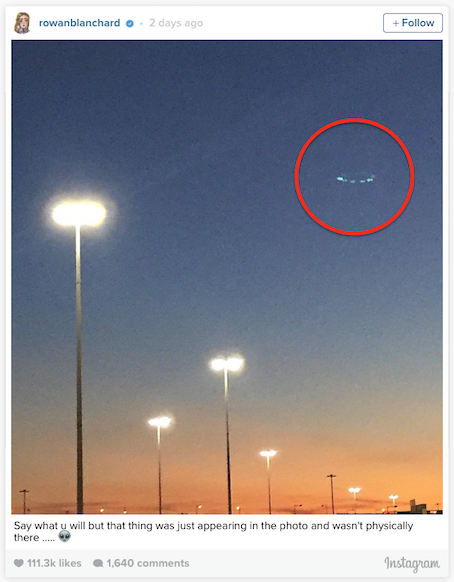
Today own Instagram Hollywood star Rowan Blanchard posted a photo of a UFO that has he fans a buzz. While visiting in New York City, she chanced to take a photo during a beautiful sunset, and accidnetly captured a UFO disk that is 90% cloaked. Remember what I said about sunset being the most common time for UFOs to be seen? Its due to the bending of the light, the observer (us) and the angle of the sun. 
ship%252C%2BUFO%252C%2BRowan%2BBlanchard%252C%2BUFOs%252C%2Bsighting%252C%2Bsightings%252C%2Balien%252C%2Baliens%252C%2BET%252C%2Brainbow%252C%2Bboat%252C%2Bpool%252C%2B2015%252C%2Bnews%252C%2Btime%2Btravel%252C%2Bsunset%252C%2Borb%252C%2Blevetating%252C%2Blevetate%252C%2Bblur%252C%2Brosette%252C%2Bnasa%252C%2Bcloak%252C%2Binvisible%252C%2Bmars%252C12322.jpg
She stated, "Say what u will but that thing was just appearing in the photo and wasn't physically there ..... 👽."  This is a fantastic catch and I am so glad she shared it with us all. This is 100% evidence that aliens do watch over New York City with enthusiasm. 
Scott C. Waring
 
 
Rowan%2BBlanchard%252C%2BNYC%252C%2BJohn%2BLennon%252C%2BMoon%252C%2Bsun%252C%2BAztec%252C%2BMayan%252C%2BWarrier%252C%2Bfight%252C%2Btime%252C%2Btravel%252C%2Btraveler%252C%2BArizona%252C%2BUFO%252C%2BUFOs%252C%2Bsighting%252C%2Bsightings%252C%2Balien%252C%2Baliens%252C%2BET%252C%2Bspace%252C%2Btech%252C%2BDARPA%252Cgod%252C%2B11.png
Rowan%2BBlanchard%252C%2BNYC%252C%2BJohn%2BLennon%252C%2BMoon%252C%2Bsun%252C%2BAztec%252C%2BMayan%252C%2BWarrier%252C%2Bfight%252C%2Btime%252C%2Btravel%252C%2Btraveler%252C%2BArizona%252C%2BUFO%252C%2BUFOs%252C%2Bsighting%252C%2Bsightings%252C%2Balien%252C%2Baliens%252C%2BET%252C%2Bspace%252C%2Btech%252C%2BDARPA%252Cgod%252C%2B13.png

{ http://www.ufosightingsdaily.com/ }

Hoe vind je dit bericht?
Geschreven door peter om 18:40 Stuur door

BEWOONBARE PLANEET ONTDEKT 'VLAKBIJ' AARDE

BEWOONBARE PLANEET ONTDEKT 'VLAKBIJ' AARDE

Bewoonbare planeet op 'kleine' afstand van aarde gevonden - de Volkskrant

https://www.youtube.com/watch?v=v_gIyvQhJ0o

Proxima b: een nieuwe planeet die lijkt op de aarde | NOS op 3

https://www.youtube.com/watch?v=wdqMpzEGW20

Vlakbij de meest nabije ster is een levensvatbare aarde-achtige planeet ontdekt. Dat meldt het ESO, de Europese Zuidelijke Sterrenwacht. Die planeet kan de dichtste woonplaats van leven buiten ons zonnestelsel zijn.

De planeet draait in een baan om Proxima Centauri, de dichtste ster buiten ons zonnestelsel. Die bevindt zich zo’n vier lichtjaar van de aarde, omgerekend een goeie veertig biljoen kilometer. De planeet, die de naam Proxima b kreeg, is ongeveer 1.3 keer zo groot als onze aarde. Ze draait op een afstand van ongeveer zeven miljoen kilometer rond de koele moederster, amper vijf procent van de afstand tussen de aarde en de zon. Maar Proxima Centauri is een rode dwergster en een stuk zwakker dan onze ster, waardoor de planeet zich toch in een levensvatbare zone bevindt.

Het lijkt erop dat vloeibaar water alleen op het oppervlak aanwezig kan zijn in de zonnigste gebieden. De draaiing van planeet Proxima b, de sterke straling van de ster en de vormingsgeschiedenis van de planeet zorgen ervoor dat het klimaat nogal verschilt van dat op aarde en dat het onwaarschijnlijk is dat er op Proxima b seizoenen voorkomen. Volgens de ESO zal Proxima b "een belangrijk doelwit zijn in de jacht naar het bewijs van leven elders in het heelal.”

Earth-mass planet found in habitable zone around#ProximaCentauri #PaleRedDot http://socsi.in/otRb8 

Photo published for Planet Found in Habitable Zone Around Nearest Star - Pale Red Dot campaign reveals Earth-mass world...

Planet Found in Habitable Zone Around Nearest Star - Pale Red Dot campaign reveals Earth-mass world...

Astronomers using ESO telescopes and other facilities have found clear evidence of a planet orbiting the closest star to Earth, Proxima Centauri. The long-sought world, designated Proxima b, orbits...

eso.org

{ http://vtm.be/ }

Hoe vind je dit bericht?
Geschreven door peter om 01:04 Stuur door

Nearly 8000 Strange Blue Lakes Have Appeared in Antarctica

Nearly 8000 Strange Blue Lakes Have Appeared in Antarctica

 
A-DigitalGlobe-Inc-750x300.jpg
Satellite Image by Digital Globe Inc
IN BRIEF

Researchers studying East Antarctica have observed nearly 8,000 dazzling, blue lakes appeared on the Langhovde Glacier between 2000 and 2013. Not just a sign of global warming, these so-called supraglacial lakes can cause an ice sheet to collapse.

SUPRAGLACIAL LAKES

Oftentimes, the sight of spectacularly blue water is enough to make anyone happy. Unfortunately, not in this case. 

Scientists studying East Antarctica, the largest ice mass on Earth, have discovered blue lakes sprouting like summer blooms on the Langhovde Glacier, an outlet glacier located at the Soya Coast.

From 2000 through 2013, scientists have been using satellite imagery to study East Antarctica’s Dronning Maud Land. And in a new study published in the Geophysical Research Letters, researchers state they’ve observed close to 8,000 lakes appearing on the surface of glaciers across the region.

Since the water is found on top of the glaciers, they are distinguished as “supraglacial.” Essentially, they are formed when the increasingly warm summer air heats the surface of an ice sheet.

These lakes were first seen spreading across Greenland and serve as beautiful, yet ominous, evidence of global climate change.

Langhovde Glacier (Source: Hokkaido University) Langhovde Glacier. Source: Hokkaido University

COLLAPSING ICE SHELVES

One of the results of the lakes’ formation is the drainage from the lake traveling and weakening the more vulnerable parts of the glacier. Researchers believe this drainage caused the shattering of the Larsen B ice shelf on the warmer Antarctic Peninsula in 2002, among possible other events.

This occurring now in East Antarctica is a signal of the further consequences of rising temperatures. “That’s the part of the continent where people have for quite a long time assumed that it’s relatively stable, there’s not a huge amount of change, it’s very, very cold, and so it’s only very recently that the first supraglacial lakes, on top of the ice, were identified,”Stewart Jamieson, one of the study authors and a glaciologist at UK’s Durham University, toldThe Washington Post.

Scientists are quite concerned about the long term consequences of increased melting. In an email to Gizmodo, lead study author Emily Langley stressed the importance of monitoring “these in the future to see how they evolve with surface air temperature changes.”

{ http://futurism.com/ }

Hoe vind je dit bericht?
Geschreven door peter om 00:45 Stuur door

NASA Just Made Contact With a Lost Spacecraft After Two Years of Silence

NASA Just Made Contact With a Lost Spacecraft After Two Years of Silence

 A-NASA-3-750x300.jpg
NASA
IN BRIEF

After almost two years of losing contact with one of its spacecrafts, NASA finally reestablishes communications with the STEREO-B as it starts to move out of the Sun's interference zone.

MISSED CONNECTIONS

In October of 2006, NASA launched the third mission of its Solar Terrestrial Probes program: the Solar Terrestrial Relations Observatory, also known as STEREO.

Two spacecrafts, STEREO-A and STEREO-B, were sent off on a mission to further understand the Sun-Earth system, particularly how violent eruptions on the Sun disrupt satellites and power grids on Earth, and when they might happen. This is also very critical for astronauts on errands outside the International Space Station, and could create potentially devastatingeffects to life on Earth.

STEREO-A and STEREO-B. NASA. STEREO-A and STEREO-B. NASA.

However, on October 1, 2014, STEREO-B lost its connection to Earth as it moved to the far side of the Sun. Meanwhile, STEREO-A maintained contact but had a weakened signal for about a year before returning to its normal performance.

Deep Space Network: Goldstone, California antenna. NASA. Deep Space Network: Goldstone, California antenna. NASA.

NASA explains that the spacecrafts’ slow drift and orbit eventually leads to a disadvantageous alignment to the Sun and Earth: “Since August 2014, our line of communication to the spacecraft (STEREO-A) was so close to the sun that pointing the antenna straight at Earth also meant pointing it nearly directly at the sun, which would cause the spacecraft’s antenna to dangerously overheat.”

LOST AND FOUND

Finally, after almost two years of failed recovery attempts, NASA finally reestablished contact with STEREO-B using NASA’s Deep Space Network (DSN) on August 21. They will be checking if the spacecraft’s systems are all in place despite the hard reset they executed as a test before losing the STEREO-B, which should get easier as the spacecraft moves closer, and outside the Sun’s interference zone.

With DSN on the job, consistent communications with STEREO-B will hopefully be restored. After all: “When it comes to making a long-distance call, it’s hard to top NASA’s Deep Space Network,” NASA says.

Hoe vind je dit bericht?
Geschreven door peter om 00:39 Stuur door

China Finally Unveiled The Rover They’re Sending to Mars in 2020

China Finally Unveiled The Rover They’re Sending to Mars in 2020

 
rsz_rtx2mrut-e1472047374577-750x300.jpg
IN BRIEF

Aiming to become a global space giant, China unveils some information on its first mission to Mars in 2020—with the goal of finding ice and water on the Red Planet.

Mankind’s insatiable hunger for knowledge has sparked another mission to find out whether Mars was ever occupied by living organisms.

Concept portrayal of China's Mars probe. -Reuters.com Concept portrayal of China’s Mars probe. China Daily.

Stepping back onto the space exploration scene, China is giving us a computer-generated glimpse of the design for its space probe and rover, which will be used in its first ever Mars mission in 2020. The goal: find ice and water on the Red Planet.

According to Reuters, the mission will initially go into orbit around Mars before deploying a lander that will touch down in the low latitudes of Mars’ northern hemisphere, where the rover will explore the surface.

Concept portrayal of China's Mars rover and lander. -Reuters.com Concept portrayal of China’s Mars rover and lander. China Daily.

Carrying a number of instruments ranging from cameras to a ground-penetrating radar, the lander’s six-wheeled rover will be the one to roam the Red Planet.

Although China would be the fifth country to orbit Mars, President Xi Jinping’s unyielding resolve to become a global space giant emerged in the undertaking of this endeavor.

“Becoming an aerospace power has always been a dream we’ve been striving for,” he said.

{ http://futurism.com/ }

Hoe vind je dit bericht?
Geschreven door peter om 00:28 Stuur door

Astronomers Catch A Rare Glimpse of A Young Supermassive Star

Astronomers Catch A Rare Glimpse of A Young Supermassive Star

Astronomers-just-caught-a-glimpse-of-a-rare-massive-star-in-formation-750x300.jpeg
IN BRIEF

Using the combined powers of two telescopes, researchers were able to gain visibility over a massive star in our galaxy that is 30 times the size of the sun—and is still growing. Much can be learned about the lifespan of supermassive stars.

TELESCOPES UNITE

Astronomers have their eyes on a young star around 11,000 light-years away from Earth, and for very good reasons. The massive young star, G11.92-0.61 MM1, or MM1 for short, is in our galaxy and reached its size faster than normal stars. “An average star like our Sun is formed over a few million years, whereas massive stars are formed orders of magnitude faster – around 100,000 years,” said team leader John Ilee, from the University of Cambridge in the UK.

The finding, published in the Monthly Notices of The Royal Astrological Society, is a rare one because while the dense clouds of molecular material make stellar nurseries perfect for birthing stars, those clouds of space dust make it very hard for normal telescopes to see through the clouds. Being able to watch this young star mature is an exceptional chance to monitor and better understand a massive star’s lifecycle.

Artist's impression, MM1. Credit: A. Smith, Institute of Astronomy, Cambridge. Artist’s impression, MM1. Credit: A. Smith, Institute of Astronomy, Cambridge.

Using the combined powers of the Submillimetre Array (SMA) in Hawaii and the (aptly named)Very Large Array (VLA) in New Mexico, which offer longer wavelengths than most telescopes, the team not only managed to spot the star but also to assess its surroundings.

EAT FAST, DIE FAST

At a young age, MM1 is already over 30 times the size of the Sun…and it’s still hungry. And it seems the MM1 still has a front seat to a full buffet, as calculations show a large disc of matter surrounding it. This is called a Keplerian disc, thus named for the law of motion it follows. Particles closer to the star move faster than those on the outer edges.

This disc implies that supermassive stars start out just like normal stars. “This type of rotation is also seen in the Solar System – the inner planets rotate around the Sun more quickly than the outer planets,” Ilee explained. “It’s exciting to find such a disc around a massive young star, because it suggests that massive stars form in a similar way to lower mass stars, like our Sun.”

So what else is on the table for MM1 (apart from lots of star food)? Well, death.

From what we know of stars, the faster they eat (and the more they do), the sooner they die. This makes finding them in their early stages of death by gluttony a rare occurrence. “These massive stars also burn through their fuel much more quickly, so they have shorter overall lifespans, making them harder to catch when they are infants,” Ilee says.

Photo: ALMA Observatory. Photo: ALMA Observatory.

However, before MM1’s imminent demise, which would end up in either a supernova or a black hole (this is a debate), researchers want to use the Atacama Large Millimetre Array (ALMA) in Chile to confirm if the Keplerian disc around it is hiding more. “Our theoretical calculations suggest that the disc could, in fact, be hiding even more mass under layers of gas and dust,” says team member Duncan Forgan. “The disc may even be so massive that it can break up under its own gravity, forming a series of less massive companion protostars.”

Hoe vind je dit bericht?
Geschreven door peter om 00:19 Stuur door

Former NASA whistleblower's shock claim space agency hid PROOF of UFOs orbiting Saturn

Former NASA whistleblower's shock claim space agency hid PROOF of UFOs orbiting Saturn

A DECORATED former NASA scientist has claimed the US space agency has proof that alien UFOs have been orbiting Saturn for years, but the shocking fact has been withheld from the public.

Dr Norman Bergrun, a distinguished engineer who has worked with NASA’s Ames Research Center in Moffett Field, California, said the rings of the planet are a massive meeting place for extraterrestrials. 

He claims "alien UFO spaceships" have started "proliferating" at a shocking rate on the planet's many rings, which are made up of "space crafts and their exhaust fumes" but the world-changing evidence has been covered up at high-level within the US Government.

The former NASA engineer, who has written books on his claims and done numerous interviews, believes the number of UFO crafts in the solar system had reached "critical" levels.

Bizarrely, Dr Bergrun claims the spaceships include living entities, which use the rings as a source of energy, and are multiplying and spreading to other planets such as Uranus and Jupiter.

Dr Bergrun developed “roll stability laws for airplanes, missiles and rockets.”

Dr Norman Bergrun claims UFOs are in Saturn's rings.

YouTube

Dr Norman Bergrun claims UFOs are in Saturn's rings.

RELATED ARTICLES

He also won prestigious awards, including the California Society of Professional Engineers Archimedes Engineering Achievement Award.

Dr Bergrun, who served on the National Advisory Committee for Aeronautics (NACA) and worked with Lockheed Martin on high-profile and top-secret aerospace projects, first launched his theory in 1986 with his book Ringmakers of Saturn, but continues to promote it and is annoyed that scientists do not appear to be giving it any credence.

He said: "What I found out is, these things inhabit Saturn, that’s where I first discovered them, and they’re proliferating. You can find them around Uranus and Jupiter.

"Wherever you see some rings, that’s where I see the aircrafts, I call them a ring maker.

Dr Norman Bergrun.

YouTube

Dr Norman Bergrun.

RELATED ARTICLES

What I found out is, these things inhabit Saturn, that’s where I first discovered them, and they’re proliferating. You can find them around Uranus and Jupiter.

Dr Norman Bergrun

"I say that it is electromagnetic because I can identify streamline patterns with respect to it that I knew were what we called 'potential lines' and that says it was electrical."

Dr Bergrun has produced historic NASA images of the rings, which he claims show UFOs, including cylindrical objects.

But he claimed we have been unable to communicate with any of these aliens so far, and they could ultimately pose a threat to Earth.

He warned that the proliferation of the crafts across our solar system was speeding up and reaching a “critical” stage.

He claims the crafts are “living” because they are capable of the essential functions of biological systems, such as self-replication and self-maintenance.

RELATED ARTICLES

Mainstream scientists dismiss his extraordinary claims, but the UFO community is captivated.

Conspiracy website Collective Evolution said: "We can assume that he knows and has worked with other intelligent and powerful people and that he has had access to extremely sensitive data, which he himself makes clear… in his book.”

And UFO blogger Scott C Waring wrote: "Norman Bergrun worked in a top secret area inside the US government and has personally witnessed seeing photos directly from NASA that had UFO near Saturn that make the rings around Saturn. 

"He says he has personally seen an increase of alien ship activity among the rings of Saturn over his career. Something has to be done."

Related articles

Hoe vind je dit bericht?
Geschreven door peter om 00:00 Stuur door

Exoplanètes: «Une preuve de vie extraterrestre d'ici dix ans»

Exoplanètes: «Une preuve de vie extraterrestre d'ici dix ans»

ESPACE L'astrophysicien Michaël Gillon nous en dit plus sur la découverte de la planète Proxima B...

Vue d'artiste de la planète Proxima B, avec son étoile, la naine rouge Proxima du Centaure, au loin

Vue d'artiste de la planète Proxima B, avec son étoile, la naine rouge Proxima du Centaure, au loin - M. Kornmesser / EUROPEAN SOUTHERN OBSERVATORY / AFP

Jamais on n’avait découvert d’exoplanète aussi proche de nous. La confirmation, mardi dans Nature, de la découverte de Proxima B, dans l’orbite de l’étoile Proxima du Centaure, se double d’une jolie surprise : La planète tourne autour de son étoile à une distance qui rend possible la présence d’eau liquide et de vie à sa surface.

>> A lire aussi : Une «seconde Terre» découverte, l'exoplanète la plus proche connue à ce jour

Proxima du Centaure est bien connue des chercheurs qui traquent les planètes situées en dehors du système solaire, car c’est la plus proche de notre soleil. L’astrophysicien belge Michael Gillon, de l’Université de Liège, co-découvreur de plusieurs exoplanètes « potentiellement habitables », analyse l’importance de cette découverte.

On a découvert plus de 3.000 planètes en dehors du système solaire, depuis la première en 1995. Pourquoi ne découvre-t-on que maintenant celle qui tourne autour de Proxima du Centaure ?

Parce que le système de Proxima du Centaure n’est pas facile à examiner. L’étoile est proche, mais beaucoup moins brillante que le soleil (670 fois moins), elle pèse 10 % de son poids et émet essentiellement de la lumière infrarouge. D’ailleurs, de la Terre on ne la voit pas à l’œil nu, il faut une lunette pour l’observer…

Dans mon équipe nous avons déjà essayé de scruter ce système par la méthode du « transit » (on guette la baisse de luminosité qui résulte du passage d’une planète devant l’étoile), sans rien détecter. Là, ils ont pu utiliser une autre méthode, gravitationnelle (on détecte indirectement les mouvements de la planète), avec une quantité de données très importante.

Cette planète, Proxima B, est située à une distance de 4,2 années-lumière, soit quarante mille milliards de kilomètres. Que change cette découverte ?

C’est très enthousiasmant qu’une étoile si proche de nous dispose d’une planète potentiellement habitable. Et il est possible qu’avec certains instruments on soit assez rapidement capables d’observer directement l’image de cette planète, et de détecter une atmosphère, si elle en a une.

La prochaine étape, c’est la découverte de vie extraterrestre. Comment procède-t-on ?

On cherche des signes de cette vie en guettant, par exemple dans la lumière émise par la planète, des traces de molécules caractéristiques de la vie. Ce sont des « biomarqueurs ». Cela peut-être de l’oxygène en grande quantité, si on prouve qu’aucun autre phénomène n’a pu le produire. Avec les nouveaux instruments qui sont en train d’être mis en place, je pense que l’on peut espérer une telle découverte d’ici une dizaine d’années.

MOTS-CLÉS :

{ http://www.20minutes.fr/ }

Hoe vind je dit bericht?
Geschreven door peter om 23:27 Stuur door

Exoplanètes: «Une preuve de vie extraterrestre d'ici dix ans»

Exoplanètes: «Une preuve de vie extraterrestre d'ici dix ans»

ESPACE L'astrophysicien Michaël Gillon nous en dit plus sur la découverte de la planète Proxima B...

Vue d'artiste de la planète Proxima B, avec son étoile, la naine rouge Proxima du Centaure, au loin

Vue d'artiste de la planète Proxima B, avec son étoile, la naine rouge Proxima du Centaure, au loin - M. Kornmesser / EUROPEAN SOUTHERN OBSERVATORY / AFP

Jamais on n’avait découvert d’exoplanète aussi proche de nous. La confirmation, mardi dans Nature, de la découverte de Proxima B, dans l’orbite de l’étoile Proxima du Centaure, se double d’une jolie surprise : La planète tourne autour de son étoile à une distance qui rend possible la présence d’eau liquide et de vie à sa surface.

>> A lire aussi : Une «seconde Terre» découverte, l'exoplanète la plus proche connue à ce jour

Proxima du Centaure est bien connue des chercheurs qui traquent les planètes situées en dehors du système solaire, car c’est la plus proche de notre soleil. L’astrophysicien belge Michael Gillon, de l’Université de Liège, co-découvreur de plusieurs exoplanètes « potentiellement habitables », analyse l’importance de cette découverte.

On a découvert plus de 3.000 planètes en dehors du système solaire, depuis la première en 1995. Pourquoi ne découvre-t-on que maintenant celle qui tourne autour de Proxima du Centaure ?

Parce que le système de Proxima du Centaure n’est pas facile à examiner. L’étoile est proche, mais beaucoup moins brillante que le soleil (670 fois moins), elle pèse 10 % de son poids et émet essentiellement de la lumière infrarouge. D’ailleurs, de la Terre on ne la voit pas à l’œil nu, il faut une lunette pour l’observer…

Dans mon équipe nous avons déjà essayé de scruter ce système par la méthode du « transit » (on guette la baisse de luminosité qui résulte du passage d’une planète devant l’étoile), sans rien détecter. Là, ils ont pu utiliser une autre méthode, gravitationnelle (on détecte indirectement les mouvements de la planète), avec une quantité de données très importante.

Cette planète, Proxima B, est située à une distance de 4,2 années-lumière, soit quarante mille milliards de kilomètres. Que change cette découverte ?

C’est très enthousiasmant qu’une étoile si proche de nous dispose d’une planète potentiellement habitable. Et il est possible qu’avec certains instruments on soit assez rapidement capables d’observer directement l’image de cette planète, et de détecter une atmosphère, si elle en a une.

La prochaine étape, c’est la découverte de vie extraterrestre. Comment procède-t-on ?

On cherche des signes de cette vie en guettant, par exemple dans la lumière émise par la planète, des traces de molécules caractéristiques de la vie. Ce sont des « biomarqueurs ». Cela peut-être de l’oxygène en grande quantité, si on prouve qu’aucun autre phénomène n’a pu le produire. Avec les nouveaux instruments qui sont en train d’être mis en place, je pense que l’on peut espérer une telle découverte d’ici une dizaine d’années.

MOTS-CLÉS :

{ http://www.20minutes.fr/ }

Hoe vind je dit bericht?
Geschreven door peter om 23:27 Stuur door

VIDEO. Faites chauffer la fusée, une potentielle «seconde Terre» découverte à deux pas de chez nous

VIDEO. Faites chauffer la fusée, une potentielle «seconde Terre» découverte à deux pas de chez nous

ASTRONOMIE Proxima du Centaure est l'étoile la plus proche du Soleil, et le système abrite une planète sans doute rocheuse...

Vue d'artiste de Proxima b, la planète la plus proche de la Terre.

Vue d'artiste de Proxima b, la planète la plus proche de la Terre. - ESO, M. KORNMESSER

C’est le Graal de l’astronomie. Des chercheurs ont bien découvert une exoplanèteautour de l’étoile la plus proche du Soleil, Proxima du Centaure, dans une zone où l’eau liquide peut exister à la surface. La rumeur, qui courrait depuis deux semaines, a été confirmée mercredi par la publication officielle dans le magazine Nature. « La chasse à la vie peut commencer », écrit son auteur principal, l’astronome Guillem Anglada-Escudé, de l’université Queen Mary de Londres.

Cette fois, il ne s’agit pas d’une erreur

Avant de réserver son billet pour un aller simple, plusieurs précisions importantes s’imposent. Proxima b, située à 4,2 années-lumière du Soleil, a une masse minimum de 1,3 fois celle de la Terre. Les chercheurs supposent qu’elle est rocheuse mais ils n’en ont pas la preuve. Ils ne savent pas non plus si elle possède une atmosphère, de l’eau liquide et tous les composés nécessaires à l’éclosion de la vie telle que nous la connaissons.

Les sceptiques se rappelleront encore que la dernière découverte d’une planète « candidate » autour de Proxima du Centaure avait finalement été rétractée. Mais cette fois, les mesures réalisées avec deux télescopes différents laissent peu de place au doute. « Les instruments ont fait d’immenses progrès. Après avoir lu l’étude, je suis convaincu que cette planète est réelle », juge l’astronome Phil Plaitsur son blog Bad Astronomy.

Le tour de son étoile en 11 jours

Proxima b se trouve à seulement 7,5 millions de kilomètres de son étoile. C’est 20 fois plus près que la Terre du Soleil. Elle en fait le tour en seulement 11,2 jours. Mais parce que Proxima du Centaure est une naine rouge de faible intensité, de l’eau liquide peut, sur le papier, exister à la surface.

La donne est cependant compliquée par la configuration de la planète, en verrouillage gravitationnel avec son étoile, comma la Terre avec la Lune. Traduction : c’est toujours la même face qui est au « soleil », et il n’y a pas de saison. On ne parle même pas des violentes éruptions solaires, face auxquelles une protection (atmosphère dense, champ magnétique) est indispensable. Bref, il va falloir observer la planète directement, et le télescope spatial James Webb, qui doit prendre la relève d’Hubble en 2018, arrivera à point nommé.

Si près et pourtant si loin

A 4,2 années-lumière, Proxima b est la planète la plus proche de la Terre. Mais avec les systèmes actuels de propulsion, il faudrait entre 20.000 et 80.000 ans à une sonde pour s’y rendre. Le projet Starshot, qui mise sur une voile solaire accélérée par des rayons laser pour atteindre 20 % de la vitesse de la lumière, permettrait toutefois de réduire la durée du voyage d’une micro-sonde à une vingtaine d’années. Allez, on espère être encore vivant pour assister à ce grand moment…

MOTS-CLÉS :

{  http://www.20minutes.fr/ }

Hoe vind je dit bericht?
Geschreven door peter om 23:21 Stuur door

Planet Earth 100 Million Years In The Future- BBC documentary- Life on Mars-New Science documentary

Planet Earth 100 Million Years In The Future- BBC documentary- Life on Mars-New Science documentary

Published on Apr 26, 2015

WELCOME to documentary channel !
SUBSCRIBE NOW
With great new content coming out regularly subscribing will help you keep up to date!

If you love documentaries about wildlife, space, cars, knowledge, history and much more, this is the channel for you!

Like and Comment to share your experience with all our viewers!

and most of all ENJOY! https://goo.gl/9Ufxwh

Hoe vind je dit bericht?
Geschreven door peter om 23:00 Stuur door

Closest potentially habitable planet to our solar system found

Closest potentially habitable planet to our solar system found

Hoe vind je dit bericht?
Geschreven door peter om 22:53 Stuur door

Mediterraans mysterie: Woonde de mythische beschaving van Atlantis op Sardinië?

Mediterraans mysterie: Woonde de beschaving van Atlantis op Sardinië?

Mediterraans mysterie: Woonde de mythische beschaving van Atlantis op Sardinië?

Luchtbeelden die onlangs zijn gemaakt lijken de theorie te bevestigen dat de mythische beschaving van Atlantis mogelijk op het Italiaanse eiland Sardinië woonde. Dat meldt de krant La Stampa.

De Italiaanse journalist Sergio Frau stelt dat Sardinië exact overeenkomt met de beschrijving die Plato gaf: een land dat rijk is aan water en bossen, met een zacht klimaat, waardoor men het hele jaar door kan oogsten.

Tsunami

Plato noemde de inwoners van Atlantis daarnaast ‘torenbouwers’. Op Sardinië staan veel oude stenen forten. Eén van deze monumenten werd gevonden in de gemeente Barumini. Het kostte archeologen 14 jaar om het bouwwerk onder een 12 meter dikke laag modder vandaan te halen.

Uit luchtbeelden blijkt dat vrijwel alle oude bouwwerken die zich vlak boven de zeespiegel bevinden, bedekt werden door modder, terwijl de overige gebouwen buiten schot bleven. Mogelijk was de modderstroom het gevolg van een tsunami, die volgens de legende de inwoners van Atlantis wegvaagde.

Zuilen van Hercules

Plato schreef dat Atlantis 9000 jaar geleden werd vernietigd, maar in die tijd waren er nog geen beschavingen in het Middellandse Zeegebied. Plato bedoelde mogelijk 9000 maanden in plaats van jaren, omdat in zijn tijd vaak in maanden werd gerekend.

In dat geval verwijst Plato naar 1200 voor Christus. In die periode deden zich op het Italiaanse eiland krachtige aardbevingen voor. Het is bekend dat Atlantis zich ten westen van de Zuilen van Hercules bevond. Volgens de legende waren die tot de derde eeuw voor Christus niet in de Straat van Gibraltar, maar in de Golf van Tunis gelegen, tussen Sicilië en Tunesië.

[La Stampa]

Hoe vind je dit bericht?
Geschreven door peter om 22:28 Stuur door

Hoe kunnen we ooit naar de 'nieuwe Aarde' vliegen? En hoelang zou dat duren? - HLN.be

Hoe kunnen we ooit naar de 'nieuwe Aarde' vliegen? En hoelang zou dat duren? - HLN.be

Bron: space.com

media_xll_8999939.jpg

Een impressie van Proxima b © space.com.

Ligt buitenaards leven dan toch niet zo ver van ons af als we dachten? Gisteren had de Europese Zuidelijke Sterrenwacht ESO groot nieuws voor de wereld: er is bewijs gevonden dat rond de meest nabije ster een planeet draait die levensvatbaar kan zijn. Mogelijk is er dus een nabije woonplaats voor leven buiten ons zonnestelsel. Nu ja, zo nabij is Proxima b nu ook weer niet: 4,22 lichtjaar, ofwel 40 biljoen kilometer. Hoe kunnen we ooit zo ver reizen?

media_l_8999944.jpg Ruimtesonde New Horizons © NASA.

Vorig jaar kwam de New Horizons-sonde van NASA aan op Pluto na een trip van 4,8 miljard kilometer. De sonde was negen jaar onderweg geweest en haalde snelheden tot 84.000 kilometer per uur. Mochten we de New Horizons naar Proxima b sturen, dan zou die 54.400 jaar onderweg zijn. Niet echt een optie dus. 

Vorige maand haalde de Juno-sonde van NASA, die in een baan rond Jupiter draait, een snelheid van 265.000 kilometer per uur. Met die snelheid komen we weliswaar vroeger aan op Proxima b, maar dan nog zou het 17.157 jaar duren.

In de jaren 90 pakten het Amerikaanse leger en NASA uit met Project Longshot, waarbij een sonde dankzij waterstofbommen snelheden zou halen tot 13.400 kilometer per seconde. Mocht dat ooit lukken, dan zijn we er binnen 100 jaar.

Lees ook

media_xll_8999942.jpg © space.com.

Project Starshot

media_l_8999945.jpg Dankzij een laserstraal zou een flinterdunne sonde to 20 procent van de lichtsnelheid kunnen halen. © epa.

Proxima b bereiken, is dus een werk van heel lange adem, laat staan dat we er ooit voet aan land kunnen zetten. Maar dankzij een nieuwe technologie wordt het misschien mogelijk om Proxima b over 50 jaar te bereiken. Met project 'Starshot' wil miljardair Joeri Milner een sonde de ruimte insturen die wordt voortgedreven door een laserstraal en in 'amper' 20 jaar Proxima b bereikt. Ook Stephen Hawking steunt het project.

Een laserstraal zou, in theorie althans, een flinterdunne sonde met 215 miljoen kilometer per uur kunnen laten reizen. Dat is ongeveer 20 procent van de lichtsnelheid. Het zou nog 20 à 25 jaar duren voor die 'lasersonde' klaar is, dus we moeten toch nog zeker een kleine 50 jaar wachten voor we Proxima b ooit te zien krijgen. Bovendien zou het project zo'n 10 miljard dollar kosten.

Is het wel de moeite waard?

media_l_8999968.jpg New Horizons schoot unieke beelden van Pluto. © NASA.

10 miljard dollar uitgeven aan een reis naar een verre planeet, is dat wel de moeite waard? Wat als we op een gigantische ontgoocheling botsen? 

Een trip naar Proxima b is zeker de moeite waard, dat bewees New Horizons al toen hij aankwam op Pluto. De sonde schoot unieke beelden van de dwergplaneet die we vanop de aarde nooit zouden kunnen genomen hebben. De sonde bezorgde ons een schat aan informatie over Pluto, dus een bezoekje aan de nieuwe Aarde is sowieso de moeite waard.

Ontdekken we over 50 jaar leven buiten ons zonnestelsel? Lees het antwoord hier in 2066.

{ http://www.hln.be/ }

Hoe vind je dit bericht?
Geschreven door peter om 15:07 Stuur door

China wil in 2020 een robotjeep naar Mars sturen - HLN

China wil in 2020 een robotjeep naar Mars sturen - HLN

Bron: Belga

media_xll_8996771.jpg

© afp.

China hoopt in juli of augustus 2020 een robotjeep naar Mars te lanceren. Het heeft via de staatsmedia een tip van de sluier over de verkenner gelicht.

Het is de bedoeling dat een Lange Mars-5 draagraket van op de nieuwe lanceerbasis Wenchang het tuig meeneemt en op een traject naar de Rode Planeet brengt. Na een reis van ongeveer zeven maanden moet de lander zich van een "orbiter" losmaken en uiteindelijk neerstrijken nabij de evenaar. Dan zal het gedurende een negentigtal dagen het Marsoppervlak en de omgeving bestuderen.

Tweehonderd kilo
De jeep zal tweehonderd kilo wegen. Hij zal zes wielen en vier zonnepanelen hebben. Dertien instrumenten doen onderzoek naar sporen van water en ijs.

In het kader van zijn ambitieus ruimtevaartprogramma heeft Peking al een robotjeep op de Maan neergezet, om daar onderzoek te doen. India was het eerste Aziatisch land dat in september een sonde rond de Rode Planeet bracht.

Mislukken
De opdracht zou niet gemakkelijk zijn. Zelfs de grote ruimtevaartmogendheden zagen zowat minstens de helft van missies naar Mars, in het bijzonder landingen, mislukken. 

België is momenteel met apparatuur op de Europees-Russische sonde en lander ExoMars op weg naar de Rode Planeet.

Lees ook

{ http://www.hln.be/ }

Hoe vind je dit bericht?
Geschreven door peter om 15:01 Stuur door

‘Aarde Twee': Levensvatbare planeet ontdekt bij buurster van de zon

'Aarde Twee': Levensvatbare planeet ontdekt bij buurster van de zon

‘Aarde Twee': Levensvatbare planeet ontdekt bij buurster van de zon

Astronomen hebben bewijs gevonden dat rond de meest dichtstbijzijnde ster een bewoonbare planeet draait. Dat laat de Europese Zuidelijke Sterrenwacht (ESO) weten.

De sterrenkundigen ontdekten met behulp van een reuzentelescoop in Chili een aardachtige planeet rond de ster Proxima Centauri. Dat is onze meest nabije buur. De planeet, Proxima b gedoopt, is 1,3 keer zo zwaar als de aarde en bevindt zich in de leefbare zone rond de ster.

Binnen bereik

Er is hoogstwaarschijnlijk vloeibaar water mogelijk op de planeet. Volgens het onderzoeksteam kan er leven aanwezig kan zijn op Proxima b. Er zijn intussen zo’n 200 aardachtige planeten bij verre sterren ontdekt, maar die staan stuk voor stuk op vele honderden lichtjaren.

Proxima Centauri staat op slechts 4,2 lichtjaar en komt langzaam maar zeker binnen het bereik van onze ruimtevaartuigen. Miljardair Joeri Milner wil binnen nu en 15 jaar een zogeheten ruimtezeil naar de ster sturen. Het ruimteschip zal ongeveer 20 jaar over de reis doen.

Een jaar op Proxima b duurt maar 11 dagen omdat de planeet veel dichter bij zijn ster staat dan de aarde bij de zon. Toch is het er niet heel warm, omdat Proxima Centauri een rode dwerg is, die veel koeler is dan onze zon.

Grootste ervaring

“De eerste waarnemingen waren er al in 2013, maar toen waren de waarnemingen niet overtuigend genoeg,” aldus onderzoeksleider Guillem Anglada-Escudé. “Sindsdien hebben we hard gewerkt om meer waarnemingen te doen.”

Hij voegde toe dat de vondst van de dichtstbijzijnde aardachtige exoplaneet de grootste ervaring van zijn leven is. De astronomen hebben hun bevindingen gepubliceerd in het wetenschappelijke vakblad Nature.

[Standaard]

Hoe vind je dit bericht?
Geschreven door peter om 14:51 Stuur door

Meer van UFO'S of UAP'S, ASTRONOMIE, RUIMTEVAART, ARCHEOLOGIE, OUDHEIDKUNDE, SF-SNUFJES EN ANDERE ESOTERISCHE WETENSCHAPPEN - DE ALLERLAATSTE NIEUWTJES

↑ Terug naar de berichten