

 Best Space Stories of the Week — Nov. 4, 2016
A small asteroid gave Earth a close shave; a guitar-strumming astronaut wrote a book about being afraid of the dark; and the largest space-based telescope ever constructed is complete. Here are our picks for the best space stories of the week.
The (non) race to Mars
NASA is not try to beat Elon Musk to the Red Planet. This summer Musk announced how his private spaceflight company SpaceX plans to eventually send thousands of humans to Mars, but that doesn't necessarily conflict with NASA's Mars plans, according to NASA's associate administrator of science. [Full Story: NASA: We're Not Racing SpaceX to Mars]
Does art imitate life on Mars?
The National Geographic Channel is gearing up for the debut of a new series called "Mars," which is a mix of fiction and non-fiction centered on humanity's journey to the Red Planet. Here's what some of the show's creators have to say about art imitating life. [Full Story: National Geographic Channel's 'Mars': Does Art Imitate Life?]
Hubble's successor on track
Construction is now complete on the largest space-based telescope ever built, the James Webb Space Telescope (JWST). Often referred to as the successor to the Hubble telescope, construction began on Webb more than 20 years ago. The telescope is now set to launch into space in 2018. [Full Story: World's Largest Space Telescope Is Complete, Expected to Launch in 2018]
Continuing the hunt for dark matter
Scientists aren't sure what dark matter is made of, just that it seems to make up most of the mass in the universe (outweighing "regular" matter by about 5 to 1). A new study has predicted the mass of one theoretical dark matter candidate, a particle called the "axion." The finding could greatly aid axion dark matter searches. [Full Story: What Is Dark Matter? Prime Candidate Gets Profiled]
Asteroid gives Earth a 'close shave'
A small asteroid buzzed Earth on Nov. 1, hours after astronomers spotted the space rock for the first time. Asteroid 2016 VA came to within about 48,000 miles (77,000 kilometers) of Earth. For comparison, the moon orbits Earth at an average distance of 239,000 miles (385,000 km). [Full Story: Surprise! Newfound Asteroid 2016 VA Gives Earth a Close Shave]
Citizen scientists in action
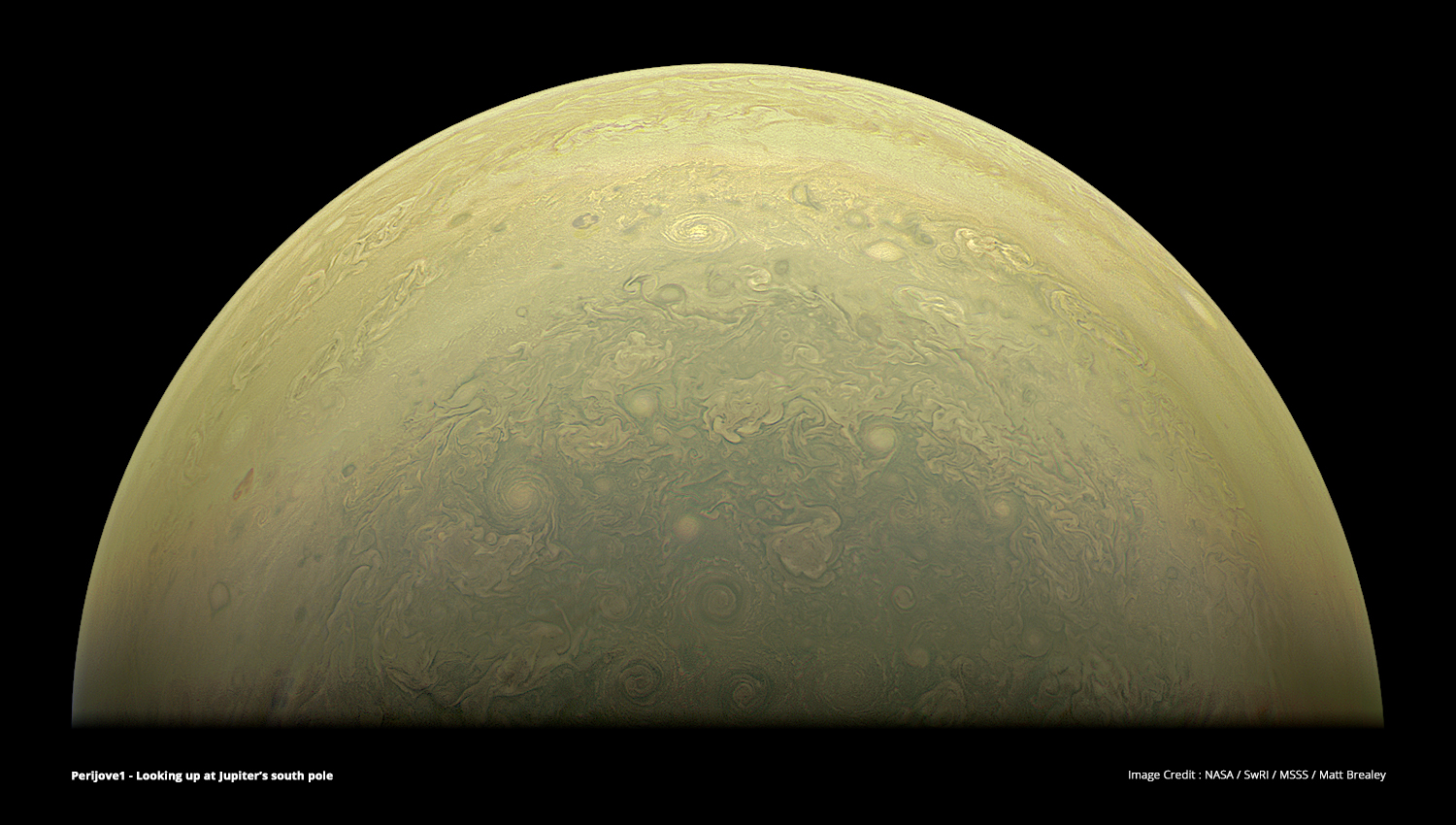
NASA is asking citizen scientists to get involved with its Juno mission to Jupiter. The JunoCam instrument on board the probe is sending back images of the gas giant's cloud tops, and members of the public are welcome to process them, either for scientific or artistic purposes. [Full Story: Citizen Scientists Jump Aboard NASA's Jupiter Mission to Create Amazing Images]
Here lie the dead
NASA's stunning ring system, as well as the rings of Neptune and Uranus, are likely composed of the powdered remains of dwarf planets like Pluto, a new study suggests. The work shows that Pluto-sized objects probably came close to those giant planets during the early days of the solar system, and were torn apart by each planet's gravitational forces. [Full Story: Saturn's Gorgeous Rings May Be Dwarf Planet Carcasses]
An astronaut faces the darkest dark
Canadian astronaut Chris Hadfield — perhaps best known for his on-orbit Bowie covers — is the author of a new children's book called "The Darkest Dark." It tells the story of a young boy facing down his fear of the dark, on the eve of the Apollo 11 mission's arrival on the moon. [Full Story: In Chris Hadfield's 'The Darkest Dark,' a Future Astronaut Faces His Deepest Fears]
Bring home the first space selfie
Former NASA astronaut Buzz Aldrin is selling t-shirts that feature a Polaroid "selfie" he snapped during the Gemini 12 mission, which took place 50 years ago this month. The selfie features a view of Earth and part of Aldrin's face through his spacesuit helmet. [Full Story: Buzz Aldrin Debuts 'First Selfie in Space' T-Shirt for Gemini 12 50th Anniversary]
The super/strange science in Marvel's new movie
Marvel's newest superhero movie, "Doctor Strange," is more fantasy than science-fiction, but still includes some elements that related to real-world physics, astrophysics and philosophy of science. Space.com talked with Adam Frank, an astrophysicist at the University of Rochester in New York who consulted on "Doctor Strange." [Full Story: 'Doctor Strange' Astrophysicist Talks Mind-Bending Marvel Science]
A colorful crash site
The first color images have been released of the site where a European Mars lander crashed onto the surface of Mars. The lander, which was intended to test technologies for a future Red Planet rover, hit the Martian surface on Oct. 19, after its thrusters failed to fire for the correct duration. [Full Story: See the 1st Color Photos of Europe Mars Lander's Crash Site]
Follow Calla Cofield @callacofield.Follow us @Spacedotcom, Facebook and Google+. Original article on Space.com.


