Ontdek de Fascinerende Wereld van UFO's en UAP's: Jouw Bron voor Onthullende Informatie!
Ben jij ook gefascineerd door het onbekende? Wil je meer weten over UFO's en UAP's, niet alleen in België, maar over de hele wereld? Dan ben je op de juiste plek!
België: Het Kloppend Hart van UFO-onderzoek
In België is BUFON (Belgisch UFO-Netwerk) dé autoriteit op het gebied van UFO-onderzoek. Voor betrouwbare en objectieve informatie over deze intrigerende fenomenen, bezoek je zeker onze Facebook-pagina en deze blog. Maar dat is nog niet alles! Ontdek ook het Belgisch UFO-meldpunt en Caelestia, twee organisaties die diepgaand onderzoek verrichten, al zijn ze soms kritisch of sceptisch.
Nederland: Een Schat aan Informatie
Voor onze Nederlandse buren is er de schitterende website www.ufowijzer.nl, beheerd door Paul Harmans. Deze site biedt een schat aan informatie en artikelen die je niet wilt missen!
Internationaal: MUFON - De Wereldwijde Autoriteit
Neem ook een kijkje bij MUFON (Mutual UFO Network Inc.), een gerenommeerde Amerikaanse UFO-vereniging met afdelingen in de VS en wereldwijd. MUFON is toegewijd aan de wetenschappelijke en analytische studie van het UFO-fenomeen, en hun maandelijkse tijdschrift, The MUFON UFO-Journal, is een must-read voor elke UFO-enthousiasteling. Bezoek hun website op www.mufon.com voor meer informatie.
Samenwerking en Toekomstvisie
Sinds 1 februari 2020 is Pieter niet alleen ex-president van BUFON, maar ook de voormalige nationale directeur van MUFON in Vlaanderen en Nederland. Dit creëert een sterke samenwerking met de Franse MUFON Reseau MUFON/EUROP, wat ons in staat stelt om nog meer waardevolle inzichten te delen.
Let op: Nepprofielen en Nieuwe Groeperingen
Pas op voor een nieuwe groepering die zich ook BUFON noemt, maar geen enkele connectie heeft met onze gevestigde organisatie. Hoewel zij de naam geregistreerd hebben, kunnen ze het rijke verleden en de expertise van onze groep niet evenaren. We wensen hen veel succes, maar we blijven de autoriteit in UFO-onderzoek!
Blijf Op De Hoogte!
Wil jij de laatste nieuwtjes over UFO's, ruimtevaart, archeologie, en meer? Volg ons dan en duik samen met ons in de fascinerende wereld van het onbekende! Sluit je aan bij de gemeenschap van nieuwsgierige geesten die net als jij verlangen naar antwoorden en avonturen in de sterren!
Heb je vragen of wil je meer weten? Aarzel dan niet om contact met ons op te nemen! Samen ontrafelen we het mysterie van de lucht en daarbuiten.
Zondag 4 december 2016
Three UFOs Over Las Vegas, Nevada On Nov 15, 2016 Using Night Vision Technology, Video, UFO Sighting News.
Three UFOs Over Las Vegas, Nevada On Nov 15, 2016 Using Night Vision Technology, Video, UFO Sighting News.
Date of sighting: Nov 15, 2016
Location of sighting: Las Vegas, Nevada, USA
These UFOs are three different craft. I have altered the colors and enhanced the detail. Within each light is a dark object about 75% as big as the light itself. These objects are flying over a USAF base in that area so nonone can travel over there a take a look. Its all fenced in high security area. It looks like the USAF is testing some of the alien craft that was given to the USAF in good faith. One of these craft crashed in Needles California back in May 14, 2008. Looks like they still have not got control of it.
Scott C. Waring
Eyewitness states:
I shot this video from my backyard in the Summerlin area of Las Vegas, Nevada on the night of November 15, 2016. I wanted to get the video I shot last night out the same night. To do that I had to increase the speed up on the night vision portion by five times because it takes so long to render, upload and process the video. Jaime Maussan told me they are always best at actual speed so I am remaking that portion of last nights video. I am not enhancing it in any way so this is exactly as it was as it came from the night vision camera.
Bronze UFO Caught Over Sand Dunes In Idaho During Day, Photos, UFO Sighting News.
Date of sighting: 2013, reported today. Location of sighting: Mountain Home, Idaho, USA Source: MUFON #80759 This disk was over Idaho back in 2013, but reported today. The disk was over a sand dunes area of Idaho. This is not an area with water, just dry sand dunes out in the middle of nowhere. The bronze colored disk has a blur around it, often caused by the propulsion of the alien craft. Scott C. Waring Eyewitness states:
As stated in the short description, I never saw this at the time. I was just taking some landscape photos of a location I was going to shoot a model. I was shooting with a lense of apx 14-54mm, camera settings at F8, ISO 200, and a shutter speed of 1/640th sec. I never noticed it till I downloaded the image to my laptop the following day. This was on Memorial Day weekend in 2013. I called the Public Affairs office at Mountain Home AFB and they assured me that they were not flying at this time as it was a Friday evening of the holiday weekend. I did email this to them, and the PA officer said he would have his photographer look at it, although I would never hear back from them regardless of what they thought. DUH! :) At the time I was shooting the pictures, I heard nothing and saw nothing to make me realize something was in my field of view. I just thought it was interesting that something like that is still pixelated when zooming in on the object, yet the clouds and horizon are much sharper. Makes me believe this thing was flying at a pretty fast pace when a shutter speed of 1/640th of a sec couldn't freeze it. I have photos of the Thunderbird Air Show where I could freeze the action as they flew in front of me much closer than this object was.
Bright lights in the sky have sparked fears of space alien arrival in a city. An online video shows four lights flying in formation before one suddenly vanishes from view.
The terrified man who captured the video claimed that the UFOs followed him for 12 miles down the highway in Brandon, Canada.
The city has recorded 30 sightings in 2015.
In the background of the video, which was uploaded on Saturday, the man can be heard saying he was shaking. He added that the UFOs followed him along the highway and he could not believe he was holding the camera steady.
There have been some unbelievable claims of UFO sightings recently, including alien bases on the Moon.
There were also claims involving crashed spaceship on Mars and a UFO passing the Supermoon.
Manitoba Museum UFO expert Scott Young said the city had experienced an increase in the number of UFO sightings.
Scott said that seeing UFOs in the flesh could give a weird sensation. He added that it is no surprise people seeing these unexplained lights find them bizarre and take videos.
Local astronomer Chris Rutkowski said there might be alien spaceships as people have seen V-shaped formations of orange lights. He revealed that 50% of the sightings reported recently were puzzling and worthfurther study.
UFO Hunters Claim To Have Spotted A Crashed UFO On Mars
UFO hunters have spotted another Martian surface anomaly that adds to the series of bizarre claims about the Red Planet.
YouTube channel UFOvni2012 has put photographs released by NASA on a video to point out a dark shape on Mars.
While the shape looks remarkably like a rock, the YouTube channel speculated that it could be a crashed spacecraft from an alien civilization.
In the video description, the so-called anomaly is the Medusa Fossae formation, a large geological unit on the planet of uncertain origin.
European Space Agency described the formation as an extensive unit of mysterious origin, which is found close to the boundary between the Tharsis and Elysium centers of volcanic activity.
The YouTube video highlights parts of the UFO through drawing two lines. It shows the detailed shape of the UFO as if it was a spaceship.
According to the uploader, they discovered a crash site with the UFO, which measures around 190 meters wide. The apparent object allegedly hit on Mars that impacted the surface at a low angle, and it ended half buried on the Red Planet’s soil.
Some UFO hunters suggested that the UFO tried to land as gently as it could because of the long and turned landing tracks left behind.
Some UFO enthusiasts speculated that the discovery is a base that opens the door. Others said that it could be a meteor that crashed.
There are also commenters who think that it is more likely to be a natural geological formation.
Stephen Hawking waarschuwt: “We bevinden ons in gevaarlijkste moment in geschiedenis van de mensheid”
door lbo | Bron: GUARDIAN
FOTO: REUTERS
De beroemde wetenschapper en astrofysicus Stephen Hawking waarschuwt voor de vernietiging van onze planeet in een open brief aan de Britse krant The Guardian.
Volgens de Brit bevinden we ons in het gevaarlijkste moment in de geschiedenis van de mensheid. Hij verwijst daarbij onder andere naar de verkiezing van Donald Trump. “Wat we ook denken van de Brexit en van de verkiezingen van Donald Trump, er is geen twijfel mogelijk dat dit een roep van woede was van mensen die het gevoel hebben dat ze in de steek werden gelaten door hun leiders. Het is het moment waarop de vergetenen hebben gesproken. Ze vonden hun stem om het advies en de richtlijnen van de experts en de elite te verwerpen”, zegt Hawking, die afgelopen weekend onverwacht moest worden opgenomen in een ziekenhuis in Rome, al is de 74-jarige wetenschapper, die aan ALS lijdt, niet in levensgevaar.
“En belangrijker nog dan die specifieke keuzes in Groot-Brittannië en in Amerika, is hoe de elite hierop zal reageren. Moeten we die stemmen de rug toekeren en het beschouwen als uitlopers van populisme die de feiten niet kennen? Dat doen zou een grote fout zijn.”
Grotere ongelijkheid
Hawking begrijpt de angsten van het volk voor de gevolgen van globalisering en technologische vooruitgang. Die evoluties zullen namelijk ook gevolgen hebben voor de jobs van de gewone mens. En dat zal dan weer de ongelijkheid in de wereld doen toenemen. Het internet speelt daar ook een rol in: het laat toe dat een kleine groep mensen enorme fortuinen verdient terwijl ze maar weinig mensen aan het werk zetten. “Dat is sociaal destructief”, zegt Hawking.
“We leven dus in een wereld waarin niet alleen financiële ongelijkheid is die alleen maar groter wordt, maar waarin de levensstandaard en de mogelijkheid om geld te verdienen steeds sneller en vaker verdwijnt. In die context is het geen verrassing dat mensen hun toevlucht zoeken in mensen als Trump of in iets als de Brexit.”
Donald TrumpFOTO: AP
Miljoenen migranten
Die evolutie wordt versneld door internet en sociale media, meent Hawking. De ongelijkheid wordt zo namelijk steeds meer zichtbaar. Mensen zien via sociale media hoe het er elders aan toegaat. Dat kan een stroom van miljoenen migranten op de been brengen die op zoek gaan en zijn naar een beter leven. “De economie en de infrastructuur in de landen waar de migranten dan terechtkomen, komt verder onder druk te staan. En dat ondermijnt de tolerantie en is een voedingsbodem voor politiek populisme.”
En dat terwijl we net in tijden leven waarin we meer dan ooit moeten samenwerken, zo vindt Hawking. “We staan voor immense uitdagingen, met de klimaatverandering, overbevolking, het verdwijnen van meerdere soorten, ziektes, de verzuring van onze oceanen of problemen met voedselproductie,...We leven in het gevaarlijkste moment in de ontwikkeling van de mensheid. We hebben momenteel de technologieën om de planeet waarop we leven te vernietigen. Maar we hebben nog geen technologieën ontwikkeld waarmee we van onze aarde kunnen ontsnappen. Misschien hebben we dat wel binnen 100 jaar. Maar momenteel hebben we maar één planeet, en we moeten samenwerken om die te beschermen.” Hawking geeft daarbij ook een sneer aan Donald Trump, die een muur wil optrekken tussen Mexico en Amerika. “We moeten dat doen door muren neer te halen, in plaats van door muren te bouwen. “We moeten geen extra grenzen optrekken tussen landen.”
IJskappen smelten door de opwarming van de aardeFOTO: GETTY IMAGES/ISTOCKPHOTO
“Politieke elite moet erkennen dat ze gefaald heeft”
Hawking richt zich tenslotte nog eens naar de politieke elite. Die moeten erkennen dat ze gefaald hebben, en dat ze veel burgers in de steek hebben gelaten. “We gaan veel meer dan dat we nu doen moeten leren om te delen”, zegt hij nog. “Als landen de migratiestroom niet aankunnen, dan moeten we meer doen om de globale ontwikkeling te bevorderen. Want dat is de enige manier om miljoenen migranten ervan te overtuigen dat hun toekomst ook wel eens in hun thuisland zou kunnen liggen.”
Hawking is ervan overtuigd dat we dat ook kunnen doen. “Ik ben een enorme optimist voor onze soort. Maar de elites, van Londen tot Harvard, van Cambridge tot Hollywood, zullen lessen moeten trekken en moeten leren uit het afgelopen jaar.”
Planet Mercury: Facts About the Planet Closest to the Sun
By Charles Q. Choi, Space.com Contributor
This view is one of the first from the MESSENGER probe's Oct. 6, 2008 flyby of Mercury.
Credit: NASA/JHUAPL/CIW
Mercury is the closest planet to the sun. As such, it circles the sun faster than all the other planets, which is why Romans named it after their swift-footed messenger god.
The Sumerians also knew of Mercury since at least 5,000 years ago. It was often associated with Nabu, the god of writing. Mercury was also given separate names for its appearance as both a morning star and as an evening star. Greek astronomers knew, however, that the two names referred to the same body. Heraclitus believed that both Mercury and Venus orbited the sun, not Earth. [Latest Photos: Mercury Seen by NASA's Messenger Probe]
Mercury's physical characteristics
Because the planet is so close to the sun, Mercury's surface temperature can reach a scorching 840 degrees Fahrenheit (450 degrees Celsius). However, since this world doesn't have a real atmosphere to entrap any heat, at night temperatures can plummet to minus 275 F (minus 170 C), a temperature swing of more than 1,100 degrees F (600 degree C), the greatest in the solar system.
Mercury is the smallest planet — it is only slightly larger than Earth's moon. Since it has no significant atmosphere to stop impacts, the planet is pockmarked with craters. About 4 billion years ago, an asteroid roughly 60 miles (100 kilometers) wide struck Mercury with an impact equal to 1 trillion 1-megaton bombs, creating a vast impact crater roughly 960 miles (1,550 km) wide. Known as the Caloris Basin, this crater could hold the entire state of Texas. Another large impact may have helped create the planet's odd spin.
As close to the sun as Mercury is, in 2012, NASA's MESSENGER spacecraft discovered water ice in the craters around its north pole, where regions may be permanently shaded from the heat of the sun. The southern pole may also contain icy pockets, but MESSENGER's orbit did not allowed scientists to probe the area. Comets or meteorites may have delivered ice there, or water vapor may have outgassed from the planet's interior and frozen out at the poles. [Related: First Photos of Water Ice on Mercury Captured by NASA Spacecraft]
As if Mercury isn't small enough, it not only shrank in its past but is continuing to shrink today. The tiny planet is made up of a single continental plate over a cooling iron core. As the core cools, it solidifies, reducing the planet's volume and causing it to shrink. The process crumpled the surface, creating lobe-shaped scarps or cliffs, some hundreds of miles long and soaring up to a mile high. In the past, the surface was constantly reshaped by volcanic activity, some fairly recently in the planet's past.
"The young age of the small scarps means that Mercury joins Earth as a tectonically active planet with new faults likely forming today as Mercury's interior continues to cool and the planet contracts," Tom Watters, Smithsonian senior scientist at the National Air and Space Museum in Washington, D.C., said in a statement.
Mercury is the second densest planet after Earth, with a huge metallic coreroughly 2,200 to 2,400 miles (3,600 to 3,800 km) wide, or about 75 percent of the planet's diameter. In comparison, Mercury's outer shell is only 300 to 400 miles (500 to 600 km) thick. The combination of its massive core and abundance of volatile elements has left scientists puzzled for years.
A completely unexpected discovery Mariner 10 made was that Mercury possessed a magnetic field. Planets theoretically generate magnetic fields only if they spin quickly and possess a molten core. But Mercury takes 59 days to rotate and is so small — just roughly one-third Earth's size — that its core should have cooled off long ago.
"We had figured out how the Earth works, and Mercury is another terrestrial, rocky planet with an iron core, so we thought it would work the same way," Christopher Russell, a professor at the University of California, Los Angeles, said in a statement.
An unusual interior could help to explain the differences in Mercury's magnetic field when compared to Earth. Observations from MESSENGER revealed that the planet's magnetic field is approximately three times stronger at its northern hemisphere than at its southern. Russell co-authored a model that suggests that Mercury's iron core may be turning from liquid to solid at the core's outer boundary rather than the inner.
"It's like a snow storm in which the snow formed at the top of the cloud and middle of the cloud and the bottom of the cloud too," said Russell. "Our study of Mercury's magnetic field indicates iron is snowing throughout this fluid that is powering Mercury's magnetic field."
The discovery in 2007 by Earth-based radar observations that Mercury's core may still be molten could help explain its magnetism, though the solar wind may play a role in dampening the planet's magnetic field.
Although Mercury's magnetic field is just 1 percent the strength of Earth's, it is very active. The magnetic field in the solar wind — the charged particles streaming off the sun — periodically touches upon Mercury's field, creating powerful magnetic tornadoes that channel the fast, hot plasma of the solar wind down to the planet's surface.
Instead of a substantial atmosphere, Mercury possesses an ultra-thin "exosphere" made up of atoms blasted off its surface by solar radiation, the solar wind and micrometeoroid impacts. These quickly escape into space, forming a tail of particles.
Mercury's orbital characteristics
Mercury speeds around the sun every 88 Earth days, traveling through space at nearly 112,000 mph (180,000 km/h), faster than any other planet. Its oval-shaped orbit is highly elliptical, taking Mercury as close as 29 million miles (47 million km) and as far as 43 million miles (70 million km) from the sun. If one could stand on Mercury when it is nearest to the sun, it would appear more than three times as large as it does when viewed from Earth.
Oddly, due to Mercury's highly elliptical orbit and the 59 Earth-days or so it takes to rotate on its axis, when on the scorching surface of the planet, the sun appears to rise briefly, set, and rise again before it travels westward across the sky. At sunset, the sun appears to set, rise again briefly, and then set again.
Mercury is the closest planet to the sun and has a thin atmosphere, no air pressure and an extremely high temperature. Take a look inside the planet.
Credit: Karl Tate, SPACE.com
Composition & structure
Atmospheric composition (by volume):
No atmosphere: Mercury possesses an exosphere containing 42 percent oxygen, 29 percent sodium, 22 percent hydrogen, 6 percent helium, 0.5 percent potassium, with possible trace amounts of argon, carbon dioxide, water, nitrogen, xenon, krypton and neon.
Magnetic field: Roughly 1 percent the strength of Earth's.
Internal structure: Iron core roughly 2,200 to 2,400 miles (3,600 to 3,800 km) wide. Outer silicate shell about 300 to 400 miles (500 to 600 km) thick. [Inside Planet Mercury (Infographic)]
Orbit & rotation
Average distance from the sun: 35,983,095 miles (57,909,175 km). By comparison: 0.38 Earth's distance from the sun.
Perihelion (closest approach to sun): 28,580,000 miles (46,000,000 km). By comparison: 0.313 times that of Earth
Aphelion (farthest distance from sun): 43,380,000 miles (69,820,000 km). By comparison: 0.459 times that of Earth
Length of Day: 58.646 Earth-days
Research & exploration
The first spacecraft to visit Mercury was Mariner 10, which imaged about 45 percent of the surface and detected its magnetic field. NASA's MESSENGERorbiter is the second spacecraft to visit Mercury. When it arrived in March 2011, MESSENGER became the first spacecraft to orbit Mercury, where it continues to study the planet. [First Photos of Mercury from Orbit]
In 2012, scientists discovered a group of meteorites in Morocco that they think could have originated from the planet Mercury. If so, it would make the rocky planet a member of a very select club with samples available on Earth; only the moon, Mars and the asteroid belt have verified rocks.
Additional reporting by Nola Taylor Redd, Space.com contributor
US Military Develops 'Multi-Object Kill Vehicle' to Blast Enemy Nukes
By Irene Klotz, Seeker
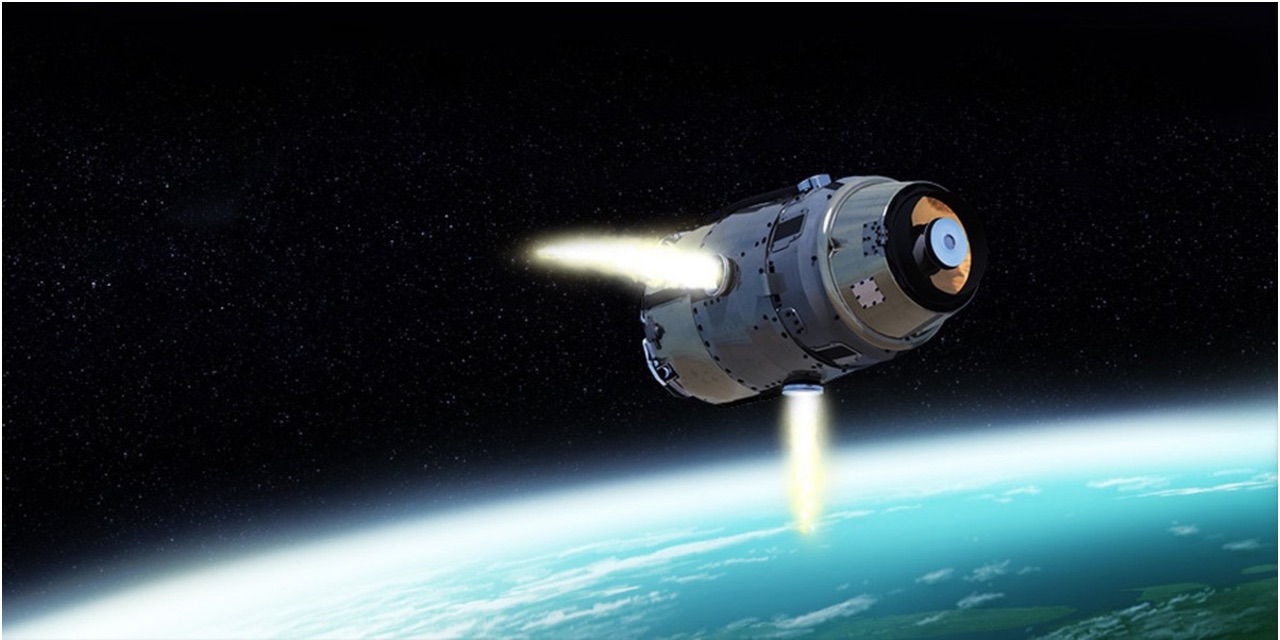
Artist's illustration of Raytheon's Standard Missile 3, a current defensive weapon system designed to destroy short- to intermediate-range ballistic missiles.
Credit: Raytheon
Defensive weapons that can intercept and destroy enemy missiles before they can harm the United States or its allies have been a key part of military strategy for decades, but the rules of the game are changing.
More countries have or are developing long-range missile technology, including systems that can carry multiple warheads, known as Multiple Independently Targetable Re-entry Vehicles (MIRVs) and/or decoys.
"Both China and Russia possess the MIRV capability for their ballistic missiles. In 2014, reports confirmed that Iran too had developed Multiple Re-entry Vehicles (MRVs) for their ballistic missiles. Cold War literature suggests that MIRVs are first strike weapons and could be strategically destabilizing," independent consultant Debalina Ghoshal wrote in a June 2016 report for the Federation of American Scientists.
"The United States realizes these threats and is working towards a robust missile defense system," she said.
Last year, the U.S. Missile Defense Agency awarded contracts to Raytheon, Lockheed-Martin and Boeing to begin designing what is known as a "Multi-Object Kill Vehicle" or MOKV, which could destroy several objects in space with a single launch.
"Ten years ago, we had a single kill vehicle on a single interceptor. Kill vehicles today are the size of a toaster … This MOKV program is the latest iteration," John Pike, director of GlobalSecurity.org, told Seeker.
Raytheon's plan, which is scheduled for a concept review in December, is to load multiple MOKVs onto a single missile for launch. Each MOKV would be outfitted with sensors, a steering and propulsion system and communications equipment that will allow them to zero in on an individual target and hit it, destroying the object by sheer kinetic forces.
The impacts would take place beyond Earth's atmosphere, but on a trajectory that would send the resulting cloud of debris back into the atmosphere, where it burn up, Pike said.
A major technological challenge is figuring out how to differentiate between bombs and decoys, such as balloons that look like they might have a hydrogen bomb aboard.
The military hopes to begin proof-of-concept demonstrations late next year and a non-intercept flight test in 2018. If successful, the Missile Defense Agency would conduct an intercept test in 2019.
EXCLUSIVE: Multiple flying saucers were 'seen over Roswell' BEFORE infamous 'UFO crash'
A SERIES of flying saucer sightings over Roswell, New Mexico, were recorded in the days before the legendary "UFO crash" of July 1947, it has sensationally been claimed.
A former military welder allegedly claimed pairs of flying saucers were seen over Roswell.
A report sent to the Mutual UFO Network (MUFON), as exclusively revealed by Express.co.uk yesterday, claims pairs of flying saucers were spotted in the Roswell area in the week before the reported UFO crash of early July.
The report is allegedly written by a retired engineer who claims to have interviewed an unnamed welder who "cut open" the flying saucer that is said to have crashed in the New Mexico desert, just outside Roswell, more than 69 years ago.
Roswell has been at the heart of the UFO scene since the military announced in a press release it had found the remains of a crashed flying saucer in the nearby desert, in July 1947.
But the following day it retracted the statement, saying it was in fact a damaged US Air Force air balloon.
Witnesses later came forward to say there had been alien bodies within the "crashed craft", which – along with the wreckage – were then taken to the mysterious top-secret Area 51 military base in Nevada.
GETTY*YouTube
The news was initially reported by the military as a flying saucer crash, but later retracted.
The report says: "The individual I interviewed was a welder by trade and after the war was employed at the Roswell Air Force base welding jigs and fixtures for servicing aircraft.
"He began by stating that the week before the 4th of July, flying saucers would fly over the base in pairs every once in a while.
"He said they were circular and had a large dome on the top.
"They were flat on the bottom and were silent.
"He assumed they were some technology obtained from the Germans.
"He said everyone working there called them 'flats'."
Yesterday, Express.co.uk revealed how the report claimed a pair of dead aliens were found in the wreckage of the crashed flying saucer discovered by the US military.
He began by stating that the week before the 4th of July, flying saucers would fly over the base in pairs every once in a while.
Report to MUFON
In the detailed report, the engineer – who has not been named – claimed to have carried out the interview in 1970, 23 years after the legendary event.
He said the welder, who was based at the Roswell USAF base, revealed how he was told to load a cutting torch for a trip to the desert when they arrived at the crash site.
The engineer said in the report: "He described the craft as being about 25/26 feet in diameter with a large dome on top.
He said after cutting a hole in the top, he saw two beings who appeared to be dead. He said the cockpit had a strong smell of ammonia.
The report read: "He finished his cut and set the metal piece aside and looked into the cockpit for a few seconds before he was ordered off the craft.
"He said it was difficult to see very far into the craft because of the glare from the portable lights and the cockpit was full of smoke from the cutting torch.
"He said he saw two beings who appeared to be dead.
"He described the two beings as being about 4feet tall, but they were doubled up so it was hard to say.
"He described their heads as what we now refer to as greys. He said there were no visible instruments that he could see."
The welder allegedly revealed he was warned to keep silent after returning to base.
The retired engineer said he promised the welder not to relay his story until after his death, which happened in the late 1980s.
It is not clear from his report why he waited until now to report it to US-based MUFON, which is the world's biggest organisation dedicated to UFO and alien investigation.
The retired engineer added: "During the interview I never sensed anything odd about his presentation or with his mannerisms.
"I think he was telling the truth."
MUFON is investigating the claims, but the organisation has previously admitted it is sometimes sent completely fictitious and bogus material.
Roswell UFO BREAKTHROUGH? 'Welder at crash site saw TWO dead ALIENS in flying saucer'
EXCLUSIVE: A PAIR of dead aliens WERE found in the wreckage of a crashed flying saucer discovered by the US military at Roswell in 1947, it was sensationally claimed yesterday.
The Mutual UFO Network (MUFON) has received a report from a retired engineer who claims to have interviewed a welder who "cut open" the flying saucer that reportedly crashed in the New Mexico desert, just outside Roswell, more than 69 years ago.
In a detailed report, the engineer – who has not been named – claimed to have carried out the interview in 1970, 23 years after the legendary event.
Roswell has been at the heart of the UFO scene since the military announced in a press release it had found the remains of a crashed flying saucer in the nearby desert, in July 1947.
But the following day it retracted the statement, saying it was in fact a damaged US Air Force air balloon.
Witnesses later came forward to say there had been alien bodies within the "crashed craft", which along with the wreckage were then taken to the mysterious top-secret Area 51 military base in Nevada.
In the shock report to MUFON, the former engineer first explained why the interview came about.
He said: "I joined the staff of the then new campus of the University of California at Santa Cruz.
"There were several sightings of UFOs in the mountains behind the campus in 1969 and reported to the University.
"I was asked to interview three people and file a report.
"I could find no credibility or evidence in these events but, because it was a small campus and everybody in the Science knew what was going on, I got the unwanted reputation of someone who knew about UFOs."
The engineers claimed this led him to be introduced to the welder who had reportedly been employed any the US Air Force at the Roswell base at the time of the crash.
He said: "The individual I interviewed was a welder by trade and after the war was employed at the Roswell Air Force base welding jigs and fixtures for servicing aircraft."
He said the welder revealed how he was told to load a cutting torch for a trip to the desert when they arrived at the crash site.
GETTY
The report claims that a witness testified to seeing two alien bodies in the Roswell flying saucer.
GETTY
The claims about aliens being found at Roswell have been reported to MUFON.
The engineer said in the report: "He [the welder] said they had a flatbed truck loaded with wreckage and there were soldiers on their hands and knees picking up every piece of wreckage and putting it in cloth bags.
"He said they drove a little farther out of sight from the wreckage and came upon a second group of people standing around an intact UFO.
"He said the brush was knocked down indicating the craft had skidded across the ground and came to rest nosed into a natural berm with the back side slightly off the ground.
"He described the craft as being about 25/26 feet in diameter with a large dome on top.
"He said the craft was the 'colour of weak tea' with a burnished finish.
"He said there were no signs of weld marks, seams, or rivets and that all of the edges had either an inside or outside radius. There were no visible windows or openings."
The welder described being told to cut an opening in the dome big enough for a man to crawl through.
The report said he began cutting a hole fromthe base of the dome.
He said he saw two beings who appeared to be dead. He said the cockpit had a strong smell of ammonia.
Former engineer
It read: "He said it was a tough alloy and slow cutting but the material was surprisingly thin. He tried bending the metal out of his way as he was cutting but the metal would spring back to its original shape without creasing."
This mirrors separate claims made in during an interview earlier this year when a woman alleged to have handled material "which came from the flying saucer which could not be cut or burnt and recovered its shape if crumpled" when aged 10 in 1957.
The report went on: "He finished his cut and set the metal piece aside and looked into the cockpit for a few seconds before he was ordered off the craft.
"He said it was difficult to see very far into the craft because of the glare from the portable lights and the cockpit was full of smoke from the cutting torch.
"He said he saw two beings who appeared to be dead.
"He said the cockpit had a strong smell of ammonia.
"He described the two beings as being about 4feet tall, but they were doubled up so it was hard to say.
"They were wearing what he said were skin tight purplish flight suits that reminded him of sequins.
"He described their heads as what we now refer to as greys. He said there were no visible instruments that he could see."
The welder allegedly revealed he was warned to keep silent after returning to base.
The engineer's report read: "He said it was dark when they arrived and he was escorted by armed guards into a building for a debriefing.
He said there were several high ranking officers at the table along with four or five civilians in suits.
"He said that after he was debriefed he was told that he was not to talk about what he had seen as it was a state secret and if he was caught divulging anything he would spend the rest of his life in prison or worse.
"He was scared to death by the threat and my friend and myself are the only people he ever told and that was 23 years after the event."
The retired engineer said he promised the welder not to relay his story until after his death, which happened in the late 1980s.
It is not clear from his report why he waited until now to report it to US-based MUFON, which is the world's biggest organisation dedicated to UFO and alien investigation.
The retired engineer added: "During the interview I never sensed anything odd about his presentation or with his mannerisms.
"He provided a lot more information that I have stated but the interview was almost 50 years ago and forgotten.
"I think he was telling the truth.
"I have shared my knowledge of this interview with a couple of investigators but I think they doubted my credibility."
MUFON is investigating the claims, but the organisation has previously admitted it is sometimes sent completely fictitious and bogus material.
Visit Express.co.uk's weird section tomorrow, Friday December 2, for more exclusive revelations from this shock report made to MUFON.
Twee elektrische voertuigen van Audi gaan volgend jaar naar de maan. De Audi Lunar Quattro is geen normale auto, maar een speciaal ontwikkeld maanvoertuig. Audi-ingenieurs werkten samen met een team van Duitse wetenschappers bij de ontwikkeling.
De twee wagentjes wegen 30 kilo per stuk. Met zonnepanelen wordt een lithium-ion-accu opgeladen. De karretjes hebben vier elektromotoren per stuk, een voor ieder wiel. De vier camera's per Lunar Quattro worden gebruikt om de voertuigen mee te besturen, maar ook om 3D- en 360 gradenopnames te maken. Audi ondersteunde de ontwikkeling op het gebied van vierwielaandrijving, lichtgewicht bouwwijze, elektrische aandrijving en autonoom rijden.
De twee Audi's worden door de ALINA-maanlander naar de Taurus-Littrow-vallei op de maan gebracht. Daar bezoeken ze onder mee het ruimtevoertuig dat Apollo 17-astronauten Eugene Cernan en Harrison Schmidt in 1972 achterlieten aan het einde van de laatste bemande vlucht naar de maan. Voor het zover is worden ze eerst in het Midden-Oosten intensief getest.
Competitie De Lunar Quattro's maken deel uit van de Duitse inzending voor de Google Lunar XPRIZE-competitie. Zestien teams doen mee aan die door de zoekgigant uitgeschreven competitie. Het eerste team dat een voertuig op de maan laat landen, 500 meter aflegt en hd-video en -foto's terug naar aarde stuurt wint 20 miljoen dollar, een kleine 19 miljoen euro. Het tweede team dat aan alle eisen voldoet krijgt een kwart daarvan. De zestien teams moeten voor het einde van dit jaar een contract voor de lancering van hun voertuig kunnen overleggen. Het Duitse team heeft dat nu gedaan door een contract met Spaceflight, Inc. te tekenen.
Alien Cube Ship Seen 3 Times In NASA Sun Video, Dec 3, 2016, Video, UFO Sighting News.
The above photo shows the two long white engines of the UFO.
Date of sighting: 2016-11-26 02:06:07 - 2016-12-03 00:54:07 UTC Location of sighting: Earths Sun Method used: LASCO C3 While looking for UFOs in NASA SOHO videos I found the cube moving about in the far distance. Now, to see the cube, you must slow the video speed to .25 on the Youtube settings and make it full screen. Stop the video at 3 seconds and you will see the UFO cubes engines...with glowing long white lights. These are warp type engines...because on the 4th second the UFO cube is now on the left side of the sun and we no longer see the engines. Instead we see its side, which has a layer over a layer. This moves at almost light speed...the same as the Star Trek warp speed. At 6 seconds into the video, the cube appears again. This time its on the right side and we see it from a whole new side...a different angle from the first two shots. At 8 seconds a 95% cloaked vessel passes from top to bottom on the left side. At 9 seconds, a disk UFO suddenly does a 180 degree turn on the lower left side of the screen. Scott C. Waring
Below is the 95% cloaked vessel moving from top to bottom...very long and may be 2 or more ships.
UFO At Space Station Dec 2016, Video, UFO Sighting News.
Date of sighting: Dec 2016 Location of sighting: Earths orbit
This UFO was caught by Streetcap1 of Youtube and shows how close these ships come to the space station. You need to understand, the rules of space contacts are much different from Earth contacts. In space its their rules, on Earth is our presidents rules. Up in orbit, humanities rules mean nothing to them. Increased space travel will also increase the number of alien contacts in the future. Scott C. Waring
86 Year Old Buzz Aldrin evacuated from South Pole In Antarctica To Hospital, Dec 2016, UFO Sighting News.
Date of news: Dec 1, 2016 Location of event: Antartica Here is an interesting video by SecureTeam10 about Buzz Aldrin who was part of a tourist group visiting Amundsen-Scott South Pole Station through White Desert. The trip was expected to last through December 12, but was cut short for Buzz when a health scare occurred. Buzz, 86 years old seems to want to keep active, and use this life to its fullest. A great example to us all. But, is Buzz thrill seeking so hard, because the Apollo moon mission never took place...forcing him to try to prove to himself and others that he did go to the moon? Is he overcompensating to make up for the lies? I have examined all the Apollo mission moon photos and Apollo 17 photos do not look like moon dust, but more like Earths common sand, and are too smooth, too sand dune-like...as if it was on a stage. However other mission photos appear real. Your thoughts? Scott C. Waring News states: Former astronaut Buzz Aldrin, the second person to walk on the moon in 1969, has landed in Christchurch, New Zealand, after being evacuated from the South Pole when his medical condition deteriorated, according to a release from the National Science Foundation. He is 86 years old. Aldrin landed at 4:25 a.m. December 2. "Upon arrival in Christchurch, the Antarctic program's logistics hub in New Zealand, Aldrin was transferred to a local medical facility," according to the foundation. He "currently has fluid in his lungs but is responding well to antibiotics and being kept overnight for observation. His condition is stable and his manager, who is currently with him, described him being in good spirits," according to an update from luxury tourism company White Desert. His manager, Christina Korp, said Aldrin is recovering. She also tweeted photos showing that Aldrin reached the South Pole, which was his goal.
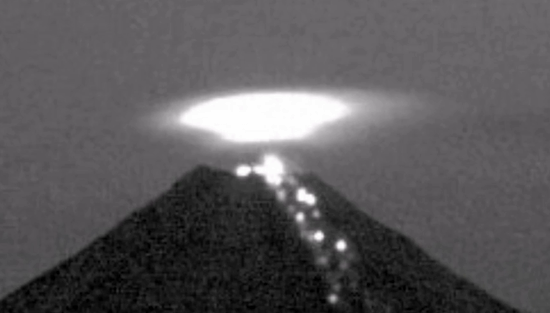
600+ Meter UFO Turns Night Into Day Over Colima Volcano, Mexico, Dec 2016, Video, UFO Sighting New
Date of sighting: December 2016 Location of sighting: Colima Volcano, Mexico
This UFO was noticed by Streetcap1 of Youtube this week over the Colima Volcano in Mexico. The UFO may have just left the volcanos mouth and seems to be charging up to leave the area. This UFO is bigger than the 600 meter wide mouth of the volcano. It seems large, but in the future people wont build spaceships...robots will, and robots don't need work breaks, phone breaks, games or food and drinks...they work 24/7 until the job is done, so making a giant ship like this would be done 10X faster than if the work was done by humans. Scott C. Waring Streetcap1 states: It disappears then reappears way above the Summit. It looked strange. When you think about it, it is the perfect cover. Streetcap1.
Pluto is hiding a massive secret. The tiny icy world in the outer depths of the solar system could in fact, be concealing a subsurface oceanbeneath its frozen, heart-shaped region known as Sputnik Planitia. The big question is: Could that subsurface ocean support extraterrestrial life?
First spotted by the New Horizons spacecraft during its historic 2015 flyby, the heart-shaped region that captured the affections of space-lovers everywhere was found by scientists to be was naturally divided into two lobes: A smooth, icy lobe named Sputnik Planitia, and a rougher region known as Tombaugh reggio.
The region informally named Sputnik Planitia is a deep basin thought to be a remnant of an ancient collision. The would-be crater has been filled in over time with a mixture of three kinds of ices — frozen nitrogen, methane and carbon monoxide — and is located on the surface opposite of Charon (which is Pluto’s large, tidally locked moon).
“Sputnik Planitia is one of Pluto’s crown jewels, and understanding its origin is a puzzle,” New Horizons Principal investigator Alan Stern, of the Southwest Research Institute, Boulder, Colorado, explained in a news release.
Pluto's icy heart could be hiding a subsurface ocean.
William McKinnon, professor of earth and planetary sciences in Arts & Sciences at Washington University in St. Louis is a member of the New Horizons team as well as a co-author on several Pluto papers, including one earlier this summer explaining that Pluto’s modest internal heat, is creating a lava lamp effect in Sputnik Planitia. McKinnon also co-authored another paper suggests any potential subsurface ocean would span some 600 miles wide and more than 50 miles thick. He also estimates that such an ocean would have an abundance of ammonia.
The New Horizons team previously detected the presence of ammonia on Charon, and also on one of Pluto’s small moons. “So it’s almost certainly inside Pluto,” McKinnon explained in a news release. “What I think is down there in the ocean is rather noxious, very cold, salty and very ammonia-rich almost a syrup.”
Could life survive in such an environment? If we’re talking about life as we know it, probably not. (Sorry Jeff Goldblum).
“It’s no place for germs, much less fish or squid, or any life as we know it,” McKinnon elaborated. “But as with the methane seas on Titan — Saturn’s main moon it raises the question of whether some truly novel life forms could exist in these exotic, cold liquids.”
Tardigrades are hearty organisms that can survive in extreme environments.
Life on Earth can tolerate a lot. Organisms known as extremophiles don’t just live, but thrive in the harshest environments. For instance, there are organisms that can tolerate extreme temperatures, as well as very salty conditions, or even the tardigrade, which can dry out for long periods of time and then reanimatethanks to a few drops of water.
It’s cold as hell out in the Kuiper Belt, so in order for a subsurface ocean on Pluto to remain a liquid, there must be some sort of anti-freeze, such as ammonia. Although scientists are not convinced there’s an organism out there that could survive in the viscous, ammonia-rich ocean on Pluto, certain types of bacteria found here on Earth are able to convert nitrogen into ammonia.
If there is an ocean lurking beneath Pluto’s icy heart, it would be a major discovery. Pluto is just one of thousands of worlds taking up residence in the Kuiper Belt, and if an exotic — meaning different than what we find here on Earth — subsurface ocean could be confirmed, the probability of other KBO’s harboring exotic oceans (and maybe life) increases exponentially.
New Horizons was decades in the making, and there are no other missions to explore Pluto currently on the books. If we want to definitively confirm a subsurface ocean exists, we will need to send another orbiter (or better yet, a lander) to collect crucial gravity measurements.
Chinese science fiction writers are having more fun with the genre than anyone else, and in fact, might even be producing its best new works. And now, in the years following the success of Liu Cixin’s award-winning novel, The Three-Body Problem, western audiences are starting to take notice.
For an easy introduction to this massive subgenre, see Ken Liu’s new anthology of short fiction, Invisible Planets, which highlights his favorite contemporary translated Chinese science fiction. And for readers who want to dive more deeply, three essays at the end of the book argue over the actual definition of Chinese science-fiction. In his essay “The Worst of All Possible Universes,” Liu Cixin himself believes that The Three-Body Problem actually helped to recontextualize science fiction in China very recently. In 2006, at the time of Three-Body’s publication in China, he wrote, “China’s science fiction market was anxious and depressed. The long marginalization of science fiction as genre led to a small and insular readership.”
Liu suggests that it has something to do with the book’s thick layer of imagination placed atop its realism. Liu implies that an adherence to strict realism is what shackled Chinese science fiction prior to 2006. “Writers struggled to attract readers outside the tribe and felt they had to give up their Campbellian science fiction fundamentalism and raise the genre’s literary qualities of realism.”
Jarringly, this is not unique to China, because what Liu Cixin is talking about is universal to science fiction publishing. If The Three-Body Problem was a big deal in Chinese science fiction in 2006, when Ken Liu’s translation showed up in American in 2014, it was also greeted as a breath of fresh air.
A contemporary science fiction writer is supposed to somehow reach a mainstream audience, demonstrate a convincing grasp of feasible science on the page, and also pay homage to previous sci-fi. If there’s one overwhelming trend from Liu Cixin or any of the other authors in Invisible Planets, it would seem to be that they looked at all those impossible criteria and said, “Fuck it.” And then, they wrote science fiction that could be realistic, but didn’t have to be. Finally, they were having fun with the genre.
Make no mistake, Invisible Planets is 100% Ken Liu’s baby. And though he might be known as the translator of Liu Cixin’s The Three-BodyProblem, the anthology wasn’t exclusively born out of that novel becoming popular in translation. “I had published 40+ translations of short Chinese fiction, and I realized that I had enough material to create a compelling anthology for readers interested in hearing new voices,” Ken Liu told Inverse. “It had nothing to do with The Three-Body Problem other than the fact that one of the stories in the anthology is adapted from a chapter in [that novel.]”
That’s why “whimsy” is the pervasive thread holding all the stories in Invisible Planets together, and “Grave of Fireflies” by Cheng Jingbo is one of its stand-out stories. In it, the author describes a future in which starships are seemingly evacuating the remnants of humanity in a mad dash to find the last remaining stars that might still be burning. Stars are going out left and right all around the universe, and no one knows why. Meanwhile, a kind of portal helps to guide the main character, Rosamund, to safety. “To the south was the Door Into Summer, built from floating asteroids like a road to heaven,” Cheng writes.
Xia Jia’s own story “Night Journey of the Dragon Horse” is another good example: it features a sentient, mechanical creature lumbering through a decayed, vaguely future-dystopian landscape. Xia Jia based the Dragon Horse on “real” dragon horses on planet Earth; it’s a kind of parade float, an attraction that would delight children. Imagining what a living version of a complex parade float might look like wouldn’t occur to most American science fiction writers. Is lack of imagination to blame? More likely, science fiction has been long dominated by western imagery and tropes, meaning everything about the imagination in Chinese science fiction seems fresh.
But how does one define “Chinese Science Fiction”? The essays in Invisible Planetsdon’t totally agree. In his essay “What Makes Chinese Science Fiction Chinese?” Xia Jia writes that the “disparate stories” found in the anthology “speak of something in common, and the tension between Chinese ghost tales and science fiction provides yet another way to express the same idea.” That’s not to say that there was ever a plan to present one unified theme with this anthology. Editor Ken Liu told Inverse that the book hopefully gives “… an overall sense of Chinese science fiction as a diverse category that includes many themes and approaches,” but Liu stopped short of saying that the book claims any “comprehensiveness” in terms of covering all of Chinese science fiction, ever. “It was conceived of as a showcase for some wonderful works of contemporary Chinese science fiction as gathered by an American writer and fan: me.” Ken Lui said. “I’m an American writer, so I write in the tradition of the Western canon … and I can’t claim that I’m too heavily influenced by any single school of thought.”
Regardless of motivation or total comprehensiveness, Invisible Planets is a wake-up call for a serious fan of science fiction. The message here is: ultra-realistic hard science fiction isn’t the global future of the genre, nor is a blend of literary fiction with borrowed “edginess” from the New Wave of the 20th century. Instead, Invisible Planets puts print sci-fi firmly where it should be: on the edge of what still isn’t quite possible in life, but can be glimpsed in art.
Quoting Gilles Deluze, Xia Jia reminds readers that science fiction is always in a state of “becoming.” There, finally, a true definition for science fiction — Chinese or otherwise might have been discovered. Chinese science fiction’s influence on the rest of the world has opened up a whole new frontier of discovery. Invisible Planets is probably just the beginning.
Tisulsky Princess — Girl in a Casket — Is at Least 800 Million Years Old!
Tisulsky Princess — Girl in a Casket — Age of Burial According to the Professor Is at Least 800 Million Years Old!
In the near future, russian scientists publish their findings, and that the scientific world will plunge into shock. Age burial, according to the professor, at least 800 million years old! This refutes the Darwinian theory of the origin of man from apes. The woman was buried in the Carboniferous period of the Paleozoic era millions of years before the dinosaurs, long before the formation of the planet coal, when, in the modern view is still the land of a complete plant kingdom.
It happened at the beginning of September 1969 in the village of Rzhavchik Tisulskago region of Kemerovo region. During the stripping work at coal mine in the core dvadtsatimetrovogo coal seam lies at a depth of over 70 meters, two meters, miner Karnaukhov discovered a marble casket of amazingly accurate mechanical manufacture.
At the command area, commander Alexander Alexandrovich Masalygina had all work stopped immediately. The casket was brought to the surface and began to open, peck on the edges of fossilized time putty. Not so much from the blows, but from the effects of solar heat, putty into a clear liquid and flowed. One looking for experiences even tried it on the language (in a week was crazy, and in February froze at the door of his house.)
Casket lid was adjusted perfectly accurate. For a more permanent connection inside edge fringed double face pyatnadtsatisantimetrovuyu plugged into the wall thickness. Tisulsky Princess Discovery was a shock to the audience. Casket coffin was filled to the brim with pink — blue crystal clear liquid. By spring stitch, which rests high (about 180 C), a slim, unusual beauty woman — who looked about thirty, with a fine European features and large, wide-open blue eyes. Her Hair was a thick, dark brown with a reddish tint, slightly curled and fell to the her waist. At her sides were soft white hands with short, neatly cropped nails.
She was dressed in a white lace transparent dress length just below the knee. With short sleeves embroidered with colorful flowers. Underwear was not. It seemed that she is not dead, but sleeping. At the head — a black, rectangular, rounded at one end, metal box (something like a cell phone) of approximately 25 to 10 cm
The coffin was open for all to see about 10 to 15 hours. See the miracle was the whole village. Almost immediately, the finding reported in the district center. Validating the authorities, fire, military, militia. By 14 o’clock in the field of brick-red helicopter landed and took a dozen solid “friends” in mufti, who once said that the place contagious and told the audience away from the sepulcher. Then sealed off the place of discovery and rewrote all who touched the coffin, and even standing near, ostensibly for a medical emergency.
Coffin “friends” dragged, it was in the helicopter, but the burden was too heavy, and decided to make it easier by removing the liquid. After pumping fluid out of the coffin corpse right in front began to blacken. Then the liquid is again filled in, and the blackness was rapidly disappearing. After a minute late on the cheeks blush is played again, and all of the mortal remains of the former acquired lifelike appearance. The coffin was closed and brought in a helicopter to get together with the remnants of the land putty in cellophane bags and ordered the witnesses to disperse. After that, the helicopter soared skyward and headed for Novosibirsk.
Five days from Novosibirsk to Rzhavchik came elderly professor and read in country club lecture on the preliminary results of a recent laboratory findings. The professor said that this discovery will turn rzhavchikskaya very understanding of history. In the near future, Soviet scientists publish their findings, and that the scientific world will plunge into shock. Age burial, according to the professor, at least 800 million years old! This refutes the Darwinian theory of the origin of man from apes. The woman was buried in the Carboniferous period of the Paleozoic era millions of years before the dinosaurs, long before the formation of the planet coal, when, in the modern view is still the land of a complete plant kingdom.
Originally coffin woman standing in the middle of a wooden vault deep thicket of the forest. Over time, the vault is completely rooted in the ground, collapsed and without oxygen for hundreds of millions of years into a solid layer of coal.
Initially put forward an alien version, but genetic analysis of a woman’s body showed a 100 — percent uniformity of the modern Russian man. Today, we are one to one are the same as were our ancestors 800 million years ago!
The level of civilization to which belonged to a woman, more than all the previously known, including our own, because the nature of the fabric from which made dress “Princess” is not amenable to scientific analysis. Equipment for the production of such material is not invented by mankind. Not managed to identify the composition and pink-blue liquid, identified only some of its constituent components, formed the oldest varieties of onions and garlic. On a metal box professor did not say anything, except that it is being studied.
Lecturer left, and after a couple of days in the local newspaper came tisulskoy tiny note that was found near the village of Rzhavchik archaeological relic, which will shed light on the story. Rzhavchane protested so much sensation, and in the newspaper three lines! Indignation subsided itself when Tisulsky area was suddenly surrounded by the military, the police went from house to house, removing “seditious” number in the population, and the place where he found the tomb, carefully dug and filled up with earth.
Yet despite the efforts of the authorities of the people in the village were found fighters for truth. One of the characters run around all instances, even wrote a letter to the Central Committee, but died a year (according to the official version — from heart failure). When, in the year one after the other in car crashes killing all six “pioneers” coffin surviving witnesses silenced forever.
In 1973, when, according to the authorities, “all was quiet” on the shores and islands of Lake Berchikul that six kilometers from the place of occurrence of the sarcophagus, all summer to late autumn in secrecy conducted large-scale excavations. Job site was surrounded by soldiers and police. But, as they say, murder will out! One guest workers who participated in the excavation and kept quiet for a long time, went to the shopping area, slightly drunk, and said that the islands discovered an ancient cemetery Stone Age. Share the details they flatly refused, but the village has seen both at the dig site and then flew to “brick” and the helicopter was taking something, and on completion of work on the islands and shores of Berchikulya are hundreds of carefully dug up and buried underground tombs …
SHOCK CLAIM: ELITE PREPARING FOR NIBIRU APOCALYPSE NEXT YEAR BUT THE REST OF US ARE DOOMED
WORLD leaders are planning to hide out in bunkers next year to escape the doom a gigantic planet will cause as it passes the Earth, according to a crackpot conspiracy theory.
The elites have been building bunkers all over the place in anticipation of Earth Changes. Governments around the world have built D.U.M.B’s (Deep Underground Military Bases).
What in the world are the elite up to? In recent days, we have learned NORAD is moving back into Cheyenne Mountain because it is “EMP-hardened”. In addition, government authorities have scheduled a whole host of unusual “training exercises” all over the nation. So are the elite doing all of this in order to prepare for something really BIG, or should we just chalk up all of this strange activity to rampant government paranoia?
I think even though we are confused, I would rather be ready and it not happen than to think it is years down the road. The pieces seem to add up and I am going with next year as the beginning of hell.
This diagram represents the the light of a neutron star passing through an area of space where vacuum birefringence, a theory of quantum electrodynamics, is occurring. The light's magnetic and electric fields (red and blue arrows) are altered and aligned as they pass through the empty space near a neutron star, suggesting the intense magnetic field there creates virtual particles that affect the light.
ESO/L. Calçada
About 400 light-years from here, in the area surrounding a neutron star, the electromagnetic field of this unbelievably dense object appears to be creating an area where matter spontaneously appears and then vanishes.
Quantum electrodynamics (QED) describes the relationships between particles of light, or photons, and electrically charged particles such as electrons and protons. The theories of QED suggest that the universe is full of "virtual particles," which are not really particles at all. They are fluctuations in quantum fields that have most of the same properties as particles, except they appear and vanish all the time. Scientists predicted the existence of virtual particles some 80 years ago, but we have never had experimental evidence of this process until now.
SEEING THE INVISIBLE
How can we possibly see such a thing? One of the properties virtual particles have in common with actual particles is that they both affect light. In addition, intense magnetic fields are thought to excite the activity of virtual particles, affecting any light that passes through that space more dramatically.
So a team of astronomers pointed our most advanced ground-based telescope, the European Southern Observatory's Very Large Telescope (VLT), at one of the densest objects we know of: a neutron star.
Neutron stars have magnetic fields that are billions of times stronger than our sun's. Using the VLT, Roberto Mignani from the Italian National Institute for Astrophysics (INAF) and his team observed visible light around the neutron star RX J1856.5-3754 and detected linear polarization—or the alignment of light waves according to external electromagnetic influences—in the empty space around the star. This is rather odd, because conventional relativity says that light should pass freely through a vacuum, such as space, without being altered. The linear polarization was to such a degree (16 degrees to be precise) that the only known explanations are theories of QED and the influence of virtual particles.
"According to QED, a highly magnetized vacuum behaves as a prism for the propagation of light, an effect known as vacuum birefringence," Mignani says. "The high linear polarization that we measured with the VLT can't be easily explained by our models unless the vacuum birefringence effects predicted by QED are included."
HOW DO YOU MEASURE SOMETHING THAT DOESN'T ALWAYS EXIST?
Vacuum birefringence was first predicted in the 1930s by Werner Heisenberg and Hans Heinrich Euler. It was an exciting time for the development of quantum mechanics, when many of the advanced theories still studied today were developed.
In the quantum realm, matter behaves very strangely to say the least. It violates both Newton's classical laws of physics and Einstein's theories of relativity and gravity. Matter can exist in two separate places at once. Entangled particles, separated by miles, can influence each other instantaneously. As far as we can tell, the smallest building blocks of matter exist with multiple, or even infinite properties, known as quantum states, until they are observed or measured.
Fortunately, we can model and even predict some quantum phenomena, and we do this using wave functions. A wave, such as a sine curve, is represented by an equation that has multiple correct values to make it a true mathematical statement. This same basic principle can be applied to physical models of particles that exist in different locations, or with different properties, or sometimes don't exist at all. When the particles are measured, the wave function collapses, and the matter only exists with one set of properties like you would expect. The researchers were able to measure the virtual particles around a neutron star indirectly, by measuring the light that passes through them.
These concepts are so profound that Einstein and Niels Bohr famously debated, at length, whether the universe even exists as a tangible smattering of matter across the void, or if it is a fluid conglomerate of infinite possible realities until we observe it. The first experimental evidence of vacuum birefringence—absurdly strong electromagnetic forces tugging at the very foundations of matter—reminds us that this is still an open-ended question.
Kosmische toverkunsten: Materie verschijnt en verdwijnt spontaan rond verre ster
Er gebeurt iets spookachtigs rond een neutronenster op 400 lichtjaar van de aarde. Materie lijkt er spontaan te verschijnen en vervolgens weer te verdwijnen.
Het is net alsof bij de ster een kosmische tovenaar aan het werk is.
Wetenschappers ontdekten dit vreemde fenomeen toen ze de Very Large Telescope van het Europese Zuidelijke Sterrenwacht (ESO) op neutronenster RX J1856.5-3754 richtten.
Polarisatie
De ster heeft een magnetisch veld dat miljarden keer sterker is dan dat van onze zon, schrijft Popular Mechanics.
Waarnemingen met de telescoop in het noorden van Chili hebben laten zien dat het licht van de neutronenster een sterke lineaire polarisatie vertoont.
Die polarisatie zou niet moeten optreden omdat de ruimte rond een ster normaal gesproken leeg is. Het licht kan erdoorheen gaan zonder veranderingen te ondergaan.
Virtuele deeltjes
In dit geval kan er maar één verklaring zijn: de ruimte rond de ster was niet leeg, maar bevatte ‘virtuele deeltjes’ die nu eens verschijnen en dan weer verdwijnen.
De kwantumelektrodynamica (QED), die gaat over de relatie tussen lichtdeeltjes (fotonen) en elektrisch geladen deeltjes, voorspelt dat zeer sterke magnetische velden de lege ruimte zodanig veranderen dat de polarisatie van passerend licht wordt beïnvloed.
Wemelt
Dit effect, dat ook wel vacuüm-dubbelbreking wordt genoemd, werd al in de jaren dertig voorspeld, maar is nog nooit eerder aangetoond.
De virtuele deeltjes zijn geen echte deeltjes, maar fluctuaties in kwamtumvelden. Deze fluctuaties gedragen zich desalniettemin als deeltjes en kunnen licht beïnvloeden.
Volgens de QED wemelt het universum van virtuele deeltjes. Er was een magnetisch veld van een verre neutronenster voor nodig om ze eindelijk aan ons te onthullen.
Meer van UFO'S of UAP'S, ASTRONOMIE, RUIMTEVAART, ARCHEOLOGIE, OUDHEIDKUNDE, SF-SNUFJES EN ANDERE ESOTERISCHE WETENSCHAPPEN - DE ALLERLAATSTE NIEUWTJES


 Three UFOs Over Las Vegas, Nevada On Nov 15, 2016 Using Night Vision Technology, Video, UFO Sighting News.