SHOCK CLAIM: ELITE PREPARING FOR NIBIRU APOCALYPSE NEXT YEAR BUT THE REST OF US ARE DOOMED

SHOCK CLAIM: ELITE PREPARING FOR NIBIRU APOCALYPSE NEXT YEAR BUT THE REST OF US ARE DOOMED
Scientists Catch "Virtual Particles" Hopping In and Out of Existence
The quantum effect known as vacuum birefringence was predicted in the 1930s, but this is the first observational evidence of the phenomenon in action.
About 400 light-years from here, in the area surrounding a neutron star, the electromagnetic field of this unbelievably dense object appears to be creating an area where matter spontaneously appears and then vanishes.
Quantum electrodynamics (QED) describes the relationships between particles of light, or photons, and electrically charged particles such as electrons and protons. The theories of QED suggest that the universe is full of "virtual particles," which are not really particles at all. They are fluctuations in quantum fields that have most of the same properties as particles, except they appear and vanish all the time. Scientists predicted the existence of virtual particles some 80 years ago, but we have never had experimental evidence of this process until now.
How can we possibly see such a thing? One of the properties virtual particles have in common with actual particles is that they both affect light. In addition, intense magnetic fields are thought to excite the activity of virtual particles, affecting any light that passes through that space more dramatically.
So a team of astronomers pointed our most advanced ground-based telescope, the European Southern Observatory's Very Large Telescope (VLT), at one of the densest objects we know of: a neutron star.
Neutron stars have magnetic fields that are billions of times stronger than our sun's. Using the VLT, Roberto Mignani from the Italian National Institute for Astrophysics (INAF) and his team observed visible light around the neutron star RX J1856.5-3754 and detected linear polarization—or the alignment of light waves according to external electromagnetic influences—in the empty space around the star. This is rather odd, because conventional relativity says that light should pass freely through a vacuum, such as space, without being altered. The linear polarization was to such a degree (16 degrees to be precise) that the only known explanations are theories of QED and the influence of virtual particles.
"According to QED, a highly magnetized vacuum behaves as a prism for the propagation of light, an effect known as vacuum birefringence," Mignani says. "The high linear polarization that we measured with the VLT can't be easily explained by our models unless the vacuum birefringence effects predicted by QED are included."
Vacuum birefringence was first predicted in the 1930s by Werner Heisenberg and Hans Heinrich Euler. It was an exciting time for the development of quantum mechanics, when many of the advanced theories still studied today were developed.
In the quantum realm, matter behaves very strangely to say the least. It violates both Newton's classical laws of physics and Einstein's theories of relativity and gravity. Matter can exist in two separate places at once. Entangled particles, separated by miles, can influence each other instantaneously. As far as we can tell, the smallest building blocks of matter exist with multiple, or even infinite properties, known as quantum states, until they are observed or measured.
Fortunately, we can model and even predict some quantum phenomena, and we do this using wave functions. A wave, such as a sine curve, is represented by an equation that has multiple correct values to make it a true mathematical statement. This same basic principle can be applied to physical models of particles that exist in different locations, or with different properties, or sometimes don't exist at all. When the particles are measured, the wave function collapses, and the matter only exists with one set of properties like you would expect. The researchers were able to measure the virtual particles around a neutron star indirectly, by measuring the light that passes through them.
These concepts are so profound that Einstein and Niels Bohr famously debated, at length, whether the universe even exists as a tangible smattering of matter across the void, or if it is a fluid conglomerate of infinite possible realities until we observe it. The first experimental evidence of vacuum birefringence—absurdly strong electromagnetic forces tugging at the very foundations of matter—reminds us that this is still an open-ended question.
Source: European Southern Observatory
Kosmische toverkunsten: Materie verschijnt en verdwijnt spontaan rond verre ster

Er gebeurt iets spookachtigs rond een neutronenster op 400 lichtjaar van de aarde. Materie lijkt er spontaan te verschijnen en vervolgens weer te verdwijnen.
Het is net alsof bij de ster een kosmische tovenaar aan het werk is.
Wetenschappers ontdekten dit vreemde fenomeen toen ze de Very Large Telescope van het Europese Zuidelijke Sterrenwacht (ESO) op neutronenster RX J1856.5-3754 richtten.
De ster heeft een magnetisch veld dat miljarden keer sterker is dan dat van onze zon, schrijft Popular Mechanics.
Waarnemingen met de telescoop in het noorden van Chili hebben laten zien dat het licht van de neutronenster een sterke lineaire polarisatie vertoont.
Die polarisatie zou niet moeten optreden omdat de ruimte rond een ster normaal gesproken leeg is. Het licht kan erdoorheen gaan zonder veranderingen te ondergaan.
In dit geval kan er maar één verklaring zijn: de ruimte rond de ster was niet leeg, maar bevatte ‘virtuele deeltjes’ die nu eens verschijnen en dan weer verdwijnen.
De kwantumelektrodynamica (QED), die gaat over de relatie tussen lichtdeeltjes (fotonen) en elektrisch geladen deeltjes, voorspelt dat zeer sterke magnetische velden de lege ruimte zodanig veranderen dat de polarisatie van passerend licht wordt beïnvloed.
Dit effect, dat ook wel vacuüm-dubbelbreking wordt genoemd, werd al in de jaren dertig voorspeld, maar is nog nooit eerder aangetoond.
De virtuele deeltjes zijn geen echte deeltjes, maar fluctuaties in kwamtumvelden. Deze fluctuaties gedragen zich desalniettemin als deeltjes en kunnen licht beïnvloeden.
Volgens de QED wemelt het universum van virtuele deeltjes. Er was een magnetisch veld van een verre neutronenster voor nodig om ze eindelijk aan ons te onthullen.
[Popular Mechanics]
UFO SCHIET RAKELINGS LANGS KLEIN VLIEGTUIG ( VIDEO )
|
Op deze website zijn al veel verhalen gepubliceerd over vreemde wolken, waarbij UFO’s een rol spelen. Vaak zijn wolken die mensen waarnemen ook gewoon wat ze horen te zijn, normale wolken. Echter, zo af en toe komt het voor dat een wolk helemaal niet de wolk is die je denkt dat het is, maar dat het een vermomming is voor een UFO of een soort dimensieportaal waar UFO’s aan komen of vertrekken. Dikwijls nemen mensen wolken waar waarbij bliksemschichten heen en weer schieten, maar wat dan ook weer geen echte onweerswolken zijn omdat ze op een bepaalde plaats hangen, terwijl de rest van de lucht gewoon blauw is. Daarnaast worden UFO’s ook regelmatig gesignaleerd bij wat wel echte onweerswolken zijn. De combinatie UFO/onweer/bliksem is er één die iedere keer weer terug komt, zoals in het volgende voorbeeld.
Het is een opname die nu net naar buiten is gekomen, maar die al in juli van dit jaar is gemaakt in de Amerikaanse plaats Cherry Hill in de staat New Jersey.
De theorie die zegt dat UFO's zich verbergen in wolken of die gebruiken om zich te vermommen, wordt ondersteund door een voorval dat plaatsvond in 2011 en wat ook wel één van de meest overtuigende UFO waarnemingen word genoemd.
In de volgende video zie je na ongeveer 3 minuten en 28 seconden de UFO langs het vliegtuig schieten.
|
Russisch ruimteschip met voorraden voor het ISS in de problemen

Hubble ontrafelt het 'draderige' sterrenstelsel NGC 4696
Caroline Kraaijvanger

Vreemd kwantumeffect gespot in de ruimte
Kleinste asteroïde ooit gevonden
Tim Kraaijvanger

Deze vrouw werd als enige ooit geraakt door een vallende meteoriet
Hoe groot is de kans dat het ook u overkomt?
Wie een vallende ster ziet, mag een wens doen, zo wordt gezegd. Wie een vallende ster voelt en het nog kan navertellen, mag vooral van geluk spreken. De Amerikaanse Ann Hodges lag vandaag exact 62 jaar geleden thuis in de woonkamer een dutje te doen toen ze door een meteoriet werd geraakt. Ze is vandaag nog altijd het enige slachtoffer ter wereld dat ooit geraakt werd door een gloeiende steen uit de ruimte.
Exact 62 jaar geleden deed Ann Hodges uit Sylacauga in Alabama ’s middags een dutje op haar zetel. Ze had net de tafel afgeruimd en de keuken opgekuist. Ze was alleen thuis, de radio speelde zacht.
Ineens hoorde ze een harde klap en voelde ze een stekende pijn aan haar linkerheup. Ze kermde het uit van de pijn. Tussen haar dij en haar heup zat een gigantische blauw/zwarte plek. Zonder het zelf te beseffen was ze de eerste persoon ooit die geraakt werd door een meteoriet uit de ruimte.
Gelukkig was de val van de steen afgeremd door het dak en het plafond en ketste hij ook nog af op de radio. Anders waren de gevolgen ongetwijfeld veel erger geweest. Maar het voorval werd wel wereldnieuws.
De Russen?
De inwoners van Sylacauga, die het hadden zien gebeuren, beschreven het vallende object als een rode lichtbal met een lange rookpluim. Sommigen dachten dat een vliegtuig neerstortte, anderen vermoedden dat de Russen er voor iets tussen zaten. Dat de Sovjets een aanval hadden uitgevoerd op de VS. Het was toen nog volop Koude Oorlog tussen beide grootmachten. Gelukkig zaten de Russen er voor niets tussen en ging het om een uitzonderlijk natuurfenomeen.

De huisdokter stond voor een raadsel. Het enige wat hij kon doen was een enorme bloeduitstorting vaststellen en patiënte Ann Hodges wat pijnstillers geven. De oorzaak van de verwondingen moest hij niet ver zoeken. Boven het hoofd van zijn patiënte zat een groot gat in het plafond. Een steen, ongeveer zo groot als een kassei, lag in de woonkamer. Hij was dwars door het dak van het landhuis gevallen.
Ann werd naar het ziekenhuis gebracht. De politie nam de steen in beslag maar wist er zelf ook niet echt raad mee. Uiteindelijk gaven militairen en wetenschappers het antwoord: het was wel degelijk een meteoriet uit de ruimte.

Ann herstelde en kreeg de steen die haar leven grondig zou veranderen terug. De pers schoof aan voor haar huis om een interview af te nemen van de vrouw. En iedereen wilde het huis waar het natuurfenomeen zich had voorgedaan van dichtbij zien. Ze kon amper nog buitenkomen zonder te worden aangeklampt en werd volgens haar omgeving een ander mens. Ze begon zich zelfs een beetje een ster te voelen.
Haar huisbaas, weduwe Birdie Guy, eiste na een tijdje de steen op. Het was haar huis waarop hij gevallen was en zij moest opdraaien voor de herstellingen. Dus kwam de meteoriet haar toe, vond ze.
Ann gaf niet toe en het kwam zelfs tot een proces. Na een lange en bitsige strijd gaf Birdie Guy haar claim uiteindelijk op. Hodges en haar man Eugene moesten wel 500 dollar aan de vrouw betalen. Ze betaalden met plezier omdat ze geloofden dat ze op termijn veel meer geld met de meteoriet konden verdienen. Een foute gok, zo bleek achteraf.

Niemand was geïnteresseerd in ‘dat stuk steen’. Uiteindelijk schonk het koppel hem in 1956 aan het natural history museum waar hij vandaag nog altijd in een vitrinekast ligt.
Nu de steen weg was, hoopten ze hun vroegere leventje weer op te nemen. Maar Ann begon met haar gezondheid te sukkelen en kreeg vooral geestelijke problemen. Het was haar allemaal wat te veel geworden. Anderzijds miste ze toch ook wel een beetje de aandacht die ze gekregen had en die nu plots was weggevallen. Na een zoveelste zenuwinzinking verliet haar man haar in 1964 en acht jaar later overleed ze in alle eenzaamheid in een verzorgingstehuis. Ze werd maar 52 jaar.
“Ann was een minzame vrouw die niet graag in de spotlight stond. Het voorval met de meteoriet heeft haar leven grondig overhoop gegooid. Ze werd zenuwziek en kon niet meer gewoon functioneren. Die steen was haar ondergang”, zei haar ex-man Eugene op haar begrafenis.
Hoe groot is de kans dat er zo een meteoriet op ons dak valt?
Bij Volkssterrenwacht Urania in Hove zeggen ze dat de kans dat je zoiets meemaakt, zeer erg miniem is.
Amerikaanse wetenschappers zeggen dat de kans dat er een meteoriet op je kop valt zelfs kleiner is dan de kans dat je één een keer het slachtoffer wordt van een orkaan, een overstroming en een blikseminslag.
Bij Urania kennen ze twee gevallen van vallende meteoren in West-Europa. Zonder gewonden. In augustus 2009 was er een inslag in Frankrijk, in oktober van hetzelfde jaar boven Groningen, in Nederland. “Gelukkig zijn daar geen gewonden bij gevallen. Maar het was uniek om zien”, zegt Marc Van den Brouck van Urania.
In de ochtend van 15 februari 2013 kwam een grote meteoriet de dampkring binnen nabij de Russische stad Chelyabinsk. Precies 88 seconden na de verblindende flitsen volgden enkele zware schokgolven. Heel veel ruiten sneuvelden. Meer dan 1.000 mensen raakten gewond. Niet door de meteoor zelf maar door rondslingerend glas en andere objecten.
De boosdoener was een steenmeteoriet met een geschatte diameter van 19 meter en een gewicht van ongeveer 12.000 ton. De kracht van de explosie werd geschat tussen 470 en 600 kiloton. Ter vergelijking: de explosieve kracht van de atoombom op Hiroshima bedroeg ongeveer 15 kiloton. De gigantische steen kwam gelukkig in het water terecht.
“Meteoren vliegen op 70 kilometer hoogte rond met een snelheid van 100.000 kilometer per uur. Op een bepaald moment spatten ze uit elkaar en vallen ze naar beneden. De kans dat we ooit, zoals die vrouw in de VS, geraakt worden door zo een vallende ster, is miniem. Uit onderzoek blijkt dat er jaarlijks een twaalftal neerkomen die de grootte hebben van een voetbal. Maar meestal vallen ze in onbewoond gebied. Voorspellen kan je zoiets niet.”, zegt Van den Brouck.

Trump's New NASA Advisor Might Push to Militarize Outer Space
After weeks of radio silence, President-elect Donald Trump has finally announced who will presumably be taking the reins over NASA for the transition team: Christopher Shank, a former top aide and communications official for the space agency. Shank’s appointment seems to reinforce Trump and Vice President-elect Mike Pence’s calls for stepping up military assets in space and push for greater cross-collaboration between NASA and U.S. intelligence agencies.
Why is that? Shank, a former member of the U.S. Air Force, has experience helping the Pentagon work on space programs. He had a stint as a special assistant to former NASA Administrator Mike Griffin. In addition, since 2011, he’s served as deputy chief of staff for Representative Lamar Smith — the chairman of the House Science Committee for the last three years, and for which Shank has served as a staffer.
Overall, Shank is an establishment figure who has spent plenty of time navigating through the federal government’s civilian and military sectors. He’ll likely act as an effective bridge between the two as the incoming Trump administration looks to foster interdepartmental collaboration.
It’s not just Shank’s appointment that speaks to this notion. Mark Albrecht, space policy advisor under former president George H.W. Bush, has been assigned to work with the Department of Defense for the transition team. Albrecht was long pegged by industry insiders to be a shoe-in for the NASA transition team, so his new role at the Pentagon is a bit of a surprise. But Albrecht’s appointment may actually be a way for the Trump administration to increase the defense department’s influence over U.S. space policy.
Trump has been vocal about his desire to resurrect the currently-defunct National Space Council, which would bring together the heads of various federal agencies together in one body to discuss and direct U.S. policy holistically — not just with regards to NASA. And the head of this council would be Pence, who is reportedly enthusiastic about melding NASA’s work with the military and intelligence community.
Why would Trump and his advisors push for more cooperation between NASA and the military? With China’s own space program pulling together a rapid string of successes, and with the advent of space mining poised to accelerate the the militarization of space, there is a legitimate case to make for why the executive office should start planning now for how it will use space as another platform for strengthening national security. International law only prohibits putting weapons of mass destruction into orbit — it doesn’t prevent conventional weaponry from being launched.
Of course, aggressive actions from the U.S. would almost certainly just persuade Russia, China, and other countries to begin making their own plans to beef up their military assets in space. Trump, if he’s not careful — and so far, there’s no reason to expect anything less than recklessness from our new president — could create a new space race that plunges the world into new existential lows.
Photos via J. Hua
RELATED ARTICLES
Astronomers Discovered a Tiny, Adorable Asteroid Near Earth
Astronomers at the University of Arizona found a new friend last year — the smallest near-Earth asteroid ever observed.
The space-rock, named 2015 TC25, is about six feet in diameter: So tiny, researchers say, that you could literally ride it like a pony (or, as the university’s blog post notes, recreate the bomb-riding scene in Dr. Strangelove). Sure, you’d need to have a spacesuit and also be traveling at roughly 56,000 miles per hour (the average speed of an asteroid orbiting the sun), but theoretically, 2015 TC25 is an explorer’s best chance for a rock ride through space. It passed by Earth at only 79,535 miles, which is about a third of the distance to the moon.
Astronomers at University of Arizona’s Lunar and Planetary Laboratory first found TeeCee in October of last year, as its name would suggest, but recently published their findings in The Astronomical Journal after watching the little rock zip through space for a year. Weirdly, TeeCee is extremely bright for an asteroid, despite its small stature. The astronomers estimate the asteroid reflects up to 60 percent of the sunlight that hits it, mostly because it’s made of shiny silicate materials formed in a high-temperature, oxygen-free environment.
Lead author Vishnu Reddy said that even though TeeCee is a shrimp, it might have bigger implications and could help astronomers learn more about where its bigger asteroid family members are headed. Near-Earth asteroids — ones that break off from the main belt between Mars and Jupiter and pass by Earth — are watched carefully by astronomers just in case one decides to go all Armageddonon us. But Reddy says that’s not really a worry with TeeCee.
“This is the first time we have optical, infrared and radar data on such a small asteroid, which is essentially a meteoroid,” Reddy said. “You can think of it as a meteorite floating in space that hasn’t hit the atmosphere and made it to the ground yet.”
Still, Reddy’s team was interested in the little rock because it was a perfect example of a small-scale meteorite sample untarnished by a traumatic trip through the atmosphere and an impact with earth.
“Being able to observe small asteroids like this one is like looking at samples in space before they hit the atmosphere and make it to the ground,” Reddy said. “It also gives us a first look at their surfaces in pristine condition before they fall through the atmosphere.”
Check out a quick timelapse of TeeCee’s trip through Earth’s turf below.
Photos via NASA/ JPL/ Photo Illustration
RELATED ARTICLES
Indian Scientists Have Detected a Crack in Earth’s Magnetic Shield
By:
Image courtesy NASA
A team of scientists from Tata Institute of Fundamental Research’s Cosmic Ray Laboratory in India detected a crack in Earth’s magnetic shield which allowed galactic cosmic rays to leak into the Earth’s atmosphere and caused huge geomagnetic storms.
The world’s largest and most sensitive cosmic ray monitor, GRAPES-3 muon telescope, located in Ooty (India), has recorded a burst of galactic cosmic rays. As per scientists, this burst of galactic cosmic rays indicates a crack in the Earth’s magnetic shield.
This telescope has recorded a burst of about 20 GeV, on 22 June 2015. This bombardment lasted for 2 hours and emitted immensely high-energy radiation. This burst took place when a giant cloud of plasma ejected from a solar corona, and traveled through space at about 2.5 million kilometers per hour and struck Earth.
This all resulted in triggering of severe geomagnetic storms that generated aurora borealis, and radio signal blackouts in many high-latitude countries in North and South America
From that very day, researchers at Tata Institute of Fundamental Research in India have performed various simulations based on the data they received from GRAPES-3, by using the 1280-core computing farm, developed by the GRAPES-3 team.
Their results indicate that the magnetosphere (the area containing the planet’s magnetic field) had been temporarily cracked. The team explained that this high-speed strike was relentless; it resulted in severe compression of the magnetosphere, forcing it to shrink from 11 to 4 times the radius of Earth.
Here’s Why Stephen Hawking Warns Us to Stop Reaching Out to Aliens
By:
Image courtesy Wikipedia
We are all interested to know more and more about the universe, and especially aliens. Many scientists believe there are many possible abodes for life throughout the cosmos, and considering the age of the universe (about 13.8 billion years) there has been plenty of time for life forms to evolve complexity and intelligence.
World-renowned physicist, Professor Stephen Hawking, said, “I am more convinced than ever that we are not alone.” But he is repeatedly warning scientists to stop trying to contact aliens before it’s too late.
According to Hawking, reaching out to advanced civilizations could put humanity in a very risky situation. But the fact is that we’ve already been signaling our location in the universe for years.
Hawking went on to say, “The Breakthrough Listen Project will scan the nearest million stars for signs of life, but I know just the place to start looking. One day we might receive a signal from a planet like Gliese 832c, but we should be wary of answering back.”
Hawking fears that alien civilizations are capable enough of picking up one of the many signals we are sending into outer space and understand where they’re coming from. If this alien civilization has the potential of billions of years of advancement, then we can become an easy target to overthrow or invade.
MIT and NASA’s Flexible Wings Make For More Efficient Flying
By:
Image courtesy Kenneth Cheung/NASA
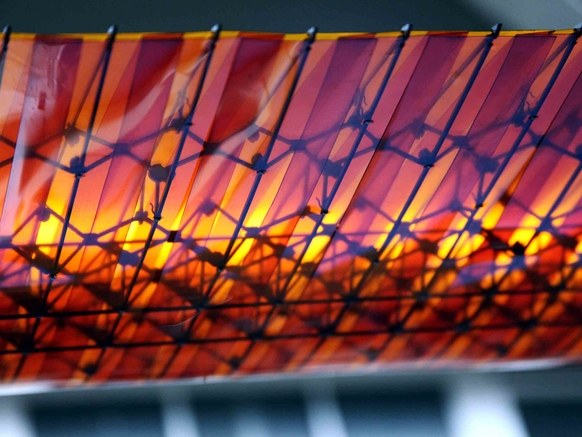
MIT and NASA researchers have developed a morphing airplane wing which could greatly simplify the manufacturing process and will make planes more fuel efficient.
The design is similar to that of Wright brothers’ Flyer 1, which they did more than a century ago. The entire wing bends and twists, but in place of wires and pulleys, this wing uses a high-strength foil on an aluminum frame.
The wing’s aerodynamics and its agility have been improved. Using an “array of tiny, lightweight structural pieces” dubbed “digital materials,” the scientists made the wings that can be assembled into a virtually infinite variety of shapes, just like LEGO blocks. The wings are able to twist with the help of activating two small motors that apply a twisting pressure to each wingtip.
As per MIT, “Wind-tunnel tests of this structure showed that it at least matches the aerodynamic properties of a conventional wing, at about one-tenth the weight.”
The wings are bendable and are made of lightweight carbon fiber reinforced plastic and are assembled by a team small robots. Miniature robots crawl along or inside the wing structure as it takes shape.
Gonzalo Rey, chief technology officer for Moog Inc., said, “Ultralight, tunable, aeroelastic structures and flight controls open up whole new frontiers for flight. The broader potential in this concept extends directly to skyscrapers, bridges, and space structures, providing not only improved performance and survivability but also a more sustainable approach by achieving the same strength while using, and reusing, substantially less raw material.”
Les premières images de la sonde TGO de la mission ExoMars
En orbite autour de la planète Mars depuis le mois d'octobre, la sonde TGO livre ses premières images de la planète rouge.

Photo d’un cratère de 1.4 km sur le rempart d’un cratère bien plus grand. Résolution de 7,2 mètres par pixel.
ESA/ROSCOSMOS/CASSIS.ExoMars. La mission ExoMars 2016 de l'Agence spatiale Européenne (ESA) consistait en l'envoi d'une sonde autour de Mars et d'un atterrisseur sur la planète rouge. Si ce dernier a connu un funeste destin en s'écrasant à la surface plutôt que d'y atterrir en douceur, la sonde ExoMars-Trace Gas Orbiter (TGO) s'est, elle, correctement positionnée en orbite le 19 octobre 2016. Depuis elle a commencé à initialiser et tester ses instruments scientifiques. En cette fin novembre, l'ESA publie les premières images prises par la caméra CaSSIS (Colour and stereo surface imaging system, système d’imagerie de surface couleur et stéréo) lors du passage de la sonde à proximité du canyon Valles Marineris et des grands volcans martiens.
Premières images d'ExoMars. Crédit : ESA/Roscosmos/ExoMars/CaSSIS/UniBE
Le principal objectif de TGO est de faire un inventaire détaillé des gaz rares qui représentent moins de 1% du volume de l'atmosphère martienne dont le méthane, la vapeur d'eau, le dioxyde d'azote et l'acétylène. Outre la caméra, les deux instruments chargés de cet inventaire ont également été testés avec succès la semaine dernière. Enfin, le FREND (un détecteur de neutrons) qui permettra de jauger la composition de la surface a aussi subi une série de contrôles qui se sont avérés tout aussi satisfaisants. Il faudra cependant plusieurs mois avant que ces instruments produisent des données scientifiquement exploitables. Les premières photos ont été prises à environ 98.000 kilomètres d'altitude mais des clichés bien plus détaillés sont attendus car la sonde va progressivement se rapprocher de Mars pour se positionner, vers la fin de l'année prochaine, à une orbite définitive de 400 kilomètres d'altitude. CaSSIS permet des prises de vue couleur en stéréo et utilise les deux images obtenues en même temps pour reconstruire la topographie d'un lieu. Ce premier lot d'images va permettre d'améliorer la qualité des prochaines prises de vue.

Image et reconstruction 3D d’un versant du canyon de Noctis Labyrinthus. La topographie a pu être calculée avec une précision d’environ 20 mètres. Crédit : ESA/Roscosmos/CaSSIS.
ISS Cargo Spacecraft Explodes! Triangle Spacecraft Spotted Afterwards? (Video)
The Progress M-04 cargo spacecraft was lost at a height of 190km (more than 623,000ft) over a remote mountainous area of the Russian Republic of Tuva, Roscosmos said in a statement on its website.
Local people reported seeing a flash of light and hearing a loud boom while Amicha Stein posted an image on Twitter (see top right image) showing an explosion in the skies over Tuva, Russia around the time the ProgressMS04 vanished.
The Russian space agency would not immediately describe the malfunction, saying a state commission is carrying out an investigation into this event, reports RT.
After a cargo spacecraft from NASA’s supplier SpaceX exploded on the launch pad at Cape Canaveral last September, the Progress M-04 cargo spacecraft is the second craft in a short period of time that explodes without knowing what caused the incident.
Coincidence or not but at about the same time the cargo spacecraft vanished, a triangle UFO has been spotted near the International Space Station! See video below.
Alien Craft Crashes in Outer Mongolia
Scientists believe they finally FOUND evidence of ANCIENT life on MARS

BREAKTHROUGH: EXTRAORDINARY REPORT FROM THE MAN ASSIGNED TO BREAK OPEN ROSWELL'S UFO!
Crashed alien spacecraft spotted on Mars? (video)