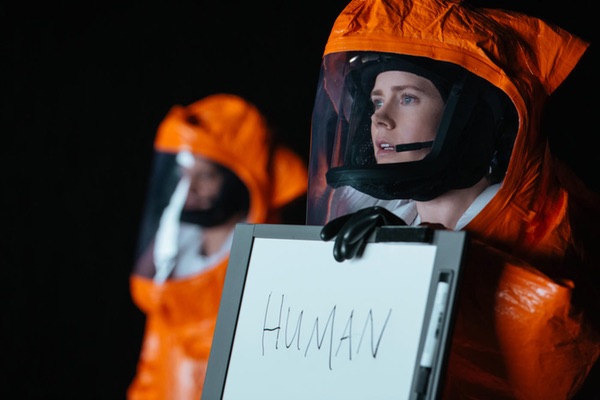
The movie Arrival illustrated the difficulties of communicating with an alien intelligence, but even that may have been an oversimplification of the real challenges.
(credit: Paramount Pictures)
|
Stranger danger: Extraterrestrial first contact as a political problem
by John Hickman and Koby Boatright
The 2016 film Arrival is simultaneously smart science fiction and wildly optimistic about the outcome of first contact with intelligent extraterrestrials. Smart because the extraterrestrials appear credible as the products of an extraterrestrial evolutionary process; wildly optimistic both because the extraterrestrials are benign in the way humans have always wanted their gods to manifest themselves and because humans are ultimately able to decode their language.1 Arrival’s heptapods sudden appear on Earth aboard interstellar spacecraft but then wait for humans to pass a difficult but not impossible language examination. Testing humans to determine their worth is a common trope in mythology and religion, and its presence in the film betrays an appeal to magical thinking.
| Getting it wrong because decision-making was freighted with unreasonable expectations might result in consequences that range from the merely amusing to the deeply frustrating to the existentially threatening. |
The 2017 film Life is even smarter science fiction because it doesn’t require interstellar travel, benign extraterrestrials, or communication between species with symbolic language. Instead, it is brutally pessimistic about the outcome of human encounters contact with extraterrestrials, intelligent or otherwise. The test portrayed in Life—biological survival—is far more fundamental and far more plausible. Viewed in succession, Arrival and Life evoke the better angels of our nature and then challenge the reasonableness of our expectations. What follows is a thought experiment, an effort to “game” the test in the most probable presentation of a first contact with an intelligent extraterrestrial entity, hereinafter referred to simply as First Contact.
If there is a consensus scholarum on the most probable scenario for First Contact, it would begin with human detection of a radio signal with sufficient structure to suggest symbolic language that had been broadcast from an exoplanet. Such an event would present the most formidable of language problems and confront national decision-makers with extraordinarily important choices, which would be made under extraordinary uncertainty.2 Deciding to respond to such a radio signal would be tempting. Lacking all but the most basic information about the transmitting extraterrestrial entity, buffeted by intense public excitement about the discovery of an intelligent extraterrestrials, and fearing that rival national decision-makers might preempt their decision by being the first to respond, national decision-makers might feel compelled to act based on assumptions that are revealed as incorrect only after the momentous encounter has begun. Getting it wrong because decision-making was freighted with unreasonable expectations might result in consequences that range from the merely amusing to the deeply frustrating to the existentially threatening. So this thought experiment is justified under the cautionary principle.
We proceed by first assessing possible risks and benefits of First Contact. The daunting language problem serves as the linchpin between possible risks and benefits. We then examine the underlying political problem before offering some conclusions about optimal public policy making.
Possible risks
For First Contact pessimists, the Fermi Paradox captures a crucial observation: a universe that ought to be noisy with the radio evidence of extraterrestrial civilizations is instead utterly silent. Searches have yet to detect radio signals operating as distant beacons announcing “we’re here.”3 Silence can be given an optimistic interpretation: Douglas Vakoch suggests that reflects a norm of respect for the wishes of other creatures that requires a species to announce its desire to communicate by broadcasting their wish to do so and proposes broadcasting such an invitation. “Maybe it takes an audacious young civilization like ours to do that.”4
What worries pessimists is the possibility that silence is motivated by rational existential fear. A preference for survival as a species and extraordinary uncertainty about possible risks attending contact between different intelligent technological species may have persuaded most species to avoid alerting others to their own existence.5 Thus, David Brin rejects the idea of broadcasting an invitation as, “seeing my children’s destiny gambled with.”6 Clearly, that proposition must be qualified with “most” because humans have been violating the proposed norm for decades with radio and television broadcasts. Perhaps we have been fortunate that Earth’s atmosphere bounces back most radio transmissions and that mass communication is increasingly transmitted by means other than broadcasting.
When Stephen Hawking warned against alerting any extraterrestrial civilization to our existence he offered as a familiar cautionary example the discovery of the Americas by Christopher Columbus.7The resulting series of first contacts resulted in population collapse of up to 90 percent of native populations across the Western Hemisphere, followed by brutal conquest and colonization by Europeans. The results of first contacts between Europeans and other peoples across the insular South Pacific were similarly tragic. Kathryn Denning critiques this and other historical analogies as a poor model for first contact with an intelligent extraterrestrial entity and notes that the historical encounters of the early modern era may be perceived less negatively over the longer term because they resulted in vibrant hybrid societies of value in their own right.8 That there are no Guanches, Tasmanians, or members of many other extinct indigenous peoples available to dispute Denning’s blithe reassurance ought to give one pause before accepting it.9
| It follows that silence is thus a plausible strategy for a risk-averse species because the result for any other species that might be listening is indistinguishable from a universe empty of species with technological civilizations. |
Given that First Contact would occur between our species and another, as yet unknown, entity, there are analogies that merit consideration. For example, the fate of large animal species after the irruption of humans in virgin soil environments can be seen as tragic. Paleoindians exterminated most of the megafauna in the Americas, including mastodons, dire wolves, giant sloths, giant armadillos, giant beavers, and glyptodonts, soon after their arrival.10 The moose and bison alone survived. Polynesian ancestors of the Maori exterminated all 13 species of the Moa, giant flightless birds, soon after their arrival in New Zealand. The remorseless encounters between native and invasive non-human species competing for the same ecological niches is similarly tragic, at least from the perspective of those of us who prefer a biosphere with more species diversity. Pathogen transfer due to contact between previously isolated wild and commercial populations of the same non-human species has resulted in population crashes.
Examples of the resulting negative outcomes are displayed in Table 1.
Table 1. Tragic Encounters
| same species | closely related species | unrelated species |
|---|
| both populations possess human level intelligent |
Western Europeans and Native Americans in the Americas11 |
modern humans and Neanderthals in Eurasia12 |
no data |
| only one population possesses human level intelligence |
no data |
modern humans and chimpanzees in sub-Saharan Africa13 |
Paleoindians and megafauna in the Americas14 |
| neither population possesses human level intelligence |
wild and commercial bumble bees, salmon, pigs15 |
roof rats and rice rats in the Galapagos16 |
brown rats and tuatara on Whenuakura Island17 |
That all of those encounters ended badly for one party, frequently involving population crashes and extinction, should not be ignored by policy makers. We note, however, that the analytic value of these analogies is constrained by three considerations. First, there are no data for the cell in the upper-right-hand corner of encounters between populations of intelligent but unrelated species, which would encompass First Contact. Second, all of the analogies involve encounters between terrestrial fauna. First Contact might be with a species that evolved amid much less aggressive life forms than those found on Earth. Indeed, First Contact might be with an entity that emerged in an entirely non-competitive environment. Third, all of the analogies involved physical contact between different populations. None were limited solely to long distance communication as is expected in First Contact.18
What matters here is that terrestrial analogies to encounters between populations offer the only empirical information for assessing the risks of First Contact. It follows that silence is thus a plausible strategy for a risk-averse species because the result for any other species that might be listening is indistinguishable from a universe empty of species with technological civilizations. Even if every intelligent entity would be benevolent towards other intelligent entity given the opportunity to interact, an implicit silence norm might be self-reinforcing as species choose to interpret the uncertainty inherent in the result as possible evidence of the rational behavior by other species. If you do not hear anyone else speaking, then either there is no one to talk to or they may know to be quiet for a very good reason.
Language
Before surveying possible benefits of First Contact, it is important to examine what is likely to be the most daunting aspect of the encounter. Will humans be able to do more than simply recognize that a radio signal is from an intelligent extraterrestrial entity and actually establish mutually intelligible communications?
When we conceive of extraterrestrial minds, they often inhabit entities with radically different body plans: planet-wide unitary organisms or populations of machine successors to biological organisms. Contrawise, similar body plans are expected to produce similar minds. Optimistic assessments of the possibility of communicating abstract ideas other than perhaps mathematics are typically premised on convergent evolution, as in Don Lincoln’s 2013 Alien Universe.19 John C. Baird’s 1987 The Inner Limits of Outer Space compared the problem of communicating with an intelligent extraterrestrial species with translating ancient hieroglyphics without benefit of a Rosetta Stone.20
Even that may be much too optimistic. Egyptian hieroglyphics were the work of human minds, merely separated in time by five millennia.21 The problem is that even if intelligent extraterrestrials resemble humans, their minds may be radically different. Our current understanding is that humans possess an innate capacity for learning and using a language and associated culture.22 Although language and mind are inextricably linked in humans, they might not be so for an intelligent extraterrestrial entity, no matter how similar in appearance. Their minds may resemble the plastic Standard Social Science Model that dominated social science thinking during the last century and that continues to influence thinking about language among proponents of SETI.23 Alternatively their minds might be organized with comparable but different innate capacities, perhaps even greater rigidity than our own.
| The problem is that even if intelligent extraterrestrials resemble humans, their minds may be radically different. |
The language problem is daunting in part because although linguists are reliable sources for questions about human language, the film Arrival notwithstanding, they are likely to have little to offer in translating messages from extraterrestrials. Experts in foreign tongues are likely to be flummoxed by efforts to communicate with entities without tongues. First Contact would present multiple “firsts,” at least in the annals of humanity. That newness means nothing should be taken for granted, and certainly not the intent to communicate simply because an extraterrestrial radio signal has been detected.
If extraterrestrials communicate via something similar to human language, it would be necessary to determine which, if either, of the two types of intentional, signification-based communication that we employ: ‘”natural language” like English, Italian, or Proto-Indo-European; or “code” like C++, syntax for expressing an architecture such as Zermelo-Fraenkel, or binary. There are several differences between a code and a natural language, but their similarities are often a source of confusion. An exacting description of these relationships is beyond the scope of this paper, so we will merely point to a few that shed light for the present strategic darkness.
First, a natural language is the product of unintentional evolutionary processes, much the same as the species that makes use of it. It is for this reason that most natural languages have irregularities in structure or spelling which have seemingly no rational basis—sometimes to the great frustration of those attempting to use such a language. A code, by contrast, is formed somewhat deliberately. This usually encourages uniformity in how it is presented and restricts its ad-libbed modification.
Second, natural language has ambiguities that codes do not. Sentence structure, tone, pitch, and a hundred other things all come together to provide variation in significance. Often, we have to simply say that it’s a matter of circumstance. These matters of circumstance cut down on the time it takes to communicate immensely. Codes are, by contrast and by design, unambiguous. A message is to be interpreted only one way, and the very grammar of the code is usually tailored in such a way that it can be deciphered purely mechanically—and let us not miss the importance of the term “decipher” here. This means that every relevant detail has to be spelled out, so if there are a lot of details, a message can quickly become enormous.
Third, along similar lines, natural language is multi-contextual. This means that it is conveyed in situations where more than one medium gives relevant information as to how the communication is to be interpreted. The ability to detect a tone of sarcasm or earnestness is immensely helpful to truly understanding each other, and it is in these areas of subtext that artificial intelligence interactions with humans find their great challenges. Codes, by contrast, contain everything in the letter. The form of the communication itself is expected to be sufficient to extract everything of relevance. This is necessary to program computers, or write out proofs of mathematical concepts that can be carried out by brute logical operation.
To sum up these differences, code operates in highly restricted circumstances on barebones prior information, making it unambiguous but not usually efficient. Natural language operates in situations where multiple external details can be taken into account to clarify, and whole separate channels of information are available, like gesturing or intoning. Humans are so accustomed to dealing with natural language situations that it is easy to mistake any communication with conscious beings for being just that simple. But with so much between us as whole star systems, and little more than a glorified two-way radio, this may be far from the case.
“To imagine a language is to imagine a form of life.” This statement by the philosopher Ludwig Wittgenstein illustrates partially why the cryptanalyst will likely be more useful to understanding far-flung communication than the linguist. There is little that can be said about the aliens’ “form of life” that isn’t assumption, and though they may have language, this will not be the artifact we pick up when our radios start squawking. We shall merely have a code.
| The inability to understand the language of the other would likely engender frustration and suspicion. |
Once we have our code, we may think that the problem is merely decryption. However, there is cause to think that the limitations we’ve just discussed not only render the situation more difficult, they may well put sharp boundaries on just what sort of information can be transmitted, and hence on what can be inferred for questions of strategy. The two problems, intertwined, are whether there is sufficient information for deciphering and whether worthwhile information can be transmitted.
The first problem doesn’t seem too difficult, because the message can be expected to provide clues to its interpretation by its form alone. Binary messages, either based on a dot-dash system or an on-off system, allows the transmission of sequences of numbers. Variation of tone around a baseline could simplify this into something like a hexadecimal system. Sequences of numbers that illustrate geometric ratios of importance could thus be a relatively simple matter to transmit and receive. Repeated series like so, replacing an element with a blank or nonsense value, might serve to indicate the variables and operations in equations.
The door of mathematics, it seems, is open to us, though interpreting even this enough to get at “interesting” information could take an incredibly long time. Such messages would not only be very long sequences as the operations became more advanced, but would take a long time to respond to indicating understanding. Further, the messages would likely have to be repeated more than once, and any part of the message that didn’t get through could seriously hamper the decryption process. Messages intended to be reinterpreted through another medium, such as pictures described dot by dot through binary, would both be immense, and a gamble, presuming that the far-flung interlocutor has a means of processing visual information.
Here is where the second difficulty comes in. Mathematical truths can be transmitted in this way because the form of the message itself bears some kind of direct relationship to the matters being conveyed, in the way that the structure of a code-message bears similarity to the structure of the “meaning.” The only comparative measurements that are needed are provided internally, and little reference to external standards, except perhaps the rules of logic, is needed. This is where the univocal nature of radio communication may put a damper on things.
Natural language requires context and the available context is likely to be very thin. Advances in astronomical observation might provide information about the gravity and composition of the atmosphere if a planet is the source of the radio signal. Beyond recognition that mathematics and the natural sciences are shared, radio signals might contain sufficient information to assemble images from binary code. Such communications, if they are to convey much detail, would also have to be quite large, potentially suffering the same difficulties as regards interference as the above-mentioned mathematical operations. After that, however, interpretation is likely to be slow going and perhaps prove impossible.
Those who are pessimistic about the possibility of establishing communication will find philosophic support in the work of the mature Ludwig Wittgenstein as it was articulated in his Philosophical Investigations. His general argument is that the meaning of words is derived from linguistic conventions that permit no external justification and are unconcerned with empirically verifiable reference points. What a word means is determined by what everyone who speaks the same language knows it to mean. Moreover, because our access to reality, facilitated by language, is overwhelmingly social in nature, the common sense meanings of words offer as firm a reflection of reality—what Richard Rorty called a “Mirror of Nature”—as is possible. If the view of the mature Wittgenstein is correct, we may be faced with an impassible barrier for translation between human and extraterrestrial languages because they simply cannot belong to the same type of society and therefore there exists no way to construct commonsense meanings.
Comparing Chinese with German, Christian Helmut Wenzel notes how the tendencies of (human) languages derived from their cultural evolution create habits of thought.24 For example, Chinese language requires Chinese speakers to be more context sensitive than German language requires of German speakers, both in text and in speech. In another example, Chinese speakers use vertical spatial metaphors to reference time—for example the future is described as “down”—while German speakers use horizontal spatial metaphors to reference time.25 The differences in such largely unconscious habits of thought between humans and any intelligent extraterrestrial entity are likely to have more causes deeper than culture. Physical sense-organs are likely to differ. One of the authors of this article is visually impaired and thus aware of the frequency with which visual metaphors are used to reference processes of cognition: “Do you now see what we mean?” The degree to which an intelligent extraterrestrial entity is social might differ. Human sociality lies midway on a spectrum between that typical of arachnids at one extreme and that typical of hymenoptera at the other extreme. The sociality of an intelligent extraterrestrial entity might lie elsewhere along that same spectrum. Thus their capacity for some affect that is equivalent to trust may be less or more than our own.
| The human mind is designed for communicating with fellow humans. There is no guarantee that we would ever achieve more than the most rudimentary communication with creatures even very similar to ourselves. |
As Table 2 shows, successful communication and Babelian confusion are not the only possibilities for attempted communication in First Contact. A great deal must be achieved by both parties to this encounter for successful communication to be achieved without frustration and suspicion by one or both of the two parties. The everyday human experience is that all that is necessary for communication between speakers of different languages to be moderately successful. Limited shared language may be sufficient to carry out important exchanges of information. That would not be true of communication between humans and an extraterrestrial entity. Instead, such exchanges would more closely resemble the negotiations between political or business decision-makers, who struggle to define their terminology in both languages so as to maximize value by avoiding future confusion or betrayal. Neither an intelligent extraterrestrial entity capable of calculated deception nor humans would be able to trust that they had properly understood the meaning of messages if they were unable to translate back from the language of the other. The inability to understand the language of the other would likely engender frustration and suspicion.
Table 2. Possible communications outcomes
| Human Language Intelligible by Extraterrestrial Entity | Human Language Unintelligible by Extraterrestrial Entity |
|---|
| Extraterrestrial Entity’s Language Intelligible by Humans |
Communication (Shared Fluency) |
Human Understanding coupled with Frustration and Suspicion by Extraterrestrial Entity |
| Extraterrestrial Entity’s Language Unintelligible by Humans |
Extraterrestrial Entity Understanding coupled with Frustration and Suspicion by Humans |
No Communication (Babelian Confusion) |
Some consequences of unsuccessful communication in First Contact are foreseeable. Humans tend to interpret the “known unknown” with imagined forces and creatures, often elaborated from familiar myths.26 Fantastic beliefs and desperate action based on those beliefs is a possible result. The urge to project theories of mind appropriate to humans onto non-human animals or natural phenomena is well known. That humans do so with the creatures that we know best—dogs—is telling. Across cultures, humans will attempt to reason with dogs using symbolic logic and dogs will mimic understanding because they are rewarded for doing so. This exchange is noteworthy because it may have begun between 15,000 and 150,000 years ago and might represent a form of co-evolution. What matters here is that incomplete understanding between two utterly familiar terrestrial species endures despite its significance for humans as the best possible opportunity to cultivate an ethical practice with “significant otherness.”27 Given such failure, is it altogether reasonable to expect the successful exchange of information with an intelligent extraterrestrial entity that presents absolute otherness?
What does this mean for the possibility of successful communication between humans and an intelligent extraterrestrial entity? The human mind is designed for communicating with fellow humans. There is no guarantee that we would ever achieve more than the most rudimentary communication with creatures even very similar to ourselves. Perhaps we might succeed in checking our math but the possibility of exchanging much beyond that is limited. Moreover that might be fortunate if the intelligent extraterrestrial entity possesses ideas that might be released among our species as destructive memes.
Benefits
Carl Sagan, icon of the First Contact optimists, prophesied that humans might benefit immensely from access to the “scientific, logical, cultural and ethical knowledge to be gained from tuning into galactic transmissions.”28 Sagan was confident that the consequent cultural shock would be relatively small and that the decoding of signals would be possible though perhaps requiring decades or centuries.29 Albert A. Harrison anticipates encountering peaceful and cooperative intelligent extraterrestrial species flourishing in the interstellar equivalent to the Kantian Peace.30 He pictures a Galactic Club of such species operating on broad principles with experience at enrolling new member species such as our own. Alas, several decades of searching now suggests that intelligent extraterrestrial entities broadcasting invitations to communicate by radio must be exceedingly rare or occur at distances so great from Earth as to be functionally non-existent.
| Simply being exposed to different and radically alien minds might have a pacifying effect on our behavior by permitting further moral development. That effect is of course dependent on actually communicating in something close to natural language. |
What benefits might be derived from communicating with an extraterrestrial entity? We already know that intelligence has arisen multiple times on Earth but have yet to converse with any of the terrestrial species exhibiting intelligence about anything other than naming food, identifying predator threats, claiming territory, and expressing affection.31 To that extent humans already know they are not alone in the universe. Alas, we are unable to compare notes with any terrestrial intelligent species about more abstract matters. That is what we might achieve if we are able to translate messages from an intelligent extraterrestrial entity.
Proponents of attempting to communicate with intelligent extraterrestrial entities typically assume that our mathematics reflects something universal and would thus serve as the basis for the development of a common terminology. They might be mistaken. The mathematics we know might simply reflect the thinking of our species, centered on performing the sort of operation that is useful to us. Even ostensibly “pure” mathematics may simply be applied mathematics applied to itself, rendering the divide a case of degrees of removal rather than a difference in substance. An important benefit of First Contact would be to determine whether we know what we think we know about mathematics, both in content and scope. Discovering that mathematics is not shared might however foreclose use of the most promising means for achieving translation of messages. Not recognizing this, if it is so, may mean we toil in vain at an impossible task for a very long time.
Another benefit would be that we could “avoid re-inventing the wheel” by adopting much of the scientific and engineering advances made by other species. However we cannot assume that the science and engineering of an extraterrestrial entity would be of any practical use.32 Humans might also benefit from exposure to new examples and benefit by recognizing value in what we already possess. Thus we might be in a situation analogous to the pre-contact Inca, who were aware of the wheel but did not put it to use in transportation. An extraterrestrial entity might possess philosophic or spiritual insights as yet unimagined by our species.
Even if the extraterrestrial entity has nothing to offer that we do not already possess, would there be any benefit to communication? Donna Haraway argues that the relationships we develop with domesticated animals, creatures with different minds, is crucial to human moral development.33Steven Pinker argues that mass communications, which has resulted in greater exposure to the minds of humans and other animals unlike ourselves, is in part responsible for our increasingly peaceful behavior.34 So simply being exposed to different and radically alien minds might have a pacifying effect on our behavior by permitting further moral development. That effect is of course dependent on actually communicating in something close to natural language.
What do political decision-makers know about the benefits attending First Contact? The answer is that they know very little. Indeed, the claimed benefits appear to reflect wishful thinking.
The political problem
The search for radio signals from extraterrestrial entities has been ongoing for decades despite the absence of an unambiguous public policy consensus about the wisdom of doing so. Instead, enthusiasm about the possibility of detecting intelligent extraterrestrial life has been assiduously cultivated in popular culture. It sometimes seems as a means of inoculating the public against xenophobia about human Others.35 Belief in the benign character of any extraterrestrial entity is sufficiently common among members of the attentive public that The Planetary Society uses it to raise money. Thus an August 15, 2014, fundraising e-mail message ends with the following promise: “If an alien civilization broadcasts our way, it would be a major discovery in human history. And you’d like to be part of it. Please help keep the search alive.” The appeal for contributions makes no mention of the risks attending detection or response to such a message. Nor is there a mass membership lobby comparable to The Planetary Society opposing the effort. There is dissent from this but it fails to resonate strongly in public opinion.36
| What do political decision-makers know about the risks attending First Contact? The answer is woefully little, and what they do know is decidedly woeful. |
Scientific experts are divided about the advisability of responding to any detected entity and of unprompted signaling of our species’ existence as an intelligent technological entity.37 Unfortunately, much of the public, which might be in opposition, ignores expert opinion in favor of more entertaining conspiracist narratives of the sort offered up by The Discovery Channel.
What do political decision-makers know about the risks attending First Contact? The answer is woefully little, and what they do know is decidedly woeful. The tragic encounters detailed in Table 1 do not bode well even for encounters confined to radio transmissions. Memes, in the original sense that Richard Dawkins coined the term, could be demoralizing and disruptive in the same manner as pandemics.38 As we are discovering in the 21st century, information itself may be weaponized.
Given the worrisome “cat-killing” curiosity common to our species, some may be tempted to respond to a radio signal before it is deciphered and before it is determined whether humans are the intended audience. Mounting popular and scientific enthusiasm driven by curiosity might be difficult for political decision-makers to resist. Frustration at the inability to derive a message from the radio broadcast is likely to feed conspiracist suspicion that decision-makers are concealing information that they do not possess. The temptation to respond will probably be strengthened by what are, in human perception, very long time periods between sending and receiving radio messages. The time horizons for decision makers are typically much shorter. Long-term consequences of even the most momentous policy making may be discounted in favor of near-term advantages that can be reckoned in public opinion polls and election outcomes.
Decision-makers are no less prone than anyone else to errors of misperception that are the product of a human proclivity to tell one another stories in which missing information is replaced with supposition. Several of the hypothesized misperceptions involved in nuclear deterrence identified by Robert Jervis are relevant here: the tendency to accept or reject new information based on existing beliefs or theory, the tendency to successfully assimilate new information only if it is received piecemeal, the tendency to believe that messages received are in response to messages sent, the tendency to overestimate the clarity of messages sent, and the tendency to believe that message recipients share common interests and perspectives.39 These tendencies to misperception may be reinforced by both the “groupthink” syndrome identified by Irving Janis40 and the competition between bureaucratic organizations even during existential crises identified by Graham Allison and Philip Zelikow.41
In his discussion of conceptualization in international relations, Robert Jervis notes that the most basic perceptual thresholds are also the most difficult to correct: whether or not decision-makers possess a concept for a category of thought.42 Thus the inaccurate image of the West employed by Chinese decision-makers in the mid-19th century delayed their learning about their challengers and rendered their response to those challenges inadequate. They thought they were interacting with a power comparable to 16th century Portugal when in reality they were dealing with 19th century Britain. One hundred years of violence and humiliation were the consequence.
The political problem is initially one of choosing between non response and delayed response. As displayed in Table 3, any response to the message should be delayed at least until the message has been deciphered and the intended recipient identified. Potential existential threats warrant decision making patience born of extreme caution.
Table 3: Optimal near-term decision-making
| Intended Recipient | Unintended Recipient |
|---|
| Decipherable |
Delay Response |
No Response |
| Undecipherable |
No Response |
No Response |
| Unless the message can be determined to have been intentionally transmitted and that humanity is its intended recipient rather than some other extraterrestrial entity, then not responding remains the optimally rational decision. |
Non-response will require official messaging to dampen both public and scientific enthusiasm. As the experience of nuclear deterrence during the Cold War reveals, news audiences can be persuaded to accept the strategic logic of preparation coupled with inaction. What that is likely to require are periodic official reports on progress in deciphering the message together with a narrative emphasizing the possible existential threat. Although it rubs against the grain of thinking since the beginning of the Modern Era, humans are proficient at living in a state of fear. Indeed, traditional societies are characterized by hostility to strangers, finding in that antipathy a source of social unity.
The longer-term political problem involves decision making with respect to messages that have been sufficiently deciphered. The choices are displayed in Table 4.
Table 4: Optimal long-term decision-making assuming intended transmission
| Intended Recipient | Unintended Recipient |
|---|
| Benign |
Possible Response |
No Response |
| Malign |
No Response |
No Response |
Unless the message can be determined to have been intentionally transmitted and that humanity is its intended recipient rather than some other extraterrestrial entity, then not responding remains the optimally rational decision. The value of not responding would be reduced, though not entirely eliminated, if it is determined that humanity is the intended recipient because that would indicate knowledge of our location in space and perhaps other information. Not responding to a message would deny the extraterrestrial entity additional information that might render humanity even more vulnerable. If the message evidenced some malign intent in the form of a threat or weaponized meme, then not responding remains the optimally rational decision.
There are possible advantages to listening in on communications between extraterrestrial entities without their knowledge. Given prophylactic measures to avoid releasing a weaponized meme, the intelligence collected through covert monitoring could be used in deciding whether and how best to respond to a message. Indeed, such monitoring might provide the benefits of First Contact without incurring the risks.
Conclusion
The relatively high probability of the existence of extraterrestrial intelligence has led to conversation about the possibility of prolonged communication with such distant intelligences. A number of logistical details beset and make problematic any attempt to engage in the communication between Earth and whatever lies in the great beyond that might speak back to us. That engaging in such communication will be advantageous is by no means a foregone conclusion. Indeed, there are good reasons to suspect that the encounter will be either non-advantageous or disadvantageous, and very possibly extraordinarily dangerous.
What a national political decision-maker is likely to seek upon encountering an extraterrestrial radio signal will depend on both their relative risk acceptance and on their willingness to act in concert with other national political decision-makers who are in possession of the same information. At present, the bureaucratic scientific apparatus for detecting such is still limited to a handful of countries, but as that number grows a coordinated response becomes more difficult, not the least because of the temptation to defect from a policy of restraint by seeking an advantage in establishing communication.
Endnotes
- Marissa Martinelli. “All Your Questions About the Mindbending Plot of Arrival, Answered.”Slate. November 18, 2016.
- Michael A.G. Michaud. “Ten Decisions That Could Shake the World.” Space Policy. (2003) 19, 2: 131-136.
- Bruce Jakosky. The Search for Life on Other Planets (Cambridge: Cambridge University Press, 1998) pp. 289–290.
- Stephen Battersby. “We’re From Earth. Hi There!” New Scientist (2010) 205, 2744: 29.
- Stephen Webb. Where is Everybody: Fifty Solutions to the Fermi Paradox and the Problem of Extraterrestrial Life (New York: Copernicus Books, 2002) pp. 108–115; Richard A. Posner.Catastrophe: Risk and Response (New York: Oxford University Press, 2004) pp. 40–41.
- Stephen Battersby. “We’re From Earth. Hi There!” New Scientist. 205, 2744: 28–31; BBC News. “Hawking Warns Over Beings.” April 25, 2010.
- BBC News. “Stephen Hawking warns over making contact with aliens.”
- Kathryn Denning, Kathryn. “Impossible Predictions of the Unprecedented: Analogy, History, and the Work of Prognostication” in Douglas Vakoch, ed., Astrobiology, History and Society: Advances in Astrobiology and Biogeographics (Berlin: Springer-Verlag, 2013) pp. 301–312.
- Alfred W. Crosby. Ecological Imperialism: The Biological Expansion of Europe, 900–1900. (Cambridge: Cambridge University Press, 1996) pp. 71–94; Jared Diamond. The Third Chimpanzee: The Evolution and Future of the Human Animal (New York: Harper Perennial, 1992) pp. 278–283.
- Shepard Kech III. The Ecological Indian: Myth and History. (New York: W.W. Norton, 1999) pp. 33–34.
- Henry F. Dobyns. “Disease Transfer at Contact.” Annual Review of Anthropology (1993) 22: 273–291.
- Diamond, The Third Chimpanzee, pp. 51–52.
- Paul Marchesi, et al., “Census and Distribution of Chimpanzees in Côte D’Ivoire.” Primates (1995) 36, 4: 591–604.
- Krech, The Ecological Indian, pp. 29–43.
- Sheila R. Colla, et al., “Plight of the Bumble Bee: Pathogen Spillover From Commercial to Wild Populations.” Biological Conservation (2006) 129, pp. 461–462; X.J. Meng, et al., “Wild Boars As Sources for Infectious Diseases in Livestock and Humans.” Philosophical Transactions of the Royal Society (2009) 364, 2697–2698.
- Franck Courchamp, et al., “Mammal Invaders in Islands: Impact, Control and Control Impact.”Biological Review (2002) 78, p. 356.
- Ibid.
- John Hickman. “Problems of Interplanetary and Interstellar Trade.” Astropolitics (2008) 6:95–104.
- Don Lincoln. Alien Universe: Extraterrestrial Life in Our Minds and in the Cosmos. (Baltimore, MD: John Hopkins University Press, 2013).
- John C. Baird. The Inner Limits of Outer Space. (Hanover, NH: University Press of New England, 1987), pp. 190–191.
- Ancient Babylonian could be read for the first time in the modern era not only because of the discovery of inscriptions in three languages on a cliff face in Bisitun, Iran but also because the creatures who wrote it and who read it were both human.
- Pinker, Steven. The Language Instinct: How the Mind Creates Language. New York: Perennial Classics, 2000) pp. 419–448.
- Ibid, pp. 421-422.
- Christian Helmut Wenzel. “Chinese Language, Chinese Mind?” From ontos verlag: Publications of the Austrian Ludwig Wittgenstein Society, New Series (2013) 1–18, 3.
- Ibid.
- David Gordon White. Myths of the Dog-Men. (Chicago: The University of Chicago Press, 1991).
- Donna Haraway. The Companion Species Manifesto: Dogs, People, and Significant Otherness. (Chicago: Prickly Paragon Press, 2003).
- Carl Sagan and Jerome Agel. The Cosmic Connection: An Extraterrestrial Perspective. (New York: Anchor Press, 1973) p. 218.
- Ibid, pp. 218–219.
- Albert A. Harrison. After Contact: The Human Response to Extraterrestrial Life. (New York: Plenum, 1997) pp. 194–195.
- Angela Dassow and Michael Coen. “Join the Conversation.” New Scientist (2015) 225, 3003: 1–5.
- Nicholas Rescher. “Extraterrestrial Science,” in Edward Regis, ed., Extraterrestrials: Science and Alien Intelligence. Cambridge; Cambridge University Press, 1985) pp. 83–116.
- Haraway, The Companion Species Manifesto.
- Steven Pinker. The Better Angels of Our Nature: Why Violence Has Declined. (New York: Penguin Books, 2011) pp. 588–592, 641–642.
- Erich Goode. The Paranormal: Who Believes, Why They Believe and Why It Matters (Amherst, NY: Prometheus Books, 2012) pp. 242–245.
- Popular culture is instead rife with risible pseudo-scientific “ancient astronaut” conspiracy theories that are easily dismissed by national political decision-makers. The problem with conspiracy theories is that they are not theories at all but collections of “questions, suspicions and allegations” that counter “conventionally available narratives.” See Jody Dean. How Technoculture Capitalizes on Democracy. (Ithaca: Cornell University Press, 2002) p. 51.
- Dan Falk. March 29, 2015. “Is This Thing On?” Slate.
- Christian Enemark. Biosecurity Dilemmas: Dreaded Diseases, Ethical Responses, and the Health of Nations. (Washington, DC: Georgetown University Press, 2017) pp. 97–98.
- Robert Jervis. “Hypotheses on Misperception.” World Politics (1968) 20, 3: 454–479.
- Irving Janis. Victims of Groupthink. (New York: Houghton Mifflin, 1972).
- Graham Allison and Philip Zelikow. Essence of Decision: Explaining the Cuban Missile Crisis, 2nd Ed. (New York: Longman, 1999).
- Jervis, pp. 466–467.
John Hickman (jhickman@berry.edu) is Professor of Political Science in the Berry College Department of Government and International Studies in Rome Georgia.
Koby Boatright (forallxthereexists@gmail.com) is an independent philosophy scholar living in Tulsa, Oklahoma.
{ http://www.thespacereview.com/index.html }


 Solar Warden: The Secret Space Program Built with Alien Technology


 Researchers Found Tesla’s ‘TORSION FIELDS' At The Bosnian Pyramids
 The Secret Underground Tunnels of Bosnia Connected To The

 Robots, Aliens And Nuclear Wars Will End Humanity In Less Than 100 Years, Warns Stephen Hawking!
  Stephen Hawking: We have LESS than 100 YEARS to save the
 3 unexplainable technologies built by ancient civilizations hundreds of millions of years ago
 They Call THIS Place 'The Center Of The Universe' Because Of One Unexplainable Phenomenon!
  International Space Station Recorded Blue Flashes
 MYSTERIOUS: NASA Detects MASSIVE Antarctica Anomal








 EE is down AGAIN: Firm's 4G network crashes for thousands of...
 Android for your car? Audi and Volvo to unveil integrated...
 Forget fidget spinners! Mini ROLLERS are set to be the new..
 Look familiar? Mark Zuckerberg shows off Instagram's new...