Follow Calla Cofield @callacofield.
Follow us @Spacedotcom, Facebook and Google+.
Original article on Space.com.


 Supernova's Expanding 'Echo' of Light Captured by Hubble Telescope

 Here's What You Really Need to Know About That Hot Plume Under Antarctica

(Helene Seroussi et al./JGR Solid Earth/Business Insider)
Don't believe the headlines that say there's a disaster coming.

Antarctica today takes a lot of heat from above, thanks to two hundred years of carbon-belching human activity and the warming this has caused.
An increasing number of researchers also think the frozen Southern Continent faces significant warming from below: Hot rock pluming upward through Earth's mantle, leaking heat through the crust, and melting the bottoms of Antarctic ice sheets.
The effect, first proposed 30 years ago, seems especially strong in West Antarctica, where ice sheet losses are most dramatic and contributing to sea-level rise. But few scientists believed this was happening, at least initially.
"I thought it was crazy," Hélène Seroussi, a climatologist and ice researcher at NASA's Jet Propulsion Laboratory, said in a press release. "I didn't see how we could have that amount of heat and still have ice on top of it."

Map of antarctic ice flow speeds.
(NASA's Goddard Space Flight Center Scientific Visualisation Studio)
However, a new study by Seroussi and others now backs up the idea of a hot mantle plume - and the melting it causes - with advanced computer modelling.
The work was published September 1 in the Journal of Geophysical Research: Solid Earth.
Rising from the depths
Earth's internal heat is always warming up the ground, including rock under ice sheets all over the planet. While this partially melts them from below, snow and ice accumulation on top is usually enough to balance out these losses.
Over the years, however, researchers who study Antarctic ice melt have detailed an anomaly at West Antarctica. There, ice sheet thinning is more drastic than anywhere else on the continent, according to satellite data.

Thinning ice sheets most dramatic in West Antarctica.
(ESA/Planetary Visions)
Since the industrial revolution, the North and South Poles have warmed at a rate many times faster than other locations on Earth. In Antarctica, this is melting ice sheets from above and pooling water on top of them - possibly helping carve off Delaware-size icebergs.
But a warming climate does not fully explain Antarctica's mounting ice loss. So in recent years, researchers have looked deeper for an answer.
Hiding under the ice
One line of research has discovered, documented, and even drilled into and explored a vast system of sub-glacial lakes and rivers.
This water helps lubricate the movement of ice sheets from the snowy mountains to the sea - and certain parts of the Southern Continent, where there's a lot of sub-glacial water - are moving and melting faster than others.

Antarctica's sub glacial lakes.
(NSF/Zina Deretsky)
Scientists have also dug into the mystery of a bulge in Earth's crust below West Antarctica, called the Marie Byrd Land Dome. At first, it was thought the crust was thicker there. But earthquake-like seismic measurements disproved that idea.
Something else is buoying the region, and recent seismic imaging - essentially 3D-radar for Earth's crust and mantle - suggests there's a warm plume of rock below West Antarctica. (Just as sound waves travel slower through liquids than solids, seismic waves slow down when encountering hotter, more gooey, and less-dense rock.)
Since this could just be an irregularity in the mantle, Seroussi and her colleagues borrowed from a computer model used to simulate the giant plume of hot rock below Yellowstone National Park.
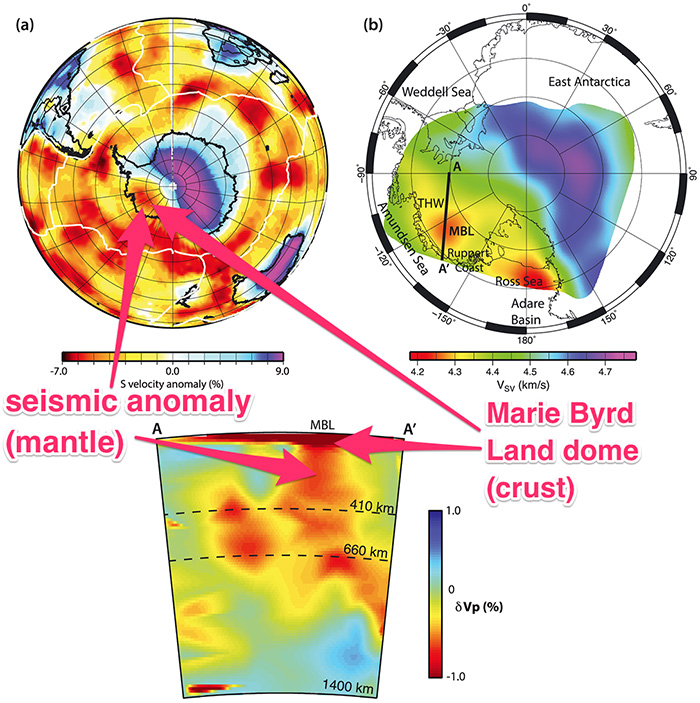
Measurements suggest a hot plume of mantle rock below West Antarctica.
(Helene Seroussi et al./JGR Solid Earth; Business Insider)
Researchers plugged in all of the known physics about the mantle, Antarctica, and its ice sheets - including their changing altitude, movement, friction caused by that movement, melting rates, and more - and produced dozens of simulations, according to NASA JPL.
Those simulations showed that heat spilling from a hot mantle plume could be up to three times greater than it is for a normal, non-volcanic chunk of mantle below the US. And compared to mantle below Yellowstone, the heat output could be 75 percent that of the volcanically active region.
When the researchers compared that heat output to basal (or bottom) melt rates in Antarctica, no places matched - except for West Antarctica. At that location, a crack or rift in the crust may be allowing heat to rapidly escape upward, the researchers wrote in their study.
"Without a plume-like heating source," they said, "our simulations show that intrinsic heating and crustal sources do not provide enough energy to generate significant amounts of basal meltwater."
This article was originally published by Business Insider
Aliens Already Live On Planet EarthALIENS ALREADY LIVE ON PLANET EARTH...
Most of these “slugs” are actually snails that have lost their shells and gained new characteristics through evolution. For example, sacoglossans are sometimes called “solar-powered sea slugs” because they use chloroplasts from the algae they eat in their own tissue.
Sea Sheep (Costasiella Kuroshimae)
Blue Angel (Glaucus Atlanticus) Blue Angel (Glaucus Atlanticus)
Sea Bunny (Acanthodoris Pilosa)
Lettuce Sea Slug (Elysia Crispata)
PROOF OF TIME TRAVEL? BIZARRE CLAIMS NUCLEAR BOMB WAS DETONATED IN INDIA 12,000 YEARS AGO
PROOF OF TIME TRAVEL? BIZARRE CLAIMS NUCLEAR BOMB WAS DETONATED IN INDIA 12,000 YEARS AGO
Videos uploaded by conspiracy theory and UFO websites suggest there is evidence of the ancient blast happening in a desert region near Jodhpur.
Website ufosightingsdaily.com was the latest to link to one of the videos today.
The “evidence” is alleged to be based on “writings” in ancient texts and an area where high levels of radiation were allegedly detected.
Conspiracy theory website Disclose.tv said: “Hindu texts dating from thousands of years ago seem to suggest that some kind of highly advanced weapon resembling an atomic bomb was set off on the Earth some twelve thousand of years ago.”
The theory is based on alleged passages from the Mahabharata and the Ramayana, Sanskrit epics said to be written in around the 8th or 9th century BC, about the Kurukshetra War and battle between Rama and the demon Ravana respectively.
Disclose.tv added: “Could an atomic bomb have gone off on Earth 12,000 years ago? Some of the passages from the Mahabharata suggest a nuclear conflict.”
The website points to these allegedly translated extracts from the texts: “A single projectile charged with all the power in the Universe…An incandescent column of smoke and flame as bright as 10,000 suns, rose in all its splendor…it was an unknown weapon, an iron thunderbolt, a gigantic messenger of death which reduced to ashes an entire race.
“The corpses were so burned as to be unrecognisable. Their hair and nails fell out, pottery broke without any apparent cause, and the birds turned white.
“After a few hours, all foodstuffs were infected. To escape from this fire, the soldiers threw themselves into the river.”
The theory suggests the discovery of an area of high radiation in the 1990s and several corpses found in an ancient city back up the texts.
The claims are that on the eastern edge of the great Thar desert, near the ancient city of Jodhpur, in the 1990s, an area “where radioactivity is so great that residents have long had high rates of cancer and birth defects.”
It suggests that nearby several skeletons were unearthered in an ancient city whiuch appeared to have perished together in the streets.
In some reports alleged Indian historian, Kisari Mohan Ganguli, said: “Indian sacred writings are full of such descriptions, which sound like an atomic blast as experienced in Hiroshima and Nagasaki.”
The theory claims there is evidence of a nuclear blast crater – the Lonar Crater near Mumbai, which cannot be explained.
Conspiracy theorists have claimed time travellers or aliens could be explanations for how advanced technology developed in the 20th century was available 12,000 years ago.
Disclose.tv said: “How the ancient Indian powers at the time developed nuclear weapons is a mystery although of course no records exist showing anything like the levels of technology needed to develop these kinds of weapons.”
But, despite appearing on many conspiracy theory and UFO websites, the story has been exposed as “fake news”.
Debunking website skeptoid.com investigated the claims.
It found no evidence of the reported passages in translated versions of the texts.
It also found no evidence outside of conspiracy forums to suggest the area of high radiation had been discovered in the desert.
The images of the ancient city and skeletons used with the reports were found to have actually been taken at the ancient cities of Mohenjo-Daro and Harappa, which are around 300 miles away from the alleged site.
Skeptoid.com said: ” If this was a nuclear war, it was practically a nationwide theatre.
“Mohenjo-Daro and Harappa are both about 500 km from Jodhpur, one to the north and one to the west. None of these places are anywhere near each other.
“Sadly for the legend, there is nothing remotely like this story in any archaeological publications.
“Archaeological information about the excavations of Mohenjo-Daro, Harappa, and other Indus Valley sites is widely available online and in print, and there is simply no such thing as radioactive skeletons or skeletons in large numbers or holding hands or sprawled in any way.”
Skeptoid.com said the Lonar Crater was 470 miles from the alleged site and had been dated back to being formed 52,000 years ago, long before the alleged ancient bomb blast.
NASA’s $1 Billion Jupiter Probe Just Sent Back Stunning New Photos Of Jupiter
Traveling above Jupiter at more than 130,000 miles per hour, NASA’s $1 billion Juno probe took its ninth set of stunning flyby images on October 24. But the sun slipped between the giant planet and Earth for more than a week, blocking the spacecraft from beaming home its precious bounty of data.
Now that the conjunction is over, however, new raw image data from Juno’s ninth perijove — as the spacecraft’s high-speed flybys are called — has poured in. Researchers posted it all online on Tuesday, and a community of amateurs and professionals has been busily processing the data to yield colorful and stunning new pictures of Jupiter.
“Brand new Jupiter pics from @NASAJuno Perijove 09! What a blimmin’ gorgeous/diabolical planet,” Seán Doran, a UK-based graphic artist who regularly processes NASA images, tweeted on Tuesday.
Below are some fresh, close-up images of Jupiter, along with other unbelievable views captured from earlier perijoves.
In the most recent flyby, as with the previous eight, Juno’s flyby started over Jupiter’s north pole.

The spacecraft then swept within a few thousand miles of the gas giant, capturing stunning high-resolution views of its cloud tops.
At its closest approach to Jupiter during each flyby, the robot briefly becomes the fastest human-made object in the solar system, reaching speeds of around 130,000 miles per hour.
Then Juno flew back out into deep space, passing over Jupiter’s South Pole on its exit. Churning storms at the poles constantly change their appearance.

Researchers upload the raw data sent by the probe to the mission’s website.
There, enthusiasts take the drab, mostly gray image data and process it all into true-to-life color photos.

Many snapshots of Jupiter take on an artistic quality.
Others dazzle with their detail of the planet’s thick cloud bands and powerful storms. Jupiter is made up predominantly of hydrogen. The simple, basic gas, a prime ingredient on the sun, accounts for 90 percent of the atmosphere. Nearly 10 percent is composed of helium.

The planet’s atmosphere is a turbulent mess of hydrogen and helium gases. The atmosphere of Jupiter is the largest planetary atmosphere in the Solar System. It is mostly made of molecular hydrogen and helium in roughly solar proportions; other chemical compounds are present only in small amounts and include methane, ammonia, hydrogen sulfide and water.Some of the tempests are large enough to swallow planet Earth — or at least a good chunk of it.

There are also traces of molecules like ammonia, methane, sulfur, and water, which give the clouds different colors and properties.
The mixture sometimes creates features that look like faces (as seen on the left in this image).

Other times, shining-white clouds fill up most of a band. With an average temperature of minus 234 degrees Fahrenheit (minus 145 degrees Celsius), Jupiter is frigid even in its warmest weather. Unlike Earth, whose temperature varies as one moves closer to or farther from the equator, Jupiter’s temperature depends more on height above the surface.
Many cloud bands have features called chevrons. These atmospheric disturbances blow at several hundreds of miles per hour and sometimes zig-zag through a band, or punch through into others.

In this older view of Jupiter, from Juno’s eighth perijove, two cloud bands battle for dominance — one of which contains a swirling storm many times larger than a hurricane on Earth.
The spacecraft will continue to document Jupiter for as long as NASA can keep it going. But not forever.
Tourist is shocked to see a 'doughnut-shaped UFO' floating above a lake in a picture he took in China
A Taiwanese businessman claimed he had caught a doughnut-shaped UFO on camera in south-west China.
Salesman John Chen said he took some picturesque shots of the famous Lake Dian after attending a trade show in Yunnan Province on November 1.
Later on, the 44-year-old and his sister-in-law were shocked to spot a mysterious ring-shaped object in sky when they were looking at one picture at home in Taipei.

Mr Chen, above, sends the pictures to Philip Mantle, a leading UFO expert, for analysis as the flying object has a ridged shape that looks like a doughnut (under).
The object in question has ridged sides and a hole in the middle, and is similar to the shape of a doughnut.
Mr Chen decided to find a UFO expert in a bid to find out what it could be.
Philip Mantle, who is said to be a leading British UFO researcher, told Mr Chen that he could not explain what the flying 'doughnut' was. Mr Mantle called the incident an 'open verdict'.
However, Mr Chen said: 'It just has to be a UFO. It's a strange doughnut shape in the sky.
'The strange thing is I didn't see it at the time. It was my wife's sister who spotted them. She said there was something in the pictures and I just thought she was joking.'


Businessman John Chen took a few pictures of Lake Dian in China the day he attended a trade show (above). Only when he returned to Taiwan, he was told that there was a UFO in it (under)

Other pictures of Lake Dian, however, did not show the strange looking object in the sky
Mr Chen then checked with his colleagues. They shared the photos that they had taken on the day, but his colleagues did not capture any strange object in the sky.
Upon receiving photos sent by Mr Chen, British UFO expert Philip Mantle doubted for the legitimacy of the images.
'What I can say is that the photographer in question here has always cooperated and seems to be genuinely puzzled by the images on his photos.
He did not see the alleged UFO at the time of taking the photos. Instead it was a relative that noticed them when he posted them on social media.'
Mantel concluded that there was no proof that the pictures were a hoax but the object could also be 'some air born debris that has been caught by the camera;
'More study needs to be done on these photos before any definite conclusion can be reached, so in the meantime it remains an open verdict,' he added.
NASA DISCOVERS GIANT MANTLE PLUME THAT’S MELTING ANTARCTICA FROM BELOW
NASA DISCOVERS GIANT MANTLE PLUME THAT’S MELTING ANTARCTICA FROM BELOW
Antarctica has been in the news a lot recently, with gloomy tales of the astonishing icy continent melting and collapsing because of the effects of climate change.
Map of antarctic ice flow speeds. (NASA's Goddard Space Flight Center Scientific Visualisation Studio)
SUPER VOLCANO DISCOVERED UNDERNEATH ANTARCTICA
However, according to scientists in one particular area of the continent something else is at work too. Researchers working for NASA have discovered that there is a massive super-volcano underneath Marie Byrd Land in West Antarctica which is generating almost as much heat as the infamous Yellowstone supervolcano and effectively melting the ice from underneath the Earth.
RELATED ARTICLES
The research team have uncovered an enormous amount of hot rock underneath Marie Byrd Land which lies between the gigantic Ross Ice Shelf and the Ross Sea. According to the team, the heat surrounding this area is creating huge lakes and rivers underneath the ice sheet. This heat, they claim, is being generated by a mantle plume. Mantle plumes are part of the anatomy of a super volcano which bring hot material from the interior to the Earth to the surface. The region directly surrounding these mantle plumes is known as a hot spot and can cause a great deal of geographical instability. According to the team, it is likely that the mantle plume is responsible for the ever changing landscape in this particular region on Antarctica and is probably responsible for its rapid collapse towards the end of the last major Ice Age eleven thousand years ago.
The existence of a blazingly hot mantle plume existing under Marie Byrd land is something which scientists have speculated about for around thirty years because of the unique conditions in this particular area of Antarctica and the domed feature of the landscape there. However, until now there has been no solid evidence to support this idea.
This has all changed because of the work at NASA’s Jet Propulsion Laboratory who commenced the project because they were interested to know what was causing the instability in the region. According to the leader of the project Hélène Seroussi, the team were actually initially sceptical about the idea that a mantle plume could be causing the unique conditions. She said that she found the idea ‘crazy’. “I didn’t see how we could have that amount of heat and still have ice on top of it, ” she said.

However, the team created a huge number of advanced numerical models to calculate how much heat would need to be generated underneath the thick ice sheet to account for geological anomalies such as the domed appearance of the landscape and the lakes and rivers in the bedrock and eventually they came to the conclusion that there simply had to be a mantle plume in this area.
Once they had come to the conclusion that it was likely that they were dealing with a mantle plume, the team dispatched to Yellowstone to analyse the geothermal heat created by the super volcano and found that it was comparable to the amount of heat being generated in Marie Byrd Land. At Yellowstone, around 200 milliwatts is generated per square meter every hour by the heat of the volcano. In Marie Byrd land approximately 150 milliwatts is generated in the same space of time. The scientists note that if the supervolcano underneath Antarctica was any hotter then it would certainly melt the ice in the surrounding area.
The team believes that the mantle plume is coming from a rift in the Earth’s crust and that it is likely that this particular rift and mantle plume formed between fifty and a hundred and ten million years ago, prior to the region being covered with ice.
According to the research team, these investigations could prove to be acutely important in the future. As scientists endeavour to understand the nature of the landscape of Antarctica and attempt to
make predictions about how it will evolve and change in the future this kind of information is absolutely essential.
RELATED ARTICLES
Has Britain's most baffling alien abduction UFO case involving police man been solved?
Mr Godfrey said he saw "a metallic disc with a dome and a row of windows at the top."
However, he also insists that moments later, as he tried to sketch it, there was a burst of light, and he then found himself driving 100 yards farther up the road, with the UFO now gone.
However, Mr Callaghan discovered that since 1971 there had been a UFO inspired Futura home in Todmorden, and it was still there in 1980.
The plastic-built home resembled a UFO, with several large oval windows around it on the top half.
What's more, the building was mobile, and was transported around the town on the back of a truck.
Waterside Plastics
The Todmorden futuro home in the Watersides Plastics brochure dated 1969.


Mr Callaghan argued that, as it would have been dark at the time of the sighting, it could have been the futura home being moved on a truck that he saw, and mistook for an alien craft.
Mr Callaghan said: "Alan is a great guy, and I know he believes what he says he saw.
"I'm not saying Alan made this up."
However, he said it was a plausible theory that further up the road the futura building was being carried on a lorry, making it appear to be above the road.

Waterside Plastics
A sketch of the UFO Alan Godfrey saw, which Russ Callaghan says resembles the futuro home.
He said: "That is how they moved the building. Does it or does it not look like a flying saucer?
"The futura buildings were small liveable houses, but the documentary makers (about Alan Godfrey's abduction) never remember to mention it was there at the time.
"But it was there and we have got a photo of it, and we have not got a photo of what Alan saw in Burnley Road."
Futurohouse.com is a website dedicated to the quirky futuristic homes, which features a section on the one at Todmorden, which confirms it was moved on a lorry.
Malcolm Stroud said of it: "The house was made by Waterside Plastics in its Waterside Mill, Rochdale Road, Todmorden.

YouTube•WATERSIDE PLASTICS
CASE CLOSED? Did Alan Godfrey see and sketch a futura home (inset)?


That is how they moved the building. Does it or does it not look like a flying saucer?
"The Futuro house was a one off and I understand they only made one. It was exhibited in Todmorden in 1971 for the town's centenary.
"The company went out of business in 1990.
"The house was exhibited outside the Abraham Omerod medical centre (now closed), in the town, near the railway viaduct.
"I have also been told that it functioned as offices for Waterside Plastics for some years."
He said there was a photo of it "peeping out" between Victorian mill buildings when it was being moved on a lorry.
Mr Callaghan also considered if Mr Godfrey just saw a bus with its lights on and got confused in the early-morning darkness.
This was because busses ran along that route at the time, and Mr Godfrey had initially said "I thought I were looking at a bus."
He also considered if it was a council road sweeping vehicle with flashing lights, also mistaken by Mr Godfrey for a UFO, before resting on the futura house theory.
Mr Callaghan was quizzed by other ufologists about what could account for Mr Godfrey's burst of light, missing time, and abduction claims.

Jon Austin
CASE CLOSED: Russ Callaghan delivering his theory at a UFO conference in Hull.


He pointed out that Mr Godfrey's vivid descriptions of what went on inside the craft had only come out after he was regressed by Jenny Randles, a prominent UFO and alien abduction investigator.
He said: "There was no mention of these prior to hypnosis.
"Under hypnosis, he came out with seeing alien beings with light bulb heads, and a black entity.
"But, before in a book, he also tells you he can't say if what he said under hypnosis was real or if he made it up because he has no recollection of these things prior to hypnosis."

BBC
Alan Godfrey interviewed by Frank Bough on BBC Breakfast at height of the media storm.
However, some believe the mystery remains as there were two independent sightings of something strange that morning.
A driver who was on Burnley Road, three miles further out at Cliviger, told of seeing a brilliant white object at the time of Mr Godfrey's sighting, and even contacted Todmorden police.
On top of this, a police patrol from nearby Halifax, searching for stolen motorbikes on Calder Valley moors saw a brilliant blue-white glow descending into the valley towards Todmorden shortly before Mr Godfrey experienced his close encounter.
Mr Godfrey insists what he saw was a flying saucer, and he has recently told all in the new book Who or What Were They?, in which he claims he was hounded from the force over the case.
Dino’s echte pechvogels: uitgestorven omdat meteoriet net dáár op aarde neerstortte - HLN.be
Joeri Vlemings
Bron: The Guardian
Detlev van RavenswaayArtistieke weergaven van de Chicxulubkrater.
De prehistorische beesten zouden 65-66 miljoen jaar geleden mogelijk niet uitgestorven zijn, was de meteoriet van, naar schatting, negen km diameter ingeslagen op zowat eender welke andere plaats op onze planeet. Op 87 procent van de aardoppervlakte zou de inslag misschien niet de massale uitroeiing van dino’s tot gevolg hebben gehad, volgens Kunio Kaiho en Naga Oshima van de Tohoku Universiteit in Japan.
Het kolossale stenen gevaarte stortte te pletter op het Mexicaanse schiereiland Yucatán, dat dus - helaas voor de dino’s - tot de dertien andere procent van de aarde behoorde. Een enorme klap moet het geweest zijn: de inslagkrater bij Chicxulub was maar liefst 180 km breed en 20 km diep. De concentratie van koolwaterstoffen in de rotsen was er zo hoog dat de in de lucht vrijgekomen roet- en sulfaatdeeltjes wereldwijd afkoeling en droogte veroorzaakten. Er kwamen tsunami’s en aardbevingen van, over heel de planeet. De zon werd verduisterd door het stof, de temperatuur op aarde zakte met tien graden Celsius. Niet alleen de dino’s - die volgens sommige paleontologen al langer in verval waren - kenden zo een abrupt einde: 75 procent van alle zee- en landdieren stierf uit.
 AFPArtistieke impressie van de Sinosauropteryx, een kleine, gevederde dinosaurus.
De onderzoekers zochten uit hoeveel roet en sulfaat een virtuele meteorietinslag de stratosfeer zou inblazen naargelang de hoeveelheid koolwaterstof en sulfaat in de grond. Dan berekenden ze vanaf wanneer de afkoeling van onze planeet zo groot zou zijn dat ze een massavernietiging kan veroorzaken. Volgens Kaiho en Oshima bereikt een meteorietinslag dat punt als er tussen de 230 miljoen en 2.300 miljoen ton roet in de bovenste atmosfeer geblazen wordt. En dat scenario blijkt slechts mogelijk voor dertien procent van de aardoppervlakte.
Uit een internationaal onderzoek in 2014 bleek dat de dinosaurussen mogelijk hadden kunnen overleven. Namelijk als de gigantische steen op een “geschikter tijdstip” was ingeslagen, wanneer de dinosoorten gevarieerder en dus meer bestand zouden geweest zijn.
 EPAEen dinomodel in het Sudwala Caves Dinosaur park bij Machadodorp in Zuid-Afrika.
En nu argumenteren wetenschappers bovendien dat niet alleen het tijdstip van cruciaal belang kan geweest zijn, maar ook de plaats van de inslag. Volgens paleontoloog Kaiho zou er “geen afkoeling, of een lichtere afkoeling, geweest zijn” als de meteoriet was neergestort op rotsen met minder organisch materiaal. Hij vat het lot van de dino’s daarom zo samen: “Ze hadden pech”. Voor de mens betekende het dan weer wel dat zoogdieren door de ondergang van de dinosaurussen betere ontwikkelingskansen kregen.
Wetenschappers krabben zich in de haren: de ster die weigert te sterven - HLN.be
Bron: ANP
ThinkstockIllustratiebeeld.
Een Amerikaanse telescoop zag in september 2014 een ontploffing aan de sterrenhemel. De explosie leek aanvankelijk normaal en het licht vervaagde langzaam. Maar waar normale supernova’s na ongeveer honderd dagen doven, bleef deze ster ongeveer twee jaar lang schijnen. Af en toe dimde het licht iets of werd het helderder. Ook nu is de supernova nog helder.
Toen de wetenschappers in de archieven doken, ontdekten ze dat er al eerder een ontploffing was geweest op precies dezelfde plek in het heelal, in 1954. Met andere woorden: de ster is toen geëxplodeerd, bleef een halve eeuw leven, ontplofte toen weer en is nog altijd niet dood. De onderzoekers begrijpen niet precies hoe het kan dat de ster zich niet houdt aan de natuurwetten. Mogelijk gaat het om een onbekend type ster. De supernova staat beschreven in het wetenschapsblad Nature.
Uber en NASA werken samen aan vliegende auto’s - HLN.be
Bron: ANP
Uber heeft de samenwerking vandaag aangekondigd. Het bedrijf is van plan de vliegende taxi’s in 2020 uit te testen in Dallas en Dubai en voegde daar nu een derde stad aan toe: Los Angeles. De stad, waar in 2028 de Olympische Spelen worden gehouden, heeft constant last van verkeersopstoppingen.
Uber had de vliegende auto’s vorig jaar ronkend gepresenteerd. Het is de bedoeling dat elektrische, zelfrijdende wagens verticaal opstijgen van een plat dak en naar een ander dak vliegen, waar ze verticaal op moeten landen.
Wetenschappers vinden bos van 260 miljoen jaar oud op Zuidpool - HLN.be
Bron: ANP
AFP
De aarde bestond 260 miljoen jaar geleden uit twee werelddelen: Gondwana in het zuiden en Laurazië in het noorden. Antarctica maakte deel uit van Gondwana, met onder meer Zuid-Amerika, Afrika, India en Australië, en was veel warmer en vochtiger dan nu. Het gebied was waarschijnlijk bedekt met mossen, varens en planten, waar vooral kleine dieren leefden.
Ondanks de temperaturen moesten de bomen extreme omstandigheden overleven. In de zomer ging de zon niet onder en was het ook midden in de nacht licht. In de winter bleef het juist donker. Uit de fossielen concluderen de wetenschappers dat de bomen snel omschakelden van zomer naar winter. Hun ‘herfst’ duurde hooguit een maand.
De universiteit van Wisconsin heeft de bevindingen nu naar buiten gebracht. Wetenschappers van de instelling hebben tussen november en januari onderzoek gedaan op de bevroren hellingen van het zogeheten McIntyre-voorgebergte, diep in de binnenlanden van de Zuidpool. Toen was het daar ‘zomer’, hoewel ook dan de temperatuur tientallen graden onder nul blijft. Komende maanden gaan ze weer, op zoek naar nieuwe sporen.
Ongeveer 250 miljoen jaar geleden, dus zo’n 10 miljoen jaar nadat de gevonden bomen leefden, stierven vrijwel alle vroege dieren- en plantensoorten uit. Dat kwam waarschijnlijk door vulkaanuitbarstingen in Siberië. Die vulden de dampkring met giftige gassen. In de lege wereld die achterbleef kwamen langzaam de voorlopers van de dino’s op.
300.000 jaar oude schedels zetten menselijke geschiedenis op zijn kop. Deze archeologen doen verrassende vondst
Wanneer ontstond de moderne mens? Antropologen worstelen al decennia met deze vraag. Ze denken dat de mensheid zo’n 200.000 jaar geleden in de sub-Sahara is ontstaan.
Maar nieuw bewijs waarover in het tijdschrift Nature wordt gesproken, staat haaks op die hypothese. Onderzoekers hebben onlangs resten gevonden die suggereren dat de eerste Homo sapiens meer dan 100.000 jaar eerder is verschenen op een onverwachte plek.
Het gaat mogelijk om de oudste fossielen van Homo sapiens ooit gevonden. Ze zijn bewijs dat de mens al buiten de sub-Sahara leefde.
In 1961 stuitten mijnwerkers ten westen van Marrakesh op een menselijke schedel. Al snel werden ook andere resten ontdekt.
Zo’n 40 jaar later besloten Jean-Jacques Hublin en zijn collega’s van het Max Planck Instituut dieper te graven. Ze vonden resten van tenminste vijf individuen.
De botten zijn inmiddels gedateerd op 300.000 tot 350.000 jaar oud. “Dat kwam voor ons als een grote verrassing,” zei Hublin.
Hij had verwacht schedels aan te treffen van menselijke voorouders zoals Homo erectus of Homo heidelbergensis, maar de schedels die hij vond vertoonden opvallend veel gelijkenissen met die van de moderne mens.
“Het gezicht van deze mensen is er één dat precies lijkt op de moderne variant,” zei Hublin.
“Ze hadden een schedel die wat langwerpiger was dan de onze, maar vandaag de dag zou je ze denk ik niet uit een menigte kunnen pikken,” vervolgde hij.
De vondst druist in tegen de gangbare opvatting dat onze soort ergens diep in de sub-Sahara is ontstaan, de zogeheten Hof van Eden, en zich vervolgens naar andere delen van de wereld heeft verspreid.
“Er is geen Hof van Eden in Afrika,” zei Hublin. “Als er al zo’n Hof is, bestaat dat uit heel Afrika.”
Professor Sonia Zakrzewski van de Universiteit van Southampton wees erop dat de ontdekking ertoe kan leiden dat archeologen anders gaan denken over de menselijke oorsprong.
“Dit betekent zeker dat we onze modellen moeten herzien,” zei ze.
Foto: Jean-Jacques Hublin, MPI-EVA
[Independent]300,000-year-old skulls that look shockingly like ours could rewrite the human origin story
Erin Brodwin, Business Insider
Precisely when and where did our species emerge? Anthropologists have struggled with that question for decades, and scattered clues had suggested the answer lay somewhere in sub-Saharan Africa about 200,000 years ago.
But new evidence outlined in two papers published in the journal Nature challenges that hypothesis. Instead, the authors describe recently discovered remains that suggest the first Homo sapiens showed up more than 100,000 years earlier than we thought in a place many experts didn't suspect.
The fossils could represent the earliest known examples of H. sapiens ever found (if confirmed by further research), and they serve as evidence that members of our species lived beyond sub-Saharan Africa.
In 1961, a crew of miners was plowing into a dense wall of limestone in a hilly region west of Marrakesh when they struck a soft patch. The hardened beige surface gave way to a mound of cinnamon-colored dirt. Peeking out of the earth was a sliver of human skull.
A bit more digging revealed a nearly-complete skull, which the miners turned over to their field doctor. As word about the discovery spread, researchers flocked to the area. They uncovered more remains, including several pieces of jaw bone and a fragment of an arm. At the time, scientists pegged the fossils as roughly 40,000 years old, a few thousand years before our extinct European relatives, the Neanderthals, were thought to have vanished.
But they hadn't dug deep enough.

Roughly 40 years later, anthropologist Jean-Jacques Hublin and his team from the Max Planck Institute excavated the half-dozen layers of soil beneath the land where the skull and arm bones had been discovered. There, the team found remains that they say belong to at least five individuals, along with a set of flint blades which had likely been burned, perhaps by nearby cooking fires.
Using a dating technique that measures how much radiation had built up in the flint since it was heated, Hublin and his team say the ancient bones belong to people who lived roughly 300,000-350,000 years ago.
"These dates were a big wow," Hublin said on a recent call with reporters.
Still, the biggest discovery didn't come until the team looked more closely at the skulls.
When Hublin peered into the cavernous eye sockets of one of the skulls, he was astonished.
Instead of the robust features he was accustomed to seeing on the faces of an ancient human ancestor like Homo erectus or Homo heidelbergensis, this face bore a striking resemblance to his own. Where an erectus skull had a single, protruding brow ridge, these individuals had smaller, separated ones. Rather than a large face and a flattened skull, these people had small faces and rounder skulls.
"The face of these people is really a face that falls right in the middle of the modern variation," said Hublin. "They had a skull that is more elongated than most of us, but I'm not sure these people would stand out from a crowd today."
Their braincase (shown below in blue) also seemed to fall somewhere between what one might expect in an ancient human ancestor and a modern human, albeit slightly more similar to those of our archaic ancestors.

This unique combination of advanced and archaic features suggests something profound, Hublin said -- he's convinced the Moroccan specimens "represent the very root of our species."
In other words, all of the Homo sapiens ever found -- including those uncovered far beyond Africa -- may trace their ancestral linkages to the land that is today's Morocco.
That suggestion contradicts the prevailing anthropological logic that our species evolved somewhere deep in sub-Saharan Africa, in what some researchers have referred to as a "Garden of Eden," then gradually moved out to other parts of the world. Instead, Hublin and his team argue that Homo sapiens could have been living in terrain across Africa.
According to Sonia Zakrzewski, an associate professor of archaeology at the University of Southampton, Hublin's discovery could encourage other archaeologists to change the way they think about human origins. "It really sets the world alight in terms of the possibilities for understanding the evolution of Homo sapiens," she said. "It certainly means that we need to rethink our models."
Read the original article on Business Insider UK. © 2017. Follow Business Insider UK on Twitter.
More about:
Alien Evidence – The Mysterious UFO Landing At Socorro, New Mexico

 Did The American Pilot Die After Seeing A Flying Cone In The Sky?

The mysterious crash in 1970 involved the disappearance of Captain William Schaffner, 28, an American pilot.
The incident took place nearly 50 years ago but created a conspiracy theory that persists until today.
The official conclusion of the unforgettable event regarding the American fighter jet that went down off Britain’s coast was that a tragic accident caused the plane piloted by U.S. Air Force pilot Captain William Schaffner to go down.
However, apparent sightings of flying transparent spheres and mysterious blips on the radar fueled intrigue, mystery, and speculation that UFOs downed the fighter jet XS894.
Adding to the enigma, the body of the pilot was missing after the aircraft was found on the seabed with its canopy closed weeks later.
Captain Schaffner was declared dead, but his body has never been found.
According to RAF Binbrook, Lincolnshire, during the Cold War, the pilot took off on the night of September 8, 1970, into the skies over Grimsby. The 28-year-old pilot then headed out over the North Sea on the way to Flamborough.
But shortly after 10:30 pm, the aircraft ditched into the sea, five miles south of Flamborough Head. Local newspapers covered the air and sea search and rescue operation.
It was revealed on October 7, 1970, that the plane was discovered by Royal Navy divers onboard the HMS Kedleston that sailed to Flamborough but they returned empty-handed as they still did not provide answers.
The plane stayed on the seabed, but the pilot’s body was still missing.
It was only in December that year the submerged plane was brought to the surface. To everyone’s surprise, the cockpit was empty, and the canopy over the cockpit was closed. Immediately rumors started to circulate.
In October 1992, a series of articles written by Pat Otter and published by Grimsby Telegraph brought life to the story with the incident being described as The Riddle of Foxtrot 94.
The writer claimed that there was evidence that out of this world was the cause of the downing and disappearance of the pilot.
Mr. Otter cited unnamed military sources who claimed they had observed UFOs across Grimsby, Flamborough and beyond.
Captain Schaffner was on Quick Reaction Alert duty during this period. He was dispatched to see what was the blips on the radar.
One newspaper report said that the pilot reported spotting a flying cone and a transparent sphere flying around his aircraft, causing malfunctions to his equipment.
In July 1994, the Grimsby Telegraph reported that the cat and mouse chase between Schaffner and the unidentified craft resulted in the death of the captain.
A team at RAF Binbrook said that it was their job to investigate the crash, but they were stalled, and their instruments had disappeared.
Until today, the case remained a mystery despite many things had happened since that day.
Watch Alleged U.S. Navy Footage Seemingly Shows A UFO That Defies Physics
An unidentified flying object that defied physics is claimed to be in a leaked U.S. Navy video footage, which has emerged after a former Area 51 insider shared about the encounter.
Several F-18 pilots are said to have outmaneuvered by extraordinary UFO during the terrifying encounter. Former U.S. national security chief Chris Mellon, who claimed to have spent time at Area 51 military base, said that U.S. Navy personnel aboard the USS Nimitz recorded the UFO on video during the seven-hour encounter.
Mr. Mellon claimed that he served for nearly 20 years in the U.S. federal government in several national security roles under the administrations of Bill Clinton and George W. Bush.
The former national security chief was reportedly on a committee with oversight of all special access programs in Department of Defense. He also said to have spent ten years on the Senate Intelligence Committee.
Mr. Mellon is one of the ex-senior government insiders who has gone forward after joining former Blink 182 frontman Tom DeLonge’s alien truth-seeking organization To The Stars Academy.
Mr. Mellon, who also had accessed on classified projects at the highly-secretive military facility in Nevada, detailed the bizarre incident that said to take place off the San Diego coast in broad daylight.
Now, a video has surfaced, claiming to be the footage recorded in 2004. It has been released anonymously and recently doing the rounds on social media.
The clip shows a mysterious object hovering in the skies.
It seems to show one of the F-18’s crosshairs lining the UFO up, but the bizarre thing speeds out of sight.
Many UFO experts believe that the craft disappeared with supersonic speed.
UFOlogist Tyler said that it looks like legit F-18 footage, which has been corroborated by men that were in the incident.
UFOs over Oklahoma caught on video with cell phone
Three videos were submitted with a UFO report submitted to the Mutual UFO Network (MUFON) on November 9, 2017. The report came from Moore, Oklahoma, and the alleged sighting occurred the same day.
The witness claims to have seen the objects at around 5:15 pm while picking up a child after school. The videos were captured by cell phone. The objects were described as square and dark, and tumbling as they rise higher into the sky. The report was titled, “Two objects floating in the air.”
The witness reported, verbatim:
I was picking my son up from after care at his School in Moore Oklahoma around 5:15pm or so. We came outside and saw two dark objects rising in the air. They were tumbling as the floated up in the air. They kept going up. The look square and dark. I took some videi (sic) with my cell phone.
The objects appear to be silently rising into the air and tumbling as they gain altitude. They do also appear to be square shaped. Although balloons are typically round, party balloons can come in all shapes and sizes. Could these be balloons that have gotten loose?
Still image of the objects seen in Oklahoma.
(Credit: MUFON)
The vast majority of UFO sightings turn out to be mundane objects, but once in awhile there are sightings that are much more difficult to explain. MUFON conducts investigations on sightings submitted to their website, and if they share their conclusions, we will let you all know. Meanwhile, others will likely chime in and we will try to keep you up to date with any discoveries. Please feel free to share your thoughts on this sighting in the comments below.
Is this the original video of the 1942 ‘Battle of Los Angeles UFO Sighting’?
Is this the original video of the 1942 ‘Battle of Los Angeles UFO Sighting’?
The Battle of Los Angeles, also known as The Great Los Angeles Air Raid, is the name given by contemporary sources to an incident in Los Angeles, California, in which, after city-wide alarms went off due to an alleged enemy attack, the US antiaircraft defenses touched off a massive barrage of anti-aircraft fire, with some 1400 shells shot into the skies over Los Angeles during the frantic evening.
The incident occurred less than three months after the United States joined the Second World War as a result of the attack on Pearl Harbor by the Imperial Japanese Navy, and a day after the Ellwood Bombing on February 23.
Initially, it was thought that the barrage of anti-aircraft fire was in response to an attack from the Japanese air force, but speaking at a press conference shortly afterward, US Navy Secretary Frank Knox described the incident as a “false alarm”.
The newspapers of the time published a series of reports and speculated about cover-ups.
Some ufologists have had even claimed that a massive barrage of anti-aircraft fire did not target Japanese bombers, but alien spaceships.
But, as it seems that all ‘good UFO sightings’ are nothing more than weather balloons, in 1983, the United States Air Force History Office attributed the event to a case of “nerves of war” likely triggered by a lost weather balloon and exacerbated by stray flares and shell bursts from adjoining batteries.
Representative Leland Ford of Santa Monica called for a Congressional investigation, saying, “…none of the explanations so far offered removed the episode from the category of ‘complete mystification’ … this was either a practice raid, or a raid to throw a scare into 2,000,000 people, or a mistaken identity raid, or a raid to lay a political foundation to take away Southern California’s war industries.”
However, based mainly on an image, published in the Los Angeles Times on February 26, 1942, Ufologists around the globe believe that the US military did not shoot at a weather balloon or Japenese bombers on the late hours of 24 February to early 25 February, but a real saucer-shaped UFO.
Ufologists assert that the photo clearly shows searchlights focused on an alien spaceship.
Nieuwe film over man met vreemd voorwerp in been. Is dit een buitenaards implantaat?
De film volgt een man, Patient Seventeen, die een onbekend implantaat in zijn been heeft. Het implantaat wordt verwijderd en geanalyseerd.
De man gaat op bezoek bij dr. Roger Leir, een arts die claimde al bij meerdere mensen buitenaardse implantaten te hebben verwijderd.
Dr. Leir ontdekte naar eigen zeggen dat deze objecten een bepaalde frequentie uitzenden en bestaan uit vreemde legeringen en vreemde isotopen.
Wijlen Harvard-psycholoog John Mack schreef hier vele boeken over, bestudeerde honderden cases en werd bijna ontslagen omdat hij zei dat buitenaardse ontvoeringen geen fictie of een mentale aandoening zijn.
“Deze gebeurtenissen zijn fysiek, echt en vinden daadwerkelijk plaats,” aldus Mack.
Het object dat in het been van Patient Seventeen zat, bleek te bestaan uit 36 verschillende elementen. Ze wijzen op een niet-aardse oorsprong.
In onderstaande video bespreekt een natuurkundige de verrassende resultaten van zijn analyse:
“Het komt niet van hier,” aldus de natuurkundige. “Dit monster kwam niet uit ons zonnestelsel. Deze isotopen komen niet van nature voor op aarde.”
Bekijk hieronder de trailer van de film:
Of kijk hier voor meer informatie.
[Extraordinary Beliefs] Sweet dreams! Adorable moment baby bursts into fits of...
 Doctors are shocked to see elderly man's lung 'disappear'...
 Shocking moment man fly-kicks a saleswoman before dragging...
 Furious parents beat up cruel nursery teacher who was caught...
 Fukushima's Radioactive Plume to Reach U.S. Soon
 Melting Antarctica Ice Reveals UFO Underwater Base
 Antarctic glacier is melting fast and may lift seas by 2 meters, study says
 Lava-Like Landslide Of Melting Permafrost Filmed In Tibet

