Abstract: Aerospace trade publications, visual reports and personal interviews with test pilots and engineers confirm the existence of multiple highly classified aerospace vehicles. These include boomerangs, black triangles, diamonds, arrowheads, and Spaceplanes/Trans Atmospheric Vehicles (TAVs). Funded by the so-called “black budget,” many of these programs are exempt from congressional oversight and public scrutiny. Developed along the famous “aerospace alley” region of southern California, many of these USAPs represent America’s super-secret “ace in the hole,” and provide a unique “power projection” capability for multiple military and intelligence agencies. Companies such as Lockheed, Rockwell, Northrop, McDonnell Douglas and Boeing made tremendous advancements during the “Reagan build-up” era, and many of these programs have now passed their “sunset” duration of deployment. Therefore, it’s now time for a re-examination of these programs and a renewed push for the “dis-lodging” of those that can be declassified without representing any threat to the national security of the United States.
Blackstar: The two-stage-to-orbit Spaceplane
During the 1980s, Soviet-era aerospace companies developed plans for what they called a “space fighter.” The primary roles for this spaceplane concept were the following: military reconnaissance, satellite interception, space station defense, and crew transfer applications. This full-scale development program fell under the jurisdiction of what came to be known as the Russian Kosmolyot I and II project. Upon getting word of these advancements in Russian aerospace technology, White House, and Pentagon officials became “deeply concerned” that America would lose the advantage in developing an operational spaceplane. Therefore, on December 1, 1985, American efforts to develop a two-stage-to-orbit spaceplane appear to have shifted into high gear, and oversight command for this program was transferred from the Department of Defense to a joint venture composed of the Central Intelligence Agency and the National Reconnaissance Office (CIA/NRO). The new code-name for this project was called “COSMIC WIND,” which was later renamed “Blackstar.” Through the tremendous efforts of former Aviation Week and Space Technology editor William Scott, a clear picture of this historically significant program has now emerged.
Approximately one month after the official go-ahead for this program the space shuttle Challenger exploded 72 seconds after launch on January 28, 1986. Since at least 70% of all payloads associated with the NASA shuttle program were classified DOD/intelligence agency applications, the Department of Defense/CIA/NRO lost what it termed its “assured access to space.” Not wanting to interrupt their schedule of launching highly classified satellites, the United States Air Force, CIA and the National Reconnaissance Office were now forced to rely on Titan booster rockets. However, there were multiple Titan rocket failures during the mid-1986 time-frame, and the “spook groups” found themselves “out of business.” The loss of these two space assets provided further emphasis and urgency for America to accelerate its plans to develop an operational spaceplane.
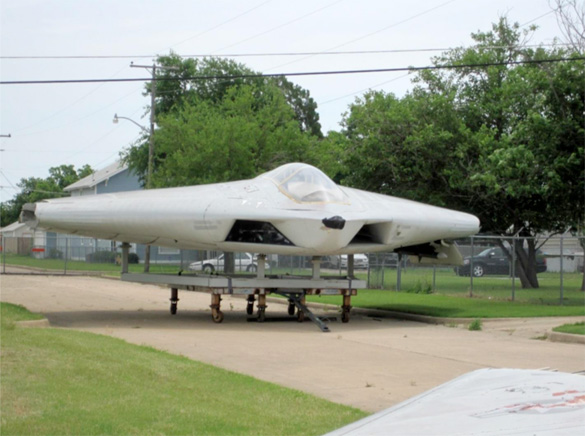
The derelict and dilapidated remains of the A-12 Avenger II mock-up outside at the Fort Worth Aviation Museum. Is this really all that American taxpayers received for their $5 Billion investment? (Image credit: Michael Schratt)
Frantic to maintain its control of the “high ground,” a desperate call went out to various aerospace defense contractors who could quickly design, build and test fly a two-stage-to-orbit spaceplane system. These included Lockheed, Rockwell, McDonnell Douglas, and Boeing. A significant majority of these contractors (except for Boeing in Seattle) had locations within what has been termed “aerospace alley” which extends from San Diego, north to Los Angeles, continuing to Lancaster/Palmdale/Air Force Plant 42, and concluding at Edwards AFB. As with most “Unacknowledged Special Access Programs” (USAPs), funding for the Blackstar program was covertly spread out over multiple projects including the ill-fated US Navy A-12 Avenger II, and the X-30 NASP (National Aerospace Plane). This wouldn’t be the first time that highly compartmented so-called “black” programs were used as a “sacrificial lamb” to cover the funding of even more highly classified projects. Many of these super-secret programs are referred to in the military/intelligence agencies as: “ace in the hole” or “trump card” technology. They are also referred to as “silver bullets.” Under extreme pressure, and on a tight schedule, the Lockheed Company in Burbank may have taken the leading role in designing a small spaceplane, and “farmed out” much of the construction/manufacturing to McDonnell Douglas in St. Louis.
The “Blackstar” system consisted of two separate components which operated as a single integrated unit: 1) a large “mothership” or carrier aircraft measuring approximately 200 feet in length. 2) a smaller “parasitic” aircraft/orbiter which could fit conformally under the belly of the mothership, and air-dropped at altitudes up to 90,000 feet. Flight testing of the Blackstar program appears to have started in 1989, and by October of the same year, the Blackstar program had flown its first operational mission. Four large carrier “Mothership” aircraft may have been produced, with eight spaceplane/orbiters possibly being built. The program was based out of Area 51/Groom Lake, utilizing the “old CIA A-12 hangers”, including and two new massive hangers that were three times larger than their historic neighbors. During flight testing and operational missions, ground controllers at Groom Lake carried the call sign “EARTH” when communicating with the spaceplane. Other bases of operation may include Alaska or Patrick AFB in Florida.
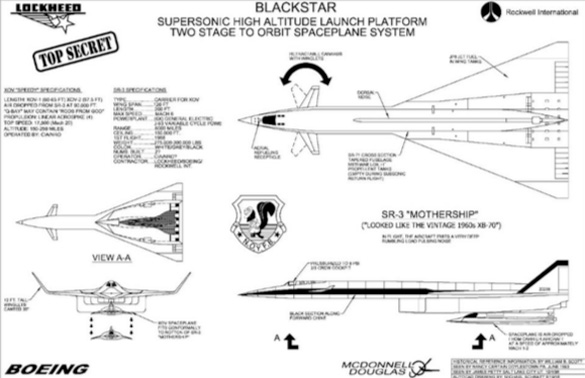
Three view drawing of large SR-3 “Mothership” with smaller XOV spaceplane below. (Image credit: Michael Schratt)
The massive mothership was referred to the “SR-3”, aka “elegant lady,” while the smaller spaceplane was designated “XOV” (Experimental Orbital Vehicle) or “Speedy.” Early in the program under the “COSMIC WIND” code-name, the large carrier aircraft was referred to as the “MAV” (Manned Aerial Vehicle), while the smaller spaceplane was designated the “AAV” (Advanced Aerial Vehicle). Resembling the 1960’s era North American Aviation XB-70 Valkyrie, the SR-3 was certainly an imposing sight to behold. Eyewitnesses who were fortunate enough to see this aircraft during the daytime described it as being “huge” or “giant.” Others simply called it the “Super Valkyrie.” Indeed, as reported by at least two former North American Aviation test pilots, the technology existed in the 1950s to develop a two-stage-to-orbit spaceplane system. With the advantage of 30 years of additional technological developments, and almost unlimited access to black budget funding, its well within the capability of the America aerospace industry to design, build and test fly such a vehicle.
With a wingspan of 120 feet, the SR-3 featured a triangular/delta wing configuration, with large “tip-sails” or winglets that rose up 12 feet and were canted at a 35-degree angle. It also featured a dorsal ridge or “spine” that extended immediately behind the cockpit, and ran down the length of the fuselage to the trailing edge of the wing. A retractable set canards (with their own winglets) were also located just aft of the crew compartment (reference email to Michael Schratt from Nancy Certain 9/13/16). These canards had the capability of retracting forward to support low speed applications. The SR-3 carried a crew of three consisting of the pilot, co-pilot and launch control officer (LRO) who sat facing backwards. The bottom of the aircraft featured a large XB-70 like triangular “splitter” air-intake which was divided into two banks at the rear of the craft. However, the most prominent feature was what appeared to be a “relieved section” or “scooped out” portion of the bottom which was designed to allow the smaller spaceplane to fit inside forming an aerodynamically efficient mating of the two aircraft (reference detailed report from James Petty to Michael Schratt 12/5/16).

Original SR-3 Mothership sketch by Nancy Certain.
According to eyewitness and Rocket scientist James Petty who saw both the Mothership and its smaller parasitic aircraft flying over Salt Lake City Utah on October 4, 1998, the more massive SR-3 carrier aircraft is powered by six modified variable-cycle J-93 engines (reference in-person 90- minute videotape interview of James Petty conducted by Michael Schratt 3/12/16). However, there appears to be a discrepancy regarding precisely what type of propulsion system was used to power the mothership. Those within the vicinity of SR-3 flight operations described hearing a VERY LOUD PULSING ROARING noise during take-off roll and climb out. This was confirmed by witness Nancy Certain Ph.D., from Doylestown PA, who saw the massive carrier aircraft during the day from a half-mile distance at an altitude of approximately 2,500 feet in 1993. Others stated that as the aircraft accelerated and gained altitude, the frequency and intensity of the pulsing noise increased. This may indicate the use of a combined cycle scramjet engine which can operate at both low and high speeds. Either way, it’s clear that this aircraft utilizes some form of “multi-cycle” engine.
The mothership has a weight of 275,000 to 300,000 pounds and a range of 6,000 miles (unlimited with aerial refueling). The SR-3 is capable of speeds over Mach 6 and can climb to an altitude of 150,000 feet. It features a white/grey exterior surface, with two being built by 1988. Fuel for the SR-3 consists of liquid hydrogen/liquid methane with JP8 used in the case of the J-93 engines. The contractors involved with designing and building the SR-3 mothership may have consisted of Lockheed, Rockwell, and Boeing. Final assembly took place at Boeing’s large assembly facility in Seattle. It’s interesting to note that on October 14, 1986, Boeing filed a patent (4,802,639) for a two-stage-to-orbit spaceplane system that closely matched the Blackstar operational capabilities, although the physical characteristics of the craft were different than what was reported by multiple eyewitnesses.Once reaching an altitude of 90,000 feet and a speed of Mach 3, the SR-3 air-drops its smaller parasitic aircraft, and either returns to its original base of operation or takes on additional fuel for an extended mission.
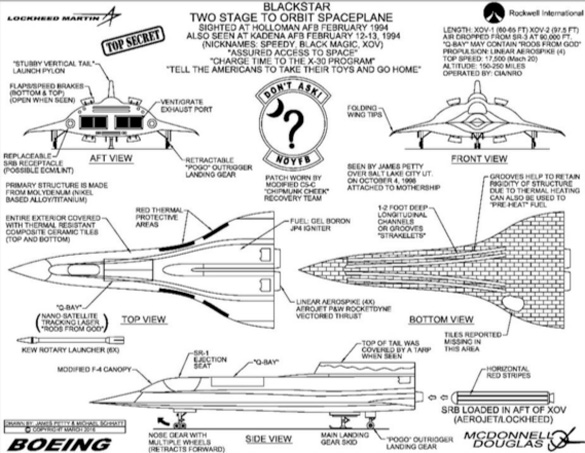
Three view drawing of Speedy XOV spaceplane. (Image credit: Michael Schratt)

Detail view of XOV linear aerospike engines showing “radiator like” screens. Illustration. (Image credit: Michael Schratt)
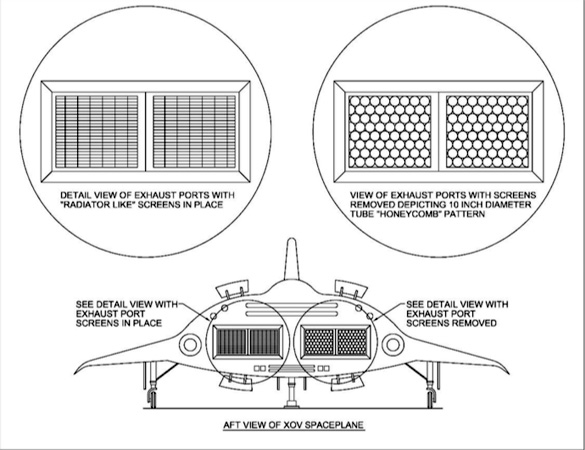
Detail view of XOV Speedy aft section depicting “radiator like” screens in place, and also removed showing 10” diameter tube “honeycomb pattern.” (Image credit: Michael Schratt)
The smaller XOV/Speedy spaceplane was manufactured in two sizes and featured a highly swept wing lifting body configuration. One measuring approximately 60-65 feet in length, with a crew of two that sat side-by-side, and another measuring 97.5 feet with a single pilot. These were named “XOV-1” and “XOV-2.” Flying in an inverted low earth orbit orientation, the XOV featured a two-door “Q-bay” on its upper surface for the operation of a large aperture adaptive optics system that featured “inches resolution.” This “reconnaissance package” had the capability of correcting for atmospheric disturbances, thereby generating extremely high-resolution images of ground-based targets. The Q-bay could also serve as a launching platform for hyper-velocity depleted uranium “Rods-from God.” The XOV could attain altitudes of between 150-250 miles, and speeds exceeding 17,500 mph (Mach 20). The primary propulsion system for the XOV were four linear aerospike engines that were grouped in two banks at the aft end of the vehicle. These engines were developed by a joint venture which included Aerojet and the Pratt & Whitney/Rocketdyne Company, which later became Aerojet Rocketdyne. Witnesses who have observed the back of this vehicle described seeing what looked like “radiator screens” covering the exhaust ports. Others described it as looking like “ventilation grating.” Embedded within the exhaust ports were multiple 10-inch diameter “tubes” which served to mix cooling air, thereby reducing the vehicle’s infrared signature. These tubes gave the exhaust ports an unusual “honeycomb” appearance. Ground tests of this unique engine took place at Groom Lake during 1988.
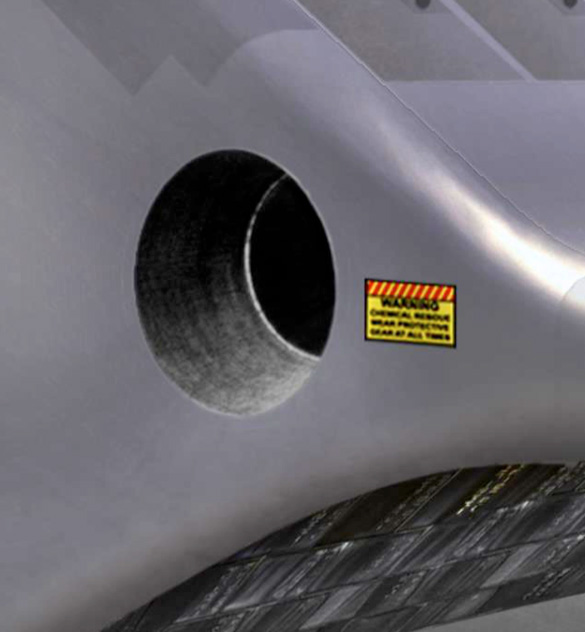
Circular receptacle for SRB on aft end of Speedy. Illustration. (Image credit: Michael Schratt)
The larger 97.5-foot long spaceplane also featured articulating intakes and variable geometry exhaust ports. On either side of the exhaust ports, a dark circular opening was seen which may have served as a solid rocket booster (SRB) receptacle. These could be loaded into the craft “like a shotgun shell” and then removed after the conclusion of a mission. The SRBs served to provide an extra boost, pushing the spaceplane into a low earth orbit flight path. Once in orbit, the spaceplane had the capability of “dipping back down” into the atmosphere and then climbing back up again. Using this technique of “skipping” over the outer reaches of the atmosphere, the spaceplane could dramatically increase its range. After completing its mission, the spaceplane would glide back to earth “like the space shuttle” and land horizontally at multiple military locations in the United States.It could then be “turned around” within 48 hours or “every other day” to fly another mission. Compared to the space shuttle which can take months or even years to prepare for flight, the Blackstar system represented a cost-effective alternative. Another unique advantage was its capability to serve as a “rapid response” military/reconnaissance platform that could surprise an enemy by flying unpredictable flight paths, unlike spy satellites.
The outer wing sections of the XOV featured a “droop down” articulated capability, which took advantage of “compression lift.” The only movable control surfaces on the Speedy spaceplane were what appeared to be flaps/speed brakes located on the upper and lower rear surface of the vehicle. A short “stubby tail” which extended from aft of the Q-bay to the extreme end of the craft served as both a vertical stabilizer and an attachment point for joining with the larger carrier aircraft. The outer structure of the craft may have been built at the McDonnell Douglas facility in St. Louis and featured an advanced composite material that was “stacked” in layers forming a sandwich to attain the desired thickness. Red colored thermal protective areas were located along the leading edges of its wings. The entire bottom surface featured dark-colored thermal resistant “space shuttle tiles.” Four “channels” or “strakelets” were seen on the bottom of the craft. These one to two-foot deep longitudinal “grooves” helped to maintain the rigidity of the structure and may have served as a way to dissipate heat during high-speed operations. Apparently, these grooves/inlets were “very complex,” and most likely took multiple attempts to perfect.

Illustration (Image credit: Michael Schratt)
The XOV incorporated a very unusual landing gear configuration which included a four-wheel nose gear arrangement, and a retractable “ski-like” landing gear skid that extended directly from the bottom of the craft. Approximately at the mid-point on the lower surface of the wings, a retractable “pogo-type” outrigger landing gear helped to stabilize the craft during roll-out. Generally speaking, highly swept low aspect ratio lifting body configurations have high landing speeds. Therefore, the Speedy spaceplane was said to have a landing speed between 250-300 mph, with the central retractable landing skid taking the brunt of the force. Certainly, the craft was a “handful” for even the most experienced test pilots. Only those with practical application in flying multiple different types of aircraft would qualify for handling such a strange and exotic aircraft. Pilots who were the “Maverick” type, and had previous air racing experience would be at the top of the list. Fuel for the XOV was a “gelled Boron” based “slurry” or endothermic type that had the consistency of toothpaste. Work on the spaceplane proceeded slowly until 1989 when the program made tremendous progress, and engineers were working “around the clock” 24 hours a day, seven days per week, for three years. It was also during this timeframe that a “fuel breakthrough” was made, which further accelerated the program.
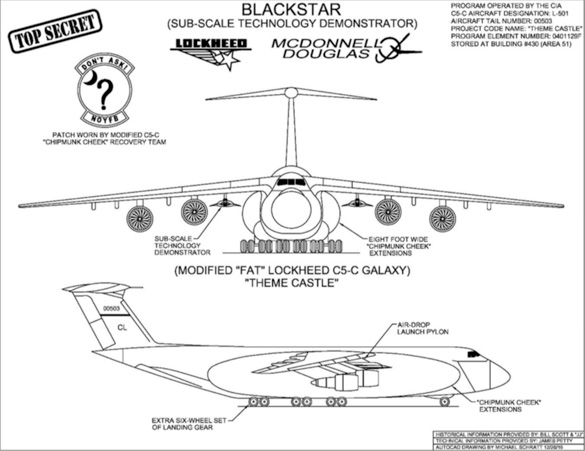
Drawing depicting the modified Lockheed C-5C Galaxy with “chipmunk cheek” extensions. (Image credit: Michale Schratt)
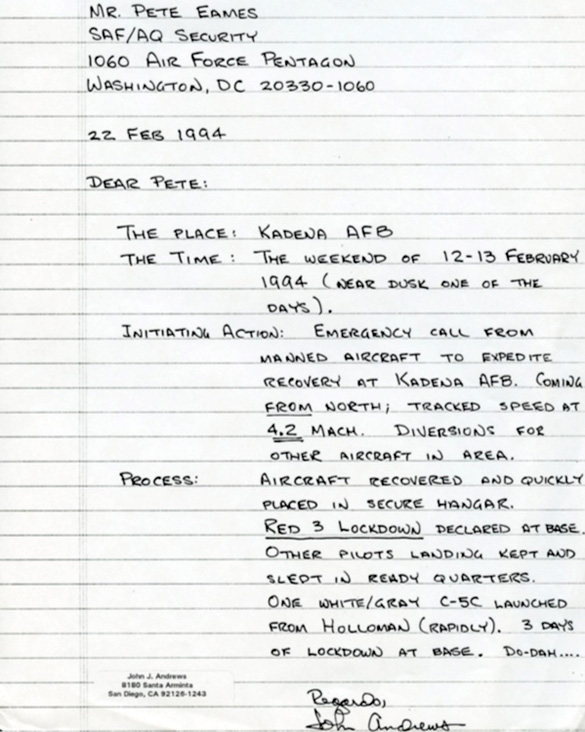
Letter from John Andrews to Pete Eames describing the emergency landing of a classified aircraft (which was tracked going Mach 4.2) at Kadena AFB on February 12-13, 1994.
On February 13 of 1994, things took a drastic turn on the project. On that day, an XOV spaceplane was involved in an incident that resulted in the craft making an emergency landing at Kadena AFB in Japan. This particular aircraft was tracked by Kadena air traffic controllers going Mach 4.2, and other aircraft in the vicinity had to be diverted to avoid a collision. Subsequently, the entire base was put on a “Red 3” lockdown for three days. Apparently, during the launch sequence, the stubby vertical fin/pylon on the spaceplane somehow made contact with its carrier aircraft and was forced to make an unscheduled detour. Within 24 hours, a highly modified Lockheed C-5 Galaxy cargo transport aircraft was dispatched from Holloman AFB to retrieve the damaged spaceplane. To “fill a gap” in their intelligence gathering capability, the CIA/NRO convinced Congress in May of 1994 to allocate 100 million dollars to put the SR-71 Blackbird spy-plane back into service so that the Blackstar program could get back on track. Three of these unique C-5 aircraft were produced which featured eight-foot-wide “chipmunk cheek” extensions on each side of the fuselage. Originally, these modifications were specifically incorporated for the purpose of transporting large containers which protected satellites during transit to launch sites. However, they were also later used to transport classified aircraft to multiple locations around the world. These highly modified aircraft also utilized an extra set of six-wheeled landing gear. Two of these aircraft were operated by NASA and carried the tail numbers 00503, and 00504. The third was operated by the CIA and featured a large red “CL” marking on its vertical stabilizer. Upon arriving at Kadena AFB, the damaged aircraft was quickly loaded inside the C-5, which then made a direct flight back to Holloman AFB.
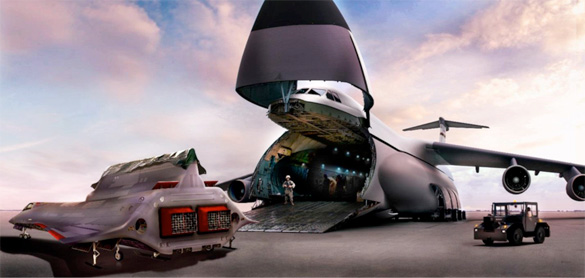
Spaceplane being unloaded from C-5 cargo aircraft at Holloman AFB (Illustration credit John MacNeill/Tom Bogan)
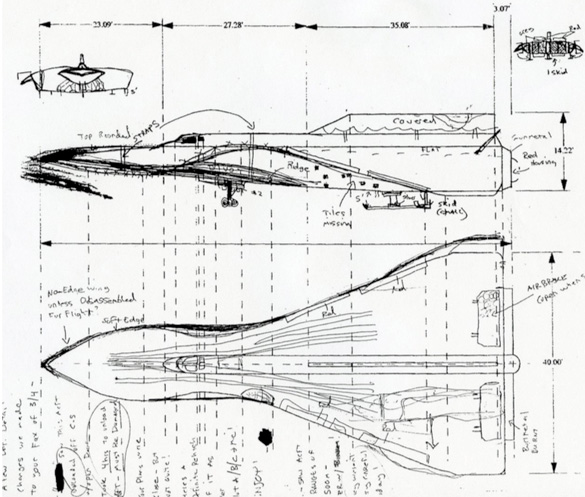
Original sketch of XOV spaceplane by F-15 pilot at Holloman AFB.
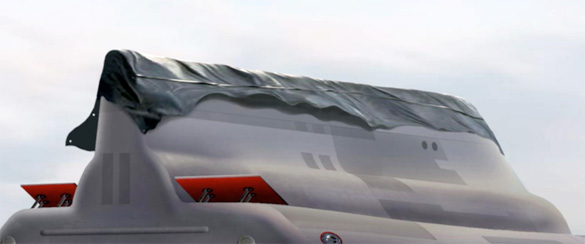
Tarp covering “stubby vertical tail.” Note extended flaps/speed brakes. (Image credit: Michael Schratt)
Sometime around February 15 of 1994, the C-5 arrived back at Holloman AFB with its precious yet damaged cargo inside. The aircraft then taxied to a remote part of the long runway at the base. Eyewitnesses who saw the spaceplane being unloaded from the much larger cargo aircraft during the daytime indicated that it was a complicated process which took at least three hours to complete. Apparently, the outer wing panels of the spaceplane have the capability of folding to allow for transportation in the C-5. One witness (a transient F-15 pilot), who saw the entire event unfold through binoculars from the cockpit of his aircraft while it was parked on the ground, sketched what he observed. “no-nonsense” military security guards were overseeing the entire unloading process. Once the spaceplane was pulled from the opened “clamshell” door of the C-5, it was immediately apparent that some damage had occurred to the spaceplane. A large tarp was seen covering the stubby vertical tail. However, this tarp did not completely obscure the view of the aft section which revealed a large “chunk” missing. In addition, the F-15 pilot also identified multiple missing tiles on the spacecraft’s bottom right wing section. It’s unknown at this time if this event in conjunction with other technical challenges “shelved” the Blackstar project, or if it secretly continued its covert activity. In the end, the Blackstar program represents one of the “crown jewels” of the military-industrial complex. It’s unlikely that the engineers or test pilots associated with the project will get the credit they deserve anytime in the foreseeable future. Like many other black programs, it’s entirely possible that it will remain another unacknowledged “silver bullet” being hidden away in some dark and mysterious hangar located somewhere in the southwest.


 Exploding Ants Discovered in Borneo