Ontdek de Fascinerende Wereld van UFO's en UAP's: Jouw Bron voor Onthullende Informatie!
Ben jij ook gefascineerd door het onbekende? Wil je meer weten over UFO's en UAP's, niet alleen in België, maar over de hele wereld? Dan ben je op de juiste plek!
België: Het Kloppend Hart van UFO-onderzoek
In België is BUFON (Belgisch UFO-Netwerk) dé autoriteit op het gebied van UFO-onderzoek. Voor betrouwbare en objectieve informatie over deze intrigerende fenomenen, bezoek je zeker onze Facebook-pagina en deze blog. Maar dat is nog niet alles! Ontdek ook het Belgisch UFO-meldpunt en Caelestia, twee organisaties die diepgaand onderzoek verrichten, al zijn ze soms kritisch of sceptisch.
Nederland: Een Schat aan Informatie
Voor onze Nederlandse buren is er de schitterende website www.ufowijzer.nl, beheerd door Paul Harmans. Deze site biedt een schat aan informatie en artikelen die je niet wilt missen!
Internationaal: MUFON - De Wereldwijde Autoriteit
Neem ook een kijkje bij MUFON (Mutual UFO Network Inc.), een gerenommeerde Amerikaanse UFO-vereniging met afdelingen in de VS en wereldwijd. MUFON is toegewijd aan de wetenschappelijke en analytische studie van het UFO-fenomeen, en hun maandelijkse tijdschrift, The MUFON UFO-Journal, is een must-read voor elke UFO-enthousiasteling. Bezoek hun website op www.mufon.com voor meer informatie.
Samenwerking en Toekomstvisie
Sinds 1 februari 2020 is Pieter niet alleen ex-president van BUFON, maar ook de voormalige nationale directeur van MUFON in Vlaanderen en Nederland. Dit creëert een sterke samenwerking met de Franse MUFON Reseau MUFON/EUROP, wat ons in staat stelt om nog meer waardevolle inzichten te delen.
Let op: Nepprofielen en Nieuwe Groeperingen
Pas op voor een nieuwe groepering die zich ook BUFON noemt, maar geen enkele connectie heeft met onze gevestigde organisatie. Hoewel zij de naam geregistreerd hebben, kunnen ze het rijke verleden en de expertise van onze groep niet evenaren. We wensen hen veel succes, maar we blijven de autoriteit in UFO-onderzoek!
Blijf Op De Hoogte!
Wil jij de laatste nieuwtjes over UFO's, ruimtevaart, archeologie, en meer? Volg ons dan en duik samen met ons in de fascinerende wereld van het onbekende! Sluit je aan bij de gemeenschap van nieuwsgierige geesten die net als jij verlangen naar antwoorden en avonturen in de sterren!
Heb je vragen of wil je meer weten? Aarzel dan niet om contact met ons op te nemen! Samen ontrafelen we het mysterie van de lucht en daarbuiten.
Zondag 20 mei 2018
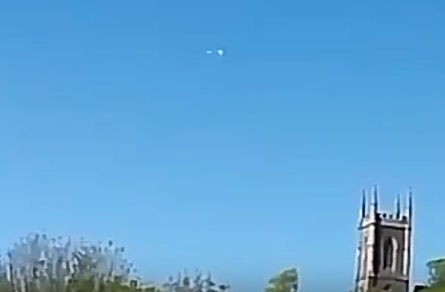
UFO Over Saint Patrick Cathedral In Ireland On May 17, 2018, Video, UFO Sighting News.
UFO Over Saint Patrick Cathedral In Ireland On May 17, 2018, Video, UFO Sighting News.
Date of sighting: May 17, 2018
Location of sighting: Downpatrick, Ireland
Downpatrick is a small-sized town about 33 km south of Belfast in County Down, Northern Ireland. It has been an important site since ancient times. Its cathedral is said to be the burial place of Saint Patrick. Since the UFO was seen over Saint Patricks place of burial, it might be because aliens have a high interest in human religions beliefs. The closer the UFO, the easier for the aliens to actually read the thoughts of people inside. Scott Waring-Taiwan
A Newly Discovered Solar System Object Hints at Hidden Planet Nine
Astronomers found a strange dwarf world that provides even more evidence that a giant planet is lurking at the edge of our solar system.
There might be a large planet lurking somewhere at the very edge of our solar system, and astronomers are hunting for it. While they have yet to find direct evidence of the planet, a recent discovery provides yet more indirect evidence that the planet does, in fact, exist. Astronomers found a small solar system body with a strange orbit that they say can only be explained by another, bigger planet hiding out there somewhere.
Astronomers have speculated for a few years that a ninth planet may be orbiting the sun at a great distance, and have spent the past few years searching for it. They first started the hunt back in 2016 after looking at a handful of distant solar system objects and noticing something strange. These objects, all orbiting further away than Pluto, had something similar in common: they orbited the sun at a distinct angle from all of the inner planets.
The observations suggest the gravitational influence of another planet is altering the orbits of the distant objects. Now additional findings of a newly discovered planetary object with an odd orbit, called 2015 BP519, supports the case for an undiscovered Planet Nine. 2015 BP519 orbits at a 54 degree angle compared to nearly everything in the inner solar system, and the theory is that Planet Nine is responsible.
If Planet Nine does exist, it’s likely only a matter of time until astronomers find it. It would be difficult, however, because it’s calculated orbit is so incredibly far away. Planet Nine is likely several times as far away as Pluto, meaning it’s barely a dot in even our most powerful telescopes and it’s dark. Adding to the difficulty is the complication that we don’t know exactly where it’s supposed to be, reports Quanta.
IS THERE ANY PLAUSIBLE REASON WHY ALIENS WOULD EVOLVE TO LOOK LIKE US?
In science fiction movies and TV shows, intelligent aliens are usually the same basic shape as humans: two arms, two legs and a head. But why would creatures that evolved on a completely different planet look so similar to us? We asked some experts, and they told us the most likely explanations for humanoid aliens.
Top image: Artwork by Wayne Douglas Barlowe
The truth is, aliens tend to look like us in science fiction for a couple of basic reasons: budget, and relatability.
“Most aliens in SF are humanoid because humans produce SF,” says Michael H. New, an Astrobiology Discipline Specialist at NASA. “While we are interested in the ‘other,’ our conception of otherness is often limited.”
And a lot of experts firmly believe that aliens would not look at all like humans. For example, Stephen Jay Gould claims that life that evolved elsewhere would look totally different from us — and in fact, if you “reran the tape” from the beginning of life on Earth, you wouldn’t end up with humans on this planet either. The emergence of humanoids on Earth is a totally random event that was a fluke, even with the exact conditions that we arose from.
But let’s say that we do meet aliens, and they turn out to be bipeds with a roughly human-like shape… how do we explain that?
Panspermia
This is the most common explanation for creatures that look sort of like us turning up all over the universe. Either humanoid aliens spread their DNA across the galaxy to give rise to creatures in their image, or the DNA just spread through the galaxy on its own, on asteroids and stuff.
Star Trek: The Next Generation reaches for this explanation in the episode “The Chase,” pictured above. And it’s the centerpiece of the recent movie Prometheus, as well.
“I’m of the strong opinion that if humanoid aliens exist, they must have some genetic heritage in common with human beings,” says Mark A. Bullock with the Southwest Research Institute. He’d find that easier to believe than the notion that humanoids could evolve independently elsewhere. Plus “it’s been shown that panspermia is quite a viable mechanism, so the interchange of genetic material between worlds is not out of the question.”
We know a lot about the history of life on Earth, but how it began is still one of our greatest…
If the galaxy really did turn out to be full of humanoid aliens, “some kind of panspermia wouldn’t be a bad explanation,” New tells io9. “We’re bilaterally symmetric and bipedal because our ancestors were.” It’s entirely possible that if certain events had played out differently, the dominant species on Earth would have had a very different shape.
The Burgess Shale, which is roughly 500 million years old, “displays a wide range of body plans, only some of which are still seen on the modern Earth,” adds New. So he believes you’d need some outside intervention to account for humanoid aliens.
Bullock sounds a similar note, saying that the Cambrian explosion, 600 million years ago, “saw a great deal of evolutionary experimentation with body plans,” some of which could be a glimpse of life forms that we might see on other planets.
At the same time, panspermia is only really likely at the microbial level, cautions Joan L. Slonczewski, a biology professor at Kenyon College and science fiction author whose books include A Door Into Ocean and The Highest Frontier. Beyond microbes, panspermia doesn’t really make much sense as an explanation for humans’ own development.
“Humans on Earth are so obviously a part of Earth’s evolutionary program,” says Sclonczewski. “From the molecular and cellular level, to the shape of organisms, we humans evolved here.”
Convergent Evolution
Or maybe humanoids just evolved on other planets, separately from us, because they just arrived at the same destination via other paths?
There are certain things about humans that helped us rise over other primates, says James Kasting, a distinguished professor of Geoscience at Penn State University. Our opposable thumbs helped us grasp tree branches, and also hold tools. And walking upright was useful, as well. Finally, being warm-blooded helped us to power our big brains.
“I would think that there’s a good chance that intelligent alien life evolved in more or less the same way and would thus bear some resemblance to humans,” says Kasting. “Not necessarily a close resemblance, though.”
The upright-walking, bipedal, two-armed posture “seems to have evolved independently in various unlikely contexts, from meerkats to velociraptors,” notes Slonczewski. “Maybe it just makes sense to have two feet to move, two hands to manipulate something, and a sensory ‘head’ with as wide a view as possible. Then again, that’s what we have, so it makes sense to us.”
We’ve seen enough examples of convergent evolution on Earth to believe that it could happen on other planets as well, notes Steven J. Dick, the 2013-2014 Baruch S. Blumberg NASA/Library of Congress Chair in Astrobiology at the Library of Congress. “For example, the eye has been reinvented many times independently, as have wings in insects, birds and bats. Fish and marine mammals such as dolphins have evolved streamlined shapes for their water environment.”
Dick recommends the 1981 book Life in Darwin’s Universe: Evolution and the Cosmos by Gene Bylinsky, which argues that “a limited number of engineering solutions” are possible when it comes to successful life forms.
The Man Who Collects Mid-Century Modern Cameras
5/09/18 9:30pm
But Dick adds that you can’t discount environmental factors which would ensure that life on other planets would look at least somewhat different, including gravity. Dick tells io9:
Because they would have been shaped by their own unique planetary environments, organisms would be different from us in the particulars, just as there is great diversity of life on Earth, including the different requirements of land and water organisms. More generally, gravity imposes size limitations on life; from the cell to the whale is a large range indeed, but the food system of the whale (and the dinosaur on land) must strain to feed such a large structure, even as the heart struggles to sustain its blood flow. Life on a low-gravity planet might be free to soar upward both in the plant and animal kingdom, while life on a high-gravity planet would be correspondingly stifled.
Bilateral Symmetry
Let’s say that the notion of aliens separately evolving bodies that have more or less a human silhouette is kind of unlikely — it’s still possible that bilateral symmetry could be a constant among intelligent life forms, say some experts. This refers to the fact that your left and right sides are more or less the same, with an eye, an ear, an arm and a leg on either side.
“Bilateral symmetry appeared independently several different times in the evolution of larger organisms on Earth,” says Bullock. “So bilateral symmetry may be a common feature of intelligent life, regardless of whether its specific body plan.”
And once you get bilateral symmetry, you are going to start drifting in the direction of a vaguely humanoid body plan, argues Bjørn Østman with Michigan State University. The symmetry means you’ll have an even number of limbs — which is most likely going to be four, rather than six or more, which don’t convey enough of an advantage to justify the extra limbs.
“Even on earth there are lots of animals that have more than two pairs of limbs,” concedes Østman. “But I think that the reason why we have lots and lots of animals that hva four limbs is that that’s highly advantageous. It just happens to be mechanically a very good solution to traversing a rugged landscape.”
And once you have a lot of quadripeds on land, one of those quadripeds is going to start using its front limbs to manipulate tools. “If you can free two limbs to manipulate tools, then it becomes very advantageous to develop high intelligence,” notes Østman.
So assuming an intelligent alien is symmetrical and has some of its limbs devoted to tool use, then it might end up being roughly bipedal, says Østman. And the sensory organs, like eyes, will have to be forward-looking and not too far away from the tool-using limbs. Which means you end up with something like a head, because the nervous system will be close to the sensory organs for maximum efficiency.
Thus those two factors — symmetry and tool use — may lend themselves to something at least vaguely similar to a human shape, in Østman’s view.
“If we were to eventually find other intelligent life in the universe, they would be humanoid, I think,” Østman concludes. “I find that a high probability.” But at the same time, he admits he’s in the minority, and most other scientists agree with Gould that humanoid life is unlikely to evolve elsewhere.
This is an artist's concept of the Earth's global magnetic field, with the bow shock. Earth is in the middle of the image, surrounded by its magnetic field, represented by purple lines. The bow shock is the blue crescent on the right. Many energetic particles in the solar wind, represented in gold, are deflected by Earth's magnetic "shield".
Credit: Walt Feimer (HTSI)/NASA/Goddard Space Flight Center Conceptual Image Lab
The solar wind streams plasma and particles from the sun out into space. Though the wind is constant, its properties aren't. What causes this stream, and how does it affect the Earth?
Windy star
The corona, the sun's outer layer, reaches temperatures of up to 2 million degrees Fahrenheit (1.1 million degrees Celsius). At this level, the sun's gravity can't hold on to the rapidly moving particles, and they stream away from the star.
The sun's activity shifts over the course of its 11-year cycle, with sun spot numbers, radiation levels, and ejected material changing over time. These alterations affect the properties of the solar wind, including its magnetic field, velocity, temperature and density. The wind also differs based on where on the sun it comes from and how quickly that portion is rotating.
The velocity of the solar wind is higher over coronal holes, reaching speeds of up to 500 miles (800 kilometers) per second. The temperature and density over coronal holesare low, and the magnetic field is weak, so the field lines are open to space. These holes occur at the poles and low latitudes, reaching their largest when activity on the sun is at its minimum. Temperatures in the fast wind can reach up to 1 million F (800,000 C).
At the coronal streamer belt around the equator, the solar wind travels more slowly, at around 200 miles (300 km) per second. Temperatures in the slow wind reach up to 2.9 million F (1.6 million C).
The sun and its atmosphere are made up of plasma, a mix of positively and negatively charged particles at extremely high temperatures. But as the material leaves the sun, carried by solar wind, it becomes more gas-like.
"As you go farther from the sun, the magnetic field strength drops faster than the pressure of the material does," Craig DeForest, a solar physicist at the Southwest Research Institute (SwRI) in Boulder, Colorado, said in a statement. "Eventually, the material starts to act more like a gas, and less like a magnetically structured plasma."
Affecting Earth
As the wind travels off the sun, it carries charged particles and magnetic clouds. Emitted in all directions, some of the solar wind is constantly buffeting our planet, with interesting effects.
If the material carried by the solar wind reached a planet's surface, its radiation would do severe damage to any life that might exist. Earth's magnetic field serves as a shield, redirecting the material around the planet so that it streams beyond it. The force of the wind stretches out the magnetic field so that it is smooshed inward on the sun-side and stretched out on the night side.
"Solar ejections are the most powerful drivers of the sun-Earth connection," NASA says on its website for the Solar Terrestrial Relations Observatory (STEREO). "Despite their importance, scientists don't fully understand the origin and evolution of CMEs, nor their structure or extent in interplanetary space." The STEREO mission hopes to change that.
When the solar wind carries CMEs and other powerful bursts of radiation into a planet's magnetic field, it can cause the magnetic field on the back side to press together, a process known as magnetic reconnection. Charged particles then stream back toward the planet's magnetic poles, causing beautiful displays known as the aurora borealisin the upper atmosphere. [Photos: Amazing Auroras of 2012]
Though some bodies are shielded by a magnetic field, others lack their protection. Earth's moon has nothing to protect it, so takes the full brunt. Mercury, the closest planet, has a magnetic field that shields it from the regular standard wind, but it takes the full force of more powerful outbursts such as CMEs.
When the high- and low-speed streams interact with one another, they create dense regions known as co-rotating interaction regions (CIRs) that trigger geomagnetic storms when they interact with Earth's atmosphere.
The solar wind and the charged particles it carries can affect Earth's satellites and Global Positioning Systems (GPS). Powerful bursts can damage satellites, or can push GPS signals to be off by tens of meters.
The solar wind ruffles all of the planets in the solar system. NASA's New Horizons mission continued to detect it as it traveled between Uranus and Pluto.
"Speed and density average together as the solar wind moves out," Heather Elliott, a space scientist at SwRI in San Antonio, Texas, said in a statement. "But the wind is still being heated by compression as it travels, so you can see evidence of the sun's rotation pattern in the temperature even in the outer solar system.
Studying the solar wind
We've known about the solar wind since the 1950s, but despite its extensive effects on Earth and on astronauts, scientists still don't know how the it evolves. Several missions over the last few decades have sought to explain this mystery.
Launched on Oct. 6, 1990, NASA's Ulysses mission studied the sun at various latitudes. It measured the various properties of the solar wind over the course of more than a dozen years.
The Advanced Composition Explorer (ACE) satellite orbits at one of the special points between Earth and the sun known as the Lagrange point. In this area, gravity from the sun and the planet pull equally, keeping the satellite in a stable orbit. Launched in 1997, ACE measures the solar wind and provides real-time measurements of the constant flow of particles.
NASA's twin spacecraft, STEREO-A and STEREO-B study the sun's edge to see how the solar wind is born. Launched in October 2006, STEREO has provided "a unique and revolutionary view of the sun-Earth system," according to NASA.
A new mission hopes to shine light on the sun and its solar wind. NASA's Parker Solar Probe, planned to launch in the summer of 2018, aims to "touch the sun." After several years of closely orbiting the star, the probe will dip into the corona for the first time, using a combination of imaging and measurements to revolutionize understanding of the corona and increase understanding of the origin and evolution of the solar wind.
"Parker Solar Probe is going to answer questions about solar physics that we've puzzled over for more than six decades," Parker Solar Probe Project scientist Nicola Fox of the Johns Hopkins University Applied Physics Laboratory, said in a statement. "It's a spacecraft loaded with technological breakthroughs that will solve many of the largest mysteries about our star, including finding out why the sun's corona is so much hotter than its surface."
Curiously, the cave is home to one of the longest archaeological sequences in Greece, featuring the cultural remains of the Middleand UpperPalaeolithic as well as the Mesolithic and Neolithicperiods.
In more recent times, it is known that the cave was used by shepherds as a shelter for their flocks.
Greece—a treasure trove of history
Numerous archaeological excavations that have been performed over the years have revealed that the cave—located in the central region of Thessaly—has been occupied by humans for as long as 130,000 years.
Excavations of the cave started in 1987 lasting 20years, until 2007. The project was led by Dr. Nina Kyparissi-Apostolika, the head of the Ephorate of Palaeoanthropology and Speleography.
Being the first cave excavated in Thessaly, researchers meticulously studied it, finding evidence of a continuous sequence of deposits that date from the Middle Palaeolithic up to the end of the Neolithic period.
Among the most significant discoveries, archeologists discovered through micromorphological analysis on the sediment that the region had been exposed to both hot and warm weather through millennia.
As the weather changed, so did the cave’s population.
Archaeologists found up to three human footprints that were embedded in the caves soft earthen floor. Studies revealed how the footprints inside the cave most likely belonged to a group of Neanderthal children, who lived inside the cave during the Middle Palaeolithic period.
But perhaps one of the most significant discoveries made in the Theopetra cave was a structure located at the entrance: a stone wall that closed of the entrance to the cave tens of thousands of years ago.
The Oldest Wall on Earth?
Using a method called Optically Stimulated Luminescence, archeologists of the Ministry of Athenian Culture found that the wall at the entrance of the cave was at least 23,000 years old.
Scientists found that the wall coincided with the last glacial Ice Age, meaning that the cave’s inhabitants most likely erected the wall in order to protect them from the extreme cold from the outside.
This wall, say, experts, is considered the oldest manmade structure in Greece, and some suggest it may be the oldest wall on the surface of the planet.
I don’t know about you, but when I’m not busy researching or reading about strange phenomena, I like to kick back and enjoy a TV show or movie about some of my favorite subjects –– whether it’s catching Ancient Aliens, Curse of Oak Island or Finding Bigfoot during the week or making time on the weekends to watch an oldie but a goodie from the Area 51 movie archives.
Here are some of our favorites that, like the UFOs they describe, have flown under the radar. All three are based on true stories.
The crash at Roswell, for many UFOlogists, is the grandaddy of the whole phenomena. Whatever happened back on Mac Brazel’s New Mexico ranch back in 1947 touched off a series of events that forever changed the way we look at the skies, as well as how we look at our own government.
This is a serious film with serious actors. Kyle MacLachlan and Martin Sheen each do an outstanding job with the material which is presented in a series of flashbacks at a military reunion 30 years after the crash. The storytelling is intelligent and compelling; this isn’t a dry documentary. If you care about why Roswell was such a big deal, you need to see this movie.
If you don’t know Whitley Strieber, you owe it to yourself to check him out. He’s the author of horror/paranormal classics The Wolfen (werewolves) and The Hunger (vampires) as well as the book behind this movie, Communion. But Communion isn’t a work of fiction, or is it?
Christopher Walken, Haunting in Communion
In Communion, published as non-fiction, Strieber claims he was abducted from his cabin in upstate New York on the evening of December 26, 1985 by non-human beings who may or may not have been of extraterrestrial origin. Although the book is seen as an account of alien abduction, Strieber himself merely refers to the beings as “the visitors,” a name meant to suggest that the beings witnessed as part of these events may exist in reality or only in his own mind—a twist worthy of Philip K. Dick.
The movie is bizarre, disturbing and deeply uncomfortable to watch, which is precisely why you need to see it. If you have even a passing interest in the alien abduction phenomenon or in the permeable veil between sanity and insanity, you will enjoy Communion. Plus, it stars one of the most bizarre and haunting actors of all time, Christopher Walken, in the main role.
Strieber has gone on to be a luminary in the paranormal research world. See his latest at Unknown Country or listen to him at Dreamland.
Fire in the Sky is a completely different look at the UFO abduction phenomenon. Where Communion is cerebral and introspective, Fire in the Sky is grounded in the real world of human jealousy, rivalry and frailty.
In 1975, Travis Walton was driving home from his logging job in the White Mountains of Arizona with some of his co-workers. That evening, they encountered an unidentified object in the sky. Walton gets out of the truck to have a look and is struck by a beam of light from the object, sending him flying backwards with great force. His co-workers flee the scene; when they later return, Walton is missing.
What ensues is a cross between a missing persons investigation and a murder mystery, with back-and-forth between the police and the loggers who stick to their UFO story. Walton finally turns up days later alive—naked, dehydrated and babbling—at a gas station.
We finally learn Walton’s ominous fate in a horrifying flashback to what happened aboard the craft. It is everything that alien abduction nightmares are made of.
The World’s First Floating Nation To Launch In Pacific Ocean In 2022, With Own Government And Cryptocurrency
The Floating City will become the first floating nation on Earth–a Libertarianutopiafreeofregulationandtaxes. It will feature offshore housing, use its own cryptocurrency, and operate ‘outside of government regulations’.
The plan to create the first floating city started off a decade ago when Peter Thiel, an American entrepreneur, venture capitalist, philanthropist, political activist, and author co-founded a nonprofit called Seasteading Institute.
In a 2009 essay, Mr. Thiel wrote, “Between cyberspace and outer space lies the possibility of settling the oceans.”
Since then, the project has taken a long leap, and as things stand now, the institute is set to embark on a pilot project with the Government of French Polynesia.
Image Credit: Seasteading Institute
The world’s first independent floating nation will soon launch in the Pacific Ocean and will operate outside of government regulations, using its own cryptocurrency called ‘Vyron’.
The floating city, a sea-bound city-state featuring around 300 intricately designed homes, a number of hotels, restaurants, offices and other buildings is being built in the Pacific Ocean near the island of Tahiti.
The floating city-state was a project never attempted before.
Its founders imagined the floating city as a Libertarianutopiafreeofregulationandtaxes.
But the plan developed beyond that.
Image Credit: Blue Frontiers
Speaking to Business Insider, Joe Quirk, president of the Institute said how he and his team now see the floating city a way mankind can coup with rising sea levels, which are sadly expected to increase by more than six feet by the end of the century.
Nathalie Mezza-Garcia, a political scientist and researchers from the Floating Island Project say how the islands residents will be free of ‘fluctuating geopolitical influences and trade issues’ and claimed the independent sea nation could one-day house refugees displaced by climate change.
“There is significance to this project being trialed in the Polynesian Islands. This is the region where land is resting on coral and will disappear with rising sea levels. Once we can see how this first island works, we will have a proof of concept to plan for islands to house climate refugees,” said Mr. Mezza Garcia in an interview with CNBC.
Image Credit: Blue Frontiers
The independent floating city is expected to cost around $50 million, and will float in international waters, while operating within its own laws, and will ‘liberate humanity from politicians’, according to the SeasteadingInstitute.
The floating city is a massive project in today’s radicalized society.
The floating island’s non-residential buildings are designed to operate as business centers, which will offer a number of companies to work ‘outside government regulations’.
“This means there is stability, outside of fluctuating geopolitical influences, trade issues, and currency fluctuations – it’s the perfect incubator,” Ms. Mezza Garcia explained.
“If you don’t want to live under a particular government, ‘people will be able to just take their house and float away to another island,” added Ms. Mezza Garcia.
The Journey to make the floating city-state happen was a long one. The Seasteading Institute, co-founded by Mr. Thiel has worked for the last five years designing and testing ‘permanent, innovative communities floating at sea’.
Their journey has seen them team up with Blue frontiers– a startup that specializes in building floating islands.
Image Credit: Blue Frontiers
The design of the floating city took inspiration from the Polynesian culture, in particular from their traditional navigation, based on observation and vast knowledge of natural elements.
The designers of the floating city-state reflected mountains and hills, the shape of ocean reefs and numerous different underwater landmarks, as well as the rising and setting of the moon, the sun and stars in the design.
Interestingly, the small platforms featuring the villas are set to be aligned with the path of the stars of Sirius according to the plans.
As explained by the Daily Mail, “Larger platforms with mixed-use buildings aligned to the celestial pillar Pou, starting from the main platform, the ‘star headlight’ or Ta’urua, and ending by the guide star Avei’a, passing through the zenith of the floating island.”
Image Credit: Seasteading Institute.
“During several visits to French Polynesia and after getting acquainted with the environment and the local contexts, one thing was sure, the project has to blend into its environment. To achieve this, local environmental characteristics, climate, ecology and cultural context have all been studied and play a major role in the process.”
“The project, however, doesn’t only want to not hurt the existing environment, the vision of the Blue Frontiers [is to] facilitate the development of more conscious and balanced settlements at sea where humans can peacefully coexist with the environment and with each other,” explains a written statement by the Seasteading Institute.
A Time Machine For The Gods—Ancient Cosmic Calendar With Over 1,000 Petroglyphs Found In Arizona
“It’s a time machine for the gods…”
An astonishing discovery has been made in Arizona’s Verde Valley.
Researchers have come across an ancient calendar carved into stone that has remained hidden for nearly one thousand years. The calendar.
More than 1,000 petroglyphs were most likely created by the ancients as a way to ‘track time’ using the sun, say experts.
According to the Arizona Daily sun, around 1,000 intricate petroglyphs were carved into the rack more than 900 years ago by the Southern Sinagua people. The Sinagua culture inhabited the region between the seventh and fifteenth centuries, farming the region growing corn, cotton, squash, and beans.
More than thousands of symbols were etched by ancient man in the distant past on the red rocks of the V-Bar-V Historic Site.
At first glance, these symbols may appear nearly impossible to decipher as one symbol was etched next to the other one. However, what experts did not know is that they needed the help of the sun.
Once the sun sits in the right place, every symbol tells a different story.
Now, experts believe that the red rocks in Arizona’s Verde Valley may have been used by ancient cultures as a calendar, or even as a device that helped them track time using the sun.
“It’s a time machine for the gods to tell you it’s time for a ceremony,” said Scott Newth, an officer with the Arizona Archaeological Society, who tracks rock art across the region.
The symbols etched in stone were intricately carved to mark the passing seasons and onset of important agricultural periods, using only the position of the sun.
Researchers found that at the beginning of summer, and the longest day of the year, two specific crocks from Arizona’s Verde Valley cast a shadow onto a corn plant.
Six months later, the sun instead shines through the space between.
According to the BBC, this ancient calendar remained unnoticed for centuries, until volunteers rediscovered it at the site in 2005.
Researchers found that as the sun would change position in the sky, it would light and cast shadows on features carved in tock, aligning with specific images that held both an agricultural and ceremonial meaning.
Some of the petroglyphs highlight solstices, equinox and other important astronomical events throughout the year.
Kenneth Zoll, Executive Director at the Verde Valley Archaeology Center and Museum, said in an interview with BBC that: ‘This was a way to track time.’
However, experts note that the calendar created by the Sinagua people isn’t the only one out there.
Many other calendars exist in the Verde Valley that may have been used by the inhabitants of the region to track time and important astronomical events.
These calendars and symbols may have been the work of ancient travelers, who taught local tribes in other nearby sites how to follow the sun, the BBC reports.
However, experts note that much about the ancient sites remains shrouded in mystery.
Resembling a wizard’s staff set aglow, NGC 1032 cleaves the quiet darkness of space in two in this image from the NASA/ESA Hubble Space Telescope.
NGC 1032 is located about a hundred million light-years away in the constellation Cetus (the Sea Monster). Although beautiful, this image perhaps does not do justice to the galaxy’s true aesthetic appeal: NGC 1032 is actually a spectacular spiral galaxy, but from Earth, the galaxy’s vast disk of gas, dust and stars is seen nearly edge-on.
A handful of other galaxies can be seen lurking in the background, scattered around the narrow strip of NGC 1032. Many are oriented face-on or at tilted angles, showing off their glamorous spiral arms and bright cores. Such orientations provide a wealth of detail about the arms and their nuclei, but fully understanding a galaxy’s three-dimensional structure also requires an edge-on view. This gives astronomers an overall idea of how stars are distributed throughout the galaxy and allows them to measure the “height” of the disk and the bright star-studded core.
Credit: ESA/Hubble & NASA Text: European Space Agency
NASA’s New Planet Hunter Snaps Initial Test Image, Swings by Moon Toward Final Orbit
NASA’s next planet hunter, the Transiting Exoplanet Survey Satellite (TESS), is one step closer to searching for new worlds after successfully completing a lunar flyby on May 17. The spacecraft passed about 5,000 miles from the Moon, which provided a gravity assist that helped TESS sail toward its final working orbit.
As part of camera commissioning, the science team snapped a two-second test exposure using one of the four TESS cameras. The image, centered on the southern constellation Centaurus, reveals more than 200,000 stars. The edge of the Coalsack Nebula is in the right upper corner and the bright star Beta Centauri is visible at the lower left edge. TESS is expected to cover more than 400 times as much sky as shown in this image with its four cameras during its initial two-year search for exoplanets. A science-quality image, also referred to as a “first light” image, is expected to be released in June.
This test image from one of the four cameras aboard the Transiting Exoplanet Survey Satellite (TESS) captures a swath of the southern sky along the plane of our galaxy. TESS is expected to cover more than 400 times the amount of sky shown in this image when using all four of its cameras during science operations. Credits: NASA/MIT/TESS
TESS will undergo one final thruster burn on May 30 to enter its science orbit around Earth. This highly elliptical orbit will maximize the amount of sky the spacecraft can image, allowing it to continuously monitor large swaths of the sky. TESS is expected to begin science operations in mid-June after reaching this orbit and completing camera calibrations
TESS is a NASA Astrophysics Explorer mission led and operated by MIT in Cambridge, Massachusetts, and managed by NASA’s Goddard Space Flight Center in Greenbelt, Maryland. Dr. George Ricker of MIT’s Kavli Institute for Astrophysics and Space Research serves as principal investigator for the mission. Additional partners include Orbital ATK, based in Dulles, Virginia; NASA’s Ames Research Center in California’s Silicon Valley; the Harvard-Smithsonian Center for Astrophysics in Cambridge, Massachusetts; and the Space Telescope Science Institute in Baltimore. The TESS science instruments were jointly developed by MIT’s Kavli Institute for Astrophysics and Space Research and MIT’s Lincoln Laboratory. More than a dozen universities, research institutes and observatories worldwide are participants in the mission.
Banner image:An illustration of TESS as it passed the Moon during its lunar flyby. This provided a gravitational boost that placed TESS on course for its final working orbit. Credit: NASA's Goddard Space Flight Center
The crop circle above appeared in 2002, in a field near Crabwood, UK. Yes, it’s real, it’s been filmed and documented in the Crop Circle archives, and you can see better pictures and video footage of it below. So, it happened, regardless of who you believe made it. It’s ridiculously precise, like many others, and contains a humanoid face but looks like a version of the typical “grey” alien. It also includes a hand with fingers and in the hand is a disc with a binary code, as well as 3 points in alignment over the beings right shoulder that may represent the constellation of Orion (Orion’s Belt).
Crop circles happen all over the world, and they’re made quite often. Constantly ignored by mainstream media, these intricate, complicated, precise and beautiful designs only seem to be brought up in a ridicule type piece. Perhaps because UFOs (balls of light) are associated with some of these designs (more on that below), and because there was, as the first director of the Central Intelligence Agency once said (CIA), an “official campaign of secrecy and ridicule, many citizens are led to believe the unknown flying objects are nonsense.”
It’s not surprising given what we already know about the CIA’s connection to mainstream media, and why we’ve seen so many ridicule pieces on these kinds of things in the public, thus influencing the collective mind.
For anybody who has looked into the phenomenon in a serious matter, and many have, there are anomalies surrounding them that can’t really be explained, unless you accept an ‘unconventional’ explanation.
The only time they get attention are when they are sloppy and man made, like this one. The more complex and extremely precise ones have strange measurements associated with them (mentioned later) and are made in the dead of night leaving no traces, marks, or footprints.
To be honest, I wouldn’t be surprised if many circles were man made (many are and we know this), but if it was deliberate to debunk the phenomenon is another matter to be discussed.
The photograph below was taken by Lucy Pringle, as well as the one above, but it was viewed by many. Here’s a close up of the Binary Circle:
Not all are unexplainable, some are clearly man made, while others remain drowned in mystery. Richard Taylor, a physicist at the University of Oregon, is one of several academics to take interest in the crop circle phenomenon within recent years, unfortunately, his is the only work that seems to be published in a serious peer reviewed scientific manner.µ
Taylor, despite ridiculing any ‘supernatural’ type of hypothesis, believes that“crop circle artists are not going to give up their secrets easily.” He believes that unknown artists are venturing “into the countryside close to your homes” to “carry out their craft, safe in the knowledge that they are continuing the legacy of the most science-oriented art movement in history.”
I’ve used him as an example in multiple crop circle articles that I’ve written, and that’s because there are strange measurements taken at crop circle locations that can’t be debunked.Taylor has suggested that crop circle artists are using GPS devices, lasers, and microwaves to create these astonishing patterns of geometric forms due to the measurements that he obviously became aware of in his research.
Some of these designs are so mysterious and complex that they’ve even been studied in a laboratory setting, and some have indicated that the nodes of some of the stalks were blasted out on one side. It’s not conclusively known how this was done, but the effect has been replicated by highly localized microwave heating. This type of technique causes water inside to vaporize and dislodge. As a result, the stock flops completely over to one side. (Dolan, Richard. UFOs For the 21st Century Mind: New York: Richard Dolan Press, 2014)
Here’s another angle, taken from a helicopter.
Many other scientists and academics, who are completely convinced that there should be serious attention given to these designs, would never have their work published, simply because of the implications and the fact that it defies belief. We see the same type of thing with regards to non-material science, and parapsychology which, despite having significant statistical results that match our ‘hard’ science, is still somewhat ridiculed by many. But things are changing and progress is being made.
And another:
What Does The Code Say?
Paul Vigay, a British computer consultant, notable for work in developing and supporting RISC OS software, a longtime research in the field, having also worked with Mel Gibson on the film signs, unfortunately died a very mysteries death, he was the one who discovered that the message was encoded in ASCI binary code. According to his interpretation, it reads:
“Beware the bearers of false gifts and their broken promises. Much pain but still time. (Damaged word.) There is good out there. We oppose deception. Conduit closing (bell sound).”
Video Footage of the Circle
Below are pictures taken from a youtube video, they are blurry screen shorts compared to the actual footage. This is one of many fascinating corp circles, that defy belief, regardless of whether it is human or extraterrestrial.
In this one you can see people roaming around in it after it’s been discovered. The traces in and out were made after its discovery for people to come and look at it, but there was no sign of entrance or exit prior.
This one you can see a couple of people standing in the binary area.
Strange Light Phenomenon
Another interesting oddity regarding crop circles is that the electromagnetic field over the area where the crop has been laid down to create the image is often electrostatically charged.
“There is a mounting body of evidence that suggests that a rare form of electromagnetic energy called an ionised plasma vortex (generally known as ball lighting) is involved.” – Greg Jefferys, historian.
This explanation was originally offered by physicist Dr. Terence Meadon, who believed that these patterns were the result of atmospheric phenomena. He suggested that wind currents and ionized plasmas are the culprit. This type of theory does have validity, as several investigators believe that some kind of light energy is key in creating these circles.
The light phenomenon is discussed and filmed in the video below, there are many floating around on youtube., and many pictures have been taken of this type of light which seems to go hand in hand with multiple crop circles. Military activity into ‘strange’ phenomenon is nothing new so the video below shouldn’t surprise you, especially now that it’s been disclosed that the military have been ‘chasing’ these objects for years.
Personally, based on my research over the years, I have no doubt that some of these designs are ‘extraterrestrial’ and or spiritual in nature I still have a lot of research to do, and there are a lot of peoples work in this area that I am still looking into.
The crop circle phenomenon is very interesting. Understandably, one might be quick to instantly dismiss the idea that some of these designs could be the work of some unknown entity. Many reasons to further ponder these wonders of the world exist.
Foster Gamble, heir to Proctor Gamble Corporation, and great-great-grandson to James Gamble, illustrates in his film Thrive that the extremely complex circles are also littered with strange magnetic particles.
Octopuses are aliens. That’s the claim being made by a team of 33 researchers published in a peer-reviewed scientific journal.
They are not referring to aliens in a metaphorical sense, but literal aliens from outer space.
Since the paper was released on Sunday, a trickle of news coverage has turned into a torrent, with increasingly alarming headlines about octopuses and their extra-terrestrial origins.
It will not come as a surprise to many to learn that these claims have been roundly mocked by the scientific community, who have branded the paper – published in Progress in Biophysics and Molecular Biology – as ridiculous and unscientific.
What are the claims being made?
They suggest the Cambrian explosion, a sudden burst of life that occurred around 540 million years ago, was the result of extra-terrestrial intervention.
The paper asks whether this event, which saw the rapid emergence of most of the main animal groups that still exist on Earth today, was “terrestrial or cosmic”. Their conclusion is the latter.
How do the scientists suggest this would work?
Specifically, the researchers propose the idea that alien viruses crashed to Earth in a meteor, infected a population of primitive squid and caused them to evolve into octopuses.
Another theory they suggest is that fertilised squid or octopus eggs were delivered to Earth by a meteor.
Are octopuses aliens from outer space? This peer-reviewed article by 33 scientists argues that the octopus genome is too complex to have evolved naturally on earth and therefore that octopuses probably came...from space https://www.sciencedirect.com/science/article/pii/S007961071830
The idea is essentially a reimagining of the “panspermia” hypothesis, which suggests that life on Earth was “seeded” by space dust or asteroids crashing into Earth. One of its first proponents, Chandra Wickramasinghe, is one of the authors of the new paper.
Why do the researchers look at the octopus in particular?
Octopuses are weird. They are molluscs, meaning they are closely related to snails, and yet they are incredibly intelligent.
On top of their large brains and sophisticated nervous systems, the authors of the new paper list camera-like eyes, flexible bodies and ability to camouflage themselves by changing colour and shape as evidence of their extra-terrestrial origins.
So suddenly did these features appear in the octopus family tree that “it is plausible then to suggest they seem to be borrowed from a far distant ‘future’ in terms of terrestrial evolution, or more realistically from the cosmos at large,” the authors write.
“Such an extraterrestrial origin as an explanation of emergence of course runs counter to the prevailing dominant paradigm,” they continue. This is a strong contender for understatement of the century.
What reason is there to doubt the claims being made in the paper?
There are plenty of reasons. First off, as Mark Carnall from the Oxford University Museum of Natural History pointed out in a series of tweets, not one of the paper’s authors is a zoologist.
Much of the authors’ speculation rests on the idea that the genetics of octopuses and their relatives are mysterious – yet a 2015 paper published in Naturerevealed the octopus genome, so this is rather disingenuous.
Mark Carnall@mark_carnall
Okay, finally found some time to read the 'Octopus are aliens' paper and wow. This figure is everything. Here's where they jump the octopus. No #justice4cephalopods here.
In fact, octopus genes suggest they fit into the generally understood theory of the evolution of life on Earth, and require no alien invasion. They are thought to have split from the squid lineage around 135 million years ago.
Molecular geneticist Professor Karin Moelling of the Max Planck Institute Molecular Genetics, who was asked to review the report, concluded that it "cannot be taken seriously”.
The primary reason for doubt given by Professor Moelling is that there is “no evidence at all”.
Haven’t I heard something about octopuses being aliens before?
Writers are fond of comparing octopuses to aliens due to their unusual appearance and great intelligence. Philosopher Peter Godfrey-Smith, who has written a book about octopus intelligence titled Other Minds, has described them as “the closest we will come to meeting an intelligent alien”.
On top of that, this is not the first time octopuses have been mistakenly labelled aliens by the press.
An unfortunately worded press release concerning the Nature paper describing the octopus genome led to a slew of online news pieces in 2015 about researchers finding “alien DNA” in these creatures.
THE MOST SHOCKING EVIDENCE THAT EARTH WAS VISITED BY ANCIENT ALIENS
The very words give me the chills: ancient aliens. In the early 1970s, when Erich von Däniken first released Chariots of the Gods, he called them “ancient astronauts”—a name that’s equally creepy. The Apollo missions were still going on, and the image of astronauts was fresh in everyone’s minds. Could ancient alien beings have arrived on Earth in the distant past? Would they have worn spacesuits, like our own astronauts?
If they truly visited our planet in millennia past: why were they here? What did the aliens do while they were on Earth?
Researchers have spent a lot of time looking into the question of whether we were visited so many millennia ago. The popular television show Ancient Aliens, although well-intentioned, has muddied the water in their search of show material—did we really need an episode asking whether aliens interfered with the American Civil War? (C’mon, guys. You’re off the reservation.)
Although we may not be ever know for sure that we had extraterrestrial visitors thousands of years in the past, perhaps if they did come, they might have left us modern people some clues. Let’s take a look at some of the most clear—and startling—evidence for the existence of ancient aliens on Earth.
ANCIENT ALIENS VISIT THE DOGON TRIBE?
African Tribe Possessed Knowledge Science Had Yet to Discover
This African tribe (whose name is pronounced “DOE-gone”) has known all sorts of specifics about the star Sirius for thousands of years, passed down from holy man to holy man. We’re talking details here, like how Sirius has a companion star (“Sirius B”), and that it circles the main star (“Sirius A”) every 50 years. Here’s the thing: it is absolutely true—but modern scientists didn’t know these things about Sirius until the middle of the 19th century. The Dogon knew a thousand years ago. Heck, the Dogon also knew that Sirius has a second companion star, and scientists didn’t discover it (“Sirius C”) until the 1990s.
How did the Dogon get this scientific information about Sirius B? If you ask them, they’ll tell you that the tribe was visited by the Nommos, an amphibian-like race that came from the Sirius star system in a noisy “ark” that spun and whipped up wind while it landed. It was the Nommos, a race of ancient aliens, who told the Dogon about their homeworld and its star cluster.
Knee-jerk skeptics like to invent reasons why all this can’t be true. Westerners must have stopped by and told them about Sirius, one denier said. There’s no way, though: the Dogon have artifacts that are thousands of years old, depicting Sirius and its companions. No one should have known this stuff that long ago, but the Dogon did.
This short video does a good job explaining the ancient Dogon knowledge. (I have no idea why the narrator pronounces Sirius as “SIGH-ree-us”, but we can give him a pass on that.)
THE PROPHET EZEKIEL DESCRIBES HIS ENCOUNTER WITH ANCIENT UFOS—IN THE BIBLE
Holy Scriptures Contain Account of Alien Contact?
Ask Erich von Däniken, the guy who pioneered the search for ancient aliens, and he’ll tell you his favorite evidence is in the Old Testament. It’s the story of Ezekiel and his bizarre encounter with UFOs.
Ezekiel was a prophet living in exile with the rest of the Hebrews in the land they called Babylon. Being a prophet was a highfalutin job back then, but Ezekiel’s life got even stranger—stranger than just being a guy who received special messages from the creator of the universe.
The prophet Ezekiel encounters a UFO and aliens 2,500 years ago
I looked, and I saw a windstorm coming out of the north—an immense cloud with flashing lightning and surrounded by brilliant light. The center of the fire looked like glowing metal, and in the fire was what looked like four living creatures. In appearance their form was human, but each of them had four faces and four wings.
Ezekiel 1:1-6
Some people read this and think: the dude was taking drugs. Others (knee-jerk skeptics) say: oh, it’s just more Biblical mumbo-jumbo. Devout people may say that Ezekiel saw angels.
Maybe.
What if this was Ezekiel actually saw something, and he didn’t know what it was, or how to explain it? If he actually encountered ancient aliens, how would he describe them? We think he’d probably describe them just like he did.
Next Ezekiel describes the machine that the being had arrived in, the machine that landed in a rush of wind.
Ezekiel confronts the great wheels within wheels. Did he meet ancient aliens?
I saw a wheel on the ground beside each creature with its four faces. This was the appearance and structure of the wheels: They sparkled like topaz … each appeared to be made like a wheel intersecting a wheel. As they moved, they would go in any one of the four directions the creatures faced; the wheels did not change direction as the creatures went.
Ezekiel 1:15-19
Doesn’t that sound like a spacecraft to you? Why would a man living 500 years B.C. write a description that sounds so much like the landing and maneuvering of an alien ship? Surely this was not just random. Remember: Ezekiel was devoutly religious, and he would interpret amazing events as signs from God. If beings appeared, he would assume they were angels. But perhaps they were ancient aliens.
What about their technology? Ezekiel’s description was of an alien craft with advanced maneuverability.
This story of the machine that had wheels-within-wheels impressed NASA engineer Joe Blumrich a lot. A wheel that could move in any direction without having to turn—that sounded like something a planetary exploration vehicle could use. He went on to invent a wheel based on Ezekiel’s description, and called it the “omni wheel.” Joe received a US patent for it in 1972. Today, omni wheels are routinely used in robot vehicles. Blumrich also wrote a popular book, The Spaceships of Ezekiel, in which he explained that after starting out intending to disprove the idea, he’d become convinced that Ezekiel truly had been writing about an encounter with ancient aliens.
“THOSE WHO CAME FROM THE SKIES TO THE EARTH”
World’s Oldest Civilization Leaves Record of Alien Contact
The ancient Sumerians lived 5,000 years ago in what’s now the country of Iraq. They left behind humankind’s first writings, books older than the Bible and the Hindu Vedas.
The Sumerians wrote a lot about the Anunnaki, whose name means “those who came from the skies to Earth”. Modern scholars have assumed that the stories of the Annunaki were just myths about Sumerian gods—but the stories themselves sound more like tales of ancient aliens.
In the writings, the Annunaki came to Earth from a lost planet in our solar system—one with such a wide orbit that it rarely approaches us. They called the planet Nibiru.
The leaders of the ancient aliens were named Enki and Enlil. They were here for gold, a mineral they needed but did not have enough of. Mines were set up there in Sumer, but also in Africa as well. Vusamazulu Credo Mutwa, a Zulu elder and author of Zulu Shaman: Dreams, Prophecies, and Mysteries, says that ancient tribal traditions speak of “visitors from the stars” who mined for gold.
After mining for some time, the Anunnaki realized that the local humanoids—Homo Erectus, our ancestors—might make useful slaves if they could make them smarter. After improving the proto-humans, presumably with DNA modification, they managed to create a hybrid race: part Anunnaki, part early human. These new beings, called the Adamu, were the first real humans. They were also the new slaves who would work in the gold mines.
Ancient Sumerian cylindrical seal shows an accurate map of our solar system
Our hybrid ancestors didn’t stand for this situation for long, though, probably because these newly created beings were far too smart. Who wants to be a slave? They eventually rose up and rebelled, and eventually, a new Adamu society formed, one which maintained an uneasy truce with the Anunnaki.
The Sumerians recorded this history after first inventing writing. They also made engravings and art of the Anunnaki along with knowledge they had received from them—for instance, an ancient Sumerian seal depicts the Sumerian “gods” along with an accurate representation of our solar system, with 11 planets. The planets have correct proportions (Jupiter is the largest, then Saturn, and so on), and the depiction also includes the asteroid belt. Remember that modern science only discovered Uranus and Neptune in the past 150 years, and that scientists are only now saying that there is gravitational evidence for a “lost” planet with a weird, oblong orbit. Are there truly 11 planets? It may be so.
Sumerian artwork always depicts members of the Anunnaki as having wings. Did they actually have wings? It seems unlikely—many researchers believe the wings are meant to show that the Anunnaki had the ability to fly, as in ships. Other strange and telling things appear in the artwork: the goddess Ishtar’s symbol, which stood for the concept of “life”, bears a striking resemblance to the entwined double helix of DNA. Could that be more than a coincidence?
We’ve been kind of critical of the show Ancient Aliens, but this segment from an early episode explains all this pretty well (below). We also very much like this documentary about the Anunnaki and the planet Nibiru.
ANCIENT ALIENS FIGHT WARS IN THE SKIES OF ANCIENT INDIA
Hindu Holy Books Called The Vedas Describe Alien Encounters
There is strong evidence that ancient aliens visited other places around the Earth. In India, for example, the ancient holy books known as The Vedas tell of a space war between ships and fought in the skies. The descriptions of the ships are remarkable—translated, it is difficult to imagine that they were describing anything except spacecraft.
The Vedas state that “strong and durable must the body of the Vimana be made, like a great flying bird of light material. Inside one must put the mercury engine with its iron heating apparatus underneath. By means of the power latent in the mercury which sets the driving whirlwind in motion, a man sitting inside may travel a great distance in the sky. The movements of the Vimana are such that it can vertically ascend, vertically descend, move slanting forwards and backwards. With the help of the machines human beings can fly in the air and heavenly beings can come down to earth.”
Spacecraft as described in the ancient Hindu holy books called The Vedas
No, that’s not a spacecraft they’re describing. No way.
“Fifty years of researching this ancient works convinces me that there are living beings on other planets and that they visited Earth as far back as 4,000 BC. There is just a mass of fascinating information about flying machines, even fantastic science fiction weapons that can be found in translations of The Vedas, Indian epics and other ancient Sanskrit text.” That’s Dr. Vijaya Raghavan, speaking; he was head of the Sanskrit department of the University of Madras in India (now retired). His job, if it’s not obvious, was to study The Vedas; his conclusion was that they described real events in which aliens came to Earth.
In other parts of The Vedas, we get a description of something that can only be a nuclear explosion.
“Gurkha flying in his swift and powerful Vimana hurled against the three cities of the Vrishis and Andhakas a single projectile charged with all the power of the Universe. An incandescent column of smoke and fire, as brilliant as ten thousands suns, rose in all its splendor. It was the unknown weapon, the Iron Thunderbolt, a gigantic messenger of death which reduced to ashes the entire race of the Vrishnis and Andhakas.”
So what do we make of that? Just ancient imagination that happens to sound exactly like nuclear devastation? Sure, you deniers and skeptics, sure. You’re probably right. It’s ancient nonsense. Right?
Hungry for more?
Check out Google searches about the Nazca lines, and the Mayan king Pakal at the pyramid of Palenque. We could go on; there’s a lot of strange evidence on our Earth that is dismissed far too easily by mainstream science. Because the universe is mundane, and it has to be mundane—that is, if you’re a knee-jerk skeptic addicted to the idea that the universe is mundane.
Now, if you want to see the original film that inspired all this hysteria, it’s below: Chariots of the Gods, from the early 1970s. Yes, sure, it’s cheesy—it’s from the ’70s! But it’s still pretty cool, we think.
“Octopussen zijn aliens die via kometen op aarde terechtkwamen”: wetenschappelijk onderzoek verbaast
door mrra
Bron:PROGRESS IN BIOPHYSICS AND MOLECULAR BIOLOGY
Stockbeeld.FOTO: SHUTTERSTOCK
Inktvissen zijn mogelijk aliens. Het klinkt als een bizarre theorie, maar een team van internationale wetenschappers sluit die piste niet uit. Zij hebben academische argumenten verzameld die aantonen dat de dieren mogelijk uit bevroren eieren kwamen vanuit de ruimte. Dat publiceren ze in het gerespecteerde en gespecialiseerde magazine ‘Progress in Biophysics and Molecular Biology’.
Camera-achtige ogen, flexibele lichamen en negen breinen. Een opvallend bewustzijn, hun mogelijkheid tot camouflage en een gesofisticeerd zenuwstelsel. “Inktvissen zijn een aparte soort op aarde, zoals we ze nog nooit gezien hebben. Het zijn maar een paar opvallende kenmerken die in het evolutiescenario heel plots verschijnen”, staat er in het onderzoek geschreven. Voor wie het zich afvraagt: octopussen zijn een ondersoort van inktvissen, dus ook voor die dieren geldt die theorie.
Via komeet op de aarde terechtgekomen
En dat zou wel eens kunnen zijn, omdat ze helemaal niet op aarde geëvolueerd zijn. “De grote sprong voorwaarts is mogelijk te danken aan ‘cryopreservatie’ van inktvissen en/of octopuseieren”, beweren de wetenschappers. “Dat betekent dat er biologisch materiaal bij zeer lage temperatuur bewaard is. Dat zou dan miljoenen jaren geleden via kometen in de oceaan neergestort zijn.”
Om buitenaardse wezens te ontmoeten hoef je dus volgens de wetenschappers niet de ruimte in, je kan hen ook bij ons in de oceanen vinden. “Wij vonden plausibel bewijs van de rol van buitenaardse virussen, die de evolutie van de inktvissen beïnvloeden. In het gen en de zogenaamde ‘transcriptome sequencing’ vonden we die inmenging terug”, schrijven ze in hun wetenschappelijke publicatie.
Alles buitenaards?
Die ontdekking had heel wat voeten in de aarde, “want het genoom van de octopus heeft een duizelingwekkende complexiteit van 33.000 eiwit-coderende genen. Dat is meer dan bij de homo sapiens.” Inktvissen staan evolutionair gezien dan ook ver van ons verwijderd. Zo kunnen ze zichzelf ‘ombouwen’, iets wat ongezien is in de mensen- en dierenwereld. Zij evolueren dus niet omdat hun DNA door de tijd heen veranderingen ondergaat, zij kunnen hun RNA (waarvan de chemische structuur deels vergelijkbaar is) zelf wijzigen, wat ze ook doen. Ook daarvoor zoeken de wetenschappers een uitleg in het buitenaardse.
Daarbij durven de academici nog iets verder te gaan. Zij opperen dat er een mogelijkheid is dat het leven op aarde beïnvloed is door buitenaards leven of sterker nog: dat alles wat we nu kennen niet op aarde is ontstaan, maar uit organismen uit de ruimte komt. Dat noemen de wetenschappers ‘panspermie’: voorlopig een theorie die nog niet bewezen is, omdat er nooit buitenlands leven is gevonden. Maar het kan ook niet wetenschappelijk weerlegd worden..
Space is a dangerous place. Aside from all of the lightsaber-wielding Sith lords, cybernetic hiveminds from the Delta Quadrant, and those sexy-but-oh-so-pesky Cylons, there are all of the space-related illnesses and natural dangers to worry about. Human visitors to outer space have to worry about mysterious “space fever,” excessive levels of cosmic radiation, and (hypothetical) alien viruses.
Still dream of being an astronaut?
One of the most worrisome threats to space travelers, though – aside from the cyborg hiveminds – is the host of genetic changes which can occur as a result of spending significant time in space. Astronauts have been returning to Earth with altered genes, and scientists still aren’t sure why. To make matters worse, a new study has found that moon dust can actually cause damage to human DNA and utterly decimate lung and brain cells. What will this mean for our plans of moon colonization?
For one, it means you should keep your space boots on and spacesuits zipped up tight. More importantly, it means any potential lunar colonies will have an ever-present danger to worry about all around them. According to new researchpublished in the journal GeoHealth, several different variations of lunar soil simulants were found to cause extensive cell death in brain cells and lung cells. More worryingly, write the authors, these soil simulants caused damage to human DNA, casting a pall over all of the various plans for lunar colonization being thrown around:
Exposure of neuronal and lung epithelial cells in culture to several types of lunar soil simulants caused cell death and DNA damage. DNA damage can be both short‐term and long‐term problems, and it can affect both the nuclear and the mitochondrial genome. Clearly, avoidance of lunar dust inhalation will be important for future explorers, but with increased human activity on the Moon it is likely that adventitious exposure will occur, particularly for individuals spending long periods of time on that body.
For decades, scientists and science fiction writers have dreamed of the day when mankind would establish permanent colonies on the Moon. Given that lunar dust covers nearly every inch of the moon, this recent study could complicate those dreams significantly – especially given the fact that moon dust is known to ‘levitate’ above the lunar surface thanks to electrostatic fields.
Who knew regular ol’ lunar dust could be so deadly?
Maybe the moon isn’t such a good candidate for colonization after all. Will we be able find a suitable new home in space before it’s too late? Time to get cracking on a solution, Elon.
The world’s most successful director has had a lifelong obsession with UFOs, and his films have moulded our expectations of otherworldly visitors. Between them, Steven Spielberg’s alien movies have grossed far in excess of a billion dollars… and that’s just his directorial projects. As producer, Spielberg’s alien-themed credits include the Men in Blackfranchise (1997–2012), the alien abduction mini-series, Taken(2002), the Transformers franchise (2007 –), the alien invasion series, Falling Skies (2011–2015), and Super 8 (2011), among many others. That Spielberg continues to make movies about alien visitation is not just down to good business sense but is due in no small part to his own childhood fascination with UFOs—a fascination that would intensify into his late-twenties and culminate in his cathartic production of Close Encounters of the Third Kind (1977).
In 2005, Spielberg returned to the alien subgenre with the world’s biggest movie star, Tom Cruise, for a cinematic updating of H.G. Wells’ War of the Worlds. In the classic story, Martians from a dying civilization view our thriving planet with envious eyes and launch a full-scale invasion to claim it as their own, only to be defeated by the tiniest of foes—the human germ.
Dreamworks and Paramount Studios poured $132 million into the Spielberg-Cruise project and would eventually see an impressive $607 million return on their investment. The combination of Spielberg, Cruise, and aliens was a no-brainer. It’s now been 13 years since the release of War of the Worlds, and it’s as good a time as any to look back at what, at the time, promised to be one of the biggest and best sci-fi movies ever made.
Spielberg’s film tapped into what Susan Sontag referred to as the “imagination of disaster,” fear of “the cataclysmic destruction of civilization, [and] mayhem of an unimaginably higher order than we had ever seen before.” The director stated to the press that his film’s distinctive imagery was intentionally reminiscent of that seen in New York as the Twin Towers fell, and, with dialogue like “is it terrorists?” during the first wave of the aliens’ sneak-attack, the parallels are far from subtle.
The tagline for Spielberg’s film, “They’re already here,” is a reference to the fact that the aliens strike not from above, but from below, having buried themselves beneath our feet in a time long forgotten. “They’ve been planning this for a million years,” says Tim Robbins’ cracked survivalist, Ogilvy, “They defeated the greatest power in the world in a couple of days. Walked right over us… this is not a war any more than there’s a war between men and maggots. This is an extermination.”
Spielberg on set with Dakota Fanning and Tom Cruise.
The most terrifying scenes in War of the Worlds are entirely alien-free—it is the human-on-human violence that draws the most horrified gasps. As panic grips the world, humanity’s basest survivalist instinct kicks in. Within hours, it’s every man for himself as widespread looting, car-jacking, and general criminality sweep the streets, and it is in these moments that Spielberg’s film is arguably at its most realistic, such behaviour being tragically inevitable when a society fractures through external force.
Appropriately, in a nod to sound science, Spielberg chose to dispense with all things Martian by removing from his adaptation all references to the Red Planet, opting instead to leave the aliens’ origin to the imagination of the viewer. Presumably their roots are extra-solar—numerous NASA missions over the decades having thrown cold water on the idea that Mars might be teeming with sentient life.
Spielberg’s movie was backed by the US Department of Defense, and it gives considerable screen time to the US armed forces, despite them being essentially helpless in the face of an overwhelmingly superior foe. It is only when the alien tripods’ impenetrable force fields are rendered ineffective by Earthly bacteria that US troops are able to inflict any damage on them whatsoever.
In contrast to its disapproval of Independence Day, the DoD had no qualms about cooperating with Spielberg on War of the Worlds. However, unlike Independence Day, Spielberg’s movie did not draw explicitly from modern UFO mythology as its narrative featured no government conspiracy, no UFO-related terminology (such as “Area 51”), no references to historical UFO events (such as Roswell), nor, indeed, did it feature any UFOs in the conventional sense—only the tripods of H. G. Wells’ source material. So, while War of the Worlds projected to audiences a vivid, vérité rendering of what a post-9/11 alien invasion might look like in reality, crucially, for the Pentagon, it also provided a recruitment-friendly depiction of the professionalism and sheer fire power with which the US military would respond to such an invasion.
Although Spielberg’s movie features no “UFOs” in the conventional sense (due in part to his source material having been written 49 years prior to the birth of the modern UFO phenomenon), the director, a self-described “UFOlogist,” did add some UFOlogical flourishes. The film’s aliens, for example, have large glassy black eyes and yawning craniums, and, from their shoulders-up, at least, bear a striking resemblance to the iconic alien Gray.
Spielberg is arguably the master of the modern alien movie, so a Spielberg adaptation of history’s best-loved alien novel should have been a masterpiece. Instead, what the director delivered was a handful of impressive set-pieces desperately in search of a cohesive movie. David Koepp’s flimsy screenplay is driven for the most part by two-dimensional characters.
Spielberg had worked previously with Tom Cruise on the brilliant Minority Report (2002), and the two superstars evidently felt a second sci-fi team-up would be a great idea. Cruise has delivered a number of outstanding dramatic performances during his long career (Rain Man, Magnolia, for example), but here, in the role of Ray Ferrier, the actor is set to cruise-control (pardon the pun). He does his best playing the everyman, but no matter how fast he runs from Spielberg’s aliens, he never escapes the fact that he’s Tom Cruise—a cinematic mega-hero whose survival skills and ultimate fate are never in question. We never truly fear for his safety or doubt the fact that he will protect and save his imperiled daughter, Rachel (Dakota Fanning). He’s TOM CRUISE. In short, he was miscast in the role, and his powerful presence drastically imbalances a movie that was meant to show how ordinary people (not extraordinary people) respond to an extraordinary situation.
Spielberg and Cruise on set for War of the Worlds (2005)
There’s also the issue of *that* ending. The death of the Martians in Wells’ original story by way of exposure to Earthly bacteria was always a bit of a damp squib, but Spielberg’s handling of it is especially disappointing, as, like the alien tripods, the movie simply collapses in its final act, dragging itself limply towards a frankly infuriating resolution which sees Ray miraculously reunited with his son, Robbie (Justin Chatwin)—completely unscathed from the napalm conflagration that had seemingly consumed him earlier in the movie. It’s one of the most slapdash, inexplicable endings of Spielberg’s career.
Still, despite its many flaws, there’s a great deal of fun to be had in War of the Worlds. For the most part, Spielberg shoots us up with adrenaline as few other filmmakers can do, and there are moments of genuine terror and dread. If only Spielberg could here have balanced his famous technical prowess with his oft-exhibited mastery of human drama.
Robbie Graham has lectured around the world on the UFO subject and has been interviewed for the BBC, Coast to Coast AM, Canal+ TV, Channel 4, and Vanity Fair, among many others. His articles have appeared in numerous publications, including The Guardian, New Statesman, Filmfax, and Fortean Times. He holds first class degrees in Film, Television and Radio Studies (BA hons) and Cinema Studies (MA) from Staffordshire University and the University of Bristol respectively. He is the author of Silver Screen Saucers: Sorting Fact from Fantasy in Hollywood’s UFO Movies (White Crow Books, 2015) and the editor of UFOs: Reframing the Debate (White Crow Books, 2017). Visit robbiegraham.uk
Fleet Of Six UFOs Over Las Cabras, Chile On May 17, 2018, Video, UFO Sighting News.
Date of sighting: May 17, 2018 Location of sighting: Las Cabras, Chile An eyewitness of this event saw six or more UFOs falling from the sky. The UFOs are leaving long white trails behind them, which tells us the direction they came from, outside earths atmosphere. An entire fleet of alien craft enter our atmosphere. Awesome video. Clearly Chile is a hotbed of UFO activity that needs more attention. Scott Waring-Taiwan
World's 'Most Advanced' Camera Will Hunt for Alien Worlds
By Tereza Pultarova, Space.com Contributor
DARKNESS, which researchers call the world's most advanced camera, will be able to directly image planets orbiting alien stars.
Credit: UCSB
A new type of camera developed by U.S. researchers will allow astronomers to directly image planets around nearby stars in the search for another Earth.
The camera, called DARKNESS (the DARK-speckle Near-infrared Energy-resolved Superconducting Spectrophotometer), relies on extremely sensitive superconductor detectors to gather light from distant worlds.
According to physicist Ben Mazin, from the University of California, Santa Barbara, who led the team developing the camera, current optical and near-infrared telescopes use cameras with semi-conductor detectors — the same type that can be found in cellphones and digital cameras. [How Do You Spot an Alien Planet from Earth? (Infographic)]
But semiconductor sensors, Mazin said, have certain limitations that make it difficult for this technology to image faint objects — such as distant stars and planets in their vicinity — a problem that he hopes the novel technology in the DARKNESS camera, based on super-conducting detectors, will solve.
"When a single photon with the energy of more than 1 electron volt hits a semiconductor detector, it frees one electron," said Mazin. "In a superconducting detector, it frees something like 5,000 or 10,000 electrons. And since there are many more electrons to measure, we can do things that you can't do with the semiconductor detector."
DARKNESS' new technology, called microwave kinetic inductance detectors (MKIDs), works at extremely low temperatures, only a tenth of a degree above absolute zero, said Mazin. The superconductor, made of platinum silicide, acts like an inductor, an electrical component that stores energy in a magnetic field, and works in conjunction with a capacitor, which stores energy in the form of an electric field, to form an oscillator, an electric circuit that can detect signal at a particular frequency.
When a photon hits the superconductor, it "shifts the resonance frequency of the oscillator," said Mazin. "We measure this shift to determine when a photon comes in and how much energy it had."
Thanks to its sensitivity, the 10,000-pixel DARKNESS camera enables the direct imaging of planets in the vicinity of nearby stars by detecting the light they reflect. The famous exoplanet hunter the Kepler telescope relied on an indirect method, called the transit technique, which detects the dip in the star's brightness as a planet passes in front of it.
"The transit technique is great, but you need to have a perfect alignment of the planet and the star to see it transit," said Mazin. "Only about 1 percent of stars show transits. They are very rare."
Another indirect technique for detecting exoplanets measures changes in the radial velocity of the star — its tiny wobbles — and the influence of an orbiting planet.
The direct-imaging technique used by the DARKNESS camera, could, Mazin said, be the most versatile planet-finding process.
"It actually takes a picture of the star and the planet," said Mazin. "You can [even] get a spectrum of the planet, but it's extremely technically challenging."
The camera has so far been tested in four runs on the 5-meter (16 feet) Hale telescope at the Palomar Observatory near San Diego. Mazin said the biggest obstacle the instrument needs to overcome is the Earth's atmosphere, which causes the twinkling seen in stars.
"We are trying to look for a tiny, little point of light right next to a bright light, and the atmosphere just blurs it all into one giant blob," said Mazin. "We are using an adaptive optic system, which is a rubber mirror and a wave-front sensor, which measures the atmosphere and changes the mirror 2,000 times per second to take out that atmospheric distortion."
Later this year, the researchers plan to deploy an even larger, 20,000-pixel camera on an 8-m (26 feet) telescope at Mauna Kea in Hawaii.
"Going from a 5-m to an 8-m telescope is a big improvement in what you can see," said Mazin. "Mauna Kea is the best site in the world for this kind of work, and we hope that the 8-m telescope in combination with a very powerful adaptive optic system will allow us to start finding more planets and for the first time start seeing planets in reflected light."
Mazin said he hopes the technology will be used in the future 30-m (98 feet) telescopes, which will be powerful enough to read the spectrum of the reflected light from exoplanets around nearby stars and look for signatures of life in those worlds' atmospheres.
Super-conducting detectors have previously been used in sub-millimeter telescopes and telescopes measuring cosmic microwave background; however, scaling them up has so far been challenging, said Mazin.
The new work was detailed in April in the journal Publications of the Astronomical Society of the Pacific.
Brrr! Earth-Like Alien Planets Could Experience 'Snowball States'
By Chelsea Gohd, Space.com Staff Writer
A NASA artist visualized what Earth would look like if it entered the "snowball state" predicted by new research from the University of Washington.
Credit: NASA
Earth-like planets with severe tilts and orbits could enter abrupt "snowball states," in which entire oceans freeze and surface life cannot survive, according to new research.
Researchers at the University of Washington (UW) have found a new reason why, just because a planet is located in a "habitable zone" — meaning it's close enough to its host star to sustain liquid water — it isn't necessarily habitable. The team found that the axial tilt and orbital dynamics of planets in the habitable zone around "G dwarf" stars like our own sun can lead to "snowball states," which are essentially extreme ice ages.
This new research looked at how a planet's obliquity, or the angle at which a planet's rotation axis tilts, and its orbital eccentricity, a parameter that determines the amount that an orbit deviates from a perfect circle, could affect that planet's potential to be habitable. [How Habitable Zones Around Stars Work (Infographic)]
Previous research suggested that planets in a habitable zone with a sun-like star that had a severe axial tilt or tilting orbit would be warmer, according to the statement. The team's research found that the opposite holds true, which was quite a shock, they said."We found that planets in the habitable zone could abruptly enter 'snowball' states if the eccentricity or the semi-major axis variations — changes in the distance between a planet and star over an orbit — were large or if the planet's obliquity increased beyond 35 degrees," Russell Deitrick, lead author of the new work and a postdoctoral researcher at the University of Bern who completed this research at UW,said in a statement.
Luckily, Earth's axial tilt varies ever so slightly, leaving Earth "a relatively calm planet, climate-wise," co-author Rory Barnes, an astronomer at UW, said in the statement. But, as it pertains to exoplanets, Deitrick "has essentially shown that ice ages on exoplanets can be much more severe than on Earth, that orbital dynamics can be a major driver of habitability and that the habitable zone is insufficient to characterize a planet's habitability," Barnes said.
A planet's position in the habitable zone is typically a major factor in considering whether it may be habitable. However, this new research shows that even if a planet seems Earth-like and is orbiting at the right distance from its star, if "its orbit and obliquity oscillate like crazy, another planet might be better for follow-up with telescopes of the future," Deitrick said.
This Newfound X-Ray Pulsar Is Orbiting Its Partner at Record Speed
By Chelsea Gohd, Space.com Staff Writer
A powerful X-ray pulsar is whipping around its stellar partner at a record-breaking speed.
According to new data from the Neutron star Interior Composition Explorer (NICER) system, which was installed aboard the International Space Station last June, these two stars revolve around each other once every 38 minutes — the fastest orbit ever observed in a pulsar binary system like this.
Of the two stars, one is an X-ray pulsar, which is a superdense neutron star that shoots out X-rays as it spins, researchers said in a new study describing the finding. Pulsars form when massive stars explode in a supernova blast, leaving behind a whirling stellar core. This particular pulsar is known as an accreting millisecond X-ray pulsar (AMXP). [Inside a Neutron Star (Infographic)]
The pulsar, called IGR J17062-6143 (J17062 for short), is closer to its partner star than Earth is to the moon. Because of how close the two are, and the brutal speeds at which they're traveling, "It's not possible for a hydrogen-rich star, like our sun, to be the pulsar's companion. You can't fit a star like that into an orbit so small," lead study author Tod Strohmayer, an astrophysicist at NASA's Goddard Space Flight Center in Maryland, said in a statement. This led the team to conclude that the second star is likely a hydrogen-poor white dwarf — white dwarf stars are small, dense stars, often the size of Earth, that are formed when low-mass stars go through gravitational collapse.
This newly discovered binary system with an X-ray pulsar is moving at record-breaking speed.
Credit: NASA's Goddard Space Flight Center
The discovery of this system was supported by earlier observations made by the Rossi X-ray Timing Explorer in 2008. Because NICER has been able to make observations for longer periods of time, the team can now confirm the record speed of this unique pulsar binary system.
As the two stars revolve around each other, over time material from the white dwarf donor star will build up on the pulsar. If the pressure of this buildup increases to the point where its atoms fuse, J17062 could explode with the energy equivalent to 100 15-megaton bombs detonating over every square centimeter, Strohmayer explained in the statement. But the pulsar has not yet reached such a point.
These findings, however, do more than prove the existence of such a fast-orbiting binary system. Neutron stars like J17062 "turn out to be truly unique nuclear physics laboratories, from a terrestrial standpoint," Zaven Arzoumanian, an astrophysicist at NASA Goddard and lead scientist for NICER, said in the statement. "We can't recreate the conditions on neutron stars anywhere within our solar system."
By studying neutron stars like J17062, scientists can examine elements of subatomic physics in ways that simply aren't possible in human-made laboratories, Arzoumanian said. So, with the discovery of a neutron star in such a unique system, scientists will have the opportunity to better understand these stars and how they behave.
The work was detailed May 9 in The Astrophysical Letters.
Meer van UFO'S of UAP'S, ASTRONOMIE, RUIMTEVAART, ARCHEOLOGIE, OUDHEIDKUNDE, SF-SNUFJES EN ANDERE ESOTERISCHE WETENSCHAPPEN - DE ALLERLAATSTE NIEUWTJES


 UFO Over Saint Patrick Cathedral In Ireland On May 17, 2018, Video, UFO Sighting News.