Ontdek de Fascinerende Wereld van UFO's en UAP's: Jouw Bron voor Onthullende Informatie!
Ben jij ook gefascineerd door het onbekende? Wil je meer weten over UFO's en UAP's, niet alleen in België, maar over de hele wereld? Dan ben je op de juiste plek!
België: Het Kloppend Hart van UFO-onderzoek
In België is BUFON (Belgisch UFO-Netwerk) dé autoriteit op het gebied van UFO-onderzoek. Voor betrouwbare en objectieve informatie over deze intrigerende fenomenen, bezoek je zeker onze Facebook-pagina en deze blog. Maar dat is nog niet alles! Ontdek ook het Belgisch UFO-meldpunt en Caelestia, twee organisaties die diepgaand onderzoek verrichten, al zijn ze soms kritisch of sceptisch.
Nederland: Een Schat aan Informatie
Voor onze Nederlandse buren is er de schitterende website www.ufowijzer.nl, beheerd door Paul Harmans. Deze site biedt een schat aan informatie en artikelen die je niet wilt missen!
Internationaal: MUFON - De Wereldwijde Autoriteit
Neem ook een kijkje bij MUFON (Mutual UFO Network Inc.), een gerenommeerde Amerikaanse UFO-vereniging met afdelingen in de VS en wereldwijd. MUFON is toegewijd aan de wetenschappelijke en analytische studie van het UFO-fenomeen, en hun maandelijkse tijdschrift, The MUFON UFO-Journal, is een must-read voor elke UFO-enthousiasteling. Bezoek hun website op www.mufon.com voor meer informatie.
Samenwerking en Toekomstvisie
Sinds 1 februari 2020 is Pieter niet alleen ex-president van BUFON, maar ook de voormalige nationale directeur van MUFON in Vlaanderen en Nederland. Dit creëert een sterke samenwerking met de Franse MUFON Reseau MUFON/EUROP, wat ons in staat stelt om nog meer waardevolle inzichten te delen.
Let op: Nepprofielen en Nieuwe Groeperingen
Pas op voor een nieuwe groepering die zich ook BUFON noemt, maar geen enkele connectie heeft met onze gevestigde organisatie. Hoewel zij de naam geregistreerd hebben, kunnen ze het rijke verleden en de expertise van onze groep niet evenaren. We wensen hen veel succes, maar we blijven de autoriteit in UFO-onderzoek!
Blijf Op De Hoogte!
Wil jij de laatste nieuwtjes over UFO's, ruimtevaart, archeologie, en meer? Volg ons dan en duik samen met ons in de fascinerende wereld van het onbekende! Sluit je aan bij de gemeenschap van nieuwsgierige geesten die net als jij verlangen naar antwoorden en avonturen in de sterren!
Heb je vragen of wil je meer weten? Aarzel dan niet om contact met ons op te nemen! Samen ontrafelen we het mysterie van de lucht en daarbuiten.
Donderdag 20 september 2018
Scientist invents technology to see multidimensional beings
Scientist invents technology to see multidimensional beings
Daniel Nemes scientist and inventor, originally from Spain but residing in Colombia, since he was 14 years old he became interested in astronomy and science. He was a member of the astronomical group of Madrid, Spain.
He says that the project started when he read an article in a magazine about the Dark Matter of the universe and the multidimensional universe momentarily interested him and called attention so he had the initiative to perform mathematical calculations and optical experiments to be able to capture images of ” the beyond”.
He discovered a method of capturing far superior to infrared, ultraviolet, black light, video camera with TV without antenna, etc. And that method I call ENERGIVISION . I use special lenses, ultrasensitive screens of his invention and above all sunlight. The images that he captures are of unknown origin. He explains that his theory is that they are images of other planes. However he says he has not traveled to other places to expose the invention. He has tried to make known to the scientific community and only answered a scientific body of the USA and in a rude way. The media have ignored and silenced the discovery along with the images captured.
Daniel Nemes says: “The only way I have to publicize my invention and the captures are by Facebook, since 2015 I have posted 1000 photos on my facebook. When I started to publish my images on my social network I had a lot of rejection, it was very hard and even insults towards me, fortunately my images are now more known and when I post on my facebook or in other groups it is rare to receive a disqualification or insult ” .
Judge for yourself the following images, the note is at the discretion of each person.
If you want more information about this technology I suggest you go to the following link: Daniel Nemes
In 1968, science fiction and fantasy authorJames Blish adapted a set of eight Star Trek: The Original Series episodes into a collection of short stories published under the title Star Trek 2.The collection included the Harlan Ellison story “The City on the Edge of Forever,” widely regarded as one of the best episodes of the original series. In one of the stories in Star Trek 2, Blish came up with a hypothetical location for planet Vulcan, home of the logical, pointy-eared Vulcans.
Vulcans actually can be pretty emotional when they want to be too. Look at that face: pure unbridled rage. Or sheer ecstasy, it’s hard to tell with these Vulcans.
Blish’s chosen location for Vulcan was 40 Eridani, a triple star system in the constellation of Eridanus some just 16 light-years from our own Sun. In 1991, Star Trek creator Gene Roddenberry admitted that the location had become part of the Star Trekcanon. In a strange twist of life imitating art, astronomers have now found a planet exactly where Blish and Roddenbery said Vulcan was.
The research which led to the discovery of the real-life Vulcan was led by University of Florida astronomer Jian Ge. Jian and other astronomers have been monitoring around 150 nearby stars for planets as part of the Dharma Planet Survey, a search for rocky habitable planets. Using the DEFT Telescope in Arizona, Jian and colleagues found a super-Earth just 16 light-years away orbiting the star HD 26965 – the price location for Vulcan in the Star Trek canon.
The planet lies in the “Goldilocks” zone of habitability.
One of the researchers who contributed to the discovery says that “HD 26965 may be an ideal host star for an advanced civilization” due to its size and distance from its host star. The University of Florida’s Bo Ma, lead author of the paper outlining the discovery, says that unlike most of the host stars of known exoplanets, “anyone can see 40 Eridani on a clear night and be proud to point out Spock’s home.”
Is it time to turn our search for extraterrestrial life into a search for Spock? Let’s hope not. The Search for Spock was terrible. I’m more of a Voyage Home fan.
When the California two-spot octopus isn’t attempting to bring more eight-legged cephalopods into this world, it prefers to be alone. Known to scientists as Octopus bimaculoides, the alien-like invertebrate spends most of its time hiding or searching for food, asocial males avoiding asocial females until their biological clocks say it’s time to partner up. That is, until they are on MDMA. In a groundbreaking study released Thursday, researchers describe how octopuses on the drug act similarly to a socially anxious human on MDMA: They open up.
Gül Dölen, Ph.D., is an assistant professor of neuroscience at Johns Hopkins University and the co-author of the new Current Biologypaper. She tells Inversethat when octopuses are on MDMA, it’s like watching “an eight-armed hug.”
“They were very loose,” Dölen says. “They just embraced with multiple arms.”
While MDMA is known to trigger prosocial behavior in mice and humans, it has never been witnessed in invertebrates, animals that have no backbone. Vertebrates and invertebrates have wildly divergent bodies and brain structures, and for a long time scientists didn’t think the latter had the capacity to be social. They only recently realized invertebrates deserved a second look.
Because of improvements in molecular genetic analysis, Dölen explains, we’re beginning to understand the ways in which both groups evolved from a common ancestor. The findings of the new study add evidence to the idea that social behaviors have a long evolutionary history — going back much farther than we ever believed. The electrifying results could significantly impact what we know about the evolution of brains and why MDMA-assisted therapy seems to be such a useful tool in treating post-traumatic stress disorder and anxiety.
“After the MDMA, it was like an eight-armed hug.”
An octopus differs from a human in ways far beyond the obvious. A heap of no bones and 33,000 genes, octopuses are belived to be Earth’s first intelligent beings. They are utterly different from all other animals, with a central brain that surrounds the esophagus and two-thirds of their neurons in their arms. They’re separated from humans by more than 500 million years of evolution. But despite the differences between octopuses and humans, Dölen and her colleague Eric Edsinger, Ph.D., a research fellow at the University of Chicago’s Marine Biological Laboratory, choose to focus on a single crucial similarity. The brain of the California two-spot octopus contains a serotonin transporter that enables the binding of MDMA — much like human brains.
This means that serotonin — believed to help regulate mood, social behavior, sleep, and sexual desire — is an ancient neurotransmitter that’s shared across vertebrate and invertebrate species. Dölen and Edsinger hypothesized this before the octopuses were ever bathed in MDMA.
“We needed to check the genome to make sure that the genes that encode the serotonin transporter, which is the protein that MDMA binds to, was still a binding site in octopuses even despite the fact that so much evolutionary time had passed,” Dölen explains.
“We performed phylogenetic tree mapping and found that, even though their whole serotonin transporter gene is only 50 to 60 percent similar to humans, the gene was still conserved. That told us that MDMA would have a place to go in the octopus brain and suggested it could encode sociality as it does in a human brain.”
That’s a revolutionary suggestion because scientists only very recently began to accept that invertebrates are even capable of being social. After all, without MDMA, California two-spot octopuses prefer to be loners. In a 2017 study in the Journal of Experimental Biology, researchers from Queen Mary University London wrote that the possibility that invertebrates could have emotions has “traditionally been dismissed by many as emotions are frequently defined with reference to human subjective experience, and invertebrates are often not considered to have the neural requirements for such sophisticated abilities.”
But recent studies, illustrating a shift in thinking, have shown that invertebrates like sea slugs, bees, and crabs all display various cognitive, behavioral, and phsyiological phenomena that suggest internal states reminiscent of emotions.
This is why the fact that octopuses can bind serotonin is so important. Serotonin is a key mitigator of the emotional aspectsof human behavior and sociality. That octopuses, one of the most advanced invertebrates, have a similar pathway geared toward social behavior despite the fact that their brains are organized very differently suggests that sociality is spread across the animal kingdom.
“There have been studies showing that serotonin is important for social behaviors for both invertebrates and vertebrates, and this really confirms to me that it’s true that serotonin is conserved across hundreds of millions of years of evolution,” says Dölen.
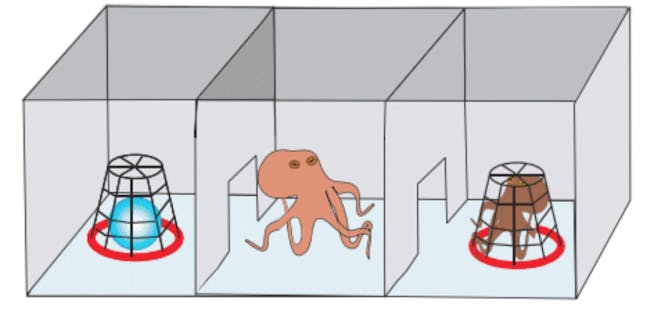
This became clear when she observed how octopuses acted after they were bathed in MDMA. Individual octopuses were put into the middle zone of a glass aquarium that was divided into three. From the middle zone, the subject octopus had the option to move into the zone on either side of it. On one side, there was another octopus in a cage, and on the other, there was a “novel toy object” (a Stormtrooper figurine). Sociality was measured by the number of seconds the subject octopus spent on the side with the caged octopus compared to the Stormtrooper side. Five octopuses were used in the control experiment, and four were used during the MDMA trial.
The study design.
Watching the individual control octopuses — those that hadn’t been bathed in MDMA — during 30-minute test sessions, the researchers found that all of the octopuses spent more time with the Stormtrooper when the social chamber contained a male. When the social chamber contained a female, both male and female octopuses tentatively explored that area.
They would “push against the wall and sort of delicately touch the container that had the octopus in it,” says Dölen.
But when these octopuses were on MDMA, they were notdelicate with their movements toward the caged individuals. After being placed in a bath with MDMA for 10 minutes then washed with saline for 20 minutes, they re-entered the three-zone aquarium. This time around, they spent significantly more time with the other octopus, whether it was male or female, and the eight-armed hugging commenced.
“This paper is welcomed, as the behavioral neuroscience of cephalopods is very understudied,” Dalhousie University invertebrate behavioral physiologist Shelley Adamo, Ph.D., who was not involved with the current paper, tells Inverse. Adamo also studies the interactions between behavior and physiology in invertebrate model systems. “We know little about how their brains work. This paper breaks new ground by examining the underlying molecular basis of at least one neurotransmitter system.”
But she also cautions that it’s too early to jump to conclusions because the paper’s evidence that “the octopus were engaging in ‘social’ behaviors is not especially strong.” There could be alternative explanations for all that friendliness: Maybe the drug altered their foraging behavior and the target octopus “smelled” like food (cephalopods are occasionally cannibalistic). Maybe the MDMA changed their typical hunting behavior, and being hungry could explain why both male and female octopuses were interested in the target.
“As with most interesting papers, it raises a number of questions: What would two octopus do if they were both on MDMA and they could contact one another?” Adamo asks. “The small sample size — a necessary evil for most studies on cephalopods — means that the data is not as robust as it could be.”
Dölen has two hypotheses to explain what happened. Qualitatively, it looks like octopuses on MDMA, much like humans, could just like touching in general and the octopus in the cage “is the most interesting object that an octopus would want to touch.” Or it could be that the drug really does make them social. The latter, she believes, is the most robust hypothesis: MDMA affects human interest in social touch as well, and that seems to be preserved in octopuses as well.
“What this says to me is that in the brain of an octopus, the neural circuits and transmitters that are required for social behavior must exist and they are just suppressed most of the time,” says Dölen. “Octopuses appear to suspend their asociality during important mating periods through a suppression mechanism in their brain.”
The MDMA used in the study was provided by the Multidisciplinary Association for Psychedelic Studies (MAPS), the nonprofit organization that funds the FDA-approved Phase 3 clinical trials of MDMA-assisted psychotherapy in patients with severe PTSD. This research, Dölen says, has intrigued MAPS founder Rick Doblin, and with good reason. It suggests that perhaps the best way to gain insight into MDMA’s mechanisms and therapeutic importance isn’t by taking an fMRI picture of the brain and examining the regions it activates, which has been standard practice in MDMA research. From Dölen’s point of view, the fact that octopuses don’t have same brain regions as humans but still carry the genes that enable MDMA binding means that molecular and cellular information is going to be more useful than anatomical data.
“Octopuses don’t have the same parts of the brain that we think are important for social behavior, a region called the nucleus accumbens,” says Dölen.
“What we’re arguing is that the brain regions don’t matter. What matters is that they have the molecules, the neurotransmitters, and some configuration of neurons. They have the serotonin transporter and that’s enough.”
NASA’s Transiting Exoplanet Survey Satellite, better known as TESS, has one mission: To find exoplanets around the brightest stars near the Earth. In just five months, it’s clear TESS is up to the task. On Tuesday, NASA announced TESS had just identified two potential planets around distant stars and released the first set of images captured by TESS. In the same week, collaborators at the Massachusetts Institute of Technology’s Kavli Institute for Astrophysics and Space Research submitted two papers outlining the evidence for the two planets.
In papers uploaded to the preprint server arXiv, the MIT researchers described a “super-Earth” that orbits its star once every 6.27 days and a “hot Earth” with an even shorter orbital period of just 11 hours. The first planet has a radius between four and five times that of Earth — hence its designation as a “super-Earth,” or a planet that is more than two but fewer than ten times the size of Earth. The hot Earth is a little closer in size to our planet, with a radius about 1.32 times that of Earth.
A closer look at the papers reveals what we know about the two new planets.
NASA_TESS✔@NASA_TESS
The @NASA_TESS team is excited to announce the mission's first candidate planet -- a super-Earth around the bright star Pi Mensae, nearly 60 light-years away. The planet orbits every 6.3 days. The discovery is now being reviewed by other scientists to validate it. Stay tuned!
On Sunday, a team led by Xu Chelsea Huang, Ph.D., a postdoctoral fellow at MIT’s Kavli Institute, submitted its findings on8the planet that orbits the star Pi Mensae (HD 39091) to arXiv. About 59.6 light years from Earth, this star is visible to the naked eye, and astronomers have previously discovered another planet orbiting it — a gas giant with a 5.7-year orbit. The newly discovered one orbits the star in just about that many days.
The researchers found the planet by measuring how the light emitted by its star dimmed periodically. This dimming indicated that something was intermittently coming between us and the star — in this case, a planet. This finding is evidence that TESS’s concept is working, as the satellite’s sole purpose is to map the sky and investigate transiting planets.
This graph shows how the light emitted by the star Pi Mensae (HD 39091) dipped when the planet passes between it and us.
It’s too early to tell what the conditions on this planet are like, but its size suggests that it could have a gas atmosphere like Neptune or Uranus.
“We also think this planet might be evaporating right now, given the intense irradiation it gets from its host star,” Huang told Space.com.
Since Pi Mensae (HD 39091) is an exceptionally bright star, scientists are confident that they will be able to further study its super-Earth using atmospheric spectroscopy, giving insights into its composition and habitability.
NASA_TESS✔@NASA_TESS
A second @NASA_TESS candidate planet has been discovered! Slightly bigger than Earth, this planet orbits LHS 3844, a M dwarf star 49 light-years away, every 11 hours. This find is being reviewed by other scientists, and we're looking forward to studying this cool "hot Earth."
On Wednesday, hot on the tail of TESS’s first images, a team led by Roland Vanderspek, Ph.D., the TESS deputy principal investigator at MIT’s Kavli Institute, submitted its findings on a hot Earth that orbits the M dwarf star LHS 3844, which is just under 49 light years away. And no, this hot Earth is not a sexy version of our planet.
So-called because of its extremely short orbital period and similar size to our planet, a hot Earth usually orbits very close to its home star. Often, its orbital distance is only a few times the radius of the star itself. This makes it a very hot Earth, indeed.
The planet’s extremely short 11-hour orbital period indicates that it almost certainly is tide-locked, meaning that one side of the planet always faces the star and one side always faces away. Therefore, this planet probably has one side that is molten lava and one side that is completely frozen. Imagine the Moon, but more extreme.
But despite the fact that this planet is almost certainly not a candidate for finding life, its proximity to LHS 3844 will allow scientists to study it closely as it transits twice a day.
These two discoveries come extremely early on in TESS’s two-year mission, indicating that many more exoplanet candidates will be identified soon. With over 200,000 stars on TESS’s mission schedule, odds are many of them will reveal transiting planets. At that point, astronomers will have their hands full studying all of them.
Alien Conspiracy – FBI Mysteriously Shut Down An Observatory and Order Evacuation
The move of the FBI to shut down a US observatory and lock down the surrounding area has sent alien conspiracy theorists into a frenzy.
The FBI mysteriously closed the National Solar Observatory (NSO) in Sunspot, New Mexico. The sudden decision has prompted theories about the reason as law enforcement keep mum about it.
On September 6, the observatory was suddenly shut down without apparent reason and after more than a week, no sign of reopening. Authorities have yet to explain the closure.
The Sunspot post office has been closed indefinitely. The United States Postal Service spokesman said that they were informed on September 6 that they would be evacuated and the surrounding area without further reason. They were just told to be out of the area until they were allowed to return.
Benny House of Otero County Sheriff said the FBI is refusing to tell them the reason. He stressed that they have people up there at Sunspot that requested them to standby while they evacuate it. However, nobody would elaborate on them the reason as the FBI were up there.
The Association of Universities for Research in Astronomy (AURA) spokeswoman said the evacuation was due to a security issue and they decided to evacuate the facility. AURA is the one that manages the observatory.
With the mysterious closure, conspiracy theorists have given their opinions. Many think that the solar observatory has captured a UFO on a photo while taking pictures of the sun. Others believe that there could be just a massive solar flare. However, most of them agree that there is definitely something off about it.
Wild Claims – UFOs Sabotaged NASA, SpaceX and Mars Probes
Three major space missions have been compromised, and UFOs have something to do with them, according to wild claims online.
Extraterrestrials reportedly have hacked and destroyed probes designed to scan the galaxy as a warning to humankind.
Conspiracy theorists had highlighted such apparent strange events as when a UFO was observed before the explosion of the SpaceX rocket in 2016 and before the disappearance of a Russian probe to Mars.
As far-fetched as it seems, these bizarre occurrences have sparked theories that intelligent aliens are monitoring our galactic missions very closely.
SpaceX rocket
Carrying a satellite Amos-6, the SpaceX Falcon-9 rocket exploded three minutes before the fire test. The satellite would have helped Facebook to extend their broadband across the world.
Conspiracy theorists spotted a strange grey orb, which appears a second before the explosion.
Some claimed the Pentagon fired a weapon to the rocket because the latter was becoming a competitor with Pentagon’s satellites.
NASA Voyager 2
In August 1977, the NASA’s Voyager 2 probe was launched to study outer planets. It’s the lone spacecraft to have visited Uranus and Neptune and has been the third most-distant human-made object from Earth that remains in contact with the space agency’s headquarters.
However, something extraordinary took place in 2010.
Voyager 2 started transmitting unreadable data for several weeks. German pseudoscience author Hartwig Hausdorf suggested aliens had hacked or reprogrammed the equipment in deep space.
Russia Mars moon probe
Russia’s Phobos 1 and 2 satellite probes were launched to explore the Martian moon in 1988, but one was reportedly lost. The second probe managed to reach the Moon and started sending back photos of the atmosphere and the surroundings, including images of strange objects with seemingly very thin eclipse shape on the surface of the moon.
The probe also managed to send a photo showing a large object between the spacecraft and Mars. Shortly after, the probe disappeared forever.
Conspiracy theorists claim the unidentified object was a giant cylindrical UFO, which cast the previous eclipse type shadow on the surface.
They have highlighted such bizarre events as when a UFO was seen seconds before the SpaceX rocket exploded in 2016 and before a Russian probe to Mars’ moon vanished.
These strange occurrences, as far-fetched as it seems, have sparked theories that intelligent lifeforms are closely monitoring our galactic missions.
SpaceX rocket
A SpaceX Falcon-9 rocket carrying a satellite Amos-6, which would have extended Facebook’s broadband across the globe, exploded three minutes before a scheduled fire test.
Some claimed the Pentagon had fired a weapon next to the rocket because SpaceX is becoming a competitor with its military satellites.
Sceptics said the UFO was simply a bird that appeared far bigger from a distance.
When Musk was asked about extra-terrestrial life, he replied on Twitter: “It is unknown whether we are the only civilisation currently alive in the observable universe, but any chance that we are is added impetus for extending life beyond Earth.”
In another reply on the social media site, the South African entrepreneur said: “There are no aliens, officially at least.”
DS
MYSTERY: A UFO was spotted flying past seconds before SpaceX rocket exploded
Nasa Voyager 2
NASA’s Voyager 2 probe, launched in August 1977 to study outer planets, is the only spacecraft to have visited the icy giants Uranus and Neptune.
It has been the third most-distant man made object from Earth and remains in contact with the space agency’s headquarters.
In 2010 something very strange happened.
Voyager 2 began transmitting unreadable data for several weeks prompting speculation that it had been hacked.
A German pseudoscience author Hartwig Hausdorf suggested aliens had tampered with the equipment in deep space.
"It seems almost as if someone has reprogrammed or hijacked the probe – thus perhaps we do not yet know the whole truth,” he said.
However NASA has a simpler explanation, blaming the malfunction on the memory of an on-board computer which within weeks was fully operational again.
While the science data was unintelligible, they insisted the probe was neither hacked or reprogrammed.
YOUTUBE
UFO: Shortly before it vanished the Russian probe beamed this strange image
It is suggested a cosmic ray from a solar storm could have struck the spacecraft.
Russia Mars moon probe
Russia launched satellite probes Phobos 1 and 2 to explore the Martian moon of the same name in 1988.
One was reportedly lost because of an error with radio command.
But the second probe reached the Moon and began sending back pictures of the atmosphere and the surroundings.
YOUTUBE
MARS: This object was captured by Russian probe exploring the Martian planet before it cut off
The incredible image showed some very strange objects, including what appeared to be a very thin eclipse shape on the moon's surface.
Shortly before the probe disappeared for ever, it sent back a photo showing a huge object between the spacecraft and Mars.
Conspiracy nuts claim the UFO was a giant cylindrical spaceship which they suggested cast the previous eclipse type shadow on the surface.
They believed it was the “first ever leaked account of an alien mothership in the solar system”.
Mysterious solar observatory evacuation caused by a child porn investigation, FBI docs say
Joel Shannon USA TODAY
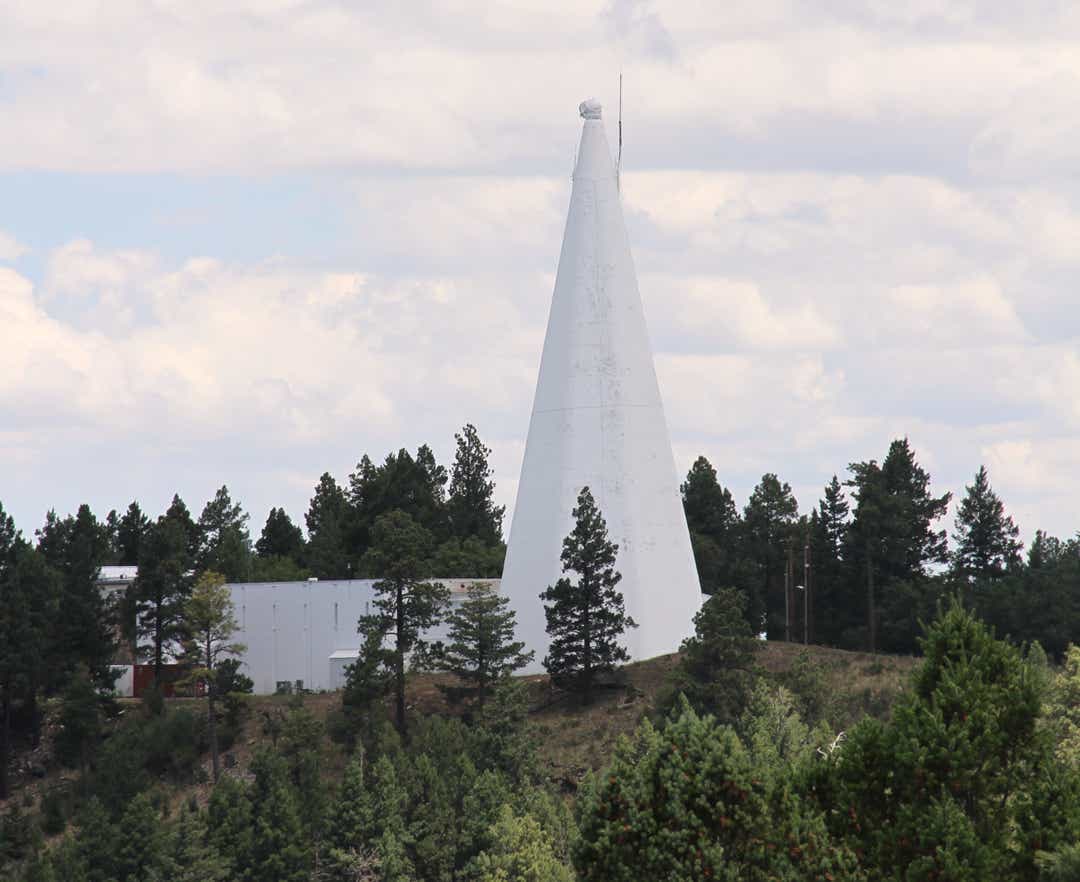
The Sunspot Solar Observatory telescope sits next door to the Apache Point Observatory. On Sept. 6, the observatory was closed and evacuated due to an undisclosed security issue.
File photo/Daily News
The sudden and previously unexplained evacuation of a New Mexico solar observatory on Sept. 6 was prompted by a child pornography investigation, according to Federal Bureau of Investigation documents.
An individual is suspected of "utilizing the wireless internet service of the National Solar Observatory in Sunspot, New Mexico, to download and distribute child pornography,” Reuters reported Wednesday, citing newly unsealed FBI records.
A laptop at the facility was seized without the knowledge of the suspect — a janitor, the Albuquerque Journal reported. The evacuation came after that person became increasingly agitated, prompting concerns about the safety of staff at the observatory, the publication reports.
In the wake of the evacuation and closure, officials provided little information, leading to widespread speculation and conspiracy theories. The observatory's proximity to Roswell — the site of an alleged UFO crash — helped fuel speculation, Reuters says.
The observatory reopened this week.
The Association of Universities for Research in Astronomy, the organization that oversees the observatory, reported Sunday that the site had been evacuated due to "law enforcement investigation of criminal activity" at Sacramento Peak, the mountaintop on which the observatory is located.
Authorities determined there was no risk to staff and that regular work could commence on Monday, the release stated.
The person being investigated has not been arrested or charged, Reuters reports.
'Ask a Spaceman' Reveals Why You Wouldn't Want to Enter a Wormhole
By Elizabeth Howell, Space.com Contributor
Whether you're a fan of "Star Trek,", "Doctor Who" or the Marvel universe, all of these franchises have at least one thing in common —– they use wormholes to move people through space rapidly. Are wormholes a real thing, or just a staple of science fiction?
"Wormholes, right?" says Sutter says in today's episode, which is Episode 6 of the series overall. "[They are] a staple of science fiction, where you can just —– boop! —- go somewhere else in the universe as fast as the plot needs to go."
To understand how a (theoretical) wormhole works, first you need to know a bit about the science of black holes, which Sutter covered in Episode 4 and Episode 5. Basically, there are several kinds of black holes. The type that Sutter focuses on is stellar-mass black holes, which happen after huge stars reach the end of their lives and explode in a supernova.
What's the deal with wormholes? Astrophysicist Paul Sutter explains in episode 6 of the Facebook Watch series "Ask a Spaceman."
Credit: Ask a Spaceman/Space.com
After a supernova happens, the resulting gravitational collapse creates a black hole, which is an extremely massive object that traps all matter and light that get too close. Black holes can only be seen only by using the radiation they emit, or by tracking their gravitational effects on other objects. And they are one possible way of generating a wormhole.
If you picture a black hole as a funnel, Sutter explains in the video, objects that get "trapped" in the black hole pass beyond its event horizon (the mouth of the funnel) and then move down. So, where's the wormhole? It's an equal and opposite funnel attached to the black hole funnel, mouths facing outwards. Sometimes this kind of wormhole is called a "white hole.".
There are a few problems with the white hole theory, Sutter saidys. It's hard to figure out exactly how you get in to the white hole from the black hole. The mathematics behind white holes show that they are incredibly unstable. Whitle holes might evaporate or even "snuff out" a black hole altogether after forming.
But even if wormholes connecting a black and a white hole could exist, they are deadly. Because once a person or a spacecraft gets in to the black- hole- event horizon, they would just get trapped, Sutter saidexplains. There's no way they could escape the hole from either the black hole side or the white hole side, because, by definition, you can never pass back out beyond a black hole's event horizon; you have to go to the singularity, whether or not it's connected to a white hole singularity.
So maybe it's best to leave the wormholes and "wibbly wobbly" science of time to "Doctor Who," or one of the "Star Trek" captains.
The episodes will be released weekly on Wednesdays at 12 p.m. EDT (1600 GMT), so " like" the Facebook page or check back later to see more. Sutter also responds to reader questions in every episode. Click here to learn more about past topics the show has covered, such as the Big Bang and Pluto.
Sutter is a cosmologist at Ohio State University and chief scientist at Columbus Ohio's the Center of Science and Industry in Columbus, Ohio. He has a long-running podcast, also called "Ask A Spaceman.". You can catch all past episodes of his podcast here.
NASA Announces Spacecraft Flyby of Object Four Billion Miles from Earth
by Penny Starr
National Aeronautics and Space Administration (NASA) scientists held a “science chat” on their Facebook page on Wednesday outlining the “farthest planetary encounter in history” as the New Horizons spacecraft heads to the edge of the solar system to inspect a mysterious “object.”
The spacecraft will have a “close encounter” with the object just after midnight on Jan. 1, 2019.
“We’re coming down on what is going to be a truly historic event,” said Mike Buckley, a public affairs specialist with the Johns Hopkins Applied Physics Laboratory in Maryland where the scientists manage the New Horizons mission.
“In just over 100 days the New Horizons spacecraft will add another chapter to its remarkable story with a flight past the Kuiper Belt object nicknamed ‘Ultima Thule,’” Buckley said. The new nickname for 2014 MU69 comes from medieval literature and refers to a distant, unknown world.
Ultima Thule is four billion miles away from Earth, having passed Pluto, the last target of the spacecraft’s flyby, in 2015. It’s located in a previously unknown part of the solar system, according to Alan Stern, New Horizons principal investigator, who took part in the chat from the Southwest Research Institute in Boulder, Colorado.
He said the story started with the discovery of Pluto decades ago.
“Its discovery was the harbinger of our knowledge now that there’s a whole third zone to the solar system,” Stern said.
“We’re a billion miles beyond Pluto now traveling at 32,000 thousand miles per hour over 24/7 — on our way to the first flyby to an object out in the Kuiper Belt,” Stern said.
The New Horizons will be the first spacecraft to explore what scientists say is a sea of stars in a deep freeze in deep space.
The flyby will be three times closer to the Ultima Thule than it was to Pluto, an encounter that captured some stunning images of the dwarf planet and its moons.
Scientists compared the Kuiper Belt to an archeological dig because that part of space is like going back in time to when the solar system first formed.
They expressed excitement about the flyby, which will begin on Christmas Day and culminate on the first day of 2019.
The creators of Star Trek made the decision to base Spock’s home solar system around one that exists in real life- the triple star system that houses primary star 40 Eridani A. The star, also known as Keid or HD26965, has been revealed to possess at least one planet in orbit. The other two stars, Eridani B and C, have been dismissed as possessing any habitable planets due to the environmental hazards posed by the two suns, which include dangerous flares and the sterilization effects of a white dwarf. Eridani A, however, is thought to have a “habitable zone” where it is possible for a planet to support life.
40 Eridani A, The Real-Life Planet Vulcan
An artist's depiction of planet 40 Eridani A (Credit: Don Davis)
Characteristics of 40 Eridani A that are similar to our own sun have given rise to hopes that the planet in question may be host to lifeforms, in whatever shape they come, or at least have the potential to support life. While the planet is not quite in the habitable zone, the possibility of life has not been ruled out yet. It is double the size of Earth and has a much shorter year, lasting only 42 days. Like the planet Vulcan in the hit series Star Trek, the new planet will likely be fairly hot, due to its close proximity to its sun.
The find has been hailed as the first Earth-like planet of its size found by the Dharma Planet Survey, a project that is in the process of detecting and categorizing large Earth-like planets that may be of interest in future exploratory missions.
It is reported that 40 Eridani A was specifically chosen by Gene Roddenberry due to its age and characteristics. At 4 billion years old and the most viable star in the system, Roddenberry felt that it would give Vulcans the time needed to evolve into a functional humanoid race.
The research is described in a paper posted to the preprint server arXiv.org on July 18 and scheduled for publication in the journal Monthly Notices of the Royal Astronomical Societynext month.
It was not caused by extraterrestrials. It was not caused by secret military operations. It was not caused by unusual sunspot activity or incoming asteroids. It was not caused by foreign hackers. Those were all possible reasons given since September 6th when the Sunspot Solar Observatory in Sunspot, New Mexico, was mysteriously shut down and evacuated, along with some of the surrounding area, by the FBI, which kept local law enforcement in the dark while allowing surveillance by Blackhawk helicopters. It was a sight and a secret operation made for conspiracy theories and they flourished. In fact, they barely dissipated when the facility was reopened on September 17th with the vague explanation that there was a criminal investigation.
It turns out there was. When you hear the real reason, you may wish it was one of the others.
“According to a search warrant filed in U.S. District Court in Las Cruces, the FBI began investigating after a wireless signal at the observatory, located on Sacramento Peak in the Lincoln National Forest, accessed child porn multiple times since January. During an interview on Aug. 21, the facility’s chief observer told agents he had found a running laptop with child porn on it in an empty office several months before.”
The Albuquerque Journal had access to the search warrant and reports that someone whose job is identified as “chief observer” first believed that the laptop belonged to a research student but nothing was done because he was “distracted by an urgent matter within the facility.”
It gets worse.
Further investigatin determined the laptop actually belonged to a part-time janitor under a contract to the facility which gives him entry authorization and full access to all areas. After the laptop was secretly seized, the janitor began to act suspiciously, at first complaining about “missing some cleaning supplies.”
“(The janitor) had continued to look feverishly through the facility and continued to make comments about the lax security.”
Those comments were made to the chief observer, who became even more concerned, according to the search warrant, when the janitor predicted that the poor security would cause the facility to be “hit” – possibly by a serial killer who would “enter the facility and execute someone.”
News channel KTSM.com reports that, while the janitor is identified by name in the warrant as the main suspect, charges have not yet been filed. If that makes the returning employees, local residents and Sunspot law enforcement officials nervous, CBS Albuquerque affiliate KRQE reports that the observatory director and the Association of Universities for Research in Astronomy, which runs the observatory, say there’s nothing to worry about.
“Given the significant amount of publicity the temporary closure has generated, and the consequent expectation of an unusual number of visitors to the site, we are temporarily engaging a security service while the facility returns to a normal working environment.”
Eerie Ring of UFO Lights over Minnesota captured by several witnesses
A strange ring of lights like a flying saucer type has been spotted in the sky over Minnesota by several witnesses on different locations on September 14, 2018.
A couple drove home when they suddenly saw something strange above the road at Stillwater in the state of Minnesota.
The man and his girlfriend are absolutely convinced that it is not a reflection or something like that because after the object had been hanging over the road for about four minutes, it suddenly flew away with great speed.
They managed to capture two images of the UFO.
Another witness noticed the UFO above Shakopee Archery Range, Jackson Township, Minnesota and recorded the object, see below video.
No doubt it is the same object despite it has changed its color, but what is it?
White UFO Seen On Live NASA Space Station Cam, Sep 20, 2018, UFO Sighting News.
Date of discovery: Sept 20, 2018 Location of discovery: Earths orbit at space station I was watching the NASA live space station cam looking for UFOs when I spotted this little guy. A white disk moved over the space station. It was small so I'm sure NASA didn't notice it, otherwise they would have gone to blue screen to hide it. The UFO passes the space station, but at a great distance, as if it didn't want to be noticed by the astronauts. Scott C. Waring-Taiwan
PROJECT BLUE BOOK: THE STUNNING TRUE CASES BEHIND HISTORY'S NEW UFO SHOW - IGN FIRST
The truth is out there, and it's declassified.
BY LAURA PRUDOMAll September long, IGN is highlighting the best TV coming your way in the 2018-2019 season. Today, we're delving into the mysterious world of Project Blue Book, executive produced by Robert Zemeckis. The sci-fi drama tells the story of Dr. Allen Hynek, a genius college professor recruited by the U.S. Air Force to spearhead the titular operation that researched thousands of real-life cases involving Unidentified Flying Objects, many of which were never solved. The series premieres this winter on History.
It's often said that truth is stranger than fiction, but nowhere is that more evident than in History Channel's new scripted drama series Project Blue Book, based on the real-life, previously classified government investigations into UFOs that took place during the 1950s and '60s.
The show stars Game of Thrones alum Aidan Gillen as Dr. Allen Hynek, an inquisitive but practical scientist who became one of the world's leading ufologists thanks to what he encountered while working on the top-secret government project.
Gillen admits that Hynek's real-life trajectory proved to be one of the most surprising and compelling aspects of the series for him. "For somebody who joined the US Air Force as a scientific advisor, to ultimately become the person who sets up the Center for UFO Studies, and a leading figure in that world, and still retain his credibility as a scientist... He wasn’t a quack who was convinced human beings were visited daily by little green men, you know? That’s really interesting," Gillen tells IGN.
"He started as a skeptic, and did not end as a skeptic. He was a very open-minded scientist who would never take an easy out and always thought logically. At the same time, he didn’t jump to explain things away in illogical ways, like, 'well these are definitely visitors from other planets.' In fact, he was quite wary of that kind of assumption. He wanted people to keep an open mind about the possibility that there was stuff there, but not be too quick to assume where it came from."
In the show, as in reality, Hynek is recruited by the Air Force to investigate inexplicable phenomena, but rather than seeking the truth, it soon becomes clear that the government is far more interested in providing palatable, mundane answers for these extraordinary encounters in an attempt to prevent mass hysteria. Thus, he's partnered up with Captain Michael Quinn (Michael Malarkey), a by-the-book military man who is initially happy to toe the party line without asking too many questions. Quinn is an amalgam of real-life characters, but was initially based on Edward J. Ruppelt, an Air Force Captain who oversaw Project Blue Book and its predecessor, Project Grudge.4
IGN has an exclusive first look at a scene from Project Blue Book's premiere, which sees Quinn insisting on a logical explanation for an unsettling close encounter, while Hynek maintains that he needs firsthand evidence in order to be convinced that a potential UFO is nothing more than a weather balloon. Check it out below:
Malarkey offers us some insight into what's going through his character's head in the pivotal scene. "I think he’s starting to realize that Hynek is not the kind of guy who’s just gonna be bossed around and be an underling, which he was kind of hoping for," he says. "And he’s kind of realizing, 'okay, this guy is brilliant, but this is going to be a problem if it continues like this. So, maybe I need to teach this guy a lesson, and show him just what we’re up against here and what we’re dealing with, so he can have a firsthand experience that this isn’t a game, this is life or death. If we stall, we’re holding back proceedings.' It’s the first time we see the conflict of interest, where Quinn’s going, 'we need to close the cases,' and Hynek’s going, 'well, we can’t close the cases if it’s not one hundred percent sure that that’s what happened.' And I’m like, 'you’re missing the point, buddy.' And that’s the first time we see that difference of motive for why they’re doing what they’re doing."
Adds Gillen, "It’s pretty important for Quinn to see that Hynek is game, or for Hynek to test Quinn - [although] he’s really testing himself. And as our story progresses, we will possibly see little shifts in that dynamic, and that relationship. And I don’t mean in that it’s an endless power play, or anything like that - it’s just them getting comfortable with each other, and inspiring each other to go further in their own ways to get to the truth. And ultimately, to find themselves as a team or a union that’s more powerful [together] than individually."
Despite Quinn's attempts to keep things moving and keep his superiors happy, Malarkey admits that teaming up with Hynek "appeals to parts of Quinn’s intellect as well. He’s been used to dealing with meatheads and people who are just barking orders. And it’s the first time he’s had to go in depth and chat back and forth with another person. He’s been used to working alone. And I think he’s realizing, as time goes by that, yeah, he actually is interested. He’s spent so long shoving off that part of him that would even allow himself to be interested, and once that door is opened, he starts seeing a lot more of the subtextual things that are going on in the chain of command. And starting to get a little upset about being left in the dark about all that stuff."
While the show takes some artistic liberties in adapting Hynek's story, Project Blue Book truly is based on real-life reports and investigations into UFOs, many of which were classified up until a few years ago. There were approximately 12,000 cases reported during that period, and while many sightings did have earthbound answers, there are still 700 cases that are unexplained to this day - something that Malarkey admits helped convince him that there may indeed be other life out there in the universe.
"What surprised me the most, I think, was the sheer quantity of stories, and especially ones that are unsolved... Seeing images, hearing actual accounts. I’m a hundred percent positive there’s a lot of fake stuff in there, but the fact that there’s that much stuff, some of the stories that are just so detailed and realistic … it just made me think about it a lot more than I ever have, and, I think, tip into the point of going, 'yeah, I know pretty much for sure that there’s something else going on.' I was a considerer, now I’m a believer."
Over the course of his research and filming the show, Malarkey says he discovered some pretty disturbing stories that made him think twice about possible explanations for these cases. "I think the most disconcerting thing for me is the amount of Air Force pilots who are up there in the skies, continuously seeing these things, and also mysteriously disappearing or being silenced or having issues or dying. There’s obviously cover-ups going on. And the fact that no one is telling us why it’s so serious to cover something like this up or what it is, it makes me believe that there is something huge to be covered up," he admits. "And also, working closely with the Air Force and learning nonverbals and how things work, this was a serious national crisis. It wasn’t just 'oh, let’s check out the flying saucers!' It's like, 'This is a crisis, we’re at breaking point. Potentially there’s gonna be anarchy and complete mayhem in the United States.'"
Sounds like a pretty good justification for a cover-up, right?
To delve deeper into the mysteries of Project Blue Book, keep an eye out for it this winter on History, with a premiere date to be announced soon.
Les “champignons verts” sont les images des lampadaires situés dans le bas de l’image, créées par de multiples réflexions parasites sur les surfaces des lentilles de l’objectif de l’appareil photo.
Face aux insondables cieux étoilés, nous ne sommes pas seuls. Qu’il s’agisse d’Ovni (Objet volant non identifié) ou PAN (Phénomène aérospatial non identifié), la réponse n’est pas toujours celle qu’on imagine ou qu’on espère, esprits rêveurs que nous sommes. Avant la conférence prévue vendredi à Annonay, Xavier Passot nous ramène les pieds sur terre.
Xavier Passot a lu des histoires fantastiques durant son travail au sein du Geipan.
“Le 28 mai 1977, à partir de 3 heures du matin, une étudiante fait trois observations d’un phénomène lumineux qui l’intrigue. Une boule de couleur jaune se déplace lentement avant de disparaître. Un autre témoin viendra sur les lieux de l’observation le lendemain entre 2 et 4 heures du matin. À la verticale de l’endroit d’observation indiqué par le premier témoin, il constatera la présence de la… Lune.”
1er juillet 1977 à chabeuil : Envoûtés par Vénus
“Le 1er janvier 1977, entre 19 h 30 et 19 h 45, deux personnes en voiture ont leur attention attirée par un objet très lumineux. Ils décrivent d’abord une boule très brillante immobile de couleur blanche située à 150 mètres�environ d’altitude puis un engin émettant une lumière très intense. L’observation a duré� environ 10 minutes avant que l’objet ne décrive une courbe de 45° et disparaisse en direction du Sud. La cartographie du ciel établie a posteriori montre la présence de Vénus dans le secteur du ciel observé.”
30 août 1979 à lus-la-croix-haute : des champignons pourtant pas hallucinogènes
“Le 30 août 1979, un cultivateur se rend dans un champ de seigle et aperçoit au sol un rond brûlé�de 10,50 mètres de diamètre. Il remarque que l’herbe est plus verte à l’intérieur du cercle que dans la prairie avoisinante. Aux environs du 20 septembre, ce même témoin découvrira que des champignons du type rosés des prés ont poussé à l’intérieur et extérieur du cercle.”
25 juillet 1993 à Saint-Etienne-de-Lugdares : la piste à l’Ovni devient piste de danse
“Dans la nuit du 24 au 25 juillet 1993, entre 2 h 45 et 3 h 30, trois témoins observent un phénomène lumineux blanc qui se déplace en tournant sur lui-même avec de nombreux points lumineux. L’enquête montrera rapidement qu’il s’agit d’un projecteur multifacettes d’une discothèque voisine, dont la lumière se reflétant sur le plafond nuageux bas peut s’apercevoir de très loin.”
1er décembre 2004 à Annonay : Débris
“Le 1er décembre 2004, vers 19 h 30, un témoin observe, dans le ciel, une boule blanche fort lumineuse qui descend à très grande vitesse. Avant d’atteindre le sol, cette boule se transforme en un petit point rouge et disparaît. Un autre témoin observera �également ce phénomène qui lui fait penser à une fusée éclairante. Les témoins ont probablement observé une rentrée atmosphérique (météorite ou bout de satellite entrant dans l’atmosphère).”
19 juin 2007 à Nyons : une navette spatiale pas si extraterrestre
“Une personne rapporte son observation faite le 19 juin 2007 à 22 h 10. Depuis son balcon, le témoin a son attention attirée par le passage silencieux Nord-Sud d’un phénomène très lumineux suivi de près par un second au volume beaucoup plus important. L’ensemble se déplace à vitesse constante et disparaît derrière une colline dans une trajectoire descendante. Un passage de la station spatiale internationale (ISS), accompagné de la navette qui venait de se séparer de la station, a eu lieu ce jour-là.”
26 octobre 2011 à Loriol-sur-Drôme : l’appel de phare aérien
Ceci est un… avion.
Photo Xavier Passot 2011
“Le 26 octobre 2011, vers 20 h 30, un témoin observe dans le ciel (région de la constellation du Verseau) une étoile extrêmement brillante. Le témoin s’étonne de constater que l’intensité lumineuse diminue progressivement pour finir en un tout petit point dans le ciel. L’observation fait penser à un avion vu de face, phare allumé, vu à une distance de plus de 10 km (qui rend les feux vert et rouge invisibles) et qui aurait changé de direction.”
Notre dossier complet à lire dans les éditions Drôme-Ardèche du Dauphiné Libéré de ce mercredi 19 septembre
Lâcher de lanterne thaïlandaise qui, dans le ciel, peut apparaître comme un étrange phénomène lumineux.
Photo Xavier Passot 2012
Par Etienne GENTIL | Publié le 19/09/2018 à 06:01 | Vu 41853 foisµ
The universe may be teeming with life, but we have yet to find any beyond Earth. These are the best prospects, says Stephen Fleischfresser.
Saturn’s moon Enceladus.
STOCKTREK IMAGES / GETTY IMAGES
You may have noticed that there are not a lot of aliens around. Which is weird, because many scientists think there should be life all over the universe. There’s even a formula called the Drake equation which tells us it probably exists.
However, alien life doesn’t have to be intelligent to be exciting. Any evidence of life elsewhere in the universe would be an amazing discovery! As we learn more about space, planets, chemistry and biology, we get more clues as to where we should be searching. Here are some of the places where scientists think we might find extraterrestrial life.
1 | ENCELADUS
Enceladus, named after a giant in Greek mythology, is actually a smallish moon of Saturn. It’s only 500 km in diameter, and when compared to Saturn’s largest moon Titan, with a diameter of 5,000 km, it seems pretty tiny.
Enceladus was discovered by the English astronomer William Herschel in 1789, but all he could really see was a dot through a telescope. For a very long time that’s all anyone knew, and most people thought this little moon was totally boring.
But in the 1970s NASA launched the Voyager spacecraft missions and they revealed a rather pretty, and surprising, icy world. Importantly the surface of Enceladus, composed of thick ice, was made up of different regions - some were very young, and some were very old. This told scientists that there were active geological processes going on.
In 2005, NASA’s Cassini spacecraft gave us a whole new outlook when it discovered huge spouts of salty water vapour, mixed with sand and simple organic compounds of carbon and hydrogen, venting from Enceladus’ surface. This led scientists to think that there must be a huge sub-surface ocean that is kept warm by some sort of energy source. In 2017, scientists confirmed the presence of hydrogen molecules which suggests the presence of hydrothermal vents in the moon’s ocean.
Taken together, this means that Enceladus is probably the most exciting place in the solar system to look for life.
PS. There’s another moon very similar to Enceladus orbiting Jupiter, called Europa. It too could support life, but its icy surface is much thicker than Enceladus’, making it difficult to investigate.
2 | TITAN
Titan is Saturn’s largest moon. It’s half as big again as our moon. It’s huge! It also has a thick atmosphere and is the only other place in the solar system to have lakes and rivers. Perfect!
But there are a few problems. The atmosphere is mostly nitrogen, the lakes and rivers are made of liquid methane and the temperature is almost -180°C.
So perhaps, not so perfect after all.
Just like Enceladus, Titan was visited by the Voyager probes, but unfortunately, they couldn’t see much through the thick, hazy atmosphere first noted by its discoverer in 1655, the Dutch astronomer Christiaan Huygens.
Once again, the Cassini spacecraft came to the rescue. It arrived at Saturn in 2004 and landed a probe, appropriately called Huygens, on Titan’s surface in 2005. The probe, together with radar mapping from orbit, revealed another young and geologically active world with a possible sub-surface ocean.
Subsequent research has revealed the presence of many different kinds of complex organic molecules, a number of which are necessary for life as we know it. Some scientists have suggested that life might be hiding in the oceans below or in the lakes and rivers, but it is so cold on Titan that anything living there might be very different from life on Earth.
3 | MARS
Mars has always been fascinating to Earthlings. It is one of only three planets, along with Venus and our own world, at just the right distance from our sun to make it a likely place for life. Scientists call this the ‘habitable zone’ because it is possible for planets, with the right atmosphere, to have liquid water on their surfaces.
We know that Mars has water, but it’s mostly frozen in polar ice caps, which were first seen by Herschel. We also know that millions of years ago Mars probably had the right sort of conditions for life as we know it.
In the 1970s NASA’s Viking landers reported that Martian soil had been exposed to water and nutrients and that lots of carbon dioxide was given off, just as it would if bacteria in the soil were alive. Then, in 2018, the Curiosity rover discovered organic compounds in the soil. Indeed, the recent discovery of organisms that eat hydrogen in Antarctica, where conditions are much like Mars, has boosted hopes of finding life.
So that’s it for the solar system. But what about planets orbiting other stars in the galaxy, known as ‘exoplanets’? Unfortunately, we know a lot less about exoplanets because they’re so far away, but astronomers have worked out that there are lots of them that might be able to sustain life. Let’s take a look.
4 | TRAPPIST-1 PLANETS
Forty light-years away is a tiny star known as TRAPPIST-1. It’s a red dwarf star, which is the most common type of star in the galaxy. Orbiting this little lukewarm star is not one, but seven rocky planets. All of these planets are a good size, with the smallest being about half the size of Earth and the largest being one fifth larger than our own world.
What’s weird is that they are all so close to their tiny star, with at least three in the star’s habitable zone. While some argue that only one of these could really sustain life, TRAPPIST-1 offers some great opportunities for future research.
5 | PROXIMA CENTAURI B
Discovered in 2016, the closest rocky exoplanet to Earth is Proxima Centauri b. If you were travelling at light-speed it would take you four years to get there.
Proxima b, as it’s also known, is in the habitable zone of the orbit of the red dwarf star Proxima Centauri and so has fairly mild surface temperatures. It’s between 1.5 and three times the mass of Earth and is known as a ‘super-Earth’ planet.
Unfortunately, Proxima b’s star is extremely active and the surface of the planet gets blasted by roughly 30 times more UV radiation than the Earth and is constantly bombarded by a huge stream of gas known as a ‘stellar wind’. This wind would have ripped away any atmosphere that Proxima b might once have had. Nonetheless, life might survive beneath a planet’s surface, and because Proxima b is so close to Earth, scientists are excited to learn more about it.
6 | ROSS 128-B
This is the most recently discovered exoplanet in a habitable zone and might be the most exciting of them all.
The star Ross 128 is 11 light-years away and doesn’t emit much radiation, making it one of the friendliest places for life that scientists have found outside our own solar system.
In orbit around this small, gentle star is a rocky exoplanet known as Ross 128-b. The planet is 1.3 times larger than Earth and 20 times closer to its sun. But because Ross 128 is so quiet, the planet would probably be warm rather than hot. Scientists estimate that although Ross 128-b is only just inside the habitable zone, it might well have surface temperatures ranging from 21°C to -60°C. While that might be on the chilly side for us, there are plenty of lifeforms, particularly microorganisms, who would think that’s balmy. Although there is still much to discover about Ross 128-b, it’s probably the best place to look for life outside our own cosy corner of the Milky Way.
Image captionThe RemoveDebris is a demonstration satellite that was launched from the space station in June
JUNKY SKIES
If aliens ever visit our planet, their first impression could be that Earthlings are a messy bunch: There’s an estimated 7,500 tonnes worth of discarded satellites, rocket parts, and other debris currently floating in our planet’s orbit.
Now, efforts are underway to clean it up. One such effort: RemoveDEBRIS. In April, the team out of Surrey Space Centre (SSC) sent its RemoveDEBRIS satellite to the International Space Station (ISS) aboard a SpaceX Dragon spacecraft; on Sunday the satellite launched from the ISS to demonstrate one of several debris-wrangling technologies.
The short sequence shows a small, shoebox-sized object tumbling end over end about 6-8m in front of the University of Surrey spacecraft.
Suddenly, a bright web, fired from the satellite, comes into view. It extends outwards and smothers the box.
"It worked just as we hoped it would," said Prof Guglielmo Aglietti, director of the Surrey Space Centre.
"The target was spinning like you would expect an uncooperative piece of junk to behave, but you can see clearly that the net captures it, and we're very happy with the way the experiment went."
AIRBUSImage captionThe net as it was stowed in its firing mechanism
If this were a real capture, the net would be tethered to the deploying satellite, which would then tug the junk out of the sky.
As this was just a demonstration, the net and the box (which was actually pushed out from RemoveDebris to act as a target) will be allowed to fall to Earth on their own. Their low altitude means it should take only a couple of months before they burn up in the atmosphere.
There has been much talk about the need to clean up space, but the Surrey satellite is the first to try out practical solutions.
Shortly, RemoveDebris will test a new camera system to track space junk - again, on a target it has brought along for the experiment.
Later, perhaps early in the New Year, there will be a demonstration of a harpoon that can snare junk. And finally, RemoveDebris will deploy a large membrane - what is termed a "drag sail", which will brush against the high atmosphere and pull the whole mission into a destructive dive towards the planet.
Image captionArtwork: How the net experiment was envisioned before its deployment
There are now millions of discarded pieces of metal and other materials in orbit - everything from old rocket segments to accidentally dropped astronaut tools, even flecks of paint.
The fear is that if we do not soon start taking this litter out of the sky, it will become a significant threat to active satellites.
Alastair Wayman is an engineer with the aerospace giant Airbus, which is also involved in the RemoveDebris project.
"If there are collisions, as there have been previously, then they will create lots of space debris. That debris then collides with more spacecraft, and you get even more space debris. It's a kind of snowball effect," he told BBC News.
The issue of space junk is particularly pressing because a number of companies are in the planning stages of launching thousands of new satellites.
Already there are calls for a tough new approach to licensing these spacecraft that would demand operators be able to bring down rapidly any of their hardware that fails in orbit.
The miniature harpoon to be tested on the mission
DEBRIS DEMO
For this demo, the satellite released a shoebox-sized objectto act as its target, then fired a spider-like web that wrapped around the box.
“It worked just as we hoped it would,” SSC Director Guglielmo Aglietti told BBC News. “The target was spinning like you would expect an uncooperative piece of junk to behave, but you can see clearly that the net captures it, and we’re very happy with the way the experiment went.”
In a full-scale version of the technology, the net will remain tethered to the RemoveDEBRIS satellite so it could pull the captured junk out of the sky when it dives toward the Earth at the end of its mission.
But since this was just a demonstration, both the box and the net will simply burn up in the Earth’s atmosphere within the next couple of months. Had the demo occurred higher up in the atmosphere, though, both would have continued to orbit the planet along with the rest of the space junk.
TRASHTOR BEAM
In 2019, the RemoveDEBRIS satellite will demonstrate another technology — a harpoon that snares space junk. Russian scientists are also building a gigantic space laser to zap junk out of the sky, and NASA is working on a large, flat sheet it hopes to use to envelop debris.
And, really, we have no time to waste. This debris already threatens the rockets and satellites already in commission. More cluttered space could make it difficult to launch new spacecraft. If that happens, we might be stuck hoping aliens do find us — after all, we won’t be able to go out hunting for them.
Weird Infrared Signal Emanates Across Space, But What Created It?
By Yasemin Saplakoglu, Live Science Staff Writer
A group of researchers recently observed a mysterious infrared emission coming from near a pulsar in NASA's Hubble Space telescope data. This animation depicts one possible source of the emission: a "fallback disk" or a disk that formed from materials of the parent star falling back into the neutron star after a supernova.
Credit: ESA/N. Tr’Ehnl (Pennsylvania State University)/NASA
Space is filled with bizarre signals that we scramble to put meaning to — and now, researchers have detected yet another mysterious signal. This one emanated from near a neutron star, and for the first time, it's infrared.
So, what's nearby that could have created the weird signal? Scientists have a few ideas.
When a star reaches the end of its life, it typically undergoes a supernova explosion— the star collapses, and if it has enough mass, it will form a black hole. But if the star isn't massive enough, it will form a neutron star. [Supernova Photos: Great Images of Star Explosions]
Neutrons stars are very dense and, as their name suggests, are made up mostly of closely packed neutrons. Neutron stars can also be called "pulsars" if they are highly magnetized and rotate rapidly enough to emit electromagnetic waves, according to Space.com.
Typically, neutron stars emit radio waves or higher-energy waves such as X-rays, according a statement released by NASA yesterday (Sept. 17). But an international group of researchers from Penn State, the University of Arizona and Sabanci University in Turkey observed something interesting in NASA's Hubble Space Telescope data: a long signal of infrared light emitted near a neutron star, the researchers reported yesterday in The Astrophysical Journal.
This signal, they found, was about 800 light-years away and was "extended," meaning it was spread across a large stretch of space, unlike typical "point" signals from neutron stars that emit X-rays. Specifically, the signal stretched across 200 astronomical units (AU) of space, or 2.5 times the orbit of Pluto around the sun, according to a statement from Penn State. (One AU is the average distance from Earth to the sun — about 93 million miles, or 150 million kilometers.)
Such extended signals have been observed before, but never in the infrared, lead author Bettina Posselt, an associate research professor of astronomy and astrophysics at Penn State, told Live Science.
This illustration depicts a "pulsar wind nebula" another source that could have produced this infrared signature.
Credit: Pulsar wind nebula
Based on previous data, the amount of infrared radiation is much more than the neutron star should be emitting, Posselt said. So "all of the emission in infrared we see is likely not coming from the neutron star itself," Posselt said. "There's something more."
The neutron star in question, RX J0806.4-4123, is one of the nearby X-ray pulsars collectively known as the Magnificent Seven. They are bizarre characters: They rotate much more slowly than typical neutron stars (it takes 11 seconds for one rotation of RX J0806.4-4123, whereas typical ones rotate in a fraction of a second), and they're much hotter than they should be based on when they formed.
In their study, the researchers proposed two possibilities for what could have snuggled up near RX J0806.4-4123 and emitted these mysterious signals: a disk of dust that surrounds the pulsar, or a "pulsar wind nebula."
A "fallback disk" — that could stretch 18 billion miles across — could have formed from the remnants of a resident star following a supernova explosion, Posselt said. Such disks that "have been long searched for, but not found" would most likely be made up mainly of dust particles, she added.
The inner part of such a disk would likely have enough energy to produce infrared light, Posselt said. This could also help explain why RX J0806.4-4123 is so hot and spins so slowly. "The disks in the past could have provided some extra heating," and also slowed down its rotation, Posselt said.
The second explanation is that perhaps the infrared signal is coming from a nearby pulsar wind nebula.
A pulsar wind can form when electrons from a neutron star are accelerated in an electric field produced by the neutron star's fast rotation and strong magnetic field, according to the NASA statement. As the neutron star moves through space, typically faster than the speed of sound, it crashes into the interstellar medium — those tiny bits of gas and dust that reside between large celestial objects. The interaction between the interstellar medium and the pulsar wind can produce the so-called pulsar wind nebula, which could give off infrared radiation, Posselt said.
Pulsar wind nebulas are typically seen emitting X-rays, so a pulsar wind nebula that radiates only in the infrared is "definitely interesting," Posselt said.
Meer van UFO'S of UAP'S, ASTRONOMIE, RUIMTEVAART, ARCHEOLOGIE, OUDHEIDKUNDE, SF-SNUFJES EN ANDERE ESOTERISCHE WETENSCHAPPEN - DE ALLERLAATSTE NIEUWTJES













 Scientist invents technology to see multidimensional beings