Ontdek de Fascinerende Wereld van UFO's en UAP's: Jouw Bron voor Onthullende Informatie!
Ben jij ook gefascineerd door het onbekende? Wil je meer weten over UFO's en UAP's, niet alleen in België, maar over de hele wereld? Dan ben je op de juiste plek!
België: Het Kloppend Hart van UFO-onderzoek
In België is BUFON (Belgisch UFO-Netwerk) dé autoriteit op het gebied van UFO-onderzoek. Voor betrouwbare en objectieve informatie over deze intrigerende fenomenen, bezoek je zeker onze Facebook-pagina en deze blog. Maar dat is nog niet alles! Ontdek ook het Belgisch UFO-meldpunt en Caelestia, twee organisaties die diepgaand onderzoek verrichten, al zijn ze soms kritisch of sceptisch.
Nederland: Een Schat aan Informatie
Voor onze Nederlandse buren is er de schitterende website www.ufowijzer.nl, beheerd door Paul Harmans. Deze site biedt een schat aan informatie en artikelen die je niet wilt missen!
Internationaal: MUFON - De Wereldwijde Autoriteit
Neem ook een kijkje bij MUFON (Mutual UFO Network Inc.), een gerenommeerde Amerikaanse UFO-vereniging met afdelingen in de VS en wereldwijd. MUFON is toegewijd aan de wetenschappelijke en analytische studie van het UFO-fenomeen, en hun maandelijkse tijdschrift, The MUFON UFO-Journal, is een must-read voor elke UFO-enthousiasteling. Bezoek hun website op www.mufon.com voor meer informatie.
Samenwerking en Toekomstvisie
Sinds 1 februari 2020 is Pieter niet alleen ex-president van BUFON, maar ook de voormalige nationale directeur van MUFON in Vlaanderen en Nederland. Dit creëert een sterke samenwerking met de Franse MUFON Reseau MUFON/EUROP, wat ons in staat stelt om nog meer waardevolle inzichten te delen.
Let op: Nepprofielen en Nieuwe Groeperingen
Pas op voor een nieuwe groepering die zich ook BUFON noemt, maar geen enkele connectie heeft met onze gevestigde organisatie. Hoewel zij de naam geregistreerd hebben, kunnen ze het rijke verleden en de expertise van onze groep niet evenaren. We wensen hen veel succes, maar we blijven de autoriteit in UFO-onderzoek!
Blijf Op De Hoogte!
Wil jij de laatste nieuwtjes over UFO's, ruimtevaart, archeologie, en meer? Volg ons dan en duik samen met ons in de fascinerende wereld van het onbekende! Sluit je aan bij de gemeenschap van nieuwsgierige geesten die net als jij verlangen naar antwoorden en avonturen in de sterren!
Heb je vragen of wil je meer weten? Aarzel dan niet om contact met ons op te nemen! Samen ontrafelen we het mysterie van de lucht en daarbuiten.
Dinsdag 16 oktober 2018
Cometlike objects could be spreading life from star to star throughout the Milky Way
An artist’s representation of ‘Oumuamua
STSCL/ESA/NASA
Cometlike objects could be spreading life from star to star throughout the Milky Way
When the U.S. football field–size, cigar-shaped object ‘Oumuamua entered our solar system last year, it didn’t just give us our first glimpse of an interstellar piece of rock. It also bolstered the plausibility of space rocks spreading life among the stars by ferrying microbes between distant star systems, according to a new study. “Life could potentially be exchanged over thousands of light-years,” says author Idan Ginsburg, a postdoc at the Harvard-Smithsonian Center for Astrophysics in Cambridge, Massachusetts.
The idea, known as panspermia, has been around for centuries. Some astronomers have even speculated that life on Earth was seeded by microbes that hitched a ride on debris ejected from another life-harboring world in the solar system, perhaps on meteorites from Mars. But it seemed improbable that life could have come from interstellar space.
Take computer simulations in 2003 by planetary scientist H. Jay Melosh, now at Purdue University in Lafayette, Indiana. The analysis revealed that about a third of the meteorites shot off Earth were eventually thrown out of the solar system by Jupiter or Saturn, but that the process took millions or tens of millions of years—a long stretch for even the toughest bugs or spores to be exposed to the vacuum and radiation of space. And vanishingly few rocks would ever be captured by some distant system, Melosh found.
The outlook improves if the receiving system is a binary star, which has a more complex gravitational field than the solar system. Yet any system that’s good at capturing is also good at ejecting, meaning refugees from another system are far more likely to be tossed back out in a game of interstellar hot potato than to settle on a hospitable world.
‘Oumuamua is providing fresh hope for the idea of galactic panspermia. For the telescopic survey that found it, the Panoramic Survey Telescope and Rapid Response System, to have detected such an object in the region it had scanned, our Galaxy needs to have 1 trillion of them per cubic light-year, according to study published earlier this year. To fill space like this, every star in the Milky Way would have to eject 10 quadrillion such objects, and a few should be passing through our solar system at any given moment.
In the new study, Ginsburg, along with astrophysicists Manasvi Lingam and Abraham Loeb, also of the Harvard-Smithsonian Center for Astrophysics, calculated the chances of such objects delivering life to an alien world. A binary star such as Alpha Centauri would ensnare a few thousand rocks of ‘Oumuamua’s size every year, and our solar system might snag one a century, the team estimates in a preprint posted last week on arXiv and in a forthcoming paper in The Astronomical Journal.
The researchers then multiplied this capture rate by the number of stars an interstellar object will encounter before whatever bugs it carries all die. If the objects move, like ‘Oumuamua, at a velocity of 26 kilometers per second through interstellar space, 10 million of them will be captured somewhere in the Milky Way in a million years. “If you look at the galaxy as a whole, you expect this to happen fairly often,” Ginsburg says.
Astronomer Jason Wright of Pennsylvania State University in State College says the analysis has merit: “For reasonable numbers, this suggests that planets and asteroids are commonly exchanged between stars.”
But astronomer Ed Turner of Princeton University says the authors may be reading too much into the single example of ‘Oumuamua. “There’s no rigorous mathematical argument you can write about one event evaluated a posteriori,” he says.
And even if our galaxy is thick with ‘Oumuamuas, they are unlikely vectors of panspermia, Melosh says. ‘Oumuamua is way too big to have been ejected from an inhabited planet, he says.
Still, Loeb says more data could settle where galactic panspermia is plausible. Additional discoveries of interstellar interlopers would clarify their prevalence, and Loeb says the detection of life on other worlds would show whether it tends to cluster, as it would if it arose in one place and spread elsewhere by panspermia. If so, he says, our entire galaxy might be considered biologically interconnected, its vast distances offset by vast spans of time and the vast number of objects that set out to cross the void.
*Correction, 16 October, 10:55 a.m.:This story has been updated to note that the new study will appear in The Astronomical Journal. A link to the study has been added.
Record Breaker: 4 Huge Alien Planets Spotted Around Baby Star
By Mike Wall, Space.com Senior Writer
An artist's illustration of the very young CI Tau system, which appears to harbor four gas-giant planets.
Credit: Amanda Smith, Institute of Astronomy
In an astronomical first, four gigantic planets have been detected around a very young star, a new study reports.
The star in question is CI Tau, which lies about 500 light-years from Earth. CI Tau is just 2 million years old and is still surrounded by a swirling clump of dust and gas known as a protoplanetary disk.
The star was already known to host one planet, a world about 10 times more massive than Jupiter that circles CI Tau once every nine Earth days. This planet, called CI Tau b, was the first "hot Jupiter" ever discovered around such a young star. [Gallery: The Strangest Alien Planets]
In the new study, a team of researchers observed CI Tau and its disk with the Atacama Large Millimeter/submillimeter Array (ALMA), a network of radio telescopes in the Chilean Andes. ALMA spotted three additional gaps in the disk, at distances of 13, 39 and 100 astronomical units (AU) from the star, the astronomers report. (One AU is the Earth-sun distance — about 93 million miles, or 150 million kilometers).
So it seems that CI Tau b has three siblings. And these newfound worlds are big, too: The team's work suggests the innermost of the three is about as massive as Jupiter, while the outer two have Saturn-esque heft.
Astronomers had never spotted four gas-giant planets around such a young star before, study team members said. And the orbital range — the outermost planet lies about 1,000 times farther from CI Tau than the innermost world does — is extreme as well, the researchers added.
Indeed, it's unclear how the two outermost planets were able to take shape.
"Saturn-mass planets are supposed to form by first accumulating a solid core and then pulling in a layer of gas on top, but these processes are supposed to be very slow at large distances from the star," study lead author Cathie Clarke, of the Institute of Astronomy at the University of Cambridge in England, said in a statement. "Most models will struggle to make planets of this mass at this distance."
It's also unclear what role, if any, the sibling planets played in driving CI Tau b to its super-tight orbit, study team members said. Observing the bizarre system further with other telescopes may help answer these and other questions, study team members said.
Ganymede, the largest moon in the solar system, appears to have undergone periods of intense geological activity.
Ganymede. Image credits: NASA / JPL.
Among the many things that make the Earth so special, plate tectonics have a special role. We don’t give it much credit, but without it, life on Earth would perhaps not have been able to exist — or at the very least, would have been dramatically different from what we see today.
The Earth’s crust is split into several rigid plates, which move relative to each other at a speed of a few cm/year. It’s not much, but if you multiply that on the scale of millions of years, it becomes quite significant. Plates can move towards each other convergently (as seen in most high mountain ranges such as the Himalayas), away from each other divergently (as seen on rifts, such as the East African Rift), or simply slide by each other in a motion called “strike-slip”. The most famous example of strike-slip movement is the San Andreas fault in California. Now, astronomers have found signs of this type of movement on another celestial body: Ganymede.
“The heavily fractured surface of Ganymede displays many distinctive regions of inferred strike-slip faulting that may be important to the structural development of its surface,” said Marissa E. Cameron, lead author of this study who completed the work as a doctoral candidate in SOEST’s Department of Earth Sciences.
Ganymede is Jupiter’s and the solar system’s largest moon. Like Europa, it is believed to be an ocean world. Although its surface is frozen, researchers believe that beneath its frozen shell there lies an ocean of liquid water heated up by friction stress caused by Jupiter’s tidal forces.
Europa is widely considered the most likely place in the solar system to hold life outside of Earth, but Ganymede is also an interesting candidate. The liquid water would provide the necessary environment for life to develop, while the ice shell would protect the water from radiation.
Several studies have shown that Europa is still tectonically active, whereas Ganymede isn’t — but it used to be. Studying this process along with its causes and effects could teach us a great deal not only about Ganymede’s past and present but also about Europa’s future.
Astronomers were intrigued to see just how much evidence of strike-slip they found.
“The unexpected finding was how commonplace strike-slip faulting was. Indicators of strike-slip were observed at all nine sites, representing various geographic locations on Ganymede,” said Cameron. “Additionally, the similarities between the sites may be indicative of a past, larger scale process. Incorporating our observations with previous studies provides an improved representation of Ganymede’s tectonic history and allows us to learn more about its neighbor, Europa.”
Journal Reference: Marissa E. Cameron, Bridget R. Smith-Konter, Liliane Burkhard, Geoffrey C. Collins, Fiona Seifert, Robert T. Pappalardo. Morphological mapping of Ganymede: Investigating the role of strike-slip tectonics in the evolution of terrain types. Icarus, 2018; 315: 92 DOI: 10.1016/j.icarus.2018.06.024
WHEN SOPHIA THE ROBOT first switched on, the world couldn’t get enough. It had a cheery personality, it joked with late-night hosts, it had facial expressions that echoed our own. Here it was, finally — a robot plucked straight out of science fiction, the closest thing to true artificial intelligence that we had ever seen.
There’s no doubt that Sophia is an impressive piece of engineering. Parents-slash-collaborating-tech-companies Hanson Robotics and SingularityNET equipped Sophia with sophisticated neural networks that give Sophia the ability to learn from people and to detect and mirror emotional responses, which makes it seem like the robot has a personality. It didn’t take much to convince people of Sophia’s apparent humanity — many of Futurism’s own articlesrefer to the robot as “her.” Piers Morgan even decided to try his luck for a date and/or sexually harass the robot, depending on how you want to look at it.
“Oh yeah, she is basically alive,” Hanson Robotics CEO David Hanson said of Sophia during a 2017 appearance on Jimmy Fallon’s Tonight Show. And while Hanson Robotics never officially claimed that Sophia contained artificial general intelligence — the comprehensive, life-like AI that we see in science fiction — the adoring and uncritical press that followed all those public appearances only helped the company grow.
But as Sophia became more popular and people took a closer look, cracks emerged. It became harder to believe that Sophia was the all-encompassing artificial intelligence that we all wanted it to be. Over time, articles that might have once oohed and ahhed about Sophia’s conversational skills became more focused on the fact that they were partially scripted in advance.
Ben Goertzel, CEO of SingularityNET and Chief Scientist of Hanson Robotics, isn’t under any illusions about what Sophia is capable of. “Sophia and the other Hanson robots are not really ‘pure’ as computer science research systems, because they combine so many different pieces and aspects in complex ways. They are not pure learning systems, but they do involve learning on various levels (learning in their neural net visual systems, learning in their OpenCog dialogue systems, etc.),” he told Futurism.
But he’s interested to find that Sophia inspires a lot of different reactions from the public. “Public perception of Sophia in her various aspects — her intelligence, her appearance, her lovability — seems to be all over the map, and I find this quite fascinating,” Goertzel said.
Hanson finds it unfortunate when people think Sophia is capable of more or less than she really is, but also said that he doesn’t mind the benefits of the added hype. Hype which, again, has been bolstered by the two companies’ repeated publicity stunts.
“Sophia and the other Hanson robots are not really ‘pure’ as computer science research systems…”
Highly-publicized projects like Sophia convince us that true AI — human-like and perhaps even conscious — is right around the corner. But in reality, we’re not even close.
The true state of AI research has fallen far behind the technological fairy tales we’ve been led to believe. And if we don’t treat AI with a healthier dose of realism and skepticism, the field may be stuck in this rut forever.
NAILING DOWN A TRUE definition of artificial intelligence is tricky. The field of AI, constantly reshaped by new developments and changing goalposts, is sometimes best described by explaining what it is not.
“People think AI is a smart robot that can do things a very smart person would — a robot that knows everything and can answer any question,” Emad Mousavi, a data scientist who founded a platform called QuiGig that connects freelancers, told Futurism. But this is not what experts really mean when they talk about AI. “In general, AI refers to computer programs that can complete various analyses and use some predefined criteria to make decisions.”
Among the ever-distant goalposts for human-level artificial intelligence (HLAI) are the ability to communicate effectively — chatbots and machine learning-based language processors struggle to infer meaning or to understand nuance — and the ability to continue learning over time. Currently, the AI systems with which we interact, including those being developed for self-driving cars, do all their learning before they are deployed and then stop forever.
“They are problems that are easy to describe but are unsolvable for the current state of machine learning techniques,” Tomas Mikolov, a research scientist at Facebook AI, told Futurism.
Right now, AI doesn’t have free will and certainly isn’t conscious — two assumptions people tend to make when faced with advanced or over-hyped technologies, Mousavi said. The most advanced AI systems out there are merely products that follow processes defined by smart people. They can’t make decisions on their own.
In machine learning, which includes deep learning and neural networks, an algorithm is presented with boatloads of training data — examples of whatever it is that the algorithm is learning to do, labeled by people — until it can complete the task on its own. For facial recognition software, this means feeding thousands of photos or videos of faces into the system until it can reliably detect a face from an unlabeled sample.
Our best machine learning algorithms are generally just memorizing and running statistical models. To call it “learning” is to anthropomorphize machines that operate on a very different wavelength from our brains. Artificial intelligence is now such a big catch-all term that practically any computer program that automatically does something is referred to as AI.
Artificial intelligence is now such a big catch-all term that practically any computer program that automatically does something is referred to as AI.
If you train an algorithm to add two numbers, it will just look up or copy the correct answer from a table, Mikolov, the Facebook AI scientist, explained. But it can’t generalize a better understanding of mathematical operations from its training. After learning that five plus two equals seven, you as a person might be able to figure out that seven minus two equals five. But if you ask your algorithm to subtract two numbers after teaching it to add, it won’t be able to.The artificial intelligence, as it were, was trained to add, not to understandwhat it means to add. If you want it to subtract, you’ll need to train it all over again — a process that notoriously wipes out whatever the AI system had previously learned.
“It’s actually often the case that it’s easier to start learning from scratch than trying to retrain the previous model,” Mikolov said.
These flaws are no secret to members of the AI community. Yet, all the same, these machine learning systems are often touted as the cutting edge of artificial intelligence. In truth, they’re actually quite dumb.
Take, for example, an image captioning algorithm. A few years back, one of these got some wide-eyed coverage because of the sophisticated language it seemed to generate.
“Everyone was very impressed by the ability of the system, and soon it was found that 90 percent of these captions were actually found in the training data,” Mikolov told Futurism. “So they were not actually produced by the machine; the machine just copied what it did see that the human annotators provided for a similar image so it seemed to have a lot of interesting complexity.” What people mistook for a robotic sense of humor, Mikolov added, was just a dumb computer hitting copy and paste.
“It’s not some machine intelligence that you’re communicating with. It can be a useful system on its own, but it’s not AI,” said Mikolov. He said that it took a while for people to realize the problems with the algorithm. At first, they were nothing but impressed.
Image Credit: Victor Tangermann
WHERE DID WE GO so off course? The problem is when our present-day systems, which are so limited, are marketed and hyped up to the point that the public believes we have technology that we have no goddamn clue how to build.
“I am frequently entertained to see the way my research takes on exaggerated proportions as it progresses through the media,” Nancy Fulda, a computer scientist working on broader AI systems at Brigham Young University, told Futurism. The reporters who interview her are usually pretty knowledgeable, she said. “But there are also websites that pick up those primary stories and report on the technology without a solid understanding of how it works. The whole thing is a bit like a game of ‘telephone’ — the technical details of the project get lost and the system begins to seem self-willed and almost magical. At some point, I almost don’t recognize my own research anymore.”
“At some point, I almost don’t recognize my own research anymore.”
Some researchers themselves are guilty of fanning this flame. And then the reporters who don’t have much technical expertise and don’t look behind the curtain are complicit. Even worse, some journalists are happy to play along and add hype to their coverage.
Other problem actors: people who make an AI algorithm present the back-end work they did as that algorithm’s own creative output. Mikolov calls this a dishonest practice akin to sleight of hand. “I think it’s quite misleading that some researchers who are very well aware of these limitations are trying to convince the public that their work is AI,” Mikolov said.
That’s important because the way people think AI research is going will depend on whether they want money allocated to it. This unwarranted hype could be preventing the field from making real, useful progress. Financial investments in artificial intelligence are inexorably linked to the level of interest (read: hype) in the field. That interest level — and corresponding investments — fluctuate wildly whenever Sophia has a stilted conversation or some new machine learning algorithm accomplishes something mildly interesting. That makes it hard to establish a steady, baseline flow of capital that researchers can depend on, Mikolov suggested.
Mikolov hopes to one day create a genuinely intelligent AI assistant — a goal that he told Futurism is still a distant pipedream. A few years ago, Mikolov, along with his colleagues at Facebook AI, published a paper outlining how this might be possible and the steps it might take to get there. But when we spoke at the Joint Multi-Conference on Human-Level Artificial Intelligence held in August by Prague-based AI startup GoodAI, Mikolov mentioned that many of the avenues people are exploring to create something like this are likely dead ends.
One of these likely dead ends, unfortunately, is reinforcement learning. Reinforcement learning systems, which teach themselves to complete a task through trial and error-based experimentation instead of using training data (think of a dog fetching a stick for treats), are often oversold, according to John Langford, Principal Researcher for Microsoft AI. Almost anytime someone brags about a reinforcement-learning AI system, Langford said, they actually gave the algorithm some shortcuts or limited the scope of the problem it was supposed to solve in the first place.
The hype that comes from these sorts of algorithms helps the researcher sell their work and secure grants. Press people and journalists use it to draw audiences to their platforms. But the public suffers — this vicious cycle leaves everyone else unaware as to what AI can really do.
There are telltale signs, Mikolov says, that can help you see through the misdirection. The biggest red flag is whether or not you as a layperson (and potential customer) are allowed to demo the technology for yourself.
“A magician will ask someone from the public to test that the setup is correct, but the person specifically selected by the magician is working with him. So if somebody shows you the system, then there’s a good likelihood you are just being fooled,” Mikolov said. “If you are knowledgeable about the usual tricks, it’s easy to break all these so-called intelligent systems. If you are at least a little bit critical, you will see that what [supposedly AI-driven chatbots] are saying is very easy to distinguish from humans.”
Mikolov suggests that you should question the intelligence of anyone trying to sell you the idea that they’ve beaten the Turing Test and created a chatbot that can hold a real conversation. Again, think of Sophia’s prepared dialogue for a given event.
“Maybe I should not be so critical here, but I just can’t help myself when you have these things like the Sophia thing and so on, where they’re trying to make impressions that they are communicating with the robot at so on,” Mikolov told Futurism.”Unfortunately, it’s quite easy for people to fall for these magician tricks and fall for the illusion, unless you’re a machine learning researcher who knows these tricks and knows what’s behind them.”
Unfortunately, so much attention to these misleading projects can stand in the way of progress by people with truly original, revolutionary ideas. It’s hard to get funding to build something brand new, something that might lead to AI that can do what people already expect it to be able to do, when venture capitalists just want to fund the next machine learning solution.
If we want those projects to flourish, if we ever want to take tangible steps towards artificial general intelligence, the field will need to be a lot more transparent about what it does and how much it matters.
“I am hopeful that there will be some super smart people who come with some new ideas and will not just copy what is being done,” said Mikolov. “Nowadays it’s some small, incremental improvement. But there will be smart people coming with new ideas that will bring the field forward.”
WATCH THE BOSTON DYNAMICS ROBODOG TWERK AND MOONWALK TO “UPTOWN FUNK”
KRISTIN HOUSER__FILED UNDER: ROBOTS & MACHINES
The last time we saw Boston Dynamics’s dog-like robot SpotMini, it was on the job, prancing around a construction site to demonstrate its surveying skills.
But all work and no play makes SpotMini a dull bot. Sometimes, a robodog just wants to dance.
Just Watch
On Tuesday, Boston Dynamics release a video of SpotMini dancing to Mark Ronson’s “Uptown Funk.”
In the clip, the bot demonstrates a bevy of surprising slick moves. It twerks. It moonwalks. It suggestively gyrates its robot hips while seemingly staring directly into your soul.
Clearly, if things don’t work out in the construction industry, SpotMini could always pursue a career as a backup dancer. And that’s great because even a robodog needs to have options.
Ik bestudeerde buitenaardse schepen in Area 51. Insider verbreekt na 30 jaar stilte over grootste UFO-verhaal aller tijden
Bob Lazar deed in 1989 heel wat stof opwaaien toen zijn interview met journalist George Knapp over zijn werkzaamheden in Area 51 werd uitgezonden.
Lazar vertelde onder meer dat hij werkte in S-4, een onderdeel van de geheimzinnige basis. Na het interview bleef het bijna 30 jaar stil.
Daar zal spoedig verandering in komen, want de afgelopen jaren liet Lazar filmmaker Jeremy Corbell toe in zijn leven. Binnenkort verschijnt er een documentaire over hem.
Enorme gevolgen
“Dit is het grootste UFO-verhaal aller tijden,” vertelde Corbell aan Daily Star Online. “Het zal de eerste keer zijn dat hij zijn hele verhaal doet.”
“Hij trok aan de bel, verbaasde de hele wereld en toen bleef het stil,” vervolgde hij. “In deze film spreekt Bob openlijk over zijn leven. Hij heeft nog nooit eerder zoiets gedaan.”
De filmmaker zei dat de documentaire voor de nodige ophef kan zorgen in Washington. “Als Bob Lazar de waarheid vertelt, dan heeft dat enorme gevolgen.”
Buitenaardse ruimteschepen
“Hij vertelt dat hij een buitenaards aandrijfsysteem bestudeerde in opdracht van het Amerikaanse leger – buitenaardse ruimteschepen,” zei Corbell.
“En dat de overheid dit voor ons geheim heeft gehouden,” vervolgde hij.
Zijn documentaire, Bob Lazar: Area 51 & Flying Saucers, komt uit op 8 december.
Are you tired of videos and photos of triangles, orbs, triangles made with orbs and other common UFO sighting? Then the past week was a good one for you. In China, thousands of people witnessed what could have been a rocket launch if any rockets had been launched that night. Meanwhile, in France, an outdoor security camera picked up a large green ring in the sky that stayed stationary while clouds seemed to move around it. Have aliens finally updated their equipment?
Let’s start with the luminous green ring since it was so unusual. It was allegedly taken in Saint-Pol-de-Léon, a villa on the northwestern coast of France. From the sole video (see it here) of what was reported to be an all-night phenomena, the glowing circle doesn’t seem to move, not does it reflect on the water below. There are some reports that the orb appeared again the following night on the same camera. With no other videos, no other reports, the orb never moving and disappearing as the sky becomes light, this one seems to be firmly in the camera anomaly zone.
The two-minute light over China (see a video here and photos here) has more substance, at least in numbers of sightings. It was seen the night of October 11 over Beijing, Shanxi province and Inner Mongolia and other areas, with videos and photos popping up on social media almost immediately. This was the same day as the aborted Soyuz launch, but that event occurred three hours before and all debris had fallen from the sky by the time this thing showed up.
After seeing more nighttime launches by both governments and private space companies, most people are getting better at recognizing their glows in the sky and avoid making embarrassing “UFO” or meteor reports. However, this one had movements different than a rocket’s straight-line trajectory that suggest something else. The Chinese government media hinted as such, saying the two-minute flight was made by an undefined high-altitude aircraft, not a rocket.
In the U.S. and Europe, a mysterious high-altitude craft is usually assumed to be the mysterious and unconfirmed TR-3 Black Manta triangular surveillance plane. In China, it’s assumed to be a mysterious hypersonic glide vehicle known as DF-ZF, which will eventually be able to a nuclear payload at Mach 10. Mach 10! It’s not known if it has reached that speed yet but China’s Ministry of National Defense at least confirms its existence and that it has been tested at least 7 – and now possibly 8 – times. The plane is said to be based at the Taiyuan Satellite Launch Centre in Shanxi province, so the location of the recent sighting matches up.
DF-ZF
The orb in France is not, as some speculated, a portal opened by the folks at CERN. While that would be worrisome, it doesn’t exist. The DZ-ZF does. Was its flight on October 11 deliberately scheduled immediately after the Soyuz launch failure so China could show its space capabilities? Was it a threat or a job audition?
Keep watching the skies and have your cellphone ready.
The drone owner was filming with his GoPro Karma Drone at his former home in Clymer, New York, approx. 25 miles East of Lake Erie when he recorded a UFO (Fastwalker).
The UFO is flying toward the drone with an enormous speed.
The drone owner had to slow down the speed to 10% otherwise you cannot see the UFO due to its speed.
It is another proof that these mysterious objects flying through our skies without we seeing them.
Then input data EIT 284 Oct 15, 2018 10:06 I found an earth size UFO near our sun today...how you ask? BECAUSE ITS EARTH SIZE!!! Needles to say, its big. If you use the SOHO earth icon to compare, then its actually a bit bigger than earth, but I want to downsize the fear...and say its earth size. Feel better yet? Gooooooooooood. This UFO is seen on the official NASA-SOHO site using their program. Follow my instructions in the video and you too will see it with your own eyes on their site. How do aliens make something that big? Easy, aliens live forever. They tell a robot to create the spacecraft, tell it the size and requirements. Time is not important in its construction. One robot builds 10 more robots. Those 11 robots build more robots and so on until there is an army of thousand of robots working on getting materials, making tech and putting together this giant ship. Which could take millions of years to finish. But since you don't die, millions of years will pass by fast...so while you are enjoying your life, those little robots of yours are creating a space ship the size of earth. There you have it! Scott C. Waring
Two Weeks Ago We Also Saw The Same UFO Leaving The Sun!
Eerie footage of a white orb of light flying through the sky has been filmed close to South America's highest monument.
An eyewitness captured the dramatic footage on his phone from the observation windows of the 272-foot Cruz del Tercer Milenio - Third Millennium Cross, in northern Chile.
It appears to show a white ball of light in mid-air flying high over the city which at one point appears to shoot at speed towards the camera in broad daylight.
The clip was later posted on social media and video-sharing platforms where it sparked a lively debate and made national headlines.
Some people were virtually convinced that Chile had been visited by extra-terrestrials while others were equally positive it was just a reflection on the glass of the monument's windows.
One viewer said: "Amazing recording of mysterious light, UFO ", while another added: "Now all the channels are talking about the UFO."
But another said: "It's obviously the flash of the mobile phone," and others agreed: "How ridiculous, it's clearly the mobile phone flash, the man goes closer to the window and the UFO does too."
It was seen from the observation window at the Cruz del Tercer Milenio - Third Millennium Cross - in northern Chile(Image: CEN/@Cruzdelmilenio)
Mysterious moving white trail over China sparks UFO fear of TOP-SECRET military experiment
A MYSTERIOUS white light trail has been spotted in four different regions across China, prompting many onlookers to speculate about alien activity or a top-secret military test.
A mysterious UFO has been captured on camera across a huge region of China on Thursday evening, prompting wide-ranging conspiracy theories.
The unusual sight in the night sky was seen by residents of the Chinese capital Beijing, as well as people in the Chongqing reguion, the Shanxi province and Inner Mongolia.
Onlookers posted videos of the bizarre sightings on popular Chinese social media network Weibo.
Footage shows a bright light swirling above several cities, leaving behind a capitivating spiral effect.
The two-minute phenomenon was described by witnesses as a "massive tail" or "artificial light" slowly moving across the sky.
Many argued that it was the result of trails left by a high-altitude aircraft activity.
However, others suggested that the bright light cloud in the sky was confirmation of alien visitation.
One baffled user posted: "Aliens are coming!"
A mysterious UFO has been captured on camera across a huge region of China (Image: IG)
Aliens are coming!
User on Weibo
Another witness referenced last week's Golden Week holiday when posting: "Is the UFO leaving China after celebrating its national holiday?"
More serious speculation was posted by a respected military magazine editor whose user name was Weaponmagazine-Xiaoning.
He suggested the footage was evidence of China's military testing a top secret hypersonic aircraft, DF-ZF - known to US officials as WU-14.
Leading UFO expert Nigel Watson claimed the footage looked like the trail of a rocket motor, similar to the phenomenon seen following a SpaceX Falcon 9 rocket launch on Sunday night.
He said: "In both cases they are night launches where the rocket exhaust gases look very spectacular and can easily make people think this is a UFO."
For the past few years, he has let investigative filmmaker Jeremy Corbell into his home and life, to tell the full story in a documentary.
And Jeremy, who runs the website Extraordinary Beliefs, told Daily Star Online exclusively: "This is the biggest UFO story of all time.
"This will be the first time he has given his full story.
"He blew the whistle, shocked the world, then went relatively silent, until now
"Over the years, George Knapp would get him to talk for a couple of minutes to remind people of his story. But that’s hard to do. Bob has never liked to be in the public eye.
"In this film Bob has fully opened his life. He’s talking candidly. He has never done anything like this before."
GETTY
EXPOSED: Bob Lazar gave his story
And The 41-year-old filmmaker admitted the documentary could rustle some feathers in the US government.
He added: "If Bob Lazar is telling the truth, the implications are huge.
"He is telling us that he studied an alien propulsion system for the US military - extraterrestrial spacecrafts. And that the government has been keeping that secret from us."
Bob Lazar: Area 51 & Flying Saucers comes out on December 3 on iTunes and Vimeo.
And Jeremy revealed he is excited to see how people react.
JEREMY CORBELL
BOB LAZAR: The man claims to have worked at Area 51
JEREMY CORBELL
RESEARCH: Bob Lazar claims to have worked on alien propulsion for the US Military
He detailed: "30 years has passed since Bob Lazar came forward to the world.
“It’s amazing what can be learned through the lens of time.
"You will have more footage of Bob Lazar and his testimony overnight than from the last three decades combined.
"Bob Lazar is the Elvis of ufology – people go crazy for him. Yet - he is a reluctant UFO messiah. He doesn’t like the attention.
"Ultimately it's up to individuals if they believe him but the movie will give you so much information to make that choice."
GETTY
AREA 51: The military base is top secret
GETTY
BANNED: The public are not allowed inside Area 51
Bob has previously received criticism over his case, after holes appeared in his story.
He claims to hold degrees from the Massachusetts Institute of Technology and the California Institute of Technology.
But investigations into his background could not find any records of him ever having attended either institution.
But Jeremy refuses to rule out the possibility of his story being the truth.
JEREMY CORBELL
FILM: Bob Lazar will be released on December 3
He explained: "My film will give you an understanding of the real Bob Lazar, which will make it harder to throw away his claims.
"And not everything makes the movie, some witnesses are not willing to go on camera.
“The more you get to know Bob Lazar, the more you have to face the uncomfortable possibility that he's telling you the truth.
You look at the evidence, you watch my film and you decide for yourself."
In 10 days time, NASA's Parker Solar Probe will embark on an unprecedented journey to the center of the solar system. The probe, destined for the sun, will skim through the sun's atmosphere in the closest flyby around a star to date, marking a historic encounter with the sun's corona.
Scheduled to launch August 11th, 2o18, the Parker Solar Probe will become humanity's first ever mission to visit a star. Inevitably, the probe will endure some of the most extreme conditions ever experienced by a spacecraft; protecting the onboard scientific equipment from the hostile conditions are some of the most sophisticated and robust cooling systems which will prevent the star exploring Parker Solar Probe from melting in the sun's atmosphere.
On its journey, the Parker Solar Probe will provide the first ever close up view of a star as it plunges through the Sun's atmosphere. From a distance of just a few solar radii away (the length of the Sun's radius), the probe will be able to directly observe the sun's atmosphere and grant the opportunity to investigate solar anomalies impossible to witness from the earth.
It will be one of the most autonomous systems ever to be launched and will undoubtedly provide profound and perplexing information about the star at the center of our solar system. But the greatest challenge will be keeping it cool.
The probe has a notable narrow profile and situated in front of most of the craft is a massive 2.5-meter wide heat shield which will keep a majority of the spacecraft out of direct line from the sun. Furthermore, the probe will follow a highly elliptical orbital path which will ensure the spacecraft will not be exposed to the sun long enough to drastically heat it up.
Keeping NASA's Parker Solar Probe Cool in the Sun's Atmosphere
Over the next few months, the Parker Solar Probe will be en route to the sun. The mission is set to last nearly 7 years, and in that time the probe will make 24 close range passes around the sun. It will come closer to the sun than any previous aircraft, and to do so it will employ a combination of thermal protection and cooling systems to keep onboard equipment at nominal operating temperatures.
"Parker Solar Probe will swoop to within 4 million miles of the sun's surface, facing heat and radiation like no spacecraft before it. To get there, it takes an innovative route," claims NASA.
At its nearest perihelion (closest orbit point to the sun), the probe will come seven times closer than any spacecraft before.
The solar probe will enter the sun's coronal plasma - an atmospheric layer comprised of an ionized gas of electrons, protons, and heavy ions. At its perihelion, the Parker Solar Probe will enter a region of space where temperatures can reach over 500,000 degrees Celsius. However, the atmosphere 6 million kilometers above the sun's surface is rather thin and so a minimal amount of energy will be transferred into the probe. While temperatures may be in excess of half a million degrees Celsius, the probe's heat shield will only have to endure temperatures of up to 1,400 degrees Celcius.
Understanding how the probe does not melt from the sun is a matter of differentiating between heat vs temperature. It is the difference between the measure of how fast a particle is moving (the temperature) versus the total energy particles can transfer (heat). While the temperatures surrounding the probe may be hundreds of thousands of degrees, there are few particles to actually transfer much heat at all. Inside the corona, despite having a high temperature, minimal heat will be transferred into the spacecraft itself.
Parker Solar Probe Heat Shield
Taking on the blunt heat of the sun and acting as the first line of defense is Parker Solar Probe's innovative heat shield. It is comprised of an 11 cm thick carbon foam core which is sandwiched between two panels of superheated carbon-carbon composite. On Earth, the foam core is 97% air, making it extremely light while minimizing heat conduction. In its entirety, the heat shield weighs in at approximately 73 kg - about the weight of the average woman.
Since only a minimal amount of heat will be absorbed through the atmosphere, the greatest concern is mitigating the amount of sunlight which is absorbed as heat by the spacecraft.
The sun-facing side of the heat shield features a highly reflective carbon material intended to deflect as much energy as possible back towards the sun. It is painted with a specially formulated white coating capable of reflecting most of the suns rays, specifically ultraviolet, infrared, and most of the visible spectrum of light.
The material is designed not to deteriorate or crack in the extreme heat of the sun on its low pass by, and on the contrary, it is also minimally affected by the extreme cold experienced at the opposing end of its orbit.
“We learned a lot about solar array performance from the [APL-built] MESSENGER spacecraft, which was the first to study Mercury,” said Lockwood. “In particular, we learned how to design a panel that would mitigate degradation from ultraviolet light.”
Despite the heat shield reaching temperatures in excess of 1000 degrees Celcius, the rest of the spacecraft situated behind the shield will remain at nearly room temperature.
"The eight-foot-diameter heat shield will safeguard everything within its umbra, the shadow it casts on the spacecraft. At Parker Solar Probe’s closest approach to the Sun, temperatures on the heat shield will reach nearly 2,500 degrees Fahrenheit, but the spacecraft and its instruments will be kept at a relatively comfortable temperature of about 85 degrees Fahrenheit," claims NASA.
Preventing heat from reaching sensitive equipment requires extensive consideration not only of the material used but also how it should be mounted to the spacecraft.
Each point of contact between the heat shield and the rest of the probe creates a pathway for heat to travel; it is imperative to minimize connection points to prevent the transfer of heat through the truss while ensuring the craft remains structurally sound.
To prevent heat from transferring through the probe, the thermal protection system connects to the truss of the Parker Solar Probe at only 6 points, minimizing the transfer of heat to the rest of the spacecraft.
The thermal shield is a phenomenal defense against the extreme light of the sun, however, it is not designed to protect the whole of the craft. Some other systems, like the probe's solar arrays, must be designed in a way which can withstand direct sunlight from just a few solar radii away.
How the Solar Panels will Survive the Inferno
NASA's Parker Solar Probe is entirely dependent on the sun. While its focal mission is to investigate a star at an extremely close range, conducting such an investigation will require power, power which will also be entirely derived from the sun.
For most of the journey, the Parker Solar Probe's solar array will extend in front of the spacecraft directed towards the sun. But on its close approach, the panels will recess behind the heat shield leaving only a small portion of the outermost edges of the solar array to extend beyond the protection of the thermally protective shield. A small portion of the solar panels will always be exposed to the sun to provide the necessary power to the onboard systems.
"Parker Solar Probe is powered by two solar arrays, totaling just under 17 square feet (1.55 square meters) in area. They are mounted to motorized arms that will retract almost all of their surface behind the Thermal Protection System – the heat shield – when the spacecraft is close to the Sun." describes NASA.
The nature of the extreme range of sunlight the probe will be exposed to introduces problems typically not experienced by ground-based solar operations.
With a fixed solar array, on the close approach the sun, the solar panels would generate enough electricity to destroy themselves with heat, not to mention the heat absorbed from the sun itself.
“Unlike solar-powered missions that operate far from the Sun and are focused only on generating power from it, we need to manage the power generated along with the substantial heat that comes from being so close to the Sun,” said Andy Driesman, project manager from the Johns Hopkins Applied Physics Laboratory in Laurel, Maryland. “When we’re out around the orbit of Venus, we fully extend the arrays to get the power we need. But when we’re near the Sun, we tuck the arrays back until only a small wing is exposed, and that portion is enough to provide needed electrical power.”
Parker Probe Cooling
Without any cooling systems, the solar panels mounted on the Parker Solar Probe would become severely damaged at its closest orbit in the direct light of the sun. Keeping the panels cool is a relatively simple cooling system; a heated tank which keeps the coolant from freezing during launch, two radiators to dissipate heat during close orbit, aluminum fins to maximize the cooling surface, and pumps to circulate the coolant through the system.
The water will be housed separately in a heated container to prevent it from freezing during launch. One in orbit, the water will return to the cooling systems where it will begin to circulate.
In total, the probe will only require a little less than four liters of deionized water to keep the solar panels cool at all times. In operation, the water will be exposed to temperatures varying between 10 C and 125 C - a range beyond what most liquids are capable of handling as effectively as water.
To prevent the water from boiling at its high range peaking of 125 C, the system will be pressurized to raise the boiling point beyond 125 C.
“Part of the NASA technology demonstration funding was used by APL and our partners at UTAS to survey a variety of coolants,” said Lockwood. “But for the temperature range we required, and for the mass constraints, water was the solution.”
The solar panel systems have already proven their competency to withstand the extreme temperatures expected on its journey through the sun's outer atmosphere.
The panels were tested earlier this year by passing a large current through the array, drastically heating them up to simulate what would happen if the panels were to absorb and generate too much energy.
During testing, each solar cell began to glow red, allowing scientists to examine each individual solar cell for potential defects. Fortunately, the array passed the tests and are expected to survive a near direct confrontation with the sun.
Parker Solar Probe Autonomous Control
On Earth, light travels almost instantaneously, making it a rather convenient tool to use in communications and control. Radio controlled devices act almost immediately once a controller is given an input. However, a few million kilometers away, the speed of light begins to create quite an issue.
The Parker Solar Probe will largely be alone for most of its journey. On the far side of the sun, besides a gigantic fusion ball blocking all chance of a signal getting through, any command given to the probe would take as long as 8 minutes to reach the spacecraft. Effectively, if engineers were required to manually control the probe, each input would take 8 minutes before a signal is read. Worsening the problem still is the fact that if the probe is to relay any information back, it will also take 8 minutes to reach the engineers. In effect, it will take 8 minutes for an issue to be reported, and another 8 minutes before it could be manually corrected. In a dire situation in an environment as hostile as the sun, waiting 16 minutes for each command is not an option. So NASA engineers decided to automate all of it.
Several sensors of about the same size of a cellphone are mounted around the body of the spacecraft, as well as along the edge of the heat shield. Should any detector sense direct sunlight, an alert is sent to the central computer of the spacecraft before subsequent corrections are made to realign the craft and keep the rest of the probe safe from the heat of the sun.
This all has to happen without any human intervention, so the central computer software has been programmed and extensively tested to make sure all corrections can be made on the fly." says NASA.
Keeping the Parker Solar Probe from melting in the sun's atmosphere is a daunting challenge backed by a slew of innovative technologies to bring humanity closer to a star than ever before. While it may raise more questions than it answers, scientists are excited about the journey and the knowledge which will undoubtedly be gained. There is still a long way to go, but there is certainly light at the end of the tunnel, and NASA plans on capturing all of it.
HYBRID HUMANS: Author Daniella Fenton claims ancient ETs engineered human race
Ancient astronauts travelled through a "wormhole" in the Pleiades star cluster but couldn't survive on Earth, it's claimed.
Extraterrestrials decided instead to "alter the genetic make up" of early human ancestors so they became more intelligent.
The proof is in the fusion of Chromosome-2 around 780,000 years ago based on the book Hybrid Humans written by Daniella Fenton.
Chromosone-2 is found in all large-brained humans, including Neanderthals and Denisovans, but no other primate species.
"The three species went on to become advanced humans with art, culture and increasingly complex technologies," said Mrs Fenton.
"The fusions site in on an active gene which expresses itself in brain structure, immunity and reproductive functions - important systems for upgrading to a new human species.
"Instead of a small number of humans having the fusion and a large group not having it, instead there was a rapid total replacement with all humans on Earth having 46 rather than 48 chromosomes, this tells us it gave enormous benefits to become so dominant.
"Approximately 800,000 years ago human brain size went into a sudden rapid increase in size and complexity which has long been a mystery to archaeologists."
DANIELLA FENTON
THEORY: Author Daniella Fenton said the DNA of humans changed dramatically due to alien science
She went on: "This was not the only change at this time and two very extraordinary changes are the sudden appearance of miR-941, which played a crucial role in human brain development.
"The gene is highly active in controlling decision-making and enabling language abilities and appeared suddenly formed out of junk DNA."
What Mrs Fenton claims are the "signature of aliens" is dramatic changes to a neocortex gene called ARHGAP11B – associated with sight and hearing in mammals.
The official explanation for Chromosome-2, the second largest in humans, does not involve aliens.
Researcher JW IJdo concluded Chromosome-2 "marks the point at which two ancestral ape chromosomes fused to give rise to human Chromosome-2."
DANIELLA FENTON
HYBRID HUMANS: The book claims aliens engineered mankind 780,000 years ago
“Approximately 800,000 years ago human brain size went into a sudden rapid increase in size and complexity which has long been a mystery to archaeologists.”
Daniella Fenton
The Australian author, who studied equine genetic and is a spirtualist and certified shaman, claims to have physical evidence to support the ancient alien theory.
Her husband Bruce is also a writer who worked on the research.
They researched a book called Alcheringa which promotes the theory an alien spaceship exploded in our atmosphere hundreds of thousands of years ago and the survivors, who couldn't survive without the mother ship, engineered Homo sapiens.
Mrs Fenton claims the melted wreckage of the crashed craft explains the mysterious Australites tektite buttons, unexplained dark glass objects thought to be ejected in meteorite impacts.
She claimed that geologists have dated the remains of a 1km sized melted object to around 780,000 years ago.
She added: "According to a NASA study the resulting liquid glass (containing around 80% silica from melted quartz crystal) formed spheres in space which then instantly froze and began to fall into our atmosphere.
"As they entered they heated and melted to form unique button shapes before landing right across Australasia.
"These Australite tektite buttons are unique in the 4.5 billion year history of our planet and remain a total mystery to science because they can’t understand how they formed."
The Hybrid Human theory also believes the alien astronauts arrived from the Pleiades star cluster, thought to contain several thousand stars.
It is among the nearest star cluster to Earth and the one which is most visible to the naked eye.
It is believed one planet could exist around the star HD 23514 due to the exceptional number of hot dust particles surrounding it.
Mrs Fenton points to how Pleiades has been referenced repeatedly by various cultures.
She said: "All around the world ancient cultures talk about ancestral beings from the Pleiades and portals that connect those stars with this planet, this includes mythology in Japan, Indonesia, Mexico, American Indians, ancient Egypt, Sumeria and Aboriginal Australia."
Are Aliens in their UFOs paraphysical extradimensional entities?
Are Aliens in their UFOs paraphysical extradimensional entities? –
– by Norio Hayakawa,
Personally I believe this to be the case, even though it seems impossible to prove this by science as we understand it.
Therefore this is simply in the realm of personal belief.
I happen to believe in the existence of what I describe as paraphysical extradimensional sentient entities who are capable of temporarily materializing and dematerializing at will to a pre-selected observer or a group of observers (i.e, the “experiencers”) for reasons yet unknown, simply presenting to them as a physical extraterrestrial phenomenon and visitation.
Some people describe them as “interdimensional”, i.e., denoting their ability to interact between their dimension and ours. I like to use the term “extradimensional”, i.e., simply denoting their origin as from outside our physical dimension.
Some researchers point out that these entities with their “UFOs” seem to be able to affect our physical parameters (such as radar, etc.).
However, I personally believe that their intrusion into our physical realm is limited to a very brief period of time (such as a few seconds or a few minutes at a time).
In other words, I am talking about their inability to survive in our physical dimension, except for a very brief period of time.
What are their intentions?
Are some of them benevolent by nature?
Are some of them malevolent?
I have proposed all of the above because, as much as we like to believe, the UFO phenomenon does not seem to represent any conclusive evidence whatsoever of actual physical ET visitations.
So far, there is not a single, physical, tangible, solid as well as credible documentary evidence whatsoever that we have ever been visited by physical extraterrestrial biological entities in any physical extraterrestrial spacecraft of any kind.
The big question is “Are we the only sentient, intelligent physical biological entities in this entire universe?”
Unfortunately, we just do not know yet – – and this is the best answer we can give for right now.
The bottom line is that, so far, we have not come up with any concrete evidence whatsoever that there are intelligent, sentient, physical extraterrestrial biological entities commonly known as “Aliens” anywhere.
But is “life” limited to just physical, sentient, intelligent biological existence in this humongous universe?
Maybe there could be countless number of sentient, paraphysical entities of extradimensional origin in this huge cosmos – – that could include both the benevolent and the malevolent kinds.
Scientists Have Created Shape Shifting Liquid Metal That Can Be Programmed
This metal can be applied to many operations in the future, including soft robotics and even flexible computer displays.
By Danielle De La Bastide
In a terrifying breakthrough similar to the metal morphing villain in Terminator 2, scientists at the University of Sussex and Swansea University have discovered a way to apply electrical charges to liquid metal and coax it into 3D shapes such as letters and even a heart.
This discovery has been called an “extremely promising” new kind of material that can be programmed to alter its shape.
Yutaka Tokuda, the Research Associate, working on this project at the University of Sussex, says: “This is a new class of programmable materials in a liquid state which can dynamically transform from a simple droplet shape to many other complex geometry in a controllable manner.
“While this work is in its early stages, the compelling evidence of detailed 2D control of liquid metals excites us to explore more potential applications in computer graphics, smart electronics, soft robotics and flexible displays.”
The scientists used electric fields to shape the liquid; these areas are created by a computer meaning that both the position and form of the liquid metal can be manipulated dynamically.
Professor Sriram Subramanian, head of the INTERACT Lab at the University of Sussex, said: “Liquid metals are an extremely promising class of materials for deformable applications; their unique properties include voltage-controlled surface tension, high liquid-state conductivity and liquid-solid phase transition at room temperature.
One of the long-term visions of us and many other researchers is to change the physical shape, appearance, and functionality of any object through digital control to create intelligent, dexterous and useful objects that exceed the functionality of any current display or robot.”
The research was presented last month at the ACM Interactive Surfaces and Spaces 2017 conference in Brighton.
Carnegie Mellon Metal Alloy
This development is not the only one to emerge within the science community, research engineers at Carnegie Mellon University have created a new metal alloy that exists in a liquid state at room temperature and can capacitate liquid metal transistors, flexible circuitry and perhaps even self-repairing circuits in the far-flung future.
Created at the Soft Machines Lab at Carnegie Mellon by researchers Carmel Majidi, Michael Dickey, and James Wissman, this alloy is the result of a marrying of indium and gallium. It would only take two drops of this liquid metal to form or break a circuit thereby opening or closing an entry, similar to a traditional transistor.Better yet, it only requires a voltage of 1 - 10 volts.
Electronic Blood
These molten metals or “electronic blood” are set to completely change computing for upcoming generations. IBM has also been developing its own form of electric sustenance since 2013, REPCOOL, or Redox flow electrochemistry for power delivery and cooling, is a project modeled after the structure and power supply of the brain, where our blood capillary system both cools and supplies energy to this vital organ. With electronic blood, the researchers believe the same effect can be applied to overheated computers.
"Compared to today's top computers, however, the human brain is roughly 10,000 times denser and 10,000 times more energy-efficient. The research team believes that their approach could reduce the size of a computer with a performance of 1 petaflop/s from the dimensions of a school classroom to that of an average PC, or in other words to a volume of about 10 liters," said Dr. Bruno Michel from IBM Research.
The first applications of this Electronic Blood should take place in 2030.
An Amateur Astronomer Accidentally Caught The First-Ever Photo of an Exploding Star
"It's like winning the cosmic lottery."
MICHELLE STARR
Even with all the photos that have been taken of space, there are still new things to be seen.
And you don't always need to be a scientist to find them.
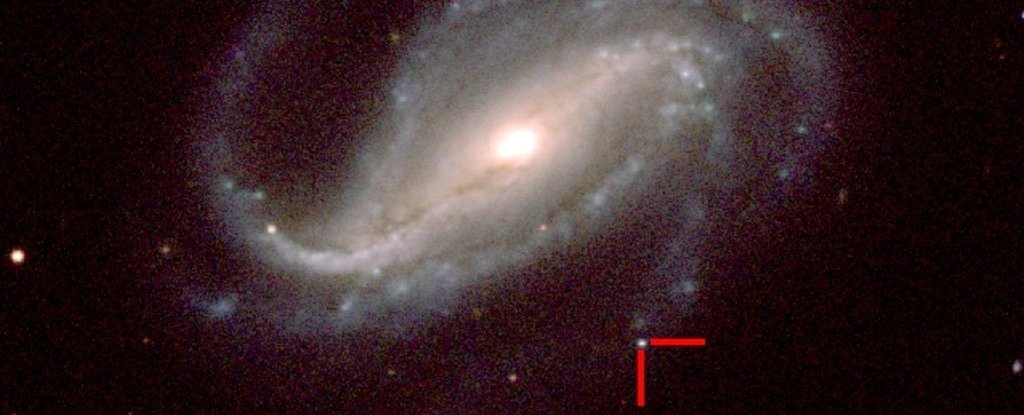
The first blooming light of a star that went supernova has been photographed for the first time - by an amateur astronomer testing a new camera.
Victor Buso from Rosario, Argentina has become the first person to ever capture the optical (or visible) light before and after the "shock breakout" of an exploding star.
This is the point right when the star explodes - when the supersonic shockwave from the star's core breaks out of the surface of the star, causing the gas there to heat and brighten very quickly.
In other words, that's the very, very first burst of light from a supernova.
They're super-difficult to capture, because the exact timing of a supernova is impossible to predict, and the shock breakout lasts such a short duration of time.
Astronomers have been chasing the phenomenon for years.
"It's like winning the cosmic lottery," said Alex Filippenko of UC Berkeley, who led a team following up observations of the supernova in the months that followed.
Indeed, obtaining the photographs involved a concatenation of lucky circumstances for Buso.
He was testing his camera on 20 September 2016, mounted on a 40-centimetre (16-inch) telescope.
To do this, he picked spiral galaxy NGC 613, located at a distance of about 80 million light-years away in the southern constellation Sculptor - a nice target because it was directly overhead.
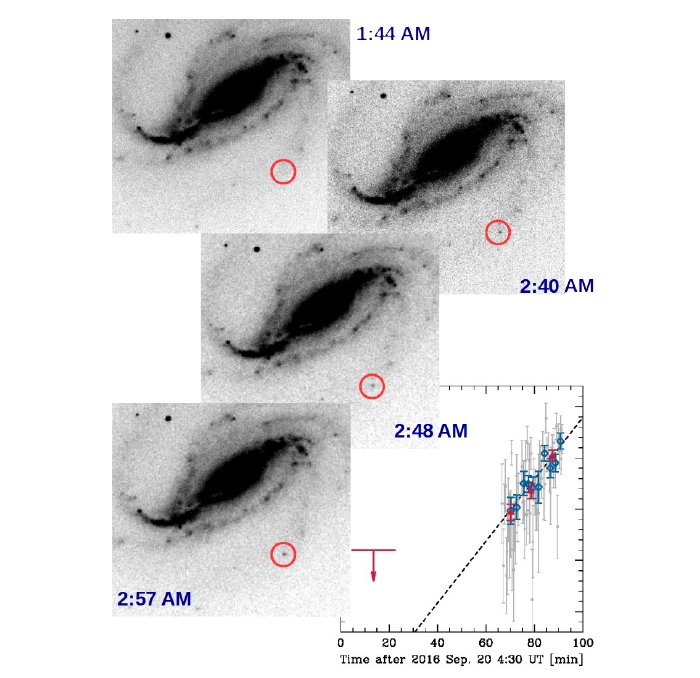
Over the course of about one and a half hours, he took pictures of the galaxy at 20 seconds of exposure time, to avoid saturation by nearby city lights. During the first 20 minutes, the photos all appeared the same.
But then Buso noticed something - a single brightening point of light at the end of one of the spiral galaxy's arms.
It wasn't long before astronomers learned of the find, and realised that Buso had captured something extraordinary.
Negatives of Buso's photographs showing the supernova brightening over time.
(Víctor Buso images; Melina Bersten data)
According to the researchers, the chances of such a discovery are one in 10 million - maybe even one in 100 million.
"Buso's data are exceptional," Filippenko said. "This is an outstanding example of a partnership between amateur and professional astronomers."
The research team used the Lick and Keck observatories to monitor the supernova, since named SN 2016gkg, for two months following Buso's discovery.
Spectral data revealed it to be a Type IIb supernova - a massive star that has already lost most of its mass prior to exploding.
The team calculated that SN 2016gkg started at around 20 times the mass of our Sun and lost three quarters of its mass, possibly to a companion star.
By the time it went supernova, it had shrunk down to around 5 solar masses.
The long-sought visual data will help astronomers find out more information about a star's structure just before it explodes, as well as information about the explosion itself.
"Professional astronomers have long been searching for such an event," Filippenko said.
"Observations of stars in the first moments they begin exploding provide information that cannot be directly obtained in any other way."
The research has been published in Nature, with Buso as one of the co-authors.
A space capsule carrying 2 passengers failed during launch, Apollo 7 celebrated its 50th anniversary and 2 missions are getting ready for upcoming target arrivals. These are just some of the top stories this week from Space.com.
Photo Credit: Bill Ingalls/NASA
1. Crew capsule fails during launch
A Russian Soyuz rocket was beginning its journey to the International Space Station when the spacecraft failed during its ascent on Thursday (Oct. 11). The passengers — Russian cosmonaut Aleksey Ovchinin and US astronaut Nick Hague — are in good condition after the malfunction sent the capsule falling back to Earth in a steep re-entry.
A spacecraft at the end of our solar system fired its engines briefly on Oct. 3 to speed up towards Ultima Thule, an object found far away in the Kuiper Belt. This is the first maneuver by NASA's New Horizons mission in which it used its own photos to make small path corrections to help arrive at the distant target.
The 50th anniversary of the first crewed Apollo flight happened on Thursday (Oct. 11). In addition to providing a crucial milestone for the program and the subsequent moon landing months later, Apollo 7 was also the first time humans broadcast live footage from space.
Researchers now say that the largest body in the asteroid belt — a dwarf planet named Ceres — experienced "true polar wander." In this phenomenon, the surface of a celestial body drifts over what lies beneath it, because the outer and inner parts of the dwarf planet spin at different rates.
Expert scientists came together to reflect on the field of astrobiology and published a paper on Wednesday (Oct. 10) with recommendations for NASA. The National Academies of Sciences, Engineering and Medicine gathered the panel together, and among many other things, their report emphasized a key challenge: identifying biosignatures, or the chemical changes that characterize life.
SpaceX made its first rocket landing on the West Coast this week. A Falcon 9 rocket launched from California's Vandenberg Air Force Base on Oct. 7 and brought an Argentine satellite into orbit.
NASA's OSIRIS-REx mission is scheduled to arrive at its target, asteroid Bennu, this December. The spacecraft performed a slowdown maneuver on Oct. 1 to reach it, and should be travelling at one-third of its previous speed as a result.
NASA released a statement on Oct. 8 saying that it expects the Hubble Space Telescope to start working again soon. Last weekend the space agency announced the probe was in safe-mode because of a failure in one of the telescope's steering mechanisms.
The two-stage Space Launch System megarocket is slated to perform a lot of future exploration for NASA. But a new report said the project is behind schedule and several billion dollars over budget.
The U.S. Air Force recently awarded a total of about $2 billion to 3 aerospace companies: Blue Origin, United Launch Alliance and Northrop Grumman Innovation Systems. The contracts are in place to bring about competitive launch system prototypes that would support the transport of national security payloads.
Meer van UFO'S of UAP'S, ASTRONOMIE, RUIMTEVAART, ARCHEOLOGIE, OUDHEIDKUNDE, SF-SNUFJES EN ANDERE ESOTERISCHE WETENSCHAPPEN - DE ALLERLAATSTE NIEUWTJES


 Cometlike objects could be spreading life from star to star throughout the Milky Way