UFO appears on live broadcast C5N News, Argentina
She quickly points to the metallic object that crosses from end to end of the screen.
Totally surprised...”it’s not a plane" said Mariela Fernández in front of the giant screen....
UFO appears on live broadcast C5N News, Argentina
Opmerkelijk ‘pilotengat’ gespot boven Halle - HLN.beBron: Noodweerbenelux
Volgens Noodweerbenelux gaat het om een vrij zeldzaam verschijnsel, waarbij een rond of elliptisch gat ontstaat in de wolken. Het fenomeen ontstaat onder meer wanneer een vliegtuig door de wolken vliegt. “Deze wolken bestaan uit onderkoelde waterdruppeltjes”, klinkt het. “Wat wil zeggen dat die druppeltjes niet zijn bevroren, maar wel een temperatuur onder het vriespunt hebben. Wanneer in een laag bevriezing optreedt, worden ijskristallen gevormd die vervolgens omlaag vallen. Zo lijkt het of er als het ware een hap uit de wolken is verdwenen.”
The science of proving an object was created by an extraterrestrial civilization

1. Introduction
In the recent world of fringe science, there has been an explosion of interest in so-called meta-materials allegedly “recovered from unidentified aerial phenomena.” Although this announcement has created a great deal of excitement, there has been very little context to these claims. The public, therefore, has no real baseline by which to critique or even understand the claims or methods being employed to confirm the potentially anomalous nature of the material. For example, how can a member of the public understand whether or not the testing methods suggested by a variety of individuals are sufficient? And how will the evidence such testing provides be understood and analyzed by the scientific community, and how best can that be expressed to the general public? In this report our group will give this context, helping the public to construct informed opinions on these testing methods, results, and the very nature of the tests performed.
As a first pass on this analysis, we must understand what questions are being asked. In other words, let’s suppose we were given a piece of material that was believed to have come from another, potentially alien civilization. The challenge presented to our scientific team is to prove whether or not this material really did, or at least most likely must have, come from some non-Earth intelligence. How would we begin to develop a plan to test if the evidence supported this hypothesis? This question can be broken down into a number of significant portions. Firstly, we would want to identify if the material has come from outer space by comparing it to similar materials or samples we find on Earth. Does it show significant enough differences to cause us to believe it did not come from our planet? Second, is there evidence that the material has been engineered or designed in some way? Does it show properties or applications that we wouldn’t expect to occur naturally, or is it engineered or composed in a way to give it specific properties? And third, does it show advanced techniques or knowledge with which we are unfamiliar. Are there super-heavy elements which we have yet to discover here on Earth, does it show crystal structures or solid phases that have not yet been documented by the materials science community, does it show composition and engineering which is beyond the scope of science today?

This artist’s concept depicts Kepler-186f, the first validated Earth-size planet to orbit a distant star in the habitable zone — a range of distance from a star where liquid water might pool on the planet’s surface.
(Image Credit: NASA)
If these three questions are answered in the affirmative and supported by evidence this would be enough to support the hypothesis. This would show that this material is not only from outer space but from a civilization that had engineered it for a specific purpose. Each question answered in the affirmative would be a tremendous milestone for the person who found the material, but not enough to support the extraordinary claim of alien engineering on its own. For instance, if the material were found to be from outer space with evidence of unknown properties it may be a meteorite or other piece of space debris, but not necessarily from another civilization. At the same time, if the material showed evidence of engineering and was also found to have unknown properties it could be from an experimental aircraft or another device that is currently unknown to the public and scientific community. One possibility we cannot ignore here is that our current science may not be able to understand or determine the properties or applications for which a given material has been engineered. This may give a false negative to our question 3 above and lead us to unfairly characterize some samples as not passing the high threshold we have set. Ultimately if a material has been engineered, it is almost implied that there would be a reasoning behind this engineering, some application for which it would be used. Therefore, I would anticipate that although we may not currently understand its application that does not imply that an application was not in mind when the material was initially designed. This suggests that for cases where engineering is suspected as well as a non-Earth point of origin careful consideration must be given to potential applications we do not expect, as well as a variety of tests that may not be obvious to the engineer or scientist.
Materials science is a broad field with applications across the breadth of scientific, engineering, and medical studies. It deals primarily with the analysis and study of solid materials, both in their bulk form (for example the properties of a gallon of sand) and at the level of individual particles (a single grain of sand). This science deals with both crystalline materials, those with repeating patterns of atomic arrangement into what are known as crystalline phases (one of the most well-known examples of a crystalline solid is diamond, although crystals do not need to be gem-like, for example, salt), and amorphous solids, those without repeating atomic arrangements (one of which is aluminosilicate glass materials such as those used for dishware or windows in homes). Other materials which are well known to the reader are metallic solids such as Iron (a bulk collection of iron atoms held together by shared electrons) and steel (an alloy of iron with other metals, creating a solid mixture of components into a roughly homogeneous material). These materials are all, more or less, simplistic in their composition and manufacturing processes. For the majority of our time as a civilization, we have either mined them from the Earth for our direct use, or performed slight modifications such as melting, remixing, and re-casting to make them more useful. It is potentially true that other civilizations, having obtained the ability to make their way to our distant corner of the universe, will have also had their bronze or iron ages far in the past, and come to roughly the same conclusions as our metallurgists, scientists, and engineers when it comes to how to shape and utilize these materials at the bulk scale (assuming of course that these beings are physical things at all, something that is out of the scope of this discussion).
In recent years, materials engineering has focused on the creation of novel materials for directed applications. In particular, this has focused on the creation of materials with nanoscale properties, those which become apparent at the bulk scale but are due to properties of the material at the scale of 1 x 10⁻⁹ meters long. Of particular interest to the study of potentially engineered materials, the behavior of nanoengineered solids is such that they would not, in general, be possible in nature as far as we understand it. These may include the creation of composite materials (e.g. solid particles covered in polymer molecules, layers of unlike oxides and metallic compounds with polymer or soft matter layers, designed or engineering crystal or polymer phases, and others), the creation of non-standard geometries (asymmetrical crystal growth or properties, designed crystal defects at regular positions, pillaring or other mixed porosity structuring), or the creation of materials that are post-synthetically functional (in other words materials that can be reversibly altered through the application of heat, chemical impulse, electromagnetic field, or some other energy/force). Probing structures of this sort is a complicated process, but one which has a tremendous amount of literature background available for the interested scientist or engineer. The pathway is apparent to those with the wherewithal to follow it; however, the jargon and specifics may be confusing and difficult to the interested public. In general, however, there are a number of properties that would be of immediate interest to a material scientist faced with the three hypotheses we have posited above.
2. Atomic and Isotopic Make-Up
The first piece of useful information is what the material is composed of. This question in the first place helps to narrow down our later searches significantly, provides information to hint at the origin point of the material, and may even help us answer if the material has been engineered or not; as has been gone over consistently in the popular articles on this subject one of these tests would include something like EDS (Energy-Dispersive X-Ray Spectroscopy) or XRF (X-ray Fluorescence). In both of these tests, a material sample is bombarded with X-Rays in a test chamber, causing the atoms within the sample to become excited. These excited atoms eventually relax back to their initial ground state, by releasing photons which are then collected by a detector within the test chamber. The released photons are dependent on the atomic number of the elements within the sample, and in some testing methods, the oxidation state of the atoms within the material can be determined as well. These tests provide information on the elements within the sample, as well as a rough estimate of the chemical makeup of the bulk solid. In the unlikely case that the material contains an unknown element, it is these sorts of tests that would show the scientist that further testing should likely be performed. These tests may also suggest the presence of elements we don’t expect to find normally on the surface of the Earth, or even percentages of elements that are uncommonly found. For example, there are elements which are not naturally occurring but instead result from our nuclear weapons testing. Elements of this sort such as Strontium and Cesium would not be anticipated in high percentages in a normal sample of material, although again this would only suggest that the material is not from a standard source and not that it is extraterrestrial in origin.
Another type of information which has been held up as the holy grail of material testing in pop science is isotopic testing and ratio analysis. Isotopes of a given element are defined by their atomic number (the number of protons in their nucleus, which gives the element it’s identity and placement on the periodic table) and their mass (the number of protons and neutrons, each defined as one atomic mass unit, within the nucleus). The relative abundance of an isotope of an element on the surface of the Earth is, very roughly, averaged to give the atomic mass listed on the periodic table for that element. Isotopes vary due to their stability (with radioactive isotopes decaying and therefore becoming less abundant with time), and therefore the relative ratio of isotopes within a given sample would normally be expected to fit within the range of other samples found on the Earth. However, the variation of isotopes across the Earth’s surface can vary significantly, with radioactive testing and other geological or historical factors potentially playing a part. Therefore, it is important to be nuanced and careful in the analysis of these tests, a fact that has not been fully appreciated to date by those claiming to have extraordinary samples. At best isotopic testing would tell us that material is outside of the range of terrestrial samples we usually find, warranting further study by other means. It may also tell us if the sample is from before or after the Earth or even our solar system formed, or what local chemical or geological make up may have looked like over the lifetime of the sample. However, isotopic testing alone is not sufficient to answer the question of whether or not a sample has been engineered or left behind by some advanced civilization.
Isotopic testing is generally performed utilizing magnetic mass spectrometry techniques such as Isotope-Ratio Mass Spectrometry (IRMS) or Inductively Coupled Plasma Mass Spectrometry (ICPMS). In these tests, the material sample is first atomized, either by grinding or very fast heating and dispersion in a carrier solution, which also causes them to take on a net positive or negative charge and thereby become ions. These ions are then carried with the carrier gas or plasma through a magnetic field towards an ion detector. The magnetic field is set up in such a way that ions will be separated from one another based on their mass to charge ratio, a value which is specific to ions of isotopes of a given element. Essentially, isotopes which are heavier will flow more slowly with the carrier gas, and those with higher charges will be more attracted to the magnetic field. This allows us to obtain a readout of the mass to charge ratio of the atoms within a sample, which when compared to a standard set of samples can then be used to determine the isotopes within the sample as well as their relative abundance based on the number of hits the detector reads. The results of these tests can be extremely accurate, down to parts per million of a sample if given the correct calibrations and analysis methods being employed.

Mass Spectrometry Machine at the University of Toronto
(Image Credit: Flickr/Nayuki)
3. Crystallography and Surface Characterization
If an advanced civilization has engineered a material for a specific purpose, one of the avenues to discover the trademarks of this engineering may be in the specifics of the solid components that make up the material. This includes the surface characteristics of the individual solid components (for example are they patterned or etched, do they show evidence of atomic deposition or other surface treatments for growth or sealing, are the surfaces polished or show a lack of imperfections), the porous structure of the support (is the surface area very high, are their complex porous channels that appear to have some separation or adsorption potential, are the pores engineered to include secondary chemical sites for chemisorption or catalysis of some sort), the crystal structure or phase of the components (is it a crystal structure that currently exists on Earth, is it a single crystal compound, does it show multiple materials combined together in a way which is unexpected), and the bulk properties of the solid (how does it respond to temperature, pressure, shear stresses, radiation, etc). The range of possible properties that can be probed in this case is vast; however, there are a few tests which I would consider to be absolutely necessary for a true analysis of any potentially engineered solid. These include X-Ray Diffraction, Pore/Surface analysis via adsorption isotherm, Raman or FTIR Spectroscopy, Electron Microscopy, and Thermogravimetric Analysis/Differential Scanning Calorimetry. These cover the broad gamut of materials characterization, giving a view of the materials properties as they currently exist, and would hint at potential other applications or methods of engineering should they exist.
X-Ray Diffraction consists of the analysis of how an X-Ray beam is diffracted off of a materials crystal lattice. You can imagine a crystal structure like a regularly repeating pattern of atoms, each placed in a fixed position to one another in 3-dimensional space. During X-Ray diffraction, the crystal lattice is bombarded with photons, which are being shot as a beam at a given angle. Photons will interact and collide with atoms within the crystal lattice if they come into contact and be diffracted off of the solids lattice. In X-Ray Diffraction the photons that are diffracted are collected at each given angle and analyzed to determine information about the geometry of the crystal structure, how well defined the crystal is, and even in some cases how much stress or strain the material is under. For our analysis, the first important characterization is if the material is a crystal structure or not. If it is a crystal, is it a sort of crystal structure that we would find in the scientific literature, or is it something novel to materials science? From the hints that we have received so far by those in possession of these materials, we may expect that the solid is layered, or lamellar. These layered solids possess diffraction patterns at the lowest X-Ray angles, between 0.1 and 5 degrees 2 theta (2 thetas being the measured angle of the X-Ray beam). This corresponds to very large spaces between repeating planes, with most layered materials in the open literature showing d spacings of between 10 and 40 Angstroms. This would be a quick and easy test to run and would immediately tell us if the structure is layered in any way which would make it outside of the scope of naturally occurring lamellar structures such as clays or layered hydroxides.

X Ray diffraction patterns at the Museum of Science and Industry in Manchester.
(Image Credit: Flickr/Duncan Hull
Spectroscopy occurs similarly, probing the structure with photons of a given energy and observing the excitation of the material surface to tell us something about the chemical bonds likely present on the material. Raman spectroscopy is generally utilized in this field for metallic structures, although the information obtained in this way is generally limited. The true use of these spectroscopic techniques from a materials science perspective is in the ability to see if there are secondary chemical functionalities present on the material’s surface. For example, we may expect that catalysis or separation applications on some other planet would require the same careful control of chemical binding sites as we use on Earth for our catalysis and separations applications. This would be clear by the presence of secondary chemical species not often found on the surface of solid materials. Sensors on a material surface, coatings for different applications, and other potential surface species adsorbed onto the material being studied (such as debris from entry into the upper atmosphere, chemical species from the atmosphere of where ever this material has been, and other surface alterations) would also potentially be observable from such an analysis. This in tandem with isotherm analysis for porosity and surface area information would also be extremely useful. Materials with very high surface areas may show potential as catalysts or adsorbents and would show at least that the material was likely created and not naturally occurring (surface areas as high as 3000 m2/g have been achieved on Earth, although only for synthetic materials).
Electron Microscopy via Scanning Electron Microscopy and Transmission Electron Microscopy would give information as to the solids bulk surface properties, although outside of that the information gleaned from such analysis is likely to be limited. Of particular interest would be whether the surface is patterned or altered in some way. For example, on Earth we are currently studying the effect of rough surface patterning on anti-bacterial or microbial properties of surfaces, as well as what effect surface etching or patterning can have on the ability to repel or absorb water. We may expect that other intelligences would also find these properties useful to tune and would utilize them to provide beneficial properties to their materials. There may also be other surface patterning alterations which provide additional benefits, for example, radar cloaking or resistance to heat or radiation. On top of that if the material has been fabricated at the micron or bulk scales, then these microscopic techniques would tell that story, providing direct evidence of engineering. Thermal analysis may also provide some benefit, although this would again be limited. TGA and DSC work by heating the material slowly over time and observing what changes are made to the temperature of the material or the weight of the material. This may provide information on organic content, the ability of the material to withstand increased temperatures or heat fluxes, and how the solid behaves under the extreme heat of entry into the atmosphere from space.
4. Current State of Materials Study and Conclusion
As far as can be gleaned from the information available to the general public, it appears that efforts to date concerning the analysis of solids potentially occurring from some unknown civilization have focused on the first class of studies, those concerning the elements making up the material and their isotopes. However, as has been suggested by this work that is only a small portion of the entire picture needed before any definitive conclusions can be made. There are other, more specific tests that would need to be run to determine the potential applications of any material, how it was potentially fabricated, and where it may have come from. However, as any first-year materials science student can tell you, these are the basic analytical techniques which would be utilized for a serious investigation. Of particular concern to the interested public should be any study that purports to give evidence without reporting clearly and in detail their methods, potential sources of error, the accuracy of their measurements, and other information required to replicate their results. Without these pieces of information, it is impossible to verify any claims regarding a material’s properties, let alone more extraordinary claims regarding potential engineering by a non-Earth civilization. It is the authors hope that this report has been informative to the general public, and it is our sincere hope that this work may be of some use to those interested in these subjects who are not sure what to make of extraordinary claims of materials with special properties or exotic origin points.
VIDEO: UFO Researchers Discuss Pentagon UFO Program at Devils TowerUFO researchers and UFO and Close Encounters of the Third Kind enthusiasts gathered in Hulett, Wyoming for the Devils Tower UFO Rendezvous recently. Held near the iconic natural phenomenon made famous from the Steven Spielberg movie, lectures discussed UFO research and the latest UFO news.
OpenMinds.tv interviewed several of the speakers on their thoughts regarding the recent revelation that the Pentagon had a secret UFO program that began in 2007. According to insiders, the program still exists.
Read the New York Times article that broke the news: Glowing Auras and ‘Black Money’: The Pentagon’s Mysterious U.F.O. Program
Read the OpenMinds.tv article on the revelation and rockstar Tom DeLonge’s involvement.
Watch our exclusive interview with Luis Elizondo.
Read more about the Devils Tower UFO Rendezvous: devilstoweruforendezvous.com
Links to more information about the researchers in the video:
Marc D’Antonio – Watch his SkyTour Livestream
Micha Hanks – The Gralien Report: gralienreport.com
Lee Speigel – leespeigel.com
David Marler – davidmarlerufo.com
Get David’s book Triangular UFOs: An Estimate of the Situation https://amzn.to/
Help keep the UFO info coming: Support me on Patreon: www.patreon.com/alejandrotrojas
Micah Hanks – UFOs and the Future – October 16, 2018


Open Minds UFO Radio: Micah Hanks is a writer, podcaster, and researcher whose interests cover a variety of subjects. His areas of focus include history, science, philosophy, current events, cultural studies, technology, unexplained phenomena, and ways the future of humankind may be influenced by science and innovation in the coming decades.
In 2012, his book The UFO Singularity explored themes that incorporated futurism and technology–both speculatively, and at times skeptically–into an analysis of UFO phenomena. Micah hosts The Gralien Report podcast which has seriously covered the UFO phenomenon for many years. In this interview, we discuss the cultural significance of the UFO phenomenon and how it has changed the culture and how it may influence the future.
To read more about Micah visit: MicahHanks.com
and: GralienReport.com
Get his book here: https://amzn.to/2CNoEzO
How Close Are We to Kubrick's AI-Controlled Vision of the Future?
Why Haven't We Found Aliens? Because We're Just Not Looking Hard Enough.
The mystery of Changing UFOs: The prize is hiding in the details

One of the most perplexing of all the UFO shapes is the Changing UFOs category. For a few years now I’ve heard many UFO enthusiasts complain that the Changing category is useless since it really doesn’t define anything, or that the observers are flawed in some way. I must admit that the previous reports of Changing or Morphing UFOs left me with the impression that these were flawed observations.
Then I listened to the radio talk show Coast to Coast AM, as investigative journalist George Knapp was interviewing Jacques Vallee, one of the deans of Ufology. Vallée made a point about Changing UFOs that seem to morph in an effort to confound observers, their cameras and other scientific equipment that the researchers might be using.
A strong case has been made that many UFOs seem to be under intelligent control vs. some random natural phenomena like ball lighting. Another idea is that these unidentified craft might be “living ships with Artificial Intelligence (AI) Consciousness.” The idea is that these living ships detect the thoughts of people on the ground trying to observe them.
I decided to see what the statistical numbers indicate. First, let me preface two important points:

Here’s some intriguing data on the “Frequency of Sighting Profile.” For comparison, I selected the most common UFO shape reported: a simple “light” in the sky. The blue line sighting profile from 2001 to 2017 is roughly consistent with most other UFO shapes. There was a slight rise from 2001 through 2007. There is a spike in 2008, which was caused by a documentary about UFOs that was on the Discovery Channel. MUFON was featured in that Discovery show as a national UFO reporting service and thereafter the MUFON data loosely tracked year to year similar to NUFOC. In 2011 through 2015 there is a sharp rise and fall and in 2016 and 2017 have fallen off sharply.
Now look at the red line which represents the Changing UFOs. Note that that the Light shape has sharply changing and huge sighting numbers between the high hundreds through the tens of thousands. The Changing UFO has numbers more or less in the dirt by comparison; with an even string of reports totaling less than 2,100 sighting reports over 17 years.
If we examine the Changing UFO with a finer resolution we can see that it also has a rolling cyclic nature; with an average of about 123 sighting reports per year.

I was surprised where these Changing UFO reports were coming from. California, as you might expect, had 340. Yet it was the next four states that were telling, with a range from 130 to 103: Florida, 130; Washington, 104; Arizona, 103; and Texas, 103. I expected to see a steeper drop in those sighting numbers. Thereafter, the sighting numbers for the Changing UFO dropped very gradually across the various states, which is a very atypical sighting pattern.
I took a peek at U.S. counties for this Changing UFO. Since the overall national sighting numbers for the Changing UFO were barely 2,100, I didn’t expect every county in the country to have a sighting. Using a Forensic Cluster process that I’ve developed I discovered the following with regard to Changing UFO reports.
Only 594 counties of more than 3,000 counties nationally, reported a Changing UFO from 2001 to 2017. Only 319 counties reported more than two. Only 31 counties reported more than 10. Interestingly, only four counties reported more than 25. Clark County, Nevada, reported 26. Orange County, California, reported 41. Maricopa County, Arizona, reported 60 and Los Angeles County, California, reported 79.
I would never have dreamed that from such tiny sighting numbers that such an interesting mystery would reveal itself.
Gas giants orbiting young star may require astronomers to rethink planetary formation
BY
Illustration of CI Tau, which is surrounded by a planetary disc and has four gas giants orbiting around it.
Credit: University of Cambridge.
Astronomers have discovered a peculiar solar system some 500 light-years away from Earth that may force them to rethink how planets form. The star in question is only two million years old — a mere ‘toddler’ by astronomical standards — but despite its very young age, it’s orbited by four Jupiter and Saturn-sized planets.
Since the first confirmation of an exoplanet orbiting a sun-like star in 1995, and with only a few narrow slices of our Milky Way galaxy surveyed so far, astronomers have confirmed 2,327 exoplanets, with a further 2,244 awaiting confirmation.
A recent statistical estimate places, on average, at least one planet around every star in the galaxy. However, only 1% of the stars astronomers have surveyed so far host a hot Jupiter — a class of gas giant exoplanets that are inferred to be physically similar to Jupiter but that have a very short orbital period.
Most of the hot Jupiters currently identified orbit stars that are at least hundreds of millions of years old. This is why CI Tau, the young star recently studied by researchers at the University of Cambridge, is so interesting. What’s more, it has not one but four gas giants orbiting it.
The astronomers used Atacama Large Millimeter/submillimeter Array (ALMA) to identify the exoplanets. CI Tau is surrounded by a huge disc of dust and ice, known as a protoplanetary disc, which will seed planets, moons, asteroids, and other objects in its system. ALMA’s instruments were able to find distinct gaps in the disc which theoretical modeling showed would correspond to gas giant planets orbiting the star.
According to the new study published the Astrophysical Journal Letters, the four planets differ greatly in their orbit. The closest planet to CI Tau, a juvenile hot Jupiter, is within the equivalent orbit of Mercury.
The farthest orbits are at a distance three times greater than that of Neptune from the Sun. The two outer planets are about the mass of Saturn, while the two inner planets are around one and 10 times the mass of Jupiter respectively. Given that the outermost planet is more than a thousand times further from the star than the innermost one, the system has also set a new record for the most extreme range of orbits observed so far.
Scientists are not sure what to make of this anomalous system. Hot Jupiters have always puzzled astronomers because they are often thought to orbit too close to their parent stars to have formed in situ — instead, they might be captured rogue planets. But considering the age of CI Tau, the findings suggest that hot Jupiters could form within close proximity of a star.
“It is currently impossible to say whether the extreme planetary architecture seen in CI Tau is common in hot Jupiter systems because the way that these sibling planets were detected—through their effect on the protoplanetary disc – would not work in older systems which no longer have a protoplanetary disc,” said Professor Cathie Clarke from Cambridge’s Institute of Astronomy, the study’s first author.
In the future, the team of researchers plans on studying CI Tau at multiple wavelengths to learn more about the disc and its planets. For instance, they would like to see whether the outer planets played a role in driving their innermost sibling into such an ultra-close orbit. How the two outer planets formed in the first place is also a mystery.
“Planet formation models tend to focus on being able to make the types of planets that have been observed already, so new discoveries don’t necessarily fit the models,” said Clarke. “Saturn mass planets are supposed to form by first accumulating a solid core and then pulling in a layer of gas on top, but these processes are supposed to be very slow at large distances from the star. Most models will struggle to make planets of this mass at this distance.”
According To Steven Greer, Trump’s Administration Has Been Briefed About UFOs

According To Steven Greer, Trump’s Administration Has Been Briefed About UFOs
What do presidents know about UFOs? Well, if you’re an avid researcher of the topic, you’ve probably realized by now that presidents don’t really have a “need to know” about these things.
by Arjun Walia
The “military-industrial complex” that Eisenhower spoke of, which has become as uncontrollably powerful as he feared, has completely taken over operations that not even the president knows about. Many from within political realms who’ve held esteemed positions have spoken out about this fact.
Take Paul Hellyer for example, a former Canadian Defense Minister, who gave a lecture at the University of Toronto in 2008 where he said it is “ironic that the U.S. would begin a devastating war, allegedly in search of weapons of mass destruction when the most worrisome developments in this field are occurring in your own backyard.”

He was referring to black budget special access programs, which receive no oversight from Congress. This means that not even the government knows about the developments happening in this area, all for “national security” purposes.
“It is ironic that the U.S. should be fighting monstrously expensive wars allegedly to bring democracy to those countries, when it itself can no longer claim to be called a democracy when trillions, and I mean thousands of billions of dollars have been spent on projects which both congress and the commander in chief know nothing about.”
To The Stars Academy
It’s almost 2019, and the topic of UFOs has exploded into the mainstream, especially with former rock superstar Tom Delonge gathering defense intelligence officials, world-renowned scientists and more to relay this information to the public via the ‘To The Stars Academy.’ They’ve already released multiple videos of UFOs, and have publicly stated that there are programs within the government that study this phenomenon.
They have Luis Elizondo, a former director of a government ‘aerospace threat identification’ program. This was all disclosed via establishment mouthpieces like the New York Times and the Washington Post.
They’ve also admitted to recovering materials from these ‘unidentified’ objects. You can read the latest updates about what’s going on with that and mainstream UFO disclosure, in general, below.
Black Budget Projects
The black budget is something we easily get information about, and for those who try to bring out information it is difficult to investigate. One example is the efforts of journalists Dana Priest and William Arkin of the Washington Post in 2010.
Their investigation lasted approximately two years and concluded that America’s classified world has “become so large, so unwieldy and so secretive that no one knows how much money it costs, how many people it employs, and how many programs exist within it or exactly how many agencies do the same work.” You can read more about that HERE.
Here is one of many statements from people who have been “in the know” so to speak. There are thousands of verified quotes on this subject, and we now have the electro-optical data and evidence to back up all of this witness testimony.
“We have, indeed, been contacted – perhaps even visited – by extraterrestrial beings, and the US government, in collusion with the other national powers of the Earth, is determined to keep this information from the general public.” (Second Look, Volume 1, No 7, Washington, DC, May, 1979)
What are the intentions of the cabal when it comes to UFO disclosure? We’ve been lied to about so many things by them, that it’s become hard to believe anything we hear from mainstream mouthpieces.
Presidents George Bush and Barack Obama, who I believe are establishment puppets, have brought up the subject, acknowledged it, but have refused to share any information on it. They did so in cryptic, often comedic ways on popular television, on the Jimmy Kimmel show. It’s hard to know what to make of their comments, or even their overall knowledge about this.
Former Russian President & Current PM: Aliens Are Real and Vising Earth
So What About Trump?
Has Donald Trump been briefed? Yes he has, according to Dr. Steven Greer.
Greer is the founder of The Disclosure Project, an initiative that has brought forth hundreds of military/ defense/ political personnel from all over the world, with verified credentials, to publicly share their testimony about their experiences with UFOs and extraterrestrials. He also released a film last year, called “Unacknowledged.”
It was one of the most popular, if not the most popular film on Itunes & Netflix in 2017. It’s highly recommended if you are new to this subject and don’t already know much about it.
Greer has amassed great credibility for his claims. For example, many years ago he claimed to have had meetings at the Pentagon with some very high-ranking people.
After this, Apollo astronaut Dr. Edgar Mitchell admitted that he also attended these meetings with Greer. What came out of these meetings is that not many people knew the details of this topic, nor wanted to discuss it.
Wikileaks documents have also been released which saw astronaut Edgar Mitchell communicate with US politician John Podesta.
He’s been able to develop relationships with individuals he has interviewed from various branches and ranks of the military as well as within the intelligence and defence communities.
In my opinion, Podesta, Clinton, Obama and Bush are all cabal puppets. Therefore, anything they say about terrorism, national security, or UFOs, is probably lathered up with some ‘disinformation’ soap.
Without this point, if we completely disregard it, there is still more than enough evidence to show that they are simply following the will of their masters. But that’s a topic for another article, back to UFOs!
Greer says he has briefed people close to Trump about the UFO / extraterrestrial issue in this interview. He has also claimed to have briefed past presidents, like Obama and Clinton, and provides those documents on his website, Sirius Disclosure. It seems credible, especially when his claim to have had high-level meetings within the Pentagon was verified by Dr. Edgar Mitchell.
White House press secretary Sarah Huckabee Sanders has so far not answered any questions that have been asked about UFOs.
Official Transcript: This is How the CIA Informed President Reagan About UFO’s
Will There Ever Be A Full Mainstream UFO Disclosure?
Given the fact that this topic seems to be controlled by a small group of very powerful people who gets to decide what humanity can and can’t know, I’d say that as long as this group maintains power, the reality of UFOs and extraterrestrial beings will be hidden from humanity in official channels. A censorship plan has also been spoken about for years by those within.
Roscoe Hiellenkoetter, the first director of the CIA, for example, pointed out decades ago in the New York Times that, “through an official campaign of secrecy and ridicule, many citizens are led to believe the unknown flying objects are nonsense.” He went on to state that they are operating under intelligent control.
That being said, there is a serious effort by multiple nations, and perhaps those within this power structure as well, to reveal these truths to humanity. This is evident by all of the whistle-blowers with verified credentials who have shared their experiences, as well as the release of evidence in the form of radar trackings and electro-optical data.
There is a serious push for mainstream disclosure, this can’t be denied and is quite evident by the article linked earlier. Establishment mouthpieces are slowly disclosing this reality.
In 1979 Spanish General Carlos Cavero told the world the following:
“Everything in a process of investigation both in the United States and in Spain, as well as the rest of the world. The nations of the world are currently working together in the investigation of the UFO phenomenon an international exchange of data.” (via Richard Dolan, “UFOs & The National Security State”)
Why Any Disclosure At All?
Why would the New York Times, CNN and the rest of them share any of this truth? Can we believe what they say?
Perhaps not everything they say is false, but for years we’ve seen major geopolitical issues completely twisted by the mainstream media, and evidence of ‘perception manipulation’ that is fostered by their close relationship with US intelligence agencies.
There is also the testimony of multiple award-winning mainstream media journalists who emphasize how mainstream media outlets are paid by governments, corporations and intelligence agencies to present a specific narrative.
Is the establishment trying to lay the foundation for a ‘war against aliens’ like they made a ‘war against drugs’ and a ‘war terror?’ Or are we seeing the white hats within these groups push for the disclosure of information?
All this remains to be seen, but we must understand why this topic would be extremely difficult to disclose and to be honest, it’s probably a mix of both.
For one, you have the energy question. These crafts are clearly not using petroleum. Have we harvested technology from these crafts? If released, what would that mean for the oil industry and our economy? Who would benefit, who would lose?
What about the historical questions, the scientific questions? What about our laws of science and what we understand about ourselves and perhaps human origin? What about the idea that there are intelligent extraterrestrials surveying, visiting, and interacting with people here on Earth!
Tremendous Implications
I’ve said it before and I’ll say it again, the disclosure of this information leaves no area of humanity untouched.
As you can imagine, it has tremendous implications and it’s something that would change the world forever. I am sure the existence of extraterrestrials and the fact that we’ve been visited and are being visited, is not even the tip of the iceberg when it comes to discovery.
Most important will be the impact on consciousness, the deeper investigation into metaphysical realities, and the validation of non-material science. One can expect that disclosure will impact our understanding of who we are and why we are here, and perhaps there is some sort of spiritual lesson to be reaped from the realization that we are not the only ones.
Whether We Can Handle the Truth or Not, Humanity NEEDS Full Disclosure
The Takeaway
Humanity is just now waking up, and ready to take the steps necessary to move out of infancy. Understand “them” will help us to understand ourselves. We are all connected in some strange form, and the future is exciting.
It’s a topic that, most importantly, we DON’T have to be afraid of or react to with fear, despite the fact that that this type of reaction seems to have been programmed into us. We need to deprogram ourselvesfrom what Hollywood has presented us with, and start to examine the actual evidence and what’s really going on here.
I don’t believe you have to be afraid to discuss or talk about this topic with your peers and your family anymore. It’s no longer taboo, and the more we speak up, speak out, and generate discussion, the closer we get to finding out what’s really going on. It’s definitely an exciting time to be alive.
Thanks to: http://humansarefree.com
NASA wants to send humans to Venus – here’s why that’s a brilliant idea

There are plans to cause HAVOC on Venus.
NASA wants to send humans to Venus – here’s why that’s a brilliant idea
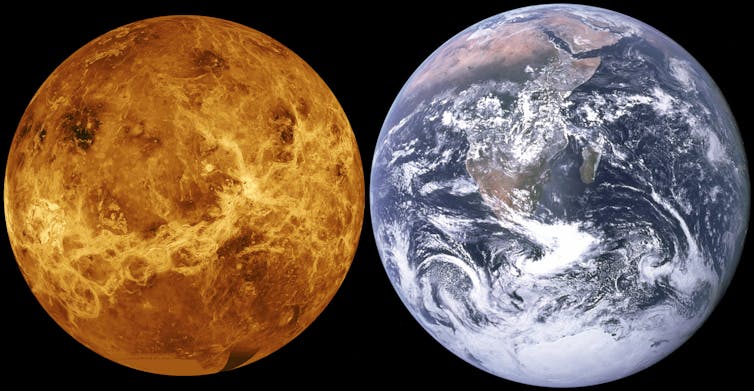
Popular science fiction of the early 20th century depicted Venus as some kind of wonderland of pleasantly warm temperatures, forests, swamps and even dinosaurs. In 1950, the Hayden Planetarium at the American Natural History Museum were soliciting reservations for the first space tourism mission, well before the modern era of Blue Origins, SpaceX and Virgin Galactic. All you had to do was supply your address and tick the box for your preferred destination, which included Venus.
Today, Venus is unlikely to be a dream destination for aspiring space tourists. As revealed by numerous missions in the last few decades, rather than being a paradise, the planet is a hellish world of infernal temperatures, a corrosive toxic atmosphere and crushing pressures at the surface. Despite this, NASA is currently working on a conceptual manned mission to Venus, named the High Altitude Venus Operational Concept – (HAVOC).
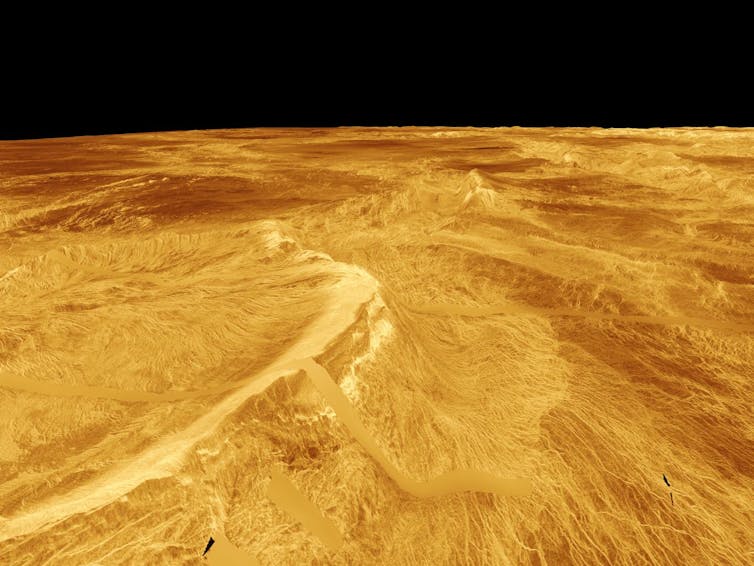
But how is such a mission even possible? Temperatures on the planet’s surface (about 460°C) are in fact hotter than Mercury, even though Venus is roughly double the distance from the sun. This is higher than the melting point of many metals including bismuth and lead, which may even fall as “snow” onto the higher mountain peaks. The surface is a barren rocky landscape consisting of vast plains of basaltic rock dotted with volcanic features, and several continent-scale mountainous regions.

It is also geologically young, having undergone catastrophic resurfacing events. Such extreme events are caused by the build up of heat below the surface, eventually causing it to melt, release heat and re-solidify. Certainly a scary prospect for any visitors.
Luckily, the idea behind NASA’s new mission is not to land people on the inhospitable surface, but to use the dense atmosphere as a base for exploration. No actual date for a HAVOC type mission has been publicly announced yet. This mission is a long term plan and will rely on small test missions to be successful first. Such a mission is actually possible, right now, with current technology. The plan is to use airships which can stay aloft in the upper atmosphere for extended periods of time.
As surprising as it may seem, the upper atmosphere of Venus is the most Earth-like location in the solar system. Between altitudes of 50km and 60km, the pressure and temperature can be compared to regions of the Earth’s lower atmosphere. The atmospheric pressure in the Venusian atmosphere at 55km is about half that of the pressure at sea level on Earth. In fact you would be fine without a pressure suit, as this is roughly equivalent to the air pressure you would encounter at the summit of Mount Kilimanjaro. Nor would you need to insulate yourself as the temperature here ranges between 20°C and 30°C.
The atmosphere above this altitude is also dense enough to protect astronauts from ionising radiation from space. The closer proximity of the sun provides an even greater abundance of available solar radiation than on Earth, which can be used to generate power (approximately 1.4 times greater).
The conceptual airship would float around the planet, being blown by the wind. It could, usefully, be filled with a breathable gas mixture such as oxygen and nitrogen, providing buoyancy. This is possible because breathable air is less dense than the Venusian atmosphere and, as result, would be a lifting gas.
The Venusian atmosphere is comprised of 97% carbon dioxide, about 3% nitrogen and trace amounts of other gases. It famously contains a sprinkling of sulphuric acid which forms dense clouds and is a major contributor to its visible brightness when viewed from Earth. In fact the planet reflects some 75% of the light that falls onto it from the sun. This highly reflective cloud layer exists between 45km and 65km, with a haze of sulphuric acid droplets underneath down to about 30km. As such, an airship design would need to be resistant to the corrosive effect of this acid.
Luckily we already have the technology required to overcome the problem of acidity. Several commercially available materials, including teflon and a number of plastics, have a high acidic resistance and could be used for the outer envelope of the airship. Considering all these factors, conceivably you could go for a walk on a platform outside the airship, carrying only your air supply and wearing a chemical hazard suit.
The surface of Venus has been mapped from orbit by radar on the US Magellan mission. However, only a few locations on the surface have ever been visited, by the series of Venera missions of Soviet probes in the late 1970s. These probes returned the first – and so far only – images of the Venusian surface. Certainly surface conditions seem utterly inhospitable to any kind of life.

The upper atmosphere is a different story however. Certain kinds of extremophile organisms already exist on Earth which could withstand the conditions in the atmosphere at the altitude at which HAVOC would fly. Species such as Acidianus infernus can be found in highly acidic volcanic lakes in Iceland and Italy. Airborne microbes have also been found to exist in Earth’s clouds. None of this proves that life exists in the Venusian atmosphere, but it is a possibility that could be investigated by a mission like HAVOC.
The current climatic conditions and composition of the atmosphere are the result of a runaway greenhouse effect (an extreme greenhouse effectthat cannot be reversed), which transformed the planet from a hospitable Earth-like “twin” world in its early history. While we do not currently expect Earth to undergo a similarly extreme scenario, it does demonstrate that dramatic changes to a planetary climate can happen when certain physical conditions arise.
By testing our current climate models using the extremes seen on Venus we can more accurately determine how various climate forcing effects can lead to dramatic changes. Venus therefore provides us with a means to test the extremes of our current climate modelling, with all the inherent implications for the ecological health of our own planet.
We still know relatively little about Venus, despite it being our nearest planetary neighbour. Ultimately, learning how two very similar planets can have such different pasts will help us understand the evolution of the solar system and perhaps even that of other star systems.
Mysterious Signals at the Center of Our Galaxy May Be an Optical Illusion
How Would Real Aliens Talk: Telepathy

I enjoy watching scifi movies as much as anyone does, but having an analytic mind I can’t help but to dissect them some. One of the questions that these movies always bring up for me is how would real aliens talk? In movies it seems like the entire Universe knows how to speak English. I realize that they do this to keep us form having to read subtitles for the entire movie, but they could manage to make it a little more realistic by giving some of the species really heavy, really strange accents. Usually the only character in the movie with a thick accent is the one that is all the way from Scotland, not the one that is from across the Universe. I could pick on the unrealistic portrayal of aliens in scifi movies all day but I won’t. What I do want to do is to talk about how aliens really would talk if we ever where to meet one.

The one way of communication between aliens that you will see in scifi movies that I think is probably the most accurate is telepathy. Telepathy is the ability where alien beings can talk to each other by using only their thoughts. While I can’t even imagine trying to understand how telepathy would work, it definitely makes sense when it comes to wanting to know how an advanced species of aliens would communicate. I think it is safe to assume that the theory of evolution is probably one of the scientific standards that stays constant throughout the entire Universe. If you follow the natural progression of intelligence and the ability to transfer ideas form one being to another, telepathy would be the best answer of how communication would evolve. The amount of time it would take advanced species to evolve would greatly be decreased by the addition of gene manipulation. Humans are already learning how to manipulate genes, which is probably going to change our species in ways that we can’t even imagine, so many alien species have surely had this technology for thousands of years. I am sure that if they didn’t naturally evolve to the point of being telepathic then they would create the ability themselves for their own species. The feeling of having their thoughts invaded is also a very common experience I hear from people that have been abducted by aliens. The abductees often report that the aliens they encountered talked to them, and the other aliens, without making a sound.After a long enough period of time evolution would step into this process again by eliminating the need for vocal cords. It is impossible to know if some aliens enjoy the art of vocal singing or not. If they do then their vocal cords would probably stay but if not then the body would eliminate them after they were not used for a long enough period of time.

The scary part about aliens having the ability to use telepathy is that they could also be using their minds to control our thoughts. Theoretically, that would mean that aliens could mask their appearance to humans. That means that they could be standing right in front of you yet you either don’t see them or they appear to be something else. Using this technique aliens could be all around us and we would never even know!
Us humans can’t even comprehend what the minds of such advanced beings could do. We like to think that we are smart but that’s because we compare ourselves to other animals on Earth. Chances are that there are humanoids somewhere in the Universe that have millions of years of advancements on us. We would be like ants to them.
This would probably make the aliens heads grow in size while their necks would get thinner. This is often how aliens have been described to me by people that have seen them. For the reasons we have discussed and many more, I believe that the number one way advanced alien species will communicate with each other is telepathy. Of course I do realize that this form of communication would make a really boring movie which is why I try not to dwell on the flaw while I am enjoying the latest scifi movie. I also think that there would still be a need among advanced alien species to use written communication because there may be some limits to their ability to communicate using telepathy; distance probably being one. I would think that aliens would also use some form of written language to record history and label things such as space ship controls. Whether they would still have ears to hear other things around them is another interesting thing to think about. As for how they decide to communicate with us only time will tell.
THE ROBOT COMPANY BOSTON DYNAMICS HAS LEARNED TO DANCE TO UPTOWN FUNK BY BRUNO MARS
The American company that has developed a robotics Boston Dynamics is known for its developments.

Especially impressed users of the Network video in which the robot dog Boston Dynamics opens the door, even resisting someone who is trying to hold him.
A well-mannered four-legged machine SpotMini has already proved that she can easily open the door and enter it, even though man armed with a hockey stick, stopping her.
Now the robot dog Boston Dynamics has learned to dance to the song Uptown Funk by American musician Mark Ronson, recorded with the singer Bruno Mars.
One user commented that to dance like robots to be after the victory over humanity.
The other resents the fact that huge funds were invested in robotic ATV to get him to dance funk and shake your ass on the screen.
Another user claims that the company Boston Dynamics was bought by the Japanese, and that the robot repeats the wonderful mechanics of living beings, but he has no “brain” and all it shows is the result of the operator’s work behind the scenes. As an example, he cites the Japanese robot ASIMO.
And “brains”, the AI is much more important than chassis with high-quality gyroscope and a powerful processor, repeating all commands. But users doubt that the robot has the AI of a sufficient scale to dance on their own.
'Roswell, New Mexico' Series Has a Fresh Take on Themes in the Original Alien Drama
Argentina: Strange Ground Effects Caused by UFOs?


Mysterious Leptoquarks Could Bind Both Types of Matter. That Is, If They Exist
WAAROM DOET DE NASA DIT ALS ER GEEN GEVAAR DREIGT?

NASA is een meester in het geruststellen van de mensheid, want als we hen moeten geloven is de kans dat de aarde ooit geraakt zal worden door een asteroïde te verwaarlozen.
En toch wordt de begroting voor hun Planetary Defense Coordination Office verdrievoudigd, wat nogal onlogisch is als er helemaal geen gevaar bestaat.
We hebben het dan over het enkele jaren geleden opgerichte Planetary Defense Coordination Office (PDCO), waarvan de begroting van 60 miljoen dollar door de overheid wordt verhoogd naar 150 miljoen dollar.
Dus, hoe kan het dat het publiek aan alle kanten wordt gerustgesteld, maar dat er toch veel meer geld wordt uitgegeven aan deze niet bestaande dreiging?
Formeel wordt het een beetje als volgt verwoord: De regering van Trump heeft voorgesteld om de begroting van het Planetary Defense Coordination Office (PDCO) van NASA te verdrievoudigen, van 60 naar 150 miljoen, vanwege toenemende zorgen dat de bevolking totaal niet is voorbereid op het hoogst onwaarschijnlijk en ook ondenkbare scenario dat een asteroïde zal inslaan met rampzalige gevolgen.
Het klinkt allemaal niet erg logisch, behalve als je weet dat er een serieuze dreiging is en je wilt niet dat de bevolking dit te weten komt.

Volgens NASA zwerven er zo’n 25.000 asteroïden in onze regio met een doorsnede van minimaal 140 meter. Als je alle ruimteobjecten telt die in de buurt van de aarde door de ruimte zweven (NEO Near Earth Objects), dan spreek je al snel over een miljoen exemplaren die een mogelijke bedreiging zouden kunnen vormen.
Het doel van de Planetary Defense Coordination Office is om een lange termijn strategie te ontwikkelen voor het tijdig opsporen van deze objecten en waar mogelijk deze te vernietigen of te zorgen dat ze op een andere koers terechtkomen als ze een direct gevaar dreigen te worden. Lukt dit allemaal niet dan wordt het Office geacht instanties zoals FEMA tijdig te informeren over waar en wanneer er een inslag te verwachten is.
Volgens het hoofd van het PDCO, voormalig luchtmachtofficier Lindley Johnson, zou zelfs een inslag van een asteroïde met een doorsnede van 100 meter nabij een dichtbevolkt gebied zoals een grote stad, een ramp veroorzaken die ongekend is in onze geschiedenis.
Volgens het hoofd van de Russische evenknie van NASA, Anatoly Perminov, zal er in de komende jaren dertig een ongeveer 300 meter grote asteroïde, Apophis, de aarde raken. Ook wij schreven hier al over en iets verder in dit artikel quoten en verwijzen we ernaar.
NASA is ook uiteraard de instantie die na eerdere paniek in 2004 nu zegt dat het allemaal wel wat mee zal vallen met Apophis.
Omdat de inslagkans nu op nihil wordt geschat, zijn de mogelijke effecten van een inslag grotendeels oninteressant geworden. Gedurende enige dagen in december 2004, toen de inslagkans op 2,4 procent werd geschat, waren er echter veel internetdiscussies over de mogelijke inslageffecten.
NASA schatte oorspronkelijk de energie die bij de inslag van Apophis zou vrijkomen op het equivalent van 1480 megaton TNT. Dat is 114.000 keer de energie van de atoombom Little Boy, die door de Verenigde Staten bij de aanval op Hiroshimagebruikt is.
Naast Apophis is er nog het volgende waarover wij eerder schreven:
Echter, de dag dat één van de ons bekende asteroïden op aarde zal knallen, is al bekend.
In oktober 2013 wordt er in de wereldmedia melding gemaakt van het feit dat er een nieuwe asteroïde is ontdekt en dat de kans groot is dat deze in 2032 de aarde zal raken.

Natuurlijk weet je dat wanneer iets dergelijks gebeurt NASA onmiddellijk zal ingrijpen en verklaren dat al die astronomen die dat hadden berekend het fout hadden en dat zij hebben gecalculeerd dat deze asteroïde niet of nauwelijks een gevaar zal opleveren.
Normaal gesproken is het dan een beetje einde verhaal, want NASA is voor de meeste mensen net de bijbel of de koran, wat zei zeggen, is waar.
Echter, er is nog een naar onze mening overtuigend argument om aan te nemen dat deze asteroïde wellicht de aarde wel degelijk zal raken in 2032.
En dat argument is afkomstig van een weblog dat in 2005 werd geschreven door een man die zei dat hij uit de toekomst kwam en op aarde was met een bepaalde missie en dat hij vanaf dat moment gerekend over enkele weken weer zou vertrekken naar waar hij vandaan kwam.
Het volgende is wat wij schreven over deze man in een eerder artikel:
Al enkele jaren lang schrijven wij over een tijdreiziger uit het jaar 2063 die naar onze aarde is gekomen in het jaar 2005 op een speciale missie.
Die missie duurde niet zo gek lang en tijdens zijn verblijf in onze tijd schreef deze tijdreiziger onder de naam Scott op een blog waar hij diverse dingen onthulde betreffende onze toekomst.
In september vorig jaar schreven wij het volgende:
Mijn codenaam is Qronos1 en mijn werkelijke naam is Scott. De eenheid waartoe ik behoor bestaat uit vier mensen die hier nu in deze tijd zijn. Wij zijn hier op een geheime missie. Er zijn in deze periode ook andere tijdreizigers en ongetwijfeld zullen er meer volgen in de toekomst. De wereld die ik ongeveer een jaar geleden verliet is anders en toch hetzelfde. De vooruitgang in tijdreizen heeft het mogelijk gemaakt dat we nu precies daar naartoe reizen waar we willen.
Er worden op dat blog berichten geplaatst in de periode van 10 september 2005 tot en met 21 september 2005. Daarna stopt het.
Het eerste wat men dan al snel roept is: “Ja, maar dat blog is net gemaakt en ze hebben de data veranderd om het oud te doen lijken”. Dit is echter niet het geval. Want al in de jaren 2006, 2007 etc. werd er op diverse fora al over dit blog gediscussieerd. Voor een voorbeeld van een forum uit 2007 klik hier. Als er dus in die jaren al over werd geschreven, mogen we aannemen dat het blog daadwerkelijk in 2005 is geschreven.
Als Scott geen tijdreiziger was dan wist hij toch heel nauwkeurig te voorspellen wat er de komende jaren zou gaan gebeuren.
Zo voorspelde hij dat 2007 een heel slecht jaar zou worden, dat er in 2009 in de VS een president zou worden geïnstalleerd die niet van Amerikaanse oorsprong was en dat er in 2010 een grote olieramp zou plaatsvinden in de Golf van Mexico.
Echter, iets dat hij ook voorspelt, is het volgende:
“Yes WW3 took allot from us and the asteroid that hit the earth in 2032 also did some bad things, but we have come out off all that ok”.
Het blog waarop dit geschreven is, stamt daadwerkelijk uit 2005, ver voordat asteroïde 2013 TV135 door astronomen werd ontdekt. Astronomen die hiervan schrikken en bekendmaken dat er een kans is dat deze asteroïde de aarde kan raken in 2032, hetzelfde jaar dat dit in 2005 door Scott de tijdreiziger wordt voorspeld.
In dit geval hopen we dat NASA een keer gelijk heeft, maar gezien de vele leugens die ze in de loop der jaren hebben rondgestrooid, houden we het er vooralsnog op dat onze tijdreiziger volkomen gelijk heeft.
ROSWELL ALIEN LEEFT NOG STEEDS ( VIDEO )

|
In juli 1947 stortte er een buitenaardse UFO neer bij het Amerikaanse plaatsje Roswell in New Mexico en vanaf dat moment begon de grote misleiding van de bevolking. Zelfs mensen die helemaal niets van UFO's weten, hebben meestal de naam Roswell wel eens gehoord.
Vanaf dat moment begon eigenlijk de misleiding van de bevolking op grote schaal en werd er alles aan gedaan om de werkelijke gebeurtenissen geheim te houden. Soms komen er stukjes waarheid bovenwater via mainstream kanalen en dat is vaak omdat de betrokkenen nu zo oud zijn dat ze nu wel eindelijk hun mond open durven doen. Zoals het volgende: Op 8 juli 1947 bracht de krant Roswell Daily Record het nieuws dat een vliegende schotel bij een lokale ranch was neergestort. Gisteren vertelde een CIA-agent tegen de Huffington Post dat er niets onwaar was aan het bericht dat 65 jaar geleden wereldnieuws werd.
'Het was echt geen weerballon, het was precies wat de pers er toen over schreef', zegt Chase Brandon, een voormalig CIA-agent. 'Het voertuig kwam duidelijk niet van deze planeet, het stortte neer en er waren wel degelijk buitenaardse lijken. Maar het waren niet alleen lijken, er was ook een overlevende.
In dat kader is er nu een artikel verschenen op de website van ufoloog Scott C. Waring, waar deze zegt dat de overlevende alien van de Roswell crash nog steeds leeft. Scott kan zich heel druk maken over het feit dat de bevolking zich zo gemakkelijk laat misleiden door de autoriteiten en ook nu is dit het geval. Hij voert nu aan dat echte beelden die ooit op Youtube zijn geplaatst eigenlijk volkomen verdwijnen in de totale chaos die is ontstaan doordat Jan en alleman nepvideo's ging maken om toch maar vooral te proberen geld te verdienen aan de Google advertenties. Zo schrijft hij onder andere: Omdat er zo idioot veel nep op Youtube staat, moeten we daardoor de echte, originele beelden dan ook maar vergeten? Beelden die zijn gemaakt in een tijd dat er nog geen complete industrie bestond die niets anders doet dan nepvideo's maken. Het antwoord is uiteraard "nee" en hij komt daarbij met het volgende voorbeeld. Een video die is gemaakt op 27 april 2000, ver voordat de neppers actief waren op dit gebied. Beelden die zijn gemaakt in een tijd dat mensen zich niet bezighielden met het maken van nep opnames om geld mee te verdienen. Scott is er honderd procent van overtuigd dat onderstaande beelden echt zijn en dat hier sprake is van een overlevende alien van de Roswell crash. De alien die werd gevonden door Amerikaanse militairen en is meegenomen en tot op de dag van vandaag nog gevangen wordt gehouden. En dan komt hij met een opmerkelijke stelling en dat is dat de Gray aliens in principe eeuwig leven en dat dit exemplaar misschien wel een paar miljoen jaren oud is. Verder dat deze alien door het Amerikaanse leger is gekloond en dat er nu talloze identieke aliens voor diezelfde overheid werken in een ondergrondse basis, vijf kilometer onder de laboratoria van Los Alamos. Dat het nu hoog tijd wordt dat de mensheid de echte beelden weer te zien krijgt en beseft dat wij niet de enige levende wezens in het heelal zijn. |
Strange Hole In Earth Sun Appears, Is It Hollow With A Planet Or Planets Within? Oct 20, 2018, UFO Sighting News.