Ontdek de Fascinerende Wereld van UFO's en UAP's: Jouw Bron voor Onthullende Informatie!
Ben jij ook gefascineerd door het onbekende? Wil je meer weten over UFO's en UAP's, niet alleen in België, maar over de hele wereld? Dan ben je op de juiste plek!
België: Het Kloppend Hart van UFO-onderzoek
In België is BUFON (Belgisch UFO-Netwerk) dé autoriteit op het gebied van UFO-onderzoek. Voor betrouwbare en objectieve informatie over deze intrigerende fenomenen, bezoek je zeker onze Facebook-pagina en deze blog. Maar dat is nog niet alles! Ontdek ook het Belgisch UFO-meldpunt en Caelestia, twee organisaties die diepgaand onderzoek verrichten, al zijn ze soms kritisch of sceptisch.
Nederland: Een Schat aan Informatie
Voor onze Nederlandse buren is er de schitterende website www.ufowijzer.nl, beheerd door Paul Harmans. Deze site biedt een schat aan informatie en artikelen die je niet wilt missen!
Internationaal: MUFON - De Wereldwijde Autoriteit
Neem ook een kijkje bij MUFON (Mutual UFO Network Inc.), een gerenommeerde Amerikaanse UFO-vereniging met afdelingen in de VS en wereldwijd. MUFON is toegewijd aan de wetenschappelijke en analytische studie van het UFO-fenomeen, en hun maandelijkse tijdschrift, The MUFON UFO-Journal, is een must-read voor elke UFO-enthousiasteling. Bezoek hun website op www.mufon.com voor meer informatie.
Samenwerking en Toekomstvisie
Sinds 1 februari 2020 is Pieter niet alleen ex-president van BUFON, maar ook de voormalige nationale directeur van MUFON in Vlaanderen en Nederland. Dit creëert een sterke samenwerking met de Franse MUFON Reseau MUFON/EUROP, wat ons in staat stelt om nog meer waardevolle inzichten te delen.
Let op: Nepprofielen en Nieuwe Groeperingen
Pas op voor een nieuwe groepering die zich ook BUFON noemt, maar geen enkele connectie heeft met onze gevestigde organisatie. Hoewel zij de naam geregistreerd hebben, kunnen ze het rijke verleden en de expertise van onze groep niet evenaren. We wensen hen veel succes, maar we blijven de autoriteit in UFO-onderzoek!
Blijf Op De Hoogte!
Wil jij de laatste nieuwtjes over UFO's, ruimtevaart, archeologie, en meer? Volg ons dan en duik samen met ons in de fascinerende wereld van het onbekende! Sluit je aan bij de gemeenschap van nieuwsgierige geesten die net als jij verlangen naar antwoorden en avonturen in de sterren!
Heb je vragen of wil je meer weten? Aarzel dan niet om contact met ons op te nemen! Samen ontrafelen we het mysterie van de lucht en daarbuiten.
Zondag 15 december 2019
Mysterious Visitor from Another Star Can't Be Captured
Mysterious Visitor from Another Star Can't Be Captured
When astronomers see something in the universe that at first glance seems like one-of-a-kind, it’s bound to stir up a lot of excitement and attention. Enter comet 2I/Borisov. This mysterious visitor from the depths of space is the first identified comet to arrive here from another star. We don’t know from where or when the comet started heading toward our Sun, but it won’t hang around for long. The Sun’s gravity is slightly deflecting its trajectory, but can’t capture it because of the shape of its orbit and high velocity of about 100,000 miles per hour.
Telescopes around the world have been watching the fleeting visitor. NASA’s Hubble Space Telescope has provided the sharpest views as the comet skirts by our Sun. Since October the space telescope has been following the comet like a sports photographer following horses speeding around a racetrack. Hubble revealed that the heart of the comet, a loose agglomeration of ices and dust particles, is likely no more than about 3,200 feet across, about the length of nine football fields. Though comet Borisov is the first of its kind, no doubt there are many other comet vagabonds out there, plying the space between stars. Astronomers will eagerly be on the lookout for the next mysterious visitor from far beyond.
Comet 2I/Borisov is only the second interstellar object known to have passed through the solar system. These two images, taken by NASA’s Hubble Space Telescope, capture the comet appearing near a background galaxy (left) and soon after its closest approach to the Sun (right). These two images, taken by Hubble, capture comet 2I/Borisov streaking though our solar system and on its way back to interstellar space. It is only the second interstellar object known to have passed through the solar system. Nov. 16, 2019, photo (left)
Credits: NASA, ESA and D. Jewitt (UCLA)
The comet appears in front of a distant background spiral galaxy (2MASX J10500165-0152029). The galaxy’s bright central core is smeared in the image because Hubble was tracking the comet. Comet Borisov was approximately 203 million miles from Earth in this exposure. Its tail of ejected dust streaks off to the upper right. The comet has been artificially colored blue to discriminate fine detail in the halo of dust, or coma, surrounding the central nucleus. It also helps to visually separate the comet from the background galaxy.
Hubble revisited the comet shortly after its closest approach to the Sun where it received maximum heating after spending most of its life in frigid interstellar space. The comet also reached a breathtaking maximum speed of about 100,000 miles per hour. Comet Borisov is 185 million miles from Earth in this photo, near the inner edge of the asteroid belt but below it. The nucleus, an agglomeration of ices and dust, is still too small to be resolved. The bright central portion is a coma made up of dust leaving the surface. The comet will make its closest approach to Earth in late December at a distance of 180 million miles.
“Hubble gives us the best upper limit of the size of comet Borisov’s nucleus, which is the really important part of the comet,” said David Jewitt, a UCLA professor of planetary science and astronomy, whose team has captured the best and sharpest look at this first confirmed interstellar comet. “Surprisingly, our Hubble images show that its nucleus is more than 15 times smaller than earlier investigations suggested it might be. Our Hubble images show that the radius is smaller than half a kilometer. Knowing the size is potentially useful for beginning to estimate how common such objects may be in the solar system and our galaxy. Borisov is the first known interstellar comet, and we would like to learn how many others there are.”
Crimean amateur astronomer Gennady Borisov discovered the comet on Aug. 30, 2019, and reported the position measurements to the International Astronomical Union’s Minor Planet Center in Cambridge, Massachusetts. The Center for Near-Earth Object Studies at NASA’s Jet Propulsion Laboratory in Pasadena, California, working with the Minor Planet Center, computed an orbit for the comet, which shows that it came from elsewhere in our Milky Way galaxy, point of origin unknown.
Nevertheless, observations by numerous telescopes show that the comet’s chemical composition is similar to the comets found inside our solar system, providing evidence that comets also form around other stars. By the middle of 2020 the comet will have already zoomed past Jupiter’s distance of 500 million miles on its way back into the frozen abyss of interstellar space.
The Hubble Space Telescope is a project of international cooperation between ESA (the European Space Agency) and NASA. NASA’s Goddard Space Flight Center in Greenbelt, Maryland, manages the telescope. The Space Telescope Science Institute (STScI) in Baltimore conducts Hubble science operations. STScI is operated for NASA by the Association of Universities for Research in Astronomy in Washington, D.C. The Minor Planet Center and the Center for Near-Earth Orbit Studies are projects of NASA’s Near-Earth Object Observations Program of the Planetary Defense Coordination Office at NASA Headquarters.
Contacts and sources:
Claire Andreoli, NASA’s Goddard Space Flight Center
Ray Villard, Space Telescope Science Institute, Baltimore
Deep Underground Facilities in Antarctica Were Used by the Secret Space Program
COAST TO COAST AM – Michael Salla spoke about what he learned during his conversation with whistleblower William Tompkins, who helped in the covert distribution of data for U.S. Naval Intelligence during World War II. Tompkins revealed there were two secret space programs.
Dr. Michael Salla is a pioneer in the development of exopolitics. He is the author of several books that include Kennedy’s Last Stand (2013) and Galactic Diplomacy (2013). Dr. Salla was an Assistant Professor/ Researcher in Residence in the School of International Service, American University from 1996-2004. He has a Ph.D. in Government from the University of Queensland, Australia.
He is also the Founder of the Exopolitics Institute, a non-profit organization that analyzes the political implications of the extraterrestrial presence. Most recently, he is the author of Antarctica’s Hidden History: Corporate Foundations of Secret Space Programs (2018) which is the third book in his Secret Space Programs series.
In this never before seen photo, I found a strange object. It was taken from the STS39 Shuttle Discovery mission while they were in orbit. The object looks semi transparent with a darker triangle within it. I checked the photos before and after this one, but did not find the anomaly in any of them. Only one photo had this UFO in it. I have never seen a satellite like this before and there is no payload in the bay that would match such an strange object. Even NASA didn't notice it in the photo and only wrote "cumulous clouds." Its unidentified...its flying...and it sure as heck is an object. Thats a UFO. Scott C. Waring-Taiwan Please donate to help my UFO research at https://paypal.me/ScottWaring?locale.x=en_US
I guess I just want to share with you something I found long ago. I was using a live cam at the grand canyon. Sadly the cam no longer works, but I did make a recording of what I found. In this video of mine I found a huge tall face of an proud American Indian looking out over the horizon. Not far from the face was the shadow of a Indian brave, legs spread, arms folded across his chest looking straight up. For such hidden evidence to be visible at only certain times of a day to occur...there must have been significant meaning behind the creation of it. I believe aliens planted a human population in this area...an Indian tribe. And these signs we see are proof that the indians are descendants of aliens. Scott C. Waring
Multiple Alien Spaceships crossing in front of the Planet Jupiter
BruceSeesall while using his CGXL1400 HD telescope and a Nikon D-850 filmed multiple alien spaceships at the moment they crossing in front of the planet Jupiter on December 13, 2019.
Previous recordings of UFOs in deep space such as the UFOs near the Orion Nebula have shown that these alien spacecraft probably piloted by advanced alien races often follow a fixed flight path.
The footage below shows the alien spaceships coming from the right, crossing the planet to disappear into deep space again.
Mysterious sky objects splitting and shooting something into the atmosphere over New Mexico
Aphotographer recorded a group of strange flying objects at a very high altitude over Truth or Consequences, New Mexico on December 12, 2019.
At a glance it looks like there's a flock of birds flying in the sky but upon closer inspection they are Not birds, but Orbs hovering and changing positions.
Suddenly several orbs split and seem to shoot something into the atmosphere.
It is noteworthy that these objects were observed near Roswell.
The video starts with the group of orbs and continues with the latest sky phenomena from around the world.
Stefan Michalak was treated at a hospital for burns to his chest and stomach that later turned into raised sores on a grid-like pattern.
Stan Michalak can still vividly remember when his dad came home sick and injured after something happened in the Falcon Lake woods in Manitoba on the May long weekend of 1967.
It was something that put his family life into upheaval and remains one of the world's best-known UFO encounters.
"I recalled seeing him in bed. He didn't look good at all. He looked pale, haggard," said Michalak, who was nine years old at the time and was allowed to see his dad for a couple of minutes on the day after what soon become known as the Falcon Lake incident.
"When I walked into the bedroom there was a huge stink in the room, like a real horrible aroma of sulphur and burnt motor. It was all around and it was coming out of his pores. It was bad," said Michalak, who co-authored the book When They Appeared with Winnipeg UFO researcher Chris Rutkowski.
Stefan Michalak's sketch of the strange craft he encountered.
The book will be launched on Saturday in conjunction with the 50th anniversary of the incident.
"I was very afraid. My dad had been injured and I didn't know anything about it," Michalak told CBC News in recalling that Saturday 50 years earlier.
Within a couple of days, however, not only did he know more — so did much of the public.
The story about his dad being burned by a UFO ran in the Winnipeg Tribune newspaper "and that's when everything pretty much hit the fan," Michalak said.
The encounter
Stefan Michalak was an industrial mechanic by trade and an amateur geologist who liked to venture into the wilderness around Falcon Lake — about 150 kilometres east of Winnipeg — to prospect for quartz and silver.
He had staked some claims the prior year and set out on the May long weekend in 1967 to explore some more.
On May 20, 1967, Stefan was near a vein of quartz along the Precambrian Shield in the area when the 51-year-old was startled by a gaggle of nearby geese that erupted into a clattering of honks.
A grid of dots can be seen on Stefan Michalak's burned shirt.
According to his accounts, as reported in newspapers at the time and since repeated in books, magazines and on TV shows like Unsolved Mysteries, Stefan looked up and saw two cigar-shaped objects with a reddish glow hovering about 45 metres away.
One descended, according to Stefan's account, landing on a flat section of rock and taking on more of a disc shape. The other remained in the air for a few minutes before flying off.
Believing it to be a secret U.S.military experimental craft, Stefan sat back and sketched it over the next half hour. Then he decided to approach, later recalling the warm air and smell of sulphur as he got closer, as well as a whirring sound of motors and a hissing of air.
A piece of the radioactive metal that was retrieved from the crash site in 1968. It was found in the cracks of the Precambrian rock. (Chris Rutkowski)
He also noted a door open on the side with bright lights inside, and said he heard voices muffled by the sounds from the craft.
He said he called out, offering mechanical help to the "Yankee boys" if they needed it. The voices went quiet but did not answer, so Stefan tried in his native Polish, then in Russian and finally in German.
Only the whirr and hiss of the craft responded.
He claims he went closer and noted the smooth metal of the ship, with no seams. He then looked into the bright doorway, pulling on the welding goggles he used to protect his eyes while chipping at rocks during prospecting.
Stefan Michalak wearing the welding goggles he says he used to peer into the craft he encountered in Falcon Lake. (My encounter with the UFO/Stefan Michalak)
Inside, Stefan said he saw light beams and panels of various-coloured flashing lights, but could not see anyone or any living thing. When he stepped away, three panels slid across the door opening and sealed it.
He reached to touch the craft, which he said melted the fingertips of the glove he was wearing.
The craft then began to turn counter-clockwise and Stefan says he noticed a panel that contained a grid of holes. Shortly afterward, he was struck in the chest by a blast of air or gas that pushed him backward and set his shirt and cap ablaze.
He ripped away the burning garments as the craft lifted off and flew away.
Disoriented and nauseous, Stefan stumbled through the forest and vomited. He eventually made his way back to his motel room in Falcon Lake then caught a bus back to Winnipeg.
He was treated at a hospital for burns to his chest and stomach that later turned into raised sores on a grid-like pattern. And for weeks afterwards, he suffered from diarrhea, headaches, blackouts and weight loss.
'It just flipped our lives over'
Once the story was out, the RCMP, the air force, the media, various government agencies, and hordes of gawking members of the public descended on the Michalaks's small River Heights bungalow in Winnipeg.
That's who Michalak refers to in the title of the book — those endless visitors and phone calls, the media and people camping on the lawn, the people who would follow Michalak to school one day peppering him with questions.
"It just flipped our lives over," he said. "It took several years before it finally died down."
When They Appeared is being launched this weekend, on the 50th anniversary of the Falcon Lake incident. (Chris Rutkowski)
After that, and until the day he died in 1999 at the age of 83, Stefan believed he never should have said a thing, Michalak said.
But at the time, he felt it was a duty. He wanted others, if they were to see the same thing, to avoid it and not get hurt, Michalak said.
In Poland, before Stefan moved his family to Canada, he was a military policeman with a set of moral guidelines that he lived by — that is, if something happened, it should be reported, Michalak said.
In addition to constant probing from authorities, the family endured condemnation and criticism in the public, Stefan's sanity was questioned and Michalak was bullied in school.
Though he wished he hadn't said anything, Stefan never backed away from the story, either. He also never claimed to have seen aliens and still considered it a secret military craft.
"If you asked him what it was he saw, he could describe it in intimate detail but he would never say, 'Oh, it was definitely extraterrestrials,' because there was no evidence to prove that," said Michalak.
"He might ask, 'What do you think I saw?' but right up until he died, his story never changed one iota — nothing about it or how he told it."
In all those years since and with some 300 pages of documentation on the encounter, "there's nothing so far that has flawed his story," Michalak said.
So what does he think?
"I'm not so close-minded that I can't entertain the possibility that it's otherworldly. I can't discount that. But without specific evidence to show me that it is, I don't know," Michalak said.
"What I can tell you is that I'm an aviation fanatic, a huge aviation buff, and I am very familiar with how aviation technology has advanced in the past 50 years. And there was nothing even close to that in the works anywhere at that time."
Intensely investigated
The case was investigated intensely by a number of levels of government and the official conclusion, even from the United States Air Force, was that the case was unexplained, Rutkowski noted.
"The Falcon Lake incident is possibly Canada's best-documented UFO case," he said.
"It even beats Roswell [the alleged flying disc that landed in New Mexico in 1947] because the United States still doesn't recognize that anything happened in Roswell out of the ordinary."
If Dad hoaxed this — remember we're talking about a blue-collar, industrial mechanic — if he hoaxed it then he was a freakin' genius.-
- Stan Michalak
Items were later retrieved from the encounter site, including Stefan's glove and shirt and some tools, which were subjected to extensive analysis at an RCMP crime lab. No one could determine what caused the burns.
At the landing site was a circle about 15 feet in diameter, devoid of the moss and vegetation growing in other areas of the same rock outcropping. Soil samples, along with samples of clothing, were tested and deemed to be highly radioactive.
So were pieces of metal that were chipped out of cracks in the rock about a year after the incident. The metal had somehow been melted into the cracks.
Many of the items have long since been lost as they were transferred through various authorities and agencies. However, Rutkowski and Michalak still have one of the pieces of metal, which remains radioactive.
Still sick in 1968 with recurrences of the burns showing up on his chest and suffering from blackouts, Stefan went to the Mayo Clinic in Rochester, Minn.
Doctors did a thorough investigation and even sent him to a psychiatrist "who came back with the report that this is a fellow who's very pragmatic, very down to earth — pardon the pun — and does not make up stories," Rutkowski said.
"If Dad hoaxed this — remember we're talking about a blue-collar, industrial mechanic — if he hoaxed it then he was a freakin' genius," said Michalak.
A Private UFO Enthusiast Donated Thousands of Government UFO Reports to the General Public
A collection of 30,000 documents was donated to the University of Manitoba in Canada by a private UFO enthusiast.
The skies of northern Canada are UFO hotspots, with many mysterious phenomena being reported. Now, alien truth seekers may have a busy winter ahead of them at the University of Manitoba in Winnipeg, thanks to the recent donation of over 30,000 UFO-related files to the school’s archives, courtesy of Chris Rutkowski.
Rutkowski is a Canadian science writer and prolific ufologist. His collection includes over 20,000 UFO reports documented over the past 30 years and over 10,000 UFO-related files from the Canadian government. Several of these files concern an infamous Falcon Lake incident, a UFO encounter that Rutkowski considers Canada’s best-documented UFO case.
For Rutkowski, the Falcon Lake incident even beats Roswell because the U.S. still does not recognize that anything happened over New Mexico. Meanwhile, the Falcon Lake incident struck both Canadian and U.S. officials as unexplainable and unusual.
Stefan Michalak was treated at a hospital for burns to his chest and stomach that later turned into raised sores on a grid-like pattern.
The incident happened on May 20, 1967, when amateur geologist Stefan Michalak was looking for quartz near Falcon Lake in Manitoba, a Canadian province that starts over above North Dakota and stretches almost 800 miles into the frigid north. A flock of agitated geese swopping past him startled Michalak. The geese were reportedly fleeing from two glowing, cigar-shaped objects flying in the sky. One of the objects eventually flew off, and the other landed nearby on a rocky terrace.
Michalak’s sketch
Michalak decided to spend some time sketching the strange craft, and those sketches are now part of the University of Manitoba’s collection. After drawing, Michalak came closer to it. He felt the warm air and smelled sulfur and heard the whirrs and hisses of the craft. Michalak then touched the craft, but it was so hot that it burned the tips of his gloves. He seemed to hear voices coming from within.
A grid of dots can be seen on Stefan Michalak's burned shirt.
Michalak looked into the craft through an open door, expecting to see a team of American military pilots. However, he saw little more than a panel of blinking lights before the door closed. The craft then rotated, and a grid-like pattern of small holes in the exterior of the ship sprayed his abdomen with scorching-hot gas.
Michalak’s shirt and hat were on fire because of the attack, which left him with first-degree burns on his stomach that looked similar to the ship’s grid-like pattern. His injuries were treated in a hospital in Winnipeg. They were later rose into welts, and he experienced headaches, blackouts, and diarrhea for a couple of weeks. Michalak reported the incident to both Canadian and U.S. authorities and eventually completed a psychological and physical evaluation at the Mayo Clinic in Minnesota, which determined him to be of sound mind and not hallucinating.
Years after the incident, a twisted piece of metal was reportedly recovered from the Falcon Lake landing site. The metal was found to be highly radioactive in several tests. Until today, neither the U.S. nor the Canadian military has been able to explain the event.
A piece of the radioactive metal that was retrieved from the crash site in 1968. It was found in the cracks of the Precambrian rock. (Chris Rutkowski)
Astronomers spy the Geminid meteors’ dust trail in space
Posted by Deborah Byrd in ASTRONOMY ESSENTIALS | SPACE
Astronomers held a press conference this week to discuss the trail of dust left by 3200 Phaethon – the mysterious blue rock-comet that spawns the Geminid meteor shower each year. This object was one of the 1st to blur the distinction between asteroids and comets.
View larger. | Look closely along the line of white dots. A faint dust trail is visible in places where the dots are omitted. This faint dust trail – left behind by 3200 Phaethon, parent body for the Geminid meteor shower – was captured for the first time by a camera called WISPR aboard the Parker Solar Probe.
The 2019 Geminid meteor shower is happening now, and it peaks this weekend. Best morning is likely December 14, but try December 15, too; both mornings will feature a bright moon. As you may know, meteors in annual showers like the Geminids are the result of Earth’s encounter with trails of dust in space – called meteoroid streams by astronomers – left behind mainly by comets. The dust enters our atmosphere and vaporizes, producing the streaks of light we see as meteors or “shooting stars.” This week (December 11, 2019), astronomers at the U.S. Naval Research Laboratory held a press conference to discuss an actual image of a dust trail (above), left behind in space by the asteroid that spawned the Geminid meteor shower. It’s none other than mysterious 3200 Phaethon, an object of great interest and speculation.
Karl Battams – who goes by @SungrazerComets on Twitter – is a computational scientist in the Naval Research Lab’s Space Science Division. At a NASA press conference on December 11, 2019, he discussed the new image, which comes from a Lab-built camera called WISPR. He said that 3200 Phaethon’s dust trail is best seen near the sun, where it’s most densely packed. And he said the data captured by WISPR determined the asteroid dust trail weighs an estimated billion tons, and measures more than 14 million miles (23 million km) long. He also said the findings raise questions about the trail’s origin:
Something catastrophic happened to Phaethon a couple of thousand years ago and created the Geminid meteor shower. There’s no way the asteroid is anywhere near active enough when it is near the sun to produce the mass of dust we are seeing …
And therein lies the essential mystery of 3200 Phaethon. Most meteor showers are spawned by comets. 3200 Phaethon is an asteroid. Comets are fragile, icy bodies that litter their orbits with debris. It’s easy to see how debris from a comet’s orbit can create a shower of meteors in Earth’s sky.
But a rocky asteroid? That’s tougher to understand.
Keep reading to learn more about mysterious 3200 Phaethon.
The Geminid meteor shower - one of the highlights of the year for stargazers - will peak this weekend, under the light of a bright waning gibbous moon.
NRL-camera aboard NASA spacecraft confirms asteroid phenomenon
WASHINGTON – A U.S. Naval Research Laboratory-built camera mounted on the NASA Parker Solar Probe revealed an asteroid dust trail that has eluded astronomers for decades.
3200 Phaethon is an odd color for an asteroid. Most asteroids are dull grey to red, depending on the type of material on their surface. 3200 Phaethon is blue. Blue asteroids are known, but make up only a fraction of all known asteroids. And Phaethon isn’t just blue. It’s one of the bluest of similarly-colored asteroids (or comets) in the solar system.
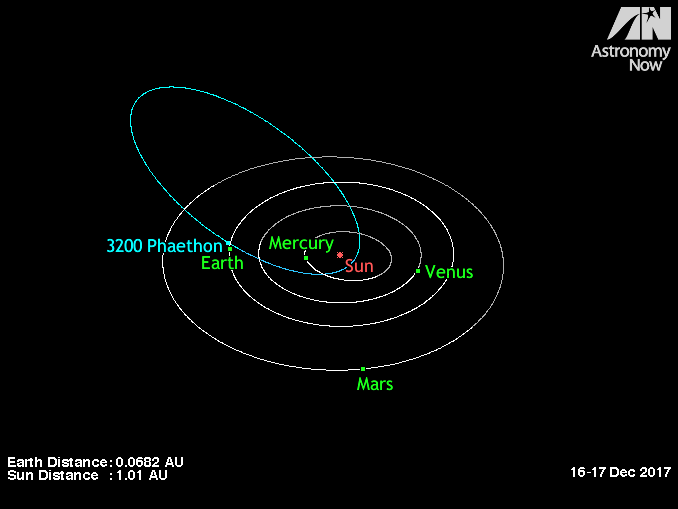
Here’s another odd feature of 3200 Phaethon. While comets tend to have more elliptical orbits, asteroid orbits are more circular. 3200 Phaethon’s orbit – which is now exceedingly well known – is highly elongated, reminiscent of some comets. Its orbit crosses the orbits of Mars, Earth, Venus and Mercury.
Orbital path of 3200 Phaethon, via SkyandTelescope.com. In 2017, 3200 Phaethon came closer to Earth than it will again until 2093. The Geminids are always a reliable shower, but the shower was extra special in 2017 because its parent object was nearby.
Plus its orbit brings 3200 Phaethon closer to the sun than any other named asteroid (though some smaller, unnamed asteroids come even closer). At its closest point, Phaethon is only 13 million miles (20.9 million km) from the sun. That’s less than half of Mercury’s closest distance. Its name honors this object’s relationship to the sun. In Greek mythology, Phaethon was the son of the sun god Helios.
3200 Phaethon’s orbit carries it so close to the sun that its surface heats up to about 1,500 degrees Fahrenheit (800 degrees C). That’s hot enough to melt aluminum.
It’s when it’s closest to the sun that 3200 Phaethon releases a tiny dust tail; that’s right, it’s a dust tail for an asteroid, one of only two known so far in our solar system. Scientists have said it’s possible the sun’s heat causes fractures, in much the same way a dry riverbed cracks in the afternoon heat.
Comets are known for their tails. 3200 Phaethon’s dust tail is one of the features of this object that blurs the line traditionally thought to set comets and asteroids apart.
This closeup image of 3200 Phaethon by NASA’s STEREO A spacecraft in 2017 shows a tail extending faintly toward lower left.
3200 Phaethon was the first asteroid to be discovered via spacecraft on October 11, 1983. Astronomers Simon F. Green and John K. Davies noticed it while searching Infrared Astronomical Satellite data for moving objects. Charles T. Kowal confirmed it optically and said it was asteroid-like in appearance. The object received the provisional designation 1983 TB. Two years later, in 1985, using the convention for naming asteroids, astronomers assigned it its asteroid number and name: 3200 Phaethon.
Before 3200 Phaethon, scientists linked all known meteor showers to active comets and not asteroids.
Thus 3200 Phaethon surprised them from the beginning, because – while it looked like an asteroid – it appeared to be the source of the annual Geminid meteor shower. Astronomers began calling 3200 Phaethon a comet-asteroid hybrid, an asteroid that behaves like a comet. Later, they began using the term rock-comet.
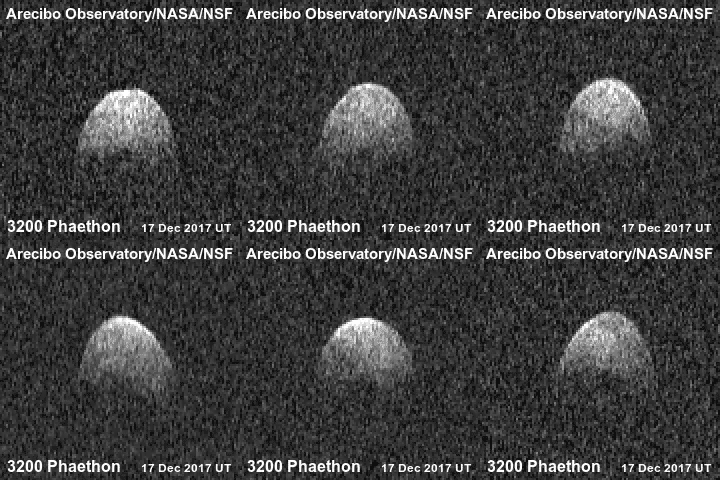
Radar images of 3200 Phaethon generated by astronomers at the Arecibo Observatory on December 17, 2017.
Image via Wikipedia.
Astronomer Teddy Kareta of the University of Arizona’s Lunar and Planetary Laboratory has studied 3200 Phaethon. He commented in 2018:
[At first], the assumption was that Phaethon probably was a dead, burnt-out comet, but comets are typically red in color, and not blue. So, even though Phaethon’s highly eccentric orbit should scream ‘dead comet,’ it’s hard to say whether Phaethon is more like an asteroid or more like a dead comet.
The composition of 3200 Phaethon resembles that of asteroid 2 Pallas. Both are dark, B-type asteroids composed of materials that have been modified by water. The 1st in this series of Hubble images of 3200 Phaethon in 2017 is marked with the asteroid’s spin axis (top) and south pole.
3200 Phaethon is classified as a potentially hazardous asteroid, which doesn’t mean it’s a threat to Earth. It just means two things. First, 3200 Phaethon is big – about 3 miles (5 km) wide – big enough to cause significant regional damage if it were to strike Earth.
Second, it’s known to make periodic close approaches to Earth.
The 2017 “close approach” brought this object to about 26 times the moon’s distance. Astronomers know of no upcoming strike by this object in this foreseeable future.
Both amateur and professional astronomers watched 3200 Phaethon as carefully as they could in 2017. For example, Northolt Branch Observatories in London, England, created the animation below from images it captured in 2017.
Steven Bellavia also produced a video of 3200 Phaethon in 2017 – below. He commented then that he’d endured cloudy weather and sub-freezing temperatures in order to capture the images. “My fingers still hurt!” he wrote.
Mike Olason in Denver, Colorado captured 3200 Phaethon on December 4, 2017:
Image via Mike Olason.
The 2017 encounter was the closest this object will come to Earth until 2093.
3200 Phaethon swept close to Earth – just 0.069 astronomical units (6.4 million miles, 10.3 million km, 26 lunar-distances) on December 16, 2017, at 23:00 UTC.
Image via Osamu Ajiki (AstroArts)/ Ron Baalke (JPL)/ Ade Ashford (AN)/ AstronomyNow.
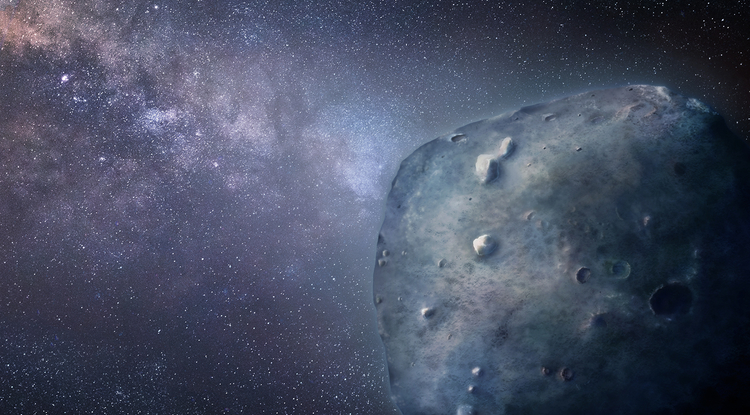
Artist’s concept of what asteroid 3200 Phaethon might look like close up. Notice its blue color and tail of dust.
Moon landing hoax? Here are six NASA lunar landing sites visible in plain sight on Moon
NASA’S six Moon landings between 1969 and 1972 have been at the heart of hoax claims and conspiracy theories for decades. Here are six photos disproving any claims of Moon landing forgery.
NASA landed the first astronauts on the Moon, Neil Armstrong and Edwin “Buzz” Aldrin, on July 20, 1969. The historic Apollo 11 mission was soon followed by Apollo 12, Apolo 13, Apollo 14, Apollo 15, Apollo 16 and Apollo 17. Of this list, the doomed Apollo 13 flight was the only mission to never land on the Moon. But despite the six incredible journeys to the Moon and back, conspiracy theorists still claim the Moon landings were faked.
The photo revealed the landing spots of Apollo 11, Apollo 15, Apollo 16 and Apollo 17.
LRO will be used to identify the best destinations for the next journeys to the Moon
Richard Vondrak, NASA
Soon after, the space agency was able to photograph the landing sites of Apollo 14 and Apollo 12.
And in each case, the photos also revealed the remains of each mission’s Lunar Lander and tools and instruments left behind.
Richard Vondrak of NASA's Goddard Space Flight Center said: “Not only do these images reveal the great accomplishments of Apollo, they also show us that lunar exploration continues.
“They demonstrate how LRO will be used to identify the best destinations for the next journeys to the Moon.”
RUSSIA IS WORKING ON ITS OWN PLAN TO BLOW UP KILLER ASTEROIDS
IMAGE VIA PIXABAY/VICTOR TANGERMANN
KRISTIN HOUSER
Space Rocks
Russian space agency Roscosmos is creating a center devoted to monitoring meteors, comets, and asteroids to ensure they don’t collide with Earth — even it means having to blow them up in space.
“As part of the creation of a monitoring system and information support for the safety of space activities in near-Earth space, we plan to launch the Russian Center for Small Celestial Bodies, whose main task will be to detect and track celestial bodies approaching Earth,” Igor Bakaras, a senior official at Roscosmos subsidiary TsNIIMash, told Russian-owned news agency Sputnik.
Get Centered
Pakistani news agency UrduPoint News has reported that officials are expected to approve the center in mid-2020. It will go online shortly after and then remain in operation until 2030.
Russia also recently announced plans to build a series of telescopes on the Moon to help it track potentially hazardous space rocks, so it seems likely the new center will play a role in bringing that effort to fruition.
Planning Stages
Before Russia can blast any dangerous asteroids out of the sky, it’ll need to do a lot of research. To that end, Bakaras told Sputnik that Russian scientists are currently exploring a variety of ways to destroy or redirect a space rock heading toward Earth, including through the use of satellites, rocket engines, and solar sails.
“At present, work in these areas is limited largely to theoretical research and the mathematical modeling of various countermeasures,” Bakaras said — and that research could be key to saving the planet if an asteroid does make its way toward Earth.
Colombia UniversityHet spoor op het fossiel, dat 200 miljoen jaar oud is, is wellicht afkomstig van een wandelende steen.
WETENSCHAP Zo’n 120 jaar geleden, in 1896, werd een fossiel van 200 miljoen jaar oud teruggevonden in Connecticut. Behalve de voetsporen van een dinosaurus, was aan de linkerkant van het fossiel een opvallende veeg te zien, waar verder niets achter gezocht werd. Nu suggereert een nieuwe studie, uitgevoerd door onderzoekers aan de Colombia University, dat het om een spoor van een wandelende steen gaat.
Wandelende stenen zijn dan wel geen nieuw verschijnsel in Amerika, ze blijven wetenschappers met verstomming slaan. Zo heeft men slechts het gissen naar de manier waarop de kolossen zich doorheen de jaren verplaatsten. Maar dat het gebeurde, staat vast. Zonder de hulp van zwaartekracht, mensen of dieren. Het lange spoor dat de stenen daarbij achterlieten, levert het bewijs.
Vooral in Death Valley werden veel wandelende stenen teruggevonden. Death Valley is een woestijnachtig dal in de Amerikaanse staat Californië. Het regent er vrijwel nooit en mag zichzelf een van de warmste plekken op aarde noemen. Behalve de talrijke (mysterieuze) stenen, is er maar weinig te zien in het extreem droge dal.
En toch worden enkele rotsblokken – sommige wegen wel 320 kilogram – vergezeld van een spoor dat honderden meters lang is.
Hoe kan dat? Al sinds 1948 stellen wetenschappers zichzelf die vraag. Inmiddels konden ze twee manieren bedenken waarop de stenen zich konden verplaatsen. Ofwel worden de stenen voortgeduwd door microbiële matten, ofwel door een dunne laag ijs.
Microbiële matten bestaan uit meerdere lagen van micro-organismen en kunnen wel enkele centimeters dik worden. Maar enkele centimeters zouden niet voldoende zijn om een rotsblok van een honderdtal kilogram te verplaatsen. Het idee van de microbiële matten werd daardoor al snel uitgesloten.
Rest nog een laatste mogelijkheid volgens de wetenschappers aan Colombia University: een dun laagje ijs en een lichte bries zouden ervoor gezorgd hebben dat de steen zich erg gestaag verplaatste.
Vulkaanuitbarsting
Maar ook die redenering vertoonde gaten. In Connecticut - waar het recente spoor aangetroffen werd - heerste namelijk een tropisch klimaat. Door een vulkaanuitbarsting koelde de aarde destijds vermoedelijk zodanig af, waardoor het zelfs in de tropen vroor. Zo suggereren de onderzoekers. “Als er daadwerkelijk dunne ijslaagjes in de regio aanwezig waren, dan hebben ze waarschijnlijk ook andere stenen verplaatst”, aldus paleontoloog Paul Olsen. “Als we die vinden, zal het alle twijfel wegnemen.”
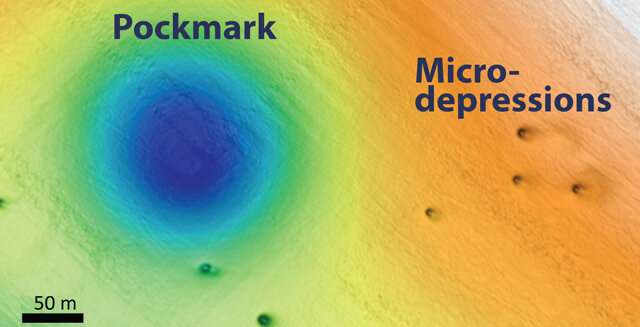
Seafloor map showing pockmark and micro-depressions in the seafloor off Big Sur.
Image. Credit: MBARI
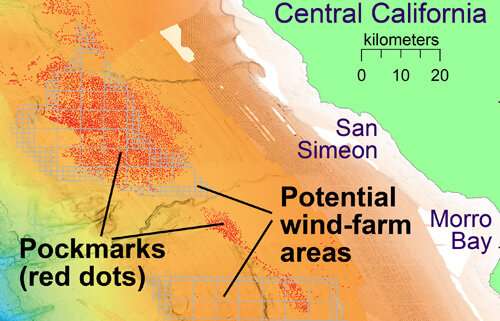
During a recent survey of the deep seafloor off Big Sur, MBARI researchers discovered thousands of mysterious holes or pits in the seafloor. Scientists and resource managers want to understand how these pits formed because this area is the site of a proposed wind-energy farm. Researchers Eve Lundsten and Charles Paull describe their discovery this week at the Fall 2019 meeting of the American Geophysical Union in San Francisco.
The researchers found two different sizes of holes. The larger ones, known as pockmarks, average 175 meters (almost 600 feet) across and five meters (16 feet) deep, and are nearly circular and fairly evenly spaced. Some of these pockmarks were initially discovered by MBARI scientists in 1999 during a seafloor survey using ship-mounted sonar. Over the last few years, additional surveys by MBARI and other organizations revealed over 5,200 pockmarks spread out over 1,300 square kilometers (500 square miles), making this area the largest known pockmark field in North America.
More recently, MBARI conducted detailed seafloor surveys using sonar mounted on autonomous underwater vehicles. These surveys revealed thousands of smaller pits, which they termed micro-depressions. The micro-depressions average just 11 meters (36 feet) across and one meter (three feet) deep. They have steeper sides than the pockmarks and are often elongated in one direction.
Seafloor pockmarks have been found elsewhere around the world, and have been associated with releases of methane gas or other fluids from the seafloor. Such methane releases could potentially cause the seafloor to be unstable, which could pose risks for structures such as offshore oil platforms or wind turbines. However MBARI researchers found no evidence of methane in the sediment or seawater in this region. In fact, sonar data showing layers of seafloor sediments suggest that these pockmarks have been inactive for the last 50,000 years.µ
Computer generated 3-D view of a micro-depression.
Credit: MBARI
Map showing the locations of some of the pockmarks and proposed wind-farm areas off Central California.
Credit: MBARI
In contrast to the pockmarks, the micro-depressions formed in relatively young sediment. In addition, almost all of the micro-depressions contain objects such as rocks, kelp holdfasts, bones, trash, or fishing gear. Many micro-depressions also have "tails" of sediment that probably originated within the depression. In many areas, these tails are all oriented in the same direction.
Based on these observations, the researchers hypothesize that the micro-depressions are relatively recent features that were were excavated by local seafloor currents. Because the sediment on the seafloor in this area is so soft and "fluffy," the researchers speculate that even the movements of fish hiding out in the micro-depressions could stir up the sediment, allowing it to be carried away by currents.
Summarizing this work, Lundsten said, "The pockmarks and micro-depressions in this area are both holes in the seafloor that occur in softer sediments, but they are morphologically distinct. The cause and persistence of the pockmarks still remains a mystery, but we find no evidence they were created from gas or fluid in the seafloor in the recent past. The micro-depressions are recently formed erosional features; they are not 'incipient pockmarks.' Overall, a lot more work needs to be done to understand how all these features were formed, and this work is in progress."
Duizenden mysterieuze gaten ontdekt in de zeebodem. Onderzoekers staan voor groot raadsel
Onderzoekers van het Monterey Bay Aquarium Research Institute (MBARI) hebben een nogal opmerkelijke ontdekking gedaan toen ze de zeebodem voor de kust van Californië bestudeerden.
De bodem blijkt namelijk vol gaten te zitten, meldt website Phys.org.
Er zijn volgens onderzoekers Eve Lundsten en Charles Paull twee soorten gaten.
5200
De ene soort is ongeveer 175 meter breed en vijf meter diep. Opmerkelijk is dat ze cirkelvormig zijn en gelijkmatig zijn verdeeld over de zeebodem.
Over een gebied van 1300 vierkante kilometer zijn sinds 1999 ruim 5200 van dit soort mysterieuze gaten ontdekt.
Op andere plekken op aarde waren ze ontstaan nadat methaangas uit de zeebodem was ontsnapt, maar in dit geval konden de wetenschappers geen sporen van methaan vinden.
Mysterie
Voor nu is het een mysterie hoe de gaten zijn ontstaan.
“We hebben geen bewijs gevonden dat ze zijn ontstaan door gassen of vloeistoffen in de zeebodem,” zei Lundsten.
Veel werk
Ze voegde toe dat er nog veel werk te doen is voordat kan worden vastgesteld hoe de gaten zijn ontstaan.
De andere soort is zo’n 11 meter breed en één meter diep. Deze gaten zijn vrij nieuw en volgens de onderzoekers veroorzaakt door de stroming.
Large Atmospheric Waves in the Jet Stream Present Risk to Global Food Production
Researchers at Oxford University, together with and international colleagues, have discovered jet stream patterns that could affect up to a quarter of global food production.In a new study published today in Nature Climate Change, scientists show how specific wave patterns in the jet stream strongly increase the chance of co-occurring heatwaves in major food producing regions of Northern America, Western Europe and Asia. Their research finds that these simultaneous heatwaves significantly reduce crop production across those regions, creating the risk of multiple harvest failures and other far-reaching societal consequences, including social unrest.
Lead author, Dr Kai Kornhuber from the University of Oxford’s Department of Physics and Colombia University’s Earth Institute, said: ‘Co-occurring heatwaves will become more severe in the coming decades if greenhouse gases are not mitigated. In an interconnected world, this can lead to food price spikes and have impacts on food availability even in remote regions not directly affected by heatwaves.
‘We found a 20-fold increase in the risk of simultaneous heatwaves in major crop producing regions when these global scale wind patterns are in place. Until now this was an underexplored vulnerability in the food system. We have found that during these events there actually is a global structure in the otherwise quite chaotic circulation. The bell can ring in multiple regions at once and the impacts of those specific interconnections were not quantified previously.’
Western North America, Western Europe and the Caspian Sea region are particularly susceptible to these atmospheric patterns that get heat and drought locked into one place simultaneously where they then affect crops production yields.
Dr Dim Coumou, co-author from the Institute for Environmental Studies at VU Amsterdam, said: ‘Normally low harvests in one region are expected to be balanced out by good harvests elsewhere but these waves can cause reduced harvests in several important breadbaskets simultaneously, creating risks for global food production.’
Dr Elisabeth Vogel, co-author from Melbourne University, said: ‘During years in which two or more summer weeks featured the amplified wave pattern, cereal crop production was reduced by more than 10% in individual regions, and by 4% when averaged across all crop regions affected by the pattern.’
Dr Radley Horton, co-author from the Lamont-Doherty Earth Observatory at Colombia University, said: ‘If climate models are unable to reproduce these wave patterns, risk managers such as reinsurers and food security experts may face a blind spot when assessing how simultaneous heat waves and their impacts could change in a warming climate.’
The scientists conclude that a thorough understanding of what drives this jet stream behaviour could ultimately improve seasonal predictions of agricultural production at the global scale and inform risk assessments of harvest failures across multiple food-producing regions.
Saturn’s icy moon Enceladus is of great interest to scientists due to its subsurface ocean, making it a prime target for those searching for life elsewhere. New research led by Carnegie’s Doug Hemingway reveals the physics governing the fissures through which ocean water erupts from the moon’s icy surface, giving its south pole an unusual “tiger stripe” appearance.
“First seen by the Cassini mission to Saturn, these stripes are like nothing else known in our Solar System,” lead author Hemingway explained. “They are parallel and evenly spaced, about 130 kilometers long and 35 kilometers apart. What makes them especially interesting is that they are continually erupting with water ice, even as we speak. No other icy planets or moons have anything quite like them.”
Credit: NASA, ESA, JPL, SSI, Cassini Imaging Team
Working with Max Rudolph of the University of California, Davis and Michael Manga of UC Berkeley, Hemingway used models to investigate the physical forces acting on Enceladus that allow the tiger stripe fissures to form and remain in place. Their findings are published by Nature Astronomy.
The team was particularly interested in understanding why the stripes are present only on the moon’s south pole but were also keen to figure out why the cracks are so evenly spaced.
The answer to the first question turns out to be a bit of a coin toss. The researchers revealed that the fissures that make up Enceladus’ tiger stripes could have formed on either pole, the south just happened to split open first.
Enceladus experiences internal heating due to the eccentricity of its orbit. It is sometimes a little closer to Saturn and sometimes a littler farther, which causes the moon to be slightly deformed—stretched and relaxed—as it responds to the giant planet’s gravity. It is this process that keeps the moon from freezing completely solid.
Key to the formation of the fissures is the fact that the moon’s poles experience the greatest effects of this gravitationally induced deformation, so the ice sheet is thinnest over them. During periods of gradual cooling on Enceladus, some of the moon’s subsurface ocean will freeze. Because water expands as it freezes, as the icy crust thickens from below, the pressure in the underlying ocean increases until the ice shell eventually splits open, creating a fissure. Because of their comparatively thin ice, the poles are the most susceptible to cracks.
The researchers believe the fissure named after the city of Baghdad was the first to form. (The stripes are named after places referred to in the stories of One Thousand and One Nights, which are also called Arabian Nights.) However, it didn’t just freeze back up again. It stayed open, allowing ocean water to spew from its crevasse that, in turn, caused three more parallel cracks to form.
“Our model explains the regular spacing of the cracks,” Rudolph said.
The additional splits formed from the weight of ice and snow building up along the edges of the Baghdad fissure as jets of water from the subsurface ocean froze and fell back down. This weight added a new form of pressure on the ice sheet.
“That caused the ice sheet to flex just enough to set off a parallel crack about 35 kilometers away,” Rudolph added.
That the fissures stay open and erupting is also due to the tidal effects of Saturn’s gravity. The moon’s deformation acts to keep the wound from healing—repeatedly widening and narrowing the cracks and flushing water in and out of them—preventing the ice from closing up again.
For a larger moon, its own gravity would be stronger and prevent the additional fractures from opening all the way. So, these stripes could only have formed on Enceladus.
“Since it is thanks to these fissures that we have been able to sample and study Enceladus’ subsurface ocean, which is beloved by astrobiologists, we thought it was important to understand the forces that formed and sustained them,” Hemingway said. “Our modeling of the physical effects experienced by the moon’s icy shell points to a potentially unique sequence of events and processes that could allow for these distinctive stripes to exist.”
This work was supported by NASA and the U.S. National Science Foundation.
The work was based on data collected by the NASA/ESA Cassini mission to Saturn.
Contacts and sources:
Doug Hemingway
Carnegie Institution for Science
Citation:
Cascading parallel fractures on Enceladus Douglas J. Hemingway, Maxwell L. Rudolph & Michael Manga Nature Astronomy (2019)Cite this article Article metrics 303 Altmetric Metrics https://www.nature.com/articles/s41550-019-0958-x
First physical evidence of Egyptian 'head cones' found in 3,300-year-old tomb reveal they were made of WAX and may have been designed to scent the hair and purify the soul
Research team reveals exciting discovery of two head cones in Egyptian graves
Some scholars argued the distinctive headwear only ever existed in artworks
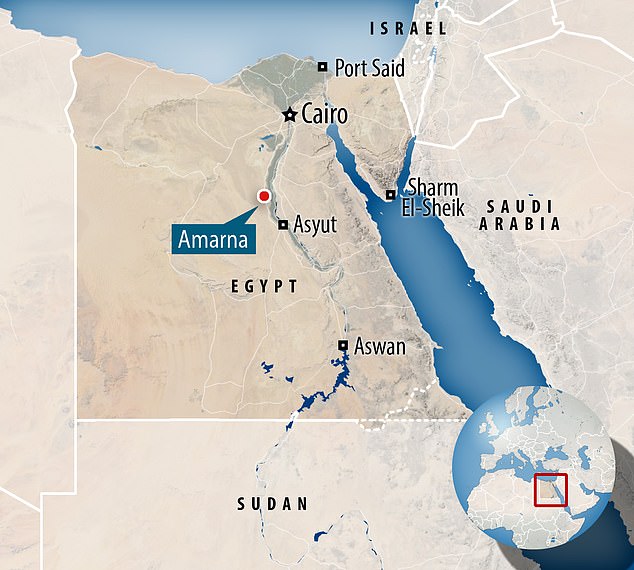
The cones were found in the ancient city of Armarna, 194 miles south of Cairo
The Egyptian city was abandoned in 1332 BC after being occupied for just 15 years after the death of its 'heretic' founder
Ancient Egyptian art frequently depicts people wearing cone-shaped headgear, but none has ever been found.
Now an international team of archaeologists has uncovered the first ever physical evidence of Egyptian head cones in the ancient city of Armarna, 194 miles south of the capital Cairo.
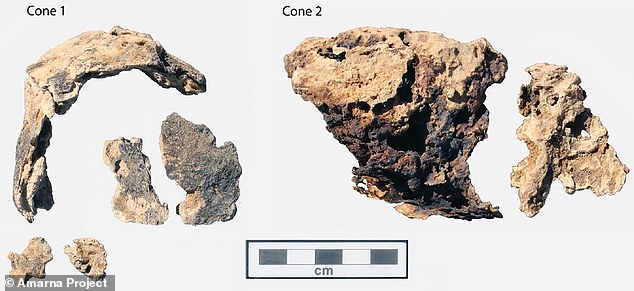
The head cones, made from wax, were discovered at two graves in 2010 and 2015. They were found in fragments but researchers have been able to reconstruct their shape.
They provide the first conclusive evidence that the objects actually existed and were worn by Egyptians, according to the archaeologists.
Due to the lack of material evidence, scholars have previously speculated that the head cones only ever existed as mere depictions in art.
Some believed that they were entirely symbolic - like halos given to religious figures in Christian art - while others argued that they did exist but were made of materials that did not survive.
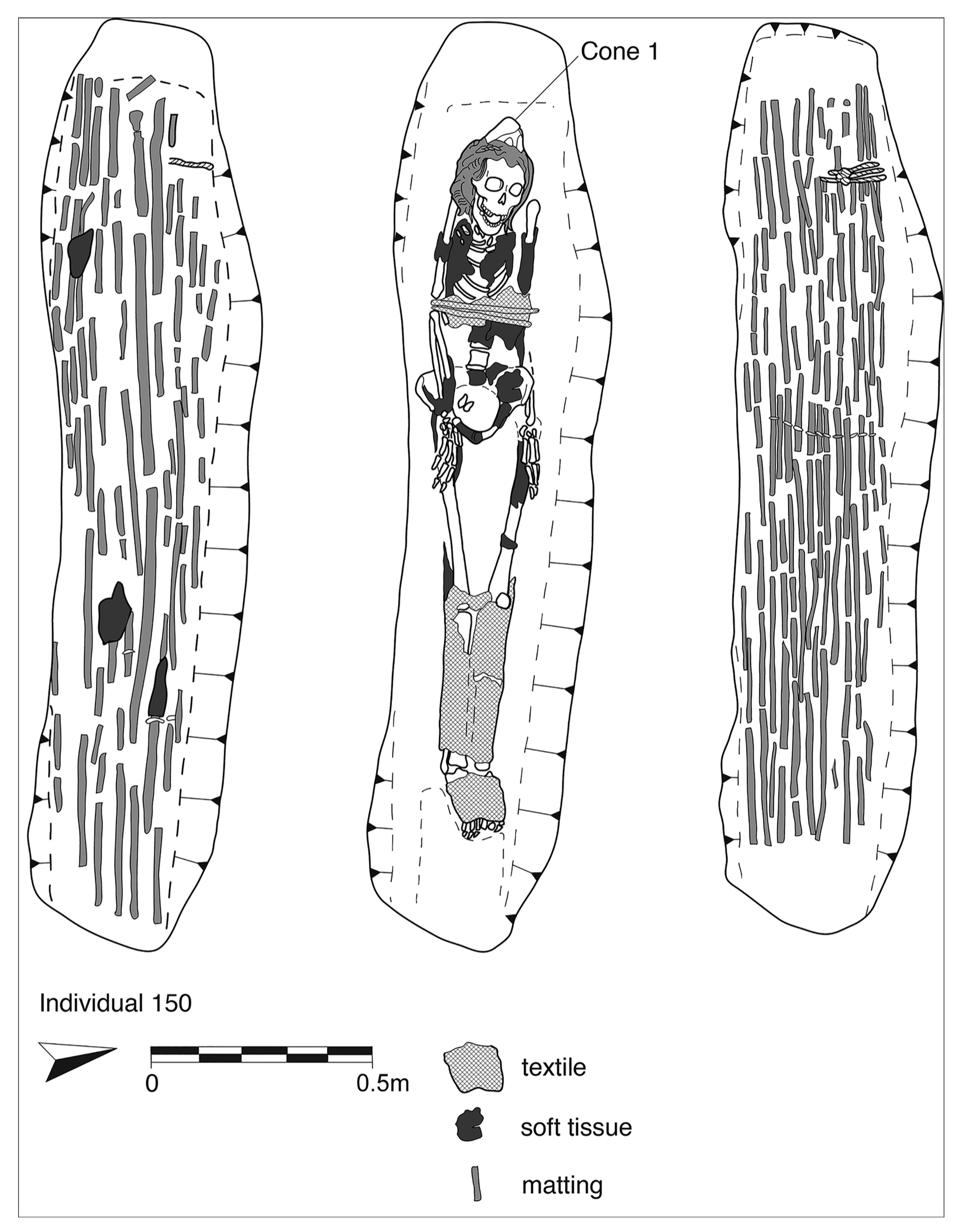
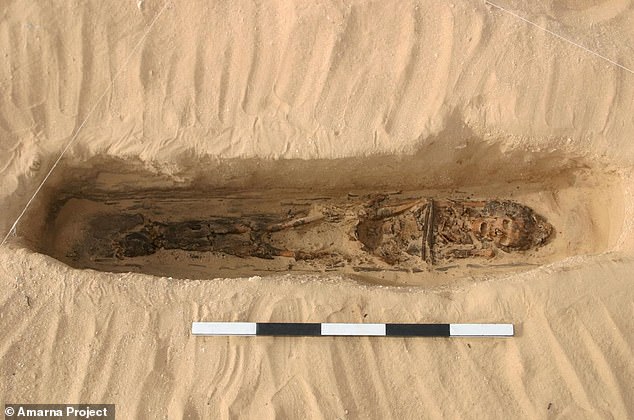
Cone 1 excavated at the South Tombs Cemetery in 2010, on the remains of an individual estimated to be a 20–29-year-old female
The Egyptian city of Amarna, 194 miles south of the Egyptian capital Cairo, was abandoned in 1332 after being occupied for only 15 years
The graves in which the cones were discovered are thought to have belonged to the non-elite, suggesting that the cones were not a particular mark of status.
'These are the first archaeological examples of this usual headwear yet known from Egypt, although we have many images of people wearing them’, said Anna Stevens, lead author of the study.
‘Many questions remain about the meaning and function of the head cones – and the excavated examples won’t answer them all.
‘But careful excavation has now shown that the cones certainly existed in 3D form, that they could be worn by the deceased and that they were not only for the elite.'
Spectroscopy analysis of the cones revealed that they were hollow and made of plant or animal wax - most likely beeswax.
It is believed they may have been infused with perfume to purify the wearer so they could engage with the rituals and deities of the afterlife.
Other theories suggest they may be connected with ideas of fertility and resurrection.
Based on cranial and pelvic observations of the human remains found with the head cones, one of the bodies is believed to be of a woman aged between 20-29 years at her time of death, still with well-preserved hair under the cone.
The adult female remains in its original place of discovery, compelete with headcone and well-preserved hair
Excavations taking place at the North Tombs Cemetery in 2017 as part of the Amarna project
The second cone, found in 2015, belonged to a 15-20 year-old of indeterminate sex.
Researchers say it's probable that these two cones were ‘model’ versions made for a burial environment, and that cones intended to be worn by the living could have been constructed differently.
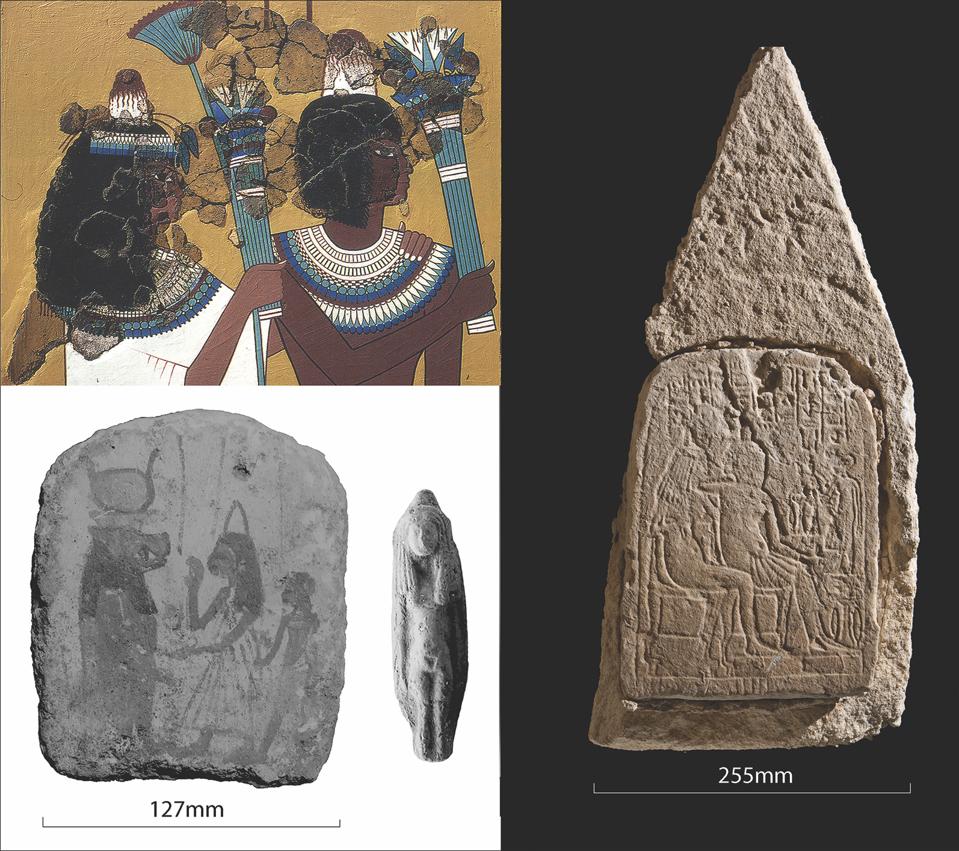
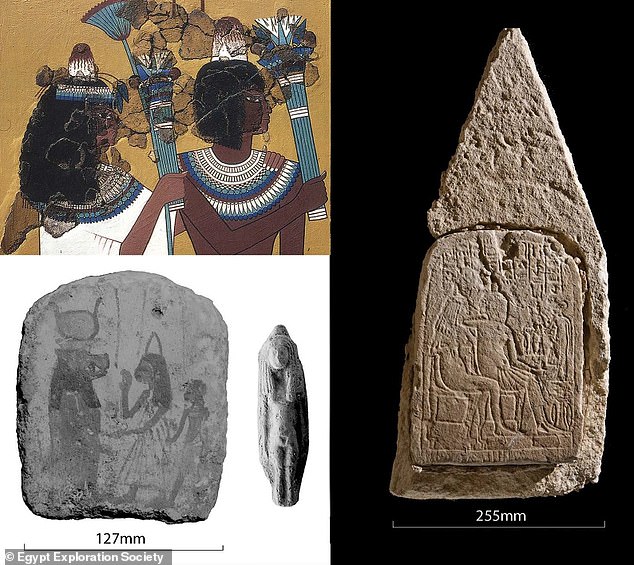
Ancient Egyptians are often depicted wearing cones in artwork depicting banquets, worship and the afterlife.
Scholars often link the cones with sensuality and sexuality, as they frequently appear in artistic imagery of women - sometimes unclothed.
One popular theory is was that they were an unguent – pieces of fat or wax perfumed, perhaps with myrrh.
As the cone melted, the scent was released, with some ancient Egyptian literature suggesting that this process would scent and cleanse the hair and body.
Head cones are worn by females and males in Ancient Egyptian art depicting banqueting scenes, including those honouring the dead, funerals, or people being rewarded by the king
A reconstruction of the two cones, revealing they are both hollow
It is not known why these cones were included in the burials, but researchers suggest they may have been symbols meant to enhance the rebirth or personal fertility of the deceased in the afterlife.
They have also previously simply been interpreted more broadly as symbols of the tomb owner's contentedness in the afterlife.
The city of Amarna was built by the pharaoh Akhenaten as home for the cult of the sun god Aten and now contains thousands of graves.
Akhenaten controversially placed much emphasis on the worship of the Egyptian sun, and away from Egyptian tradition of polytheism, the worship of multiple deities.
The city was abandoned around 10 years after the pharaoh’s death, despite only being occupied for 15 years from 1347 to 1332 BC.
But the abandoned city attracted ancient looters, who stole from all four cemeteries at the site.
This has made the task of piecing together all the disturbed burials all the more difficult for archaeologists of the Amarna Project, who have been excavating the site since2005.
The study of the two head cones has been published in the journal Antiquity.
WHO WAS AKHENATEN?
Akhenaten was a pharaoh of 18th Dynasty of the New Kingdom of Egypt.
The ancient Egyptian city of Tell el-Amarna (or simply Amarna) was the short-lived capital built by the ‘heretic’ Pharaoh Akhenaten and abandoned shortly after his death (c. 1332).
It was here that he pursued his vision of a society dedicated to the cult of one god, the power of the sun (the Aten) – seen as heresy at the time.
Akhenaten, upon becoming Pharaoh, ordered all the iconography of previous gods to be removed.
After his death, his monuments were dismantled and hidden and his statues were destroyed.
One of Akhenaten’s sons was Tutankhaten, who went on to become pharaoh and took the name Tutankhamun, one of the most famous ancient Egyptian pharaohs.
One of the many places known for elongated skulls is Egypt. While few ancient remains or mummies have been discovered sporting the long craniums, many paintings and sculptures depict them. In many other paintings, the Egyptians aren’t shown with cone heads but more than a few have mysterious head cones. Now, a new study reports that a few of these head cones have actually been found — and they may solve the mystery surrounding their appearances in ancient Egyptian art.
“Images of ancient Egyptians wearing distinctive, cone-shaped objects on their heads have, in the absence of physical examples, long elicited scholarly debate. Did people wear these cones, or were they a purely iconographic device? What was their function and meaning? Recent excavations at the Amarna cemeteries now provide the first material examples of head cones.”
In the study published in the journal Antiquity, a team of archeologists describe finding two of these mysterious head cones in graves in Akhetaten (also called Amarna), an unusual ancient Egyptian city that was only occupied for about 15 years during the 14th century B.C.E. while Egypt was ruled by its namesake — Akhenaten. He was later considered to be a heretic for creating a religious system based on a single god, Aten, and may have also been the father of Tutankhamun. What does any of this have to do with the mysterious head cones?
“Between 1550 B.C. and 30 B.C., Egyptian art depicted people wearing what look like cones on their heads. Because no examples of these cones had ever been found, archaeologists wondered whether they actually existed or were an artistic motif that had no basis in reality (similar to people with halos over their heads depicted in Christian art).”
LiveScience draws a comparison between the Christian halo and the head cone, giving it a religious connotation. The difference is, we now have two real people with real head cones found in graves in Akhetaten. (Photographs here.) One, a woman no more than 29 when she died, had “long, thick braids featuring many extensions and end-curls” and “the cone was found in situ, placed on top of the head over the well-preserved hair.” The other, according to the archeologists, was an individual of undetermined sex, age 15-to-20, whose cone “seems to be that of a low dome” and measured 3.1 inches (80 mm) high and 3.9 inches (100 mm) across.
Plan of excavation of a young woman with a head cone buried at Amarna, Egypt.
ILLUSTRATION BY M. SHEPPERSON FROM STEVENS ET AL. 2019, ANTIQUITY PUBLICATIONS LTD.
Besides their actual existence, what the researchers found most unusual about these two head cones was that they were made of beeswax – not a perfumed oil solid or fat that was intended to melt in the grave to cleanse the spirit. Oh, and the cones were solid lumps of wax, not hollow hats. The beeswax, combined with the physical condition of the individuals, indicates they were of a worker class – a surprise to archeologists who believed they signified membership in a higher class. So, what was their true purpose?
“The authors tentatively suggest that the Amarna cones were symbols meant to enhance the rebirth or personal fertility of the deceased in the afterlife.”
Now that they finally have a couple of head cones to deconstruct, the researchers speculate the cream-colored beeswax bonnets were fertility aids placed on their heads in death to resolve these issues in the afterlife. Support for this theory comes from the fact that “Scholars often link the cones specifically with sensuality, sexuality and related notions, as they are frequently associated in imagery with women, sometimes unclothed” and are painted on women in scenes with the fertility goddess Hathor.
Beeswax is still used in rituals
One of the graves found with a head cone.
AMARNA PROJECT/ANTIQUITY PUBLICATIONS LTD
Case closed? Not so fast, say other researchers interviewed by LiveScience. Lise Manniche, a professor emeritus of Egyptology at the University of Copenhagen, thinks they were just cheaper, lower-class versions of the perfumed unguent head cones of the upper class. Nicola Harrington, an honorary research associate at the University of Sydney’s archaeology department, points out that the two individuals had “stress/compression fractures of the mid-lower spine” which were common among dancers, indicating that the two may have been ritual hoofers who performed for the king and his god Aten.
Which brings us back to the brief life of Akhetaten and the controversy surrounding Akhenaten and his attempt at monotheism in ancient Egypt. Was this so abhorring that these people were forced to abandon Akhenaten, which means “Horizon of the Aten,” in shame?
Our head cones are tipped to the archeologists who continue to search for their true meaning.
Strange Circles Appear On Forbidden Island, Video, UFO Sighting News.
Date of discovery: Dec 2019 Location of discovery: Island of Carmen
A helicopter was passing over an island area and noticed something really strange. The beach area was littered with huge circles that were tied together. They almost appeare like we are looking at giant atoms...or perhaps the atomic structure of a totally new element. This island is forbidden for anyone to step onto it. Its considered a wildlife refuge...or so they say. But may be a hidden island that is used by aliens as a base location. These circles should not exist on an island where there are no humans on it. Obviously these circles were made by intelligent beings...if no humans...then aliens. Scott C. Waring
Strange Symbols Resembling Crop Circles Appear In UNESCO Protected Island
Symbols that resemble crop circles appeared in Isla del Carmen
The symbols appeared in nature reserve protected by UNESCO
A UFO expert believes the symbols were made by aliens
Several strange symbols resembling crop circles were spotted along the beaches of a nature reserve in Mexico that’s protected by UNESCO. According to a UFO expert, the symbols could have been made by intelligent alien life forms.
The symbols appeared on the beaches of an island in Mexico known as Isla del Carmen, which is situated in the Gulf of California. It is classified as a nature reserve and is under the protection of UNESCO.
According to the YouTube channel shadowland.13, photos of the mysterious symbols were taken by a helicopter pilot of the aviation company Specialized Aero as he was passing over the island. Based on the photos, the symbols were drawn on the sand and featured same-sized circles. Each of the circles was connected to each other by straight lines that were also drawn on the sand.
The symmetrical appearance and vastness of the symbols closely resemble the crop circles that usually appear in cornfields. Due to their mysterious nature, these symbols have been associated with UFOs and alien entities.
According to Scott Waring of ET Data Base, the strange symbols that appeared in Isla del Carmen resemble the structure of atoms or a new element.
“The beach area was littered with huge circles that were tied together,” he wrote on a blog post. “They almost appear like we are looking at giant atoms...or perhaps the atomic structure of a totally new element.”
Waring noted that the area where the symbols appeared is a protected site, which means people are not allowed to wander through it without proper authorization or a guide. Because of this, he believes that it is highly unlikely that the symbols were made by humans. He suggested that alien life forms may have taken advantage of the island’s remote nature to establish a base there.
“This island is forbidden for anyone to step onto it,” he stated. “It’s considered a wildlife refuge...or so they say. But maybe a hidden island that is used by aliens as a base location. These circles should not exist on an island where there are no humans on it. Obviously these circles were made by intelligent beings...if no humans...then aliens.”
Crop Circle found in Chualar, Ca, now known to be created by NVIDIA.
Meer van UFO'S of UAP'S, ASTRONOMIE, RUIMTEVAART, ARCHEOLOGIE, OUDHEIDKUNDE, SF-SNUFJES EN ANDERE ESOTERISCHE WETENSCHAPPEN - DE ALLERLAATSTE NIEUWTJES


 Mysterious Visitor from Another Star Can't Be Captured














 Fossilised 35 million-year-old whale remains uncovered in...
 Shining a light on the secrets of ancient Egyptian mummies:...
 Why the Nile has flowed north for 30million years: 'Conveyor...
 Ancient Egyptian 'cat mummy' preserved in French museum has...