Ontdek de Fascinerende Wereld van UFO's en UAP's: Jouw Bron voor Onthullende Informatie!
Ben jij ook gefascineerd door het onbekende? Wil je meer weten over UFO's en UAP's, niet alleen in België, maar over de hele wereld? Dan ben je op de juiste plek!
België: Het Kloppend Hart van UFO-onderzoek
In België is BUFON (Belgisch UFO-Netwerk) dé autoriteit op het gebied van UFO-onderzoek. Voor betrouwbare en objectieve informatie over deze intrigerende fenomenen, bezoek je zeker onze Facebook-pagina en deze blog. Maar dat is nog niet alles! Ontdek ook het Belgisch UFO-meldpunt en Caelestia, twee organisaties die diepgaand onderzoek verrichten, al zijn ze soms kritisch of sceptisch.
Nederland: Een Schat aan Informatie
Voor onze Nederlandse buren is er de schitterende website www.ufowijzer.nl, beheerd door Paul Harmans. Deze site biedt een schat aan informatie en artikelen die je niet wilt missen!
Internationaal: MUFON - De Wereldwijde Autoriteit
Neem ook een kijkje bij MUFON (Mutual UFO Network Inc.), een gerenommeerde Amerikaanse UFO-vereniging met afdelingen in de VS en wereldwijd. MUFON is toegewijd aan de wetenschappelijke en analytische studie van het UFO-fenomeen, en hun maandelijkse tijdschrift, The MUFON UFO-Journal, is een must-read voor elke UFO-enthousiasteling. Bezoek hun website op www.mufon.com voor meer informatie.
Samenwerking en Toekomstvisie
Sinds 1 februari 2020 is Pieter niet alleen ex-president van BUFON, maar ook de voormalige nationale directeur van MUFON in Vlaanderen en Nederland. Dit creëert een sterke samenwerking met de Franse MUFON Reseau MUFON/EUROP, wat ons in staat stelt om nog meer waardevolle inzichten te delen.
Let op: Nepprofielen en Nieuwe Groeperingen
Pas op voor een nieuwe groepering die zich ook BUFON noemt, maar geen enkele connectie heeft met onze gevestigde organisatie. Hoewel zij de naam geregistreerd hebben, kunnen ze het rijke verleden en de expertise van onze groep niet evenaren. We wensen hen veel succes, maar we blijven de autoriteit in UFO-onderzoek!
Blijf Op De Hoogte!
Wil jij de laatste nieuwtjes over UFO's, ruimtevaart, archeologie, en meer? Volg ons dan en duik samen met ons in de fascinerende wereld van het onbekende! Sluit je aan bij de gemeenschap van nieuwsgierige geesten die net als jij verlangen naar antwoorden en avonturen in de sterren!
Heb je vragen of wil je meer weten? Aarzel dan niet om contact met ons op te nemen! Samen ontrafelen we het mysterie van de lucht en daarbuiten.
Zaterdag 27 juni 2020
What is NASA’s new strategy for finding extraterrestrial civilizations in space?
What is NASA’s new strategy for finding extraterrestrial civilizations in space?
Scientists are conducting a new study into the possibility of extraterrestrial civilizations.
The study involves a search for “technosignatures,” such as air pollution, the presence of which could signify advanced life on planets beyond the Solar System.
RT America’s Natasha Sweatte reports for the News with Rick Sanchez.
Ancient Aliens – The World Before Time History Channel, Season 15 Episode 6 29th February 2020
Many ancient civilizations dates back to the time that is ever been recorded on earth. Are these ancient civilization shows that we are not only advanced species on Earth and alien civilization inhabited Earth.
As if 2020 couldn’t get any more surreal, the Senate has just confirmed the existence of a UFO task force.
Members of the US Senate recently expressed concern that the US military was not giving the appropriate amount of attention to reports of encounters with unidentified aerial phenomena (UAPs), otherwise known as UFOs.
Because of this, they now want the Director of National Intelligence to work with other relevant agencies to create an unclassified report detailing the information they have on UFOs, and the kinds of threats or risks these objects might pose.
The call for this review of information was included in a Senate Intelligence Committee report accompanying a draft of the Intelligence Authorization Act – which concerns funding the government’s intelligence activities – initiated by Senator Marco Rubio.
The report asked for a ‘detailed analysis of unidentified aerial phenomena data and intelligence reporting collected or held by the Office of Naval Intelligence, including data and intelligence reporting held by the Unidentified Aerial Phenomena Task Force’, according to Motherboard.
It also expressed the need for a ‘detailed analysis’ of ‘unidentified phenomena data’ that has been collected by ‘geospatial intelligence, signals intelligence, human intelligence; and measurement and signals intelligence’.
Not only that, but the committee report wanted a ‘detailed analysis of data of the FBI, which was derived from investigations of intrusions of unidentified aerial phenomena data over restricted United States airspace’.
Pixabay
The report continued:
The Committee supports the efforts of the Unidentified Aerial Phenomenon Task Force at the Office of Naval Intelligence to standardise collection and reporting on unidentified aerial phenomenon, any links they have to adversarial foreign governments, and the threat they pose to U.S. military assets and installations.
However, the Committee remains concerned that there is no unified, comprehensive process within the Federal Government for collecting and analysing intelligence on unidentified aerial phenomena, despite the potential threat.
The main takeaway from this, apart from the upcoming report, is that the Senate has finally acknowledged the existence of a UFO task force. Prior to this report, the existence of such a task force had only been alluded to.
US Department of Defense
Before you get all excited and think this means the Senate has also acknowledged the existence of aliens, I hate to break it to you but that’s just not the case. UFOs – or UAPs, as the US government calls them – in this case refer to ‘potential aerospace or other threats’ to national security.
The committee has asked that the report identifies whether these phenomena are the work of a foreign adversary who ‘may have achieved breakthrough aerospace technology that could put the United States strategic or conventional forces at risk’.
In simple terms, they’re not looking for aliens… so they say.
US senators are demanding to see the Pentagon's UFO files as they push for influence over a secretive Navy program.
The Senate Intelligence Committee wants defense chiefs to publish a report on the Pentagon's UFO program and any phenomena it observes.
The committee says it 'supports the efforts of the Unidentified Aerial Phenomenon Task Force' - appearing to confirm that such a program still exists.
In 2017 the Pentagon acknowledged funding a secret multi-million dollar program to investigate UFO sightings, although defense chiefs claimed it had ended in 2012.
Senators now want to regulate the program - saying the public should be better informed of its activities.
In April 2020 the Pentagon released footage from three sightings of unidentified objects. One of the videos was captured off the coast of Jacksonville, Florida, in 2015 (pictured)
The Senate's focus on the program stems less out of a concern over extraterrestrials, and more from the threat posed by real-world US adversaries such as China.
The Pentagon admitted earlier this month that a nuclear detonation in space by Russia or China was among the possible threats to US interests.
The US is particularly worried about China's espionage capabilities, including use of drones and other aerial technology.
The UFO program, managed by the Office of Naval Intelligence, is responsible for 'collection and reporting on unidentified aerial phenomenon, any links they have to adversarial foreign governments, and the threat they pose to US military assets and installations.'
But senators said that information sharing had been 'inconsistent' and called for a detailed report on the program's progress and any phenomena it observes.
The provision is part of the 2021 intelligence authorization bill, which has yet to make its way to the full Senate.
If it passes, the Pentagon will have 180 days to submit a report to Congress.
The Pentagon said in 2017 that an earlier operation called the Advanced Aviation Threat Identification Programme had ended in 2012.
'It was determined that there were other, higher priority issues that merited funding and it was in the best interest of the DoD to make a change,' a spokeswoman said at the time.
But the Pentagon was less clear about whether the UFO program continues to hover somewhere in the vast universe of the US defense establishment.
'The DoD takes seriously all threats and potential threats to our people, our assets, and our mission and takes action whenever credible information is developed,' the spokeswoman said.
Another video shows the notorious 2004 'Tic Tac' incident (pictured) that was recorded over the Pacific Ocean
In April this year, the Pentagon released three videos taken by US Navy pilots showing mid-air encounters with unexplained objects.
The grainy black and white footage had previously been leaked and the Navy had acknowledged they were genuine videos.
One of the videos was shot in November 2004 and the other two in January 2015.
In one, a weapons sensor operator appears to lose lock on a rapidly moving object which seconds later suddenly accelerates away to the left and out of view.
In another video which is tracking an object above the clouds, one pilot wonders if it is a drone.
The Department of Defense said it was 'releasing the videos in order to clear up any misconceptions by the public on whether or not the footage that has been circulating was real, or whether or not there is more to the videos.'
'The aerial phenomena observed in the videos remain characterized as 'unidentified,'' the Pentagon statement said.
Retired US Navy pilot David Fravor, who saw one of the 'UFOs' in 2004, said the object he saw had been moving erratically.
'As I got close to it ... it rapidly accelerated to the south, and disappeared in less than two seconds,' Fravor told CNN in 2017.
'This was extremely abrupt, like a ping pong ball, bouncing off a wall. It would hit and go the other way.'
Former Nevada senator Harry Reid, whose state hosts the top secret Area 51 Air Force facility, welcomed release of the videos.
'I'm glad the Pentagon is finally releasing this footage, but it only scratches the surface of research and materials available,' he tweeted.
'The U.S. needs to take a serious, scientific look at this and any potential national security implications. The American people deserve to be informed.'
The Hubble Space Telescopespotted a bat signal out in the cosmos, 1,300 light-years from home. And the bat? It's flapping its wings.
In new observations released Thursday (June 25), Hubble has captured the young star HBC 672, nicknamed Bat Shadow. The far-off star, which lies in the Serpens Nebula, got its moniker because it sports a wing-like shadowy feature, which happens to be so large, it stretches out about 200 times the diameter of our entire solar system. The star has a planet-forming disk surrounding it that casts this wing-shaped shadow across the cloudy star-forming region.
But, while the bat-like feature might seem subtle (and might even take you a few minutes to spot), with these new images it is more apparent as you can see the structure's "wings" "flapping." That's right, much to the surprise of the team observing the star, Bat Shadow "flaps." In a new study, researchers led by Klaus Pontoppidan, an astronomer at the Space Telescope Science Institute (STScI) in Baltimore, Maryland, observed the star using Hubble and noticed this shadow "flapping."
In this image taken by the Hubble Space Telescope and released June 25, 2020, you can see the star nicknamed "Bat Shadow" for the flapping, bat-shaped shadow feature it has. (Image credit: NASA, ESA, K. Pontoppidan)
Pontoppidan and the other scientists think that this "flapping," which you can see in the video above, might be caused by a planet tugging on Bat Shadow and its surrounding disc and warping that disc. The researchers didn't expect to see the shadowy feature "flapping." But, as they observed Bat Shadow over 13 months, it looked like the shadow had moved.
"You have a star that is surrounded by a disc, and the disc is not like Saturn's rings — it's not flat. It's puffed up," Pontoppidan said in a statement. "And so that means that the light from the star, if it goes straight up, can continue straight up — it's not blocked by anything. But if it tries to go along the plane of the disk, it doesn't get out, and it casts a shadow."
The scientists concluded that a planet tugging on the star's disk and warping it would likely need at least 180 days to orbit the star and be about as far from its star as Earth is to the sun. The researchers also suggested that the star's disk is likely flared, meaning it angles out like the end of a trumpet, according to the same statement. The team also thinks another planet, or less likely a small star, may be embedded in Bat Shadow's disk.
The research is described in a paper published June 10 to the preprint server arXiv. The study has been accepted to be published in an upcoming edition of the Astrophysical Journal.
The brightest red dwarf star in the sky may be the best chance astronomers have yet to analyze the atmospheres of alien worlds — and perhaps detect whether those worlds have life, a new study finds.
Scientists focused on the red dwarf star GJ 887, also known as Gliese 887. (Red dwarfs are the most common kind of star in the galaxy, and weigh between 7.5% and 50% the mass of the sun.) At a distance of about 10.7 light-years from Earth, Gliese 887 is the twelfth-closest star. Furthermore, at visible wavelengths, Gliese 887 is the brightest red dwarf in the sky, and with nearly half the sun's mass, Gliese 887 is the heaviest red dwarf star within about 20 light-years of Earth.
Previous work found that many red dwarfs host planetary systems, ones usually made up of multiple small worlds. Still, "we've been looking for exoplanets orbiting Gliese 887 for nearly 20 years, and while we saw hints of a planetary signal, it wasn't strong enough to convince ourselves that it was a planet," study lead author Sandra Jeffers, an astrophysicist at the University of Göttingen in Germany, told Space.com.
Pressing forward, the researchers examined Gliese 887 for 80 nights in 2018. They relied on the High Accuracy Radial Velocity Planet Searcher (HARPS) instrument at La Silla Observatory in Chile, combining this data with archival measurements of the star spanning nearly two decades.
Astronomers use two strategies to discover most exoplanets, or worlds beyond our solar system. One method relies on how distant worlds regularly block out a fraction of light from their stars as they pass in front of their stars from the observer's perspective. However, this method will only spot planets that pass through the line of sight between Earth and their stars, meaning it will only detect a small fraction of exoplanets.
Instead, the scientists in this latest work looked for any wobbles from Gliese 887 due to gravitational tugs from orbiting planets. They found the red dwarf has at least two "super-Earth" exoplanets, dubbed Gliese 887 b and Gliese 887 c. The former is about 4.2 times Earth's mass and orbits just 6.8% of an astronomical unit (AU) from its star (one astronomical unit is the average distance between Earth and the sun), whereas the latter is about 7.6 times Earth's mass and orbits 12% of an AU from the red dwarf.
The researchers also found evidence for a possible third planet farther out from Gliese 887. Although the red dwarf's two confirmed planets are likely too hot for life as we know it on Earth, this potential third planet might lie within the star's habitable zone, where surface temperatures are suitable to host liquid water.
The bright light from this red dwarf might help astronomers learn more about the atmospheres of its planets by illuminating what ingredients make up those skies, Jeffers said. (The spectrum or wavelengths of light that an element absorbs or emits can act like a fingerprint, revealing the identity of the material in question.)
In addition, Gliese 887 is unusually quiet when it comes to flares and other explosive activity when compared to other red dwarfs. This factor would make it easier to analyze exoplanet atmospheres, because such activity could get confused with atmospheric signals, she added.
"The host star Gliese 887 is the best star in close proximity to the sun to understand whether its exoplanets have atmospheres and whether they have life, because it is such a bright and quiet star," Jeffers said.
The unusually quiet nature of Gliese 887 suggests that if it does possess a planet within its habitable zone, that world might have a greater chance at life than other red dwarf planets, which often erupt with dangerous flares.
"When a star is active, this makes it more likely that the original atmosphere can be blown away, with the result that the planet is less shielded from the star's activity," Jeffers said.
In the future, "our next step is to see if there is a third planet, and to try and detect exoplanetary atmospheres using the James Webb Space Telescope due to be launched next year," Jeffers said.
The scientists detailed their findings in the June 26 issue of the journal Science.
Onlangs publiceerden wij een artikel met daarin een aantal bizarre beelden van de lucht boven Amerika en Engeland.
Het was niet alleen daar, want ook bij ons waren vreemde dingen in de lucht waar te nemen.
Na de vreeemde bizarre beelde boven een stad als Birmingham en de vele dubbele regenbogen, vroegen wij ons af of er misschien ook bij ons vreemde dingen zijn waargenomen.
Voor wat betreft dubbele regenbogen was dit zeker het geval, want talloze Belgische lezers reageerden (dank!). Hierna volgen enkele opnames die een paar dagen geleden zijn gemaakt in België:
Ook de volgende bijdrage is afkomstig van een lezer uit België die schrijft:
Hier in belgie ook dubbele regenboog gezien in Hechtel-Eksel bij zonsondergang en gaf ook een beetje extra licht op ons terras op 5 juni 2020
Vervolgens komen er enkele foto's en een video. Het vreemde is dat op één die foto's een aantal blauwe stippen te zien zijn, die lijken op hetgeen men in Birmingham zag.
Gaat het hier om een ufo of een lensflare? In de video die hierna volgt is door ons geen ufo te ontdekken, dus misschien toch een lensflare.
De dubbele regenboog was ook bij ons te zien (Belgie - Gent), zie de bijgevoegde foto's.
We blijven nog even in België, waar het volgende bericht vandaan kwam:
Deze en meerdere hebben we gezien op zondag in oost vlaanderen, België. We voelden direct dat het een dimensiepoort is
Dan een bijdrage uit Nederland (dank!) met een heel mooie foto die lijkt op de perzikkleurige luchten in Amerika.
N.a.v. jullie artikel, vandaag 24 juni , stuur ik deze foto van een roze lucht met een regenboog terwijl het niet geregend had. De foto is genomen op maandagavond 15 of dinsdagavond 16 juni in Hertme Overijssel, bij Zenderen, vanaf een camperplaats. Iedereen stond ernaar te kijken, het was heel vreemd en lijkt erg op de foto’s in jullie artikel.
Het volgende verhaal speelt zich af in Brummen, een plaats die bekend is geworden in Nederland omdat ze Evert Jan Poorterman tot haar inwoners mag rekenen.
Een lezer schrijft het volgende (dank!):
Ik ben al jaren trouwe lezer van jullie website dank voor alle wijze en mooie artikelen. Ik las zojuist het artikel over Birmingham en ik schrok me een ongeluk. Ik heb dit zelf namelijk gezien in Nederland!! Dit was toevallig met Kerst 2019 bij mijn schoonouders in Brummen. Een zelfde soort dome met een dubbele regenboog. En als je inzoomt zie je 2 stippen zweven wat verdomd veel op ufo’s lijken.
Dan komt er nog het volgende:
Nog ter aanvulling; bij 9 seconde zie je de ufo’s als je inzoomt iets wat rechts van de dome. Zie foto ter illustratie.
Hier volgende de bewegende beelden van dit voorval:
Er zijn beelden opgedoken van een heel vreemd fenomeen in de lucht boven de Engelse stad Birmingham.
Het deed de maker denken aan bijbelse beelden, maar ook op andere plekken in Groot Britannië en Amerika waren vreemde luchten te zien.
De afgelopen dagen werden een aantal vreemde luchten waargenomen in Amerika, maar vooral ook in Engeland.
Donderdagavond werd er volgens een lezer op diverse plaatsten in Amerika hele vreemde luchten waargenomen. Oranje luchten, of misschien beter gezegd, perzikkleurige luchten met daarin een soort cirkel.
That same orange light was seen all over the US as well. Over here it was like the entire sky was a strange peach color. I heard some people talking about an eclipse. But the thing is, I can't find any information about it at all.
De volgende foto is genomen in South Carolina.
Een zelfde vreemde cirkel vinden we ook terug in Birmingham, waar wel héél spectaculaire beelden werden gemaakt. Wij kregen deze opgestuurd van een lezer (dank!).
Het begint als een naderend onweer en langzaam maar zeker vormt zich een vreemde cirkelvormige wolk waar op een gegeven moment een ufo uit tevoorschijn komt. (rechts boven in beeld).
Hierna volgen twee video's die betrekking hebben op het fenomeen hierboven. De opname lijkt echt, ook gezien het commentaar van de maker in de achtergrond.
Bovenstaande beelden doen natuurlijk heel sterk denken aan de diverse dimensieportalen die we hier in de loop der jaren voorbij hebben zien komen en waar we ook uitgebreid over hebben geschreven.
Eveneens afkomstig uit Engeland is de volgende prachtige foto van een dubbele regenboog.
En ook hier weer, net zoals in Amerika vreemde paarse/perzikkleurige luchten.
Voor zover ons bekend hebben bovenstaande fenomenen zich niet voorgedaan in ons land of België. Mocht dat wel zo zijn, laat het ons weten. redactie (apestaart) niburu.co
Er gebeuren allerlei bizarre dingen op aarde. In Argentinië zijnbeelden gemaakt van een verbazingwekkende zwerm sprinkhanen. “Ik heb nog nooit zoiets gezien,” zei een lokale overheidsfunctionaris. De insecten doen zich tegoed aan alles wat ze maar te pakken kunnen krijgen en hebben al talloze boerderijen verwoest.
De zwerm is nu op weg richting Brazilië, waar men extreem bezorgd is. Een Braziliaanse nieuwssite meldt dat mensen rekening moeten houden met 40 miljoen insecten per vierkante kilometer. Al deze sprinkhanen eten in één dag net zoveel als 2000 koeien of 350.000 mensen, zei de Argentijnse agronoom Hector Medina tegen Reuters.
Meest opzienbarende gebeurtenis in 50 jaar
Daarnaast is een gigantische stofwolk uit Afrika de Atlantische Oceaan overgewaaid. De stofwolk slokte enkele dagen geleden de Caribische eilanden op en staat op het punt de Verenigde Staten te bereiken.
Experts zeggen dat het de laatste 50 jaar niet zo heftig is geweest. “Dit is de meest opzienbarende gebeurtenis in zijn soort van de afgelopen halve eeuw,” zei Pablo Mendez Lazaro van de Universiteit van Puerto Rico tegen persbureau AP.
Woensdag is het zuiden van Californië bovendien getroffen door een aardbeving met een kracht van 5,8 op de schaal van Richter. Inwoners van Californië kregen een noodbericht op hun telefoon waarin stond: “Aardbeving! Ga liggen, zoek dekking, hou je vast. Breng jezelf in veiligheid.” De aardbeving werd gevolgd door een aantal krachtige naschokken. In de afgelopen week zijn er in Californië en Nevada niet minder dan 2267 aardbevingen geregistreerd. Dinsdag was er ook al een zware aardbeving in Mexico, met een kracht van 7,4.
The Big One
Wetenschappers waarschuwen al jaren voor The Big One, een zware beving in dichtbevolkt gebied. Seismologen voorspellen al tientallen jaren dat in het zuidwesten van de VS een keer een krachtige beving zal plaatsvinden op de San Andreas-breuklijn. Die loopt over zo’n 1200 kilometer dwars door Californië en passeert grote steden als San Francisco en Los Angeles.
Schrijver Michael Snyder stelt dat wat we tot nu toe hebben zien gebeuren slechts het topje van de ijsberg is.
"The Thing" Found in Antarctica Is a Monster's Egg
An artist’s interpretation of a baby mosasaur emerging from an egg
Credit: John Maisano/Jackson School of Geosciences.
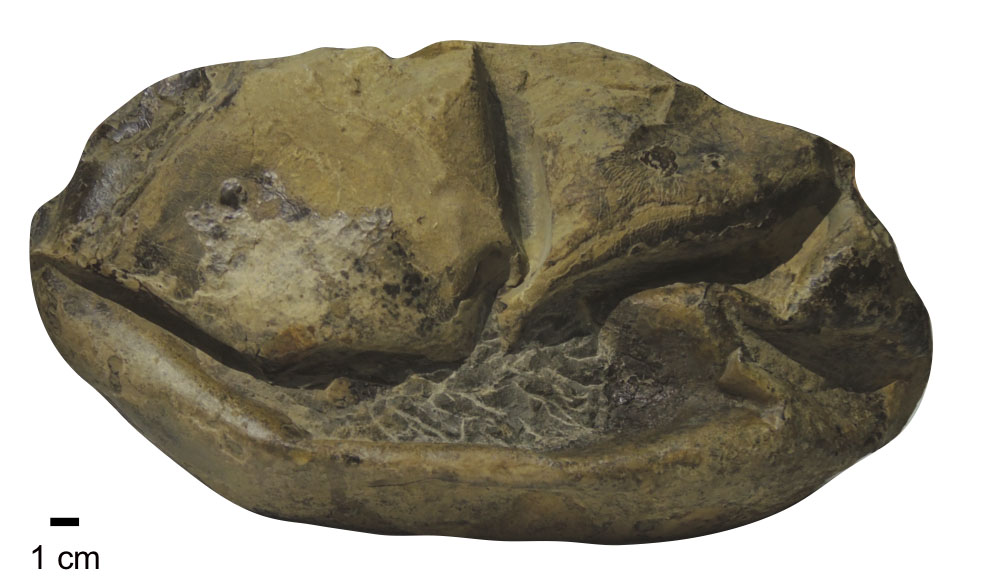
In 2011, Chilean scientists discovered a mysterious fossil in Antarctica that looked like a deflated football. For nearly a decade, the specimen sat unlabeled and unstudied in the collections of Chile’s National Museum of Natural History, with scientists identifying it only by its sci-fi movie-inspired nickname - “The Thing.”
A side view of the fossil of the giant egg.
Credit: Legendre et al. 2020
An analysis led by researchers at The University of Texas at Austin has found that the fossil is a giant, soft-shell egg from about 66 million years ago. Measuring in at more than 11 by 7 inches, the egg is the largest soft-shell egg ever discovered and the second-largest egg of any known animal.
The specimen is the first fossil egg found in Antarctica and pushes the limits of how big scientists thought soft-shell eggs could grow. Aside from its astounding size, the fossil is significant because scientists think it was laid by an extinct, giant marine reptile, such as a mosasaur — a discovery that challenges the prevailing thought that such creatures did not lay eggs.
“It is from an animal the size of a large dinosaur, but it is completely unlike a dinosaur egg,” said lead author Lucas Legendre, a postdoctoral researcher at UT Austin’s Jackson School of Geosciences. “It is most similar to the eggs of lizards and snakes, but it is from a truly giant relative of these animals.”
A study describing the fossil egg was published in Nature on June 17.
Co-author David Rubilar-Rogers of Chile’s National Museum of Natural History was one of the scientists who discovered the fossil in 2011. He showed it to every geologist who came to the museum, hoping somebody had an idea, but he didn’t find anyone until Julia Clarke, a professor in the Jackson School’s Department of Geological Sciences, visited in 2018.
“I showed it to her and, after a few minutes, Julia told me it could be a deflated egg!” Rubilar-Rogers said.
A diagram showing the fossil egg, its parts and size relative to an adult human.The giant egg has a soft shell. This is shown in dark gray in the drawing, with arrows pointing to its folds and surrounding sediment shown as light gray.
Credit: Legendre et al. 2020
Using a suite of microscopes to study samples, Legendre found several layers of membrane that confirmed that the fossil was indeed an egg. The structure is very similar to transparent, quick-hatching, eggs laid by some snakes and lizards today, he said. However, because the fossil egg is hatched and contains no skeleton, Legendre had to use other means to zero in on the type of reptile that laid it.
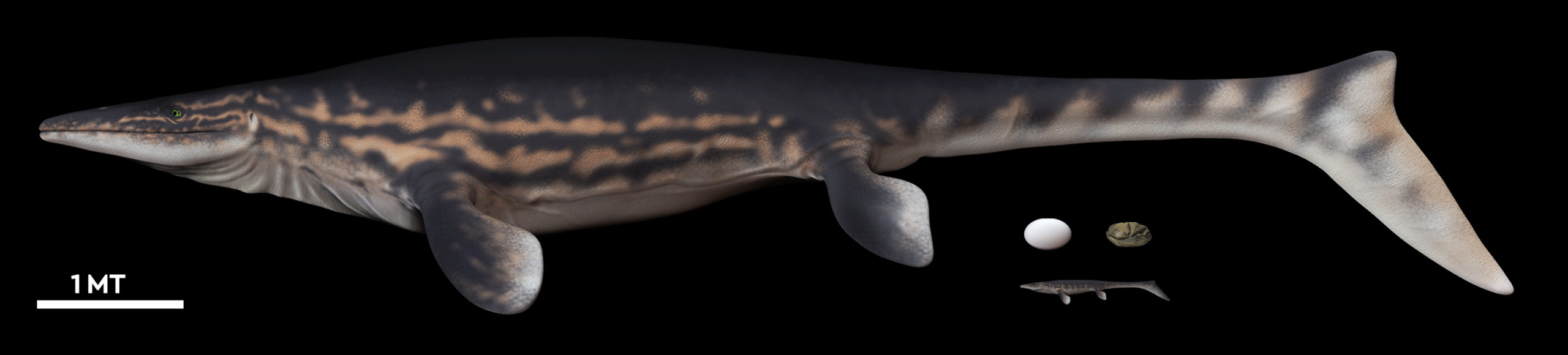
He compiled a data set to compare the body size of 259 living reptiles to the size of their eggs, and he found that the reptile that laid the egg would have been more than 20 feet long from the tip of its snout to the end of its body, not counting a tail. In both size and living reptile relations, an ancient marine reptile fits the bill.
An artist’s interpretation of a mosasaur, an extinct marine reptile that scientists think may have laid the egg. An adult mosasaur is shown next to the egg and a hatchling.
Credit: Francisco Hueichaleo, 2020.
Adding to that evidence, the rock formation where the egg was discovered also hosts skeletons from baby mosasaurs and plesiosaurs, along with adult specimens.
“Many authors have hypothesized that this was sort of a nursery site with shallow protected water, a cove environment where the young ones would have had a quiet setting to grow up,” Legendre said.
The paper does not discuss how the ancient reptile might have laid the eggs. But the researchers have two competing ideas.
One involves the egg hatching in the open water, which is how some species of sea snakes give birth. The other involves the reptile depositing the eggs on a beach and hatchlings scuttling into the ocean like baby sea turtles.
The researchers say that this would demand some fancy maneuvering by the mother because giant marine reptiles were too heavy to support their body weight on land. Laying the eggs would require the reptile to wriggle its tail on shore while staying mostly submerged, and supported, by water.
“We can’t exclude the idea that they shoved their tail end up on shore because nothing like this has ever been discovered,” Clarke said.
The study’s other co-authors are Clarke, Jackson School graduate students Sarah Davis and Grace Musser, and Rodrigo Otero and Alexander Vargas of the University of Chile. Rubilar-Rogers led the expedition organized by the Chilean Antarctic Institute (INACH) in the Antarctic Peninsula, where he and Otero discovered the fossil.
The Howard Hughes Medical Institute’s Science Education Program and the National Research and Development Agency of Chile funded the research.
Contacts and sources:
Monica KortshaUniversity of Texas at Austin
Publication:
A giant soft-shelled egg from the Late Cretaceous of Antarctica. Lucas J. Legendre, David Rubilar-Rogers, Grace M. Musser, Sarah N. Davis, Rodrigo A. Otero, Alexander O. Vargas, Julia A. Clarke. Nature, 2020; DOI: 10.1038/s41586-020-2377-7
Planet's Deep Water Cycle Linked Directly to Earthquakes and Tsunamis
In a new study, published in the journal Nature, an international team of scientists provide the first conclusive evidence directly linking deep Earth’s water cycle with magmatic productivity and earthquake activity.
Water (H2O) and other volatiles (e.g. CO2 and sulphur) that are cycled through the deep Earth have played a key role in the evolution of our planet, including in the formation of continents, the onset of life, the concentration of mineral resources, and the distribution of volcanoes and earthquakes.
Subduction zones, where tectonic plates converge and one plate sinks beneath another, are the most important parts of the cycle – with large volumes of water going in and coming out, mainly through volcanic eruptions. Yet, just how (and how much) water is transported via subduction, and its effect on natural hazards and the formation of natural resources, has historically been poorly understood. Quill, on the island of Statia. One of the islands in the Lesser Antilles.
“As plates journey from where they are first made at mid-ocean ridges to subduction zones, seawater enters the rocks through cracks, faults and by binding to minerals. Upon reaching a subduction zone, the sinking plate heats up and gets squeezed, resulting in the gradual release of some or all of its water. As water is released it lowers the melting point of the surrounding rocks and generates magma. This magma is buoyant and moves upwards, ultimately leading to eruptions in the overlying volcanic arc. These eruptions are potentially explosive because of the volatiles contained in the melt. The same process can trigger earthquakes and may affect key properties such as their magnitude and whether they trigger tsunamis or not.”
Exactly where and how volatiles are released and how they modify the host rock remains an area of intense research. Most studies have focused on subduction along the Pacific Ring of Fire. However, this research focused on the Atlantic plate, and more specifically, the Lesser Antilles volcanic arc, located at the eastern edge of the Caribbean Sea.
“This is one of only two zones that currently subduct plates formed by slow spreading. We expect this to be hydrated more pervasively and heterogeneously than the fast spreading Pacific plate, and for expressions of water release to be more pronounced,” said Prof. Saskia Goes, Imperial College London.
“We collected data over two marine scientific cruises on the RRS James Cook, temporary deployments of seismic stations that recorded earthquakes beneath the islands, geological fieldwork, chemical and mineral analyses of rock samples, and numerical modelling,” said Dr Cooper.
To trace the influence of water along the length of the subduction zone, the scientists studied boron compositions and isotopes of melt inclusions (tiny pockets of trapped magma within volcanic crystals). Boron fingerprints revealed that the water-rich mineral serpentine, contained in the sinking plate, is a dominant supplier of water to the central region of the Lesser Antilles arc.
“By studying these micron-scale measurements it is possible to better understand large-scale processes. Our combined geochemical and geophysical data provide the clearest indication to date that the structure and amount of water of the sinking plate are directly connected to the volcanic evolution of the arc and its associated hazards,” said Prof. Colin Macpherson, Durham University
“The wettest parts of the downgoing plate are where there are major cracks (or fracture zones). By making a numerical model of the history of fracture zone subduction below the islands, we found a direct link to the locations of the highest rates of small earthquakes and low shear wave velocities (which indicate fluids) in the subsurface,” said Prof. Saskia Goes.
The history of subduction of water-rich fracture zones can also explain why the central islands of the arc are the largest and why, over geologic history, they have produced the most magma.
“Our study provides conclusive evidence that directly links the water-in and water-out parts of the cycle and its expressions in terms of magmatic productivity and earthquake activity. This may encourage studies at other subduction zones to find such water-bearing fault structures on the subducting plate to help understand patterns in volcanic and earthquake hazards,” said Dr Cooper.
“In this research we found that variations in water correlate with the distribution of smaller earthquakes, but we would really like to know how this pattern of water release may affect the potential – and act as a warning system – for larger earthquakes and possible tsunami,” said Prof. Colin Macpherson.
Contacts and sources:
University of Bristol
Publication:
Variable water input controls evolution of the Lesser Antilles volcanic arc. Cooper, G. F., Macpherson, C. G., Blundy, J. D., Maunder, B., Allen, R. W., Goes, S., Collier, J. S, Bie, L., Harmon, N., Hicks, S. P., Iveson, A. A., Prytulak, P., Rietbrock, A., Rychert, C., Davidson J. P. & the VoiLA team. Nature, 2020 DOI: 10.1038/s41586-020-2407-5
COAST TO COAST AM April 2020 - Author, journalist, and TV personality Nick Pope ran the British Government’s UFO project at the Ministry of Defense. In the first half, he discussed the Pentagon’s release of three short videos of “unidentified aerial phenomena,” as well as other UFO news, and theories about aliens.
A media phenomenon, Coast to Coast AM deals with UFOs, strange occurrences, life after death, and other unexplained (and often inexplicable) phenomena.
The very strange year of 2020: The solar system gets more visitations from a series of comets
“And there shall be signs in the sun, and in the moon, and in the stars; and upon the earth distress of nations, with perplexity; the sea and the waves roaring; men’s hearts failing them for fear and for looking after those things that are coming on the earth: for the powers of heaven shall be shaken” – (Luke 21:25, 26).
2020: The year of locust plagues, giant hornets, earthquakes, volcanic eruptions, giant dust storms, wars, strange moons, wildfires, plagues, financial-market meltdowns, deadly tornado outbreaks, global riots and protests, and now – comets. We seem to have entered a region of space where the universe appears to be throwing more objects in our direction. We certainly get it now – the year 2020 will certainly go down by us as one of the worst on record.
And then there were five. Though we’re long overdue for the next great ‘Comet of the Century,’ 2020 seems intent on throwing decent binocular comets our way, the ranks of which include comets C/2017 T2 PanSTARRS, C/2019 Y1 and C/2019 Y4 ATLAS and C/2020 F8 SWAN. Now, C/2019 U6 Lemmon is set to take center stage in July. Website Space Weather said: “Comet NEOWISE (C/2020 F3) is also plunging toward the sun for a close encounter near the orbit of Mercury on July 3rd.”
Discovered on Halloween night, October 31, 2019 by the prolific Mount Lemmon Sky Survey based outside of Tucson, Arizona, comet C/2019 U6 is one of a long lineage on comets to bear the Lemmon moniker. The comet is on a 9,250 year orbit inbound, and departs the inner solar system on a 5,200 year orbit outbound. A newfangled technology known as ‘farming’ was just starting to trickle into Europe from the Middle East around the seventh millennium BCE, last time Comet U6 Lemmon rolled ’round to the inner solar system. The comet is on a steep orbit inclined 61 degrees relative to the ecliptic plane. Had this comet come by in mid-May, we would have had a truly spectacular pass, just 0.027 AU (2.5 million miles/4 million kilometers) interior to the orbit of the Earth, or 10 times the Earth-Moon distance.
Any given comet entering the inner solar system stands a 40% chance at having its orbit modified by Jupiter on its outbound leg. This famously happened to Comet Hale-Bopp in the late 1990s, and this is also now the case with the 2020 tale of Comet U6 Lemmon. Up north, we should get our first good views of Comet U6 Lemmon in late June, as the comet vaults up to about 30 degrees above the western horizon at sunset. We’ll see the comet on its outbound leg in July through August, passing through the constellation of Sextans the Sextant, then vaulting northward above the ecliptic into Leo and Virgo. At its brightest, Comet U6 Lemmon may flirt with naked eye visibility in early July, topping out at +5th magnitude. As of writing this in late June, the comet seems to have been an over-performer for southern hemisphere observers, holding at +8 magnitude in early June and approaching +6th magnitude as it neared perihelion.
Moving at its fastest across the sky in late June, the comet will be clear 2 degrees a day, four times the diameter of a Full Moon. The comet just came off of perihelion at 0.915 AU (85 million miles/137 million kilometers) from the Sun on June 18th, and is very slowly revealing itself for northern hemisphere observers low in the dusk sky. –Universe Today
While exploring NASA's image atlas for the Apollo 16 mission, I came across many images that have a glowing white cloud UFO on the far left of the panoramic image. At first I was skeptical and took a closer look at the craft noting that the shape of the UFO changed shape several times. It is unknown if the cloud is a cloak for the craft or the cloud is the craft, but one thing is for sure, it moves fast and matched the speed of the Apollo module. This UFO was clearly following and monitoring the Apollo 16 module as it flew in orbit around the moon taking photos. Please notice that the UFO moves from the top of the photo and matches its speed with the Apollo module then at about 450 photos it begins to fall behind, apparently realizing that the Apollo craft was no threat. Also there were about 40-45 images that had a 100% focused cloud in its location and each of these images are slightly different than the next, not to mention that the lunar surface below the UFO changes in each photo the Apollo 16 module took. I took all 458 still images and put them in movie format with each showing once per second. The movie starts with a close up of the UFO and then half way through shows the UFO in the full NASA panoramic photos. So the similarities to the Mars UFO seem to show it is a ship. Scott C. Waring
White Long UFO Seen Passing Over Homes In Texas, Photos, UFO Sighting News.
Date of sighting: June 25, 2020
Location of sighting: Richardson, Texas, USA
Source: MUFON #109706
This is an unusual report from MUFON today. Someone spotted a tall long craft moving over the neighborhood in Texas. The object was metallic and said to be moving too fast to be a balloon. The object also has a rocket like exhaust coming out of the bottom of the craft. Awesome catch and a first for this shape and angle of UFO.
Scott C. Waring
Eyewitness states:
When I first saw this I thought it was a foil balloon, then realized it was moving too fast and stayed right on course. It was moving from East to West.
Mysterious craft with no wings or visible signs of propulsion caught over Buffalo Mountain in Floyd Virginia
Some time ago, Paul Stoutamire filmed this video while flying a drone over Buffalo Mountain in Floyd Virginia. The mountain has an elevation of 3,971 feet, and Paul's drone was flying about 350 feet above the peak.
He said that he can't figure out what the object is that flew underneath the drone but looking at the craft then it is beyond a doubt a fastwalker.
The solid white rectangular shaped fastwalker has no wings or visible signs of propulsion though it flies at an impossible rate of speed through our atmosphere.
“Fastwalker” is a term used by NORAD and branches of armed forces to describe unidentified aerial phenomena moving and/or changing directions at high speed far beyond what current aerospace technology is capable of.
Ancient Aliens: The Mystery of the Stone Giants S15E05
Ancient Aliens – The Mystery of the Stone Giants History Channel, Season 15 Episode 5 22nd February 2020
Various stone structures have been found in various form of the world. From Easter island moais to marquesus island Tikis and Egypt to Olmecs stone. Are these giant stones have any connection with aliens in the form of energy generators.
What They Really Saw on the Moon... Astronauts Reported That They 'Were Huge'!
According to researchers, Apollo astronauts witnessed numerous strange activity on the Lunar surface. From large constructed buildings and domes, to strange craft that seemingly landed on the edge of a crater so to observe the first moon landing.
There are countless questionable photographs by NASA in regards to geometric constructions, even possible roads. The biggest questions are… Why did Apollo end, and why did we not go back? Was Were Warned Away?
All Content on this channel is fully licensed, and or produced in-house at our studios in UK, Europe and USA.
Huge Discovery! Largest Prehistoric Site Ever Discovered In Britain Is Located Right Next to Stonehenge
In an extraordinary discovery, archaeologists have uncovered the largest prehistoric site ever, found in Britain, it’s situated just next to Stonehenge! The archaeologists discovered a ring of prehistoric shafts that were dug thousands of years ago. These fascinating shafts are 1.2 miles wide with huge stone circles of Durrington Walls in the center. The Durrington Walls are situated a mere 2 miles away from Stonehenge! These large shafts are about 10 meters in diameter and 5 meters into the ground. Experts have tested these shafts and can confirm that they are Neolithic and were dug over 4,500 years ago.
Russian Secret UFO Documentation on Encounters... The Siberian Hotspot!
Russian Military Exploration of Siberia and Antartica have lead to numerous classified documents containing information on the subject of UFO encounters. Siberia, rich in mineral deposits has been the focus for Russian government exploration and experiments. Similar operations have been carried out in Antartica and by the Russian Space Agency which were documented and later released to the general public. The information in these reports were shocking!
All Content on this channel is fully licensed, and or produced in-house at our studios in UK, Europe and USA.
This channel in managed by Zohar Entertainment Group UK, Zohar Entertainment Group International Inc, USA and AdRev, USA.
Meer van UFO'S of UAP'S, ASTRONOMIE, RUIMTEVAART, ARCHEOLOGIE, OUDHEIDKUNDE, SF-SNUFJES EN ANDERE ESOTERISCHE WETENSCHAPPEN - DE ALLERLAATSTE NIEUWTJES


 What is NASA’s new strategy for finding extraterrestrial civilizations in space?


 Dozens of US airmen test positive for coronavirus at Guam...
 Revealed: Cold War plot to nuke the MOON... How US military...