Ontdek de Fascinerende Wereld van UFO's en UAP's: Jouw Bron voor Onthullende Informatie!
Ben jij ook gefascineerd door het onbekende? Wil je meer weten over UFO's en UAP's, niet alleen in België, maar over de hele wereld? Dan ben je op de juiste plek!
België: Het Kloppend Hart van UFO-onderzoek
In België is BUFON (Belgisch UFO-Netwerk) dé autoriteit op het gebied van UFO-onderzoek. Voor betrouwbare en objectieve informatie over deze intrigerende fenomenen, bezoek je zeker onze Facebook-pagina en deze blog. Maar dat is nog niet alles! Ontdek ook het Belgisch UFO-meldpunt en Caelestia, twee organisaties die diepgaand onderzoek verrichten, al zijn ze soms kritisch of sceptisch.
Nederland: Een Schat aan Informatie
Voor onze Nederlandse buren is er de schitterende website www.ufowijzer.nl, beheerd door Paul Harmans. Deze site biedt een schat aan informatie en artikelen die je niet wilt missen!
Internationaal: MUFON - De Wereldwijde Autoriteit
Neem ook een kijkje bij MUFON (Mutual UFO Network Inc.), een gerenommeerde Amerikaanse UFO-vereniging met afdelingen in de VS en wereldwijd. MUFON is toegewijd aan de wetenschappelijke en analytische studie van het UFO-fenomeen, en hun maandelijkse tijdschrift, The MUFON UFO-Journal, is een must-read voor elke UFO-enthousiasteling. Bezoek hun website op www.mufon.com voor meer informatie.
Samenwerking en Toekomstvisie
Sinds 1 februari 2020 is Pieter niet alleen ex-president van BUFON, maar ook de voormalige nationale directeur van MUFON in Vlaanderen en Nederland. Dit creëert een sterke samenwerking met de Franse MUFON Reseau MUFON/EUROP, wat ons in staat stelt om nog meer waardevolle inzichten te delen.
Let op: Nepprofielen en Nieuwe Groeperingen
Pas op voor een nieuwe groepering die zich ook BUFON noemt, maar geen enkele connectie heeft met onze gevestigde organisatie. Hoewel zij de naam geregistreerd hebben, kunnen ze het rijke verleden en de expertise van onze groep niet evenaren. We wensen hen veel succes, maar we blijven de autoriteit in UFO-onderzoek!
Blijf Op De Hoogte!
Wil jij de laatste nieuwtjes over UFO's, ruimtevaart, archeologie, en meer? Volg ons dan en duik samen met ons in de fascinerende wereld van het onbekende! Sluit je aan bij de gemeenschap van nieuwsgierige geesten die net als jij verlangen naar antwoorden en avonturen in de sterren!
Heb je vragen of wil je meer weten? Aarzel dan niet om contact met ons op te nemen! Samen ontrafelen we het mysterie van de lucht en daarbuiten.
Dinsdag 21 juli 2020
Unknown object becomes visible during mysterious flashes on Venus
Unknown object becomes visible during mysterious flashes on Venus
Asky-watcher spotted mysterious flashes on Planet Venus and it is hard to think they could be explosions. There were so many strange bursts as you will see in this video. During the flashes an unknown object becomes visible for a fraction of a second.
Then the sky-watcher also captured flashing and moving lights in the Moon's Aristarchus Crater and beyond as well as a view of the surface of the moon east of Copernicus Crater showing the real surface of the moon close up and several lunar anomalies.
The footage starts with an unknown object passing the Moon at high speed, the mysterious flashes and unknown object in slow motion start at about the 11.30 mark in the video.
China's Secret Space Program: Threat or Opportunity
China is in the midst of a stealth war against the USA where it is using an asymmetric military strategy called “Assassin’s Mace” to dominate the strategic high ground of space, and replace the US as the world’s hegemony before 2049.
By 2030, China’s economy will outgrow the US, and China plans to use its vast economic resources to project its presence deep into space in ways that may lead to escalating military confrontations with the newly created US Space Force.
REUTERSVrouwen kijken naar een livestream van de lancering in het Mohammed bin Rashid Space Centre in Dubai.
Vanop de Japanse ruimtehaven Tanegashima is maandag (lokale tijd) de eerste Arabische sonde naar Mars gelanceerd. Dat was op het internet te volgen.
Al-Amal (Hoop) werd om 6.58 uur lokale tijd (23.58 uur zondagavond Belgische tijd) gelanceerd met een H2A202-draagraket die deel uitmaakt van de H-IIA draagraketfamilie. Ze is ontwikkeld en gebouwd door Mitsubishi Heavy Industries.
Het bedrijf twitterde ongeveer een uur later dat de Marsverkenner al-Amal (Hoop) was losgekomen van het restant van de draagraket.
Het is de bedoeling dat al-Amal in februari in een baan rond Mars komt, als eerste Arabische missie naar een andere planeet.
APDe H-IIA-raket wordt gelanceerd vanaf het Tanegashima Space Center in Minamitane, in het zuiden van Japan.
De sonde is drie meter hoog, 7,9 meter breed en weegt 1,35 ton. Het ruimtetuig moet ongeveer twee jaar lang de atmosfeer van de Rode Planeet in kaart brengen. De verkenner moet onder andere helpen duidelijk te maken waardoor waterstof en zuurstof verdwijnen uit de dunne dampkring van Mars. Het vliegt de ruimte in, waardoor Mars geen kans meer heeft op leven zoals op aarde.
Maar de missie is vooral bedoeld om de Emiraten op de kaart te zetten. Het land ziet wetenschap en technologie als een inkomstenbron voor de toekomst, wanneer de olie opraakt. De VAE hebben sinds 2014 een eigen ruimtevaartorganisatie en vorig jaar ging voor het eerst een man uit het land naar de ruimte. Astronaut Hazza al-Mansoeri verbleef ongeveer een week in het Internationaal Ruimtestation ISS.
REUTERSMensen kijken naar een livestream van de lancering in het Mohammed bin Rashid Space Centre in Dubai.
We leven in vreemde tijden waarin je niet meer weet wat je nu wel of niet moet geloven.
Zo verschijnt Jezus in een boomstam in Brazilië en heeft iemand een creatieve, maar wel pijnlijke, manier bedacht om onder de mondkapjesplicht uit te komen.
Nu zijn er een aantal afbeeldingen opgedoken waarop het lijkt alsof er een afbeelding van Jezus verschijnt op een doorgezaagde boomstam. Het overkwam een aantal Braziliaanse wegwerkers toen ze bezig waren met de aanleg van een weg.
Deze Goddelijke verschijning vond plaats in Itaquira in de staat Mato Grosso do Sul. Volgens Odimar Souza, de directeur die belast was met de klus, werd de afbeelding toevallig gevonden door een aantal van zijn mensen in een boomstam toen ze met de weg bezig waren.
Dit is niet de eerste keer dit jaar dat Jezus in een boom verschijnt in Zuid Amerika. In april verscheen hij in een boom in Colombia en dit terwijl het land midden in een lockdown zat. Voor de bewoners was Jezus echter belangrijker dan het virus en de bevolking negeerde alle quarantaine en anderhalve meter regels massaal om naar de verschijning te kunnen kijken.
Het vreemde met dit soort dingen is dat het bijna altijd voor komt in streng gelovige landen, of weet iemand of wij ook dit soort verschijningen kennen?
Waar wij wel mee te maken hebben is de virushoax pandemie die tot nu toe ons leven aardig heeft weten te verzieken en het eind is nog lang niet in zicht.
Ondertussen doen autoriteiten wereldwijd nog steeds hun uiterste best om coronadoden bij elkaar te scharrelen. Het wordt steeds moeilijker, dus soms zijn er drastische maatregelen gewenst.
Zoals bij dit motorongeluk in Florida vorige week waar een jongeman om het leven kwam. Later bleek dat deze omgekomen motorrijder als doodsoorzaak covid-19 mee kreeg. Maar, in plaats van toegeven dat ze sjoemelen met coronadoden toen ze werden betrapt, komen ze nu met een theorie dat het misschien mogelijk is dat deze omgekomen motorrijder het label "coronadode" meekreeg omdat hij misschien wel een ongeluk had gekregen omdat hij besmet was met het gevaarlijke virus.
In het kader van autoriteiten die je een oor aannaaien kregen we de volgende opgestuurd van een lezer
Enormous cosmic structure dubbed the 'South Pole Wall' is discovered stretching across 1.4BILLION light-years and containing hundreds of thousands of galaxies
Researchers created a 3D map of parts of the universe hidden by the Milky Way
They found hundreds of thousands of galaxies connected by string of hydrogen
South Pole Wall is adjacent to an area called the Zone of Galactic Obstruction
A gigantic stretch of the universe dubbed the 'South Pole Wall' containing hundreds of thousands of galaxies was 'found hiding in plain sight' by astronomers.
The wall had remained undetected until now because large parts of it were hidden from Earth's view by the bright Milky Way galactic centre and dust surrounding it.
The wall is one of the largest cosmic structures ever found, according to Paris-Saclay University researchers, whose worked involved creating 3D maps of the universe.
Within these maps - that focused on an area behind the Milky Way Galaxy known as the Zone of Galactic Obscuration - the team discovered the South Pole Wall.
This is a wall of galaxies stretching 1.4 billion light years across - roughly eight sextillion miles - and when seen from Earth is below the south pole.
A projection of the South Pole Wall in celestial coordinates. The Wall can be seen almost exactly in the centre of this image
An alternate representation of structure of hte wider universe surrounding the South Pole Wall - the labels are constellations and the bright orange and red areas are galactic structures
The Milky Way is part of a local galactic cluster that is 520 million light years across, this is about half the size of the South Pole Wall or about three sextillion miles.
Whereas Pluto is just 3.7 billion miles from the Sun or 0.0006 light years.
It was found about half a billion light-years away from the Earth by researchers using a mapping technique that involves measuring the 'peculiar velocity of galaxies'.
This process takes into account the redshift - that is the speed at which an object is receding from Earth - as well as the motion of galaxies around one another.
Study lead, Daniel Pomarede, said this method let them detect hidden mass that is gravitationally influencing how galaxies move - including dark matter.
Dark matter makes up the bulk of matter in the universe but it emits no light and so can only be detected by the gravitational pull it exerts on nearby objects.
By measuring the way this hidden mass interacts gravitationally they were able to map regions of space otherwise invisible from the Earth.
Using computer models the team were able to plot the three dimensional distribution of matter in and around the Zone of Galactic Obscuration.
The area of cosmology responsible for mapping the universe, particularly at a multi-galaxy level, is known as 'cartography of the cosmos', said Pomarede.
The new map created of the area behind the Zone of Galactic Obscuration let the team discover the South Pole Wall.
It has been described as a 'mind-boggling bubble' of material in the southernmost point of the sky - as seen behind the Milky Way Galaxy.
It has a sweeping wing extending north on one side towards the constellation of Cetus and a stubby arm int he opposite direction in the Apus constellation.
The area may actually be bigger than it currently appears, according to the French cosmographers, who say there might be much more to it.
The new map created of the area behind the Zone of Galactic Obscuration let the team discover the South Pole Wall. Here is a region of space known as the Chamaeleon cloud complex - the wall is behind this
This graphic shows the dense central region surrounding the South Pole Wall with the constellations visible from Earth that it covers
'We will not be certain of its full extent, nor whether it is unusual, until we map the universe on a significantly grander scale,' the wrote.
Galaxies within this 'wall' are contained in what is known as a cosmic web made of enormous strands of hydrogen gas the they hang from.
These structures, that appear like jewels on a necklace, are surrounded by large empty voids
Pomarede and colleagues used similar 3D maps generated of the universe to unveil the Laniakea supercluster - the galactic collection the Milky Way is part of.
This Laniakea supercluster is 520 million light-years wide and contains the mass of a 100 million billion Suns, according to Pomarede.
Cosmography has helped chart the extent of galactic assemblies including the largest - the Hercules-Corona Borealis Great Wall that spans 10 billion light-years.
Astronomers say uncovering structures like this help to further our understanding of the universe and how it works.
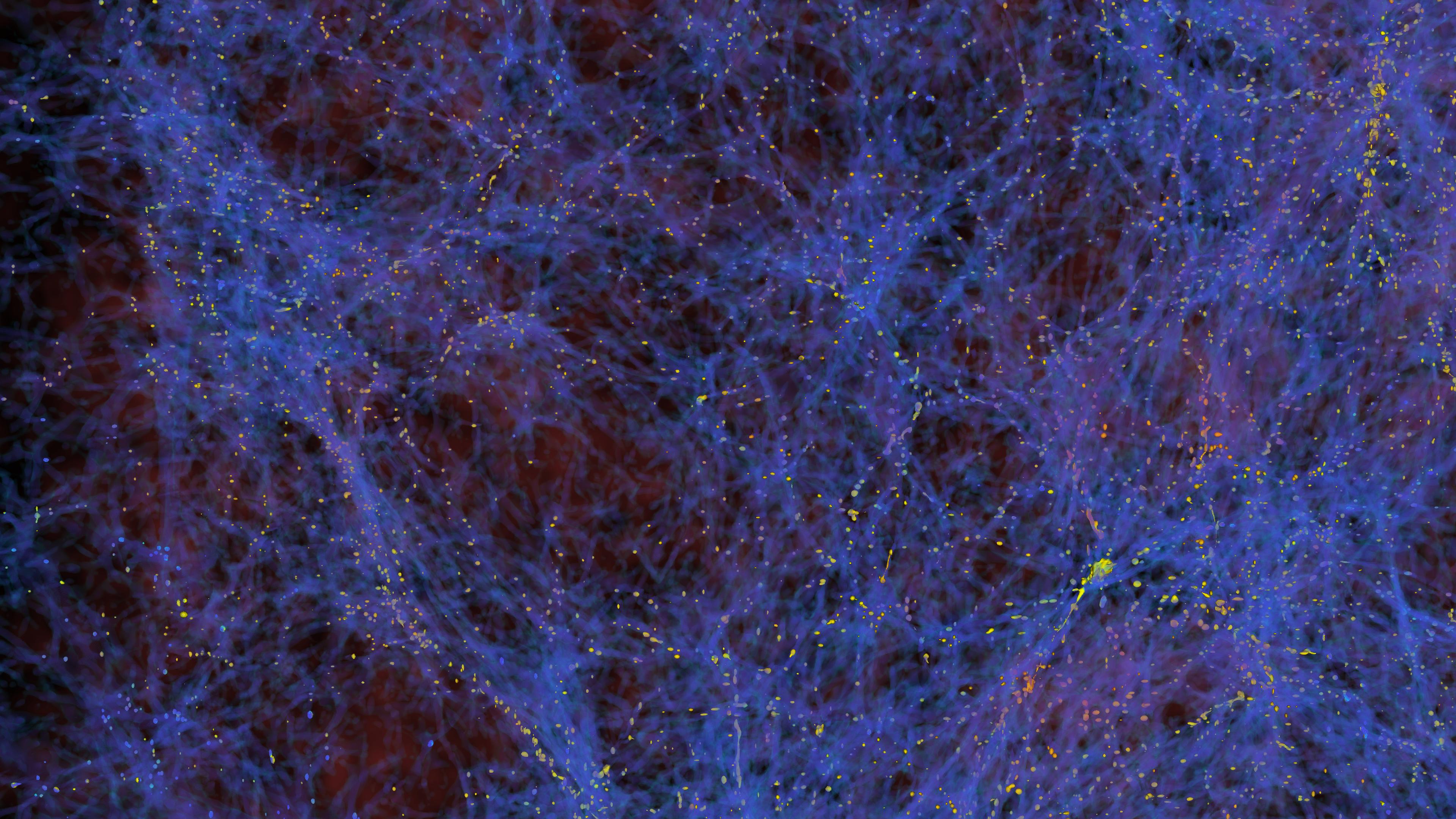
HOW DO YOU CREATE A COMPUTER SIMULATION OF THE UNIVERSE? THE SCIENCE BEHIND ILLUSTRIS EXPLAINED
Scientists have created an entire universe inside a computer to learn about how our universe formed.
Dubbed Illustris: The Next Generation, or IllustrisTNG for short, the simulated cosmos is the most detailed ever created and has a diameter of one billion light-years.
To create this simulation, scientists used evidence of the earliest days of our universe, gathered from the cosmic microwave background leftover from the Big Bang.
Computational cosmologists use this data to model the conditions of the time, when the universe was just a few hundred thousand years old.
Into this virtual universe, they add baryonic matter, which forms stars and planets; dark matter, which enables galactic structures to grow; and dark energy, the mysterious force behind all cosmic acceleration.
These are coded into the simulation alongside equations that describe supernova explosions and black holes.
Cosmologists then watch and wait as the computer-powered simulation plays out what is believed to have happed 13.8 billion years ago – the virtual universe expands, gas condenses into small structures and eventually forms stars and galaxies.
Scientists said the detail and scale now provided by IllustrisTNG has enabled them to observe how galaxies form, evolve, grow, and trigger the creation of new stars.
Astronomers found a giant “wall” of galaxies hiding in plain sight
Astronomers have found one of the largest structures in the known universe—a “wall” of galaxies that’s at least 1.4 billion light-years long. And given how close it is to us, it’s remarkable that we haven’t seen it before now.
What happened:
An international team of scientists reported the discovery of the South Pole Wall in a paper published Thursday in the Astrophysical Journal. The structure is basically a curtain that stretches across the southern border of the universe (from the perspective of Earth) and consists of thousands of galaxies, along with huge amounts of gas and dust.
What do you mean by “wall”?
Galaxies aren’t just strewn randomly throughout the universe. Along huge strands of hydrogen, galaxies collect into larger groupings of massive filaments, separated by giant voids of nearly empty space. Each filament is basically a wall of galaxies, stretching for hundreds of millions of light-years. They’re the biggest structures in the known universe. Other identified structures include the Great Wall, the Sloan Great Wall, the Hercules-Corona Borealis Great Wall, and the Bootes Void.
Put together, these walls make up what astronomers call the cosmic web. Piecing together the cosmic web is one of the major pursuits of cosmology—it would not only tell us about the structure of the universe and its interior but could also help us better understand how the universe was formed and how it’s evolved over time.
Why is this one special?
It’s so close! The South Pole Wall is just half a billion light-years away. In fact, this is part of the reason it was so hard to find until now—it is situated right behind the Milky Way galaxy, in a place called the Zone of Galactic Obscuration, where the galaxy’s brightness effectively kept the wall shrouded in plain sight.
So how was it found?
Cosmological surveys are often done by measuring objects’ redshift: the speed at which those objects seem to be moving away from Earth thanks to the expansion of the universe. The faster an object is receding, the farther away it is.
The team behind the South Pole Wall discovery did redshift observations as part of their survey of the sky, but they also added measurements of the velocity of certain galaxies, which illustrates how they gravitationally interact with one another. This technique can alert astronomers to unseen masses—while it’s normally used to investigate dark matter, it can also just highlight masses obscured by bright light. Using this data, the researchers were able to map out the South Pole Wall for the first time.
Astronomen ontdekken gigantische muur achter de Melkweg: ‘We waren verrast’
Astronomen hebben boven de Zuidpool een gigantische structuur ontdekt die meer dan 1,4 miljard lichtjaar lang is en 600 miljoen lichtjaar diep.
Deze zogeheten Zuidpoolmuur bevindt zich vanuit de aarde bekeken langs de zuidelijke grens van de kosmos, en bestaat uit duizenden sterrenstelsels, waterstofgas, stof en donkere materie, schrijven Vice en MIT Technology Review. Het is ook één van de grootste structuren in het heelal.
De muur vormt samen met een aantal andere structuren het kosmische web. Het grootste object strekt zich uit over een gebied van 10 miljard lichtjaar. De resultaten zijn gepubliceerd in The Astrophysical Journal.
Verrast
De Zuidpoolmuur wordt aan het zicht onttrokken door de Melkweg. De astronomen hebben de muur ontdekt toen ze zagen hoe de aantrekkingskracht van het reusachtige object naburige sterrenstelsels beïnvloedde.
“Toen we aanwijzingen hadden dat er iets aan de hand was bij de zuidelijke hemelpool waren we verrast,” zei Daniel Pomarede van de Universiteit Parijs-Saclay. “Er waren nog geen grootschalige structuren in deze regio ontdekt.”
Bekijk ook onderstaand filmpje over de Zuidpoolmuur:
I found some amazing things in this Mars photo. Some faces that one would never expect to see. The sculptures are crude and primitive, but the details are easy to see even after thousands of years in the sun. They make the faces in unique ways and each one is different, sometimes a bear, a squirrel, cat, human, dwarf, and much more. The sky is the limit and some of these faces actually existed and others came from their religions, stories, imagination. Life...is amazing on any planet.
UFOs or unidentified flying objects are often linked to conspiracies about aliens and government agents known as the men in black. Those who believe UFOs are genuine extraterrestrial visitors to Earth celebrated this fact on July 2 - world UFO day. To mark the occasion, analysts in the US have compiled data from the National UFO Reporting Center to determine which states have the highest rates of UFO reports.
Object was moving very fast and low in the night sky
UFO sighting, February 2020
What is the best place to track UFOs?
According to the newly published data by SatelliteInternet.com, California, Alabama and Florida are the top three UFO hotspots with 13,559, 10,882 and 6,534 reports respectively.
The states are followed by Washington at 5,894, Texas at 4,969, New York at 4,689, Arizona at 4,028, Pennsylvania at 3,887, Illinois at 3,616 and Ohio at 3,566.
The 10 lowest states all reported less than 1,000 sightings each, with North Dakota only producing 212 UFO sightings.
The states are Kansas at 951, West Virginia at 736, Mississippi at 642, Nebraska at 568, Hawaii at 532, Rhode Island at 429, Wyoming at 327, Delaware at 316, South Dakota at 315 and North Dakota at 212.
However, most of these UFO sightings involve mysterious lights, slow-moving objects or flashes in the skies.
Unfortunately, none of these are representative of the sorts of UFOs fans of Hollywood might expect.
For example, one report from Arizona on June 25, 2020, reads: "Three lights in evening sky. One fades away and other two fly playful formation."
Another person in Michigan on May 30, 2020, wrote: "Came outside. Starting recording at 9.51pm. Saw a white circular object moving fast across the sky.
"Looked like it was going in a straight line. Did not see any blinking lights. Have eleven seconds video.
"Thinking it might be from the Launch today, but have no idea. Thank you."
Kristin Cooke of SatelliteInternet.com said: "The reality is most UFO sightings are less dramatic, such as a strange aircraft or odd light formations descending slowly into a forest.
"What we do know is that UFO sightings are most frequent during the warmer months.
"Why? We're not sure. Maybe people are outside more often in good weather, or maybe aliens go on summer vacations with their kids.
"So what are the tools of the trade? UFO hunters use binoculars, night vision goggles and cameras, and they have a lot of patience. You never know when a UFO will appear."µ
AlienUFO sightings across Brazil went viral on social media in May this year as many people shared reports of an extraterrestrial spacecraft crashing north of Rio de Janeiro. Conspiracy theorists took over platforms like Twitter and Facebook to share footage of glowing lights in the skies. One video, in particular, alleged to show a UFO crash site in Mage forest, along Brazil's east coast and Guanabara Bay.
As the story gained traction, the hashtag #MageUFO began trending on Twitter.
Soon after, the hashtag seemingly disappeared and many of the shared video clips were taken down, leading people to speculate a coverup was in action.
According to the Brazilian news site UOL, local authorities and the Air Force had no record of unidentified flying objects around the time of the supposed crash.
So what exactly happened in Brazil last month and did alien UFOs really visit our planet?
According to investigators from the Mutual UFO Network (MUFON), the Brazil UFO story was a well-constructed hoax.
The MUFON team said: "The case, which has been widely circulated on social media outlets, has been determined to be nothing more than an elaborate hoax."
MUFON is a non-profit organisation tasked with collecting eyewitness accounts, videos and photos of UFO sightings.
The investigation into the Brazil UFO was led by the Brazillian Director for MUFON Ademar José Gevaerd.
The MUFON chief determined there was no factual evidence to back the UFO crash story.
Brazil UFO: Some said this Google Maps photo was proof of the UFO
My team and I have intensively investigated this alleged case
Ademar José Gevaerd, MUFON
He said: "My team and I have intensively investigated this alleged case and found out that it is a total hoax.
"It started with a fake audio about a supposed UFO crash published over the net, later assumed to be a fabrication by the female author.
"As time went on the story got bigger and bigger every day, with many alleged witnesses making all sorts of claims, all disconnected from each other, all exaggerated, and mostly lies."
According to Mr Gevaerd, some people claimed to have heard "telepathic" requests for help from the downed aliens trapped inside of their spacecraft.
The mystery UFOsor unidentified flying objects were spotted over southern Connecticut 15 years ago today (July 20). An eyewitness described the UFOs as dark oblongs that silently hovered in the sky. Now, 15 years after the UFO sighting was made, the eerie photograph was dug up once again byconspiracy theorist Scott C Waring.
The original eyewitness statement reads: "Last week, my friend and I were mountain biking in the Cockaponset State Forest. I think it's in Middletown.
"We were riding for a couple of hours and were close to the Connecticut River and not far from the power plant (I think). It's hard to tell on the trail.
"It was getting dark and were taking a short break before heading back to our cars.
"At first I didn't even notice these things until my friend pointed them out."
According to neuroscientist Joel Vos, the brain is hardwired to make these connections.
He told Vice in 2015: "If you think about it, anything you see is just a collection of light patterns falling on your retina.
"There's nothing inherently meaningful about the pattern of lines that make up a coffee cup but as this info flows through the higher portions of the visual system as you get more toward the front of the brain, the hypothesis is that those patterns get matched up with templates for things you see all the time.
"If you see lines that are a cylinder with an arc coming off of it, it's a coffee cup-like shape, those random features get matched up to these templates and that allows the categorization and object identity and recognition to occur."
July 20, THIS DAY IN UFO HISTORY, UFO Fleet Over Connecticut, July 20, 2005, UFO Sighting News.
Date of sighting: July 20, 2005 Location of sighting: Connecticut Forest, USA We learn from the past to understand the future sightings. They made no sound. They floated slowly. They were dark with some lights. These three things are important factors that future sightings might have. Which could validate a future sighting. Scott C. Waring Full Report:
Last week, my friend and I were mountain biking in the Cockaponset State Forest. I think it’s in Middletown. We were riding for a couple of hours and were close to the Connecticut River and not far from the power plant (I think). Its hard to tell on the trail. It was getting dark and we were taking a short break before heading back to our cars. At first I didn’t even notice these things until my friend pointed them out. They were dark oblong shapes with some lights. Nothing bright and we didn’t hear any noise. They didn’t move for several minutes so I was able to take a few pictures.
When they left they just floated away slowly. I’m only sending one because two of them didn’t come out, the digital camera doesn’t work well without much light and one of them you can see my friend. I didn’t send that one, because even though everyone rides out here we all know we shouldn’t be and I don’t want to get in trouble for trespassing.
They could be helicopters or maybe a blimp of some kind, but I thought I would forward this to you for a better explanation.
Related videos, selected and posted by peter2011 - is Etchilhampton, Wiltshire, UK the place to be for crop circles or is there a crop circle - artist in the region?
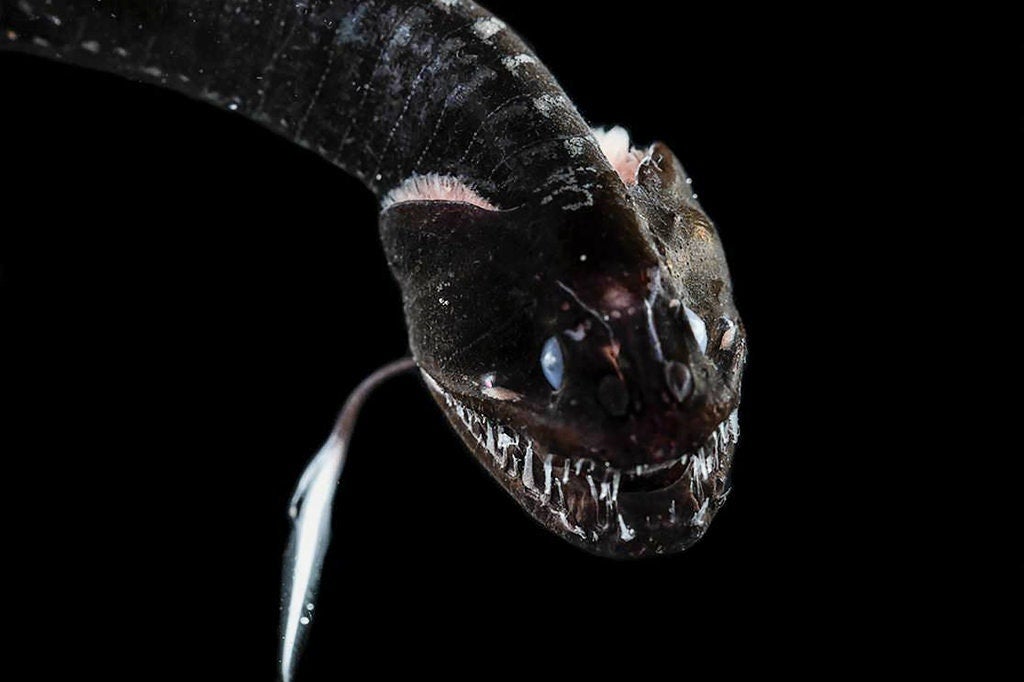
A team of marine biologists have discovered 16 new species of terrifying deep-sea fish that reflect almost no light at all, Wired reports — much like the ultra-black material Vantablack.
Marine biologist Karen Osborn was astonished when she attempted to take pictures of a fangtooth, a terrifying fanged monster of the deep sea, for cataloguing reasons. The fish appeared to absorb almost all of the light her underwater studio shone at it, leaving only eerie silhouettes.
Credit for all images: Karen Osborn/Smithsonian
“I had tried to take pictures of deep-sea fish before and got nothing but these really horrible pictures, where you can’t see any detail,” Osborn, who co-authored a paper about the fish published in Current Biology, told Wired. “How is it that I can shine two strobe lights at them and all that light just disappears?”
“It’s like looking at a black hole,” lead author Alexander Davis, a Duke University biologist, told The New York Times.
Some of the newly discovered species are so dark that they absorb 99.956 percent of light that hits it. For context, last year MIT engineers claimed they accidentally created the darkest material that absorbs 99.995 percent of incoming light — 10 times darker than Vantablack, an extremely dark and difficult to produce carbon nanotube material designed by British nanotech company Surrey Nanosystems.
“We had no idea that there were any fishes at all that were ultra-black,” Davis told Wired. “As far as we knew, the only vertebrates that were ultra-black at all were these birds-of-paradise and a couple other bird species.”
“It was the first case we have of something this black really being used as camouflage as well,” he added.
Deep sea oceans are actually much brighter than you might think. There may be little or no natural light penetrating hundreds of meters of ocean water, but bioluminescent creatures and bacteria produce plenty of light all by themselves.
At the same time, light produced by these organisms tends to draw the attention of prey, suggesting the ultra-black fish may be camouflaging themselves to stop them from being detected as they stalk their prey — or hide from other predators.
So how do these fish get so dark? Special layers of melanosomes, tiny cellular structures stuffed with melanin — the same natural pigment that colors human skin — scatter incoming photons and stop them from finding their way back out.
One species, the threadfin dragonfish, was even found to only be ultra-black when its young — likely a defense mechanism to protect it when it needs to hide from predators.
Other species had melanosomes lining their guts to make sure any bioluminescent fish they ate won’t give away their position. “You don’t want to be swimming around with a glowing belly, right?” Osborne told Wired. “That’s just asking for trouble.”
So will we be able to make our own deep sea fish-inspired Vantablack coating? According to Davis, you’d need to be able to make the nanoparticles just the right size and shape, “then you should be able to just coat anything with it,” as he explained to Wired.
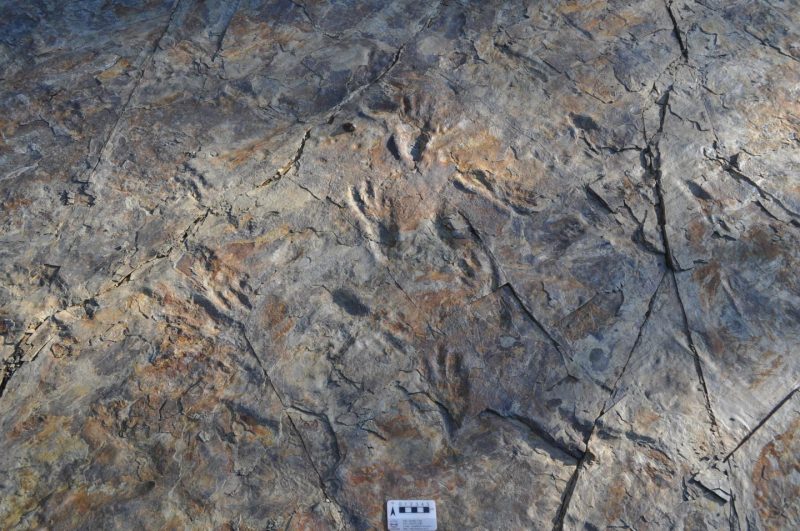
Researchers suggest 110-120 million year old fossil footprints were made by ancient crocodiles that walked on 2 hind legs about the same length as adult human legs.
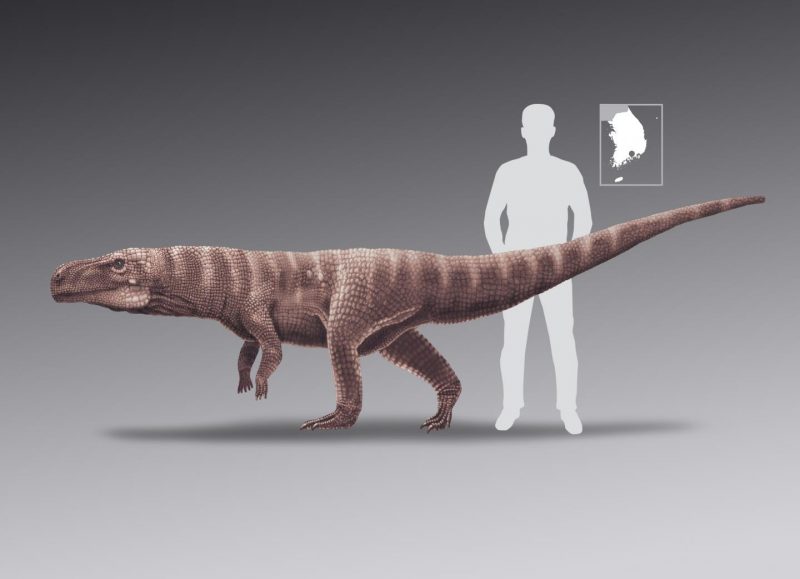
A reconstruction of an ancient landscape of South Korea, showing crocodiles that walked on 2 legs and left tracks studied by scientists today.
An international team of researchers has announced that a trackway of ancient footprints – first thought to belong to a pterosaur – might have been made by ancestors of today’s crocodiles that walked on two hind legs, like dinosaurs. The fossil footprints, which the researchers estimate are 110 to 120 million years old, were discovered in the Jinju rock formation, near Sacheon City in South Korea. University of Queensland paleontologist Anthony Romilio is a co-author of the new study, which was published June 11, 2020, in the peer-reviewed journal Scientific Reports.
The footprints measure around 24 centimeters (9 inches), suggesting the track-makers had legs about the same height as human adult legs. These were long animals that we estimate were over 3 meters (10 feet) in length.
A reconstruction of ancient South Korean crocodile track-makers.
While footprints were everywhere on the site, the researchers noticed that there were no handprints. Study leader Kyung Soo Kim, from Chinju National University of Education, said:
Typical crocodiles walk in a squat stance and create trackways that are wide. Oddly, our trackways are very narrow looking – more like a crocodile balancing on a tight-rope.
When combined with the lack of any tail-drag marks, it became clear that these creatures were moving bipedally.
They were moving in the same way as many dinosaurs, but the footprints were not made by dinosaurs. Dinosaurs and their bird descendants walk on their toes. Crocodiles walk on the flat of their feet leaving clear heel impressions, like humans do.
Researchers initially questioned the absence of hand impressions from the trackways, given that today’s typical crocodiles are “four-legged” or quadrupedal. Romilio said:
Fossil crocodile tracks are quite rare in Asia, so finding an abundance of nearly one hundred footprints was extraordinary.
As an animal walks, the hind feet have the potential of stepping into the impression made by the hand and ‘over-printing’ it, but we find no evidence of this at these Korean sites.
It isn’t due to poor preservation either, because these fossils are spectacular, they even have the fine details of the toe-pads and scales on their soles preserved.
Fossilized trackways made by ancient South Korean bipedal crocodiles. Image via Seul Mi Bae.
Biologist Michela Johnson studies crocodylomorphs – extinct ancestors of modern crocodiles – at the University of Edinburgh. She told New Scientist that the fossilized tracks appear to have very distinct, chunky-looking toes, in addition to impressions from crocodile-like scales. She added:
But modern crocodiles have at least some webbing between toes in their back feet, whereas these tracks don’t appear to have any.
Bottom line: Researchers say that a trackway of 110-120 million year old fossil footprints may have been made by ancient crocodiles that walked on two hind legs about the same length as adult human legs.
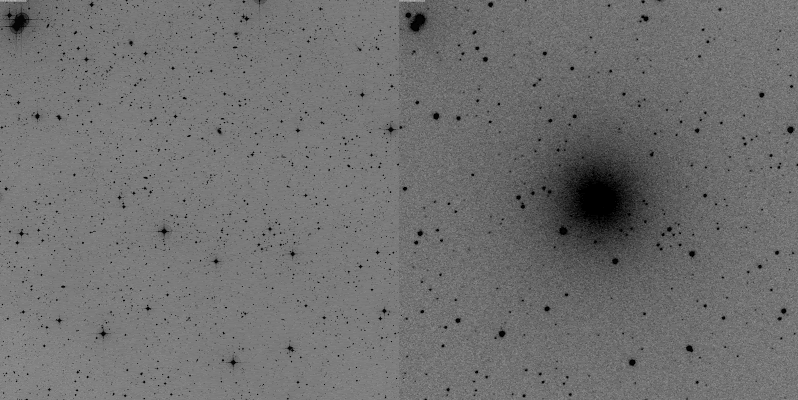
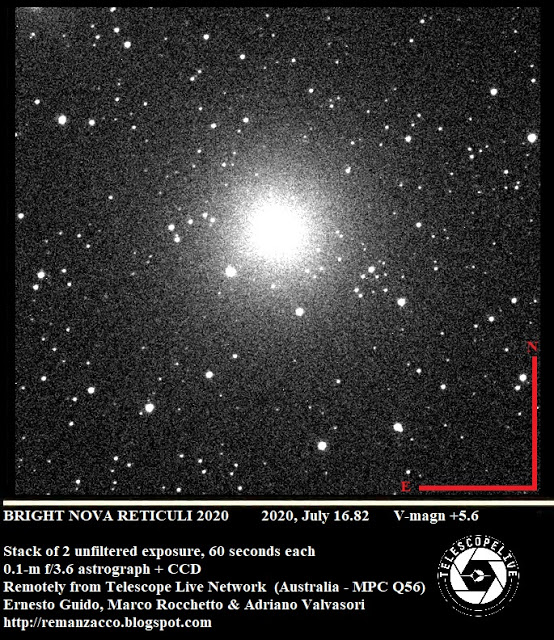
Astronomers have spotted a classical nova outburst in a type of variable star that involves a white dwarf orbiting a main sequence star. Nova Reticulum 2020 has been briefly visible from the Southern Hemisphere.
A nova is a star that suddenly pops into view. Early stargazers thought they were new stars. Today, we know differently.
Veteran comet hunter Robert McNaught from Coonabarabran, Australia, must have been perplexed – and then surprised – and then delighted when he noticed something peculiar on CCD images of the night sky, taken July 15, 2020. It was a faint, but visible star where none had appeared before. Such a star is called a nova, from a Latin word meaning new. This one is in front of the southern constellation Reticulum. Once confirmed by other astronomers, and reported in The Astronomer’s Telegram on July 16, the object was quickly announced to the world’s community of variable star observers as Nova Reticuli 2020 (N Ret 2020).
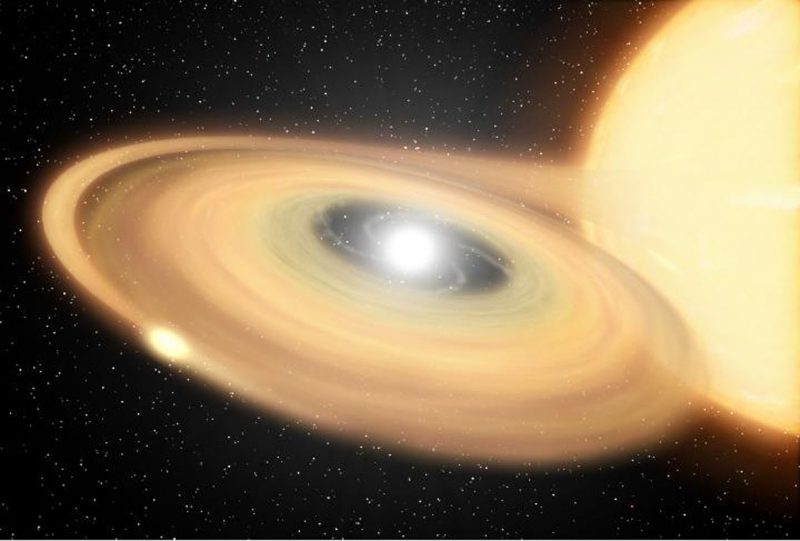
Astronomers have determined that this outburst is of the sort called a classical nova. That is, it’s created in a double-star system where one star is a white dwarf and the other is an ordinary main sequence star, not dissimilar from our sun. These two stars are close together in space, orbiting one another on a timescale of only hours. Because they’re close – and because the white dwarf is a collapsed object with very powerful gravity (a teaspoon of white dwarf material would weigh several tons) – hydrogen from the main sequence star is drawn into an accretion disk around the white dwarf. Eventually, this hydrogen piles onto the surface of the white dwarf. As explained on the website Cosmos from Swinburne University:
As more hydrogen (and helium) is accreted, the pressure and temperature at the bottom of this surface layer increase until sufficient to trigger nuclear fusion reactions [the same process that causes our sun and most other stars to shine]. These reactions rapidly convert the hydrogen into heavier elements creating a runaway thermonuclear reaction where the energy released by the hydrogen burning increases the temperature, which in turn drives up the rate of hydrogen burning.
The energy released through this process ejects the majority of the unburnt hydrogen from the surface of the star in a shell of material moving at speeds of up to 1,500 km/s. This produces a bright but short-lived burst of light – the nova.
A classical nova outburst can occur again and again in a system of this kind.
Nova Reticulum 2020 is associated with a known object in the database of the American Association of Variable Star Observers, labeled MGAB-V207 and categorized as a cataclysmic variable star. These sorts of stars are known to undergo classical nova outbursts due to mass transfer between a main sequence star and a white dwarf.
In a classical nova, a dense white dwarf pulls material from a companion star. The material piles up on the white dwarf’s surface until thermonuclear processes begin, creating an outburst.
Can you see Nova Reticuli 2020? Possibly, if it hasn’t faded yet, and if you live in the Southern Hemisphere, where the constellation Reticulum can be seen. On July 17, writing at Astronomy.com, Alison Klesman said Nova Reticuli 2020 was shining at around magnitude 5.
That is, it’s visible to the eye, but only barely.
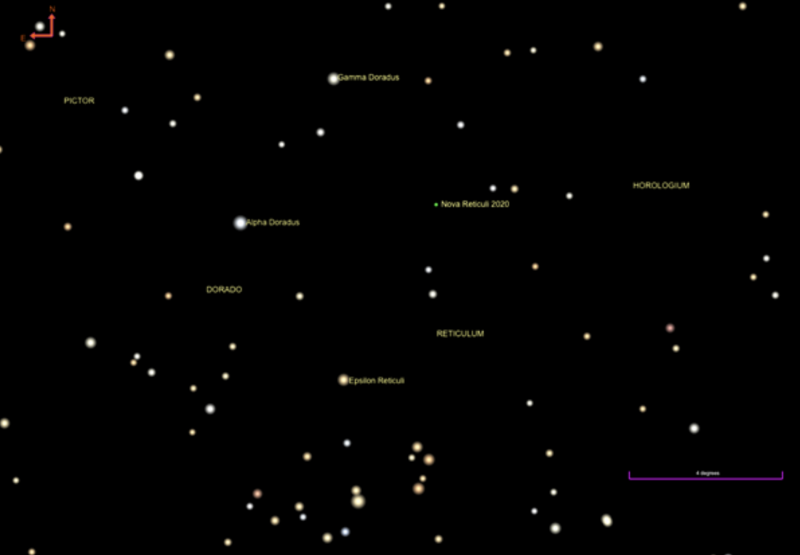
If it’s still visible to the eye, you will need a very dark to see the nova. If you have that – and a constellation chart to show you how to find Reticulum – look first for the bright stars Alpha and Gamma Doradus, shown on the chart below (apologies for the blurriness of the chart; be sure to view it larger).
Good luck!
View larger. | If you live in the Southern Hemipshere, you can see the constellation Reticulum and the nova. You can pinpoint Nova Reticuli 2020 by looking roughly 5 degrees west of magnitude 3.3 Alpha Doradus and 4.25 degrees southwest of magnitude 4.3 Gamma Doradus. Notice that these 2 stars make a triangle with the nova. If the nova has gotten fainter, try using binoculars to bring it into view.
Bottom line: Astronomers have spotted a classical nova outburst in a type of variable star that involves a white dwarf orbiting a main sequence star. Nova Reticulum 2020 has been briefly visible from the Southern Hemisphere. At this writing, we do not know if it is still visible.
Ancient light from the Big Bang has revealed a precise new estimate for the universe's age: 13.77 billion years, give or take 40 million years.
The new estimate, based on data from an array of telescopes in the Chilean Atacama Desert, also weighs in on one of the most important disagreements in astrophysics: How fast is the universe expanding? Described in two scientific papers, the new result gives a significant boost to one side of the disagreement, though the physicists couldn't prove the other side of the dispute wrong.
Here's the problem: Physicists need to understand the universe's expansion rate to make any sense of cosmology — the science of our whole universe's past, present and future. They know that a mysterious substance called dark energy is causing the universe to expand (at an ever-increasing rate) in all directions.. But when astronomers point their telescopes into space to measure the Hubble constant (H0) — the number that describes how fast the universe is expanding at different distances from us or another point — they come up with numbers that disagree with each other, depending on the method they use.
One method, based on measurements of how fast nearby galaxies are moving away from the Milky Way, produces one H0. Another method, based on studying the oldest light in space, or cosmic microwave background (CMB), produces another H0. This disagreement has left scientists wondering whether there's some important blind spot in their measurements or theories, as Live Science previously reported. These new results seem to show that there weren't any measurement errors on the CMB side.
"We find an expansion rate that is right on the estimate by the Planck satellite team," which is another study of the CMB, Cornell University astrophysicist Steve Choi, lead author of one of two new papers, said in a statement. "This gives us more confidence in measurements of the universe's oldest light."
The data from the Planck satellite, released in 2018, were the most important measurements of the CMB before now. With an unprecedented level of precision, they showed how sharply CMB measurements of H0 disagree with measurements based on the movement of nearby galaxies.
These new results recalculated the CMB measurement from scratch using an entirely different set of telescope data and calculations, and came up with very similar results. That doesn't prove that the CMB measurement of H0 is correct — there could still be some problem with the physics theories used to make the calculation — but it does suggest that there aren't any measurement errors on that side of the disagreement.
Relying on data from the Atacama Cosmology Telescope (ACT) in Chile's Atacama Desert, the researchers tracked faint differences between different parts of the CMB -- which appears to have different energy levels in different parts of the sky. The CMB, which formed as the universe cooled after the Big Bang, is detectable in every direction in space as a microwave glow. It's more than 13 billion light-years in the distance, a relic of a time before stars and galaxies formed.
By combining theories on how the CMB formed with precise measurements of its fluctuations, physicists can determine how fast the universe was expanding at that moment in time. That data can then be used to calculate H0.
The ACT methodically scanned half the sky between 2013 and 2016, looking particularly at microwave light. Then researchers spent years cleaning up and analyzing the data with the aid of supercomputers, removing other microwave sources that are not part of the CMB, to stitch together a full map of the CMB. The whole time, they "blinded" themselves to the implications of their work, they wrote in their papers, meaning they didn't look at how their choices affected estimates of H0 until the very end. Only when the full CMB map was complete did the researchers use it to calculate H0.
The new CMB map also offered a new measure for the distance between Earth and the CMB. That distance, combined with a new measurement of how fast the universe has expanded over time, allowed a precise calculation of the age of the universe.
"I didn't have a particular preference for any specific value — it was going to be interesting one way or another," Choi said.
It's still possible, as Live Science has previously reported, that some error in those theories is messing up the calculation. But it's not clear what the error would be.
The other approach to calculating H0 relies on pulsing stars known as cepheids, which reside in distant galaxies and pulse regularly. That timed pulsing allows researchers to perform precise calculations of their motion and distances from Earth.
With those direct speed measurements, it's fairly straightforward to come up with a measurement of H0. There are no complicated cosmological theories involved. But it's possible, some scientists have proposed, that our region of the universe is just weirdly empty, and not representative of the whole universe. It's even possible that there are measurement issues with the cepheids, and that these cosmic measuring sticks don't work quite the way physicists expect.
For now, the true H0 remains a mystery. But CMB researchers have more ammunition for their side of the disagreement.
Both new papers describing the new analysis have been published July 14 to the preprint database arXiv and submitted for formal peer review.
Aztec palace's remains uncovered off Mexico City's main Zócalo plaza
REUTERSImage captionThe palace, found under a historic pawnshop, was also used by Spanish conquistador Hernán Cortés
The remains of an ancient Aztec palace have been discovered under a stately building in Mexico City.
During renovations at the building off the capital's central Zócalo plaza, workers found basalt slab floors.
The floors were part of an open space in the palace of Aztec ruler Axayácatl, Mexico's National Institute of Anthropology and History (INAH) said.
The palace was also used as the home of Spanish conquistador Hernán Cortés after the fall of the Aztec empire.
Excavators have found evidence of the home Cortés had at the palace site.
Archaeologists say it is likely to have reused materials from Axayácatl's palace - which, like other sacred Aztec buildings, was razed by the Spanish conquistadors.
Image copyright - INAHImage captionArchaeologists say the floor is likely to have formed part of a courtyard
Axayácatl reigned between 1469 and 1481 and was the father of Montezuma, one of the empire's last rulers.
"Below the subflooring of the house of Cortés, more than three metres deep, the remains of another floor of basalt slabs, but from pre-Hispanic times, were detected," INAH said.
"Given its characteristics, the specialists deduced that it was part of an open space in the former palace of Axayácatl, probably a courtyard."
Image copyrightREUTERSImage caption
The floors were part of an open space in Axayácatl's palace
Image copyright - INAHImage caption
The palace was found during renovation work on a stately building in Mexico City
Cortés arrived in what is now Mexico in 1518 as commander of a mission to explore the region - rumoured among Europeans to hold great wealth - for Spanish colonisation.
He and his men laid siege to the Aztec capital Tenochtitlán in 1521. When the city surrendered, the Spanish colonisers destroyed it.
The building which stands on the site now - the Nacional Monte de Piedad - is a historic pawnshop that was built in 1755.
Meer van UFO'S of UAP'S, ASTRONOMIE, RUIMTEVAART, ARCHEOLOGIE, OUDHEIDKUNDE, SF-SNUFJES EN ANDERE ESOTERISCHE WETENSCHAPPEN - DE ALLERLAATSTE NIEUWTJES


 Unknown object becomes visible during mysterious flashes on Venus


 Stunning 'fluffy galaxy' 67 million light-years away from...
 Mysterious red glow at the centre of the Milky Way caused by...
 Caught in the Act! Astronomers spot 'firework streamers'...
 International Space Station resembles Darth Vader's TIE...