Scott C. Waring
Eyewitness states:
This year is full of such strange events that the sight of an alien looking at me no longer touches me. This is one sun, but the clouds obscured it. This is a picture without filter, 100% original.
There May Be A Hidden Planet Orbiting Three Suns In Distant Star System

According to a new study, groups of stars can actually rip apart their planet-forming disks resulting with misaligned, broken, warped rings.
For eleven years, researchers from the United Kingdom, Belgium, France, Chile, and the United States studied a young triple star system called GW Orionis that’s located 1,300 light-years away from Earth. They analyzed the data produced by the AMBER (Astronomical Multi-BEam combiner) and the GRAVITY instruments on the European Southern Observatory’s Very Large Telescope (VLT). Then they analyzed data collected by the SPHERE (Spectro-Polarimetric High-contrast Exoplanet REsearch) instrument on the VLT and with the ALMA (Atacama Large Millimeter/submillimeter Array) telescope. (Pictures can be seen here.)
They noticed that its ring-shaped planet-forming disks were being ripped apart by the three stars. “This data allowed us to build a detailed computer model of the system, which predicted that the circumstellar disk would be bent and even torn to form a separate inner ring,” Alison Young, who is from the Universities of Exeter and Leicester in England as well as a co-author of the study, explained in an email to Space.com.
She went on to say, “There have been a number of theoretical studies on disk-tearing effects, but this is the first direct evidence of effect occurring in a planet-forming disk,” adding, “This demonstrates that it is possible for such disks to be warped and broken and raises the possibility that planets could form on highly inclined orbits around multiple star systems.”
If scientists could find a planet within that triple star system, it would be the first time ever that a planet orbiting three suns would have been discovered. They did find 30 Earth-masses of dust in the interior portion of the disk which means that there is enough material present to form into planets. Stefan Kraus, who is a professor of astrophysics at the University of Exeter in the UK and the lead author of the study, went into further details, “It’s the best mechanism for forming planets on such extreme orbits, such as been found so far,” adding, “But … from the planet-detection side, we don’t have a way of detecting these planets yet.”
Young finished off by stating, “It is exciting to see mathematical predictions verified in observations so clearly. I find the SPHERE image particularly amazing because we can really see the disk is a 3-dimensional structure with a surface covered in bumps and shadows.” “We are looking at what could eventually become an unusual type of planetary system in the very process of forming.”
While scientists have already determined that multi-star systems can rip apart their disks, if they could find a planet within that system, it would be an even bigger historical discovery. We’ll have to wait and see what they can find.
Related videos, selected and posted by peter2011
Three Suns Seen Over Poland Sept 7, 2020, Photos, UFO Sighting News.
Bright Light Moves Over Homes, Lighting Them Up, Florida, Aug 22, 2020, Video, UFO Sighting News.
Alien Disk Recovered, Slides Off Truck, Eyewitness Is Blown away, Video, UFO Sighting News.
Hidden anomalies of Antarctica which they are trying to keep secret
Unknown lights in the sky above Marcy, New York 6-Sep-2020

Here’s one new footage of unidentified flying object hovering in the sky above Marcy, NY.
Witness report:
5 strange lights over crowd footage. At first the lights were in a triangle formation then they changed shape & vanished. Recorded on 9/6/2020
Real aliens? Here are all the scientists arguing UFOs exist

With the help of social media and even recent announcements by the U.S. Navy, more than ever believers are pushing to prove UFOs exist. If fuzzy pictures or government conspiracies aren’t enough to convince you, maybe these scientists can.
From documenting key evidence to tightening their arguments, the scientific community is changing the dialogue on UFOs. Here are all the outspoken scientists arguing for the existence of UFOs.

Refusing to denounce the recent stockpile of images & testimonials of UFO sightings is the stance of Michael Masters – a biological anthropology professor at the University of Montana.
In the argument for the existence of UFOs, Masters doesn’t think these objects are the vehicle of choice for little green people. Instead, Masters proposed UFOs are driven by humans from the future. Master’s discussed the theory in his book, Identified Flying Objects: A Multidisciplinary Scientific Approach to the UFO Phenomenon (2019).
Putting stake in the greater proof of UFOs than of aliens, Masters discussed his theory with Leonard Davis from Space.com. Davis theorized, “We know that we’ve had a long evolutionary history on this planet. And we know our technology is going to be more advanced in the future. I think the simplest explanation, innately, is that it is us.”

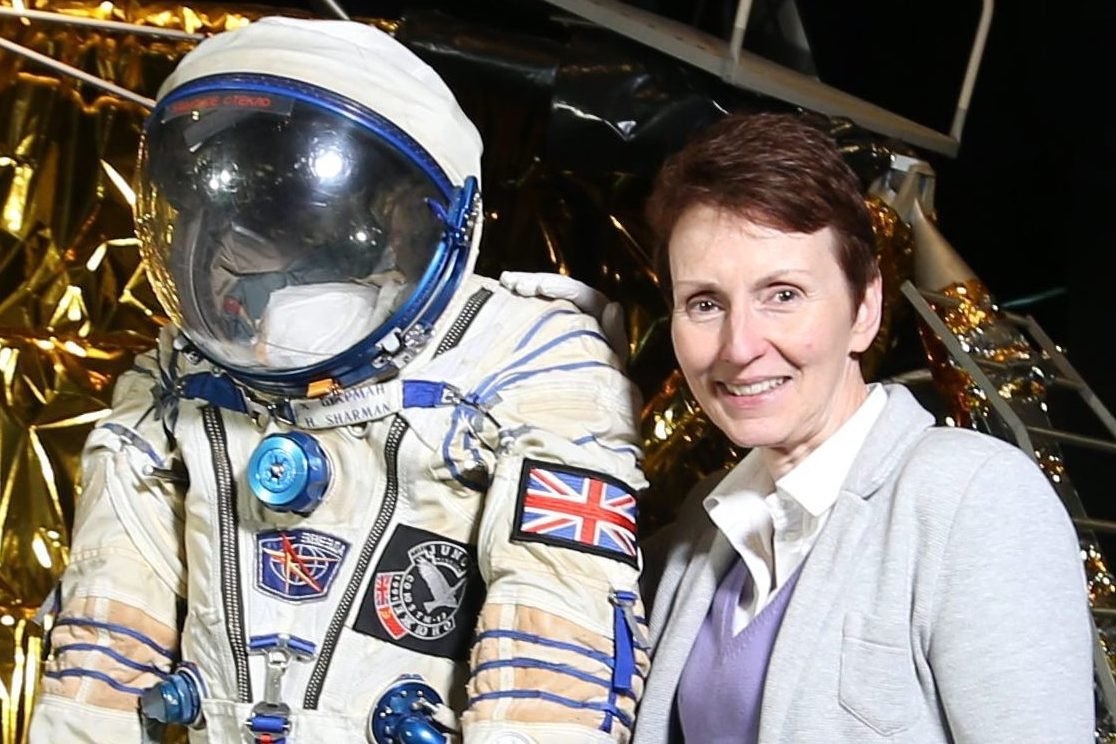
Scientist & astronaut Helen Sharman was Britain’s first astronaut. Sharman took a trip to the Soviet Mir space station in 1991, and returned with a conclusive thought: “aliens exist, there’s no two ways about it.”
Sharman spent eight days working in space as a chemist and researcher. She even believes many of us may have had encounters with aliens during our lives and didn’t know. If perspective from the ground isn’t enough to convince you, what about from someone who’s seen our very civilization from above?
In January 2020 Sharman told The Observer, “There are so many billions of stars out there in the universe that there must be all sorts of different forms of life” – although Sharman doesn’t know if they’re carbon-based like humans. She even suggested, “It’s possible they’re here right now and we simply can’t see them.”

Those are the beliefs of Kevin Knuth – a NASA researcher and assistant professor of physics at the University of Albany in NY. Knuth remembered always being interested in UFOs, and professed, “there’s plenty of evidence to support UFO sightings.”
With a firm understanding of the scientific method, Knuth admitted studying or testing for UFOs is “extremely challenging” – the appearance of UFOs can’t just be repeated. Knuth discussed the “discrepancy between the expectation that there should be evidence of . . . and the presumption that no visitations have been observed.”

What Knuff described is called the Fermi Paradox, spawned by the belief the billions of stars must hold life beyond our knowledge. Knuff also discussed sightings by military governments. He proposed, “some of the strange flying objects that outperform the best aircraft in our inventory and defy explanation may indeed be visitors from afar.”
In Kevin Knuth’s opinion, the biggest issue with the very topic of UFOs is its taboo nature in the scientific community. Instead, he turns to the wide array of multiple witnesses, photographic evidence, and patterns of activity. If UFOs and aliens exist, they need to be taken seriously if they’re going to be documented with substantial proof.

In response to the recent comments on possible UFO existence from the U.S. Navy, Vox spoke to Alexander Wendt – an author & political scientist. Wendt hasn’t tried hiding his own frustrations with the scientific community for their underwhelming reaction to new evidence on UFOs & alien life.
Wendt specializes in topics related to social science and interpersonal interactions, and is intrigued by the unknown something blocking scientists from taking UFO studies seriously. At a loss, Wendt stated, “. . . anything else even remotely this interesting would generate limitless research dollars.”
In his Vox interview, Wendt acknowledged his true feelings on the significance for such a discovery: “Because if ETs were discovered, it would be the most important event in human history.” Now it’s hard to argue with the truth in those words, and more than ever it feels like unwilling scientists are the ones affecting progress – not a lack of UFOs.

Again casting aside the theory of green people or Earth destroyers from films, several scientists are aligned with the belief aliens may be among us. However, unlike cinematic depictions, the creatures just aren’t in a form we’d expect – or even recognize.
Such are the beliefs of Andrew Fraknoi – a member of the board for the Search for Extraterrestrial Intelligence in Mountain View, and former professor of astronomy at Foothill College in California.
Instead of full-size beings, Fraknoi adheres to a different popular belief amongst some astrobiologists. Aliens may be among us, but arrived in the form of microorganisms. From our lands to our oceans, it’s hard to keep track of everything falling to Earth. Fraknoi instilled in his students the belief intelligent life comes in every shape & size.
All related videos, selected and postyed by peter2011
The Biggest Background Investigation MythsUFO’s, Bigfoot, a second shooter on the grassy knoll. America’s history is rich with urban myths and conspiracy theories. In many, if not most, of these fantastical tales, the federal government plays a prominent role. I think a healthy skepticism of government is a good thing within reason, irrespective of whether Uncle Sam is writing your paychecks or merely extracting taxes from them. But those who work for the government are, in my experience, sometimes the wariest of governmental power. They’ve seen up-close-and-personal the vast resources and long arm of our nation’s law enforcement and intelligence apparatuses in a way that most private citizens can only imagine. They know what the government is capable of when the wheels start turning.
And so, it is perhaps unsurprising that many of the people who call my office looking for legal help in preparing for a security clearance background investigation are not first-time, blissfully ignorant applicants, but rather current clearance holders up for periodic review. They are commonly concerned about something the government might dig up and frequently wondering, “how deep does this investigation go?”.
Truth be told, not very deep. Despite incredible advances in technology over the past few decades, the security clearance background investigation process remains decidedly low-tech and horribly outdated. Policy-makers within the federal bureaucracy are working to change this, but the process is something akin to repositioning a cruise-liner: slow and incremental.
Until and unless radical transformations occur, security clearance background investigators won’t be reading your emails, surveilling your movements, bugging your telephones, or surreptitiously tracking your internet browsing history – all questions I’ve been asked by current clearance holders over the years.
Even with hypothetical policy changes allowing for more invasive means of investigation, efforts like these would legally require the security clearance applicant’s affirmative consent. The only alternative would be if authorities obtained a search warrant pursuant to specific and articulatable evidence of criminal conduct obtained via otherwise authorized investigative methods.
Part of the reason for this is that the government simply lacks the resources to do a deep investigative dive on every security clearance applicant. Security officials have to instead assess risk and allocate resources accordingly. No doubt there are some particularly paranoid security officials out there advocating for the Orwellian state, but it isn’t happening – at least not any time soon.
So, rest-assured that applying for a security clearance doesn’t mean Big Brother will be watching your every move. But do remember to exercise reasonable prudence and common sense, lest those otherwise private activities you’d like to keep private unexpectedly spill out into the open.
Record-breaking gravitational waves reveal that midsize black holes do exist

DEBORAH FERGUSON, KARAN JANI, DEIRDRE SHOEMAKER, PABLO LAGUNA/GEORGIA TECH, MAYA COLLABORATION
The biggest. The farthest. The most energetic. A new detection of gravitational waves from two colliding black holes has racked up multiple superlatives.
What’s more, it also marks the first definitive sighting of an intermediate mass black hole, one with a mass between 100 and 100,000 times the sun’s mass. That midsize black hole was forged when the two progenitor black holes coalesced to form a larger one with about 142 solar masses. It significantly outweighs all black holes previously detected via gravitational waves, ripples that wrinkle spacetime in the aftermath of extreme events.
“This is the big guy we’ve been waiting for, for the longest time,” says Emanuele Berti, a physicist at Johns Hopkins University who was not involved with the research. One of the behemoth’s two progenitors was itself so massive that scientists are pondering how to explain its existence.
Detected on May 21, 2019, the gravitational waves originated from a source about 17 billion light-years from Earth, making this the most distant detection confirmed so far. Because of the expansion of the universe, that distance corresponds to a travel time of about 7 billion years, meaning that the gravitational waves were emitted when the universe was about half its current age. It’s also the most energetic event yet seen, radiating about eight times the equivalent of the sun’s mass in energy, says astrophysicist Karan Jani of Vanderbilt University in Nashville, a member of the LIGO Scientific Collaboration. “I hope it deserves its own entry in the record book.”
The new event dethrones the previous record-holder, a collision that occurred about 9 billion light-years away that radiated about five solar masses worth of energy, and created a black hole of 80 solar masses (SN: 12/4/18).
Researchers with LIGO, or the Advanced Laser Interferometer Gravitational-Wave Observatory, in the United States and Advanced Virgo in Italy reported the new detection September 2 in two papers in Physical Review Letters and the Astrophysical Journal Letters.
While scientists know of black holes with tens of solar masses and others with millions or billions of solar masses, the intermediate echelon has remained elusive. Previous purported sightings of intermediate mass black holes have been questioned (SN:1/22/16).
But, for the new event, “there’s no doubt,” says astrophysicist Cole Miller of University of Maryland at College Park, who was not involved with the study. “This demonstrates that there is now at least one intermediate mass black hole in the universe.”
The black hole’s two progenitors were themselves heftier than any seen colliding before — at about 85 and 66 times the mass of the sun. That has scientists puzzling over how this smashup came to be.
Normally, physicists expect that the black holes involved in these mergers would each have formed in the collapse of a dying star. But in the new event, the larger of the pair is so big that it couldn’t have formed that way. The known processes that go on within a star’s core mean that stars that are the right mass to form such a big black hole would blow themselves apart completely, rather than leaving behind a corpse.
Instead, it might be that one or both of the colliding black holes formed from an earlier round of black hole mergers, within a crowded cluster of stars and black holes (SN: 1/30/17). That would make for a family tree that began with black holes lightweight enough to form from collapsing stars.
But there’s a problem with the multiple-merger explanation. Each time black holes merge, that coalescence provides a kick to their velocity, which would normally launch the resulting black hole out of the cluster, preventing further mergers.
However, mergers as massive as the new event seem to be very rare, given that LIGO and Virgo have detected only one. That means, Miller says, “my gosh, you’re allowed to invoke a tooth fairy,” a relatively unlikely process. Perhaps, he says, the kick might sometimes be small enough that the black holes could stay within their cluster and merge again.
The May 21 gravitational wave event had previously been publicly reported as an unconfirmed candidate, to allow astronomers to look for flashes of light in the sky that might have resulted from the collision. Some researchers had suggested that the waves might have been associated with a flare of light from the center of a distant galaxy (SN: 6/25/20). But that galaxy is significantly closer than the distance now pinpointed in the new papers, at about 8 billion light-years from Earth rather than 17 billion, making the explanation less plausible.
The longer LIGO and Virgo observe the heavens, the more the bounty of unusual events can be expected to grow, Miller says. “We are going to have a set of ‘gosh, didn’t expect that’ type of events, which are thrilling to think about and extremely informative about the universe.”
A weirdly warped planet-forming disk circles a distant trio of stars

The star system GW Orionis is surrounded by a complicated trio of rings that could form planets, as shown in this artist’s illustration.
L. CALÇADA/ESO, S. KRAUS ET AL, UNIV. OF EXETER
The star system GW Orionis, located about 1,300 light-years away in the constellation Orion, includes a pair of young stars locked in a close do-si-do with a third star making loops around both. Around all three stars is a broken-apart disk of dust and gas where planets could one day form. Unlike the flat disk that gave rise to the planets in our solar system, GW Orionis’ disk consists of three loops, with a warped middle ring and an inner ring even more twisted at a jaunty angle to the other two.
The bizarre geometry of this system, the first known of its kind, is reported in two recent studies by two groups of astronomers. But how GW Orionis formed is a mystery, with the two teams providing competing ideas for the triple-star-and-ring system’s birth.
In a Sept. 4 study in Science, astronomer Stefan Kraus of the University of Exeter in England and colleagues suggest that gravitational tugs and torques from the triple-star ballet tore apart and deformed the primordial disk. But in a May 20 study in the Astrophysical Journal Letters, Jiaqing Bi of the University of Victoria in Canada and colleagues think that a newborn planet is to blame.
“The question is how do you actually form such systems,” says theoretical physicist Giuseppe Lodato of the University of Milan, who was not on either team. “There could be different mechanisms that could do that.”
Astronomers have seen tilted disks of gas and dust around binary star systems, but not systems of more than two stars (SN: 7/30/14). Around half of the stars in the galaxy have at least one stellar companion, and their planets often have tilted orbits with respect to their stars, going around more like a jump rope than a Hula-Hoop (SN: 11/1/13). That misalignment could originate with the disk in which the planets were born: If the disk was askew, the planets would be too.
About a decade ago, astronomers first realized that GW Orionis has three stars and a planet-forming disk, and the scientists scrambled to get a closer look. (At the time, it was impossible to tell if that disk was a single loop or not.) Bi’s team and Kraus’ team aimed the Atacama Large Millimeter/submillimeter Array in Chile at the triple-star system.
Both groups spotted the trio of stars: one about 2.5 times and another about 1.4 times the sun’s mass orbiting each other once every 242 days, and another 1.4 solar mass star orbiting the inner pair about every 11 years.
The observations also revealed three distinct rings of dust and gas encircling the stars. The closest ring to the star trio lies about 46 times the distance from Earth to the sun; the middle one about 185 times the Earth-sun distance; and the outermost ring about 340 times that distance. For perspective, Neptune is about 30 times the distance from Earth to the sun.
That innermost ring is strongly misaligned with respect to the other rings and the stars, the teams found. Kraus’ group added observations from the European Southern Observatory’s Very Large Telescope to show the shadow of the inner ring on the inside of the middle loop. That shadow revealed that the middle ring is warped, swooping up on one side and down on the other.

Next, both groups ran computer simulations to figure out how the system formed. This is where their conclusions begin to differ, Bi says. His team suggests that a newly formed, not-yet-discovered planet cleared its orbit of gas and dust, splitting the inner ring off from the rest of the disk (SN: 7/16/19). Once the disk was split, the inner ring was free to swing around the stars, settling into its skewed alignment.
Simulations from Kraus’s team, though, found that the chaotic gravity from the triple stars’ orbital dance alone was enough to break up the disk, a phenomenon called disk tearing. Each star tends to keep the disk aligned with itself, and the tug-of-war warped and sheared the disk, and twisted the inner ring even further. Theoretical studies had suggested disk tearing might happen in multiple star systems, but this is the first time it’s been seen in real life, Kraus contends.
“I think it’s plausible that there could be planets somewhere in the system, but they’re not needed to explain the misalignment,” he says. “We don’t need to invoke undiscovered planets to explain what we see.”
A trio of stars in GW Orionis are surrounded by an enormous, warped disk of gas and dust, new observations reveal. This animation, which is based on computer simulations and observational data, shows the complex geometry of the deformed and broken-apart disk.
The difference may lie in the assumptions that the groups made about the disk’s properties, in particular its viscosity, says astrophysicist Nienke van der Marel, Bi’s colleague at the University of Victoria. A more viscous disk would tear like how Kraus and colleagues propose, but a less viscous disk needs a planet to break apart, she says. She thinks her team’s work is more realistic based on observations of other star systems. But with current technology, there’s no way to tell what the properties of GW Orionis’ disk are really like.
And neither group could explain what made the disk split into three. “We don’t really know what’s causing the outer ring,” Klaus says.
Lodato, who predicted the disk-tearing effect in 2013, thinks GW Orionis is proof that the phenomenon really exists. Back then, Lodato and colleagues were “very worried” that their simulations showed an effect that was introduced by the computations, not real physics, he says. “Now observations tell us that it does happen in reality.”
Future telescopes may also be able to spot the planet if it exists, van der Marel says.
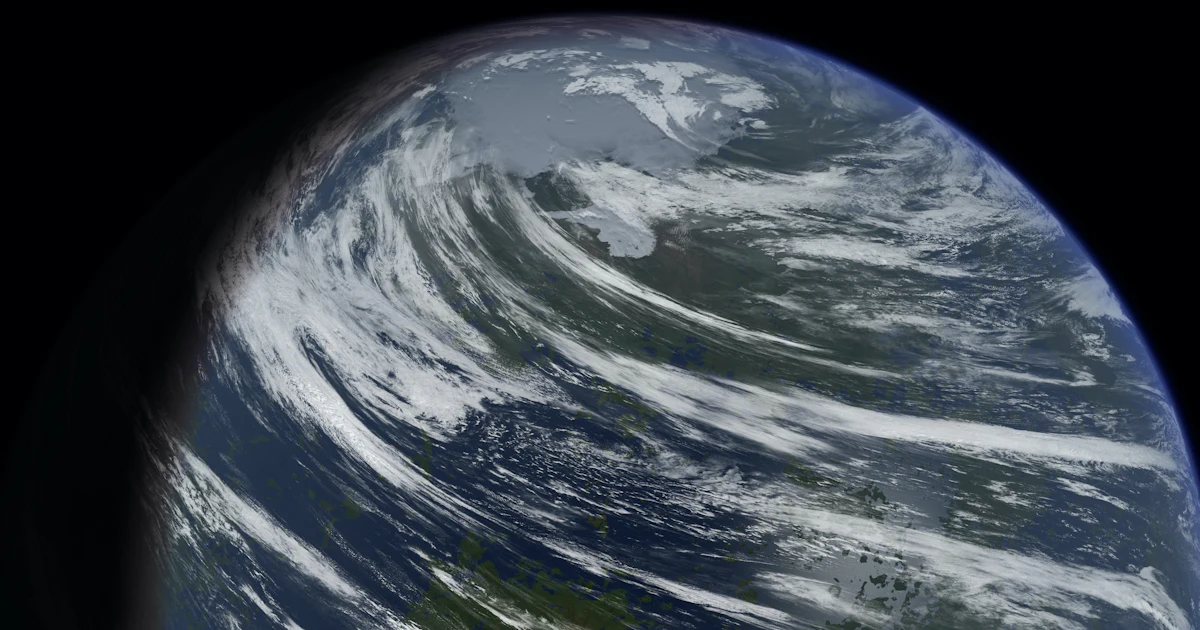
VENUS MAP WITH WATER: STUNNING TERRAFORMING IMAGE SHOWS ALTERNATIVE TO MARS

A new image shows what Venus would look like if it had water on its surface, similar to the Earth.
WHAT WOULD VENUS LOOK LIKE IF IT HAD A SIMILAR AMOUNT OF SURFACE WATER TO EARTH?
A viral map highlights how terraforming Venus could result in an impressively Earth-like planet.
The map was shared in a Reddit post by a user called "Dragonite-2" on the "MapPorn" subreddit on August 21. It visualizes one of the BOLDEST PROPOSALS FOR TERRAFORMING THE SOLAR SYSTEM.
The map bears similarities to Aaditya Raj Bhattarai's water-filled map of Mars, which was shared on Reddit earlier this month. Proposals for terraforming elsewhere in the Solar System tend to focus on the Red Planet. One of the most popular is Elon Musk's idea for colonizing Mars. Musk plans to build a city on Mars, and then somehow release the planet's carbon dioxide stores, creating an atmosphere that humans could move around in with just a breathing apparatus.
Venus is a totally different story. Unlike Mars' comparatively tranquil surface, Venus would be tough for humans to inhabit – its surface temperature is a scorching 465 degrees Celsius, and the atmosphere's thick, acidic clouds whizz all the way around the planet in just five days.
But experts like Carl Sagan have proposed methods for terraforming the treacherous planet, and making its surface a bit more hospitable. It also has benefits over Mars – Venus is similar in size to Earth, and much closer to our planet. Mars is about twice as far from Earth as Venus.
"Dragonite-2"'s post gives an idea of how the end results of such a terraforming mission could look. The map shows a mountainous continent to the north, a flatter series of lands to the east, a series of large islands to the west, and a large archipelago to the south.

Map of Venus if it has as much water as Earth.
The post sparked widespread discussion. Other users shared ideas about where they would live and set up settlements on the new world: one user, called "JPRCR," wrote: "if I had to settle there, I think I would choose the massive continent on the north, probably it will have colder temperatures on the ridges and fertile valleys in the southern part."
BUT HOW ACCURATE IS THE MAP?
Paul Byrne, associate professor of planetary sciences at North Carolina State University, who has written before about Venus' surface, tells Inverse that it's perhaps best to take it with a pinch of salt.
"The map is fairly accurate, in that someone has taken the real-world digital elevation model for Venus and added a 'sea level' to it," Byrne says.
"I don't know how realistic the 'if Venus had as much water as Earth' part is, but I'm guessing that whoever made this map picked an average ocean depth for Earth and 'flooded' the Venus topography to that same depth."
That's where the realism ends, unfortunately. Byrne explains that oceans like that would create rivers, rainfall, and lakes, meaning the surface would look pretty different after erosion and other natural movements. A planet with oceans would likely have plate tectonics, which would also change the arrangement of the geographic features.
Perhaps most importantly, Byrne says, Venus' climate would be terrible for hosting oceans.
"In reality, it's not remotely realistic," Byrne says.
But that doesn't mean the map holds no value. Byrne notes that there's some evidence Venus may once have had Earth-like oceans, and it's something humanity can research in the future.
"Although a Venus with oceans wouldn't look much like the Reddit image, it is fun to think about what a blue Venus might once have looked like — and why its climate turned into the hellish world it is today," Byrne says.

HOW TO TERRAFORM VENUS
Terraforming Venus could involve various approaches. Carl Sagan proposed in 1961 using algae seeded into the clouds to photosynthesize and reduce the carbon dioxide. Three decades later, he had to admit his plan wouldn't work: the atmosphere was later discovered to be thicker than expected.
In a 1991 Journal of the British Interplanetary Society paper, scientist Paul Birch proposed using a sunshade to cool the planet, an insulating cover to stop re-evapotation, smashing an ice moon to add some water, using solar mirrors to move its orbit, and using a soletta device to create a more hospitable 24-hour day and night cycle. Birch suggested the whole process could take around 200 years.
Transforming the planet on this scale would not be an easy task. NASA engineer Geoffrey A. Landis explained in a 2011 research paper that most proposals involved trying to undo the rampant greenhouse gas effects, which would require huge amounts of energy or highly advanced technology. In practice, Landis says, these proposals are aiming to reverse climate change and return Venus to a hypothetical earlier state.
But although the relatively peaceful Mars has captured the imagination of pro-terraforming researchers, Byrne argues that Venus could be a better candidate. It's closer in size, which would make the gravity closer to Earth's. It's also likely easier to remove carbon dioxide from Venus' existing atmosphere than to try and bulk up Mars' feeble atmosphere.
"If we were to terraform anywhere, then I'd pick Venus over Mars," Byrne says. "But, to be clear: it's going to be orders of magnitude more achievable to stop fucking up our own climate here on Earth than trying to make anywhere else even remotely habitable for humans."
The lush, water-filled planet of the future could be closer than it seems.
Related videos, selected and posted by peter2011
Mysterious Tribes With Mind-Bending Concepts of Time

Most people would probably say they have a good idea of what time is. A minute passes, an hour, today becomes yesterday as we move to tomorrow. The past is behind us, the future is ahead of us, the now is the now. It seems as if this is immutable and that surely everyone is aware of this without saying. Many Westerners see time as linear. That is, we move through time in a straight line from point A to point B, with one moment moving in a straight progression on to the next, and a clear progressions between today, tomorrow, and yesterday. Yet, while to experience time this way was once thought to be a universal trait among human beings, this seems to be far from the case, and indeed there are some rather profound difference in how different cultures view the basic concept of how time passes and works. Here we will look at some isolated peoples who live away from our world of clocks and calendars, and who have some rather unique and often baffling concepts of time.
In the remote wilds of the Finisterre mountain range of north-east Papua New Guinea there is an isolated village by the name of Gua. Here there are no roads, no cars, no modern technology, and it is about as removed from civilization as you can get. This is the home of the mysterious and little-known Yupno people, who largely shy away from the outside world, with only infrequent contact with outsiders such as missionaries or government workers. For these people their lifestyle has not changed much over time, and indeed time itself has a rather unique perception here.
For the Yupno, time is very closely intertwined with the very landscape itself, namely the river that dominates the area. Researchers who have studied these people have found that their timeline and perception of time followed the river’s course very closely, with time winding uphill to the rivers source as it follows the curvature of the waterway and even a kink in the river. When asked about future and past events, the Yupno consider the past to lie downhill towards the mouth of the river and the future to lie uphill towards the source, and tribespeople will always gesture downhill when talking about the past and uphill when talking about the future. the two are inextricable. Essentially, time for them flows uphill. Even if the Yupno is facing downhill, they will point behind them if mentioning the future and vice versa. Time is also nonlinear for them, following the curvature of the river, meaning that time only goes in a straight line when the river is straight, and that their timeline has a kink in it where the river actually kinks. Interestingly, when indoors the Yupno will point towards the doorway when talking about the past and away from the door when talking about the future, regardless of the orientation of the house, partly because the doorways are raised and so they have to climb down to leave the premises, and so the doorway is perceived as facing or going downhill towards the past. One researcher has said of this unique perception of time:
This is the first time ever that a culture has been documented to have everyday notions of time anchored in topographic properties. This study is an important landmark. It demonstrates both universality of cognitive processes and a fascinating cultural difference. Each one of these discoveries isn’t just telling us something about other people, it’s telling us something about us. A lot of English speakers think that it’s natural to think of time as a straight line. But that’s an illusion. It doesn’t have to be that way.
The tribe has not been thoroughly studied, and there is still much we do not understand, but it does show us that people from different cultures can have fundamentally different views on time and how it works. For the Yupno time flows uphill and in accordance with the geography, and interestingly there are other cultures that tie time to a sense of spatial or directional awareness. In the remote wilderness of the western side of the Cape York peninsula in Queensland, northern Australia, we have the Australian Aboriginal community of Pormpuraaw. Here, the people see time not as going forward or backward or uphill or downhill, but rather in a unique way all their own. For the Pormpuraaw, relative spatial relationships such as up, down, front, and back, are not used at all, but rather absolute directions such as north, south, east, west, etc.
This tendency to use directions infuses all aspects of life here. For instance, if a Pormpuraaw wanted you to hand them a utensil, they might ask you to pass the one to the west of the plate, and so on. This of course extends to how they view time, as in their culture time always flows from east to west, no matter which direction they happen to be facing at the moment, for instance it flows from left to right when one is facing south, from right to left when one is facing north, toward the body when one is facing east, and away from the body when one is facing west. Researchers have found that when given cards depicting a temporal order, a Pormpuraaw will always arrange them in order from east to west, no matter how the table is rotated, whereas a typical westerner will typically just arrange them from left to right, only arranging them east to west by pure chance. Similarly, when shown a dot and told it is “today” and asked where tomorrow would lie, the Pormpuraaw will place a second dot to the west of the first. Someone with a linear sense of time will just place it to the right. Interestingly, such is their innate dependency on absolute directions that the Pormpuraaw were found to be uncannily accurate with knowing the directions relative to their location, even without a compass, down to within 10º in either direction, every time almost without fail.
If all of this isn’t weird enough as it is, how about a culture that has no real concept of time as we know it at all? Deep within the Amazon rainforest of Brazil is the Amondawa tribe, which is so isolated that they were only first contacted by the outside world in 1986. For the Amondawa, time is a nebulous concept. They do not have words in their language for “hour,” “day,” “month” or “year,” or even a word for “time” for that matter. They do not have ages in the way we think of them, but rather names that change as they progress in their society, and indeed their counting system only goes up to four. They don’t have calendars and nothing like a clock in any sense of the word. The years pass through “dry season” and “rainy season” rather than months or years, and in fact they have no concept of what a year even is. There seems to be no “mapping” between the concepts of time passage and movement through space. That is to say, they don’t have a concept that an event has “passed” or that one is “coming up,” or that an event was “long” or “short.” Indeed, there are no words of any kind related to the measurement of the passage of time in any metaphorical sense.
In a sense, they seem to almost live in a continuous “now,” have no linguistic structures that relate time and space, and the use of language to denote specific points in time is limited to something like meeting “the next daytime” rather than “tomorrow.” It does seem that the Amondawa are capable of cognitively recognizing the passage of time, they are vaguely aware of it, they just don’t operate as a part of it. One Chris Sinha, a professor of psychology of language at the University of Portsmouth, has said of this:
We’re really not saying these are a ‘people without time’ or ‘outside time.’ Amondawa people, like any other people, can talk about events and sequences of events. What we don’t find is a notion of time as being independent of the events which are occurring; they don’t have a notion of time which is something the events occur in. None of this implies that such mappings are beyond the cognitive capacities of the people. It’s just that it doesn’t happen in everyday life.
It is somewhat amazing that such a seemingly simple concept of moving through time from the past to the future has so many permutations among us, but it is perhaps on reflection not so surprising. After all, time is a concept that our brain has very little outside stimulus on which to gage it. Sure we have clocks, calendars, the sense that one day ends and another begins, but what is time really? How does our mind really have anyway to gage it and objectively measure it? It seems that it is a very malleable concept, and that those who live apart from mainstream civilization should naturally develop a different perception of time in the absence of our ways of trying to measure it. Looking at how these perceptions change show us the true uniqueness that each culture possesses and the various ways they interpret the reality they are presented with. It is a fascinating glimpse into the workings of our psyche and what it means to be human, and well as a humbling look at how we try to find a place within this vast universe of ours, full of things we have yet to understand and some which may lie forever beyond us.
Hundreds Of Mammoth Bones Unearthed At Airport Construction Site

An airport construction site located north of Mexico City has become “mammoth central” with hundreds of bones already recovered. So far, experts have unearthed around 200 mammoth bones with many more waiting to be excavated at the location of the new Santa Lucia airport. In fact, there are such a large number of bones at the site that experts have to dig through each load of soil picked up by bulldozers. Additionally, the site is now regarded as the largest discovery of mammoth bones in the entire world.
The site was once the location of an ancient lake bed that mammoths were attracted to but where they also met their end when they became trapped in the marshy soil. Interestingly, archaeologists also found dozens of tools created from the bones that would have been made by ancient humans after the mammoths died between 10,000 and 20,000 years ago. Experts are hoping that the bones will reveal more information regarding their extinction.
The airport construction site is located just 12 miles from artificial pits that ancient humans used to trap and kill mammoths. With the pits nearby, it’s possible that even if the mammoths died from getting stuck in the lake bed, early humans could have still used their bones to make tools – similar to the remains found at the trap site in Tultepec.
More studies need to be conducted as explained by archaeologist Rubén Manzanilla López from the National Institute of Anthropology and History, “Here we have found evidence that we have the same kind of tools, but until we can do the laboratory studies to see marks of these tools or possible tools, we can’t say we have evidence that is well-founded.”
Paleontologist Joaquin Arroyo Cabrales weighed in by stating, “What caused these animals extinction, everywhere there is a debate, whether it was climate change or the presence of humans,” adding, “I think in the end the decision will be that there was a synergy effect between climate change and human presence.”
The construction of the new Santa Lucia airport is scheduled to be completed by 2022, so archaeologists still have some time left to potentially unearth a lot more mammoth bones. A picture of some of the bones already discovered at the site can be seen here.

Belgisch-Russisch onderzoek bewijst: ruimtemissie heeft blijvend effect op menselijk brein - HLN.beBron: Belga
Aan de hand van MRI-scans van Russische kosmonauten voor en na hun ruimtemissie in het internationaal ruimtestation ISS, onderzochten de wetenschappers of de hersenen van astronauten veranderingen ondergaat.
“We ontwikkelden een nieuwe beeldvormingstechniek, waarmee we voor het eerst een duidelijk beeld konden krijgen van wat er precies met de hersenen van astronauten gebeurt. In nauwe samenwerking met onderzoekers van de universiteiten van Leuven en Luik en de Russische Academie voor Wetenschappen in Moskou vonden we de eerste aanwijzingen voor neuroplasticiteit, of het vermogen van het brein om zich aan te passen aan een veranderde omgeving of situatie”, legt dr. Ben Jeurissen uit.
Specifiek vonden de wetenschappers neuroplasticiteit in de belangrijkste motorische regio’s van het brein. “Dat wijst erop dat het brein verandert om aangepaste strategieën voor beweging toe te laten in gewichtloze toestand”, vervolgt onderzoeker Steven Jillings. “We zagen ook dat deze neuroplasticiteit nog gedeeltelijk aanwezig was zeven maanden na terugkeer op aarde, wat wijst op een leereffect. Dit is wellicht voordelig voor volgende ruimtemissies.”
Het onderzoek bevestigde ook bevindingen van andere recente studies die aantonen dat de vloeistof rondom en in het brein zich herverdeelt, wat een meer direct fysisch gevolg is van gewichtloosheid. Deze studie toonde aan dat deze herverdeling van vloeistof niet volledig terugkeert naar de toestand van voor de ruimtemissie. Dat geldt ook voor het scherp zien, een probleem waar meer dan de helft van de Amerikaanse astronauten mee kampt.
Het gaat om belangrijke vaststellingen met het oog op langdurige missies, zoals naar Mars, besluit prof. Floris Wuyts. De onderzoekspaper verschijnt in het wetenschappelijk hoog aangeschreven tijdschrift Science Advances.
Antarctica's Hidden Elite Underground Bases and Other Anomalies aka Illuminati Disneyland.jpg)
.jpg)
Antarctica Hidden Elite Underground Bases and Other Anomalies
Join Brad Olsen to explore the possibility of massive craft under the ice, pyramids in the Shackleton Range, megalithic architecture being uncovered, and the possibility of giants and Ice Age animals being uncovered from the ice. Could Antarctica be the lost continent of Atlantis? Why are many of the elite going down there, to a location called the “Illuminati Disneyland”? These locations and more will be explored!
Brad will describe some of the research stations he visited, and the work that is being performed down there by scientists… and more.
Related videos, selected and posted by peter2011
UFO Matches Speed With Space Station For 40 Minutes! Sept 2020, Video, UFO Sighting News.
Glowing Green UFO Over Chennai, India, Sept 2020, Video, UFO Sighting News.
UFO Fleet Astonish Medellin Residents, Colombia, Sept, 2020, Video, UFO Sighting News.
Giant Hole Opens Up In Siberia, UFO Tunnel To Underground Alien Base! Photos, UFO Sighting News.
High speed craft spotted above Earth from the ISS