Ontdek de Fascinerende Wereld van UFO's en UAP's: Jouw Bron voor Onthullende Informatie!
Ben jij ook gefascineerd door het onbekende? Wil je meer weten over UFO's en UAP's, niet alleen in België, maar over de hele wereld? Dan ben je op de juiste plek!
België: Het Kloppend Hart van UFO-onderzoek
In België is BUFON (Belgisch UFO-Netwerk) dé autoriteit op het gebied van UFO-onderzoek. Voor betrouwbare en objectieve informatie over deze intrigerende fenomenen, bezoek je zeker onze Facebook-pagina en deze blog. Maar dat is nog niet alles! Ontdek ook het Belgisch UFO-meldpunt en Caelestia, twee organisaties die diepgaand onderzoek verrichten, al zijn ze soms kritisch of sceptisch.
Nederland: Een Schat aan Informatie
Voor onze Nederlandse buren is er de schitterende website www.ufowijzer.nl, beheerd door Paul Harmans. Deze site biedt een schat aan informatie en artikelen die je niet wilt missen!
Internationaal: MUFON - De Wereldwijde Autoriteit
Neem ook een kijkje bij MUFON (Mutual UFO Network Inc.), een gerenommeerde Amerikaanse UFO-vereniging met afdelingen in de VS en wereldwijd. MUFON is toegewijd aan de wetenschappelijke en analytische studie van het UFO-fenomeen, en hun maandelijkse tijdschrift, The MUFON UFO-Journal, is een must-read voor elke UFO-enthousiasteling. Bezoek hun website op www.mufon.com voor meer informatie.
Samenwerking en Toekomstvisie
Sinds 1 februari 2020 is Pieter niet alleen ex-president van BUFON, maar ook de voormalige nationale directeur van MUFON in Vlaanderen en Nederland. Dit creëert een sterke samenwerking met de Franse MUFON Reseau MUFON/EUROP, wat ons in staat stelt om nog meer waardevolle inzichten te delen.
Let op: Nepprofielen en Nieuwe Groeperingen
Pas op voor een nieuwe groepering die zich ook BUFON noemt, maar geen enkele connectie heeft met onze gevestigde organisatie. Hoewel zij de naam geregistreerd hebben, kunnen ze het rijke verleden en de expertise van onze groep niet evenaren. We wensen hen veel succes, maar we blijven de autoriteit in UFO-onderzoek!
Blijf Op De Hoogte!
Wil jij de laatste nieuwtjes over UFO's, ruimtevaart, archeologie, en meer? Volg ons dan en duik samen met ons in de fascinerende wereld van het onbekende! Sluit je aan bij de gemeenschap van nieuwsgierige geesten die net als jij verlangen naar antwoorden en avonturen in de sterren!
Heb je vragen of wil je meer weten? Aarzel dan niet om contact met ons op te nemen! Samen ontrafelen we het mysterie van de lucht en daarbuiten.
Vrijdag 6 november 2020
Mars: Alien Body Cut In Two Found Under Altar With Bones, NASA Source! Nov 5, 2020, Photos UFO Sighting News.
Mars: Alien Body Cut In Two Found Under Altar With Bones, NASA Source! Nov 5, 2020, Photos UFO Sighting News.
I was searching through Mars photos when I found something that really screamed for my attention. I discovered an alter. The kind of alter that was sacrificial. I say that because all evidence points to that being its use. You can easily see the bones and trinkets laying on the alter. Religions are a universal thing...belief in a creator gives life purpose for some and guidance for others. It's only logical to think that there is religion out there in the universe...some may be barbaric and some so advanced it would be difficult to comprehend. I also found a tilted over statue and something that looks like a hand weapon...a phaser of sorts. The weapon looks similar to the phaser in the last star trek series. It looks as though a big fight took place in this cultures last moments. I also found a dead body broken in two pieces under the alter. The head, neck spine and ribs area down to the waist. The other area below the waist and two long legs and feet under it but separated from the other half. Sacrificial site for sure.
Nest camera recording of UFO Fastwalker moving extremely fast
Recently, a UFO Fastwalker moving extremely fast at high altitude was captured from a northward pointing Nest camera in the backyard of a home in Abilene, Texas. It looks like the UFO in the last frame finished its flight path, and disappeared into a portal.
Besides the above mentioned UFO Fastwalker sighting, the same Nest camera captured a second UFO Fastwalker, three days earlier.
Witness: The UFO Fastwalker captured three days earlier appears out of a spot that appears suddenly and then as the spot it exited from, disappears, it creates and enters a new spot or portal that it hits directly.
The portal slowly dissipates in place afterwards. This situation happens in a fraction of a second and on the camera recording it is only a combination of about 6 frames or so. If the object was 20 ft across for example, it would have to be at least a few hundred feet above the ground.
Both events were high speed and the object that we caught in the Nest camera feed on October 18, was first a bright circle and in the next moment was a grey color as if it was engulfed in a sort of fog before entering the portal or point that had manifested.
At that point the spot disappears slowly in the next frame or two. One important fact that I noticed upon further review is that an upright dark grey or black cylinder shape happened to slowly appear and dissipate to the east, right before the event. This seemed to be around a quarter mile to the east of it from what I could tell.
To add to my credibility, I am active duty Air Force and have seen many aircraft flying during the day and night from multiple deployed locations and stateside bases. Nothing I have seen is anything like what we captured on the camera. Mufon report here.
If the extraterrestrial hypothesis is controversial, then abductions of humans by alien beings is controversial squared, if not cubed. There’s intense polarization on the issue, not just between UFO skeptics and believers, but between the believers themselves. Is there a person who can share reality story of alien abductions? Famous abduction cases, such as the Travis Walton situation, have been popularized in books and movies, along with the occurrence been validated using polygraph tests administered to all parties involved. While this may not be proof positive that aliens are abducting humans and performing experiments and surgical procedures on them, it does raise questions.
Investigators worth mentioning sightings and abduction reports call themselves Ufologists, and now have precise scientific methods meant for investigating the reports people receive. While many of your methods and findings are usually not recognized by the scientific community overall, it does raise this question of why many people would risk their reputations and careers while in the scientific world by becoming needed for paranormal investigations such seeing that these. Logic would say you need to have something to the UFO and additionally separate question, for the property to take such risks. Of course, there’s no concrete evidence that anyone has taken by an alien spaceship. However, there are those who assert they’ve been kidnapped, and their stories are chilling.
After the Sitgreaves National Forest nearby Heber, Arizona, the occurrence began on Nov. 5, 1975. Walton and his six loggers were heading when they saw a 40 ft. shiny disc soaring in the air. According to his testimony, the disc has an enthusiastic and metallic material, making strange sounds. From the time it got close, the more it became scary to people. Fifteen years later, it was being revealed that the trees where the extraterrestrial craft hovered had been producing wood fibers thirty-six times it did 85 years before. The most curious part is that its core has thickened growth, but only in the direction where the craft had been years ago.
It’s a fact that the origins of Area 51date back to the early years of the Second World War. The Nevada Test and Training Range soon came to fruition and planted the seeds for what would come in the mid-1950s: Area 51. Highly advanced aircraft, such as the U-2, the SR-71 Blackbird, the Stealth Fighter and the Stealth Bomber were all secretly test-flown from Area 51. Probably the “secret aircraft”known as the Aurora, too. In that sense, many might say, there is no doubt that Area 51 has a valid reason for keeping just about everything under wraps. Indeed, considering the fact that those aforementioned aircraft were being built, tested, and flown when the Cold War was still in place and the Soviet Union had still yet to fall, one can easily see why stringent measures would be taken to ensure that the U.S. Government’s most advanced aircraft would be subject to incredible secrecy. It makes total sense. But, is there just too much secrecy for a squadron or several of strange, futuristic aircraft?
As most will know, there is one thing – more than any other – that sets Area 51 apart from just about every other military or government facility in the United States: it’s the sheer extent of the government’s determination to make sure that absolutely nothing gets out of Area 51 and no one gets in, unless you have the correct clearance. Of course, and particularly so in today’s climate of uncertainty, everyone needs to be vigilant. And that includes everyone who works at Area 51, too. They are, after all, just like us, regular people with lives and families. The big difference, though, is they know the reasons for so much secrecy and we don’t. It would be hard – in fact, impossible – to find a military installation in the United States that protects its secrets to a greater degree than Area 51. Those who stray too close to portions of the Nevada desert that the staff of Area 51 would prefer to keep under wraps risk large fines, imprisonment and even death, and all in the name of national security.
Aircraft are banned from flying close to or over Area 51. They can even be shot down out of the sky, if circumstances dictate and warrant such drastic action. When, in 1974, NASA’s astronauts on-board Skylab took an aerial photo of the base, all hell broke loose in the defense and intelligence-based communities of the United States. The CIA and the Department of Defense quickly got involved. Major concerns were expressed about how on Earth (or, in this case, off it) such a thing could have happened. Secret files were created, most of which have never publicly surfaced. Motion-detector equipment peppers the landscape. Cameras are everywhere. Guards patrol the local roads for any perceived suspicious characters. Night-vision technology ensures that no one can penetrate the base in the early hours of the morning.
Skylab
The government practically refuses to acknowledge not just the existence of Area 51, but even its name. That same government refused to offer help on the 1996 movie Independence Day, and all because a substantial portion of the movie revolved around Area 51 and the 1947 incident at Roswell, New Mexico. All of the above is astonishing. No facility in the United States comes even close to the level of secrecy and paranoia that surrounds Area 51. Which brings up an important question: is all of this overwhelming secrecy just in place to protect next-generation after next-generation of aircraft? Or, are the rumors and the whispers true? You know the ones, of course: the claims that deeply hidden at Area 51 are the remains of the Roswell wreckage, recovered flying saucers, and alien corpses. Maybe, even living aliens are at the base, too.
Regardless of where you, me and everyone else stands on the matter of what goes on at Area 51, there can be no doubt that it is the UFO-driven rumors and revelations which attract so much attention. Certainly, there’s no doubt it was Bob Lazar who, in the late 1980s, set the wheels in motion for the controversy to begin and for the media and the public to sit up and take notice. Consider the following: in her 2011 book, Area 51, Annie Jacobsen told the story of a man named Alfred O’Donnell, who had provable links to Area 51. O’Donnell told Jacobsen that the Roswell wreckage and the grossly mutated human crew aboard were secretly transferred to the Nevada Test and Training Range in 1951, after previously being secretly stored at Wright-Patterson Air Force Base, Dayton, Ohio. The story suggest the bodies may well still be stored there. Perhaps in a museum-like state. Moving on, we should note there are certain threads running through the tales of UFOs at Area 51 that should make us cautious of what we are told about the base and its work. Let’s not forget that Bob Lazar told of how his mind may have been messed with – possibly using updated MK-Ultra-type technologies. Certain portions of his memories were wiped clean. He felt that his very brief glimpse of a small creature at S-4 may have been a staged event; an event designed to make him think that live extraterrestrials were hidden at the base, when they may not have been.
There can be no doubt that the alien angle of the history of Area 51 excites many. Maybe that’s what the U.S. Government is counting on. After all, not even the power of all the military-, defense-, and intelligence-based agencies in the United States can prevent a few leaks of classified information. So, perhaps to keep eager Ufologists away from stumbling on covert programs concerned with new aircraft designs, next-generation weapons-systems, mind-control techniques and more of a down to earth nature, they swamp those same Ufologists with enticing tales of extraterrestrial conspiracies and the ever-popular Roswell affair. For the people at Area 51, it may be a case of this: if you can’t plug the genuine leaks, then swamp them with far more tantalizing and enticing tales of E.T. A good argument could be made that this is exactly what has happened. At times, the targeted people might have been patriotic American citizens who overstepped the mark in their quests to find out if alien life really does hang out at Area 51. On other occasions, and particularly during the Cold War, the targets may have been Soviet spies, seeking the very same answers. Dangling an alien carrot – so to speak – would be the perfect way to reel in and arrest eager Russian agents who were trying to figure out what was going on deep in Nevada. And if that carrot never really existed – except in the minds of those running the disinformation programs – then all the better.
Something that dates back decades has prompted the U.S. Government to turn Area 51 into a veritable impenetrable fortress. Is this all about secret aircraft? Aliens? Both? Or something else completely? We still don’t know. We may never know.
ALL RELATED VIDEOS, selected and posted by peter2011
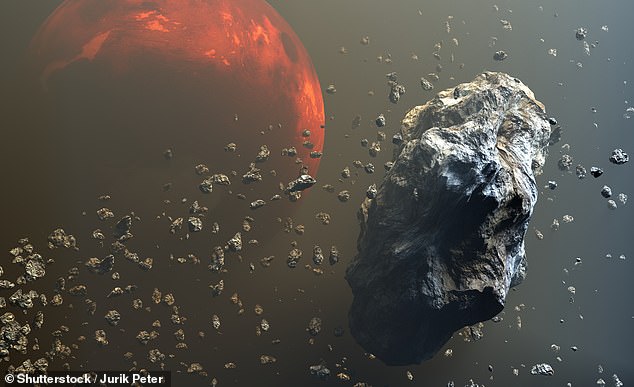
The long-lost twin of the moon has been spotted trailing behind Mars, according to a new study.
The 3,280-foot-wide asteroid called (101429) 1998 VF31 was first spotted 22 years ago, and new analysis reveals it is 'strikingly similar' to the moon.
Scientists from the Armagh Observatory and Planetarium (AOP) in Northern Ireland used the European Southern Observatory's (ESO) and the Very Large Telescope (VLT) to study the space rock.
The lead author of the study, Dr Apostolos Christou from the AOP, believes it is possibly a chunk of moon that was dislodged by an enormous impact during the Solar System's formative years, around four billion years ago.
However, while the origin of this rock may be lunar, the research team say it is also possible it could have stemmed from the Martian surface.
Scroll down for video
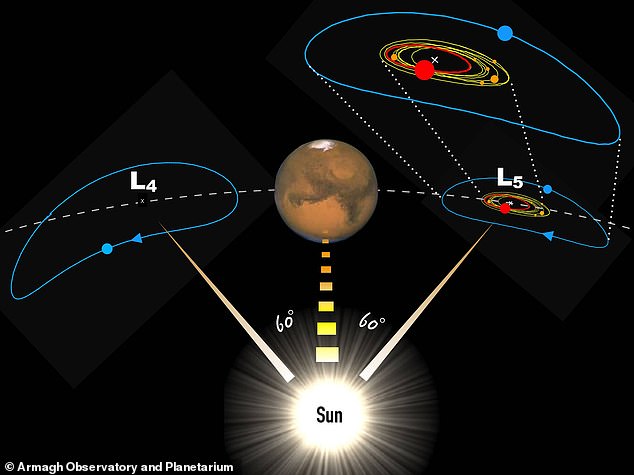
The asteroid is a Mars Trojan which orbits the Sun while trailing behind the red planet at an angle of about 60 degrees relative to the Sun, in a so-called Lagrange point. These are locations in a planet's orbit where the gravity of the Sun and the planet balances out, allowing a rock to remain in a static location. L4 is ahead of Mars and L5, where VF31 is, sits behind Mars
Dr Christou studied the space rock with a technique called spectral matching.
'It's similar to the photo-IDing done by the police when chasing crooks, you try to match your data - the spectral profile - against the same type of data taken from other objects, for example other asteroids or meteorites,' he told MailOnline.
'None of these matches were particularly satisfactory until we included spectra of the Moon in our analysis. The similarity to parts of the lunar surface was striking.'
The asteroid is part of a group known as Mars Trojans, and their origin is a long-standing astronomical mystery.
They orbit the Sun while either trailing behind the red planet at an angle of about 60 degrees relative to the Sun, L5, or 60° in front of Mars, L4.
For example, if Mars reaches a point in its orbit deemed to be the same as 12 o'clock on a clock face, the Trojans will be at two o'clock.
They stay in this location because they are trapped at a Lagrange Point, a patch of space where the gravitational pull of various celestial bodies balances out.
As a result, they never go around Mars and always lurk behind it, following in the planet's wake.
The study, which was funded by the UK Science and Technology Facilities Council (STFC), reveals that VF31 is very different in composition to all the other Mars Trojans.
This, Dr Chrisotu told MailOnline, was surprising. None of the other Trojans had any resemblance to the moon, making this object unique.
The research team speculates that the moon may have been struck by an asteroid, called a planetesimal, causing VF31 to chip off the surface.
'The early solar system was very different from the place we see today,' Dr Christou says.
'The space between the newly-formed planets was full of debris and collisions were commonplace.
'Large asteroids – we call these planetesimals – were hitting the Moon and the other planets.
'A shard from such a collision could have reached the orbit of Mars when the planet was still forming and was trapped in its Trojan clouds.'
Although the researchers are unable to say conclusively that the space rock is a fragment of the moon, the evidence is convincing.
To test if it would even be possible for the asteroid, which is less than a kilometre in diameter, to have originated from the moon and end up in Martian orbit the researchers crunched the numbers.
Previous studies show that for a rock to escape the moon's gravity, it would have to be travelling at 2.4 km/s (5,368 mph).
For it to then enter an orbit around the Sun, it would have to be travelling at a minimum of 3.5 km/s (7,829 mph).
The researchers say it is possible for a rock fragment of around one kilometre in diameter to travel at this speed if the moon is hit by a projectile at least 125km (77 mils) in size, travelling at 10 km/s (22,369 mph).
Such a monumental collision would create a crater measuring 974 km (604 miles) across.
In order for a loose piece of rock from the lunar surface to escape the moon's gravity and enter a solar orbit it would require the moon to be hit with a projectile at least 125km (77 mils) in size, travelling at 10 km/s (22,369 mph). This would create a crater measuring 974 km (604 miles), much smaller than the Aitken crater (pictured) on the far side of the Moon, which is far bigger than this. This proves it is at least possible for the asteroid to have come from the moon
A 1km-wide asteroid called (101429) 1998 VF31 was first spotted 22 years ago and new analysis reveals it is 'strikingly similar' to the moon, astronomers say
(stock)
'This is considerably smaller than the size of the largest lunar basin, therefore this scenario is at least plausible,' the researchers write in their study, published today in the journal Icarus.
While there has not been another asteroid discovered which could be an ancient remnant of the moon, the researchers believe there could well be more undiscovered lunar 'twins'.
'It is sensible to expect that if there is one there could be more,' Dr Christou says.
'However, to preserve those objects for 4 billion years until today they would need to have been trapped early on in similar "safe havens" along the orbits of nearby planets, Mars or the Earth.
'Perhaps there is some other asteroid out there that looks exactly like this one; so far we haven't found it. But we will keep looking.'
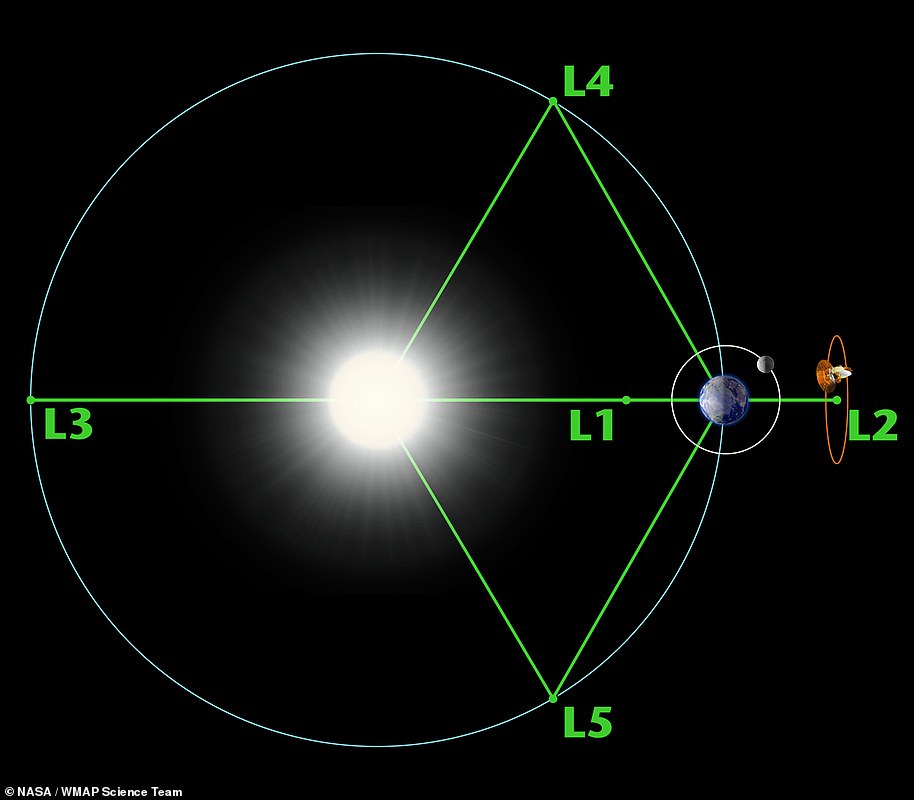
WHAT IS A LANGRANGE POINT?
A Lagrange point is a spot in space where the combined gravitational forces of two large bodies are equivalent to the centrifugal force of another body.
The way the forces interact creates a net directional force of zero and allows an object to stay stationary in space.
These points are named after Joseph-Louis Lagrange, an 18th-century mathematician who wrote about them in 1772.
major astronomical bodies have five points - labelled L1, L2, L3 L4 and L5.
L1, L2 and L3 are all unstable as they rely entirely on a fragile equilibrium.
L4 and L5 are far more stable.
L1 - Between the two objects. This location between the sun and the Earth is currently occupied by SOHO - Solar and Heliospheric Observatory and the Deep Space Climate Observatory.
L2 - The second spot is a million miles beyond Earth and in the opposite direction to the sun. This is currently occupied by NASA's Wilkinson Microwave Anisotropy Probe (WMAP) and will be the target area for the upcoming James Web telescope.
L3 - This spot lies behind the sun and away from Earth. This spot remains, as of yet, unoccupied.
L4 and L5 - They lie along Earth's orbit at 60 degrees ahead of and behind Earth.
Nasa has created the four concepts and has said they will likely be positioned at L2 - an astronomical position a million miles beyond Earth and in the opposite direction to the sun
A new study has suggested that astronomers have located our moon’s “long-lost twin”. The asteroid, that’s called (101429) 1998 VF31, measures 3,280 feet (1 kilometer or 0.62 miles) in width and is located behind Mars. Even though it was first discovered 22 years ago, recent studies have just revealed that it is “strikingly similar” to our moon.
The asteroid was studied by scientists from the Armagh Observatory and Planetarium (AOP) in Northern Ireland and they believe that it did break off of our moon approximately 4 billion years ago during a gigantic impact.
In an interview with MailOnline, Dr. Apostolos Christou from AOP explained how they used spectral matching to study the space rock. “It’s similar to the photo-IDing done by the police when chasing crooks, you try to match your data – the spectral profile – against the same type of data taken from other objects, for example other asteroids or meteorites,” he said, adding, “None of these matches were particularly satisfactory until we included spectra of the Moon in our analysis. The similarity to parts of the lunar surface was striking.”
Some of the moon’s many craters.
The asteroid is part of the Mars Trojans and orbits our sun at around a 60 degree angle either behind or in front of the Red Planet. It is stuck in the Lagrange point which is a spot where the combined gravitational forces of two bigger objects cancel each other out, causing the third smaller body to remain in place.
Based on their research, scientists noticed that VF31 is much different than the other Mars Trojans as it had certain resemblances to our moon. They think that a big asteroid hit the moon which caused a piece of the lunar surface to break off.
Dr. Christou explained this further, “The space between the newly-formed planets was full of debris and collisions were commonplace.” “Large asteroids – we call these planetesimals – were hitting the Moon and the other planets.” “A shard from such a collision could have reached the orbit of Mars when the planet was still forming and was trapped in its Trojan clouds.”
Prior studies were conducted in order to predict the series of events in which the lunar chunk would have been launched into space. Based on the fact that the rock is only about a kilometer in width, it would have been flying at a speed of around 5,368 miles per hour in order to leave the gravitational pull of the moon. It would have then been traveling at a minimum speed of 7,829 mph when it entered into the sun’s orbit.
And in order for the space rock to travel at this tremendous speed, the moon would have been hit by an object that measured at least 77 miles and traveling at around 22,369 mph prior to the impact. The impact would have made a crater that measured approximately 604 miles in width. In their study (which can be read here), the researchers wrote in part, “This is considerably smaller than the size of the largest lunar basin; therefore this scenario is at least plausible.”
What’s even more shocking is that there may be more moon “twins” lurking around the solar system. “Perhaps there is some other asteroid out there that looks exactly like this one; so far we haven’t found it. But we will keep looking,” Dr. Christou stated.
While it isn’t confirmed yet that the space rock is in fact a piece of the moon, the new research is certainly compelling.
Actor Dan Aykroyd Reveals His Own UFO and Men In Black Experiences via Coast to Coast AM
Actor Dan Aykroyd Reveals His Own UFO and Men In Black Experiences
COAST TO COAST AM INSIDER Archived Show – George Noory welcomed Dan Aykroyd and David Sereda, who talked about their new documentary film, Dan Aykroyd Unplugged on UFOs. Aykroyd, who’s had a long-standing interest in ufology, said he’s had two of his own UFO experiences and that he serves as the Hollywood consultant for MUFON.
Of all the cases he’s studied, the one he said that stands out most for him featured police officer audio tapes with live descriptions of a UFO that was pursued around Trumbull County, Ohio in 1994.
Skinwalker Ranch Latest News & Photos - Coast to Coast AM - October 2020
Skinwalker Ranch Latest News & Photos – Coast to Coast AM – October 2020
Chris Bartel worked for Robert Bigelow as a security officer and spent time at the Skinwalker Ranch. His photography of the ranch will be on display at the University of Maryland Art Gallery in 2021.
Chris, along with Taras W. Matla, Associate Director of the Gallery, joined George Knapp to discuss the exhibit and the experiences Chris had when working on the ranch, providing a rare glimpse into the mystique surrounding the location while highlighting its grandeur and natural beauty.
Dr. Steven Greer: Preparing For Contact... Early Age Experiences of the UFO Phenomenon
COAST TO COAST AM INSIDER Archived Show - Dr. Steven Greer returned to discuss his memoir Hidden Truth: Forbidden Knowledge, as well as to comment on ufology and disclosure. His latest book chronicles his UFO/alien encounters that began at an early age. At 8 he saw his first UFO, a silvery disc, and later he began to have lucid dreams where he was onboard the craft.
At 17, Greer said he had an NDE where he experienced “cosmic consciousness” (being at one with the universe) with two enlightened beings. Later in 1973, while at the top of a mountain, he described encountering a 3-4 ft.-tall ET lifeform that floated him into a spacecraft where he meditated with several ETs from different planetary systems.
Guys I found this really cool looking UFO that has landed on the moon. I was using an Arizona State University/NASA map so its not just a photo...and it had a measurement in the lower right hand corner. The ruler says this craft is 50 meters across. The craft also had a long horn like arm coming out one side of the front and an huge black opening into the craft. This could be some kind of mining craft, but it is a bit small. Probably a transport for equipment and such. Made a video to give you more looks at this and see it on the actual map. Please subscribe to my channel UFO Sightings Daily.
Glowing UFO Over Ancient City of Thessaloniki Greece Aug 15, 2020, UFO Sighting News.
Date of sighting: Aug 15, 2020
Location of sighting: Thessaloniki, Greece
Watch this video and you will see a huge flashing UFO over the ancient city of Thessaloniki, Greece. The city was founded over 2335 years ago in 315 BC. That makes this area a very important location since aliens can monitor the human inhabitants over a long time period and make accurate predictions of the future of the city. This glowing light looks similar to the one seen a back in 2011 over Dome of Rock (Holy temple) in Jerusalem in which thousands saw the UFO and recorded it. This...is the same UFO.
Scott C. Waring - Taiwan
BELOW IS A NEWS VIDEO OF THE EXACT SAME UFO IN 2011 OVER THE HOLY TEMPLE OF DOME OF ROCK, JERUSALEM.
White Cloud Orb Has Nowhere To Hide Over Mazatlan, Mexico, Oct 24, 2020, Video, UFO Sighting News.
Date of sighting: Oct 24, 2020
Location of sighting: Mazatlan, Mexico
This UFO was recorded over Mexico last week. The white craft is seen not moving in the wind, but does rise higher. This UFO looks really similar to the cloud orbs I often seen shooting in and out of the clouds. These orbs are AI controlled, meaning no alien pilot, but then again, the AI controlling it is alive. Fantastic catch of an orb watching the people below. Since its a cloudless blue sky, the white orb stands out easily.
White UFOs Over Honfleur, Canada On Nov 2, 2020, UFO Sighting News.
Date of sighting: Nov 2, 2020 Location of sighting: Honfleur, Canada Source: MUFON
Some white objects were recorded a few days ago over Canada. The person was in a moving car so the objects are a bit difficult to see, but you can see there are white objects moving in the sky. Although this could be a flock of geese or ducks its very hard to say for sure. UFOs or flock of geese...impossible to say for sure without a more close up look. Still, such UFOs have been recorded shooting in and out of clouds.
Scott C. Waring - Taiwan
Eyewitness states:
Yesterday November 2, 2020 my kids and I were driving home to Honfleur, Quebec and we saw something in the sky that seemed very strange to us.
Kid On School Bus Records UFO Over Philadelphia, Pennsylvania Nov 2, 2020, MUFON, UFO Sighting News.
Date of sighting: Nov 2, 2020 Location of sighting: Philadelphia, Pennsylvania, USA
A student was still in a school bus when he recorded a dark triangle object passing his school. The boy asked his friends "What is it?" Then he responded to himself saying UFO, and then possibly a kite. But as I watch this strange object in the sky the diamond shape does remind me of thousands of UFO reports that came in just this year alone of such similar looking craft. Even the US Navy have reported some infrared footage with a UFO that looks very close to this one over Philadelphia. This video is powerful evidence that UFOs not only exist, but are deliberately allowing themselves to be seen in public places.
UFO fleet flying across Long Beach, California 3-Nov-2020
These multiple unidentified flying objects were seen and recorded in the sky above Long Beach, a coastal city and port in Southern California. This happened on Tuesday, 3rd November 2020.
Don’t forget to follow us on Facebook for the latest UFO news, videos & photos.
Possible TR-3B UFO sighting over Pomona, California 1-Nov-2020
Check out this interesting footage of a possible triangle UFO – T3-RB that was filmed over Pomona, a city in Los Angeles County, California. This happened on Sunday, 1st November 2020 at around 4pm.
Witness stated that it was not moving for about 3 hours.
Check out this amazing book about the top 10 UFO cases in the history.
Unknown lights witnessed over Melbourne, Australia 25-Oct-2020
These bright unidentified flying objects were filmed in the sky above Melbourne, Australia on 25th October 2020.
Witness report:
Not sure what we seen… never seen this before. Living on the spacecoast we seen a lot of beautiful rocket Launches. What we seen doesn’t make sense. I posted the videos online to ask others. Some people saying Flares but no aircraft flying or sounds of one in the air. It was a very still night and clear sky’s. My video would’ve been better if I didn’t have a bright street light in my way. I was able to video some at the end when I grabbed my phone.
Don’t forget to install our Android App for the latest UFO news & videos!
SCIENTISTS CONFIRM THE SOURCE OF MYSTERIOUS RADIO BURSTS IN THE MILKY WAY
All the signs point to a powerful type of star.
ON APRIL 28, space observatories detected a burst of activity from the center of the Milky Way that lasted for a fraction of a second.
The blip was a fast radio burst, a strong radio signal that lasts mere milliseconds. Although fast radio bursts are frequently detected coming from outside our own galaxy, their sources remain a mystery. But a team of astronomers believe they have identified the source of the first such radio burst detected in the Milky Way — a kind of hyper-magnetized star.
Their findings are detailed in three studies published Wednesday in the journal Nature.
An artist's illustration of a magnetar — a dense, spinning ember left behind after a supernova and wrapped in intense magnetic fields.
Fast radio bursts were first detected in 2007, but the signals came from a far enough distance that astronomers had a hard time identifying their source. But then a radio burst came in from a little closer to home.
Before 2007, the next closest source detected was at a distance of 490 million light years away from Earth.
This radio signal was different. It was so bright scientists could tell that it came from within our own galaxy, yet it shared the properties of fast radio bursts from very distant sources — putting its source also tantalizingly close at hand.
"This burst was so bright that, in theory, if you had a recording from the raw data from your cellphone's 4G LTE receiver, which does detect radio waves, and if you kind of knew what you were looking for, you might have found the signal that came about half way across the galaxy in your cellphone data," Christopher Bochenek, a graduate student at the California Institute of Technology and one of the authors on the new studies, said in a press briefing to discuss the results.
“THIS IS THE FIRST TIME WE’VE BEEN ABLE TO TIE ONE OF THESE EXOTIC FAST RADIO BURSTS TO A SINGLE ASTROPHYSICAL OBJECT.”
Tracing it back, scientists found that the burst, dubbed SGR 1935+2154, appeared to erupt from a source just 30,000 light-years away from Earth.
From their observations, the astronomers worked out that the radio pulses seem to have been produced by a magnetar, a dense, spinning and hyper-magnetized star. These strange stars are the remnants left after a supernova and are wrapped in intense magnetic fields. These fields are so strong, Bochenek said, they "squish atoms into pencil-like shapes."
“There’s this great mystery as to what would produce these great outbursts of energy, which until now we’ve seen coming from halfway across the universe,” Kiyoshi Masui, assistant professor of physics at Massachusetts Institute of Technology, who led the team’s analysis of the fast radio burst's brightness, said in a statement.
“This is the first time we’ve been able to tie one of these exotic fast radio bursts to a single astrophysical object.”
Scientists have long hypothesized that fast radio bursts are produced by magnetars, but this is the first time that they have been able to prove it with direct observations. Such a discovery is no mean feat — this project had a 10 percent chance of actually detecting this kind of fast radio burst, Bochenek said.
In the case of this particular magnetar, dubbed SGR 1935+2154, it is one of about 30 known magnetars in the Milky Way. These neutron stars occasionally go through spurts of activity, during which they emit radiation at different wavelengths.
The researchers were able to pinpoint the fast radio burst to a point in the sky within a fraction of a degree of this magnetar, which happened to be blasting out X-rays around the same time.
“There was some buzz in the astronomy community about this magnetar that had become active in the X-ray, and it had been mentioned within our collaboration that we should keep an eye out for something more from this magnetar,” Masui said. “If it was coming from any other object close to the magnetar, it would be a very big coincidence," he added.
Now that scientists have confirmed that fast radio bursts are produced by magnetars, the next cosmic mystery to crack is to figure out exactly how these bursts of emissions are produced by the strange stars.
Abstract, study one:
Magnetars are highly magnetized young neutron stars that occasionally produce enormous bursts and fares of X-rays and γ-rays1 . Of the approximately thirty magnetars currently known in our Galaxy and the Magellanic Clouds, fve have exhibited transient radio pulsations2,3 . Fast radio bursts (FRBs) are millisecondduration bursts of radio waves arriving from cosmological distances4 , some of which have been seen to repeat5–8 . A leading model for repeating FRBs is that they are extragalactic magnetars, powered by their intense magnetic felds9–11. However, a challenge to this model is that FRBs must have radio luminosities many orders of magnitude larger than those seen from known Galactic magnetars. Here we report the detection of an extremely intense radio burst from the Galactic magnetar SGR 1935+2154 using the Canadian Hydrogen Intensity Mapping Experiment (CHIME) FRB project. The fuence of this two-component bright radio burst and the estimated distance to SGR 1935+2154 together imply a burst energy at 400 to 800 megahertz of approximately 3 × 1034 erg, which is three orders of magnitude higher than the burst energy of any radio-emitting magnetar detected thus far. Such a burst coming from a nearby galaxy (at a distance of less than approximately 12 megaparsecs) would be indistinguishable from a typical FRB. However, given the large gaps in observed energies and activity between the brightest and most active FRB sources and what is observed for SGR 1935+2154-like magnetars, more energetic and active sources— perhaps younger magnetars—are needed to explain all observations.
Abstract, study two:
Since their discovery in 20071 , much efort has been devoted to uncovering the sources of the extragalactic, millisecond-duration fast radio bursts (FRBs)2 . A class of neutron stars known as magnetars is a leading candidate source of FRBs3,4 . Magnetars have surface magnetic felds in excess of 1014 gauss, the decay of which powers a range of high-energy phenomena5 . Here we report observations of a millisecond-duration radio burst from the Galactic magnetar SGR 1935+2154, with a fuence of 1.5 ± 0.3 megajansky milliseconds. This event, FRB 200428 (ST 200428A), was detected on 28 April 2020 by the STARE2 radio array6 in the 1,281–1,468 megahertz band. The isotropic-equivalent energy released in FRB 200428 is 4 × 10³ times greater than that of any radio pulse from the Crab pulsar—previously the source of the brightest Galactic radio bursts observed on similar timescales7 . FRB 200428 is just 30 times less energetic than the weakest extragalactic FRB observed so far8 , and is drawn from the same population as the observed FRB sample. The coincidence of FRB 200428 with an X-ray burst9–11 favours emission models that describe synchrotron masers or electromagnetic pulses powered by magnetar bursts and giant fares3,4,12,13. The discovery of FRB 200428 implies that active magnetars such as SGR 1935+2154 can produce FRBs at extragalactic distances.
Abstract, study three:
Fast radio bursts (FRBs) are millisecond-duration radio transients of unknown physical origin observed at extragalactic distances1–3 . It has long been speculated that magnetars are the engine powering repeating bursts from FRB sources4–13, but no convincing evidence has been collected so far14. Recently, the Galactic magnetar SRG 1935+2154 entered an active phase by emitting intense soft γ-ray bursts15. One FRB-like event with two peaks (FRB 200428) and a luminosity slightly lower than the faintest extragalactic FRBs was detected from the source, in association with a soft γ-ray/hard-X-ray fare18–21. Here we report an eight-hour targeted radio observational campaign comprising four sessions and assisted by multi-wavelength (optical and hard-X-ray) data. During the third session, 29 soft-γ-ray repeater (SGR) bursts were detected in γ-ray energies. Throughout the observing period, we detected no single dispersed pulsed emission coincident with the arrivals of SGR bursts, but unfortunately we were not observing when the FRB was detected. The non-detection places a fuence upper limit that is eight orders of magnitude lower than the fuence of FRB 200428. Our results suggest that FRB–SGR burst associations are rare. FRBs may be highly relativistic and geometrically beamed, or FRB-like events associated with SGR bursts may have narrow spectra and characteristic frequencies outside the observed band. It is also possible that the physical conditions required to achieve coherent radiation in SGR bursts are difcult to satisfy, and that only under extreme conditions could an FRB be associated with an SGR burst.
Meer van UFO'S of UAP'S, ASTRONOMIE, RUIMTEVAART, ARCHEOLOGIE, OUDHEIDKUNDE, SF-SNUFJES EN ANDERE ESOTERISCHE WETENSCHAPPEN - DE ALLERLAATSTE NIEUWTJES


 Mars: Alien Body Cut In Two Found Under Altar With Bones, NASA Source! Nov 5, 2020, Photos UFO Sighting News.


 Massive asteroid named after Apophis - the 'God of Chaos' -...
 Martian meteorite discovered in the Sahara Desert provides...
 There IS water on the Moon: NASA reveals tiny pockets of ice...
 NASA OSIRIS-REx craft JAMS after collecting too much rubble...