Ontdek de Fascinerende Wereld van UFO's en UAP's: Jouw Bron voor Onthullende Informatie!
Ben jij ook gefascineerd door het onbekende? Wil je meer weten over UFO's en UAP's, niet alleen in België, maar over de hele wereld? Dan ben je op de juiste plek!
België: Het Kloppend Hart van UFO-onderzoek
In België is BUFON (Belgisch UFO-Netwerk) dé autoriteit op het gebied van UFO-onderzoek. Voor betrouwbare en objectieve informatie over deze intrigerende fenomenen, bezoek je zeker onze Facebook-pagina en deze blog. Maar dat is nog niet alles! Ontdek ook het Belgisch UFO-meldpunt en Caelestia, twee organisaties die diepgaand onderzoek verrichten, al zijn ze soms kritisch of sceptisch.
Nederland: Een Schat aan Informatie
Voor onze Nederlandse buren is er de schitterende website www.ufowijzer.nl, beheerd door Paul Harmans. Deze site biedt een schat aan informatie en artikelen die je niet wilt missen!
Internationaal: MUFON - De Wereldwijde Autoriteit
Neem ook een kijkje bij MUFON (Mutual UFO Network Inc.), een gerenommeerde Amerikaanse UFO-vereniging met afdelingen in de VS en wereldwijd. MUFON is toegewijd aan de wetenschappelijke en analytische studie van het UFO-fenomeen, en hun maandelijkse tijdschrift, The MUFON UFO-Journal, is een must-read voor elke UFO-enthousiasteling. Bezoek hun website op www.mufon.com voor meer informatie.
Samenwerking en Toekomstvisie
Sinds 1 februari 2020 is Pieter niet alleen ex-president van BUFON, maar ook de voormalige nationale directeur van MUFON in Vlaanderen en Nederland. Dit creëert een sterke samenwerking met de Franse MUFON Reseau MUFON/EUROP, wat ons in staat stelt om nog meer waardevolle inzichten te delen.
Let op: Nepprofielen en Nieuwe Groeperingen
Pas op voor een nieuwe groepering die zich ook BUFON noemt, maar geen enkele connectie heeft met onze gevestigde organisatie. Hoewel zij de naam geregistreerd hebben, kunnen ze het rijke verleden en de expertise van onze groep niet evenaren. We wensen hen veel succes, maar we blijven de autoriteit in UFO-onderzoek!
Blijf Op De Hoogte!
Wil jij de laatste nieuwtjes over UFO's, ruimtevaart, archeologie, en meer? Volg ons dan en duik samen met ons in de fascinerende wereld van het onbekende! Sluit je aan bij de gemeenschap van nieuwsgierige geesten die net als jij verlangen naar antwoorden en avonturen in de sterren!
Heb je vragen of wil je meer weten? Aarzel dan niet om contact met ons op te nemen! Samen ontrafelen we het mysterie van de lucht en daarbuiten.
Zondag 27 december 2020
Three UFOs Near Rocket Launch Then Explosion Over Suzhou, China! Dec 26, 2020, UFO Sighting News.
Three UFOs Near Rocket Launch Then Explosion Over Suzhou, China! Dec 26, 2020, UFO Sighting News.
Date of sighting: Dec 26, 2020
Location of sighting: Suzhou, Jiangsu, China
Source: Email report
They guy said he caught sight of something strange over Suzhou, China yesterday. He said it may be a rocket launch, but seemed more like a failed rocket launch. However in the video I can see at 16 seconds into it...there are three glowing objects in the path ahead of the rocket...at 18 seconds...one of them actually comes so close that it may have hit the rocket...at 45 seconds into it...an explosion occurs. It looks like aliens did not approve of the payload aboard this top secret rocket launch in China and the aliens destroyed it. 100% proof that aliens not only watch over us, but watch out for us and keep us safe.
AMAZING! Cigar-shaped UFO filmed over Andes (Chile)
This really interesting UFO video was filmed from a plane that was flying over Andes in Chile on 11th November 2020.
Witness report: (Google translate from Spanish)
I present my case, my name is Rodrigo from Chile, on 11/11/2020 on the sky flight H272 from Puerto Montt to Santiago (departure 18:36, arrival 20:14 hours). Approximately arriving in Santiago at 8:00 p.m., I was looking at the landscape (Andes mountain range) the only “cloud” (dark and fat, in the shape of a worm) catches my attention, “rain cloud” style, above the peak of the Montana. From my window at an angle of about 65 degrees. As the plane was in parallel with the “cloud”, I noticed that it began to be “clearer” (I thought it was “something” normal of the winds and altitude) and it was there that at the right point of the cloud, it made a ” small flash of white light “that caught my attention and amazement (in a matter of second), I couldn’t believe what I was seeing, I was stunned, when I turned around and saw inside the cabin if someone was looking at the same thing as me, the person closest to me, I was in an intermediate seat to mine (Mrs. Older) sleeping with masks (I also had the mask on), when trying to take my cell phone that was locked and is unlocked with facial recognition, I lost valuable seconds when using alphanumeric unlock. After enabling the cell phone, I focus on the “cloud” to take a photo and then a video. As can be seen in the photo “it was no longer a rain cloud”, but it took the form of something solid and clearer. After the first photo, go to video in slow motion format (effect that was used when making videos to my daughter), where “you can see that it is no longer a cloud” but a “solid disk” (it passed all its metamorphosis) It was impressive to see the “UFO” (calmly in my house and thanks to google map, look for the reference hill, when measuring, it showed me that the UFO was approximately 6 kilometers long). Video 1 and Video 2 (use of filter on video) When the plane moves away from the UFO, at first glance it gives a visual effect of fading on the horizon, it may be an optical effect, but when occupying filters in the video the UFO was still but getting smaller …), at that moment the plane makes a U-turn preparing the landing, at that moment I thought I had already lost sight of the UFO, and to my surprise I see it again at another point of the Andes mountain range, on the horizon, where I take my cell phone , I unlock it for the last photo and video of the UFO …
The former head of the Central Intelligence Agency said recently it’s “presumptuous and arrogant” to believe that there are no other forms of life than the ones on Earth.
“I think some of the phenomena we’re going to be seeing continues to be unexplained and might, in fact, be some type of phenomenon that is the result of something that we don’t yet understand and that could involve some type of activity that some might say constitutes a different form of life,” ex-CIA Director John Brennan said on the podcast “Conversations with Tyler.”
“It’s a bit presumptuous and arrogant for us to believe that there’s no other form of life anywhere in the entire universe,” Brennan added, according to the transcript of the Dec. 16 podcast.
Brennan commented on the videos, calling them “quite eyebrow-raising.”
“You try to ensure that you have as much data as possible in terms of visuals and also different types of maybe technical collection of sensors that you have at the time,” he added.
“I think an important thing for analysts to do is not to go into this type of challenge either discounting certain types of possibilities or believing in advance that it is likely X, Y, or Z. You really have to approach it with an open mind, but get as much data as possible and get as much expertise as possible brought to bear.”
Brits thought UFOs were festive ghosts of WWI soldiers, police detective claims
Richard Rokeby claims mysterious lights that started appearing near Burton Dassett, Warwickshire, in December 1922 were UFOs mistaken as the festive ghosts of World War One soldiers
Mysterious lights believed to be the festive ghosts of World War One soldiers were in fact aliens, a police detective has claimed.
Mysterious lights believed to be the festive ghosts of World War One soldiers were in fact aliens, a police detective has claimed.
The sightings were attributed to a natural phenomenon known as marsh gas or Will O' the Wisps by a local newspaper.
But amateur UFO researcher Richard Rokeby has penned a book, The Lights Upon The Hills, where he claims the witness accounts show they were actually ETs.
The married dad-of-three wrote: "Following the First World War desperate families wanted to believe that there is a hope of communicating with their lost sons again.
"Therefore, it would be natural at this time to assign any strange phenomena to ghosts and spirits.
"But as we will see if we look at these events through modern eyes, it is very clear that what they are witnessing is an historic Unidentified Aerial Phenomenon event."
Mysterious lights believed to be the festive ghosts of World War One soldiers were in fact aliens, according to new research(Image: Getty Images/iStockphoto)
He told of how several sightings of "multi-coloured" lights moving at speed were reported by the Banbury Guardian in February 1923.
And insisted the paper's explanation was not "credible" as the lights reportedly spooked horses and exerted "downward pressure".
The author wrote: "What we have here is multiple witnesses saying that they saw strange lights in the sky and above the ground moving in ways that modern aircraft find very difficult to do today.
Richard Rokeby says it's understandable that villagers thought they were seeing ghosts in 1922(Image: Universal Images Group via Getty Images)
"I firmly believed that what was actually being witnessed here was a mass Unidentified Flying Object ( UFO) or Unexplained Aerial Phenomena (UAP) event.
"Therefore, over the course of this book I hope to show that what was seen in the winter of 1922-23 was not ghosts or marsh gas, but was in fact a well documented, multi-witnessed, extraterrestrial encounter and that these encounters may have been happening for hundreds years, are still happening today and perhaps a large event is going to occur there again and very soon!"
Top British flying saucer investigator Philip Mantle has published the former Army man's book on the Flying Disk Press.
Philip said: "The story of these sightings in 1923 is so unique that I simply had to publish it.
"I personally have been involved in UFO research for over 40 years and it never ceases to amaze me, especially when cases like this land on my desk.
"I am already in discussion with colleagues overseas to see if we can publish Richard's work in French, Spanish and German."
Planetary Researchers Create Map of Early Mars’ River Systems
Using data from the Context Camera aboard NASA’s Mars Reconnaissance Orbiter, planetary researchers have generated an 8-trillion-pixel global map of Mars and performed the first systematic global survey of Martian fluvial (river) ridges.
This image shows a suite of fluvial ridges on Mars (at –67.64 °E, 43.37 °S).
Image credit: J. Dickson.
Mars used to be a wet world, as evidenced by rock records of lakes, rivers, and glaciers.
The Martian river ridges were formed between 4 and 3 billion years ago (the Noachian to Hesperian period), when large rivers deposited sediments in their channels, rather than only having the water cut away at the surface.
Over time, sediment built up in the channels; once the water dried up, those ridges were all that was left of some rivers.
The ridges are present only in the southern hemisphere, where some of Mars’ oldest and most rugged terrain is, but this pattern is likely a preservation artifact.
“These ridges probably used to be all over the entire planet, but subsequent processes have buried them or eroded them away,” said lead author Dr. Jay Dickson, a researcher in the Division of Geological and Planetary Sciences at Caltech.
“The northern hemisphere is very smooth because it’s been resurfaced, primarily by lava flows.”
“Additionally, the southern highlands are some of the flattest surfaces in the Solar System,” said co-author Dr. Woodward Fischer, also from the Division of Geological and Planetary Sciences at Caltech.
“That exceptional flatness made for good sedimentary deposition, allowing the creation of the records being studied today.”
The new map allows planetary researchers to explore questions at global scales, rather than being limited to patchier, localized studies and extrapolating results to the whole hemisphere.
In addition to identifying 18 new fluvial ridges, using the map allowed the team to re-examine features that had previously been identified as fluvial ridges. Upon closer inspection, some weren’t formed by rivers after all, but rather lava flows or glaciers.
“If you only see a small part of a ridge, you might have an idea of how it formed,” Dr. Dickson said.
“But then you see it in a larger context — like, oh, it’s the flank of a volcano, it’s a lava flow.”
“So now we can more confidently determine which are fluvial ridges, versus ridges formed by other processes.”
“Now that we have a global understanding of the distribution of ancient rivers on Mars, future explorations — whether by rover or by astronauts — could use these rock records to investigate what past climates and tectonics were like.”
“One of the biggest breakthroughs in the last twenty years is the recognition that Mars has a sedimentary record, which means we’re not limited to studying the planet today,” Dr. Fischer said.
“We can ask questions about its history.”
“And in doing so, he says, we learn not only about a single planet’s past, but also find truths about how planets evolved… and why the Earth is habitable.”
The team’s results are published in the journal Geology.
J.L. Dickson et al. The global distribution of depositional rivers on early Mars. Geology, published online December 21, 2020; doi: 10.1130/G48457.1
Massive Tsunami Hit the Neolithic Middle East 9,000+ Years Ago
Study may explain why previous archaeological surveys have found no evidence until the Late Neolithic for low-lying coastal villages at Tel Dor, Israel
The small bays of Israel’s Tel Dor.
Image courtesy of University of Haifa-UC San Diego Carmel Coast Marine Archaeology Expedition.
This wasn’t Noah’s flood. But it was still a catastrophic event that profoundly changed the landscape and could have given rise to legends, too. According to a new study from an international team of researchers, a massive tsunami swept over the coastline near Tel Dor, Israel, sometime between 9,910 and 9,290 years ago.
The date makes it the oldest known paleo tsunami in the Eastern Mediterranean.
Published in the open-access journal PLOS ONE, the paper is by Gilad Shtienberg, Richard Norris and Thomas Levy from the University of California San Diego, with colleagues from Utah State University and the University of Haifa. It is part of an ongoing, long-term project between UC San Diego’s Scripps Center for Marine Archaeology (SCMA) and Haifa’s Leon Recanati Institute for Maritime Studies, directed by paper co-author Assaf Yasur-Landau, to investigate how humans have, over the past 12 millennia, adapted to climate and environmental change along Israel’s Carmel Coast.
Taking a sediment core from South Bay, Tel Dor, Israel.
Photo by T. E. Levy.
The researchers discovered evidence for the tsunami by cutting open sediment cores from their coastal study area at the South Bay of Tel Dor. In these samples, they found an abrupt layer of seashells and sand, dated to between 9,910 and 9,290 years ago, in the middle wetland layers deposited 15,000 to 7,800 years ago. The only way that this marine material could have arrived so far inland, or what would have been inland at that time, the authors determined, was through a destructive wave.
They estimate that the wave capable of doing this would have traveled inland between 1.5 to 3.5 kilometers (about 1 to 2 miles) and would have been between 16 and 40 meters (52 to 130 feet) high at the coast.
Tsunamis are not uncommon in the eastern Mediterranean; historical records and geographic data suggest that a tsunami has been occurring about once per century over the past 6,000 years. For comparison, however, previously documented tsunami events have traveled inland only around 300 meters (or about 1,000 feet). In other words, this Neolithic event was significant. The authors suspect a strong earthquake on the Dead Sea Fault System was followed by an underwater landslide.
Gilad Shtienberg identifies tsunami deposit in sediment core from Tel Dor.
Photo by T. E. Levy.
If there was a village at the site, this tsunami would have devastated it – and destroyed crop lands, pastures and herds, as well as near-shore marine fisheries and resources.
This event, which occurred during the Early to Middle Neolithic cultural periods of the region, might explain why previous archaeological surveys have found no evidence for low-lying coastal villages in that particular area until the late Neolithic, the researchers said. The evidence for earlier settlement may have been wiped out.
“We can’t know for sure why people weren’t living there, in a place otherwise abundant with evidence of early human habitation and the beginnings of village life in the Holy Land,” said Levy, the paper’s senior author, co-director of UC San Diego’s SCMA and an archaeology professor in the university’s Department of Anthropology. “Was the environment too altered to support life? Was the tsunami part of their cultural knowledge – did they tell stories of this destructive event and stay away? We can only imagine.”
By the Late or Pottery Neolithic period, however, archaeological sites along the coast begin to reappear – and coincide with the resumption of wetland deposition in the core samples from Dor, indicating resettlement and highlighting, Levy said, people’s resilience in the face of massive disruption.
One of those rare Pottery Neolithic submerged sites was excavated at the South Bay of Tel Dor by Assaf Yasur-Landau and Levy’s joint University of Haifa-UC San Diego team as part of the PLOS ONE paper.
To conduct their analysis, the authors of this paper used photogrammetric remote sensing techniques to create a digital model of their study area at Tel Dor, combined with underwater excavation and terrestrial borehole drilling. The dating was locked down using a relatively new radiometric dating technique called Optical Stimulated Luminescence, or OSL, in co-author Tammy Rittenour’s Luminescence Laboratory at Utah State University. OSL dates the last time quartz sediment was exposed to light.
“Our project focuses on reconstructing ancient climate and environmental change over the past 12,000 years along the Israeli coast,” said Shtienberg, the paper’s first author and a Koret postdoctoral scholar at UC San Diego’s SCMA, who is studying the sediment cores. “We never dreamed of finding evidence of a prehistoric tsunami in Israel.”
Marine shells that were transported inland by the paleo tsunami at Tel Dor, Israel.
Detail of figure by G. Shtienberg, PLOS ONE.
In the future, the researchers hope to do more geophysical research in deeper water and send divers down to test their results and perhaps find evidence of earlier settlements.
The research is supported, in part, by funding from the Koret Foundation (Grant ID 19-0295); the Murray Galinson San Diego-Israel Initiative; the Israel Institute (Washington, D.C.); Marian Scheuer-Sofaer and Abraham Sofaer Foundation; Norma and Reuben Kershaw Family Foundation; Ellen Lehman and Charles Kennel - Alan G Lehman and Jane A Lehman Foundation; Paul and Margaret Meyer and the Israel Science Foundation (Grant ID 495/18).
Archaeologists Find Evidence of Neolithic Mega-Tsunami in Israel
A catastrophic tsunami occurred sometimes between 7,910 and 7,290 BCE with an extreme 16 m (52.5 feet) wave height and 1.5-3.5 km (0.93-2.2 mile) run-up on the Carmel coast of Israel, according to new research published in the journal PLoS ONE.
The archaeological site of Tel Dor, Israel.
Image credit: Institute of Archaeology, Hebrew University of Jerusalem.
“Tsunami events in antiquity had a profound influence on coastal societies,” said lead author Dr. Gilad Shtienberg from the Department of Anthropology in the Scripps Center for Marine Archaeology at the University of California, San Diego, and colleagues.
“6,000 years of historical records and geological data show that tsunamis are a common phenomenon affecting the eastern Mediterranean coastline, occurring at a rate of around 8 events per century in the Aegean region over the past 2,000 years and approximately 10 per century over the past 3,000 years in the Levant basin.”
“Most of these events are small and have only local impacts.”
In the study, the researchers found a large paleo-tsunami deposit (between 9,910 to 9,290 years ago) at the archaeological site of Tel Dor in northwest Israel.
“Tel Dor, located along the Carmel coast of northwest Israel, is a maritime city-mound that has been occupied from the Middle Bronze II period (2000 to 1550 BCE) throughout the Roman period (3rd century CE) while Byzantine and Crusader remains are also found on the tel,” they said.
“The local environment of Dor is characterized by a series of unique embayments/pocket beaches that stand out from the linear morphology of the southeastern Mediterranean littoral shore face.”
To conduct their analysis, the scientists used photogrammetric remote sensing techniques to create a digital model of the Tel Dor site, combined with underwater excavation and terrestrial borehole drilling to a depth of 9 m (29.5 feet).
In their samples, they found an abrupt layer of seashells and sand, dated to between 9,910 and 9,290 years ago, in the middle wetland layers deposited 15,000 to 7,800 years ago.
They estimate that the ancient tsunami had a run-up of at least 16 m and traveled between 3.5 to 1.5 km inland from the paleo-coastline.
The near absence of Pre-Pottery Neolithic A-B archaeological sites (11,700-9,800 years ago) suggest these sites were removed by the tsunami, whereas younger, late Pre-Pottery Neolithic B-C (9,250-8,350 years ago) and later Pottery-Neolithic sites (8,250-7,800 years ago) indicate resettlement following the event.
“We can’t know for sure why people weren’t living there, in a place otherwise abundant with evidence of early human habitation and the beginnings of village life in the Holy Land,” said Professor Thomas Levy, a researcher in the Department of Anthropology and the Levant and Cyber-Archaeology Laboratory in the Scripps Center for Marine Archaeology at the University of California, San Diego.
“Was the environment too altered to support life? Was the tsunami part of their cultural knowledge — did they tell stories of this destructive event and stay away? We can only imagine.”
“Our project focuses on reconstructing ancient climate and environmental change over the past 12,000 years along the Israeli coast; and we never dreamed of finding evidence of a prehistoric tsunami in Israel,” Dr. Shtienberg said.
“Scholars know that at the beginning of the Neolithic, around 10,000 years ago, the seashore was 4 km (2.5 miles) from where it is today.”
“When we cut the cores open in San Diego and started seeing a marine shell layer embedded in the dry Neolithic landscape, we knew we hit the jackpot.”
_____
G. Shtienberg et al. 2020. A Neolithic mega-tsunami event in the eastern Mediterranean: Prehistoric settlement vulnerability along the Carmel coast, Israel. PLoS ONE 15 (12): e0243619; doi: 10.1371/journal.pone.0243619
How future spacecraft might handle tricky landings on Venus or Europa
Fan-powered descents and nimble landing legs are just two ideas for touching down safely
If a spacecraft (like the one shown in this artist’s concept) ever touches down on Jupiter’s icy moon Europa, the craft will need to be especially agile in order to stick its landing.
The best way to know a world is to touch it. Scientists have observed the planets and moons in our solar system for centuries, and have flown spacecraft past the orbs for decades. But to really understand these worlds, researchers need to get their hands dirty — or at least a spacecraft’s landing pads.
Since the dawn of the space age, Mars and the moon have gotten almost all the lander love. Only a handful of spacecraft have landed on Venus, our other nearest neighbor world, and none have touched down on Europa, an icy moon of Jupiter thought to be one of the best places in the solar system to look for present-day life (SN: 5/2/14).
Researchers are working to change that. In several talks at the virtual American Geophysical Union meeting that ran from December 1 to December 17, planetary scientists and engineers discussed new tricks that hypothetical future spacecraft may need to land on unfamiliar terrain on Venus and Europa. The missions are still in a design phase and are not on NASA’s launch schedule, but scientists want to be prepared.
Navigating a Venusian gauntlet
Venus is a notoriously difficult world to visit (SN: 2/13/18). Its searing temperatures and crushing atmospheric pressure have destroyed every spacecraft lucky enough to reach the surface within about two hours of arrival. The last landing was over 30 years ago, despite increasing confidence among planetary scientists that Venus’ surface was once habitable (SN: 8/26/16). That possibility of past, and perhaps current, life on Venus is one reason scientists are anxious to get back (SN: 10/28/20).
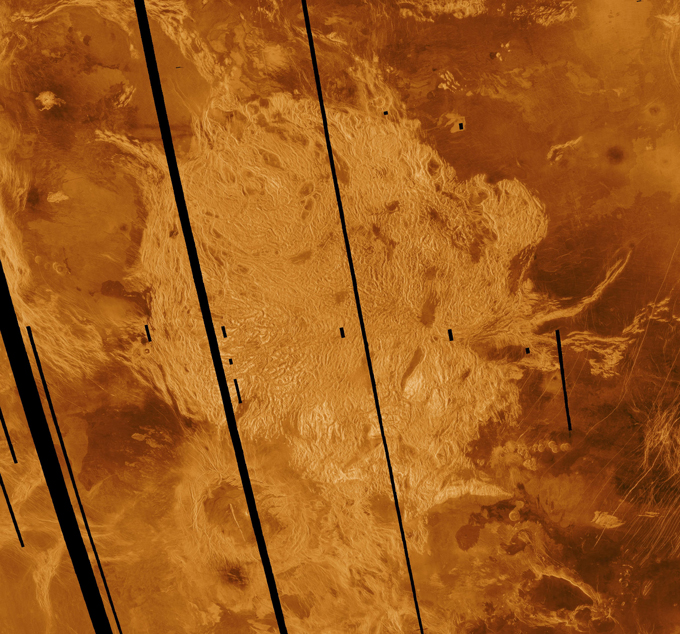
In one of the proposed plans discussed at the AGU meeting, scientists have ridged, folded mountainous terrain on Venus called tessera in their sights. “Safely landing in tessera terrain is absolutely necessary to satisfy our science objectives,” said planetary scientist Joshua Knicely of the University of Alaska Fairbanks in a talk recorded for the meeting. “We have to do it.”
Knicely is part of a study led by geologist Martha Gilmore of Wesleyan University in Middletown, Conn., to design a hypothetical mission to Venus that could launch in the 2030s. The mission would include three orbiters, an aerobot to float in the clouds and a lander that could drill and analyze samples of tessera rocks. This terrain is thought to have formed where edges of continents slid over and under each other long ago, bringing new rock up to the surface in what might have been some version of plate tectonics. On Earth, this sort of resurfacing may have been important in making the planet hospitable to life (SN: 4/22/20).
Ridged, folded mountainous terrain on Venus called tessera (bright region in this false-color image from NASA’s Magellan spacecraft) might have formed through long-ago tectonic activity.JPL-CALTECH/NASA
But landing in these areas on Venus could be especially difficult. Unfortunately, the best maps of the planet — from NASA’s Magellan orbiter in the 1990s — can’t tell engineers how steep the slopes are in tessera terrain. Those maps suggest that most are less than 30 degrees, which the lander could handle with four telescoping legs. But some could be up to 60 degrees, leaving the spacecraft vulnerable to toppling over.
“We have a very poor understanding of what the surface is like,” Gilmore said in a talk recorded for the meeting. “What’s the boulder size? What’s the rock size distribution? Is it fluffy?”
So the lander will need some kind of intelligent navigation system to pick out the best places to land and steer there. But that need for steering brings up another problem: Unlike landers on Mars, a Venus lander can’t use small rocket engines to slow down as it descends.
The shape of a rocket is tailored to the density of air that it will push against. That’s why rockets that launch spacecraft from Earth have two sections: one for Earth’s atmosphere and one for the near-vacuum of space. Venus’ atmosphere changes density and pressure so quickly between space and the planet’s surface that “dropping a kilometer would go from the rocket working perfectly, to it’s going to misfire and possibly blow itself apart,” Knicely says.
Instead of rockets, the proposed lander would use fans to push itself around, almost like a submarine, turning the disadvantage of the dense atmosphere into an advantage.
The planet’s atmosphere also presents the biggest challenge of all: seeing the ground. Venus’ dense atmosphere scatters light more than Earth’s or Mars’ does, blurring the view of the surface until the last few kilometers of descent.
Worse, the scattered light makes it seem like illumination is coming from all directions at once, like shining a flashlight into fog. There are no shadows to help show steep slopes or reveal big boulders that the lander could crash into. That’s a major issue, according to Knicely, because all of the existing navigation software assumes that light comes from just one direction.
“If we can’t see the ground, we can’t find out where the safe stuff is,” Knicely says. “And we also can’t find out where the science is.” While proposed solutions to the other challenges of landing on Venus are close to doable, he says, this one remains the biggest hurdle.
Sticking the landing on Europa
Jupiter’s icy moon Europa, on the other hand, has no air to blur the surface or break rockets. A hypothetical future Europa lander, also discussed at the AGU meeting, would be able to use the “sky crane” technique (SN: 8/6/12). That method, in which a platform hovers above the surface using rockets and drops a spacecraft to the ground, was used to land the Curiosity rover on Mars in 2012 and will be used for the Perseverance lander in February 2021.
“The engineers are very excited about not having to deal with an atmosphere on the way down,” said spacecraft engineer Jo Pitesky of NASA’s Jet Propulsion Laboratory in Pasadena, Calif., in a recorded talk for the meeting.
Still, there’s a lot that scientists don’t know about Europa’s surface, which could have implications for any lander that touches down, said planetary scientist Marissa Cameron of the Jet Propulsion Laboratory in another talk.
The best views of the moon’s landscape are from the Galileo orbiter in the 1990s, and the smallest features it could see were half a kilometer across. Some scientists have suggested that Europa could sport jagged ice spikes called penitentes, similar to ice features in the Chilean Andes Mountains that are named for their resemblance to hooded monks with bowed heads — although more recent work shows Europa’s lack of atmosphere should keep penitentes from forming.
Another mission, the Europa Clipper, that’s already underway will take higher-resolution images when the orbiter visits the Jovian moon later this decade, which should help clarify the issue.
In the meantime, scientists and engineers are running elaborate dress rehearsals for a Europa landing, from simulating ices with different chemical compositions in vacuum chambers to dropping a dummy lander named Olaf from a crane to see how it holds up.
“We have a requirement that says the terrain can have any configuration — jagged, potholes, you name it — and we have to be able to conform to that surface and be stable at it,” says John Gallon, an engineer at the Jet Propulsion Laboratory. (The dummy lander was named for his 4-year-old daughter’s favorite character in the movie Frozen.)
Olaf, a scale model of a possible Europa lander, is helping NASA engineers test different strategies for landing on the icy moon of Jupiter. The rover is named for the snowman in the movie Frozen.
Over the last two years, Gallon and colleagues have tested different lander feet, legs and configurations in a lab by suspending the lander from the ceiling like a marionette. That suspension helps simulate Europa’s gravity, which is one-seventh that of Earth’s.
Without much gravity, a massive lander could easily bounce around and damage itself when trying to land. “You’re not going to stick the landing like a gymnast coming off the bars,” Gallon says. His team has tried sticky feet, bowl-shaped feet, springs that compress and push into the surface and legs that lock to help the lander stay put on various terrains. The lander might crouch like a frog or stand stiff like a table, depending on what type of surface it lands on.
Although Olaf is hard at work helping scientists figure out what it will take to build a successful Europa lander, the mission itself, like its Venusian counterpart, remains only on some planetary scientists’ wish lists for now. Meanwhile, other researchers dream about voyages to entirely different worlds, including Saturn’s geyser moon Enceladus.
“Some people will pick favorites,” Cameron says. “I just want to land someplace we’ve never been to that’s not Mars. I’d love that.”
These science claims from 2020 could be big news if confirmed
Findings in need of more proof include potential signs of life on Venus and Earth’s oldest parasites
A report that Venus (shown in a false-color composite image) has phosphine gas — a potential sign of life — in its atmosphere stoked controversy in 2020.
Discoveries about the cosmos and ancient life on Earth tantalized scientists and the public in 2020. But these big claims require more evidence before they can earn a spot in science textbooks.
1. Cloudy with a chance of life
The scorching hellscape next door may be a place to look for life. Telescopes trained on Venus’ clouds spotted traces of phosphine in quantities that suggest something must be actively producing the gas (SN: 9/14/20). On Earth, phosphine is emitted by certain bacteria or industrial processes, leading some astrobiologists to speculate that microbes may be living in Venus’ relatively temperate upper atmosphere. But other research teams’ analyses suggest the phosphine detection was a misread — perhaps the result of a fluke in data processing (SN: 10/28/20).
2. Flashback
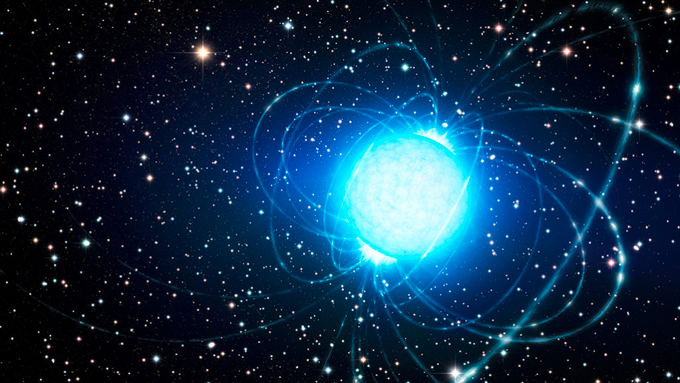
For the first time, astronomers may have glimpsed a fast radio burst in the Milky Way. Even more intriguing, the source of the super-bright boost of radio waves appears to be a magnetar — a type of neutron star with an intense magnetic field (SN: 6/4/20). But it’s too soon to claim that magnetars caused any of the dozens of previously detected fast radio bursts, as those flashes came from galaxies too far away to trace the bursts back to a source.
A bright radio burst generated by a magnetar (one illustrated) in the Milky Way suggests that these highly magnetic neutron stars may be responsible for other fast radio bursts previously observed.L. CALÇADA/ESO
3. Totally tubular
Tubes stuck to the outer shells of hundreds of fossilized brachiopods discovered in an outcropping in China may have housed the earliest-known parasites. The clamlike brachiopods lived about 512 million years ago. Researchers speculate that organisms living inside the tubes swiped food from their filter-feeding hosts (SN: 6/2/20). That the tubes were never found alone or on other fossils in the outcropping suggests that the organisms could not survive on their own. But some critics question whether the relationship was truly parasitic, given that the tubed-up brachiopods didn’t seem any worse off than their tube-free counterparts.
Ancient organisms that lived in tubes stuck to clamlike brachiopods (illustrated) may be the earliest known examples of parasites.ZHIFEI ZHANG/NORTHWEST UNIV.
4. Found: ordinary matter
Only about half of the universe’s expected amount of ordinary matter has ever been cataloged. But this year, astronomers claimed that the other half is hiding out in intergalactic space (SN: 5/27/20). That conclusion is based on an analysis of how a small sample of fast radio bursts from other galaxies were distorted by particles on the way to Earth. Before the case of the missing matter can be closed, though, more of these bright blasts of radio waves need to be examined.
Observations of brief, brilliant flashes of radio waves from other galaxies, detected by the Australian Square Kilometre Array Pathfinder (shown), suggest that all of the universe’s “missing” ordinary matter lurks in intergalactic spaceCSIRO, ALEX CHERNEY
5. Start your cosmic engines
A ghostly subatomic particle may have been revved up by a star’s destructive encounter with a black hole. Sensed by the IceCube detector in Antarctica, the neutrino carried 200 trillion electron volts — about 30 times as much energy as that of a proton accelerated by the Large Hadron Collider. Scientists matched the neutrino detection to a flash of light in the sky caused by a black hole shredding a star. The probability of the neutrino and the flash coinciding by chance is just 0.2 percent. If the finding holds up, it would be only the second time a high-energy neutrino has been traced to its source, and the first direct evidence that shredding a star can accelerate neutrinos to high energies (SN: 5/26/20).
A high-energy neutrino may have been born when a black hole ripped apart a star (illustrated).M. WEISS, CXC/NASA
6. On the move
The long-running debate over when humans first traveled to and from the Americas rages on. One group of researchers reported that people arrived to North America more than 15,000 years earlier than generally thought, based on the discovery of roughly 33,000-year-old stone tools unearthed in Mexico (SN: 7/22/20). Some archaeologists, however, doubt that the artifacts are even stone tools and say they instead are just naturally broken rocks.
If confirmed as stone tools, this object and others unearthed in a cave in Mexico suggest humans arrived in North America by at least 33,000 years ago.CIPRIAN ARDELEAN
Another research group reported that Indigenous South Americans crossed thousands of kilometers of open ocean and reached eastern Polynesia more than 800 years ago, not long after settlers from Asia initially colonized the islands (SN: 7/8/20). That conclusion rests on genetic evidence suggesting the intrepid South Americans mated with ancient Polynesians. But some anthropologists question whether early South American groups had the equipment or seafaring skills necessary for the journey. Ancient Polynesians, who were expert navigators, may have traveled to South America, bringing new DNA with them on a return trip home.
Here on the little space rock we call Earth, humans often wonder whether or not we are alone in this universe. Though that question was not answered in 2020, many discoveries seemed to increase the prospect of extraterrestrial entities existing. Findings on the closest planet to us, in the outer solar system and the far beyond seemed to point to the possibility that other worlds could host organisms ranging from bacteria to technological beings. Perhaps, new results in the coming year will finally reveal who else might be out there.
1. Is E.T. phoning us from Proxima Centauri?
(Image credit: CSIRO/A. Cherney)
The answer to weird signals happening in the universe is never aliens, until maybe it is. Earlier this month, researchers announced that they had captured a very mysterious beam of energy in the radio part of the electromagnetic spectrum at 980 megahertz, coming from the closest star to our own. Proxima Centauri, which is just 4.2 light-years away, hosts one gas giant and one rocky world 17% larger than Earth that happens to be in its star's habitable zone, meaning liquid water could exist there. The unexplained signal reportedly shifted slightly while it was being observed, in a way that resembled the shift caused by the movement of a planet. Researchers are excited but cautious, explaining that they will need to figure out if more mundane sources, such as a comet, hydrogen cloud or even human technology, could be mimicking an alien signal, and that it will likely take time before they know one way or another if E.T. is phoning us.
2. Alien bacteria might live in the clouds of Venus
(Image credit: NASA)
Astrobiologists were a-twitter with anticipation and skepticism in September when news broke of potential evidence of life in the upper clouds of Venus. The announcement pointed to the presence of phosphine, a rare and often poisonous gas that, on Earth at least, is almost always associated with living organisms. With its hellish surface temperature, outlandish pressure and sulfuric-acid clouds, Venus has long played second fiddle to the seemingly more potentially habitable Mars. But a team aimed both the James Clerk Maxwell Telescope in Hawaii and the Atacama Large Millimetre/submillimetre Array in Chile at Venus and picked up phosphine's signature in a Venusian cloud layer with downright Earth-like temperatures and pressures. Terrestrial bacteria are known to thrive in some pretty tough conditions, making the biological explanation a not unreasonable one. The research team doesn't claim that it is airtight evidence of space bugs, and many in the community aren't quite convinced, but if nothing else it will mean more funding in the hunt for life in unlikely places.
Two years ago, scientists spotted a cigar-shaped object hurtling through the solar system. Dubbed 'Oumuamua, the entity is considered by most to be an interstellar comet flung out from around another star. But close observations showed that 'Oumuamua was accelerating, as if something were propelling it, and scientists still aren't sure why. Avi Loeb, a Harvard University astrophysicist has proposed that, instead of a comet, the interstellar visitor could have been an alien probe pushed by a lightsail — a wide, millimeter-thin piece of material that accelerates as it's pushed by solar radiation. Other scientists have thrown cold water on Loeb's idea, pointing out that hydrogen ice could have melted off the object in a way that was similar to a rocket engine or other propulsion method. But in August, Loeb fired back, writing in a study stating that hydrogen ice is very easily heated, even in the cold depths of interstellar space, and should have sublimated away before 'Oumuamua reached our system. It seems the debate might go on for a little longer at least.
4. Navy declassifies UFO videos but don't believe the hype
(Image credit: U.S. Navy)
A fair number of Earthlings don't care what ambiguous evidence scientists come up with to show that aliens are out there. They are convinced that we've been visited by technological beings many times, pointing to stories about UFOs and alien encounters (pretty much all of which have been debunked). True believers received a boost in April when the U.S. Navy released footage captured by pilots that showed odd wingless aircraft traveling at hypersonic speed, looking for all intents and purposes like bizarre alien machinery. Despite the existence of such videos, people should still be wary, argued freelance journalist Sarah Scoles in her book "They Are Already Here: UFO Culture and Why We See Saucers" (Pegasus Books, 2020). After deciding to look into the Navy evidence, Scoles was unable to determine if it really showed alien aircrafts. But she found a much more human story by speaking to leaders in contemporary UFO culture and discussing our very basic need to believe in something beyond ourselves.
Ocean worlds, which are classified as those having significant amounts of water on or just beneath their surfaces, are surprisingly common in the solar system. Earth is obviously one such place, but Jupiter's moon Europa is thought to host vast seas under its icy shell and Saturn's moon Enceladus is known to have watery geysers spewing from its exterior. Momentum is in fact building in the astronomy community to send a probe that could land on either satellite sometime in the 2030s and check if any living things might lurk under their shells. As for ocean worlds beyond our sun, in a study released in June, researchers looked at 53 exoplanets similar in size to Earth and analyzed variables including their size, density, orbit, surface temperature, mass and distance from their star. The scientists conclude that, of the 53, roughly a quarter might have the right conditions to be considered ocean worlds, suggesting that such places could be relatively common in the galaxy.
6. Earth bugs breathe hydrogen, maybe aliens do too
(Image credit: Shutterstock)
Most Earthlings require oxygen to survive. But oxygen isn't common in the cosmos, making up about 0.1% of the ordinary mass of the universe. There's far more hydrogen (92%) and helium (7%), and many planets, including gas giants like Jupiter and Saturn, are made mostly from these light elements. In May, scientists took E. coli (a bacteria found in the guts of many animals, including humans) and ordinary yeast (a fungus used to bake bread and make beer) and tried to see if they could live in different environments. Such microbes are already known to survive without oxygen and, when placed in a flask filled with either pure hydrogen or pure helium, they managed to grow, albeit at slower rates than usual. The findings suggest that when searching for organisms elsewhere in the universe, we might want to consider places that don't look exactly like Earth.
When hunting life on other worlds, most scientists stick to what they know — searching for Earth-size worlds orbiting sun-like stars. But far more exotic configurations could exist such as a planet circling around and heated by a black hole. At first glance, such a scenario seems absurd. But, contrary to popular depictions, black holes don't just suck in everything around them. Gravitationally stable orbits are possible and the light from the cosmic background radiation — a relic with temperatures at near absolute zero from the early universe that permeates all of space — would get heated as it fell into the black hole. As a paper released in March showed, this could provide warmth and energy to any organisms that happened to evolve in such a strange location.
As we hunt for beings beyond our planet, it's important to keep in mind that we might not be the only ones doing so. In October, researchers came up with a catalog of 1,004 nearby stars that would be in a good position to detect life on Earth. "If observers were out there searching [from planets orbiting these stars], they would be able to see signs of a biosphere in the atmosphere of our Pale Blue Dot," study lead author Lisa Kaltenegger, an associate professor of astronomy at Cornell and director of the university's Carl Sagan Institute, said in a statement. Using observational tools similar to the transit-timing methods that human astronomers use to study exoplanets, such alien onlookers could hunt for oxygen and water in our atmosphere and perhaps conclude that Earth is a good home for organisms.
Where there's life, there's also death. While we like to imagine that our galaxy is teeming with technological beings capable of contacting us, the flip side is recognizing that all cultures rise and fall, meaning that plenty of cosmic societies likely bit the dust long ago. A model released in December put some numbers to these truths, taking into account such things as the prevalence of sun-like stars hosting Earth-like planets; the frequency of deadly, radiation-blasting supernovas; the time necessary for intelligent life to evolve if conditions are right; and the possible tendency of tool-bearing beings to destroy themselves. The analysis found that the highest probability of life emerging in the Milky Way likely happened around 5.5 billion years ago, before our planet even formed, suggesting that humanity is a relative latecomer to the galaxy and that plenty of our potential otherworldly partners are no longer around to talk to us.
10. We should be open-minded as we search for life elsewhere
(Image credit: NASA/JPL-Caltech)
The human brain has plenty of constraints. We are misled by cognitive biases, optical illusions and inattentional blindness to things we don't expect to see. One question that has always dogged research into alien creatures is whether or not we could recognize life that is so different from what we encounter here on Earth. Scholars have long urged us to expect the unexpected, trying not to let theory too heavily influence what we count as significant. Life on other planets might not leave the same biological signatures as terrestrial organisms, making them difficult to spot from our vantage point. And, as Claire Webb, an anthropology and history of science student at the Massachusetts Institute of Technology, told Live Science in January, we must train ourselves to "make the familiar strange," looking at ourselves through an alien lens in an effort to constantly reexamine our own assumptions. That way, we might be able to better understand ourselves through the eyes of another and perhaps meet creatures on other worlds on their own terms rather than ours.
One charity said: ‘Babies are being born pre-polluted.’
Photograph: Zffoto/Getty Images/iStockphoto
Microplastic particles have been revealed in the placentas of unborn babies for the first time, which the researchers said was “a matter of great concern”.
The health impact of microplastics in the body is as yet unknown. But the scientists said they could carry chemicals that could cause long-term damage or upset the foetus’s developing immune system. The particles are likely to have been consumed or breathed in by the mothers.
The particles were found in the placentas from four healthy women who had normal pregnancies and births. Microplastics were detected on both the foetal and maternal sides of the placenta and in the membrane within which the foetus develops.
A dozen plastic particles were found. Only about 4% of each placenta was analysed, however, suggesting the total number of microplastics was much higher. All the particles analysed were plastics that had been dyed blue, red, orange or pink and may have originally come from packaging, paints or cosmetics and personal care products.
The microplastics were mostly 10 microns in size (0.01mm), meaning they are small enough to be carried in the bloodstream. The particles may have entered the babies’ bodies, but the researchers were unable to assess this.
“It is like having a cyborg baby: no longer composed only of human cells, but a mixture of biological and inorganic entities,” said Antonio Ragusa, director of obstetrics and gynaecology at the San Giovanni Calibita Fatebenefratelli hospital in Rome, and who led the study. “The mothers were shocked.”
In the study, published in the journal Environment International, the researchers concluded: “Due to the crucial role of placenta in supporting the foetus’s development and in acting as an interface with the external environment, the presence of potentially harmful plastic particles is a matter of great concern. Further studies need to be performed to assess if the presence of microplastics may trigger immune responses or may lead to the release of toxic contaminants, resulting in harm.”
The potential effects of microplastics on foetuses include reduced foetal growth, they said. The particles were not found in placentas from two other women in the study, which may be the result of different physiology, diet or lifestyle, the scientists said.
Microplastics pollution has reached every part of the planet, from the summit of Mount Everest to the deepest oceans. People are already known to consume the tiny particles via food and water, and to breathe them in.
Their effect in the body is unknown but scientists say there is an urgent need to assess the issue, particularly for infants. In October, scientists revealed that babies fed formula milk in plastic bottles are swallowing millions of particles a day. In 2019, researchers reported the discovery of air pollution particles on the foetal side of placentas, indicating that unborn babies are also exposed to the dirty air produced by motor traffic and fossil fuel burning.
The Italian researchers used a plastic-free protocol to deliver the babies in order to prevent any contamination of the placentas. Obstetricians and midwives used cotton gloves to assist the women in labour and only cotton towels were used in the delivery room.
Andrew Shennan, professor of obstetrics at King’s College London, told the Daily Mail it was reassuring that the babies in the study had normal births but “it is obviously preferable not to have foreign bodies while the baby is developing”.
Elizabeth Salter Green, at the chemicals charity Chem Trust, said: “Babies are being born pre-polluted. The study was very small but nevertheless flags a very worrying concern.”
A separate recent study showed that nanoparticles of plastic inhaled by pregnant laboratory rats were detected in the liver, lungs, heart, kidney, and brain of their foetuses.
Microplastics ontdekt in placenta's van ongeboren baby's
Voor het eerst zijn microplasticdeeltjes aangetroffen in placenta's van ongeboren baby's. Dat is erg verontrustend en kan de ontwikkeling van de foetus mogelijk schaden, zeggen de wetenschappers in Rome die de ontdekking deden.
De twaalf deeltjes werden gevonden in de placenta's van vier gezonde moeders met een normaal verloop van hun zwangerschap. Omdat slechts vier procent van elke placenta werd onderzocht, ligt het totale aantal microplasticdeeltjes naar verwachting een stuk hoger.
De stukjes plastic verschilden van kleur en waren ongeveer 0,01 millimeter groot, waardoor ze via de bloedbaan vervoerd konden worden. Ze waren onder meer afkomstig van cosmetische producten en verf. De kans is reëel dat de plasticdeeltjes ook in de lichamen van de baby’s werden opgenomen, maar dat konden de onderzoekers niet nagaan.
Wat de impact van microplastic in het lichaam is, is nog onbekend, maar volgens wetenschappers bevatten de deeltjes mogelijk chemicaliën die op lange termijn schade kunnen berokkenen of de ontwikkeling van het immuunsysteem van de baby verstoren. Vermoedelijk kwamen de deeltjes binnen via de ademhaling of spijsvertering van de moeder.
Het is alsof je een cyborgbaby krijgt, die niet langer alleen is samengesteld uit menselijke cellen
Antonio Ragusa
“Het is alsof je een cyborgbaby krijgt, die niet langer alleen is samengesteld uit menselijke cellen, maar uit een combinatie van biologische en anorganische entiteiten", vertelde onderzoeksleider Antonio Ragusa aan The Guardian. “De moeders waren geschokt”, aldus Ragusa, directeur verloskunde en gynaecologie van een ziekenhuis in Rome.
Bij twee andere vrouwen in de studie werden geen microplastics aangetroffen in de placenta. Dat is mogelijk het gevolg van een verschillende lichaamsbouw, dieet of levensstijl, aldus de onderzoekers.
Microplastic wordt op steeds meer plekken aangetroffen, van op de top van de Mount Everest, tot in het diepst van de oceaan. Geweten is dat mensen de minuscule plasticdeeltjes binnenkrijgen via voedsel, water en via de ademhaling. Vorige maand ontdekten wetenschappers van een Ierse universiteit dat baby's die met een plastic fles worden gevoed, dagelijks meer dan een miljoen stukjes microplastic kunnen binnenkrijgen.
I found an alien face and it is important, more important than any other discoveries you can make on Mars. But is it life? Is it fungus? Is it a plant? Is it an animal? No...but NASA has never shown you such things either, but if you have been watching me over the last 15 years...you would already know that I have reported most of those already. A face is a sculpture of the ancient species that once walked this planet...that once owned this planet we call Mars. They lived, concurred and died on this planet. A cycle that we humans are also following. Criticize this face as being ugly, a rock a figment of my imagination, but know this...its fate and yours...is the same in the end. Nothing in the universe can change that. So, lets focus on the positive shall we? We now know the facial appearance of this alien species. Something 30 seconds ago you never knew existed. In just 30 seconds...I changed your whole perspective on life. Imagine what I could do with a full hour.
I found a tower in this old Lunar Orbiter photo today. The tower is about 2.5 km tall. Its probably gone unnoticed so long because it sits on a crater edge in the shadows. The bottom base has six legs supporting it, but only four are viable at this angle. Defiantly proof that a species far more advanced than our own lives on the moon right now. This is why we don't go back and never will. Its occupied and they don't want us inferior species messing up their society and culture. Humans...we do what we want, how we want. It seems futile to aliens to try to change us.
I also found a lot of other things, but will only report a few below. Most people wont have the experience or practice at seeing these things...but any university student in the art department would pick them out without trouble. Or...test yourself, can you see below what I saw? Or...do you see nothing? Its not luck, not a gift, not a curse, just good old practice at my passion. I'm sure your passion is something I probably don't get too. Why am I so good at it? Because I don't require others approval of my discoveries. I already know...without doubt what they are, who possibly has my experience about this that I could possible need their approval? No one exists with such experience. Just me...and I approve.
This day in UFO history: The 1980 UFO Landings In Rendlesham Forest
England holds one of the most compelling UFO landing accounts. In late December 1980, invasion of unidentified flying objects over a period of several nights took place in the joint air bases of Bentwaters and Woodbridge, situated within the vast Rendlesham Forest in late December.
Description of alien beings added to the controversial stories of the twin air bases. The hype took into another level with anomalous radar readings, electromagnetic effects, and surrealistic atmospheric conditions. Professionals, deemed to be credible, have been coming forward revealing their knowledge of the real alien event on the Bentwaters and Woodbridge Air Force Bases.
Uncorrelated object showed on the radar screens at RAF in Norfolk shortly after midnight on December 27, 1980. The thing then suddenly vanished in the area of the Rendlesham Forest in Suffolk. Bentwaters RAF radar also picked up the object.
The bases were allegedly housed a large stockpile of nuclear weapons, and the Woodbridge was the base of the 67th Aerospace Rescue and Recovery Squadron.
The radar operator that night, Mal Scurrah, said that they did not have any idea of what they captured on their radar. They checked the air traffic agencies and found out that there should have been nothing in the vicinity at the time. They sent a jet aircraft to investigate, and the pilot reported seeing a dazzling light in the sky in front of them after getting within about a quarter of a mile.
They saw on radar the object was stationary and it moved off in seconds. In just five minutes the UFO reached 90,000 feet and higher, and they had lost it in the radar scope.
The Woodbridge/Bentwaters started their extraordinary events with the sighting of a massive glowing object by three security guards of the twin bases. They followed the lights into the forest with initial thought that it was a commercial or military aircraft that crash landed.
The patrol was stunned to see a saucer-like craft with small beings with large heads suspended by a type of beam from the bottom of the craft. The beings reportedly performing a repair to their craft unaware of the three men watching their activities.
The guards radioed the base headquarters and requested emergency help. Assistance reportedly arrived headed by senior officers of the base. Later, there would be off record reports that they encountered strange anomalies, such as reality-bending, time displacement, and surreal atmospheric conditions.
Some of the senior officers allegedly communicated with the alien beings.
Called out on the second night of the sightings was then the now famous Colonel Halt. The group of Colonel Halt was reportedly one of the groups to chase the glowing UFO in the forest. He made an audio recording of the details of his trek into the woods.
Patrolmen Jim Penniston, John Burroughs, and Larry Warren later co-wrote a book about the incident, titled Left at East Gate.
Other men who were present during the encounter later revealed that there was an underground theater where soldiers were interrogated, sworn to secrecy and threatened. They also revealed that they were shown several films featuring UFO recoveries around the world. It was also reported that an alien being was there in one of the meetings.
Small objects such as asteroids get trapped for a time in Earth orbit, becoming "minimoons."
Minimoons are typically asteroids, but this one is something else.
The new minimoon may be part of an old rocket from the 1960s.
From time to time, asteroids whizzing past Earth get trapped by our gravitational pull, falling into orbit around the planet. These rocks only stay for a while, eventually escaping and continuing on their journey to who-knows-where. While they're here, they're considered "minimoons."
Astronomers have detected an object that's likely to become our next minimoon. But it's either not an asteroid or it's an odd one. Really, scientists suspect it's man-made tech returning home after many years out in cold, lonely space.
Minimoons
Scientists have confirmed just two prior minimoons. One was 2006 RH120, which orbited us from September 2006 to June 2007. The other was 2020 CD3, which got stuck in the 2015–2016 timeframe, and is believed to gotten away in May 2020.
2020 SO, the new kid on the block, is expected to arrive in October 2020 and pop out of orbit in May 2021.
Identifying 2020 SO
The first clue 2020 SO isn't your ordinary asteroid is its exceptionally low velocity. It's traveling much more slowly that a typical asteroid — their average rate of travelis 18 kilometers (58,000 feet) per second. Even moon rocks sent careening into Earth orbit by impacts on the lunar surface outpace pokey 2020 SO.
For another thing, 2020 SO has an orbital path very similar to Earth's, lasting about one Earth year. It's also just slightly less circular than our own orbit, from which it's barely tilted off-axis.
So, what is it? NASA estimates that the object has dimensions very reminiscent of a discarded Centaur rocket stage from the Surveyor 2 mission that landed an unmanned craft on the moon. Back in the day, rocket stages were jettisoned as craft were aimed toward their desired position. This stuff, if released high enough, remains in space. It appears that this Centaur rocket, launched in September 1966, is now making its way back homeward, at least for a little bit.
When 2020 SO arrives at its closest point in December, the rocket is expected to be about 50,000 kilometers from Earth. Its next closest approach is much further: 220,000 kilometers, in February 2021.
Earthly space programs being as young as they are, scientists would love to know what's happened to our rocket during a half century in space.
While 2020 SO won't get close enough to drop into our atmosphere, its slow progress has scientists hopeful that they'll still get some kind of a decent look at it.
Spectroscopy may be able to reveal what the rocket's surface is like now — has any of its paint survived, for example? Of course, being out in space, it's likely to have been hit by lots of dust and micrometeorites, so the current state of its surfaces is also of interest. Experts are curious to know how reflective the rocket is at this point, valuable information that can help planners of future long-term missions anticipate how well a craft out in space for extended periods will remain able to reflect sunlight.
Eyewitnesses were frightened by the appearance of a Blue Orb over New Hampshire
As you can already tell from the title, this new picture emerged out of nowhere earlier this year on the internet, and ever since it was first uploaded experts have tried to explain its existence.
The picture shows what appears to be a massive blue orb in the sky, protruding through the clouds with its bright luminescence.
The picture was taken from Merrimack, New Hampshire, and through it, experts have tried to explain the fact that aliens are real and that what we’re looking at here is actually a UFO after all.
Since the original photographer wasn’t the biggest fan of conspiracy theories, he decided to contact the NH1 News Station in hopes of getting an answer that would explain his discovery.
However, this plan ended up backfiring as their explanation didn’t make much sense, to say the least. They stated that this was all just a refraction of the light that emerges when the clouds and the Sun are blocking each other at the exact same time.
So, he then switched over to UFO Sightings Hotspot, sending them the exact same picture. They reported that this could only be the result of a lens flare retracted back by a UFO.
They even brought solid proof to back their discovery up in the form of a video that NASA took back on June 11th in which you can see the same UFO lens flare from outer space.
The same lens flare was spotted in Ontario, Canada, and Alta, Utah too. They’re watching us, and that’s a fact.
Some alien life conspiracy theorists suggest a UFO has been captured in footage purportedly filmed on October 1 in Canterbury, New Hampshire. The amateur video apparently shows a shows an odd anomaly sandwiched between two clouds.
IMAGE: ARTISTIC DIAGRAM OF THE SUBSEA AND COASTAL PERMAFROST ECOSYSTEMS, EMPHASIZING GREENHOUSE GAS PRODUCTION AND RELEASE. CREDIT: VICTOR OLEG LESHYK AT NORTHERN ARIZONA UNIVERSITY
New research suggests slow but substantial greenhouse gas release from submarine permafrost
In the far north, the swelling Arctic Ocean inundated vast swaths of coastal tundra and steppe ecosystems. Though the ocean water was only a few degrees above freezing, it started to thaw the permafrost beneath it, exposing billions of tons of organic matter to microbial breakdown. The decomposing organic matter began producing CO2 and CH4, two of the most important greenhouse gases.
Though researchers have been studying degrading subsea permafrost for decades, difficulty collecting measurements and sharing data across international and disciplinary divides have prevented an overall estimate of the amount of carbon and the rate of release. A new study, led by Ph.D. candidate Sara Sayedi and senior researcher Dr. Ben Abbott at Brigham Young University (BYU) published in IOP Publishing journal Environmental Research Letters, sheds light on the subsea permafrost climate feedback, generating the first estimates of circumarctic carbon stocks, greenhouse gas release, and possible future response of the subsea permafrost zone.
Sayedi and an international team of 25 permafrost researchers worked under the coordination of the Permafrost Carbon Network (PCN), which is supported by the U.S. National Science Foundation.
The researchers combined findings from published and unpublished studies to estimate the size of the past and present subsea carbon stock and how much greenhouse gas it might produce over the next three centuries.Using a methodology called expert assessment, which combines multiple, independent plausible values, the researchers estimated that the subsea permafrost region currently traps 60 billion tons of methane and contains 560 billion tons of organic carbon in sediment and soil. For reference, humans have released a total of about 500 billion tons of carbon into the atmosphere since the Industrial Revolution. This makes the subsea permafrost carbon stock a potential giant ecosystem feedback to climate change.”Subsea permafrost is really unique because it is still responding to a dramatic climate transition from more than ten thousand years ago,” Sayedi said. “In some ways, it can give us a peek into the possible response of permafrost that is thawing today because of human activity.”
Estimates from Sayedi’s team suggest that subsea permafrost is already releasing substantial amounts of greenhouse gas. However, this release is mainly due to ancient climate change rather than current human activity. They estimate that subsea permafrost releases approximately 140 million tons of CO2 and 5.3 million tons of CH4 to the atmosphere each year. This is similar in magnitude to the overall greenhouse gas footprint of Spain.
The researchers found that if human-caused climate change continues, the release of CH4 and CO2 from subsea permafrost could increase substantially. However, this response is expected to occur over the next three centuries rather than abruptly. Researchers estimated that the amount of future greenhouse gas release from subsea permafrost depends directly on future human emissions. They found that under a business-as-usual scenario, warming subsea permafrost releases four times more additional CO2 and CH4 compared to when human emissions are reduced to keep warming less than 2°C.
“These results are important because they indicate a substantial but slow climate feedback,” Sayedi explained. “Some coverage of this region has suggested that human emissions could trigger catastrophic release of methane hydrates, but our study suggests a gradual increase over many decades.”
Even if this climate feedback is relatively gradual, the researchers point out that subsea permafrost is not included in any current climate agreements or greenhouse gas targets. Sayedi emphasized that there is still a large amount of uncertainty about subsea permafrost and that additional research is needed.
“Compared to how important subsea permafrost could be for future climate, we know shockingly little about this ecosystem,” Sayedi said. “We need more sediment and soil samples, as well as a better monitoring network to detect when greenhouse gas release responds to current warming and just how quickly this giant pool of carbon will wake from its frozen slumber.”
This research was funded by the U.S. National Science Foundation and by BYU Graduate Studies.
Summary of the key scientific points:
Subsea permafrost has been thawing since the end of the last glacial period (~14,000 years ago) when it began to be inundated by the oceanµ
An international team of 25 permafrost researchers estimate that the subsea permafrost region currently traps 60 billion tons of methane and 560 billion tons of organic carbon in sediment and soil. However, the exact amount of these carbon stocks remains highly uncertain.
This carbon is already being released from the subsea permafrost region, though it remains unclear whether this is a natural response to deglaciation or if anthropogenic warming is accelerating greenhouse gas production and release.
The researchers estimate that currently, the subsea permafrost region releases approximately 140 million tons of CO2 and 5.3 million tons of CH4 to the atmosphere each year. This represents a small fraction of total anthropogenic greenhouse gas emissions–approximately equal to the greenhouse gas footprint of Spain.
Experts predict a gradual increase in emissions from subsea permafrost over the next three hundred years rather than an abrupt release.
The amount of greenhouse gas increase depends on how much human emissions are reduced. Experts estimate that approximately ¾ of the extra subsea emissions can be avoided if humans actively reduce their emissions compared to a no mitigation scenario.
This climate feedback is still virtually absent from climate policy discussions, and more field observations are needed to better predict the future of this system.
Quotes from other co-authors:
“I think there are three important messages from this study. First, subsea permafrost is probably not a climate time bomb on a hair trigger. Second, subsea permafrost is a potentially large climate feedback that needs to be considered in climate negotiations. Third, there is still a huge amount that we don’t know about this system. We really need additional research, including international collaboration across northern countries and research disciplines.”
Dr. Ben Abbott, senior researcher on the project, Brigham Young University
“This work demonstrates the power of science synthesis and networking by bringing together experts across a range of disciplines in order to assess our state of knowledge based on observations and models currently available. While scientific work will continue to be done to test these ideas, bringing knowledge together with this expert assessment provides an important baseline for shaping future research on subsea permafrost greenhouse gas emissions.”
Dr. Ted Schuur, Lead investigator of the Permafrost Carbon Network, Northern Arizona University
“This expert assessment is a crucial contribution to the scientific literature in advancing our knowledge on subsea permafrost and potential greenhouse gas emissions from this so far understudied pool. Bringing together scientists from multiple disciplines, institutions, and countries has made it possible to move beyond individual datapoints or studies providing a much more comprehensive estimate of subsea permafrost. ”
Dr. Christina Schädel, Co-Investigator of the Permafrost Carbon Network, Northern Arizona University
“I hope this study begins to unite the research community in submarine permafrost. Historically, it’s not only been a challenging location to do field work and make observations, but language barriers and other obstacles in accessibility to the existing observations and literature has challenged international scientific progress in this area.
“I’m optimistic that this study will shed light on the fact that submarine permafrost exists, and that people are studying its role in climate,” she said. “The size of the research community doesn’t necessarily reflect its importance in the climate system. The amount of carbon sequestered or associated with submarine permafrost is relevant when you compare it to the numbers of carbon in terrestrial permafrost and what’s in the atmosphere today. This is an example of a very large source of carbon that hasn’t been considered in climate predictions or agreements. And while it’s not a ticking time bomb, what is certain is that the choices we make today that influence anthropogenic climate change will determine the response of submarine permafrost carbon stocks far into the future.”
Dr. Jennifer Frederick, Sandia National laboratories
High resolution versions of the photos and illustrations are available at this link.
'VERGETEN' ONDERZEES PERMAFROST LIJKT EEN ENORME IMPACT OP ONS KLIMAAT TE GAAN HEBBEN
Vivian Lammerse
Het permafrost – dat momenteel nog aan het bijkomen is van het einde van de IJstijd – blijkt veel CO2 en methaan te herbergen.
Tegen het einde van de laatste ijstijd – zo’n 14.000 jaar geleden – overspoelde in het hoge noorden de aanzwellende Noordelijke IJszee grote delen van de kusttoendra. Hoewel het oceaanwater slechts een paar graden boven het vriespunt lag, begon het onderliggende permafrost te dooien. En die dooi is nog steeds gaande. Hierdoor worden er elk jaar miljarden tonnen CO2 en methaan de lucht in gepompt. En ondanks dat dit onderzeese permafrost een enorme impact op ons klimaat lijkt te hebben, is het niet opgenomen in klimaatakkoorden of klimaatdoelen.
Dooi Permafrost is een normaliter permanent bevroren laag aarde. Maar toen het onderzeese permafrost duizenden jaren geleden begon te dooien, werd het organische materiaal blootgesteld aan microbiële afbraak. De ontbindende organische stof begon CO2 en methaan te produceren; twee belangrijke broeikasgassen. Het wegsmelten van het onderzeese permafrost is dus een verontrustend proces. Want al die opgeslagen broeikasgassen worden naar de atmosfeer getransporteerd en leveren zo een belangrijke bijdrage aan de opwarming van de aarde. “Onderzees permafrost is echt uniek, omdat het nog steeds reageert op de klimaattransitie van meer dan tienduizend jaar geleden,” zegt onderzoeker Sara Sayedi. “In sommige opzichten kan het ons een kijkje geven in de mogelijke reactie van permafrost dat vandaag door menselijk toedoen ontdooit.”
Illustratie van het onderzeese permafrost en de manier waarop opgeslagen broeikasgassen vrijkomen.
Afbeelding: Original artwork created for this study by Victor Oleg Leshyk at Northern Arizona University
Hoewel onderzoekers al decennialang de teloorgang van onderzees permafrost bestuderen, is het nog niet zo gemakkelijk om betrouwbare metingen uit te voeren. Hierdoor weten we eigenlijk nog steeds niet precies hoeveel broeikasgassen er tijdens dit proces de lucht in worden gepompt. Ook weten we niet precies hoe snel dit gebeurt. En dus waagde een onderzoeksgroep in een studie, gepubliceerd in het vakblad Environmental Research Letters, opnieuw een poging. De onderzoekers combineerden de bevindingen van verschillende studies om zo de omvang van de onderzeese koolstofvoorraad uit het verleden en in het heden te schatten. Ook bestudeerden ze hoeveel broeikasgassen er nog in de komende drie eeuwen vrij zouden kunnen komen.
Broeikasgassen De resultaten zijn best zorgelijk. Want de onderzoekers schatten dat het sediment en de bodem in het betreffende onderzeese permafrostgebied momenteel zo’n 60 miljard ton methaan en 560 miljard ton CO2 vasthoudt. Voor je beeldvorming, de mensheid heeft sinds de industriële revolutie in totaal ongeveer 500 miljard ton CO2 in de atmosfeer gepompt. Wanneer alle broeikasgassen die het onderzeese permafrost herbergt een weg naar onze atmosfeer weten te vinden, zou dat dus een enorme impact hebben op ons mondiale klimaat.
Geen houden aan De vraag is in hoeverre we het proces nog kunnen stoppen. Want momenteel komt er al veel broeikasgas vrij. De onderzoekers schatten dat het onderzeese permafrost jaarlijks zo’n 140 miljoen ton CO2 en 5,3 miljoen ton methaan de atmosfeer in pompt. Dat is qua omvang vergelijkbaar met de totale uitstoot van Spanje. Maar dat is nog niet het enige. Want de onderzoekers ontdekten dat wanneer de door de mens veroorzaakte klimaatverandering aanhoudt, de afgifte van CO2 en methaan uit het onderzeese permafrost aanzienlijk zou kunnen toenemen. Die toename zal waarschijnlijk heel geleidelijk, verspreid over de komende driehonderd jaar, plaatsvinden.
Mensen De resultaten wijzen erop dat de hoeveelheid toekomstige uitstoot van broeikasgassen door onderzeese permafrost dus rechtstreeks afhangt van onze menselijke emissies. Als we niets doen om klimaatverandering een halt toe te roepen, zal er zo’n vier keer meer CO2 en methaan de atmosfeer weten te bereiken in vergelijking met wanneer de menselijke uitstoot wordt verminderd en de opwarming van de aarde onder de 2 graden Celsius wordt gehouden. Ondanks dat actie dus vereist is, lijken we het probleem van onderzees permafrost een beetje te zijn ‘vergeten’. Want geen enkel klimaatakkoord of klimaatdoel rept over dit onderzeese permafrost en de mogelijk grote bijdrage van de dooi aan de opwarming van de aarde.
Volgens de onderzoekers is het erg belangrijk dat we meer over dit onderzeese permafrost te weten komen. “Vergeleken met hoe belangrijk het zou kunnen zijn voor ons toekomstige klimaat, weten we eigenlijk schrikbarend weinig over dit ecosysteem,” concludeert Sayedi. “We hebben meer sediment- en bodemmonsters nodig, evenals betere metingen. Op die manier kunnen we begrijpen hoe de uitstoot van broeikasgassen reageert op de huidige opwarming en hoe snel deze gigantische opbergplaats van koolstof uit zijn bevroren slaap ontwaakt.”
BEVERS
Niet alleen onderzees permafrost dooit, ook het Noordpoolgebied wordt geteisterd door smeltend permafrost. En dat ligt niet alleen aan extreem weer. Zo blijkt uit een nieuwe studie dat ook bevers een vinger in de pap hebben. Hoe? Gewapend met hun scherpe tanden bouwen de bevers van struiken en bomen dammen, waardoor er kleine poeltjes ontstaan die uitgroeien tot nieuwe meren die soms wel een paar hectare omvatten. En dat gaat rap. In slechts vijf jaar tijd hebben bevers woonachtig in noordwest-Alaska 56 nieuwe meren gecreëerd. Ook al bestaande meren dijen door toedoen van de bever uit. En dat gaat ten koste van kwetsbaar permafrost. Het water is namelijk warmer dan de omringende grond. En dus kunnen deze meren en vijvers de dooi van permafrost versnellen. Meer weten? Lees hier verder!
Meer van UFO'S of UAP'S, ASTRONOMIE, RUIMTEVAART, ARCHEOLOGIE, OUDHEIDKUNDE, SF-SNUFJES EN ANDERE ESOTERISCHE WETENSCHAPPEN - DE ALLERLAATSTE NIEUWTJES


 Three UFOs Near Rocket Launch Then Explosion Over Suzhou, China! Dec 26, 2020, UFO Sighting News.