Ontdek de Fascinerende Wereld van UFO's en UAP's: Jouw Bron voor Onthullende Informatie!
Ben jij ook gefascineerd door het onbekende? Wil je meer weten over UFO's en UAP's, niet alleen in België, maar over de hele wereld? Dan ben je op de juiste plek!
België: Het Kloppend Hart van UFO-onderzoek
In België is BUFON (Belgisch UFO-Netwerk) dé autoriteit op het gebied van UFO-onderzoek. Voor betrouwbare en objectieve informatie over deze intrigerende fenomenen, bezoek je zeker onze Facebook-pagina en deze blog. Maar dat is nog niet alles! Ontdek ook het Belgisch UFO-meldpunt en Caelestia, twee organisaties die diepgaand onderzoek verrichten, al zijn ze soms kritisch of sceptisch.
Nederland: Een Schat aan Informatie
Voor onze Nederlandse buren is er de schitterende website www.ufowijzer.nl, beheerd door Paul Harmans. Deze site biedt een schat aan informatie en artikelen die je niet wilt missen!
Internationaal: MUFON - De Wereldwijde Autoriteit
Neem ook een kijkje bij MUFON (Mutual UFO Network Inc.), een gerenommeerde Amerikaanse UFO-vereniging met afdelingen in de VS en wereldwijd. MUFON is toegewijd aan de wetenschappelijke en analytische studie van het UFO-fenomeen, en hun maandelijkse tijdschrift, The MUFON UFO-Journal, is een must-read voor elke UFO-enthousiasteling. Bezoek hun website op www.mufon.com voor meer informatie.
Samenwerking en Toekomstvisie
Sinds 1 februari 2020 is Pieter niet alleen ex-president van BUFON, maar ook de voormalige nationale directeur van MUFON in Vlaanderen en Nederland. Dit creëert een sterke samenwerking met de Franse MUFON Reseau MUFON/EUROP, wat ons in staat stelt om nog meer waardevolle inzichten te delen.
Let op: Nepprofielen en Nieuwe Groeperingen
Pas op voor een nieuwe groepering die zich ook BUFON noemt, maar geen enkele connectie heeft met onze gevestigde organisatie. Hoewel zij de naam geregistreerd hebben, kunnen ze het rijke verleden en de expertise van onze groep niet evenaren. We wensen hen veel succes, maar we blijven de autoriteit in UFO-onderzoek!
Blijf Op De Hoogte!
Wil jij de laatste nieuwtjes over UFO's, ruimtevaart, archeologie, en meer? Volg ons dan en duik samen met ons in de fascinerende wereld van het onbekende! Sluit je aan bij de gemeenschap van nieuwsgierige geesten die net als jij verlangen naar antwoorden en avonturen in de sterren!
Heb je vragen of wil je meer weten? Aarzel dan niet om contact met ons op te nemen! Samen ontrafelen we het mysterie van de lucht en daarbuiten.
Woensdag 17 februari 2021
Hitler’s UFO Alien Connection During World War II - whatweknow
Hitler’s UFO Alien Connection During World War II - whatweknow
Hitler’s UFO-Alien Connection During World War II When Hitler first stepped onto the world stage with his contrived rhetoric, he was re-writing German mythology and history into a form of propaganda designed to increase German self-worth after Germany’s WWI defeat.
Most people thought he was insane and did not take him seriously at first. However Hitler announced that he was a member of a UFO cult and had an exclusive line of communication with a powerful extraterrestrial group. According to Hitler, these extraterrestrials were the source and power behind his new-found, born-again German ideology.
He explained that Nazi mysticism was the product of their devotion and worship of the Manipulative Extraterrestrials. Many high ranking Nazi members of Hitler’s inner circle declared that they also communicated with the extraterrestrial Nordic gods.
This is What Happens to Spacecraft When They Re-Enter the Earth’s Atmosphere
When one of the Russian Progress resupply ships undocks from the International Space Station, timing is everything. The Progress needs to fire its engines at just the right time to instigate the deorbit burn in order for the ship to enter the atmosphere at just the right place, so that its destructive re-entry occurs over the Pacific Ocean. That way, any potential surviving bits and pieces that might reach Earth will hit far away from any land masses – which are home to people, buildings, and other things we don’t want to get bonked.
Last week, the timing for the Progress MS-15 cargo ship was just right so that the astronauts/cosmonauts on board the ISS could see the ship as it broke apart and burned up in Earth’s atmosphere. JAXA astronaut Soichi Noguchi shared the view on social media.
“Farewell, Progress 76P MS-15! #Russian cargo spacecraft undocked from #ISS, and successfully burned up,” Noguchi tweeted, sharing a photo of the Progress’ fiery demise.
Uncrewed Progress cargo ships have been flying since 1978, supporting previous Soviet-era space stations such as Salyut 6, Salyut 7 and Mir. They have been bringing supplies to the ISS since the very beginning of operations.
But now, there are several different robotic, automated resupply ships for the space station: the European Space Agency’s Automated Transfer Vehicle (ATV), JAXA’s (Japan Aerospace Exploration Agency) HTV resupply ship, Northrop Grumman’s (formerly Orbital ATK) Cygnus cargo ship, and SpaceX’s Cargo Dragon.
The ISS Progress 60 cargo craft is seen just a few minutes away from docking to the International Space Station on July 5, 2015. Credit: NASA TV
These ships bring supplies such as food, water, replacement/spare parts, and experiments to the crew, as well as propellants and oxygen. After everything is unloaded, the ships like Progress become a trash can – a place to stow garbage and other unneeded items. The ships stay docked to the ISS for about 6 months, and after being loaded with trash and waste, the hatch to the vehicle is closed and the Progress undocks from the station. Then the procedures for reentry begin.
Progress is designed to burn up in the atmosphere, but not everything is completely combustible. In a press release, Roscosmos said the non-combustible components of the craft land and sink into a “non-navigable region of the South Pacific. Non-combustible structure elements will drop in the calculated area of the non-navigable region of the Pacific Ocean. The estimated fragments drop area is approximately 1,680 km east of Wellington (New Zealand). Roscosmos has completed all the necessary procedures to flag this area as temporarily dangerous for sea navigation and aircraft flights.”
In this Oct. 23, 2016 image, the International Space Station’s Canadarm2 robotic arm captures Orbital ATK’s Cygnus cargo spacecraft on its sixth mission to the station. Credits: NASA
But besides the cargo ships returning from the ISS, other man-made objects regularly meet their demise by streaking through and burning up in Earth’s atmosphere. Things like old, inactive satellites, rocket stages and other discarded hardware, as well as smaller pieces of space debris — such as fragments of vehicles that exploded or collided, and even small pieces of paint that have come off of space vehicles.
All these items – both big and small – are tracked by radar by the Space Surveillance Network (SSN), which oversees radar and optical sensors at various sites around the world. There is the Joint Combined Space Operations Center (CSpOC) at Vandenberg Air Force Base, part of U.S. Strategic Command and ESA’s Space Debris team. They detect, track and identify all objects in Earth orbit, as well as monitoring the International Space Station (ISS) and other NASA satellites for collisions.
Trackable objects in Low Earth Orbit. Image Credit: ESA
Interestingly, on average, about one satellite crashes back to Earth every week. Most are uncontrolled entries, and it’s kind of a crap shoot as to where any pieces surviving pieces might fall. But these fiery reentries are rarely seen, mostly because Earth is a big place, mainly covered by water, and much of what falls ends up in the oceans. Another thing is, most of us aren’t looking up into the night sky all that often.
The Hayabusa spacecraft burned up on re-entry into Earth’s atmosphere in 2010, but the capsule containing the samples survived. The glowing piece on the bottom front of the debris stream is the sample capsule. Image: NASA Ames.
But these reentries do sometimes get seen – sometimes by video surveillance cameras or dashcams. If the satellite or old rocket piece is big enough, pieces can be seen shedding as the reentering vehicle descends in a superheated shroud of incandescent plasma. The ablation process starts around a height of 100 km and is usually complete by the time the object has descended to about 20 km. (Here’s additional info on space debris).
Of course, “naturally occurring” objects fall through our atmosphere too, space rocks that range in size from dust grains to small asteroids. Many times, if you see something steak across the night sky, it is hard to tell the difference between a meteor and a piece of disintegrating space debris.
Of course, for the spacecraft we DON’T want to have break up in the atmosphere — such as crewed spacecraft — there are heat shields to protect them. But that’s another story for another day.
How Reptilians Highjacked The Matrix - The Biggest Secret in Human History
How Reptilians Highjacked The Matrix – The Biggest Secret in Human History
Bringing you the highest quality, edited videos. All of my videos are created by me primarily using the editing programs Adobe premiere pro course Photoshop. change backgrounds, overlay images. And also im narrate to my videos my own voice. All of my videos are created with one purpose in mind. Aliens, spirituality.
Welcome the truth can change your life youtube channel Thanks for subscribe. Share Our Messages with Love and Gratitude
Bright Object With Nearby Orb, Coventry, England 2-1-2021, UFO Sighting News.
Date of sighting: February 1, 2021 Location of sighting: Coventry, England Source: MUFON 113692
This UFO is very shiny and bright, even during the day. Its as if it were made of pure light. That orb shooting past it was absolute proof that these two objects are UFOs. What we are looking at its an orb maker, a mothership of sorts. They create hundreds of orbs, usually one ever three seconds. This one is not...its probably noticed that its being watched and recorded. So its waiting and will move off to a new location to create cloud orbs. Cloud orbs are alien drones that are fully autonomous. They are controlled by AI. The appear white when 50 meters or further away, but when they are just 2-3 meters away they are almost glass-like but with a surface like mother of pearl, but the orbs surface rotates at about 1 rotation every 10 seconds. I saw one once 2 meters in front of me on the roof of my 8th floor apartment building, but it scared easily and shot 50 meters in 2 seconds when I reached for my camera, which was on, but it was facing straight up at the sky. I got a great shot of a white spot in the distance. LOL, little buggers.
Scott C. Waring - Taiwan
Eyewitness states:
Spotted helixical shape whilst in garden pruning trees hence it was in line of sight . Started filming after a minute another faster moving shape enters frame moving erratically . The second object disappeared . The first object tracked on a fairly straight trajectory ( ISS was shown by nasa as being over UK at approximately that time but not sure this would be visible in daylight) either way second object flight path was to erratic to be a satellite. Wife also witnessed at time. Flight radar app checked and no flights over location at the time.
Unidentified Lights In Over Tempe, Arizona Night Sky 2-12-21 UFO Sighting News.
Date of sighting: February 12, 2021 Location of sighting: Tempe, Arizona, USA Source: MUFON 113700
At first I thought this could be Chinese lanterns, but the lights are not orange or red, but white. They don't disappear, but fade and then come back. They are too bright to be drones and too large.
The brightness of the UFOs is incredible. The UFOs are almost evenly spaced and seem to hold position. Arizona is a UFO hotspot and this...is absolutely why. Aliens love Arizona. But the city of Tempe, is on the edge of Phoenix...so this is obviously the same UFOs that was seen back in 1997, also I just reported a similar sighting in the same area, but from Feb 9, 2021, and will place the video below. Undeniable proof there is a UFO base below the city of Phoenix, Arizona.
Scott C. Waring - Taiwan
Eyewitness states:
On the night of 2/12/2021, I happen to look out of my kitchen window while talking to my wife when I noticed a group of strange lights in the sky. I always look into the night sky and in the general direction of what I filmed. I've never seen anything like this especially in that part of the sky. This video is what I recorded. The objects traveled to a certain part of the sky and stayed there pulsated and then vanished into the clear night sky. I recorded is 2 separate clips. Because I thought the event ended but more returned. At one point an airplane traveling east went in the general direction of the objects. The objects seemed unaffected by this and more returned in the sky. They had a reddish orange color. The cell phone camera didn't pick up these colors. Not sure what these were.
Object rotating silently over Aldie Airport, Virginia, USA 8-16-2020, UFO Sighting News.
BELOW I ADDED LIGHT, WHICH REVEALS A SHINY DOME AT ITS CENTER. Possible cockpit of pilot.
Date of sighting: 8-16-2020 Location of sighting: Aldie, Virginia, USA Source: MUFON 113688
This triangle craft was seen over Virginia six months ago, but reported today. The eyewitness says he has a drone, but dones don't work because the airport is using an anti drone system to stop drones from flying in the area, I'm guessing it signal jamming. I personally have never heard of that, but sound smart. So...that rules out drones. But when I took a screenshot and added light, I noticed a glimmering center to it. That may be the cockpit for an alien pilot. Not the typical TR3B craft the USAF has, but something unique. This is 100% proof aliens exist.
Scott C. Waring - Taiwan
Eyewitness states:
I live near Dulles airport within the surface area and no drones are functional (i have one and it will not work outside). I was driving home and saw this object hoving and sort of drifting in a westerly direction below the clouds. It was completely silent. It slowly rotated with what seemed like a purpose. The object was black, and had 3 control surfaces protruding from the center so it looks like a 3 pronged aircraft of some sort...
Legends of lost and mysterious islands, advanced civilisations and Eden-like paradises have been told by sailors throughout human history. Is it possible these stories are more than just the myths of imaginative seafarers?
Lights Over Ocean Near Laguna Niguel, California 2-7-2021, UFO Sighting News.
Date of sighting: February 7, 2021 Location of sighting: Niguel, California, USA Source: MUFON 113681
I noticed some of the comments below the video say that they are military flares, but they don't seem to fall or move. Often UFOs will be seen in one location only and not move if they are about to leap out of the area with a massive jump at light speed. UFOs near military bases are not as uncommon as you might think. Aliens actually want to remind the military of their superior alien technology in order to keep humans in check. For instance, back in 1980 in Redlesham Forest many soldiers watched and recorded a glowing UFO skirting the edge of the base. Aliens like to be seen, especially to the military. And this sighting in Niguel, California is near several US military bases. Thats one instance, of dozens I can name. I think these are UFOs, telling the US military bluntly, "don't even think about messing up, or else." A warning to keep the weapons in check and unused in order to prevent future conflicts and wars.
Scott C. Waring - Taiwan
Eyewitness states:
The six or seven lights were constant, not blinking, and appeared to be originating over water near Dana Point. I was far away, but the lights were very unusual. There are military bases/testing in the area, but this still appeared awkward, I'm not sure what type of training exercise would look like this...
Conspiracy theories make the world go round (or flat). The greatest hits include the Illuminati, lizard people and Avril Lavigne being a clone, but none have endured quite like the theory that ancient aliens built the pyramids. The tin-foil belief has been kicking around since medieval times and now, thanks to TV series like Ancient Aliens – currently in its 16th season - it’s more popular than ever.
In July, 2020, tech edgelord Elon Musk tweeted “aliens built the pyramids, obv” and conspiracy theorist bed friend Joe Rogan has hosted a podcast with an autodidact who believes ancient civilisations ruled the earth. Believers aren’t just your classic conspiracy theorists, LSD heads or Louis Thereoux longform nut-jobs either. Mainstream international publications including the BBC and National Geographic have reported on the matter, and it’s also popped up on TikTok, which suggests people debate the theory across all walks of western (we’ll get to this later) life.
What they all believe, in one form or another, is that the pyramids in Ancient Egypt were built by outer-space terrestrials who likely use them as a way to monitor and observe planet Earth. But where, of every absurd belief in the world, did the idea that aliens built the pyramids come from?
To find out, I spoke to Karen Douglas, a professor of social psychology at the University of Kent, who explained that – much like simulation theory, which Elon Musk also loves – “the most popular conspiracy theories are those which can’t be proven wrong, or theories that mainly just ask questions about what happened”.
When the mystery is as big as the Great Pyramid of Giza – the world’s tallest building for about 3,800 years and the only original wonder of the world still standing – it’s easy to see how conspiracy theories can stick like a bad case of super skunk-induced paranoia. These points don’t really explain the astronomical leap from “those who lived there did it” to “aliens did”, though.
I decided to poll my Instagram and Twitter following to see how many of the people I regularly enjoy beers with also harbour a belief that aliens knocked up the Egyptian pyramids and, if so, why.
Twitter came in at 24 percent, Instagram 42. Almost everyone who said yes said their primary reason for believing the conspiracy is the sheer scale of the pyramids and the lack of technology to build them at the time, plus some stuff about space (essentially: there’s a correlation between the location of the three largest pyramids in Giza and the Orion’s Belt constellation).
For Rhian, 21, from Cardiff, “it just seems impossible that any humans could have [built the pyramids] back then, they’re so intricately built and there’s a lot of mathematical clues supposedly built into them”.
Dr. Nicky Nielsen is an egyptologist at the University of Manchester who knows that the Egyptians built the pyramids themselves, as proven by quarries, diaries, tool marks and other forms of evidence. For the benefit of the theorists, I asked how humans could have lifted the giant stones used to build the pyramids (some weighing 80 tonnes, or around around 40 small elephants) into the sky.
“Pulleys,” he says calmly. “They could pull very heavy blocks up a very steep gradient using pulleys and a ramp. The actual ramp that's preserved is very steep, I think it's something like 16 degrees.”
Despite there being academic reasoning for how Egyptians built the pyramids – AKA the pulleys – people still believe aliens built or at least instructed the building and go on to make YouTube videos about the conspiracy, which then perpetuates the belief for a whole new generation of skeptics and extraterrestrial enthusiasts. We’ll never know the full story, so people fill in the gaps with the narrative they believe the most – which, for lots of people, goes back to aliens.
Tim, 25, from Northampton, says: “A theory I’ve thought of is that the pyramids might have been used like hands on a clock, so that aliens could measure the passage of time when observing Earth from the outside.” This, he says, is “why they are placed in such a specific position”.
For Rhian, the ambition of the task of constructing 400 foot high pyramids, coupled with how “there must be other forms of life out there'', suggests “there’s a fair chance extraterrestrials could have been involved. [The pyramids are] way beyond anything else of the time that we know about.”
But is it really true that we don’t know of any other elaborate structures from a similar, ancient period? Greek and Roman architecture are historically seen as ahead of their time, both beautiful and intricate, but no one suggests extraterrestrials came down and helped build the Colosseum.
“I don't think that the people who believe [that aliens built the pyramids] are all racist, but the conspiracy perpetuates a very Eurocentric view of other cultures – not just the Egyptians, but Mayans and Incas and whoever else,” says Nielsen.
“Aside from Stonehenge, European ancient monuments aren’t dragged into the whole Ancient Aliens debate, like the Colosseum, even though it's clearly a massive work of construction. It removes agency from indigenous cultures, and it takes their ownership of their own history away from them. Arabic writing from the time pretty unanimously says it was the Egyptians, but nobody bothered to check for a long time.”
When I raised this with Rhian, she says: “I hadn’t thought about that – it is problematic. All of the people I’ve seen mention the conspiracy are white, too. It is still the most impressive of all of the ancient buildings, though, so perhaps it could be the one aliens did help with… I’ll have to think more about it.”
Nielsen happily concedes that while there is evidence for many things, there’ll always be questions about how exactly the pyramids were built. “In 200 years, when something else becomes popular in culture, maybe that will be used as the alternative to Egyptians themselves building it,” he says, adding: “People will always have an alternative idea instead of accepting that non-Europeans are capable of building monumental architecture, which is, after all, the easiest explanation: the pyramids were built by the Egyptians. Because they were there.”
Artist’s reconstruction of Chicxulub Crater soon after impact, 66 million years ago. Image via Detlev Van Ravenswaay/ Science Source.
Around 66 million years ago, a giant asteroid struck our planet off the coast of Mexico. The devastating impact, whose force was equivalent to 10 billion Hiroshima A-bombs, unleashed huge tsunamis hundreds of feet tall, global wildfires, and sent molten rock hurtling all the way to the moon. About 75% of all life on Earth was killed almost instantly, including all non-avian dinosaurs. But according to a controversial Harvard astronomer, the culprit wasn’t an asteroid, but rather a comet fragment from the outer reaches of the solar system.
Since geophysicists first identified the huge impact crater in Chicxulub, Mexico, the site has been the subject of important research probing into the nature of the impactor in order to reconstruct the devastating timeline of the mass extinction that would follow.
We now know, for instance, that the impactor must have been very large, measuring between 10 and 80 kilometers in diameter, judging from the staggering 180-kilometer-wide crater, most of which is submerged in the Pacific Ocean. The impact then shrouded the planet into a decades-long winter, which decimated the suitable environments for dinosaurs.
This leading theory is that this impact arrived from the asteroid belt between Mars and Jupiter, but Harvard’s Professor Avi Loeb and astrophysics graduate student Amir Siraj have published a new study proposing an alternative source.
Loeb is no stranger to controversial theories. Previously, he claimed that the first-ever interstellar object Oumuamua may actually be an alien spaceship. He’s actually being a lot more conservative with his most recent paper published Monday in the journal Scientific Reports.
The pair of researchers performed the statistical analysis and gravitational simulations to essentially reverse-engineer the path the Chicxulub impactor took, showing that the impact actually originated from the Oort cloud — a shell of icy objects that exist in the outermost reaches of the solar system, more than a trillion miles away from Earth.
The Oort cloud is where most of the comets in the solar system are flung from. However, the Chicxulub impact wasn’t produced by a comet, but rather by comet fragments.
According to the researchers’ simulations, many Earth-crossing events were also directly preceded by very close encounters with the Sun. Astronomers call these comets “sun-grazers”.
Due to the gravitational interactions with the Jupiter-Sun system, large comets are torn apart into a large number of smaller fragments. Since the number of fragments large enough to account for the Chicxulub crater was about an order of magnitude greater than the background asteroid or comet population, the researchers simply conclude that it was far more likely that the crater was produced by a comet fragment.
“The solar system acts as a kind of pinball machine,” Siraj said. “Jupiter, the most massive planet, kicks incoming long-period comets into orbits that bring them very close to the sun.”
“And crucially, on the journey back to the Oort cloud, there’s an enhanced probability that one of these fragments hit the Earth,” the scientist added.
The comet fragment hypothesis may explain the unusual composition of the Chicxulub crater, which suggests the impactor was made of carbonaceous chondrite. These minerals are rare amongst main-belt asteroids, but rather widespread among long-period comets that make rounds between the sun and the Oort cloud.
A similar mineral composition was also encountered at the 2-billion-year-old Vredefort crater in South Africa, which is the largest confirmed crater in Earth’s geological history, as well as the Zhamanshin crater in Kazakhstan, which is the largest confirmed crater within the last million years. This is why the researchers plan to use the same approach on these craters as well.
These insights may be important in the future as the new Vera Rubin Observatory in Chile is scheduled to come online next year. The observatory can measure both the composition and tidal disruption of long-period comets, so it should be able to provide data that may confirm the researchers’ model.
“We should see smaller fragments coming to Earth more frequently from the Oort cloud,” Loeb says. “I hope that we can test the theory by having more data on long-period comets, get better statistics, and perhaps see evidence for some fragments.”
Ultimately, these investigations may be crucial in our efforts to mitigate catastrophic cosmic impacts and avoid the same fate as the dinosaurs.
“It must have been an amazing sight, but we don’t want to see that again,” Loeb said.
China’s Yutu-2 rover just turned two years old and it received a fitting birthday gift. During one of its forays on the far side of the moon, the rover came across an elongated shard that has surprised scientists.
Yutu-2 is the first man-made craft that has explored the moon’s far side. On February 6, the rover resumed operations after Chinese mission control engineers forced it into hibernation in order to preserve energy during the cold lunar nights.
Thanks to Yutu-2, we now know what the moon looks like below the surface after the rover beamed back radar images it had collected. It also sent back very valuable photos and videos of the moon’s far side that will keep scientists busy for years.
Since it arrived at the moon’s far side, Yutu-2 has also come across a number of peculiar objects. In 2019, not long after touchdown, the rover found a “gel-like” substance that turned out to be breccia (broken fragments of minerals cemented together) formed by impact melts.
Credit: China National Space Administration.
Now, Chinese scientists have reported what they describe as a ‘milestone’: an elongated shard sticking out of the lunar surface. The vast majority of lunar rocks are rounded, so the pointy rock immediately drew scientists’ attention.
Due to its shard-like shape and pronounced ridge near the rock’s edge, scientists believe that it must be geologically young since it didn’t have enough time to get rounded by weathering.
As for its formation, the most likely explanation is that it is impact ejecta from a nearby crater. Planned investigations using the rover’s visible and near-infrared imaging spectrometer may reveal more insights surrounding this strange rock’s nature.
'A fortunate accident': Scientists stumble across sea creatures living in -2°C water on the Southern Ocean seabed underneath Antarctica
By Joe Pinkstone For Mailonline
British Antarctic Survey researchers drilled a borehole through 900m of ice
They then ventured further through the ocean water and down to the sea floor
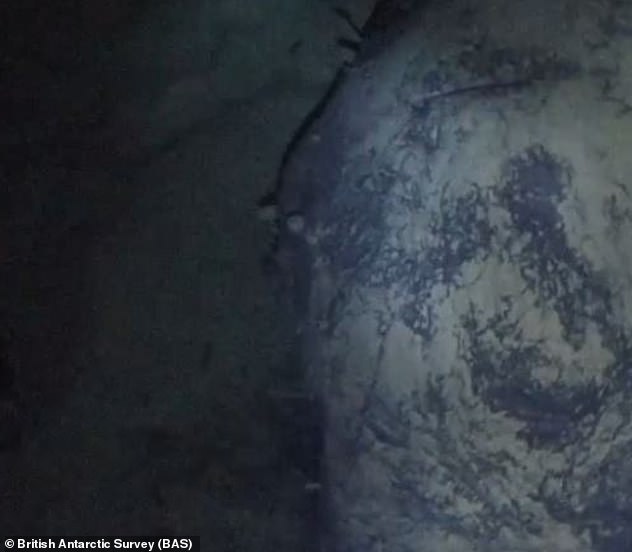
Here they ricocheted off a large boulder and a camera caught sight of the rock
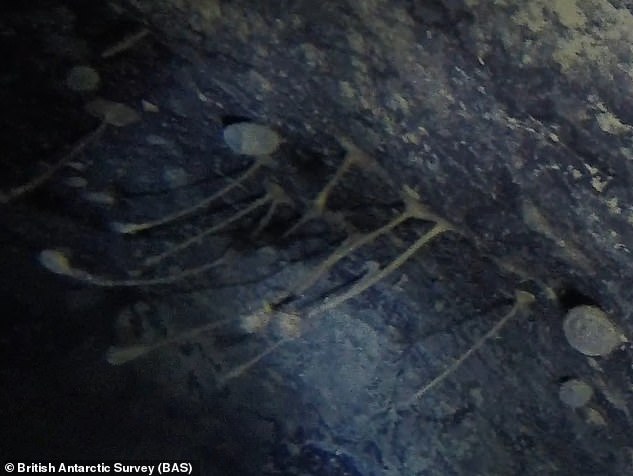
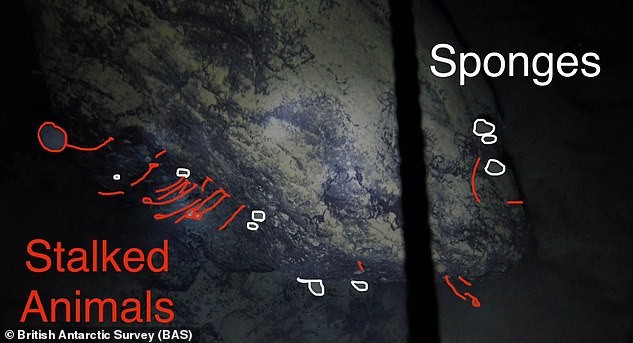
Revealed sponges and unidentified stalked animals on the surface, a world first
Animals have been found living on the sea floor underneath Antarctica in what was previously thought to be an uninhabited wasteland.
Two types of filter-feeding sea sponges were spotted attached to a boulder at the bottom of the ocean by scientists from the British Antarctic Survey.
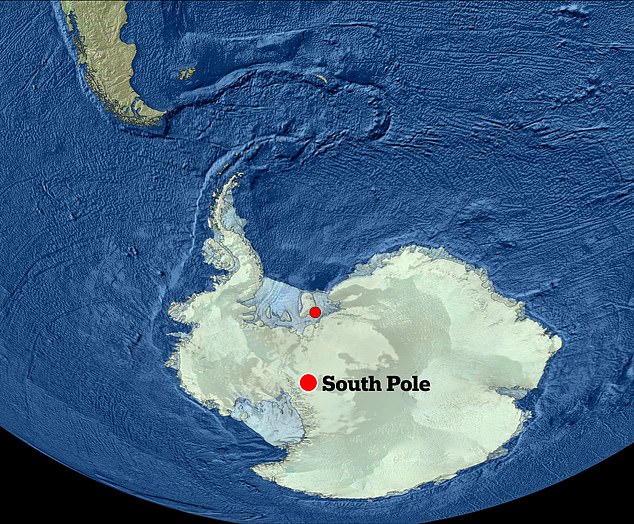
The explorers dropped a camera down a borehole which went through the 3,000ft (900m) of solid ice before plunging into the frigid Antarctic ocean underneath.
In the pitch black of the unexplored marine frontier the researchers found evidence of life in the -2.2°C water, the first stationary animals ever seen in this habitat.
These currently unidentified species are more than 200 miles from the nearest food source but appear to be thriving despite the arduous existence.
Animals have been found living on the sea floor underneath Antarctica in what was previously thought to be an uninhabited wasteland. Pictured, a boulder with the stationary life on
Sponges and unidentified stalked animals were spotted on a boulder at the bottom of the ocean by scientists from the British Antarctic Survey (pictured)
This part of the world is one of the last truly unexplored regions of the world as floating ice shelves have made it impossible to study the ocean beneath.
More than 1.5 million square km — an area bigger than the UK, Germany, Spain and Italy combined — is covered by this fortress of ice.
As a result only an area the size of a tennis court has been explored at all, thanks to eight boreholes drilled through the ice.
The exploration and study that has been done in this area has been primitive by modern standards as accessibility is so difficult due to the extreme weather.
'This discovery is one of those fortunate accidents that pushes ideas in a different direction and shows us that Antarctic marine life is incredibly special and amazingly adapted to a frozen world,' says biogeographer and lead author of the study Dr Huw Griffiths.
Researchers drilled the hole to take sediment samples from the sea floor when they ricocheted off the boulder (pictured), with the spinning camera capturing the lifeforms
The borehole was drilled 160 miles (260km) from the open sea, further confounding researchers
Earth lost a record 28 TRILLION tonnes of ice between 1994 and 2017
A record-breaking 28 trillion tonnes of ice — enough to cover the whole of the UK in a sheet over 300 feet thick — melted from the face of the Earth between 1994–2017.
Researchers from the University of Leeds carried out the first ever global survey of ice loss using data collected from satellites orbiting our planet.
The team found that the annual rate of ice loss increased by 65 per cent over the 23-year period — going from 0.8 trillion tons in the nineties up to 1.3 trillion tons.
The accelerating melt — which continues to get worse — has been driven largely by steep increases in losses from the polar ice sheets in Antarctica and Greenland.
Ice melt serves to raise sea levels across the globe, increases the risk of flooding to coastal communities and endangers natural habitats that wildlife depend upon.
'Our discovery raises so many more questions than it answers, such as how did they get there? What are they eating? How long have they been there? How common are these boulders covered in life? Are these the same species as we see outside the ice shelf or are they new species? And what would happen to these communities if the ice shelf collapsed?'
The borehole was drilled 160 miles (260km) from the open sea, further confounding researchers.
Current theories clearly state that life becomes increasingly unlikely the further underwater and away from open water a location is.
Previous studies have found some mobile animals, such as fish and krill, in these areas but never before has an organism which stays still and filters the water around it for food ever been found.
Aptly, the study has been titled 'Breaking All the Rules' by its authors, and published today in the journal Frontiers in Marine Science.
Researchers drilled the hole to take sediment samples from the sea floor when they ricocheted off the boulder, with the spinning camera capturing the lifeforms.
'To answer our questions we will have to find a way of getting up close with these animals and their environment - and that's under 900 m (3,000 ft) of ice, 260 km (160 miles) away from the ships where our labs are,' adds Dr Griffiths.
'This means that as polar scientists we are going to have to find new and innovative ways to study them and answer all the new questions we have.
Mysterious lifeforms have been discovered in one of the most inhabitable places on our planet. Deep below the Antarctic ice shelf is very dark with subzero temperatures but some species are surprisingly thriving down there.
Located on a seafloor boulder were several species. In fact, this is the first time ever that stationary creatures attached to one specific location have been found underneath the ice of Antarctica.
Huw Griffiths, who is a biogeographer at the British Antarctic Survey and an author of the study, explained this further, “This discovery is one of those fortunate accidents that pushes ideas in a different direction and shows us that Antarctic marine life is incredibly special and amazingly adapted to a frozen world.”
Since it is so difficult to study what’s underneath Antarctica’s ice shelves, scientists are only able to make holes in the ice and lower equipment into the depths of the water. Based on evidence gathered from eight of their borehole surveys, they do know that there is some life beneath the ice, such as jellies, fish, crustaceans, and worms. But the fact that they found sponges was incredibly surprising.
Antarctica
They found the sponges underneath 890 meters of ice (2,920 feet) on the seafloor which was 1,233 meters down (4,045 feet). Located on the seafloor boulder was one sponge on a stalk while 15 others were without them. Furthermore, they discovered 22 organisms that have yet to be identified but could possibly be sponges, hydroids, ascidians, cnidaria, barnacles, or polychaetes. (Pictures can be seen here.)
Griffiths noted that there are still many unanswered questions like how they got there; how long have they been there; what do they eat; how many boulders have this type of life attached to them; are they new species and what would happen to them if the ice shelves ended up collapsing?
Since the majority of life on our planet needs sun to survive, it’s amazing to think that these creatures reside in complete darkness and are still able to live. Chemosynthesis is when organisms use the energy from reactions created by inorganic chemicals when there isn’t any sunlight around. Thermal vents found in the ocean release volcanic chemicals and heat, and bacteria uses chemosynthesis to make sugar for their food chain.
Antarctica
Organisms that live beneath glaciers chemosynthesise hydrogen and some chemosynthetic ecosystems depend on methane. Interestingly, a methane leak has been discovered in the waters of Antarctica.
With that being said, the living creatures underneath Antarctica’s ice shelves probably depend on a chemosynthetic food chain but much more research needs to be conducted in order to know for sure. Nevertheless, it’s incredibly interesting to know that several different species can survive beneath the freezing cold ice shelves of Antarctica.
Unknown lights filmed over Tempe, Arizona 12-Feb-2021
These UFOs were filmed over Tempe, Florida on 12th February 2021.
Witness report:
On the night of 2/12/2021. I happen to look out of my kitchen window while talking to my wife when I noticed a group of strange lights in the sky. I always look into the night sky and in the general direction of what I filmed. I’ve never seen anything like this especially in that part of the sky. This video is what I recorded. The objects traveled to a certain part of the sky and stayed there pulsated and then vanished into the clear night sky. I recorded is 2 separate clips. Because I thought the event ended but more returned. At one point an airplane traveling east went in the general direction of the objects. The objects seemed unaffected by this and more returned in the sky. They had a reddish orange color. The cell phone camera didn’t pick up these colors. Not sure what these were.
This bright UFO was filmed hovering in the sky above Coventry, a city in central England. This happened on 1st February 2021.
Witness report:
Bright helixical shape with Additional orb. Spotted helixical shape whilst in garden pruning trees hence it was in line of sight .Started filming after a minute another faster moving shape enters frame moving erratically . The second object disappeared . The first object tracked on a fairly straight trajectory ( ISS was shown by nasa as being over UK at approximately that time but not sure this would be visible in daylight) either way second object flight path was to erratic to be a satellite. Wife also witnessed at time. Flight radar app checked and no flights over location at the time.
When researchers are drilling almost one kilometer of ice, they’re not expecting to find all that much life. But in a recent survey in the Weddell Sea in Antarctica, they came across multiple life forms living in complete darkness, at temperatures of -2.2°C (28 °F)
“This discovery is one of those fortunate accidents that pushes ideas in a different direction and shows us that Antarctic marine life is incredibly special and amazingly adapted to a frozen world,” says biogeographer and lead author, Dr. Huw Griffiths of British Antarctic Survey.
Breaking all the rules
Antarctica is the world’s harshest continent, and yet life seems to find a way even in these conditions. Few creatures can survive in Antarctica in the first place, but to do it in such hellish conditions is truly stunning. This is the first study to find stationary animals attached to a boulder on the Antarctic seafloor, the authors say, and they’re “breaking all the rules.”
Researchers found several sponge-like species, including some species previously unknown to science. It’s very unlikely that they just got lucky and hit the needle in the Antarctic haystack — the one place where such animals happen to survive in these conditions. Instead, Griffiths says, there’s probably much more like this waiting to be discovered.
“There appear to be at least three species present in the images, possibly more. Given that this is the first record of a hard substrate community observed from a habitat that covers 1.6 million km2 then I would be very surprised if we had been lucky enough to find all the species on a single boulder, so I would expect that there are many more waiting to be found,” Griffiths told ZME Science.
We don’t yet know much about these species, and in a way, their discovery seems to pose more questions than it answers. They appear to be a group of unpretentious filter-feeders — creatures that feed by straining suspended matter (food) from the water. But where does their food even come from, and how common are these life forms? Since it’s so dark, there can’t be any talk of photosynthesis, and there doesn’t seem to be any hydrothermal vent, so Griffiths suspects the food comes from farther away.
“From looking at the video it appears to be a filter-feeding community, obviously this community must be able to cope with less food than others elsewhere. There are no obvious signs of chemosynthesis, these sponges are not the typical hydrothermal vent or methane seep fauna and the water temperatures are very cold. As far as we know the most likely source of food is what washed in from beyond the ice shelf by the currents, but this requires further investigation,” Griffiths added in an email.
British Antarctic Survey camera travelling down the 900-meter-long bore hole in the Filchner-Ronne Ice Shelf. (Marine creature pictured is unrelated to the discovery).
Image credits: Dr Huw Griffiths/British Antarctic Survey.
Tantalizing information for life on Earth and beyond
The discovery of an established community on a boulder 260 km from the ice raises “significant questions,” the researchers note, forcing us to rethink what we think about how life survives under ice shelves. The findings have wide implications not just in regards to creatures inhabiting the Earth now, but also to creatures that lived hundreds of millions of years ago, in a period called the “snowball earth” — and even for potential life on frozen bodies such as Jupiter’s satellite Europa.
The problem is further complicated by the fact that these creatures are filter-feeders. Filter-feeders depend on a supply of food from above, so they are among the first to disappear as you move away from open water and sunlight. Yet, here they are, probably covering large habitats, showing just how much we’ve still yet to learn about these extreme environments.
“Ice shelves cover roughly a third of the Antarctic’s 5 million km2 continental shelf and the Ronne-Filchner Ice Shelf [where the creatures were found] covers around 420,000 km2, so these environments are surprisingly common but we know virtually nothing about them. Finding filter feeding animals so far from their food source shows us that life beneath ice shelves is more resilient and widespread than we expected.”
Now, researchers will continue to study these creatures and see what they can understand about these extremophilic communities. But they also leave a warning: we may end up destroying these communities before we even truly understand them. Despite being remarkably well adapted for the cold, they are vulnerable to the global heating that could wreck their entire ecosystem.
“If these communities turn out to be new species, only found under ice shelves then this would make them very vulnerable to climate change and ice shelf collapse, which could destroy their entire habitat in the future,” Griffiths concludes.
NASA's Hubble Telescope provides 14 years of data on the exoplanet HD106906 b.
It exhibits strange behavior along its orbit 336 light-year away from Earth.
Scientists think data from the exoplanet may explain what happened to the possibly hidden Planet Nine in our Solar System.
How many planets are in our Solar System? You may think there's an obvious answer you learned in kindergarten, but the number has fluctuated between 8 and 9, depending on whether you accept Pluto as being large enough for a planet. But there's another mysterious planet that may be lurking at the edge of the Solar System – the so-called "Planet Nine". All we know about it is through inference, arrived at by judging the effects this potential planet may be having on its surroundings. Now, for the first time, scientists measured the motion of a massive exoplanet, in a different solar system, that may be exhibiting behavior similar to that of the hypothesized Planet Nine.
The exoplanet HD106906 b is 336 light-year away from Earth. With the mass of as much as 11 Jupiters, it orbits a double star system. Scientists first discovered it in 2013 but have now been able to get much better information about its orbit thanks to NASA's Hubble Space Telescope. In fact, Hubble has collected 14 years worth of precise data about the exoplanet, allowing for a wealth of new insight.
The exoplanet is located very far from its host stars, 730 times as far as it is from the Earth to the Sun. While its slow 15,000-year-long orbit would ordinarily not allow for very conclusive observation in just 14 years, the Hubble team found that its orbit is extreme, both very inclined and elongated, staying on the outside of a debris disc surrounding the twin stars.
Meiji Nguyen of the University of California, Berkeley, who led the study, commented on how unusual the exoplanet's orbit is:
"To highlight why this is weird, we can just look at our own Solar System and see that all of the planets lie roughly in the same plane,"shared Nguyen. "It would be bizarre if, say, Jupiter just happened to be inclined 30 degrees relative to the plane that every other planet orbits in. This raises all sorts of questions about how HD 106906 b ended up so far out on such an inclined orbit."
The Strange Exoplanet That Resembles the Long-Sought “Planet Nine”
How did this planet develop such an orbit? The scientists think it likely formed much closer to the host stars, but the drag from the system's gas disc might have affected its orbit. This could have pushed it closer to the twin stars, whose gravitational force then threw it out into an eccentric orbit, nearly all the way into interstellar space. As the Hubble team's press release explains, a passing star then possibly corrected the exoplanet's orbit and stopped it from leaving the home system altogether.
This explanation is similar to what scientists predict could have pushed the potential Planet Nine to the edges of our Solar System, past the Kuiper belt. Jupiter might have affected its orbit, kicking it out from the inner Solar System. Planet Nine could have kept going past Pluto but a passing star possibly stopped it by altering its orbit.
Paul Kalas of the University of California, Berkeley, a member of the Hubble team, commented that analyzing what happened to exoplanet HD106906 b is like investigating our own past.
"It's as if we have a time machine for our own Solar System going back 4.6 billion years to see what may have happened when our young Solar System was dynamically active and everything was being jostled around and rearranged,"elaborated Kalas.
This image, taken by the Hubble Space Telescope, shows one possible orbit (via the dashed ellipse) of the exoplanet HD 106906 b.
Credits: NASA, ESA, M. Nguyen (University of California, Berkeley), R. De Rosa (European Southern Observatory), and P. Kalas (University of California, Berkeley and SETI Institute)
Of course, none of this means we actually found Planet Nine, if it even exists. Evidence for its corporeality includes the strange behavior of small space bodies past Neptune, whose inexplicable orbits might be the result of being affected by the gravitational pull of an unseen planet.
Further investigations into the formation and debris system of the exoplanet HD106906 b will be carried out by the James Webb Space Telescope, slated to launch in October 2021. It promises to shed more like on the exoplanet's unusual system and, by extension, on our own mystery Planet Nine.
Check out the team's paper, published in The Astronomical Journal.
Artist's impression of the possibly hidden "Planet Nine"
The hunt for life on Mars: A visual guide to NASA’s latest mission
The Perseverance spacecraft, due to land this week, aims to scour Jezero Crater and collect the first rocks from the red planet.
By Alexandra Witze
Perseverance will explore Jezero Crater (shown in this artist’s impression), the oldest terrain yet explored on the red planet. Credit: NASA/JPL-Caltech
About 3.9 billion years ago, a wayward rock slammed into Mars, punching a 45-kilometre-wide hole into its surface. On 18 February, NASA plans to land its latest rover inside that pit, named Jezero Crater.
The goal is to explore an area of Mars that was once much warmer and wetter, and perhaps even liveable. Scattered throughout the crater are geological formations hinting at its watery past, including the remains of a lake and a river delta. Studying the make-up of these rocks — in a region where no spacecraft has gone before — will give NASA its best chance yet at answering the age-old question of whether life ever existed on Mars.
“Jezero is very special,” says Briony Horgan, a planetary scientist at Purdue University in West Lafayette, Indiana, and a member of the mission’s science team.
NASA’s six-wheeled rover, named Perseverance, will explore Jezero as a robotic geologist — examining outcrops and then scooping dirt and rock into a carousel of tubes stored in its belly. If all goes well, by the end of its first Mars year on the surface — a little under two Earth years — the rover will have travelled more than 15 kilometres. And it will have collected a precious set of samples that it will drop onto the Martian ground, where future spacecraft might one day retrieve them — the first attempt to bring Mars rocks back to Earth.
Destination: Jezero
Two other missions reached Mars this month. The United Arab Emirates’ Hope spacecraft started orbiting the planet on 9 February, followed a day later by China’s Tianwen-1 mission — a first for both nations. But Perseverance aims to become the first rover to land since 2012, when NASA’s Curiosity spacecraft arrived in Gale Crater, a dry lake bed about 3,700 kilometres from Jezero. (Tianwen-1 is slated to send a rover to touch down as early as May, and Hope will continue orbiting.) Only eight spacecraft have successfully operated on the red planet’s surface (see ‘Touch Down’).
Touch Down
Only eight spacecraft, beginning with the twin Viking landers in 1976, have successfully landed and operated on the red planet. Perseverance is heading to a previously unexplored region on 18 February.
Phoenix , Viking 2, Jezero Crater, Viking 1, Pathfinder, Perseverance,
Scientists are excited about Perseverance because it could answer questions about Mars’s past that they have only guessed at. Jezero’s ancient, fractured landscape will be the oldest terrain ever explored on the red planet. “This region is a very old part of Mars,” says Vivian Sun, a planetary geologist at the Jet Propulsion Laboratory in Pasadena, California, and a member of the Perseverance science team. “That’s important because the oldest periods of time are when we think Mars was most habitable.”
Ancient landscape
Perseverance aims to land within a 7.7 x 6.6 kilometre ellipse in Jezero Crater, either next to or on top of the ancient river delta it aims to explore.
Jezero Crater rim Target landing site for Perseverance
Credit: ESA/DLR/FU-Berlin
From around 4.1 billion to 3.7 billion years ago, volcanoes belched gases into Mars’s atmosphere, thickening it, trapping heat and allowing clouds to form and rain to fall. Flowing water carved out river valleys and filled up lakes — and scientists see evidence of these on the surface today. Eventually, however, Mars became colder, drier and much more inhospitable.
Images taken by orbiting spacecraft show that one river that formed during this time flowed through and over the western edge of Jezero Crater. The river must have carried tiny particles of sediment scoured from far upstream. When it entered the crater, it dropped this sediment into the lake there, creating a delta that fanned out to the east. In and around the delta and lake, conditions would have been ripe for microbial life to thrive. Later, the lake drained away and left behind the formation, now turned to rock.
Mining the delta
Perseverance is heading to Jezero to explore this ancient delta. One goal will be to look for organic matter in the delta’s rocks, which could indicate whether microbes or other life forms once thrived in the region. On Earth, deltas such as that of the Mississippi River hold huge amounts of organic material, the decaying remnants of plants and other matter from farther upstream. If the Jezero delta trapped this type of organic matter, the rover could find it by rolling across the formation and drilling, says Linda Kah, a geologist at the University of Tennessee in Knoxville and a member of Perseverance’s science team.
A watery past
Billions of years ago, a river flowed into Jezero from the west, spilling into a large lake that filled the crater. Sediment exited the river to form a fan-shaped delta.
Crater rim, Ancient lake, shoreline, Inflowing, ancient river, River delta, Nili,
Planum, Crater floor, (bottom of ancient lake)
Credit: NASA/JPL-Caltech/MSSS/JHU-APL/Brown University
Another place to look for signs of past life on Mars is along the ancient shores of the lake. In particular, Perseverance will study an arc of rocks that run alongside the delta and parallel to the rim of the crater. Earlier observations from orbiting spacecraft suggest that these rocks could be made of carbonate minerals, which are relatively rare on Mars but common on Earth. Carbonates, including limestone, are often associated with living organisms such as coral reefs, and with fossils that preserve past organisms such as microbes. “Carbonate excites the hell out of geobiologists like me,” says Kah.
A path forward
Once it lands, Perseverance’s biggest challenge will be to quickly and efficiently explore all these target areas and collect samples. NASA has allotted only one Mars year (equivalent to nearly two years on Earth) for Perseverance to carry out its initial mission.
So scientists on the team have been drawing up routes that the rover might take soon after it touches down. “A lot will depend on where we land” in the 8-kilometre-wide target area, says Kah.
A rover’s journey
One possible route would see Perseverance landing on the crater floor, travelling across and along the ancient river delta and collecting rocks from multiple locations before driving out of Jezero to lay those rock samples down for future missions to bring back to Earth.
Credit: NASA/JPL-Caltech/USGS
In one scenario, Perseverance will land on the crater floor, just in front of the delta’s cliffs. Scientists aren’t entirely sure what the crater floor is made of, but the rock appears to be dark and smooth and could be a volcanic flow. If so, picking up a sample will be a top priority for mission scientists: when that sample eventually gets back to Earth, researchers will be able to analyse it and obtain a precise date for the volcanic eruption that created it, which will help them to understand the timing of geological events in Jezero.
From the crater floor, the rover could drive up and onto the delta, grabbing clay-rich samples and other rocks. It could then head onto the potentially carbonate-rich rocks, drilling into those as well, and afterward drive up onto the rim of Jezero.
If the rover takes this route, it will have travelled more than 15 kilometres and collected at least 15–20 tubes of rocks of different types.
In this video, scientist Ken Farley narrates a flyover of the terrain Perseverance will explore. Credit: NASA/JPL-Caltech
Rock collector
To obtain rock and soil samples, Perseverance will use a drill on its robotic arm (see ‘Tools To Explore’). It will collect duplicates of the most important samples, filling two tubes with the same rock. When the rover reaches the rim of Jezero Crater, it will lay one set of these tubes on the ground and keep the other stashed in its belly. This is to ensure that there is an initial collection of Mars samples available for a future mission to pick up easily and return to Earth.
If the rover is still healthy after its first Mars year, it will head from the crater rim out to the surrounding plains, called Nili Planum. This part of its journey will explore the most ancient terrain yet, including enormous blocks of jumbled-up rock that were blasted from deep inside Mars when another huge asteroid hit, nearly 4 billion years ago. These rocks could come not just from the Martian crust, but from a deeper layer of Mars known as the mantle — which scientists have never been able to look at directly before. “They’re just sitting there, perhaps for more than three billion years, waiting for us to look at them,” says Horgan.
Tools to explore
The car-sized Perseverance carries multiple instruments to probe the Martian landscape. The drill that it will use to collect rock samples is at the end of its robotic arm.
Mastcam-Z and SuperCam, imagers, MEDA,weather station, Carousel, RIMFAX
subsurface, radar, Robotic arm, MOXIE produces oxygen from carbondioxide,
Also up on Nili Planum, according to past observations, are the remains of ancient hydrothermal systems, where hot water once percolated through the Martian crust. On Earth, in places like Yellowstone National Park in Wyoming, these hydrothermal areas are teeming with microbial ecosystems. The same might once have been true on Mars. So Nili Planum offers a type of potentially habitable environment entirely different from that in Jezero Crater.
If everything is still going well in this ‘extended mission’, Perseverance will drill and collect samples until it runs out of tubes. With one set dropped off at the rim of Jezero Crater, the rest of the tubes will be laid down somewhere out on Nili Planum, awaiting retrieval.
This video shows a simulation of the job Perseverance’s helicopter will do on the red planet: scouting ahead and taking images of the landscape to help the rover navigate its route. (This video contains the sound of machinery and helicopter blades in an otherwise silent Martian landscape.)
Credit: NASA/JPL-Caltech
Perseverance will perform other tasks during its time on Mars, including testing the first helicopter placed on another world — as a way to scout the safest path across the landscape — and experimenting with ways to extract oxygen from the Martian atmosphere, as a resource for future human explorers. But its top priority is to collect those samples for eventual return to Earth.
The European Space Agency and NASA are working on plans for two missions needed to retrieve the samples. Launching no earlier than 2026, they would send a rover to Jezero Crater or Nili Planum to retrieve the sample tubes laid down by Perseverance, as well as an orbiter to loop around Mars. The rover would put the tubes on a rocket and launch them into Mars orbit, where the orbiter would grab them and fly them back to Earth no earlier than 2031.
Perseverance is the first step in that lengthy process — a step scientists have been anticipating for decades. “Perseverance will be the first rover to seek the answer to the outstanding questions that we haven’t been able to address with other rovers — was there life on Mars, and can we find evidence that there used to be life?” says Sun. “I’m super-excited.”
According to more than 20 witnesses, a very large aerial object with very bright lights hovered near Fox Lake between 8pm and 9pm, in December of 1996, in Yukon, Canada.
Reflect On:
The disclosure of these strange objects has happened, and they've been recognized within the 'mainstream.' Are these objects extraterrestrial? How long have they been sighted?
The topic of UFOs has gained a tremendous amount of credibility, especially within the past few years alone. We’ve written in depth about the subject for ten years now, and if you’re interested in skimming through some of our articles on the subject, you can find all of them, in order, here
There are no shortage of stories from around the world when it comes to UFO sightings, one great example of strange objects that are commonly seen in the sky comes from the Yukon, a province in Canada situated on the Northwest side of the country. It’s a remote area, nowhere near any major cities or populated areas. This reported sighting happened on December 11th, 1996 near a place called Fox Lake. It’s extremely cold in this part of the country at this time of year – it’s not far from Alaska – and again, it is hundreds of miles from any major city or heavily populated public area.
According to more than 20 witnesses, a very large aerial object with very bright lights hovered near the lake (Fox Lake) between 8pm and 9pm.
The picture you see as the cover for this article was done by Canadian engineer Martin Jasek, who wrote a detailed account of the event after he investigated it for himself.
“Two of the witnesses were cousins, driving in separate vehicles. Each saw it over the lake, slammed on their brakes, and got out of their vehicles. They watched the huge object as it slowly drifted towards one of them and was soon almost directly overhead. It then moved slowly across the highway and over a hill to the east, whereupon it was lost to view.” (1)
“While the two cousins were observing this object, a married couple with their baby were a bit farther to the south along the same highway, driving toward them. They too saw the object. By the time they caught up with the cousins and pulled over, the object had moved off. The married couple continued driving until they arrived at a lodge farther ahead. There, they told the owner abougt what they had seen. He promptly recounted a sighting from an earlier witness, who had gotten very close to this object. (1)
“At the nearby village of Pelly Crossing, other people described the same object. In one case it seemed to respond to a man’s flashlight by accelerating towards him. When he turned off his flashlight, the object stopped. By then it had gotten quite close to him, filling much of the sky. It also emitted several beams of light, including one that swooped along the ground. They ran ran across a clearing, perhaps to get to a better view. When he turned to look for the object, it was gone.” (1)
Just imagine seeing something like this. How remarkable would that be? I myself have had a number of fairly remarkable UFO encounters, even with a few members here at Colletive-Evolution. As a result of all of the evidence supporting the phenomena, along with my own experiences, I have been fascinated with this subject for a very long time.
This case has been investigated by many, and most of the interviews with the witnesses are available online. Here is a video that has a few of them describing their experience in person, but again, more are available online.
This is one out of many extraordinary sightings that has occurred around the world, and judging by ancient artwork and history, it seems to have been happening for a very long time. One example would be the aboriginal community in Canada. Their stories have not been passed down through documentation, but through an oral storytelling tradition. These stories often speak of spiritual beings from another world.
“My people tell of Star People who came to us many generations ago. The Star people brought spiritual teachings and stories and maps of the cosmos and they offered these freely. They were kind, loving, and set a great example. When they left us, my people say there was a loneliness like no other.”
5000 year old cave art from Australia depicts strange beings that resemble what many perceive to represent the modern day ‘Gray Alien.’ These beings were known as Wandjina, cloud spirits and sky beings. You can read more about that here. It’s all very interesting to think about.
If you put all of these teachings and stories from multiple cultures around the world together with the evidence that is available today, things start to seem quite strange – and very real.
This particular case included various drawings and detailed interviews with many of the people who witnessed the object.
Meer van UFO'S of UAP'S, ASTRONOMIE, RUIMTEVAART, ARCHEOLOGIE, OUDHEIDKUNDE, SF-SNUFJES EN ANDERE ESOTERISCHE WETENSCHAPPEN - DE ALLERLAATSTE NIEUWTJES


 Hitler’s UFO Alien Connection During World War II - whatweknow


 Martian landslides may be caused by underground salts and...
 Is this the end of the A68a iceberg? Enormous block of...
 Earth lost a record 28 TRILLION tonnes of ice between 1994...
 How melting icebergs change ocean patterns: New study sheds...