Missing 411: This Navajo Park Ranger Reveals The Truth About What's Happening To People Inside These Parks

Missing 411: This Navajo Park Ranger Reveals The Truth About What's Happening To People Inside These Parks
Triangular UFO over Cincinnati, Ohio 5-Nov-2021

This fast triangular-shaped object was flying across the sky above Cincinnati in Ohio on 5th November 2021.
Witness report:
This object was triangular or delta wing shaped. Traveling from the south headed due north and recorded this from my night vision camera attached to my tripod
Sodium Vapor Outgassing Explains Asteroid Phaethon’s Cometlike Activity
The 5.8-km-wide (3.6-mile) near-Earth asteroid Phaethon, which is the source of the annual Geminid meteor shower, brightens as it gets close to the Sun. The asteroid’s elongated, 524-day orbit takes it well within the orbit of Mercury, during which time the Sun heats the asteroid’s surface up to 750 degrees Celsius (1,390 degrees Fahrenheit).
This illustration depicts the asteroid Phaethon being heated by the Sun.
Image credit: NASA / JPL-Caltech / IPAC.
“Phaethon is a curious object that gets active as it approaches the Sun,” said Dr. Joseph Masiero, a researcher at IPAC/Caltech.
“We know it’s an asteroid and the source of the Geminids. But it contains little to no ice, so we were intrigued by the possibility that sodium, which is relatively plentiful in asteroids, could be the element driving this activity.”
Dr. Masiero and his colleagues were inspired by observations of the Geminids.
When meteoroids streak through Earth’s atmosphere as meteors, they disintegrate.
But before they do, friction with the atmosphere causes the air surrounding the meteoroids to reach thousands of degrees, generating light.
The color of this light represents the elements they contain. Sodium, for example, creates an orange tinge. The Geminids are known to be low in sodium.
Until now, it was assumed that these small pieces of rock somehow lost their sodium after leaving the asteroid Phaethon.
The new study suggests that the sodium may actually play a key role in ejecting the Geminid meteoroids from the asteroid’s surface.
The researchers think that as Phaethon approaches the Sun, its sodium heats up and vaporizes.
This process would have depleted the surface of sodium long ago, but sodium within the asteroid still heats up, vaporizes, and fizzes into space through cracks and fissures in Phaethon’s outermost crust.
These jets would provide enough oomph to eject the rocky debris off its surface.
So the fizzing sodium could explain not only the asteroid’s cometlike brightening, but also how the Geminid meteoroids would be ejected from the asteroid and why they contain little sodium.
“Asteroids like Phaethon have very weak gravity, so it doesn’t take a lot of force to kick debris from the surface or dislodge rock from a fracture,” said Dr. Björn Davidsson, a researcher at NASA’s Jet Propulsion Laboratory.
“Our models suggest that very small quantities of sodium are all that’s needed to do this — nothing explosive, like the erupting vapor from an icy comet’s surface; it’s more of a steady fizz.”
To find out if sodium turns to vapor and vents from an asteroid’s rock, the researchers tested samples of the Allende meteorite.
The meteorite may have come from an asteroid comparable to Phaethon and belongs to a class of meteorites, called carbonaceous chondrites, that formed during the earliest days of the Solar System.
The scientists then heated chips of the meteorite to the highest temperature Phaethon would experience as it approaches the Sun.
“This temperature happens to be around the point that sodium escapes from its rocky components,” said Dr. Yang Liu, also from NASA’s Jet Propulsion Laboratory.
“So we simulated this heating effect over the course of a ‘day’ on Phaethon — its three-hour rotation period — and, on comparing the samples’ minerals before and after our lab tests, the sodium was lost, while the other elements were left behind.”
“This suggests that the same may be happening on Phaethon and seems to agree with the results of our models.”
The study was published in the Planetary Science Journal.
Joseph R. Masiero et al. 2021. Volatility of Sodium in Carbonaceous Chondrites at Temperatures Consistent with Low-perihelion Asteroids. Planet. Sci. J 2, 165; doi: 10.3847/PSJ/ac0d02
Former UK Astronaut Suggests Alien Beings Are Here On Earth

(Arjun Walia) Dr. Helen Sharman was Britain’s first astronaut. She went to space 28 years ago and recently made headlines by stating that there is no doubt whatsoever that “All sorts of forms of life” exist in the universe, and it’s possible that “They’re here right now” and in some cases we “simply can’t see them” as they are so different to humanity.
Related
by Arjun Walia,
Could she have been referring to beings that exist within other dimensions? Based on my research, when it comes to the topic of UFOs and the extraterrestrial hypothesis as an explanation for some of these objects, many have hypothesized that some of these craft simply pop in and out of our existence, perhaps from another dimension.
Sharman told the Observer Magazine that “Aliens exist, there’s no two ways about it” and that “There are so many billions of stars out there in the universe that there must be all sorts of forms of life.”
The chemist spent eight days as a researcher on the space mission when she was 27, making her one of the youngest people to enter orbit.
This echoes the thoughts and feelings of the majority, if not all of the scientific community right now when it comes to contemplating life beyond our own world.
The list of astronauts around the world who have shared their belief that intelligent life exists, in abundance, elsewhere in our known universe is quite long. Some have even stated that they have been privy to evidence suggesting that we have been visited, and are being visited.
Not long ago, Bigelow Aerospace CEO Robert Bigelow said that one doesn’t have to go anywhere to find this type of life, that it’s already here…
Apollo 14’s Dr. Edgar Mitchell is a great example. He spent many years creating awareness about the UFO phenomenon, and made many incredible statements throughout his life. He claimed to be “privileged enough to be in on the fact that we have been visited on this planet” and that “the UFO phenomenon is real.”
Book Project Stargate and Remote Viewing Technology: The CIA’s Files on Psychic Spying
His words were verified after his passing by the leak of this document. The focal point of the document is about a meeting (and what happened after that meeting) that took place in 1997 between UFO researcher Dr. Steven Greer, Admiral Wilson, Dr. Edgar Mitchell (Apollo 14 astronaut) and other high ranking individuals within the military. This meeting was spoken about by Dr. Greer and Dr. Mitchell nearly four years prior to the leak of these documents on multiple occasions. You can learn more about this document, here.
Dr. Brian O’leary, a former astronaut and Princeton physics professor has stated that “there is abundant evidence that we are being contacted,” astronaut Story Musgrave has done the same, stating that intelligent life most certainly exists and that “they’re doing star travel, that’s how good they are.” Gordon Cooper and again, several others have done the same. Apollo 12 astronaut Al Worden has also made some interesting comments about aliens.
All of these statements are quite out-dated, and since they’ve been made it’s been proven without a doubt that the UFO phenomenon is real. The mainstream seems to be getting more acclimatized to this fact, as objets performing maneuvers that no known air-craft can have been documented via electrooptical data, like video recordings and radar trackings, as well as high ranking testimony from hundreds trained observers.
NEW YORK TIMES BESTSELLER • Impeccably researched, this riveting journalistic investigation separates fact from fiction, and documents the existence of—and government reactions to—actual UFOs. “A treasure trove of insightful and eye-opening information.”—Michio Kaku, PH.D., bestselling author of Physics of the Future
A former Pentagon official who led a secret government program to research potential UFOs, revealed in 2017, told CNN at the time that he believes there is evidence of alien life reaching Earth, and that the UFO phenomenon is part of that evidence.
We’ve see mainstream UFO disclosure ramp up quite a bit every single year, as it continues to be legitimized by articles taking the subject seriously in media outlets like the Washington Post, and the New York Times. It’s quite clear that something is going on.
For a deeper discussion into mainstream UFO disclosure, the motives, and more, you can refer to this article I recently published on the subject.
This subject is huge, and like I’ve said many times before, leaves no aspect of humanity untouched.
LATEST UFO SIGHTINGS AND VIDEOSLATEST UFO SIGHTINGS AND VIDEOS
UFO's Just Over Head?(Two UFO Sightings)
Two strange UFO sightings starting out in Texas then our next sightings is in Washington State.
First Video Source: MUFON Case # 118980
Second Video Source: MUFON Case # 119021
Flying Humanoid Figure Filmed In The Sky Over Maryhill In Glasgow, Scotland.
Lynsey Currie and her boyfriend filmed this strange object above his flat and at first they though it could be a weather balloon but given the odd shape to this object it looks like no weather balloon we have seen. One thing is sure it that this is a UFO as it is flying over this area in Glasgow but to me the object seem to be "Humanoid" in appearance as we can see a head, arms and legs which are attached to a body.
Lynsey Currie also added " it was flying across the sky going from the northwest of Glasgow towards the southwest."
Thanks to Lynsey Currie and her boyfriend for filming this..
Source and Story: Glasgow Live
NASA, USGS Release First Landsat 9 Images
Landsat 9, a joint mission between NASA and the U.S. Geological Survey (USGS) that launched Sept. 27, 2021, has collected its first light images of Earth.

Mangroves are prominent along the northwest coast of Australia. The first image collected by Landsat 9, on Oct. 31, 2021, shows mangroves clustered in protected inlets and bays on the edge of the Indian Ocean. Fluffy cumulus clouds and high-altitude cirrus clouds hover nearby. The aqua colors of the shallow near-shore waters give way to the deep, dark blues of the ocean.
Credits: NASA
The images, all acquired Oct. 31, are available online. They provide a preview of how the mission will help people manage vital natural resources and understand the impacts of climate change, adding to Landsat's unparalleled data record that spans nearly 50 years of space-based Earth observation.
"Landsat 9's first images capture critical observations about our changing planet and will advance this joint mission of NASA and the U.S. Geological Survey that provides critical data about Earth's landscapes and coastlines seen from space," said NASA Administrator Bill Nelson. "This program has the proven power to not only improve lives but also save lives. NASA will continue to work with USGS to strengthen and improve accessibility to Landsat data so decision makers in America - and around the world - better understand the devastation of the climate crisis, manage agricultural practices, preserve precious resources and respond more effectively to natural disasters."
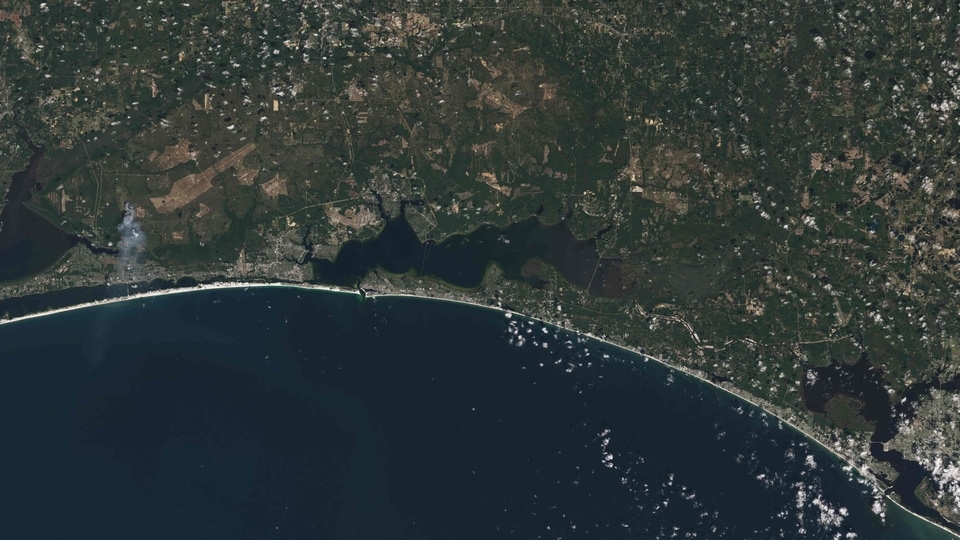
These first light images shows Detroit, Michigan, with neighboring Lake St. Clair, the intersection of cities and beaches along a changing Florida coastline and images from Navajo Country in Arizona that will add to the wealth of data helping us monitor crop health and manage irrigation water. The new images also provided data about the changing landscapes of the Himalayas in High Mountain Asia and the coastal islands and shorelines of Northern Australia.

This image collected by Landsat and released by NASA, shows the white sands of Pensacola Beach stand out of the Florida Panhandle of the US.
(NASA/AFP)
Landsat 9 is similar in design to its predecessor, Landsat 8, which was launched in 2013 and remains in orbit, but features several improvements. The new satellite transmits data with higher radiometric resolution back down to Earth, allowing it to detect more subtle differences, especially over darker areas like water or dense forests. For example, Landsat 9 can differentiate more than 16,000 shades of a given wavelength color; Landsat 7, the satellite being replaced, detects only 256 shades. This increased sensitivity will allow Landsat users to see much more subtle changes than ever before.
![]()
"First light is a big milestone for Landsat users - it's the first chance to really see the kind of quality that Landsat 9 provides. And they look fantastic," said Jeff Masek NASA's Landsat 9 project scientist at Goddard Space Flight Center. "When we have Landsat 9 operating in coordination with Landsat 8, it's going to be this wealth of data, allowing us to monitor changes to our home planet every eight days."
Landsat 9 carries two instruments that capture imagery: the Operational Land Imager 2 (OLI-2), which detects visible, near-infrared and shortwave-infrared light in nine wavelengths, and the Thermal Infrared Sensor 2 (TIRS-2), which detects thermal radiation in two wavelengths to measure Earth's surface temperatures and its changes.
These instruments will provide Landsat 9 users with essential information about crop health, irrigation use, water quality, wildfire severity, deforestation, glacial retreat, urban expansion, and more.
"The data and images from Landsat 9 are expanding our capability to see how Earth has changed over decades", said Karen St. Germain, Earth Science Division director at NASA Headquarters in Washington. "In a changing climate, continuous and free access to Landsat data, and the other data in NASA's Earth observing fleet, helps data users, including city planners, farmers and scientists, plan for the future."
NASA's Landsat 9 team is conducting a 100-day check-out period that involves testing the satellite's systems and subsystems and calibrating its instruments in preparation for handing the mission over to USGS in January. USGS will operate Landsat 9 along with Landsat 8, and together the two satellites will collect approximately 1,500 images of Earth's surface every day, covering the globe every eight days.
"The incredible first pictures from the Landsat 9 satellite are a glimpse into the data that will help us make science-based decisions on key issues including water use, wildfire impacts, coral reef degradation, glacier and ice-shelf retreat and tropical deforestation," said USGS Acting Director Dr. David Applegate.
"This historic moment is the culmination of our long partnership with NASA on Landsat 9's development, launch and initial operations, which will better support environmental sustainability, climate change resiliency and economic growth - all while expanding an unparalleled record of Earth's changing landscapes."

UFO expert set to make alien reports publicA former policeman has released thousands of UFO reports to the public.
John Hanson has investigated extraterrestrial sightings in the UK for the past two decades and his books on UFOs were praised by the late Prince Philip.
Hanson has 25,000 reports that will go on display at the British UFO Information Office to allow the public to look at his vast collection of documents and files.
He told The Sun newspaper: "I began collecting information and records from a number of UFO groups over the years.
"I thought it best to date all of the material - for example, if you said what happened in January 1995, I would set out four huge files showing on a day-to-day basis what was reported both by the press and the UFO groups concerned.
"I anticipate 25,000 documents, I haven't finished yet!"
Black Object Poked Out of the Water Several Feet in Latest Nessie Sighting

Long time Live Webcam viewer Eoin O’Faodhagain recorded another strange occurrence in Scotland’s Loch Ness. On October 19th, he noticed a black object that emerged high out of the water on the northern side of the loch and began moving through the water. Based on the video and the distance that the webcam is from the loch, the object would have been at least a couple of feet out of the water. While it was moving down the water, it got closer to the surface and eventually went under as soon as a cruiser began getting closer.
Once the cruiser came into view on the webcam, the unexplained dark object was completely under the water. However, there was still a straight line wake on the surface which indicated that it was still very close to the surface and possibly even touching it. But when the cruiser reached the exact spot where the object was last viewed, it was totally gone so it must have been submerged a good distance down from the surface.
O’Faodhagain posted his recordings on YouTube where the first part of the video can be viewed here and part two can be seen here.
This is O’Faodhagain’s fifth sighting of the year. His first occurred on January 19th when he witnessed a mysterious shape in the water for about 20 minutes. Three days later, he saw two unexplained objects splashing around in the water. He noticed a black shape moving up and down in the water, followed by two mysterious objects on March 12th. And on August 22nd, he again saw two shapes moving across the surface. There were five other webcam sightings reported by other viewers this year for a total of ten so far.
As for visitors who actually witnessed the elusive creature in person at the loch, there have been six reports so far this year that included a sonar image on August 26th. The image, which was captured on board the “Nessie Hunter” of Loch Ness Cruises, showed a mysterious shape that was estimated to have been 3 to 4 meters in length (9.8 to 13.1 feet). All of the sightings can be viewed on The Official Loch Ness Monster Sightings Register page.
There was another interesting and very questionable sighting that included a drone camera but it hasn’t been accepted or listed on the register’s page. A camper named Richard Mavor was part of the great glen canoe challenge for Alzheimer’s Society when he decided to send his drone in the air to capture some footage of the loch for his YouTube channel and that’s when he allegedly filmed the Loch Ness Monster.

You too could find Nessie if you stop looking at the surfers and swimmers
However, not everyone is convinced that the footage is real and some have even called it out, saying that it was a toy used in a hoax. Maybe that’s why it hasn’t been accepted to The Official Loch Ness Monster Sightings Register page.
Rocky exoplanets are even STRANGER than we thought! Most nearby worlds are made of rock types that can't be found in our solar system - with some so exotic that scientists have had to create new names for them, study finds
Rocky planets outside our solar system, known as exoplanets, are composed of 'exotic' rock types that don't even exist in our planetary system, a study shows.
Researchers have used telescope data to analyse white dwarfs – former stars that were once gave life just like our Sun – in an attempt to discover secrets of their former surrounding planets.
The experts found that some exoplanets have rock types that don't exist, or just can't be found, on planets in our solar system.
These rock types are so 'strange' that the authors have had to create new names for them – including 'quartz pyroxenites' and 'periclase dunites'.
Some of these rocks would dissolve more water than rocks on Earth, which might have impacted how oceans formed on these planets prior to their demise.

Rocky debris, the pieces of a former rocky planet that has broken up, spiral inward toward a white dwarf in this illustration. Studying the atmospheres of white dwarfs that have been 'polluted' by such debris, an NSF astronomer and a geologist have identified exotic rock types that do not exist in our solar system
The new study has been led by the NSF's NOIRLab, an astronomical research centre based in Tucson, Arizona.
'While some exoplanets that once orbited polluted white dwarfs appear similar to Earth, most have rock types that are exotic to our solar system,' said study author astronomer Siyi Xu at NOIRLab.
'They have no direct counterparts in the solar system.'
So far, astronomers have discovered thousands of exoplanets orbiting other stars in our galaxy.
Some 4,374 exoplanets have been confirmed in 3,234 systems since the first exoplanet discoveries in the early 1990s.
The majority of these exoplanets are gaseous, like Jupiter or Neptune, rather than terrestrial, according to NASA's online database.
The closest exoplanet is called Proxima Centauri b, around 4.2 light years away from our Sun.
However, it's difficult to know what exactly exoplanets are made of, or whether any resemble Earth.
To try and find out more, astronomer Xu partnered with geologist Keith Putirka of California State University, Fresno, to study the atmospheres of what are known as polluted white dwarfs.
White dwarfs are the incredibly dense stellar remains of dead stars after they exhaust their nuclear fuel, shrunk down to roughly the size of Earth.
They contain foreign material from planets, asteroids or other rocky bodies that once orbited the star but eventually fell into the white dwarf and 'contaminated' or 'polluted' its atmosphere.
Roughly 98 per cent of all the stars in the universe will ultimately end up as white dwarfs, including our own Sun.

Artistic rendering of what an exoplanet might look like, with its star in the background. So far, astronomers have discovered thousands of exoplanets orbiting other stars in our galaxy, the Milky Way
By looking for elements that wouldn't naturally exist in a white dwarf's atmosphere (anything other than hydrogen and helium), scientists can figure out what the rocky planetary objects that fell into the star were made of.
The team looked at 23 polluted white dwarfs, all within about 650 light-years of the Sun, where calcium, silicon, magnesium and iron had been detected, using the W. M. Keck Observatory in Hawai'i, the Hubble Space Telescope and other observatories.
The list of polluted white dwarfs studied included WD 1145+017, approximately 570 light-years from Earth in the constellation of Virgo.
The scientists then used the measured abundances of those elements to reconstruct the minerals and rocks that would form from them.
They found that these white dwarfs have a much wider range of compositions than any of the inner planets in our solar system, suggesting their planets have a wider variety of rock types.
'Some rock types might melt at much lower temperatures and produce thicker crust than Earth rocks, and some rock types might be weaker, which might facilitate the development of plate tectonics,' said Putirka.
Earlier studies of polluted white dwarfs had found elements from rocky bodies, including calcium, aluminum and lithium.
But these are 'minor elements' (which typically make up a small part of an Earth rock), so measurements of 'major elements' (which make up a large part of an Earth rock), especially silicon, are needed to truly know what kind of rock types would have existed on those planets.

The team studied polluted white dwarfs using the W. M. Keck Observatory in Hawai'i (pictured) and other observatories
High levels of magnesium and low levels of silicon measured in the white dwarfs' atmospheres suggest that the rocky debris detected likely came from the interiors of the planets, from the mantle, not their crust.
This is because high magnesium and low silicon are characteristic of Earth’s mantle composition.
Some previous studies of polluted white dwarfs reported signs that continental crust existed on the rocky planets that once orbited those stars.
Interestingly, Putirka and Xu found no evidence of crustal rocks, although this does not completely rule out that the planets had continental crust or other crust types.
'We believe that if crustal rock exists, we are unable to see it, probably because it occurs in too small a fraction compared to the mass of other planetary components, like the core and mantle, to be measured,' said Putirka.
The study has been published in the journal Nature Communications.
Rocky Exoplanets Are More Diverse Than Previously Thought

According to new analysis, rocky planets found in other systems are much more diverse than previously thought. An astronomer named Siyi Xu from NSF’s NOIRLab and a geologist named Keith Putirka from California State University, Fresno, focused on rocky worlds that orbit nearby stars as well as “polluted” white dwarfs’ chemical compositions. Polluted white dwarfs are the collapsed dense cores that were once suns (similar to own sun). Their “contaminated” atmospheres contain materials from asteroids, planets, and other rocky worlds that orbited them at one time.
The experts were able to determine what the rocky planets were composed of by figuring out what types of foreign materials were in the atmospheres of the white dwarfs. They focused on 23 polluted white dwarfs that are all located within 650 light-years away from our sun. They used several observatories for their study that included the W. M. Keck Observatory in Hawai’i, as well as data from the Hubble Space Telescope. They were able to measure the amount of calcium, magnesium, silicon, and iron in the atmospheres of the white dwarfs. Then they used their calculations to determine which types of rock could have been formed from those specific elements and measurements.
And what the scientists found was that the rocky planets contained a large amount of different types of rock. What’s even more jaw-dropping is that several of them were previously unknown rocks that have never been found in our own Solar System. In fact, Xu and Putirka had to give names to some of the odd new rock types – “quartz pyroxenites” and “periclase dunites”.
Putirka & Xu present the first estimates of rock types on exoplanets that once orbited polluted white dwarfs — stars whose atmospheric compositions record the infall of formerly orbiting planetary objects.
Image credit: NOIRLab / NSF / AURA / J. da Silva / M. Zamani & M. Kosari, NSF’s NOIRLab.
As for these exotic rocks, Putirka described them in further detail, “Some of the rock types that we see from the white dwarf data would dissolve more water than rocks on Earth and might impact how oceans are developed.” “Some rock types might melt at much lower temperatures and produce thicker crust than Earth rocks, and some rock types might be weaker, which might facilitate the development of plate tectonics.”
Another interesting discovery was that based on the large amount of magnesium and the small amount of silicon in the atmospheres of the white dwarfs, it is believed that the rocky materials probably came from the planets’ mantle instead of the crust. “We believe that if crustal rock exists, we are unable to see it, probably because it occurs in too small a fraction compared to the mass of other planetary components, like the core and mantle, to be measured,” Putirka explained.
Their study was published in Nature Communications where it can be read in full.
Triangle UFO Formation Over Rome, Italy, Nov 2, 2021, UFO Sighting News.Date of sighting: November 2, 2021
Glowing UFO Over Hill In Utah On Oct 30, 2021, Photos, UFO Sighting News.
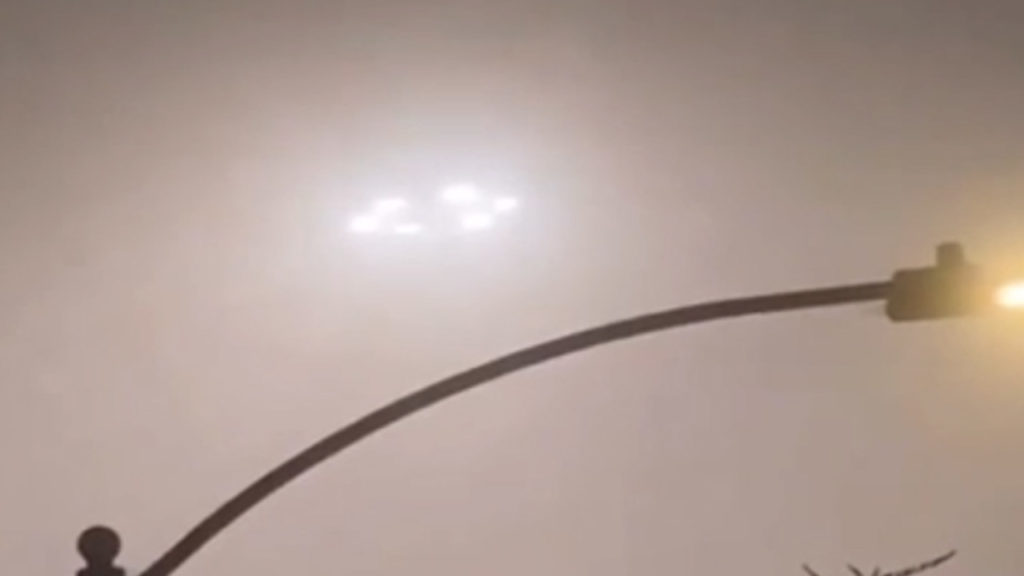
Huge flying saucer filmed over Los Angeles 2 days ago

This huge disc-shaped UFO with eight lights was filmed in the sky above Los Angeles, California on 4th November 2021. What do you think this is?
A “door seems to open” in Antarctica and fuels all kinds of theories


It seems that fans of conspiracy theories have been given a new topic to discuss. Onlookers have already suggested that the structure could be an entrance to the “hollow earth” or a “military cover-up.”
The huge mystery hole located on a remote island in Antarctica has been spotted again on Google Maps, sparking much debate on social media.
The discovery, whose authenticity cannot be verified, was made by the authors of the YouTube channel ThirdPhaseFromTheMoon, who published a video showing what looks like a giant cave.
Two elements continue to intrigue the channel’s hosts: the origins of this strange entrance and its impressive size.
Using Google Maps, Blake and Brett Cousins showed that the cryptic hole first appeared in 2007 only to disappear several months later.
Another detail that astonished the hosts is that such a giant structure, which is 83 meters high and 75 meters wide, did not exist in 2006.
According to the hosts, this cave could house “hundreds, if not thousands, of people”.
Speaking about the origins of this enigmatic hole, Brett Cousins said that it could be the result of a natural event.
His co-host pointed out an unusual structure leading up to the entrance that looked like a staircase or some kind of access.
“It is large enough for spaceships and flying saucers or even the assets of our military to fly into this massive opening. Is this a base? There is no indication that it is a sinkhole, ”said Brett Cousins.
Social media users added even more mystery, with some suggesting that the giant structure could be an entrance to a submarine or a secret government project.
Although other users said it could just be a melt hole.
But the theory that has taken the cake is the one that defend that the structure is actually a door to the depths of the Earth.
‘Right Wing, Red Outfit': New Details Emerge in Latest LAX ‘Jet Pack' SightingThe NBC4 I-Team has obtained new records that add additional detail to the latest reported “jetpack” sighting near LAX. Eric Leonard reports for the NBC4 News on Wednesday, Oct. 6, 2021.
Air traffic control recordings and documents show the latest jetliner pilot to report seeing what looked like a person flying in a jetpack near Los Angeles International Airport offered a description of the flying-person’s clothing, according to records obtained from the FAA by the NBC4 I-Team under the Freedom of Information Act.
A Kalitta Air cargo pilot, using the call sign “Connie 363,” made the most recent report July 29 while lining up for final approach to the south runways at LAX, according to an FAA recording made directly from its communications network.
“Connie 363, possible jet pack man in sight at position Gate,” the pilot said while descending through 5,000 feet near the 710 and 105 freeways.
“Was he off your left or right sir?,” the controller asked.
“Uh, right wing, red outfit,” the pilot replied.
The controller, working from a remote air traffic control center referred to as “So Cal Approach,” then warned other pilots to be on the lookout for the flying object.
“Attention all aircraft use caution for the jetpack. He is just north of the final around 5000 at 'Gate' last reported.”
Minutes later, the same controller asked a FedEx cargo pilot to look for the object.
“FedEx 326 heavy let me know if you see that, uh, jet man. He was reported just up here right just now,” she said.
“I'm looking I have no [inaudible] so far, I’ll let you know, FedEx 326 heavy,” the pilot replied.
“Okay, they're all calling them Iron Man,” the controller said.
The incident was summarized in an FAA “Mandatory Occurrence Report,” which are used to document a variety of unusual events. The initial report, also obtained by the I-Team, said an LA County Sheriff’s Department helicopter crew was notified about the sighting, as it was reported in airspace above an area patrolled by the sheriff’s department.
Minutes later, the same controller, while apparently briefing another air traffic controller, said that no other pilots in the same area at the same time saw anything similar.
“Man in the jet pack was reported right here about 15 minutes ago now and no one else reported them so I think he got scared,” the controller said.
Multiple law enforcement sources have told the I-Team that, to date, no corroborating witnesses or evidence -- like cellphone video -- have been found for the July 2021 report. The first two pilot reports in August and October 2020 have reportedly led to similar dead ends.
The I-Team has confirmed that sometime after the second sighting in 2020 an LAPD helicopter crew recorded video of a flying object that resembled a, “scarecrow,” possibly being carried aloft by balloons. The LAPD denied our request for a copy of the video, which has been shared with both the FBI and FAA.
The FBI said Wednesday there was no new information to share publicly on the case, characterizing it as an open and ongoing investigation.
RELATED VIDEOS, selected and posted by peter2011
NEW ‘ASTROAGRICULTURE’ RESEARCH MAY HAVE JUST SOLVED HOW WE GROW FOOD ON MARS
Is a greenhouse on Mars called… a ‘redhouse?’ While agricultural endeavors on Mars aren’t quite possible yet, scientists have made a discovery that can help us get there.
New research shows that nitrogen-fixing bacteria can help plants grow better in Mars-like soils. This finding, presented in the journal Plos One, by Franklin Harris of Colorado State University and his colleagues, increases the possibility of farming Martian regolith—a necessary achievement if humans are to set up bases on Mars for an extended period of time.
While the colonization of Mars is an increasingly prevalent topic, there are plenty of reasons why it’s still a pipe dream, chief among them is the obvious incompatibility of the planet with our lifestyle as humans. If humans are to survive on Mars, we’d naturally require water and food.
Growing crops on Mars is difficult; the Martian regolith lacks essential plant nutrients and microorganisms, including nitrogen-containing molecules. On Earth, soil bacteria play a crucial role in converting—fixing—atmospheric nitrogen into molecules needed for plant growth.
This research into the performance of plant life on Mars has led scientists to several possibilities, including using hydroponic greenhouses and controlled environmental systems, like in the International Space Station, or even using advanced synthetic biology to engineer whole organisms.
The alternatives for adapting conditions for plant growth require looking to different and non-traditional sources of food, with previous research even suggesting the substitution of food with microbes.
To examine what the introduction of nitrogen-fixing bacteria could do in the field of astroagriculture, the researchers planted clover in man-made regolith that imitated Martian soil. They inoculated some of the plants with the microbe Sinorhizobium meliloti, typically found in clover root nodules.
The experiment showed that the inoculated clover experienced 75% greater roots and shoots growth compared to the uninoculated clover. When researchers tested the soil of the inoculated clover, they found no signs of elevated NH4—a crucial nitrogen-containing molecule for plants—suggesting that the microbes helped the plant more efficiently absorb the nutrient.
This finding implies that while the symbiotic microbes boosted clover growth, they did not produce an excess of nitrogen compounds that other nearby plants could hypothetically use.
“This study shows that nodule forming bacteria Sinorhizobium meliloti has been shown to nodulate in Martian regolith, significantly enhancing growth of clover (Melilotus officinalis) in a greenhouse assay,” the authors write.
“This work increases our understanding of how plant and microbe interactions will help aid efforts to terraform regolith on Mars.”
While this research could potentially alleviate some of the problems posed by the lack of plant nutrients on Mars, there are other hurdles scientists still need to overcome. The Martian regolith isn’t just inadequate for plant growth; it’s also toxic, containing high levels of perchlorate compounds containing chlorine.
This new research suggests that different combinations of symbiotic bacteria could help plants avoid taking in harmful molecules.
Hopefully, with the progression of astroagriculture research, future inhabitants of Mars can enjoy more than just microbes for dinner.
Candy Chan is a journalist based in New York City. She recently graduated from Barnard College with a degree in History. Follow her reporting on her Twitter @candyschan.

RELATED VIDEOS, selected and posted by peter2011
Chicago Woman Spots Black Object Floating in Sky, Footage Leaves UFO Watchers Stumped


The black wishbone shape with wings ending in a sphere, which could be seen in the video, was spotted by Aiyana from her terrace.
(Representational image: Reuters)
This world has a lot of hidden secrets and unanswered questions. Strange and bizarre occurrences often put people and experts in a dilemma. Spotting of Unidentified Flying Objects or UFOs are among these events. In one such incident, a woman from Chicago was “creeped out” when she saw a weird black object floating in the sky, reported Mirror. The woman whose name is Aiyana was left in “total confusion” after spotting the strange shape. The black wishbone shape with wings ending in a sphere, which could be seen in the video, was spotted by Aiyana from her terrace. The report quoted her saying, “I literally have no idea what it was. There is nothing comparable.” She further told that the object seemed like some ball with two long strings attached to it. The strings had knob attached to them in the middle and end.
© Provided by Indiatimes
The report further quoted Aiyana and her son saying that they had no idea what they had seen. They kept seeing the object until it was no more in sight. Aiyana said that the object floated in the south east direction with no significant movement. She added that the shape floated few miles in around 20 minutes.
To seek some clarity as to what that object was, Aiyana’s friend shared the surreal footage online with UFO watchers. But instead of getting any clarification, the UFO watchers themselves got bewildered, watching the object floating so calmly above the “windy city,” the report stated.
One of the watchers said, “I've never seen a balloon just hang still in the open air like that. It should bob, even if just a little."The watcher added that this could happen only if there was absolutely no wind.
Another watcher stumped by the footage said that they had no explanation. The person said that it seemed like some object hanging from a helicopter, sans helicopter.
One of them ruled out the possibility of the object being a balloon or rooftop antenna covered by clouds.
Read all the Latest News, Breaking News and Coronavirus News here. Follow us on Facebook, Twitter and Telegram.
RELATED VIDEOS, selected and posted by peter2011
THESE 4 TECHNOLOGIES CAN SAVE HUMANITY FROM A ‘GLOBAL WARMING HELL WORLD’
ALS HET AAN WETENSCHAPPERS LIGT, GAAN BACTERIËN RAKETBRANDSTOF KNUTSELEN OP MARS

GERELATEERDE VIDEO'S, uitgekozen en gepost door peter2011 (eng)
Watch: Dashcam Video From Canadian Cops' UFO Sighting Surfaces OnlineWatch: Dashcam Video From Canadian Cops' UFO Sighting Surfaces Online
By Tim Binnall
An odd video said to be dashcam footage from a UFO sighting reported by police in Canada over a decade ago has surfaced online. The material allegedly comes from a case that occurred on April 24th, 2011 in the city of Selkirk, Manitoba and was obtained by the website Vice from "a government source with knowledge of the incident." The sighting in question centered around what officers described as "an unidentified bright yellow and orange light traveling west to east" at around 2:15 in the morning. The witnesses also asserted that they were familiar with conventional aircraft and insisted that the object was no such thing.
The case was apparently intriguing enough that it wound up being sent to NORAD as well as Canada's federal transportation department, which included a post about it in their Civil Aviation Daily Occurrence Reporting System (CADORS). Alas, as with so many intriguing UFO sightings, that appears to be where the official investigation ended with no clear answer as to what the mysterious craft might have been. This dead-end is reportedly what prompted Vice's source to share the video with the website after all these years. However, the origins and nature of the footage far outweigh what can be seen on screen which is, sadly, not particularly fantastic.
In the video, a glowing ball of light can be seen slowly ascending in the sky over the city of Sekirk with no response from the officers watching the scene unfold. Opinions on the decade-old footage seems to largely fall into two camps: that the object was a plane or, failing that, a lantern. The latter theory has been met with skepticism since the possibility of a solitary lantern floating over the community at that time of night seems doubtful. However, the possibility that the UFO was a plane does seem plausible considering its trajectory in the video. That said, ten years later, the true nature of the peculiar object remains a mystery. With that in mind, what's your take on the intriguing footage? Share your thoughts with us at the C2C Facebook page.