Ontdek de Fascinerende Wereld van UFO's en UAP's: Jouw Bron voor Onthullende Informatie!
Ben jij ook gefascineerd door het onbekende? Wil je meer weten over UFO's en UAP's, niet alleen in België, maar over de hele wereld? Dan ben je op de juiste plek!
België: Het Kloppend Hart van UFO-onderzoek
In België is BUFON (Belgisch UFO-Netwerk) dé autoriteit op het gebied van UFO-onderzoek. Voor betrouwbare en objectieve informatie over deze intrigerende fenomenen, bezoek je zeker onze Facebook-pagina en deze blog. Maar dat is nog niet alles! Ontdek ook het Belgisch UFO-meldpunt en Caelestia, twee organisaties die diepgaand onderzoek verrichten, al zijn ze soms kritisch of sceptisch.
Nederland: Een Schat aan Informatie
Voor onze Nederlandse buren is er de schitterende website www.ufowijzer.nl, beheerd door Paul Harmans. Deze site biedt een schat aan informatie en artikelen die je niet wilt missen!
Internationaal: MUFON - De Wereldwijde Autoriteit
Neem ook een kijkje bij MUFON (Mutual UFO Network Inc.), een gerenommeerde Amerikaanse UFO-vereniging met afdelingen in de VS en wereldwijd. MUFON is toegewijd aan de wetenschappelijke en analytische studie van het UFO-fenomeen, en hun maandelijkse tijdschrift, The MUFON UFO-Journal, is een must-read voor elke UFO-enthousiasteling. Bezoek hun website op www.mufon.com voor meer informatie.
Samenwerking en Toekomstvisie
Sinds 1 februari 2020 is Pieter niet alleen ex-president van BUFON, maar ook de voormalige nationale directeur van MUFON in Vlaanderen en Nederland. Dit creëert een sterke samenwerking met de Franse MUFON Reseau MUFON/EUROP, wat ons in staat stelt om nog meer waardevolle inzichten te delen.
Let op: Nepprofielen en Nieuwe Groeperingen
Pas op voor een nieuwe groepering die zich ook BUFON noemt, maar geen enkele connectie heeft met onze gevestigde organisatie. Hoewel zij de naam geregistreerd hebben, kunnen ze het rijke verleden en de expertise van onze groep niet evenaren. We wensen hen veel succes, maar we blijven de autoriteit in UFO-onderzoek!
Blijf Op De Hoogte!
Wil jij de laatste nieuwtjes over UFO's, ruimtevaart, archeologie, en meer? Volg ons dan en duik samen met ons in de fascinerende wereld van het onbekende! Sluit je aan bij de gemeenschap van nieuwsgierige geesten die net als jij verlangen naar antwoorden en avonturen in de sterren!
Heb je vragen of wil je meer weten? Aarzel dan niet om contact met ons op te nemen! Samen ontrafelen we het mysterie van de lucht en daarbuiten.
Donderdag 23 december 2021
Snow is glowing in the Russian Arctic. The culprit? Tiny sea creatures.
Researchers found marine copepods in the snow near the White Sea Biological Station in the Russian Arctic emitting a bright blue glow, in the first sighting of its kind.
PHOTOGRAPH BY ALEXANDER SEMENOV / WHITE SEA BIOLOGICAL STATION (WSBS MSU)
Snow is glowing in the Russian Arctic. The culprit? Tiny sea creatures.
Tiny bioluminescent animals called copepods recently lit up the snow near a remote field station, in the first documented sighting of its kind.
BY ELIZABETH ANNE BROWN
High in the Russian Arctic, at a remote field station on the shores of the White Sea, biologist Vera Emelianenko set out for a walk on a frigid December night. With her were Mikhail Neretin, the son of the station’s molecular biologist, and a couple dogs: a giant schnauzer and soft-coated Wheaten terrier.
Trudging along the icy embankments of the tidal zone in fierce Arctic winds, Neretin spotted a blue illumination in a snowbank. Had Emelianenko dropped her phone?
As they walked over to investigate, their footsteps created streaks of ethereal blue. “They were like blue Christmas lights in the snow,” Emelianenko says.
The washed-up plankton started to glow when disturbed by the scientists’ footsteps, during a nighttime walk through the snow.
PHOTOGRAPH BY ALEXANDER SEMENOV / WHITE SEA BIOLOGICAL STATION (WSBS MSU)
She bent down to scoop up a handful. With a gentle squeeze, the snowball glowed brighter. The dogs left a glowing trail as they raced ahead, as though the Northern Lights had seeped from sky to snow.
After a flurry of phone calls and texted photographs, the station’s biologists and a group of marine scientists across Russia were buzzing over the find. Emelianenko and Neretin took the station photographer, Alexander Semenov, out to document the lights. “We stomped the ground all together for maybe two hours” to get the spots to shine, Semenov says.
The next day, Emelianenko slipped a glowing snowball under a stereo microscope to try to identify the bioluminescent culprit. As she waited for the ice to melt away, she prodded miniscule detritus with a needle to no avail. But then Emelianenko spotted some copepods, tiny aquatic crustaceans, in the slushy petri dish. When she poked them, they shone a faint blue.
This may be the first documented explanation for glowing snow in the Arctic, which has been observed occasionally by researchers over the years but not been rigorously tested.
Copepod life history
Copepods are miniscule crustaceans just a few millimeters long, about the size of several grains of sand in a row. “They’re the bugs of the sea,” explains Steven Haddock, a marine biologist studying deep-sea zooplankton at the Monterey Bay Aquarium Research Institute. “They’re small and numerous, they’re eaten by a lot of things.”
While they don’t exactly get a lot of press or cultural representation (with the notable exception of Plankton, a copepod in SpongeBob SquarePants), copepods make up the plurality of biomass in the ocean, according to some estimates. They’re passive swimmers, meaning they can’t resist the currents. This particular species of copepod—Metridia longa—is tossed around the oceans from Canada’s Hudson Strait to the waters of Maine and all across the Arctic.
Even so, Metridia have no business on the shores of the White Sea, says Ksenia Kosobokova, an expert on Arctic marine zooplankton at Russia’s Academy of Science in Moscow. They’re usually found farther out in the ocean, migrating to depths of 80 to 300 feet during the day and ascending to a few feet from the surface during the darkness of night (which, in the winter, is most of the time), Kosobokova explains.
What must have occurred, Kosobokova says, is that the copepods were caught in a powerful current. Twice a day when the White Sea’s rising tide sweeps ashore, the frigid water and everything in it is sluiced through cracks in the ice and snow. For weak swimmers like copepods, there’s no escape.
It could be that tides were particularly strong on the day of the first sighting, December 1—the moon was almost new and three days away from 2021’s closest perigee, the time when the moon is nearest to the earth. Both conditions make for stronger tides. But a second round of sightings on December 16 suggest that it may not take a once-in-a-year lunar cycle to create conditions for the glowing snow.
How the copepod got its glow
Most bioluminescence is produced when a small energy-storing molecule called luciferin is oxidized. On its own, luciferin produces a very faint, steady glow. But combined with the enzyme luciferase, the reaction is sped up, and that glow becomes a dramatic burst.
“So we have these two molecules inside of them, a light emitter and an accelerator,” Haddock explains. For some copepods, the luciferin and luciferase react internally, but Metridia longa has glands on its head and body to secrete its incandescence into the world. “They’ll shoot out those two molecules at the same time and form a little puff of light in the water.” (Learn more: How bioluminescence works in nature.)
Scientists believe Metridia and other copepods use bioluminescence as a defense. “One idea is that the light could startle predators and cause them to spit out the copepod” or distract them long enough for the copepod to escape, says Todd Oakley, a professor of evolutionary ecology and marine biology at the University of California Santa Barbara.
Ghostly lights
Kosobokova figures the copepods nestled in the snow were fading but alive—after all, Arctic plankton are no strangers to freezing temperatures. But bioluminescence experts say they may well have been dead—making their blue glow somewhat ghostly.
As many ham-handed children are sad to learn, fireflies still glow if you accidentally squish them.
“It happens for us with our scientific specimens,” Haddock adds. “You collect an organism and you put it in the freezer for later study. And then when you pull it out, it will slowly start to glow—the chemicals that are inside of their bodies are still perfectly capable of reacting.”
Emily Lau, a graduate student at UCSB, studies the biochemistry of bioluminescence in fishes and the copepod’s crustacean cousin the ostracod. They look like sesame seeds with eyeballs. “People can dry them, and then you can still crush them in the water after they’re dead and they will produce bioluminescence,” she explains.
“As long as that small molecule luciferin is present, then the bioluminescence is going to occur,” Lau says.
Jørgen Berge, a professor at the Arctic University of Norway who studies polar night and arctic marine ecosystems, says it may be too early to give copepods credit for the light show. Berge has observed similar deposits in the snow on the shores of the Norwegian archipelago Svalbard, which he believes are better explained by clumps of dinoflagellates, single-celled algae that also bioluminesce (although he hasn’t tested the spots to identify their composition.)
Dinoflagellates are behind many spectacular marine displays of bioluminescence—like the “phosphorescent bays” of Puerto Rico, where bathers can splash each other with light, or the dolphins that leave ethereal glowing trails off the coast of California. (Related: This deep-sea shark is one of the world’s largest glowing animals.)
“It’s very easy to direct your attention to the larger organisms [in a sample],” Berge explains. But identifying a creature capable of bioluminescence in the sample doesn’t mean another, less obvious creature isn’t responsible. However, Berge agrees that the lights are particularly bright, even for dinoflagellates.
Perhaps what’s most surprising is that glowing snow had not been seen before at a biological station that’s been active for over 80 years—only to be spotted by Emelianenko, 24, and Neretin, 18. That could be because most folks don’t go for leisurely December strolls in the Arctic night, Kosobokova says. It’s not very hospitable. “We also get bears and wolves up here,” Semenov adds.
But the young biologists’ keen eyes and tolerance for cold was rewarded. “There’s so many mysteries out there if you’re willing to have a childlike curiosity,” Haddock says.
Semenov agrees. “You never expect that there will be beauty right under your nose that you haven’t realized can exist.”
Antarctica New Discovery! Scientists Have Just Found The Deepest Hole There & Couldn't Believe What They Found Inside
Scientists have just found the deepest hole in Antarctica & couldn’t believe what they found inside. Today, we take a look at this recent Antarctica discovery. There are mysteries all around us, and we are fascinated by what we cannot understand. Inexplicable phenomena are discovered every day, keeping our curiosity piqued and the prospect of actually knowing the world around us a foreign concept.
Researchers exploring the Ellsworth Sub glacial Highlands, an ancient mountain range buried beneath miles and miles of Antarctic ice, have discovered a pit deeper than The Grand Canyon. The incredible find was discovered by combining data provided by aircraft satellites, with ice-penetrating radar technology towed by snowmobiles.
Thank you for watching! Thank you to CO.AG for the background music!
Skinwalker Ranch: What Is The Secret? Full Documentary
Skinwalker Ranch: What Is The Secret? Full Documentary
Skinwalker Ranch, also known as Sherman Ranch, is a property located on approximately 512 acres southeast of Ballard, Utah, that is reputed to be the site of paranormal and UFO-related activities. Its name is taken from the skin-walker of Navajo legend concerning vengeful shaman. Wikipedia
Tower Found On Saturn Moon Hyperion, Photos, UFO Sighting News.
Date of discovery:Dec 23, 2021
Mission: Cassini Location of discovery: Saturn moon Hyperion
While running through the Saturn moon index I came across a few photos that revealed a dark twisted tower on the far right of the moon. The tower almost looks like a human body without a head, standing on two human like legs. It's strange, it's weird, but it's what it is. Being near saturn and near the rings, this long tower is most likely an engine to propel the moon away from the rings to keep the rings beautiful. Saturns rings has an almost religious nature to it. One that is both sacred and holy. Thus they protect it.
Object Falls From Space, Enters Volcano In Mexico! Live Cam Footage, UFO Sighting News.
Date of sighting: December 10, 2021
Location of sighting: Volcano Popocatepetl, Mexico
This video was recorded straight from the live cam. The volcano is located not far from Mexico City. A UFO was caught moving very slowly, falling almost directly into the mouth of the volcano. It entered the left side of the volcano, where there is a known vent. The vent in that location often spews ash, lava and clouds every week. Thats the opening I believe this UFO entered. I have long said that there is an alien base below Popocatepetl volcano. Not only have UFOs been seen passing over, around and into the volcano, but they have also been recorded exiting the mouth. There has even been sightings by the locals of 7 foot hairy beings with huge spikes on their heels of the feet seen climbing up the volcano side without any mounting climbing equipment. The proof is mounting, soon aliens will choose to reveal themselves to the world. Are you ready? I know I am.
Orb Over Longmont, Colorado Dec 18, 2021, UFO Sighting News.
Date of sighting: Dec 18, 2021
Location of sighting: Longmont, Colorado, USA
Source: MUFON
What looks like a quiet small UFO is actually very special. This is one of the famous glowing orb UFOs in Colorado. They have been witnessed by thousands of people and gov officials in Colorado, so this is one very special report. I have heard so much about them, police, mayors witnessing them and this video actually has one moving slowly over the city of Longmont, Colorado. It's certainly taking its sweet time and I love that it is, because it's gives us a better view of it, its movement, its color, it's orb shape. This alien pilot either didn't know he was uncloaked or just didn't care. Most often recorded over Denver near the Rocky mountains, this UFO may be heading to that mountain range where I believe an alien base sits 6km below its surface. There even seems to be a window area at the front of it when I put the screenshot into negative formate and add light.
Scott C. Waring - Taiwan
Eyewitness states:
We were taping the sunset and when we watched it we say the strange light and say that it moved kinda weird. We always watch the jets, but this was definitely not a jet. We have a video of it and it is very interesting. We would like to have your opinion. If you watch it it appears and hovers.Then it moves up.
Two Glowing Objects Marion, Ohio, Dec 16, 2021, UFO Sighting News.
Date of sighting: Dec 16, 2021
Location of sighting: Marion, Ohio, USA
Source:MUFON
Now this is an eyeopening video, however I have a problem with it. The two glowing UFOs seem to pass behind the house in the first 10 seconds, but at the 35 second mark both UFOs pass in front of a light pole alone the road. That should be impossible. For that to happen would mean the lights are coming from behind the person recording the video and reflecting off the front window of the car...as he records. I feel this is 100% fake. Also compounded by the fact the eyewitness statement was only five words, when such an amazing event took place. Odd. Thats just my personal opinion, but it's how I see it and wanted to share it with you in case you see this video out there circulating.
The Anunnaki: They Created the first Human on Earth
445 000 years ago, “creator gods” – as they call it – came to Earth. They were called the Anunnaki, which means “Those Who from Heaven to Earth Came”. These beings inhabited a distant orbiting planet called Nibiru, which only entered our solar system every 3,600 years. They describe Nibiru as many times the diameter of Earth, and abundant with iron oxide, making its rivers and lakes appear red. A side note about Nibiru: according to the Sumerian tablets, Nibiru’s atmosphere began to deteriorate and became a hostile place for life, and in order to restore it, the Annunaki needed one important element for their atmosphere: gold. Scenes from the following productions were used under Fair Use for educational purposes: History Channel's Ancient Aliens PBS NOVA's Secrets of Noah's Ark 2015 Ancient Sumerian
The first studies conducted on the Ryugu asteroid samples have revealed some very interesting facts. Thanks to the Japan Aerospace Exploration Agency’s Hayabusa 2 spacecraft, scientists have 5.4 grams of material from the asteroid to study and they found that the diamond-shaped Ryugu is more porous and darker than originally thought.
µIt is believed that the samples contain materials from the outer Solar System. This suggests that the researchers could have the some of the most pristine samples from when the Solar System was in its very early stages and before Earth even formed.
Two papers regarding the findings of the samples have been published in Nature Astronomy. The first paper revealed that the samples reflect only 2% of light. Additionally, it is extremely fragile and is approximately 50% more porous than carbonaceous chondrite meteorites that have previously hit our planet. The paper went into further details by reading in part, “Such high-microporosity materials have not been discovered in any meteorites found on Earth probably due to break-up owing to their fragile nature during entry into the Earth’s atmosphere.”
The second paper discussed the chemical analysis of the samples by announcing that there are numerous volatile organic compounds that are present in the material, such as non-water molecules created by oxygen as well as hydrogen atoms that are called hydroxyls that probably came from the outer part of the Solar System.
While the results are very interesting and significant, these are just the first studies that have been conducted on the samples, so much more information will be found out upon further analysis. Scientists are also waiting for the returned samples from asteroid Bennu in 2023 as they will then be able to compare them both.
(Not Ryugu or Bennu)
The analysis of both Ryugu and Bennu samples will be very crucial as stated by JAXA scientist Toru Yada in an interview with Inverse, “Because reflectance spectra and colors of surface rocks on Bennu look different from those of Ryugu, I expect that different kinds of samples will be returned from Bennu.”
While Ryugu measures 3,280 feet in diameter, Bennu is much smaller with a diameter of 1,610 feet. Bennu does pose a threat to Earth with a 1 in 1,750 chance of hitting us through the year 2300, although scientists have stated that they are not worried about an impact. However, when it will fly past our planet in September of 2135, it will be close enough that Earth’s gravity might possibly change its trajectory.
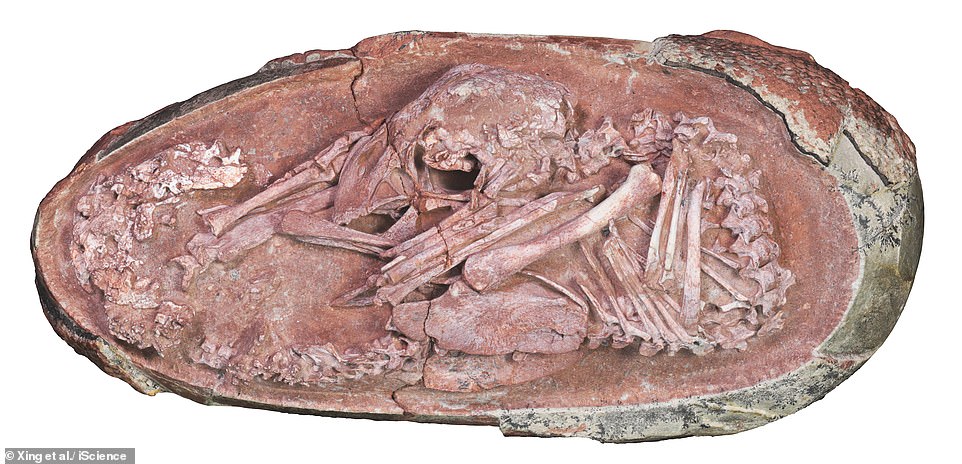
An exquisitely preserved dinosaur embryo has been found curled up inside a fossilised egg, unearthed in southern China, dating back some 66–72 million years.
The embryo has been dubbed 'Baby Yingliang' and was found in the rocks of the 'Hekou Formation' at the Shahe Industrial Park in Ganzhou City, Jiangxi Province.
Palaeontologists led from the University of Birmingham said that Baby Yingliang belonged to species of toothless, beaked theropod dinosaurs, or 'oviraptorosaurs'.
Oviraptors, which were feathered, are found in the rocks of Asia and North America and had varied beaks and body sizes allowing them to adopt a wide range of diets.
The specimen is one of the most complete dino embryos known and notably sports a posture closer to those seen in embryonic birds than usually found in dinosaurs.
Specifically, Baby Yingliang was close to hatching, and had its head below its body, its back curled into the egg's blunt end and its feet positioned either side of it.
In modern birds, such a posture is assumed during 'tucking' — an embryo behaviour controlled by the central nervous system that is critical for a successful hatching.
The discovery of such behaviour in Baby Yingliang suggests that this is not unique to birds, but may instead have first evolved among the non-avian theropod dinosaurs.
Scroll down for video
An exquisitely preserved dinosaur embryo has been found curled up inside a fossilised egg (pictured), unearthed in southern China, dating back some 66–72 million years
Palaeontologists led from the University of Birmingham said that Baby Yingliang (depicted in this artist's impression) belonged to species of toothless, beaked theropod dinosaurs
BABY YINGLIANG STATISTICS
Age: 72–66 million years old
Locality: Ganzhou City, China
Type: Oviraptorosaur
Length: 10.6'' (27 cm) head-to-tail
Egg size: 6.7'' (17 cm) -long
The study was conducted by vertebrate palaeontologist Fion Waisum Ma of the University of Birmingham and her colleagues.
'Dinosaur embryos are some of the rarest fossils and most of them are incomplete with the bones dislocated,' Ms Ma said.
'We are very excited about the discovery of "Baby Yingliang" — it is preserved in a great condition and helps us answer a lot of questions about dinosaur growth and reproduction with it.
'It is interesting to see this dinosaur embryo and a chicken embryo pose in a similar way inside the egg, which possibly indicates similar prehatching behaviours.'
Baby Yingliang takes its nickname from the Yingliang Stone Nature History Museum in Xiamen, among whose fossil collections it is held.
The researchers believe that the embryonic oviraptorosaur would have been some 10.6 inches (27 cm) from head to tail, but was developing curled inside a 6.7 inch (17 cm) -long egg.
'This dinosaur embryo was acquired by the director of Yingliang Group, Mr Liang Liu, as suspected egg fossils around the year 2000,' said paper author and palaeontologist Lida Xing of the China University of Geosciences in Beijing.
'During the construction of Yingliang Stone Nature History Museum in the 2010s, museum staff sorted through the storage and discovered the specimens.
'These specimens were identified as dinosaur egg fossils. Fossil preparation was conducted and eventually unveiled the embryo hidden inside the egg.
'This is how "Baby Yingliang" was brought to light.'
The specimen is one of the most complete dino embryos known and notably sports a posture closer to those seen in embryonic birds than usually found in dinosaurs. Specifically, Baby Yingliang — who was close to hatching — had its head below its body, its back curled into the egg's blunt end and its feet positioned either side of it
'It is interesting to see this dinosaur embryo (pictured) and a chicken embryo pose in a similar way inside the egg, which possibly indicates similar prehatching behaviours,' said vertebrate palaeontologist Fion Waisum Ma of the University of Birmingham
'This dinosaur embryo inside its egg is one of the most beautiful fossils I have ever seen,' said paper co-author and vertebrate palaeontologist Steve Brusatte of the University of Edinburgh.
'This little prenatal dinosaur looks just like a baby bird curled in its egg, which is yet more evidence that many features characteristic of today’s birds first evolved in their dinosaur ancestors.'
The full findings of the study were published in the journal iScience.
The embryo — which has been dubbed 'Baby Yingliang' — was found in the rocks of the 'Hekou Formation' at the Shahe Industrial Park in Ganzhou City, Jiangxi Province
HOW THE DINOSAURS WENT EXTINCT AROUND 66 MILLION YEARS AGO
Dinosaurs ruled and dominated Earth around 66 million years ago, before they suddenly went extinct.
The Cretaceous-Tertiary extinction event is the name given to this mass extinction.
It was believed for many years that the changing climate destroyed the food chain of the huge reptiles.
In the 1980s, paleontologists discovered a layer of iridium.
This is an element that is rare on Earth but is found in vast quantities in space.
When this was dated, it coincided precisely with when the dinosaurs disappeared from the fossil record.
A decade later, scientists uncovered the massive Chicxulub Crater at the tip of Mexico’s Yucatán Peninsula, which dates to the period in question.
Scientific consensus now says that these two factors are linked and they were both probably caused by an enormous asteroid crashing to Earth.
With the projected size and impact velocity, the collision would have caused an enormous shock-wave and likely triggered seismic activity.
The fallout would have created plumes of ash that likely covered all of the planet and made it impossible for dinosaurs to survive.
Other animals and plant species had a shorter time-span between generations which allowed them to survive.
There are several other theories as to what caused the demise of the famous animals.
One early theory was that small mammals ate dinosaur eggs and another proposes that toxic angiosperms (flowering plants) killed them off.
70 miljoen jaar oud en perfect bewaard embryo van dinosaurus ontdekt
In Ganzhou, een stad in het Zuiden van China, is een wel heel bijzondere ontdekking gedaan. Zo werd een 70 miljoen jaar oud dinosaurusembryo teruggevonden. Wat het nog bijzonderder maakt, is dat het embryo zo goed als perfect bewaard is gebleven.
Baby Yingliang, zo werd het embryo genoemd, stond zo’n 70 miljoen jaar geleden op het punt om uit zijn schaal te breken, toen hij vermoedelijk bedolven raakte onder een modderstroom. Dit heeft er voor gezorgd dat hij al die jaren zo goed bewaard is kunnen blijven. Volgens wetenschapsjournalist Martijn Peters is dit erg bijzonder, vaak raken dinosaurusembryo’s immers beschadigd of ontbreken er delen. Van hoofd tot staart meet de kleine dinosaurus 27 centimeter en hij zit opgerold in een ei van 17 centimeter.
Baby Yingliang was een oviraptorosaurus, wat letterlijk een “eierdiefhagedis” betekent. Deze gevederde dinosaurussen leefden in Azië en Noord-Amerika tijdens het Krijttijdperk, dat is zo'n 145 tot 66 miljoen jaar geleden. De vormen van hun snavels kunnen variëren, maar ze staan toch vooral bekend om hun papegaaiachtige bek. Ook in lengte waren er grote verschillen binnen deze dinosaurussoort. De kleinste variant valt qua grootte te vergelijken met de hedendaagse kalkoen, terwijl de meest uit de kluiten gewassen oviraptorosaurus tot 8 meter lang kon worden. Baby Yingliang was volgens de onderzoekers vermoedelijk 2 tot 3 meter groot geworden, als hij zijn volwassen leeftijd had bereikt.
Volgens Fion Waisum Ma, onderzoeker aan de Universiteit van Birmingham, is dit een van de best bewaarde embryo’s ooit ontdekt. Ook geeft baby Yingliang de onderzoekers meer inzicht in de link tussen dinosaurussen en vogels vandaag. Zo lag zijn kopje onder zijn lichaam en waren zijn pootjes opgekruld naast zijn rug. Deze houding zien we ook bij hedendaagse ongeboren kuikens, maar is voor dinosaurussen uniek.
Vergeten in opslagruimte
Baby Yingliang was eigenlijk al ontdekt in 2000, maar raakte in vergetelheid toen hij in de opslagruimte van het museum waar hij bewaard werd belandde. Toen het museum recentelijk aan verbouwingswerken begon, herontdekten wetenschappers het bestaan van het embryo. Wie baby Yinglang een bezoekje wil brengen, kan terecht in het Yingliang Stone Natural History Museum in China.
Another Structure on Jupiter Moon Europa, Photos, UFO Sighting News.
Date of discovery: Dec 22, 2021
Location of discovery:Jupiter Moon Europa
Look carefully at this structure and you will soon notice that its on a separate foundation from that of the ground. There is also some walls around its edges and even main structures upon it. Not far is a huge tunnel that leads directly up to the city. You can see the tunnel hot straight and then break off into many other smaller tunnels. To me, this is an alien structure, built by intelligent beings far beyond our own abilities. The structure has some similarities to our own, but many differences too. I believe it to be grown, a bio-mechanical structure that was grown to save time so that aliens could use it.
Odd Structure on the Jupiter moon Europa #astronomy #astrophysics #jupiter #tunnels #ufosighting UFO Sighting News.
Date of discovery: Dec 22, 2021 Location of discovery: Europa, moon of Jupiter Source:Secret
I was going through an old index I have recently discovered and found this odd white egg shaped structure on the moon Europa. The center top of the structure is open and the sides are curved like a flower that is partly open. Its the only such object with such a unique shape and size. This object is several km tall and over 5km wide. The chances of this being an alien base is very high. The tall white walls are there to protect the city. Absolutely amazing!
On December 17, 2021 NASA's satellite SDO AIA171 captured a huge cylinder-shaped unidentified flying object seemly leaving the sun's surface at a tremendous speed.
It's said that it is impossible to get that close to the sun, yet extraterrestrials are millions of years ahead of us with their technology. A technology so advanced that their ships might also be able to withstand the heat of the sun.
To date, it is not known why these ships come so close to the surface of the sun.
These two bright UFOs were filmed in the night sky above Marion, a city in and the county seat of Marion County, Ohio. This happened on 16th December 2021.
Located near the village of Shiyan Beicun in Zhejiang province, China, lie the Longyou Caves - an extensive, magnificent and rare ancient underground world considered in China to be “the ninth wonder of the ancient world.” Thought to date back at least 2,000 years, the Longyou Caves, also known as the Xiaonanhai Stone Chambers, represent one of the largest underground excavations of ancient times and are an enduring mystery that have perplexed experts from every discipline that has examined them.
Scientists from around the world in the fields of archaeology, architecture, engineering, and geology have absolutely no idea how the Longyou Caves were built, by whom, and why. First discovered in 1992 by a local villager who set out to drain some ponds which locals believed to be bottomless, to date 24 hand-carved caves have been discovered covering a massive 30,000 square meters (322,917 ft sq).
Carved into solid siltstone, each grotto descends around 30 meters (98 ft) underground and contains stone rooms, bridges, gutters and pools. Within the Longyou Caves there are pillars evenly distributed throughout the caves which are supporting the ceiling, and the walls, ceiling and stone columns are uniformly decorated with chisel marks in a series of parallel lines.
Only one of the caves has been opened for tourism, chosen because of the stone carvings found inside which depict a horse, fish and bird. The Longyou Caves of Zhejiang province in China truly are an enigma and here we will explore ten enduring mysteries that remain unresolved, despite more than two decades of research.
A rough estimation of the workload involved in building the Longyou Caves is awe-inspiring. The quantity of rock that would have been removed in the overall excavation of the grottoes is estimated to be nearly 1,000,000 cubic meters (35,314,666 cu ft). Taking into account the average digging rate per day per person, scientists have calculated that it would take 1,000 people working day and night for six years to complete.
These calculations are based purely on hard labor, but what they haven’t taken into account is the incredible care and precision of the sculptors, meaning that the actual workload would far surpass the theoretical estimation. As for how they were constructed and what tools were used, it is still unknown. No tools have been found in the area, and, as we will explore later, scientists still don’t know how they achieved such symmetry, precision, and similarity between the different caves.
2. No Traces of Construction
Despite their size and the effort involved in creating them, so far no trace of their construction, or even their existence, has been located archival sources. Although the overall excavation involved almost a million cubic meters of stone, there is no archaeological evidence revealing where that quantity of stone went, and no evidence of the work. Moreover, there is not a single historic document that refers to them, which is highly unusual considering the sheer scale of the project. The origin of the Longyou Caves is a complete and utter mystery.
Experts wonder why the walls at the Longyou Caves in China are covered in chiseled parallel lines.
Every single one of the Longyou Caves is covered, from floor to ceiling, in parallel lines that have been chiseled into virtually every surface. The effect is a uniform pattern throughout the caves, which would have required immense manpower and endless hours to create. The question is why? Was such labor-intensive work purely for decoration? Are the lines or patterns symbolic in some way? All that is currently known is that the markings are similar to those found on pottery housed in a nearby museum, which is dated between 500 and 800 BC.
4. Lack of Fish in the Longyou Caves
When the caves were first discovered, they were filled with water, which presumably had been there for a long period of time. They had to be pumped out in order to realize that these were not just like the other “bottomless ponds” found within the area, but rather man-made structures. Most villages in southern China contain very deep ponds, which have been called "bottomless ponds" by generations of villagers. These ponds teem with fish, which are easily caught. However, after the first cave was pumped dry, not a single fish was to be seen, or any other sign of life.
5. How Did the Longyou Caves Remain So Well Preserved?
One of the most interesting and challenging questions is how the Longyou Caves have been able to keep their structural integrity for more than 2,000 years. There are no signs of collapse, no piles of rubble, and no damage despite the fact that in some areas the walls are only 50 centimeters (20 in) thick. Over the centuries, the area has gone through numerous floods, calamities and wars, the mountains have changed their appearance and exposed stones have been weathered, but inside the Longyou Caves, the form, patterns and markings are still clear and precise – it is as though they were built yesterday.
6. How Did the Builders Work in the Dark?
Due to the great depths of the caves, some areas at the bottom, which are not exposed to the opening above, are pitch-black. Yet even those dark areas are decorated with thousands of parallel lines on the walls, columns, and ceiling. So how did ancient people work in the dark?
According to Jia Gang, a Tongji University professor specializing in civil engineering: "There should be lamps, because the cave's mouth is very small, and the sunbeam could only shine in the cave at a certain angle during a certain period of time. As one goes deeper into the cave, the light becomes dimmer. At the cave's bottom, which is usually dozen of meters from the mouth, one could hardly see anything." However, this was at least two millennia ago and nothing that could have been used for lighting has been found.
7. Were the Longyou Caves Meant to be Connected?
All of the Longyou Caves are distributed across an area of only one square kilometer (0.38 sq mi). Considering such a high density, one cannot help asking whether some grottoes were meant to be connected. What would be the purpose of making so many separate caves in such a tight area without connecting them? In many areas, the walls between the caves are very thin, only 50 centimeters (20 in), but they were never linked so it appears they were intentionally kept apart. What’s more, many of the Longyou Caves are almost identical to each other.
Geological cross-section of cave 3 (left) and photo showing rock pillars in cave 3 (right).
Nobody has any idea who built the caves. Some scientists have claimed that it was not possible or logical for such as mammoth job to have been undertaken by regular village people. Only the emperor and the leaders could have organized such a huge project, like the construction of the Great Wall , which was built to defend against invasion from the outside world. But if it was commissioned by an Emperor, why are there no historical records of its construction?
9. How Did They Achieve Such Precision?
The scale of the Longyou Caves is magnificent and momentous, the design was delicate and scientific, the construction was sophisticated, and the precision is indicative of superior craftsmanship. The model, pattern and style of each cave is extremely similar. Every grotto is like a grand hall. One side is steep and another side is 45% inclined. The four walls are straight; the edges and corners are clearly demarcated. The chiseling marks within the Longyou Caves are uniform and precise.
"At the bottom of each cave, the ancient [builders] wouldn't be able to see what the others were doing in the next grotto,” explained Yang Hongxun, an expert at the Archaeological Institute of Chinese Academy of Social Sciences. Nevertheless, “the inside of each cave had to be parallel with that of the other, or else the wall would be holed through. Thus the measure apparatus should have been very advanced. There must have been some layout about the sizes, locations, and the distances between the caves beforehand."
With the help of modern equipment and methods, the investigators measured the sizes of the walls, and surprisingly found that the overall construction is extremely accurate. The walls between the caves are of the same thickness in different sections. So how did they achieve this precision? What were their methods?
Stairs leading down into one of the once-submerged Longyou Caves.
Following extensive investigations and study, scientists and scholars have attempted to put forward explanations for the grottoes, but none so far provide a convincing explanation for why they were built and what they were used for.
Some archaeologists have suggested that the grottoes were the tombs of old emperors, emperor halls, or places for storage. But this interpretation is far-fetched. No funeral objects or tombs have been found and no artifacts left behind. If it were used like an emperor’s palace, the caves surely would have been designed differently, with separate rooms for different purposes like entertaining, meeting, and sleeping. But no evidence can be found of this and no traces of habitation have been found.
Another hypothesis is that the Longyou Caves were used for mining and extracting some type of mineral resource. However, mining operations would have required equipment and apparatus to extract the rocks and transport them. Again, no traces of this have been found, nor any evidence of where the rocks were taken. And of course, if the caves were just for mining, why create such intricate decorations on the walls, columns and ceilings?
Finally, some have suggested that these caves were the places for troops to be stationed and that an emperor of the past wanted to keep his soldiers out of view in order to keep his war preparations secret. However, these caves could not have been built in a short period of time. They would have taken many, many years to build so it is unlikely to have been done in preparation for war, which tends to come about much more quickly. Furthermore, there are no signs of people having stayed in the caves.
Despite decades of research, very few answers have emerged to explain the enigma of the Longyou Caves . Our ancient ancestors have achieved many wondrous things throughout history, but this discovery from China is truly an unsolved mystery which has yet to be cracked.
Top image: In China the Longyou Caves are known as the ninth wonder of the ancient world.
Egypt Responds To Elon Musk’s Suggestion The Pyramids Were Built By Aliens
LOUIS W / SHUTTERSTOCK / TWITTER / IFLSCIENCE
Fresh from winning a defamation lawsuit last year after he inexplicably called a British cave explorer involved in the tense rescue of 12 Thai boys trapped in a flooded underground cave system a "pedo guy," Elon Musk has continued to use his Twitter presence for chaotic evil this year.
For example, where many people at the top of successful companies use their platform for important business updates, industry chatter, or else just a bit of fun, earlier this year the Tesla and SpaceX CEO wiped $14 billion off Tesla's value after tweeting "Tesla stock price too high imo". Er, lol?
Now, he's turned his twitter feed into a place for conspiracy theorists to gather, with the baiting post "Aliens built the pyramids obv".
Musk followed up the tweet, clearly a joke but certainly taken seriously by some of his fans, by sharing the true fact that "the Great Pyramid was the tallest structure made by humans for 3,800 years," and sharing a link to Wikipedia. (Though why someone who just made history in a scientific field feels the need to bait conspiracy theorists online in the first place is baffling.)
Though the tweets were likely tongue-in-cheek, it prompted a response from Egypt's Minister of International Co-operation, Rania al-Mashat, who invited Musk to come to Egypt in order to see the pyramids for himself, and learn how they were actually built.
Normally when somebody tells you "we're waiting for you" at a tomb you do not accept the invite, let's hope this is an exception.
If he were to go, he would discover the pyramids were not built by aliens. Obvs.
Contrary to another popular misconception, they weren't built by slaves either. The current consensus is that they were built by paid laborers, after a worker's village and cemetery on the Khafre and Menkaure pyramids was uncovered in the 1990s.
The manner of burial of the workers – in mud-brick tombs, with beer and bread to take with them to the afterlife – and proximity to the pyramids suggests that the builders were paid workers. Examination of their remains showed that they had a protein-rich diet, which was unheard of at the time. There was evidence that broken bones had been reset, and one person was even found to have had his leg amputated before living for a further 14 years, suggesting they were given medical care.
As for how they were built, the answer is simple: The Ancient Egyptians were skilled engineers, and put a lot of time and a gigantic workforce into the task. The giant blocks were moved by boat, oxen, and may have been dragged on sleds by workers across wet sand, reducing the amount of force they'd need to move the huge stones. If aliens had built the pyramids, it's unlikely you would see the progression that has been found in the pyramids, with engineers using bigger blocks as time went on. It's a bizarre alien civilization that masters interstellar travel, builds one pyramid, before realizing how to dramatically improve their masonry.
Musk later linked to a piece explaining some of the techniques used in the building of the pyramids, perhaps making Egypt's kind offer unnecessary, though clearly a lot of his conspiracy theory-loving fans could do with a visit.
You may have seen my recent article on a UFO incident that occurred on November 8, 1966 – near Shrewsbury, England – and that involved a young woman named Diane Foulkes. Diane had a classic case of UFO-driven “Missing Time.” Notably, U.K. military police descended onto Diane’s home, created a file on the incident, and interviewed her and her parents about the encounter and her lost time. The incident makes for fascinating reading. There’s a reason why I mention this: it’s because I find it very strange that so many people laugh at the idea of government agencies quietly interviewing alien abductees and those with erased minds. Or, rather, briefly erased minds. The fact is, though, this has been going on for a long time. Let’s have a look at some cases. Evidence of serious, government concerns about the real alien abduction phenomenon continued into the 1950s, specifically in 1959. That was the year in which a young American soldier found himself caught up in a very strange saga that, to a degree, still disturbs him to this very day. It all went down on a chilly night in Utah’s expansive desert.Private Bernard Gerry Irwin was the manwhose life took a turn of the decidedly unforeseen type. February 20, 1959 began as a regular day for Irwin, but, it most definitely didn’t end that way. At the time, Irwin was driving to Fort Bliss, Texas, from Idaho – the former being the facility at which Irwin was stationed, and the latter his home state. As night set in, something completely unforeseen and paradigm-shifting happened to Irwin. He was about to be confronted by the UFO phenomenon in spectacular and mysterious fashion.
(Nick Redfern)
The night was dark, silent and all but empty of vehicles. As desert highways so often are well after sunset. But, for Irwin this was a night he would never forget – which is somewhat ironic, as a result of the fact that certain portions of his memory were forever erased from his mind. As he drove along the winding, curving road, Irwin was suddenly distracted by a bright light in the night sky – but at a distinctly low level – which descended below a looming ridge. A meteorite? No. A flare, perhaps? Wrong again. Maybe an aircraft in trouble? That was Irwin’s first thought and, with that in mind, he brought his car to a stop at the side of the road, and turned on the blinkers. He quickly got out, and left a note for passing drivers. It read: Have gone to investigate what looks like a plane crash about one-quarter mile to my right. Notify state police immediately. Wearing his Army coat and armed with a flashlight, Irwin headed off into the unknown. Irwin headed for what he suspected – and feared – just might be the site of a plane crash, only to find himself in an even greater nightmare. The next thing Irwin remembered was waking up in a hospital bed in Cedar City. Where and why, he didn’t know.
Certainly, one of the most notable pieces of evidence that has surfaced via the Freedom of Information Act is a document prepared by a Captain Valentine, who was Irwin’s psychiatrist while he was undergoing treatment for his strange condition. On March 27, 1959, Irwin was injected with sodium amytal. It provoked a strange response from Irwin, which caught Captain Valentine’s deep attention. In his official report on this particular drug-induced session, the captain wrote: “[Irwin] stated there was a ‘special intelligence’ that he couldn’t explain to me, since it would be incomprehensible to me, which has directed him not to remember or not to tell me about any of the events in Utah. He says that if he tells what was behind the incidents in Utah there will be a ‘big investigation’ that he does not want to be bothered with and also because it will harm many people and he doesn’t want that to happen. He states ‘it’ all began at the age of three years,’ although he will not reveal how or what began, stating that it would provide a clue to me as to what is behind all this. Also, he informed me that he could leave this hospital any time if he wanted to by invoking a special force. Following this interview the patient stated he could remember nothing of what he said during it.”
Now, onto another case: Just five months after Betty and Barney Hill’s late night encounter, a similar incident occurred in the U.K. In this case, the witness was a man named Ronald Wildman. It was in the early hours of February 9, 1962 that Wildman had an extraordinary experience, one which led him to fully believe he had seen a UFO at very close quarters: an egg-like thing that put Wildman in a state of amzement. So amazed, and even slightly unsettled, by what occurred, Wildman contacted the local police. It was via the police that the U.K.’s Air Ministry (today, called the Ministry of Defense) came to hear about the story. It turns out that the military learned Wildman had lost a period of missing time. A file, of course, was opened.
The night of October 10, 1973 was one that Calvin Parker and Charles Hickson would not forget. And it all began in a perfectly normal, relaxed fashion. Forty-two-year-old Hickson and Parker – who was nineteen – worked together and often spent time fishing on Mississippi’s Pascagoula River. It was around 9:00 p.m. on a dark and fateful night when their world came tumbling down around them. For a while the fish were biting. It would, however, not be long before the two men would find themselves reeled in. “Hauled in” might be a better piece of terminology. As they sat on the banks of the river, the two could not fail to see that there was an odd, blue, flickering light in the distance – odd in the sense that it seemed to be following the contours of the river, but slightly above it. Both Hickson and Parker stared at it, trying to figure out what on Earth it was. Earth may very well have had nothing to do with it. They wondered: helicopter? But, there was no noise. An aircraft? Way too low and slow. Someone’s idea of a joke? If only. When the strange whatever-it-was got closer, a stark realization quickly hit both men: this was like nothing they had ever seen before. It was a fairly small craft, oval in design, and illuminated – almost glowing. And a vomit-inducing, deep droning sound suddenly enveloped them. Things seemed strange, unreal, dream-like, as the pair tried to scramble away. No such luck: in seconds both Parker and Hickson were rendered almost unable to move.
In no time at all after contacting the police, Parker and Hickson were whisked off to Keesler Air Force Base, which is in Biloxi, on the Mississippi Gulf Coast. They were driven there by a local police-officer: Deputy Tom Huntley, who later made an intriguing statement: “We were in an unmarked car but the guards were expecting us and waved us through the moment I said who I was. I looked back through my rear-view mirror, and damn if two cars full of air police hadn’t fallen in behind us. They had more air police stationed at each crossing all along the road.” Officer Huntley eventually revealed much more, too: on being directed to one particular building, a team of medical personnel were already there, waiting for the arrival of Hickson and Parker. Huntley said that after he and Parker and Hickson were directed into the building, a series of tests quickly began. Of the doctors, Huntley added that they “looked like space creatures – all wrapped in white and masked and gloved.” Both men had a Geiger-counter ran over them. Their fingers and shoes were swabbed – with each swab carefully placed into separate bottles.
All of this tells us that, yes, government agencies do take an interest in “missing time” cases and alien abductions. The events above are just the start of things.
Oudste fossiel ooit van duizendpoot zo groot als een auto ontdekt op Brits strand
“Een volslagen toevalstreffer”, zo noemt Neil Davies van de universiteit van Cambridge het grootste en oudste fossiel van een duizendpoot ooit ontdekt. Wetenschappers botsten op het exemplaar van de uitgestorven ‘Arthropleura’ op het strand van het Engelse Northumberland. Het dier zou meer dan 2,5 meter lang geweest zijn en zo’n 50 kilogram hebben gewogen.
De Arthropleura is een uitgestorven duizendpotigengeslacht dat tijdens het late Carboon leefde. Het fossiel van het exemplaar in Northumberland is 75 centimeter lang en werd voor het eerst gespot in 2018 toen een groot blok zandsteen op het strand van Howick viel. “Door de manier waarop het rotsblok neerkwam, barstte het open en legde zo het fossiel perfect bloot. Een van onze vroegere doctoraatsstudenten zag het toevallig toen hij er langsliep”, zegt Dr. Neil Davies van de universiteit van Cambridge.
De reuzenduizendpoot leefde zo’n 326 miljoen jaar geleden, toen het noordoosten van Engeland nog een veel tropischer klimaat had dan nu. Dat is meer dan 100 miljoen jaar voor het tijdperk van de dinosauriërs. Volgens Davies is het fossiel waarschijnlijk niet afkomstig van een dode Arthropleura, maar van het uitwendige skelet dat de duizendpoot vermoedelijk van zich afwierp tijdens zijn groei. “Fossielen van deze reusachtige duizendpoten vinden, dat is zeldzaam, omdat hun lichamen na hun dood meestal uit elkaar vallen”, legt hij uit. Hij voegt eraan toe dat er nooit een fossiele kop werd gevonden, wat “het moeilijk maakt om er alles over te weten te komen”.
Wél staat vast dat ook deze duizendpoten geen duizend poten hadden. Volgens de onderzoekers telden ze er wel minstens 32 en mogelijk tot zelfs 64. Dat de dieren zo groot konden worden, wijst op erg voedzame eetgewoontes. Mogelijk vulden ze hun maaltijden van noten en zaden aan met kleine beestjes en amfibieën. Dit exemplaar zou tot zo’n 2,7 meter lang geweest zijn, zo groot als een kleine auto.
Het is nog maar de derde Arthropleura ooit gevonden en ook de oudste én de grootste. De twee vorige fossielen werden in Duitsland ontdekt.
De vondst van Northumberland, die werd gepubliceerd in de ‘Journal of the Geological Society’, zal volgend jaar worden tentoongesteld in het Sedgwick Museum in Cambridge. Dankzij deze studie weten we dat Arthropleura het grootse bekende ongewervelde dier aller tijden was. Ze waren nog groter dan oer-zeeschorpioenen, die tot voor kort de grootste bekende geleedpotigen waren.
Meer van UFO'S of UAP'S, ASTRONOMIE, RUIMTEVAART, ARCHEOLOGIE, OUDHEIDKUNDE, SF-SNUFJES EN ANDERE ESOTERISCHE WETENSCHAPPEN - DE ALLERLAATSTE NIEUWTJES


 Snow is glowing in the Russian Arctic. The culprit? Tiny sea creatures.



 Sauropods liked it HOT! Long-necked dinosaurs were...
 That's jaw-some! Theropod dinosaurs evolved more robust jaws...
 Dinosaur faces and feet may have popped with COLOUR to...
 Asteroid that wiped out the dinosaurs 66 million years ago...
 Move aside, Usain Bolt! Theropod dinosaurs could reach...
 Welcome to Italy's 'dinosaur trove'! Remains of up to 11...


