Ontdek de Fascinerende Wereld van UFO's en UAP's: Jouw Bron voor Onthullende Informatie!
Ben jij ook gefascineerd door het onbekende? Wil je meer weten over UFO's en UAP's, niet alleen in België, maar over de hele wereld? Dan ben je op de juiste plek!
België: Het Kloppend Hart van UFO-onderzoek
In België is BUFON (Belgisch UFO-Netwerk) dé autoriteit op het gebied van UFO-onderzoek. Voor betrouwbare en objectieve informatie over deze intrigerende fenomenen, bezoek je zeker onze Facebook-pagina en deze blog. Maar dat is nog niet alles! Ontdek ook het Belgisch UFO-meldpunt en Caelestia, twee organisaties die diepgaand onderzoek verrichten, al zijn ze soms kritisch of sceptisch.
Nederland: Een Schat aan Informatie
Voor onze Nederlandse buren is er de schitterende website www.ufowijzer.nl, beheerd door Paul Harmans. Deze site biedt een schat aan informatie en artikelen die je niet wilt missen!
Internationaal: MUFON - De Wereldwijde Autoriteit
Neem ook een kijkje bij MUFON (Mutual UFO Network Inc.), een gerenommeerde Amerikaanse UFO-vereniging met afdelingen in de VS en wereldwijd. MUFON is toegewijd aan de wetenschappelijke en analytische studie van het UFO-fenomeen, en hun maandelijkse tijdschrift, The MUFON UFO-Journal, is een must-read voor elke UFO-enthousiasteling. Bezoek hun website op www.mufon.com voor meer informatie.
Samenwerking en Toekomstvisie
Sinds 1 februari 2020 is Pieter niet alleen ex-president van BUFON, maar ook de voormalige nationale directeur van MUFON in Vlaanderen en Nederland. Dit creëert een sterke samenwerking met de Franse MUFON Reseau MUFON/EUROP, wat ons in staat stelt om nog meer waardevolle inzichten te delen.
Let op: Nepprofielen en Nieuwe Groeperingen
Pas op voor een nieuwe groepering die zich ook BUFON noemt, maar geen enkele connectie heeft met onze gevestigde organisatie. Hoewel zij de naam geregistreerd hebben, kunnen ze het rijke verleden en de expertise van onze groep niet evenaren. We wensen hen veel succes, maar we blijven de autoriteit in UFO-onderzoek!
Blijf Op De Hoogte!
Wil jij de laatste nieuwtjes over UFO's, ruimtevaart, archeologie, en meer? Volg ons dan en duik samen met ons in de fascinerende wereld van het onbekende! Sluit je aan bij de gemeenschap van nieuwsgierige geesten die net als jij verlangen naar antwoorden en avonturen in de sterren!
Heb je vragen of wil je meer weten? Aarzel dan niet om contact met ons op te nemen! Samen ontrafelen we het mysterie van de lucht en daarbuiten.
The US Navy admitted to a F-35 crash while attempting to land on a US Navy aircraft carrier last week. The black box transponder has a ten day life and the Navy says that it's a race now to recover the jet before the Chinese do. It has the newest, hi tech devices in it, things highly classified and still top secret. Then...the US Navy announces it across all news media agencies around the world! Wait...they did what? Yeah...that gave it away right there. They wanted the news agencies to scream out the news so that China would go and recover the jet...thus satisfying China temporarily with the fake crash of the craft, which by the way...just happens to be 99.99% intact minus the cockpit pilot chair and canopy. Coincidence? I think not.
Do you remember back in April of 2001, when a US Navy EP-3E Aries II spy plane on routine surveillance mission over South China, was intercepted by several China fighter jets and was told to land in China or be shot down? So they flew to China...with the most high tech spy plane the US had and handed them the keys saying its yours, but we want it back in a few months...China gave it back...in boxes since they took everything apart and copied, every single item before eventually returning...most, minus software, computer chips, memory storage and so on. That was strange...like it was a gift all wrapped up for China to open. Not even a protest from the pilots before landing in China. Thats not normal for a US military pilot. I'm a USAF vet and I worked on may B-1 bombers and I can tell you, pilots are cocky and ready for a fight win or lose. They want it. They don't give in that easy in the US military unless ordered to do so.
So the US is making it look like its an accident to keep Taiwan safe from China since there must be a secret agreement with payment of aircraft every twenty years or so. But mostly its made to look like an accident to keep the US public out of it...keep the public in the dark so there is no protests, activist, anger over the who thing.
I totally get why the US is doing this, and honestly appreciate it since I'm living in Taiwan now, but...it does concern me...and makes me wonder...how many other secrets are US presidents giving away to the communists?
UFO Creates Cloud Around It Over Corpus Christi, Texas, Video, January 20, 2022
Date of sighting: January 20, 2022
Location of sighting: Corpus Christi, Texas, USA
Source: MUFON
Watch as this UFO appears in the sky during sunset and it realizes it has been seen and it quickly creates a puffy small white cloud around it. The cloud soon glows pinkish because of the sunset, but the UFO was seen creating it so we know it still exists within. This is 100% proof that UFOs do create UFOs to hide within.
Scott C. Waring - Taiwan
Eyewitness states:
For context I first thought this was a cloud but after watching it for several minutes it kept growing and got really bright. After this large bright spot appeared it quickly disappeared. No other clouds were in the sky and the sun was already going down. No airplane incidents were reported on the news either. Very weird and I’m hoping someone can explain! I did not see the moon behind it, the sun was setting to my right and I do not know where the moon was. Stopped recording so I could phone a friend to determine if they could see it. I had called a friend to see if they had noticed it. He said he could find it in the sky but he lives about 20~ miles in a different direction. Girlfriend saw it though so I know I’m not crazy lol. It pretty much went away quickly after this video was shot. We didn’t see any scheduled launches. This direction is towards south padre though. There is a Naval Air Base in this direction as well but I didn’t see any planes in the sky.
UFO Over Mountains of Arizona! Video, January 22nd 2022
Date of sighting: January 22, 2022
Location of sighting: Arizona, USA
A white UFO was seen over Arizona this week. The object appears to be a white thick disk and is tilted at a 45 degree angle. Bob Lazar who once worked inside Area 51 at a top secret location called Area S4 once said, that UFOs often tilt when moving. He said the tilting allows the UFO to move along the sky like a slide and tilting creates a different angle of propulsion force allowing it to do so. This UFO is a great example of that. You can easily see its tilted as it changes locations over the mountains.
Astronomers witnessed something incredibly strange in space that is “unlike anything” they have ever seen before. According to information provided by the International Centre for Radio Astronomy Research (ICRAR), a team of experts who were mapping the universe’s radio waves noticed an incredibly odd space object that was emitting massive bursts of energy three times every hour.
As the object was spinning in space, a radiation beam was ejected from it which scientists were able to observe. The beam could be seen for one full minute and occurred every twenty minutes. Incredibly, it was one of the brightest radio sources ever witnessed in space.
In the release, astrophysicist and team leader Natasha Hurley-Walker went into further details, “This object was appearing and disappearing over a few hours during our observations, that was completely unexpected. It was kind of spooky for an astronomer because there is nothing known in the sky that does that,” adding, “And it’s really quite close to us – about 4,000 light-years away. It’s in our galactic backyard.”
Space is a mysterious place.
Scientists have previously documented space objects that “turn on and off” (these are called “transients”). They can occur at different frequencies as slow transients can happen for a few days and disappear within a few months (supernovas do this), while fast transients are extremely quick – some lasting just seconds or even milliseconds (pulsars do this).
However, the space object that was seen turning on for one minute had never been witnessed before. Since it is exceptionally bright, smaller than our sun, and sends out blasts of high-polarized radio waves, it is believed that the object contains a strong magnetic field. As for what it is, experts think that it may possibly be either a neutron star or a white dwarf.
Hurley-Walker went on to say that it could be a previously hypothesized space object known as an “ultra-long period magnetar”. “It’s a type of slowly spinning neutron star that has been predicted to exist theoretically.” “But nobody expected to directly detect one like this because we didn’t expect them to be so bright.” “Somehow it’s converting magnetic energy to radio waves much more effectively than anything we’ve seen before.”
Is it a magnetar?
While it remains a mystery, researchers are keeping a close eye on the object in case it decides to briefly turn back on. And if it does, they will be able to see it with numerous telescopes, such as the Murchison Widefield Array (MWA) telescope in Western Australia. “If it does, there are telescopes across the Southern Hemisphere and even in orbit that can point straight to it,” said Hurley-Walker. The research has been published in the journal Naturewhere it can be read in full.
Images showing where the mysterious object is located in space can be viewed here.
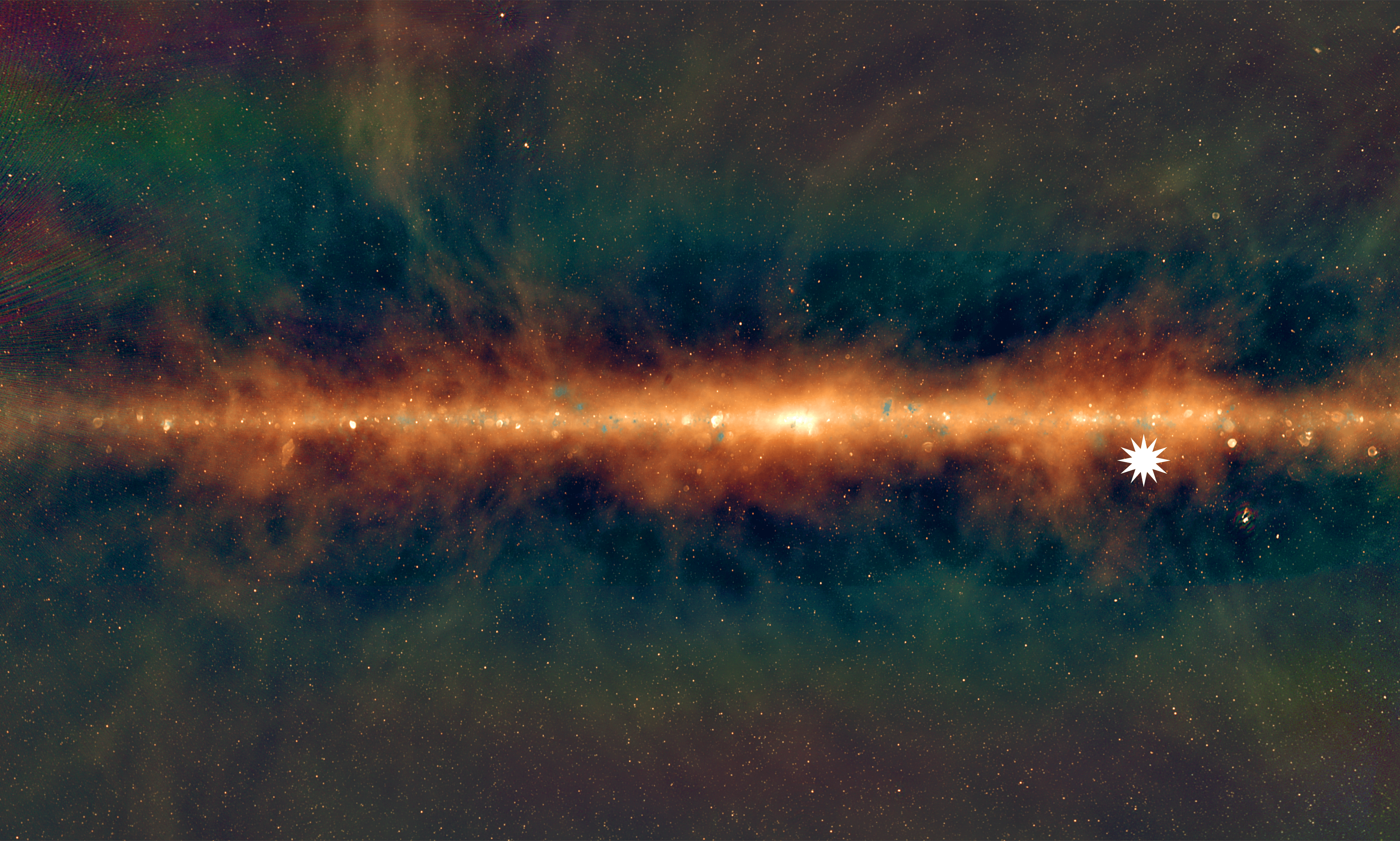
This image shows the Milky Way as viewed from Earth. The star icon shows the position of the mysterious repeating transient. Credit: Dr Natasha Hurley-Walker
(ICRAR/Curtin).
This image shows a new view of the Milky Way from the Murchison Widefield Array, with the lowest frequencies in red, middle frequencies in green, and the highest frequencies in blue. The star icon shows the position of the mysterious repeating transient.
Credit: Dr Natasha Hurley-Walker (ICRAR/Curtin) and the GLEAM Team.
The new radio is transient in the sky, as it would have been seen at the MWA during the night in March 2018, when it was active. The source is shown with a large white star marker, but would be invisible to the naked eye. Image source: Stellarium
The location of the source in the sky in January 2022, marked with a large white star marker. At this time of year, it is above the horizon during the day.
Image source: Stellarium
Magnetar An artist’s impression of what the object might look like if it’s a magnetar. Magnetars are incredibly magnetic neutron stars, some of which sometimes produce radio emission. Known magnetars rotate every few seconds, but theoretically, “ultra-long period magnetars” could rotate much more slowly.
The turbulent heart of the Milky Way contains nearly 1,000 inexplicable magnetic filaments — ten times more than previously thought, a new image has revealed.
The strange strands, some of which stretch up to 150 light-years across, were first discovered by astronomers at Northwestern University back in the early 1980s.
Observations using radio waves have shown the filaments to be highly organised, appearing in pairs and clusters, with some evenly spaced out like strings on a harp.
The team believe that filaments are comprised of cosmic ray electrons gyrating the magnetic field at close to the speed of light, but their origins remain a mystery.
However, the identification of more of the strings, the researchers said, will now enable broad statistical studies that might allow them to unravel this puzzle.
The team have already ruled out supernovae as the source of the filaments, and suspect they may have been created by our galaxy's supermassive black hole.
The turbulent heart of the Milky Way contains nearly 1,000 inexplicable magnetic filaments — ten times more than previously thought, a new image (pictured) has revealed
A mosaic image of the heart of the Milky Way. The filaments can be seen as vertical slashes throughout
Observations using radio waves have shown the filaments to be highly organised, appearing in pairs and clusters, with some evenly spaced out like strings on a harp
THE FILAMENTS MAY HAVE THEIR ORIGINS IN THE SUPERMASSIVE BLACK HOLE AT THE HEART OF THE GALAXY
The new data gathered by the MeerKAT telescope has allowed Professor Yusef-Zadeh and his colleagues to better study the filament's magnetic fields, alongside the role that cosmic rays play in illuminating them.
They found that the radiation emitted from the filaments is very different to that seen from supernova remnants.
This suggests that the two phenomena have different origins.
The team think that the filaments may have been formed as a result of the past activity of the supermassive black hole that lurks at the centre of the Milky Way — rather than from the coordinated bursts of supernovae.
In addition, the filaments may be related to the vast, radio wave-emitting bubbles, which Professor Yusef-Zadeh and his team first reported discovering back in the September of 2019.
The study was led by Northwestern University astrophysicist Farhad Yusef-Zadeh, who spotted the first strands back in 1984.
'We have studied individual filaments for a long time with a myopic view. Just examining a few filaments makes it difficult to draw any real conclusion about what they are and where they came from,' explained Professor Yusef-Zadeh.
'Now, we finally see the big picture — a panoramic view filled with an abundance of filaments. This is a watershed in furthering our understanding of these structures.
'This is the first time we have been able to study statistical characteristics of the filaments. By studying the statistics, we can learn more about the properties of these unusual sources.
'If you were from another planet, for example, and you encountered one very tall person on Earth, you might assume all people are tall. But if you do statistics across a population of people, you can find the average height.
'That's exactly what we're doing. We can find the strength of magnetic fields, their lengths, their orientations and the spectrum of radiation.'
The new image of the Milky Way's centre was the result of three years' worth of sky surveys undertaken using the MeerKAT radio telescope at the South African Radio Astronomy Observatory (SARAO) in the country's Northern Cape providence.
After a total of 200 hours of telescope time, the team were able to piece together a mosaic of 20 separate observation of different parts of the sky in the direction of the galactic centre, which lies some 25,000 light years from Earth.
Alongside the filaments, the final composite image also captures numerous other sources of radio emissions, including outbursts from stars, stellar nurseries and new supernova remnants.
'I've spent a lot of time looking at this image in the process of working on it, and I never get tired of it,' said paper author and astrophysicist Ian Heywood of the University of Oxford.
'When I show this image to people who might be new to radio astronomy […] I always try to emphasize that radio imaging hasn't always been this way, and what a leap forward MeerKAT really is in terms of its capabilities.
'It's been a true privilege to work over the years with colleagues from SARAO who built this fantastic telescope.'
The strange spatial strands (pictured), some of which stretch up to 150 light-years across, were first discovered by astronomers at Northwestern University back in the early 1980s
Alongside the filaments, the final composite image also captures numerous other sources of radio emissions, including outbursts from stars, stellar nurseries and new supernova remnants. Pictured: a rare, almost-perfectly spherical supernova remnant seen in the image
The new image of the Milky Way's centre was the result of three years' worth of sky surveys undertaken using the MeerKAT radio telescope (pictured) at the South African Radio Astronomy Observatory in the country's Northern Cape providence
To get a clearer look at the filaments, the team used a special technique that allowed them to remove the background from the main image, isolating the strands.
'It's like modern art. These images are so beautiful and rich, and the mystery of it all makes it even more interesting,' said Professor Yusef-Zadeh.
The researchers said that they are particularly intrigued by how structured the filaments appear, with those in clusters seemingly spaced at equal intervals, each around the distance of that from the Earth to the sun.
'They almost resemble the regular spacing in solar loops,' commented Professor Yusef-Zadeh.
'We still don't know why they come in clusters or understand how they separate and we don't know how these regular spacings happen.
'Every time we answer one question, multiple other questions arise.'
This includes whether or not the filaments change over time or move, and what is causing the electrons to accelerate in the first place.
'How do you accelerate electrons at close to the speed of light?' Professor Yusef-Zadeh asked.
'One idea is there are some sources at the end of these filaments that are accelerating these particles.'
After a total of 200 hours of telescope time, the team were able to piece together a mosaic of 20 separate observation of different parts of the sky in the direction of the galactic centre — which lies some 25,000 light years from Earth. Pictured: the distribution of the strengths of magnetic fields in the final, composite image of the heart of the Milky Way
To get a clearer look at the filaments, the team used a special technique that allowed them to remove the background from the main image — isolating the strands, as pictured
With this latest study complete, the researchers are now working to identify and catalogue each filament in the image, noting its orientation, curve, magnetic field, spectrum and intensity, properties that may shine a light on the strands' nature.
'We're certainly one step closer to a fuller understanding. But science is a series of progress on different levels,' said Professor Yusef-Zadeh.
'We're hoping to get to the bottom of it, but more observations and theoretical analyses are needed. A full understanding of complex objects takes time.'
A pre-print of the researchers' article, which has not yet been peer-reviewed, can be read on the arXiv repository, as can an accompany paper presenting the full image created from the MeerKAT data.
'I've spent a lot of time looking at this image in the process of working on it, and I never get tired of it,' said paper author and astrophysicist Ian Heywood of the University of Oxford. Pictured: the complex, cirrus-like emission from the Galactic centre super bubble, which is crossed by a complex of many parallel radio filaments
The new image of the Milky Way's centre was the result of three years' worth of sky surveys undertaken using the MeerKAT radio telescope at the South African Radio Astronomy Observatory in the country's Northern Cape providence
THE MILKY WAY'S OLDEST STAR
A star discovered in 2018 is thought to be one of the oldest in the Milky Way.
Scientists at the Instituto de Astrofísica de Canarias (IAC) in Spain believe that it might have formed about 300 million years after the 'Big Bang'.
IAC researcher Jonay González Hernández said: 'Theory predicts that these stars could form just after, and using material from, the first supernovae, whose progenitors were the first massive stars in the Galaxy.'
Researchers hope the star, known as J0815+4729, which is in line with the Lynx constellation, will help them learn more about the Big Bang, the popular theory about the galaxy's evolution.
IAC director Rafael Rebolo said: 'Detecting lithium gives us crucial information related to Big Bang nucleosynthesis. We are working on a spectrograph of high resolution and wide spectral range in order to be able to measure (among other things) the detailed chemical composition of stars with unique properties such as J0815+4729.'
Scientists Puzzled by Weird “Strands” at the Center of Our Galaxy
There are almost 1,000 of them — and we have no idea what they are made of and where they came from.
Image by Northwestern University/SAORO/Oxford University
Over the last 35 years, Northwestern University astronomy professor Farhad Yusef-Zadeh has been studying mysterious strands made up of cosmic ray electrons stretching up to 150 light years across the center of the Milky Way.
And now, with he help of his team, Yusef-Zadeh was able to find ten times more strands than previously discovered — which is striking, since we still have no idea what they are made of, nevermind where they came from.
Using the South African Radio Astronomy Observatory MeerKAT telescope, the team was able to get a panoramic view of almost 1,000 of these mysterious filaments, as detailed in a new study accepted into The Astrophysical Journal Letters.
“We have studied individual filaments for a long time with a myopic view,” Yusef-Zadeh said in a statement. “Now, we finally see the big picture — a panoramic view filled with an abundance of filaments.”
Needless to say, it’s a significant moment in his career-long investigation.
“Just examining a few filaments makes it difficult to draw any real conclusion about what they are and where they came from,” he added. “This is a watershed in furthering our understanding of these structures.”
To create the panorama, the team stitched together 20 separate observations made over 200 hours by the MeerKAT observatory. The resulting image is awe-inspiring, and “like modern art,” according to Yusef-Zadeh.
Credit: Northwestern University/SAORO/Oxford University
Despite the advancements and an abundance of questions left to answer, the team is willing to make some educated guesses.
The variation in the radiation emitted by the filaments for instance suggest they aren’t the leftovers of supernovae, but rather the result of past activity of the supermassive black hole suspected to be at the center of our galaxy.
“This is the first time we have been able to study statistical characteristics of the filaments,” Yusef-Zadeh said in the statement. For instance, the team discovered that magnetic fields are being amplified along the strands.
They are also spaced apart from each other at exactly the same distances.
“We still don’t know why they come in clusters or understand how they separate, and we don’t know how these regular spacings happen,” Yusef-Zadeh said.
But getting a full understanding will require “more observations and theoretical analyses,” he said, a process that “takes time.”
“Every time we answer one question, multiple other questions arise,” he added.
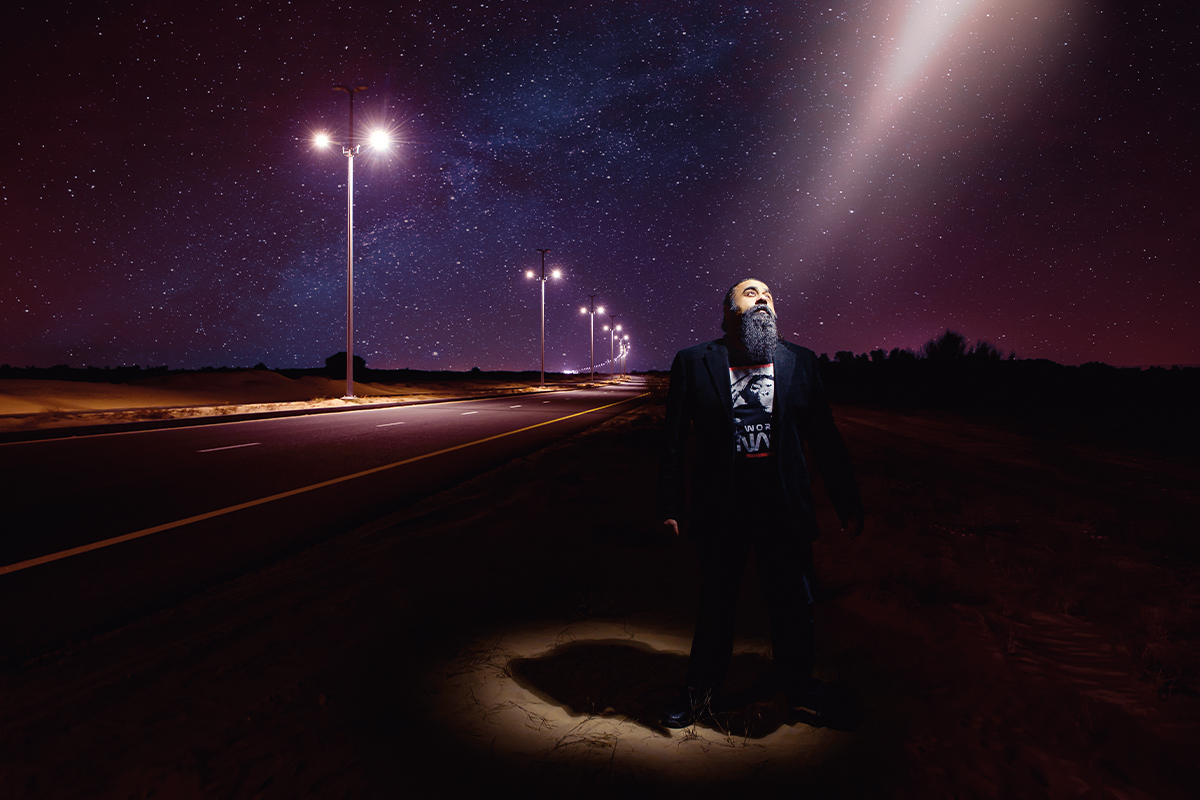
The very real story of how UFOs shaped Middle East culture
From The Arabian Nights to alien ‘sightings’ over Dubai, the fantastical has a big impact.
Photo credit: SIDDHARTH SIVA
In late 2020, retired Israeli space security chief Haim Eshed became—for a brief time, at least—the most celebrated figure in the world of ufology. Already respected in aeronautics circles, Eshed shot to wider fame following an interview in Israel’s Yedioth Ahronoth newspaper, in which he claimed that aliens have not only visited Earth, but have joined humans in an inter-species “Galactic Federation.” As luck would have it, this headline-grabbing revelation coincided with the publication of Eshed’s as-told-to book The Universe Beyond the Horizon, which made similar claims. It’s unclear whether the disclosures made news on other planets.
At around the time Eshed was drip-feeding the world tales of interplanetary collaboration—coordinated, perhaps, from an underground base on Mars—the US Congress got in on the act, instructing the Pentagon to deliver a report on the 144 unresolved sightings of UFOs (or unidentified aerial phenomena—UAP—in the current parlance) recorded by the military since 2004. The paper, which came out in June, amounted to a series of observations which could be summed up as: dunno. Perhaps, as Eshed has suggested, the Federation is withholding full disclosure in order to avoid “mass hysteria.”
Believers, for their part, have remained unfazed by the lack of definitive answers, pointing to grainy military footage of inverted pyramids flitting across the sky, or dark blobs plunging into the sea, as evidence that the truth is not only out there, but right here. Even Dubai, not traditionally known as a destination for alien joyriders, was reportedly treated to a visitation in 2020, this time in the form of a huge saucer-shaped object hovering over the Arabian Gulf. As self-styled UFO-hunter Scott Waring put it in a subsequent blog: “looks like there is an alien base not far off the coast of Dubai.”
The 2016 sci-fi film Aerials, which depicts similar objects looming menacingly over Dubai, is said to be the first full-on alien-invasion movie shot in the UAE—possibly because the region as a whole has had more immediate conflicts on its mind. According to Dubai-based filmmaker S.A. Zaidi, however, his movie grows out of a longstanding, widespread regional interest in the subject. “I belonged to UFO clubs,” he says of his childhood. “I was a part of that geek culture.”
Zaidi is quick to add, though, that having a passion for science fiction does not make a person—or indeed a region—more inclined toward tin foil hats. He also objects to the idea that the Middle East’s supposed penchant for conspiracy theories—which he calls a “cultural stereotype”—transforms every errant weather balloon or odd-shaped cloud into a scene from Close Encounters. “After Aerials came out, my father kept asking me, ‘what do you think will happen if aliens actually land?’ I told him, ‘dad, I don’t know. It’s just a film.’”
That said, Dubai’s “UFO” was by no means the first in the region—Saudi Arabia, Kuwait, and Morocco are just some of the places that have reported sightings over the years (albeit mostly debunkable). The most notorious incident occurred in 1976, when glowing, fast-moving objects appeared in the skies over Tehran, and were deemed threatening enough that fighter pilots scrambled to intercept them.
More recently, The Washington Post ran an article on how UFOs have become a “national security worry” in the US. “The question is, what is it? What are its intentions? What are its capabilities?” said one former intelligence official in the piece, referring to the objects that have appeared on air-force pilots’ screens. Such comments may not point to mass hysteria, but they do suggest a kind of mass concern. As the late theoretical physicist Stephen Hawking put it: “meeting an advanced civilization could be like Native Americans encountering Columbus. That didn’t turn out so well.”
The aliens in Zaidi’s film Aerials are not of the city-incinerating variety—partly because he lacked the budget for global annihilation, partly because he was more interested in building a subtle tension, and partly because he doesn’t necessarily buy into the idea that aliens would come here with the aim of stirring trouble. “I’m not sure a race that had the ability to travel all this way would do it just to say, ‘hey, I’m going to take this laser out and zap you,’” he says. “Maybe they just came because they were interested.”
Zaidi’s reluctance to venture into fire and brimstone territory was also a matter of what he describes as cultural sensitivity. “When we made Aerials, maybe the region wasn’t ready for something like Independence Day, you know, where the beam comes down on the White House,” he says. “We have local landmarks in the film, Emirates Towers and so on, but we were not going to shoot lasers down on them. We were not going to show Dubai getting destroyed.” He pauses and adds: “Then again, your imagination takes you there whether you want it or not.”
Dubai-based filmmaker S.A. Zaidi says his alien-invasion movie grew out of UFO “geek culture.”
Back to the future
The day German academic Jörg Matthias Determann landed in Doha, he felt as though he’d stepped onto a different planet. “You see all these glass towers rising out of the sand,” he says. “From the inside of these air-conditioned buildings, you look out at this hot, inhospitable environment, and you almost feel as though you are in a city on Mars, some kind of future habitat, these glass containers where the heat and dust storms are being kept out.”
Determann, a professor of history specializing in science, technology, and society at the Virginia Commonwealth University School of the Arts in Qatar, believes the Middle East’s reputation as a “very traditional, conservative place” does not take into account its appetite for extravagant ideas. “Look at Dubai, which is about to open a Museum of the Future,” he says. “There is a broad interest in futuristic mega-projects here, a commitment to try things that haven’t been tried before. And there is a long history of this—rulers wanting to leave gigantic legacies, going back to the Pharaohs. The Emirates Mars mission is another of these mega projects.”
In his latest book, Islam, Science Fiction and Extraterrestrial Life: The Culture of Astrobiology in the Muslim World, Determann traces a line from groundbreaking astronomers in ancient Mesopotamia to the burgeoning interest in space exploration today. Along the way, he draws our attention to various cultural aspects that have made the Middle East fertile ground for stargazing, ranging from religion to commerce to the fantastical stories in One Thousand and One Nights (which became known as The Arabian Nights in English)—the latter of which, he says, could be seen as the root of it all.
It seems odd to think of The Arabian Nights as the starting point for regional futurism, given that its tales tend toward talking donkeys and vindictive demons rather than interstellar travel. Yet the collection has undoubtedly influenced generations of storytellers, who in turn have wielded an influence of their own. “No matter where you grew up, you couldn’t escape the power of these stories,” Determann says. “So you’ve always had these broadly speculative elements to culture here—you see it in the architecture, and in the science fiction I’ve had the pleasure of reading.”
Ahmed Salah Al-Mahdi, the Egyptian author of the dystopian novel Malaz: City of Resurrection, is currently working on a book about extremely unpleasant aliens touching down in the desert between Egypt and Libya. “I like imagining other worlds, life on other planets,” he says. “I read the stories in The Arabian Nights as a child and was fascinated by the magic, the heroes, the kingdoms. It created another world here in the Middle East. Anyone who wants to understand how to build fantasy worlds should read The Arabian Nights.”
Medieval folk tales, however, are not the only thing fueling imaginative storytelling in the region—or, for that matter, the willingness to accept that alien life forms may actually exist. In his book, Determann argues that Islamic beliefs—which accommodate ideas of multiple worlds and the existence of sentient, invisible beings—have played an important part, too. “To believe in the Quran,” he says, “is to believe that we are not alone.”
Following close behind religion, meanwhile, is the Middle East’s age-old role as a center for global trade. “Doha and Dubai are not so much desert cities as port cities—there’s a long tradition of going to distant shores,” Determann says. “This leads to stories of adventurers sailing off to strange lands, encountering strange creatures. You can see the movement of this over time: from seaport to airport, trading center to global aviation hub. The next step could be the spaceport. The urge to explore the unknown—that is something you can see here very clearly.”
Even the multicultural makeup of Gulf cities, Determann adds, leads back to this spirit of adventure and exploration. “One of the things I love about here is the coming together of so many cultures, like the cantina in Star Wars. There is an openness to the stranger, the alien.”
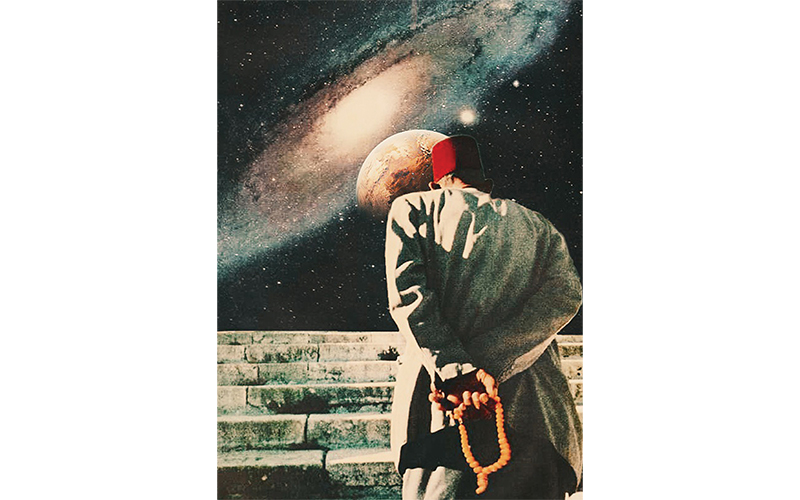
Ayham Jabr, “Damascus Under Siege”
(AYHAM JABR)
Battlefield Earth
If the idea of aliens flitting around our planet represents a kind of superstition, then there are strains of Middle East culture that foster this, too. “Many people believe in magic, its ability to affect lives,” says Al-Mahdi. “They’ll go to a man who they think will help them marry or divorce or have a child. They’ll take a piece of paper with the name of a loved one written on it, put it in water and drink it so they will be married. People really believe this stuff. It’s not fantasy, it’s something that exists. So, yes, a lot of people believe in aliens.”
Maybe so, but there is also a broad streak of pragmatism and skepticism here, epitomized by S.A. Zaidi’s aunt, who used to berate him for wasting his time reading stories with titles like Ray of Death. “She kept telling me I fantasize too much, go back to your schoolbooks,” he recalls. “This is not practical.” Then there are people like Syrian artist and filmmaker Ayham Jabr, for whom science fiction has a very practical purpose—namely, the idea that “fantasy can help the artist or writer to deliver his point.”
“Sci-fi provides a way to bypass censorship and address taboo subjects. You can present criticisms in a story about Mars, or about alien invaders, which gives you plausible deniability.”
As with many of his peers, Jabr got hooked on science fiction as a kid. “My family are artists, actors, screenwriters, so multiple cultures were in front of my eyes,” he says, going on to recall the fantasy TV shows he watched, the books he read, the tales of Pharaohs and kings. He has no time, though, for the conspiracy theorists and myth makers who occupy the margins of ufology. “There are so many fake, cheap stories, such as the one about the pyramids being used as fuel tanks for alien ships,” he says. “For some, this isn’t seen as fantasy but as theory.”
Religion, Jabr continues, also fired up his childhood imagination, though not always in a positive way. “My interest was coming from fear,” he says. “All these stories about the afterlife, Judgment Day, angels, and demons.” Fear is the prevailing emotion in Jabr’s Damascus Under Siege, a series of surreal collages that depict sinister-looking spacecraft either looming over the Syrian capital or shooting lasers into it—a representation of the country’s civil war rather than the prospect of an alien invasion.
“Science fiction provides a way to bypass censorship and address taboo subjects,” says Determann. “You could write a realistic story set in the present that criticizes authority, but that might get you into trouble. Or you can present the same criticisms in a story about a society on Mars, or about alien invaders, or about the future, which gives you plausible deniability.”
Al-Mahdi, too, admits to cloaking political and social provocations in fantasy. “I like to write post-apocalyptic novels, to imagine the collapse of what we have now and start anew—you can chop and change things however you like, and it is the same with alien invasions,” he says. “If you look closely, you’ll see I’m criticizing current regimes.”
Not all fantasies, however, fit this mold. It’s unlikely that the makers of the hammy 1959 Egyptian flick Journey to the Moon intended much more than a bit of harmless escapism. The same could be said of Rex Chouk, the Saudi artist whose works include trippy images of flying saucers hovering over the desert. As for the alien-invasion film Aerials, Zaidi says this: “I’d like to be able to say that we had underlying messages, but the reality is I’m just obsessed with UFOs.”
Ayham Jabr’s “The Guardian of Life”
(AYHAM JABR)
Brave new world
In 2007, former Syrian culture minister Riad Agha stood before a science fiction symposium in Damascus and delivered an address that, in its own way, provided a direct rebuttal to Zaidi’s skeptical aunt. “Man is an imaginative being,” Agha said to the assembled geeks. “The more he excels in imagining, the more he excels in innovation and invention.”
For Determann, the truth behind this statement is apparent in everything from Abu Dhabi’s futuristic Masdar City to the emerging Saudi-UAE space race. “There are three things you need before you can explore space,” he says. “You need knowledge and technology, you need money, and you need imagination. Before you go to Mars, you have to imagine going there.”
In fact, Determann continues, potential engineers and astronauts should be encouraged to immerse themselves in sci-fi. “There’s an idea that you can use space research to build a high-tech, knowledge-based economy, which the Emiratis have really bought into,” he says. “So if the aim is to inspire young people to go into space and contribute to that economy, we have to start early, building up the fascination long before they’re ready to study physics at university.”
Jasem Mutlaq, founder of the Ikarus Observatory in Kuwait, would likely agree. “It’s rare that you’ll find astronomers who are not fans of science fiction,” he says. “I grew up in the 80s watching Star Trek: The Next Generation. But the biggest impact of all was in 1997, when Contact was released. I was literally in tears when the movie was over. I’ve been hooked ever since.”
Like Mutlaq, Al-Mahdi grew up on a diet of science fiction, though his career took a different turn. “I wanted to be an astronaut, that was one of my childhood dreams,” he says with a laugh. “In high school I was good at chemistry and physics, but I liked poetry and literature more. I went to an engineering college, but then left for the faculty of the arts. So I was torn. In the end, I put both things together.”
Here, Mutlaq offers a word of caution. For him, the intermingling of science and science fiction is a positive thing, but not to the extent that it blurs the line between fantasy and reality. “Following the footsteps of Carl Sagan, I usually do not fall prey to conspiracy theories, especially those related to aliens roaming around,” he says. “While recent videos of UAP encounters are intriguing, they are not conclusive evidence for beings who traveled thousands of light years to go zipping over coastlines for a couple of seconds.”
And while Mutlaq will continue to gaze into the stars from his observatory, to read his sci-fi books, and abide by the moral standards of Captain Picard, he has learned to keep his own fantasies in check. “Alien life has yet to be proven scientifically, so we shouldn’t fall prey to our whims and wishes,” he says. “We ought to understand the universe as it is, not as what we aspire it to be.”
Hidden secrets? An ancient virus? Evidence for aliens? An alien's body? What secrets and mysteries are hidden in Siberia?
Aliens filmed on camera? Would you believe it? Scary and frightening shots taken by eyewitnesses that will make you goosebumps, it is unlikely that we are alone in this vast universe.
Did you know that in Siberia in recent years have found an ancient virus that has been frozen for the last 30,000 years and the most interesting thing is that here scientists come across scary and strange creatures, animals that are able to resurrect, even aliens.
This huge, cold area hides many mysteries, which Ayhan Infire will tell you about in the video below.
Meet Deep Prasad. Deep is a 26 year old self taught prodigy working on quantum computing and with a deep interest in UFO’s. In this video we discuss how he combines those interests by attempting to solve the schrodinger many body equation at scale with quantum computing; we also discuss quantum biology, quantum sensing and what, if anything, the aliens have planned for us.
Strange Light That Can Only Be Seen With Night Vision & V Shaped UFO Sighted Over A Town In Germany
Clip One : This was captured in Porter County in Indiana on January 9, 2022. This bizarre light can only be seem with the use of the night vision and when in normal mode it's invisible. The witness stated "We see them quite often with our night vision camera and have several posted on our channel. This video shows what the sky looks like when the night vision camera is switched to the dusk setting." Thanks to Contact at 110 UAP Sightings for allowing the use of his footage and to view the original:
Clip Two:This was sighted on January 24, 2022 at around 11:00am over Göppingen near Stuttgart in Germany at the train station. In this footage this looks like a V shaped or Boomerang shaped craft but what do you guys think?
Thanks to Saim for allowing me the use of his footage and to view the original
ou guys may have noticed that the channel has a new banner and this was designed for by TeeBry Sensei. An Huge Thanks for your work and if you like "Anime" please check out their channel:
The Murchison Widefield Array captured the Milky Way in radio frequencies. The lowest frequencies are red, middle frequencies are green, and the highest are blue. The star icon shows the mysterious object.
(CNN)- While mapping radio waves across the universe, astronomers happened upon a celestial object releasing giant bursts of energy -- and it's unlike anything they've ever seen before.
The spinning space object, spotted in March 2018, beamed out radiation three times per hour. In those moments, it became the brightest source of radio waves viewable from Earth, acting like a celestial lighthouse.
Astronomers think it might be a remnant of a collapsed star, either a dense neutron star or a dead white dwarf star, with a strong magnetic field -- or it could be something else entirely.
This image shows the Milky Way as viewed from Earth, and the star icon marks the location of the unknown object.
A study on the discovery published Wednesday in the journal Nature.
"This object was appearing and disappearing over a few hours during our observations," said lead study author Natasha Hurley-Walker, an astrophysicist at the Curtin University node of the International Centre for Radio Astronomy Research, in a statement.
"That was completely unexpected. It was kind of spooky for an astronomer because there's nothing known in the sky that does that. And it's really quite close to us -- about 4,000 light-years away. It's in our galactic backyard."
Curtin University doctoral student Tyrone O'Doherty made the unusual discovery while using the Murchison Widefield Array telescope in the outback of Western Australia.
"It's exciting that the source I identified last year has turned out to be such a peculiar object," O'Doherty said in a statement. "The MWA's wide field of view and extreme sensitivity are perfect for surveying the entire sky and detecting the unexpected."
What remains of a massive star's death
Flaring space objects that appear to turn on and off are known as transients.
"When studying transients, you're watching the death of a massive star or the activity of the remnants it leaves behind," said study coauthor Gemma Anderson, ICRAR-Curtin astrophysicist, in a statement. "'Slow transients' -- like supernovae -- might appear over the course of a few days and disappear after a few months. 'Fast transients' -- like a type of neutron star called a pulsar -- flash on and off within milliseconds or seconds."
This new, incredibly bright object, however, only turned on for about a minute every 18 minutes. The researchers said their observations might match up with the definition of an ultra-long period magnetar. Magnetars usually flare by the second, but this object takes longer.
This is an artist's impression of what the object might look like if it's a magnetar, or an incredibly magnetic neutron star.
"It's a type of slowly spinning neutron star that has been predicted to exist theoretically," Hurley-Walker said. "But nobody expected to directly detect one like this because we didn't expect them to be so bright. Somehow it's converting magnetic energy to radio waves much more effectively than anything we've seen before."
The researchers will continue to monitor the object to see whether it turns back on, and in the meantime, they are searching for evidence of other similar objects.
"More detections will tell astronomers whether this was a rare one-off event or a vast new population we'd never noticed before," Hurley-Walker said.
“Spookachtig” ruimteobject zendt om de 18 minuten radiosignalen uit
Een Australische astronoom is bij het in kaart brengen van radiogolven in het heelal op een hemellichaam gebotst dat drie keer per uur enorme energiegolven uitstootte. Wetenschappers hadden zoiets nog nooit gezien. Nature publiceerde gisteren een studie over de verrassende ontdekking, die voorlopig een mysterie blijft.
Het tollende ruimteobject, dat in maart 2018 werd gespot, bleek om de 18 minuten ongeveer een minuut lang radiosignalen uit te zenden. Op die momenten was het de helderste bron van radiogolven die vanaf de aarde te zien was. “Een hemelse vuurtoren”, zo omschrijft CNN het.
Dit is een artistieke impressie van hoe het object eruit zou kunnen zien als het een magnetar is, of een ongelooflijk magnetische neutronenster.
Astrofysicus Natasha Hurley-Walker en haar team publiceerden de ontdekking in het gerenommeerde wetenschappelijke tijdschrift Nature, maar een sluitende verklaring ervoor vonden ze niet. “Dit object verscheen en verdween weer gedurende een paar uren tijdens onze waarnemingen”, zegt Hurley-Walker, die verbonden is aan de Curtin University in Australië. Flikkerende ruimteobjecten die aan en uit lijken te gaan, staan bekend als transiënten. Het geflikker kan in principe van een pulsar komen, een snel ronddraaiende neutronenster die in milliseconden of seconden aan en uit flitst. Of van een supernova, die een paar dagen te zien is en dan weer verdwijnt. Maar in dit geval flitste het hemellichaam elke 18 minuten aan en uit. “Dat was totaal onverwacht”, zegt Hurley-Walker. “Een beetje spookachtig ook voor een astronoom omdat, voor zover we weten, er niets aan de hemel is dat dit doet. En het is echt heel dicht bij ons, ongeveer 4.000 lichtjaar van ons. Dat is in onze galactische achtertuin.”
Het was Tyrone O’Doherty, doctoraatsstudent aan de Curtin University, die de ongewone ontdekking deed met de Murchison Widefield Array-telescoop (MWA), die opgesteld staat in de outback van deelstaat West-Australië. “Opwindend dat de bron die ik vorig jaar kon identificeren zo’n eigenaardig object blijkt te zijn”, zegt hij. “Het brede gezichtsveld en de extreme gevoeligheid van de MWA zijn perfect om de hele hemel in kaart te brengen en het onverwachte te detecteren.”
De Murchison Widefield Array legde de Melkweg vast in radiofrequenties. De laagste frequenties zijn rood, de middelste frequenties zijn groen en de hoogste zijn blauw. Het sterpictogram toont het mysterieuze object.
“Hij vond iets”, zegt Natasha Hurley-Walker, Doherty’s promotor van zijn doctoraatsthesis, over de ontdekking. Op beelden van de telescoop zien we in de melkweg een heldere stip die de locatie van het object markeert. “Net rechts daarvan is er een bron, en die is een superzwaar zwart gat dat stralen van radiogolven de ruimte inslingert met bijna de snelheid van het licht”, aldus Hurley-Wallker. “Toegegeven, dat is verder weg. Maar het geflikker dat we zagen is ongeveer net zo helder. Dat is dus echt extreem. En we hadden niet verwacht iets te vinden dat zo helder was. Op de een of andere manier zet het magnetische energie om in radiogolven, veel effectiever dan alles wat we eerder hebben gezien.”
Het gedrag van het object komt overeen met iets waarvan het bestaan wel is voorspeld, maar dat nooit is waargenomen: een soort langzaam draaiende neutronenster. Of het zou een overblijfsel kunnen zijn van een ingestorte ster die een dode witte dwergster met een sterk magnetisch veld werd, al is dat zeer onwaarschijnlijk. Wat het ook is, het is “echt extreme fysica”, volgens Hurley-Walker. “En het kan natuurlijk ook iets zijn waar we nog nooit aan hebben gedacht.
De onderzoekers zullen het object in de gaten blijven houden om te zien of het weer aangaat, en in de tussentijd zoeken ze naar bewijs voor andere soortgelijke objecten. “Meer detecties zullen astronomen vertellen of dit een zeldzame eenmalige gebeurtenis was of een grote nieuwe populatie die we nog nooit eerder hadden opgemerkt”, besluit Hurley-Walker.
GERELATEERDE VIDEO'S, geselecteerd en geplaatst door peter2011
2 Blackhawks Escorting Glowing Orb in Durham, Connecticut! Video, Jan 21, 2022 UFO Sighting News.
Date of sighting:January 21, 2022
Location of sighting: Durham, Connecticut, USA
Here we have two military helicopters escorting an unknown craft. The craft glows powerfully and appears to be orb shaped. This is a shocking encounter of both military and alien craft. It's not a typical meeting, this one is escorting the alien craft to the US military base nearby for some important conference. Most agreements made with aliens will involve trade...since technology is the most powerful commodity to the US military. Absolutely proof that the US military is working on an alliance with aliens.
The Milky Way is massive, but far more weighty is the volume of dark matter purported to pervade our home galaxy. And a pair of scientists have proposed that the cumulative force of dark matter in our galaxy is significant enough to affect interstellar spacecraft, according to a recent study shared on a preprint server.
While the study still requires peer review, it also says the Pioneer and New Horizons spacecraft were already affected, and so will planetary astronomy and astrophysics.
This could alter not only how we travel through deep space, but also how we study it.
Dark matter gravity on interstellar spacecraft
When an asteroid, comet, or even a spacecraft moves around the sun, our host star's gravity is the primary force in its motion. Out beyond Pluto, it's the entire solar system that serves as the main gravitational force. Even out in the Kuiper belt — the cloud of ancient primordial asteroids on the fringe of our solar system, any net-zero calculation of gravitational forces on a spacecraft is best calculated as a two-body problem: between the mass of the spacecraft, and that of the entire solar system. But all of that changes when you move too far away from the sun.
Recommended videos
Why do we need telescopes in space?
The exciting future of commercial space flight
How the first image of a black hole was captured
The world’s most advanced humanoid robot
Why do some space launches fail?
Could we stop an extinction-level asteroid?
Mk-II Aurora: A real-life space plane
If "an object is moving sufficiently far from the sun, then there is another gravitational force that can play an important role," wrote the authors of the study. The lead study author is Professor of Celestial Mechanics and Mathematics Edward A. Belbruno of Yeshiva University, who is also visiting research collaborator at Princeton University's department of astrophysical sciences. He worked in collaboration with NASA Chief Scientist Jim Green, co-lead author of the study who is due to retire early this year, according to a blog post from the agency. But together, Green and Belbruno analyzed a different force that comes into play for spacecraft that travel in interstellar space.
As you might guess, they found that this is the cumulative gravitational force of the Milky Way galaxy. But, surprisingly, the overwhelming majority of this force isn't generated by the disc, central bulge, and the stellar halo of our galaxy. While those are there, the primary force of gravitational attraction stems from dark matter. And, although "it is small," the collective force of all dark matter in our galaxy "can cumulatively add up and significantly affect the trajectory of motion over long periods of time."
An Interstellar Probe to analyze dark matter beyond the solar system
Ordinary, or "baryonic" matter comprises roughly 5% of the total energy of the observable universe, according to the study. Dark matter (non-baryonic matter), which we can't observe directly, comprises 25%. That's five times the energy — roughly the same difference in strength between the average human and a grizzly bear. Yikes! "The dark matter halo contains most of the mass of the Galaxy," wrote the study authors. "In the milky Way the dark matter is measured by observing the rotational circular motion of the Galaxy" around the galactic center, and measuring its velocity relative to radial distance has in the past revealed that the rotational speed of the galaxy "levels off" as you move away from the core. This is why even spacecraft as far away from the core as our solar system will be affected by the gravitational force of dark matter in our galaxy — just like everything else in the galaxy, almost independent of radial distance from the core.
"The existence of this force has many implications for planetary astronomy and astrophysics," since tracking the motion of alien worlds beyond our solar system has become a core practice of these fields. But, and perhaps most exhilarating to consider: "It may be possible to detect" this cumulative gravitational force of dark matter "on a proposed mission called Interstellar Probe", suggest the authors. There's a lot going on in space travel, especially with the James Webb Space Telescope's mounting success, not to mention SpaceX, NASA, and China. But on the macro-scale and the future awaiting us beyond the solar system, we're only just beginning.
METHANE has been detected on Saturn's icy moon Enceladus and the levels detected are consistent with that of microbes.
A new study suggests that this could be sign of life on Enceladus or just evidence of a chemical process we don't yet understand.
Saturn's Enceladus moon is thought to have a subsurface ocean
Credit: Getty - Contributor
Beneath the moon's icy surface, there's thought to be a salty subsurface ocean.
This water bursts through the icy crust sometimes in giant plumes.
Nasa, the European Space Agency, and the Italian Space Agency sent a space probe called Cassini to dive through these plumes.
This is how large amounts of methane were detected as well as other molecules like dihydrogen and carbon dioxide.
An illustration of the interior of Saturn's moon Enceladus showing a global liquid water ocean between its rocky core and icy crustCredit: NASA/JPL-Caltech
Researchers think Enceladus's seafloor could have hydrothermal vents similar to ones found on Earth.
We know that the Earthly hydrothermal vents are surrounded by microbes that consume dihydrogen and carbon dioxide and produce methane.
As part of a new experiment, a research team ran models to see what could be the most likely explanation for the large amounts of methane.
They planned out several different scenarios in which microbes would and wouldn't survive and compared them to the results the Cassini probe detected.
Saturn could have up to 82 moonsCredit: Getty - Contributor
Régis Ferrière, co-lead study author, said: "In summary, not only could we evaluate whether Cassini's observations are compatible with an environment habitable for life, but we could also make quantitative predictions about observations to be expected, should methanogenesis (by microbes) actually occur at Enceladus' seafloor.
"Obviously, we are not concluding that life exists in Enceladus' ocean.
"Rather, we wanted to understand how likely it would be that Enceladus' hydrothermal vents could be habitable to Earthlike microorganisms.
"Very likely, the Cassini data tell us, according to our models. And biological methanogenesis appears to be compatible with the data."
Astronomers will continue to research Saturn's Enceladus moon to find out more.
The full study has been published in the journal Nature Astronomy.
Enceladus – the key facts
Here's what you need to know...
Enceladus is Saturn's sixth-largest moon, with a diameter of 310 miles
It's roughly one-tenth the size of Saturn's largest moon, Titan
The moon is largely covered by fresh and clean ice, making it highly reflective
This also means it's very cold, with surface temperatures at noon reaching -198C
The moon was first discovered by British astronomer William Herschel on August 28, 1789
But we learned much more about it after Voyager 1 and Voyager 2 spacecraft fly-bys. in the 1980s
In 2014, Nasa found evidence to suggest there was a large subsurface ocean of liquid water on Enceladus
And in 2018, scientists discovered complex macromolecular organics on the moon's jet plumes
This has given scientists hope for finding evidence of alien life on the moon
A Series Of Mysterious Cattle Killings Swept Through Argentina
A series of mysterious killings of cattle on a farm in Argentina have raised fears that the Chupacabra may be behind these horrific murders.
According to local media reports, a curious incident occurred on the farm of the farmer Hugo Valenzuela, located near the city of Eskina. On three separate occasions in the past two months, he found cows slaughtered in an unusual way: their tongues, udders and reproductive organs were removed with uncanny precision.
“There are no signs of bleeding,” Valenzuela wonders. Longtime researchers will no doubt recognize these aspects of the case as classic signs of a cattle murder mystery. In this regard, the farmer also noted that no other animals approached the remains of the slaughtered cows and that there were no witnesses to the chilling killings, despite a neighbor who was only 1,300 feet from the scene of the attack.
“When it happens once or twice, you perceive it as something curious or strange,” the farmer reflects. However, initial bewilderment has turned to anger as he now hopes to get answers after losing his third cow in two months and resulting in significant financial damage.
Valenzuela is considering installing cameras to catch the perpetrator, or if another attack occurs.
While seasoned livestock mutilation investigators may speculate that some government conspiracy is behind the phenomenon, the farmer and others in the area point to a completely different suspect: the notorious chupacabra.
Their reasoning is that a man would not attack a cow in the way that Valenzuela’s cattle were killed, removing only some of the organs. The notorious blood-sucking cryptid was also charged with a similar string of murders in neighboring Chile last year.
While backward villagers blame the mythical Chupacabra for what is happening, this phenomenon goes far beyond the usual “terrestrial crimes” and “Chupacabra tricks” – organs are removed using high-tech tools, incisions are made on a living but immobilized animal, organs are taken from still living animals, but there is no blood, no noise.
These are not the tricks of the Chupacabra, this is the work of creatures for whom the suffering of an animal is nothing, especially since the same cases have happened to people.
Aliens Can Use Asteroids And Viruses In The War With Humans
Asteroids and viruses can be used as weapons by extraterrestrial civilizations that may seek to colonize the Earth in order to get all of its resources.
Such a statement, was made in an interview with The Sun Online by Professor Paul Springer from the US Air Force College in Alabama.
At the same time, he compared potential alien invaders with Europeans who came to the New World 300 years ago and actually exterminated the local inhabitants there.
So the aliens, in his opinion, can try to destroy earthlings in order to get the resources available on the planet.
Paul Springer is sure that any civilization acts solely in its own interests, which may not include good will, so you need to prepare for any scenario.
The specialist also explained that the alien invaders may have weapons that are much superior to the earth.
For example, they can use special lasers for pinpoint strikes against ground targets. Or they may have asteroid bombardment technology. Another option for the invaders is to spread viruses that act exclusively on people to cleanse the planet.
According to him, NASA is hiding a mysterious building.UFO researcher Scott Waring continues to search for alien life in photographs of the surface of celestial bodies.
As stated by the Daily Star, he made a “new shocking discovery”: in his opinion, on the surface of Mars, it turns out that an alien base has been hiding for a long time, which extends for 25 kilometers.
“Found a 25-kilometer base on Mars. 25 kilometers, judging by the ruler on the map. It is located near the ridges of Sulci Gordii. NASA doesn’t want anyone to know about it,” Waring said on his Twitter page.
He claims to have gone through tens of thousands of photos and over 3 – 4 dozen indexes that he “didn’t even know existed”.
Scott explains he can see other less detailed structures that have been intentionally all blurred out, leaving just one.
He said: “I believe the person editing this photo, this particular photo, missed it on purpose because there are less detailed structures all around it that are blurred out.”
This is not the first alien base that Waring has allegedly found outside of Earth. Prior to this, a UFO hunter had already “found” such objects on the Moon, and shortly before that, he “discovered” a spaceship there as well.
Meer van UFO'S of UAP'S, ASTRONOMIE, RUIMTEVAART, ARCHEOLOGIE, OUDHEIDKUNDE, SF-SNUFJES EN ANDERE ESOTERISCHE WETENSCHAPPEN - DE ALLERLAATSTE NIEUWTJES


 Strange UFO descends over Oak Cliff, TX




 Mysterious object just 4,000 light years away from Earth...
 Not too big and not too small! Astronomers discover a rare...
 Star of the show! NASA shares stunning footage of powerful...
 Black hole is spotted 'giving birth' to stars in a nearby...