Ontdek de Fascinerende Wereld van UFO's en UAP's: Jouw Bron voor Onthullende Informatie!
Ben jij ook gefascineerd door het onbekende? Wil je meer weten over UFO's en UAP's, niet alleen in België, maar over de hele wereld? Dan ben je op de juiste plek!
België: Het Kloppend Hart van UFO-onderzoek
In België is BUFON (Belgisch UFO-Netwerk) dé autoriteit op het gebied van UFO-onderzoek. Voor betrouwbare en objectieve informatie over deze intrigerende fenomenen, bezoek je zeker onze Facebook-pagina en deze blog. Maar dat is nog niet alles! Ontdek ook het Belgisch UFO-meldpunt en Caelestia, twee organisaties die diepgaand onderzoek verrichten, al zijn ze soms kritisch of sceptisch.
Nederland: Een Schat aan Informatie
Voor onze Nederlandse buren is er de schitterende website www.ufowijzer.nl, beheerd door Paul Harmans. Deze site biedt een schat aan informatie en artikelen die je niet wilt missen!
Internationaal: MUFON - De Wereldwijde Autoriteit
Neem ook een kijkje bij MUFON (Mutual UFO Network Inc.), een gerenommeerde Amerikaanse UFO-vereniging met afdelingen in de VS en wereldwijd. MUFON is toegewijd aan de wetenschappelijke en analytische studie van het UFO-fenomeen, en hun maandelijkse tijdschrift, The MUFON UFO-Journal, is een must-read voor elke UFO-enthousiasteling. Bezoek hun website op www.mufon.com voor meer informatie.
Samenwerking en Toekomstvisie
Sinds 1 februari 2020 is Pieter niet alleen ex-president van BUFON, maar ook de voormalige nationale directeur van MUFON in Vlaanderen en Nederland. Dit creëert een sterke samenwerking met de Franse MUFON Reseau MUFON/EUROP, wat ons in staat stelt om nog meer waardevolle inzichten te delen.
Let op: Nepprofielen en Nieuwe Groeperingen
Pas op voor een nieuwe groepering die zich ook BUFON noemt, maar geen enkele connectie heeft met onze gevestigde organisatie. Hoewel zij de naam geregistreerd hebben, kunnen ze het rijke verleden en de expertise van onze groep niet evenaren. We wensen hen veel succes, maar we blijven de autoriteit in UFO-onderzoek!
Blijf Op De Hoogte!
Wil jij de laatste nieuwtjes over UFO's, ruimtevaart, archeologie, en meer? Volg ons dan en duik samen met ons in de fascinerende wereld van het onbekende! Sluit je aan bij de gemeenschap van nieuwsgierige geesten die net als jij verlangen naar antwoorden en avonturen in de sterren!
Heb je vragen of wil je meer weten? Aarzel dan niet om contact met ons op te nemen! Samen ontrafelen we het mysterie van de lucht en daarbuiten.
Zaterdag 29 januari 2022
Weird Facts About Black Holes
Weird Facts About Black Holes
Imagine a place where all matter is squeezed in so tight that nothing at all can escape. Planets, moons even light in fact nothing at all! The gravitational force is so large that anything coming even remotely close to it is sucked in, this, in essence, defines a black hole. But how did they come to be? Check out these 7 facts below about these amazing objects.
1. X-ray astronomy discovered the very first black hole.
The very first black hole ever discovered named Cygnus X-1 was discovered way back in the 1960s, but it wasn’t actually identified as a black hole for at least another decade. NASA state that Cygnus X-1 is around 10 times bigger than our sun, a nearby giant star which is around 20 times bigger than our sun is bleeding due to the massive X-ray emission coming from the black hole.
2. What does a black hole look like?
A black hole is ‘black’ meaning no light can escape from it, this means it is impossible to see or sense a black hole using any of our instruments. The key (according to NASA), to actually see a black hole is to study the effects it has on its environment. Passing stars are ripped to shreds by the black hole due to the massive pull on them, when this happens the matter from the star gets brighter and hotter, glowing in X-rays.
3. How big is a black hole?
NASA says that there are at least three types of black hole ranging from ‘relative squeakers’ to black holes that dominate an entire galaxy. The smallest black holes are called Primordial ranging from the size of 1 atom to the size of a mountain, the most common black holes are Stellar black holes and can be up to 20 times the size of our sun – there are dozens of them in the Milky Way. Supermassive Black Holes are the really big ones at the centres of galaxies, more than 1 million times bigger than the sun.
4. The Milky Way has a black hole!
Are we in any danger you ask right? Well no, astronomers have confirmed we are ok you will be pleased to read, although our Milky Way almost definitely has a supermassive black hole in its centre. Don’t panic we are nowhere near this although we can see its effects from where we are.
5. How does a black hole form?
When our sun eventually dies it will go quietly, as the nuclear fuel burns away the sun will slowly fade into a white star, however that is not the case for bigger stars. When the massive stars run out of fuel gravity will overwhelm the star and it will loose its stable shape, this is called a supernova. The core that remains after the supernova collapses is called a singularity, which is basically a spot of infinite density with next to no volume… a black hole!
6. What is inside a black hole?
Imagine if a person fell into a black hole, while another person watches. From the watchers perspective, the person who fell into the black hole time goes much slower, or as Einstein put it time is affected by how fast you go. A black hole warps time and space on such a level that for anything inside it time is much slower from the outside, while from the perspective of inside time seems normal. Did you get that?
7. Science Fiction uses black holes all the time
Many, many films feature black holes. You must have seen most of them right? Interstellar features a journey through a black hole, Event Horizon explores black holes and the phenomenon that they create and of course, Star Trek features them heavily.
8. Black Holes Distort Time and Space Around Them
If you happened to fly near a black hole, its extreme gravitational pull would increasingly slow down time and warp space. You'd be tugged ever closer, gradually joining an accretion disk of orbiting space material (stars, gases, dust, planets) spiraling inward toward the event horizon or "point of no return." Once you crossed this boundary, gravity would overcome all chances of escape and you'd be super-stretched, or "spaghettified" as you plunged toward the singularity at the black hole's center — an inconceivably small point with a monstrous mass where gravity and density theoretically approach infinity and space-time curves infinitely. In other words, you'd be gobbled up and annihilated in a place that utterly defies the laws of physics as we understand them.
Take a simulated journey
9. Black Holes Come in Miniature, Middling and Mammoth Sizes
Middling-sized stellar-mass black holes are the most common type. They form when a massive dying star, or supernova, explodes and the remaining core collapses from the weight of its own gravity. Eventually, it compresses into a tiny, infinitely dense singularity that forms the center. In truth, then, black holes aren't really holes, but points of highly compacted matter with outsized gravitational footprints. Stellar-mass black holes typically weigh about 10 times more than our sun, though scientists have discovered a few that are significantly larger.
Supermassive black holes are the biggest in the universe, some with masses billions of times that of our sun. Scientists don't fully understand how they form, but these enormous celestial mind-bogglers may have appeared shortly after the Big Bang and are believed to exist at the center of every galaxy, even the tiniest ones. Our own Milky Way galaxy spirals around Sagittarius A* (or Sgr A*), which contains the mass of about 4 million suns.
Researchers have also recently discovered stealth black holes that appear to devour material and gases at a slower rate, meaning fewer X-rays are emitted so they're harder to detect. Astronomers also believe there are tiny primordial black holes formed in the seconds after the Big Bang. These mini-mysteries have yet to be observed, but the smallest may be more minuscule than an atom (but with the mass of an asteroid), and the universe may be swarming with them.
Supermassive black hole Sagittarius A* (center) lies at the heart of our Milky Way galaxy. This image, taken with NASA's Chandra X-Ray Observatory space telescope, shows light echoes (circled) from a recent X-ray outburst.
NASA/Wikimedia Commons
10. There Are Too Many Black Holes to Count
The Milky Way galaxy alone is thought to harbor between 10 million to one billion stellar-mass black holes, plus supermassive Sgr A* at its heart. With 100 billion galaxies out there, each with millions of stellar-mass black holes and a core supermassive monster (not to mention other types being discovered), it's like trying to count grains of sand.
11. Black Holes Devour Things — and Regularly Spit Them Out
Rest-assured, black holes don't roam the universe like hungry predators, stalking planets and other space prey for dinner. Rather, these heavenly beasts feast on material that orbits too close, like this unfortunate star that scientists have watched being swallowed for the last decade (the longest black-hole meal ever recorded). The good news is that Earth isn't on a collision course with any known black holes.
But just because we're unlikely to be slurped down, doesn't mean we shouldn't worry. That's because Sgr A* (and presumably other supermassive behemoths) occasionally fling out planet-sized "spitballs" that could someday do us in.
How do spitballs escape a black hole's clutches? They're actually made of matter that slips from the accretion disk before passing the point of no return and coalesces into chunks. In the case of Sgr A*, these hefty pieces are spewed into our galaxy at up to 20 million miles per hour. Here's hoping one never zooms too close to our solar system.
12. Supermassive Black Holes Also Give Birth to Stars and Determine How Many Stars a Galaxy Gets
In the same way that planet-sized fragments are expelled from the accretion disk, a recent discovery shows that behemoth black holes occasionally unloose enough material to form whole new stars. Even more remarkable, some even land in deep space, well beyond their galaxy of origin.
And a 2018 study in the journal Nature suggests that supermassive black holes not only create new stars, they control how many stars a galaxy gets by directly impacting how quickly the process of star formation turns off. Star formation, perhaps strangely, stops more quickly in galaxies with smaller — in a manner of speaking — black holes at the center.
Learn more about black-hole star formation
13. It's Possible to Stare Into the Abyss
The new Event Horizon Telescope — powered by nine of the world's highest-resolution telescopes — recently took first-time photos of the event horizons surrounding two black holes. One is our own Sgr A* and the other is a supermassive black hole at the center of the galaxy Messier 87, 53 million light-years away. The image of the latter, now dubbed Powehi, astonished astronomers in April 2019, but the photo session also raised new interest in ongoing questions about what black holes look like and the mind-warping laws of physics that drive them.
14. Yet Another Black Hole Head-Scratcher
Astronomers in South Africa recently stumbled upon a region of distant space where supermassive black holes in several galaxies are aligned in the same direction. That is, their gas emissions all jet out as though they were synchronized by design. Current theories can't explain how black holes up to 300 million light-years apart appear to be acting in concert. In fact, the only way it's possible, say researchers, is if these black holes are spinning in the same direction — something that may have occurred during galaxy formation in the early universe.
Famous Black Holes
Cygnus X-1:a stellar-mass black hole and x-ray source that lies some 6,500 light-years away. It is a binary system that contains a blue supergiant variable star and the x-ray source thought to be the black hole.
Sagittarius A*: the supermassive black hole at the heart of the Milky Way Galaxy. It lies in the direction of the constellation Sagittarius. This black hole contains the mass of about 4 million suns.
M87: this elliptical galaxy has a 3.5 billion solar-mass black hole at its heart. The black hole is surrounded by a disk of superheated material and has a jet of superheated material streaming away from the black hole that extends across 5,000 light-years from the galaxy’s core.
Centaurus A: this galaxy, which lies in the direction of the constellation Centaurus, is a giant spiral galaxy with an incredibly active nucleus. It contains a 55 million solar-mass black hole at its heart, with two jets of material that stream away from the galaxy at about half the speed of light across a million light-years of space.
3 UFOs over Ithaca, New York Seen Very Close Up! Video, Jan 26, 2022
Date of sighting: January 26, 2022 Location of sighting: Ithaca, New York, USA Source:MUFON
Watch this amazing video as several glowing objects are seen crossing the sky over NewYork this week. The objects are following each other and moving silently. Glowing powerfully, they are easy to make out in the darkness of night. Many alien craft want to be seen. Some say its the aliens way of easing humanity into knowing that they exist, little by little in order to not create panic.
Scott C. Waring - Taiwan
Eyewitness states:
I went sledding with some friends at 11:00 pm on Thursday January 26th at Ithaca College and about midway through at ~11:18 we witnessed three orbs come into view. At first we saw one moving light, and I knew it wasn’t a plane or satellite as it was moving pretty erratically. I initially thought it was a planet as I like to watch the night sky but as the moment unfolded I realized it was a UFO. Out of no where two more orange orbs came into view and stayed for approx. two minutes, the craft that showed up first (on the bottom) disappeared from view in an instant but the two that came afterward stayed a bit. They then proceeded to vanish around two minutes after they appeared.
I was really astounded by the experience. I’ll share the google drive video I have with anyone, I was not 100% sober so the full recording is a bit shaky. The last two orbs hung around the constellation Cassiopeia for the two minutes.
Look carefully and you will see some faces hidden among the Mars hillside. One face is like that of a lion made atop a rectangle entrance to a structure. It's a sphinx similar to that found in Giza, Egypt. The other face is nearby the first, built into the hill itself. The fact that there are two ancient faces so close in the same Mars photo is proof it's more than coincidence. These structures are 100% proof that an ancient alien species once existed on Mars and they had a high enough intelligence to make likenesses of themselves caved in stone, so they would not be forgotten...even thousands of years later.
The Most Credible UFO Case From United Kingdom: It Happened In British Channel
It’s difficult to say which UFO sighting is more credible. The world has witnessed incredible UFO footage and photographs in recent years. In 2007, one of the most under-reported yet significant sightings occurred over the British Channel Island of Alderney.
On April 23, 2007, two airline pilots witnessed a mystery mile-wide object hovering off the coast of Alderney. Captain Ray Bowyer (then 50) of British airline Aurigny was flying a robust turboprop airplane with 5 people on board. It was a short journey of 80 miles (130 kilometers) from Southampton, England to Alderney.
Captain Bowyer saw a “bright-yellow-light with a green area” 10 miles west of Alderney during a 40-minute flight at around 3 p.m. When he saw the light, he was only 30 miles away from the island and sailing at 4000 feet. He initially assumed it was a reflection of sunshine from a Guernsey glasshouse.
-
On November 11, 2007, Ray Bowyer spoke to the National Press Club in Washington, D.C. about his sighting.
(Photo courtesy of James Fox)
Captain Bowyer thought it odd that the plane remained immobile as it approached the brilliant light. He took out his binoculars for a closer look and was taken aback when he saw a massive, wide object. A cigar-shaped object with pointed ends was radiating bright yellow light, according to him. A dark grey band ran roughly one-third of the way down the right side, covering it.
“I assumed it was around ten miles distant, but it turned out to be about 40 miles away. “At first, I mistook it for a Boeing 737,” he explained. Captain Bowyer stated that the UFO was below the plane at a height of 2000 feet. He lowered the plane’s nose slightly to give the passengers a better view of the object.
Captain Bowyer was already in a dangerous situation. His mind split into two directions: closer to the object or away from it. He found the thing to be palpable, theeforre he opted to pass because he needed to protect the passengers. “I’m not implying that it was something out of this world. All I’m saying is that in all my years of flying, I’ve never seen anything like it,” he continued.
Meanwhile, he inquired about aviation traffic in the vicinity of the Jersey Air Traffic Control Centre. According to Paul Kelly, the on-duty air traffic controller, there were no other planes flying that route. However, something was identified around seven miles west of Alderney by radar. As a result of this information, Captain Bowyer was able to estimate the size of the object, which was estimated to be roughly a mile long.
The oddness didn’t stop there. Captain Bowyer encountered a second UFO after a few minutes, which was identical to the first but appeared to be smaller and further away. Both objects were discovered at a height of 2,000 feet. Surprisingly, while on route to Jersey, another Blue Islands airline pilot verified a similar sighting. The second pilot noticed the item while flying south of Sark Island at a height of 3,500 feet, according to Kelly.
The sighting lasted 15 minutes, according to Captain Bowyer, and he intended to explore it further, but he landed at Alderney to ensure the safety of his passengers.
On April 23, 2007, Captain Ray Bowyer flew a similar aircraft, as depicted in this illustration.
The bizarre UFO sighting was also corroborated by two visitors who stayed in a hotel at Sark during that time, according to BBC radio. They went out for an afternoon walk when they noticed weird things in the sky heading towards Alderney.
The item appeared on the radar for 55 minutes, according to reports from Captain Bowyer, the Blue Islands pilot, and Jersey Airport Radar Control, and a gradual movement was also detected. A similar UFO activity had been observed above the Alderney coast just a few weeks before the Alderney UFO event. However, the possibility of a UFO was ruled out by referring to it as an atmospheric occurrence.
The Alderney event caused quite a stir in the media. Guernsey Press initially reported this story on April 28. Meanwhile, the British Ministry of Defence (MoD) started looking into the matter.
-
On Oct. 16, 1957, Ray Bowyer witnessed a similar UFO near Holloman Air Development Center in New Mexico, which was documented by a US government employee.
Captain Bowyer disclosed on prime time television that he had been collaborating with Sheffield Hallam University’s Dr. David Clarke to discover more about his sighting. Miss Ella Louise Fortune, a Welfare Nurse at Mescalero Apache Indian Reservation at Holloman Air Development Center in New Mexico, photographed an object that looked like a UFO on October 16, 1957, according to Bowyer.
Several theories have been proposed to refute the UFO theory, including the sun dog effect and most likely military aircraft. Troy Queripel, a Flybe airline pilot, speculated that it could have been military secret testing of new equipment. Captain Bowyer, on the other hand, refuted all of these claims. He assured that the objects were not created by aircraft or natural phenomena. In his 20 years of flying, he had never seen anything like that.
The Ministry of Defense ended its investigation into the Channels sighting after a month because there was no threat to the UK’s national defense. They came to the conclusion that the incident occurred over French airspace. The case has yet to be solved.
If it involves aliens, you can bet this podcast host will discuss it. For this list, we’ll be looking at times the host of the Joe Rogan Experience and his guests talked about extraterrestrial life. Our countdown includes Former CIA Agent Mike Baker on UFOs, Neil deGrasse Tyson on Stephen Hawking’s Warning, Christopher Mellon on UFOs, and more! What are your thoughts on aliens? Let us know in the comments!
MILITARY DESPERATELY TRYING TO RECOVER $100 MILLION STEALTH JET FROM BOTTOM OF OCEAN
WHOOPS.
LOCKHEED MARTIN/FUTURISM
$100 Million Rescue
Think you had a bad day at work? Just remember there’s a US Navy pilot out there who crashed a multimillion dollar jet — causing it to sink to the bottom of the ocean.
The US military is frantically searching for a $100 million F-35C fighter jet in the South China Sea after its pilot crashed into the USS Carl Vinson aircraft carrier while attempting to land, The Associated Press reports.
And that’s not exactly surprising, given the fact that the F-35, manufactured by Lockheed Martin, is the most expensive weapons system ever built, with an estimated lifetime cost of $1.6 trillion.
Luckily, the pilot was able to hit the eject button and safely yeet himself away from the crash.
His jet, however, ended up sinking.
“The US Navy is making recovery operations arrangements for the F-35C aircraft involved in the mishap aboard USS Carl Vinson in the South China Sea,” LT Nicholas Lingo said in a statement seen by The Independent.
Race Against Russia
The F-35C Lightning II jet reportedly carried advanced radar and stealth tech, which makes it a pretty big target for US adversaries. It’s now up to the US military to make sure countries such as Russia and China don’t beat them to it.
However, we still don’t know if other countries — most notably China, given the proximity — are actually looking for it. Lingo added in the statement that the military could not “speculate on what the People’s Republic of China intentions are on this matter.”
The jet is designated as a NATO Joint Strike Fighter. That means Moscow would likely love to get its hands on it, considering the saber rattling it’s doing against NATO forces outside of Ukraine. So the US may also be hoping to get there before Putin snatches it up.
In the wake of their documentary special Scream: The True Story, the discovery+ series “Shock Docs” is back with a brand new upcoming episode looking at the real Fire in the Sky.
Based on Travis Walton’s book, The Walton Experience, the 1993 movie Fire in the Sky follows a community shaken by the sudden disappearance of a local logger. He reappears 5 days later, seriously disturbed and with bizarre claims he’s been abducted by aliens. The “Shock Docs” special “Alien Abduction: Travis Walton” examines the real-life Fire in the Sky.
Here’s everything you need to know about both new specials, with trailers below…
“The U.S. government has confirmed the existence of Unidentified Aerial Phenomenon (UAPs) – aka UFOs- and is currently establishing a new commission to study these incidents in a more serious and open manner. While the government reports do not confirm or debunk the existence of alien life, it has reignited worldwide interest in the existence of extraterrestrials and sets the perfect stage to take a look back at two of the most well-documented alleged UFO abduction cases in history. In two all-new ShockDocs, discovery+ presents the real stories, recounted by the eyewitnesses and victims themselves, and supported by exclusive audio and hypnosis tapes, of the most fascinating and frightening close encounters ever to be reported.
“With new forensic technologies not available in the 60s and 70s, and access to the remarkably preserved physical evidence from these two cases, investigators re-examine the key pieces of evidence to see if they can prove that humans have had physical contact with extraterrestrials. The ShockDocs reveal new discoveries in both of these cases. In the Walton case, which took place in Arizona in 1975, unique tree ring growth may prove where the UFO was hovering and separately, the program uncovers details behind the man who led a complex plot to debunk Travis’s story. In the Hill case, which took place in New Hampshire in 1961, UFO expert Ben Hansen and his team run DNA testing on Betty Hill’s dress and corroborated parts of Betty’s examination story.”
“Even after decades, these are still active cases,” said Hansen. “We’ve been following up on leads and field research in the last few years that have uncovered incredible discoveries. As the world is hearing official confirmation of the existence of UAPs that may be of extraterrestrial origin, we now have to ask the next question: how up close and personal are these visits? And, no matter the agenda of these visitors, the vivid and dramatic details of the encounters in these historic cases should make everyone pause and wonder what might be coming.”
ALIEN ABDUCTION: BETTY AND BARNEY HILL
In September 1961, Betty and Barney Hill are driving home to New Hampshire from a honeymoon trip when they make a shocking discovery and come face to face with a UFO. When they cannot shake the feeling that something more happened, the Hills undergo regressive hypnosis. Here they recall a terrifying ordeal of being abducted and experimented on by extraterrestrial beings aboard their UFO.
When their story is leaked to the press, Betty and Barney Hill receive global attention as the world’s first widely-reported alien abductees. They become pop culture figures through a best-selling book, magazine excerpts, and numerous media appearances. Decades later, in an intimate first-person interview their niece, Kathleen Marden, walks us through her lifelong mission to expose the truth behind the Betty and Barney Hill alien abduction. She has revisited their story by searching through documents, witness testimony and physical evidence to find the truth.
ALIEN ABDUCTION: TRAVIS WALTON
On November 5, 1975, a seven-person logging crew drives home after a long workday in the Apache-Sitgreaves National Forest when they suddenly encounter a UFO. One of the men, 22-year-old Travis Walton, gets out of the truck to investigate. His crewmates are horrified when they witness a bolt of blue light flash from the alien ship that knocks Travis to the forest floor.
Fearing Travis dead, the crewmates flee back to town and call the Sheriff. When a search of the area turns up no sign of Travis, puzzling questions arise. Was Travis truly abducted by aliens? Or did his coworkers murder Travis or have something to do with his disappearance and concoct the UFO story to cover their tracks?
The six crewmen pass polygraph examinations, but rumors persist. The Walton story becomes an international media sensation and pushes the residents of rural Snowflake, Arizona to the brink. Years later, the film Fire in the Sky brings awareness of the story to a whole new group of UFO investigators. They uncover physical evidence that may prove alien visitation of planet earth.
AWESOME PHOTO SHOWS JAMES WEBB SPACE TELESCOPE IN DEEP SPACE HOME
IT'S AMAZING.
NASA
Parking Spot
Breathe easy, fellow space nerds.
The much-anticipated James Webb Space Telescope (JWST) is unfurled and parked in its final orbit, roughly one million miles away from Earth.
While we’ll likely never see it up close and personal ever again, a remotely-controlled telescope has provided us with one of the first images of the Webb in orbit — showing the JWST as a distant dot that’s virtually indistinguishable amongst the stars and galaxies in the image.
Check out the photo for yourself below:
Credit: Virtual Telescope Project
Robot Astronomer
The stunning image itself was captured by a 17-inch telescope dubbed “Elena.” It’s managed by the Virtual Telescope Project 2.0, which provides astronomers access to two remotely-controlled robotic telescopes in Rome, Italy.
The photo was snapped just as the Webb arrived at its final destination at the Lagrange Point 2 (L2) — and if that’s not enough for you, they were able to cobble together a short video of it moving through the inky blackness of space.
Webb’s Future
NASA initially estimated that the Webb had enough fuel for a roughly 10 year mission. During that time, scientists hope that it’ll provide us with the most detailed — and hopefully revealing — images of deep space we’ve ever seen.
However, some experts believe it’ll be able to work for a lot longer than that.
“You’ve heard numbers around 20 years. We think that’s probably a good ballpark,” Keith Parrish, the JWST observatory commissioning manager at NASA, said in a press teleconference attended by SpaceNews after the Webb reached L2 on Monday. “This is capping off just a remarkable 30 days.”
So hopefully, we’ll have plenty more images of — and from — the Webb for a long time to come.
NASA’s Curiosity Rover continues to send back new information about the Red Planet on a frequent basis. The latest discovery brings news of an interesting carbon signature that we didn’t expect to see on Mars. Following analyzations of rock samples returned by the rover, NASA announced that several of the samples are rich in a carbon type that we see on Earth, too. The signature, NASA claims, is most often associated with biological processes, which could give more credence to the possibility of life on Mars.
NASA Curiosity Rover samples bring more intriguing news
Image source: NASA/JPL-Caltech/MSSS
Of course, like many previous samples recovered from the Red Planet, these new ones continue to raise new questions. It’s worth noting that the existence of the carbon type on Mars isn’t necessarily proof of ancient life. A new study says that the signature could be proof of ancient life. However, it could also just be the result of an interaction between carbon dioxide and ultraviolet light. Additionally, it could be the remnants of carbon left behind after a major cosmic event that happened millions of years ago.
With so many possibilities, the samples continue to give NASA and other scientists plenty to think about. “We’re finding things on Mars that are tantalizing interesting,” Paul Mahaffy, a former Curiosity investigator stated in an announcement on NASA’s website. “But we really need more evidence to say we’ve identified life.”
Mahaffy also noted that the team behind Curiosity is looking at other possibilities behind the carbon signatures they discovered in the Curiosity Rover samples. The scientists published their study in the Proceedings of the National Academy of Sciences earlier this year. The authors break down their hypotheses as well as more information about the findings.
Letting go of Earth bias
Image source: NASA/JPL-Caltech
It’s very easy to look at the data from these samples and to say that we’ve found proof of life. However, the reality of the situation isn’t that simple.
“The hardest thing is letting go of Earth and letting go of that bias that we have and really trying to get into the fundamentals of the chemistry, physics, and environmental processes on Mars” Jennifer L. Eigenbrode, an astrobiologist with NASA’s Goddard Space Flight Center, wrote in the announcement.
Eigenbrode says that we have to really open our minds and think outside the box. Once we do that, we can start to truly decode the data that we’re discovering on Mars. If we don’t do that we could end up misinterpreting the data that the Curiosity Rover samples have provided. This could jeopardize any missions to the Red Planet in the future.
According to a new study that focused on numerous Martian craters, it is believed that the Red Planet has beenhit steadily with asteroids for at least the last 600 million years.
A team of scientists came up with this time frame based on the analysis of crater formations around the planet. They used a crater detection algorithm system to study 521 impact craters that all had a diameter that was more than 12 miles (19.3 kilometers). Interestingly, just 49 of those craters appeared in the last 600 million years; however, they were formed at a very steady rate. This information disputes previous work that indicated asteroid impacts were not consistent and happened in “spikes” throughout the last 600 million years that were caused by massive asteroids that broke up in space and sent many smaller chunks onto the planet.
In a statement, Anthony Lagain, who is a research fellow and planetary scientist at Australia’s Curtin University, went into further details, “When big bodies smash into each other, they break into pieces or debris, which is thought to have an effect on the creation of impact craters,” adding, “Our study shows it is unlikely that debris resulted in any changes to the formation of impact craters on planetary surfaces.”
Furthermore, the “Ordovician spike” that happened approximately 470 million years ago may have been “[crater] preservation bias rather than a real increase in the asteroid impact flux,” the authors noted. Their study was published in Earth and Planetary Science Letters where it can be read in full.
A picture of one of the Martian craters can be seen here.
This new algorithm may even help scientists in studying lunar craters in greater detail as explained by Professor Gretchen Benedix, “The formation of thousands of lunar craters can now be dated automatically, and their formation frequency analysed at a higher resolution to investigate their evolution.”
It was previously reported that about 800 million years ago, the moon and Earth were hit with a gigantic meteor shower that sent between 40 and 50 trillion metric tons of meteoroids onto our planet. Researchers were able to calculate this by studying 59 lunar craters that measured at least 12 miles in width, thanks to data collected by the Japanese lunar orbiter spacecraft Kaguya.
It was later revealed that between 3.5 and 2.5 billion years ago when Earth was very young, it suffered a pretty steady bombardment of enormous asteroids about the size of a city with some of them even being as massive as a province. These giant impacts occurred about every 15 million years.
I guess Mars wasn’t the only planet that suffered a consistent pounding of asteroids.
An interesting encounter between a U.S. military pilot and a UFO over Atlantic City, New Jersey, in 2018 surface this week thanks to a Freedom of Information Act (FOIA) by The Drive, and the cache received included FAA documents, a video of the UFO and an audio of the conversation between the Air Force pilot, who was flying a small private plane at the time, and the FAA. (See and hear them here.) An even more interesting comment on the YouTube video made a connection between the UFO and a famous group of aliens connected to New Jersey – the Biaviians. Let’s check out both – starting with the pilot’s account.
Atlantic City
The Drive does its usual excellent job of dissecting the FOIA package. The unidentified pilot was flying a Diamond DA40 light aircraft at more than 2,000 feet above Atlantic City, New Jersey on September 16th, 2018, when he saw the UFO and had a passenger in the plane who recorded it. He at first thought it was balloons, but changed his mind when the object climbed along with him, mirroring his actions. He didn’t think it was a drone – although the object had a “strange v-shaped antenna and a payload hanging off the bottom” that could have been a camera. The pilot himself used the term “unidentified flying object” and commented on how the object outmaneuvered his private plane. In response, the air traffic controller said this:
“You’re kind of rattled, aren’t you? You’re not the first, just so you know.”
The Drive notes that FAA records show several other UAS (unmanned aerial system), including one a few months before this one. That observation seems to connect the dots to a dot from the YouTube audio recording of the FAA conversation – the ‘dot’ being this comment:
“It’s the Biavians. Riley Martin has reported extensively of these sightings at the Jersey Shore over the years. He has witnessed them first hand. Unfortunately everyone thought he was a kook when he talked about them. R.I.P. Riley.”
Those who follow UFO contactees may remember Riley Lee Martin, who claimed he was abducted at the age of 7 in 1953. From Arkansas, he said he was taken by two aliens to their mothership near Saturn. He said he was abducted again at 18 and that time the aliens placed a headset on him and downloaded 144,000 different symbols, the history of humanity, alien insights, and more. Riley referred to these aliens as the Biaviians (from the planet Biaveh of the Taurus constellation — drawing here) and his primary contact and friend as O-Qua Tangin Wann or just Tan. He told his stories on both mainstream and paranormal shows like The Howard Stern Show (where Riley was part of the Wack Pack) , Coast to Coast AM, The Jerry Springer Show and his own The Riley Martin Show.
Can a drone outperform a private plane or was it an alien spacecraft?
Back at The Drive, they speculate this craft could have been a highly unusual drone, pointing to the fact that the FAA seemed to spend an inordinate amount of time documenting it. It’s getting harder for that organization to track airspace violations by drones that are being built in garages by private citizens.
Drones or Biaviian spaceships? If only Riley Martin were here to set us straight.
Recent studies of ancient ice cores from Greenland and Antarctica revealed that there was a massive solar storm approximately 9,200 years ago. The study, which was conducted by a research team that was led by Lund University in Sweden, showed that the mysterious solar storm happened during a time when the sun was actually rather quiet.
One of the long ice cores examined in the new study.
(Image credit: Raimund Muscheler)
This new information baffled experts as solar storms are thought to occur when our sun is most active during its sunspot cycle. However, the fact that a massive storm happened during a quiet solar time put that theory into question.
The discovery was made when experts studied drill cores, looking for rising amounts of radioactive isotopes beryllium-10 and chlorine-36 which are present in sediment and ice from when our planet is hit with high-energy cosmic particles. Raimund Muscheler, who is a geology researcher at Lund University, stated, “This is time consuming and expensive analytical work. Therefore, we were pleasantly surprised when we found such a peak, indicating a hitherto unknown giant solar storm in connection with low solar activity.”
To put this significant event into better perspective, if a solar storm of that magnitude were to occur in modern times, the effects on our planet today would be drastic. It would cause power outages, numerous communication systems would go down, and there would be radiation damage to our satellites.
“These enormous storms are currently not sufficiently included in risk assessments. It is of the utmost importance to analyze what these events could mean for today’s technology and how we can protect ourselves,” Muscheler noted.
While this was a massive solar storm that occurred almost 10,000 years ago, it isn’t the only large storm that has been discovered and reported. Back in 2019, it was revealed that a huge solar storm hit our planet about 2,600 years ago and was around ten times stronger than any in modern times.
There have been several documented massive solar storms that have hit Earth in the past, such as the Carrington Event that happened in 1859. If an event that like that were to happen today, power outages could last weeks, months, or even years. An even stronger storm occurred around 660 BC based on the discovery of radioactive atoms that were found in ice from Greenland. Another strong one happened sometime between 993 and 994 AD, while the strongest known solar eruption to have ever occurred was between 774 and 775 AD.
Let’s hope that massive solar storms like the ones I just mentioned don’t happen any time soon.
A massive solar flare (or coronal mass ejection) erupts out of the sun in 2017.
NASA is Already Designing Hardware for a Mars Sample Return Mission
Testing is key to the success of any space mission, and the more complex the mission, the more testing is required to complete it successfully. The Mars Sample Return (MSR) mission is one of the most ambitious missions ever undertaken. It started with the Perseverance rover, which is currently exploring Jezero crater while occasionally stopping to fill sample bottles with interesting material. But the more impressive engineering feat is what happens next. NASA plans to launch a combination lander, rover, and ascent rocket that will land on the Martian surface, pick up the sample containers Perseverance has left behind, sterilize them, launch them back into space, and then return them to Earth.
That’s enough new achievements to make any engineer nervous, and when engineers get nervous, they tend to test things. In the case of MSR, the testing has already started. There are two main steps that the testing is currently focusing on: the landing and the beginning of the rocket ascent.
NASA video detailing the testing its engineers are doing on the MSR mission. Credit – NASA-JPL YouTube Channel
Taking enough equipment and fuel to launch a rocket of another planet for the time requires a lot of weight, so MSR will be the heaviest object landed on Mars. Various techniques for that difficult landing have been used over the years, but MSR will use the tried-and-true method of retro rockets for its final landing descent.
Unfortunately, there are plenty of problems that can happen when touching down, including rocks in the way, soft sand, or a strange landing angle. NASA engineers working on the lander have designed it with legs that can handle many of those hazards, but they need to be thoroughly tested before being deployed. Testing is currently ongoing by dropping a 1/3 scale model of the lander at various angles onto various types of ground.
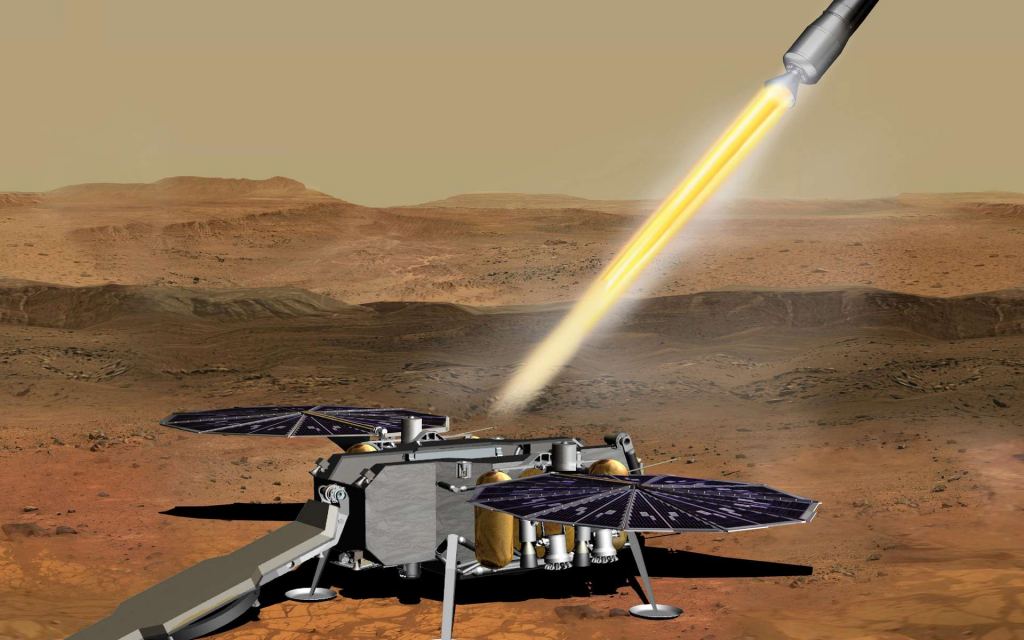
Artist’s conception of the MSR mission rocket taking off from the surface of the red planet. Credit – NASA / JPL-Caltech
Utilizing high-speed cameras, they track how the lander the various drops it is subjected to and update computer models to reflect what happened in their testbed. The more unique test scenarios they can capture in the lab, the more likely the lander will have experienced it before. As testing progresses, it will eventually scale up to a full-size lander system to see how the real thing would respond.
The lander’s landing position is critical because it will have to launch a rocket up into the air. Early in the mission design, the team decided that it would be better to throw the rocket up in the air. That rocket, known as the Mars Ascent Vehicle, will take the samples back to orbit, eventually transferring to Earth via another rocket system sitting in orbit around Mars.
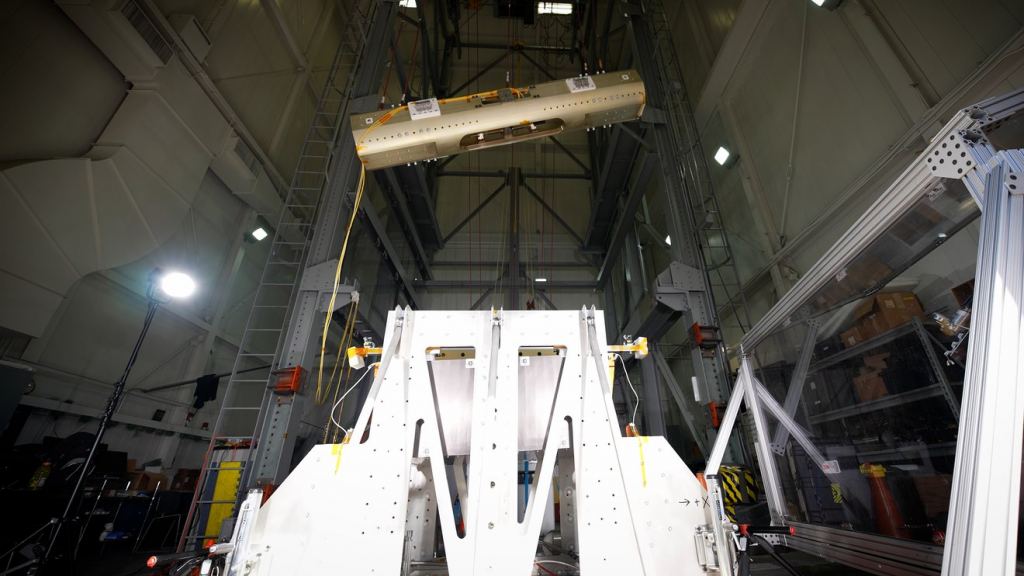
The MSR lander tosses a mock rocket into the air, which is then suspended by a crane. This toss will be critical to the success of MSR’s mission, as it will allow the samples to be returned back to an orbiter, and thence to Earth. Credit – NASA / JPL-Caltech
Testing for that ejection mechanism is also ongoing, with engineers at JPL throwing a 400 kg (881 lb) fake rocket 3.3 meters (11 ft) up in the air at an angle. To do this, the lander utilizes a piston system, but on Earth, it also gets help from a crane designed to mimic Martian gravity by offloading more than half the rocket’s weight. The crane is also conveniently placed to entirely suspend the rocket at the end of the test so that it doesn’t fall back down, crushing the test lander.
Even still, testing the Vertically Ejected Controlled Tip-off Release (VECTOR) system is dangerous, and everyone performing the testing does so from outside the building. Data collected from the tests will help compensate for different potential landing orientations of the lander itself and the modeling of the stressors the lander itself must be designed to withstand during the rocket’s ascent.
Typically these tests are performed in stages, which is also the case for most of MSR’s tests. In addition to eventually testing a fully sized lander, engineers will attempt to throw a larger rocket even further into the air later this year. There’s still a long way to go before the most complex Martian mission ever untaken is completed, but the process has already started.
The US Navy admitted to a F-35 crash while attempting to land on a US Navy aircraft carrier last week. The black box transponder has a ten day life and the Navy says that it's a race now to recover the jet before the Chinese do. It has the newest, hi tech devices in it, things highly classified and still top secret. Then...the US Navy announces it across all news media agencies around the world! Wait...they did what? Yeah...that gave it away right there. They wanted the news agencies to scream out the news so that China would go and recover the jet...thus satisfying China temporarily with the fake crash of the craft, which by the way...just happens to be 99.99% intact minus the cockpit pilot chair and canopy. Coincidence? I think not.
Do you remember back in April of 2001, when a US Navy EP-3E Aries II spy plane on routine surveillance mission over South China, was intercepted by several China fighter jets and was told to land in China or be shot down? So they flew to China...with the most high tech spy plane the US had and handed them the keys saying its yours, but we want it back in a few months...China gave it back...in boxes since they took everything apart and copied, every single item before eventually returning...most, minus software, computer chips, memory storage and so on. That was strange...like it was a gift all wrapped up for China to open. Not even a protest from the pilots before landing in China. Thats not normal for a US military pilot. I'm a USAF vet and I worked on may B-1 bombers and I can tell you, pilots are cocky and ready for a fight win or lose. They want it. They don't give in that easy in the US military unless ordered to do so.
So the US is making it look like its an accident to keep Taiwan safe from China since there must be a secret agreement with payment of aircraft every twenty years or so. But mostly its made to look like an accident to keep the US public out of it...keep the public in the dark so there is no protests, activist, anger over the who thing.
I totally get why the US is doing this, and honestly appreciate it since I'm living in Taiwan now, but...it does concern me...and makes me wonder...how many other secrets are US presidents giving away to the communists?
UFO Creates Cloud Around It Over Corpus Christi, Texas, Video, January 20, 2022
Date of sighting: January 20, 2022
Location of sighting: Corpus Christi, Texas, USA
Source: MUFON
Watch as this UFO appears in the sky during sunset and it realizes it has been seen and it quickly creates a puffy small white cloud around it. The cloud soon glows pinkish because of the sunset, but the UFO was seen creating it so we know it still exists within. This is 100% proof that UFOs do create UFOs to hide within.
Scott C. Waring - Taiwan
Eyewitness states:
For context I first thought this was a cloud but after watching it for several minutes it kept growing and got really bright. After this large bright spot appeared it quickly disappeared. No other clouds were in the sky and the sun was already going down. No airplane incidents were reported on the news either. Very weird and I’m hoping someone can explain! I did not see the moon behind it, the sun was setting to my right and I do not know where the moon was. Stopped recording so I could phone a friend to determine if they could see it. I had called a friend to see if they had noticed it. He said he could find it in the sky but he lives about 20~ miles in a different direction. Girlfriend saw it though so I know I’m not crazy lol. It pretty much went away quickly after this video was shot. We didn’t see any scheduled launches. This direction is towards south padre though. There is a Naval Air Base in this direction as well but I didn’t see any planes in the sky.
UFO Over Mountains of Arizona! Video, January 22nd 2022
Date of sighting: January 22, 2022
Location of sighting: Arizona, USA
A white UFO was seen over Arizona this week. The object appears to be a white thick disk and is tilted at a 45 degree angle. Bob Lazar who once worked inside Area 51 at a top secret location called Area S4 once said, that UFOs often tilt when moving. He said the tilting allows the UFO to move along the sky like a slide and tilting creates a different angle of propulsion force allowing it to do so. This UFO is a great example of that. You can easily see its tilted as it changes locations over the mountains.
Astronomers witnessed something incredibly strange in space that is “unlike anything” they have ever seen before. According to information provided by the International Centre for Radio Astronomy Research (ICRAR), a team of experts who were mapping the universe’s radio waves noticed an incredibly odd space object that was emitting massive bursts of energy three times every hour.
As the object was spinning in space, a radiation beam was ejected from it which scientists were able to observe. The beam could be seen for one full minute and occurred every twenty minutes. Incredibly, it was one of the brightest radio sources ever witnessed in space.
In the release, astrophysicist and team leader Natasha Hurley-Walker went into further details, “This object was appearing and disappearing over a few hours during our observations, that was completely unexpected. It was kind of spooky for an astronomer because there is nothing known in the sky that does that,” adding, “And it’s really quite close to us – about 4,000 light-years away. It’s in our galactic backyard.”
Space is a mysterious place.
Scientists have previously documented space objects that “turn on and off” (these are called “transients”). They can occur at different frequencies as slow transients can happen for a few days and disappear within a few months (supernovas do this), while fast transients are extremely quick – some lasting just seconds or even milliseconds (pulsars do this).
However, the space object that was seen turning on for one minute had never been witnessed before. Since it is exceptionally bright, smaller than our sun, and sends out blasts of high-polarized radio waves, it is believed that the object contains a strong magnetic field. As for what it is, experts think that it may possibly be either a neutron star or a white dwarf.
Hurley-Walker went on to say that it could be a previously hypothesized space object known as an “ultra-long period magnetar”. “It’s a type of slowly spinning neutron star that has been predicted to exist theoretically.” “But nobody expected to directly detect one like this because we didn’t expect them to be so bright.” “Somehow it’s converting magnetic energy to radio waves much more effectively than anything we’ve seen before.”
Is it a magnetar?
While it remains a mystery, researchers are keeping a close eye on the object in case it decides to briefly turn back on. And if it does, they will be able to see it with numerous telescopes, such as the Murchison Widefield Array (MWA) telescope in Western Australia. “If it does, there are telescopes across the Southern Hemisphere and even in orbit that can point straight to it,” said Hurley-Walker. The research has been published in the journal Naturewhere it can be read in full.
Images showing where the mysterious object is located in space can be viewed here.
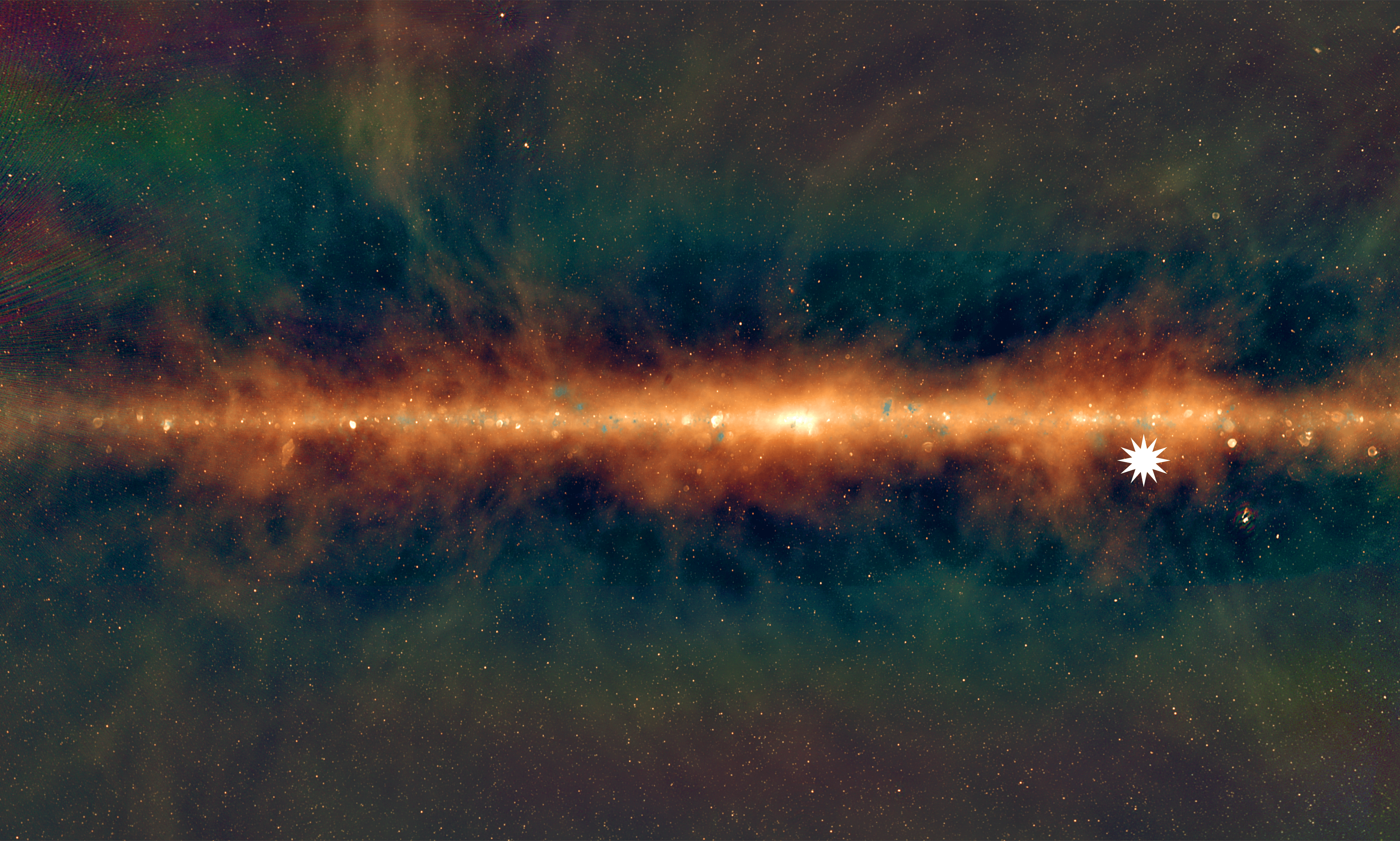
This image shows the Milky Way as viewed from Earth. The star icon shows the position of the mysterious repeating transient. Credit: Dr Natasha Hurley-Walker
(ICRAR/Curtin).
This image shows a new view of the Milky Way from the Murchison Widefield Array, with the lowest frequencies in red, middle frequencies in green, and the highest frequencies in blue. The star icon shows the position of the mysterious repeating transient.
Credit: Dr Natasha Hurley-Walker (ICRAR/Curtin) and the GLEAM Team.
The new radio is transient in the sky, as it would have been seen at the MWA during the night in March 2018, when it was active. The source is shown with a large white star marker, but would be invisible to the naked eye. Image source: Stellarium
The location of the source in the sky in January 2022, marked with a large white star marker. At this time of year, it is above the horizon during the day.
Image source: Stellarium
Magnetar An artist’s impression of what the object might look like if it’s a magnetar. Magnetars are incredibly magnetic neutron stars, some of which sometimes produce radio emission. Known magnetars rotate every few seconds, but theoretically, “ultra-long period magnetars” could rotate much more slowly.
The turbulent heart of the Milky Way contains nearly 1,000 inexplicable magnetic filaments — ten times more than previously thought, a new image has revealed.
The strange strands, some of which stretch up to 150 light-years across, were first discovered by astronomers at Northwestern University back in the early 1980s.
Observations using radio waves have shown the filaments to be highly organised, appearing in pairs and clusters, with some evenly spaced out like strings on a harp.
The team believe that filaments are comprised of cosmic ray electrons gyrating the magnetic field at close to the speed of light, but their origins remain a mystery.
However, the identification of more of the strings, the researchers said, will now enable broad statistical studies that might allow them to unravel this puzzle.
The team have already ruled out supernovae as the source of the filaments, and suspect they may have been created by our galaxy's supermassive black hole.
The turbulent heart of the Milky Way contains nearly 1,000 inexplicable magnetic filaments — ten times more than previously thought, a new image (pictured) has revealed
A mosaic image of the heart of the Milky Way. The filaments can be seen as vertical slashes throughout
Observations using radio waves have shown the filaments to be highly organised, appearing in pairs and clusters, with some evenly spaced out like strings on a harp
THE FILAMENTS MAY HAVE THEIR ORIGINS IN THE SUPERMASSIVE BLACK HOLE AT THE HEART OF THE GALAXY
The new data gathered by the MeerKAT telescope has allowed Professor Yusef-Zadeh and his colleagues to better study the filament's magnetic fields, alongside the role that cosmic rays play in illuminating them.
They found that the radiation emitted from the filaments is very different to that seen from supernova remnants.
This suggests that the two phenomena have different origins.
The team think that the filaments may have been formed as a result of the past activity of the supermassive black hole that lurks at the centre of the Milky Way — rather than from the coordinated bursts of supernovae.
In addition, the filaments may be related to the vast, radio wave-emitting bubbles, which Professor Yusef-Zadeh and his team first reported discovering back in the September of 2019.
The study was led by Northwestern University astrophysicist Farhad Yusef-Zadeh, who spotted the first strands back in 1984.
'We have studied individual filaments for a long time with a myopic view. Just examining a few filaments makes it difficult to draw any real conclusion about what they are and where they came from,' explained Professor Yusef-Zadeh.
'Now, we finally see the big picture — a panoramic view filled with an abundance of filaments. This is a watershed in furthering our understanding of these structures.
'This is the first time we have been able to study statistical characteristics of the filaments. By studying the statistics, we can learn more about the properties of these unusual sources.
'If you were from another planet, for example, and you encountered one very tall person on Earth, you might assume all people are tall. But if you do statistics across a population of people, you can find the average height.
'That's exactly what we're doing. We can find the strength of magnetic fields, their lengths, their orientations and the spectrum of radiation.'
The new image of the Milky Way's centre was the result of three years' worth of sky surveys undertaken using the MeerKAT radio telescope at the South African Radio Astronomy Observatory (SARAO) in the country's Northern Cape providence.
After a total of 200 hours of telescope time, the team were able to piece together a mosaic of 20 separate observation of different parts of the sky in the direction of the galactic centre, which lies some 25,000 light years from Earth.
Alongside the filaments, the final composite image also captures numerous other sources of radio emissions, including outbursts from stars, stellar nurseries and new supernova remnants.
'I've spent a lot of time looking at this image in the process of working on it, and I never get tired of it,' said paper author and astrophysicist Ian Heywood of the University of Oxford.
'When I show this image to people who might be new to radio astronomy […] I always try to emphasize that radio imaging hasn't always been this way, and what a leap forward MeerKAT really is in terms of its capabilities.
'It's been a true privilege to work over the years with colleagues from SARAO who built this fantastic telescope.'
The strange spatial strands (pictured), some of which stretch up to 150 light-years across, were first discovered by astronomers at Northwestern University back in the early 1980s
Alongside the filaments, the final composite image also captures numerous other sources of radio emissions, including outbursts from stars, stellar nurseries and new supernova remnants. Pictured: a rare, almost-perfectly spherical supernova remnant seen in the image
The new image of the Milky Way's centre was the result of three years' worth of sky surveys undertaken using the MeerKAT radio telescope (pictured) at the South African Radio Astronomy Observatory in the country's Northern Cape providence
To get a clearer look at the filaments, the team used a special technique that allowed them to remove the background from the main image, isolating the strands.
'It's like modern art. These images are so beautiful and rich, and the mystery of it all makes it even more interesting,' said Professor Yusef-Zadeh.
The researchers said that they are particularly intrigued by how structured the filaments appear, with those in clusters seemingly spaced at equal intervals, each around the distance of that from the Earth to the sun.
'They almost resemble the regular spacing in solar loops,' commented Professor Yusef-Zadeh.
'We still don't know why they come in clusters or understand how they separate and we don't know how these regular spacings happen.
'Every time we answer one question, multiple other questions arise.'
This includes whether or not the filaments change over time or move, and what is causing the electrons to accelerate in the first place.
'How do you accelerate electrons at close to the speed of light?' Professor Yusef-Zadeh asked.
'One idea is there are some sources at the end of these filaments that are accelerating these particles.'
After a total of 200 hours of telescope time, the team were able to piece together a mosaic of 20 separate observation of different parts of the sky in the direction of the galactic centre — which lies some 25,000 light years from Earth. Pictured: the distribution of the strengths of magnetic fields in the final, composite image of the heart of the Milky Way
To get a clearer look at the filaments, the team used a special technique that allowed them to remove the background from the main image — isolating the strands, as pictured
With this latest study complete, the researchers are now working to identify and catalogue each filament in the image, noting its orientation, curve, magnetic field, spectrum and intensity, properties that may shine a light on the strands' nature.
'We're certainly one step closer to a fuller understanding. But science is a series of progress on different levels,' said Professor Yusef-Zadeh.
'We're hoping to get to the bottom of it, but more observations and theoretical analyses are needed. A full understanding of complex objects takes time.'
A pre-print of the researchers' article, which has not yet been peer-reviewed, can be read on the arXiv repository, as can an accompany paper presenting the full image created from the MeerKAT data.
'I've spent a lot of time looking at this image in the process of working on it, and I never get tired of it,' said paper author and astrophysicist Ian Heywood of the University of Oxford. Pictured: the complex, cirrus-like emission from the Galactic centre super bubble, which is crossed by a complex of many parallel radio filaments
The new image of the Milky Way's centre was the result of three years' worth of sky surveys undertaken using the MeerKAT radio telescope at the South African Radio Astronomy Observatory in the country's Northern Cape providence
THE MILKY WAY'S OLDEST STAR
A star discovered in 2018 is thought to be one of the oldest in the Milky Way.
Scientists at the Instituto de Astrofísica de Canarias (IAC) in Spain believe that it might have formed about 300 million years after the 'Big Bang'.
IAC researcher Jonay González Hernández said: 'Theory predicts that these stars could form just after, and using material from, the first supernovae, whose progenitors were the first massive stars in the Galaxy.'
Researchers hope the star, known as J0815+4729, which is in line with the Lynx constellation, will help them learn more about the Big Bang, the popular theory about the galaxy's evolution.
IAC director Rafael Rebolo said: 'Detecting lithium gives us crucial information related to Big Bang nucleosynthesis. We are working on a spectrograph of high resolution and wide spectral range in order to be able to measure (among other things) the detailed chemical composition of stars with unique properties such as J0815+4729.'
Meer van UFO'S of UAP'S, ASTRONOMIE, RUIMTEVAART, ARCHEOLOGIE, OUDHEIDKUNDE, SF-SNUFJES EN ANDERE ESOTERISCHE WETENSCHAPPEN - DE ALLERLAATSTE NIEUWTJES


 Weird Facts About Black Holes


 -






 Mysterious object just 4,000 light years away from Earth...
 Not too big and not too small! Astronomers discover a rare...
 Star of the show! NASA shares stunning footage of powerful...
 Black hole is spotted 'giving birth' to stars in a nearby...


