Ontdek de Fascinerende Wereld van UFO's en UAP's: Jouw Bron voor Onthullende Informatie!
Ben jij ook gefascineerd door het onbekende? Wil je meer weten over UFO's en UAP's, niet alleen in België, maar over de hele wereld? Dan ben je op de juiste plek!
België: Het Kloppend Hart van UFO-onderzoek
In België is BUFON (Belgisch UFO-Netwerk) dé autoriteit op het gebied van UFO-onderzoek. Voor betrouwbare en objectieve informatie over deze intrigerende fenomenen, bezoek je zeker onze Facebook-pagina en deze blog. Maar dat is nog niet alles! Ontdek ook het Belgisch UFO-meldpunt en Caelestia, twee organisaties die diepgaand onderzoek verrichten, al zijn ze soms kritisch of sceptisch.
Nederland: Een Schat aan Informatie
Voor onze Nederlandse buren is er de schitterende website www.ufowijzer.nl, beheerd door Paul Harmans. Deze site biedt een schat aan informatie en artikelen die je niet wilt missen!
Internationaal: MUFON - De Wereldwijde Autoriteit
Neem ook een kijkje bij MUFON (Mutual UFO Network Inc.), een gerenommeerde Amerikaanse UFO-vereniging met afdelingen in de VS en wereldwijd. MUFON is toegewijd aan de wetenschappelijke en analytische studie van het UFO-fenomeen, en hun maandelijkse tijdschrift, The MUFON UFO-Journal, is een must-read voor elke UFO-enthousiasteling. Bezoek hun website op www.mufon.com voor meer informatie.
Samenwerking en Toekomstvisie
Sinds 1 februari 2020 is Pieter niet alleen ex-president van BUFON, maar ook de voormalige nationale directeur van MUFON in Vlaanderen en Nederland. Dit creëert een sterke samenwerking met de Franse MUFON Reseau MUFON/EUROP, wat ons in staat stelt om nog meer waardevolle inzichten te delen.
Let op: Nepprofielen en Nieuwe Groeperingen
Pas op voor een nieuwe groepering die zich ook BUFON noemt, maar geen enkele connectie heeft met onze gevestigde organisatie. Hoewel zij de naam geregistreerd hebben, kunnen ze het rijke verleden en de expertise van onze groep niet evenaren. We wensen hen veel succes, maar we blijven de autoriteit in UFO-onderzoek!
Blijf Op De Hoogte!
Wil jij de laatste nieuwtjes over UFO's, ruimtevaart, archeologie, en meer? Volg ons dan en duik samen met ons in de fascinerende wereld van het onbekende! Sluit je aan bij de gemeenschap van nieuwsgierige geesten die net als jij verlangen naar antwoorden en avonturen in de sterren!
Heb je vragen of wil je meer weten? Aarzel dan niet om contact met ons op te nemen! Samen ontrafelen we het mysterie van de lucht en daarbuiten.
Zaterdag 12 maart 2022
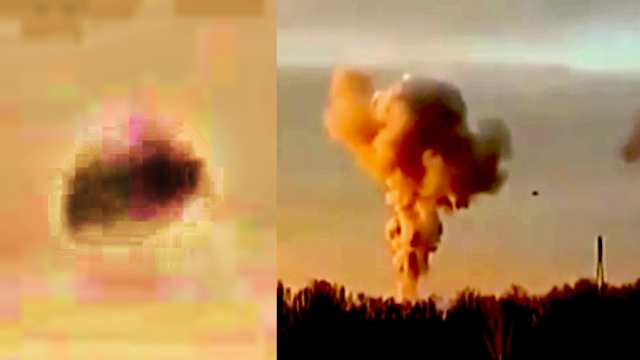
UFO Near Explosions In Ukraine As Russian Army attacks town, 3-1-2022, UFO Sighting News.
UFO Near Explosions In Ukraine As Russian Army attacks town, 3-1-2022, UFO Sighting News.
Added contrast to above screenshot to show UFO better, Below its original untouched.
Date of sighting:March 1, 2022
Location of sighting: Ukraine
This video was taken from inside Ukraine from an apartment window as explosions were heard. I can hear the man ask several times, "is it a drone?" But even he has never seen such a huge wingless drone before, nor have I. This object is very strange, nothing like a drone, not a helicopter for sure...a helicopter holding still would be instantly targeted by rocket launchers on the ground. I see no wings, no propellers, no windows or doors, no exhasust. This thing is not from Earth. It's an alien ship watching the war as it unfolds. Maybe the aliens are even helping in some way. Most likely not taking sides, but instead causing large missile weapons to stop working permanently. UFOs have been known to do that over nuclear missile silos at my old USAF base Ellsworth AFB in South Dakota, USA. It's a show of who's truly boss.
Oval Glowing UFO Shoots Over Dallas, Texas March 7, 2022, Video, UFO Sighting News.
Date of sighting: March 7, 2022
Location of sighting: Dallas, Texas, USA
Source: Twitter @ChikDigsLngBall
Now this is some fast and short footage, but...it is raw footage and that beats the alternative, no footage at all. I looked at it again and again, trying to see any detail of the craft that would stand out. However I found no wings, no aircraft lights, drone lights, tails or any sign of it being a normal aircraft. It's has a shape like that of an egg...an oval. Its speed is that of a jet...but too slow to be a meteor. Very awesome catch. And over Dallas, Texas...a UFO hotspot.
Scott C. Waring - Taiwan
Eyewitness states:
Soo the night before last, my sister and I saw a UFO. No big deal... 🛸It was actually crazy. I couldn't get my camera out on time and my sis was too stunned to be useful 😄 It had started out from the horizon in front of us on other side of the sky before zooming to where u see it here. Then, it just disappeared behind clouds and never reemerged. It was actually bigger, brighter, faster, and had more lights than you can see here.
Giant UFO at the bottom of the ocean off coast Peru
Years ago, people in the cafes around Pisco's central plaza, Peru were talking nonstop about the second UFO display off coast Lima the previous night. Rumors spread about the presence of an underwater base offshore. Some said it was an alien base, others claimed that it was secret NATO base.
Scanning the bottom of the ocean off coast Lima, Peru shows a perfect disk shaped object with a diameter of 6,4km that seems out of place compared to the surrounding ocean floor.
Could it be:
1. A huge flying saucer (UFO_USO) that floats above a black hole.
2. A solid construction that can open and close leading to an underwater base.
Another perfect disk shaped object with a diameter of 4km shows up at the bottom of the ocean floor 385 km away from the first disk. This disk also seems out of place and we may wonder whether it is a crashed UFO.
Is it possible that the witnesses, who years ago saw UFOs off the coast of Lima, Peru be right that there is an alien underwater base?
In this video, I discuss a UFO photograph my friend Elijah took on January 27th 2022 outside the Tropicana Hotel in Atlantic City, New Jersey. We were in the area in order to attend Sifu Alan Goldberg’s Martial Arts Action Mega Weekend event. I breakdown and analyze the UFO picture and give my thoughts.
In addition to that, I also breakdown and analyze a video of a UFO from Doron @MOTORHEADS that he took in Beverly Hills in 2010.
Guys you gota check this out. Have you ever played the game Halo and seen the aliens purple weapons? Or perhaps seen the weapons in Stargate Atlantis TV series? Well reality is not far off. This is an alien pulse rifle found on Mars in the latest photos from the rover. This pulse rifle was upside down, so I flipped it over and made it purple so you could really see it. Look at it carefully and you could see a person holding this rifle defending themselves from an attack. Humans do not hold exclusive rights on fighting, killing or war. Its a universal concept and a virus that the universe has to live with.
Scott C. Waring - Taiwan
BELOW ARE THREE HELMETS ALL CLOSE TO EACH OTHER. MAY OR MAYNOT HAVE SEVERED HEADS INSIDE. WAR IS WAR.
During the early 1950s my dad, Frank Redfern, like all young men of his age at that time, had to serve three years of National Service. And, having a passion for aircraft, he chose to join the Royal Air Force. During his three years in the RAF, and before returning to his regular job as a carpenter, which he held until his retirement at the age of sixty-five, he was trained in the field of, and worked on, radar. It was towards the end of his service that my dad was involved in several radar-based UFO encounters, all of which occurred at the height of a September 1952 NATO operation, called Exercise Mainbrace. On each occasion, fast moving objects of unknown origin were tracked on the radar-screens, fighter planes were scrambled, and the ominous and official stamp of secrecy came firmly down on just about everyone and everything. Certainly, my dad didn’t tell me about this most weird affair until I was in my early teens, around 1978 or 1979. It was an event that got me deeply interested in UFOs, and set me on a path to seek out the truth concerning all things saucer-shaped and flying. And it’s a strange and conspiracy-filled path that I’m still on today. And, arguably, those September 1952 events left a deep and lasting impression on my dad, too, since – if asked – he is still willing to talk about them to this very day.
(Nick Redfern)
Radar and my dad: still sharing his UFO experiences
There’s no doubt it was my dad’s experiences – and particularly those military-based radar events he was involved in -that got me involved. With that said, let’s now take a look at some other UFO-radar cases that I consider to be important. On March 26, 1957, there was an amazing encounter. The UK Air Ministry documentation (now in the public domain) states in part: “A report was received from Royal Air Force Church Lawford on 26th March, 1957 of a sighting of an unusual nature. The object moved at a speed timed at exceeding 1400mph [italics mine]. This in itself was unusual as the object had accelerated to this speed from a stationary position [italics mine]. No explanation has yet been found for this sighting but a supplementary report, including a copy of the radar plot, was requested and has been received from Church Lawford this afternoon.” Few of the files have been placed into the public domain.
(Nick Redfern)
At the National Archives
A perfect example of UFOs and radar, is a collection of U.S. Air Force documents that detail an astonishing wave of UFO activity that occurred in early 1958. They are files declassified under the terms of the Freedom of Information Act, but which have not generally received the positive commentary they deserve. The mystery began on the night of March 9, 1958. The location: a now-closed U.S. Army installation on the Panama Canal Zone called Fort Clayton. It was around 8:00 p.m. when a UFO was tracked, by anti-aircraft personnel, in the Canal Zone area. Further blips soon appeared on the screen. Clearly something unusual was afoot. It turns out that Fort Clayton was not the only base monitoring unusual aerial activity. Radar staff at Fort Amador, Flamenco Island were also tracking something airborne and unknown. In fact, they were tracking two UFOs – both of which maintained a circular pattern above a nearby installation, Fort Kobbe. Their heights, however, fluctuated between 2,000 and 10,000 feet. It was at this time that staff at Taboga Island’s Track Radar Unit confirmed they were keeping a careful watch on certain unknowns, too.
Shortly before midnight, personnel at Fort Amador chose to take a new and novel approach to try and identify the UFOs: they bathed them with powerful, ground-based searchlights. The response was incredible: in no more than a handful of seconds the UFOs headed skywards from 2,000 to 10,000 feet. Official records on this particularly eye-opening development state: “…this was such a rapid movement that the Track Radar, which was locked on target, broke the Track Lock and was unable to keep up with ascent of the objects. As Track Radar can only be locked on a solid object, which was done in the case of the two unidentified flying objects, it was assumed that the objects were solid.” This strange and bizarre activity continued into the early hours of March 10 – something which saw UFOs hovering and accelerating to speeds around 1,000 miles per hour, and unknown objects tracked on radar.
(Nick Redfern)
The U.K.’s Ministry of Defense
One of the most fascinating of all UFO encounters – an incident that almost resulted in a mid-air collision between a UFO and a Meteor jet – occurred over Royal Air Force Gaydon, Warwickshire, England, on the night of October 21, 1957. Less than a week later, the UK media was chasing down the story. Describing RAF Gaydon as “one of the RAF’s top V-bomber stations,” the Sunday Express newspaper stated that the Air Ministry (today, the Ministry of Defense) had taken rapid steps to get to the heart of the mystery. Reportedly, the UFO was seen visually by the pilot and tracked by ground-radar personnel – and only a few minutes apart. Questions, unsurprisingly, were quickly being asked: could the UFO actually have been a Soviet spy-plane? It was certainly a scenario that the Air Ministry felt important enough to address. Although – as will become apparent – the description given by the pilot did not sound like that of the average Russian aircraft. Plus, six days after the event occurred, Air Ministry staff were still scratching their heads. As all of this demonstrates, radar and UFOs come together – and in an amazing fashion. Sometimes with your own dad!
New L.A. Marzulli: UFO Disclosure - Full Length Film
New L.A. Marzulli: UFO Disclosure – Full Length Film
In the last few years, we’ve seen a heightened interest from the public … the media … and the government on UFO encounters. Would it be beyond imagination to suggest that one day an alien craft might appear on Earth, claiming to represent the ones who seeded our planet millions of years ago? If Christians are gone, who wouldn’t believe their lie? Or, perhaps this “official disclosure” explains away the rapture of the church, the day Jesus takes millions of believers to heaven as He promised us in the Bible? How else could they explain away our mass disappearance?
Now I was looking in the Eagle nebula which is a infrared color photo taken by the Hubble Telescope. I was actually looking for faces, nebula gases manipulated to create faces...I found a dozen over the last decade so its easy for me. I did however point out one face in the nebula in the middle of my video. These Dyson Spheres are gold, much as many artists imagined them to be. I did not alter the color at all. I only added darkness. Theres not one, but thousands of these spheres and they are not just spheres, but instead the outside is embellished with these huge sections and arms that clearly scream out life living on the outside of the Dyson Spheres. The difficulty here is most people never heard of Dyson Spheres and have little to no expense in astrophysics were in grad school I was top of my class, but chose it as a fun elective. As the theory of Dyson Sphere spreads, it will become more and more accepted as any new scientific discovery does. 100% proof...of thousand of Dyson Spheres in the Eagle Nebula.
Hey check this out. This is some raw footage of an unknown craft over Kiev, Ukraine a few days ago. The object was hovering low, then shot up at an angle and then across the city to shoot up and then down again. Very odd behavior of an aircraft. But then again its war, so it could be anything. However I distinctly remember that during the Fukashima, Japan there was a nuclear reactor leak and a news video taken which accidentally caught a white long tictac UFO flying low and slow over the reactor. I think this may be there for the same reason. A reactor leak not only causes harm to the humans below, but makes it unusable to aliens too...for thousands of years. This object has all the signs of being a UFO.
Carlos Diaz: The Man Who Contacted And Filmed The UFO
One morning in January 1981, Mexican photographer Carlos Diaz pulled into a deserted car park at Ajusco Park near Mexico City. He was on an assignment for a magazine, and had arranged to meet a journalist who was yet to arrive.
Diaz sat in his car, preparing his camera for the job ahead. Although it was early in the morning, the air was thick with humidity which made even sitting still uncomfortable. Impatiently, Diaz began to look at his watch.
Suddenly, his attention was caught by a strange yellow glow coming from the valley below him. At first he thought it was a forest fire, but, an instant later, the source of light revealed itself to be a large, orange, oval-shaped UFO, slowly hovering about 30 metres from his car.
Unable to believe his eyes, Diaz quickly grabbed his camera. With it resting on his steering wheel, he began frantically firing off shots. Then, without warning, the whole car began to shake violently.
Diaz got out of the vehicle and took two more photographs before the craft sped up vertically into the sky, leaving Diaz in a state of shock. This encounter marked the beginning of what was to develop into one of he most fascinating and long-running contactee cases in the history of UFOlogy.
Carlos Díaz
Today, the case remains among a small minority of alledged extraterrestrial encounters to be supported by verified film documentation that has stood up to the scrutiny of a range of experts.
KEY ENCOUNTER
Indeed, the apparent credibility of Diaz’s claims has attracted the attention of some of the world’s top UFO researchers, including German author Michael Hesemann and abduction researcher Dr John Mack. Both concluded that Diaz’s story is completely credible.
Hesemann echoes the views of most researchers when he states: ‘The Carlos Diaz case is the most important case of documented alien-human contact to have emerged in modern times.’ Certainly, at the time of his initial encounter, Diaz little suspected what was to come.
The transition from a run-of-the-mill UFO sighting in an area now acknowledged as a UFO hot-spot, to one of the key cases of recent years did not occur until weeks later. In the days that followed this January sighting, Diaz remained preoccupied by his experience.
Unable to forget what he had seen, he repeatedly returned to the Ajusco Park location, hoping to secure more pictures. After a succession of fruitless visits, Diaz began to think that he was wasting his time. But then, on 23rd of March, his patience was rewarded.
RETURN TRIP
While roaming the greenery, Diaz was again alerted to the presence of a UFO by an orange glow, which he could see only dimly through the fog and rain that had saturated the forest in Ajusco Park. As he climbed up the walls of the valley, he managed to position himself within 45 metres of the object. Diaz watched the ‘craft’ hovering above him, eminating a bright orange light.
It was, he said, dome-shaped with a smooth ring in its centre. This, claimed Diaz, was covered with a number of half spheres, each around one metre in diameter. Crouching behind some rocks, Diaz thought his actions had gone unnoticed, but, as he continued to watch the craft, he felt someone grab his shoulder from behind.
Diaz immediately fainted, and, when he awoke, it was dark and the UFO was gone. He was shocked to discover that, despite heavy rain, his clothes were completely dry. At that point, he knew something strange had happened to him. When he returned to his car, Diaz noticed another car parked in front of him.
At this point, Diaz claimed, a humanoid entity with fair hair approached him and told him that if he wanted to know more about what he had just experienced, he should return to the same spot at noon the following day. Apparently, when Diaz returned the next day, he discovered the same entity sitting on the grass.
Diaz claimed that the being then turned to him and explained that it was he who grabbed his shoulder the previous day. Before leaving, the being also told Diaz that he had come from inside the craft and that Diaz would gradually recover his memory of what had happened while he was unconscious. Sure enough, over the next few months, Diaz’s memory returned, piece by piece.
According to his account, he recalled the craft hovered directly over his head. As he attempted to touch the craft, his hand seemed to pass through the yellow light and he seemed to merge with it. The next thing he recalled was seeing the craft parked on a platform inside a giant cave.
Diaz was filled with awe when he remembered what he had seen inside: ‘It was full of stalagmites, some of which were carved into what appeared to be Mayan sculptures,’ he stated.
‘I saw many people in the cave, some of whom waved to me and, in a state of shock, I waved back.’ Apparantly the being Diaz had encountered in the park then led him to a smaller cave which contained seven glowing, egg-shaped orbs, one of which Diaz was invited to step into. On entering, Diaz could at first only see yellow light.
But then he found himself surrounded by the image of a forest. ‘I could see all the details of the forest as if I was walking through it,’ said Diaz. ‘I couldn’t touch anything, but I could feel the temperature and moisture.
I could see and experience everything, yet I wasn’t physically there.’ His guide then told him that the orbs were also a system for storing information and that certain data had been imparted to him. Diaz was then returned to the ship and, in time, to the park.
CONTINUING CONTACT
According to Diaz, this was only the first of a series of contacts with the same beings, which continue to this day. Since 1981, Diaz has stated that his experience inside the orbs has enabled him to ‘travel’ to different regions of the Earth’s ecosystem – forest, desert, jungle, shoreline, even Arctic areas – with his ET contact.
Through this contact, Diaz claims to have been imbued with an awareness of the interconnectedness of all life and the need to preserve our environment.
To many UFOlogists, especially those who have had their ‘fingers burnt’ by alledged contactees before, these claims may appear far-fetched. However, Diaz is seen by many researchers as a highly reliable source, not least because of the strong body of photographic evidence he has amassed to support his claims.
INDISPUTABLE PROOF?
Mexican TV journalist and UFOlogist Jaime Maussan, who has been at the centre of UFO investigations in Mexico since the wave began in 1991, believes that Diaz’s UFO photographs are among the most impressive he has seen.
Maussan took Diaz’s photographs to Jim Dilettoso, an image processing expert at Village Labs, in Tucson, Arizona, who concluded they were genuine. After satisfying himself he was not dealing with a hoaxer, Maussan visited Diaz at his hime in Tepoztlan, Mexico. There, he spoke to a number of other witnesses who claimed to have seen exactly the same type of UFO.
The apparent credibility of the Diaz case has also attracted UFO researchers from further afield, who have attempted to glean insights into the alien agenda from Diaz’s contactee claims. German author Michael Hesemann, who first interviewed Diaz in June 1994, is convinced of the credibility of Diaz’s story.
‘Not only is he contacting these beings through encounters on the ships,’ says Hesemann, ‘but he claims to be meeting these beings socially, since he believes some of them are living among us.’ However Hesemann explains that, according to Diaz, the beings are reluctant to fully disclose their origins.
‘Apparently,’ says Hesemann, ‘they did, however, explain that they have been visiting Earth for thousands of years, and are particularly interested in our evolution which, compared to their own, has happened at a much faster rate. They are trying to learn why.’
Another UFO researcher intrigued by Diaz’s case is Professor of Psychiatry at Harvard Medical School, John Mack. Mack has a long history of dealing with abductees and contactees and believes that the Diaz case is among the most convincing he has come across.
In his book Passport to the Cosmos, he states: ‘Out of all the experiencers I have worked with, it is Carlos Diaz who seems to have developed the richest understanding of the interconnected web of nature. Diaz’s experience of connecting with living creatures is so intense that he seems literally to become the thing he is describing.’
Diaz’s experience, Mack claims constitutes an ‘awakening’, a process which, he says, is common in abductees. Diaz told Mack that his contact with the ETs had instilled in him a need to preserve the environment and the ability to ‘enjoy a beautiful planet’.
Whether or not an extraterrestrial influence was involved, Diaz’s new-found concern for the environment has certainly become a driving force in his life. he has repeatedly and passionately conveyed this environmental warning publicly, most notably at a UFO conference in Dusseldorf, Germany in 1995.
Diaz has revealed that he had been informed through his contacts that the civilization of the visiting extraterrestrial, like ours, had been threatened by its own history of destruction, but had somehow managed to survive.
He remains convinced that his contacts’ disturbing prediction for our future is only too real – a prediction that states with near certainty that humanity, on its current course, is headed for total extinction.
ALIEN MESSENGER
This outspokenness, coupled with the public nature of his experience, has le Diaz to assume visionary status in both his home town of Tepoztlan and UFO circles. however, Diaz has been quick to dispute this, claiming that he is not a unique visionary, but merely ‘a messenger’.
The real nature of Diaz’s current incarnation aside, for many UFOlogists, the Diaz case remains among the most convincing on record. Indeed, few UFO reports exist that boast such impressive and abundant photographic evidence. And fewer still have emerged that have stood up to the scrutiny applied to Diaz’s images.
PERFECT PICTURES
Expert analysis of Carlos Diaz’s UFO pictures has been extremely thorough. Mexican UFOlogist Jaime Maussan gave the original transparencies to Professor Victor Quesada at the Polytechnical Institute of the University of Mexico for examination.
Quesada stated: ‘We were shocked to discover that the spectrum of light from the object was unlike anything we have ever seen, it broke all previous parameters and didn’t match anything in our data banks.
The light was extraordinarily intense. There was no evidence of superimposition or a hoax. We estimated the object to be around 30 to 50 metres in diameter.’ Interestingly, the photographs were also analysed by Dr Robert Nathan at NASA’s Jet Propulsion Laboratory in California. Nathan, a notorious UFO sceptic, stated that he could find no evidence of a fake.
Certainly, for many who have examined the three images, the first shot is the most impressive. In it, the orange glowing craft can be seen through the windshield of the car, and light from the object is reflected both off the car’s bonnet and off the metal guard rail by the side of the road. These, in particular, are details that experts claim are extremely difficult to fake.
VIDEO EVIDENCE
Mexican UFOlogist Jaime Maussan was so intrigued by Carlos Diaz’s account of his experiences that he provided him with a video camera and asked him to see if he could record the UFO on tape when it next appeared. A few weeks later, Diaz awoke at 5 a.m. and grabbed his camera. He walked out and waited.
Apparently, within minutes, the craft appeared and hovered over the house, where Diaz filmed it. When Maussan saw the remarkable footage, he asked Diaz if he could get even closer to the craft while filming. Two months later, Diaz was once again able to film the craft, which this time hovered directly above him, without moving.
However it is Diaz’s third attempt to capture the craft on video that is the most spectacular. In this footage, Diaz having mounted his camera on a tripod, walks to the bottom of a field waving a flash light.
Responding to this, the craft suddenly materializes directly above Diaz’s head and sends beams of light down towards him. Then, the unidentified object remains motionless for 30 seconds, before blinking out. It is universally recognized that this video contains some of the best UFO footage ever taken.
The incredible story of Carlos Diaz and the big oval-shaped UFO
Many believe that there are no so-called UFOs. They believe it is just a future secret technology under test. We are ignorant of it and therefore we think it is unknown. But what about large, strange yellow glow, oval-shaped object with spectrum, which unlike anything we have ever seen and didn’t match anything in our data banks, in 1981.
Nanorobotics is about creating robots which are so small they are nearly invisible to the naked eye. Operating as a swarm, these tiny robots have the promise to do some really incredible things.
Nanorobots are so small that they actually interact on the same level as bacteria and viruses. Nanorobots or nanobots are measured in nanometers or a millionth of a millimeter. Nanobots are envisaged to be little machines, or tiny robots that rush around and do things like cleaning out blocked arteries or swimming through the ocean eating polluting chemicals.
Nanobots are no longer speculation, but unlike science fiction, they won't take over the world, at least, not yet. A hypothetical end of the world scenario involves molecular nanotechnology, in which out-of-control self- replicating robots consume all matter on Earth while building more of themselves because of a programming error.
Nanotechnology is an emerging field in robotics with a promise of different solutions to problems which have plagued mankind since our beginning. Nanobots can be one of the most important achievements humans have ever produced. Nanotechnology is the creation of microscopic objects, which are so small that they are constructed not with regular materials but with the very atomic building blocks of life. Nanorobotics is a part of this line of work, with its main focus on creating robots, which are so small they are nearly invisible to the naked eye. Operating as a swarm, these tiny robots have the promise to do some really incredible things.
There are various areas of science that can benefits from nanotechnology. These are medicine, environment, industrial manufacturing, and even warfare. The first real application in medicine will be in treating cancers. Nanobots are preferable to the existing means of fighting cancer because they can bring the medicine directly to the tumor, helping to avoid killing healthy cells along with the cancerous ones.
Nanobots, delivering a killing blow to cancer cells
Researchers from Columbia University announced a fleet of molecular nanobots that can deliver drugs to specific cells, and also identify certain genetic markers by using fluorescent labeling. This type of targeted therapeutic approach could prove beneficial, especially for cancer treatment, which presently sweeps up healthy cells along with malignant ones, very often doing more harm than good. We are about to see a new phase of pharmaceuticals where conventional drugs are incrementally replaced by nanodrugs.
In addition to cancer treatment, nanobots can potentially be used for other medical purposes, such as regulating diabetes. Diabetic patients have to test their blood several times daily to ensure stable glucose levels. Nanobots can be used to travel through patients’ bloodstreams and send data about glucose levels to external electronic sources. They could travel with the natural flow of the bloodstream, sensing blood sugar levels along the way.
Another potential application is the detection of toxic chemicals, and the measurement of their concentrations, in the environment. Since nanobots can change things at the molecular level, they could possibly solve our pollution troubles.
A swarm of nanobots released into the atmosphere could quickly set to work deconstructing the pollution molecules and turning them into harmless material, which could easily be eliminated from the air. These molecular scrubbers could remain in the air, cleaning, until the air was as fresh as it was eons ago.
The theoretical uses of nanobots are virtually endless, as their size would allow them to essentially rebuild matter. In this sense, properly programmed nanobots would be able to take raw materials and build them into anything, from proteins to foods to tiny microprocessors. If set up to do so, they could, in theory, build more nanobots, through the process of auto-replication. A small group of nanobots could quickly develop into a massive swarm, capable of large-scale projects.
A million nanobots can fit on the head of a pin.
The ability of nanobots to work on an atomic level has far reaching implications for industry as well. Industrial manufacturing requires many resources, equipment and manpower. This is due to the need to acquire resources, process them to a usable state and then assemble them into the products we use on a daily basis. Rather than building things piece by piece and then assembling the component parts, factories could employ nanotechnology to build complete products. Since they can use raw molecules, industrial nanobots would only need the most basic of raw materials to construct nearly anything. As long as they have enough raw materials, these factories could simply reprogram the nanobots to build something else. This would free them from the need to completely replace large portions of the factory just to change its output.
As nanoweapons, nanobots could be used for surveillance for the military, or for assassinations, even used to eat-up and destroy enemy armor. Inspired by colonies of bees, ants and locusts, army engineers are creating armies of nanobots, which are used to locate bombs, clean weaponry, or fly over remote regions of a battlefield. Each individual custom robot is quite basic, but the combined activity in the entire swarm is way more complex. The entire army of robots can be considered as one single customized system, just like a bee colony can be considered a super organism, exhibiting swarm intelligence.
The Nano-Hummingbird is a flying robot created through a program sponsored by DARPA (Defense Advanced Research Projects Agency) that is meant to be used in future indoor and outdoor surveillance missions. DARPA requested a remote controlled nanobot that can fly, hover, move forward and backward and be controlled without an external power source. DARPA specifically asked AeroVironment to create a flying robot that had the body and wings of a bird. What better bird to use than the agile and tiny hummingbird?
AeroVironment employed biomimicry at a very small scale to create the nanobot, which flies just like the real thing. It can travel forward at eleven miles an hour; and resist a wind gust of 5 mph while hovering without being thrown more than three feet off track, and it can be controlled by a distant operator using only the information from an on-board camera.
Molecular nanotechnology (MNT), the umbrella science of nanomedicine, envisions nanobots manufactured in nanofactories no larger than the average desktop printer. The nanofactories would use nano-scale tools capable of constructing nanobots to exacting specifications. The design, shape, size and type of atoms, molecules, and computerized components included would be task-specific. Raw material for making the nanobots would be nearly cost-free, and the process virtually pollution-free, making nanobots an extremely affordable and highly attractive technology.
THIS ROBOT IS SO TINY YOU COULD FIT TEN OF THEM ON A SINGLE PERIOD
ITS CREATORS HOPE THE MICROSCOPIC BOT WILL CRAWL AROUND INSIDE YOUR BODY TO FIGHT CANCER.
CORNELL UNIVERSITY
Jitterbug
A team of Cornell University scientists developed a new robot — so small that it’s invisible to the naked eye — that they hope will someday crawl around inside the human body and hunt for disease.
The robots themselves are little more than microchips attached to four origami-inspired legs, BBC News reports. But their simplicity — the engineers can manufacture 1 million of the bots every week, each one steered by beaming a laser at its feet — gives the team hope that they’ll become a useful medical tool. BBC News published a video of the robots wiggling around, and it’s highly recommended.
New Legs
The hardest part, the team told BBC News, wasn’t necessarily building a microscopic robot, but rather giving such a tiny machine a way to actually move around.
“People have become very good at shrinking computer chips to microscopic dimensions,” Cornell physicist Itai Cohen told BBC News. “The problem was that there weren’t any legs that would work at that scale that could connect to these microchips. We invented a new technology [that’s] essentially the legs for these robotic brains.”
Hunter Killers
So far, the team is celebrating the tiny robots as an achievement and development all of their own. But someday, Cohen hopes that they could serve as medical devices that root around for signs of disease.
“You could imagine having these as little microsurgery devices,” he told the BBC. “You inject these robots in, they locally track down either bacteria or maybe a tumor cell and then they go snip it up and destroy it.”
Near The International Space Station Spotted A Fleet Of UFOs
Near the space station, a flotilla of three U̳F̳O̳s was spotted, the first to report the discovery was researcher Marco Pedotti.
After that, the well-known Taiwanese U̳F̳O̳logist Scott Waring commented on the footage.
“I went over this footage again and again, and I cannot see anything wrong with it. It is 100% authentic. When I took screenshots of some of the U̳F̳O̳s…I noticed they were all blurry and transparent. But one U̳F̳O̳ was over land and it looked like a triangle, but when focused is actually a four sided pyramid,” Waring wrote on his blog.
“This is crazy cool for sure. These are not satellites, they shoot off turning incredibly fast. I have seen satellites released before from the space station… this is not such a thing. These are 100% a̳l̳i̳e̳n̳ technology, piloted by living entities. ”
Of course, Internet users also actively joined the discussion. And, as expected in such cases, opinions were divided.
Someone was skeptical about what they saw, someone supported the idea that we are talking about a̳l̳i̳e̳n̳s.
NOTHER NASA ASTRONAUT JUST BRUTALLY ROASTED THE HEAD OF THE RUSSIAN SPACE PROGRAM
"ROGOZIN HAS ALWAYS BEEN A FOOL."
GETTY IMAGES/FUTURISM
Open Season
Another former NASA astronaut is piling on to mock Dmitry Rogozin, the head of Russia’s space agency Roscosmos, for his inflammatory comments amid Russia’s invasion of Ukraine.
“Rogozin has always been a fool,” former NASA astronaut Garrett Reisman tweeted this week in Russian. “Only now he actually mortally wounds Roscosmos and ends one of the few remaining sources of currency for Russia.”
“Keep this in mind when your ATM is empty,” he added. “It will need a trampoline soon,” referring to a notorious quip in which Rogozin mocked SpaceX back in 2014.
At the time, the space chief famously told the US to “bring their astronauts to the International Space Station using a trampoline” after the US aimed sanctions at the country over — you guessed it — the 2014 Ukraine crisis.
Rogozin had previously been butting heads with former NASA astronaut Scott Kelly, an argument that ballooned into a bitter Twitter feud.
“Maybe you can find a job at McDonald’s, if McDonald’s still exists in Russia,” Kelly tweeted at the space chief on Sunday.
Lashing Out
Rogozin has garnered a reputation for making hotheaded comments and repeatedly lashing out at the international community over the years. Most recently, he’s griped that Roscosmos was being unfairly targeted by fresh waves of sanctions, the result of Russia’s troops invading Ukraine this year.
Rogozin went as far as to seemingly threaten the United States with a plummeting International Space Station late last month, then posting a bizarre video of the station breaking apart on Twitter over the weekend.
In short, Rogozin is actively burying any good will Roscosmos had left, potentially cutting the organization off from any future collaborations with international partners.
And that has the agency in dire straits. Rogozin has already had to resort to slashing his own salary, as well as that of other top figures, significantly.
His controversial scorched Earth approach has earned him plenty of derision and mockery — and only time will tell if Roscosmos will be able to pick up the pieces once the dust has settled.
Een Egyptisch-Oostenrijks team van archeologen heeft meer dan twintig ronde graansilo’s opgegraven in Kom Ombo in het zuiden van Egypte. Volgens de archeologen vormden de silo’s tussen 2.180 en 2.050 voor Christus een belangrijk distributiecentrum voor de Egyptische graanhandel.
De ontdekking werd gedaan in de buurt van de beroemde Tempel van Kom Ombo, die stamt uit de veel latere periode 180 - 47 v.Chr. Het archeologische onderzoek was onderdeel van een project dat al sinds 2017 loopt, om de restanten van Kom Ombo in kaart te brengen. Vreemd genoeg is hier namelijk nooit systematisch archeologisch onderzoek verricht.
De ligging van Kom Ombo
Publiek Domein.
WAT IS ER GEVONDEN?
“De architectonische elementen van de silo’s zijn uitzonderlijk goed bewaard gebleven”, liet archeoloog Abd El-Moniem weten in een interview met de Luxor Times. “Sommige muren zijn zelfs nog zo’n twee meter hoog.” Ook melden de archeologen dat de grootste silo’s een diameter van twee meter lang hebben, en dat er botten en uitwerpselen van ratten zijn aangetroffen. “Dit bewijst dat er ongedierte aanwezig was in de silo’s”, aldus El-Moniem.
Egyptisch Ministerie van Oudheden.
GESCHIEDENIS VAN KOM OMBO
Het is niet geheel duidelijk wanneer Kom Ombo precies gesticht is. Wel weten we dat de stichting op zijn laatst plaats heeft gevonden in de tijd van het Oude Rijk (ca. 2.686 - 2.181 v.Chr.). Gedurende alle dertig dynastieën die het oude Egypte gekend heeft, diende Kom Ombo als garnizoensstad. Deze stad lag namelijk op een strategische locatie, aan een belangrijke handelsroute tussen Nubië in het huidige Soedan, en de steden in het noorden van Egypte. Over het algemeen gaan historici ervan uit dat de stad pas echt belangrijk werd tijdens de heerschappij van de Ptolemaeën (305 - 30 v.Chr.), de van oorsprong Griekse dynastie die over Egypte heerste, nadat Alexander de Grote in 332 v.Chr. Egypte veroverde. Met name in 180 v.Chr. toen farao Ptolemaeus VI Philometor (ca. 191 - 145 v.Chr.) de opdracht gaf om de Tempel van Kom Ombo te bouwen.
De Tempel van Kom Ombo
Olaf Tausch via Wikimedia Commons.
NIEUW INZICHT
Maar Kom Ombo was dus niet alleen belangrijk vanaf de tweede eeuw voor Christus. El-Moniem: “Deze unieke ontdekking in Kom Ombo laat het belang zien van de stad in Opper-Egypte, gedurende de Eerste Tussenperiode (ca. 2180 en 2050 v.Chr.).” De Eerste Tussenperiode is de benaming voor de overgangsfase tussen het Oude- en het Middenrijk, waarin het centrale gezag van de farao tijdelijk wegviel.
This has been found beside the temple at Kom Ombo. You can see a tour boat in the background. I wonder if this used to be the lovely park we spent time in while Akram broke his fast before we went to the temple in the evening
Archaeologists Discover 4000-Year-Old Silos in Upper Egypt
FIP Administrative Building Discovered in Kom Ombo
The Egyptian-Austrian archaeological mission working at Kom Ombo (45 kilometres north of Aswan and 170 kilometres south of Luxor) discovers an administrative building dated to the First Intermediate Period (FIP) (2180-2050 B.C).
Dr Mostafa Waziry said “During the excavation to the northern east side of the ptolemaic temple, a large administrative building with more than 20 conical silos used to store grains were discovered. The administrative facility is dated to the First Intermediate Period.”
Dr Waziry added “This discovery highlights the importance of Kom Ombo during the FIP as it has a large population and it was a center for agricultural and commercial activities.”
Dr Abd El-Moniem Said (Director of Aswan and Nubia antiquities) explained “The architectural elements of the silos are very well preserved and some of the silos walls standing as two meters hight. The existence of rats bones remains and feces proves vermin infestation in the storage rooms.
Dr Irene Forstner-Müller (Director of the Austrian mission of the Austrian Archaeological Institute) said “During the mission’s work over the previous seasons at the archaeological site around the Ptolemaic temple, the remains of a fortress was probably built during the British occupation during the 19th century and was used as an observation and defense point by the Nile during the Mahdist revolution in Sudan (1881-1898)”
Think “Interstellar” or “Event Horizon.” These wormholes could allow a person to jump into one black hole and emerge in a totally different galaxy, in a totally different part of the universe.
Unfortunately, most leading hypotheses surrounding wormholes suggest that they would collapse as soon as they formed due to instability. However, one new theory slated to be published in The Journal of Modern Physics D posits that, actually, wormholes can remain stable enough for objects to enter on one side and leave through the other.
Wormhole Metrics
The theory, by Ecole Normale Supérieure de Lyon computer scientist Pascal Koiran, relies on the Eddington-Finkelstein metric to describe the movements of objects in and around a wormhole. This metric differs from the more often used Schwarzschild metric, which breaks down once an object reaches the event horizon, meaning the point at which no object can escape the pull of a black hole, according to LiveScience‘s writeup of Koiran’s work.
Using the Eddington-Finkelstein metric, though, Koiran was able to mathematically simulate a path for an object into a black hole and through a wormhole instead of breaking down at the event horizon.
Of course, this doesn’t necessarily mean that jumping through any ol’ black hole will send you across the universe. However, it does pose a very interesting theory that shows that wormholes wouldn’t just instantly collapse as soon as they’re created.
SCIENTISTS CAPTURE FIRST-EVER IMAGE OF QUANTUM ENTANGLEMENT
THE IMAGE PAVES THE WAY FOR TOOLS TO ANALYZE QUANTUM BEHAVIOR.
UNIVERSITY OF GLASGOW
Candid
Scientists just managed to snap an image of two photons linked by quantum entanglement, marking the first time that the bizarre phenomenon has been captured with a camera.
The image shows two photons that have been linked through quantum entanglement, which means that they instantly respond to changes that occur in each other, even if they’re separated by a vast physical distance, according to research published Friday in the journal Science Advances. This first-ever photographic evidence of entanglement could help scientists better understand new technology, reports New Atlas, like quantum computers or cryptography.
Rapid-Fire
Taking the image was no easy task, according to the research. The University of Glasgow physicists rigged a camera to capture 40,000 frames per second of an experimental setup that they maintained at -30 degrees Celsius in pitch black. They then had to comb through thousands of frames to find signs of entanglement.
“The image we’ve managed to capture is an elegant demonstration of a fundamental property of nature, seen for the very first time in the form of an image,” Glasgow physicist Paul-Antoine Moreau, told New Atlas. “It’s an exciting result which could be used to advance the emerging field of quantum computing and lead to new types of imaging.”
Meer van UFO'S of UAP'S, ASTRONOMIE, RUIMTEVAART, ARCHEOLOGIE, OUDHEIDKUNDE, SF-SNUFJES EN ANDERE ESOTERISCHE WETENSCHAPPEN - DE ALLERLAATSTE NIEUWTJES


 UFO Near Explosions In Ukraine As Russian Army attacks town, 3-1-2022, UFO Sighting News.