Ontdek de Fascinerende Wereld van UFO's en UAP's: Jouw Bron voor Onthullende Informatie!
Ben jij ook gefascineerd door het onbekende? Wil je meer weten over UFO's en UAP's, niet alleen in België, maar over de hele wereld? Dan ben je op de juiste plek!
België: Het Kloppend Hart van UFO-onderzoek
In België is BUFON (Belgisch UFO-Netwerk) dé autoriteit op het gebied van UFO-onderzoek. Voor betrouwbare en objectieve informatie over deze intrigerende fenomenen, bezoek je zeker onze Facebook-pagina en deze blog. Maar dat is nog niet alles! Ontdek ook het Belgisch UFO-meldpunt en Caelestia, twee organisaties die diepgaand onderzoek verrichten, al zijn ze soms kritisch of sceptisch.
Nederland: Een Schat aan Informatie
Voor onze Nederlandse buren is er de schitterende website www.ufowijzer.nl, beheerd door Paul Harmans. Deze site biedt een schat aan informatie en artikelen die je niet wilt missen!
Internationaal: MUFON - De Wereldwijde Autoriteit
Neem ook een kijkje bij MUFON (Mutual UFO Network Inc.), een gerenommeerde Amerikaanse UFO-vereniging met afdelingen in de VS en wereldwijd. MUFON is toegewijd aan de wetenschappelijke en analytische studie van het UFO-fenomeen, en hun maandelijkse tijdschrift, The MUFON UFO-Journal, is een must-read voor elke UFO-enthousiasteling. Bezoek hun website op www.mufon.com voor meer informatie.
Samenwerking en Toekomstvisie
Sinds 1 februari 2020 is Pieter niet alleen ex-president van BUFON, maar ook de voormalige nationale directeur van MUFON in Vlaanderen en Nederland. Dit creëert een sterke samenwerking met de Franse MUFON Reseau MUFON/EUROP, wat ons in staat stelt om nog meer waardevolle inzichten te delen.
Let op: Nepprofielen en Nieuwe Groeperingen
Pas op voor een nieuwe groepering die zich ook BUFON noemt, maar geen enkele connectie heeft met onze gevestigde organisatie. Hoewel zij de naam geregistreerd hebben, kunnen ze het rijke verleden en de expertise van onze groep niet evenaren. We wensen hen veel succes, maar we blijven de autoriteit in UFO-onderzoek!
Blijf Op De Hoogte!
Wil jij de laatste nieuwtjes over UFO's, ruimtevaart, archeologie, en meer? Volg ons dan en duik samen met ons in de fascinerende wereld van het onbekende! Sluit je aan bij de gemeenschap van nieuwsgierige geesten die net als jij verlangen naar antwoorden en avonturen in de sterren!
Heb je vragen of wil je meer weten? Aarzel dan niet om contact met ons op te nemen! Samen ontrafelen we het mysterie van de lucht en daarbuiten.
Zondag 29 januari 2023
Two Golden Mummies Found - One Wrapped in Gold Leaf May Be Oldest Ever
Two Golden Mummies Found - One Wrapped in Gold Leaf May Be Oldest Ever
The Saqqara necropolis at Egypt's ancient capital of Memphis has been an archeological gold mine recently … and to prove it, one of the latest discoveries there is covered with gold leaf. Gold seems to be the theme when it comes to mummies these days as the mummified remains of a boy that was never unwrapped was digitally unwrapped with a CT scanner and it show the boy covered with 49 golden amulets, including a gold tongue and a gold cover for his private part. Will this trigger a ‘gold rush’ of mummy hunters to Egypt?
Not all mummies are in good condition.
“This mummy may be the oldest and most complete mummy found in Egypt to date.”
Egyptian archaeologist Zahi Hawass, the director of Egyptian excavation team which discovered the gold-covered mummy, made the announcement this week at the site of the Step Pyramid of Djoser in Saqqara, near Cairo. This has been a year-long excavation which also uncovered a 52-foot-long papyrus containing the complete Book of the Dead. However, that discovery pales in comparison to the finding of the mummied remains of a man named Hekashepesy. Hawass told the media that the mummy was found at the bottom of a 49-foot (15 meters) shaft in a group of tombs dating back to the fifth and sixth dynasties of the Old Kingdom – putting them in the 2500 BCE to 2170 BCE timeframe. The tombs are near the Step Pyramid of Djoser, which was completed around 2650 BCE. That gave Hawass and his team a good idea how old the limestone sarcophagus might be when they pulled it up from the shaft. While the coffin was sealed in mortar, Hawass was able to inspect its interior. (Photos can be seen here.)
“I put my head inside to see what was inside the sarcophagus: a beautiful mummy of a man completely covered in layers of gold. This mummy may be the oldest and most complete mummy found in Egypt to date.”
IMAGE SOURCE,GETTY IMAGES - Image caption,
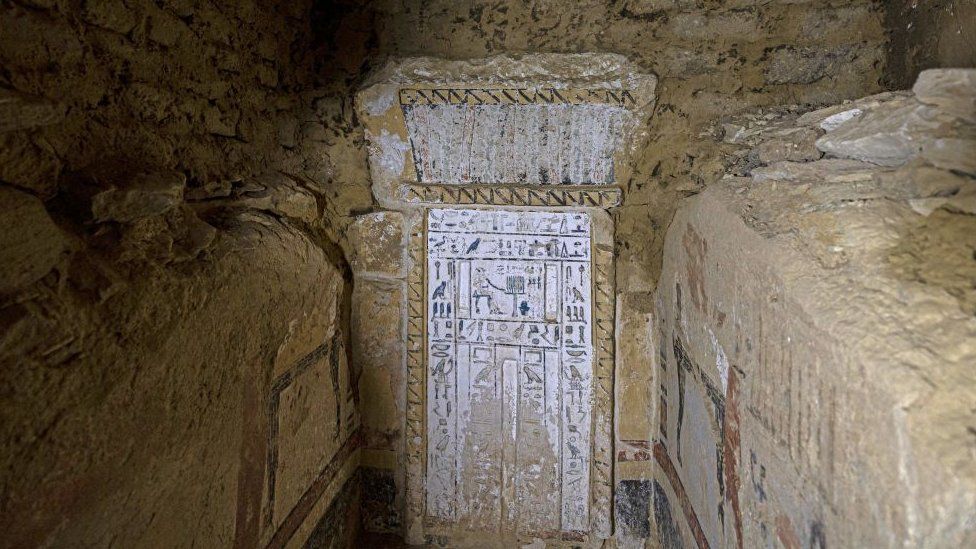
One of four newly discovered tombs at the Saqqara archaeological site south of Cairo
IMAGE SOURCE,GETTY IMAGES
Image ca - ption,Various statues and items of pottery were found in the tombs
It is a challenge to accurately determine the age of Egyptian mummies. A naturally mummified body was found in a near Gebelein (now called Naga el-Gherira) in 1896 – the so-called Gebelein Man was estimated to have died around 3400 BCE and is nicknamed ‘Ginger’ for his red hair. The mummified body of Lady Rai, the nursemaid to Queen Ahmose-Nefertari, the first Queen of the 18th Dynasty of Ancient Egypt, was found in 1891 and dates to around 1530 BCE. The mummy of Amenhotep I is considered to be the oldest royal Egyptian mummy, dating to about 1506 BCE. Based on that, Hekashepesy is certainly in the running, if not the current leader, in the ‘oldest Egyptian mummy’ contest. Hawass stresses the significance of this discovery is not in its age or gold leaf but in the fact that Hekashepesy and the others found there were ordinary Egyptians.
“The most important tomb belongs to Khnumdjedef, an inspector of the officials, a supervisor of the nobles, and a priest in the pyramid complex of Unas, the last king of the fifth dynasty. The tomb is decorated with scenes of daily life.”
The team found another shaft that was 30 feet deep and contained three other tombs and many wooden statues. In addition to Khnumdjedef, they found the mummified remains of Meri, the “keeper of the secrets and assistant to the great leader of the palace” who oversaw the Pharaoh's archive documents, which were considered to be magic to common Egyptians who could not read. The wooden statues were of individuals and families, not just gods, and included three of one person, a judge and writer identified as “Fetek,” which were next to his mummy. Finally, this ancient burial site contained burial artifacts - amulets, stone vessels and other items.
While the discovery of the gold-covered mummy was significant, it didn’t overshadow an announcement just a few days before of another mummy taking a lot of gold into the afterlife.
"Here we show that this mummy's body was extensively decorated with 49 amulets, beautifully stylized in a unique arrangement of three columns between the folds of the wrappings and inside the mummy's body cavity."
In an interview with CNET, Sahar Saleem, a radiologist at Cairo University, explains how she and her team revealed new information about another old mummy – one which has been stored and unexamined in the Cairo Egyptian Museum since 1916. Saleem is the first author of the research paper, “Scanning and three-dimensional-printing using computed tomography of the “Golden Boy” mummy.” Published in the journal Frontiers of Medicine, which describes how she and her team used Computed Tomography (CT) and 3D-printing to scan the mummified remains and learn enough to call it the “Golden Boy.”
“Biological sex could be determined from the presence of male genitalia; epiphyseal fusion and tooth eruption indicated an approximate age at death of 14–15 years.”
The CT scan provided a non-invasive view of the body and the 3D printing helped to digitally reconstruct the boy’s bones, blood vessels, soft tissues and more. It showed he wore a pair of white sandals, which appear to be the least expensive part of his burial outfit. The amulets, many made of solid gold, included the Eye of Horus -- a scarab beetle inside his chest – and a two-finger amulet beside his penis. (Many photos can be seen here.) The amulets were placed in specific areas in accordance with the aforementioned Egyptian Book of the Dead. A gold tongue amulet was placed inside the mouth to ensure the deceased boy could speak in the afterlife, and the two-finger amulet by the penis was to protect the embalming incision. The mummy’s eye lines and eyebrows were inlaid with stones, and the eye pupil was made of black obsidian.
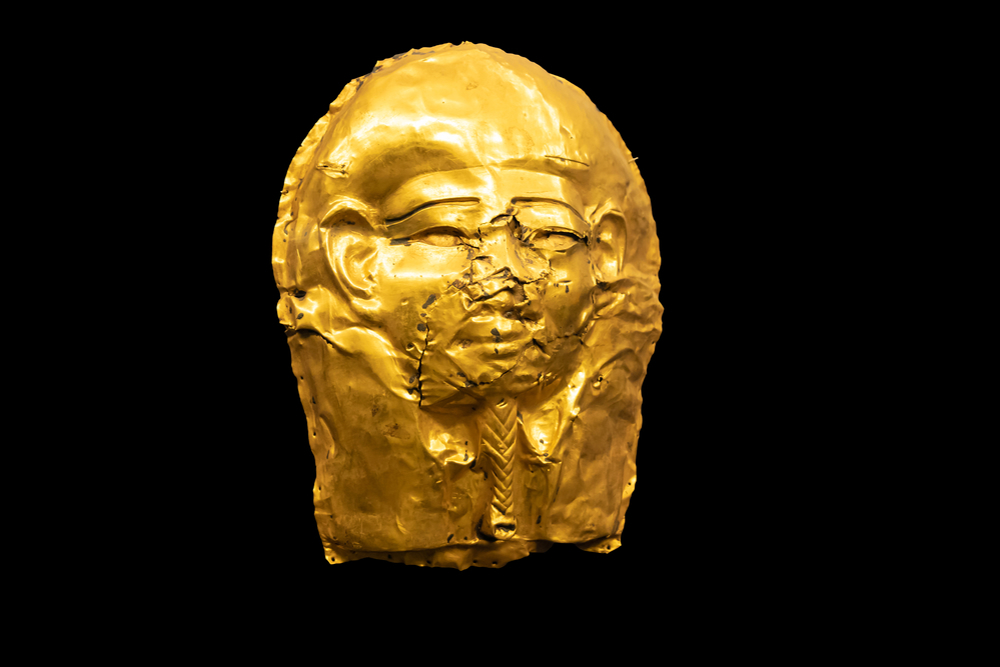
A typical gold mummy mask (not the one in the article)
Other amulets included a gold double-falcon-plume, gold scarab, stone serpent head, and a gold double ostrich plume, and the Golden Boy’s face was covered with golden head mask. On the medical side, the CT scan showed the boy had excellent teeth and had no signs of trauma, so the researchers assume the cause of death, even at such a young age, was natural. The mummy and coffin were discovered in 1916 at a necropolis in Nag el Hassaya, the cemetery of the city of Edfu. The scan helped date the boy’s death to between 330 BCE and 30 BCE, and the gold mask indicated he was of high status.
The mystery of ancient Egyptian mummification continues to unfold and goes on to fascinate us. These recent discoveries of a complete Book of the Dead, the gold-covered oldest known mummy and the Golden Boy show the Egyptians long had a strong belief in the afterlife and a reverence for the dead – and not just the deceased of the royal families but of ordinary Egyptians as well. We would do well to follow their examples rather than portray their mummified deceased in horror movies.
Silver Disk Over Palmdale, California Jan 24, 2023, UFO Sighting News.
Date of sighting: Jan 24, 2023
Location of sighting: Palmdale, California, USA
This video was taken this week by a girl who noticed a silver disk over the neighborhood. The object is seen rotating slowly and holding its position, making no sound, having no wings, no propellers, no lights. But the movement, color and shape all fit thousands of UFO reports. So...its your call now.
Scott C. Waring - Taiwan
Eyewitness states:
My daughter and I saw it appear out of no where which was strange and then it seemed to have gone transparent. There were zero engine noises. No breeze. No sound at all. We kept our eyes in the very spot that we first originally seen it and watched for about 10 mins but it never returned. As you can see it was in a clear sky scenario and there are zero buildings or trees it could have gone behind. Literally just disappeared.
Miners in Siberia dug up a strange statue of an angel with shield and sword in the permafrost
Miners of the Elga coal deposit (Yakut) in Siberia dug up a strange statue in the form of a woman with a sword and shield, and behind it there seem to be wings, like a fallen angel. The statue was unearthed by an excavator.
Miners show their emotions and enthusiasm when they are standing next to the statue. If the translation is right, they say that they cannot describe or tell what it is and that right now the special services will arrive by helicopter to pick up the statue to an unknown location.
Further study and examination by experts may be required to determine the significance of this potentially valuable ancient artifact, but since the special services are involved, it remains to be seen whether we will hear anything about it in the future.
UFO sightings have long been a source of fascination and intrigue, with many people claiming to have seen unidentified flying objects in the sky. One such sighting occurred a few years ago at Beijing airport, when a witness reported seeing a strange, crackling craft that seemed to hum with energy. The witness, who was a technician in the aerospace industry and had worked in electroplating components in his grandfather’s company, was struck by the unusual appearance of the craft.
According to the witness, the craft was large and had four louvered boxes that shimmered like a road on a hot summer day. The boxes looked like a TV with no channels, with black and gray colors from top to bottom. The witness was so struck by the craft that he turned off his truck to get a better look.
The witness reported that the craft was unlike anything he had ever seen before, and was significantly larger than any aircraft he had ever worked on. In fact, the witness stated that the craft would not have fit in the world’s largest building, the Everett Washington aircraft hanger, as the ceiling would have collapsed with all the structures having to be removed to fit it in.
Despite his background in the aerospace industry, the witness was unable to explain what he saw. He was also struck by his own level of emotion while describing his sighting, as he remained calm and composed throughout the four methodical interviews that were conducted with him.
The witness’s sighting was investigated by a UFO researcher from MUFON, who found that the witness was credible and had a clear recollection of the event. The researcher concluded that the witness was describing a remembered event that he could not explain, and classified the sighting as an unknown aerial vehicle or UFO.
The researcher, who has been studying UFO sightings for many years, believes that this case is particularly intriguing. He speculates that the craft could have been a time traveler’s vehicle or something from the future, and notes that the craft had a “human-like” appearance, with the louvered boxes resembling an aircraft carrier.
Despite the many prosaic explanations for UFO sightings, the researcher is convinced that there is still a small percentage of cases that cannot be explained. He notes that this is what keeps him going in his research, and encourages others to get involved in the field. He offers a mentorship program to help new researchers get started, and encourages people to submit their own UFO sightings to MUFON, a safe place to report such sightings.
The researcher also notes that, as people become more involved in UFO research, they may start to have their own experiences with UFOs. He himself has not had any such experiences yet, but is excited about the possibility and believes that there is more to learn about this fascinating and mysterious phenomenon.
Overall, this case serves as a reminder of the ongoing mystery surrounding UFOs and the importance of continued research and investigation into these sightings. It also highlights the importance of taking reports from credible witnesses seriously, as their accounts may hold valuable insights into this elusive and intriguing phenomenon.
Living in space! Water, ball throwing, cords and more explained by ISS astronaut
NASA Expedition 68 Flight Engineer Nicole Mann answers student questions from the Boys and Girls Club of the Flathead Reservation and Lake County in Montana. Topics include, water behavior, hair washing, ball throwing, cord management and more.
Credit:NASA
Boeing Starliner is a disaster, NASA gives up on it!!!
Boeing Starliner is a disaster, NASA gives up on it!!! In 2010, Boeing hoped to complete a crewed Starliner mission by 2015. Yet, here we are in 2022, and the Starliner has simply seen delay after delay and failure after failure. Meanwhile, SpaceX has been making tremendous progress in terms of Crew Dragon. The company has already completed seven crewed missions using Crew Dragon, and Crew Dragon will only be used more frequently moving forward. But is Boeing Starliner a complete failure? Hang on there till the end of this script as I rip off everything about Boeing Starliner line by line, word by word.
Frankly, not a failure, the Starliner program has been a disaster in all aspects.
Firstly, it’s actually painful to remember that NASA dumped $4.2 billion of taxpayer money on Boeing to build the spacecraft. Furthermore, in an award that NASA's own inspector general described as "unnecessary," NASA paid Boeing an additional $287.2 million. This brings Boeing's total to $4.49 billion.
For the same services, the development of Crew Dragon, and six operational missions, NASA paid SpaceX $2.6 billion. After its initial award, NASA has agreed to buy an additional eight flights from SpaceX—Crew-7, -8, -9, -10, -11, -12, -13, and -14—through the year 2030. This brings the total contract awarded to SpaceX to $4.93 billion.
Since we now know how many flights each company will be providing NASA through the lifetime of the International Space Station, and the full cost of those contracts, we can break down the price NASA is paying each company per seat by amortizing the development costs.
Boeing, in flying 24 astronauts, has a per-seat price of $183 million. SpaceX, in flying 56 astronauts during the same time frame, has a seat price of $88 million. Thus, NASA is paying Boeing 2.1 times the price per seat that it is paying SpaceX, inclusive of development costs incurred by NASA. What a ridiculous expense! Boeing Starliner is a disaster, NASA gives up on it!!!
The UnXplained: GIANT SKELETONS Found In Wild West Cave (Season 4)
Abnormally large human skeletons have been found deep in Lovelock Cave. See more in this scene from Season 4, Episode 20, "The Weird Wild West."
Apollo Program (ALL PARTS)
This is the dramatic story of NASA's Apollo Program, beginning with President Kennedy's ambitious deadline for a lunar landing by the end of the decade, in response to Soviet success with Sputnik and cosmonaut Yuri Gargarin. We look at how Werner von Braun, a former rocket scientist of the Third Reich, played a leading role in NASA's planning. After groundbreaking success with the Mercury and Gemini missions, NASA was rocked by the Apollo 1 disaster, in which all three crew members (Gus Grissom, Ed White and Roger Chaffee) were killed in an accidental fire on the launch pad. NASA overhauled its designs and methods to achieve a successful manned launch with Apollo 7. Then came the launch of Apollo 8 aboard the mighty Saturn V rocket - the largest and most powerful rocket ever seen. The mission was a complete success, culminating in the first manned orbit of the moon, and the capture of the legendary 'Earthrise' photograph by astronaut Bill Anders.
NASA's next challenge was to test the world's first true 'spacecraft' - the Lunar Module, as well as identify what risks the moon's unexpected 'mascons' posed to future Apollo missions. But in 1969, everything was in place for the Apollo Program to make history, with the first lunar landing attempt - a mission which would test the skills of crew-members Armstrong, Aldrin and Collins to their limit.
Following the success of Apollo 11, and the fulfilment of Kennedy's goal of landing a man on the Moon, questions hung over the future of the Apollo Program. With declining public interest in Moon missions, and government funding slashed, NASA focused on scientific research. But the final phase of the Program is best remembered for the dramatic near-disaster of Apollo 13, in which the ingenuity of astronauts and Mission Control was pushed to the limit.
Incredible Experiments That May Find Dark Matter...Or Something Else
NASA Just Admitted They've Created Something So Advanced It Can Reach Lightspeed
For decades, scientists have been trying to develop aircraft that can travel at the speed of light so that some of the most fundamental questions of human existence can be answered. How did we come to be? And what lies out there in the vast open? With this net NASA creation, it just might be possible to finally get those questions answered. In this video, we will talk about the latest discovery and uncover what is in store for the future of NASA. So, let's get right into it.
NASA-verkenner ontdekt "tekening van beer" op Mars
Wetenschappers die het oppervlak van de planeet Mars onderzoeken, zijn onlangs op een opvallend "(ge)zicht" gestoten. De Amerikaanse ruimtevaartorganisatie NASA heeft een foto vrijgegeven van wat gezien kan worden als gezicht van een beer, of een teddybeer zo je wil, een toeval door een tekening van kraters en rotsen.
Michaël Torfs
De foto is vrijgegeven door de University of Arizona (UA). "Dit lijkt op het gezicht van een beer. Maar wat is het echt?" schrijft de UA in een bericht.
Het gaat wellicht om een in elkaar gevallen heuvel in een oude krater. Naast de V-vormige ingevallen structuur (de neus) zijn er twee kraters (de ogen) en een ronde breuklijn (het hoofd) te zien. "Het ronde patroon kan gevormd zijn door de afzetting van materiaal bovenop een oude (gevulde) impactkrater", denkt de UA. De neus zou een vulkanische opening kunnen zijn, die vroeger lava of ander materiaal heeft uitgespuwd, maar dat is giswerk.
Dat we er de snuit van een beer in herkennen, komt omdat de mens nu eenmaal de neiging heeft om dingen te willen herkennen in bepaalde waarnemingen (pareidolie).
De foto werd op 12 december genomen door NASA's Mars Reconnaissance orbiter (MRO) op een hoogte van ongeveer 251 kilometer boven de Rode Planeet.
There’s a hill with a V-shaped collapse structure (the nose), two craters (the eyes), and a circular fracture pattern (the head). The circular fracture pattern might be due to the settling of a deposit over a buried impact crater. Maybe the nose is a volcanic or mud vent and the deposit could be lava or mud flows?
The UFO phenomenon has many strange cases spread out over a wide range of weird stuff. Among the weirdest of these are those supposed encounters with the alien entities themselves, and these can real run the range of the bizarre. There doesn't seem to be any rhyme or reason to any of it. There are the typical "Grey aliens" that seem to be the most popular, but for every one of those there is a report of something decidedly stranger and more difficult to categorize. One such case allegedly played out in an are of California, and it is a damn strange account that seems difficult to really put into any category.
It was a beautiful, clear Sunday afternoon on August 22, 1955, and on this day a group of about eight boys were playing at one of the boy’s houses in the quiet, scenic residential area of Casa Blanca, in Riverside County, California. The boys were having a fun time to be sure, doing what little boys do, running, roughhousing, and generally being rambunctious, but at one point their play time was interrupted when they looked to the sky to notice a radiant, slightly translucent dome-like object hovering in the sky. As the transfixed boys looked on, the object just vanished into thin air, after which another object appeared with an audible “ping” sound, this one looking like a disk spinning on its side and composed of various colors such as red, blue and orange, and silver. Yet another object then appeared, this one a round sphere. The original object then reappeared and now there were two of the strange things in the sky, occasionally disappearing and reappearing with that “ping” and leaving the boys to wonder whether they should continue staring in disbelief or run away.
One of the children began to run home to tell his parents what was going on, but when he did the objects all vanished, only reappearing when he came back. This happened a few times, leading the boys to suspect they were being watched and that they were under intelligent control. Finally, one of the boys shouted out for his mother in a panic and several adults arrived at the scene, but rather bizarrely, although the kids could all still see the objects the parents saw nothing but blue sky. In the meantime, an even larger orb had appeared, this one even brighter and more colorful than the others and “as big as three houses put together,” which descended to apparently land in a nearby field. When the boys approached, they could see that it had not landed, but was rather ominously hovering three feet off the ground and that was when they noticed a peculiar entity appear near one of the houses, itself also hovering.
The creature was described as translucent and around 4 feet tall, and with “big red eyes, a big red mouth, and four round objects that sparkled like diamonds where his nose should be.” Where there should have been legs there was only a tapering rounded nub, and there was also a belt around its waist with a disc-shaped buckle that shone so brightly that it nearly blinded them. By this time the kids were terrified, with some of them screaming and crying, but their parents could still not figure out what was going on since it was all apparently invisible to them. It was then that one of the children seemed to fall into some sort of dazed trance and began to mindlessly walk towards the enormous hovering orb over the field, resisting all attempts to stop him and only brought under control when two of the other boys had to tackle him and wrestle him to the ground. It would only get stranger from there.
As the boys tried to restrain their friend, there allegedly appeared a procession of spheres and disks in the sky, which descended and began flying all over the place, the whole time disappearing and reappearing at a rapid pace, like flickering images on a broken TV. One of the objects was even said to shoot some sort of beam from a long antenna-lie apparatus. Bizarrely, one of the boys would claim that a small metallic arm appeared out of thin air and began beckoning to him in midair, and this free-floating arm was apparently covered in armor of some sort. While this was happening another boy saw an enigmatic figure described as just “a strange man” in the field brandishing two “ray guns” that he used to shoot two of the other boys, not killing them but rather seeming to paralyze them. What in the world was going on here?
As this chaotic scene played out, with UFOs flying around, disembodied arms terrorizing the kids, and a futuristic alien gun man shooting lasers, an opening appeared in the side of the massive sphere hovering over the field and out stepped the strangest thing of all. The entity itself looked very much like the creature they had seen earlier near the house, but in this case it had undulating white skin, and a strange configuration of appendages made up of four tentacle-like legs that ended in rounded nubs and two arms that split at the elbow to grow into two sets of forearms on each side with a hand attached to each. It was almost mindboggling in its bizarreness, and then it apparently hypnotized two boys and had them climb up a nearby tree, after which it telepathically commended to wait there for him to pick them up in 15 minutes. What in the world?
The bizarre apparition then disappeared, but 15 minutes later a huge orb appeared, this one with a rim or ring around it that made it look little like the planet Saturn. On this ring were seven humanoid gnomes of some sort, which reached out and tried to take the hypnotized boys as their friends screamed at them to come down and tried to snap them out of their trance, even going as far as to spray them with a nearby garden hose. Although one of the boys did snap out of it and climbed down, the other remained in a daze, and then began levitating over to the roof of a nearby house, where he stood in a zombified state for a moment before leaping off to land on his head. As soon as he hit the ground, all of the UFO activity ceased, and the objects and their bizarre occupants all vanished into thin air. Luckily, the boy was not seriously injured, although he suffered amnesia of everything that had happened. Ufologist Ted Bloecher would research the case and come to no definitive conclusion, stating:
This extraordinary incident- Manifestation may be a better word- lacks sufficient information to come to any final conclusions. Even so, available data are sufficient to conclude that something bizarre and inexplicable occured that afternoon at Casa Blanca; that the children alone were able to perceive it; and that whatever it was, it appears to be directly related to an area of UFO phenomena suggestive of certain types of parapsychological experiences.
What are we to make of all of this? Other investigators would directly interview the children and find them to be sincere and reliable in their recollection of the events. The whole case is baffling in that it seems to have played out right before the eyes of adults, yet they did not see any of it. What does this mean? Why should only the children see all of this going on? Does this mean it was some phenomenon privy to only them for reasons we will never understand, or does it just mean that or was the wild musings of young, overactive imaginations? We may never know for sure, and it remains a damn strange case all the same.
Deze robot kan van vorm veranderen zoals Terminator
Wetenschappers hebben minuscule robots ontwikkeld die van vorm kunnen veranderen. Als een ode aan de T-1000 uit de 'Terminator'-films laten ze eentje ontsnappen uit een cel.
In the 1991 film 'Terminator 2: Judgement Day' T-1000 liquifies himself to walk through metal bars, and this sci-fi scene is recreated in a real-world robot.
A video of a shape-shifting robot shows it trapped in a cage, melting and then sliding through the bars where it reforms on the outside.
Researchers led by The Chinese University of Hong Kong created the new phase-shifting material by embedding magnetic particles in gallium, a metal with a very low melting point of 85 degrees Fahrenheit.
While the team does not see the innovation threatening humanity like in the Terminator movie, they foresee it removing foreign objects from the body or delivering drugs on demand.
Scientists tested the robot through a series of 'obstacles.' One saw a person-shaped robot inside of a cage
As well as being able to shape-shift, the engineers say their robots are magnetic and can also conduct electricity.
The robots were tested in obstacle courses of mobility and shape-morphing.
The terrifying dystopia of shapeshifting metal assassins seen in Terminator 2 may not have been as far-fetched as once thought.
Researchers from China created droplets of liquid metal that move through obstacle courses and Petri dishes by 'eating' flakes of aluminum
Team leader Doctor Chengfeng Pan explained that where traditional robots are hard-bodied and stiff, 'soft' robots have the opposite problem; they are flexible but weak, and their movements are difficult to control.
'Giving robots the ability to switch between liquid and solid states endows them with more functionality,' said Pan.
Senior author Professor Carmel Majidi, a mechanical engineer at Carnegie Mellon University, in Canada said: 'The magnetic particles here have two roles.
'One is that they make the material responsive to an alternating magnetic field, so you can, through induction, heat up the material and cause the phase change.
'But the magnetic particles also give the robots mobility and the ability to move in response to the magnetic field.'
He explained that the process is in contrast to existing phase-shifting materials that rely on heat guns, electrical currents, or other external heat sources to induce solid-to-liquid transformation.
Prof Majidi says the new material also boasts an 'extremely fluid' liquid phase compared to other phase-changing materials, whose 'liquid' phases are considerably more viscous.
Before exploring potential applications, the team tested the material's mobility and strength in various scenarios.
The robot seems to pull inspiration from Terminator 2: Judgment Day. In the 1991 film T-1000 liquifies himself to walk through metal bars
The robot liquifies and slides through the bars. This is because of magnetic particles embedded in gallium, a metal with a very low melting point of 85 degrees Fahrenheit.
With the aid of a magnetic field, the robots jumped over moats, climbed walls, and even split in half to cooperatively move other objects around before coalescing back together.
'Now, we're pushing this material system in more practical ways to solve some very specific medical and engineering problems,' Pan said.
The team also used the robots to remove a foreign object from a model stomach and to deliver drugs on-demand into the same stomach.
The robot can be heated and an external magnet pulls it in a specific direction
Once on the outside of the cage, the robot reforms back into its solid shape
The innovation may also work as smart soldering robots for wireless circuit assembly and repair and as a universal mechanical 'screw' for assembling parts in hard-to-reach spaces.
Prof Majidi added: 'Future work should further explore how these robots could be used within a biomedical context.
'What we're showing are just one-off demonstrations, proofs of concept, but much more study will be required to delve into how this could actually be used for drug delivery or for removing foreign objects.'
UFO on the Horizon: Passenger Captures Incredible Footage on Delta Flight
On January 6, 2023, an unidentified flying object (UFO) was sighted by a passenger on a Delta flight traveling from Los Angeles to Atlanta. The sighting occurred at an altitude of 41,000 feet above an unknown location in the southwestern region, possibly somewhere near Phoenix, Arizona.
According to the witness, the UFO appeared to be flying in tandem with the passenger’s plane, and at one point, the object’s brightness increased. The witness was able to capture both photographs and a video of the sighting.
UFO sightings have been reported throughout history, but the true nature of these objects remains a mystery. Some people believe that UFOs are extraterrestrial spacecraft, while others believe that they are man-made aircraft or natural phenomena.
Stationary Orb Suddenly Takes Off With Much Brighter Orb In Tow!
Small Orb that looks like it could be a star suddenly jets off with much brighter Orb following after
But Where Is Everybody? Fermi Paradox Explored: Problems With The Zoo Hypothesis
RELATED VIDEOS
Beyond Human: A Billion Years of Evolution and the Fate of Our Species
Our lifespans might feel like a long time by human standards, but to the Earth it's the blink of an eye. Even the entirety of human history represents a tiny slither of the vast chronology for our planet. We often think about geological time when looking back into the past, but today we look ahead. What might happen on our planet in the next billion years?
Written and presented by Prof David Kipping, edited by Jorge Casas.
This Amazing View Of Saturn Is Impossible
It's a popular trope in Science Fiction, and indeed in scientific visualization, a stunning view of Saturn and its rings viewed while standing on one of Saturn's moons. However, the reality is that only 2 major moons - Mimas and Iapetus - offer anything other than a near perfect edge on view of the rings. And there's good scientific reasons for why this is the case.
How are we searching for Extra Terrestrial messages ?
We been searching for intelligent life outside out planet for over 100 years and yet we still haven't found anything that provides solid proof that is out there. So in this video we look at how we are seaching to find E.T.
How to spot Comet C/2022 E3 (ZTF), plus JWST finds weird distant galaxies | Night Sky News Jan '23
In this month’s Night Sky News episode we’re chatting about how to spot Comet C/2022 E3 ZTF, the plan to collect Perseverance’s rock samples off the surface of Mars, the threat of light pollution to astronomical observatories, and of course two new JWST discoveries of distant galaxies!
Scientists Invented a Jail-Breaking Liquid Metal Robot
Someone call James Cameron — a team of scientists just invented a new kind of liquid metal robot that can shapeshift between solid and liquid form using the power of magnetism. Also, the Earth's spinning inner core may have slowed down so much it looks like it's spinning backwards from a certain point of view. But that's okay, it's happened before.
Hosted by: Hank Green (he/him)
ULA Vulcan Rocket is to launch into orbit after 9years await making Blue Origin & NASA crazily
ULA Vulcan Rocket is to launch into orbit after 9years await making Blue Origin & NASA crazily Now it's time to go one step further advancing American superiority in space. ULA is unleashing the energy of American ingenuity with the development of the Vulcan centaur a rocket purpose-built to meet all of the requirements of our national security space launch needs.
Unveiled in 2015, ULA has been working on Vulcan Centaur since at least 2014. After many years of delays, all the parts of the United Launch Alliance’s next-generation Vulcan Centaur rocket are finally about to converge on Florida for their first launch. Why the success of the first Vulcan orbital flight will be a big deal for NASA and Blue Origin? Find out everything about this in today's episode of Alpha Tech:
Following Russia’s first illegal invasion of Ukraine, countries around the world attempted to punish the aggressor mainly through economic sanctions. In the US, those sanctions included bans on the import of most Russian aerospace technologies, including the RD-180 engines that still power ULA’s Atlas V workhorse rocket in 2023. In 2014, ULA announced that it would work with Blue Origin to integrate the startup’s BE-4 engine into a new rocket booster to end its reliance on Russian engines.
Unfortunately, the BE-4 engine has proved to be one of the main stumbling blocks on Vulcan Centaur's journey to flight readiness, which was originally expected in 2020.
One reason the BE-4's development is progressing slower than planned is that it's a hugely ambitious piece of engineering. More than eight years later, that BE-4 engine is finally ready for flight, and the rest of the first two-stage Vulcan rocket appears to be right behind it. ULA Vulcan Rocket is to launch into orbit after 9years await making Blue Origin & NASA crazily
NASA test-fires 3D-printed Rotating Detonation Rocket Engine - Could be revolutionary!
NASA successfully test-fired a full-scale Rotating Detonation Rocket Engine (RDRE). It generates thrust by “using a supersonic combustion phenomenon known as a detonation,” according to the space agency's Marshall Space Flight Center, where the test was conducted.
Let's talk about Apollo 12 and its incredible 30 year journey through space. In September 2002, astronomers discovered what they first thought was an asteroid, but would soon find out it was the Saturn V third stage that launched the Apollo 12 astronauts to the Moon. This rocket left Earth in 1969 and returned to Earth 30 years later. But what happened in the meantime? In this video we look at how one tiny error in the Apollo 12 mission sent this rocket stage on a 30 year trip through space!
Excited to enter this month's giveaway? Enter at the link below for your chance to win a Space Shuttle canvas print from the Primal Space shop collection.
Unknown Craft Near Airliner, Phoenix, Arizona Jan 6, 2023 UFO Sighting News
Date of sighting: Jan 6, 2023
Location of sighting: over Phoenix, Arizona, USA
Check out this eyewitness video of a group of UFOs following a passenger jet this month. The UFOs are keeping steady speed with the plane and seem to rotate each of the four glowing objects. The passenger was recording through the window and has both sound and visual. However the UFOs seem to not have any sound, but we do hear the cabin. I see a huge similarity between these UFOs and the historic sighting of the Phoenix lights seen by thousands back in March of 1997. Defiantly the same types of UFOs.
Scott C. Waring - Taiwan
Eyewitness states:
At 41,000 feet above possibly Nevada or Arizona, I looked out of the window of our Delta plane and saw something flying in tandem with us, or at least it appeared to be. The brightness increased at one point. I took both pictures and a video of it. The city and state are not correct since we were flying and that information is required to file a report. I actually have no clue where we were except it had to be in the south west region given our flight path from LA to ATL.
Cylinder UFO Exits Popocatepetl Volcano In Jan 26, 2023, UFO Sighting News.
Date of sighting: Jan 26, 2023
Location of sighting: Mexico
Watch this UFO I recorded on the live cam of volcano Popocatepetl not far from Mexico City, Mexico. This volcano is a known hotspot for UFOs due to an alien base existing about 5-6 miles below its surface. UFOs are recorded exiting and entering it almost weekly.
Webcam caught mysterious ball of light flying over Mount Merapi volcano in Indonesia
A mysterious ball of light streaking across the sky seen in a video captured by a webcam monitoring the active Mount Merapi volcano in Indonesia on January 24, 2023.
Indonesia's Space Research Center said that it was a Falconsat-3 satellite burning up upon reentering the Earth's atmosphere while others explained that the phenomenon was an aircraft flying at that specific location at the time of the sighting.
There are various theories about what the orb could be, but without concrete evidence, it is difficult to say for certain. But some people believe that it could be of extraterrestrial origin.
In 2019, Michel Mayor and his colleague, Jean-Luc Queloz, were awarded a Nobel Prize for their discovery of the first exoplanet. Over 4,000 exoplanets have already been studied and classified, and more are expected to be discovered soon. In addition, NASA’s James Webb Space Telescope has the capability to take detailed images of exoplanets.
But what will we find when we look upon the images of other worlds, and possibly even the beings that inhabit them? According to ancient astronaut theory, it’s thought that these extraterrestrial beings coming from outside of our solar system were interacting with our society and manipulating our DNA to create people on Earth that look like them.
As we discover more exoplanets, the implications for humanity are enormous. Some believe that we’re on the verge of discovering our home planet and the place of our origins. The big revelation may not be whether they look like us, but rather that we look like them because we are their offspring. The discovery of intelligent alien life forms on exoplanets could cause a sea change in scientific and religious communities all over the world.-
Exoplanets Reveal Our True Ancestors | Ancient Aliens (Season 1)
Since the discovery of exoplanets, Ancient Astronaut Theorists believe they could be home to our true ancestors. See more in this clip from "Aliens and Outer Space."
Watch all new episodes of Ancient Aliens, Fridays, at 9/8c, and next day on The HISTORY Channel website at http://history.com/schedule.
Asteroid 2023 BU seen shortly before super close approach to Earth - Time-lapse
Gianluca Masi from the Virtual Telescope Project captured asteroid 2023 BU when it less than 40,000 km (25,854 mi.) away from Earth on Jan. 26, 2023. It’s closest approach to Earth was about 3,600 km (~2,236 mi) away.
Scientists Make a New Bizarre Discovery in Africa That Changes Everything!
As the so-called “cradle of mankind”, Africa plays a key role in the development of our species. Rich in culture and breathtaking landscapes, the second largest continent on earth is always in the sights of historians, naturalists and archaeologists. Today we would like to show you which overwhelming treasures are really slumbering in Africa! You want to know what the inexplicable incident that took place in Zimbabwe in 1994 is all about? And why is the discovery of an ancient city shaking our conventional worldview? Then be sure to watch our video to the end!
25,000 Mile Pre-Flood Ruin Exposed In Peru?
How Elon's SpaceX Starship SHOCKED Scientists, will blow your mind...
Astronomers breathed a collective sigh of relief as the James Webb Space Telescope (JWST) sprung to life. Getting the $10-billion telescope up and running following its launch on Christmas Day 2021 had been a nerve-racking affair. JWST would not fit into any modern rocket without being folded, and it had to rely on hundreds of moving parts to unfurl to full size once in space. Ultimately those efforts were successful, and the telescope has started returning some of its first calibration images to thrilled audiences back on Earth. Yet the experience left many astronomers wondering if there was a simpler way to build and launch telescopes of this size. “We were worried about the unfolding,” says John Blevins of NASA’s Marshall Space Flight Center. But with a larger rocket, “you don’t have to unfold in space. You can do it on the ground.”
As chance would have it, two such rockets are currently sitting on launchpads. Each should ultimately exceed the power of the mighty Saturn V, which sent the Apollo astronauts to the moon.
The first, NASA’s Space Launch System (SLS), is ready and waiting at Kennedy Space Center in Florida for its inaugural uncrewed voyage around the moon as part of the Artemis I mission—the opening shot in NASA’s plan to return humans to the lunar surface in the 2020s. The rocket, tentatively scheduled for a launch in late this month, is meant to be as reliable as possible and is therefore based, in large part, on legacy hardware from NASA’s Space Shuttle program.
But reliance on tried-and-true technology could be its Achilles’ heel: some estimates currently peg the SLS’s cost at an eye-watering $4.1 billion per launch. Presuming it is not scuttled by congressional appropriators feeling buyer’s remorse, its massive size could eventually be a boon for scientists seeking to send larger, more ambitious spacecraft and telescopes throughout the solar system—and even beyond. However, it can't! How Elon's SpaceX Starship SHOCKED Scientists, will blow your mind...
How Did SpaceX Starship Do During The BIGGEST Test Yet? - Largest Rocket Ignition In History Next!
Today’s episode is a big one! SpaceX did the Starship Wet Dress rehearsal, and we’re doing a DETAILED analysis! Elon Musk's Ship 24 is getting ready for the orbital launch, and Super Heavy Booster 7 is about to perform the largest rocket ignition in human history! On top of that, ULA’s Vulcan Centaur has arrived at the Cape and is getting ready for its maiden flight, Rocket Lab did its first Electron launch from US soil, and Neutron, Rocket Lab’s futuristic new super rocket, is making fast progress! Stay tuned, and let’s dive right in!”
Can They See Us? With Dr. Lisa Kaltenegger and Jonathan Barrientos
Neil deGrasse Tyson Explains Faster Than Light Interstellar Travel
In this video Neil DeGrasse Tyson, a well-known astronomer and science communicator, examines the idea of traveling between stars faster than the speed of light.
Tyson explores the theories and prospects of traveling at speeds faster than the speed of light, drawing on his vast understanding of physics and the cosmos.
He talks on how time travel affects technology, the limitations of today's technology, and the possibilities of advanced technologies like warp drive and hyperspace.
Tyson also discusses the idea of wormholes as a potential means of exceeding the speed of light travel and the influence of quantum mechanics in this area.Additionally, he discusses how popular culture, particularly Star Trek, affects how people view travel faster than light.
NASA Said That Something Massive Is Heading Towards Our Planet!
NASA has revealed that a massive asteroid, capable of destroying entire planets, is hurtling through space towards Earth. Dubbed the "planet killer," this ominous celestial object is said to be larger than any previously recorded asteroid. And if it collides into earth, we could be looking at doomsday in just a few months. The question that remains is, is this true? And if it is true, what does it mean for the human race? Watch till the end of this video to find out!
Star Trek Fans Rejoice! Actual Tractor Beam Was Made In a Lab Using Lasers
Massive iceberg breaks off Antarctica’s Brunt Ice Shelf, seen from space
A 1550 square km (963 sq mi.) iceberg, designated A81, recently broke off Antarctica’s Brunt Ice Shelf. A time-lapse of the 'calving process' was captured by satellites, according to ESA.
NASA's Day of Remembrance honors fallen astronauts
NASA honors the crews of Challenger, Columbia, Apollo 1, astronauts who died in training and on a test flight.
Apollo 1:Astronauts Virgil "Gus" Grissom, Edward White and Roger Chaffee
Challenger: Commander Scobee, Pilot Michael J. Smith, Mission Specialists Judith A. Resnik, Ellison S. Onizuka, and Ronald E. McNair, and Payload Specialists Gregory B. Jarvis and Sharon Christa McAuliffe
Columbia: Commander Rick D. Husband, Pilot William C. McCool, Payload Commander Michael P. Anderson, Mission Specialists Kalpana Chawla, David M. Brown and Laurel B. Clark, and Payload Specialist Ilan Ramon (Israeli Space Agency)
Astronauts that died during training/test flight:Theodore Freeman, Charles Bassett, Elliot See, Clifton C. Williams, Robert Henry Lawrence Jr. and X-15 pilot Michael James Adams
Credit:NASA
Dream Chaser Tenacity's Final Tests Before Its First Launch
Spaceplanes are unique engineering feats that come with different benefits and downsides compared to traditional spacecraft. They also come in many different shapes and sizes with the Space Shuttle and Dream Chaser being great examples.
In the past, the Shuttle revolutionized space access and what was capable. Now in 2023, Sierra Space and Dream Chaser are hoping to do the same. In the last couple of months, we have seen an increase in progress from the company regarding the first Dream Chaser test article expected to go to space named Tenacity. This involves finishing heat shield application and an upcoming shipment for final ground testing. Once complete, the only other factor influencing this launch is the first flight of Vulcan scheduled in a couple of months, which Tenacity will launch on in the future.
However, with Vulcan a few months behind schedule and this being Dream Chaser ‘s first ever mission, a lot can come in the way of the launch set to happen in the third quarter of this year. Here I will go more in-depth into some of the recent updates on both Dream Chaser Tenacity and Vulcan, what to expect on this first mission, the significance of this spaceplane, and more.
A lonely Milky Way analogue galaxy, too massive for its wall. The background image shows the distribution of dark matter (green and blue) and galaxies (here seen as tiny yellow dots) in a thin slice of the cubic volume in which we expect to find one of such rare massive galaxies. Credit Images: Miguel A. Aragon-Calvo. Simulation data: Illustris TNG project Licence type Attribution (CC BY 4.0)
According to Simulations, the Milky Way is One in a Million
Humanity is in a back-and-forth relationship with nature. First, we thought we were at the center of everything, with the Sun and the entire cosmos rotating around our little planet. We eventually realized that wasn’t true. Over the centuries, we’ve found that though Earth and life might be rare, our Sun is pretty normal, our Solar System is relatively non-descript, and even our galaxy is one of the billions of spiral galaxies, a type that makes up 60% of the galaxies in the Universe.
But the Illustris TNG simulation shows that the Milky Way is special.
Illustris TNG is an ongoing series of large-scale simulations. The goal is to understand the mechanisms behind galaxy formation and evolution. The effort is a “series of large, cosmological magnetohydrodynamical simulations,” according to the Illustris TNG website. So far, the project has produced three primary runs, each one larger and higher resolution than the previous one: TNG 50, TNG 100, and TNG 300. Each run also focuses on various aspects of galaxy formation. TNG 300 is the largest, simulating a region of almost 300 million megaparsecs, over a billion light-years across, and containing millions of galaxies.
TNG 50, TNG 100, and TNG 300. Image: IllustrisTNG
New research based on Illustris TNG shows that the Milky Way is special. But it’s not special purely for its intrinsic qualities. It’s special in relation to its surroundings.
The findings are in a new paper based on Illustris TNG 300 published in the Monthly Notices of the Royal Astronomical Society. The title is “The unusual Milky Way-local sheet system: implications for spin strength and alignment.” The lead researcher is Miguel Aragón, a computational cosmologist and assistant professor at the National Astronomical Observatory, Universidad Nacional Autonoma de Mexico.
Illustris TNG simulates the large-scale structure of the Universe. It shows how galaxies are arranged on filaments of dark matter that weave their way through vast cosmic voids. Some of the features it shows are cosmological walls, also called galaxy walls. They’re enormous features, and one of them—a wall called the Hercules–Corona Borealis Great Wall—is the largest known structure in the Universe and is 10 billion light-years long.
This image from TNG 50 shows the large-scale structure of cosmic gas in the early Universe at redshift three. It shows a region of space 15 megaparsecs across, where the cosmic web of gas filaments come together to fuel galactic formation and growth. Image Credit: Illustris TNG 50.
Cosmological walls are made up of galaxies. They’re a subtype of filaments, but they’re flattened and have voids on either side. The voids seem to squash the walls into their flattened shape. The cosmological wall nearest the Milky Way is called the Local Wall or Local Sheet.
The Local Sheet influences how the Milky Way and other nearby galaxies rotate on their axes. The Milky Way takes about 250,000,000 years to rotate, and the study shows that the rotation is more organized than if the galaxy wasn’t near the Local Sheet.
The study also shows that the Milky Way is special. While typical galaxies tend to be much smaller in relation to walls, the Milky Way is surprisingly massive in relation to the Local Wall. According to the research, this is a rare cosmic occurrence.
This video is from Illustris TNG 50 and shows the formation of an elliptical galaxy. Credit: Illustris TNG
One characteristic that cosmologists study is velocity dispersion. It describes how much dispersal there is in the velocity of a group of astronomical objects. The velocities are dispersed around a mean velocity. The velocity of objects in the Milky Way/Local Wall neighbourhood has low dispersion, meaning they’re not dispersed far from the mean.
This is unusual for a high-mass galaxy like the Milky Way in an environment like this, close to the Local Wall. To understand this better, the researchers looked for Milky Way Analogue (MWA) galaxies in Illustris TNG 300.
They found that MWAs in Local-Sheet analogues are rare. There was only one of them per 160–200?Mpc3 of volume in the simulation. With their research, they showed that the cold environment around the Local Sheet is responsible. “We find that a Sheet-like cold environment preserves, amplifies, or simplifies environmental effects on the angular momentum of galaxies,” they write in their paper.
Specifically, the Local Sheet affects the spin of the Milky Way. “… there are particularly strong alignments between the sheet and galaxy spins,” they explain, adding that in the simulation, the galaxies near walls have low spin parameters.
This all affects how galaxies grow and merge over time, they think. It leads to lower-mass galaxies in these types of cosmic neighbourhoods. That’s why the Milky Way, with its high mass, is so unusual and why the simulation found only one like it in up to 200 cubic megaparsecs of space.
This figure from the study shows how velocity dispersal relates to mass, with mass shown on the x-axis. The legend in the upper right shows how each line in the graph represents a different velocity dispersal (sigma v.) The blue solid line is the mass function in cold (<25, high velocity dispersal) regions, and the black solid line is the mass function in warm (<40, low velocity dispersal) regions. The dotted lines are the same, but for regions near Cosmic Walls. It shows how lower velocity dispersal produces less massive galaxies near walls. There are also two shaded grey areas: light and dark grey. The light area represents the masses of Milky Way Analogues in the simulation, and the dark grey shows where the Milky Way actually is. Image Credit: Aragon et al. 2023.
The study reminds us of something critical: context is important. If we look at the Milky Way as a discrete object and compare it to other similar discrete objects, it doesn’t appear to be exceptional. But in relation to its surroundings, it is. “Our results highlight the importance of carefully characterizing the environment around our galaxy,” the paper states. “The effect of the geometry and coldness of Local Sheet environment on angular momentum processes may help us better understand current problems in galaxy formation…”
In a press release presenting the research, the authors refer to the Copernican bias. “This bias, describing the successive removal of our special status in the nearly 500 years since Copernicus demoted the Earth from being at the centre of the cosmos, would come from assuming that we reside in a completely average place in the Universe,” the press release says. It shows the risk inherent in ignoring the environment of an object being studied.
This work also shows a potential flaw in how scientists use simulations like Illustris TNG. It’s misleading to think that any point in the simulation is the same as any other point. Galaxies close to a Cosmic Wall can evolve quite differently than at other points.
“So, the Milky Way is, in a way, special,” said research lead Miguel Aragón. “The Earth is very obviously special, the only home of life that we know. But it’s not the centre of the Universe or even the Solar System. And the Sun is just an ordinary star among billions in the Milky Way. Even our galaxy seemed to be just another spiral galaxy among billions of others in the observable Universe.”
“The Milky Way doesn’t have a particularly special mass or type. There are lots of spiral galaxies that look roughly like it,” Joe Silk, another of the researchers, said. “But it is rare if you take into account its surroundings. If you could see the nearest dozen or so large galaxies easily in the sky, you would see that they all nearly lie on a ring embedded in the Local Sheet. That’s a little bit special in itself. What we newly found is that other walls of galaxies in the Universe like the Local Sheet very seldom seem to have a galaxy inside them that’s as massive as the Milky Way.”
Spiral galaxies are common. This image shows six spectacular spiral galaxies in images from the ESO’s Very Large Telescope (VLT) at the Paranal Observatory in Chile. Credit: ESO
“You might have to travel half a billion light years from the Milky Way, past many, many galaxies, to find another cosmological wall with a galaxy like ours,” Aragón said. He adds, “That’s a couple of hundred times farther away than the nearest large galaxy around us, Andromeda.”
So is it okay if we feel special again? We’re obviously special just because we’re alive, and most matter we can see isn’t. But that doesn’t necessarily tell us about how much other matter might be alive and if we’re special. From a vantage point elsewhere in the Universe, there could be much more living matter. Before the rise of modern astronomy, we had no idea if there was life elsewhere or how special Earth might be. We’re wise to be cautious with the word special, according to one of the authors.
“You do have to be careful, though, choosing properties that qualify as ‘special,’” Dr. Mark Neyrinck, another member of the team, said. “If we added a ridiculously restrictive condition on a galaxy, such as that it must contain the paper we wrote about this, we would certainly be the only galaxy in the observable Universe like that. But we think this ‘too big for its wall’ property is physically meaningful and observationally relevant enough to call out as really being special.”
Archeologen ontdekken mogelijk oudste en meest complete mummie ooit gevonden in Egypte
Archeologen hebben een ontdekking gedaan vlakbij de Egyptische hoofdstad Caïro. Ze vonden er een graftombe van een farao met een mummie die mogelijk de oudste en meest complete is die ooit in Egypte werd gevonden. Dat meldt de leider van de opgraving, Zahi Hawass.
De mummie is 4.300 jaar oud en behoort toe aan een man met de naam Hekashepes. Hij lag in een kalkstenen sarcofaag die dichtgemaakt was met mortel, op de bodem van een schacht van vijftien meter diep, en was met goud bedekt.
“Deze mummie zou wel eens de oudste en meest complete kunnen zijn die tot nu toe gevonden werd in Egypte”, aldus Hawass in een verklaring. De sarcofaag verkeerde “in de exacte staat waarin de oude Egyptenaren hem 4.300 jaar geleden hebben achtergelaten.”
De tombe waarin de ontdekking werd gedaan maakt deel uit van een groep graven uit de vijfde (2504 tot 2347 voor Christus) en de zesde (2347 tot 2216 voor Christus) dynastie van het Oude Rijk. Die werden onlangs ontdekt vlakbij de Piramide van Djoser in Saqqara.
Een tweede graf behoorde toe aan Khnumdjedef, een inspecteur van ambtenaren, opzichter van edelen en priester tijdens het bewind van Unas, de laatste farao van de vijfde dynastie. Het graf was versierd met taferelen uit het dagelijkse leven.
Een derde graf bleek van Meri, die omschreven werd als “hoeder van de geheimen” en assistent van de grote leider van het paleis.
Tussen de graven lagen ook talloze beelden, waaronder eentje van een man met zijn vrouw en verschillende bedienden.
Eerder deze week kondigde Caïro ook de ontdekking van “een hele Romeinse stad” aan. Volgens critici hebben de berichten meer politieke en economische betekenis dan wetenschappelijke, aangezien het land in een ernstige economische crisis verkeert. Egypte rekent op het toerisme om de financiële situatie te herstellen.
Asteroïde komt deze nacht ontzettend dicht bij de aarde, maar “hij zal ons niet raken”, benadrukt NASA
Een asteroïde ter grootte van een bestelwagen zal vrijdagochtend langs de aarde razen. Dit zal een van de dichtstbijzijnde asteroïdes ooit zijn die we konden waarnemen. NASA benadrukt dat de asteroïde de aarde niet zal raken.
NASA zei woensdag dat deze pas ontdekte asteroïde 3.600 kilometer boven de zuidpunt van Zuid-Amerika zal vliegen. Dat is 10 keer dichterbij dan de vele communicatiesatellieten die boven de aarde cirkelen.
An illustration of the orbits of asteroid 2023 BU and Earth showing the asteroid at perigee on Jan. 26.
De nadering vindt plaats om 1.27 uur vrijdagochtend Belgische tijd. Zelfs als de ruimterots een stuk dichterbij komt, zou het grootste deel ervan volgens wetenschappers in de atmosfeer verbranden en zouden sommige grotere stukken als meteorieten kunnen vallen.
NASA’s systeem voor het inschatten van het inslaggevaar, Scout, sloot een inslag snel uit, aldus de ontwikkelaar ervan, Davide Farnocchia. “Maar ondanks het zeer geringe aantal waarnemingen kon het toch voorspellen dat de asteroïde de aarde buitengewoon dicht zou naderen”, zei Farnocchia in een verklaring. “In feite is dit een van de dichtste naderingen door een bekend object ooit geregistreerd.”
Tientallen waarnemingen
De asteroïde die zaterdag werd ontdekt en bekend staat onder de naam 2023 BU, heeft een diameter van 3,5 tot 8,5 meter. Hij werd voor het eerst gezien door dezelfde amateur-astronoom op de Krim, Gennady Borisov, die in 2019 een interstellaire komeet ontdekte. Binnen een paar dagen werden tientallen waarnemingen gedaan door astronomen over de hele wereld, waardoor ze de baan van de asteroïde konden verfijnen.
Het pad van de asteroïde zal drastisch worden gewijzigd door de zwaartekracht van de aarde zodra hij voorbijraast. In plaats van elke 359 dagen rond de zon te cirkelen, zal hij volgens NASA in een ovale baan van 425 dagen terechtkomen.
27.000 asteroïden
Wetenschappers hebben in de buurt van de Aarde zo’n 27.000 asteroïden geïdentificeerd, waarvan ongeveer 10.000 met een diameter van ruim 140 meter. Er is er geen enkele bekend die in de nabije toekomst rechtstreeks op onze planeet zou afstevenen.
Afgelopen oktober slaagde NASA er voor het eerst in de bewegingsrichting van een asteroïde te veranderen door een sonde te laten inslaan. Aan de basis van dat experiment lag de vraag hoe onze Aarde kan worden beschermd tegen aanstormende hemellichamen. Een inslag van een asteroïde ongeveer 66 miljoen jaar geleden wordt door wetenschappers beschouwd als de belangrijkste theorie waarom de dinosauriërs zijn uitgestorven.
KIJK.
Nasa wil raket met kernaandrijving ontwikkelen
Fully interactive, Eyes on Asteroids uses science data to help visualize asteroid and comet orbits around the Sun. Zoom in to travel along with your favorite spacecraft as they explore these fascinating near-Earth objects in beautiful 3D.
Meer van UFO'S of UAP'S, ASTRONOMIE, RUIMTEVAART, ARCHEOLOGIE, OUDHEIDKUNDE, SF-SNUFJES EN ANDERE ESOTERISCHE WETENSCHAPPEN - DE ALLERLAATSTE NIEUWTJES


 Two Golden Mummies Found - One Wrapped in Gold Leaf May Be Oldest Ever