Date of sighting: January 26, 2023
Holes In Clouds Are 100% Proof Of Alien Craft Passing Through, San Antonio, Texas, UFO Sighting News.

Holes In Clouds Are 100% Proof Of Alien Craft Passing Through, San Antonio, Texas, UFO Sighting News.
Date of sighting: January 26, 2023
UFOs filmed over Texas 20-Jan-2023

A UFO sighting was reported on the night of January 20th, 2023. The witness, who was observing the night sky, noticed an unusual object that appeared to be flying lower than the clouds. The object was silent and was seen to change its formation at some point, which left the witness feeling bewildered. Despite not being an expert in this field, the witness was confident that what he saw was not a conventional aircraft. The incident has left the witness with more questions than answers, and he is still uncertain about the nature of the object he saw that night.
Stanton sighting – UFO only seen on camera, not with naked eye!

On March 22, 2022, a UFO sighting was caught on camera in Stanton, California and it was just recently submitted to MUFON. The strange object was only captured on camera and was not visible to the naked eye. According to the witness, the camera malfunction was not related to their iPhone and they were able to obtain photos and video footage of the sighting.
In the footage, the UFO can be seen hovering in the sky while cars pass by and the moon is also visible. The exact nature of the object remains unknown and it is not clear if it was a natural phenomenon or a man-made object.

This is not the first time a UFO sighting has been reported in Stanton, and it has sparked interest and speculation among the local community. Despite the increasing number of UFO sightings in recent years, there is still much that is unknown about these strange objects and the reasons for their appearance. This recent sighting in Stanton adds to the growing body of evidence and serves as a reminder of the mysteries that still exist in our world.
Stunning UAP Sightings by Pilots: Its Implications for Aviation Industry
The aviation industry is in dire need of a proactive approach to addressing the phenomenon of unidentified flying objects (UFOs). With reports of UFO sightings increasing in number, it’s time for the industry to start taking the issue seriously and come up with a trustworthy reporting mechanism for pilots and other stakeholders.
The Federal Aviation Administration (FAA) has a reactive rather than proactive approach to the issue, only addressing the problem when it becomes necessary. However, there are trusted resources such as the integration and Outreach committee at the American Institute of Aeronautics and Astronautics (AIAA), NASA’s UAP study team, and other organizations that are working towards finding a solution.
Recently, a commercial pilot and guest on a Merged podcast, Mark, spoke about his own experience with a UFO sighting and the need for a more proactive approach to the issue. He believes that encouraging more pilots to come forward and share their experiences is a crucial step in solving the mystery.
The aviation industry should also be exploring different technologies that might be useful in detecting and reporting UFO sightings. Off-the-shelf technology can be modified to build sensors and improve the overall reporting process. The industry should strive to make this a continuous and active conversation, taking new data and great ideas to drive the conversation forward.
At the end of the day, NASA holds the authority for aviation safety in the United States and has established trusted programs for reporting safety hazards. However, the current procedures for reporting UFO sightings are scattered and not official, and there is no practical method for reporting such incidents.
It’s time for the aviation industry to take the issue of UFOs seriously and come up with a reliable and trustworthy reporting mechanism for all stakeholders. This way, the industry can work towards finding solutions and understanding the phenomenon of UFOs.
TIMESTAMPS:
0:00 Intro
0:50 Mark’s Military Background
5:00 First UAP Encounter
26:11 Mark’s Career Now
28:40 Memorable UAP Sighting
49:40 Backlash from skeptics
52:22 Actual Radar Footage
54:14 Steps to Expanding Our Understanding
58:16 People have the Right to Know
1:08:43 Gathering Data
1:14:04 How Common This Is
1:18:39 Conclusion
Will an AI be the first to discover alien life?
Groene komeet bereikt na 50.000 jaar zijn dichtste punt bij de aarde: waar en hoe kan je hem zien aan de nachtelijke hemel?Maar liefst 50.000 jaar is C2022 E3 (ZTF) onderweg geweest. Dat is de naam van de groene komeet die voor het laatst in de buurt van de aarde kwam toen de Neanderthalers er nog op rondliepen. Momenteel nadert hij zijn dichtste punt bij de aarde. Maar wat is een komeet precies en hoe spot je hem in de komende nachten?
Kometen zijn, net zoals asteroïden, restjes van toen de planeten zich vormden. Het is een allegaartje van stof, rots en ijs. Vandaar hun toepasselijke bijnaam: stoffige ruimtesneeuwballen. Meestal zijn ze enkele honderden meters tot kilometers groot. Kometen zijn afkomstig uit de Kuipergordel of Oortwolk. De donutvormige kuipergordel ligt net voorbij Neptunus op ongeveer 4,5 miljard kilometer van de zon. De Oortwolk ligt nog een stukje verder, op 300 miljard kilometer afstand. Hij zit als een schil rond ons zonnestelsel.
De groene komeet die onze planeet nadert, is afkomstig uit die Oortwolk. Wetenschappers ontdekten hem vorig jaar en gaven hem de naam C/2022 E3 (ZTF). Dat is niet zomaar. De “C” betekent dat zijn baan rond de zon meer dan 200 jaar duurt. Voor deze komeet is dat zelfs een pak langer, zo’n 50.000 jaar. De “2022” verwijst naar het jaar waarin hij ontdekt is. Dat was in de eerste helft van maart en het was de derde al die maand, daarom “E3”. Tot slot staat de “ZTF” nog voor Zwicky Transient Facility, die legde de komeet vast op beeld.
Op dit moment komt C/2022 E3 (ZTF) het dichtst in de buurt bij de aarde. Al is dat wel nog zo’n 43 miljoen km. Met een magnitude rond de 6 zal hij net helder genoeg zijn om met het blote oog te zien. Je kijkt dus best met een verrekijker of telescoop. Waar precies? Zoek de poolster in het noorden. Een klein stukje rechts daarvan vliegt C/2022 E3 (ZTF). Vannacht doe je dat best tussen 06u en 08u. De maan en zon zijn dan allebei achter de horizon.
AANVERWANTE VIDEO'S
AI algorithm pinpoints 8 radio signals that may have come from aliens/avatars/6UKotck4r9pz.jpg)
As the SETI Institute's press statement points out, "signals caused by natural phenomena tend to be broadband,". In contrast, the ones picked up by the algorithm "were narrow band, meaning they had narrow spectral width, on the order of just a few Hz." The signals also exhibited a number of properties that suggest they aren't caused by Earth-based interference, such as the fact they had non-zero drift rates.
Essentially, Ma and colleagues' algorithm filters out Earth-based interference while also identifying signals with specific features that could mean they are being used for communication or other technological applications.
Scientists are increasingly using machine learning and artificial intelligence to sift through massive amounts of cosmic data that could otherwise take humans years to investigate. Machine learning is a subset of AI that uses data to refine its search parameters and improve its capabilities.
Ma chose to use a machine learning neural network because this allows adaptability that is not afforded by more traditional artificial intelligence algorithms. "The issue is that the nature of an ET signal is not completely known," he told VICE, "hence our proposed approach is to just learn it."
Though Ma and colleagues' algorithm pinpointed eight unique signals, there is no guarantee that these signals did, indeed, originate from alien civilizations. The next step is for researchers to investigate the signals in more detail and determine whether it's worth carrying out follow-up observations on the regions of space from which the mystery signals originated.
Artificiële intelligentie ontdekt 8 signalen die van buitenaards leven kunnen zijnSinds de jaren ‘80 al speurt de mens doelbewust naar buitenaards leven. Vooral met grote radiotelescopen, die overal ter wereld staan. Ze vangen signalen op uit de kosmos. Artificiële intelligentie kan nu helpen om die signalen te onderzoeken, en er zijn er al 8 ontdekt door AI die wel eens van een andere beschaving in het heelal konden zijn.
SETI heet het onderzoek naar buitenaards leven - Search for extraterrestrial intelligence - en het gebeurt met gigantische telescopen die ‘straling’ uit het heelal opvangen. Het doel is simpel maar moeilijk: zoeken naar signalen die van intelligente wezens op een andere planeet, in een ander zonnestelsel kunnen komen.
Uiteraard vangen die telescopen ook allerlei signalen op die helemaal niets met aliens te maken hebben. Denk aan het signaal van radiozender Q-Music of de ontploffing van een ster. SETI zet nu artificiële intelligentie in om tussen alles wat wordt opgevangen te speuren naar iets wat mogelijk contact met buitenaardse wezens kan zijn.
“De grootste uitdaging voor ons is niet om signalen op te vangen en de data te krijgen”, vertelt Sofia Sheikh van het SETI-instituut. “Het moeilijke gedeelte is het onderscheid te maken tussen signalen uitgezonden door menselijke technologie of door die van technologie ergens anders in het heelal.”
De grootste uitdaging is niet om signalen op te vangen maar om het onderscheid te maken tussen menselijke en buitenaardse signalen.
Daarom gebruikt SETI vanaf nu ook ‘machine learning’, eigenlijk heeft een computer geleerd om signalen te zoeken die mogelijk van buitenaardse beschavingen komen. En daar is die AI béter in dan andere technieken. Zo heeft hij acht signalen ontdekt in gegevens die eerder al waren onderzocht. Die acht signalen bleken uiteindelijk niet afkomstig van een beschaving op een andere planeet.
Maar de toekomst is wel aan AI, voor SETI: “Het is echt een nieuw tijdperk waarin we nu terchtkomen, dankzij deze nieuwe technologie”, zegt Franck Marchis van SETI Californië. Het enthousiasme van wetenschappers is groot, en ook de kans dat het eerste contact ooit met aliens niet ontdekt wordt door een mens maar een ‘slimme’ computer.
Mystical Blue Spiral Illuminates Hawaiian Skies
A National Astronomical Observatory of Japan camera at the summit of Mauna Kea in Hawaii captured a mesmerizing blue “flying spiral” on January 18th, 2023. The video of the event has since gone viral, capturing the attention of people all over the world.
SpaceX’s launch of a new satellite earlier that day is believed to be related to the formation of the blue spiral, according to officials at the Subaru Telescope. The spiral can be seen twisting and turning in the sky, creating a mesmerizing spectacle for those lucky enough to witness it.
This incredible phenomenon provides us with a glimpse into the beauty and mysteries of the sky above us. It serves as a reminder of the vastness and intricacy of our universe, and the endless possibilities that exist beyond our understanding.
While the exact cause of the blue spiral is still unknown, it is a fascinating example of the wondrous sights that can occur in our skies. It is a thrilling reminder that there is still so much to be discovered and explored in the vastness of space.
“Living Nostradamus” Athos Salomé, has a prediction for 2023: He believes aliens will arrive through a portal in the controversial Area 51. He previously predicted the Covid-19 pandemic and conflict in Ukraine!

Athos Salomé, known as the “Living Nostradamus,” (you can check him out on Linktr.ee) has made a new prediction for 2023 that is causing a stir. He claims that a three-dimensional portal will open under Area 51, the highly classified US Air Force base in Nevada. Salomé says that this portal will transport people between space and time dimensions and that Elon Musk already knows about it. According to the so-called psychic, the portal will be accessible through an underground tunnel located at Area 51.
Area 51 has been the subject of many conspiracy theories and has long been associated with aliens and UFO sightings. The base covers 2.3 million acres of remote desert in Nevada and is said to have a network of airstrips stretching up to 12,000ft. The official explanation from the US military is that it serves as a testing ground for tactics, development, and advanced training.
However, the true purpose of Area 51 has remained a mystery for decades, fueling speculation about its connection to aliens and extraterrestrial technology. The base has been the site of many supposed UFO sightings, and rumors of secret experiments and underground facilities have circulated for years.
This latest prediction by Salomé has added fuel to the fire, with many wondering what could be hidden at Area 51 and what kind of technology or secrets could be harnessed through this supposed portal. The fact that Elon Musk is said to know about it only adds to the intrigue.
Musk, the billionaire founder of Tesla and SpaceX, has been open about his interest in space and the potential for futuristic technology. He has made headlines in recent years for his ambitious plans to colonize Mars and his interest in developing advanced transportation systems.
It is said that Musk has an idea of the power that lies underground at Area 51, and that his company SpaceX even has a secret area known as “Area 59.” In a 2019 interview, Musk hinted at the existence of this secret area, stating that it was where SpaceX developed much more robust projects and prototypes.

This latest prediction by Salomé raises the question of whether there could be some truth to the rumors and speculation surrounding Area 51. Could this supposed portal be a gateway to advanced technology and secrets that could change the course of human history?
While many remain skeptical of psychic predictions, the idea of a portal at Area 51 is certainly intriguing. The mysterious base has been a source of fascination for decades, and the idea of aliens and advanced technology being connected to it only adds to the allure.
In conclusion, Athos Salomé’s prediction about a portal at Area 51 is a reminder of the many mysteries and legends that surround this iconic and controversial site. Whether or not the prediction will come true remains to be seen, but it is clear that the speculation and fascination surrounding Area 51 will continue for many years to come.
Most Incredible UFO Footage Analyzed

The Contact team have traveled the world to gather UFO footage and talk to witnesses about their encounters. The footage they have collected is stunning and has been analyzed using sophisticated software to determine its authenticity.
One piece of footage, captured in Rio Blanco, showed an object moving at a high speed and maintaining a general shape. The team used motion analysis software to track the object’s movement and found that the motion vectors were consistent with the object’s predicted path. This level of detail and accuracy would be difficult to fake, leading the team to conclude that the footage is authentic.
Another piece of footage was captured by a medical doctor in Phoenix, who saw a formation of six lights in the sky. The doctor captured video of the lights, which appeared to be attached to something, and over 10,000 people reported seeing the same sighting. Despite multiple sightings over several years, there has been no official explanation from the military or government.
The Contact team continues to search for and analyze UFO footage, hoping to shed light on the mysterious and unexplained phenomenon.
REPLY
“Despite multiple sightings over several years, there has been no official explanation from the military or government.”
Sorry but that is statement misleading. Fact is that there were military exercises being carried out on the other side of the mountain bordering that side of Phoenix and flares were being dropped from aircraft. An analysis performed by a completely credible but non-military or government organization showed the descent rate of deployed flares, intensity, duration etc, and then they compared that to the “lights” and the mountain and camera locations…..everything checked out. Even if the Gov or military does step up remain skeptical, they love when people blame ALIENS for things they do and people misinterpret. That all being said that white object ripping through the air across that valley? That’s something very intriguing.
The Mysterious Stone Kingdom of the Great Zimbabwe

Zimbabwe is home to one of the most stunning historical monuments in Africa – the monument of the Great Zimbabwe. Built 900 years ago, the massive stone structures of the Great Zimbabwe create a breathtaking view, leaving visitors to wonder about the historical events that transpired many centuries ago. How were these massive stone structures built? What kind of society lived here? Why was such an impressive and durable structure ultimately abandoned?
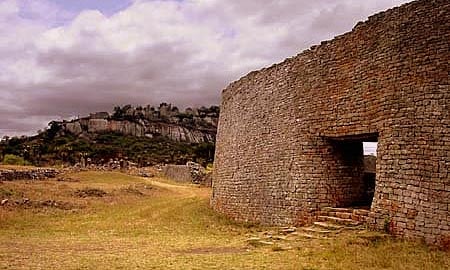
The name ‘Zimbabwe’ is an anglicized form of an African word meaning ‘stone houses’, for the ruins of the Great Zimbabwe are comprised of several stone walls, monuments, and buildings built mainly of granite. The structures were created using a method called dry stonewalling, which requires a high level of masonry expertise. The internal structure contains many passageways and enclosures. It spans almost 1800 acres of the southeastern area of the country of Zimbabwe. While it may seem that the structure was named after the country, it is actually the other way around.

Conical tower at Great Zimbabwe.
Image source: Wikipedia
It is estimated that construction spanned more than 300 years, and that the complexes housed a civilization of up to 18,000 people. The Great Zimbabwe would have been used as a political seat of power, serving as a palace for the Zimbabwean monarch. It is not known who constructed the Great Zimbabwe, but there are several groups that may have been involved, including the Bantu people of the Gokomere, ancestors of the Southern African ethnic group known as the Lemba or Venda, or a branch of the Shona-speaking people known as the Karanga.

Preserved wall of the Great Zimbabwe ruins.
Image source: Wikipedia
The Great Zimbabwe was ultimately abandoned, with parts of it falling into ruin. However, many of the structures are still standing today, and the site has been recognized as a World Heritage Site by UNESCO. According to some, the most impressive remains of the Great Zimbabwe are the massive stone walls. The walls were constructed of granite; a local natural resource that was collected from the exposed rock in the surrounding hills. The large slabs were easy to remove, transport, and construct, creating an expansive set of walls around the complex.

Great Zimbabwe, stone imitation of a wooden lintel.
Image source: Wikimedia
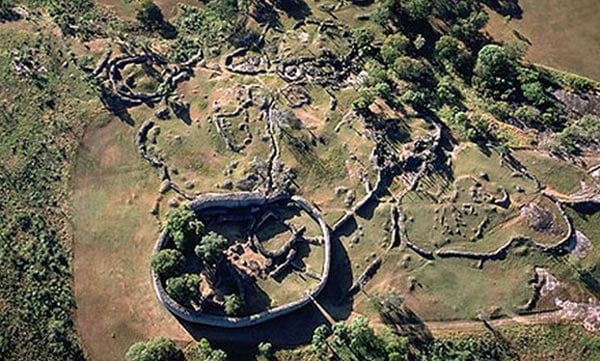
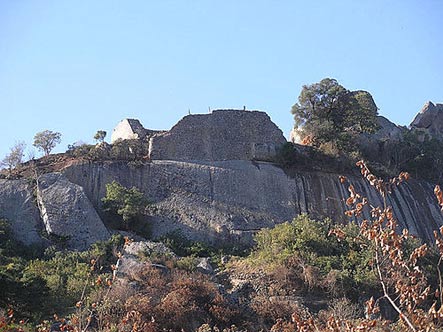
The ruins of the Great Zimbabwe form three distinctive architectural groupings, which have been labeled as the Hill Complex, the Valley Complex, and the Great Enclosure. There is some disagreement as to the meaning or purpose of the three groupings. Some say that each group represents a different king, with new rulers creating a new residence upon taking power. This would suggest that the focus of power shifted throughout the Great Zimbabwe over the centuries. Others suggest that the groupings were used consistently throughout the lifespan of the Great Zimbabwe, with each complex serving a specific purpose within society; the Hill Complex possibly served as a temple, the Valley Complex was where citizens resided, and the Great Enclosure housed the king.

The Hill Complex in the Great Zimbabwe.
Image source: Wikipedia
Some evidence of the peoples that inhabited the Great Zimbabwe comes from the artifacts that have been discovered in the area, including soapstone figurines, pottery, iron gongs, elaborately worked ivory, iron and copper wire, iron hoes, bronze spearheads, copper ingots and crucibles, and gold beads, bracelets, pendants and sheaths. One of the most notable artifacts discovered to date is known as the eight Zimbabwe Birds. The birds are 16 inches tall, carved from soapstone and had been placed atop massive stone monoliths that were about a yard tall. Unfortunately, the birds were not discovered in situ, so it is not known where they were placed when constructed. There are some physical indications that the Zimbabwe Birds were placed at the Eastern Enclosure of the Hill Complex. The birds contain both human and bird-like features, including lips for a beak, and five-toed feet for claws. They may have been symbols of a royal presence. Determining exactly where the birds were located could provide insight as to where the king or leader lived within the Great Zimbabwe.

Copy of one of the soapstone birds found at the Great Zimbabwe.
Image source: Wikipedia
There has been much speculation as to what led to the decline of the inhabitants of the Great Zimbabwe, mostly adducing to a decline in available resources. Some say it may have been due to declines in trade from the North, or exhaustion of the resources in the nearby gold mines. Others cite political unrest, famine, and water shortages caused by climate changes, which would have forced the citizens to move to an area with a higher abundance of resources available.
The Great Zimbabwe give visitors a glimpse into the landscape of past human civilization, but it remains a great enigma. So much is still unknown about the ancient site – how it came to be, why it was built, how it was used, and why it was abandoned. We may never know the answers to these questions, but we can still marvel at the breathtaking ruins that gave the country of Zimbabwe its name.
Sources:
By M R Reese
RELATED VIDEOS, selected and posted by peter2011
Riding the Seas: Kelpies, Hippocampus, and More Monstrous Horses

There are many interesting legends from around the world and through the ages that refer to mythical beings that are similar to horses. The Scottish Kelpies are some of the more intriguing of these creatures and tales about these water horses have been told far and wide around that country. But before those creatures existed there was a sea horse in Greek myth that was known as a hippocampus.
In Scotland, the kelpie is a shape-shifting water spirit which resides in lakes and pools. The historian Douglas Harper defined kelpies as demons appearing specifically in the shape of horses. However, some legends say that it can also assume human form.

‘The Kelpie’ (1913) by Herbert James Draper.
( Public Domain )
While appearing as a human, the kelpie will still have its hooves. For this reason, the kelpie is seen as a malefic entity. In Scotland, almost every lake has a story about a kelpie. Probably the most well-known of these stories is the one about the kelpie of Loch Ness .
In the past, human sacrifices were made to appease the gods and spirits of the waters. In time, this practice led to the appearance of the belief in evil water horses. There are some stories, however, in which kelpies are seen in a more positive light and are said to protect small children from drowning in lakes. Kelpies also apparently warned young women to be wary of handsome strangers.
Kelpies are the most common water spirits in Scottish folklore and they can live both in water as well as on land. They often appear in legends as strong and beautiful black horses which live in the deep pools of rivers and streams in Scotland.
Kelpies are known for preying on the humans they encounter. The hooves of the kelpie are thought to be reversed to those of a regular horse. In Aberdeenshire, the kelpie allegedly has a mane of serpents, while the kelpie of River Spey was known to be white and capable of singing.

Kelpie Scares Man – Anon.
( Archivist /Adobe Stock)
The tangie or tongie is another shape-shifting spirit from Orkney and the Shetland Isles. It is a sea spirit appearing in the form of a horse or as a merman. This spirit can also appear as an old man. The creature is said to be covered with seaweed and it allegedly loves to terrorize lonely travelers.
Specifically, the tangie has a predilection for young women, whom it allegedly will abduct and devour under water. Black Eric, a sheep rustler, was known in legends for riding a tangie. The tangie he rode offered him supernatural assistance while raiding surrounding crofts. Ultimately, Black Eric fell to his death in the sea - but his tangie continued to terrorize the area.

People in the Highlands were often wary of lone animals and strangers they encountered near the water’s edge.
( natalia9 /Adobe Stock)
The each-uisge of Scotland is known as “Ech-Ushkya” or as the “each-uisce” in Ireland. Literally meaning “water horse” it is a water spirit resembling the kelpie, but is far more vicious. Folklorist Katharine Briggs described the mythical being as “perhaps the fiercest and most dangerous of all the water-horses”.
While the kelpie inhabits rivers and streams, the each-uisge lives in the sea and in lakes. It is a shape shifter disguised as a beautiful horse, a pony, a giant bird or as a handsome man. While it is in its horse form, should a person mount it, then the individual is only safe while the each-uisge is on land.
However, as soon as the horse smells water it is the end for the rider. The horse’s skin will become adhesive and the horse creature will immediately take its rider into the deepest part of the lake, drowning him. Once the victim has drowned, the each-uisge rips the corpse apart and devours it, leaving only the liver to float to the surface. For this reason, people in the Highlands were often wary of lone animals and strangers they encountered near the water’s edge.

Representation of each-uisge, a supernatural water horse found in the lochs of Scotland.
( Liza Phoenix /CC BY SA 3.0 )
On the Isle of Lewis, Croc-na-Beist, meaning “hillock of the monster”, is a knoll where an each-uisge was said to have been slain by the brother of a woman it tried to seduce while in its human form.
Apart from humans, these malevolent water creatures also fed on cattle and sheep. The use of these animals could also help someone to lure, capture, and kill the each-uisge. The smell of roasted meat attracts the each-uisge in McKay’s story from “ More West Highland Tales ”:
A blacksmith from Raasay lost his daughter to the each-uisge. In revenge the blacksmith and his son made a set of large hooks, in a forge they set up by the loch side. They then roasted a sheep and heated the hooks until they were red hot. At last a great mist appeared from the water and the each-uisge rose from the depths and seized the sheep. The blacksmith and his son rammed the red-hot hooks into its flesh and after a short struggle dispatched it. In the morning there was nothing left of the creature apart from a jelly like substance .
The hippocampus, meaning “horse monster” in Greek, is a mythical creature in Greek and Phoenician mythology. In English, the creature is often called a “sea-horse”. The being was also adopted by Etruscan mythology and it is described as having the upper body of a horse and the lower body of a fish.
Melquart, the tutelary god of the Phoenician city of Tyre, was depicted as riding a winged hippocampus. Poseidon was also the god of horses and known as Poseidon Hippios.

A representation of a mythical hippocampus (sea horse).
(DiGiTAM/ CC BY NC ND 2.0)
Even though it was not a water horse, Sleipnir of Norse mythology is also worth mentioning here. Sleipnir was believed to be the eight-legged steed of the chief god Odin, the child of Loki, and the fastest horse in all of the nine worlds.
Horses have been present since the beginning of human history and they have also entered the myths and legends of the world in a variety of forms – sometimes sweet, sometimes scary.

Sculptures of Kelpies in Falkirk.
( CC BY SA 2.0 )
By Valda Roric
RELATED VIDEOS
NASA has Simulated a Tiny Part of the Moon Here on Earth

Using the Lunar Lab and Regolith Testbeds at NASA’s Ames Research Center, a team created this simulated lunar environment to study lighting conditions experienced at the unexplored poles of the Moon.
Credit: NASA/Uland Wong.
BY
Before going to the Moon, the Apollo astronauts trained at various sites on Earth that best approximated the lunar surface, such as the volcanic regions Iceland, Hawaii and the US Southwest. To help prepare for upcoming robotic and human Artemis missions, a newly upgraded “mini-Moon” lunar testbed will allow astronauts and robots to test out realistic conditions on the Moon including rough terrain and unusual sunlight.
The Lunar Lab and Regolith Testbed at the Ames Research Center in California simulates conditions on the Moon in a high-fidelity environment, allowing researchers to test hardware designs intended for the lunar surface. The lab is currently being used as a test environment for the next phases of the Artemis Program, to conduct studies on optical sensing and drill testing, and tests for in-situ resource utilization identification and extraction techniques.

The facility was originally built in 2009 but has now been expanded and upgraded to include a lunar lab with multiple testbeds with a variety of simulated lunar regolith. These large indoor “sandboxes” can be configured and customized to simulate various regions on the Moon. In addition, a special lighting system can re-create realistic lighting conditions on the Moon, such as the darkness of a lunar polar crater, or the glaring rays of the Sun that the Apollo astronauts had to deal with in the lunar mares.
The testbeds aren’t huge, but big enough to provide a variety of conditions. The first original sandbox measures approximately 13 feet by 13 feet by 1.5 feet (4 meters by 4 meters by 0.5 meter) and is filled with eight tons a lunar regolith simulant called Johnson Space Center One simulant (JSC-1A), which makes this the world’s largest collection of the material. The JSC-1A simulant mimics the Moon’s mare basins and is dark grey in color.
The new larger testbed, measures 62 feet by 13 feet by 1 foot (19 meters by 4 meters by 0.3 meter) and is filled with more than 20 tons of Lunar Highlands Simulant-1 (LHS-1), which is light grey to simulate the lunar highlands. This larger sandbox can be reconfigured if needed to be a smaller, but deeper, testbed.
Some of the things tested are how various tools and rovers work in the incredibly abrasive and “sticky” regolith. Moon dust has grains as fine as powder, but it can also be sharp as tiny shards of glass. In addition, it has the annoying ability to electrostatically cling to everything.
The special lighting system can mimic both the dark polar regions of the Moon and the glaring, unfiltered light elsewhere on the Moon.
“When rovers and astronauts carry out missions at the lunar South Pole, they’ll have to navigate in low-angle lighting and overcome harsh solar glare that makes it difficult to see,” NASA said in a press release. “Because the Sun will never rise overhead, even the smallest rock or crater will cast long shadows and cloak craters in darkness. And, at times, the Sun will blaze at eye-level as it reflects off the soil.”

The new testbeds have been instrumental in testing out NASA’s new Moon rover, the Volatiles Investigating Polar Exploration Rover (VIPER). VIPER’s rover drivers will rely on a system of rover-mounted lights and cameras to steer clear of boulders, descend steep declines into craters, and avoid other potentially mission-ending dangers. The facilities at the Regolith Testbed allowed research teams create over 12 different scenarios of craters and rock formations to improve the rover’s autonomous navigation system, so it can navigate safely through unknown terrain and harsh conditions.

Astronomers Find 25 Fast Radio Bursts That Repeat on a Regular Basis

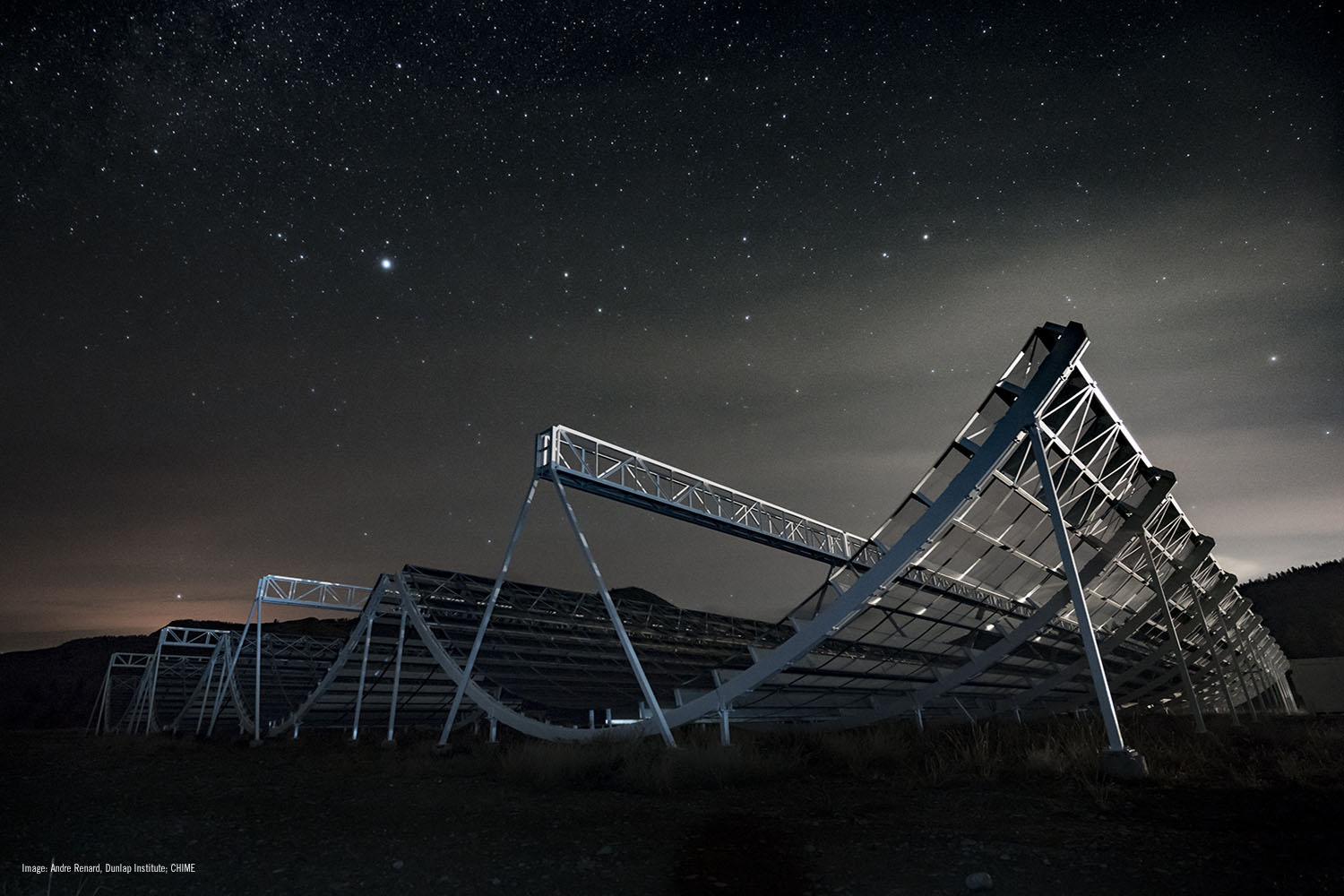
CHIME consists of four metal "half-pipes", each one 100 meters long.
Image Credit: CHIME/Andre Renard, Dunlap Institute
BY
Like Gravitational Waves (GWs) and Gamma-Ray Bursts (GRBs), Fast Radio Bursts (FRBs) are one of the most powerful and mysterious astronomical phenomena today. These transient events consist of bursts that put out more energy in a millisecond than the Sun does in three days. While most bursts last mere milliseconds, there have been rare cases where FRBs were found repeating. While astronomers are still unsure what causes them and opinions vary, dedicated observatories and international collaborations have dramatically increased the number of events available for study.
A leading observatory is the Canadian Hydrogen Intensity Mapping Experiment (CHIME), a next-generation radio telescope located at the Dominion Radio Astrophysical Observatory (DRAO) in British Columbia, Canada. Thanks to its large field of view and broad frequency coverage, this telescope is an indispensable tool for detecting FRBs (more than 1000 sources to date!) Using a new type of algorithm, the CHIME/FRB Collaboration found evidence of 25 new repeating FRBs in CHIME data that were detected between 2019 and 2021.
The CHIME/FRB Collaboration comprises astronomers and astrophysicists from Canada, the U.S., Australia, Tawain, and India. Its partner institutions include the DRAO, the Dunlap Institute for Astronomy and Astrophysics (DI), the Perimeter Institute for Theoretical Physics, the Canadian Institute for Theoretical Astrophysics (CITA), the Anton Pannekoek Institute for Astronomy, the National Radio Astronomy Observatory (NRAO), the Institute of Astronomy and Astrophysics, the National Centre for Radio Astrophysics (NCRA), and the Tata Institute of Fundamental Research (TIFR), and multiple Universities and institutes.
Despite their mysterious nature, FRBs are ubiquitous and the best estimates indicate that events arrive at Earth roughly a thousand times a day over the entire sky. None of the theories or models proposed to date can fully explain all the properties of the bursts or the sources. While some are believed to be caused by neutron stars and black holes (attributable to the high energy density of their surroundings), others continue to defy classification. Because of this, other theories persist, ranging from pulsars and magnetars to GRBs and extraterrestrial communications.
CHIME was originally designed to measure the expansion history of the Universe through the detection of neutral hydrogen. Roughly 370,000 years after the Big Bang, the Universe was permeated by this gas, and the only photons were either the relic radiation from the Big Bang – the Cosmic Microwave Background (CMB) – or that released by neutral hydrogen atoms. For this reason, astronomers and cosmologists refer to this period as the “Dark Ages,” which ended roughly 1 billion years after the Big Bang as the first stars and galaxies began reionizing neutral hydrogen (the Reionization Era).
Specifically, CHIME was designed to detect the wavelength of light that neutral hydrogen absorbs and emits, known as the 21-centimeter hydrogen line. This way, astronomers could measure how fast the Universe was expanding during the “Dark Ages” and make comparisons to later cosmological eras that are observable. However, CHIME has since proven itself to be ideally suited for studying FRBs, thanks to its wide field of view and the range of frequencies it covers (400 to 800 MHz). This is the purpose of the CHIME/FRB Collaboration, which is to detect and characterize FRBs and trace them back to their sources.
As Dunlap Postdoctoral Fellow and lead author Ziggy Pleunis told Universe Today, each FRB is described by its position in the sky and a quantity known as its Dispersion Measure (DM). This refers to the time delay from high to low frequencies caused by the burst’s interactions with material as it travels through space. In a paper released in August 2021, the CHIME/FRB Collaboration presented the first large-sample catalog of FRBs containing 536 events detected by CHIME between 2018 and 2019, including 62 bursts from 18 previously reported repeating sources.

For this latest study, Pleunis and his colleagues relied on a new clustering algorithm that looks for multiple events co-located in the sky with similar DMs. “We can measure the fast radio burst’s sky position and dispersion measure up to a certain precision that depends on the design of the telescope that’s being used,” said Pleunis. “The clustering algorithm considers all fast radio bursts that the CHIME telescope has detected and looks for clusters of FRBs that have consistent sky positions and dispersion measures within the measurement uncertainties. We then do various checks to make sure the bursts in a cluster are really coming from the same source.”
Of the over 1000 FRBs detected to date, only 29 were identified as repeating in nature. What’s more, virtually all repeating FRBs were found to be repeating in irregular ways. The only exception is FRB 180915, discovered by researchers at CHIME in 2018 (and reported on in 2020) and pulses every 16.35 days. With the help of this new algorithm, the CHIME/FRB collaboration detected 25 new repeating sources, almost doubling the number available for study. In addition, the team noted some very interesting features that could provide insight into their causes and characteristics. As Pleunis added:
“When we carefully count all our fast radio bursts and the sources that repeat we find that only about 2.6% of all fast radio bursts that we discover repeat. For many of the new sources we have detected only a few bursts, which makes the sources quite inactive. Almost as inactive as the sources that we have only seen once.
“We thus cannot rule out that the sources for which we have so far only seen one burst, will eventually show repeat bursts as well. It is possible that all fast radio burst sources eventually repeat, but that many sources are not very active. Any explanation for fast radio bursts should be able to explain why some sources are hyperactive while others are mostly quiet.”

An illustration of CHIME detecting Fast Radio Bursts (FRBs) in the night sky.
Credit: James Josephides/Mike Dalley
These findings could help inform future surveys, which will benefit from next-generation radio telescopes that will become operational in the coming years. These include the Square Kilometer Array Observatory (SKAO), which is expected to gather its first light by 2027. Located in Australia, this 128-dish telescope will be merged with the MeerKAT array in South Africa to create the world’s largest radio telescope. In the meantime, the prodigious rate at which new FRBs are being detected (including repeating events) could mean that radio astronomers could be close to a breakthrough!
ALL RELATED VIDEOS, selected and posted by peter2011
Draper to send a mission to the far side of the Moon
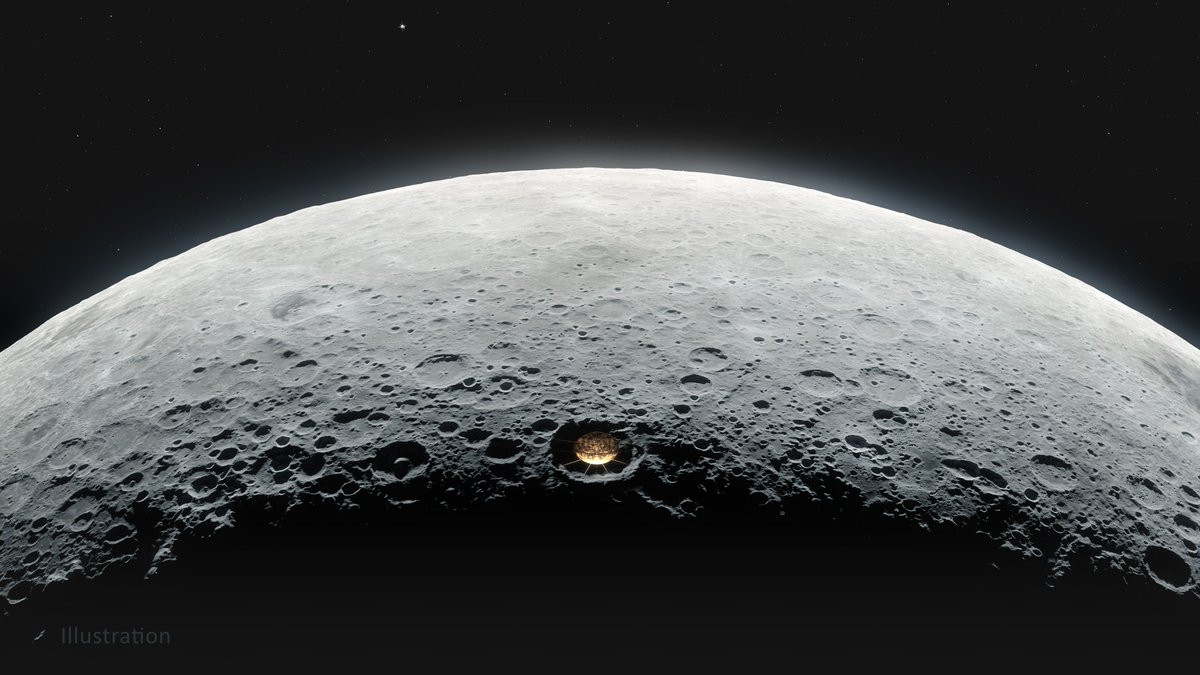
Draper has received a USD 73 million NASA contract to deliver several cargoes to the far side of the Moon. It was given as part of the CLPS (Commercial Lunar Payload Services) program, the main purpose of which is to attract American industry to the development of the moon of our planet.

Under the terms of the agreement, Draper is responsible for cargo integration, its delivery from Earth to the Moon (the SERIES-2 platform developed by the company will be used for landing) and operations on the lunar surface. This is the eighth contract issued under the CLPS program.
The landing site of the mission will be the Schrödinger impact basin, a 312-kilometer crater located near the south pole of the Moon. This place is of great interest to geologists. Schrödinger is one of the youngest lunar craters. The impact that formed it tore off the lunar crust, exposing the upper part of the mantle in the inner ring. The outer ring of the crater consists of an impact melt.

Another interesting feature of the impact formation is that its bottom is covered with smooth sedimentary deposits. According to scientists, after the formation of the crater it became the site of a major eruption. Scientists hope that studying the basin will allow them to better understand the thermal and geophysical properties of the Moon’s interior, as well as the electrical and magnetic properties of the surface in a place sheltered from the influence of Earth’s electromagnetic fields.

The Draper descent platform will have to deliver instruments to the Moon for the implementation of three NASA experiments with a total mass of 95 kg. Among them:
Currently, the implementation of the Draper mission is planned for 2025. It is not yet known which launch operator will be chosen to launch it to the Moon.
Astronomers Prepare to Launch LuSEE Night, A Test Observatory on the Far Side of the Moon

Artist's impression of a radio telescope on the far side Moon.
Credit: Vladimir Vustyansky
BY
Astronomers have not yet been able to map large portions of the radio emissions from our universe because of interference from the Earth itself. A team of astronomers hopes to change that, beginning with the LuSEE Night mission to the far side of the Moon. It will launch in 2025 and chart a new pathway to Lunar observatories.
The Earth is really loud in the radio, especially at frequencies below 20 megahertz. The ionosphere of the planet itself crackles at those frequencies, obscuring radio emissions from more distant sources. Plus we use low frequency radio waves for communication and radar searches, swamping cosmic sources.
The only way to mitigate all that terrestrial contamination is to get up and away from it. The best place is the far side of the Moon, so that the bulk of the Moon’s body blocks out radio emissions from the Earth. The Sun itself is also a rather loud emitter of radio signals at those frequencies, so the best time to observe is during the Lunar night, when the far side of the Moon is plunged in darkness.
But building radio observatories on the far side of the Moon is no easy task, so we have to start small. One of the first steps is LuSEE Night, the Lunar Surface Electromagnetic Explorer, a small radio antenna and instrument package that is scheduled to be delivered to the far side of the Lunar surface as early as 2025.
LuSEE Night owes its technological heritage to the Parker Solar Probe, and is in fact nearly an identical copy of one of the instruments onboard that spacecraft. LuSEE Night consists of two 6m long antenna set in a cross-shaped pattern along with a bare bones set of electronics.
In observing mode the instrument is relatively quiet, so it doesn’t add to any radio contamination. It can then send up any data to an orbiting Lunar spacecraft which sends the data back to Earth.
The team behind LuSEE Night hopes to capture some of the first observations of the very low frequency radio universe, which includes emissions from cosmic rays spiraling around the magnetic fields of the Milky Way galaxy and distant bright sources like supernovae and white dwarfs.
LuSEE Night is just the first step. The astronomers hope that it will prove to be a success, so that future observatories and missions on the Lunar far side can open up new windows into the cosmos.

The Lunar Surface Electromagnetics Experiment, or LuSEE, will be built by the Space Science Laboratory to study the magnetic and electric fields on the moon’s surface and how they interact with fine dust particles.
LuSEE will integrate flight-spare and repurposed hardware from the NASA Parker Solar Probe FIELDS experiment, the STEREO/Waves instrument, and the MAVEN mission to make comprehensive measurements of electromagnetic phenomena on the surface of the Moon.
Mysterious UFO Captured on Camera by FedEx Pilot Flying Over Monterrey, Mexico!

On the night of March 19, 2020, a team of experienced American aircrew flying a Boeing 767 encountered something truly extraordinary. As they flew from Queretaro International Airport in Mexico to Memphis, Tennessee, a strange, yellowish-white light suddenly appeared in their view and descended from above. Initially believed to be a meteor, the light then projected a beam of bright, white light onto their aircraft and seemed to take a collision course with their flight.
The crew, highly experienced with observing and identifying aircraft, prepared for evasive action, but to their surprise, the beam of light suddenly stopped and the light accelerated to the same speed and heading of the aircraft. It then maintained a safe distance of approximately 1-2 kilometers and paced the aircraft for a significant amount of time.
As they took a closer look, they realized they were not looking at another airplane. The copilot described the light as “a brilliant yellow-white plasma object, teardrop-shaped.” The captain even exclaimed “Platillo…., Platillo…” (“saucer”, implying “Flying Saucer” or “Platillo Volador” in Spanish). They noted the lack of navigation lights or any other features associated with airplanes and the light seemed to have a tail.
The crewmen quickly realized that they were witnessing something truly unique, something that defied conventional explanation. They were able to capture 8 photographs and a 4:47 video of the encounter from the cockpit, providing valuable evidence of the event.
The National Aviation Reporting Center on Anomalous Phenomena (NARCAP) was contacted by members of MUFON to look into the report. After reviewing the case and evidence, NARCAP agreed to conduct an independent analysis of the incident. NARCAP’s definition of an Unidentified Aerial Phenomenon (UAP) is “the visual stimulus that provokes a sighting report of an object or light seen in the sky, the appearance and/or flight dynamics of which do not suggest a logical, conventional flying object and which remains unidentified after close scrutiny of all available evidence.”
This event is just one of many recent reports of UFO sightings around the world, sparking questions about what could be behind these mysterious sightings. Are they top-secret military technologies, natural phenomena, or something altogether different? While the answer remains unknown, it’s clear that the skies above us hold many secrets waiting to be uncovered.
This report is a fascinating glimpse into the unknown and will leave you wondering, what could be flying above our heads? Could this be proof of extraterrestrial life or just a misinterpretation of a natural occurrence? The evidence captured by the aircrew and analyzed by NARCAP provides a tantalizing glimpse into the mystery of the skies, and leaves us all with questions waiting to be answered.
_
The Roswell Incident: Exploring the Possibility of Extraterrestrial Life

The Roswell Incident of 1947 has been the subject of much debate and speculation for many years. The story goes that a flying saucer crashed in the Foster Ranch near Roswell, New Mexico, and was later reported to have been recovered by the Roswell Army Airfield. However, the details of the flying disc were never revealed, and the incident was eventually written off as a weather balloon by the military.
Despite this official explanation, many people believe that the Roswell Incident was the result of an extraterrestrial event. They point to several pieces of evidence to support their theory, including the original newspaper articles from 1947 that reported the crash, as well as FBI documents from the same year that discussed the recovery of a hexagonal object that was suspended from a balloon by cable.
In addition to these historical documents, there is also the possibility that a secret group of people was created by President Harry Truman in order to investigate the Extraterrestrial issue. This group, known as the Majestic 12, was said to be aware of the existence of extraterrestrial aircraft and the methods used to recover them. Although the authenticity of the Majestic 12 documents has been questioned, they are still considered by many to be solid evidence of a cover-up by the government.
It’s interesting to consider that the Roswell Incident may have been the result of a technological advance by an extraterrestrial species. With so much evidence suggesting that there may be life beyond our planet, it’s important that we continue to explore the possibilities and seek the truth about the Roswell Incident and the possibility of extraterrestrial life.
In conclusion, while the Roswell Incident may never be fully explained, it continues to capture the imagination of people all over the world. Whether you believe in the possibility of extraterrestrial life or not, the Roswell Incident remains a fascinating and mysterious event that will continue to be the subject of much debate for years to come.
The video below features a comprehensive examination of the 1997 “Roswell Report” released by the Air Force, as well as interviews with multiple individuals, including members of the Wilmot and Brazel families, Marilyn Strickland, Major Jesse Marcel, Brigadier General Thomas DuBose, First Lieutenant Walter Haut, Jed Roberts, the Henderson family, Vern Maltais, Barbara Duggar, Glenn Dennis, Gerald Anderson, and others.
LATEST UFO SIGHTINGS AND VIDEOS - 30/01/2023LATEST UFO SIGHTINGS AND VIDEOS - 30/01/2023
Something MASSIVE Detected During SpaceX's launch mission, Elon Musk Revealed...
The Loneliest Galaxy in the Universe - Void Galaxies and How They Form
Interstellar Space Documentary 2023 - Advanced Knowledge | Encyclopedia Galactica
Is Interstellar travel possible? Could microbes actually be encoded with interstellar messages from some distant race of extraterrestrials? Given that we are now capable of sequencing the entire human genome, it’s not so far-fetched to think that a more advanced alien race could have easily done this in the past. Such microbes might be the perfect media for an interstellar Encyclopedia Galactica...
What Is This Mysterious Sunken Object Beneath The Baltic Sea? | The Mystery Beneath | Timeline
Treasure hunters Peter and Dennis were out on a typical day exploring the Baltic Sea when a very unusual image appeared on the sonar. A nearly 200-foot cylindrical object was something that had never been seen before. This documentary takes you on an extraordinary journey to find out what the object could be. Reviewed by multiple disciplines of scientists, and using advanced equipment, could this object be an ancient crash site from an advanced civilization millions of years ago?
Submarine Discovers Something TERRIFYING Science Can't Explain
If you think there is no mystery left on earth for man to discover, you are wrong. As per an interesting fact, 80% of the ocean is still unexplored by humans. It means that there are creatures, concepts, and processes in the ocean that we are unaware of.
Cern Researchers Just Announced a New Terrific Discovery!
It is September 10, 2008 when the Large Hadron Collider at the European Nuclear Research Center CERN goes into operation. At this point in time, the anticipation of the scientists was understandably boundless - after all, the most powerful particle accelerator of all time should help significantly to understand the invisible particle world around us more precisely than ever. However, the experiments carried out so far have by no means only resulted in insightful findings: recently scientists announced that they had come across something extremely mysterious that contradicts the laws of our physics! Since this inexplicable incident, experts have been trying to find out the exact causes - but whether their theories correspond to reality is still completely uncertain. You're wondering what this scientific riddle is all about? Then stick around until the end of today’s video!
WORLDS BEST UFO Photo? CALVINE PHOTO Investigation
Is the Calvine photo the worlds best ufo photo? The Calvine photograph continues to captivate everyone due to its unique history and relative detail of an unidentified aerial phenomenon. Through your input, I was able to uncover more information about the photograph, which led me to make some conclusions and generate further questions that may be worth exploring.
00:00 Calvine Photo
00:29 Loch Errochty
00:49 Island Theory
01:38 Review Document
02:17 Loch Tummel
02:32 Reflection Theory
02:41 Airport Theory
03:27 Aurora Project
05:02 Hotel Staff
05:24 Sean's Theory
06:14 Subscribe & Comment!
If you want to learn more about the Calvine Photo I have shared some sources below:
RELATED VIDEOS