Where could aliens exist in our solar system? Mars, Jupiter's moon Europa and Saturn's satellites Enceladus and Titan are among the worlds most likely to host extraterrestrial life, experts say - PART I
- MailOnline looks at the worlds in our solar system most likely to harbour alien life
- They include Jupiter's moons, a dwarf planet, Mars, Venus and Saturn's satellites
By SAM TONKIN FOR MAILONLINE
For thousands of years, humanity has wrestled with the idea we may not be alone in our solar system.
Speculation that aliens might exist dates back to philosophers in ancient Greece, but it was the middle of the 20th century when people's imaginations really began to run riot — suddenly 'little green men' were everywhere in popular culture.
Although the use of the phrase is believed to have originated in 1908, it was between the 1920s and 50s that green Martian characters were plastered all over the covers of science fiction
The reality is that if extraterrestrial life does exist in our solar system it will be of a more simpler variety, perhaps hidden in Venus' clouds, beneath Mars' surface or in the vast underground oceans of one of Saturn's icy moons.
But where else is the best bet of finding it? MailOnline speaks to a number of experts to find out.
Are we alone? For thousands of years, humanity has wrestled with the idea that aliens might exist in our solar system. But despite mid-20th century's excitement about 'little green men', if there is extraterrestrial life it will be of a more simpler variety, perhaps hidden in Venus' clouds, beneath Mars' surface or in the vast underground oceans of one of Saturn's icy moons
Mars
The most obvious candidate for extra-terrestrial life either past or present.
Scientists know the Red Planet was once habitable because billions of years ago it had lakes and rivers of liquid water on its surface, as well as a much thicker atmosphere than the thin one it has now.
But although the conditions were right for life to emerge, is that actually what happened?
Scientists have been trying to find out since the 19th century, although the answer has so far eluded them. Telescopes and probes have offered clues, while NASA has also deployed rovers to hunt for evidence over the past two decades.
Near neighbour: Mars is the most obvious candidate for another world in our solar system to harbour alien life either past or present. NASA's Perseverance rover is currently collecting samples in its search for evidence of ancient life, which will be analysed on Earth in the 2030s
Opportunity and Curiosity began the work, but today that baton has very much been handed over to Perseverance and its accompanying Ingenuity helicopter, which touched down on the Red Planet in February 2021.
Car-size robot Perseverance, nicknamed Percy, has so far collected 18 samples of rock and regolith (broken rock and soil) from the Jezero Crater where a river flowed billions of years ago.
Busy: Car-size robot Perseverance (pictured) has so far collected 18 samples of rock and regolith (broken rock and soil) from the Jezero Crater where a river flowed billions of years ago
MARS: THE BASICS
Mars is the fourth planet from the sun, with a 'near-dead' dusty, cold, desert world with a very thin atmosphere.
Mars is also a dynamic planet with seasons, polar ice caps, canyons, extinct volcanoes, and evidence that it was even more active in the past.
It is one of the most explored planets in the solar system and the only planet humans have sent rovers to explore.
One day on Mars takes a little over 24 hours and a year is 687 Earth days.
Facts and Figures
Orbital period: 687 days
Surface area: 55.91 million mi²
Distance from Sun: 145 million miles
Gravity: 3.721 m/s²
Radius: 2,106 miles
Moons: Phobos, Deimos
When these sample tubes are eventually collected and returned to Earth by a European spacecraft some time in the 2030s, it could help scientists determine whether microbial left ever existed in the region.
If there are signs of ancient life, it is also possible that there are still alien microbes on Mars today, although these would more likely be underground rather than on the surface.
Several studies have previously used radar observations to show that reservoirs of liquid water probably exist just over a mile below the surface, but it would take future exploration – and likely a tricky mission – to try and establish once and for all if life exists there.
Professor Andrew Coates, from the Department of Space & Climate Physics at University College, said the UK-built Rosalind Franklin rover could help with this.
'We're searching for evidence of biomarkers with the Rosalind Franklin rover (launch 2028), which will drill 2m under the surface, below where UV and oxidants are, and below where energetic solar and galactic radiation can penetrate,' he told MailOnline.
Professor Coates said Mars would be in his top three most likely worlds to host life in our solar system.
'Mars had the right conditions 3.8 to 4 billion years ago – with evidence for water on the surface, CHNOPS [the six elements of carbon, hydrogen, nitrogen, oxygen, phosphorus and sulfur make up 98 per cent of living matter on Earth] and energy – at about the same time life was starting on Earth,' he added.
'It is the nearest possibility for life beyond Earth. Even the cold night side on the Mars surface (about 150K) is warmer than the surfaces on Europa (140K), Enceladus (70K) and Titan (90K).
Professor Michael Garrett, of the University of Manchester, said: 'There is probably no life above ground (Mars' atmosphere is thin to absorb sterilizing UV radiation from the sun) but underground looks a better bet.
'There is likely to be significant quantities of water underground and the temperature is also higher, so it's possible some sort of basic life might be hiding there, like microbial life.'
How are we going to confirm either way?
In all likelihood, Perseverance. There are high hopes for the Mars rover, but it won't be for another decade until we potentially get an answer.
Venus
Earth's closest neighbour and the second planet from the sun, Venus is a hellish world where surface temperatures are hot enough to melt lead and its atmosphere is thick with carbon dioxide.
But despite such inhospitable conditions, there has been a lot of excitement recently that it might in fact host a type of life in an unusual place.
Just over a year ago, a new study suggested that alien lifeforms 'unlike anything we've ever seen' may be living in the clouds of Earth's 'evil twin'.
Scientists claimed that the planet could be becoming 'more habitable' after identifying a chemical pathway by which life could neutralise Venus' acidic environment, creating a self-sustaining, habitable pocket in the clouds.
For nearly 50 years experts have been baffled by the presence of ammonia, a colourless gas made of nitrogen and hydrogen, which was tentatively detected in Venus' atmosphere in the 1970s.
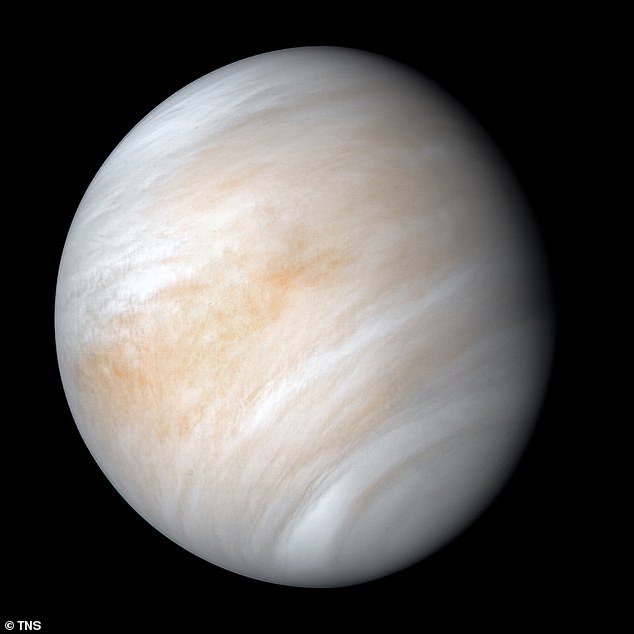
Hellish world: Venus has been in the news a lot recently amid excitement that the planet might host life. Just over a year ago, a new study suggested that alien lifeforms 'unlike anything we've ever seen' may be living in the clouds of Earth's 'evil twin'
CO2 AND SULPHURIC ACID DROPLETS EXIST IN THE ATMOSPHERE OF VENUS
Venus's atmosphere consists mainly of carbon dioxide, with clouds of sulphuric acid droplets.
The thick atmosphere traps the sun's heat, resulting in surface temperatures higher than 470°C (880°F).
The atmosphere has many layers with different temperatures.
At the level where the clouds are, about 30 miles (50 km) up from the surface, it's about the same temperature as on the surface of the Earth.
As Venus moves forward in its solar orbit while slowly rotating backwards on its axis, the top level of clouds zips around the planet every four Earth days.
They are driven by hurricane-force winds travelling at about 224 miles (360 km) per hour.
Atmospheric lightning bursts light up these quick-moving clouds.
Speeds within the clouds decrease with cloud height, and at the surface are estimated to be just a few miles (km) per hour.
On the ground, it would look like a very hazy, overcast day on Earth and the atmosphere is so heavy it would feel like you were one mile (1.6km) deep underwater.
At the heart of the confusion is that it should not be produced through any chemical process known on the hellish planet.
In the study by Cardiff University, MIT and Cambridge University, researchers modelled a set of chemical processes to show that if ammonia is present, the gas would create a cascade of reactions that would neutralise surrounding droplets of sulphuric acid.
If that were the case, this would then result in the acidity of the clouds dropping from -11 to zero, which although still very acidic on the pH scale, is a level that life could potentially survive at.
As for the source of ammonia itself, the authors believe the most plausible explanation is of biological origin, rather lightning or volcanic eruptions.
This chemistry suggests that life could be making its own environment on Venus.
'No life that we know of could survive in the Venus droplets,' said study co-author Sara Seager, from MIT.
'But the point is, maybe some life is there, and is modifying its environment so that it is liveable.'
If the researchers are correct, the lifeforms are likely to be microbes similar to bacteria found on Earth.
However, a separate study by Cambridge University scientists – published in the summer of last year – claimed to have found no evidence of life in the planet's clouds.
Any life form in sufficient abundance is expected to leave chemical fingerprints on a planet's atmosphere as it consumes food and expels waste.
But the Cambridge experts found no sign of this in the atmospheric and biochemical models they used.
'We wanted life to be a potential explanation [for the strange behaviour going on in Venus' clouds], but when we ran the models, it isn't a viable solution,' said lead author Sean Jordan from Cambridge's Institute of Astronomy.
The debate rages on and will likely not end until the various hypotheses can be tested with proposed Venus-bound missions set to launch later this decade.
The belief that life may exist in Venus's clouds has been disputed. Some studies say it could but others have ruled it out. Pictured is an artist's impression of what microbial life could look like
How are we going to confirm either way?
Two new NASA probes, coming in at a total cost of $500million (£352m), are set to blast-off later this decade and head for Venus. They have cool acronyms – DAVINCI+ and VERITAS – but they won't actually be able to confirm the existence of life.
Despite this, scientists hope the information and findings they can gather will at least get us closer to answering that question more concretely.
VERITAS (Venus Emissivity, Radio Science, InSAR, Topography, and Spectroscopy), will orbit Venus and peer through its thick clouds to map the surface.
Its aim is to understand the planet's geological history and investigate why it developed so differently to Earth. The probe could also discover whether volcanoes and earthquakes are still happening on Venus.
WHAT ARE NASA'S TWO NEW MISSIONS TO VENUS?
In June NASA announced that it is sending two new missions to Venus to examine the planet's atmosphere and geological features. They will be the first US probes sent to explore the hellish world in 30 years.
The missions, which have each been awarded $500million (£352m) in funding, are:
DAVINCI+
Pictured: The Deep Atmosphere Venus Investigation of Noble gases, Chemistry, and Imaging probe (DAVINCI+) that will carry out flybys of Venus and land on its surface
What does it stand for?
Deep Atmosphere Venus Investigation of Noble gases, Chemistry, and Imaging
What will it do?
As it drops to the surface the high-tech probe will measure Venus' acrid atmosphere to understand how it formed and evolved.
It will also aim to determine whether Venus — which is the hottest planet in the solar system with a surface temperature of 500C — ever had an ocean.
As it heads toward the surface, DAVINCI+ is expected to return the first high resolution images of the planet's 'tesserae' geological features in Alpha Regio.
Scientists believe these features could be comparable to continents on Earth and may possibly suggest that Venus has plate tectonics.
When will it launch?
2029
When will its scientific experiments begin?
The spacecraft will carry out two flybys of the planet in 2030 to study its atmosphere and the nightside surface.
Seven months after the two flybys, the craft will make a one-hour descent through the clouds, beaming back data all the way down to its landing site Alpha Regio.
What could its big discovery be?
Whether Venus ever had an ocean.
VERITAS
Pictured: The Venus Emissivity, Radio Science, InSAR, Topography, and Spectroscopy (VERITAS) probe that will orbit Venus and peer through its clouds to map the surface
What does it stand for?
Venus Emissivity, Radio Science, InSAR, Topography, and Spectroscopy
What will it do?
VERITAS will orbit Venus and peer through its thick clouds to map the surface.
The aim is to understand the planet's geological history and investigate why it developed so much differently than Earth.
When will it launch?
2028
What could its big discovery be?
Whether volcanoes and earthquakes are still happening on Venus.
DAVINCI+ (Deep Atmosphere Venus Investigation of Noble gases, Chemistry, and Imaging), meanwhile, will go one step further by actually landing on the hothouse world.
As it drops to the surface the high-tech probe will measure the planet's acrid atmosphere to understand how it formed and evolved.
It will also aim to determine whether Venus — which is the hottest planet in the solar system with a surface temperature of 900°F (500°C) — ever had an ocean.
US company Rocket Lab is also developing the first privately-funded science mission to Venus called Venus Life Finder (VLF).
It will see a probe inserted into the planet's hot, thick cloud layers to spend just five minutes searching for signs of habitable conditions.
The plan is for VLF to be launched in May this year and arrive at Venus in October, but if it misses this target lift-off date it will have to wait until the next launch window in January 2025.
Enceladus
You wouldn't think that an object completely covered in ice would offer even the remotest chance of hosting life.
But although the surface of Enceladus is freezing cold, there is a lot of activity going on beneath it.
Scientists know this because Saturn's sixth largest moon ejects liquid water, ice and organic material from its core out into space.
The organic molecules have been identified as nitrogen and oxygen-bearing compounds, similar to those involved in chemical reactions on Earth that produce the amino acids that are the building blocks of life.
Saturn's moon Enceladus is thought to have a vast salty, liquid water ocean hidden below its frozen crust, while NASA has also found evidence of hydrothermal activity deep underground. This, scientists believe, could provide the source of heat needed to give life a chance to thrive
WHY IS ENCELADUS SO EXCITING?
Enceladus is Saturn's sixth largest moon, at 313 miles wide (504 kilometres).
It is an icy satellite with hydrothermal activity - a rare combination - with vents spewing water vapour and ice particles out from a global ocean buried beneath the moon's frozen crust.
A handful of worlds are thought to have liquid water oceans beneath their frozen shell, but only Enceladus sprays its ocean out into space, where a spacecraft can sample it.
According to Nasa observations, the plume includes organic compounds, volatile gases, carbon dioxide, carbon monoxide, salts, and silica.
Microbes on our planet either produce these compounds or use them for growth, leading some to speculate that tiny organisms live in Enceladus's hidden ocean.
This means that while Enceladus may look 'inhospitable' like Saturn's other moons, it is a prime candidate in our search for alien life.
The world is thought to have a vast salty, liquid water ocean hidden below its frozen crust, while NASA has also found evidence of hydrothermal activity deep underground.
This, scientists believe, could provide the source of heat needed to give life a chance to thrive.
'If the conditions are right, these molecules coming from the deep ocean of Enceladus could be on the same reaction pathway as we see here on Earth,' Nozair Khawaja, of the Free University of Berlin, has previously said.
He carried out research on data from NASA's Cassini mission, which discovered the organic compounds during a 13-year mission that ended in 2017.
'We don't yet know if amino acids are needed for life beyond Earth, but finding the molecules that form amino acids is an important piece of the puzzle,' Khawaja added.
Professor David Rothery, of the Open University, said he believed Enceladus was one of two worlds in our solar system most likely to harbour extraterrestrial lifeforms.
'The big unknown is how likely it is for life to get started, if conditions are suitable for life,' he told MailOnline.
'However, Enceladus and Europa both have internal (below an ice shell) oceans sitting on top of tidally-heated (so warm) rock.
'Chemical reactions between water and hot rock probably result in "hydrothermal vents" (hot springs) on the ocean floor, where microbes can feed off the chemical energy.
'It doesn't matter that sunlight can't penetrate to those depths — we have similar "chemosynthetic life" clustered around hydrothermal vents on Earth's sunless ocean floors too.
'If there are microbes, maybe some more complex forms of life have evolved that eat the microbes.'
Active: Saturn's sixth largest moon ejects liquid water, ice and organic material from its core out into space. It is thought to have a salty, liquid water ocean hidden below its frozen crust, while NASA has also found evidence of hydrothermal activity deep underground (pictured)
Professor Andrew Coates, of UCL, also said Enceladus was one of the leading contenders to host alien life.
'The plumes discovered by Cassini-Huygens come from a subsurface salty ocean under the ice, and the mission also discovered evidence for silicates in the plumes, which likely come from vents on the ocean floor, perhaps a bit like black smokers on Earth,' he told MailOnline.
'Also hydrogen was directly found, completing CHNOPS at Enceladus. [The six elements of carbon, hydrogen, nitrogen, oxygen, phosphorus and sulfur make up 98 per cent of living matter on Earth.]'
How are we going to confirm either way?
Unfortunately there aren't currently any missions scheduled to study Enceladus. A number of proposals have been put forward, including several to NASA, but nothing has been picked to actually go to Saturn's moon.
This is a shame, given that many scientists believe Enceladus to be one of the most likely candidates to host extra-terrestrial life.
If and when we ever do go there, digging into the ocean would be the best way to see if any lifeforms exist on the moon, although it might also be possible to detect biosignatures in cryovolcanoes.
These are volcanos that erupt vaporised materials such as water or ammonia rather than molten rock.
Europa
Another popular candidate to host alien life — and this time there might soon be an answer from missions scheduled to fly to it.
Europa is the smallest of Jupiter's four Galilean moons but it is seen by most experts as the most likely to have the right ingredients for life.
Part of the reason is its massive subsurface, and potentially salty, ocean which is heated up by tidal forces.
This is believed to create an internal circulation system which keeps waters moving and replenishes the icy surface on a regular basis.
Such a theory is significant because it means scientists would not necessarily have to delve deep into the underground ocean to find evidence of life, as the fact that the ocean floor interacts with the surface means it could throw up clues there.
A big contender: Europa is the smallest of Jupiter's four Galilean moons but it is seen by most experts as the most likely to have the right ingredients for life
'Of the Galilean satellites, Europa is the most likely [to have alien life] as the ocean is likely in contact with sand/rock according to models,' Professor Coates told MailOnline, 'whereas at Ganymede and Callisto the ocean floor would be ice due to lower temperature'.
He added that because Europa is bathed by Jupiter's energetic radiation belts this too could be useful for emerging life, as it could result in oxygen potentially finding its way into the subsurface oceans.
Professor Garrett, of the University of Manchester, added: 'The giant planets like Saturn and Jupiter tend to churn up the interiors of their icy moons, so there is a lot of mixing of water with carbon rich chemistry — but it would probably be microbial life, if there is any life at all.
'If we do find life in the solar system, I wouldn't be shocked if we discover it somewhere we think is least likely — new science is always full of surprises.'
How are we going to confirm either way?
NASA's Europa Clipper will provide the best chance of confirming the existence of extraterrestrial life on Europa.
The spacecraft is due to launch in 2024 and reach the Jovian moon in 2030, at which point it will carry out a series of low-altitude flights to study the surface.
Clipper will also investigate the subsurface environment where possible, in an attempt to find signs of alien activity.
More data will also be provided by the European Space Agency's Jupiter Icy Moons Explorer (JUICE) spacecraft, which is due to launch in April.
It will make two flybys of Europa during its time in the Jovian system and is set to explore three of Jupiter's moons during its mission.
The Europa Clipper (pictured) will provide the best opportunity of confirming the existence of extraterrestrial life on Jupiter's moon. It is due to launch in 2024 and reach Europa in 2030
{ https://www.dailymail.co.uk/ }


 The Planet That Shouldn’t Exist