Ontdek de Fascinerende Wereld van UFO's en UAP's: Jouw Bron voor Onthullende Informatie!
Ben jij ook gefascineerd door het onbekende? Wil je meer weten over UFO's en UAP's, niet alleen in België, maar over de hele wereld? Dan ben je op de juiste plek!
België: Het Kloppend Hart van UFO-onderzoek
In België is BUFON (Belgisch UFO-Netwerk) dé autoriteit op het gebied van UFO-onderzoek. Voor betrouwbare en objectieve informatie over deze intrigerende fenomenen, bezoek je zeker onze Facebook-pagina en deze blog. Maar dat is nog niet alles! Ontdek ook het Belgisch UFO-meldpunt en Caelestia, twee organisaties die diepgaand onderzoek verrichten, al zijn ze soms kritisch of sceptisch.
Nederland: Een Schat aan Informatie
Voor onze Nederlandse buren is er de schitterende website www.ufowijzer.nl, beheerd door Paul Harmans. Deze site biedt een schat aan informatie en artikelen die je niet wilt missen!
Internationaal: MUFON - De Wereldwijde Autoriteit
Neem ook een kijkje bij MUFON (Mutual UFO Network Inc.), een gerenommeerde Amerikaanse UFO-vereniging met afdelingen in de VS en wereldwijd. MUFON is toegewijd aan de wetenschappelijke en analytische studie van het UFO-fenomeen, en hun maandelijkse tijdschrift, The MUFON UFO-Journal, is een must-read voor elke UFO-enthousiasteling. Bezoek hun website op www.mufon.com voor meer informatie.
Samenwerking en Toekomstvisie
Sinds 1 februari 2020 is Pieter niet alleen ex-president van BUFON, maar ook de voormalige nationale directeur van MUFON in Vlaanderen en Nederland. Dit creëert een sterke samenwerking met de Franse MUFON Reseau MUFON/EUROP, wat ons in staat stelt om nog meer waardevolle inzichten te delen.
Let op: Nepprofielen en Nieuwe Groeperingen
Pas op voor een nieuwe groepering die zich ook BUFON noemt, maar geen enkele connectie heeft met onze gevestigde organisatie. Hoewel zij de naam geregistreerd hebben, kunnen ze het rijke verleden en de expertise van onze groep niet evenaren. We wensen hen veel succes, maar we blijven de autoriteit in UFO-onderzoek!
Blijf Op De Hoogte!
Wil jij de laatste nieuwtjes over UFO's, ruimtevaart, archeologie, en meer? Volg ons dan en duik samen met ons in de fascinerende wereld van het onbekende! Sluit je aan bij de gemeenschap van nieuwsgierige geesten die net als jij verlangen naar antwoorden en avonturen in de sterren!
Heb je vragen of wil je meer weten? Aarzel dan niet om contact met ons op te nemen! Samen ontrafelen we het mysterie van de lucht en daarbuiten.
Donderdag 7 september 2023
Stick UFO Over Oakley, California Sept 4, 2023, UFO Sighting News. Video.
Guys this sightings is really odd. I admit I not seen many sightings like this over the years. A few in the north arctic region, but this is just confusing. Its over California, one of the busiest states in the US and the line looks huge about 15-25 meters long. Similar craft have been seen on the side over airports in China, but this is vertical. I know UFOs can go from horizontal to vertical without having gravity within the craft affected (1960s Friendship Case, Italy) but this is some serous showing off by aliens.
Scott C. Waring Eyewitness states:
We have seen unknown object in a shape of the stick consisted of several joints. It was flying straight up and disappeared in a few seconds.
Einstein’s Student Dr. Wright Scientist Witnesses Roswell Alien Survivor: Startling Revelation of Underground Existence
The Enigma of Dr. Wright: A Glimpse into the World of Extraterrestrial Contact
In a realm of science where most shy away from delving into the inexplicable, Dr. Shirley Jean Wright PhD (8/19/1929 – 7/1/2015) stands as an anomaly. Not just any scientist, Wright had the extraordinary privilege of working with Albert Einstein during his early academic years. His story takes us far beyond the realm of nuclear chemistry into something truly otherworldly: an encounter with extraterrestrial beings.
Working with Einstein: An Unforgettable Experience
In his youth, Wright had the unparalleled opportunity to work with none other than Albert Einstein. The experience was part of a summer program in nuclear chemistry. Sponsored either by the government or a university grant—Wright isn’t quite sure anymore—this program aimed to gather the country’s brightest minds. Here, he was a “special student” under the mentorship of Einstein, a position that could make any academic career. But the mystique of Dr. Wright’s narrative doesn’t end with the chalk and spectacles of the university classroom.
A High-Stakes Security Clearance
Wright once had a security clearance, although he can’t remember the specific name or classification. The clearance allowed him access to top-secret information, but what was most intriguing was that he never felt the need for such a high level of clearance afterward. Even though he published papers with esteemed bodies like the National Academy of Science, he never again entered the world of classified information. That is, except for one unforgettable experience that transcends the normal boundaries of science.
Contact: Not of This World
Dr. Wright recalls an extraordinary event where he was somehow involved in the contact with extraterrestrial beings from the Roswell Incident. The beings, nine in to
tal, were unlike anything known to humanity. They had enormous eyes, almost brown-black, and lacked noticeable pupils. Their bodies were a grayish-green, slim, and lean, with peculiar facial features that included markings instead of a nose.
VIDEO:
1993 UFO Audio: Einstein Protegé, Dr. Wright, Recounts Roswell Aliens from 1947
The beings wore suits of an unknown fabric, designed without any recognizable fasteners, zippers, or ties. The suits included an insignia, puzzlingly located in the middle rather than the side where one might expect a badge or emblem.
Questions Left Unanswered
Despite the high-stakes situation, the scientists, including Dr. Wright, tread carefully when questioning these beings. Concerned about offending or antagonizing them, the team managed to learn only that these extraterrestrials lived partly subterranean and found humans “very odd.” However, the beings were cryptic about their methods of procreation and were “limited in what they felt was appropriate to tell.”
One lingering question that emerged was whether these beings intended to maintain contact with Earth. According to Wright, they “very definitely” did but seemed to have already discounted Earth as a less desirable destination.
An Unparalleled Tale
In his interview, Dr. Wright navigates from the halls of academic prestige to the enigmatic corridors of extraterrestrial contact. His account, while leaving us with more questions than answers, opens a door to the limitless possibilities that extend beyond our world.
So, where does this leave us? Wright’s extraordinary narrative expands our understanding of what science, in its purest form, can strive to investigate: the unfathomable. While most of the world ponders over life’s terrestrial issues, let’s take a moment to ponder over Dr. Wright’s unforgettable experiences, which compel us to look toward the stars, and maybe, just maybe, receive a glimpse of the unimaginable.
The Truth Is Out There: National Archives Unveils a Trove of Digitized UFO Records
In recent times, the subject of unidentified flying objects, or UFOs, has transcended the realm of conspiracy theories to become a topic of national discussion. And now, with the National Archives digitizing tens of thousands of pages related to UFO sightings and investigations, you no longer need to don a tinfoil hat or hack into classified files to peek into the mysteries of the extraterrestrial. You just need a computer and an internet connection.
A Step Toward Transparency
The National Archives has undertaken the herculean task of bringing decades-old paper records into the digital age, including rare sketches, black and white photographs, and, yes, original films of the famed Roswell incident. The effort represents a significant shift toward government transparency on the subject, even as questions persist about how many documents remain classified.
The Roswell Files: Not Just a Hollywood Blockbuster
You’ve probably heard of Roswell—the incident that inspired countless books, movies, and TV shows. But now, thanks to the Archives, you can view original films of the 1947 Roswell incident, previously only available at an archival facility outside Washington, D.C. What’s especially noteworthy is that these aren’t dramatized Hollywood versions but official Air Force footage, offering a peek into the government’s perspective on what was officially described as debris from tests of covert weather balloons.
A Glimpse Back in Time: Project Blue Book
According to Chris Naylor, a research services executive, the archive will also include files from Project Blue Book, a U.S. Air Force program operational from 1947 to 1969. The project was responsible for receiving, documenting, and investigating UFO reports. Among these files is a captivating 1950s amateur sketch of egg-shaped discs flying over the Baltimore night sky—a sighting witnessed by an entire neighborhood and still unexplained decades later. Another photograph, from 1969, turned out to depict not an alien spaceship but a rare cloud formation.
Today’s Mysteries: The Pentagon’s All-domain Anomaly Resolution Office
Though the Archives provide a valuable historical context, it’s essential to note that UFO phenomena are still under investigation. The All-domain Anomaly Resolution Office inside the Pentagon is tasked with collecting and investigating modern-day reports. How many of these newer reports remain classified is unknown, but the digitization of older documents could pressure the government to disclose more recent findings.
Public Impact: Stigma, Scrutiny, and Speculation
The Archive’s new online accessibility could change the cultural conversation around UFOs in significant ways:
Reduced Stigma: Greater transparency could help lessen the ridicule or disbelief often associated with reporting UFO sightings.
Increased Scrutiny: With open access, the public can engage in a detailed examination of these files, potentially identifying overlooked clues or inconsistencies.
Fuel for Speculation: Of course, increased transparency comes with its downsides—wild theories and speculation may find new life in the broader discussion.
VIDEO:
National archives digitizes once-secret UFO records | Elizabeth Vargas Reports
With the National Archives aiming to complete the digitization by the end of the year and tens of thousands more documents slated for online access by 2024, one thing is certain: the conversation around UFOs is about to get a lot more interesting. And who knows? Maybe, just maybe, the truth really is out there, waiting for us to find it.
So, the next time you find yourself gazing at the night sky, pondering the existence of extraterrestrial life, remember: you can now search “UFO” in the National Archives online catalog to add a little factual flair to your cosmic curiosity.
UFO Moves Through Aurora Borialis At Quebec, Canada Sept 5, 2023, UFO Sighting News.
Date of sighting: Sept 5, 2023
Location of sighting: La Sarre, Quebec, Canada
Source: MUFON
An eyewitness saw a glowing craft moving slowly through the Aurora in Quebec last night. The aurora has had several sightings over the years of UFOs both big and small getting caught in photos. I feel the energy release by the planet causing the aurora is of highly scientific interest to aliens so UFOs may be accidentally caught in some videos and photos. It the future, the most valuable commodity, will be knowledge.
We were watching northen lights and my niece was taking pictures with her phone. There was no clouds. We saw some satellites mouvements, some planes going by (blue and red flashing lights) and a few shooting stars. Around 23h00, I saw a big star like LIGHT moving slowly downwards and I said look at the shooting star but I realised that it was mutch slower, a lot brighter and the movement lasted for around 15 seconds and then just disapear. There was no trails, the LIGHT just fainted rapidly. Then my niece was showing me pictures of the northen lights and I told her that she catched the LIGHT on one of her picture. When she zoomed on the light, it looked like 3 light togeteher. So we tought it was a bizare event.
Foo Fighters Over Plymouth, England 7-29, 2023, UFO Sighting News. Video.
Date of sighting: 7-29-2023 Location of sighting: Plymouth, Devon, England
An eyewitness caught sight of two glowing objects over Plymouth UK a few months ago. The glowing objects had no wings, no contrail, no windows or any indication of being any known aircraft. These glowing white spheres are the most common type of UFO, and were called foo fighters back in WW1 and WW2 when they were seen flying next to the fighter planes around England. Aliens are getting more and more bold about being seen by humans. I guess they too know, the US gov is now taking steps to reveal the truth to the public, so they too will do their part.
Scott C. Waring
Eyewitness states:
Every evening I go to the moor, dartmoor, plymouth side and this night 2 cigar shaped objects flew through the sky one after the other, they were definable not drones or any aircraft as I have never seen anything like this before they were cigar shaped with and glowing white at first but could see a lilac purple colour changing from the light, I have a video and photo footage as it took us by surprise, they were totally silent and the edges of the objects you can see what looks like it's got some sort of energy pulsing from them but not pulsing light, these objects were definitely not helicopter or planes or drones as I observe these regularly sitting on the moor, these was like nothing I've ever seen before.
The Spinning Daytime UFO Over Sydney Harbor: A Deep Dive into Jodee Knowles’ Stunning Footage
UFO sightings have always captivated the human imagination. From ancient history to modern times, mysterious aerial phenomena never fail to mystify us. And when a daytime UFO is captured on camera in a bustling location like Sydney Harbor in Australia, you know the buzz is real. In this fascinating story, we unravel the details of the stunning UFO footage shot by artist Jodee Knowles. Not only did this footage send ripples across UFO enthusiasts worldwide, but it also happens to align with Jodee’s new exhibition about unidentified aerial objects.
The Sighting: What We Know
On May 20, 2022, passengers on the ferry from Manly to Sydney had their daily commute turned into a moment of cosmic wonder. Artist Jodee Knowles, who was on the ferry, managed to capture the phenomenon on camera. The video reveals a bright, metallic sphere-like object hanging in the midday sky. Not only was this UFO dazzling in its luminance, but it also appeared to be spinning, adding a layer of complexity to the already puzzling sighting.
Why Daytime UFO Sightings are Exceptional
Most UFO sightings occur under the cover of darkness, leaving room for skepticism and attributions to natural phenomena like stars or aircraft. However, a daytime UFO leaves less room for such explanations. The bright, metallic, and spinning nature of the object over Sydney Harbor has left even skeptics scratching their heads. It defies easy categorization and demands our attention.
VIDEO:
If you’re intrigued by mysterious aerial phenomena, stay tuned for more updates and exclusive insights into the world of UFO sightings.
The US government is notoriously secretive when it comes to sharing what it knows about extraterrestrial life.
But in a possible bid for transparency, the Department of Defense has released a new document disclosing the 'world's UFO hotspots'.
It includes a map disclosing where the most sightings of unidentified objects have been recorded, based on reports between 1996 and 2023.
The map comes shortly after a Pentagon chief admitted that hundreds of mysterious objects have been spotted 'all over the world.'
Dr Sean Kirkpatrick, director of the Pentagon's All-domain Anomaly Resolution Office (AARO), said: 'We see these ['metallic orbs'] all over the world, and we see these making very interesting apparent manoeuvres.'
The map discloses where the most sightings have been recorded based on reports between 1996 and 2023 - naming Japan and the coasts of the US as particular hotspots
The US government is notoriously secretive when it comes to sharing information about UFOs, but the Department of Defense's All-domain Anomaly Resolution Office, which was set up last year, now has a website with updates
Senganmori mountain lies just south-east of the city of Fukushima, famous for a nuclear disaster in 2011
The map reveals Nagasaki and Hiroshima in Japan, the east and west coasts of the US including California, as well as parts of the Middle East are all hotspots for UFO sightings.
Revealing that Japan and a region of the Middle East – including Iraq and Syria – are UFO hotspots may surprise enthusiasts who commonly associate sightings with the US.
In particular, the map identifies a region in the south-west of the country, covering the cities of Nagasaki and Hiroshima – which were famously the targets of US nuclear strikes in 1945.
Another one of the Japanese hotspots is the small community of Iinomachi in Fukushima Prefecture, which has been referred to as 'UFO Town'.
Iinomachi has been decked out with extraterrestrial-themed decorations in an effort to drawn fans and promote itself as a 'home to aliens'.
It is also the base of a research institute called the International UFO Lab, opened in 2021 and headed by alien enthusiast Takeharu Mikami.
In June this year, the International UFO Lab released six images of 'likely UFOs', the Japan Times reported, taken in Kobe and Fukushima among other regions.
They were narrowed down from a total of 494 reports it received from people in Japan and abroad in one year, although most appeared to be of drones, birds or just reflections.
A flying object near Japan's Senganmori mountain, highlighted by the International UFO Lab
An alleged unidentified flying object sighting in the night sky over Japan
Five 'glowing orbs' spotted over a Japanese sports stadium in 2020
What is AARO?
The map and other data has been released in a document from the All-domain Anomaly Resolution Office (AARO).
AARO was formed in July 2022 within the US Office of the Secretary of Defense (part of the Department of Defense).
It is specifically tasked with investigating unidentified flying objects (UFOs) and other unidentified anomalous phenomena (UAP).
The webite will provide the public with information about AARO and its 'efforts to understand and resolve unidentified anomalous phenomena'.
'This website will provide information, including photos and videos, on resolved UAP cases as they are declassified and approved for public release,' it says.
The unveiling of the website may reflect increased efforts from the US government to be less secretive about UFO activity.
In a statement last week, Department of Defense officials said the site would shows how 'committed' the Pentagon is to 'transparency with the American people'
He testified under oath that the Pentagon had first-hand encounters or knowledge about secret government programmes involving technology that is 'non-human'.
'My testimony is based on information I've been given by individuals with a long-standing track record of legitimacy,' he said.
'[They] have shared compelling evidence in the form of photography, official documentation and classified oral testimony to myself and many various colleagues.'
He also claimed the US government has 'intact and partially intact' extraterrestrial vehicles, although he provided no evidence to support that or any of his other assertions.
His remarks, however, were condemned by the head of the Pentagon's UFO office, Sean Kirkpatrick, who is a laser and materials physicist.
Kirkpatrick slammed Grusch's claims about alleged secret programs that retrieve crashed UFOs and reverse engineer the technology as 'insulting'.
Former intelligence official said the DoD is covering up evidence related to extraterrestrials
The US government has been forced to take the presence of unidentified flying objects more seriously in recent months.
Former intelligence official David Grusch testified under oath in July that the Pentagon had first-hand encounters or knowledge of secret government programmes involving technology that is 'non-human'.
'My testimony is based on information I've been given by individuals with a long-standing track record of legitimacy... whom have shared compelling evidence in the form of photography, official documentation and classified oral testimony to myself and many various colleagues,' Grusch said, adding that he was driven to share by a 'commitment to truth and transparency.'
Its release comes come roughly a month after David Grusch claimed the Pentagon is covering up evidence related to extraterrestrials in a bombshell testimony before Congress
'I am asking Congress to hold our government to this standard and thoroughly investigate these claims,' he told lawmakers at the time. 'But as I stand here under oath now, I am speaking to the facts as I have been told them.'
He told the committee that he and more than 30 aircrew members and veterans had experience of UAPs, unidentified anomalous phenomena, along with members of Congress who have confided in him.
He also claimed the government has 'intact and partially intact' extraterrestrial vehicles, although he provided no evidence to support that or any of his other assertions.
Suggesting the American people had been left in the dark for nearly a century, he claimed the first recovery of a UFO was in Magenta, Italy, in 1933.
An artist's impression of the alleged 1933 UFO crash outside Magenta in northern Italy shows a craft shaped like a saucer
He said Mussolini's Italian government held it until 1944 through 1945 when Pope Pius XII tipped America off about it.
When asked if he firmly believes the government had UAPs, Grusch responded: 'Absolutely.'
He said his view was based on interviews with at least 40 witnesses.
Asked where the craft are, he said: 'I know the exact locations and those locations were provided to the inspector general ... I actually had the people with the first-hand knowledge provide a protected disclosure to the Inspector General.'
He further claimed he has faced brutal retaliation after coming forward about his firsthand accounts of UFOs.
'I do have knowledge of active planned reprisal activity against myself and other colleagues,' Grusch said.
'There were certain colleagues of mine that were brutally administratively attacked. It makes me very upset as a leader to see that happen to other co-workers and superiors of mine in the last three years.'
Unveiling the Sky’s Mysteries: Pentagon Marks Hiroshima and Nagasaki as UFO Hotspots
Darker Areas Indicate Higher Frequencies of Reported UAP Sightings. Source: U.S. Department of Defense’s Office of Prepublication and Security Review.
Ever wondered where UFO sightings occur the most? Hold onto your hats, because the U.S. Department of Defense has just released a new interactive map that places two historic Japanese cities—Hiroshima and Nagasaki—right at the heart of global UFO sightings. This eye-opening revelation comes from the Pentagon’s All-domain Anomaly Resolution Office (AARO), and it’s reshaping conversations about unidentified flying objects, or as the military prefers to call them, Unidentified Anomalous Phenomena (UAPs).
What is AARO?
Before we dive into the ‘how’ and ‘why’ of UFO sightings in Hiroshima and Nagasaki, let’s first discuss the role of AARO. This office is responsible for investigating, collecting, and sharing information about UAPs. Their mission has increasingly gained traction as more officials in the U.S. Congress demand transparency on UFO-related matters for national security reasons. It seems the public’s endless fascination with extraterrestrial life forms and unidentified flying objects has finally found an authoritative outlet.
Japan’s “UFO Town”
It’s not just Hiroshima and Nagasaki that have a UFO story to tell. Iinomachi, located in Japan’s Fukushima province, is colloquially known as “UFO Town.” Local authorities have seized the opportunity to attract UFO enthusiasts by installing themed bus shelters and street lights. Even the International UFO Lab has released images of “likely UFOs,” sparking further speculation. In this context, it’s perhaps not so surprising that the Pentagon’s data has identified Japan as a hotspot for UFO sightings.
Why Hiroshima and Nagasaki? That’s a question many are asking. These cities are historically significant, being the first and only to experience atomic bombings. This prompts an intriguing question: Could the atomic events have left some form of “signal” that interests extraterrestrial beings?
UFOs in the Global Spotlight
The AARO’s map also indicates other major hotspots around the world, including the Middle East and the southeastern United States. This points to a global phenomenon that might be more complex than what current technology and science can explain. In a statement, AARO’s director, Dr. Sean Kirkpatrick, emphasized that the organization has found “no credible evidence thus far of extraterrestrial activity, off-world technology, or objects that defy the known laws of physics.”
Chart of Reported UAP Sightings Sorted by Category. Source: U.S. Department of Defense’s Office of Prepublication and Security Review.
Beyond National Security
UFO sightings have moved from fringe conspiracy theories to mainstream political discourse in the United States. The revelations about Hiroshima and Nagasaki add another layer to this evolving narrative. If anything, the Pentagon’s recent data is not just about unidentified flying objects but also about the constant quest for understanding phenomena that currently defy explanation.
The AARO’s new website serves as a hub for all things UAP, providing a treasure trove of declassified photos, videos, and reports. Although the site currently accepts sightings only from military and governmental personnel, it may eventually become a one-stop-shop for all UFO-related reports.
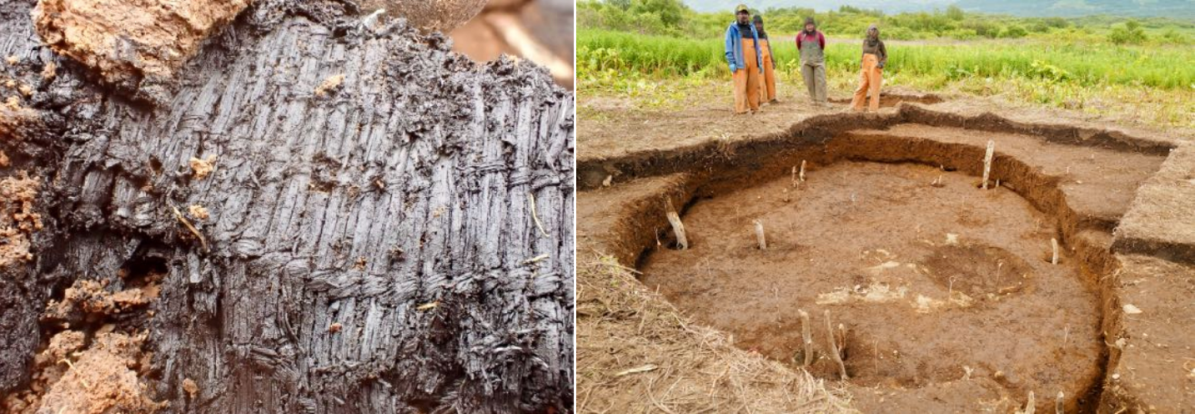
Conny Waters - AncientPages.com - During excavations of an ancestral sod house on the shore of Karluk Lake, Kodiak Island, Alaska, archaeologists uncovered rare fragments of woven grass artifacts estimated to be 3,000 years old.
The fragments, which appear to be pieces of mats, are the oldest well-documented examples of Kodiak Alutiiq/Sugpiaq weaving.
_
Weaving is a long-practiced Alutiiq art.
Image credit: Patrick Saltonstall, Alutiiq Museum
“We were excavating a sod house beside Karluk Lake as part of a broader study to understand how Alutiiq people used Kodiak’sinterior,” said Saltonstall. “When we reached the floor, we discovered that the house had burned and collapsed.
The walls of the structure, which were lined with wood, fell into the building and covered a portion of the floor. This sealed the floor quickly and limited burning. As we removed the remains of the walls, we were surprised and excited to find fragments of charred weaving. It looks like the house had grass mats on the floor. The pieces covered about a two-meter area at the back of the house, perhaps in an area for sleeping,” Alutiiq Museum Curator of Archaeology Patrick Saltonstall explained in a press release.
Weaving is a long-practiced Alutiiq art, but one that is difficult to document archaeologically as fiber artifacts are fragile and rarely preserved. The Alutiiq Museum’s extensive archaeological collections contain grass and spruce root baskets that are as much as 600 years old but nothing older.
Detail of ca. 3,000-year-old grass matting from ancestral Alutiiq house by Karluk Lake.
Image credit: Patrick Saltonstall, Alutiiq Museum
The house that produced the weavings was radiocarbon-dated to about 3,000 years old. The style of the structure and artifacts found in association support this determination.
“It is likely that our ancestors worked with plant fibers for millennia, from the time they arrived on Kodiak 7500 years ago,” said April Laktonen Counceller, the museum’s executive director.
“It makes sense. Plants are abundant and easily harvested, and they are excellent materials for making containers, mats, and other useful items. It’s just very hard to document this practice. This wonderful find extends our knowledge of Alutiiq weaving back an additional 2400 years.”
Close inspection of the woven fragments shows that their makerslaid down long parallel strands of grass (the warp) and then secured them with perpendicular rows of twining (the weft)spaced about an inch apart.
This technique created an open weave, also found in historic examples of Alutiiq grass matting. Small fragments of more complicated braiding may represent the finished edge of a mat. The field crew carefully lifted the fragile woven fragments off the floor of the sod house and placed them in a specially made box for transport back to Kodiak and the Alutiiq Museum’slaboratory.
The sod house after excavation. The structure is oval and about 4 x 6 meters across. Modern sticks mark the locations of holes left by posts that once held up the structure roof. Image credit:
Patrick Saltonstall, Alutiiq Museum
Here, they will be preserved, documented, and made available for study as a loan from Koniag—the regional Alaska Native Corporation for Kodiak Alutiiq people and the sponsor of the research. The corporation owns the land on which the excavation took and has been generously supporting archaeological studies in the region.
“Discoveries like these highlight our Alutiiq people’s innovation and resilience,” said Koniag President Shauna Hegna.“Koniag is humbled to partner with the Alutiiq Museum on critical projects like this.”
Written by Conny Waters - AncientPages.com Staff Writer
Guys I found this the other day, if you read my twitter or my website UFO Sightings Daily, you already know about it from yesterday. This ancient monolith looks to be built in a small 5km crater and takes up 3km of the space. Its is 3km by 3km and looks to be over a million years old or more. Can you imagine the wonderful things that must lay inside? Scott C. Waring
1 Meter UAP Shoots Past Crop Duster In Newport, Virginia, 8-11-2023, UFO Sighting News.
Date of sighting: 8-11-2023
Location of sighting: Newport, Virginia, USA
Source: MUFON
This just in, an eyewitness that was taking photos of a crop duster as it was dusting the fields caught sight of a mysteries object shooting near the plane. The object moved incredibly fast and from the photo, it looks like a fat disk. These dark fat disks have been seen before and once were seen close up near a power-line here in Taiwan and a photo was taken by a teacher. This disk is similar, so I estimate this craft to be 1 meter across, dark brownish red.
Scott C. Waring
Eyewitness states:
On August 11 I was taking several pictures of Crop Plane spraying our land. I am not very experienced with all the features of a smart phone, however I was able to take several photos and the vehicle seemed to travel several miles in just a few seconds. It was very fast and just saw a blur while I was taking pictures and was surprised upon my view.
In a world brimming with enigmas, two questions have captured the public imagination like no other: Are we alone in the universe, and what lurks in the deep, dark corners of our oceans? Recent revelations from the U.S. Office of Naval Intelligence and Antarctic researchers present puzzling anomalies that only deepen these mysteries.
VIDEO:
Top 4 UFO Government Conspiracies
When the Sky Isn’t the Limit
Footage from Naval Intelligence has left experts scratching their heads. An object cruising miles above the Earth displayed unprecedented characteristics: an irregular shape, unidentifiable markings, and bizarre flight physics. Could it be a top-secret technological marvel, a product of reverse engineering, or even a visitor from another world?
Google Loon balloons were ruled out as an explanation, as the program ended in January 2021, before the footage was shot. Experts agree that the object doesn’t align with conventional flight physics, so they’re hesitant to identify it as an aircraft or a drone.
“There’s no rulebook to what we’re seeing,” said Rich Hoffman from the Scientific Coalition for UAP studies. “Everything is on the table, even aliens. But for now, it’s genuinely unknown.”
Interestingly, the Pentagon is taking these unidentified flying objects seriously enough to establish a special task force. Its goal? To detect, identify, and attribute these mysterious objects. Their report is awaited with bated breath.
An Unearthly Cargo near Edwards Air Force Base
In another head-scratching moment, a video taken near Edwards Air Force Base showcased what looked like a UFO strapped to a flatbed truck. While the object’s shape vaguely resembled that of a B2 stealth bomber, it wasn’t aerodynamic by any stretch of the imagination.
Tim McMillan, an aviation expert, stated that while it looked exotic, moving such an object openly in daylight contradicts protocol if it were a genuine UFO. Further examination led video analyst Mick West to identify the location as the Helendale Radar Cross-Section Facility, where radar testing occurs. In all likelihood, it’s a model for radar tests, not a downed alien spacecraft.
The “Antenna” of the Antarctic Ocean
Moving from skies to ocean depths, researchers discovered a strange object during a mission near the Antarctic Coast. It appeared to be an “antenna,” but no explanation seemed to fit—until marine biologist Shea Conger pointed out that it might actually be a carnivorous sponge. A sponge that eats meat? Nature never ceases to amaze.
So, in this fascinating journey of earthly mysteries and cosmic riddles, the only certain thing is our own curiosity. As we peer into the skies above and the oceans below, we continue to uncover truths that are sometimes stranger than fiction.
A Man Who Captures Remarkable UFO Footage Near Area 51
If the mysteries of the cosmos ever pique your interest, then buckle up! We’re diving deep into a captivating story about a man who’s spent over a decade documenting unidentified flying objects (UFOs), not too far from the legendaryArea 51. Armed with night vision technology and an unwavering curiosity, this individual has unearthed footage that might just redefine our understanding of the universe.
Meet the UFO Hunter
Ben, a journalist curious about the otherworldly, was invited to meet a man named Steve Barone (you can check his Youtube channel here) who has dedicated over ten years of his life to recording UFO sightings. Set against the backdrop of Nellis Air Force Base and the looming Modry Mountain, Steve has positioned himself in an area that’s a hotbed of mysterious activity. Area 51 is just 77 miles away, making this region rich for cosmic investigation.
The Power of Night Vision
What sets Steve apart is not just his persistence but his technological ally: night vision. It was night vision that “opened up even more footage to all of these areas,” according to Steve. And what sort of footage are we talking about? Mysterious lights that dance in the sky, triangular crafts that seem to defy our understanding of aerodynamics, and various other UFOs that have captivated him over the years.
The Triangle Craft and Multi-Dimensional Beings
Steve shared footage of a particular triangle craft that caught Ben’s interest. Could these crafts be connected to entities beyond our understanding? The concept of multi-dimensional beings is often invoked in such discussions. These entities would exist in a way that gives them a tremendous advantage over our “primitive perceptions of time and physical reality,” as Ben puts it.
The Silent Witnesses
Steve isn’t the only one who has had close encounters. Trish, another interviewee, spoke about her reluctance to discuss her own UFO sighting due to her employment with a government contractor. Her story stayed silent for four years until she discovered the Mutual UFO Network online. Their specialty? Deciphering UFO sightings. When she finally decided to report her experience, she realized she was not alone, giving her validation and the courage to talk openly about it.
Why You Should Care
You may ask, just how alarmed should we be about these sightings? While Steve’s decade-long journey of documenting UFOs might not serve as a clarion call for impending extraterrestrial contact, it certainly invites us to expand our understanding and question our place in this vast universe.
Video:
Ben Interviews A Man With Astonishing UFO Sighting Recordings | UFO Witness
In a world where we often stick to the comfortable corners of what we understand, individuals like Steve push us to expand our horizons. Whether it’s multi-dimensional beings or highly advanced drones, the footage being collected challenges our preconceived notions and asks us to be open to possibilities that stretch the limits of our imagination.
As the sightings continue and more people break their silence, perhaps we’ll inch closer to unraveling these cosmic mysteries. Until then, the skies above Area 51 and the watchful eyes of people like Steve will keep us wondering—what exactly is out there?
It all had started a few years before the “Space Race” began between the two rival nations: the USA and Soviets. The world was stunned by the daily UFO sightings, and stories of alien contact flushed newspapers. It was the era of two types of people: the first one was groups of like-minded people, for example, engineers, scientists, and inventors who dismissed any alien contact and flying saucers’ stories, while the second ones were the contactees who also claimed to had been in the UFOs. These groups never aligned with each other, but Wilbert Brockhouse Smith (1910-1962), a Canadian engineer was the only line of connection between these two groups.
Mr. Smith worked as a senior radio engineer for the Canadian government’s Department of Transport in the late 1940s and 50s. He was the reason behind the radio communication between Canada and the United States at that time. Very few people know that Mr. Smith convinced the Canadian government to establish a program to monitor the UFOs that eventually detects the strange aerial phenomenon which, according to him, was not earthly. While asking Americans about the existence of UFOs, he received a reply from them that the US government had put this subject at their uppermost concern, and it was even more top secret than the atomic bomb.
“One of the most important things I had to realize was that we are not alone. The human race in the form of man extends throughout the universe and is incredibly ancient. Also, its appearance in physical form is but one of its many manifestations along the path of progress. This planet has been colonized many times by people from elsewhere and our present human race are blood brothers of these people. Is it any wonder that they are interested in us,” Wilbert Smith said.
Wilbert Brockhouse Smith (1910-1962) Credit: Grant Cameron
Besides, according to researcher Grant Cameron, Mr. Smith played a major role in establishing Radio Ottawa used by Canadian spies and also for tracking secret Soviet communications.
In 1950, the Canadian UFO study program Project Magnet was established by Transport Canada under the supervision of Mr. Smith. The government funded the project for four years, but he received informal funding after. In 1952, he set up an observatory at Shirley’s Bay to study the findings of UFO sightings under Project Magnet. He had a personal interest in geo-magnetism, which made him conclude that the UFOs were of extraterrestrial origin, propelled by magnetic forces, and actually from parallel universes.
Mr. Smith said: “It is my opinion that the people from elsewhere choose all sorts of methods to make contact with us, and their technology and understanding being much better than ours, they can use methods which we find quite incomprehensible.”
Interestingly, he believed that the UFOs were controlled through physic powers, and such statements embarrassed the Department of Transport. In 1952, when the great UFO wave hit the media, Mr. Smith claimed that the United States Air Force shot down a UFO near Washington, D.C, recovered its piece and let him borrow it. When asked if he had returned the piece to the USAF, he replied that it went to a much more highly secret group (It was neither FBI nor CIA), which identity he could not disclose.
Surprisingly, Mr. Smith was also a firm believer in aliens. In 1961, he gave a speech at the Vancouver Area UFO Club, where he claimed to had been in contact with aliens, referring to them as “the boys topside.” Furthermore, he said that the aliens had explained to him that the speed of light is not constant, and time works differently in the universe, not chronological ticking that people can imagine on Earth, but a “field function” that changed throughout the universe, and which could be altered. (Source)
Their ships as he was told, were supported on the Earth’s gravitational field. The fields surrounding their ships, he added, created areas that reduced areas that weakened the strength of objects that came into contact with them, accounting for the destruction of earthly military craft that flew too close to them. This explained, among other phenomena, the May 1956 crash of a military jet into the Villa St. Louis convent in Orleans — the jet, Smith said, flew into a “very strong vortex of reduced binding,” causing it to break apart.
When nuclear explosions happened, he added, similar unstable vortices were formed. His unnamed friend, who had also been in communication with “these people from outside,” claimed to have spoken with one of them, Tyla, a garbage collector whose duty was to clean up the radioactive messes left by such man-made explosions. Tyla, according to Smith, grabbed the stuff, transported it onboard his ship, rendered it inactive, and then dumped it in a remote location on Earth. Tyla reportedly told a friend in 1948 that he would dump his next load near Ottawa at an appropriate moment so that many people could observe it.
On November 21, 1950, Mr. Smith wrote a memo that was classified as “Top Secret” but later, it was recovered from the Archives of the University of Ottawa. According to the memo, the Canadian government was serious about UFOs and had been building a secret technology using oceanic radiation, atmospheric radioactivity, and geo-magnetism. He further wrote that his work in geomagnetic and the energy on which flying saucers operate was connected. (Source)
By summarizing sightings reported in 1952, Mr. Smith reported that UFOs were “a hundred feet or more in diameter; they can travel at speeds of several thousand miles per hour; they can reach altitudes well above those which should support conventional aircraft or balloons, and ample power and force seem to be available for all required maneuvers.”
Project Magnet was discontinued just a few days afterward. Ottawa Journal reported that scientists insist, “there is no proof flying saucers exist but they honorably admit there is no proof that all the strange and wandering objects reported in the sky are freaks of imagination or atmosphere.”
Before his death from cancer, Mr. Smith had asked his wife to hide all his research and sensitive files, as he was afraid that they would get into the wrong hands. “They will be coming to ransack all my work,” Smith proclaimed. He died on December 27, 1962, and as he predicted soon after that, the Soviets, Americans, and Canadians approached his wife. (Source)
NASA marks 53 years since the first human stepped on Moon on July 20, 1969. For some people, lunar landing is still a conspiracy whereas many top-notch people came forward to criticize NASA for hiding the truth. Whether or not the Moon is inhabited, there are some photos presented by UFOlogist Bob Dean at Barcelona Exopolitics Summit, on 25 July 2009, that NASA did not want the world to see, as he claimed.
Soon after the news broke out that NASA landed humans on Moon, different conspiracies quickly took over the matter. From a fake landing to aliens on the moon, people were discussing every bizarre thing a human mind could imagine. Then a sudden halt to Apollo missions in 1972 fueled the conspiracies to grow, allowing astronauts, military personnel, NASA workers, etc to discuss about Moon mysteries.
A man named Robert O. Dean, a.k.a. Bob Dean gave a number of interesting lectures, providing a wealth of information about not only the Moon landings and Apollo missions but also corroborating what numerous whistleblowers said in the past.
Bob Dean’s credibility cannot be questioned as he worked at NATO headquarter from 1963 to 1967. He joined the US Army on April 5, 1960, and also served in combat service in Korea and later in Vietnam. He got retired from the army on October 31, 1976, as a Command Sergeant Major.
Former US military retired Major Robert Dean. Image in public domain
During the Barcelona Exopolitics Summit, on July 25, 2009, Mr. Dean released a set of amazing images. He also explained the Apollo missions, and what astronauts encountered unlike anyone before. He released to the public a set of fascinating images supposedly captured by astronauts of the Apollo 12 mission, including an image showing some mysterious spacecraft several hundred feet in diameter.
During the lecture, Mr. Dean recounted how in the morning of February 2, 1961, World War III almost began, and a fleet of UFOs were to blame. “It appears that on the morning of the 2nd of February 1961, World War III almost started. It was involved in the flyover of large numbers of circular metallic craft, flying in formation, very obviously under intelligent control,” said Mr. Dean.
Mr. Dean continued: “They would fly out of the Soviet sector in the Warsaw Pact toward the U.S. in formation at a high speed and at a very high altitude. They would turn north over the English Channel over the southern coast of England and then they would disappear off of NATO radar over the Norwegian Sea.”
“The Soviets went on red alert. The NATO forces went on red alert. Everybody was, you know … fingers on their triggers, thumbs poised above those red buttons. And World War III was just moments away,” explained Mr. Dean. “Within 20 minutes, it was all over. The objects flew, turned north and disappeared off of radar.”
He claimed that NATO launched a three-year program to investigate the UFOs and find out if they posed a military threat. He received this information from a 1964 NATO report titled “AN ASSESSMENT” (An Evaluation of a Possible Military Threat to Allied Forces in Europe). He said the report was so sensitive that only 15 copies of it were printed. Besides, the report contained in-depth studies of atmospheric physicists, astronomers, astrophysicists, sociologists, historians, and theologians. (Click here to read full the article)
Mr. Dean said: “There had been the case after case of UFO landings, face-to-face confrontations, invitations to come aboard their ships. It had been going on for some years. It has been going on for centuries.” According to him, the report stated that “there apparently was not a military threat because if…[ETs] were hostile or malevolent, the game would have been up a long time ago.” This conclusion sounds similar to the UFO emails sent to John Podesta by Edgar Mitchell, who also called E.T. “nonviolent.”
He further said in the lecture that “They [experts] concluded that the planet Earth and the human race had been under some kind of survey or observation going on for hundreds, if not thousands, of years. They concluded, in 1964, that there were at least four different groups coming here, observing us, surveying us, analyzing us, closely watching us, what we were up to, what we were doing.”
In his 41 years of federal service to the United States, Mr. Dean heard a lot of bizarre things, but the thing that the human race is a hybrid race stunned him. He said: “I’ve learned that we are not merely alone; we have never been alone. We have had an intimate interrelationship with advanced extraterrestrial intelligence from the beginning of our history. And let me tell you that that intimate interrelationship is still going on.”
He continued: “This one race, in particular, apparently reengineered us as aspeciesabout 200,000 years ago. What we are here today is what we call homo sapien sapiens — you’re an engineered creature. Your genetics have been manipulated. You’re not the same as what you were and you are not the same as to what your children and grandchildren and great-grandchildren will be in the next hundred years.”
NASA unreleased images?
Mocking NASA acronym calling it “Never A Straight Answer,” Mr. Dean in anguish said that the agency erased 40 rolls of film of the Apollo Program: the flight to the Moon, the flight around the Moon, the landings on the Moon, and others.
Credit: Bob Dean
This image (shown above) comes from the Apollo 12 mission, Apollo Systems 12, roll number 50, negative number 7348. A mysterious object was sighted by Apollo astronauts as they were orbiting the moon.
The image seen below was taken by Astronaut Neil Armstrong. While the astronauts were looking out of the window of their little craft, this cigar-shaped object flew by.
Credit: Bob Dean
The next image, according to Mr. Dean, shows a mysterious disc-shaped object with several hundred feet in diameter. It was snapped while the astronauts were on their way to the surface of the moon. (Note: This image, which in many ways appears the most spectacular, may have a prosaic explanation: click here to read)
Credit: Bob Dean
The next two images were taken by Apollo Astronauts when they were overflying the so-called Lansberg crater. According to Mr. Dean, “The astronauts in orbit above the Moon were particularly fascinated by the Lansberg crater. They had been given a special designation to take pictures of Lansberg, because the crater, which they named as the Lansberg, had things going on that were very anomalous. There was construction going on. There were gigantic facilities in the crater up there. So they were specifically delegated and assigned to photograph Lansberg to see if they could figure out what the hell was going on down there. While they were looking at Lansberg, this object happened to express interest in them and flew by. Now this line is an artificial line that was drawn to show you the… it gave the direction that this object was going. This is a good-size object flying past the Apollo Lander.”
Credit: Bob Dean
Another image of the Apollo 13 “UFO” encounter, as noted by Mr. Dean.
Mr. Dean continued showing evidence gathered by astronauts from the Apollo 13 mission. The below image, as Mr. Dean said, was taken by Apollo 13 astronauts while traveling to the moon when a number of things began happening. Some strange objects were appearing outside the windows of the spacecraft, so the Apollo 13 astronauts grabbed their Hasselblad cameras and started taking pictures of what they encountered.
Credit: Bob Dean
Another image of the Apollo 13 ‘UFO’ encounter, as noted by Mr. Dean.
Such claims and evidence shared by Mr. Dean come with a price. He received harsh criticism from the skeptics’ side, but most opinions shared by people are in favor of Dean, and the majority believes that he was legit. He died on October 11, 2018, at the age of 89 in Tucson, Arizona.
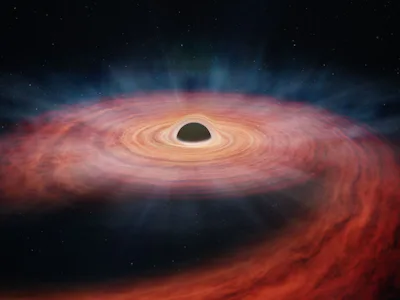
When a black holeconsumes a star, things can get quite messy. Take, for example, the event known as ASASSN-14li, where a massive star strayed too close to a supermassive black hole and paid the ultimate price.
There are two main dangers posed by a black hole. The first is that they possess an event horizon. Mass curves, space, and black holes contain so much mass in such a small space that spacetime folds into itself, creating a cosmic trap. Anything that crosses the event horizon is lost forever. The second is the threat of tidal forces.
When a body approaches a dense mass such as a planet, star, or black hole, the part closest to the mass is pulled slightly more strongly than the part of you furthest from the mass. Gravity tries to squeeze the body into an oval or egg shape rather than a sphere. Since these forces between the Earth and the Moon are what cause ocean tides, they are known as tidal forces. Normally, tidal forces are rather small, but near dense massive objects such as a black hole, the tidal forces can be so powerful they can rip apart objects, causing what is known as a tidal disruption event (TDE).
When a star approaches a black hole, tidal forces typically rip the star apart well before it reaches the event horizon. How much of the star is consumed by the black hole then depends on the original trajectory of the star. In the case of ASASSN-14li, most of the star wasn’t consumed by the black hole. The TDE ripped the star apart and superheated its remains, which emitted powerful X-rays and ultraviolet light. While this was bad news for the star, it was great news for astronomers.
NASA’s Chandra X-ray Observatory and ESA’s XMM-Newton telescope both captured the X-ray spectra of the event, and further observations from other observatories provided UV spectra. Together, this gave astronomers a detailed look at the composition of the doomed star. In this recent work, the team was able to analyze the spectra of both the material captured in orbit around the black hole and gasses that streamed away from the black hole. By comparing things such as the abundances of nitrogen and carbon in the stellar debris, the team was able to confirm the star had a mass of about 3 Suns.
Earlier this year, astronomers observed another TDE named Scary Barbie, which could have been a 14 solar mass star, but this estimate is based on the overall brightness of the event, not its spectra. ASASSN-14li is currently the largest TDE with a confirmed mass.
This event is a powerful example of how stars near a supermassive black hole. With further events, we may even be able to study the clustering of stars around supermassive black holes in other galaxies, which would help us understand how the central cores of galaxies can evolve and the role they play in stellar evolution.
The Closest Supernova Seen in the Modern Era, Examined by JWST
In November of 1572, Tycho Brahe noticed a new star in the constellation Cassiopeia. It was the first supernova to be observed in detail by Western astronomers and became known as Tycho’s Supernova. Earlier supernovae had been observed by Chinese and Japanese astronomers, but Tycho’s observations demonstrated to the Catholic world that the stars were not constant and unchanging as Aristotle presumed. Just three decades later, in 1604, Johannes Kepler watched a supernova in the constellation Ophiuchus brighten and fade. There have been no observed supernovae in the Milky Way since then.
More than three centuries passed. Galileo pointed his first telescopes to the heavens. Astrophotography revolutionized our view of the heavens, as did radio astronomy. We launched telescopes into space, landed on the Moon, and sent robotic probes to the outer solar system. But there were no nearby supernovae to observe with our clever tools. Until February 1987, when a supernova appeared in the Large Magellanic Cloud. Known as SN 1987a, it reached a maximum apparent magnitude of about 3. It is the only naked-eye supernova to occur within the era of modern astronomy.
Hubble’s observations of SN 1987a over time. Credit: Mark McDonald/Larsson, J., et al
In cosmological terms, SN 1987a is right in our backyard, only 168,000 light-years away. It has been studied over the years by both land-based and space-based telescopes, and recently the James Webb Space Telescope has taken a closer look. The results tell us much about the rare supernova but also raise a few questions.
Most prominent in the image is the bright equatorial ring of ionized gas. This ring was ejected from the star for thousands of years before it exploded. It’s now heated by shockwaves from the supernova. The equatorial ring girdles the hourglass shape of the fainter outer rights that stem from the polar regions of the star. These structures have been observed before by telescopes such as Hubble and Spitzer. But JWST’s real power is to peer into the center of SN 1987a. There it reveals a turbulent keyhole structure where clumps of gas expand into space. Rich chemical interactions have begun to occur in this region.
The structures seen in the new JWST image.
Credit: NASA, ESA, CSA, M. Matsuura, R. Arendt, C. Fransson
But even JWST wasn’t able to observe the ultimate jewel of the supernova, the remnant star. Supernovae not only cast off new material into interstellar space, they also trigger the collapse of the star’s core to become a neutron star or black hole. Based on the scale of SN 1987a, a neutron star should have formed in its center. However, the gas and dust of the inner keyhole region are too dense for JWST to observe it. How a neutron star forms, and how it interacts with surrounding gas and dust, is a mystery that will require further study. We have observed the neutron stars of some supernovae, but only from a much greater distance.
Tycho’s supernova was just 8,000 light-years from Earth, and Kepler’s about 20,000 light-years distant. Unless Betelgeuse happens to explode in the near future, SN 1987a is likely the closest new supernova we’ll be able to study for quite some time.
A Bizarre Pulsar Switches Between Two Brightness Modes. Astronomers Finally Figured Out Why.
Pulsars are the lighthouses of the universe. These rotating dead stars shoot twin jets of radiation from their poles, usually with a predictable rhythm. But sometimes pulsars behave strangely, and one pulsar in particular has had astronomers scratching their heads for years. It’s called PSR J1023+0038, and a decade ago, it shut off its jets and began oscillating between two brightness levels in an unpredictable pattern. Now, scientists think they understand why: it is busy eating a neighboring star.
When a supergiant star approaches the end of its lifespan, it will explode and collapse into a back hole if it has enough mass, or into a neutron star if it does not. Neutron stars are the remaining, ultra-dense cores of the old star. They are often very fast-spinning, and a subset of them become pulsars. PSR J1023+0038 began life this way, and when it was discovered in 2007, it behaved like a normal pulsar.
But it didn’t stay that way.
In 2013, something changed. The radio pulses – evidence of its twin lighthouse beams – shut off. The was a sudden explosion of energy at multiple wavelengths: gamma rays and X-rays increased by a factor of five, and in visible light the star brightened by 1-2 magnitude. Astronomers also discovered that it seemed to have formed an accretion disk: a hot swirling mass of material surrounding the star.
Perhaps most strangely, the star began alternating between two intensities in X-ray wavelengths: a high mode and a low mode, and it has continued like this over the entire decade since. It spends about 70% of its time in high mode, the rest in low, and alternates between the two every few seconds or minutes on an unpredictable schedule.
Recently, astronomers devised an ambitious plan to find out what’s going on.
“Our unprecedented observing campaign to understand this pulsar’s behavior involved a dozen cutting-edge ground-based and space-borne telescopes,” says Francesco Coti Zelati of the Institute of Space Sciences in Barcelona.
These telescopes covered a gamut of electromagnetic wavelengths, and with them, astronomers were able to piece together what was going on.
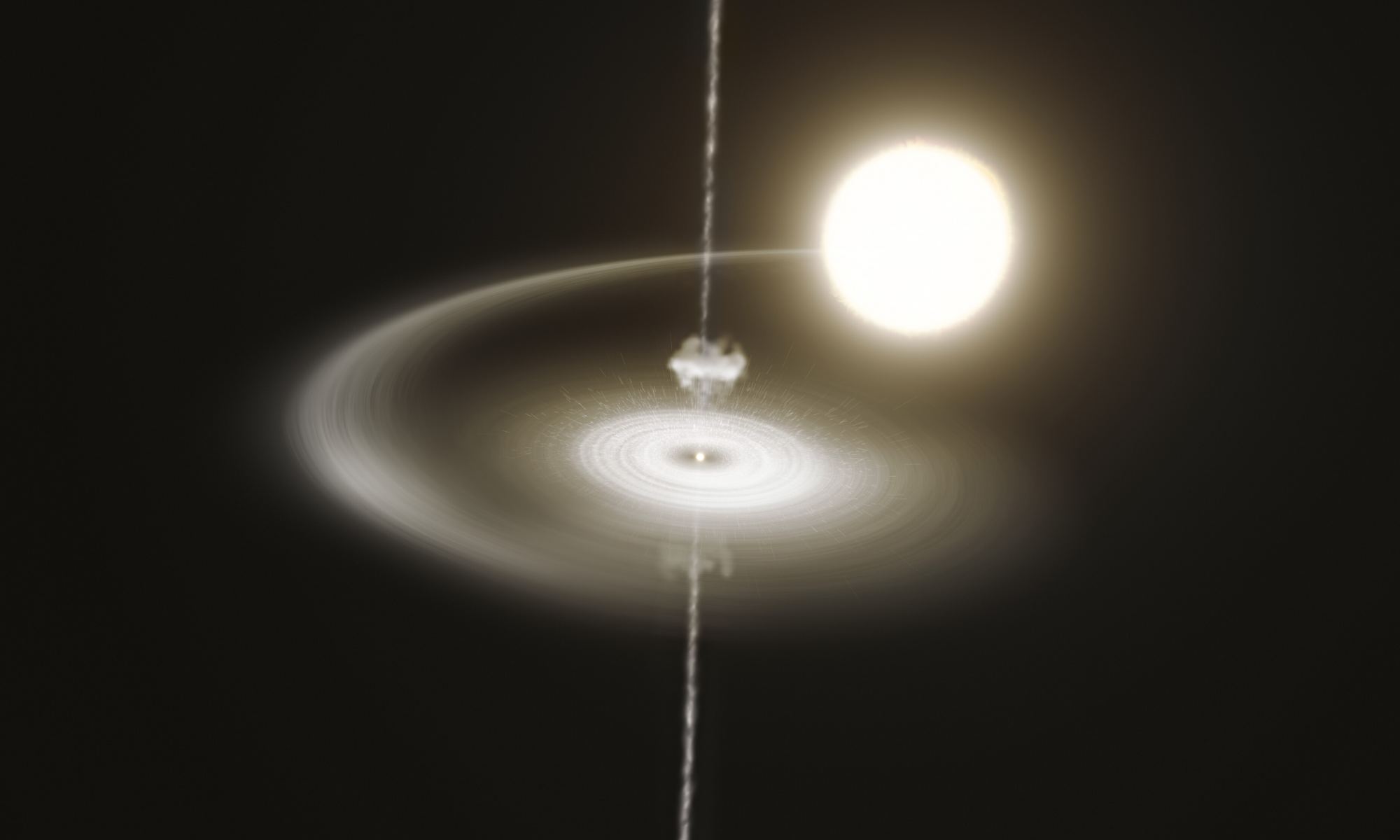
Here’s what they found. The accretion disk is made of matter being pulled from the pulsar’s neighboring star. This matter, as it closes in on the pulsar and begins to accumulate, is heated by the solar wind. The matter begins to glow in X-ray, UV, and visible light, and the hot, glowing material is what astronomers have been seeing as the pulsar’s ‘high mode.’ Eventually, however, there is a process by which the matter is expelled at high energies, leaving perpendicular to the accretion disc, in the direction of the pulsar’s jets.
“Enormous amounts of matter, similar to cosmic cannonballs, are launched into space within a very brief time span of tens of seconds,” says Maria Cristina Baglio of New York University Abu Dhabi, and the Italian National Institute for Astrophysics.
This violent expulsion results in the pulsar returning to its ‘low mode,’ having removed the heated material from its vicinity.
The cycle then repeats.
Through an incredible collaborative effort by astronomers around the world, using the best instruments humanity has to offer, the PSR J1023+0038 mystery has been solved.
The lessons learned from this weird pulsar have taught us more about the physics of accretion, and that knowledge can now be applied in the study of other unexplained variable phenomena, including the accretion disks of some black holes.
An artist’s impression shows the pulsar PSR J1023+0038 stealing gas from its companion star. Interactions with the solar wind cause the pulsar to switch two modes of brightness every few seconds or minutes. Credit: ESO/M. Kornmesser.
Meer van UFO'S of UAP'S, ASTRONOMIE, RUIMTEVAART, ARCHEOLOGIE, OUDHEIDKUNDE, SF-SNUFJES EN ANDERE ESOTERISCHE WETENSCHAPPEN - DE ALLERLAATSTE NIEUWTJES


 Stick UFO Over Oakley, California Sept 4, 2023, UFO Sighting News. Video.