Ontdek de Fascinerende Wereld van UFO's en UAP's: Jouw Bron voor Onthullende Informatie!
Ben jij ook gefascineerd door het onbekende? Wil je meer weten over UFO's en UAP's, niet alleen in België, maar over de hele wereld? Dan ben je op de juiste plek!
België: Het Kloppend Hart van UFO-onderzoek
In België is BUFON (Belgisch UFO-Netwerk) dé autoriteit op het gebied van UFO-onderzoek. Voor betrouwbare en objectieve informatie over deze intrigerende fenomenen, bezoek je zeker onze Facebook-pagina en deze blog. Maar dat is nog niet alles! Ontdek ook het Belgisch UFO-meldpunt en Caelestia, twee organisaties die diepgaand onderzoek verrichten, al zijn ze soms kritisch of sceptisch.
Nederland: Een Schat aan Informatie
Voor onze Nederlandse buren is er de schitterende website www.ufowijzer.nl, beheerd door Paul Harmans. Deze site biedt een schat aan informatie en artikelen die je niet wilt missen!
Internationaal: MUFON - De Wereldwijde Autoriteit
Neem ook een kijkje bij MUFON (Mutual UFO Network Inc.), een gerenommeerde Amerikaanse UFO-vereniging met afdelingen in de VS en wereldwijd. MUFON is toegewijd aan de wetenschappelijke en analytische studie van het UFO-fenomeen, en hun maandelijkse tijdschrift, The MUFON UFO-Journal, is een must-read voor elke UFO-enthousiasteling. Bezoek hun website op www.mufon.com voor meer informatie.
Samenwerking en Toekomstvisie
Sinds 1 februari 2020 is Pieter niet alleen ex-president van BUFON, maar ook de voormalige nationale directeur van MUFON in Vlaanderen en Nederland. Dit creëert een sterke samenwerking met de Franse MUFON Reseau MUFON/EUROP, wat ons in staat stelt om nog meer waardevolle inzichten te delen.
Let op: Nepprofielen en Nieuwe Groeperingen
Pas op voor een nieuwe groepering die zich ook BUFON noemt, maar geen enkele connectie heeft met onze gevestigde organisatie. Hoewel zij de naam geregistreerd hebben, kunnen ze het rijke verleden en de expertise van onze groep niet evenaren. We wensen hen veel succes, maar we blijven de autoriteit in UFO-onderzoek!
Blijf Op De Hoogte!
Wil jij de laatste nieuwtjes over UFO's, ruimtevaart, archeologie, en meer? Volg ons dan en duik samen met ons in de fascinerende wereld van het onbekende! Sluit je aan bij de gemeenschap van nieuwsgierige geesten die net als jij verlangen naar antwoorden en avonturen in de sterren!
Heb je vragen of wil je meer weten? Aarzel dan niet om contact met ons op te nemen! Samen ontrafelen we het mysterie van de lucht en daarbuiten.
Zondag 24 september 2023
Alien Structures On NASA Released Moon Photo, UFO Sighting News.
Alien Structures On NASA Released Moon Photo, UFO Sighting News.
Date of discovery: Sept 20, 2023
Location of discovery: Earths moon, south pole Source:
NASA released this photo a few days ago and I found the structures that day. Not sure how they could overlook them, usually the structures get edited out, but I assume they left them for the public to find out about aliens. The evidence is mounting, soon it will be undeniable and the public will all know the truth.
UAP Over Santa Monica, California Aug 27, 2023, UFO Sighting News.
Date of sighting: Aug 27, 2023
Location of sighting: Santa Monica, California, USA
At first I thought this was balloons, however the object does not break apart and the object keeps its shape. It's a dark craft, and keeps behind the trees before moving off silently. More proof, UFOs are everywhere, but even here, most the people were not looking up in the video, only a few.
Scott C. Waring
Eyewitness states:
Star-shaped dark object (maybe 20 ft.) changed shapes in almost geometrical way at tree-level over the bluff at Palisades Park then rapidly floated into the distance. This was witnessed by one other person besides myself. By the time I got my phone camera out it was further away, but at :17 seconds the viewer can see the unusual star shape of the object.
3 UFOs Pass security cam, Cave Creek, Arizona Aug 9, 2023, UFO Sighting News.
Date of sighting: Aug 9, 2023 Location of sighting: Cave Creek, Arizona, USA
Guys this looks real and it seems very close to the persons home. The UFO flew down and passed his door cam three separate times, which either is the same UFO circle the house or its three separate craft following each other. It just an amazing and lucky capture.
Scott C. Waring
Eyewitness states:
One of my security cameras made 3 recordings of 3 separate orb like objects between 04:40 a.m. and 04:43 a.m. that hovered and then moved through its field of view. I had recently moved to this residence and hadn't mounted the cameras on the house yet. I had the camera laying on its side on a small boulder in the backyard when the recordings were made. Since I don't know the size of the objects, I can't determine the distance. However, if they were over or close to my backyard as they appear to be, I would estimate their size to be between a grapefruit and a beach ball depending on their distance.
The Pentagon reportedly holds a highly classified photograph of a “Black Triangle” UFO emerging from the ocean, taken by a US Navy pilot flying an F/A-18F Super Hornet. The photo’s existence has not been officially confirmed by the Pentagon, but many people believe that it does exist, as they have been told by government insiders. It is thought to be one of the most compelling UFO sightings ever captured on camera and is considered to be highly classified because it was captured using military equipment onboard the fighter plane.
In 2020, during an interview on Coast to Coast AM radio with investigative journalist George Knapp, former AATIP head Luis Elizondo stated that the current UAP Task Force obtained images of multiple unknown aerial objects, including a clear image of a mysterious triangle emerging from the ocean, recorded by military pilots.
The object was described as a large triangle with “blunted” edges and spherical white “lights” on each corner, and the encounter is said to have occurred off the East Coast of the US. The pilots who encountered the object are believed to have been operating from either the USS Dwight D. Eisenhower or the USS John C. Stennis, both of which are Nimitz-class nuclear-powered supercarriers, which further deepens the apparent links between UFOs and man’s nuclear capabilities.
Several officials confirmed the photo’s existence, but they did not provide any further details. The report primarily focused on “Unidentified Submersible Phenomena” or unidentified “transmedium” vehicles that can operate both underwater and in the air. The UAP Task Force appears to be concerned that these objects may originate from within the world’s oceans.
Tom Rogan, a national security writer for the Washington Examiner, verified the existence of the photo with his sources. He believes that the photo is “the tip of the iceberg” and that more UAP imagery and data would be leaked in the coming years. Rogan also called on the Pentagon to officially release more material. (Source)
In 2020, The Debrief reported that the Pentagon was investigating the “transmedium” element of the phenomena, which is the apparent ability of some UAPs to transit seamlessly between the air and the ocean.
The idea of “USOs,” or “unidentified submersible objects,” is not exclusive to the current UAP Task Force. In fact, there have been reports of unexplained, very high-speed sonar targets recorded by some of the most sophisticated listening equipment on the planet. A senior member of the intelligence community, whose responsibilities for decades involved underwater surveillance and reconnaissance programs, acknowledged that there are valid claims of extremely fast-moving underwater objects being detected by U.S. military systems.
The UAP Task Force is particularly interested in “transmedium vehicles,” which may seem unusual, but there have been many accounts, some going back centuries, in which people observed unidentifiable craft operating in and out of the water. In public appearances, Marc D’Antonio, an astronomer and chief video/image analyst for the Mutual UFO Network (MUFON), shared an unusual experience involving the detection of an underwater “Fast Mover,” which occurred while he was sailing as a civilian aboard one of the U.S. Navy’s prized attack submarines.
Tyler Rogoway, a defense journalist, spoke with several veteran submariners who almost unanimously acknowledged that unexplained, very high-speed sonar targets are indeed recorded by some of the most sophisticated listening equipment on the planet. Although there is skepticism about D’Antonio being granted a civilian ride-along, the Navy vets being interviewed confirmed the validity of such claims. The intelligence official declined to provide further details, citing the high levels of security classification associated with underwater reconnaissance.
Andy McGrillen from UAP Media UK, a team set up to campaign for a more open and serious discussion on UFOs in Britain, told The Sun Online that the triangular object was initially tracked underwater, then emerged, climbing to an altitude of 35-40,000 feet when an aircraft’s onboard systems took a high-fidelity image. He thought that something like this would surely be highly classified given the nature of the equipment taking the picture. However, if it did make its way into the public domain, it could be a key piece of evidence, demonstrating that we are truly in the presence of some other intelligence.
Mystery Wire reported that UFO enthusiast Joe Murgia wrote on his Twitter that Knapp asked Elizondo about an alleged triangle UFO coming out of the water, to which Elizondo responded by saying he was confident the photo exists, and it might even be a still frame from a video. Elizondo and Knapp talked about the need for patience when talking about disclosure and the series of high-level briefings that Elizondo took part in. Elizondo praised Florida Senator Marco Rubio for his willingness to talk about UFOs publicly.
Knapp also asked if the UFO mystery can be solved by just looking at military encounters with UFOs or if we need to expand our horizons and look at other topics like poltergeists and Bigfoot that seem to be connected to close encounter cases. Elizondo said the government programs have limitations, such as an inability to speak with commercial pilots about sightings.
When asked if he would consider ever returning to the government to work on the new Unidentified Aerial Phenomena task force (UAPTF), Elizondo said he would have to clear it with his family first. If he did go back, he would try to run it differently than when he ran the AATIP at the Pentagon. Elizondo said he would push for more openness with the public and work to break down the barriers that stigma about UFOs can cause.
“The problem with it is that the government recognizes it. There are some very authentic UAP images. When people say, “Oh, they’re all grainy and blurry,” no, they’re not. There are some that are really clear and are very authentic because we can look at the date and time stamp and the metadata on the video. We can then correlate that to any other type of assets that may be in the area, and we know where it turns out that we’re picking something up that came across, let’s say, the Pacific Ocean. All of a sudden, someone in San Diego says, “I had this really funny light doing these weird things in the backyard,” and all of a sudden, you realize, “Oh, man, they got it on camera.”
Yeah, there are some very, very compelling ones. There’s one, in particular, I probably can’t talk about it, but there’s one of a triangle, and it’s at night, and it’s not just three points of light. I mean, you can see the skin of the aircraft. You can see a lot, and to the point where some of our folks were like, “Well, should we take it off?” No, don’t take it off the internet. Leave it up. That’s not your video to take down. That’s a private citizen’s. Yes, they got a great video of a UAP. Congratulations. You should probably give them an award. Don’t take the video down”
Leaked emails from John Podesta, the chairman of Hillary Clinton’s 2016 presidential campaign, may provide new insight into transmedium UFOs. The emails include a conversation between Podesta and a person named Bob Fish, who claims that the federal government has been collecting data on UFOs since the 1970s, using the Defense Support Program (DSP) satellites. (Click here to read the full article)
Fish shared an incident that happened to him in California, where a USAF official who worked on the program told Fish that there were times when they were diverted from these missions to track UFOs off the east coast of Florida. Fish stated that the UAP entered the atmosphere and descended into the Atlantic Ocean, specifically in an area east of Miami, Florida and north of Bermuda.
The US government has knowledge of some UAPs entering Earth’s orbit from deep space and can actively track them via RF signals emanating from these crafts. The officials realized that if this god-like technology were to be obtained and mastered by their adversaries before the United States, it would make democracy vulnerable.
Additionally, for many years, Bob McGwier worked in clandestine intelligence. He disclosed two incidents about underwater UFOs or USOs, that he saw while performing covert operations. This claim was made several months after a video had been made public by the United States military, in which it appeared to show an unidentified flying object moving from the sky into the water in the year 2019. (Click here to read the full article)
On Sunday, September 24, NASA is doing something it has never done before. At about 10 a.m. Eastern, the space agency will receive its first collected samples from an asteroid, delivered to Earth over the Utah desert.
Like its Japanese predecessor, the OSIRIS-REx mission will come in for a close approach to Earth, release a parcel filled with asteroid rubble, and then fly off toward its secondary mission in the Solar System.
OSIRIS-REx, which stands for Origins, Spectral Interpretation, Resource Identification, and Security–Regolith Explorer, has had a long road. The mission launched in September 2016 and finally reached its asteroid target, Bennu, two years later in 2018. Then, the epic sample retrieval occurred in October 2020 and was almost a total disaster, OSIRIS-REx principal investigator Dante Lauretta tells Inverse. After a scary brush with the Solar System’s surprises, the spacecraft was able to collect pristine material from the asteroid.
Lauretta is now gearing up for the home stretch of the mission. In an interview with Inverse, Lauretta opens up about what it took to reach this final sample phase and what the asteroid sample may reveal about the origins of our universe.
Dante Lauretta, OSIRIS-REx’s Principal Investigator, during a test run for the retrieval of the asteroid sample in Colorado in June. OSIRIS-REx reached the asteroid Bennu in 2018 and successfully collected NASA's first-ever sample from an asteroid in 2020. OSIRIS-REx will return on September 24th to drop off acollection of samples from Bennu.
HYOUNG CHANG/DENVER POST/GETTY IMAGES
This interview has been edited and condensed for clarity.
Why did you go to Bennu? Why that particular asteroid?
We needed an asteroid that didn’t get too close to the Sun because it gets really hot, and we didn’t want to have a complicated thermal control system. We didn’t want it to get too far away from the Sun because we were using solar arrays for our power. So we had from maybe 0.8 to 1.4 astronomical units, with 1.0 being the average distance of the Earth from the Sun. So a little bit closer than the Earth and a little bit farther away, but not too much. That got rid of most asteroids in the Solar System with that tight of a constraint.
Then, we had to consider the sample return. The steeper the angle the capsule comes in, the higher the temperature and the higher the speed, so we wanted something that was in almost the same orbital plane as the Earth. It also needed to be bigger than 200 meters. Anything smaller than that could spin too rapidly — some of them are spinning once a minute— [and] the idea of touching a surface that’s moving that fast was really daunting.
By the time we went through all of those, there was like a couple dozen asteroids left in the Solar System. Then we wanted to go to one rich in carbon because our science is all about the origin of life and organics. There were five asteroids in the whole Solar System that met all of those constraints. Bennu had the best orbit; it was easily accessible with a pretty standard propulsion system, and we had a lot of data on it.
The OSIRIS-REx mission’s Touch-And-Go (TAG) sample collection event on October 20, 2020.
For all the planning that you did, the retrieval process didn’t go as planned. In fact, you described Bennu as a ball pit in a children’s playground. What happened?
We were expecting a hard surface. We were expecting that this was an asteroid, a rock. We thought we were going to contact the surface of a rock. We actually had a spring in its arm, so the idea was that we would pogo-stick, so it was going to pogo and bounce back off the surface. But that didn’t happen.
When we made contact with Bennu, there was no resistance. There was no solid surface. It was like hitting quicksand, and we just sunk and sunk past the gas bottles of TAGSAM’s arm. If we hadn’t fired our rocket engines, I think we would have just disappeared into the Bennu subsurface, never to be heard from again. Fortunately, we had the engines ready to go. It safely got away from the surface of the asteroid.
You call Bennu a source of grandfather rocks. What makes rocks from Bennu so special?
In some cases, asteroid rocks were the very first solid material that formed in the Solar System. A lot of that got swept up into the planets, especially the inner region where Jupiter’s gravity wasn’t perturbing them. Then, once you get a planetary-sized object like the Earth, there’s radioactive isotopes like uranium and potassium. And they melt. Everything melts. In fact, the surface of the early Earth was probably a magma ocean. The entire surface of the planet was molten. So, any information about the formation of the planet was erased in that event.
You can’t really understand the earliest geologic evolution of the Solar System by looking at Earth's rocks. You can get a little older if you go to the Moon. We learned an enormous amount from the lunar samples that we brought back. But even the Moon has melted, and had volcanoes, and eruptions, and had changes to the surface. So it doesn’t get you back to the very beginning. To do that, you have to go to the asteroids. That’s why I call them the grandfather rocks. They hold the memory of the very early days of our Solar System.
At a press conference earlier this month, you said you plan to be on-site when the sample arrives on Sunday. What will that be like?
When we’re out in the field, we are in a harsh desert climate. So we need to be cognizant of heat stroke and heat exhaustion, so we’re constantly monitoring each other for that.
The area is also a military test range. There could be unexploded bombs and other weapons out there. So, a representative from the Air Force surveys the area to make sure it's safe.
Once the capsule containing the sample is dropped, it needs to be cleared for safety by a safety assurance engineer from Lockheed Martin. Even once that’s cleared, the capsule and samples can still be really hot. So we need to wear thermal protection gloves to protect our hands.
We feel ready. We’re battle-tested. This team knows what to do. The spacecraft is healthy. Everyone is in a good mood. It kind of feels like the calm before the storm. So I’m sanguine. I think that is the word I’m looking for.
Mysterious UFO Sighting in Maryland Captures Attention!
Maryland, USA – September 21, 2023– With a rising number of UFO sightings being reported worldwide, Maryland has now found itself amidst this cosmic phenomenon. A recent sighting has locals and enthusiasts buzzing about the possibilities of extraterrestrial presence.
A Close Encounter in Broad Daylight
A local Maryland resident, having just finished their workday at 7pm, encountered an unexpected sight right across from their home. Describing the experience, the witness shared, “I saw a silverish clear type disk with lights around the side slowly rotating.” Intrigued by this floating spectacle, the quick-thinking observer immediately took a video of the unexplained object, hoping to capture evidence of this curious occurrence.
But just as things were getting interesting, the UFO took a mysterious turn. “I went to get my mom, and by the time I reached the porch, just 15ft away, it had vanished,” added the witness, emphasizing the eeriness of the situation.
An Unsolved Mystery Awaits
For those keyed into UFO sightings, this Maryland incident provides a fresh piece of the puzzle. It offers yet another testament to the diverse and unpredictable nature of such encounters. The video evidence that accompanies this report will surely be dissected and analyzed by enthusiasts and skeptics alike.
Have you ever witnessed such mysterious events in the sky? Maryland might just be the latest hotspot for UFO sightings. This recent episode begs the question – what’s really out there?
De bodemstalen die 3 jaar geleden door een ruimtesonde zijn opgepikt op een asteroïde, 330 miljoen kilometer van hier, zijn veilig geland in de woestijn van de Amerikaanse staat Utah. De verzamelde steentjes zijn mogelijk 4,5 miljard jaar oud en kunnen ons meer leren over het ontstaan van ons zonnestelsel.
Als een vuurbal, met een snelheid van meer dan 40.000 kilometer per uur, kwam de capsule met bodemstalen om 16.45 uur onze dampkring binnen. Het hitteschild moest de verzamelde steentjes en het gruis beschermen tegen temperaturen tot 3.000 graden Celsius en de capsule afremmen.
Enkele minuten later gingen de parachutes open om het pakketje uiteindelijk veilig te laten neerploffen in de woestijn van Utah. De capsule landde zelfs enkele minuten vroeger dan voorzien. Daarmee bereikt de OSIRIS-Rex-missie zijn einde, na een tocht van 7 jaar en in totaal 7 miljard kilometer door de ruimte.
De ruimtesonde werd in 2016 gelanceerd naar de asteroïde Bennu, een ruimterots van zo'n 500 meter groot die rond de zon draait. Het doel van de missie: bodemstalen van het oppervlak halen en die terugbrengen naar de aarde.
In oktober 2020 slaagde het meest delicate deel van de missie. De ruimtesonde was met succes kunnen landen op Bennu, die toen op zo'n 330 miljoen kilometer van de aarde stond.
Hoewel het ruimtetuig maar enkele seconden op het oppervlak is geweest, heeft het meer steentjes en stof kunnen opzuigen dan gepland. Het oppervlak bleek minder hard dan wat astronomen hadden verwacht. Een deel van de lading ging daardoor zelfs verloren, omdat de box te vol zat en niet goed meer afsloot.
NASA verwacht dat er uiteindelijk toch zo'n 250 gram aan bodemstalen is geland. En dat is de grootste hoeveelheid ooit. Enkel Japan had 2 soortgelijke missies, maar toen werd telkens "maar" een theelepeltje aan bodemmateriaal terug naar de aarde gebracht.
Wat is er zo interessant aan Bennu?
Er zijn verschillende redenen waarom NASA Bennu koos en niet één van de 500.000 andere gekende asteroïden in ons zonnestelsel. Bennu bevindt zich relatief dicht bij de aarde en draait in een vergelijkbare baan om de zon als de aarde. De asteroïde is niet te klein en draait niet te snel rond haar as. Dat maakt het landen iets gemakkelijker.
Maar bovenal: Bennu is oeroud. De asteroïde is waarschijnlijk 4,5 miljard jaar geleden ontstaan, in de beginjaren van ons zonnestelsel. "We zullen naar materiaal kunnen kijken dat al voor onze planeet bestond. Misschien zitten er zelfs korreltjes tussen die ouder zijn dan het zonnestelsel zelf", zegt Dante Lauretta, hoofdonderzoeker van de missie bij NASA.
Bennu is ook rijk aan koolstof, één van de belangrijke bouwstenen van het leven op aarde. Er wordt aangenomen dat alle bouwstenen van het leven ooit op aarde zijn terechtgekomen dankzij botsingen met asteroïden zoals Bennu.
"We proberen bij elkaar te puzzelen hoe alles ooit is begonnen", zegt Lauretta. "Hoe is de aarde gevormd en waarom is het een leefbare wereld geworden. Waar hebben de oceanen hun water gevonden? Waar komt de zuurstof in onze atmosfeer vandaan? En bovenal: vanwaar komen de moleculen waarmee al het leven op aarde is opgebouwd?"
Buitenaardse bodemstalen van ruimterots van 4,5 miljard jaar oud landen vandaag op aarde
Het zijn vragen waar wetenschappers zich al lang over buigen. Via OSIRIS-REx hopen ze een beetje dichter bij de antwoorden te komen. Maar zover zijn we dus nog niet.
Na de landing werd de capsule met bodemstalen opgepikt door een helikopter om ze naar het militaire test- en trainingskamp van het Amerikaanse ministerie van Defensie te brengen in Utah. Dat hele proces werd de afgelopen maanden uitvoerig geoefend.
Morgenochtend worden de stalen naar het Johnson Space Center van NASA in Houston, Texas, gebracht. Daar zullen de stalen geanalyseerd worden. NASA belooft op 11 oktober met meer informatie naar buiten te komen.
De ruimtesonde die het pakketje heeft opgehaald en afgeleverd vliegt trouwens door naar Apophis, een asteroïde van 185 meter groot die in april 2029 langs de aarde zal scheren.
Apophis komt tot op 30.000 kilometer, wat op astronomische schaal net geen botsing met de aarde is. Ter vergelijking: de maan bevindt zich gemiddeld op 385.000 kilometer van ons. De ruimtesonde zal vanaf 2029 nog 1,5 jaar rond Apophis blijven cirkelen om de asteroïde te bestuderen.
Artistieke impressie van OSIRIS-REx die op asteroïde Bennu landt
70% of the sample will be preserved 'for study by scientists not yet born, using technologies not yet invented.'
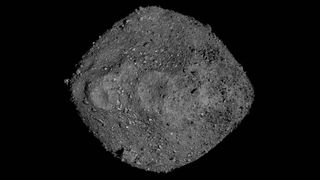
This mosaic of the near-Earth asteroid Bennu was created using observations made by NASA’s OSIRIS-REx spacecraft, which was in close proximity to the asteroid for over two years.
(Image credit: NASA/Goddard/University of Arizona)
A precious bounty of asteroid samples is set to arrive on Earth this weekend, and scientists around the world can't wait.
Early on Sunday morning (Sept. 24), NASA's OSIRIS-REx probe will release a capsule containing about 8.8 ounces (250 grams) of material collected from a 1,650-foot-wide (500 meters) asteroid named Bennu. If all goes according to plan, the capsule will land in the desert of northern Utah that day at 10:54 a.m. EDT (1454 GMT).
In Utah, a recovery team will take the capsule apart, remove the canister containing the Bennu material and prepare the sample for transport. Such work should take about a day, according to NASA's OSIRIS-REx sample-return press kit.
On Monday (Sept. 25) or thereabouts, the sample will be loaded on a plane and flown to NASA's Johnson Space Center (JSC) in Houston. The asteroid dirt and gravel will then make its way to a newly built curation facility managed by the agency's Astromaterials Research and Exploration Science (ARES) division.
ARES "is home to the world’s most extensive collection of extraterrestrial materials — including lunar rocks, solar wind particles, meteorites, cosmic dust, and comet samples," NASA officials wrote in the press kit.
The OSIRIS-REx science team will then spend two years studying the sample and conducting analyses needed to meet the $1 billion mission's chief research goals. Those goals include shedding further light on the solar system's early days and mapping out the role carbon-rich asteroids like Bennu may have played in delivering the building blocks of life to Earth long ago.
The team consists of more than 200 people based at 35 institutions around the world. NASA officials have said these researchers will have access to about 25% of the Bennu material.
The new OSIRIS-REx curation laboratory at NASA’s Johnson Space Center undergoing preparations for completion of the glovebox nitrogen plumbing. (Image credit: NASA/Nicole Lunning)
The Canadian Space Agency will get 4% of the sample, in return for contributing OSIRIS-REx's laser altimeter instrument. The Japan Aerospace Exploration Agency (JAXA) will get 0.5%, as part of a partnership with NASA that features collaboration between OSIRIS-REx and JAXA's Hayabusa2 asteroid sample-return mission.
Hayabusa2 returned about 0.2 ounces (5 g) of the asteroid Ryugu to Earth in December 2020. NASA got 10% of that sample. (Despite the lower percentage, JAXA's Bennu haul will likely be larger than NASA's Ryugu allocation, given how much material OSIRIS-REx collected.)_
NASA will keep the remaining 70% of the Bennu sample at JSC, preserving it "for study by scientists not yet born, using technologies not yet invented, to answer fundamental questions about the solar system," the press kit states.
The agency employed this same approach with moon material brought home by the Apollo astronauts from 1969 to 1972. Scientists continue studying the Apollo material today, steadily revealing new insights about the moon and its history.
NASA also made some Apollo moon rocks available to museums, allowing regular folks to get a close-up look at off-Earth stuff. The agency will almost certainly do the same with the OSIRIS-REx material, so expect some announcements on that front over the next few years.
Join our Space Forums to keep talking space on the latest missions, night sky and more! And if you have a news tip, correction or comment, let us know at: community@space.com.
Rendlesham’s UFO Event: Decoding the Extraterrestrial Message from the Future
In the dense woods of Rendlesham Forest, nestled between two RAF bases in Suffolk, England, one of the most intriguing UFO incidents in history transpired over a series of nights in December 1980. Dubbed the “British Roswell,” the event raised eyebrows, spurred controversies, and left countless questions in its wake. But what truly happened during those fateful nights, and how much of the narrative surrounding it can we genuinely believe?
A Mysterious Encounter
On a chilly December night, USAF personnel stationed at RAF Woodbridge witnessed curious lights descending into the nearby forest. Assuming it was a downed aircraft, a security patrol was dispatched to investigate. What they found wasn’t a plane, but a radiant object with hieroglyphic-like symbols, metallic in appearance, seemingly hovering or placed gently on tripod-like legs. Over the next couple of nights, the enigma deepened as other personnel, including the deputy base commander, Lt. Col. Charles Halt, observed inexplicable luminous phenomena in the sky, including beams of light seemingly descending into the ground.
More Than Meets the Eye?
However, the incident’s perplexity was amplified when one of the officers, Jim Penniston, claimed that upon touching the hieroglyphics, he was imbued with a binary code, which he then jotted down in his notebook. But here’s where the story takes another twist. Although Penniston asserted he became aware of the binary code in 2010, evidence shows him flipping through that very notebook on television as early as 2003. Was Penniston holding back, or was this just a lapse in memory? More intriguingly, when translated, the binary code Penniston provided yielded a coherent message, albeit in ASCII (American Standard Code for Information Interchange) format, which was only gaining popularity in the 1980s.
Inter-Allied Tensions and Misunderstandings
In a surprising subplot, SAS (Special Air Service) paratroopers were reportedly detained by USAF personnel after a failed exercise. Given the proximity to what was potentially a nuclear base, the paranoia was understandable. The British paratroopers underwent an 18-hour interrogation, raising questions about intra-allied mistrust and the extreme measures taken during the Cold War era.
Disinformation or Genuine Encounter?
As with many UFO encounters, the waters get muddied with potential misinformation. Theories have surfaced that the Rendlesham incident might have been a counterintelligence operation. Some, like former Air Force OSI agent Richard Doty, admit their roles in such UFO disinformation campaigns, making it harder to distinguish fact from fiction.
The Role of Pop Culture
In a curious parallel, Penniston’s binary code revelation bears an uncanny resemblance to an X-Files episode titled “Conduit,” which aired in 1993. Was Penniston’s story influenced by this episode, or is it merely a coincidence?
Seeking the Middle Ground
While UFO enthusiasts point to the testimonies of high-ranking military officials as undeniable proof, skeptics focus on the discrepancies and potential disinformation to debunk the incident. However, as with many things, the truth may lie somewhere in between.
VIDEO:
The Why Files – The Rendlesham UFO Encounter and the Alien Message from the Future
The Rendlesham Forest UFO incident remains one of the most captivating and contentious UFO encounters. Whether it was an extraterrestrial visit, a military mishap, or a masterclass in misinformation, it’s a reminder of the universe’s vastness and the mysteries it holds. As we dive deeper into such stories, it’s crucial to approach them with an open mind, discernment, and an insatiable curiosity, always ready to unearth the next big revelation.
Whether you’re a believer or a skeptic, the allure of the unknown is undeniable. And as we look up at the skies, we’re reminded of the timeless words of Shakespeare: “There are more things in heaven and earth, Horatio, than are dreamt of in your philosophy.”
Het frauduleuze verhaal achter de Mexicaanse buitenaardse wezens: “Het hoofd is de schedel van een lama”
UPDATE - In het Mexicaanse parlement verkondigden dinsdag enkele mensen dat buitenaardse wezens mogelijk echt bestaan. Meer nog, ze brachten bewijs mee in de vorm van twee lichamen uit een zonne- of sterrenstelsel hier ver vandaan. Wetenschappelijk onderzoek bewijst volgens hen dat die meer dan duizend jaar oud zijn, en niet verwant met de mens. Is dat wel zo? Wetenschapsjournalist Martijn Peters ging op zoek naar het échte verhaal achter de Mexicaanse buitenaardse mummies.
Het was dinsdagtijdens een hoorzitting in het Mexicaanse parlement in Mexico City dat journalist en ufo-enthousiasteling José Jaime Maussan met groot ceremonieel vertoon twee mysterieuze lichamen presenteerde. Mummies afkomstig uit Peru. Hij en nog een aantal andere personen beweerden trots dat het hier ging om “niet-menselijke wezens die geen deel uitmaken van onze aardse evolutie.”
De verschrompelde lichamen met hun grote hoofden, gebrek aan tanden, intrekbare nekken en 3 vingers zorgde voor heel wat verbazing in het parlement en op social media. In het parlement riepen sommigen zelfs “we are not alone”, we zijn niet alleen.
KIJK.
Mexico’s non-human "Alien-like” beings fake? | Can ufologist Jaime Maussan be trusted? | Originals
Volgens Maussan is met deze lichamen het ultieme bewijs geleverd: “Als het DNA ons laat zien dat het niet-menselijke wezens zijn en dat niets in de wereld op hen lijkt, dan moeten we dat ook zo aannemen.” Maar hij waarschuwde dat hij ze voorlopig nog niet ‘buitenaards’ wil noemen.
Maussan vertelde tijdens de hoorzitting dat de lichamen onderzocht zouden zijn door wetenschappers van de Universidad Nacional Autónoma de México en verschillende andere toonaangevende instituten van over de hele wereld. Ze vonden zelfs ‘eieren’ en implantaten in de lichamen.
De lichamen werden diep onder de grond gevonden in mijnen in de zanderige Peruaanse kustwoestijn van Nazca. Dit gebied staat bekend om zijn tot de verbeelding sprekende gigantische figuren die in de aarde zijn geschraapt en alleen vanuit vogelperspectief te zien zijn.
Naast de 2 voorgestelde lichamen zouden er nog 18 andere kleine mummies gevonden zijn van 60 centimeter groot en een grotere mummie van 1 meter en 70 centimeter. De lichamen zouden tussen de 700 en 1800 jaar oud zijn.
Echte buitenaardse mummies of amateuristische knutselwerkjes?
Dit is niet de eerste keer dat Maussan uitpakt met zogenaamde buitenaardse wezens. In 2015 toonde hij op een evenement genaamd ‘Be Witness' het gemummificeerde lichaam van een buitenaards wezen afkomstig uit Peru. Later werd deze bevinding echter ontkracht. Het bleek te gaan om het lichaam van een kind met een schedelafwijking. Dat berichtte factcheckingwebsite snopes.com. Geen goed begin.
Ook wetenschapper José de Jesús Zalce Benítez was toen al van de partij als een van de leidinggevende onderzoekers. Hij presenteerde tijdens de hoorzitting deze week de scans van de lichamen vol overtuiging aan het parlement.
In 2017 beweerde Maussan opnieuw dat hij buitenaardse wezens zou gevonden hebben in Peru. Ook in dit verhaal duikt Benítez op. Er wordt zelfs een reeks over gemaakt: ‘Unearthing Nazca’. Je kan die nog altijd bekijken op betalend mediaplatform Gaia, dat bekend staat voor video’s gevuld met pseudowetenschap, complottheorieën en paranormale beweringen. De lichamen die het Mexicaanse parlement deze week te zien kregen, komen ook in die afleveringen aan bod. Nieuw zijn ze dus niet.
Een team van wetenschappers nam in 2021 al deze zogenaamde buitenaardse wezens van Nazca onder de loep. De drie video’s met hun duiding kan je bekijken op het YouTube-kanaal Scientists Against Myths (aflevering 1, aflevering 2, en aflevering 3). Hun conclusie destijds was duidelijk. De gevonden lichamen van de kleine buitenaardse wezens waren een mix van dierlijke en menselijke beenderen gemaakt door mensen.
Zo zat er een dijbeen in een bovenarm en waren de handen met drie vingers een allegaartje van hand- en zelfs voetbotjes. Het aantal beenderen in de handen verschilde ook per mummie, wat bizar is als het om dezelfde soort gaat, en ze zaten vaak in de verkeerde richting. De schedels zouden dan weer gemaakt zijn van de achterkant van de schedel van een lama of alpaca. In het geval van de grote mummie zou het kunnen gaan om een echte mummie die aangepast is om overeen te komen met de andere ‘knutselwerken’.
Tot diezelfde conclusie kwamen ook belangrijke organisaties zoals de World Committee on Mummy Studies, die de ontdekking als fraude heeft bestempeld, en wetenschappers van over de hele wereld. De grote mummie is een gemodificeerd pre-Spaans menselijk lichaam, terwijl de kleinere, die deze week in het Mexicaanse parlement zijn gepresenteerd, lichamen zijn die zijn samengesteld uit dierlijke en menselijke botten.
Ook een team van experten van het Peruaanse Instituut voor juridische geneeskunde en forensische wetenschappen nam een van de kleine mummies onder handen. Het bleek om een samenraapsel van dierlijke en menselijke beenderen te gaan. De huid was dan weer een mix van papier, synthetische lijm, rubber en plantaardige vezels.
Ook nu uiten wetenschappers opnieuw kritiek
Een van de wetenschappers die nu naar voren stapt in deze heisa is Julieta Fierro, onderzoeker aan het Instituut voor Astronomie van de Nationale Autonome Universiteit van Mexico (UNAM). Volgens haar houden heel wat wetenschappelijke details geen steek. Zo merkte ze bijvoorbeeld op dat wetenschappers meer geavanceerde technologie nodig zouden hebben dan de röntgenfoto’s om te bepalen of de zogenaamd verkalkte lichamen “niet-menselijk” waren.
KIJK.
'Kunnen niet uitsluiten dat we zijn bezocht door buitenaards leven'
Daarnaast wist ze ook te vertellen dat de claim van de onderzoekers dat haar universiteit achter hun resultaten en interpretaties zou staan, volledig vals was. UNAM publiceerde gisteren zelf het volgende statement: “Het Laboratory of Mass Spectrometry with Accelerators (LEMA) heeft een koolstofdatering uitgevoerd in mei 2017 op een aantal stalen die, volgens de cliënt, afkomstig waren van huid en hersenen. Van de bron van de stalen hebben wij geen kennis. De resultaten van de analyse werden in juni van dat jaar overgemaakt aan de cliënt. Wij bepalen enkel de ouderdom van de stalen. Daarbuiten zijn wij op geen enkel vlak betrokken en beweringen die dit wel stellen, zijn vals.”
Fierro voegde eraan toe dat het vreemd leek dat ze deze ‘nationale schat’ uit Peru hebben meegekregen en vervolgens niet eens de Peruaanse ambassadeur hebben uitgenodigd op de zitting. “Maussan vertelde me bovendien dat buitenaardse wezens niet tegen mij praten zoals ze tegen hem praten, omdat ik niet in hen geloof.”
Ook andere wetenschappers hebben hun wantrouwen geuit. Zo merken ze meermaals op dat het bizar is dat een ontdekking van deze grootteorde niet gepubliceerd is in een toonaangevend wetenschappelijk tijdschrift.
“Wat gisteren in het Mexicaanse Congres gebeurde was een spektakel, met informatie die niet noodzakelijkerwijs verifieerbaar is. Het is het product van fanatisme dat meer draait rond mediaspektakel en politiek gewin dan rond het verklaren van het fenomeen van mogelijk leven buiten onze planeet”, zegt Raúl Trejo Delarbre, onderzoeker bij het Instituut voor Sociaal Onderzoek van UNAM.
“Niemand ontkent dat er leven op andere planeten zou kunnen zijn. Maar ik maak me vooral zorgen over deze verspilling van aandacht in de publieke discussie en ook over de mogelijke verspilling van middelen.”
Zelfs andere ufo-enthousiastelingen distantiëren zich
Maussan liet ook Ryan Graves getuigen, een voormalige gevechtspiloot en ex-directeur bij de Amerikaanse marine. Ryan nam eerder al deel aan hoorzittingen van het Amerikaanse Congres over wat hij persoonlijk had ervaren met uap’s (unidentified aerial phenomenon) en sprak ook over het stigma rond het melden van dergelijke waarnemingen.
Nadat hij voor het Mexicaanse parlement had getuigd, zei hij op X (voorheen Twitter) dat deze hoorzitting “een enorme stap achteruit was” en dat hij “diep teleurgesteld was door deze ongefundeerde stunt van Maussan”.
NASA verwacht zondag pakket met stukje van asteroïde Bennu: Waarom deze ruimterots? En wat is het doel? 5 vragen beantwoord
Zondag is een hoogdag voor het Amerikaanse ruimtevaartagentschap. NASA verwacht namelijk een pakketje met 250 gram aan materiaal van de asteroïde Bennu. Dat verzamelde hun ruimtesonde OSIRIS-REx in 2020. Nu, 3 jaar later, zal OSIRIS-REx dit staal in een capsule naar de aarde schieten bij het voorbijvliegen. Een primeur voor de Amerikanen en meteen ook het grootste staal van een ruimterots ooit dat naar de aarde gehaald is.
In 2016 lanceerde NASA de ruimtemissie OSIRIS-REx. Hun doelwit? De asteroïde Bennu, een ruimterots met een diameter van 500 meter die ontdekt werd in 1999. Dat het ruimtevaartagentschap voor dit exemplaar ging is niet zonder reden.
1 Waarom willen we een stukje van de asteroïde Bennu verzamelen?
Zo zijn asteroïden zoals Bennu tijdcapsules waarmee men kan terugkijken in het verleden. Het zijn overblijfselen uit de tijd toen de planeten zich vormden in ons zonnestelsel. Door het materiaal binnenin de asteroïde te verzamelen en vervolgens te bestuderen kan je iets te weten komen over het ontstaan van zulke asteroïden maar ook dat van onze planeet. Het voordeel is dat je de oorsprong kent van het stukje Bennu dat je meevoert en dat het ‘ongerept’ is. Bij meteorieten die hier op aarde neervallen is dat niet zo. Die zijn bijvoorbeeld aangetast door hun reis door onze atmosfeer en vaak lange verblijf op aarde. Daarom is het staal van de OSIRIS-REx missie wetenschappelijk gezien veel interessanter.
Daarnaast is Bennu ook gekozen omdat het een zogenaamde koolstofrijke ruimterots is. Wetenschappers vermoeden dat er complexe koolstofverbindingen in kunnen schuilen, dat zijn bouwmaterialen die nodig zijn voor het ontwikkelen van leven op een planeet. Hoe zulke organische stoffen hier bij ons zijn beland is namelijk nog steeds een onbeantwoorde vraag. Zijn ze hier ontstaan? Of zijn ze misschien wel meegelift op een asteroïde die hier insloeg toen onze planeet nog jong was?
Tot slot was er nog een ander doel waarom NASA richting Bennu trok. Er bestaat namelijk een zeer kleine kans dat de asteroïde in een verre toekomst op onze planeet terechtkomt. Die kans is het grootst tussen 2135 en 2300, al blijft hij zelfs dan nog steeds heel klein. In september 2182 bedraagt hij bijvoorbeeld 0,04 %. Als Bennu toch zou neerstorten op aarde, is zijn 500 meter voldoende om de Benelux van de kaart te vegen. Door Bennu te bestuderen kunnen we in de toekomst onszelf beter beschermen tegen nieuwe bedreigingen vanuit de ruimte.
2 Is dit de eerste keer dat wetenschappers materiaal van een asteroïde gaan verzamelen en terugbrengen naar de aarde?
Het is een primeur voor de Amerikanen, maar zeker niet voor de wereld. In 2010 deden de Japanners het hen al voor met de eerste Hayabusa missie. Die bracht minder dan een milligram van de asteroïde 25143 Itokawa terug naar de aarde. In 2020 volgde de tweede missie met 5,4 gram materiaal afkomstig van asteroïde Ryugu. De 250 gram meegenomen door OSIRIS-REx is dus niet het eerste materiaal ooit, maar wel het meeste.
De ruimtesonde OSIRIS-REx vertrok in september 2016 richting Bennu. Het toestel heeft met zijn zonnepanelen een lengte van 6,2 m en een breedte en hoogte van 2,4 bij 3,2 meter. Het duurde 2 jaar voor de ruimtesonde in de buurt kwam van de asteroïde en nog eens 2 jaar om een geschikte landingsplaats te vinden.
Op 20 oktober 2020 was het zover. Tijdens een zogenaamd ‘touch and go”-manoeuvre verzamelde OSIRIS-REx met een 3 meter lange kosmische stofzuiger wat materiaal van de asteroïde. Een technologisch huzarenstuk aangezien de ruimtesonde op dat moment zo’n 320 miljoen kilometer van de aarde verwijderd was. Eventjes een aanpassing doorvoeren was dus geen optie voor de missieleiding. Ondanks dat er een aantal zaken niet helemaal gingen zoals verwacht wist de ruimtesonde toch terug huiswaarts te keren met 250 gram aan materiaal. Ruim over de doelstelling van 60 gram.
Nu, na 7 jaar en 7 miljard kilometer, komt de ruimtesonde terug aan op zijn vertrekpunt.
4 Hoe zal zondag het pakket met de stukjes van asteroïde Bennu op aarde afgeleverd worden?
Op 100.000 kilometer van de aarde, ongeveer een derde van de afstand tot de maand, lanceert de ruimtesonde een capsule met daarin het staal richting de onze planeet. Vier uur later vliegt die aan 44.500 kilometer per uur de atmosfeer binnen waarbij de temperatuur oploopt tot 2700 °C. Gelukkig is er een hitteschild aanwezig ter bescherming. Voor nog verder af te remmen maakt de capsule gebruik van parachutes alvorens te landen met 18 kilometer per uur in een beveiligd stukje woestijn in de Amerikaanse staat Utah.
Een bergingsteam 4 helikopters probeert de capsule dan zo snel mogelijk te vinden om besmetting met aards materiaal te voorkomen. Een deel van Bennu gaat dan naar labo’s over de hele wereld. De rest verdwijnt in een kluis voor toekomstige generaties.
Na het afleveren van zijn pakketje vliegt de ruimtesonde verder en krijgt een nieuwe naam OSIRIS-APEX. Zijn nieuwe doel is dan de 370 meter grote asteroïde Apophis. Die nadert de aarde in 2029 tot op zo’n 32.000 kilometer. Al hoeven we niet te vrezen voor een inslag. Berekeningen door wetenschappers geven aan dat de kans daarop zo goed als onbestaand is.
Maar die dichte passage is wel het ideale moment voor OSIRIS-APEX om zich in een baan rond Apophis te brengen. Wat dan volgt zijn 18 maanden aan onderzoek waarbij de ruimtesonde de samenstelling van de Apophis in kaart zal brengen.
60 Thousand of Egrets Gather In Shimen Reservoir, Taiwan, Sept 17, 2023, News.
Date of sighting: Sept 17, 2023
Source:My Family video
Yeah this is not a UFO sighting video, it's better. Its a very rare occurring migration of the most beautiful and loved bird in Taiwan.
This is very rare to catch tens of thousands of white Taiwan Egrets at once not traveling but gathering together on the migration path. This video was sent to my by my Aunt who said it was a beautiful moment like no other. I have lived in Taiwan 25 years, and never before witnessed this size of a group of Egrets. Just an amazing sight to see. Recorded at Shimen Reservoir, Taiwan. Very rare, I just had to share this wonderful sight. Scott C. Waring - Taiwan
White UAP Over Ogden, Utah On Sept 16, 2023, UFO Sighting News.
Date of sighting: Sept 16, 2023
Location of sighting: Ogden, Utah, USA
Source: MUFON
Guys, this just in. Two fellows in Utah spotted a white gaseous looking UFO over their area of Ogden. The object is extremely high up, but they are only using a cell phone to record it so it's a fantastic video all in all. Similar white UFOs have been seen all week worldwide and this one is one of the best videos yet of this UFO. It's white, has a haze around it like gas, it zig zags around and changes directions even going against the wind! Such a significant video and during the day time so we can take everything around it in perspective. Absolute proof that aliens are watching us, and having fun doing it too.
Scott C. Waring
Eyewitness states:
The wind was barely blowing northwest, the UAP was going east against the breeze. The time 5:18 pm. It started out going east, then zagged south. After that it went north, towards Ben Lomond peak in Ogden UT and disappeared. Speed was about twice as fast as you think a "breeze" would be, it would slow down and speed up. The camera and lens was just on my Samsung Galaxy s20 fe, zoomed in all the way in. Lasted about 7 -10 minutes. Looked like maybe an Aura around it, or zoomed in on the picture. Looks like a hamburger bun.
As always, NASA is suppose to have all the answers and of course does not. The public was hoping for even a hint of suggesting that intelligent aliens could exist, yet time and time again, they shoot down those expectations. Its not hard to know that NASA has the best and most sophisticated astronomy, astro photography of our solar system planets, moons, astroids...and yet they refuse to talk about the cities on the moon, the abandoned structures and ships in craters that I have reported thousands of discoveries, and yet non of my evidence was submitted, none of my evidence was even considered and I am the foremost head of my field in the US and maybe the world.
But we need to understand that NASA was created back on July 29, 1958 in order to hide alien evidence from the public so that it would give the US time to contact aliens, create trade agreements, get technological advantages and so on, before any other country did. Thus, even today the US is still the world power. Now to back this up, I would like to say the a president JFK wrote a memo to NASA just a week and a half before he was assassinated, coincidence? I think not, that totally implicates the CIA and NASA working together to keep the truth about aliens a secret from the world.
So, no, I didn't expect anything from NASA, it's like trying to squeeze lemon juice from a rock, it's just not going to happen. However I feel that other countries like India, Russia, China, maybe even a private space program like SpaceX will be the ones in history books who announce the discovery of both alien life, and intelligent alien life, backed by 100% proof. Of course, a week after the announcement, NASA will step in and announce they discovered alien life, trying to take credit from the country or organization that already honestly made the discovery. They did this before for water on the Mars discovery, when it was already announced by India first, NASA stepped in to announce the same thing, taking full credit, not even mentioning India. So...I don't trust NASA, neither should you.
Now I just reported a similar transparent UFO over Indiana few days ago, and now its it Illinois? Wow, this thing is doing something out there over the farm states. Possibly scanning the farm animals to see how much the medicine and steroids injected into the farm animals will one day be injected by humans, thus having potential effects on humanity's future and direction.
Scott C. Waring
News states:
Witnesses described the object as a white or translucent balloon, possibly with some red lighting and a box structure underneath. "Rocky says it's right up there, and he points to it and sure enough, there it was — and it didn't move forever," Franks said. Police said the craft was visible by the naked eye for a moment but eventually moved further away, having to use optical scopes to examine it. The image below is a view of the scope, followed by a close-up of the unusual object.
Two earth size spheres near sun. UFO Sighting News
Date of sighting: Sept 13, 2023
Location of sighting:Earths Sun
Source: NASA/SOHO
Guys, check this out. I was looking over NASA sun images and found two huge spheres that are earth size near our sun. The objects are now gone, and were only seen in a single image, so they move incredibly fast. It's very possible that there are UFOs out there as big as Earth using the sun to recharge and supply them with endless energy. Just amazing and I thing this may be a sign from aliens that soon something big is about to happen.
Ancient alien bodies at Mexico's Congress, by Jaime Maussan, UFO Sighting News.
Here is something by a friend of my I chat with often, Jaime Muassan. He's found some alien bodies and parts that are just amazing. The aliens in this video are extraordinary, understand there are X-rays revealing the inner bone structures and organs of the small aliens. One alien even has three eggs within it, it died a mother with unborn children with it. The debate should no longer be...are aliens real, it's clear that they are 100% real, which would also explain the elongated skulls of Peru, which US gov tried to say it was natural. Aliens exist, but the real question here is, how long will it take to break the US gov and cause them to cave in and reveal the truth?
As I said before, NASA was created by the US gov not to reveal the truth, not to explore space, but to fake moon landings to make the US appear as a world power and to hide real alien evidence. If the US can contact those intelligent alien species, then they can create trade agreements to get technology that is thousands or millions of years ahead of our own. That is a matter on national security, a top priority of the US gov. Remember, president Kennedy 8 days before he was killed, he wrote a presidential memo ordering NASA to reveal the truth about aliens and release all alien and UFO information to the public. That last order was never followed, nor did he live long enough to enforce it. I feel the CIA killed president Kennedy to keep the all alien and UFO information a secret.
Ancient alien bodies presented to Mexico's Congress, Jaime Maussan, a ufologist, presented 1,000-year-old “non-human” bodies to Mexico's Congress. Maussan said the bodies “were found buried in diatomite mines,” adding that “diatomaceous earth has the ability to desiccate the bodies; it does not allow the growth of bacteria or fungi and so these bodies were preserved for 1,000 years.” UFO Sighting News.
Transparent Ring UFO Seen Over Indiana, Sept 12, 2023, UFO Sighting News.
Date of sighting: Sept 12, 2023
Location of sighting: Indiana, USA Source: MUFON
Now this just came in a few minutes ago. This object does have some similarities to the Chinese spy balloon seen about four months ago over the US, and my have similarities to a weather balloon, but guess what? UFOs do come in this transparent color when they are only semi-cloaked. Also UFOs most common shape is spheres, as we see here. So although there is evidence to it not being a UFO, there is an equal amount of evidence saying it is from past reports, descriptions photos, and yes, video.
Scott C. Waring
Eyewitness states:
Appeared to be a stationary space station that had a synchronized low earth orbit over Warsaw Indiana Sep12 630pm-815pm. Wasn't a balloon because it didn't drift. Had now visible propulsion. Had a donut like inner structure with spokes leading to the center with an overall cover.
Meer van UFO'S of UAP'S, ASTRONOMIE, RUIMTEVAART, ARCHEOLOGIE, OUDHEIDKUNDE, SF-SNUFJES EN ANDERE ESOTERISCHE WETENSCHAPPEN - DE ALLERLAATSTE NIEUWTJES


 Alien Structures On NASA Released Moon Photo, UFO Sighting News.