Andrew McAuley Disappears In Middle of Ocean, Leaving Behind Terrifying Video
Andrew McAuley was born on August 7, 1968, in Gurn, Australia. Growing up, McAuley and his brother engaged in various outdoor activities, such as swimming, climbing trees, and diving from cliffs, fostering a fearless and adventurous spirit. This early exposure to the great outdoors laid the foundation for McAuley’s extraordinary exploits in the years to come.
McAuley’s journey into kayaking began during a trip to South America in the late 1990s. Encountering a severe storm while mountaineering, McAuley and his friends navigated through mountain gorges using kayaks. This experience revealed the raw power and freedom of kayaking, leaving a lasting impact on McAuley.
In the early 2000s, McAuley’s kayaking exploits gained momentum. In 2003, he achieved a significant milestone by becoming the first person to kayak solo across the notorious Bass Strait, a treacherous 250 km stretch of water between mainland Australia and Tasmania. This journey, completed in 35 hours, showcased McAuley’s skill, determination, and meticulous planning.
Not content with this accomplishment, McAuley embarked on a nearly 600 km journey across the Gulf of Carpentaria in northern Australia in the following years. This week-long expedition tested his endurance, resilience, and ability to sleep in his kayak – preparing him for even greater challenges.
Antarctic Expedition and Recognition
McAuley’s reputation as an adventurer was solidified in 2005 when the Australian Geographic Society awarded him the Adventurer of the Year. His journeys were not merely about personal achievement; they were about venturing into the unknown and facing life-threatening situations.
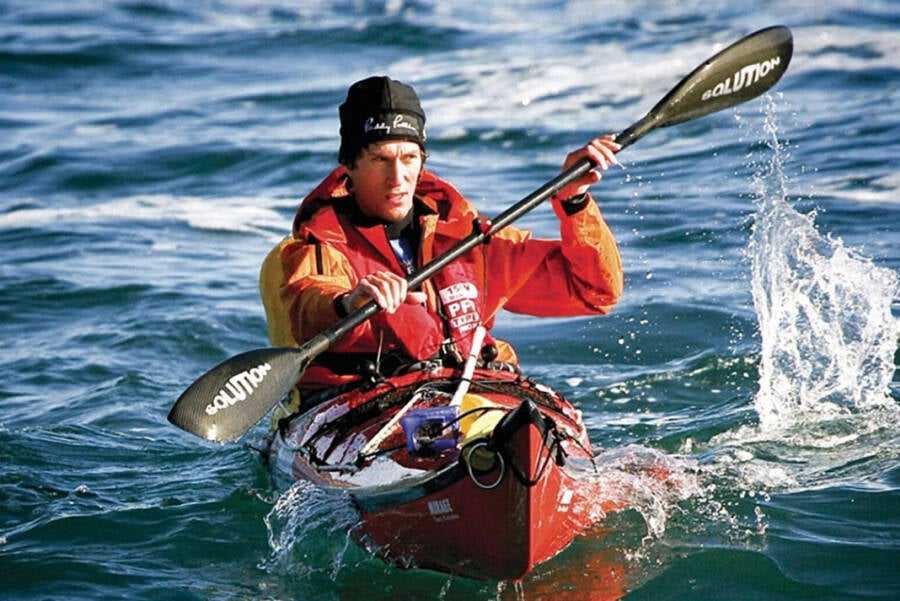 Long-distance sea kayaker and mountaineer Andrew McAuley.
Image Credit: Vicki McAuley
Long-distance sea kayaker and mountaineer Andrew McAuley.
Image Credit: Vicki McAuley
In 2006, McAuley led an Antarctic expedition where kayakers covered an 800 km stretch along the Antarctic coast. This experience further honed McAuley’s skills and deepened his expertise in navigating through perilous conditions.
The Ultimate Challenge – Tasman Sea Crossing
McAuley’s ultimate challenge lay in the Tasman Sea, a vast and volatile stretch of water between Australia and New Zealand. Considered one of the most dangerous and unpredictable oceans globally, the Tasman Sea presented a daunting challenge that had defeated many before him. Undeterred, McAuley aimed to be the first to cross it solo in a kayak.
The preparation for the Tasman Sea crossing was exhaustive. McAuley worked closely with engineers to design a kayak capable of withstanding the sea’s worst conditions. The resulting kayak, named Mirage, featured a specially designed capsule known as Casper. This capsule, made from fiberglass, was watertight and buoyant, providing McAuley with shelter during storms and allowing him to sleep relatively comfortably.
The Voyage Across the Tasman Sea
The Tasman Sea crossing was not just another expedition for McAuley; it was the ultimate test of his mettle. Stretching approximately 2,000 km, the Tasman Sea was notorious for its rough conditions, including treacherous waves, unpredictable weather, and strong currents.
McAuley’s meticulous planning included researching weather patterns, studying previous attempts, and understanding the sea’s behavior. Physical fitness was paramount, and McAuley underwent a rigorous training regimen to prepare his body for the continuous strain of paddling and the challenges of being confined to a small space.
Andrew McAuley’s solo sea kayak journey across the Tasman Sea was a monumental undertaking. The stormy southern ocean proved to be a formidable adversary, with relentless waves transforming it into a tumultuous sea of mercury. Amidst this chaos, McAuley found himself battling the elements, struggling to keep his touring kayak afloat. The howling wind whipped the waves into a stinging spray, creating a hostile environment for the intrepid adventurer.
“I GUESS I’M REALLY DRAWN TO A JOURNEY LIKE THIS—IT’S A REAL PERSONAL CHALLENGE. THERE’S A GREAT DEAL OF SATISFACTION IN COMING UP WITH AN ADVENTURE THAT’S UNLIKELY AND IMPROBABLE.”
– Andrew McAuley
As McAuley pressed on with his journey, one night in January 2007, he found himself in the midst of a ferocious storm. He was two-thirds through the 1,600-kilometer open ocean crossing from the east coast of Tasmania to New Zealand’s South Island. Locked up in his kayak for 28 hours, McAuley faced the relentless fury of the storm, both external and internal battles raging simultaneously.
“THIS REALLY IS EXTREME. IT’S FULL ON. I REALLY COULD DIE.”
– Andrew McAuley
Days later, with the storm behind him and the seas relatively calm, McAuley vanished. The mountaintops of New Zealand’s southern Alps loomed on the horizon, and the paddling community, along with his family and friends, was left grappling with a perplexing mystery. What had happened to the experienced adventurer so close to completing such a challenging journey?
“Man cannot discover new oceans unless he has the courage to lose sight of the shore.”
– André Gide
Andrew McAuley had been drawn to this adventure by a deeply felt inner voice, seeking personal challenge and satisfaction in the face of the unlikely and improbable. He was no stranger to risk, having spent nearly a decade preparing for the journey. McAuley, an IT consultant from suburban Sydney, had a diverse adventurous background, previously dedicating his energies to mountaineering and making first ascents in challenging terrains like Pakistan, Patagonia, and Australia.
“When you do [a trip like this], you are exposing yourself to criticism. I take risks, but they are calculated risks, and I want to be beyond criticism.”
– Andrew McAuley
The solo sea kayak crossing was not taken lightly by authorities. Both Tasmanian police and Australia’s search and rescue service had cautioned against the inherently dangerous trip. McAuley’s kayak, a standard 19-foot Mirage modified for sleeping inside the cockpit, underwent thorough testing to ensure its seaworthiness. A yellow fiberglass canopy, humorously named “Casper,” provided self-righting capability and protection during storms.
“We had strongly advised against the trip to start with because we believed it was inherently dangerous.”
– AusSAR spokesperson
McAuley’s journey took him below the 40th parallel, known as the Roaring Forties, a region feared by sailors for its treacherous weather and storms. Two-thirds into his voyage, he faced a 40-knot gale that knocked out his spare satellite phone and tracking beacon. Surviving the storm, McAuley sent a triumphant text message to his family when he was just 120 kilometers away from his destination.
“See you 9 a.m. Sunday!”
– Andrew McAuley
Tragically, McAuley disappeared shortly after this message. A scrambled radio call with distressing words led to a search that uncovered his upturned kayak in near-perfect condition, just offshore of Milford Sound. The cockpit canopy was missing, but the paddle, satellite phone, GPS, and emergency beacon were inside and functional. Despite extensive search efforts, McAuley was not found.
“The EPIRB is a last resort. It is far better (if possible) to make contact by phone or radio and let people know the exact situation—rather than the huge panic and search that an EPIRB generates.”
– Laurie Ford
Speculation arose about McAuley’s fate, with the kayak’s designer suggesting that he may have capsized without the cockpit cover and became separated from his kayak. The mystery of Andrew McAuley’s disappearance continues to perplex, leaving the paddling community and McAuley’s loved ones with unanswered questions about the fate of this adventurous soul.
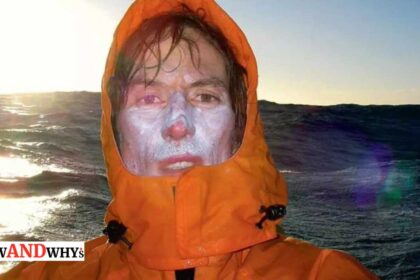
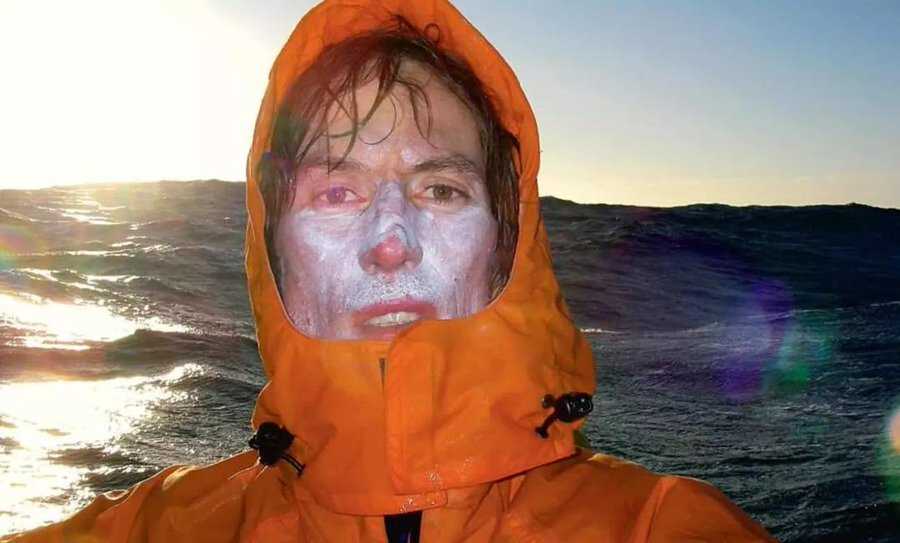 Final self photo of kayaker Andrew McCauley recovered from his memory stick after his disappearance.
McAuley’s past experiences of capsizing twice, coupled with the complicated re-entry procedure due to the cockpit cover, video camera, and other deck-mounted gear, made him cautious about a potential capsize during his Tasman Sea journey. His kayak had an oversized cockpit and lacked a standard seat, making rolling impossible. Modifications, such as removing the seat for sleeping and accessing gear, were necessary. He sat on a beanbag, doubling as a pillow, and retrieved gear from the rear compartment by lying down and rolling onto his stomach, using strings to pull his gear forward.
“Responsible adventure is character-building and good for people, but I felt that to continue on this occasion was not on.”
– Andrew McAuley
Paul Hewitson, the kayak’s designer, speculated that McAuley, with the mountains in sight, might have been eager to reach land and pushed too hard. Facing a small cold front, he might not have worn his drysuit, a decision he planned to make in rough weather. Disaster often strikes those nearing safety, and McAuley, possibly fatigued, may have prioritized making miles over seeking shelter beneath the canopy.
“Andrew thinks the same as I do on this subject… The EPIRB is a last resort. It is far better (if possible) to make contact by phone or radio and let people know the exact situation—rather than the huge panic and search that an EPIRB generates.”
– Laurie Ford
After a possible capsize, McAuley might have unscrewed the rear hatch to access his VHF radio and drysuit. During the struggle into the drysuit, he could have become separated from the kayak, along with the Emergency Position-Indicating Radio Beacon (EPIRB). McAuley’s decision not to trigger the EPIRB immediately raised questions, but Tasmanian kayaker Laurie Ford suggested that McAuley, like himself, considered the EPIRB a last resort. McAuley may have intended to use it once he was in the drysuit, but the kayak’s separation thwarted his plans.
“It was the separation from the kayak that brought him undone.”
– Laurie Ford
Tragically, McAuley had overlooked a crucial detail—attaching the EPIRB to himself, not the boat. Ford speculated that a strobe light might have increased the chances of being spotted by rescuers on the first night of the search.
“Andrew thinks the same as I do on this subject… It is far better (if possible) to make contact by phone or radio and let people know the exact situation—rather than the huge panic and search that an EPIRB generates.”
– Laurie Ford
In McAuley’s final days, he acknowledged the possibility of miscalculations, pushing boundaries too far, and the extreme nature of his adventure. A self-portrait taken near the end of his journey revealed a stark contrast to the confident athlete seen in earlier photographs. At a memorial service, a haunting message recovered from McAuley’s kayak emphasized the severity of his endeavor:
“THIS REALLY IS EXTREME. IT’S FULL ON. I REALLY COULD DIE.”
– Andrew McAuley
Despite the public criticism of extreme adventuring, McAuley’s family, especially his wife Vicki, emphasized that it was Andrew’s drive to explore his limits that defined him. In the face of inevitable questions about the perceived selfishness or imprudence of his adventure, Vicki highlighted a quote from André Gide on McAuley’s website:
“Man cannot discover new oceans unless he has the courage to lose sight of the shore.”
– André Gide
Andrew McAuley’s attempt to cross the Tasman Sea solo in a kayak was an epic journey that left an indelible mark on the world of adventure. McAuley’s story became a beacon for discussions on safety, preparedness, and the spirit of exploration within the kayaking community and among solo adventurers worldwide.
The legacy of McAuley’s journey extended beyond his final voyage. It prompted discussions on safety protocols, risk management, and the importance of advanced preparation for solo expeditions. McAuley’s story inspired innovations in kayaking equipment and technology, leading to improved safety measures and communication devices.
His disappearance remains a profound mystery, fueling continued speculation and intrigue within the adventure community. McAuley’s enduring impact is reflected in the changes and conversations sparked within the kayaking community, emphasizing the delicate balance between the human spirit’s desire to explore and the respect owed to the unpredictable forces of nature.
{ https://www.howandwhys.com/ }


 Mysterious hidden ‘structures’ hundreds of metres deep discovered on dark side of moon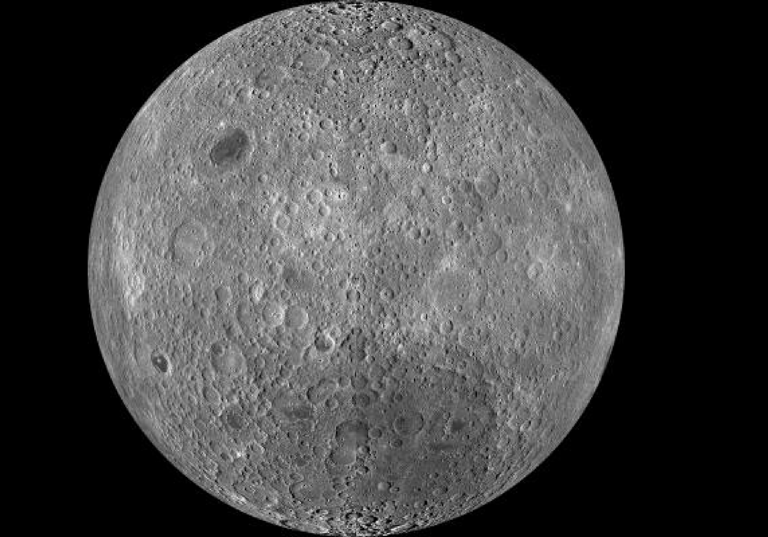











/https://tf-cmsv2-smithsonianmag-media.s3.amazonaws.com/accounts/headshot/tara.png)
:focal(1000x467:1001x468)/https://tf-cmsv2-smithsonianmag-media.s3.amazonaws.com/filer_public/47/c7/47c7be66-6841-4043-b793-f516aeb2f4f8/meteoritenfund_im_havelland_c_cevin_dettlaff_3.png)


/https://tf-cmsv2-smithsonianmag-media.s3.amazonaws.com/filer_public/25/86/25868869-7aab-4e63-8892-36f542f96392/aubrite-meteorite-from-asteroid-2024-bx1-laura-kranich-2024.jpg)