Ontdek de Fascinerende Wereld van UFO's en UAP's: Jouw Bron voor Onthullende Informatie!
Ben jij ook gefascineerd door het onbekende? Wil je meer weten over UFO's en UAP's, niet alleen in België, maar over de hele wereld? Dan ben je op de juiste plek!
België: Het Kloppend Hart van UFO-onderzoek
In België is BUFON (Belgisch UFO-Netwerk) dé autoriteit op het gebied van UFO-onderzoek. Voor betrouwbare en objectieve informatie over deze intrigerende fenomenen, bezoek je zeker onze Facebook-pagina en deze blog. Maar dat is nog niet alles! Ontdek ook het Belgisch UFO-meldpunt en Caelestia, twee organisaties die diepgaand onderzoek verrichten, al zijn ze soms kritisch of sceptisch.
Nederland: Een Schat aan Informatie
Voor onze Nederlandse buren is er de schitterende website www.ufowijzer.nl, beheerd door Paul Harmans. Deze site biedt een schat aan informatie en artikelen die je niet wilt missen!
Internationaal: MUFON - De Wereldwijde Autoriteit
Neem ook een kijkje bij MUFON (Mutual UFO Network Inc.), een gerenommeerde Amerikaanse UFO-vereniging met afdelingen in de VS en wereldwijd. MUFON is toegewijd aan de wetenschappelijke en analytische studie van het UFO-fenomeen, en hun maandelijkse tijdschrift, The MUFON UFO-Journal, is een must-read voor elke UFO-enthousiasteling. Bezoek hun website op www.mufon.com voor meer informatie.
Samenwerking en Toekomstvisie
Sinds 1 februari 2020 is Pieter niet alleen ex-president van BUFON, maar ook de voormalige nationale directeur van MUFON in Vlaanderen en Nederland. Dit creëert een sterke samenwerking met de Franse MUFON Reseau MUFON/EUROP, wat ons in staat stelt om nog meer waardevolle inzichten te delen.
Let op: Nepprofielen en Nieuwe Groeperingen
Pas op voor een nieuwe groepering die zich ook BUFON noemt, maar geen enkele connectie heeft met onze gevestigde organisatie. Hoewel zij de naam geregistreerd hebben, kunnen ze het rijke verleden en de expertise van onze groep niet evenaren. We wensen hen veel succes, maar we blijven de autoriteit in UFO-onderzoek!
Blijf Op De Hoogte!
Wil jij de laatste nieuwtjes over UFO's, ruimtevaart, archeologie, en meer? Volg ons dan en duik samen met ons in de fascinerende wereld van het onbekende! Sluit je aan bij de gemeenschap van nieuwsgierige geesten die net als jij verlangen naar antwoorden en avonturen in de sterren!
Heb je vragen of wil je meer weten? Aarzel dan niet om contact met ons op te nemen! Samen ontrafelen we het mysterie van de lucht en daarbuiten.
Vrijdag 29 maart 2024
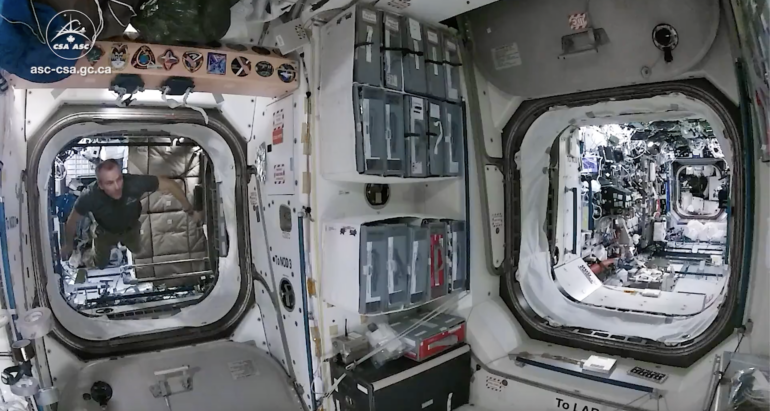
Astronauts Have Surprising Ability to Orient Themselves and Gauge Distance Traveled in Space: Study
Astronauts Have Surprising Ability to Orient Themselves and Gauge Distance Traveled in Space: Study
New research has implications for crew safety in space and could potentially give clues to how aging affects people’s balance systems here on Earth.
Jörges et al. tackled the question of whether body posture influences human perception of self-motion and distance; they found some evidence that the same amount of optic flow can elicit the sensation of having traveled further when supine versus when sitting upright, that is, optic flow is more effective at eliciting a sense of self-motion when supine; this constitutes evidence that visual and non-visual cues are at least partially integrated even when self-motion is presented only visually; however, they did not find any significant differences between performance on Earth and in the microgravity of the ISS, suggesting that vestibular cues play a minor role, if any, in the estimation of visually presented self-motion.
“It has been repeatedly shown that the perception of gravity influences perceptual skill,” said York University’s Professor Laurence Harris, senior author of the study.
“The most profound way of looking at the influence of gravity is to take it away, which is why we took our research into space.”
“We’ve had a steady presence for close to a quarter century in space and with space efforts only increasing as we plan to go back to the moon and beyond, answering health-and-safety questions only becomes more important.”
“Based on our findings it seems as though humans are surprisingly able to compensate adequately for the lack of an Earth-normal environment using vision.
In the research, Professor Harris and colleagues studied a dozen astronauts aboard the International Space Station (ISS), which orbits about 400 km from the Earth’s surface.
“Here, Earth’s gravity is approximately cancelled out by centrifugal force generated by the orbiting of the station. In the resulting microgravity, the way people move is more like flying,” Professor Harris said.
“People have previously anecdotally reported that they felt they were moving faster or further than they really were in space, so this provided some motivation to actually record this.”
The authors compared the performance of a dozen astronauts — six men and six women — before, during, and after their year-long missions to the space station and found that their sense of how far they traveled remained largely intact.
Space missions are busy endeavors and it took the researchers several days to connect with the astronauts once they arrived at the space station.
“It’s possible our research was unable to capture early adaptation that may have occurred in those first few days. It’s still a good news message because it says that whatever adaptation happens, happens very quickly,” Professor Harris said.
Space missions are not without risk. As the ISS orbits the Earth it is sometimes hit with small objects that could penetrate the vessel requiring astronauts to move to safety.
“On a number of occasions during our experiment, the ISS had to perform evasive maneuvers,” Professor Harris said.
“Astronauts need to be able to go to safe places or escape hatches on the ISS quickly and efficiently in an emergency. So, it was very reassuring to find that they were actually able to do this quite precisely.”
“Our research shows exposure to microgravity mimics the aging process on a largely physiological level — wasting of bones and muscles, changes in hormonal functioning and increased susceptibility to infection — but this paper finds that self-motion is largely unaffected, suggesting the balance issues that frequently come from old age may not be related to the vestibular system.”
“It suggests that the mechanism for the perception of movement in older people should be relatively unaffected, and that the issues involved in falling may not be so much in terms of the perception of how far they’ve moved, but perhaps more to do with how they’re able to convert that into a balance reflex.”
The study was published in the journal npj Microgravity.
B. Jörges et al. 2024. The effects of long-term exposure to microgravity and body orientation relative to gravity on perceived traveled distance. npj Microgravity 10, 28; doi: 10.1038/s41526-024-00376-6
Study: Introduced Tardigrade Proteins Slow Metabolism in Human Cells
New research led by the the University of Wyoming, Laramie, provides additional evidence that tardigrade proteins eventually could be used to make life-saving treatments available to people where refrigeration is not possible and enhance storage of cell-based therapies.
Sanchez-Martinez et al. provide insights into how tardigrades induce reversible biostasis through the self-assembly of labile CAHS gels.
First discovered in 1773, tardigrades are a diverse group of microscopic invertebrates that are best known for their ability to survive extreme conditions.
Also known as water bears or moss piglets, these creatures can live for up to 60 years, and grow to a maximum size of 0.5 mm, best seen under a microscope.
They are able to survive for up to 30 years without food or water, for a few minutes at temperatures as low as minus 272 degrees Celsius (minus 457 degrees Fahrenheit) or as high as 150 degrees Celsius (302 degrees Fahrenheit), and minus 20 degrees Celsius (minus 4 degrees Fahrenheit) for decades.
Tardigrades withstand pressures from virtually 0 atm in space up to 1,200 atm at the bottom of the Marianas Trench, and are also resistant to radiation levels up to 5,000-6,200 Gy.
They survive by entering a state of suspended animation called biostasis, using proteins that form gels inside of cells and slow down life processes.
“Amazingly, when we introduce these proteins into cells, they gel and slow down metabolism, just like in tardigrades,” said Dr. Silvia Sanchez-Martinez, a researcher at the University of Wyoming, Laramie.
“Furthermore, just like tardigrades, when you put human cells that have these proteins into biostasis, they become more resistant to stresses, conferring some of the tardigrades’ abilities to the human cells.”
“Importantly, our research shows that the whole process is reversible,” said Dr. Thomas Boothby, a researcher at the University of Wyoming, Laramie.
“When the stress is relieved, the tardigrade gels dissolve, and the human cells return to their normal metabolism.”
“Our findings provide an avenue for pursuing technologies centered on the induction of biostasis in cells and even whole organisms to slow aging and enhance storage and stability.”
S. Sanchez-Martinezet al. 2024. Labile assembly of a tardigrade protein induces biostasis.Protein Science33 (4): e4941; doi: 10.1002/pro.4941
UAP Up Close Shoots Past Passenger Jet Windows! March 2024, UFO Sighting News Video.
Date of sighting: March 2024 Location of sighting: New York, New York, USA
Watch as a UFO shoots past a passenger jet over New York and gets caught on video. The object is long, dark and has a bright white window area which is the alien pilots cockpit location. It's obvious this UAP shoot past to scan the technology of the plane as well as record the thoughts of its passengers. This is 100% proof that UFOs frequent heavily populated areas.
UFO Caught On Photo Redondo Beach, California, USA March 10, 2024, UAP Sighting News.
Water UFOs otherwise known as USO are much more common than the US Gov would like you to believe. This UFO is diving so fast it was caught in many locations of the photo as it was diving into the water. The Earth is covered by 75% water, which makes it the ideal location to place an alien base since humans don't frequent the bottom of the ocean floor. This UFO was observing the sailboat and then dived into the water before it was seen. However the camera has a more perfect eye and caught this little fella as it was observing and trying to leave. USO are serious and real craft that even the US Navy talks about under the table.
💫I was taking photos at Redondo and walked to the end of the pier to shoot an array of sailboats. I didn't see the object with my eyes as I was focused on the boats but when processing the photo I saw what appears to be something falling from the sky. It had to be fast to be captured by my camera at a speed of 1/500 of a second. You can easily see the descent and the object with a trail.
A talk with ChatGPT about a cloud orb I summoned years ago, UFO Sighting News. Taiwan, Sept 17, 2011 - sighting discussed.
Above gif is the closest I can find to what the orb looked like, this is about 70% what I saw, still missing the white clouds within about 10%, the black clouds about 15% and the silver metallic paint moving within which covered 65-75% of the sphere. My sighting took place in Taiwan, on an 8 floor rooftop of my apartment building, on Sept 17, 2011.
All the statements by me are 100% true, and I do have a video of it after it shot 50 meters from me...at which time it looked white in the distance. I was curious what AI GPT Chat would say about the sighting and what insights it may have. And I did not expect such fantastic comprehension and advice from GPT Chat. It was both helpful and eye opening. Something that is rare in this field.
Scott C. Waring
Below is the video...where I grabbed the tripod and flipped it around only to see the orb shot 50 meters away and sat there, watching me. I could not coax it to come back.
The asteroid Dimorphos was captured by NASA’s DART mission just two seconds before the spacecraft struck its surface on Sept. 26, 2022. Observations of the asteroid before and after impact suggest it is a loosely packed “rubble pile” object. Credit: NASA/JHUAPL
DART Changed the Shape of Asteroid Dimorphos, not Just its Orbit
On September 26th, 2022, NASA’s Double Asteroid Redirection Test (DART) collided with the asteroid Dimorphos, a moonlet that orbits the larger asteroid Didymos. The purpose of this test was to evaluate a potential strategy for planetary defense. The demonstration showed that a kinetic impactor could alter the orbit of an asteroid that could potentially impact Earth someday – aka. Potentially Hazardous Asteroid (PHA). According to a new NASA-led study, the DART mission’s impact not only altered the orbit of the asteroid but also its shape!
The study was led by Shantanu P. Naidu, a navigation engineer with NASA’s Jet Propulsion Laboratory (JPL) at Caltech. He was joined by researchers from the Lowell Observatory, Northern Arizona University (NAU), the University of Colorado Boulder (UCB), the Astronomical Institute of the Academy of Sciences of the Czech Republic, and Johns Hopkins University (JHU). Their paper, “Orbital and Physical Characterization of Asteroid Dimorphos Following the DART Impact,” appeared on March 19th in the Planetary Science Journal.
The Didymos double asteroid system consists of an 851-meter-wide (2792 ft) primary orbited by the comparatively small Dimorphos. The latter was selected as the target for DART because any changes in its orbit caused by the impact would be comparatively easy to measure using ground-based telescopes. Before DART impacted with the moonlet, it was an oblate spheroid measuring 170 meters (560 feet) in diameter with virtually no craters. Before impact, the moonlet orbited Didymos with a period of 11 hours and 55 minutes.
Artist’s impression of the DART mission impacting the moonlet Dimorphos. Credit: ESA
Before the encounter, NASA indicated that a 73-second change in Dimorphos’ orbital period was the minimum requirement for success. Early data showed DART surpassed this minimum benchmark by more than 25 times. As Naidu said in a NASA press release, the impact also altered the moonlet’s shape:
“When DART made impact, things got very interesting. Dimorphos’ orbit is no longer circular: Its orbital period is now 33 minutes and 15 seconds shorter. And the entire shape of the asteroid has changed, from a relatively symmetrical object to a ‘triaxial ellipsoid’ – something more like an oblong watermelon.”
Naidu and his team combined three data sources with their computer models to determine what happened to the asteroid after impact. The first was the images DART took of Dimorphos right before impact, which were sent back to Earth via NASA’s Deep Space Network (DSN). These images allowed the team to gauge the dimensions of Didymos and Dimorphos and measure the distance between them. The second source was the Goldstone Solar System Radar (GSSR), part of the DNS network located in California responsible for investigating Solar System objects.
The GSSR was one of several ground-based instruments that precisely measured the position and velocity of Dimorphos relative to Didymos after impact – which indicated how the mission greatly exceeded expectations. The third source was provided by ground-based telescopes worldwide that measured changes in the amount of life reflected (aka. light curves) of both asteroids. Much like how astronomers monitor stars for periodic dips (which could indicate a transiting planet), dips in Didymos’ luminosity are attributable to Dimorphos passing in front of it.
Artist’s impression of the ESA’s Hera mission rendezvousing with Dimorphos. Credit: NASA
By comparing these light curves from before and after impact, the team learned how DART altered Dimorphos’ motion. Based on these data sources and their models, the team calculated how its orbital period evolved and found that it was now slightly eccentric. Said Steve Chesley, a senior research scientist at JPL and a co-author on the study:
“We used the timing of this precise series of light-curve dips to deduce the shape of the orbit, and because our models were so sensitive, we could also figure out the shape of the asteroid. Before impact, the times of the events occurred regularly, showing a circular orbit. After impact, there were very slight timing differences, showing something was askew. We never expected to get this kind of accuracy.”
According to their results, DART’s impact reduced the average distance between the two asteroids to roughly 1,152 meters (3,780 feet) – closer by about 37 meters (120 feet). It also shortened Dimorphos’ orbital period to 11 hours, 22 minutes, and 3 seconds – a change of 33 minutes and 15 seconds. These results are consistent with other independent studies based on the same data. They will be further tested by the ESA’s Hera mission, scheduled to launch in October 2024, when it makes a flyby of the double-asteroid and conducts a detailed survey.
Cosmochemistry: Why study it? What can it teach us about finding life beyond Earth?
Universe Today has had some fantastic discussions with researchers on the importance of studying impact craters, planetary surfaces, exoplanets,astrobiology,solar physics, comets, planetary atmospheres, and planetary geophysics, and how these diverse scientific fields can help researchers and the public better understand the search for life beyond Earth. Here, we will investigate the unique field of cosmochemistry and how it provides researchers with the knowledge pertaining to both our solar system and beyond, including the benefits and challenges, finding life beyond Earth, and suggestive paths for upcoming students who wish to pursue studying cosmochemistry. But what is cosmochemistry and why is it so important to study it?
“Cosmochemistry is the study of space stuff, the actual materials that make up planets, stars, satellites, comets, and asteroids,” Dr. Ryan Ogliore, who is an associate professor of physics at Washington University in St. Louis, tells Universe Today. “This stuff can take all the forms of matter: solid, liquid, gas, and plasma. Cosmochemistry is different from astronomy which is primarily concerned with the study of light that interacts with this stuff. There are two main benefits of studying actual astromaterials: 1) the materials record the conditions at the time and place where they formed, allowing us to look into the deep past; and 2) laboratory measurements of materials are extraordinarily precise and sensitive, and continue to improve as technology improves.”
In a nutshell, the field of cosmochemistry, also known as chemical cosmology, perfectly sums up Carl Sagan’s famous quote, “The cosmos is within us. We are made of star-stuff. We are a way for the cosmos to know itself.” To understand cosmochemistry is to understand how the Earth got here, how we got here, and possibly how life got wherever we’re (hopefully) going to find it, someday.
Like all scientific fields, cosmochemistry incorporates a myriad of methods and strategies with the goal of answering some of the universe’s most difficult questions, specifically pertaining to how the countless stellar and planetary objects throughout the universe came to be. These methods and strategies primarily include laboratory analyses of meteorites and other physical samples brought back from space, including from the Moon, asteroids, and comets. But what are some of the benefits and challenges of studying cosmochemistry?
“One of the primary benefits of cosmochemistry is the ability to reproduce measurements,” Dr. Ogliore tells Universe Today. “I can measure something in my lab, and somebody else can measure either the same object, or a very similar object, in another lab to confirm my measurements. Only after repeated measurements, by different labs and different techniques, will a given claim be universally accepted by the community. This is difficult to do in astronomy, and also difficult using remote-sensing measurements on spacecraft studying other bodies in the Solar System.”
Apart from the crewed Apollo missions to the Moon, all other samples from space have been returned via robotic spacecraft. While this might seem like an easy process from an outside perspective, collecting samples from space and returning them to Earth is a very daunting and time-consuming series of countless tests, procedures, precise calculations, and hundreds to thousands of scientists and engineers ensuring every little detail is covered to ensure complete mission success, often to only collect a few ounces of material. This massive effort is tasked with not only ensuring successful sample collection, but also ensuring successful storage of the samples to avoid contamination during their journey home, and then retrieving the samples once they land in a capsule back on Earth, where they are properly unpacked, cataloged, and stored for laboratory anal
To demonstrate the difficulty in conducting a sample return mission, only four nations have successfully used robotic explorers to collect samples from another planetary body and returned them to Earth: the former Soviet Union, United States, Japan, and China. The former Soviet Union successfully returned lunar samples to Earth throughout the 1970s; the United States has returned samples from a comet, asteroid, and even solar particles; Japan has successfully returned samples from two asteroids; and most recently, China succeeded in returning 61.1 ounces from the Moon, which is the current record for robotic sample return missions. But even with the difficulty of conducting a successful sample return mission, what can cosmochemistry teach us about finding life beyond Earth?
“Cosmochemistry can tell us about the delivery of the ingredients necessary for life to planets or moons via asteroids or comets,” Dr. Ogliore tells Universe Today. “Since we have both asteroid and comet material in the lab, we can tell if primitive pre-biotic organic compounds may have been delivered by these bodies. Of course, this doesn’t mean life on Earth (or elsewhere) started this way, only that it is one pathway. Detection of life on another world would be one of the biggest discoveries in the history of science. So of course we’d want to be absolutely sure! This requires repeated measurements by different labs using different techniques, which requires a sample on Earth. I think the only way we’d know for sure if there was life on Europa, Enceladus, or Mars is if we bring a sample back to Earth from these places.”
As it turns out, NASA is actively working on the Mars Sample Return (MSR) mission, for which Dr. Ogliore is a member of the MSR Measurement Definition Team. The goal of MSR will be to travel to the Red Planet to collect and return samples of Martian regolith to Earth for the first time in history. The first step of this mission is currently being accomplished by NASA’s Perseverance rover in Jezero Crater, as it is slowly collecting samples and dropping them in tubes across the Martian surface for future retrieval by MSR.
For Europa, while there have been several discussions regarding a sample return mission, including a 2002 study discussing a sample return mission from Europa’s ocean and a 2015 study discussing a potential plume sample return mission, no definitive sample return missions from Europa are currently in the works, possibly due to the enormous distance. Despite this, and while not a life-finding mission, Dr. Ogliore has been tasked to lead a robotic mission to Jupiter’s volcanic moon, Io, to explore its plethora of volcanoes. For Enceladus, the Life Investigation for Enceladus (LIFE) mission has had a number of mission proposals submitted to return samples from Enceladus’ plumes, though it has yet to be accepted. But what is the most exciting aspect about cosmochemistry that Dr. Ogliore has studied during his career?
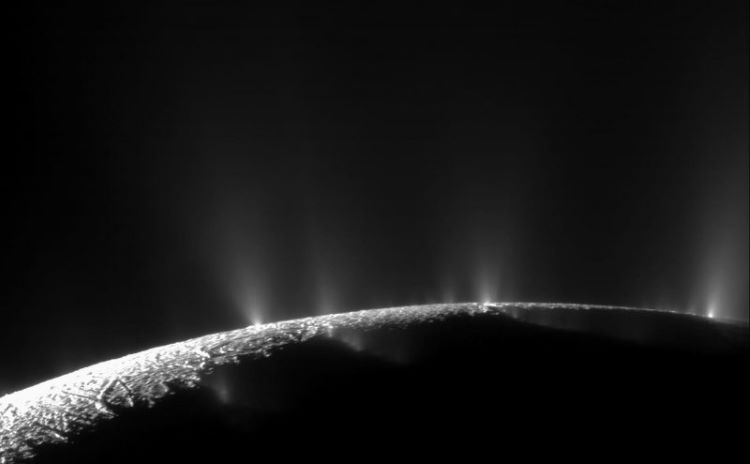
Image from NASA’s Cassini spacecraft of the water vapor plumes emanating from the south pole of Saturn’s moon Enceladus. (Credit: NASA/JPL/Space Science Institute)
“In my opinion the most important single measurement in the history of cosmochemistry was the measurements of the oxygen isotopic composition of the Sun,” Dr. Ogliore tells Universe Today. “To do this, we needed to return samples of the solar wind to Earth, which we did with NASA’s Genesis mission. However, the sample return capsule crashed on Earth. But did that stop the cosmochemists?! Hell no! Kevin McKeegan and colleagues at UCLA had built a specialized, enormous, complicated instrument to study these samples. Despite the crash, McKeegan and colleagues analyzed oxygen in the solar wind and found that it was 6% lighter than oxygen found on Earth, and it matched the composition of the oldest known objects in the Solar System: millimeter-sized calcium-aluminum inclusions (CAIs) found in meteorites.”
Dr. Ogliore continues by telling Universe Today about how this result was predicted by Bob Clayton at the University of Chicago, along with crediting his own postdoc, Lionel Vacher, for conducting a research project that built off the Genesis results, noting, “This was a really fun project because it was technically very challenging, and the results put the Solar System in its astrophysical context.”
Like the myriad of scientific disciplines that Universe Today has examined during this series, cosmochemistry is successful due to its multidisciplinary nature that contributes to the goal of answering some of the universe’s most difficult questions. Dr. Ogliore emphasizes that analysis of laboratory samples involves a multitude of scientific backgrounds to understand what the researchers are observing within each sample and the processes responsible for creating them. Additionally, this also includes the aforementioned sample return missions and hundreds to thousands of scientists and engineers who partake in each mission. Therefore, what advice can Dr. Ogliore offer to upcoming students who wish to pursue cosmochemistry?
“Biology, chemistry, geology, physics, math, electronics — you need it all!” Dr. Ogliore tells Universe Today. “If you like learning new things constantly, then planetary science is for you. It is good to get a very broad education. This will serve you well in a number of careers, but it is especially true for planetary science and cosmochemistry. I get to work with people who study volcanoes, and mathematicians working on chaotic motion. How cool is that?!”
All things considered, cosmochemistry is both an enormously challenging and rewarding field of study to try and answer some of the most difficult and longstanding questions regarding the processes responsible for the existence of celestial bodies in the Solar System and beyond, including stars, planets, moons, meteorites, and comets, along with how life emerged on our small, blue world. As noted, cosmochemistry perfectly sums up Carl Sagan’s famous quote, “The cosmos is within us. We are made of star-stuff. We are a way for the cosmos to know itself.” It is through cosmochemistry and the analysis of meteorites and other returned samples that enable researchers to slowly inch our way to answering what makes life and where we can find it.
“Meteorites are the most spectacular record of nature known to mankind,” Dr. Ogliore tells Universe Today. “We have rocks from Mars, the Moon, volcanic worlds, asteroid Vesta, and dozens of other worlds. Iron meteorites are the cores of broken apart planets. These rocks record processes that occurred four and a half billion years ago and fall to Earth in a blazing fireball traveling at miles per second. You can follow various blogs that track fireballs, and even calculate areas where meteorites might have fallen. If you ever have the opportunity, go try to find one of these freshly fallen meteorites. The odds are long, but it is worth a try. I have not found a meteorite myself yet, but it is a life goal of mine.”
How will cosmochemistry help us better understand our place in the universe in the coming years and decades? Only time will tell, and this is why we science!
The Enigma of Nazi UFOs: Unveiling the Third Reich’s Secret Projects
In the annals of World War II’s history, the technological prowess of Nazi Germany has been well-documented, from the V2 rocket to the infamous Enigma machine. However, nestled within these tales of engineering marvels lies a lesser-known, yet equally fascinating narrative: the story of the Nazi UFO projects. This exploration takes us beyond conventional warfare technologies into the realm of science fiction turned purported reality under the aegis of the Third Reic
The Origins of the Nazi UFO Legend
The legend of Nazi UFOs originates from post-war claims and scattered evidence suggesting that the Third Reich embarked on ambitious projects to develop advanced aircraft, often described as “flying saucers” or “foo fighters.” These projects were said to leverage unconventional propulsion systems, potentially including anti-gravity, a concept that was light years ahead of its time.
Historians and enthusiasts have traced the roots of these alleged programs back to pre-war German engineering prowess, coupled with an interest in esoteric and occult knowledge. Figures such as Viktor Schauberger, an Austrian inventor, are often mentioned as being central to these efforts, with his work on vortex propulsion cited as a possible basis for the UFO projects.
Between Fact and Fiction: The Development of Flying Discs
While concrete evidence remains elusive, various accounts suggest that the Nazis did indeed experiment with disc-shaped aircraft. Projects such as the “Die Glocke” (The Bell) have entered the lore, described as an anti-gravity device capable of generating an immense power field. Despite the lack of physical proof, the narrative is bolstered by reports of high-ranking Nazis, including SS officers, taking an intense interest in these technologies.
The involvement of Nazi Germany in researching and potentially attempting to harness energy fields or otherworldly propulsion methods has been a topic of speculation. This interest aligns with the era’s broader fascination with breaking the boundaries of known science, driven by the war’s demands and Hitler’s obsession with achieving technological supremacy.
Post-War Legacy and Allied Interest
The end of World War II did not bury the stories of Nazi UFOs; instead, it marked the beginning of a new chapter. Operation Paperclip, a secret program by the United States, brought over German scientists, engineers, and technicians. Among them were individuals purportedly involved in the Reich’s most secretive projects, including those rumored to be associated with UFO research.
This transfer of knowledge and personnel fed into Cold War era projects and contributed to advancements in aerospace technologies. The specter of Nazi UFOs lingered, morphing into part of the broader UFO phenomenon and conspiracy theories concerning hidden government projects and extraterrestrial contacts.
The Verdict: Myth or Lost Technology?
Deciphering the truth behind Nazi UFOs is challenging, with the line between historical fact and speculative fiction often blurred. While there’s no definitive proof that the Third Reich succeeded in developing operational flying saucers, the numerous accounts and circumstantial evidence suggest a keen interest in transcending conventional aerospace technologies.
The legacy of the Nazi UFO projects, whether real or imagined, has significantly impacted popular culture and the UFO community. It represents a fascinating intersection of history, science fiction, and the enduring human desire to push the boundaries of the possible.
In conclusion, the story of Nazi UFOs occupies a unique niche within the tapestry of World War II history. It serves as a testament to the era’s technological ambitions and the lengths to which the Nazi regime would go in its quest for domination. As with many aspects of that tumultuous period, the truth may be stranger than fiction, obscured by the fog of war and the passage of time.
Scientists have discovered a gigantic volcano on Mars near the planet’s equator that remained unnoticed for decades, according to newly published research.
The huge volcano was found in the Red Planet’s eastern Tharsis volcanic province, along with what researchers interpret to be a large sheet of buried glacial ice beneath the Martian surface. The discovery came as a surprise, partly because orbital spacecraft have photographed this region of Mars since the early 1970s.
Hidden in plain sight now for decades, the giant volcano, which has undergone extensive erosion over time, somehow remained unnoticed.
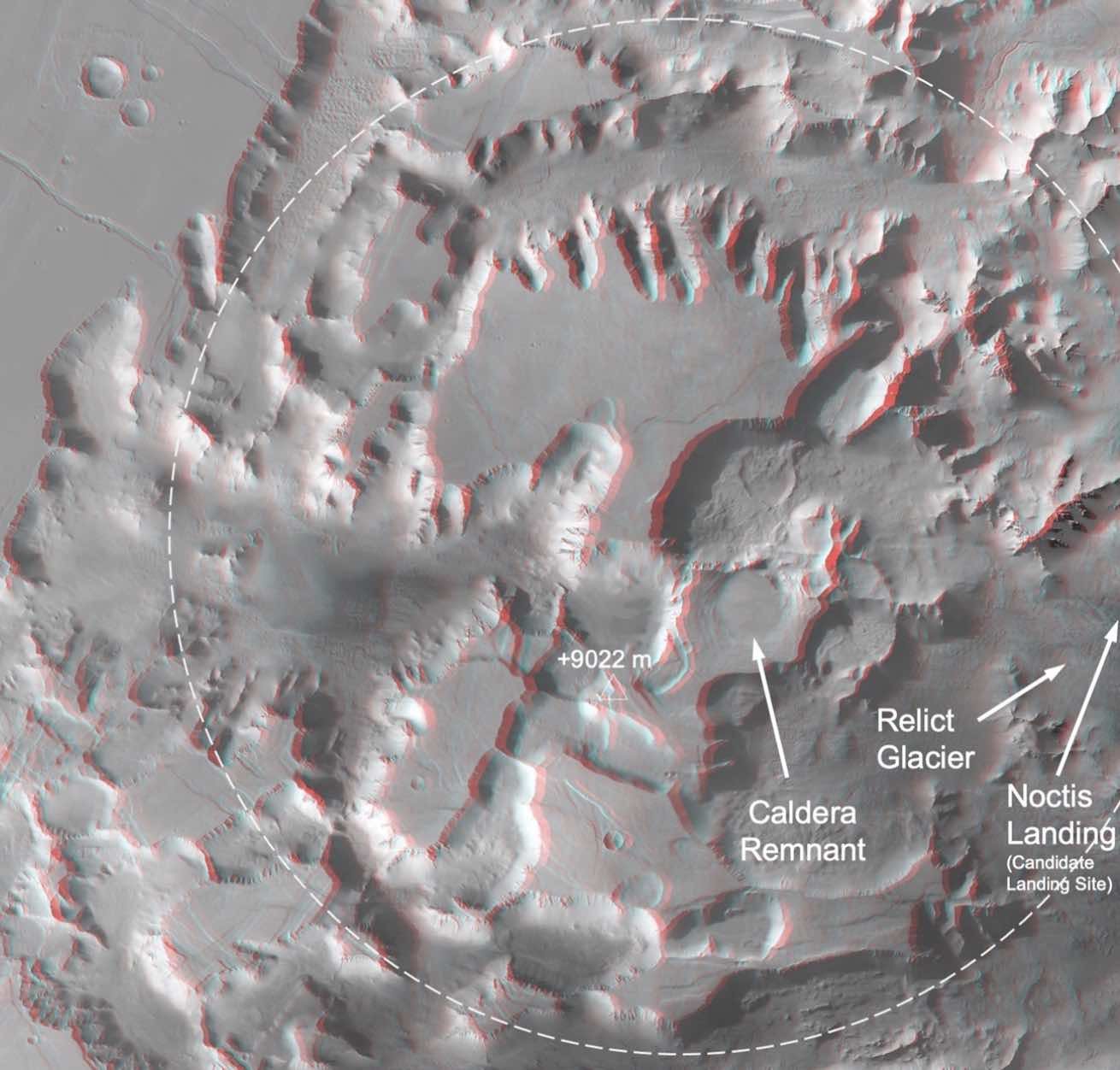
The feature has been given the temporary name “Noctis volcano” due to its proximity to the Noctis Labyrinthus, a region noted for its steep valleys that possess a maze-like appearance.
The 29,600-foot-tall volcano covers an area spanning approximately 280 miles and is believed to have remained active for an extended period. However, it is the giant volcano’s proximity to a region where glacier ice is believed to exist that makes the discovery so promising for researchers, who say it offers a location ripe for studies of the Red Planet’s geology and evolution over tim
The location could also be a promising area for future studies involving potential life that may have once existed—or could still exist—on Mars, with its promising combination of warmth from volcanic activity and water made present by the ancient glacier.
Dr. Pascal Lee, a planetary scientist with the SETI Institute and the Mars Institute, said he and his coauthors of a new study detailing the discoveries say they stumbled onto the huge volcano while observing other features.
“We were examining the geology of an area where we had found the remains of a glacier last year when we realized we were inside a huge and deeply eroded volcano,” Lee said in a statement.
Lee and his coauthors said there were several clues that the area was a massive volcano, which included a series of mesas that formed an arc, as well as what soon revealed itself through examination to be the remains of a caldera, where the volcano collapsed in the aftermath of past eruptions.
Additionally, past studies have revealed the presence of hydrated minerals, which were long believed to point to volcanic activity in the area.
“A volcanic setting for these minerals had long been suspected. So, it may not be too surprising to find a volcano here,” said Sourabh Shubham, one of the study’s co-authors.
“In some sense, this large volcano is a long-sought ‘smoking gun’,” Shubham said.
In addition to the newly discovered volcano, blister-like areas, believed to have been produced by the explosive escape of steam, point to the existence of a “relict glacier” further evidenced by deposits of light-colored sulfates like jarosite, which may represent the most recent past glaciation that affected the giant volcano.
The volcano provides scientists a window into the long history of glacial erosion and other processes that have occurred throughout the history of the region, although the ancient volcano’s age remains a mystery. However, scientists maintain that there is evidence of eruptions in modern history, and although it is presently unclear whether the Noctis volcano is still active, it is not impossible that it might erupt again in the future.
“It’s really a combination of things that makes the Noctis volcano site exceptionally exciting,” Lee said in a statement. “It has also had a long history of heat interacting with water and ice, which makes it a prime location for astrobiology and our search for signs of life.
Given all the potential for new discoveries, Lee added that the giant volcano “is looking very attractive for robotic and human exploration.”
Lee and his team’s new paper, “Large Eroded Volcano Complex and Buried Glacier Ice In Eastern Noctis Labyrinthus: Evidence For Recent Volcanism and Glaciation Near Mars’ Equator,” can be found online here.
The newest spot to search for life on Mars could be a collapsed volcano whose layers are sandwiched with the icy remains of ancient glaciers.
Noctis Mons (AKA the Night Mountain, which is an extremely cool name) has been hidden for a long time. Researchers just now recognized the jumbled terrain, in old images from decades of Martian satellites, as the remains of a collapsed volcano. It looks like Noctis Mons was active fairly recently (and it may still erupt again), and its slopes are layered with glacial ice and snow. That may make it the perfect place to search for alien life.
SETI Institute astrobiologist Pascal Lee and his colleagues presented their findings at the recent Lunar and Planetary Science Conference.
Looking down from orbit, Noctis Mons doesn’t immediately look like a volcano, but if you look closely, you can still spot the caldera at its center.
LEE AT AL. 2024
FIRE, ICE, AND ALIEN LIFE?
Lee and his colleagues recently realized that the strangle jumble of canyons and gently-sloping mesas in images of the Martian equator were actually the remains of a collapsed volcano, eroded and reshaped by glaciers. Looking closer, they spotted old lava flows, fields of pumice and ash, and minerals left by hydrothermal activity. And beneath the uppermost layer of volcanic debris lies a sheet of ice, which gleams here and there through an eroded hole in the thin blanket of volcanic ash that covers it.
Beneath the crumbling slopes of Noctis Mons, fire and ice may have created the perfect environment for life: warm, with plenty of liquid water and chemical nutrients. And since the volcano appears to have been active for a very long time, life has had plenty of opportunity to evolve from the complex chemistry that happens when water and volcanic rock meet.
All around the slopes of Noctis Mons lies a blanket of pumice and volcanic ash. Based on images from a whole series of Martian satellites, from Mariner 9 to the Mars Reconnaissance Orbiter, it’s between 3 and 9 feet thick, and it looks strangely blistered. Here on Earth, when hot volcanic ash lands atop ice, it cools quickly, but hot steam bubbled up beneath the surface, creating blister-like mounds. Where some of these mounds have eroded over time, satellite images reveal the telltale gleam of ice beneath a thin layer of minerals. Lee and his colleagues say the whole 1,900 square mile area of Noctis Mons could lie atop a huge ice sheet left over from one of the last glaciers to pass through the area.
That’s 1,900 square miles of ice interacting with the heat of a volcano, creating pockets and streams of liquid water underground, possibly for billions of years. In other words, it’s a huge Martian oasis that’s potentially perfect for life.
Noctis Mons is also an ideal place for rovers or — someday — astronauts to explore. Because it’s collapsed, what was once a tall, forbidding mountain is now “so deeply eroded that you could hike, drive, or fly through it,” says Lee in a recent statement. And all that glacial ice could support future exploration crews or provide the raw material for rocket fuel (assuming it’s not actually a sensitive alien habitat, that is).
In other words, the place is basically a theme park for astrobiologists.
A VOLCANO WITH A MESSY BACKSTORY
We don’t know how long ago Noctis Mons formed, but [authors] say it looks like the volcano has been active for a huge stretch of Martian history, and it’s been active fairly recently. It may even still be active today. Olympus Mons, the largest volcano in our Solar System, formed about 3.5 billion years ago and stayed active for millions of years, longer than any volcano here on Earth, but Noctis Mons may turn out to beat its neighbor’s impressive streak.
Noctis Mons was once a wide, gently-sloping mountain, built up over time from layers of lava and pyroclastic debris (small grains of volcanic ash and larger chunks of pumice). Between those layers of volcanic rock lay sheets of ice: some compacted snow that fell on the volcano’s slopes and some thick glaciers, all buried beneath the next eruption.
At some point, the magma welling up through cracks and fissures in the mountain melted all of that ice, causing the slopes of the volcano to collapse. Today, the summit is now just a partial ring of mesas, which slope gently downward. From above, it looks like a wide ring of broken rock, crossed by lava flows and cut by deep, glacier-carved canyons.
And someday it just might be the place where we discover we’re not alone in the Solar System.
Did ‘alien’ debris hit Earth? Startling claim sparks row at scientific meeting
Astrophysicist Avi Loeb says that an interstellar meteor showered Earth with particles. At a planetary-science conference this week, researchers begged to differ.
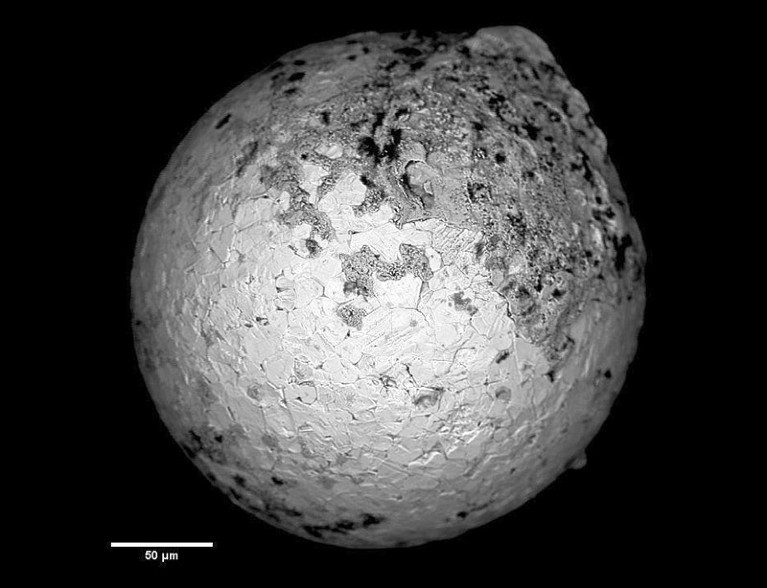
Avi Loeb and his team say that metallic balls found near Papua New Guinea could be of extraterrestrial origin.
Credit: Avi Loeb's photo collection
The Woodlands, Texas
A sensational claim made last year that an ‘alien’ meteorite hit Earth near Papua New Guinea in 2014 got its first in-person airing with the broader scientific community on 12 March. At the Lunar and Planetary Science Conference in The Woodlands, Texas, scientists clashed over whether a research team has indeed found fragments of a space rock that came from outside the Solar System.
The debate occurred at a packed session featuring Hairuo Fu, a graduate student at Harvard University in Cambridge, Massachusetts, who is a member of the team that found the fragments. Team leader Avi Loeb, an astrophysicist at Harvard who did not attend the conference, has made other controversial claims about extraterrestrial discoveries. Many scientists have said that they don’t want to spend much of their time analysing and refuting these claims.
During his presentation, Fu described tiny metallic blobs that Loeb’s expedition dredged from the sea floor near Papua New Guinea last year, and said that the spherules have a chemical composition of unknown origin1. He then faced questions from a long line of scientists sceptical of the implication that the material is extraterrestrial. “At the very least, it is something different from what we know,” Fu responded.
New work questions the team’s findings. In a manuscript posted on the arXiv preprint server on 8 March2, ahead of peer review, a researcher argues that the debris collected by Loeb and his co-workers is actually molten blobs generated when an asteroid hit Earth 788,000 years ago.
“What they found has all the characteristics of microtektites — little pieces of melted Earth that came from this impact,” says preprint author Steve Desch, an astrophysicist at Arizona State University in Tempe.
Meanwhile, other studies are challenging different aspects of Loeb’s claim, such as whether the meteor that reportedly produced the fragments was on the trajectory Loeb says it was. Together, the findings show how the broader scientific community is engaging with Loeb’s extraterrestrial claims, in spite of reluctance to do so.
A unique find?
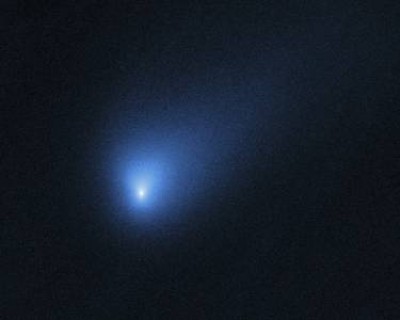
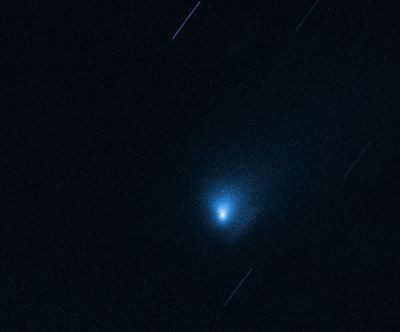
‘Interstellar’ objects remained in the realm of theory until 2017, when astronomers spotted the first known celestial object to be on a trajectory that meant it could only have come from outside the Solar System. Loeb made headlines when he speculated that the object, a comet-like body named ‘Oumuamua, was an artefact sent by an extraterrestrial civilization.
‘Oumuamua passed through the Solar System far from Earth, but Loeb hoped to find another interstellar object that had hit the planet. He later proposed that a bright meteor that appeared in the sky north of Papua New Guinea in January 2014 had an interstellar trajectory and could have scattered debris in the ocean.
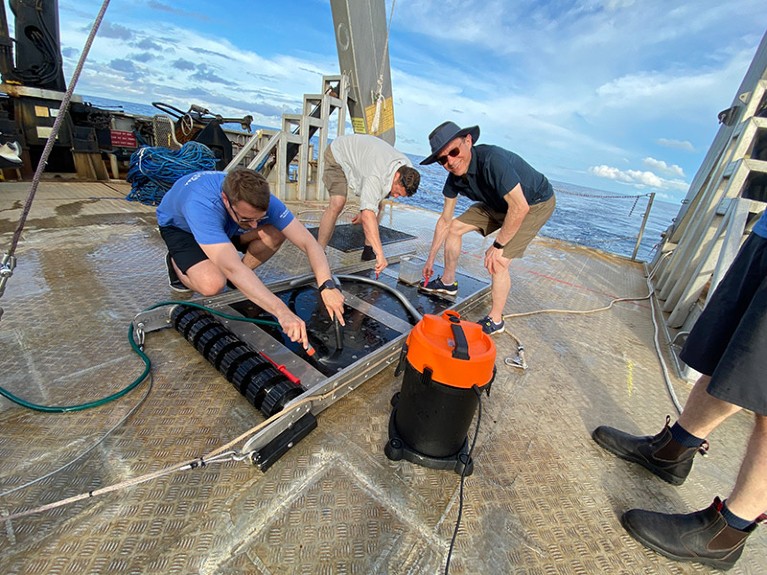
Avi Loeb (in hat) and colleagues recover particles from a magnetic sledge on their 2023 expedition.
Credit: Avi Loeb’s photo collection
In June 2023, Loeb led a privately funded expedition to the site that used magnetic sledges to recover more than 800 metallic spherules from the sea floor. Almost one-quarter of the spherules had chemical compositions indicating that they came from igneous, or once-molten, rocks. Of those, a handful were unusually enriched in the elements beryllium, lanthanum and uranium. The researchers concluded that those spherules are unlike any known materials in the Solar System1.
However, Desch counters that the spherules could have come from an asteroid impact in southeast Asia. Key to his proposal2 is a kind of soil called laterite, which forms in tropical regions when heavy rainfall carries some chemical elements from the topmost layers of soil into deeper ones. This leaves the upper soil enriched in other elements, including beryllium, lanthanum and uranium — similar to the composition of the spherules collected by Loeb and his colleagues. Desch says that an asteroid known to have struck the region around 788,000 years ago3 probably hit lateritic rock and created the molten blobs found by Loeb’s team.
In an e-mail to Nature, Loeb argues that spherules from an impact 788,000 years ago should have been buried by ocean sediments. Desch counters that sedimentation rates are relatively low in the offshore area where the spherules were collected.
But others are sceptical of Desch’s proposal, too. Scientists have yet to find any confirmed tektites from lateritic rock, notes Pierre Rochette, a geoscientist at Aix-Marseille University in Aix-en-Provence, France, who is not affiliated with either team. And very few tektites are magnetic, he says, so it would be difficult for Loeb and his colleagues to have pulled up hundreds from the sea floor.
Fiery critiques
Desch was not the only scientist to challenge Loeb’s work this week.
After Fu’s conference presentation, Ben Fernando, a seismologist at Johns Hopkins University in Baltimore, Maryland, spoke and took aim at claims concerning the 2014 meteor. Fernando and his colleagues, including Desch, analysed seismic and acoustic data gathered by ground-based sensors at the time the meteor hit the atmosphere4. Data from a seismometer on nearby Manus Island, which Loeb and his team studied as they were deciding where to dredge, show no characteristics of a high-altitude fireball — but do indicate a vehicle driving past, Fernando said. “This is almost certainly a truck,” he told the meeting. A second set of observations, made using infrasound sensors that listen for clandestine nuclear tests, seems to have detected the meteor hitting the atmosphere, but suggests it happened around 170 kilometres away from where Loeb’s team calculates.
Loeb told Nature that such critiques do not take into account US Department of Defense data that he says confirm the exact trajectory of that fireball. But because those data are held by the government, they have not been independently cross-checked by other scientists.
As conference-goers poured out of the room after his talk, Fu told Nature that Loeb’s team is working on further analyses, such as isotopic studies, that could shed more light on what the spherules are. After that, Fu said, he is looking forward to graduating and working on a new project — on how the Moon was formed.
A really interesting document found in the CIA archive speaks of a UFO attack, and a scrimmage held between Russian troops and extraterrestrials. The source of the information provided by the CIA document is based on the 250-page file obtained by the agency after the dissolution of the Soviet Union, which occurred under Mikhail Gorbachev in 1991.
This mysterious file is the primary source of the Russian military fight with extraterrestrials as stated by the CIA. In 1993, an unspecified Ukrainian newspaper wrote about an alien attack on the Russian soldiers at a military base in Siberia, citing KGB documents. The newspaper mentioned the presence of a 250-page KGB folder about this incident with photographs of the victims and pictures of the UFO itself.
The document stated that after the fall of the Soviet Union in 1991, many KGB files ended up in the CIA. The report said the fight between Russian troops and the alien creatures began when a low-flying UFO buzzed a routine Russian military training exercise. This apparent unexpected surveillance by a UFO caused one of the soldiers to unwisely launch a surface-to-air missile that hit the UFO — bringing it down not far from where the troops were assembled.
Former CIA director named R. James Woolsey. He headed the Central Intelligence Agency from February 5, 1993, until January 10, 1995.
The report said that five humanoids of short stature with large heads and large black eyes emerged from the wreckage of the fallen vehicle. They fired a brilliant white spherical ball of light toward the Soviet military, buzzing and hissing. The strange object exploded, turning 23 soldiers to stone. Two survivors of this battle with aliens told others what had happened
The transcript of the document is as follows: (Source)
“One of the CIA representatives referred to this case as a “Horrific picture of revenge on the part of extraterrestrial creatures, a picture that makes one’s blood freeze.”
According to the KGB materials, a quite low-flying spaceship in the shape of a saucer appeared above a military unit that was conducting routine training maneuvers. For unknown reasons, somebody unexpectedly launched a surface-to-air missile and hit the ufo. It fell to earth not far away, and five short humanoids with “Large heads and large black eyes” emerged from it.
It is stated in the testimonies by the two soldiers who remained alive that, after freeing themselves from the ‘debris, the aliens came close together and then “Merged into a single object that acquired a spherical shape.” That object began to buzz and hiss sharply and then became brilliant white.
In a few seconds, the spheres grew much bigger and exploded by flaring up with an extremely bright light. At that very instant, 23 soldiers who had watched the phenomenon turned into… Stone poles. Only two soldiers who stood in the shade and were less exposed to the luminous explosion survived.
The kgb report goes on to say that the remains of the ufo and the “Petrified soldiers” were transferred to a secret scientific research institution near Moscow. Specialists assume that source of energy that is still unknown to earthlings instantly changed the structure of the soldiers’ living organisms, having transformed it into a substance whose molecular composition is no different from that of limestone.
A CIA representative stated: “If the KGB file corresponds to reality, this is an extremely menacing case. The aliens possess such weapons and technology that go beyond all our assumptions, they can stand. Up for themselves if attacked.”
September 8, 1992, US fantasy and conspiracy magazine Weekly World News published an incredible story where in 1987 over Siberia an alien ship was shot down. Source
It cannot be denied that what has been reported so far sounds like the plot of a science fiction series or movie. However, it is important enough to be included in an official CIA document, which concludes that if this case is real, it is something really “threatening,” since “aliens have weapons and technology that go beyond our assumptions with which they can defend themselves if attacked.”
Besides, UFOs with the ability to change shape have often been spoken of by eyewitnesses, and the sequence of transformation of the aliens into a single entity is something sometimes described in legitimate ufological cases – the latter seems to be an otherworldly method used by these alien creatures to protect themselves or destroy others.
On the other hand, the unusual death of the Russian soldiers turned to stone is reminiscent of God’s so-called “angels” who destroyed Sodom and Gomorrah in the Bible and turned Lot’s wife into a pillar of salt.
“As the cities were being demolished, Lot’s wife “looked back, and she became a pillar of salt” (Genesis 19:26). It appears to be the same molecular shift technology, which is more advanced than anything developed here on Earth so far.
And it is that if in the Holy Scriptures we replace the word “angels” with “aliens,” many events acquire a technological nuance, where these beings from heaven and under the command of a vengeful god called Yahweh, used their advanced weapons to assassinate peoples and destroy entire cities.
The U.S. Naval Research Lab (NRL) is assisting an investigation into unexplained arctic phenomena associated with the sudden formation of intense “polar lows” that are known to lead to hazardous conditions at sea.
Since late February, a field campaign, the Cold-Air outbreak Experiment in the Sub-Arctic Region, or CAESAR, has been collecting data on the phenomenon underlying these potentially dangerous arctic events by observing cloud formations and other Arctic meteorological conditions.
“These subjectively beautiful clouds serve as a natural lab to study cloud dynamics at a wide range of scales,” said Bart Geerts, a professor of atmospheric science at the University of Wyoming and a CAESAR principal investigator, last month.
Based in Kiruna, Sweden, CAESAR is comprised of an international team of scientists and is attempting to determine the meteorological processes underlying Arctic cold-air outbreaks (CAOs), events that pose a threat to sailing vessels and can potentially cause disruptions to Arctic weather systems.
UNDERSTANDING COLD-AIR OUTBREAKS
Recognized as one of the most extreme and sudden forms of meteorological transformations in air mass known to occur, cold-air outbreaks are the result of freezing Arctic air moving from over regions of icy ocean or frozen land masses to areas where warmer ocean waters exist.
When this occurs, extreme wind conditions can lead to dangerous seas as convective boundary layers create small, localized regions of intense Arctic cold known as “polar lows.”
These abrupt spikes in cold temperatures not only create potentially dangerous conditions for sailing vessels that include military operations conducted by the U.S. Navy and other world militaries but also significantly impact ocean circulation and weather conditions throughout the Arctic.
To aid in CAESER’s research effort, the NRL has assigned James Doyle, Ph.D., an NRL research meteorologist, to participate in the campaign.
“Despite the profound impact that CAOs have on atmospheric and oceanic circulations in the Arctic, as well as the important implications for Navy operations, surprisingly little is known about the nature of intense surface flux impacts on the atmosphere and ocean boundary-layer structure,” Doyle in a recent statement.
A HAZARD TO NAVAL OPERATIONS
Understanding what causes CAOs to occur is particularly important for Navy operations, not only for safety reasons but also because of the way these sudden, often unexpected changes in atmospheric and ocean conditions can greatly impact the behavior of acoustic and electromagnetic propagation, thereby creating difficulties for Naval officers who rely on instrumentation that monitor these frequencies.
However, gaining a deeper understanding of CAOs has been hindered both by the challenging conditions they induce, as well as how suddenly and unexpectedly they can occur.
“The nature of the air-sea-ice interaction and cloud processes in CAOs are rapid with abrupt transitions,” Doyle says, “which have been a roadblock to process understanding and model predictions.”
A specialized C-130 aircraft provided by the National Science Foundation (NSF) and National Center for Atmospheric Research (NCAR) will assist in the CAESAR campaign’s investigations
(Credit: Dan Zietlow/NSF/NCAR).
To successfully investigate CAOs, part of the CAESAR campaign’s strategy involves focusing on atmospheric boundary layer properties, as well as clouds that are known to develop coinciding with CAOs. Additionally, storm conditions that have been identified with CAOs are also being investigated.
UNEXPLAINED ARCTIC PHENOMENA
Based on current data, Doyle says that hazardous conditions normally develop when interactions between air pockets and the ocean begin to intensify, which leads to the production of convective cells, and in some cases, the extremely intense, yet very small polar lows.
“Conventional theories and model parameterizations in Arctic CAOs have been lacking this vital data,” Doyle says, adding that “CAESAR will provide a detailed characterization that will form the basis for NRL boundary layer and coupled modeling studies.”
Although CAESAR will conclude in April, its current efforts to resolve these unexplained arctic phenomena include the use of a specialized C-130 Hercules aircraft provided by the National Science Foundation (NSF) and National Center for Atmospheric Research (NCAR) center that is equipped with remote sensing capabilities and deployment of dropsondes that will collect information on the Arctic air mass.
The C-130 also showcases airborne radar, LiDAR, and aerosol and cloud precipitation probes which can be activated when conditions matching CAO events are identified.
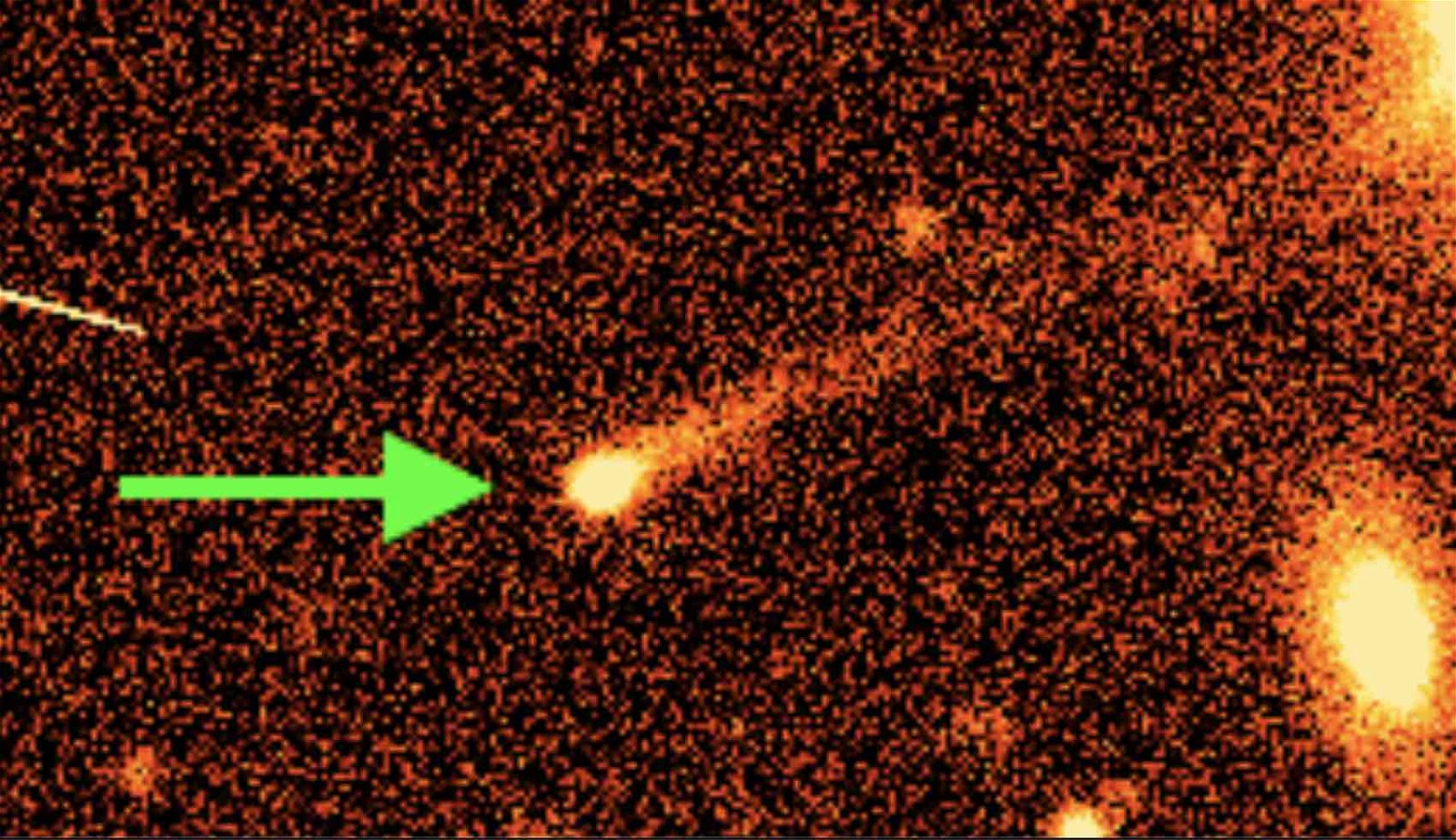
Fifteen rare asteroids showcasing very unusual “active” properties have been detected as part of an ongoing international volunteer effort to unravel the mysteries of a peculiar variety of space objects.
The asteroids were spotted amid 430,000 images during an effort comprising more than 8000 volunteers who scoured images from the Dark Energy Camera, or DECam, on Chile’s Victor M. Blanco telescope.
Founded by Colin Orion Chandler, Ph.D., a University of Washington and DiRAC Institute scientist, the Active Asteroids project continues to leverage the work of volunteers in its ongoing search for asteroids possessing these unusual properties.
What makes these “active” objects so rare is that they possess traits that blur the lines between asteroids and other kinds of celestial objects, as some of them possess tails like comets, while others are enveloped in pockets of dust or gas.
Since their first discovery in 1949, only a few dozen of the rare asteroids have ever been discovered.
According to NASA, the properties these objects display challenge our conventional ideas about objects in the solar system, and present opportunities for new insights about the behavior and origins of these rare “active” asteroids.
Among the things astronomers hope to learn from studying these objects are insights into solar system evolution and the formation of planets, as well as clues to the origins of water on Earth.
Active asteroids may also help provide valuable resources for future space missions, since the ice within their tails could be used for a range of applications in deep space that include providing breathable air, to help power spacecraft on long missions.
The fifteen newest additions to the growing number of active asteroids currently known to exist are described in a new paper in the Astronomical Journal.
a comet tail coming from Asteroid 2015 VA108, one of the active asteroids spotted by volunteers from NASA’s “Active Asteroids” Citizen Science project (Credit: Colin Orion Chandler/University of Washington).
For many of the Active Asteroid project’s participants, helping to spot these odd space objects has been a life-changing experience. Virgilio Gonano, an Italian amateur astronomer and one of the volunteers who helped make the discoveries, said it was a “dream come true” to be able to be part of such an effort.
Tiffany Shaw-Diaz, a volunteer from Dayton, Ohio, said that she has been a member of Active Asteroids since the project produced some of its earliest results.
“To say that this project has become a significant part of my life is an understatement,” Shaw-Diaz recently said. “I look forward to classifying subjects each day, as long as time or health permits, and I am beyond honored to work with such esteemed scientists on a regular basis.”
There’s potentially good news for others who may be interested in joining the volunteer-driven effort: Active Asteroids is seeking additional volunteers for its growing network of contributors. Who knows, you may even be the next volunteer who helps them spot an asteroid that behaves a lot like a comet. More about the project can be found online at the project’s official website.
Op 14 november 1971 gebeurde er iets wat cruciaal was voor ons begrip van onze rode buurplaneet, Mars.
Na een ruimtereis van 167 dagen arriveerde de onbemande NASA-sonde Mariner 9 in het gebied rond de rotsplaneet en bracht zichzelf als het eerste ruimtevaartuig ooit in een baan om Mars.
Binnen een jaar wist de satelliet beelden vast te leggen van ongeveer 80 procent van het grillige oppervlak, waar bijvoorbeeld grote ravijnen in zitten, maar ook oude kraters en droge riviergeulen.
Maar blijkbaar hebben astronomen een groot landschapselement over het hoofd gezien op de in totaal ruim 7000 foto’s die in 50 jaar zijn gemaakt.
Dat kwam aan het licht tijdens een jaarlijkse maan- en planeetconferentie in Texas, halverwege maart 2024.
Hier onthulden astronomen van het SETI Institute en het Mars Institute van NASA Ames Research Center de ontdekking van een gigantische vulkaan die zich al decennia schuilhoudt op een van de meest iconische plekken van de planeet: de grens tussen een gebied dat bekendstaat om zijn diepe, doolhofachtige dalen en een groot kloofsysteem, dat langs de evenaar loopt en her en der tot wel 7 meter diep is.
‘We waren bezig met geologisch onderzoek in een gebied waar we afgelopen jaar de resten van een gletsjer ontdekten toen we beseften dat we in een enorme, geërodeerde vulkaan zaten,’ zegt onderzoeksleider dr. Pascal Lee in een persbericht.
Uitbarsting is al lang gaande
De pas ontdekte vulkaan, die voorlopig de naam Noctis-vulkaan heeft gekregen, is uitgestrekt over 450 kilometer en heeft een hoogte van 9022 meter.
De onderzoekers zeggen dat zowel de grootte als de vorm van de vulkaan erop wijzen dat de reus al vroeg in de geschiedenis van de planeet zijn krachten verzamelde, en zeer lange tijd actief is geweest.
De pas ontdekte megavulkaan (rode ring) ligt ten zuiden van de evenaar van de planeet, in het oostelijke deel van het doolhofachtige gebied Noctis Labyrinthus en in het westelijke deel Valles Marineris, een gebied met kloven met een diepte van 2 tot 7 kilometer. Ter vergelijking: het diepste punt van Grand Canyon is 1800 meter.
Maar de reusachtige vulkaan is niet de enige nieuwe ontdekking in het iconische gebied.
In het zuidoostelijke deel van de vulkaan ligt een nieuwere, smalle afzetting, waar volgens de onderzoekers gletsjerijs verstopt kan zitten.
De onderzoekers noemen de ontdekkingen opmerkelijk, want ze wijzen in de richting van een nieuw gebied, dat interessant kan zijn als we meer willen weten over de ontwikkeling van de planeet door de tijd heen en mogelijke tekens van leven.
De reden dat we tientallen jaren de 450 kilometer brede reus over het hoofd hebben gezien, moeten we zoeken in het grillige en gehavende landschap. Daardoor ging de als het ware op in de omgeving.
Op de rotsplaneet zijn meerdere grote, slapende vulkanen uit een ver verleden te vinden.
Een daarvan heet Olympus Mons en is met zijn 25 kilometer hoogte en 600 kilometer breedte de grootste vulkaan in het zonnestelsel.
A long-awaited Pentagon report says there is "no verifiable evidence" of the U.S. government encountering or concealing evidence of alien life.
The Pentagon, Washington DC, USA.
(Image credit: Glowimages via Getty Images)
The U.S. government is not hiding aliens or their spaceships — although it did once propose a program to reverse-engineer any hypothetical alien technology it found, a Department of Defense (DOD) report reveals.
The Pentagon report, a highly anticipated review of classified documents from 1945 to 2023 that was submitted to Congress Friday (March 8), found no evidence that the U.S. government has encountered aliens or covered up their existence.
Instead, the report blames UFO sightings in the 1960s on top-secret flights of prototype American spy planes and spacecraft. And while the U.S. government did consider a program to reverse-engineer any captured alien ships in the 2010s, no craft were ever found and the proposal was rejected for "lacking merit," according to the report.
There is "no verifiable evidence for claims that the U.S. government and private companies have access to or have been reverse-engineering extraterrestrial technology," Maj. Gen. Pat Ryder, the Pentagon press secretary, said in a statement after the report's release. The report also found "no evidence that any U.S. government investigation, academic-sponsored research, or official review panel has confirmed that any sighting of a UAP [unidentified aerial phenomenon] represented extraterrestrial technology."
"All investigative efforts, at all levels of classification, concluded that most sightings were ordinary objects and phenomena and the result of misidentification," Ryder added.
The 63-page review was made by the Pentagon's All-domain Anomaly Resolution Office (AARO), which was established in 2022 to investigate and manage reports of UFO sightings from the U.S. Army, Navy and Air Force. The review included classified and unclassified archical evidence, full access to all secretive government programs related to UFOs, and 30 interviews with intelligence personnel.
The U.S. government's renewed interest in UFOs came after a 2017 leak of three now-infamous video clips that appeared to show mysterious, wingless aircraft flying at hypersonic speeds past dumbfounded U.S. Navy pilots. In 2020, the U.S. Senate Select Committee on Intelligence called for an inquiry into UFOs, and in June 2021, the Pentagon released a report on more than 140 UFO sightings by Navy pilots. That report concluded there was no evidence of alien activity in any of the instances.
Despite those findings, the government's interest in UFOs drove news outlets and social media sites into frenzies of speculation. The conspiracy theories reached their apex when, in July 2023, David Grusch, a former U.S. intelligence official and whistleblower, claimed that the government had been secretly investigating crashed UFOs. In his congressional hearing, Grusch told the House Committee on Oversight and Reform that not only had spaceships been recovered but that "nonhuman" beings had been found inside.
Despite bluntly contradicting many of Grusch's claims, the report does mention a brief period when the Pentagon considered a program to reverse-engineer alien technology. Called Kona Blue, it was proposed to the Department of Homeland Security (DHS) by individuals who suspected the U.S. government was hiding crashed UFOs.
"This proposal gained some initial traction at DHS to the point where a 35 Prospective Special Access Program (PSAP) was officially requested to stand up this program, but it was eventually rejected by DHS leadership for lacking merit," the report said. "It is critical to note that no extraterrestrial craft or bodies were ever collected — this material was only assumed to exist by Kona Blue advocates and its anticipated contract performers."
The AARO said that later this year it will publish a second volume of the report covering sightings made between November 2023 and April 2024. The office also announced that the DOD is working on a portable sensor kit called the "Gremlin system" to investigate UFO sightings as they occur.
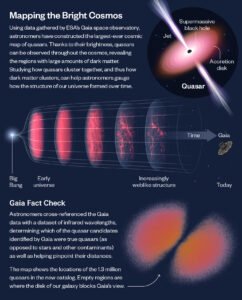
An international team of astronomers has revealed a three-dimensional map of the known universe that charts the largest-ever volume of the extended cosmos. The tools used to create the map were initially designed to measure stars in our galaxy. However, their sensitivity revealed the locations of quasars powered by supermassive black holes at the centers of other galaxies, leading to the map’s eventual creation.
“This quasar catalog is different from all previous catalogs in that it gives us a three-dimensional map of the largest-ever volume of the universe,” says map co-creator David Hogg, a senior research scientist at the Flatiron Institute’s Center for Computational Astrophysics in New York City and a professor of physics and data science at New York University. “It isn’t the catalog with the most quasars, and it isn’t the catalog with the best-quality measurements of quasars, but it is the catalog with the largest total volume of the universe mapped.”
MAP OF THE KNOWN UNIVERSE COMBINES DATA FROM MULTIPLE OBSERVATORIES
Fans of the movie Star Trek: Generations may recall the map of the known universe used by Captain Picard and Commander Data to track an anomaly across vast regions of space known as the Nexus. Of course, such a detailed map covering the entire cosmos has thus far existed only in the world of science fiction. Now, a team of Flatiron Institute researchers say they have created the first-ever real-world map of the known universe, bringing yet another concept from science fiction to science fact.
To create their map of the known universe, the researchers compiled data from the European Space Agency’s Gaia Space telescope, which included over 6.6 million quasar candidates. That data was then compared against observations collected by NASA’s Wide-Field Infrared Survey Explorer and the Sloan Digital Sky Survey, allowing the map’s creators to remove “noise” from the final product, including from other stars and galaxies, which resulted in a final 1.3 million quasars ending up in the final version of the map. The team also mapped dust and other “nuisances” that may block out certain quasars from observation.
An infographic explaining the creation of a new map of around 1.3 million quasars from across the visible universe. CREDIT: ESA/Gaia/DPAC; Lucy Reading-Ikkanda/Simons Foundation; K. Storey-Fisher et al. 2024.
As previously noted, Gaia’s primary mission involved mapping stars in the Milky Way Galaxy. However, the researchers behind this latest effort found that Gaia “inadvertently spots objects outside the Milky Way.” This includes supermassive quasars dating back to 1.5 billion years after the Big Bang.
“We were able to make measurements of how matter clusters together in the early universe that are as precise as some of those from major international survey projects—which is quite remarkable given that we got our data as a ‘bonus’ from the Milky Way–focused Gaia project,” explained the paper’s lead author, Kate Storey-Fisher.
While black holes themselves typically emit no light, quasars driven by supermassive black holes are often hundreds of times brighter than entire galaxies. That’s because the extreme gravitational pull of black holes at the center of galaxies collects and “spins up” nearby gas, resulting in an enormously bright disk that can be spotted across the space between galaxies. The result is a massive collection of bright objects that can be spotted by humanity’s most advanced telescopes, leading to the creation of the cosmic map.
NEW MAP ALREADY PAYING SCIENTIFIC DIVIDENDS
In their published study, which appears in The Astrophysical Journal, the researchers behind the largest-ever map of the known universe say their tool is already paying dividends. For instance, the data gathered by Gaia was recently compared against the light from the Big Bang, known as the cosmic microwave background. According to the researchers, this comparison will allow scientists to measure how matter clumps together throughout the cosmos.
The map is also likely to aid scientists who are trying to unravel the mystery of dark matter, as enormous rings of dark matter surround these individual quasars. In fact, the researchers say they expect their new largest-ever map of the known universe to aid astronomers and astrophysicists across a wide range of research efforts.
“It has been very exciting to see this catalog spurring so much new science,” Storey-Fisher says. “Researchers around the world are using the quasar map to measure everything from the initial density fluctuations that seeded the cosmic web to the distribution of cosmic voids to the motion of our solar system through the universe.”
“This quasar catalog is a great example of how productive astronomical projects are,” adds Hogg. “Gaia was designed to measure stars in our own galaxy, but it also found millions of quasars at the same time, which give us a map of the entire universe.”
Christopher Plain is a Science Fiction and Fantasy novelist and Head Science Writer at The Debrief. Follow and connect with him on X, learn about his books at plainfiction.com, or email him directly at christopher@thedebrief.org.
A new paper suggests that the “zoo hypothesis” may explain why we haven’t heard from aliens yet
Extraterrestrial societies may have advanced means to conceal themselves
One of the researchers thinks we’ll get proof of extraterrestrials within 15 years
Where are all the aliens? This question hasn’t just puzzled UFO enthusiasts but has been the subject of longstanding scientific inquiry. Famously, during one lunch-time conversation in 1950, Enrico Fermi, the Nobel-Prize-winning physicist who was known as the “architect of the nuclear age,” asked his colleagues a similar question – “where is everybody?”
Fermi asked this question of fellow physicists Edward Teller, Herbert York, and Emil Konopinski, referring to the fact you’d think in a 13.8 billion-year-old universe that’s teeming with ingredients for life, we would have encountered alien intelligence by now.
This vital question from Fermi became known as the “Fermi paradox,” and now a new paper tackles the possibility that it may be resolved by figuring out whether extraterrestrial civilizations are absent from our galaxy or perhaps they do exist but are hiding from us — in an argument known as the “zoo hypothesis.”
Why the ‘great silence’?
The new paper, published in Nature Astronomy, comes from a team of Ian A. Crawford, Professor of Planetary Science and Astrobiology at UCL/Birbeck College, and Dirk Schulze-Makuch, Professor of Planetary Habitability and Astrobiology at the Technical University of Berlin, and several other institutions.
The scientists aimed to address in their work that even after decades of observation and a variety of SETI surveys that looked for radio transmissions and techno signatures of advanced civilizations, more needs to be detected. What explains the conundrum of such a “great silence”?
The researchers believe a possible explanation could be that the so-called Hart-Tipler Conjecture is true, which basically maintains that the absence of evidence for alien life forms can only be explained by the absence of ExtraTerrestrial Civilizations (ETCs) altogether. It may also be that intelligent life is rare since the odds against it emerging are so great – due to the so-called Great Filter.
Alternatively, if neither of these possibilities is the reason for the Great Silence, then the zoo hypothesis may be correct. The ETCs are just doing a good job of preventing us from detecting them.
In an exchange with Universe Today, Crawford elaborated: “Either we would never expect to observe them because space is so big, etc., [or] we don’t observe them because they have taken steps to ensure that we don’t ( this is the Zoo Hypothesis).”
What is the zoo hypothesis?
This idea, first put forth in 1973 by John A. Ball, a radio astronomer with ties to Harvard University and MIT, suggests that advanced alien species may know we exist but stay clear of us on purpose. They don’t want to interfere with our evolution and societal development. As Ball said, “…the only way that we can understand the apparent non-interaction between ‘them’ and us is to hypothesize that they are deliberately avoiding interaction and that they have set aside the area in which we live as a zoo.”
Perhaps the extraterrestrials are of higher intelligence and there may exist some sort of Star-Trek-like Prime Directive to not disrupt or contaminate the path of lower-level beings (like humans). This assumes the aliens are rather high-minded and do not want to harm us, as many of our movies on the subject imagine.
In the interview with Universe Today, Professor Crawford shared that if advanced technological life forms exist, they are likely hiding. On the other hand, he thinks it’s more probable they don’t exist at all.
His colleague Schulze-Makuch believed the zoo hypothesis was behind the lack of aliens. He bases this on the recent UFO report, which clarified the great amount of unidentified aerial phenomena (UAP) that make it hard to ignore the possibility of extra-terrestrial intelligence (ETI) being behind some of them. He also sees it unlikely that humans are all on their own considering the vastness of the cosmos.
”While I do think that humanity is something very special, being a technologically advanced life form, I can’t fathom that we are truly unique or so rare in that capability that—for practical reasons—nothing is out there,” wrote the scientist.
Finding ETIs
The scientists think that there are paths we should take to truly find out the answer to one of life’s biggest mysteries – are we alone in the universe? These include SETI surveys and looking for techno-signatures of structures like Dyson Spheres that advanced civilizations might have created. “We can only assert an absence of evidence if we have searched for evidence sufficiently hard,” they write in their paper.
As exoplanet studies advance, aided by our advanced tech like the James Webb Space Telescope, it may also be soon possible to look for “biosignatures” of life on planets outside the Solar System. This scientific power will allow tracking traces of life, biological events, and even intelligence.
Schulze-Makuch believes that if the aliens were hiding from us as per the zoo hypothesis, no matter how well they were doing it, we would still be able to find them one day as our technologies get more and more powerful.
In line with that thinking, the professor predicts, based on the current rate of our technological advancement that we’ll get proof of extraterrestrials within 15 years. He even has a bet going with his partner Ian on this eventuality. “But the timeline is, of course, difficult to predict and depends to a large degree also on how fast the progress will be, and how attentive the ‘Zoo keepers’ are or what their aim is,” he pointed out.
Could the aliens have a Prime Directive?
If the aliens are indeed ghosting us, is that due to some intergalactic agreement not to contaminate the growth of lower-level species like ours? An earlier study actually took a look at that very question.
In his 2016 paper “The Galactic Club, or Galactic Cliques? Exploring the limits of interstellar hegemony and the Zoo Hypothesis,” Duncan Forgan of the University of St. Andrews in the UK, presented a mathematical simulation of the galaxy that tracked how advanced alien civilizations might go about creating a galactic treaty. Its goal would be to safeguard primitive societies, like ours might appear to them.
Forgan tried to account for how communication between civilizations would be handled, looking at what kind of overlap would be necessary for messages to be passed along. He also considered what parts of the galaxy would be more habitable and the different types of leadership these alien societies might have.
The researcher’s model showed that the degree of contact between the civilizations would depend on their amount. Fewer societies in existence would mean less potential contact.
The model also suggests that if civilizations lived for less than a million years, there would likely be several galactic groupings, with no full consensus emerging, and you would need to make a treaty that involved everyone. But if all civilizations lived well past a million years, the models propose that a single “galactic club” could exist.
As Forgan wrote, “If civilization cliques do come into contact, it is likely they will hold significantly different perspectives on the universe, and the rights and responsibilities of sentient beings and the institutions they construct.”
We've Got 'Multiple US Military Whistleblowers' Saying There's Video of a UFO Shooting Down a Nuke With a Laser Beam
Jerry Thornton
David Wall Getty Images..
I'm disappointed by the way the federal government's "transparency" on the UFO phenomenon over promised and under delivered. You're probably disappointed. We're all disappointed. And it feels increasingly likely that what little they have actually revealed is part of some coordinated key-jingling operation to distract us from what they've really been hiding all along.
Yet there are elements of UFO/UAP reporting that can't be dismissed. Namely how many of these crafts appear around our most sensitive nuclear defense facilities. Enough that it's hard to believe it's all random and not part of a pattern. There's no shortage of UFO researchers who believe the infamous crash at Roswell can be traced directly to the atomic bomb research by J. Robert Oppenheimer's team at Los Alamos. That splitting the atom attracts them like a magnet.
And there have even been multiple reports down through the years of them appearing over our nuclear missile facilities and demonstrating the power to disarm them.
But never a story quite like this one:
Source -The US military is in possession of a video of a UFO apparently disabling a nuclear warhead during a routine test, according to multiple former officials.
They claim the video in question captured a saucer-shaped craft circling the unarmed, dummy warhead shortly after it detached from the Atlas missile booster, then shooting four beams of light at the warhead, disabling it.
Retired US Air Force officers Lieutenant Bob Jacobs and Major Florenze Mansmann claim to have viewed the recording of the 1964 encounter before the tape went missing.
The former officials were part of a team responsible for capturing video of missile test launches in California with telescopic photography and videography equipment.
Two days later, after they screened the video, they claim that two plain-clothed CIA agents confiscated the footage and swore them to secrecy. …
The alleged incident occurred nearly six decades ago, on September 15, 1964, but it has more recently come into public knowledge due to author Robert Hastings investigating it.
Luis Elizondo acknowledged the existence of the video and claimed he has seen it [and] he was the former director of the Pentagon's Advanced Aerospace Threat Identification Program (AATIP) program to study UFOs. …
The craft inadvertently caught on film was domed and disc-shaped, according to Jacobs and Mansmann.
It was a 'classic disc, the center seemed to be a raised bubble…the entire lower saucer shape was glowing and seemed to be rotating slowly,' according to a letter Mansmann wrote about the incident in 1983.
'At the point of beam release…the object turned like an object required to be in a position to fire from a platform …'
Beyond the video, there is some limited evidence supporting the story.
A declassified but unreleased set of radar data of the September 15, 1964 event apparently confirmed that an unidentified aerial object was observed near the dummy warhead during the missile test, a source told Hastings.
Great. Just great. Classic 1950s flying saucers with rotating discs shooting our nuclear test missiles out of the sky with fricking space lasers like the Death Star:
Giphy Images.
Our missile defense researchers have it captured on video, but the Men in Black had to grab it and hide it in a secret wall safe hidden behind a portrait of whoever really killed JFK for the past 60 years. This I guess is what we're paying them for and why the Pentagon can't ever pass a budget. Because all the money is going to running around hiding videos that would change the course of history like they're sex tape.
I can understand why the deep state operatives choose to keep some stuff hidden from the public. They can justify it by telling themselves that if we knew the truth it would create distrust in the government and society would collapse or whatever. But aliens shooting down and disarming nukes would have the exact opposite effect.
If anything, it would make everyone feel safer. We'd sleep better at night knowing that aliens or whoever are here keeping us safe from each other. The human race figured out how to destroy itself. And we're basically a toddler who found dad's gun and are playing with it. It's comforting to think there's some adult supervision in the cosmos making sure the gun isn't loaded so we can keep running around pointing it at each other in blissful ignorance.
That alternative beats the hell of out living life knowing we're all one madman starting nuclear armageddon monkey business away from the Age of the Cockroaches on our home world. So release the video, for crying out loud. Not only do we deserve to see it finally, it'll give us something to watch now that football is over
NASA Reveals its Planetary Science Goals for Artemis III
If all goes well, NASA’s Artemis III mission will bring humans back to the Moon as early as 2026, the first time since the Apollo 17 crew departed in 1972. It won’t be a vacation, though, as astronauts have an enormous amount of science to do, especially in lunar geology. A team from NASA recently presented their planetary science goals and objectives for Artemis III surface activities, which will guide the fieldwork the astronauts will carry out on the lunar surface.
The landing site hasn’t been chosen yet, but it will be within 6 degrees of latitude from the South Pole. These instruments will collect valuable scientific data about the lunar environment, the lunar interior, and how to sustain a long-duration human presence on the Moon, which will help prepare NASA to send astronauts to Mars.
“Artemis marks a bold new era of exploration, where human presence amplifies scientific discovery. With these innovative instruments stationed on the Moon’s surface, we’re embarking on a transformative journey that will kick-start the ability to conduct human-machine teaming – an entirely new way of doing science,” said NASA Deputy Administrator Pam Melroy. “These three deployed instruments were chosen to begin scientific investigations that will address key Moon to Mars science objectives.”
Two of the three main Artemis science goals and the instruments deal with understanding the Moon itself. The Lunar Environment Monitoring Station (LEMS) is a compact, autonomous seismometer suite will help study planetary processes, while the Lunar Dielectric Analyzer (LDA) will aid in understanding the character and origin of lunar polar volatiles. The third main science objective will investigate how to mitigate the risks of human exploration, and to that end the Lunar Effects on Agricultural Flora (LEAF) instrument will investigate the lunar surface environment’s effects on space crops to see if the lunar regolith can be used to grow food.
Artist’s concept of an Artemis astronaut deploying an instrument on the lunar surface. Credits: NASA
Falling under the planetary science goals with the two instruments, scientists have laid out four main objectives, which are designed to be “site agnostic,” so that they can be performed at any landing site, or be able to be modified to fit with any future chosen landing site.
A. Understand the Early Evolution of the Moon as a Model for Rocky Planet Evolution
The main objective here is to evaluate the leading theory of the Moon’s early days, which is the Lunar Magma Ocean (LMO) theory. It is theorized that a layer of molten rock was present on the surface of the Moon from the time of the Moon’s formation (about 4.5 or 4.4 billion years ago) to tens or hundreds of millions of years after that time, which led to the formation of the crust, mantle, and core. While the LMO model is supported by many observations, it is not supported by all.
The scientists said gathering samples from the Moon’s polar region and comparing the ages and chemical and isotopic compositions of the new samples to those collected by the Apollo astronauts will help to evaluate the current LMO model and perhaps “find alternate or more complex LMO models.” Scientists would also like to determine the composition of the lower crust, and mantle materials if possible.
Artist’s impression of the impact that caused the formation of the Moon. Credit: NASA/GSFC
Another theory that scientists hope to put under scrutiny during the Artemis program is the giant impact hypothesis. This is the most widely accepted theory for the origin of the Earth–Moon system, which proposes the Moon formed during a collision between the Earth and another small planet, about the size of Mars. The debris from this impact collected in an orbit around Earth to form the Moon. However, similarities between the Earth and Moon don’t quite fit that model, the majority of the Moon’s material should originate from the impactor. “The Artemis III samples will allow new assessments of the formation process and age of the Moon,” the scientists wrote.
B. Determine the Lunar Record of Inner Solar System Impact History.
Impacts played a big role in the early history of our Solar System, and scientists say they would like to determine the age of South Pole Aitken (SPA) Basin, the oldest known lunar impact basin. “This will provide key new information for determining when the record of bombardment starts and how complete that early record is,” the scientists wrote. They also hope to determine the sources of early impactors, which will provide a fundamental benchmark for understanding the ages of surfaces across the Solar System.
Scientists would also like to gather data to test the Lunar Cataclysm Hypothesis, a theory that says an intense period of bombardment occurred on the Moon about 3.9 billion years ago, where about 80% of the Moon was “resurfaced,” with the formation of approximately 1,700 craters 100 kilometers in size or larger. This hypothesis is controversial, but determining if this period of bombardment did occur would help scientists determine if a similar cataclysmic bombardment may have affected life on Earth or been involved in life’s origins.
For the two above goals, the Lunar Environment Monitoring Station (LEMS) will carry out continuous, long-term monitoring of the seismic environment, namely ground motion from moonquakes, in the lunar south polar region. This instrument is expected to operate for at least three months and up to two years and may become a key station in a future global lunar geophysical network. NASA said the instrument will characterize the regional structure of the Moon’s crust and mantle, providing valuable information to analyze the current lunar formation and evolution models.
C & D: Determine the Variability of Regolith in the Circumpolar Environment as a Keystone for Understanding Surface Modification of Airless Bodies, and Reveal the Age, Origin, and Evolution of Solar System Volatiles
The Moon’s poles – and especially the permanently shadowed regions – have been compared to an attic in an old house, because it likely contains a record of history. On the Moon, the “attic-like” regions near the poles would still hold the exogenous material delivered to the inner Solar System. Since the terrestrial record of the early Earth is largely lost, finding it on the Moon would be extremely valuable.
A map showing the permanently shadowed regions (blue) that cover about 3 percent of the moon’s south pole. Credit: NASA Goddard/LRO mission
“Little is known about cold-trapped volatile composition, abundance, age, and the general ability of the Moon to retain volatiles over time,” the scientists wrote. “….Assessing volatiles in cold traps of varying thermal environments and age will provide key new observations to understand their nature.”
And there’s also growing evidence for the presence of lunar polar volatiles like water, hydrogen, and methane, which would be extremely important for future long-term habitation on the Moon. Scientists also want to study how volatiles might be transported across the lunar surface, as such transport has yet to be measured on the Moon, and how it might occur – whether it driven by diurnal temperature changes, solar wind or and micrometeoroid delivery across the Moon.
The Lunar Dielectric Analyzer (LDA) will help in these studies as it will measure the regolith’s ability to propagate an electric field, which is a key parameter in the search for lunar volatiles, especially ice. It will gather essential information about the structure of the Moon’s subsurface, monitor dielectric changes caused by the changing angle of the Sun as the Moon rotates, and look for possible frost formation or ice deposits.
With the Artemis program, NASA will land the first woman, first person of color, and its first international partner astronaut on the Moon, and with the goal of establishing long-term exploration for scientific discovery and preparation for human missions to Mars for the benefit of all.
Meer van UFO'S of UAP'S, ASTRONOMIE, RUIMTEVAART, ARCHEOLOGIE, OUDHEIDKUNDE, SF-SNUFJES EN ANDERE ESOTERISCHE WETENSCHAPPEN - DE ALLERLAATSTE NIEUWTJES


 Astronauts Have Surprising Ability to Orient Themselves and Gauge Distance Traveled in Space: Study