 NASA Takes Six Advanced Tech Concepts to Phase II
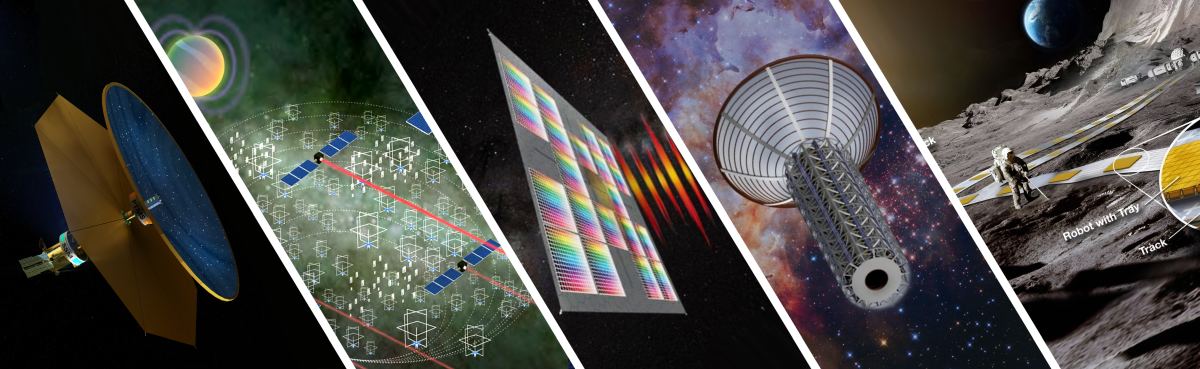
It’s that time again. NIAC (NASA Innovative Advanced Concepts) has announced six concepts that will receive funding and proceed to the second phase of development. This is always an interesting look at the technologies and missions that could come to fruition in the future.
The six chosen ones will each receive $600,000 in funding to pursue the ideas for the next two years. NASA expects each team to use the two years to address both technical and budgetary hurdles for their concepts. When this second phase comes to an end, some of the concepts could advance to the third stage.
“These diverse, science fiction-like concepts represent a fantastic class of Phase II studies,” said John Nelson, NIAC program executive at NASA Headquarters in Washington. “Our NIAC fellows never cease to amaze and inspire, and this class definitely gives NASA a lot to think about in terms of what’s possible in the future.”
Here they are.
1. Fluidic Telescope (FLUTE): Enabling the Next Generation of Large Space Observatories
Telescopes are built around mirrors and lenses, whether they’re ground-based or space-based. The JWST’s large mirror is 6.5 meters in diameter but had to be folded up to fit inside the rocket that launched it and then unfolded in space. That’s a tricky engineering feat. Engineers are building larger and larger ground-based telescopes, too, and they’re equally tricky to design and build. Could FLUTE change this?
FLUTE envisions lenses made of fluid, and the FLUTE team’s concept describes a space telescope with a primary mirror 50 meters (164 ft.) in diameter. Creating glass lenses for a telescope this large isn’t realistic. “Using current technologies, scaling up space telescopes to apertures larger than approximately 33 feet (10 meters) in diameter does not appear economically viable,” the FLUTE website states.
But in the microgravity of space, fluids behave in an intriguing way. Surface tension holds liquids together at their surfaces. We can see this on Earth, where some insects use surface tension to glide along the surfaces of ponds and other bodies of water. Also, on Earth, surface tension holds small drops of water together. But in space, away from Earth’s dominating gravity, surface tension is much more effective. There, water maintains the most energy efficient shape there is: a sphere.
Another force governs water: adhesion. Adhesion causes liquids to cling to surfaces. In the microgravity of space, adhesion can bind liquid to a circular, ring-like frame. Then, due to surface tension, the liquid will naturally adopt a spherical shape. If the liquid can be made to bulge inward rather than outward, and if the liquid is reflective enough, it creates a telescope mirror.
The FLUTE team would like to make optical components in space. The liquid would stay in the liquid state and form an extremely smooth light-collecting surface. As a bonus, FLUTE would also self-repair after any micrometeorite strike.
The FLUTE study is led by Edward Balaban from NASA’s Ames Research Center in California’s Silicon Valley. The FLUTE team has already done some tests on the ISS and on zero-g flights.
 FLUTE researchers experience microgravity aboard Zero Gravity Corporation’s G-FORCE ONE aircraft while operating an experiment payload during a series of parabolic flights.
Image Credits: Zero Gravity Corporation/Steve Boxall
2. Pulsed Plasma Rocket (PPR): Shielded, Fast Transits for Humans to Mars
It takes too long to get to Mars. It’s a six-month journey each way, plus time spent on the surface. All that time in microgravity, exposure to radiation, and other challenges make the trip very difficult for astronauts. PPR aims to fix that.
PPR isn’t a launch vehicle for escaping Earth’s gravity well. It would be launched on a heavy lift vehicle like SLS and then sent on its way.
PPR was originally derived from the Pulsed Fission Fusion concept. But it’s more affordable, and also smaller and simpler. PPR might generate 100,000 N of thrust with a specific impulse (Isp) of 5,000 seconds. Those are good numbers. PPR could reduce the travel time to Mars to two months.
It has other benefits as well. It could propel larger spacecraft to Mars on trips longer than two months, carrying more cargo and also provide heavier shielding against cosmic rays. “The PPR enables a whole new era in space exploration,” the team writes.
PPR is basically a fusion system ignited by fission. It’s similar to a thermonuclear weapon. But rather than a run-away explosion, the combined energy is directed through a magnetic nozzle to produce thrust.
In phase two, the PPR team intends to optimize the engine design to produce more specific impulse, perform proof-of-concept experiments for major components, and design a shielded ship for human missions to Mars.
This study is led by Brianna Clements with Howe Industries in Scottsdale, Arizona.
3. The Great Observatory for Long Wavelengths (GO-LoW)
One of modern astronomy’s last frontiers is the low-frequency radio sky. Earth’s ionosphere blocks our ground-based telescopes from seeing it. And space-based telescopes can’t see it either. It’s because the wavelengths are so long, in the meter to the kilometre scale. Only extremely massive telescopes could see these waves clearly.
GO-LoW is a potential solution. It’s a space-based array of thousands of identical Small-Sats arranged as an interferometer. It would sit at an Earth-Sun Lagrange point and observe exoplanet and stellar magnetic fields. Exoplanet magnetic fields emit radio waves between 100 kHz and 15 MHz. The GO-LoW team says their interferometer could perform the first survey of exoplanetary magnetic fields within 5 parsecs (16 light years.) Magnetic fields tell scientists a lot about an exoplanet, its evolution, and its processes.
 GO-LoW is a Great Observatory concept to open the last unexplored window of the electromagnetic (EM) spectrum. The Earth’s ionosphere becomes opaque at approximately 10m wavelengths, so GO-LoW will join Great Observatories like HST and JWST in space to access this spectral window.
Image Credits: NASA/GO-LoW
While there’s no doubt that large telescopes like the JWST are powerful and effective, they’re extremely complex and expensive. And if something goes wrong with a critical component, the mission could end.
GO-LoW takes a different approach. By using thousands of individual satellites, the system is more resilient. GO-LoW would have a hybrid constellation. Some of the satellites would be smaller and simpler satellites called “listener nodes” (LN,) while a smaller number of them would be “communication and computation” nodes (CCNs). They would collect data from the LNs, process it, and beam it back to Earth.