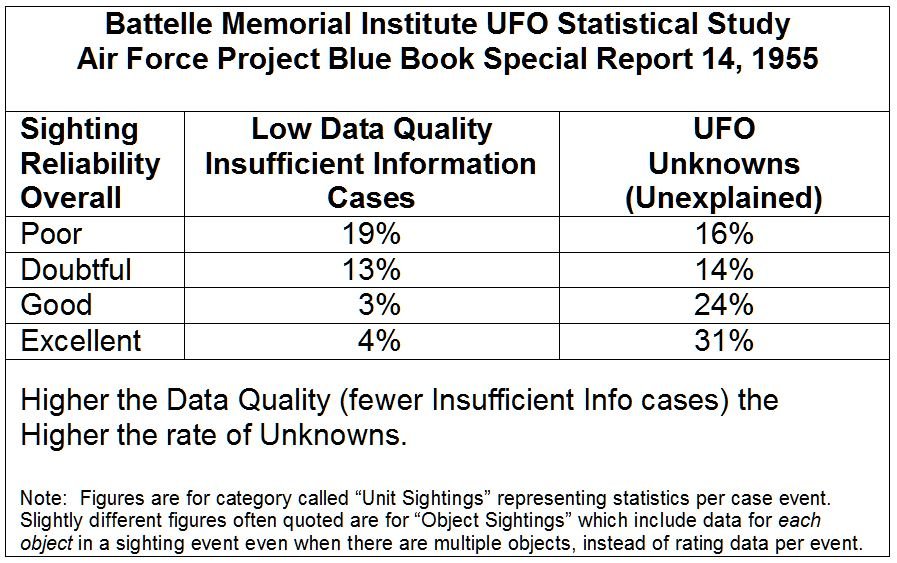
Last month the U.S. government’s new UAP investigation office, the All-domain Anomaly Resolution Office (AARO), submitted a report to Congress entitled, “Report on the Historical Record of U.S. Government Involvement with Unidentified Anomalous Phenomena” (UAP, the new term for UFO). This new report is itself anomalous for several reasons.
- First, who ever heard of a government report being submitted months before it was due? Especially one so rife with embarrassing errors in desperate need of additional fact-checking and revision? Was AARO Director Dr. Sean Kirkpatrick rushing to get the report out the door before departing, perhaps to ensure that his successor could not revise or reverse some of the report’s conclusions?
- Second, this appears to be the first AARO report submitted to Congress that the Director of National Intelligence (DNI) did not sign off on. I don’t know why, but Avril Haines and her Office were quite right not to in this case, having spared themselves considerable embarrassment in the process.
- Third, this is the most error-ridden and unsatisfactory government report I can recall reading during or after decades of government service. We all make mistakes, but this report is an outlier in terms of inaccuracies and errors. Were I reviewing this as a graduate student’s thesis it would receive a failing grade for failing to understand the assignment, sloppy and inadequate research, and flawed interpretation of the data. Hopefully, long before it was submitted, the author would have consulted his or her professor and received some guidance and course correction to prevent such an unfortunate outcome.
Another irregularity worth noting is the fact that before its release, Department of Defense (DoD) Public Affairs sponsored a closed-door pre-brief on the report’s findings for a select group of press outlets on an invitation-only basis. Outlets like The Debrief, which closely follow the UAP issue, were excluded. Following the report’s release, most of the news agencies that had participated in the pre-brief went on to publish articles that uncritically parroted the report’s findings. Moreover, they seem to have done so without consulting any of the scholars or experts who have studied and written extensively on this topic as would normally be the case in another field.
What about consulting the famous scientist, author, venture capitalist, and UAP expert Dr. Jacques Vallee, who worked with Air Force astronomer Dr. J. Allen Hynek on Project Blue Book and lived much of the history this UAP report purports to cover? Neither AARO nor the press bothered to speak with him. How about Robert Powell, Director of the Scientific Coalition for UAP Studies and author of the outstanding new book UFOs: A Scientist Explains What We Know (and Don’t Know)? Or professor Alexander Wendt at the Ohio State University? I’m sure these and many other authors and scholars would have been happy to assist AARO or the press, had they been contacted.
That America’s leading press outlets missed the problems and issues identified below and failed to present an alternative perspective, is itself typical of the stigmatized history of UAP press coverage since WWII. Those interested in the role of the press on the UAP topic may want to read Terry Hansen’s provocative book, The Missing Times.
The disappointing lack of critical press coverage of this important report prompted me to begin compiling the insights of UAP scholars and experts who have studied the history of UAP and the US government. I hope the observations below will prove helpful to members of Congress and the public seeking to understand the history of the US government’s involvement with UAP. Perhaps, when AARO publishes Volume II of its report, some effort will be made by the mainstream press to consult UAP subject-matter experts before rushing their articles into print.
One of the other concerns I have about press coverage of this report is the tendency to conflate the UAP topic generally with allegations the government has recovered off-world technology. The UAP issue is distinct and critically important regardless of the truth about allegations of recovered extraterrestrial, nonhuman technology. Asking AARO to investigate that allegation was unfortunate since a subordinate DoD or IC office finding its superiors innocent was never going to satisfy the critics anyway.
Moreover, a disruptive secret of that colossal magnitude affecting every person on the planet would never be revealed in a report to Congress from a mid-level official or organization. Only the President, or an independent Congressional investigation, could reasonably be expected to reveal such a profound and transformative issue. If Congress wants to be confident it knows the truth, it needs to conduct its own independent investigation.
In the meantime, Congress and the public deserve a great deal more transparency and clarity regarding US government data on the UAP issue. Too many well-documented incidents are occurring at too many locations, a problem greatly exacerbated by the rise of sophisticated drone technologies. If you don’t think this is a serious issue, consider that just a few months ago fighter aircraft were transferred from Langley Air Force Base in Virginia to Naval Air Station (NAS) Oceana after weeks of intrusions by unidentified drone-like craft. The Air Force seemed powerless to capture or deter these intruders and has still not been able to identify them. Similar incidents have been afflicting Navy warships and other bases around the country.
If the Air Force can’t defend its own bases, how can it defend the rest of the country? Don’t we need to get on top of this sooner rather than later? As journalist Tyler Rogoway (incidentally a skeptic of ET theories) said in one of his many superb articles at The War Zone (emphasis added here and elsewhere below): “The gross inaction and the stigma surrounding Unexplained Aerial Phenomena as a whole has led to what appears to be the paralyzation of the systems designed to protect us and our most critical military technologies, pointing to a massive failure in U.S. military intelligence.”
In sum, the number of UAP reports and the number of intrusions into US military airspace are both increasing, so we need to embrace the full range of UAP and drone issues and pursue them vigorously, rather than trying to diminish or trivialize the topic the way AARO’s historical report seeks to do.
Hopefully, Volume II of AARO’s history of UAP will be far more accurate and informative, and will also garner more serious, informed, and independent press coverage.
Missing the Target
The new UAP investigative agency of the U.S. Government is currently called the All-domain Anomaly Resolution Office (AARO). It reports jointly to the leaders of DoD and the Intelligence Community (IC). AARO recently sent the classified version of its first historical report, Vol. I, to Congress. Ostensibly, it covers the period from 1945 to October 31, 2023. The administrative cover date is February 2024. Volume II is due on about June 15, 2024.
The Congressional legal mandate, meaning by statutory law, required that this AARO historical report present the detailed history of UAP as recorded in US Government records. However, AARO instead presented a summary history of the records of flawed USG investigations of UAP, rather than what was actually mandated: the history of UAP and “relating to” UAP, meaning the history of UAP sightings and investigations (and to be completed using USG records and other official information).
The law required a “written report detailing the historical record of the United States Government relating to unidentified anomalous phenomena,” and the word “investigations” nowhere appears – the phrase does not say it is to be a historical report solely “relating to” investigations of “unidentified anomalous phenomena.” (NDAA FY2023 Sec. 6802(j)(1)(A), codified statute 50 U.S. Code § 3373(j)(1)(A), as amended.)
In another breach of the explicit terms of the law, AARO failed to compile, itemize, and report on US intelligence agency abuses on UAP (per 50 U.S.C. § 3373, below). The AARO Historical Report was required to:
“(ii) include a compilation and itemization of the key historical record of the involvement of the intelligence community with unidentified anomalous phenomena [UAP], including— …
“(III) any efforts to obfuscate, manipulate public opinion, hide, or otherwise provide incorrect unclassified or classified information about unidentified anomalous phenomena [UAP] or related activities.” [NDAA FY23 Sec. 6802(j)(1)(B); 50 U.S. Code § 3373(j)(1)(B)]
Contrary to Congressional direction, AARO completely omits entire agencies – NORAD, NSA, DIA (prior to 2009), CBP, etc. – agencies with known investigations or activities relating to UAP, and also omits any discussion of “any efforts to obfuscate, [or]… hide … unclassified or classified information about unidentified anomalous phenomena [UAP] or related activities.” AARO omits these agencies even when there are unclassified documents available on those agencies’ records and investigations of UAP (for example, see the approximate 100 pages of CBP Customs & Border Protection agency internal memos of Records on UAP, plus 10 videos, released in August, 2023, but unmentioned by AARO; Also see McMillan, Hanks, Plain, “Incursions at the Border,” The Debrief, May 27, 2022).
Excessive Secrecy
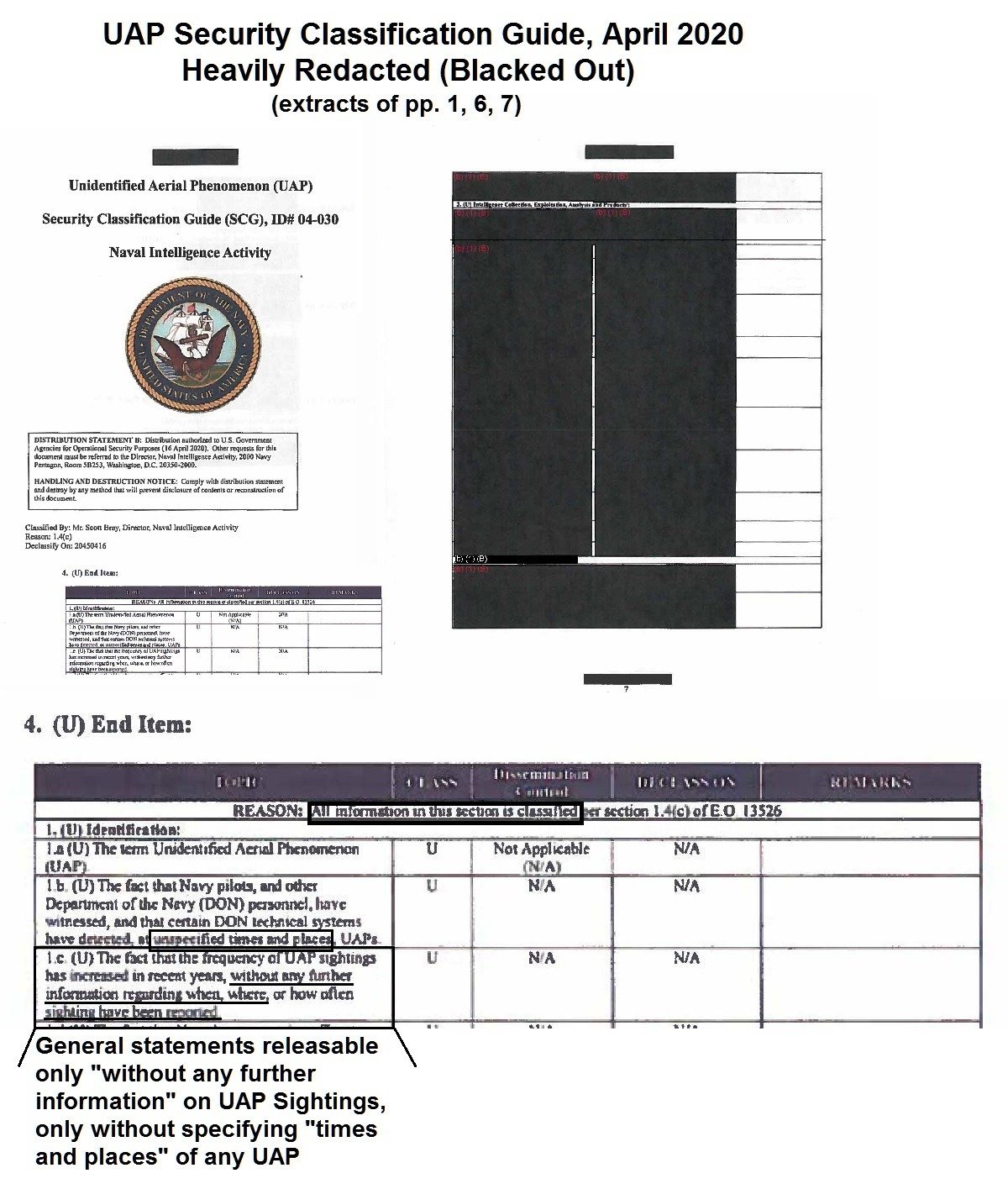
In the past, extreme and excessive secrecy has been displayed in efforts to “hide … unclassified or classified” UAP-related information, illustrated by the AARO predecessor’s UAP Security Classification Guide, first distributed internally on April 16, 2020 (see graphic below) which is itself heavily redacted, removing most indications of the type of UAP report content requiring classification. This is a binding secrecy regulation – don’t be fooled by the word “guide,” it is absolutely mandatory. The secrecy regulation specifically states that only a general statement of an increase in UAP sightings can be released to the public, and “without [releasing] any further information regarding when [or] where” a UAP “sighting [has] been reported” as that is classified. Additionally, the “times and places” of UAP detections are classified and are required to be “unspecified” and can’t be released; it is not “U” (Unclassified) (p. 6, subparagraphs. 4.1b-c).
The internal Pentagon talking points on the UAP subject are a gag order that specifically forbids DoD officials from even revealing to the media and the public the fact that “virtually everything” about UAP is unreleasable, citing the above UAP Security Classification regulation (produced by AARO’s predecessor, the UAP Task Force). Specifically, it states: “Except for its existence, and the mission/purpose, virtually everything else about the UAPTF [UAP Task Force] is classified, per the signed Security Classification Guide.”
Similar UAP security regulations no doubt are applied throughout the US Government. There is not one single item of government information about a UAP sighting that is not classified according to this secrecy regulation. Why is that? How can the US Government be transparent about UAP sighting incidents if nothing will be released? (See John Greenewald of The Black Vault, in “What’s NOT in AARO’s recent “Historical Record” UAP Report?” from his X/Twitter post on March 31, 2024).
How can this be, when DoD itself confirmed, prior to the creation of this (excessive) classification guide, that the three famous Navy UAP videos I provided the New York Times and Washington Post were unclassified, and their release would not damage national security? In fact, by bringing a major intelligence failure occurring in US airspace to the attention of policymakers, the public release of those videos clearly advanced national security. The bureaucratic fiasco of this classification guide occurred despite a broad consensus in government, including among our military and intelligence officials and members of Congress, that over-classification is a major problem that needs to be addressed. As Avril Haines, the Director of National Intelligence (DNI) said in a letter to Congress in 2022, “Over-classification of government secrets both undermines national security by blocking the intelligence community’s ability to share critical information and erodes the basic trust that our citizens have in their government.”
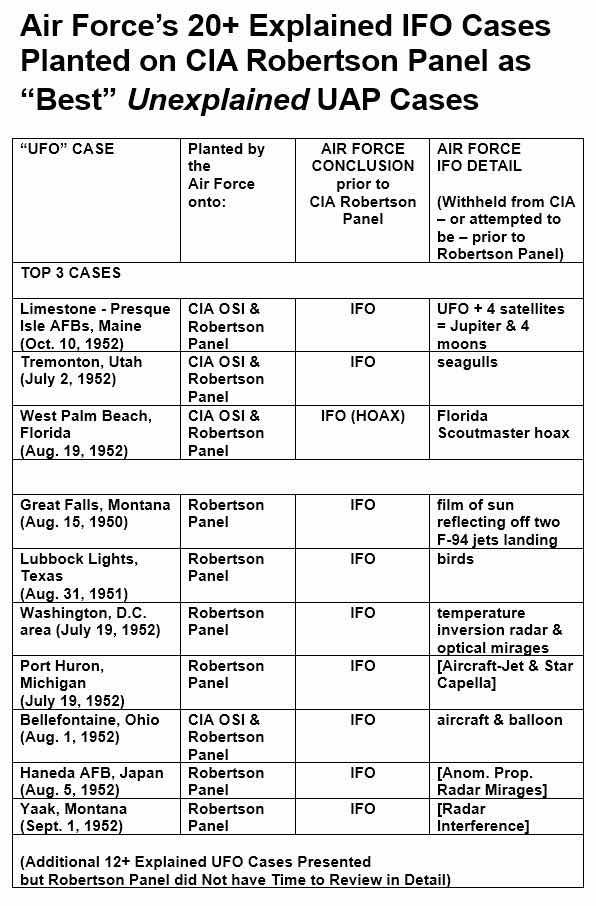
Air Force intelligence agency “efforts to … manipulate public opinion” on UAP since the 1950s are what caused the harsh stigma attached to the entire UFO subject in society. But this powerful anti-UAP stigma is not investigated or historically documented by AARO – or even mentioned – contrary to its legal obligation (more on this below). In addition to the AF-instigated Robertson Panel of 1953, and all that followed after it, there are even admissions by a retired USAF OSI officer of allegedly spying on civilian UFO researchers and spreading disinformation on behalf of the Air Force.
The unclassified version of the historical AARO Report (AAROR) was released on March 8, 2024. But prior to that, AARO quietly released the report 2 days in advance to several friendly media outlets to cultivate favorable media coverage. These outlets, including the New York Times and Washington Post, faithfully carried the government’s message forward, apparently without consulting any of the scholars and researchers who could have helped them understand the report’s numerous errors, omissions, and shortcomings to provide a more balanced assessment. More objective reporting would have uncovered numerous major problems and serious errors in the AARO Report.
What follows are only a select few of the many issues and questions raised by the AARO Historical Report.
The AARO Report is Filled with Hundreds of Errors
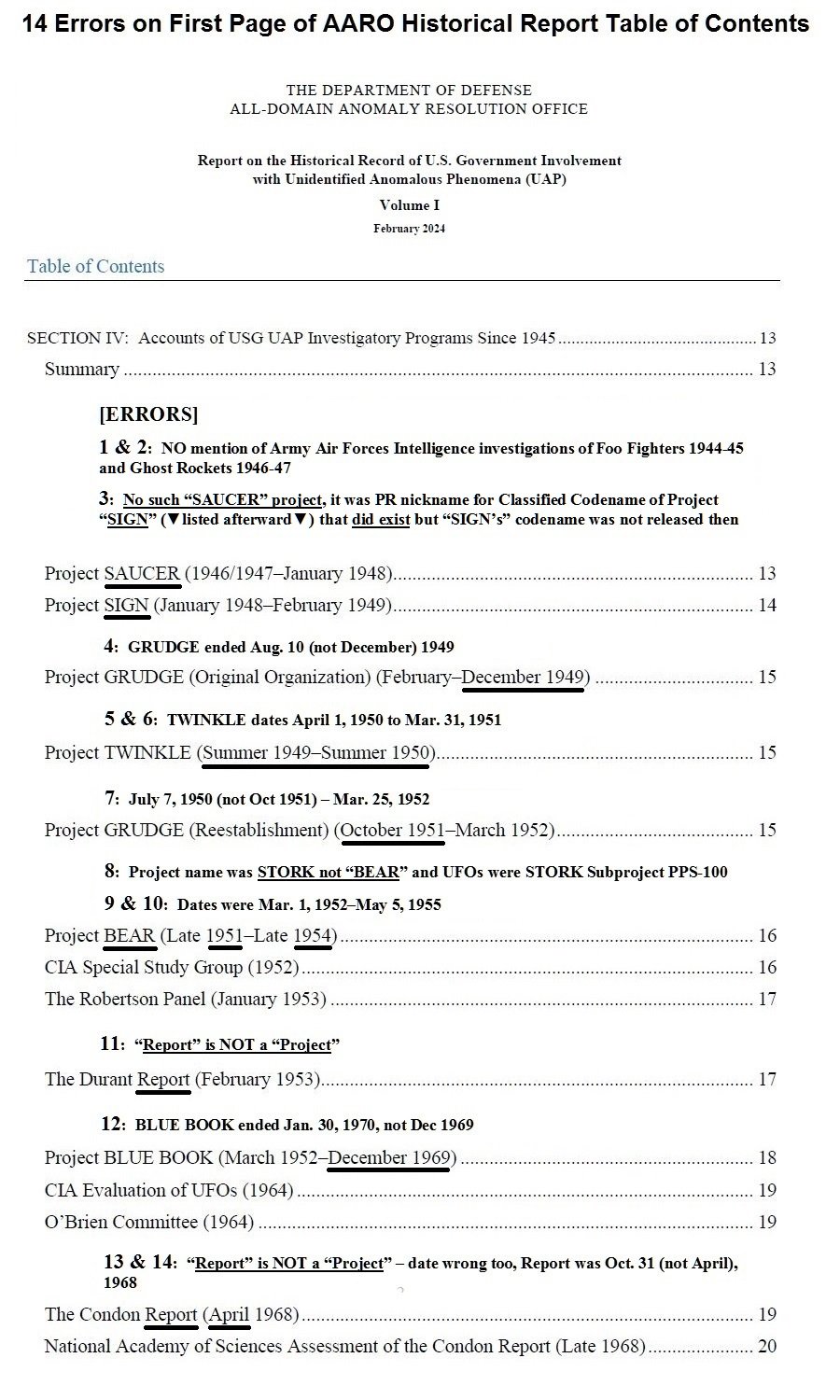
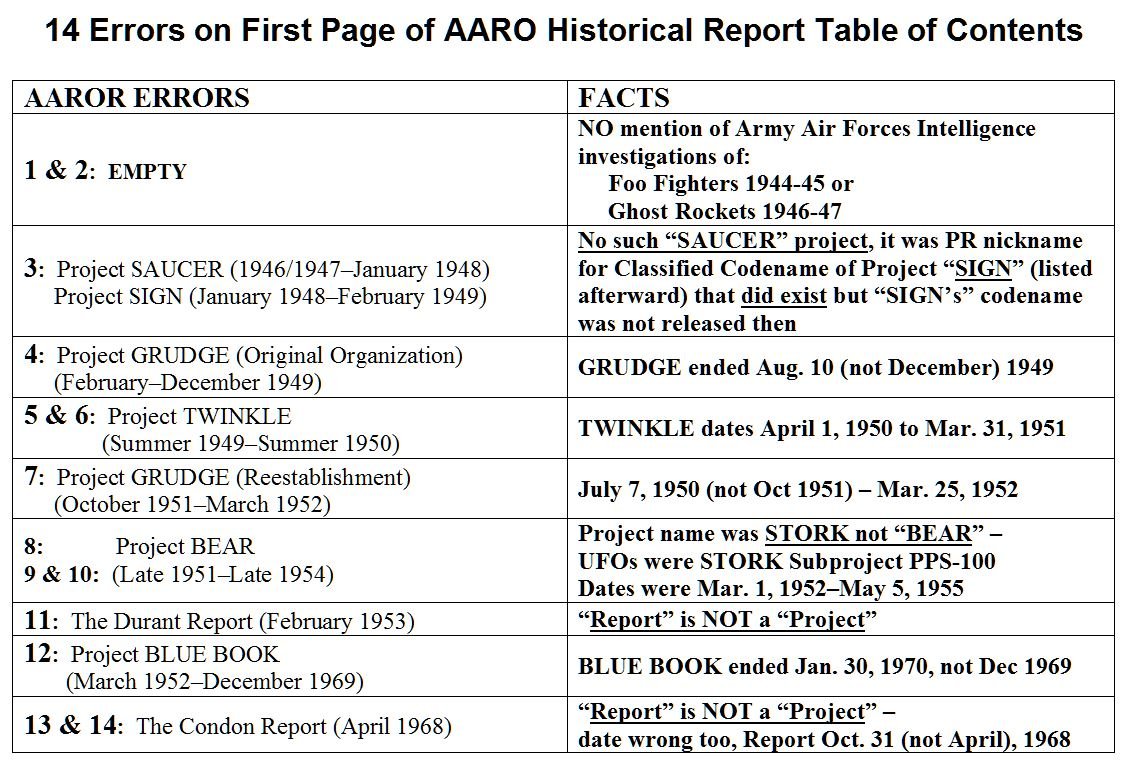
The AARO report (AAROR) is pervaded by hundreds of unfortunate errors and absurdities involving the history, science, and facts presented in its 63 pages, with dozens–or more–errors on some pages (see graphic below of 14 errors alone just on the first page of the Table of Contents).
The report is replete with so many mistakes and misunderstandings that, page for page, it appears to be the greatest single repository of UAP errors, arguably surpassing even the Air Force’s Project Blue Book. Call AARO the New Blue Book. Speaking of which, the report utterly fails to convey any of the fundamental flaws or national controversies that dogged Project Blue Book, including the admission by its own chief scientist that Blue Book was a deeply flawed Air Force public relations effort to dispel public and Congressional concerns, rather than an objective inquiry.
To begin with, AARO asserts the Kenneth Arnold sighting that launched the whole UAP era occurred on June 23, 1947 (AAROR, p. 14).
Simple Googling would have gotten the correct June 24 date and the correct shape (it wasn’t actually “circular,” and neither was the Flying Flapjack which they call the “Flying Pancake” to erroneously emphasize its circularity even more). Arnold insisted the press’s label “flying saucers” for his sighting was a misnomer. Significantly, it is the important watershed event that launched the entire modern age of UAP. It’s not a typo in a minor detail that can just be brushed off.
There are unbelievable statements and insinuations in the AARO report such as the peculiar claim that the Manhattan Project that built the first atomic bomb somehow caused “sightings” and “erroneous UAP reporting” (AAROR pp. 4, 39-40) and did so even after it terminated on December 31, 1946 (a date they omit because it would not explain the sightings that began the modern UAP era in June 1947). That is a bit like saying trailer parks cause tornadoes. Since the Manhattan Project did not launch special aerial vehicles of any kind that could be “misidentified” as UAP, did the Project’s buildings fly up in the air and cause “sightings” and “erroneous UAP reporting”? This incredible claim is not explained by AARO.
Indeed, the truth is precisely the opposite of what AARO suggests. Not only is there no evidence of outside civilians mistaking the Manhattan Project and successor operations for UAP, but we know that personnel working inside the US nuclear weapons program were sighting UAP, reporting them, and thereafter collecting hundreds of their own authentic UAP reports. The senior AFOSI (Air Force Office of Special Investigations) officer responsible for Los Alamos Scientific Laboratory compiled a detailed catalog of 209 recent “Unknown Aerial Phenomena” sightings and instrument tracking incidents in the Los Alamos area and surrounding regions (see sample p. 38 below). He sent the catalog with a classified memo to his superior, the agency director in Washington DC, General Joseph P. Carroll, on May 25, 1950, stating that security officials agreed:
“… the frequency of unexplained aerial phenomenon in the New Mexico area was such that an organized plan of reporting these observations should be undertaken…”
Other documents explain this “organized plan” included instrumented UFO / UAP tracking stations and networks that were set up by scientists and security officials in the Los Alamos Lab, Sandia Lab, Kirtland AFB, and Holloman AFB–White Sands areas, and put on base-wide alert, consisting of missile-tracking telescopic cameras, radars, nuclear radiation detectors, radio communication networks, aircraft for interception, etc. Yet, no AARO discussion of this.
“The observers of these phenomena include scientists, Special Agents of the Office of Special Investigations (IG), USAF, airline pilots, military pilots, Los Alamos Security Inspectors, military personnel, and many other persons of various occupations whose reliability is not questioned.”
Many of the UAPs reported by scientists and military personnel were described as either “green fireball phenomena” or flying “disks” (or “variation”). AARO has completely misrepresented the situation: The Manhattan Project and subsequent nuclear weapons activities were not causing spurious UAP sightings by civilians awed by “new technologies” they did not understand – the government scientists and military personnel themselves were actually seeing UAP and recording hundreds of UAP in authentic and well-documented reports.
These sightings officially reported by US Government personnel were consistent with what the external “unknowing” civilians (as AARO calls them) were reporting at the time – sometimes the government personnel and civilians sighted the same UAP at the same time, confirming each other.
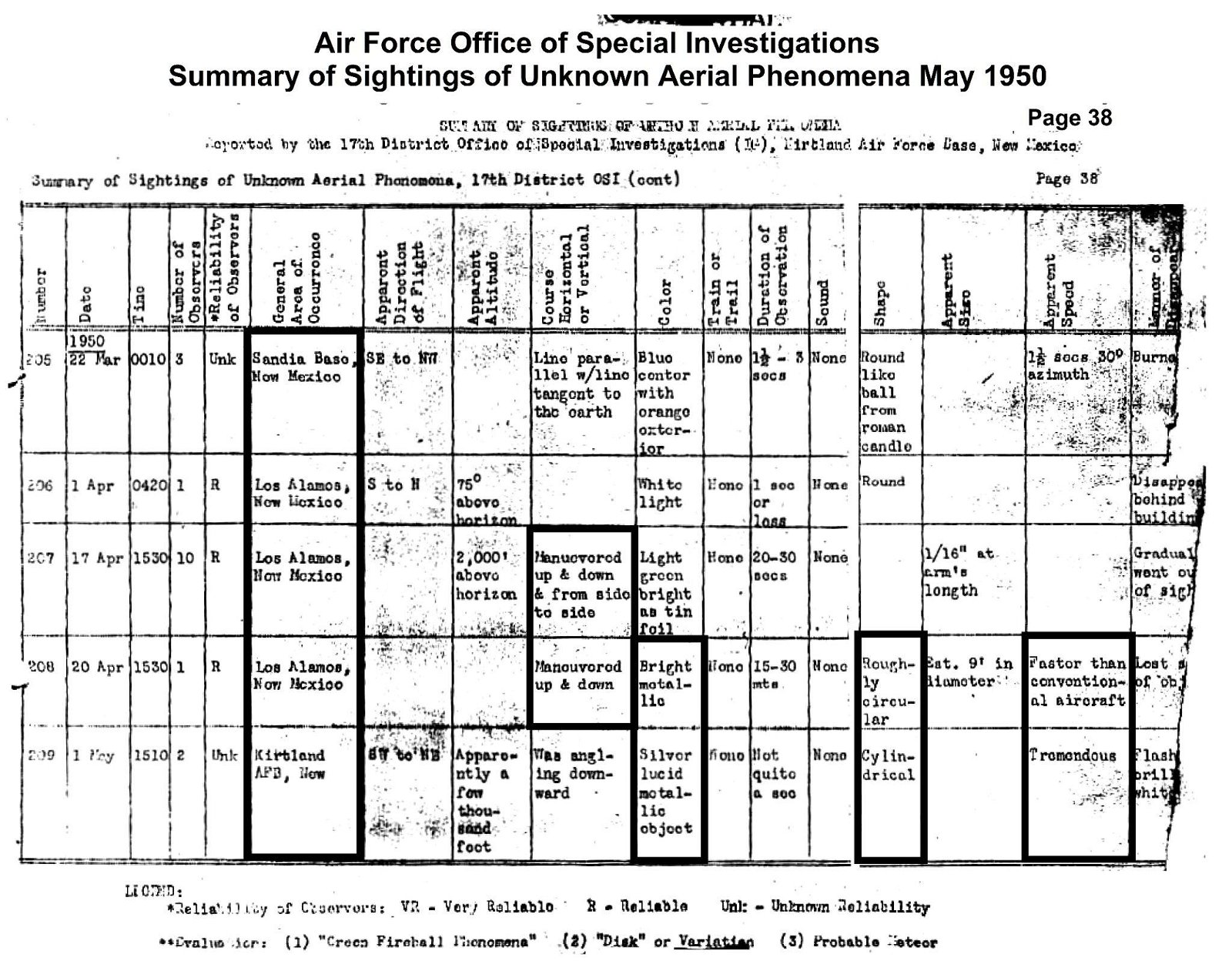
Seemingly AARO is confusing secrecy-bred lurid rumors of aliens with a careful sighting of a UAP, up in the air, at an exact date, time, and location, having unexplainable motions and appearance, and backed up with scientifically valuable directional data involving speed, size, altitude, sensor data, radar tracking, etc. Yet AARO suggests that many of these documented sightings are just rumors or mistaken reports based on unwitting civilian observations of “new technologies” in classified US military activities.
AARO claims the first US satellite, Explorer 1 in 1958, and even the Apollo moon landings (pp. 41-42) caused UAP sighting misidentifications and were “formerly classified and sensitive … national security programs” (AAROR, pp. 39-40) – which they were not, and Apollo was just civilian NASA. AARO insinuates that the Apollo missions were “classified and sensitive”, and yet, apart from a limited number of contingency missions later revealed to have had classified components, the vast majority of NASA’s objectives with the missions were fully known to the public, with the moon landing broadcast to the entire planet on live television.
AARO states (pp. 10-11, 36):
“AARO assesses that some portion of [UAP] sightings since the 1940s have represented misidentification of never-before-seen experimental and operational space, rocket, and air systems… From the 1940s to the 1960s especially, the United States witnessed a boom in experimental technologies… Many of these technologies fit the description of a stereotypical Unidentified Flying Object (UFO). It is understandable how observers unfamiliar with these programs could mistake sightings of these new technologies as something extraordinary, even other-worldly.”
“AARO assesses that the incidents of UAP sightings reported to USG organizations … most likely are the result of a range of cultural, political, and technological factors. AARO bases this conclusion on the aggregate findings of all USG investigations to date [and] the misinterpretation of all reported named sensitive programs…”
What “new technology” let alone “many” was ever flown that “fit the description of a stereotypical … UFO” (e.g., a flying saucer)? Yet just before “naming” the Manhattan Project and Apollo as supposed “examples,” AARO reiterates the unsubstantiated point, claiming that many:
“… UAP sightings … were the result of misidentifications … of new technologies that [civilian] observers would have understandably reported as UFOs…. [O]bservers unknowingly … witnessed … and report[ed] as UFOs … classified and sensitive programs that involved … rocket launches … which AARO assess [sic] most likely were the cause of many UAP reports. AARO assesses that this common and understandable occurrence—the misidentification of new technologies for UAP— is present today [and] are reported as UAP.” (AAROR, p. 39)
Subsequently, AARO lists the Apollo program as one of 28 alleged examples (pp. 40, 42).
But no such UAP or “stereotypical UFO” sightings of a “misidentified” Apollo are known or cited by AARO and frankly, it is baffling to suggest anyone on Earth could see the Apollo moon landings with their eyes from 240,000 miles away or Apollo anywhere along the flight trajectory. AARO makes a point of stating that there were in the Apollo program “12 astronauts walking on the moon” without explaining how that is relevant or giving a single UAP sighting they seem to insinuate was caused by that. Are there any actual, serious UAP sightings misidentifying Apollo launches to the moon as UAP?
Scientific errors by AARO thus abound in its secret-project-inflated report, including those pointed out above regarding the miraculous feats of human vision sighting Apollo moon landings and Explorer 1 from outer space – besides insinuating apparent errors of logic and physics and injecting a non-issue of misleading irrelevancies (non-secret “secret” projects that did not and could not actually cause UAP sightings).
Did AARO Miss 64,000 Pages of Air Force Blue Book UAP Files?
AARO may have “partnered” with the National Archives in retrieving old Air Force Project Blue Book files but AARO seems to think there are only 65,778 pages of Blue Book files (within some 7,000 larger digital files), instead of the actual total of some 130,000 pages.
Is AARO aware there are 130,000 pages of Air Force UAP files on microfilm at the National Archives (and some additional files that were never microfilmed)?
All that anyone has to do is check the Fold3 Ancestry.com website, available on the Internet since 2007, to find its total Blue Book page count of 129,658 pages (round off to 130,000) that Fold3’s predecessor digitized from Blue Book microfilm at NARA (see Fold3 internet screenshot below). (Page count includes about 6,000 AFOSI pages, some duplicative of the files and released with Blue Book.) And again it is documented that many records and files are missing from Blue Book, many with exact file numbers that determined investigators such as Jan Aldrich have documented over the years.
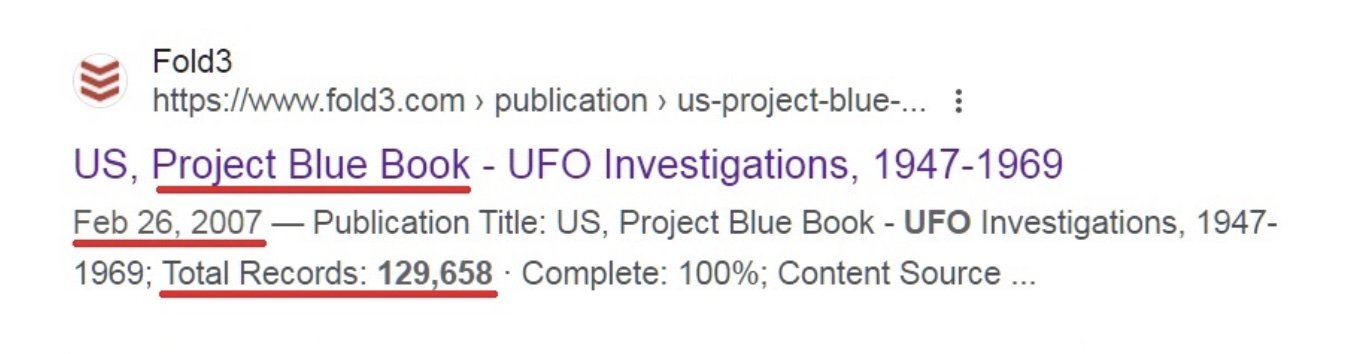
Did AARO somehow miss half of Blue Book’s files–some 64,000 pages–in its supposedly “thorough”, “complete”, and “accurate” history (AAROR, p. 12)? Did someone lose 64,000 pages of Blue Book UFO files? Did AARO investigate where these apparently missing Blue Book files disappeared or how the accounting error arose if it is just that?
Even aside from missing half of Blue Book’s files, which therefore could not be reviewed for history, AARO’s review of Air Force Blue Book history is so cursory that AARO seems to merely rehash old Blue Book press releases (see AAROR, pp. 18-19).
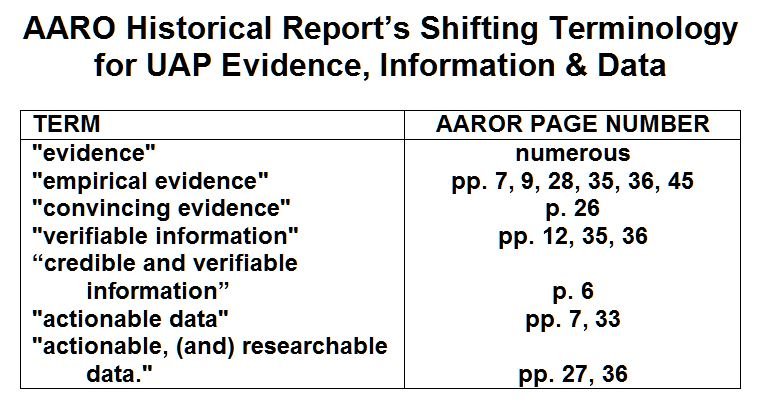
AARO claims it established 6 Lines of Effort (“LOEs” they call them) to prepare a “complete” and “accurate” history of the UAP “record” of government investigations (just not of UAP sightings as Congress also wanted): (1) open source, (2) classified, (3) personal interviewing, (4) National Archives, (5) private companies, and (6) intelligence/nat sec agencies (AAROR, pp. 22-13).
But obviously, AARO’s Six Lines of Effort were unmindful of 64,000 missing pages of Blue Book UFO files that only they at AARO were missing – while the rest of the world has, and has had, access to the pages through the Fold3 website since 2007 or by going to the microfilms at the National Archives or buying copies (all available since 1976). Additionally, as will be explained further below, AARO seems completely unaware of the existence of numerous important US government UAP investigation programs, activities, sightings, and radar/sensor-tracking incidents.
{ https://thedebrief.org/category/uap/ }


 Earth Will Have a Tiny New Mini-Moon for a Few Months

 The asteroid Dimorphos was captured by NASA’s DART mission just two seconds before the spacecraft struck its surface on Sept. 26, 2022. Observations of the asteroid before and after impact suggest it is a loosely packed “rubble pile” object.
Credit: NASA/JHUAPL