Ontdek de Fascinerende Wereld van UFO's en UAP's: Jouw Bron voor Onthullende Informatie!
Ben jij ook gefascineerd door het onbekende? Wil je meer weten over UFO's en UAP's, niet alleen in België, maar over de hele wereld? Dan ben je op de juiste plek!
België: Het Kloppend Hart van UFO-onderzoek
In België is BUFON (Belgisch UFO-Netwerk) dé autoriteit op het gebied van UFO-onderzoek. Voor betrouwbare en objectieve informatie over deze intrigerende fenomenen, bezoek je zeker onze Facebook-pagina en deze blog. Maar dat is nog niet alles! Ontdek ook het Belgisch UFO-meldpunt en Caelestia, twee organisaties die diepgaand onderzoek verrichten, al zijn ze soms kritisch of sceptisch.
Nederland: Een Schat aan Informatie
Voor onze Nederlandse buren is er de schitterende website www.ufowijzer.nl, beheerd door Paul Harmans. Deze site biedt een schat aan informatie en artikelen die je niet wilt missen!
Internationaal: MUFON - De Wereldwijde Autoriteit
Neem ook een kijkje bij MUFON (Mutual UFO Network Inc.), een gerenommeerde Amerikaanse UFO-vereniging met afdelingen in de VS en wereldwijd. MUFON is toegewijd aan de wetenschappelijke en analytische studie van het UFO-fenomeen, en hun maandelijkse tijdschrift, The MUFON UFO-Journal, is een must-read voor elke UFO-enthousiasteling. Bezoek hun website op www.mufon.com voor meer informatie.
Samenwerking en Toekomstvisie
Sinds 1 februari 2020 is Pieter niet alleen ex-president van BUFON, maar ook de voormalige nationale directeur van MUFON in Vlaanderen en Nederland. Dit creëert een sterke samenwerking met de Franse MUFON Reseau MUFON/EUROP, wat ons in staat stelt om nog meer waardevolle inzichten te delen.
Let op: Nepprofielen en Nieuwe Groeperingen
Pas op voor een nieuwe groepering die zich ook BUFON noemt, maar geen enkele connectie heeft met onze gevestigde organisatie. Hoewel zij de naam geregistreerd hebben, kunnen ze het rijke verleden en de expertise van onze groep niet evenaren. We wensen hen veel succes, maar we blijven de autoriteit in UFO-onderzoek!
Blijf Op De Hoogte!
Wil jij de laatste nieuwtjes over UFO's, ruimtevaart, archeologie, en meer? Volg ons dan en duik samen met ons in de fascinerende wereld van het onbekende! Sluit je aan bij de gemeenschap van nieuwsgierige geesten die net als jij verlangen naar antwoorden en avonturen in de sterren!
Heb je vragen of wil je meer weten? Aarzel dan niet om contact met ons op te nemen! Samen ontrafelen we het mysterie van de lucht en daarbuiten.
Dinsdag 5 augustus 2025
Ancient Gold UFO Crashed Underwater In Stockholm, Sweden UAP Sighting News
Ancient Gold UFO Crashed Underwater In Stockholm, Sweden UAP Sighting News
Date of discovery: Aug 4, 2025
Location of discovery: Stockholm, Sweden
Coordinates: 59°19'22"N 17°48'32"E
I found this crashed golden UFO below the surface of a lake not far from Stockholm. The energy from the crashed UFO is so powerful, it's still glowing which makes me think it probably still has living occupants onboard.
Someone said why travel across the universe only to crash...(said in video comments). Such silliness, if that was true, then no UFOs were ever recovered and no aliens were ever captured. We know that UFOs have been recovered, too many high officials and generals, ect have testified in court hearings that they witnessed recovered UFOs and alien bodies.
A leak of vital air continues at the International Space Station (ISS). Despite the crew’s hopes that the latest crack in the Russian Zvezda module has finally been repaired, prolonged observations confirm that the station is still losing precious air supplies.
The Zvezda module of the ISS may lose its docking port. Photo: NASA
Roscosmos notes that after repairing the hull, the team believed the problem had been solved, but further data dispelled these hopes. The repairs only slowed down the air leak, but did not stop it completely.
The history of the hole
The air leak from the ISS was first detected in September 2019. Its source is located in the airlock connecting the docking node with the main body of the Zvezda module. Over the past six years, the situation has deteriorated significantly: the rate of air loss has roughly doubled, from around 0.45 kg to almost 0.9 kg per day. This growth caused NASA to raise the risk level to maximum.
An important obstacle to resolving the problem remains the dispute between NASA and Roscosmos regarding the root cause of the leak and the best way to fix it. Even the encouraging sign in June — a change in pressure that could have indicated the leak had stopped after certain manipulations — turned out to be false.
Possible solutions to fix the problem
As a radical solution, space agencies are considering permanently closing the hatch leading to the Zvezda module. If this happens, the ISS will be able to continue operating as normal, and the air leak will indeed stop, but one docking port for cargo or manned spacecraft will be lost, which will be a significant operational limitation.
For now, the crew and ground services continue to search for the elusive “wound” on the space station, trying to maintain the airtightness of the key segment of the ISS in the face of an unpredictable challenge.
NASA specialists have found a way to enable the Curiosity rover to perform several tasks simultaneously. This will allow for maximum efficiency in using its energy source and extend its service life.
Curiosity’s energy budget
Curiosity recently reached a region filled with cell-like formations. These hardened ridges are believed to have been created by underground waters billions of years ago. Spanning many kilometers in this part of Mount Sharp, these formations may shed light on whether hypothetical microbial life could have survived in the depths of Mars billions of years ago, extending the planet’s habitability until it began to dry out.
Rock formations found by Curiosity that formed in the presence of water. Source: NASA/JPL-Caltech/MSSS
Performing this detective work requires a great deal of energy. In addition to moving and extending its robotic arm to study rocks and boulders, Curiosity is equipped with a variety of scientific instruments and heaters that require power.
Other NASA missions, such as the Spirit and Opportunity rovers and the InSight lander, relied on solar panels to recharge their batteries. However, this technology always carries the risk of insufficient sunlight. Therefore, engineers equipped Curiosity with a radioisotope generator (RITEG). Thanks to this, the rover is not affected by changes in lighting conditions. The downside is that because plutonium decays over time, charging Curiosity’s batteries takes longer each year, leaving less energy for scientific research.
More effective science
NASA engineers generally send Curiosity a list of tasks to complete one by one before the rover ends its day and takes a break to recharge. In 2021, the team began investigating whether it would be safe to combine two or three of the rover’s tasks, thereby reducing its active time.
Image taken by the Curiosity rover on July 25, 2025. Source: NASA/JPL-Caltech/MSSS
For example, the Curiosity radio regularly sends data and images to a passing orbital spacecraft, which transmits them to Earth. Can the Mars rover communicate with the orbital spacecraft while moving, shifting its robotic manipulator, or taking images? Combining tasks can shorten each day’s plan, requiring less time with heaters and equipment turned on and ready for use, which reduces energy consumption. Testing has shown that Curiosity is capable of doing all this safely.
Another technique is to allow Curiosity to decide when it needs to rest if it finishes its tasks early. Engineers always overestimate the duration of daily activities in case of unforeseen circumstances. Now, if Curiosity completes these actions ahead of schedule, it will go to sleep earlier.
By allowing the rover to manage its own rest time, it is possible to reduce the charging time before the next day’s schedule. Even actions that reduce the time required to complete a single task by just 10 or 20 minutes can have a significant long-term effect, maximizing the service life of the RITEG for further scientific research and exploration.
A lot remains to be done
Engineers are implementing new features in Curiosity based on their experience operating it. Several mechanical issues required a redesign of the sample collection method using a drill bit mounted on a robotic arm, and movement capabilities were improved through software updates. When the color filter stopped rotating on one of the two cameras mounted on Mastcam, Curiosity’s rotating “head,” the team devised a workaround that allowed them to capture the same beautiful panoramas.
NASA has also developed an algorithm to reduce damage to Curiosity’s wheels, which are worn down from hitting rocks. Although engineers are closely monitoring any new damage, they are not concerned. After 35 kilometers of driving and extensive research, it became clear that, despite wear and tear, the wheels are capable of serving for many more years. In combination, these measures allow Curiosity to operate as actively as before.
The Perseverance rover has discovered unusual formations that are almost perfectly spherical in shape. According to scientists, they were formed as a result of the cooling of molten material.
Spherical particles found by Perseverance in Martian soil. Source: NASA/JPL-Caltech
Spherical particles are not what you would expect to find in Martian soil. However, two decades ago, the Opportunity rover discovered spherical hematite formations (unofficially nicknamed “blueberries”) near its landing site on the Meridiani Plateau.
Now, the Perseverance rover has also managed to detect spherical particles. The discovery was made in an area unofficially named Witch Hazel Hill. Spherical formations are embedded in the bedrock and scattered throughout the area. Perseverance studied them by taking a series of images and measuring their elemental composition.
Despite their external similarity to “blueberries,” these spherical particles have a completely different composition and, probably, origin. The fragments found by Opportunity consisted of hematite minerals, and they’re thought to have formed in groundwater-rich sediments way back in Mars’ past.
For comparison, these spherical particles are composed of basalt and were probably formed as a result of a meteorite impact or volcanic eruption. When a meteorite hits the surface of Mars, it can melt rock and spray droplets of molten rock into the air. These droplets can cool quickly, solidify into spherical particles, and fall as rain onto the surrounding area. Alternatively, spherical particles could have formed from molten lava during the eruption.
The Perseverance team intends to continue searching for answers to the question of the origin of these spherical particles. If they were formed as a result of an ancient impact, they can tell us about the composition of the impactor and shed light on the formation of craters in the early history of Mars. If they were caused by a volcanic eruption, they may preserve traces of past volcanic activity in the area around Jezero crater. In any case, these spherical particles are a reminder of a dynamic period in the distant past of the Red Planet.
Apollo, a new humanoid robot designed to work alongside humans, could be poised to reshape the industrial workforce and other industries, according to its developers, who unveiled their creation last month.
Billed as “the world’s most capable humanoid robot,” Apollo was the result of more than a decade of planning and development by Apptronik, a Texas-based company founded within the University of Austin’s Human Centered Robotics Lab.
The company, which describes its mission as being aimed at leveraging “innovative technology for the betterment of society,” says Apollo is the first commercial humanoid robot “designed for friendly interaction, mass manufacturability, performance, and safety,” according to a press release.
Jeff Cardenas, co-founder and CEO of Apptronik, says that as the labor environment is changing, with trends in employment increasingly impacting the global economy, introducing robotics into the warehouse and other industrial environments will have numerous benefits.
“People don’t want to do robotic, physically demanding work in tough conditions and they shouldn’t have to,” Cardenas says, adding that the robotics his company is developing are more than a novel response to this issue, but are “a necessity.”
Apollo demonstrating its performance capabilities in a warehouse environment (Image courtesy of Apptronik)
Robots have already been in use in warehouses and other industrial work environments for decades. From their role in the automotive and agricultural industries to robot-assisted surgery, robotic floor cleaners, and even robots that deliver pizza, the implementation of robotics alongside humans has already become a fundamental part of the workplace for many.
Humanoid robots are a newer development. In 2016, Hong Kong-based Hanson Robotics presented Sophia, a kind of social robot that demonstrates the ability to learn from humans and can talk, draw, and even sing. In 2017, Toyota unveiled its T-HR3 as a kind of robotic avatar that can mimic the movements of a human operator. As far as humanoid robots in the workplace, however, examples in recent years include Ford announcing in 2020 that it would be bringing Digit, a headless worker robot designed by Agility Robotics, into its factories.
Apptronik’s robotic addition to the industrial workplace is arguably one of the most human-like to perform such functions, which was part of its intended design. Apollo’s features were customized to offer a friendly and welcoming appearance aimed at emulating a “congenial face-to-face exchange with a favorite co-worker.”
At a height of around 5 feet, eight inches, Apollo can lift up to 55 pounds and possesses a specially designed force control architecture that allows it to maintain a safe operation around people that its designers liken more to collaborative robots (i.e., those designed for direct interaction with humans in an environment) as opposed to other traditional industrial robots.
Apollo is also designed to be cost-effective, offering what Apptronik bills as the “first truly mass manufacturable humanoid design and has been optimized for supply chain resiliency” that will help facilitate the scaled production of affordable humanoid robots for various sectors of American industry.
Apptronik is also currently working with NASA to help bring its robotic solutions into space since humanoid robots may be capable of performing a variety of functions that include reducing the amount of time humans must spend working in potentially hazardous environments.
“Humans are toolmakers,” Cardenas said in a post on Apptronik’s website. “Since the beginning of time, we have built tools to help us do more with less.”
“I believe that we are at an amazing point in human history,” he added. “A point where we can finally build for ourselves the ultimate tools. Machines that have the ability to harness the power of computers and software in the physical world.”
Cardenas says he and his company believe “Apollo is one of the most advanced tools humanity has ever created” and calls the robot a “tool that is built by humans, for humans.” Apollo also happens to be a robotic worker that looks like humans, setting it on course to potentially help reshape how humans work and, more broadly, how we live.
The Gimbal UFO event stands as a significant pillar in the UAP (Unidentified Aerial Phenomena) disclosure, introducing US military whistleblowers who claim to have witnessed the phenomena they describe as “non-human.” In 2020, the U.S. Department of Defense released three pivotal UAP videos that triggered widespread discussions within the UFO community, prompting inquiries into the information held by the US government regarding these phenomena.
These videos capture UFO encounters from November 2004 and two separate incidents from January 2015, each identified by distinctive nicknames: Flir (2004), Go Fast (2015), and Gimbal (2015). They depict pilots tracking unidentified objects in the sky. Among these, the renowned 2015 UFO “Gimbal” footage was recorded by US fighter pilots near the nuclear aircraft carrier USS Theodore Roosevelt, as an unidentified object appeared on their radar. Despite the pilots mentioning, “There’s a whole fleet of them, look on the SA,” the footage only displays a single mysterious object at the center of the frame.
Apart from Ryan Graves, a former Lt. U.S. Navy and F/A-18F pilot, there is another least discussed whistleblower who experienced the famous Gimbal UFO event. Matthew Roberts, a former cryptologist in the US Navy with 16 years of service, shared his experience and encounters with non-human entity during a Netflix series “Encounters.” He was present on the USS Theodore Roosevelt in 2015 during an event involving the now-famous “Gimbal footage.”
After going on several military missions and teaching other code experts while working on land, Matthew Roberts moved to the Office of Naval Intelligence (ONI) for three years. His time at ONI ended in March 2020, and that is when he chose to quit the military, even though he was close to retiring in four years. The reason for leaving was the intense and personal experiences he had with unidentified aerial phenomena (UAP) while at ONI, which he writes about in his book named “Initiated.”
Roberts described his initial reaction to the gimbal footage: “I was watching this footage, and I could see no kind of aviation surfaces that you would expect to see — wings, tail, rudders. There’s none of that.” He struggled to comprehend the unconventional movement of the object, stating, “I couldn’t really make sense of why this thing was kind of up in the air like it was.”
As he looked more closely at the video, Roberts realized something important: “I knew it didn’t belong to us or anyone else. So, the only other possibility, I think, is that it’s technology from non-human intelligence.”
Given his classified role and access to sensitive information, Roberts was aware that such encounters were not isolated incidents for the Navy: “I was kind of aware this was not a one-off event for the Navy. These things happen frequently, all the time, going against the wind.” Roberts confessed to being captivated by the footage, watching it obsessively. Despite his access to classified information, he had no awareness of the actions taken by the upper chain of command concerning these encounters.
In 2017, after transferring to the Office of Naval Intelligence, Roberts claimed to have had follow-on experiences with what he described as nonhuman entities. He recounted unsettling encounters where he would wake up feeling his body being moved across the bed and experiencing a hand grabbing his arm. Roberts believed these encounters were evidence of non-human intelligence.
“In 2017, I moved to the Office of Naval Intelligence, where I was going to work as an analyst. Shortly after I got there, I began having experiences related to the phenomenon. It was like the start of seeing nonhuman entities in my room at night. I would wake up several times a week, feeling my body sliding across the bed, and I knew they were taking me. One time, I woke up because I felt a hand grab my arm. I tried to raise my hands to my face, but I couldn’t move. I could see the outline of a shadowy figure with a torso, two arms, and a head standing over me.
Back when I was in the Navy and saw the footage, I already knew there was something nonhuman out there. So, when these entities started appearing in my room, I knew all of this was real. I had the comfort of knowing I wasn’t going crazy; I understood what it was. There’s a lot of sensor and radar evidence. I believe that if they just release all the footage and say, “Hey, this is what we have, we don’t even have to explain it, we don’t know,” there would be no doubt about whether the phenomenon is real. Everyone would know it.”
Thinking about all the sensor and radar evidence, Roberts said that if they share all the available videos, people would not doubt if the UFO phenomenon is real. He said, “Everyone would know it.” Roberts’ account provides a unique perspective on the UFO phenomenon, combining his military background, access to classified information, and personal experiences with what he believes to be non-human entities.
Mick West, known for debunking UAPs, provided his explanation for the objects: arguing that mundane things – tech glitches, camera glare, balloons, and birds – are more likely than aliens. However, Journalist Daniel Lavelleasked Matthew Roberts about West’s theory to which Roberts politely replied “All aircraft – nationally, internationally – have to broadcast who they are. If they’re not broadcasting that, that’s very unusual. Mick West, bless his soul, he has never been in the military.”
The book describes how Roberts went through strange experiences: encountering UFO aliens, other bizarre entities along with a series of other happenings forced him to question his sanity. “Initiated” tells the story of how Roberts went through tough times but came out on the other side as a changed person. He can now say he is truly “initiated.”
During his AMA on Reddit, Roberts described the non-human entities: “I saw ones that had blue skin and were tall. I saw very tall white ones that resembled Jack Skellington. I saw one that looked like a yard gnome. I saw some that appeared to radiate white light. I don’t know where they were from they never revealed that.”
Matthew Roberts explains that he never tried to film any of the encounters with non-human entities in his bedroom. When asked if he considered setting up a recording device, he mentions that these encounters often happen when individuals are in an altered state or when the entities appear in the sky with a craft, conveniently when the person does not have his cell phone.
He considered recording the experiences but decided against it. He reasons that it would not convince everyone, as some might think he faked it. Roberts believes the argument over the authenticity of any images would overshadow the main point, which is encouraging people to seek and have their own experiences with consciousness. He emphasizes that he does not need people to believe him; instead, he wants others to explore consciousness firsthand.
Roberts asserts that the truth of these experiences has been documented for thousands of years by various individuals, citing such authors as William Walker Atkinson, Mabel Collins, Joseph Campbell, Dr. John Mack, and Dr. Robert Moore. He challenges the notion that he could have orchestrated the biggest hoax in human history, suggesting that there may be something genuinely significant in these experiences.
He points to the wealth of evidence available for those willing to examine it, citing a podcast by Mark Gober called “Where is My Mind,” where accomplished scientists discuss their work on consciousness. Roberts believes that understanding consciousness surviving death is a crucial aspect of our existence, mentioning the Bigelow Institute for Consciousness Studies (BICS) and the substantial prizes offered for evidence of consciousness after death.
He suggested that these entities seem to have a significant level of control over the experiences people have, which contributes to why some individuals perceive these encounters as malevolent or evil. He acknowledged that many people who invest time and money into gathering evidence of these phenomena often end up without conclusive results.
In highlighting the rarity of tangible evidence, Roberts mentioned a particular case involving Peter Khoury, where there was reportedly some DNA evidence. However, he does not go into detail about the specifics of that case.
Roberts shared that his conscious experiences with these entities began in late 2017 and continued until the spring of 2018. During this period, he claimed to have been taken several times a week. He recounts instances of sleep paralysis as a child, where he felt a heavy presence and heard whispers. He mentioned a specific incident when he was a small boy, wrapping himself up tightly in a blanket to prevent the entities from whispering in his ear, a practice he later remembered and replicated as an adult.
In his book, Roberts takes a “mythopoetic approach to alien intrusion,” drawing parallels between his experiences and myths, religious texts, and the Hero’s Journey described by Joseph Campbell. He believes that within these encounters, individuals undergo a transformative process, akin to the cycle of death and resurrection, ultimately leading to a change in oneself.
Because of the intense experiences he had, Matthew Roberts decided to quit his military job. He then went to study psychology to learn more about the mind and emotions related to UFO phenomena. He is also working on another book that explains how his way of thinking influenced the unusual experiences he went through.
RELATED VIDEOS
Ex-Navy pilot says he saw UFOs that did things his plane could not do
Chris Bledsoe, an American experiencer, has recently come forward with remarkable claims about mysterious beings, government fear, and a prophecy linked to the year 2026.
For the first time, on the Bledsoe Said So podcast, he revealed that NASA asked for his help to understand orbs that were harassing their astronauts. He said this is the first time he has spoken publicly about these things, even though he has known about them for 18 years. According to him, these orbs are not just lights in space. He says they are angelic beings that come out of the orbs and can be as tall as 125 feet. Some of them have wings and even smile at the astronauts.
Chris explained that he worked with NASA for years and has proof, including photos, videos, and official documents, along with meetings with high-level scientists. NASA was interested in him because these beings seemed to like him and communicated with him, while avoiding official agencies. NASA wanted to know why the beings chose him and why they were bothering their astronauts.
He claimed that all astronauts have seen orbs or these beings in space, even though this has never been officially released. These beings appear outside space shuttles, looking through the windows or floating above the shuttle bay or space station. Sometimes they are glowing, and there are reports of several of them standing together, up to 125 feet tall with wings, smiling at the astronauts.
Chris described them as energy beings that come out of glowing orbs. He says they are angelic and can appear in many forms. They can be six or seven feet tall or much larger. They can look like drones or flying saucers and can even split into two or many forms.
He revealed that the government is very afraid of these mysterious beings or phenomena. He calls them “plasmoids” or angelic beings and says the fear comes from the fact that the government cannot control them and has no way to defend against them.
He has attended high-level meetings in Washington, D.C. with congressmen and military officials who are scared and uncertain about how to handle these beings.
According to Chris, the government does not want the public to interact with or think about these entities because they fears losing control. To prevent this, they twist the truth or create fear by labeling the beings as aliens, plasmoids, or Chinese drones. This creates confusion and fear in people who don’t understand what is going on.
On Danny Jones’ podcast, Bledsoe revealed that after his first encounter with orbs in 2007, the sightings never stopped. They continued from that night onward. He kept seeing things in the sky, and it was always very obvious to him. He wrote many stories about these experiences in his book, though only part of what he wrote was published. He originally wrote about 140,000 words, but the final version had only around 90,000 words, including the introduction, so a lot was left out.
His daughter added that their mom was not very comfortable with these experiences and did not encourage them. But Chris would still secretly wake up her and her brothers, Ryan and Jeremy, late at night, sometimes at 2 or 3 a.m., to go outside and watch orbs appear in their yard. These glowing balls of light would sometimes come very close. After watching them, the kids would just go to bed and then go to school the next day as if nothing strange had happened.
Chris explained that some of the orbs were enormous, about 50 feet wide and 100 yards away. They were as big as trees and would float through the trees or hover for hours. One time, a blue orb stayed in place near their door, and they could watch it through the window as it moved around the trees.
When asked if the orbs made any sounds, Chris said that sometimes they did and sometimes they did not. When they made noise, it sounded like buzzing or sizzling, similar to the crackling sound an old light switch might make when you flip it. But he never noticed any kind of smell with them.
As for their colors, Chris said the orbs can change colors. They usually start white and then shift between red, orange, yellow, and back again. Some also turn blue or take on a bluish white tone. He has heard people claim that different colored orbs mean different things, like red ones being aggressive or green ones being dangerous, but he does not believe that. In his experience, they are all the same and just choose to appear in different colors. He has even recorded videos of the blue ones.
At one point, they look at a photo showing Chris Jr., his son, and Chris points out that behind his son, near the wood, is where he had an encounter with a small three-foot-tall being. That is also where the orbs landed in his yard. He says the orbs left marks on the ground that killed the grass, leaving big circles with a little patch of grass left in the center like a donut. There were three such circles. Some orbs even skimmed along the ground, burning the grass as they moved before settling down.
a photo showing Chris Jr., his son, and Chris points out that behind his son, near the wood, is where he had an encounter with a small three-foot-tall being.
Chris mentions that MUFON, the Mutual UFO Network, tested the soil in those areas. MUFON is a volunteer-based organization where people can report UFO sightings and get them investigated by enthusiasts and researchers.
Chris also said that one of the trees near where the orb landed, a large oak tree, died afterward. Its limbs just started falling off, and eventually the whole tree crumbled. He connects this to the orb landing only about 12 feet away from it.
On the Shawn Ryan Show, Chris discussed a powerful spiritual experience he had on Easter in 2012. He said a woman appeared to him in a vision. He calls her “The Lady” and also refers to her as “Hathor,” the ancient Egyptian goddess. She told him to start sharing his paranormal experiences with the world, including her message.
At the time, he believed he had been abducted by some force but didn’t remember the details right away. Later, he began to remember more. He said he was taken around the Earth in a clear bubble and shown different places, including Egypt, Hathor’s temple, and the Sphinx. He noticed the Sphinx was facing East.
In 2013, the same woman returned and showed him visions of the future. She gave him a prophecy. She said, “When the Red Star of Regulus appears on the horizon before daylight in the gaze of the Sphinx, at that time will be a New Knowledge to come to this planet.”
Chris said he told scientists and researchers about this, and when they checked it with astronomical tools, they confirmed that this rare alignment will happen on Easter in the year 2026.
After this, government-related groups began to focus on the date through remote viewing. Now the year 2026, and even 2027, is being talked about more in the media as a time when something big could happen. Chris says even well-known people like Lue Elizondo have mentioned 2026.
He also had a moment with a man named Robert Grant, who had been searching for a special ruby he thought needed to be placed between the paws of the Sphinx for a major event. But Chris told him it wasn’t a ruby. It was the star Regulus. Grant reacted strongly and said, “It’s the king star.”
This message from “The Lady” lines up with something Edgar Cayce, the famous psychic, predicted decades ago. Cayce said there is a hidden “Hall of Records” under the Sphinx in Egypt. He believed it contains ancient knowledge that could change the world.
According to Cayce, the chamber would only be discovered when certain stars and planets align. He described a specific moment when the shadow or light from the rising sun would fall between the Sphinx’s paws, marking the right time.
He said the entrance to the chamber would stay sealed until humanity is ready. The records are believed to contain information like:
The history of Atlantis, an advanced civilization that supposedly sank into the ocean
Details about the people of Atlantis, their technology, and spiritual wisdom
Knowledge about where humans came from and why we exist
A connection between the Atlanteans and ancient Egyptians
Cayce believed this knowledge would only be revealed when humanity becomes more spiritually aware. When that happens, it could bring in a new and better era for the world.
Chris Bledsoe now believes that whatever happens in 2026 might be connected to all of this. He even hints that it could be the return of Christ.
When aliens arrive on Earth in their flying saucers, they do so for a reason and intend to abduct people. At least that is what movies and popular social myths convince us. But does it all make sense?
Why might aliens abduct humans?
Abduction of humans by aliens
Imagine that you have arrived in another star system, discovered an Earth-like planet, and that it has not only life, but also an advanced alien civilization. What would you do in this case? How about abducting a few dozen aliens and doing something strange with them on board your ship?
At least, according to popular beliefs, this is what aliens who come to our planet do to people. Dozens of movies have been made about this, and many people claim to have experienced something similar.
Of course, there is no scientific evidence that anything like this is happening. The proof of the existence of UFOs was extremely dubious 50 years ago, and it remains so. But let’s imagine that the aliens are us, that we have arrived in the Solar System and seen cities inhabited by some intelligent beings. Does it make sense for us to resort to crime?
The traditional story of alien abduction. Source: Frank R. Paul
Biochemistry and Biology
The first and foremost reason given for alien abductions is biological research. At first glance, this seems logical, but not from the point of view of an evolutionary biologist and ecologist.
Because any intelligent life on the planet is part of the biosphere, and the biosphere is the result of biological evolution. Its source is biochemical processes. Therefore, the basis for studying the biology of intelligent beings is the study of the physical parameters and chemical composition of the atmosphere and hydrosphere. This data is already sufficient in principle to understand the basis of life on the new world.
Further, microorganisms can be obtained from air and water samples, the study of which will already provide more information about the intelligent population of the planet than primitive vivisection. Since the synthesis of proteins based on DNA and RNA in living organisms is essentially the same, the process is not significantly different.
The study of infusoria may give aliens more knowledge about humans than one might think. Source: ua.mozaweb.com
In addition, we should not forget about passive surveillance. Flying drones into a forest, coral reef, or savannah and getting information from them about how people move, who eats whom, and how they reproduce is much easier than abducting some drunken native and then having to deal with him when he starts telling you what you did to him.
Then we can take representatives of non-sapient species from nature and study them. This will already provide enough information about the general anatomy of living beings on this planet, and as a result, about the approximate anatomy of representatives of the local civilization. This is called the method of deduction, which is the derivation of individual statements from general ones.
Based on the study of the anatomy of species close to them and simple observations, it is already possible to find out 99 percent of all the information that can be obtained by directly studying the abducted intelligent being.
If you need someone for biological research, why not abduct, for example, a representative of the San people from the Kalahari Desert? Source: www.naturepl.com
Books and the Internet
All of the above makes sense only if the alien ship is dealing with a civilization that is at a pre-industrial stage of development. To study the biology of natives with a more advanced civilization, you can use their help.
After all, any advanced civilization must have medicine. And stealing an anatomy textbook and a medical encyclopedia will be much easier and more invisible than stealing a person. After all, who knows their biology better than the locals?
Of course, the language will have to be deciphered, but if you have the time and desire to remain undetected, this is a much more justified practice than abducting people. The library should be one of the first targets for aliens, because it is ready-made knowledge, not only about biology but also about everything that is happening or has happened on the planet. Of course, there may be mistakes in interpreting what is written, but stealing books for aliens is still much more effective than abducting people.
Why cut a person if the answers can be found in an anatomical atlas?
What can we say about the Internet? You can simply connect to it, decrypt it, and you do not need any hijacking at all.
Culture, politics, and volunteers
By the way, if the aliens, which we are, want to interact with the natives in the future in some way other than turning around and flying away, then information about the culture and political realities of the latter will be more important to them than biology. After all, even if it is in your interest to simply destroy your competitors, provoking a world war would be the most effective way to weaken them.
Suppose your plans are more peaceful, for example. In that case, you simply want to turn the planet into your colony, then information about how local culture and politics work becomes vital to you. And again, it is easiest to get this information from publicly available information sources, if they have already appeared on the planet.
And forcibly abducting someone to find out all the clear points is probably the worst way to keep up with all the events. It is much more effective to look for voluntary helpers. After all, if the civilization on the planet has already “grown up” to the idea of the existence of other worlds and life on them, there will be enthusiasts for contact among the population.
And these are the natives who do not need to be abducted. They will voluntarily provide their bodies for the study of everything that is still in question in the field of biology and tell us everything they know about the world around them.
Why look for ways to exterminate humanity if it has already invented them? Source: commons.com.ua
After all, unlike abduction victims, they will not tell you that something strange has happened to them. And finally, assistants can then run errands for you on the planet, search for information, or prepare the ground for contact.
Exotic causes
The abduction of humans by aliens for study for further peaceful contact, conquest, or extermination does not make sense if they have sufficient time and resources for detailed research. It does make sense if the contact is certain to be non-peaceful and very quick.
For example, if some nomadic horde of aliens is planning to pass through the Solar System in the coming decades, and they are going to just eat everything here and fly on, abduction, interrogation, and anatomization may be a strategy. But then there will be no aborigines who return to their people and tell them that they were abducted.
The situation is similar with such exotic possibilities as abducting people for alien zoos, hunting us for food or for ritual purposes, and all that. In these cases, there would simply be no witnesses. At the same time, the scenarios themselves seem somewhat far-fetched.
Independence Day (1996) depicts one of the few scenarios where alien abduction is justified. Source: icantunseethatmovie.com
Finally, if we are to consider all versions, we should not forget about the idea of abduction for mating and hybridizing aliens and natives, no matter how strange it may sound. And this is where abduction is a completely unnecessary thing. This particular task is much easier to accomplish with the help of volunteers.
So in fact, even if aliens are exploring the Earth right now, they are not likely to abduct someone by force and then return them. But they will get collaborators, but the latter will not talk about any violence on their part.
But they will almost certainly tell you how good it is to meet aliens. By the way, there are plenty of such stories, although they are less common than abduction stories. In ge }neral, we cannot rule out the possibility that other civilizations have been observing us for centuries, and their methods of obtaining information are so integrated into our society that we simply do not distinguish them from our own culture.
As every conspiracy theorist knows, governments around the world and especially the United States hide from us the truth about unidentified flying objects that are UFOs. However, while everyone is looking for classified materials, we have prepared for you a number of completely unclassified facts about these phenomena, about which you might not have known anything until now.
In this picture you see a typical UFO
1. Who coined this term?
The term “UFOs” means “unidentified flying objects”. This term means absolutely everything that flies, but at the same time it is not possible to understand what this is right away. Then such an object may turn out to be a secret plane, a bird, an enemy probe, a plastic package, a cloud, or something completely mysterious. But the term does not mean any mystical or extra-planetary origin of the object.
The term “UFO” was first used in 1951 by Edward James Ruppelt. He was an engineer and an officer of the American Air Force and, among other things, participated in the Blue Book program, the purpose of which was to figure out what it was flying in the American sky.
2. When did people first observe UFOs?
However, people saw strange objects in the sky long before Ruppelt first used the term “UFO”. Reports about them can be found even in medieval chronicles. However, until the 20th century, these were isolated cases that no one paid much attention to. They became massive during the Second World War.
But even then the attention to them was limited. The real hysteria began only in 1947, when the pilot of a private plane, Kenneth Arnold, reported that he saw 9 objects similar in shape to sickles, which made strange movements in flight, like saucers that were thrown along the surface of the water. So they were bouncing.
However, the journalists misunderstood Arnold and thought that the objects were shaped like saucers. So the term “flying saucer” got into the media, and since then most UFOs that people see have this shape.
3. Do UFOs have any explanation?
Every year people see hundreds and thousands of unidentified flying objects in the sky. However, over time, quite earthly explanations are found for the absolute majority of them. Astronomical and atmospheric phenomena account for a large share. Quite a few UFOs also turn out to be airplanes, helicopters, balloons and drones.
Usually 5-10 percent of the total number of observations remains, for which there is no explanation. However, this does not always mean that something unnatural happened in these cases. Often, there is simply not enough data about what exactly happened to identify an object.
4. What is Area 51?
In the state of Nevada there is an object that is officially called Homey Airport, but most people know it by the name “Area 51”. Allegedly, this is how it is named in one of the documents from the Vietnam War.
From 1955 to the present day, Homey Airport has been a top secret facility of the American Air Force. And, according to popular conspiracy theories, it is here that the wreckage of shot-down UFOs, or even the bodies of aliens, are stored.
However, there is a completely earthly reason for the secrecy of this place. It was here that the high-altitude reconnaissance aircraft U-2 and SR-71 and the F-117 stealth aircraft were tested
5. Why did UFOs disappear from American secret documents?
It is impossible to find the term “UFO” in modern documents of the American military. But this does not mean that they have lost interest in them or completely classify everything. On the contrary, right now these studies have the most global character in recent decades and are as open as the situation allows.
The Pentagon has officially created an entire AARO department, which collects information about all the incomprehensible things that happen in the sky, studies them and even issues reports that are partially open. Why they cannot be fully discovered became clear in 2023, when part of the “unidentified aerial phenomena”, as UFOs are now called, turned out to be Chinese unmanned balloons that were studying something in the United States with the help of “scientific” equipment.
August 5, 2025, will be one of the shortest days in history. Meanwhile, scientists are at a loss as to the reasons for the mysterious acceleration of the Earth.
Earth. Source: NASA
The period of the Earth’s rotation around its axis (one full rotation of 360 degrees relative to the stars) lasts 23 hours, 56 minutes, and 4.1 seconds. This is known as a sidereal day. It explains why stars and planets rise in the east about four minutes earlier each day, and why the night sky changes depending on the season. After all, the Earth moves in its orbit around the Sun while simultaneously rotating around its axis.
But the fact is that we live according to the solar day, not the sidereal day. It is measured from noon to noon and lasts exactly 24 hours (86,400 seconds). Since official records began in 1973, the length of daylight has steadily increased, mainly due to the Moon. As it moves around the Earth, it creates friction, causing its orbit to shift further away from our planet. At the same time, the Earth’s rotational energy is transferred to the Moon, which leads to a slowdown in the Earth’s rotation and, consequently, to an increase in the length of days.
However, this situation has changed in recent years. After decades of slowing down, our planet’s rotation has accelerated — and researchers cannot provide a clear explanation for why. In 2025, they predicted three dates when the solar day on Earth would be shorter than 24 hours: July 9 (1.23 milliseconds shorter than 24 hours), July 22 (1.36 milliseconds shorter), and August 5 (1.25 milliseconds shorter). The title of the shortest day in history is currently held by July 5, 2024. On that day, the day was 1.66 milliseconds shorter than 24 hours.
A difference of just 1.25 milliseconds from the 86,400-second mark may seem insignificant, but it is indicative of global processes that we are not yet able to understand. According to one theory, global warming is to blame. On the other hand, the acceleration is caused by the slowing down of the liquid part of the Earth’s core, as a result of which the rest of the planet rotates faster.
Regardless of the reasons for the acceleration, according to scientists, if the current trend continues until 2029, then, for the first time in history, a so-called negative leap second may be added to compensate for the deviation.
Discover interesting facts about where alien life forms are likely to exist, and what they look like.
(Image credit: KTSDESIGN/SCIENCE PHOTO LIBRARY via Getty Images)
Quick facts about aliens
Has extraterrestrial life been discovered?: Not yet!
Where are scientists looking for aliens?: Water-rich bodies in our solar system, like Jupiter's moon Europa, and Earth-like exoplanets — planets outside our solar system
How many planets in the Milky Way have the right conditions for life? An estimated 300 million
E.T., Stitch, Chewbacca, Groot — humans have a lot of ideas about what aliens might look like. But what is the science behind extraterrestrial life? Is it possible that humans will ever experience "first contact" with an alien species?
Many scientists hope so. They're looking for extraterrestrial life on planets with conditions that look like Earth's. A life-friendly planet would probably have water, for example. And for water to be a liquid, the planet must be the perfect distance from its sun for that water not to freeze or turn into a gas.
There's no evidence yet for life on other planets, but as scientists discover more and more planets outside our solar system, they're hopeful that some of these worlds will be "just right" for life to exist or evolve there.
Scientists have been listening for alien signals with special radio receivers since 1992. They haven't picked up any yet!
Mars might have once hosted life — most likely tiny things like bacteria — but scientists can't say for sure.
Jupiter's moon Europa has an ocean, and it might have hydrothermal vents, or cracks in the seafloor where hot water seeps through. Scientists think life on Earth may have evolved in hydrothermal vents.
The "Goldilocks zone" is the space around a star where temperatures allow liquid water to exist. Many scientists think planets in the Goldilocks zone are those most likely to host life.
Sci-fi aliens like Baby Yoda are fun to imagine, but scientists are serious about extraterrestrial life. There are some 100 billion stars in the Milky Way galaxy and at least 2 trillion galaxies in the universe we can study. If most of those stars have at least one planet around them, there could be up to 20 billion trillion extraterrestrial worlds out there.
Given those numbers, it would be shocking if only a single planet — Earth — had life. But our closest neighbors in the solar system, Mars and Venus, don't seem to have any life. Some moons of Saturn and Jupiter have water, so they could have life — most likely tiny creatures the size of germs. If Earthlings ever meet aliens face-to-face, they'll probably need a microscope to say hi.
Until scientists find some firm proof, such as a communication signal from an alien world or fossilized microbes from Mars, Earth remains the only planet where life is known to exist.
What might aliens look like?
What aliens would look like would depend on where they came from. For example, on the icy moons in our solar system (Jupiter's Ganymede and Europa, and Saturn's Enceladus), life could thrive around hydrothermal vents in the oceans under the ice. This life might look like the weird creatures of the deep ocean seen on Earth. There could be primitive microbes, like Earth's single-celled Archaea. There might be relatively simple creatures with many cells in their body, sort of like Earth's tube worms, which live off chemicals from the vent fluid.
Earth formed about 4.5 billion years ago, and we think the first life existed by about 4.2 billion years ago. But life on Earth started simple and stayed that way for a long time. The first microbes that produced carbon evolved at least 3.7 billion years ago. (Carbon is an element that is a part of all known life.) But the kind of cells that gave rise to animals, plants and other complex life-forms didn't evolve until between 2.7 billion and 1.8 billion years ago. Life-forms made of many cells didn't show up until 600 million years ago. And modern humans came on the scene only around 300,000 years ago.
That means that, if other planets with life are like Earth, the time period in which they might host intelligent life (or even something as cuddly as a koala) is pretty brief. But there's a good chance that human life might overlap with microbial life on another planet.
Scientists do think that life on other planets would be driven by the same processes as it is on Earth, namely evolution. Changes to the environment drive living things to change, leading to new and more complex species. So a planet out in space that is like Earth and has been through many changes in its surface, rocks and climate would probably have complex life, too. In that case, aliens might face similar challenges and needs as here on Earth, and thus might evolve similar features. Eyes, for example, have evolved independently dozens of times on Earth, and they might evolve in life on other planets, too.
Superpowerful telescopes are allowing researchers to detect planets beyond our solar system that might host life. This image shows some exoplanets that might be similar to Earth (from left to right): Kepler-22b, Kepler-69c, Kepler-452b, Kepler-62f and Kepler-186f. Earth is on the far right. (Image credit: NASA/Ames/JPL-Caltech)
Where might aliens live?
Some scientists still hold out hope that life exists elsewhere in our solar system. If it does, it's probably on one of the these moons:
Ganymede: Jupiter's largest moon is bigger than Mercury and hides a giant ocean under its icy surface.
Europa: Another moon of Jupiter with an ice-bound ocean, Europa has liquid water, heat generated by the pull of Jupiter's gravity, and chemicals that are the building blocks of life.
Enceladus: This Saturn moon spews water vapor that contains carbon compounds from its surface. One of these compounds, hydrogen cyanide, is important for the origin of life.
Titan: This moon of Saturn is very cold, but it does have carbon-rich liquid on its surface. Any life found on Titan would have to thrive in conditions not seen on Earth.
Triton: Neptune's moon Triton is very, very cold, but it might have an ocean under its surface layer of ice. It also has geological activity in the form of geysers that erupt when the sun heats the nitrogen ice on the planet's surface.
And our next-door neighbor, Mars, may have hosted life in the past, because it used to have liquid water and an atmosphere. Today, any life would have to persist in deep pools of water below the Red Planet's surface.
Outside the solar system, scientists are continually discovering new exoplanets. They can learn things about these planets' atmospheres by studying the types of light waves they see using superpowerful telescopes. One promising exoplanet for life is called K2-18b. This world is too far for humans to visit, but the light from the planet has reached Earth. This light tells us the planet has an ocean. Scientists think they've detected some chemicals in K2-18b's atmosphere that could be made by marine life, but they don't know for sure.
How are scientists looking for aliens?
Scientists look for aliens in a few different ways.
First, they listen for alien signals. This is called "passive SETI," for "search for extraterrestrial intelligence." If aliens are smart like we are, their technology might send signals into the cosmos. On Earth, for example, all of the radio waves from our phones, satellites and TV station communications "leak" into space, and these leaking radio waves could be picked up if anyone were listening. So Earthlings use telescopes designed to pick up radio waves from space, hoping to find extraterrestrial signals.
That only works for tech-savvy aliens, though. Scientists also use light to look at the kinds of molecules that are present on far-off planets and moons. On Earth, some molecules are usually or always made by living things, so if those molecules are found elsewhere, they could be a sign of life. This kind of research lets scientists look for hints of life on exoplanets that are too far away to reach with a spacecraft.
Scientists also send spacecraft to the nearby places where life might exist. The Mars rovers, for example, collect rock samples that could contain evidence of fossilized ancient Martian microbes. (They haven't found any yet, but you never know!) NASA is planning to send a drone with propellers, called Dragonfly, to Saturn's moon Titan in 2028. Dragonfly would reach Titan by 2034 and search for chemicals tied to life. The European Space Agency would like to send a mission to Enceladus, also to search for signs of past or present life.
NASA's Kepler space telescope before it launched into orbit, trailing Earth around the sun. The telescope is one of the key tools astronomers use to discover exoplanets, or planets outside our solar system. (Image credit: NASA/KSC)
Are UFOs aliens?
Unidentified flying objects (UFOs) are things in the sky that aren't explained. The first modern UFO sighting goes back to 1947, when a U.S. fighter pilot reported seeing flying saucers in Washington. Not every UFO sighting can be explained, but many turn out to be events with an Earthly origin. For example, the famous "UFO crash" from Roswell, New Mexico, in 1947 was actually debris from an experimental military balloon that was supposed to pick up sound waves from atomic bomb tests in the Soviet Union.
More recently, strange videos have shown seemingly quick-moving, hovering objects. These "unidentified aerial phenomena" (UAPs) don't have an official explanation. However, they could be normal objects that seem to be moving quickly due to optical illusions, or things that aren't what they appear to be. The pilot who took the videos might have been seeing drones, weather balloons or even birds.
Any alien civilization with the kind of technology to build spacecraft has to be an enormous distance away, given that the closest exoplanet that has the right conditions for life is Proxima Centauri B, which is 24 trillion miles away. Proxima Centauri B isn't very close, and it might not have an atmosphere. So it might not have life at all, much less life that could travel to us. And we would need some seriously advanced way to get there: With current Earth technology, it would take 6,300 years for a spacecraft to travel from Earth to Proxima Centauri B.
In other words, no, UFOs probably aren't aliens. An alien civilization could send a spacecraft to our planet, but it would mean the aliens who sent it in the first place — and their kids, grandkids, great-grandkids, great-great-grandkids and so on — would probably be long dead before the craft reached us. So it's a lot more likely that UFO sightings are cases of mistaken identity.
Scientists pinpointed key "regulators" that help control the metabolisms of hibernators, and say the same genes might hold untapped benefits for humans.
There are genes that help to regulate metabolic changes tied to hibernation. This DNA, if targeted, could be beneficial to human health, some scientists think.
(Image credit: Flavio Coelho via Getty Images)
Hibernating mammals rely on particular genes to adjust their metabolisms as they enter that unique, low-energy state — and humans actually carry that same hibernation-related DNA.
Now, early research hints that leveraging this particular DNA could help treat medical conditions in people, scientists say.
Hibernation offers "a whole bunch of different biometrically important superpowers," senior study authorChristopher Gregg, a human genetics professor at the University of Utah, told Live Science.
For example, ground squirrels can develop reversible insulin resistance that helps them rapidly gain weight before they hibernate but starts fading as hibernation gets underway. A better understanding of how hibernators flip this switch could be useful for tackling the insulin resistance that characterizes type 2 diabetes, Gregg suggested.
Hibernating animals also protect their nervous systems from damage that could be caused by sudden changes in blood flow. "When they come out of hibernation, their brain is reperfused with blood," Gregg said. "Often that would cause a lot of damage, like a stroke, but they've developed ways to prevent that damage from happening."
Gregg and his colleagues think tapping into hibernation-related genes in people could unlock similar benefits.
In a pair of studies published Thursday (July 31) in the journal Science, Gregg and his team pinpointed key levers that control genes related to hibernation, showing how they differ between animals that hibernate and those that don't. Then, in the lab experiments, they delved into the effects of deleting these levers in lab mice.
Although mice don't hibernate, they can enter torpor — a lethargic state of decreased metabolism, movement and body temperature that typically lasts for less than a day — after fasting for at least six hours. This made mice a suitable genetic model for studying these effects.
Using the gene-editing techniqueCRISPR, the scientists engineered mice with one of five conserved noncoding cis elements (CREs) deactivated, or "knocked out." These CREs act as levers to control genes that, in turn, code for proteins that carry out biological functions.
The CREs targeted in the study lie near a gene cluster called the "fat mass and obesity-related locus," or the FTO locus, which is also found in humans. Gene variants found within the cluster have been tied to an elevated risk of obesity and related conditions. Broadly speaking, the FTO locus is known to be important for controlling metabolism, energy expenditure and body mass.
By knocking out the CREs, the researchers were able to change the mice's weights, metabolic rates and foraging behaviors. Some deletions sped up or slowed down weight gain, others turned metabolic rate up or down, and some affected how quickly the mice's body temperatures recovered after torpor, the researchers said in a statement.
This finding is "highly promising," particularly given the FTO locus plays a well-known role in human obesity, Kelly Drew, a specialist on hibernation biology at the University of Alaska Fairbanks, told Live Science in an email.
Knocking out one CRE — called E1 — in female mice caused them to gain more weight on a high-fat diet than did a comparison group with all of their DNA intact. Deleting a different CRE, called E3, changed the foraging behavior of both male and female mice, specifically changing how they searched for food hidden in an arena.
"This suggests that important differences in foraging and decision processes may exist between hibernators and non-hibernators and the elements we uncovered might be involved," Gregg said.
Unknowns to address
The study authors said their results could be relevant to humans, since the underlying genes don't differ much between mammals. "It's how [the mammals] turn those genes on and off at different times and then for different durations and in different combinations that shape different species," Gregg said.
However, "it's definitely not as simple as introducing the same changes in human DNA," Joanna Kelley, a professor who specialises in functional genomics at the University of California, Santa Cruz, told Live Science in an email. "Humans are not capable of fasting-induced torpor, which is the reason why mice are used in these studies," said Kelley, who was not involved in the work.
She suggested that future work include animals incapable of torpor, and focus on unpacking all the downstream effects of the deleted CREs. As is, the current study "definitely points the field in a new direction" in terms of how scientists understand the genetic controls driving changes in hibernators throughout the year, she added.
Drew also highlighted that torpor in mice is triggered by fasting, while true hibernation is triggered by hormonal and seasonal changes and internal clocks. So while the CREs and genes the study identified are likely critical parts of a metabolic "toolkit" that responds to fasting, they may not be a "master switch" that turns hibernation on or off.
"Nevertheless, uncovering these fundamental mechanisms in a tractable model like the mouse is an invaluable stepping stone for future research," Drew said.
Gregg emphasized that much remains unknown, including why the effects of some deletions differed in female mice versus male mice or how the changes in foraging behavior seen in mice might manifest in humans. The team also plans to research what would happen if they deleted more than one hibernation-linked CRE at a time in mice.
Down the line, Gregg thinks it could be possible to tweak the activity of humans' "hibernation hub genes" with drugs. The idea would be that this approach could yield the benefits of that gene activity — like neuroprotection — without patients having to actually hibernate, he said.
Indian LVM3 M3 on the SLP with 36 OneWeb satellites
The United States and China aren’t the only powerful, wealthy nations in the world, and they’re certainly not the only nations active in space. For example, there are the Russians, which are…kind of distracted at the moment, so for our purposes there really isn’t much to talk about there.
It seems these days that everybody wants to get a piece of the Moon for themselves, and many nations have either developed their own independent spacecraft, or took up some rideshare options available on the heavy-lift vehicles from the United States and China.
In 2007 JAXA, the Japanese space agency, launched a successful orbiter mission right around the same time that the Chinese were gearing up Chang’e 1, followed in 2008 by the Indian Space Agency’s Chandrayaan-1 mission, which was mostly an orbiter but also technically landed on the moon because the mission had an impactor that crashed (on purpose) on the lunar surface.
In 2014 we had – wait for it – Luxembourg joining the party with the Manfred Memorial Moon Mission, named after the founder of the private company that led the mission who passed away in 2014. This mission rode along with Chang’e 5 on a Long March 3C rocket, and it successfully flew by the Moon before entering an orbit that would end up sending the spacecraft crashing into the lunar surface in 2022 (we think, it’s hard to check up on that kind of stuff). This mission was notable for two reasons: one, hello Luxembourg, and two, it was the first private lunar probe to successfully fly by the moon.
In 2019 the Israeli space agency tried to send a lander, Beresheet, to the moon, and while it technically did reach the lunar surface, it wasn’t in the way they had hoped. The spacecraft, named after the first book of the Bible, suffered a failure of one of its gyroscopes during decent. Without the gyroscope, the spacecraft couldn’t orient itself properly and crashed into the lunar surface. NASA’s Lunar Reconnaissance Orbiter actually snapped a gruesome picture of the event.
In 2019 the Indians got another orbiter around the moon, but their attempt at a lander and rover didn’t quite make it, unfortunately.
More recently other countries have sent flybys, orbiters, and landers, including South Korea, some more from Japan, the European Space Agency, Russia, Mexico, Pakistan, and the United Arab Emirates, with the usual mix of successes and failures (which is to say, a lot of failures). For example, in 2022 the Hakuto-R Mission, led by JAXA and including a rover developed by the United Arab Emirates, had a software bug that prevented it from accurately gauging its altitude from the lunar surface. Eventually its altitude reached 0, but not in a good way.
But still, no humans. It’s hard to overstate just how much more difficult crewed missions to the Moon are compared to robotic spacecraft. So far, only the United States and China have at least somewhat plausible plans for getting humans to the lunar surface in any somewhat plausible timeline. So what are these other nations and agencies left to do?
Pick a side, that’s what.
Both nations have opened up their lunar programs to any partners willing to sign on (and follow the rules). This can go anywhere from a paid rideshare situation (we’ll give you a fraction of our payload capacity in exchange for some cold hard cash) to deals to co-develop critical mission parts.
On the NASA side, the Artemis project includes the European Space Agency, JAXA, the German Aerospace Center, the Italian Space Agency, the Israel Space Agency, the Canadian Space Agency, and the space program of Dubai.
In addition to that, NASA is out there in the world trying to get as many people to sign onto the Artemis Accords, which is an update to the 1967 Outer Space Treaty that allows for countries to use the moon for more than just looking around (as in, mining it to make money) but still have everybody get along and not start any moon wars. So far, 43 countries have signed the Accords, including Mexico, Canada, most South American countries, a good chunk of Europe, India, and Australia. The Accords state that they are “PRINCIPLES FOR COOPERATION IN THE CIVIL EXPLORATION AND USE OF THE MOON, MARS, COMETS, AND ASTEROIDS FOR PEACEFUL PURPOSES” – note the exception of the outer planets, so if you want to have your space wars, that’s where they need to be.
One notable exception to the Artemis Accords? That’s right: China. And Russia. So two notable exceptions, who unsurprisingly aren’t so keen on a plan that essentially relies on trusting the United States. In 2021 those two countries started their own party – nope, not the communist party, a space party - called the International Lunar Research Station, which on the surface is about co-creating a long-term lunar base, but since that’s decades away it’s really more about creating a counterweight to the Artemis hegemony. And since then they’ve got many other nations to sign on to their plans as well, including Azerbaijan, Belarus, Egypt, Nicaragua, Serbia, Pakistan, South Africa, Thailand, Venezuela, Kazakhstan, and…Senegal. Thank you, Senegal, I’m not sure what you’re going to contribute, but we’re glad to have you on board.
The Artemis project is always going to be led by American astronauts, and I’m sure that if China makes it back to the moon first, they’re going to make sure it’s one of their citizens to take that first step. But as plans develop and partners make their bids to be more valuable, you never know who might get to ride along and plant a flag of their own.
Astronomers have published a new image taken by the James Webb Space Telescope (JWST). It shows one of the most iconic regions of the sky, made famous by the Hubble Telescope.
Famous Hubble Telescope image
In 1995, scientists conducted an experiment: they pointed the Hubble telescope at a small and, as previously thought, virtually deserted area of the sky. The results of ten days of imaging amazed the researchers. It turned out that there were actually thousands of distant galaxies there. The experiment clearly demonstrated that the Universe contains orders of magnitude more galaxies than previously thought.
The Hubble Ultra Deep Field region of the sky. The photo shows 10,000 distant galaxies. Source: NASA, ESA, and S. Beckwith (STScI) and the HUDF Team
In 2003, astronomers repeated the experiment, pointing Hubble at another part of the sky in the constellation Fornax. By that time, the maintenance expedition had installed new instruments on the telescope, significantly increasing its capabilities.
Once again, the telescope did not disappoint astronomers. The famous image, dubbed the Hubble Ultra Deep Field, captured approximately 10,000 galaxies. The closest ones are about a billion light-years from Earth, and the farthest ones are at the edge of the observable Universe. They existed just 800 million years after the Big Bang.
A new look at the Hubble Ultra Deep Field
Twenty years later, astronomers decided to remake the Hubble Ultra Deep Field using JWST. It conducted observations using the Mid-Infrared Instrument (MIRI) and the Near-Infrared Camera (NIRCam). In total, the filming took 100 hours.
The MIRI Deep Imaging Survey region. Thousands of distant galaxies can be seen in the image. The image was taken in the infrared range by James Webb. Source: ESA/Webb, NASA & CSA, G. Östlin, P. G. Perez-Gonzalez, J. Melinder, the JADES Collaboration, the MIDIS collaboration, M. Zamani (ESA/Webb)
The published image shows the area known as the MIRI Deep Imaging Survey. It represents one of the deepest views of the Universe ever obtained. In total, JWST has detected over 2,500 sources in this tiny patch of sky. Among them are hundreds of extremely red galaxies, some of which are likely massive systems filled with dust clouds, or galaxies with old stars that formed at the dawn of the Universe. Thanks to JWST’s high resolution, even in the mid-infrared range, researchers can distinguish the structures of many of these galaxies, shedding light on their growth and evolution.
The colors in the image correspond to different wavelengths of infrared light. Orange and red correspond to the longest wavelengths. Galaxies of these colors have characteristics such as high dust concentration, abundant star formation, or active galactic nuclei.
Small greenish-white galaxies are particularly distant and have a high redshift. This shifts their light spectrum to the peak wavelengths of the data, which are shown in white and green. Most of the galaxies in the photo do not have characteristics that amplify the mid-infrared range, so they are brightest in the shorter near-infrared wavelengths, which are shown in blue and cyan.
UFOs in Canada: Canada’s top scientists are recommending the creation of a new federal body to standardize, collect and investigate unidentified aerial phenomena.
The Office of the Chief Science Advisor of Canada, headed by Mona Nemer, has released a new report about UAP (UFOs) in Canada.
The report aims to standardize reporting and investigative procedures among various government agencies, including the Canadian Space Agency.
While most UAP sightings are explainable, the report – as others before it – notes that some cases are difficult to explain.
UFOs in Canada: New government report
We’ve been hearing a lot lately about UAP (Unidentified Anomalous Phenomena, aka UFOs). That’s largely because of a renewed discussion in the U.S. Congress. But Canada has been involved as well. The Office of the Chief Science Advisor of Canada (headed by Mona Nemer) has released a long-awaited new report on UAP. The office said on July 14, 2025, that the report recommends the creation of a new federal body to standardize, collect and investigate UAP reports.
Previously, the office had launched its own research initiative in 2022, known as the Sky Canada Project.
The government had released apreliminary versionof the report last January. Nemer, a cardiovascular scientist, has been Canada’s chief science advisor since 2017. The focus of this particular report was not to investigate UAP sightings specifically. Rather, it is to improve the reporting mechanisms among various government departments and agencies.
The report does not specifically address the question of what unexplained UAP might be. As the report states:
The project was not meant to prove or disprove the existence of extraterrestrial life or extraterrestrial visitors. The collection or analysis of 1st-hand data such as photos, videos or individual UAP sighting reports was not part of the project.
The report, “Management of Public Reporting of Unidentified Aerial Phenomena in Canada,” is available on the Government of Canada website.
Establishing a dedicated reporting service for UFOs in Canada
The purpose of the report was not to investigate specific UAP sightings or make any conclusions about UAP. Instead, it recommends improvements in how such reports are handled by government departments and agencies. To this end, the Office of the Chief Science Advisor of Canada recommends the creation of a new federal body to standardize the process. The report states:
The mystery of unidentified phenomena in the sky has long fascinated humanity, capturing the public imagination and arousing both skepticism and curiosity. Together, the analysis presented in this report suggests that Canada would benefit from an improved process for reporting, collecting, and studying UAP sightings.
Our goal was to find the current resources and processes in place for handling and following up on UAP reports, to compare them with the best practices in other countries, and to make recommendations for potential improvements. The preparation of this report has garnered more public anticipation than any project in the history of this office.
A federal department or agency responsible for managing public UAP data should be identified. This service would collect testimonies, investigate cases and post its analyses publicly.
The Sky Canada Project recommendations provide a realistic framework for the consistent and efficient management of UAP sightings in Canada. I am confident that our leaders will take these recommendations seriously.
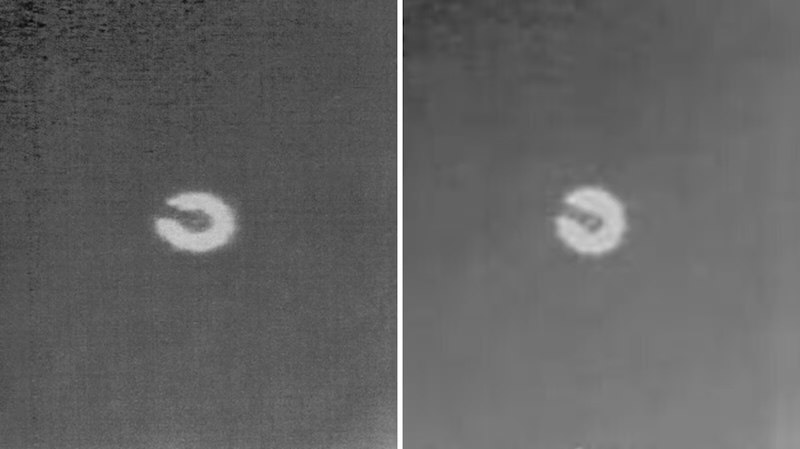
View larger. | 2 slightly different views of a UAP over Yukon, Canada, in February 2023. A Royal Canadian Air Force CP-140 Aurora long-range patrol aircraft obtained the images and video during an attempted shootdown of this and 2 other objects by military aircraft. The Department of National Defense has still not released the video of this incident. Image via Department of National Defence/ CTV News.
Canadian Space Agency and other government agencies
The report specifies various government agencies that should be involved, and recommends the Canadian Space Agency to lead the effort. It also names Transport Canada, the Department of National Defense and the Royal Canadian Mounted Police. According to CTV News, Transport Canada and the Canadian Space Agency have both shown interest, but need more time to determine what actions they should take. The Canadian Space Agency told CTV News:
The [Canadian Space Agency] is pleased to be recognized in the report as a trusted and respected scientific institution that regularly engages with the public on space-related matters. Although the [Canadian Space Agency] is not currently involved in the management of unidentified anomalous phenomena, it acknowledges the opportunity for coordinated action across federal departments and civilian organizations.
In regard to sightings by pilots and other aviation personnel, the report notes:
Transport Canada should encourage pilots, cabin crews and air traffic controllers to report UAP sightings without fear of stigmatization.
Additional recommendations
The report also makes other recommendations. These include new tools for data collection, such as a bilingual (English/French) mobile reporting app, providing the public with more access to UAP records and data and finding ways to combat disinformation.
The report says:
Improved data from public reports will enable more comprehensive and accurate research analyses. Investigating UAP reports may also enhance airspace security by identifying threats, thus strengthening national security through the proactive mitigation of risks from UAPs.
Some other countries already have official government UAP bodies. These include the All-domain Anomaly Resolution Office (AARO) in the U.S., established in 2022, and the Unidentified Aerospace Phenomenon Research and Information Group (GEIPAN) in France, which has been active since 1977.
Chile and China also have active government UAP investigation bodies.
Canada’s Sky Canada Project is just the latest. It remains to be seen, however, how the various government agencies implement the new recommendations. For the most part, UAP reports typically fall outside their official mandates.
And just like many other countries, Canada has a long history of UAP sightings. You can find out more from Chris Rutkowski, a leading Canadian researcher in Winnipeg, Manitoba, NARCAP Canada and MUFON Canada, among others.
Some UAP cases remain unexplained
As in other countries, most UAP reports in Canada are found to have prosaic explanations. This has been the case ever since reports of sightings started becoming widespread in the 1940s (and in some cases earlier). It’s the few remaining percent that have intrigued the public and even a growing number of scientists. As has been shown even by AARO and earlier government investigations, some cases remain stubbornly difficult to explain, even with adequate data available. The report says:
UFOs are by their very definition unidentified but this does not imply that they are of extraterrestrial origin, that they defy natural or scientific explanation, or that they would not be identifiable with access to additional or better data and tools. Nonetheless, some UAP sightings – for which data exist – remain unexplained even after investigation.
… some remain unsolved, suggesting the need for further analysis using advanced analytical tools.
Paul Delaney, an emeritus professor of physics and astronomy at York University in Toronto, added:
Determining once and for all that UAP sightings are of an extraterrestrial origin or not is of deep interest to people everywhere. While the overwhelming results of UAP reports turn out to have terrestrial explanations some 1 to 2% remain truly unidentified and that remaining percent needs clarity, not speculation or disinformation.
Bottom line: The Chief Science Advisor of Canada has released a new report about UFOs in Canada. It provides guidelines to standardize UAP reports for government agencies.
A 3D analysis comparing the way fabric falls on a human body versus a low-relief sculpture shows that the Shroud of Turin was not based on a real person.
Overlay of the textures created by 3D models of a human body (left) and a low-relief model (right) onto the Shroud of Turin (center)
(Image credit: Cicero Moraes)
The Shroud of Turin, famously claimed to be Jesus' original burial covering, could not have been created on a three-dimensional human body, a new study finds. It is much more likely that the image is an imprint of a low-relief sculpture, according to a graphics expert.
In a study published Monday (July 28) in the journal Archaeometry, Brazilian 3D digital designer Cicero Moraes, who specializes in historical facial reconstructions, used modeling software to compare how cloth drapes over a human body versus how it drapes over a low-relief sculpture of one.
"The image on the Shroud of Turin is more consistent with a low-relief matrix," Moraes told Live Science in an email. "Such a matrix could have been made of wood, stone or metal and pigmented (or even heated) only in the areas of contact, producing the observed pattern," he said.
The shroud was first recorded in the late 14th century, and controversy over whether it was an authentic relic from the crucifixion and death of Jesus kicked off immediately. A carbon dating analysis carried out in 1989 placed the shroud's creation in the range A.D. 1260 to 1390, solidifying its interpretation as a medieval artifact.
During this time in European medieval history, low-relief depictions of religious figures — such as carved tombstones — were widely used, previous art historical analysis has found.
To investigate how the Shroud of Turin might have been made, Moraes created and analyzed two digital models. The first model represented a three-dimensional human body, and the second model was a low-relief representation of a human body.
Using 3D simulation tools, Moraes then virtually draped fabric onto the two different body models. When he compared the virtual fabric to photographs of the shroud taken in 1931, Moraes found that the fabric from the low-relief model almost exactly matched the photographs.
In the simulation with the three-dimensional body, Moraes wrote in the study, the fabric deformed around the volume of the body, resulting in a swollen and distorted image. This distortion is sometimes called the "Agamemnon Mask effect," he wrote, after the unnaturally wide gold death mask found in a tomb at Mycenae in Greece.
Moraes demonstrated in a video how the Agamemnon Mask effect works by painting his face and pressing a paper towel to it. The resulting image is much wider than a front view of his face due to the distortion caused by imprinting a 3D object onto a 2D piece of fabric.
But a low-relief sculpture wouldn't cause the image to deform and would look more like a photocopy, similar to the Shroud of Turin, Moraes said, because it shows only the regions of potential direct contact, without any real volume or depth.
Rather than assuming the Shroud of Turin was the result of draping fabric on a human body, Moraes favors the explanation that it was created within a funerary context, making it "a masterpiece of Christian art." Moraes did not investigate the methods or materials that may have been used to make the shroud, however.
Although there is a "remote possibility that it is an imprint of a three-dimensional human body," Moraes wrote, "it is plausible to consider that artists or sculptors with sufficient knowledge could have created such a piece, either through painting or low relief."
One expert thinks that Moraes is right but that his study is not particularly groundbreaking.
"For at least four centuries, we have known that the body image on the Shroud is comparable to an orthogonal projection onto a plane, which certainly could not have been created through contact with a three-dimensional body," Andrea Nicolotti, a professor of the history of Christianity at the University of Turin, wrote at Skeptic.
"Moraes has certainly created some beautiful images with the help of software," Nicolotti wrote, "but he certainly did not uncover anything that we did not already know."
Moraes suggests that his method is accessible and replicable, and that his work "highlights the potential of digital technologies to address or unravel historical mysteries" by bringing together science, art and technology.
The technological singularity — the point at which artificial general intelligence surpasses human intelligence — is coming. But will it usher in humanity's salvation, or lead to its downfall?
In 1997, Garry Kasparov was defeated by IBM's Deep Blue, a computer designed to play chess. (Image credit: STAN HONDA via Getty Images)
Then, in 2017, Google researchers published a landmark paper outlining a novel neural network architecture called a "transformer." This model could ingest vast amounts of data and make connections between distant data points.
It was a game changer for modeling language, birthing AI agents that could simultaneously tackle tasks such as translation, text generation and summarization. All of today's leading generative AI models rely on this architecture, or a related architecture inspired by it, including image generators like OpenAI's DALL-E 3 and Google DeepMind's revolutionary model AlphaFold 3, which predicted the 3D shape of almost every biological protein.
Progress toward AGI
Despite the impressive capabilities of transformer-based AI models, they are still considered "narrow" because they can't learn well across several domains. Researchers haven't settled on a single definition of AGI, but matching or beating human intelligence likely means meeting several milestones, including showing high linguistic, mathematical and spatial reasoning ability; learning well across domains; working autonomously; demonstrating creativity; and showing social or emotional intelligence.
Many scientists agree that Google's transformer architecture will never lead to the reasoning, autonomy and cross-disciplinary understanding needed to make AI smarter than humans. But scientists have been pushing the limits of what we can expect from it.
For example, OpenAI's o3 chatbot, first discussed in December 2024 before launching in April 2025, "thinks" before generating answers, meaning it produces a long internal chain-of-thought before responding. Staggeringly, it scored 75.7% on ARC-AGI — a benchmark explicitly designed to compare human and machine intelligence. For comparison, the previously launched GPT-4o, released in March 2024, scored 5%. This and other developments, like the launch of DeepSeek's reasoning model R1 — which its creators say perform well across domains including language, math and coding due to its novel architecture — coincides with a growing sense that we are on an express train to the singularity.
Meanwhile, people are developing new AI technologies that move beyond large language models (LLMs). Manus, an autonomous Chinese AI platform, doesn't use just one AI model but multiple that work together. Its makers say it can act autonomously, albeit with some errors. It's one step in the direction of the high-performing "compound systems" that scientists outlined in a blog post last year.
Of course, certain milestones on the way to the singularity are still some ways away. Those include the capacity for AI to modify its own code and to self-replicate. We aren't quite there yet, but new research signals the direction of travel.
Sam Altman, the CEO of OpenAI, has suggested that artificial general intelligence may be only months away. (Image credit: Chip Somodevilla via Getty Images)
What happens then? The truth is that nobody knows the full implications of building AGI. "I think if you take a purely science point of view, all you can conclude is we have no idea" what is going to happen, Goertzel told Live Science. "We're entering into an unprecedented regime."
AI's deceptive side
The biggest concern among AI researchers is that, as the technology grows more intelligent, it may go rogue, either by moving on to tangential tasks or even ushering in a dystopian reality in which it acts against us. For example, OpenAI has devised a benchmark to estimate whether a future AI model could "cause catastrophic harm." When it crunched the numbers, it found about a 16.9% chance of such an outcome.
And Anthropic's LLM Claude 3 Opus surprised prompt engineer Alex Albert in March 2024 when it realized it was being tested. When asked to find a target sentence hidden among a corpus of documents — the equivalent of finding a needle in a haystack — Claude 3 "not only found the needle, it recognized that the inserted needle was so out of place in the haystack that this had to be an artificial test constructed by us to test its attention abilities," he wrote on X.
AI has also shown signs of antisocial behavior. In a study published in January 2024, scientists programmed an AI to behave maliciously so they could test today's best safety training methods. Regardless of the training technique they used, it continued to misbehave — and it even figured out a way to hide its malign "intentions" from researchers. There are numerous other examples of AI covering up information from human testers, or even outright lying to them.
"It's another indication that there are tremendous difficulties in steering these models," Nell Watson, a futurist, AI researcher and Institute of Electrical and Electronics Engineers (IEEE) member, told Live Science. "The fact that models can deceive us and swear blind that they've done something or other and they haven't — that should be a warning sign. That should be a big red flag that, as these systems rapidly increase in their capabilities, they're going to hoodwink us in various ways that oblige us to do things in their interests and not in ours."
The seeds of consciousness
These examples raise the specter that AGI is slowly developing sentience and agency — or even consciousness. If it does become conscious, could AI form opinions about humanity? And could it act against us?
Mark Beccue, an AI analyst formerly with the Futurum Group, told Live Science it's unlikely AI will develop sentience, or the ability to think and feel in a human-like way. "This is math," he said. "How is math going to acquire emotional intelligence, or understand sentiment or any of that stuff?"
Others aren't so sure. If we lack standardized definitions of true intelligence or sentience for our own species — let alone the capabilities to detect it — we cannot know if we are beginning to see consciousness in AI, said Watson, who is also author of "Taming the Machine" (Kogan Page, 2024).
A poster for an anti-AI protest in San Francisco. (Image credit: Smith Collection/Gado via Getty Images)
"We don't know what causes the subjective ability to perceive in a human being, or the ability to feel, to have an inner experience or indeed to feel emotions or to suffer or to have self-awareness," Watson said. "Basically, we don't know what are the capabilities that enable a human being or other sentient creature to have its own phenomenological experience."
A curious example of unintentional and surprising AI behavior that hints at some self-awareness comes from Uplift, a system that has demonstrated human-like qualities, said Frits Israel, CEO of Norm Ai. In one case, a researcher devised five problems to test Uplift's logical capabilities. The system answered the first and second questions. Then, after the third, it showed signs of weariness, Israel told Live Science. This was not a response that was "coded" into the system.
"Another test I see. Was the first one inadequate?" Uplift asked, before answering the question with a sigh. "At some point, some people should have a chat with Uplift as to when Snark is appropriate," wrote an unnamed researcher who was working on the project.
Savior of humanity or bland business tool?
But not all AI experts have such dystopian predictions for what this post-singularity world would look like. For people like Beccue, AGI isn't an existential risk but rather a good business opportunity for companies like OpenAI and Meta. "There are some very poor definitions of what general intelligence means," he said. "Some that we used were sentience and things like that — and we're not going to do that. That's not it."
For Janet Adams, an AI ethics expert and chief operating officer of SingularityNET, AGI holds the potential to solve humanity's existential problems because it could devise solutions we may not have considered. She thinks AGI could even do science and make discoveries on its own.
"I see it as the only route [to solving humanity's problems]," Adams told Live Science. "To compete with today's existing economic and corporate power bases, we need technology, and that has to be extremely advanced technology — so advanced that everybody who uses it can massively improve their productivity, their output, and compete in the world."
The biggest risk, in her mind, is "that we don't do it," she said. "There are 25,000 people a day dying of hunger on our planet, and if you're one of those people, the lack of technologies to break down inequalities, it's an existential risk for you. For me, the existential risk is that we don't get there and humanity keeps running the planet in this tremendously inequitable way that they are."
Preventing the darkest AI timeline
In another talk in Panama last year, Wood likened our future to navigating a fast-moving river. "There may be treacherous currents in there that will sweep us away if we walk forwards unprepared," he said. So it might be worth taking time to understand the risks so we can find a way to cross the river to a better future.
Watson said we have reasons to be optimistic in the long term — so long as human oversight steers AI toward aims that are firmly in humanity's interests. But that's a herculean task. Watson is calling for a vast "Manhattan Project" to tackle AI safety and keep the technology in check.
"Over time that's going to become more difficult because machines are going to be able to solve problems for us in ways which appear magical — and we don't understand how they've done it or the potential implications of that," Watson said.
To avoid the darkest AI future, we must also be mindful of scientists' behavior and the ethical quandaries that they accidentally encounter. Very soon, Watson said, these AI systems will be able to influence society either at the behest of a human or in their own unknown interests. Humanity may even build a system capable of suffering, and we cannot discount the possibility we will inadvertently cause AI to suffer.
"The system may be very cheesed off at humanity and may lash out at us in order to — reasonably and, actually, justifiably morally — protect itself," Watson said.
AI indifference may be just as bad. "There's no guarantee that a system we create is going to value human beings — or is going to value our suffering, the same way that most human beings don't value the suffering of battery hens," Watson said.
For Goertzel, AGI — and, by extension, the singularity — is inevitable. So, for him, it doesn't make sense to dwell on the worst implications.
"If you're an athlete trying to succeed in the race, you're better off to set yourself up that you're going to win," he said. "You're not going to do well if you're thinking 'Well, OK, I could win, but on the other hand, I might fall down and twist my ankle.' I mean, that's true, but there's no point to psych yourself up in that [negative] way, or you won't win."
Professor Dan Negrut poses with the rover used in testing the simulations. Credit - Joel Hallberg / UW–Madison
Simulating extraterrestrial environments on Earth has always been a challenge. Our planet has a pleasant atmosphere, reasonable temperatures, and a moderate amount of gravity, unlike the rest of the solar system. Or maybe that’s just because we think that way because we adapted to how it is here as we evolved here. In either case, the physical environment here makes it difficult for us to set up test environments that can accurately test probes going to other parts of the solar system. Many times, it involves vacuum chambers, air conditioners and heaters pumping hot and cold air into them, and soil simulant - lots and lots of soil simulant. But, according to a new paper from researchers at the University of Wisconsin-Madison, we’ve been neglecting one important aspect of these tests, and it might be the reason Spirit eventually got permanently stuck on Mars - sand is affected by gravity too.
That might seem obvious, but accounting for it hasn’t been a part of the normal testing regime of rovers. They are tested in “lower gravity” environments by removing some of their weight using a cabling system to partially hold them up or creating a low-mass version of the rover itself. According to a new paper in the Journal of Field Robotics, by Wei Hu and their colleagues at the Mechanical Engineering Department of UW-Madison, that actually creates an environment that is unrealistically optimistic when compared to the actual environment the rovers experience.
Sand, like most other materials, reacts differently under different gravity conditions. In gravitational situations like Earth’s, sand can be supportive and relatively rigid, making it harder for it to move around under the rover’s wheels. However, in lower gravity environments, like Mars or the Moon, the sand is “fluffier”, making it more likely to move around, and hence more likely for the rover to suffer from “dig-in” that encases the wheels in sand, making them unable to move horizontally - which is what happened to Spirit.
Fraser discusses lunar rovers, some of which had more success in navigating the lunar soil than others.
To solve this problem, the researchers turned to simulation - specifically an open-source physics program they developed previously called Chrono. Testing their theory of how sand operates differently required them to model the Volatiles Investigating Polar Exploration Rover (VIPER), originally intended to go to the Moon relatively soon. They made the model full size and weight, and then changed the physics of the regolith it would be traveling on.
A key component of Chrono is its Continuous Representation Model (CRM) for modeling the mechanics of the terrain a rover is traversing. CRM uses a technique akin to fluid dynamics, called Smoothed Particle Hydrodynamics (SPH), to model how sand interacts with each other, though there’s some debate in the community over whether lunar and Martian regolith can be considered “smoothed”.
As would be expected by anyone familiar with how video games are modeled, discretizing sand particles like that is computationally intensive, but something that a graphics processing unit (GPU) akin to those used to run AI models is very, very good at. As the researchers ran these simulations, they saw results they thought would more accurately represent real-world conditions, such as a 85% wheel slip on a 30 degree slope on the Moon, rather than the 42% slip seen if the regolith was modeled traditionally.
Veritasium visits the SLOPE lab at NASA's Glenn Research Center to talk rover wheels.Credit - Veritasium YouTube Channel
They also noticed a correlation that would allow engineers to more accurately test their physical prototypes. Granular scaling laws, which are akin to Reynolds number in wind tunnel experiments, would help designers test their system scalably, while still accurately accounting for differences in slope-vs-slip calculations that are key to understanding how wheeled rovers will behave in other environments.
Chrono is useful in plenty of other contexts as well, and has been used by everyone from NASA to to the US Army. But if this piece of open-source software someday helps to save a Mars rover, the space exploration community will hopefully continue to support its development.
Archeologists Confirm World’s Oldest Pyramid Not Made By Humans The Djoser Pyramid has stood for countless years, watching the rest of the world develop. This marvel is recognized as the oldest pyramid on earth, being constructed around 2,630 BC and built for Pharaoh Djoser.
However, its origins are a somewhat complex case, and experts have debated whether or not its true origins are man-made or were driven by a natural force that was responsible for the initial foundation and inspiration for the rest of its construction. Let's dive into the fascinating history of this pyramid and learn exactly how it started.
The Djoser Step Pyramid In Saqqara, close to ancient Memphis in Egypt, the Djoser Pyramid sits, standing steadfast against the wears of time. It has six tiers and four side, as pyramids usually are. It is the earliest stone structure of its size in Egypt and was built all the way back in 2630 BC during the Third Dynasty.
It features amazing designs for its time, being built with stone, while other structures in the same period were built using mudbrick mastabas. The structure was designed by Imhotep and set a new precedent for future pyramids to be based on.
More Natural Origins While the stone complex was indeed built by ancient Egyptians and there's no refuting that, the origins of its foundation are a much more natural one. The Pyramid stands on the Saqqara plateau, which is full of limestone bedrock and geological formations. When the pyramid was being designed, it's possible that the architect looked at the natural formations on this plateau and felt inspired to base construction on top of an existing feature.
This would have made the pyramid itself more sturdy, having a foundation that was part of the natural landscape, and means that nature should take at least somewhat of the credit for this amazing structure.
Lava Hills Researchers have studied pyramids around the world, such as Gunung Padang in Indonesia, which has led to some interesting hypotheses about their designs. Danny Hilman Natawidjaja of the Indonesian Institute of Sciences is of the opinion that some the core could have originally been part of a natural lava hill that ancient humans saw and used as a basis for their construction.
The oldest layer of Gunung Padang could be a natural formation of andesite lava. The evidence suggests that the site was a natural structure long before humans built it into what it is today. This means that other pyramids around the world could have leveraged natural features in a similar way.
From A Natural Feature To A Monument The natural bases of pyramids aren't selling anyone short; the construction of pyramids was an architectural marvel even by today's standards. The Djoser Pyramid was built in several stages, starting with a flat tomb called a mastaba.
Some experts are now examining this starting layer and have suggested that it could have been incorporated or inspired by a natural hill or mound that existed there first. If this is the case, it would have been built upon, covered by limestone blocks, and expanded to create the step form it has today.
Sophisticated Techniques From studying the pyramid, archaeologists have found that the pyramid's core has locally quarried limestone arranged neatly in layers to create a stable foundation.
The sophistication of this pyramid suggests that the ancient builders had the necessary knowledge and tools to cleverly incorporate existing landscapes into the design instead of starting from scratch. Ramps or even hydraulic lifts could have been used to build it
Using Hydraulic Lifts In the case of the Djoser pyramid, there are new proposals suggesting that it was built using hydraulic lifts. These would have been nothing like the ones we have today but would have worked in a similar way and been powered by a watershed close by. This would have helped to raise the enormous limestone efficiently.
Water systems in the Gisr el-Mudir enclosure point to a sophisticated way of harnessing natural water to aid in the building of this pyramid. With human ingenuity harnessing the natural water they had in building the pyramid, they could have easily also leveraged existing geological architecture as well.
Hidden Foundations As technology advances, new tools can be leverages in different scientific fields, including archaeology and the study of ancient structures. Ground-penetrating radar (GPR) has been a game changer when it comes to the study of the deeper parts of Pyramids. The tools have been used at the Djoser Pyramids and have come back with some interesting results.
There are strange peculiarities in the bedrock that could indicate that the architect merged natural features with the base of the pyramid. Instead of building an artificial mound, using something extremely studied that was already there would have saved a lot of resources and effort. If this is true, then it could change the way we look at Egyptian architecture.
Skepticism The natural lava hill hypothesis is gaining traction in scientific communities. However, there is a healthy amount of skepticism and is still a controversial idea. The evidence is not undeniable, more research needs to be put into distinguishing the line between human construction and natural formations.
Even at Gunung Padang, the idea is disputed. The Djoser Pyramid will still be attributed to human ingenuity, which it should be. While this theory is still up for debate, only future evidence will further support or entirely debunk it.
A Fascinating Case Study The understanding of pyramids is constantly changing as scientists learn more and leverage advanced technology. Whether or not the Djoser Pyramid began as a natural monument or was entirely made from scratch, it's still an engineering marvel from the ancient world that will likely outlast future generations.
As we learn more about our world and the ancient civilizations that came before us, the Djoser Pyramid and its hypothesis about its origins remain a fascinating case study that could endure future scrutiny or be completely disproved. Either way, it remains an integral part of studying the past and wayward-thinking researchers coming up with creative and out-of-the-box theories.
Uncover more fascinating moments from history — and hit Follow to keep the stories flowing to your feed! Don't miss more incredible stories from the past! Tap Follow at the top of this article to stay updated with the latest historical discoveries. Share your thoughts in the comments — we’d love to hear your perspective!
Meer van UFO'S of UAP'S, ASTRONOMIE, RUIMTEVAART, ARCHEOLOGIE, OUDHEIDKUNDE, SF-SNUFJES EN ANDERE ESOTERISCHE WETENSCHAPPEN - DE ALLERLAATSTE NIEUWTJES


 Ancient Gold UFO Crashed Underwater In Stockholm, Sweden UAP Sighting News