White Disk Over Arnold, Missouri USA March 31, 2026, UFO Sightings Daily

White Disk Over Arnold, Missouri USA March 31, 2026, UFO Sightings Daily
100 mile long UFO rises off moon as Artimus approaches, UAP Paranormal Alien Sighting News.
60 Mile UFO appears in Earths orbit in NASA Artimus photo, April 3, 2026, UAP Paranormal Alien Sighting Breaking News.

Scientists hint at what US government UFO files may reveal©Source: Pixabay
Scientists Hint at What US Government UFO Files May Reveal
Curiosity about extraterrestrial life has long blurred the line between science, speculation, and storytelling. Now, renewed calls to release classified UFO files are reigniting that curiosity, raising a simple but powerful question, what does the government actually know, and what might finally come to light?
©Source: Shutterstock
Government Push Renews Interest In UFO Disclosure
A recent directive to begin reviewing and releasing government records related to unidentified aerial phenomena, UFOs, and possible extraterrestrial life has sparked widespread attention. The initiative suggests a shift toward greater transparency, potentially opening decades of classified material to public scrutiny and scientific evaluation.
©Source: Pexels
Political And Public Reactions Fuel Speculation
Public interest intensified following comments from political figures discussing the possibility of life beyond Earth. While some statements emphasized the vastness of the universe as a basis for believing in extraterrestrial life, others hinted at the existence of undisclosed information, further fueling debate and speculation.
©Source: Pexels
New Sightings Add Urgency To The Discussion
Recent reports documenting hundreds of new unidentified aerial sightings highlight the scale of the phenomenon. While many cases remain unexplained, the volume of data underscores the need for systematic analysis, especially as advanced detection technologies continue to capture unusual activity.
©Source: Pixabay
Former Investigator Urges Realistic Expectations
A former lead investigator of government UFO programs has cautioned that the public may not find definitive proof of alien life in the released files. His experience suggests that many incidents can be attributed to misinterpretations, experimental defense projects, or deliberate obfuscation rather than extraterrestrial encounters.
©Source: Unsplash
Scientific Perspective Emphasizes Probability Over Proof
From a scientific standpoint, experts widely agree that life beyond Earth is statistically plausible given the immense scale of the universe. However, they also stress that no current evidence confirms that such life has visited or interacted with our planet in any verifiable way.
©Source: Unsplash
Astronomers Highlight Limits Of Human Perception
Astronomers note that unfamiliarity with atmospheric, optical, and astronomical phenomena often leads people to misidentify what they observe in the sky. This gap in understanding can transform ordinary events into seemingly mysterious encounters, reinforcing the importance of scientific literacy.
©Source: Common Wikimedia
The Role Of Skepticism In Scientific Inquiry
Skepticism remains a cornerstone of scientific investigation. Researchers emphasize that extraordinary claims require equally strong evidence, and this standard is essential for separating credible findings from assumptions or misinformation in the study of unidentified phenomena.
©Source: Unsplash
Challenges Of Declassification And National Security
Experts anticipate that many documents may be heavily redacted due to national security concerns, particularly those involving advanced surveillance systems. Even so, older data could be released in a way that allows scientists to reanalyze past observations using modern tools and methodologies.
©Source: Commons Wikimedia
Search For Life Focuses On Microbial Evidence
Rather than expecting dramatic discoveries of intelligent beings, many scientists are focused on the possibility of microbial life. Since microorganisms were the foundation of life on Earth, finding similar evidence elsewhere would represent a major scientific breakthrough.
©Source: Unsplash
A Scientific Approach To The Unknown
Researchers studying these files aim to distinguish between explainable events and truly anomalous cases. While most sightings are likely to have conventional explanations, scientists remain open to the possibility that a small number of incidents could challenge current understanding, making careful, evidence-based analysis essential.
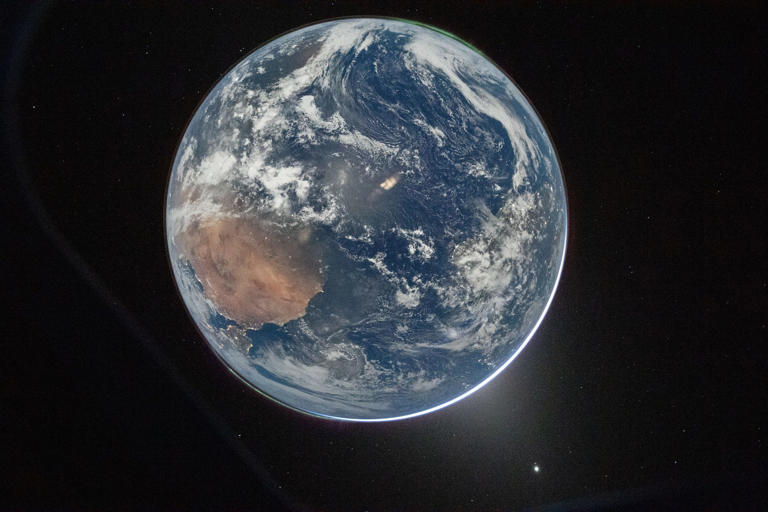
ArtemisII crew saw a life-changing view. The story of a viral photoAs the four astronauts on the 10-day Artemis II mission around the moon got their first clear glimpse of Earth, the view of their home planet in the distance stopped them in their tracks.
They captured a remarkable photo of Earth from the first crewed moon mission in 50 years. The photo, taken by Commander Reid Wiseman on April 2 from the Orion spacecraft's window, showed Earth from tens of thousands of miles away. It captured the "spectacular blues and browns" of the planet and even caught two auroras lighting up the atmosphere.
The image has dazzled those back on Earth who are following the Artemis II mission and may never get the chance to see our home planet from space for themselves. But the view has also had a profound impact on the crew, the first humans to leave Earth's orbit since 1972.
"There was a moment about an hour ago where Mission Control Houston reoriented our spacecraft as the sun was setting behind Earth, and I don't know what we all expected to see in that moment," Wiseman told reporters during a question-and-answer session from space on April 2, describing all the detail the crew could see of Earth. "It was the most spectacular moment, and it paused all four of us in our tracks."
Astronauts in the past have gotten to see glimpses of auroras, lightning strikes and metropolitan areas lit up as evidence of human life. Seeing Earth from above has had such a transformative influence on astronauts that there is an entire psychological phenomenon to describe it, called the overview effect. It can change an astronaut's entire perspective on Earth and life itself.
The astronauts will also get to see parts of the moon that nobody has ever laid eyes on before, the far side not viewable from Earth. That will happen during a roughly six-hour window on April 6 when the sun, moon and the Orion spacecraft will be aligned in just the right way so the astronauts can see about 20% of the far side of the moon, lit by the sun, NASA said.
The Artemis II crew members described the "breathtaking" view of Earth and the details of what they were seeing. From space, they can see the coastline of continents, rivers, thunder clouds and the South Pole lit up, said Artemis II Mission Specialist Christina Koch, reported NPR. The photo captured by Wiseman shows auroras on the poles, lit up in green.
There's nothing that prepares you for the breathtaking aspect of seeing your home planet both lit up bright as day and also the moon glow on it at night with the beautiful beam of the sunset," Koch told reporters in a live stream from space.
"You could see the entire globe from pole to pole, you could see Africa, Europe and if you looked really close, you could see the northern lights," Wiseman said.
Astronauts for decades have tried to put into words the experience of seeing Earth from various missions. Alan Shepard was the first American to view Earth from space in 1961 from the Freedom 7 Mercury Capsule during a 15-minute suborbital flight.
"If somebody'd said before the flight, 'Are you going to get carried away looking at the Earth from the moon?' I would have said, 'No, no way,'" Shepard said after walking on the moon during the Apollo 14 mission in 1971. "But yet, when I first looked back at the Earth, standing on the moon, I cried."
The International Space Station has a particularly good view of Earth from its seven-windowed cupola module. Former NASA astronaut Nicole Stott said she looked for her home state of Florida during her first trip to the ISS in 2009.
"I wanted to go to the window and see it, and then realized somewhere down the line that I wasn’t looking at Florida that same way anymore,” she said. “I still wanted to see Florida, but Florida had just become this special part of home, which is Earth. We’re all earthlings.”
The life-altering effects of viewing Earth from space have garnered psychological research. In 1987, it was dubbed the "overview effect" by space philosopher and author Frank White, who first considered the phenomenon while on a cross-country flight and decided to start interviewing astronauts. One of the most common experiences they shared was seeing the reality that there are no borders or boundaries separating people, he said.
"And what the astronauts were telling me was, I, I knew before I went into orbit, or went to the moon, that there weren’t any little dotted lines. But it’s knowing intellectually versus experiencing it," White said on a NASA podcast in 2019.
A common conclusion astronauts made from their observations, White said: "We are really all in this together. Our fate is bound up with people that we may think are really different from them. We may have different religions, we may have different politics. But ultimately, we are connected. Totally connected."
It's a difficult concept to convey, White said, "because all you have is words." To fully understand, you need to see it for yourself, he said.
Koch described the overview effect from the International Space Station this way, in a NASA publication from November 2025:
“The overview effect is when you’re looking through the cupola and you see the Earth as it exists with the whole universe in the background. You see the thin blue line of the atmosphere, and then when you’re on the dark side of the Earth, you actually see this very thin green line that shows you where the atmosphere is. What you realize is every single person that you know is sustained and inside of that green line and everything else outside of it is completely inhospitable. You don’t see borders, you don’t see religious lines, you don’t see political boundaries. All you see is Earth and you see that we are way more alike than we are different.”
"Are you going to try to live your life a little differently? Are you going to really choose to be a member of this community of Earth?" Artemis II Pilot Victor Glover previously said.
On April 2, when asked about division back on Earth, Glover said: "Trust us, you look amazing, you look beautiful. And from up here you also look like one thing. Homo sapiens, all of us, no matter where you're from or what you look like, we're all one people."
Two photos taken more than a half-century apart were compared side-by-side by NASA in a post to social media this week.
The first, the famous "blue marble" photo taken in December 1972, was captured by the crew of the Apollo 17 mission, the last crewed mission to land on the moon.
The second photo was taken April 2, 2026, during Artemis II, which won't include a lunar landing but paves the way for future landings and space exploration.
This article originally appeared on USA TODAY:
RELATED VIDEOS
What is alien disclosure? This answer may surprise you..
In a recent Substack essay, writer Dana Kippel tackles the often‑misunderstood concept of “alien disclosure.” Rather than focusing on declassified government files or sensational sightings, Kippel frames disclosure as a collective shift in consciousness that could redefine humanity’s relationship with any extraterrestrial intelligence. The piece, published in early 2026, weaves together references to UFO research, metaphysical theories of the “higher self,” and emerging fringe scientific models that treat consciousness as a fundamental component of reality.
Kippel argues that the conventional narrative—wherein a secretive agency releases proof of alien craft—misses the deeper purpose of disclosure. She writes that “the real unveiling is internal, a co‑creative plasma reality where human perception expands to recognize non‑human intelligences as part of a shared field.” The essay links this idea to recent discussions about plasma‑consciousness dynamics, a model suggesting that matter and mind are intertwined at a sub‑atomic level. According to Kippel, if humanity begins to experience reality as a mutable, fractal “Mandelbrot plasma,” the distinction between “us” and “them” dissolves, paving the way for authentic contact.
Mainstream scientists remain cautious about claims that consciousness can directly interface with extraterrestrial entities. The U.S. Office of the Director of National Intelligence’s 2021 UAP report, for instance, emphasized the need for rigorous data collection and warned against speculative interpretations. Nonetheless, a growing niche of researchers—often labeled “fringe”—explores parallels between quantum entanglement, information theory, and the possibility of non‑local communication. Kippel cites work from physicists investigating “co‑creative plasma” as a medium that could, in theory, support such exchanges, though she acknowledges that empirical validation is still pending.
The essay also highlights voices from the UFO and metaphysical communities who view disclosure as an evolutionary catalyst. Authors like Dr. Jacques Vallée have long suggested that UFO phenomena may be psychological or sociocultural mirrors, prompting humanity to confront unresolved aspects of its own consciousness. Kippel extends this line of thought, proposing that alien contact could act as a “mirror of the higher self,” encouraging individuals to transcend egoic limitations. She references a recent live discussion with fellow researcher Jonathan Cohen, noting that participants reported “heightened intuitive awareness” after meditative sessions focused on interstellar dialogue.
If Kippel’s interpretation gains traction, the policy implications could shift dramatically. Rather than preparing for a sudden release of classified footage, governments and scientific institutions might prioritize public education on consciousness research and interdisciplinary collaboration between physicists, neuroscientists, and philosophers. Critics caution that such a pivot risks blurring the line between evidence‑based inquiry and speculative mysticism. Yet Kippel maintains that “the surprise of true disclosure lies not in the arrival of alien ships, but in humanity’s readiness to recognize itself as part of a larger, self‑organizing cosmos.”
Review: In an Age of Disinformation, “Saucers, Spooks and Kooks” is the Real Disclosure Film

If you’re tired of never-ending promises of UFO disclosure that never arrive, then have I got a movie for you.
Based on the 2021 book by Adam Gorightly and directed by Christopher Graybill, Saucers, Spooks and Kooks digs into the origins of longstanding UFO myths that persist to this day. In a nostalgia fest for the paranoid UFOlogy of the 80s and 90s, the film provides more real answers on where the grey aliens come from than you can expect to find in any trove of government documents or collection of experiencers’ tales.
Unlike other recent UFO films, Saucers, Spooks and Kooks also doesn’t take itself too seriously. Even if that would turn off some of the more solemn pursuers of truth in our midst, soldiering through it will nonetheless offer a solid case that they, in fact, may be the ones taking the “disclosure” idea a bit too seriously. While modern advocates have claimed disclosure is right around the proverbial corner, the film highlights an uncomfortable reality: that others have been saying very similar things for many decades—and the specific time period that the film covers, spanning the late 1970s through the mid 1990s, helped set the stage for much of our present UFO mythology.
Over the course of the film, the amount of intentional disinformation, tall tales, and willingness to believe that have shaped UFOlogy becomes clear, providing essential context for where the topic stands today, as addressed (spoiler alert) at the end of the film. In short, the film offers a history lesson that may be strange and fascinating enough to surprise both the skeptic and believer, as it twists and turns through murky truths and strange characters that, at times, may seem every bit as incredible as UFOs themselves.
These ideas are traceable to specific people, whom the film follows through moments ranging from the “dark side” of the subject—as in the case of Paul Bennewitz, who was driven to madness, and reportedly with the help of UFO disinformation—to the absurd, as in the case of the strange prankster known as “TAL LeVesque,” who in one instance claimed to meet a reptilian alien in his bedroom. These, and many others, are the individuals who contributed to shaping UFOlogy as we know it, although as the film argues, UFOlogists who ignore the lessons these human stories teach are doomed to continue banging their heads against the wall into perpetuity.

Adam Gorightly hosts the documentary in-character, as a quirky, paranoid researcher surrounded by monitors.
Credit: Christopher Graybill
While some of the basic elements of the story presented also appeared in the 2013 documentary Mirage Men, Saucers, Spooks and Kooks vastly expands on that film. The main thrust of Mirage Men was the story of how Air Force Office of Special Investigations officer Richard Doty intentionally passed false information to UFO investigators in an alleged counterintelligence operation, events that ended up becoming a crucial part of the UFO mythos and culminating in Bill Moore’s fiery speech at the 1989 MUFON convention, which at the time tore the community apart.
Mirage Men, some historians might argue, could be seen as part of the “before times,” as it was released prior to the 2017 New York Times article, which revealed the existence of a previously secret U.S. government program that examined UFOs and related phenomena—a moment that has become viewed as a sort of dividing line for the modern era of UFOlogy. Mirage Men conveyed Doty as an individual who, decades after his “official” involvement with counterintelligence, was seemingly still up to his old tricks, attempting to pull one over on a dwindling audience of die-hard UFO buffs with the story of a secret US space program exchanging humans with aliens that became known as the SERPO affair.
Where Saucers, Spooks and Kooks expands the retelling is in highlighting not just the “spooks” like Doty and their side of the story, but also the many “kooks” who ran with the disinformation provided by them that helped build on the mythos. The result provides a more complete and satisfying account of UFOlogical history by exploring how these two elements play off of one another like a snowballing internet creepypasta, to produce an ever-evolving myth.
And that myth remains in motion to this day. The film ends with images of modern “whistleblowers” claiming to have insider information all over again. This time, wrapped in an air of respectability that the Bill Moores of the era never achieved, with congressional hearings and 20/20 interviews, yet the same mist of evidence that is perpetually out of reach, “cannot be discussed in this setting,” or simply remains unseen, but perpetually “imminent.” While Doty may still be out there somewhere on the internet, attempting to lay claim to his own stake in “disclosure,” the new faces that have emerged in recent years come with more impressive titles and from positions deeper inside the intelligence apparatus.

Unlike the bland graphic design on other recent UFO documentary covers, Saucers, Spooks and Kooks uses the Ghanaian film poster style for its promotional artwork. While those posters have become popular collectibles among schlock film fans, the reference may be lost on the typical UFO enthusiast.
Credit: Christopher Graybill
This is all helped along with a presentation that feels straight out of the period, transforming narrator Gorightly into a quirky character in this retelling, and combining Graybill’s Gen X memories of the Unsolved Mysteries television show with Gorightly’s knowledge of the field’s myriad characters as they appeared at the time. The intentional lo-fi vibe appeals to those who appreciate the earnestness of the underground UFO zines and VHS tapes of the era, into which UFOlogy’s forefathers poured their blood, sweat, and tears before the ease of Tweets, YouTube rants, and the all-too-tempting allure (and overuse, in many cases) of AI-generated content.
From Graybill’s synth music and animated reenactments, complete with CRT TV scan lines, to a host of well-researched period footage, Saucers, Spooks and Kooks transports one back to the era. Especially notable are the kitschy yet eerie live-action reenactments sourced from Japanese television of the time.
The Debrief spoke with the pair to find out how it all came together.
“I find a lot of the disclosure crowd, and what they’re producing—the content, the visuals, you know, using AI or whatever, to be pretty damn boring. And the old stuff I love,” Gorightly said. “I think it was my idea to use that. Chris spent a lot of time wrangling old footage. I like that sensibility.”
“It was a collaborative process, for sure. It evolved with both of our sensibilities, I guess,” Gorightly explained. “For instance, we called where I was at ‘Gorightly’s Lair,’ and I kind of came up with that concept of having a guy in his basement, you know? The set [was] in my garage. Since then, I’ve remodeled, and it’s a recording studio.”
“What we modeled that on was John Lear back in the day. I don’t know if you’ve seen any videos of him. He had all those television screens and stuff behind him,” Gorightly continued. “It was kind of a mishmash of John Lear and the conspiracy theorist who lives with his parents down in the basement. Chris and I put the set together, and the murder board. We collaborated in putting all those little elements together for the film.”
“[Initially] it was a bit too dry; I was reading it straight, so we kind of came up with a thing. If I was on Unsolved Mysteries … how would I be announcing that—a little bit more amped up, but also kind of quirky, and that throws some humor in there now and then,” Gorightly concluded.
“I think I’ve always approached it more as entertainment than anything,” Graybill told The Debrief, calling UFOlogy a “metafiction.”
“It could be true, but it’s more just fun to think about and entertain,” Graybill said.
“The documentary kind of TV shows, it was just like ‘we’re gonna get to the bottom of it,’ and they never do. But they’ll show you some great footage. You do wonder; it makes you really curious, I think. It made me really curious: what is the real story?”
And get to the “real” story is what Gorightly appears to have done. He spoke with many of the involved persons for the original book, and, along with Graybill, conducted another round of in-depth interviews for the film. Additionally, Graybill sourced footage from the National UFO Historical Records Center, including rare early footage of the two men most responsible for popularizing Roswell as the most well-known UFO case in the US: UFO researchers Stanton Friedman and Bill Moore.
However, not everyone from those days was eager to tell their story, as a few of the participants from that era don’t look back on those days fondly, offering something of a warning to the eager young UFOlogists of today.
“I put out feelers to talk to Bill Moore through Bishop. I think Greg Bishop is still in touch with him,” Gorightly said. “But it didn’t sound like Moore was interested, and he hasn’t really discussed it for many years now.
“Chris found the number of Jamie Shandera and called him, and the conversation went:
‘Is this Jamie Shandera?’
‘Yes.’
‘Jamie Shandera from UFO Cover-Up Live?’
‘Uh, yes.’
“Chris asked if he wanted to talk about them. He said, ‘No, I’m not interested,’ and hung up.”

Director Christopher Graybill conducted extensive research for the film. Credit: Christopher Graybill
We asked Gorightly when he first began to have suspicions of the ever-around-the-corner disclosure movement. His answer took him back two decades.
“Let’s see, this would be 2006, at the Roswell conference,” Gorightly said. “That was the 60th anniversary? A bunch of different researchers and ufologists were there, and I gave a talk I had at that time.”
“They had us stay at a hotel, and I was there with Greg Bishop and Nick Redfern,” Gorightly remembered. “We went down for the free breakfast, and down there were Stan Friedman, Bruce Maccabee, and Steven Bassett. I didn’t know who Stephen Bassett was at the time. I knew Maccabee and Stan Friedman; I think it was those three guys. So, you know, we’re just waking up, having coffee or whatever. Free cereal, your waffles that you’d make on the little thing there. Bassett’s going on and on about how Hillary’s gonna be the disclosure president, and this and that. It’s like, holy shit, who’s this guy?”
“And we got done with him, and I’m walking away, and I asked Greg Bishop, ‘Is that guy serious about all this?’ And he said, oh yeah, he’s quite serious. That’s Stephen Bassett,” Gorightly said, recalling that “he had this thing called the disclosure clock back then. It’s almost like the Doomsday Clock. It hit the midnight hour. We’re talking around 2000.”
“I was dubious when people started saying they have these unnamed sources in the government,” Gorightly said.
So, while history has shown that “disclosure” never quite seems to arrive, Saucers, Spooks and Kooks at least proves that understanding the history of UFOs and, perhaps more importantly, those who have been involved with their study, can offer a more viable way of discerning a degree of “truth” about the subject. In addition to their film, for even more in-depth information on all of this, be sure to also check out Gorightly and Graybill’s companion podcast, which is full of expanded interviews and deep dives.
RELATED VIDEOS
10 Weird Archaeological Facts That Will Blow Your Mind

Archaeology isn’t just about dusty ruins and ancient pottery—it’s full of bizarre discoveries that challenge what we think we know about the past. From mysterious artifacts to unusual burial practices, here are 10 of the strangest archaeological facts ever uncovered!
1. The Ancient Egyptians Used Honey to Treat Wounds
Over 4,000 years ago, Egyptian doctors used honey as an antiseptic to prevent infections. They believed it had magical healing properties, but modern science confirms they were onto something—honey is naturally antibacterial and still used in medicine today!

AI-generated image (provided by author).
While people in medieval Europe shivered in their castles, the ancient Romans were enjoying underfloor heating! They built a system called hypocaust, where hot air from a furnace flowed beneath raised floors—basically, ancient central heating.

AI-generated image (provided by author).
Some mummies have been found with terrifying, open-mouthed expressions, leading to myths of cursed souls trapped in eternal screams. But archaeologists say this happens because the jaw drops open after death—still creepy though!

AI-generated image (provided by author).
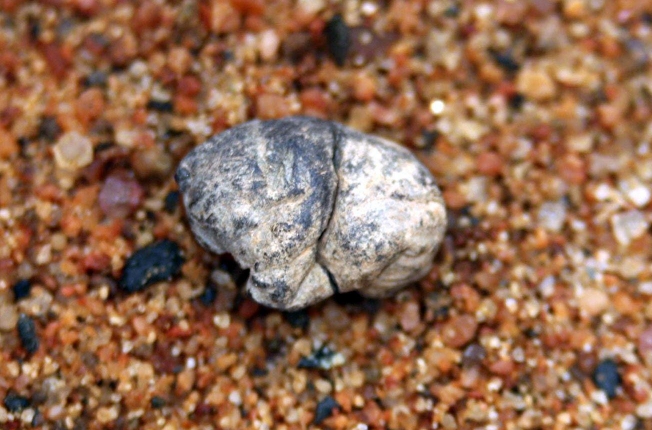
Archaeologists in Sweden found a piece of ancient chewing gum made from birch bark tar, complete with human teeth marks! It’s believed Stone Age people chewed it for fun, to clean their teeth, or as medicine—kind of like prehistoric bubble gum.

Graves from the Middle Ages reveal skeletons with stakes through their hearts, rocks in their mouths, or even decapitated heads. These were suspected vampires, buried in ways to prevent them from rising from the dead.

AI-generated image (provided by author).
In Pompeii, archaeologists found a well-preserved street food stall (thermopolium) with painted menus showing the food they served. Turns out, fast food isn’t a modern idea—Romans were grabbing quick bites over 2,000 years ago!

An ancient Roman fast food counter that was unearthed in Pompeii last year will open to the public.
(Luigi Spina / AFP).
Ancient skulls with unnaturally long shapes have been found worldwide, from South America to Asia. Some believe they’re proof of alien contact, but archaeologists explain they were intentionally reshaped using tight bindings, possibly as a status symbol.

One of the elongated skulls found in the Mayan cenote in Mexico.
(Bradley Russell / National Geographic).
Deep in the Honduran jungle, explorers uncovered ruins of a mysterious, forgotten civilization, which legends call "The White City" or "City of the Monkey God." Even weirder? Many of the researchers got sick after excavation, leading to rumors of an ancient curse.

AI-generated image (provided by author).
Ancient Roman concrete is stronger than modern concrete, especially in seawater. Scientists discovered it gets stronger over time due to a chemical reaction with seawater, making it almost indestructible—unlike today’s crumbling bridges!

AI-generated image (provided by author).
At Göbekli Tepe in Turkey, archaeologists found huge stone pillars covered in carvings of strange, humanoid figures. Built over 6,000 years before the Egyptian pyramids, the site has led some to speculate about lost civilizations—or even ancient giants!

Archaeological site of Göbeklitepe in Turkey.
Archaeology is full of mysteries, and every discovery raises new questions about our past. From vampire burials to unbreakable Roman concrete, history is weirder than we ever imagined! Which fact surprised you the most?
Nearly a century of wondering: The American UFO saga, in reality and in fiction
UFOs, or the notion of them, have been around a long time. Here´s a look at how the various iterations of the subject - from government investigations to sightings to movies and TV - have unfolded since World War II:
On June 24, private pilot Kenneth A. Arnold reports seeing nine objects flying near Mount Rainier in Washington state. His was the first widely reported UFO sighting in this country and set off a wave of other reported sightings. On July 2, A ranch foreman checking on sheep finds strange debris spread over a prairie near Roswell, New Mexico. Authorities initially say the material is from a flying disc, but later say it is from a weather balloon.
U.S. Air Force launches Project Sign, an investigation into UFOs; renamed Project Blue Book in 1953. More than 12,600 reported sightings were investigated between 1948 and 1969.
Release of the spy film "The Flying Saucer."
Radar operators, pilots and others pick up or see up to a dozen unexplained objects in the sky above Washington, D.C. in July.

FILE - A sign directs travelers to the "1947 UFO Crash Site Tours" in Roswell, N.M., on June 10, 1997. (AP Photo/Eric Draper, File)
Construction begins for what would become the Area 51 site northwest of Las Vegas as an Air Force facility. Area 51 becomes a hotspot for UFO conspiracy theories. In 2013, the CIA acknowledged the existence of the site.
In November, dozens of people in Levelland, Texas, west of Lubbock, report strange lights in the sky that interfered with their vehicles and lights.
In September, "Star Trek" premieres on NBC, launching the most enduring space drama in history.
Dec. 17: Air Force says it found no evidence of any UFO that was extraterrestrial in nature or that threatened national security; terminates Project Blue Book.
Steven Spielberg´s "Close Encounters of the Third Kind" released.
U.S. Air Force personnel stationed in Great Britain report seeing strange lights above Rendlesham Forest, northeast of London, in December. Officers reportedly see a metallic object in the forest after investigating the lights.
Spielberg´s "E.T. the Extraterrestrial" is released.
Roland Emmerich´s "Independence Day" is released.
Residents report seeing lights from a large flying object in the sky over or near Phoenix in March.
U.S. aviators track an unidentified blob which was dubbed "Gofast." In another video from that year, labeled "Gimbal," an unexplained object is tracked as it soars high along the clouds, traveling against the wind. "There´s a whole fleet of them," one naval aviator tells another, though only one indistinct object is shown. "It´s rotating." The videos are leaked and later released by the Pentagon.
Navy acknowledges the three clips of declassified military footage as unidentified aerial phenomena.
Pentagon announces a UAP (unidentified aerial phenomena) Task Force.
Investigators say in a U.S. government report that they did not find extraterrestrial links in reviewing 144 sightings of aircraft or other devices apparently flying at mysterious speeds or trajectories. They highlighted the need for better data collection.
Congress holds first hearing in 50 years on UFOs following reports of unexplained aerial phenomena by the military. Lawmakers from both parties say UFOs are a national security concern. NASA announces that it is launching a study of UFOs as part of a new push toward high-risk, high-impact science. The space agency says it´s setting up an independent team to see how much information is publicly available on the matter and how much more is needed. The agency releases its findings in 2023, saying the study of UFOs will require new scientific techniques, including advanced satellites as well as a shift in how unidentified flying objects are perceived. The All-Domain Anomaly Resolution Office (AARO) set up in the Pentagon to track reports of unidentified objects in the sky, under water and in space.
Former Air Force intelligence officer David Grusch testifies before a House Oversight subcommittee in July that the U.S. is concealing a longstanding program that retrieves and reverse-engineers unidentified flying objects. The Pentagon denies it´s concealing any such program.
New Pentagon study that examined reported sightings of UFOs over nearly the last century finds no evidence of aliens or extraterrestrial intelligence. The study from the Defense Department´s All-Domain Anomaly Resolution Office analyzed U.S. government investigations since 1945 of reported sightings of unidentified anomalous phenomena. It found no evidence that any of those claims were actually signs of alien life, or that the U.S. government and private companies had reverse-engineered extraterrestrial technology and were hiding it.
-Feb. 14: Former U.S. President Barack Obama, answering a question about "are aliens real" on a podcast, says, "They´re real. But I haven´t seen them. And, they´re not being kept in Area 51." Obama later released this statement on social media: "Statistically, the universe is so vast that the odds are good there´s life out there. But the distances between solar systems are so great that the chances we´ve been visited by aliens is low, and I saw no evidence during my presidency that extraterrestrials have made contact with us. Really!"
-Feb. 19: President Donald Trump announces on social media that he´s directing the Pentagon and other government agencies to identify and release files related to extraterrestrials and UFOs because of "tremendous interest." Trump accuses Obama of disclosing "classified information" and tells reporters that he doesn´t know if UFOs are "real or not."
-March 31: U.S. Rep. Anna Paulina Luna requests in a letter to Defense Secretary Pete Hegseth that the government release about four dozen videos related to UAP sightings to an oversight committee task force. "The presence of UAPs in and around the sensitive airspaces of U.S. military installations poses a threat to the security of the armed forces and their readiness," Luna writes.
RELATED VIDEOS
Hollywood's narrative on UFOs and ETs reaches back many decades
Before zombies shambled about, ghoulishly feasting on the flesh of those too slow to flee, aliens from outer space ruled movie theaters, drive-ins and late Saturday night creature features on television.
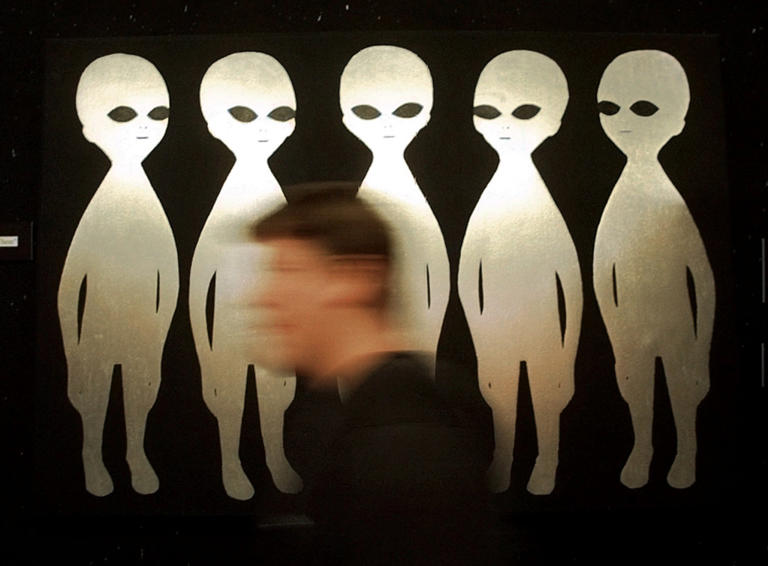
Even as Hollywood still drives how Americans envision little green men with big eyes and bigger heads, fiction soon could be separated from - or revealed as - fact if government agencies release secret files related to extraterrestrials and UFOs as called for in February by President Donald Trump.
The science fiction genre has shaped how people think about intelligent life elsewhere in the universe - "whether it´s invasion narratives or aliens coming to warn us that we´re on the wrong track or aliens just trying to come and make contact and help us with things or just say `hi,´" says Duke University professor Priscilla Wald, who teaches a class on science fiction and film.
Trump's announcement on social media followed former President Barack Obama suggesting in a podcast interview that aliens were real. Obama later clarified that he had not seen evidence that aliens had made contact, but said since the universe is so vast odds are good that life exists elsewhere.
Movies say they are nearly everywhere, from a Pennsylvania cornfield in 2002's "Signs" to Wyoming's Devil's Tower in 1977's "Close Encounters of the Third Kind" to a Central American jungle where 1987's "Predator" was set.
"Hollywood has basically been preparing the public for this," retired Navy Rear Adm. Timothy Gallaudet says of any revelation that intelligent life from outer space exists and has visited Earth. "I think people can handle it. It does, of course, depend on what information is released (by the government)."

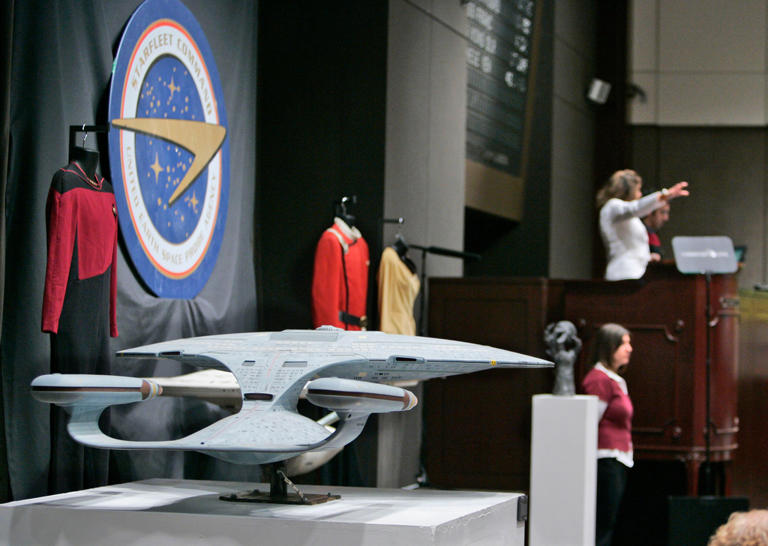
FILE - Model ships hang at the entrance to the Star Trek Experience at the Las Vegas Hilton in Las Vegas on Aug. 25, 2008.
(AP Photo/Isaac Brekken, File)
Hollywood quickly latched on following the 1947 discovery of debris near Roswell, New Mexico. Authorities initially identified crash materials as a flying disc before quickly backtracking and saying they were from a high-altitude weather balloon.
About three years after Roswell, "The Flying Saucer" made it to theaters. That was followed by a some low-budget and mostly forgettable movies, while others continue to inspire sci-fi buffs like 1951´s "The Day the Earth Stood Still."
"If you think back to the flourishing of alien films, this starts really in the U.S. in the 1950s," Wald says.
"The aliens are gentle souls who come down and try to warn us after nuclear war," she says of "The Day the Earth Stood Still." "They´re trying to warn that we´re creating problems in the cosmos and that if we don´t stop, they are and have to do something about it."
Still others depict visitors arriving with more nefarious motives and intentions - to kill us, to take over the Earth, sometimes even to make us food.
"I think if we found out aliens were on the way, there would be a mix of responses," Wald says. "I think there would be a lot of people out there welcoming them. A lot of people would be going down to the cellars and stocking them with canned food."
A plethora of documentaries also have been released, including 2025´s "The Age of Disclosure," which details government knowledge of the existence of intelligent life outside of humans and attempts to reverse engineer alien technology.
Steven Spielberg has directed such box office hits as 1982's "E.T. The Extraterrestrial" and "Close Encounters of the Third Kind." His upcoming film "Disclosure Day" teases: "If you found out we weren´t alone, if someone showed you, proved it to you, would that frighten you?"
"My question is always, 'Well, what is that fear really about?'" Wald says. "It seems to me it´s a reflection on who we are, that we´re projecting onto aliens the way we treat each other. So, the aliens are coming down, they want to conquer us, they´re violent. Who does that sound like? It sounds like us."
De schokkende waarheid over Leviathan: de geheimen van oude religies ontleed

De schokkende waarheid over Leviathan: de geheimen van oude religies ontleed
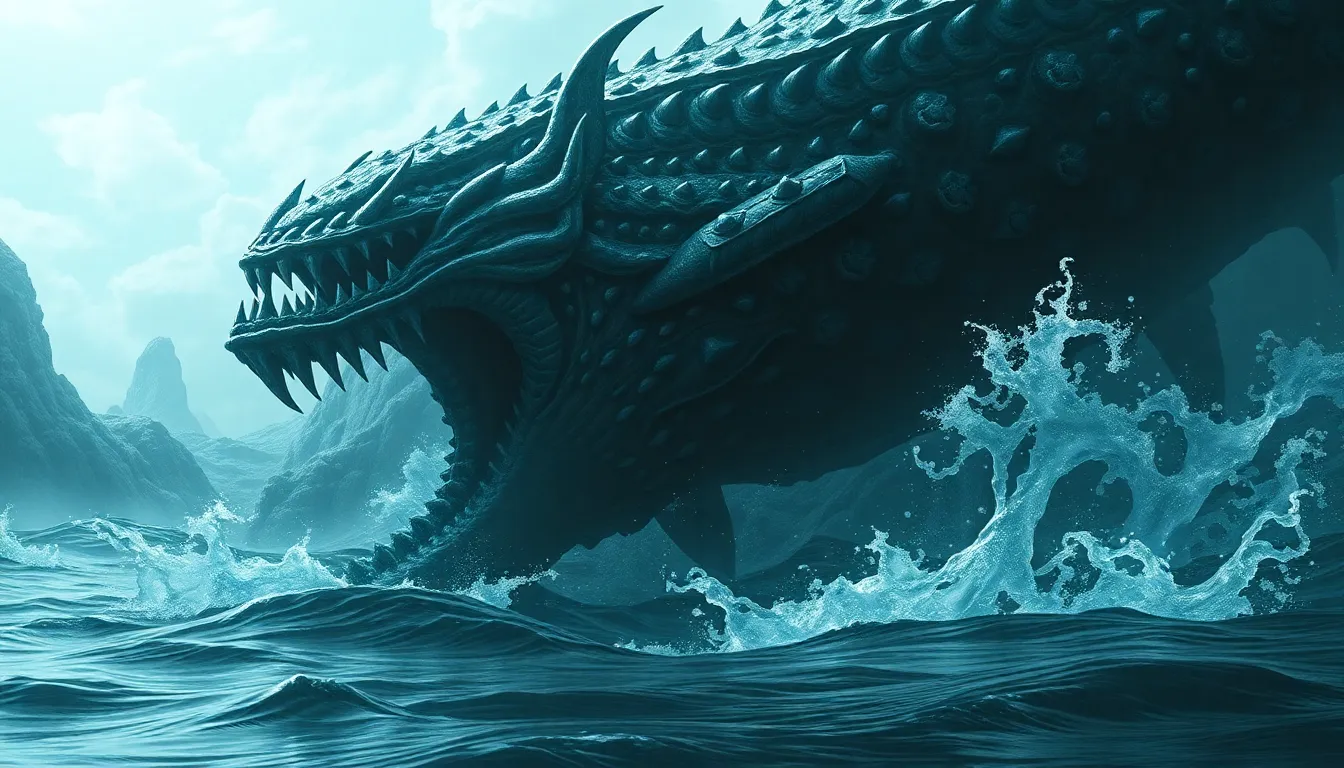
Heb je ooit gehoord van Leviathan? Het is een reusachtig zeemonster dat voorkomt in oude religieuze teksten en mythologieën over de hele wereld. Maar wat is Leviathan precies? En wat kunnen we leren over de overtuigingen en praktijken van onze voorouders door dit mysterieuze schepsel te bestuderen? In dit artikel duiken we diep in de wereld van Leviathan, de verborgen betekenissen die eraan verbonden zijn en de rol die het speelt in de ontwikkeling van religieuze en mythologische verhalen uit het verre verleden.
Het ontrafelen van de geheimen van het Bijbelse zeemonster en de invloed ervan op oude mythologieën
De mysterieuze Leviathan Leviathan is een mythisch zeemonster dat vooral bekend is uit de Bijbel. Het heeft de verbeelding van theologen, historici en leken al duizenden jaren gevangen gehouden. Sommige creationisten beschouwen Leviathan als een soort dinosaurus of prehistorisch reptiel, terwijl een diepere verkenning van dit mythische wezen laat zien dat het verband houdt met oude religies en mythologieën van de Proto-Indo-Europese volkeren en andere oude beschavingen. In dit artikel onderzoeken we de ware aard van Leviathan en wat het ons kan vertellen over de overtuigingen en verhalen die de oude wereld vormgaven.
De Bijbelse Leviathan: een monstrueus zeemonster
In de Hebreeuwse Bijbel wordt Leviathan zes keer genoemd, onder andere in het boek Job (Job 3:8 en Job 40:25–41:26), Psalmen (Psalm 74:14 en Psalm 104:26) en twee keer in Jesaja (Jesaja 27:1). In deze teksten wordt Leviathan beschreven als een gigantisch, angstaanjagend schepsel dat menselijke controle lijkt te weerstaan. Het wordt voorgesteld als een ontembaar zeemonster dat de kracht heeft om hele oceanen te verwoesten en dat de kracht van de natuursymboliek vertegenwoordigt. Hoewel sommigen speculeren dat Leviathan mogelijk gebaseerd is op reële dieren, zoals dinosaurussen of andere prehistorische reptielen, gaat de betekenis van Leviathan veel verder dan alleen zijn fysieke kenmerken. Het dient als een krachtig symbool binnen religieuze teksten en oude mythologieën.
Leviathan in de oude Nabije Oosterse mythologie
De oorsprong van Leviathan ligt in de oude mythologieën van het Nabije Oosten, waar het verwant is aan andere gigantische zeewezens zoals Tiamat uit de Babylonische mythologie en Lotan uit de Kanaänitische traditie. Deze wezens symboliseren vaak de chaos en de ontwrichting die bestaan vóór de schepping van de orde in het universum. Het verhaal van de strijd tussen de goden en deze monsters vertegenwoordigt de overwinning van orde op chaos. Zo verslaat Marduk de Tiamat en gebruikt haar lichaam om de hemel en de aarde te vormen. Deze mythologische verhalen tonen aan dat er een gemeenschappelijk culturele erfgoed bestond, dat vermoedelijk teruggaat tot de proto-Indo-Europese volkeren.
De Proto-Indo-Europeanen en hun mythologie
De Proto-Indo-Europeanen waren een prehistorisch volk dat duizenden jaren geleden leefde en een taal sprak die de basis vormt voor een groot aantal moderne talen, waaronder Engels, Duits, Hindi en vele anderen. Hoewel we weinig concrete documenten van hen hebben, laten archeologische vondsten en vergelijkingen tussen verschillende oude culturen zien dat zij een rijke mythologie en religie hadden. De overeenkomsten tussen Leviathan en andere oude zeemonsters uit verschillende culturen wijzen op een gedeeld mythologisch erfgoed dat teruggaat tot voor de schriftelijke geschiedenis. Dit gemeenschappelijke verhaal kan worden geïnterpreteerd als een universele verbeelding van de strijd tussen chaos en orde, die zich uitstrekt over verschillende tijdperken en regio’s.
Symboliek van zeewezens: chaos en orde
In veel oude culturen symboliseerden zeewezens zoals Leviathan de krachten van chaos die de gevestigde orde bedreigden. Het gevecht tussen de goden en deze monsters werd gezien als een strijd om de kosmos te herstellen en te behouden. Een bekend voorbeeld hiervan is het Babylonische scheppingsverhaal, waarin de god Marduk de Tiamat verslaat en haar lichaam gebruikt om de wereld te vormen. Dit verhaal onderstreept dat de overwinning op chaos niet alleen een kosmologisch verhaal is, maar ook een diepere symboliek bevat over het handhaven van orde in de samenleving en het universum. Het herinnert ons eraan dat oude beschavingen een universeel begrip hadden van de kracht van chaos en de noodzaak van een gestructureerd cosmos.
De erfenis van Leviathan in de moderne cultuur
De invloed van Leviathan en soortgelijke mythologische wezens is nog steeds voelbaar in onze hedendaagse cultuur. De term “leviathan” wordt vaak gebruikt om te verwijzen naar grote of machtige entiteiten, meestal met negatieve connotaties zoals onderdrukkende regeringen, grote bedrijven of oncontroleerbare systemen. Bijvoorbeeld, in politieke discussies wordt het woord gebruikt om een allesomvattend en overweldigend machtsmonopolie te beschrijven dat de vrijheid en autonomie van individuen ondermijnt. Deze symboliek krachtig herinnert ons aan de oude verhalen waarin de strijd tussen chaos en orde centraal stond, en toont aan dat de mythologieën van onze voorouders nog altijd invloed hebben op hoe we moderne problemen en machtssystemen begrijpen.

Het belang van het begrijpen van Leviathan en oude religies
Hoewel de ware aard van Leviathan nog steeds onderwerp van discussie is, is het onmiskenbaar dat deze mythische figuur een cruciale rol speelt in de ontwikkeling van religieuze en mythologische denkbeelden. Door de verbanden te bestuderen tussen Leviathan en andere oude zeewezens, kunnen we diepere inzichten krijgen in de overtuigingen en wereldbeelden van onze voorouders. Deze verhalen vormen de basis voor veel religieuze tradities en hebben bijgedragen aan de vormgeving van culturele normen en waarden.
Leviathan als venster op het verleden
De symboliek van Leviathan en gerelateerde monsters biedt ons een unieke blik op de manier waarop oude samenlevingen de wereld interpreteerden. Ze weerspiegelen de angsten, de hoop en de kosmologische ideeën die de basis vormden voor hun religieuze praktijken. Het bestuderen van deze mythes helpt ons niet alleen te begrijpen hoe onze voorouders de natuur en het universum zagen, maar ook hoe zij met de onvoorspelbare krachten van de natuur omgingen.
De rol van Leviathan in religieuze rituelen en cultuur
In veel oude culturen waren er rituelen en ceremonies die gericht waren op het omgaan met chaos en het herstellen van de orde. Bijvoorbeeld, het symbolische gevecht met een monster zoals Leviathan of Tiamat werd vaak uitgevoerd tijdens religieuze festivals of ceremoniële rituelen. Deze rituelen dienden niet alleen om de goden te eren, maar ook om de gemeenschap te beschermen tegen de destructieve krachten van chaos. Het geloof dat deze krachten konden worden bezworen door rituelen en offers was sterk aanwezig in verschillende beschavingen.
Leviathan en de evolutie van religieuze ideeën
Door de eeuwen heen evolueerden de ideeën over Leviathan en vergelijkbare wezens. In de loop van de tijd werden ze minder letterlijk genomen en meer symbolisch geïnterpreteerd. In de christelijke traditie bijvoorbeeld kreeg Leviathan een meer allegorische betekenis, waarin het staat voor de duistere krachten die overwonnen moeten worden door het geloof. Tegelijkertijd bleef de kracht van het symbool bestaan, en werd Leviathan een metafoor voor grote bedreigingen die de mensheid teisteren.
De invloed van Leviathan op literatuur en kunst
De mythes rond Leviathan hebben kunstenaars, schrijvers en dichters geïnspireerd door de eeuwen heen. Van de schilderijen van barokkunst tot moderne literatuur, het monster en de symboliek ervan worden vaak gebruikt om diepere thema’s van chaos, macht en het onbekende uit te beelden. Bijvoorbeeld, in de roman “Moby-Dick” wordt de zee en haar monsters gebruikt als metaforen voor de ongrijpbare en vaak gevaarlijke natuur van het bestaan. In de schilderkunst zijn er talloze werken die Leviathan afbeelden als een angstaanjagend wezen dat de menselijke verbeelding blijft prikkelen.
De psychologische interpretaties van Leviathan
Sommige psychologen en filosofen zien Leviathan ook als een symbool voor de onbewuste krachten binnen de mens. Het monster vertegenwoordigt onze angsten, onze onderdrukte emoties en de destructieve neigingen die we proberen te beheersen. In deze interpretatie wordt Leviathan niet alleen gezien als een fysiek wezen, maar ook als een metafoor voor de innerlijke strijd die iedere mens voert. Het confronteert ons met de oncontroleerbare aspecten van onszelf en herinnert ons eraan dat het overwinnen van deze krachten een voortdurende uitdaging is.
De wetenschap en Leviathan
Mythes en realiteit Hoewel veel wetenschappers sceptisch staan tegenover het idee dat Leviathan echt een bestaand dier was, blijft de mythe een krachtig symbool binnen menselijke cultuur. Sommige wetenschappelijke theorieën suggereren dat oude verhalen over grote zeewezens kunnen voortkomen uit de waarneming van grote walvissen, reuzeninktvissen of andere gigantische zeedieren die toen nog niet goed begrepen werden. Het is mogelijk dat de mythes ontstonden uit reële observaties, die vervolgens werden versterkt en verfijnd door culturele verhalen.
Conclusie
Leviathan als culturele en religieuze erfenis Leviathan is veel meer dan een mythisch zeemonster; het is een krachtig symbool dat door de eeuwen heen is gebleven en dat nog altijd invloed heeft op onze manier van denken. Het vertegenwoordigt de eeuwige strijd tussen chaos en orde, de kracht van het onbekende en de menselijke drang om te begrijpen en te beheersen. Door de studie van Leviathan en de oude religies waarin het voorkomt, krijgen we een waardevol inzicht in de wereldbeelden en overtuigingen van onze voorouders. Het is een venster op het verleden dat ons helpt de complexiteit van menselijke mythologieën en religieuze tradities te doorgronden, en ons eraan herinnert dat de zoektocht naar de waarheid altijd een reis is door de diepe wateren van de menselijke verbeelding.
{ PETER2011 }
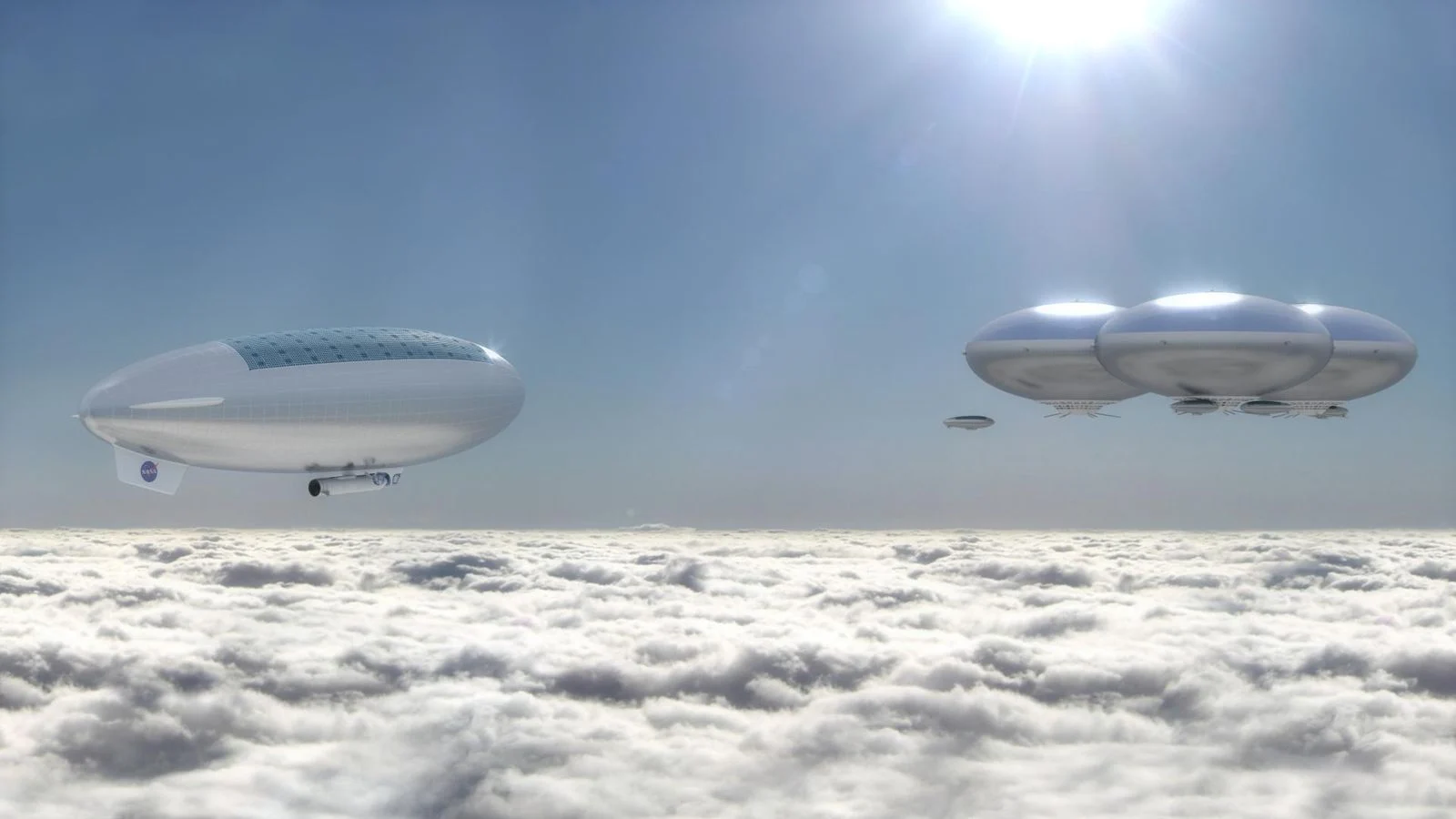
An Aerobot With ISRU Capabilities Could Explore Venus' Atmosphere for Years
Artist's concept for NASA's High Altitude Venus Operational Concept (HAVOC).
Credit: NASA
In Dante's "Divine Comedy," Hell is described as an "Inferno" with nine concentric circles, the entrance of which has a sign that reads "Abandon all hope, ye who enter here." For the planets of the Solar System, Venus is about as close to this description as one can get. On the surface, temperatures are hot enough to melt lead (464 °C; 872 °F), while the atmosphere is dense enough to crush a human skull (over 90 times Earth's atmospheric density). However, above the cloud deck, roughly 47-70 km (29–43 mi) above the surface, temperatures are stable, and the atmospheric pressure is roughly equivalent to Earth's.
This makes aerial robotic platforms (aerobots) that can operate for years an ideal choice for exploring Earth's "Sister Planet." While prototypes have been built in response to NASA's strategic plans, these designs lack a method for replenishing buoyant gases, limiting their lifetimes. According to a new proposal led by researchers from the Massachusetts Institute of Technology (MIT), In-Situ Resource Utilization (ISRU) could extend the lifetime of aerobots by using electrolysis to convert atmospheric carbon dioxide (CO2) into buoyant gas products and an energy source.
The team was led by Kyle Horn, a Ph.D. Candidate from MIT's Department of Aeronautics and Astronautics. He was joined by researchers from NASA's Jet Propulsion Laboratory, MIT's Haystack Observatory, and - OxEon Energy LLC. Their proposal is described in a paper and presentation made at the 2026 Lunar Planetary Science Conference, which took place from March 16th–20th, 2026, in The Woodlands, Texas.
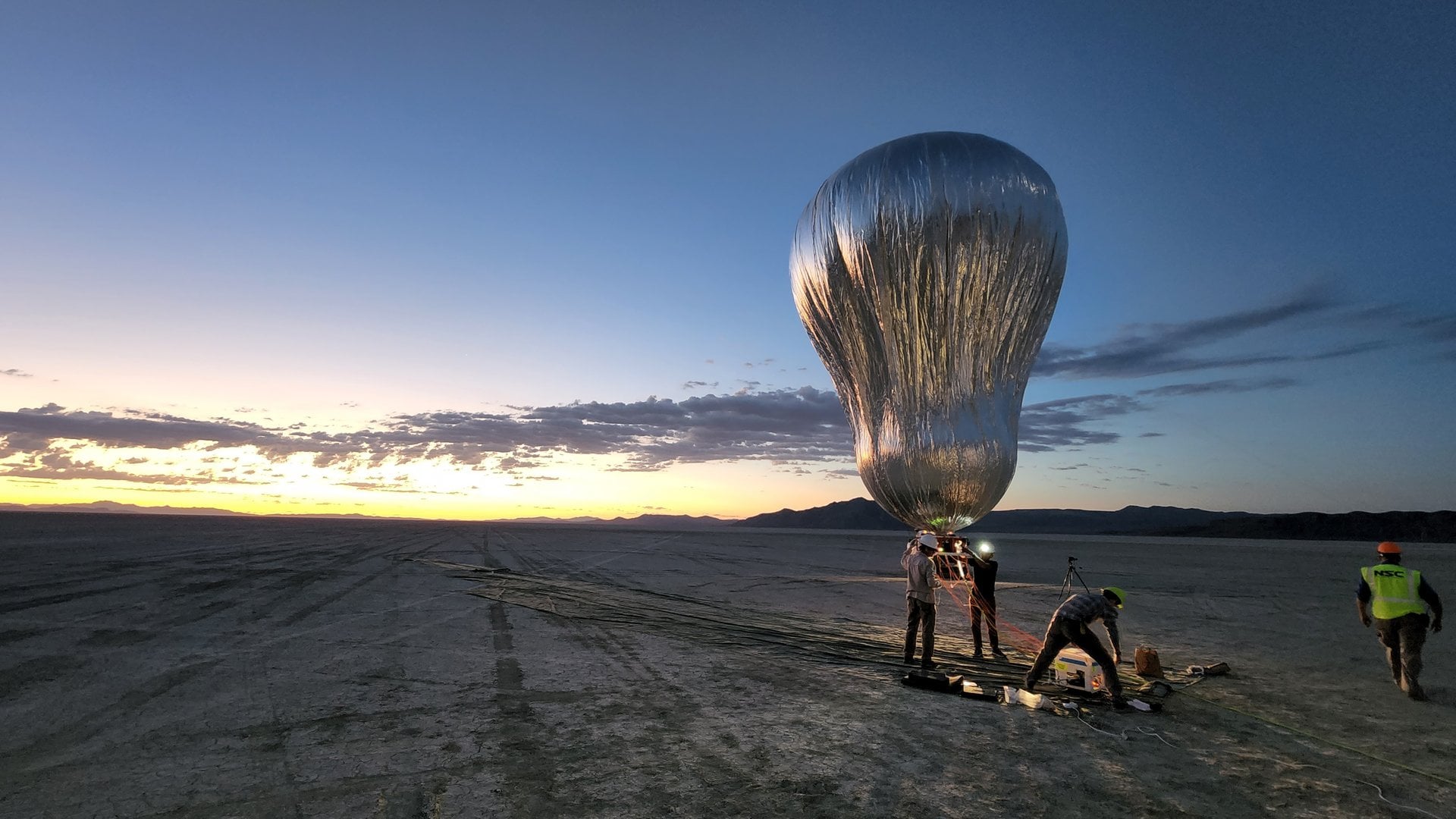
*A prototype aerobot is readied for a sunrise test flight at Black Rock Desert, Nevada, in July 2022, by team members from NASA JPL and the Near Space Corporation.
Credit: NASA/JPL-Caltech*
As they describe in their paper, aerobots could perform landmark scientific investigations into Venus' geophysics and atmospheric science. However, balloon-based proposals are constrained by helium loss from pinholes and diffusion through the balloon envelope. In addition, solar-powered vehicles face challenges due to the super-rotating winds in Venus' atmosphere, which result in a 50-hour nightside traverse for aerial missions. This makes an ISRU-based replenishment and supplemental power strategy a very wise idea.
Their concept relies on Solid Oxide Electrolysis (SOE), a high-temperature electrolyzer that uses solid ceramic electrolytes to convert CO2 into oxygen gas (O2) and carbon monoxide. The design consists of a 12.5 m (41 ft) diameter balloon with a 20 kg (44 lbs) suite of scientific instruments powered by a continuous supply of 10 Watts (W) of electricity using solar arrays. The aerobot will fly at an operational altitude of 61 km (~38 mi), drop to 50 km (31 mi) to replace its helium supply via SOE, and will have a nominal lifespan of our months and a maximum operational lifespan of 10 years.

The one-third scale prototype aerobot is designed to withstand the corrosive chemicals in Venus’ atmosphere. During the flights, the balloon’s materials were tested for the first time, giving the team confidence that a larger aerobot design could operate in Venus skies.
Credit: Near Space Corporation
Their concept could explore seismic events by studying infrasound wave patterns, which can be detected at an altitude of 55 km (34 mi). There's also the potential for Thermoremanent Magnetism Investigations (TRM). While magnetic measurements are ideally made close to the surface, since signals would be weakened by the extreme temperatures of the planet's crust, weak TRM signals and small-scale magnetic anomalies could still be discerned by an aerobot through repeated passes over a target area. An aerobot would also be able to conduct lucrative studies on Venus' atmospheric chemistry and dynamics.
This includes investigations into why sulfur dioxide (SO2) concentrations change over decade-long periods. While previous in-situ missions have provided some data on this phenomenon, the driving mechanism remains unclear. A ten-year mission could study the entire cycle of SO2 changes and observe them directly. Furthermore, energy transport through the atmosphere's vertical layers cycles with each Venusian year (~225 days), and a 10-year mission could study year-to-year variability.
A key aspect of this mission's lifespan is the ability to recombine some of the gas products from the SOE process to generate power. Used together, CO and O2 can generate power via oxy-fuel combustion, a well-known carbon-capture process, or using specialized electrochemical cells. The enhanced capability enabled by ISRU could also increase the platform's instrument-carrying mass or be used to add payloads, such as deployable assets.
Exploring Venus is one of the main objectives for space exploration in the coming decades. In addition to investigating the possibility that its clouds could support life, there are also the mysteries of the planet's slow (and retrograde) rotation and how it became the hot, hellish landscape that it is today. Knowing the answers to these questions will improve our understanding of how the rocky planets of the Solar System evolved and why Earth became habitable while Venus and Mars did not.

The Venus aerobot team readies the inflated aerobot for the launch of its first flight over Black Rock Desert, Nevada, in July 2022, in this view from a drone overhead.
Credit: Near Space Corporation
Further Reading:
Artemis II video fuels theories that Apollo moon landings were fake
A video of the Artemis II crew discussing the moon months before this week’s historic launch has fueled online conspiracy theories claiming the Apollo missions were staged.
A short clip of Commander Reid Wiseman is making waves on social media, where he says: 'This is the first time we’re going to send humans to the moon and, at the same time, have humans in low Earth orbit.'
Conspiracy theorists have seized on the remark as supposed evidence that earlier lunar missions never happened, with one X user writing: 'That's the confession right there. They lied about the moon landing.'
The moon landing conspiracy theory claims that NASA faked the Apollo moon landings between 1969 and 1972, alleging they were filmed in a studio to win the Space Race against the Soviet Union.
The viral 25-second clip, however, was taken from a longer video in which Wiseman acknowledged the Apollo missions, explaining that his comment referred to him and the three other Artemis II astronauts being the first crew of a new lunar era.
The Artemis II mission, which launched Tuesday, will mark the first time humans travel toward the moon since Apollo and the first time astronauts journey beyond low Earth orbit in more than 50 years.
The crew includes NASA astronauts Wiseman, Victor Glover and Christina Koch, along with Canadian astronaut Jeremy Hansen, who are set for a 10-day journey around the moon and back.
The crew is also expected to travel approximately 250,000 miles from Earth by April 6, breaking the previous record set by Apollo 13 in 1970.

The crew includes NASA astronauts Wiseman (second from left), Victor Glover (right) and Christina Koch, along with Canadian astronaut Jeremy Hansen, who are set for a 10-day journey around the moon and back
NASA has consistently maintained that the Apollo missions were real, backed by telemetry data, moon rocks and the testimony of thousands of engineers and scientists, though some skeptics continue to dispute the missions.
One X user commented on the video of Wiseman, saying: 'What timeline am I on for them to openly admit this is the first time sending humans to the moon?'
The comments were made on September 24, 2025, as the crew was just months away from launching to the moon.
About 20 minutes before the controversial comments, Wiseman said: 'We have been to the moon in Apollo.
'So when we go to the training and talk about us looking at the moon and all the things we can bring in, in the back of my mind and in the back of yours, we have been there.
'We orbited the moon, we have seen these things before, and what does Artemis II bring that is new to us, then, based as we fly around the moon.'
He continued to explain that Artemis II will also pass by the dark side of the moon, which has never been seen by human eyes.
'[That is] just because Apollo [has] always landed on the lit side of the moon,' said Wiseman.

Conspiracy theorists have seized on the remark as supposed evidence that earlier lunar missions never happened. Pictured is Buzz Aldrin standing on the moon in 1969
The clip has resurfaced other doctored videos, including clips of Buzz Aldrin, the second man to walk on the moon, that appeared to show him making similar statements.
In a 2000 appearance on the Conan O'Brien Show, Aldrin stunned the audience when the host recalled watching the moon landing as a boy.
'No, you didn't,' Aldrin snapped. 'There wasn't any television, there wasn't anyone taking a picture. You watched an animation.'
The awkward exchange left O'Brien speechless and has since racked up millions of views online. However, he was referring to animations used by broadcasters at the time in their coverage of the moon landing, intercut with real footage.
Then, in 2015, an eight-year-old girl asked the former astronaut why no one had returned to the moon. Aldrin replied: 'Because we didn't go there, and that's the way it happened.'
The clip, widely shared on social media, cuts off before Aldrin clarifies that funding and shifting government priorities ended lunar missions.
He later explains: 'We need to know why something stopped in the past if we want it to keep going.
'It's a matter of resources and money; new missions need new equipment.'
Doubt over the moon landing took root in the mid-1970s, fueled by public mistrust after Watergate and the Pentagon Papers.
Theories about staged sets, lighting inconsistencies, and suspicious interviews have persisted ever since.
Shroud of Turin discovery places burial cloth at time of Jesus' death
The Shroud of Turin is widely considered the most studied, debated and controversial relic in human history.
The 14-foot linen cloth showing a photographic negative image of a crucified man is claimed by many to be Jesus' burial cloth, while skeptics hold it is a medieval forgery.
Now, a biblical scholar has highlighted a previous analysis of the shroud that places it in the same season as Jesus was said to have died on the cross.
Speaking on the Shawn Ryan Show, Dr Jeremiah Johnston highlighted a 1970s forensic analysis of the cloth that identified 58 different types of pollen.
He said that 38 of them were identified as species associated with the Jerusalem region, many of which bloom in spring around Passover
'Pollen from Middle Eastern plant species was found in the dust samples,' Johnston told the Daily Mail.
'Among them were plants that only grow in southern Israel, western Jordan, and the Sinai. Dust from the feet area of the Shroud contained a specific calcium carbonate from travertine aragonite limestone, similar to dust taken from a tomb in Jerusalem. '
He said the remaining pollen species trace the shroud's documented journey over the past 2,000 years, suggesting it originated in Jerusalem before traveling through Europe to its current home in Italy.

The 14-foot linen cloth showing a photographic negative image of a crucified man is claimed by many to be Jesus' burial cloth, while skeptics hold it is a medieval forgery
'We know Jesus is crucified...It's the best-established fact of the ancient world on April 3rd, AD 33,' Johnston told podcast host Shawn Ryan.
The date of the crucifixion is based on Bible accounts stating that Jesus died during Passover and that the following day was the Sabbath or Saturday.
Because historical records show that Pontius Pilate, the Roman governor who sentenced Jesus to death, ruled Judea from AD 26 to AD 36, scholars examined those years.
They found that Passover fell on a Friday only on April 7, AD 30, and April 3, AD 33, now considered the two most likely dates for the crucifixion.
'The pollen, which only blooms at Passover (springtime) in Judea, along with the travertine limestone on the shroud, leave it beyond all doubt that the Shroud of Turin is authentic,' Johnston, who recently published 'The Jesus Discoveries: 10 Historic Finds That Bring Us Face-to-Face with Jesus,' told the Daily Mail.
'I believe that based on the evidence, because I am not irrational.'
Researchers say the pollen evidence suggests the cloth was present in the Jerusalem region during the same time period traditionally associated with the crucifixion.
However, skeptics continue to point to earlier radiocarbon testing that dated part of the fabric to between AD 1260 and 1390, centuries after Jesus' death.

On November 23, 1973, Max Frei was permitted to collect sticky-tape samples of dust from the shroud's surface (PICTURED)

Pictured are images of the pollen take from the shroud
Johnston, who earned his PhD at Oxford, admitted on the Shawn Ryan Show that he was long conditioned to view the cloth as a medieval forgery, a belief rooted in a 1988 study that dated a corner sample of the fabric between AD 1260 and AD 1390.
'I used to be the biggest skeptic of the shroud,' said Johnston.
'It turns out, when you look at it, the shroud of Turin is scientific proof of the physical bodily resurrection of Jesus Christ.
'I believe that based on the evidence in the 102 academic disciplines that have studied over 600,000 research hours in it. So I went from skeptic to believing in it based on the science.'
Johnston discussed the work of forensic scientist Max Frei, who specialized in microscopy and forensic trace analysis and became known for applying adhesive tape sampling techniques to collect microscopic evidence, methods similar to those used in modern crime-scene investigations.
On November 23, 1973, Frei was permitted to collect sticky-tape samples of dust from the shroud's surface. He collected 12 samples, which were later analyzed under a microscope in his Zurich laboratory.
The 38 types of pollen were linked to plants typical of desert regions surrounding the Jordan Valley, including species adapted to soils with high salt content found near the Dead Sea.
According to biblical accounts, Jesus was crucified near Jerusalem, located roughly 13 miles from the northern edge of the Dead Sea.
Many of the pollen types have also been identified as microfossils in sediment taken from the Dead Sea and Lake Gennesareth, also known as the Sea of Galilee.
Only 17 of the pollen species identified on the cloth are known to grow in France or Italy, regions associated with the shroud's documented movement through Europe in later centuries.

Dr Jeremiah Johnston, who earned his PhD at Oxford, told the Daily Mail he was long conditioned to view the relic as a medieval forgery, but after doing his own researchers is now a believer it is the burial cloth of Jesus
Some researchers argue this distribution supports the idea that the cloth traveled from the Middle East to Western Europe over time.
A more recent study in 1999 by botanist Avinoam Danin of the Hebrew University of Jerusalem reanalyzed the pollen samples and identified a high density of pollen from the thistle Gundelia tournefortii.
This species has bloomed in Israel between March and May for thousands of years, aligning with the spring Passover season described in the Bible.
Danin also reported evidence of another plant, Zygophyllum dumosum, appearing in floral images visible on the shroud. This species is native to the region and known for its distinctive paired leaflets.
According to Danin, Gundelia tournefortii and Zygophyllum dumosum coexist in a geographically limited area defined by lines connecting Jerusalem and Hebron in Israel with Madaba and Karak in modern-day Jordan.
The identification of a third species, Cistus creticus, through pollen and floral image analysis further narrowed the possible location.
'This combination of flowers can be found in only one region of the world,' Danin stated. 'The evidence clearly points to a floral grouping from the area surrounding Jerusalem.'
As Trump orders UFO data released, a question hangs: If aliens exist, what would they think of us?For generations, human beings have wondered: What would alien life from another planet be like? But we rarely ask the opposite: What would they think of us?
It's a question that can produce some, well, uncomfortable answers if you happen to be an earthling.
“If I were looking at Earth from a distance, I would be pretty disappointed,” theoretical physicist Avi Loeb says. “Most of our investing is dealing with conflicts to prevent other people from killing us or us killing others. Look at the Ukraine war over a little bit of territory. That is not a sign of intelligence."
The debate on whether little green men or UFOs are among us escalated in February when former President Barack Obama, responding to a podcaster's question, said aliens are “real,” but he ”hasn’t seen them” and “they’re not being kept at Area 51.” President Donald Trump later announced on social media that he was directing release of government files because of “tremendous interest.”
Stepped-up interest in UFOs also is swirling as the United States heads back toward the moon with Wednesday's launch of NASA’s Artemis II mission. The four astronauts aboard will do a fly-around of the moon before returning to Earth.
In a world riven by war, civil unrest, climate change and divisiveness, it's easy to wonder what newcomers to Planet Earth might make of us and our struggles. Whatever the case, well over a majority of Americans echo the sentiment of the slogan from “The X-Files”: “The truth is out there."
A 2021 survey conducted by the Pew Research Center showed about two-thirds of Americans said their best guess is that intelligent life exists on other planets. About half of U.S. adults said UFOs reported by people in the military are “definitely” or “probably” evidence of intelligent life outside Earth.
“We don’t want to think this is the only place in this extraordinarily and incomprehensibly large universe where life and intelligence and even technology have emerged,” says Bill Diamond, president and chief executive of the SETI Institute in Mountain View, California.
“It sort of says about humans, ’We don’t want to be alone.'"
Hollywood ran with it. Flying saucers, little green men and eventually humanoid gray aliens became part of popular culture. April 5 even is celebrated annually throughout the iconic “Star Trek" franchise as “First Contact Day” to mark the date in 2063 when humankind, in “Trek” canon, first made contact with Vulcans.
Much in the popular culture suggests any aliens might be aggressive. Priscilla Wald, who teaches about science fiction at Duke University, has a theory as to why.
“It seems to me it’s a reflection on who we are, that we’re projecting onto aliens the way we treat each other," Wald says. "So the aliens are coming down, they want to conquer us, they’re violent. Who does that sound like? It sounds like us.”
In 2024, the Pentagon released hundreds of reports of unidentified and unexplained aerial phenomena. However, that review gave no indications that their origins were extraterrestrial.
On two separate occasions, Debbie Dmytro saw things in the sky over Michigan’s southern Oakland County. The greenish object Dmytro says she saw March 1 in the sky over Royal Oak, Michigan, looked like neither plane nor helicopter. Dmytro, a 56-year-old medical professional, acknowledges that it could have been some type of commercial or delivery drone.
What she saw in 2023 in the same general area north of Detroit is not so easily explained.
“Four yellow lights, yellowish golden lights and they were all flying very, very low,” Dmytro remembers. She says the lights were about 100 feet (30 meters) up at their nearest.
“I’ve never seen anything so low without any noise and flying in complete uniformity,” she says. “Is it something man-made? Is it something that’s not manmade? Who knows?”
Who knows indeed? UFOs, the term for unidentified flying objects, has in recent years given way to UAP — unidentified aerial phenomena or unidentified anomalous phenomena.
“Absolutely, there are such things” as UAPs and UFOs, says Diamond, whose SETI — Search for Extraterrestrial Intelligence — seeks to explore, search and understand the nature of life and intelligence in the universe.
“People observe things in the sky that they can’t immediately identify or recognize as either human engineering such as planes or drones or helicopters, or animals, such as birds, and therefore they don’t know what they are," Diamond says.
Like so many, Dmytro wants to know what the government knows. “I think there’s more information out there. I’m open to learning more,” she says. “I have an open mind. It’s always about scientific proof.”
Retired Rear Adm. Timothy Gallaudet says evidence clearly shows there are UAP zipping around the airspace and in the oceans.
“The nonhuman intelligence that operates them or controls them are absolutely real,” Gallaudet says. “We’ve recovered crashed craft. We don’t know if they’re extraterrestrial in origin."
Gallaudet worked as acting administrator for the National Oceanic and Atmospheric Administration. He participated in a 2024 congressional hearing on UAP disclosure and says the release of government files promised by Trump is something people find of interest. He just hopes the president follows through.
There are billions of galaxies in the universe and each has billions of stars, so the likelihood life developed elsewhere is fairly high, according to University of Michigan Astronomy Professor Edwin Bergin, who teaches about looking for life elsewhere. He believes that if intelligent beings navigated vast distances to reach Earth they would make themselves known — despite humanity’s penchant for creating chaos.
“I would think that they would look at us like we were crazy ... but they would come out," he says. "I mean, why come here otherwise unless you’re going to sit and observe.”
Loeb, director of the Institute for Theory & Computation at Harvard and head of the university's Galileo Project for the Systematic Scientific Search for Evidence of Extraterrestrial Technological Artifacts, believes in the likely existence of extraterrestrials.
“They might be laughing at us,” he says. "They might be watching us ... to make sure we will not become predators, that we will not become dangerous to them.”
Much of the government’s secrecy around UFOs and UAP is tied to national security concerns, according to Diamond.
“We have pretty advanced technologies, satellite, ground-based that are for various purposes mostly national security and defense that are pointing at the sky or things on board aircraft,” Diamond says. “Sometimes these pick up objects. The technology behind it is sensitive and protected.”
Government data, including a “trove ” of UAP video the Navy is sitting on, should be shared with scientists for research and a better understanding of the characteristics of the objects, says Gallaudet, who spent 32 years in the Navy and viewed classified UAP video.
“When you look at these things in our airspace having near collisions with our aircraft, that’s a real valid concern,” he says. “We are just not sure of what they are and what they intend to do with their interaction with humanity. That could be a national security threat, or not."
“When has ignorance ever been a good national strategy?" Gallaudet asks. "Whether it be scary, harmful or not, or a mix, I think seeking the truth is in our best interest.”
Meanwhile, Diamond doesn't think any “true alien encounter could be kept secret.”
“If any civilization has mastered interstellar travel, they have technology and capabilities beyond our wildest comprehension,” he says. “If they want to interact, they will; if they don’t, they won’t. If they want to be seen, they will be, and if not, they won’t be!”
RELATED VIDEOS
Chinese satellite with robotic 'octopus arm' passes key refueling test in orbit — making longer-lived space assets more likely

China's Hukeda-2 satellite has passed a major refueling test after its experimental robotic arm successfully docked with a target port elsewhere on the spacecraft.
(Image credit: CCTV handout)
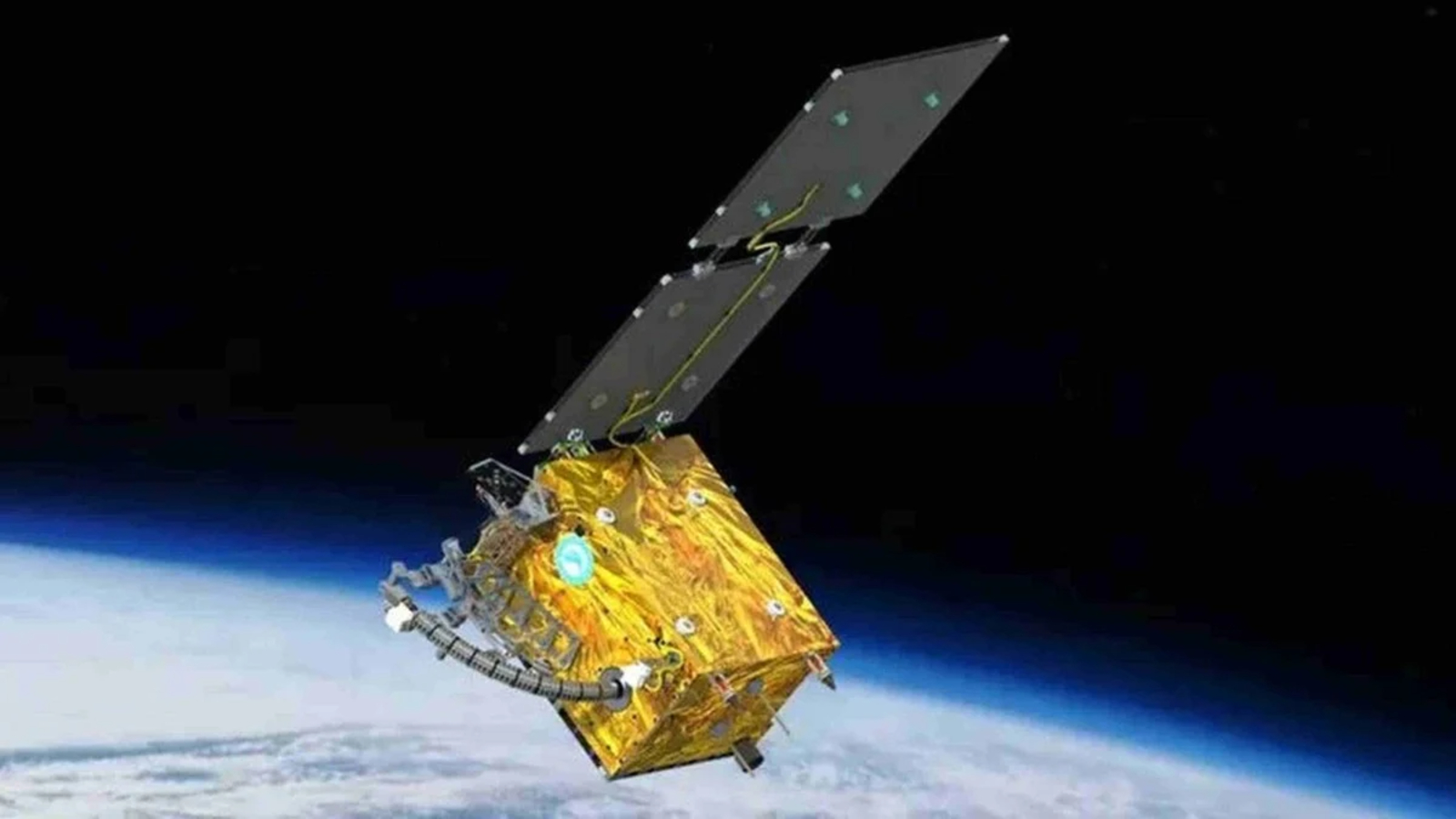
A Chinese satellite equipped with a robotic "octopus arm" has passed a key refueling test in low Earth orbit (LEO), according to state-run media. The achievement highlights China's continued leadership with this particular technology, which NASA has not yet caught up with.
The experimental spacecraft will eventually deploy a giant balloon in LEO, which could help solve another important issue surrounding satellite "megaconstellations" like SpaceX's Starlink network.
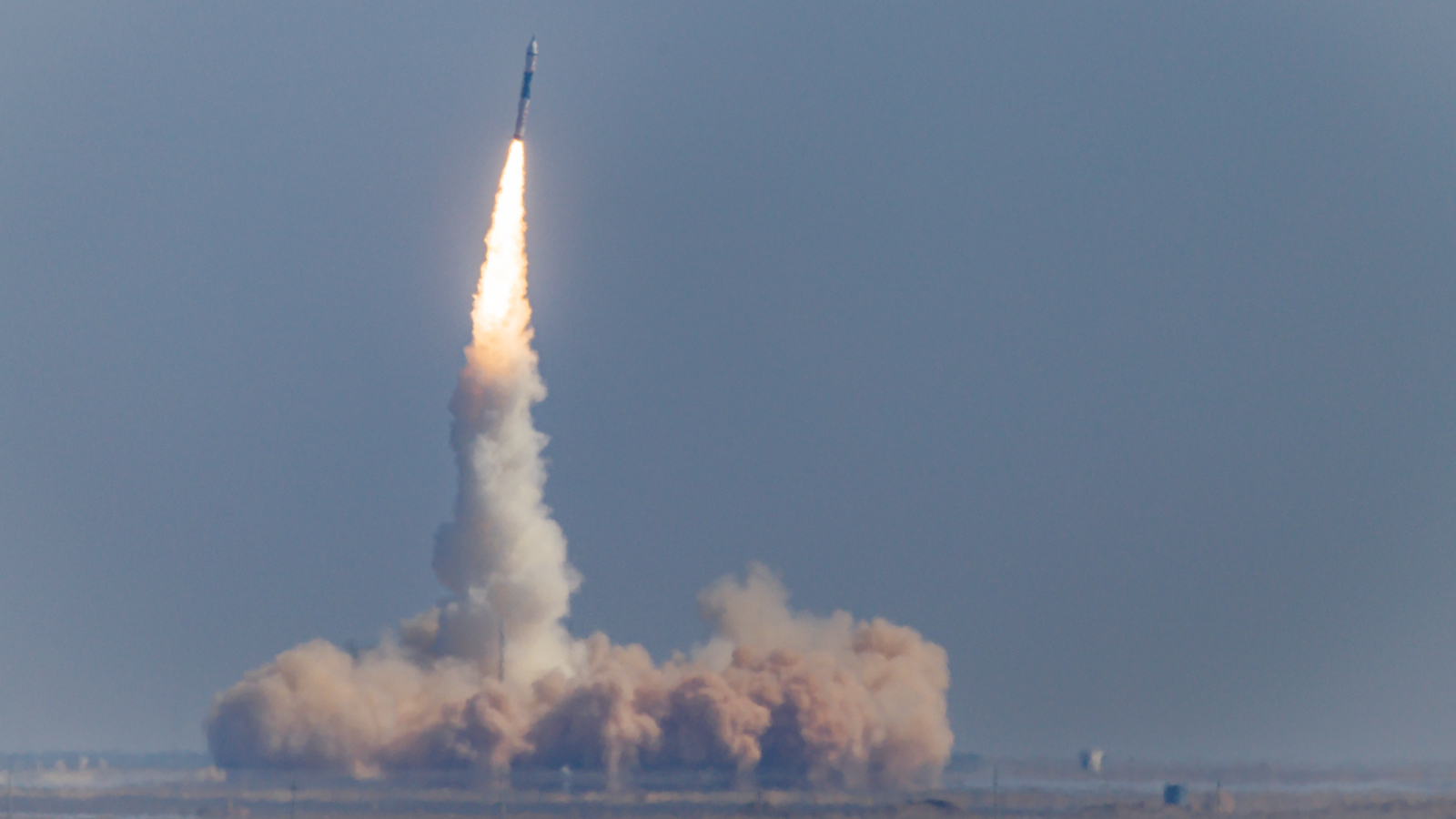
The satellite, dubbed Hukeda-2 (also known as Yuxing-3 06 within China), launched March 16 aboard the Kuaizhou-11 rocket from Jiuquan Satellite Launch Center, according to the website of Jonathan McDowell, a now-retired astronomer at the Harvard and Smithsonian Center for Astrophysics who has been tracking the movements of Earth-orbiting spacecraft for more than two decades. It was one of eight satellites deployed during this mission, and it is now orbiting Earth at an altitude of around 335 miles (540 kilometers).
You may likeChinese astronauts describe moment a crack was discovered on Shenzhou-20 spacecraft
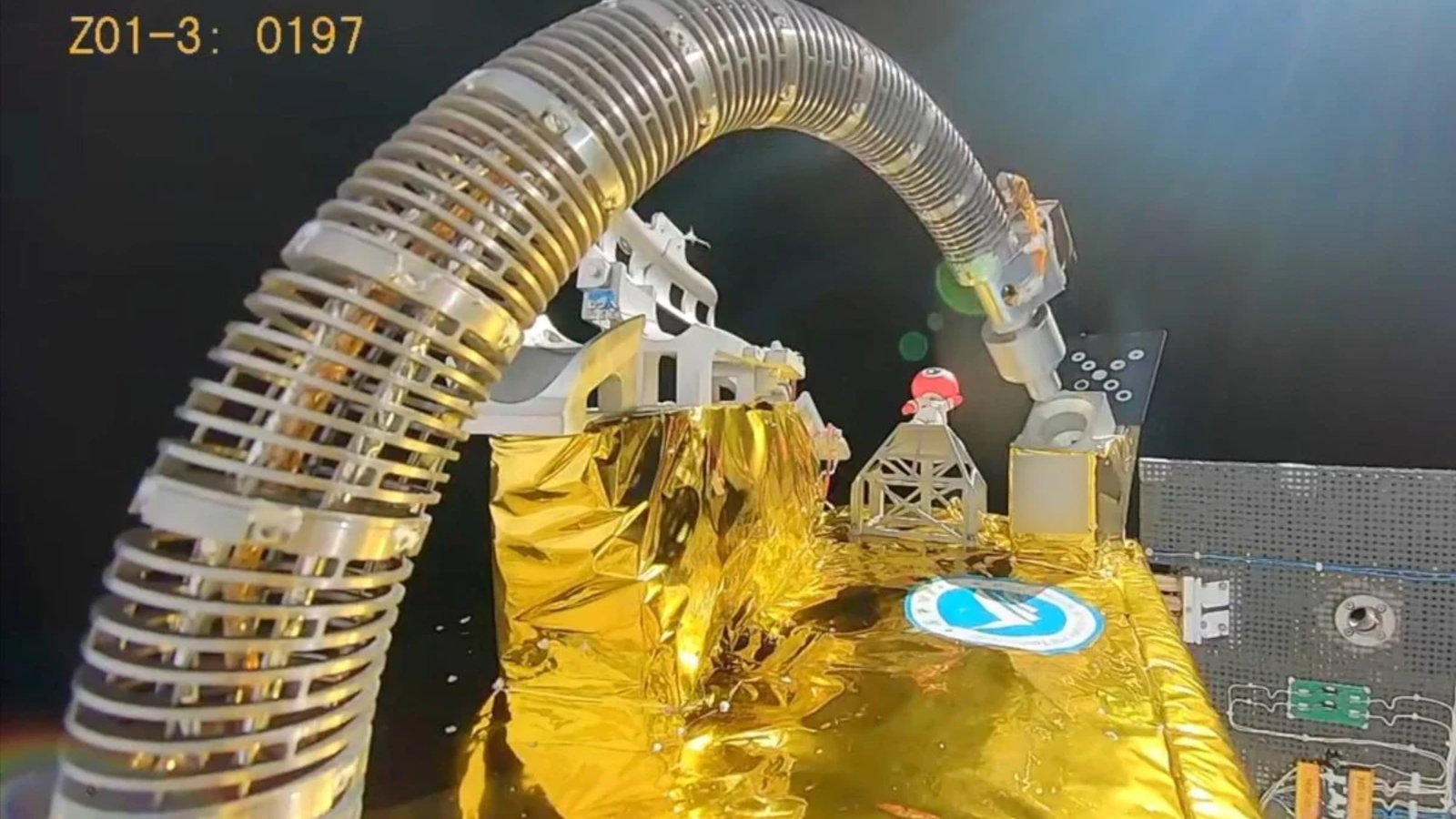
Hukeda-2 is a demonstration satellite intended to test new technologies in LEO. Its most notable attachment is an octopus-like robotic arm that "can curl, twist and wrap around objects to work in tight, complex spaces, with a nozzle-like tip at one end designed to line up and connect with a target port," according to the South China Morning Post.
The arm is made of a series of spring-like tubes threaded with cables attached to a motor, allowing it to bend in almost any direction and make the small adjustments needed to dock with another satellite while both spacecraft are traveling at speeds of around 16,800 mph (27,000 km/h).

On March 24, Chinese state media reported that Hukeda-2's robotic arm had successfully completed its first refueling test. It was initially unclear if this test involved another satellite. However, photos have since confirmed that the robotic arm instead docked with a target port located on Hukeda-2 itself.
This is the biggest milestone for satellite refueling since June 2025, when China's Shijian-25 satellite successfully connected to and refueled the Shijian-21 satellite, which had previously run out of fuel. This encounter occurred in a higher, geosynchronous orbit, around 22,000 miles (33,500 km) above Earth's surface, and was the first confirmed case of satellite-to-satellite refueling, according to Live Science's sister site Space.com.
When satellites run out of fuel, they can no longer maintain their altitude and are slowly pulled back toward Earth, before eventually burning up in the upper atmosphere. By refueling them, operators can keep the same spacecraft in orbit much longer, thus making them more cost-effective and sustainable, reducing the need to launch replacements. This has been a big aim for NASA and Western companies for several years, but has remained out of reach so far.
China will likely attempt to use similar refueling spacecraft to service its rapidly expanding Qianfan, or "Thousand Sails," constellation, which launched its first batch of satellites in 2024 and is set to rival Starlink in the coming years. (There are currently about 108 active Qianfan satellites in orbit, with plans to deploy 15,000 by 2030.)
SpaceX, on the other hand, does not appear interested in sustaining its active satellites. Instead, the company favors repeated launches of new spacecraft with its reusable Falcon 9 rocket to keep costs down.
What to read nextOrbiting satellites could start crashing into one another in less than 3 days, theoretical new 'CRASH Clock' reveals

Another issue with expanding constellations is that the number of dead spacecraft waiting to fall back to Earth is rising fast and taking up valuable space that could be occupied by new satellites. In an attempt to fix this, Hukeda-2 will deploy an 8-foot-wide (2.5 meters) balloon at the end of its mission, which will increase atmospheric drag and speed up its return to Earth.
If this works, future Chinese satellites could be deployed with similar devices that allow them to fall back to Earth without initiating a final deorbiting burn. However, it is unclear when Hukeda-2 will deploy its test balloon.
Although quick deorbiting of satellites is prudent, it is unlikely to fix the greater issue of overcrowding that is expected to occur in LEO in the coming decades, especially if SpaceX's controversial plan to launch 1 million orbital data centers comes to fruition.
Recent research has also revealed that satellite reentries release high levels of metal pollution in the upper atmosphere, which is likely triggering issues we are still not fully aware of.
"What goes up must come down," University of Regina astronomer and vocal megaconstellation critic Samantha Lawler recently wrote for Live Science.
Haunting 911 call reveals new clue in search for missing UFO-linked Air Force general
Chilling new details have emerged surrounding the disappearance of a retired Air Force general tied to UFO secrets and a string of missing or dead US scientists.
A 911 call has been released, capturing a police dispatcher speaking with the wife of William Neil McCasland, 68, who vanished without a trace on February 27.
Susan Wilkerson is heard telling authorities that she believed the former general 'had planned not to be found' after finding her husband's phone and other personal items still inside their New Mexico home.
'He's left his phone. He changed his clothes into... I don't know what. I think he's on foot. All of our cars and bicycles are in the garage,' Wilkerson said approximately three hours after McCasland disappeared.
'He turned it off and left it behind, which seems kind of deliberate because he's always got his phone. He has a smartwatch. I don't know if that's with him or not,' Wilkerson continued in audio obtained by the Law&Crime Network.
After the 911 call, Wilkerson later claimed that 'foul play' was not suspected in the general's disappearance, but noted that McCasland left home with only a pair of boots and his .38-caliber revolver.
The retired Air Force officer, reportedly tied to both nuclear and UFO-related government programs, did not take any of his wearable devices or his prescription glasses, leaving behind any way of tracing or contacting him.
While Wilkerson pushed back on the possibility that her husband may have intended to harm himself, she revealed to 911 that he had been seeing a doctor for both physical and mental irregularities before he disappeared.

William Neil McCasland, 68, was last seen around 11am Friday near Quail Run Court NE in Albuquerque, the Bernalillo County Sheriff's Office said

The sheriff's office has issued a Silver Alert, a public notification system used in the US to locate missing seniors or individuals with Alzheimer's, dementia or other mental disabilities
When asked by the dispatcher if McCasland had been diagnosed with any type of mental disorder before vanishing, the general's wife disclosed that he had been dealing with anxiety and short-term memory loss recently.
Wilkerson also told 911 the 68-year-old military veteran had been struggling with a lack of sleep, and then revealed McCasland feared his brain was 'deteriorating.'
The dispatcher can be heard asking Wilkerson if her husband kept any guns in the home and if any of them were missing.
She replied that McCasland has a gun safe, adding that 'he has quite a number of pistols and rifles,' not knowing at the time that one of the handguns had been taken.
Wilkerson then addressed the missing general's recent comments to her about his health, saying that she did not believe he was seriously considering ending his life.
'Other than saying if his brain body keeps deteriorating, he didn't want to live like that. But it seemed to me that was just a "man, I hate how this is going" kind of thing,' Wilkerson said in the 911 recording revealed on Law&Crime's Sidebar with Jesse Weber.
The Bernalillo County Sheriff's Office issued a Silver Alert for McCasland, typically used to find a missing senior citizen who potentially has Alzheimer's disease, dementia or another mental disability.
However, there have been no breaks in the case since that time, and no trace of the missing general since he was last seen near Quail Run Court NE in Albuquerque around 11am local time.
McCasland's disappearance was the most recent in a potentially sinister pattern dating back to mid-2025.
The retired general had been in command of the Air Force Research Laboratory (AFRL) at Wright-Patterson Air Force Base in Ohio, a facility tied to UFO conspiracy theories for decades.
According to UFO researchers and former government scientists, Wright-Patterson is the base where debris from the alien spacecraft that allegedly crashed in Roswell, New Mexico was taken for analysis.
On Monday, Tennessee Congressman Tim Burchett told WABC radio in New York that McCasland was the key figure in America's secret research into UFO and extraterrestrial technology.
Burchett said: 'He's the guy that had a lot of nuclear secrets. I've been told by several sources that he was the gatekeeper for the UFO stuff.'
McCasland was also previously stationed at New Mexico's Kirtland Air Force Base, which has close ties to the Los Alamos National Laboratory (LANL) - one of America's most important nuclear research facilities.
In 2025, three other people connected to AFRL and LANL vanished without a trace in almost the exact same manner as McCasland.
This includes NASA aerospace engineer Monica Jacinto Reza, 60, who was directly under McCasland's supervision while she was working on the creation of a new metal for advanced missile and rocket engines.
Reza has not been seen since June 22, 2025, when she disappeared while on a hiking trip in California with two friends.

Monica Reza (Pictured) had worked on the creation of advanced rocket technology before becoming a director at NASA's Jet Propulsion Laboratory

McCasland was previously stationed at Wright-Patterson Air Force Base (Pictured), suspected of being a research facility for UFO technology
Two employees from Los Alamos National Laboratory also went missing around the same time as Reza last year.
Anthony Chavez, 79, a former employee at LANL until his retirement in 2017, vanished without a trace on May 4, 2025. He was last seen leaving his home in the Denver Steels neighborhood of Los Alamos on foot.
The longtime LANL employee left his car locked in the driveway and did not take his wallet, keys or other personal items, which were all found inside Chavez's home.
Just seven weeks later, administrative assistant Melissa Casias, 54, vanished after not reporting for work at the nuclear lab on June 26, 2025.
Her family said she uncharacteristically decided to work from home that day, but was last spotted miles from their house walking alone without her wallet, phone or keys.
Chris Swecker, a former FBI assistant director, called the disappearances concerning and told the Daily Mail these cases needed to be investigated as if all of them were connected.
'The first thing you go to is it's potential espionage,' Swecker said. 'Our scientists have been targeted for a long time, especially in the rocket propulsion area, by hostile foreign intelligence services.'
'[Foreign adversaries] target individuals and try to compromise them or bribe them. So there's a whole lot of different ways that espionage occurs,' the counterintelligence expert added.
'People who are touching on technology areas that hostile foreign intelligence services want to get their hands on... This is the type of investigation that the FBI has to take over, or at least work jointly, and look for potential connections to a hostile foreign intelligence service.'
Silenced: Nine scientists and officials tied to UFO Research are missing or killed
Archive video of extraterrestrial beings.

Current science claims that myths and legends are invented. They have been invented by people trying to explain natural phenomena. There is very much of them, and no nation is without them. – But remember that many do not relate to explanations of natural phenomena!
They usually include a record of encounters with higher beings. -This either helps people in a faraway situation, or they represent our creators and teachers. -They bring “new learning” and want to “tell us something.” -Egyptian, Mesopotamian, Indian, Indian and other myths are proof.
A few people said, “What if it’s not invented, but it’s alien visits?” -Smartfully “supernormal” abilities would then be expressions of using their technically superior means. Creating the first people by experimenting with their genetic science. They tried to occupy the planet Earth, which they had previously seen in the universe. -Zecharia Sitchin writes about Annunakoch from Sumerian beauties and Erich von Däniken about flying machines from wall paintings of Indians and Egyptians.
They also do not forget to mention Ezekiel with his vision in the first chapter, in which they see the description of UFOs. -Which reads the original of the vision or the myth knows that they have no description of the technically advanced civilization of the cosmos.
You need a clever promoter to make them “find” in them. -She can do everything! -It only have the belief that the aliens have visited the Earth in the past. I know about people who have similar experiences today and they are neither invented nor invented by visitors of the cosmos.


EXCLUSIVE - Scientists are vanishing or turning up dead. Now ex-FBI boss reveals chilling plot likely unfolding... and who he fears is behind it
As the string of mysterious disappearances and deaths among America’s scientists grows, a former FBI boss believes a sinister plot against the US could be unfolding.
Chris Swecker, who was the assistant director in charge of the bureau’s Criminal Investigative Division during his 24-year career, told the Daily Mail that foreign powers could be targeting citizens who have knowledge of US national security secrets.
’The first thing you go to is it’s potential espionage,’ he said. ’Our scientists have been targeted for a long time, especially in the rocket propulsion area, by hostile foreign intelligence services.’
A disturbing pattern has been developing after a former Air Force general, a top NASA scientist and two employees from one of the country’s major nuclear research labs all vanished without a trace in the span of just ten months.
The long-time FBI agent warned that, if these disappearances are connected, several foreign powers may be responsible for abducting, blackmailing, torturing and even killing key individuals to gain America’s national security secrets.
’China, Russia, even some of our friends – Pakistan, India, Iran, North Korea - they target this type of technology,’ Swecker disclosed.
Swecker warned that enemy intelligence agencies have been attempting to derail top-secret US programs for decades, using one of two main methods: finding ways to steal the information from the US or killing those who know about the programs.
’It’s been happening since the Cold War,’ he added. ’Especially when nuclear technology and missile technology was first coming to the forefront.

Chris Swecker was a member of the FBI for 24 years. The counterintelligence expert warned that the disappearance of multiple people tied to national security fields was alarming
’I think we’ve even seen instances where nuclear scientists have been taken out. They've been assassinated.’
When it comes to the first espionage tactic that may be unfolding, Swecker called the four disappearances in the US Southwest extremely ’suspicious’.
’If you were conjuring up a scenario here, kidnapping and trying to extract information out of someone is not unheard of,’ he told the Daily Mail.
The FBI veteran focused on the cases of retired Air Force General William Neil McCasland and aerospace engineer Monica Jacinto Reza, who were closely connected through the Air Force Research Laboratory (AFRL).
McCasland, 68 – who disappeared on February 27 after leaving his New Mexico home with only a .38-caliber revolver and no phone – supervised research projects at AFRL and allegedly knows both nuclear and UFO-related military secrets.
Reza, 60, was the first scientist to disappear in this alleged conspiracy on June 22, 2025. She vanished without a trace while hiking with two friends in California's Angeles National Forest.
She was the director of the Materials Processing Group at NASA’s Jet Propulsion Laboratory and previously invented Mondaloy, a space-age metal used in advanced missile and rocket engines, which McCasland oversaw the funding for at AFRL.
The third missing person, 54-year-old Melissa Casias, was last seen by her husband and daughter on June 26, 2025. She worked as an administrative assistant at the Los Alamos National Laboratory (LANL), which Swecker said means she likely had high-level clearance to the same sensitive nuclear information her superiors possessed.
’[Foreign adversaries] target individuals and try to compromise them or bribe them. So there’s a whole lot of different ways that espionage occurs,’ Swecker said.


William Neil McCasland, 68, and Monica Reza, 60, were connected through the Air Force Research Laboratory and projects involving advanced missile and rocket technology

Melissa Casias worked at the Los Alamos National Laboratory, a nuclear research facility with ties to Kirtland Air Force Base, where General McCasland was previously stationed
Another former Los Alamos lab employee, Anthony Chavez, vanished without a trace in May 2025.
Police told the Daily Mail that Chavez, 79, had retired in 2017. However, the lab worker disappeared in nearly the same exact way as Casias, walking out of his home and leaving behind his car, phone, wallet and keys.
LANL has not commented on the nature of Chavez's work and duties at the nuclear laboratory.
Along with the four Americans still missing, four other scientists have died since July 2024, including two prominent researchers who were murdered in their own homes.
Physicist Nuno Loureiro, astrophysicist Carl Grillmair and pharmaceutical researcher Jason Thomas were all found dead.
Loureiro was a key scientist at the Massachusetts Institute of Technology and was reportedly on the brink of revolutionizing the energy sector using nuclear fusion before being shot to death in his Massachusetts home on December 15, 2025.

Anthony Chavez (pictured) was an employee at the Los Alamos National Laboratory until 2017. He disappeared without a trace in May 2025
Authorities said the gunman was Claudio Neves Valente, a former classmate of Loureiro’s in Portugal, who was also accused of carrying out the mass shooting at Brown University on December 13.
Grillmair, 67, had worked on infrared space telescopes that use the same technology as military systems for tracking satellites and hypersonic missiles. He was fatally shot while standing on his front porch in California on February 16.
The Los Angeles County Sheriff’s Department named Freddy Snyder, 29, as a person of interest in Grillmair’s homicide case and later charged the man with murder, carjacking and burglary.
However, police did not release a motive in the alleged homicide and it was unclear if the two men knew one another or whether the shooting was targeted.


Scientists Nuno Loureiro (left) and Carl Grillmair (right) were both murdered in their own homes after making significant progress in the fields of nuclear fusion and astrophysics
Thomas’s remains were found in a Wakefield, Massachusetts, lake on March 17 – three months after the drug researcher vanished without a trace. Local police are still investigating the cause of death.
In both killings, police claimed the gunmen acted alone and have not announced any ties to foreign espionage. Investigators in the Thomas death said no foul play has been found.
Meanwhile, the circumstances surrounding the death of respected NASA scientist Frank Maiwald, who died on July 4, 2024 in Los Angeles, have not been revealed to the public or commented on by the space agency. Authorities have no record of an autopsy ever taking place.

Frank Maiwald (pictured) was a researcher at NASA's Jet Propulsion Laboratory before his death in 2024. His cause of death has not been revealed and NASA has not commented on the loss
Maiwald, 61, had been a Technical Group Supervisor at NASA’s Jet Propulsion Laboratory, and had been the lead researcher on a breakthrough that could help future space missions detect clear signs of life on other worlds.
’This has to be fully investigated by the FBI, not three different local police departments,’ Swecker told the Daily Mail, urging his former agency to treat the cases as a possible conspiracy and spy operation.
’People who are touching on technology areas that hostile foreign intelligence services want to get their hands on... This is the type of investigation that the FBI has to take over, or at least work jointly, and look for potential connections to a hostile foreign intelligence service.’
As for the likeliest suspects that would be engaging in an espionage plot on US soil, the former FBI assistant director looked at America’s adversaries in Asia and the current conflict in the Middle East.
’It’s an ongoing thing in the world of espionage between countries that are essentially hostile to each other,’ Swecker said.
’China, especially, is prolific in its quest to steal technology,’ he claimed. ’They’re not good innovators. They don’t have the scientists that we have, and they don’t have the environment for innovation. And they’re very quick to steal technology.
’North Korea and Iran are always looking for it, but they’re more susceptible to being identified and countermeasures applied against them.
’I’m not saying that’s what’s happening with these [cases]. But I’m saying if you look at the mosaic of what has gone on since the Cold War, there is a constant battle of espionage and counter-espionage.
’The CIA are our spies, and the FBI are our spy catchers. This has to be a proactive investigation by the FBI.’
“I know these scientists and researchers. They have testified. We’ve got to get to the bottom of it,” he said. “It’s just too much, too much is going on right now—and by the way, I’m not suicidal.”