![]() |
Unusual sky activity continues: Fireball strikes Sumatra, Indonesie

Unusual sky activity continues: Fireball strikes Sumatra, Indonesie
![]() |
'History in the making': NASA crew releases landmark image of the moon as astronauts set for historic fly-by - after being forced to fix the loo again!
NASA’s astronauts have released a landmark image of the moon as they approach the lunar surface for a historic flyby.
The picture offers a rare look at a feature long hidden from view – the full expanse of the Orientale basin.
It is visible along the very right edge of the lunar disk, marking the first time it has ever been seen in its entirety by human eyes.
The enormous impact basin, measuring 200 miles wide, formed 3.7 billion years ago by an asteroid smashing into the surface at nine miles a second.
The destructive impact of the asteroid is hard to comprehend, as it is three times the size of the one believed to have wiped out Earth’s dinosaurs.
Apollo astronauts partially saw it half a century ago, but from a far lower altitude than Artemis II’s crew.
While it has been photographed by satellites, it usually appears as a shadowy smear.
‘This mission marks the first time the entire basin has been seen with human eyes,’ NASA said.

The Orientale basin is visible along the very right edge of the lunar disk, marking the first time it has ever been seen in its entirety by human eyes
The enormous impact basin, measuring 200 miles wide, formed 3.7 billion years ago by an asteroid smashing into the surface at nine miles a second. Until now, it has only been imaged in full by satellites. Pictured: A computer model of the basin, with gravity anomalies depicted in different colours
In an interview from the Orion space capsule, which is more than two-thirds of the way to the moon, mission specialist Christina Koch said: ‘What we are probably most excited as a crew about seeing on the moon would be an amazing feature called Orientale.
‘It is sometimes known as the Grand Canyon of the moon because it has all kinds of multi-layered crater rims and a lot of different land formations, and it has lava fields all throughout.
‘It’s very distinctive and no human eye previously had seen this crater until today, when we were privileged enough to see it, so we can’t wait to share more when we get closer to the moon.’
So far, the 685,000-mile (1.1 million km) round trip to the dark side of the moon and back has gone relatively smoothly.
But of all the issues the Artemis II crew have faced, the toilet has been the most persistent.
Shortly after launch the loo appeared to malfunction, with astronauts reporting a ‘blinking amber fault light’.
Luckily, after several hours of troubleshooting the issue, it emerged the toilet simply needed a while to ‘warm up’ and was cleared for use.
But the contraption has broken down a second time – and on this occasion a frozen vent was to blame.

The Artemis II crew (pictured from left) Canadian astronaut and mission specialist Jeremy Hansen, Commander Reid Wiseman, mission specialist Christina Koch and pilot Victor Glover


Within hours of launch, astronauts on-board Artemis II noticed issues with their toilet. Pictured (right): A training mockup of the toilet used to practice on Earth
Mission Control at NASA’s headquarters were able to orient the spacecraft so that the vent was facing the sun in an attempt to melt the blockage.
During this time, the crew were only allowed to use the toilet for ‘number twos’ and had to make use of a bag-and-funnel system called a Collapsible Contingency Urinal (CCU) for ‘number ones’.
Thankfully, after several hours of pointing the vent at the sun, whatever was blocking it melted and a waste dump was conducted.
The toilet then returned to full operational use.
Mission control told the crew: 'Breaking news. At this time you are go for all types of uses of the toilet.'
The titanium toilet, which uses air suction to remove waste, is located in the 'floor' of the capsule, with a door and curtain for privacy.
The system collects urine and solid waste separately – urine is vented into space and 'number twos' are stowed for the return trip.
The loo is an upgraded version of an experimental toilet that launched to the International Space Station in 2020.
Compared to the toilet on the ISS, Orion's lavatory has been modified to be more practical for female astronauts. NASA also found enough space on Orion to fit the toilet in its own tiny room.
On Apollo, astronauts had to simply float in a corner while doing their business, but Artemis II's crew have the luxury of a tiny cabin in the 'floor' of the capsule.
Artemis II astronaut Jeremy Hansen previously described this as 'the one place we can go during the mission where we can actually feel like we're alone for a moment.'
Another new feature is the automatic start of air flow when the toilet lid is lifted, which also helps with odour control.
Tomorrow, on flight day six, Orion will reach its farthermost point from Earth as it sails 6,400 miles (10,299km) beyond the lunar surface before looping back and beginning its journey back to Earth.
It will take another four days to return, which the astronauts will fill by conducting key safety demonstrations, including testing procedures designed to shield the crew against dangerous radiation from solar flares.
As Orion approaches Earth, it will separate key components before plunging into the atmosphere at speeds of about 25,000mph (40,233kph) and splashing down in the Pacific Ocean.
The voyage aims to pave the way for a moon landing in 2028 which, if successful, will be the first time humans have set foot on the moon since December 1972.
NASA hit by wild moon-hoax claims over bizarre viral clip of 'green-screen glitch' on Artemis II
A NASA video has sparked a firestorm online, with conspiracy theorists claiming it 'proves' Artemis II is staged.
The crew gave a live interview to CNN over the weekend to discuss their journey to the moon while a plush toy named 'Rise' floated around the capsule as a zero-gravity indicator.
The video in question, filmed from a television screen by a smartphone, appeared to show unusual visual distortions with fragmented white text, including partial letters such as 'TAN' and 'OW,' flickering across the toy's head and body.
And some viewers quickly seized on it as supposed evidence of digital manipulation. 'It's fake. NASA has been misleading the American public since the '60s. Fake Apollo moon landing. Fake Artemis 2,' one user shared on X.
The viral clip, however, was not digitally altered but recorded from a television display with chromakey overlay processing active. Chromakey, commonly known as the blue- or green-screen effect, is routinely used by broadcasters to insert graphics, captions and lower-third text into live footage.
Live interviews routinely include graphic overlays added by the network, such as name banners, logos, and scrolling captions, which are digitally layered over the video in real time.
During the NASA interview, CNN likely displayed standard on-screen graphics identifying the astronauts and the mission.
When the viral clip was recorded from a television screen rather than taken from the original broadcast feed, the phone camera captured both the video and those graphics at slightly different refresh rates.
That timing mismatch can cause fragments of on-screen text to briefly overlap with bright or moving objects, such as the colorful plush toy, creating the illusion that letters were appearing directly on it.

The video in question, filmed from a television screen (RIGHT), appeared to show unusual visual distortions with fragmented white text, including partial letters such as 'TAN,' flickering across the toy's head and body
The Daily Mail has reached out to NASA for comment.
The strange letters likely came from standard on-screen graphics, such as name banners and captions, that networks routinely layer over live interviews.
When the clip was recorded from a television screen rather than taken from the original broadcast feed, the camera captured both the video and those graphics at slightly different refresh rates.
That mismatch can cause fragments of the on-screen text to briefly overlap with bright or moving objects, such as the colorful plush toy.
The original NASA and CNN footage shows the toy floating normally, without the flickering letters or distortions seen in the viral clip.
The Artemis II crew, which includes NASA astronauts Reid Wiseman, Victor Glover and Christina Koch, and Canadian astronaut Jeremy Hansen, is on their final approach to the lunar surface ahead of this evening's flyby, which will see it break the record for the farthest distance ever travelled by humans.
As part of the mission, the team will take photos and videos of the moon and record their observations.
But there will be a tense 40 minutes when the lunar surface blocks radio signals needed for the Deep Space Network to connect with the spacecraft.

The Artemis II crew, which includes NASA astronauts Reid Wiseman (LEFT), Victor Glover (RIGHT) and Christina Koch, and Canadian astronaut Jeremy Hansen
During this time, there will be a communications blackout between mission control and the astronauts.
And it means that if something goes wrong, there is no way the astronauts can contact Earth for help.
‘When we’re behind the moon, out of contact with everybody, let’s take that as an opportunity,’ Artemis pilot Victor Glover previously told the BBC.
‘Let’s pray, hope, send your good thoughts and feelings that we get back in contact with the crew.’
At around 1.56pm ET, the crew is expected to surpass the record previously set by the Apollo 13 mission in 1970 for the farthest humans have ever travelled from Earth.
While the Apollo crew travelled 248,655 miles from Earth, Artemis II will reach a maximum distance of 252,757 miles.
The team will then commence seven hours of moon observations and will be able to get a close look at both the near and far sides of the moon.
Since room at the windows is limited, the crew will divide into pairs with two observing for 55 to 85 minutes while the other pair exercises or works on other tasks.
The most terrifying moment will come at 6.47pm ET when mission control will lose communication with the crew as Orion passes behind the moon.
During this time, the astronauts will make their closest approach to the moon. At this distance, it will appear about the size of a basketball held at arm’s length.
NASA’s mission control should re-acquire communication with the astronauts at 7.27pm ET
The crew will have another two hours of flyby observation before they begin transferring imagery and data to the ground.
40 minutes of silence: Artemis astronauts approach the most terrifying part of their journey - and will lose contact with Earth tonight
NASA will lose contact with its astronauts for 40 minutes tonight as their spacecraft passes behind the moon.
The Artemis II crew are on their final approach to the lunar surface ahead of this evening's flyby, which will see them break the record for the farthest distance ever travelled by humans.
As part of the mission, the team will be taking photos and videos of our celestial neighbour and recording their observations.
But there will be a tense 40 minutes when the lunar surface blocks radio signals needed for the Deep Space Network to connect with the spacecraft.
During this time, there will be a communications blackout between mission control and the astronauts.
And it means that if something goes wrong, there is no way the astronauts can contact Earth for help.
‘When we’re behind the moon, out of contact with everybody, let’s take that as an opportunity,’ Artemis pilot Victor Glover previously told the BBC.
‘Let’s pray, hope, send your good thoughts and feelings that we get back in contact with the crew.’

NASA shared this image earlier today with the caption: 'One last look at the moon before flight day six and your epic lunar flyby, taking you farther into space than humans have EVER traveled'

The Artemis II crew, from left, Canadian astronaut and mission specialist Jeremy Hansen, Commander Reid Wiseman, mission specialist Christina Koch and pilot Victor Glover
The mammoth 685,000-mile (1.1 million km) round-trip mission marks the first time humans have been sent to the moon in more than 50 years.
The Orion capsule is currently around 32,000 miles (51,499km) away from the lunar surface, and images taken by the astronauts have already revealed features never previously seen by human eyes.
At around 1:56pm ET (6:56pm UK time) the crew are expected to surpass the record previously set by the Apollo 13 mission in 1970 for the farthest humans have ever travelled from Earth.
While the Apollo crew travelled 248,655 miles (400,171km) from Earth, Artemis II will reach a maximum distance of 252,757 miles (406,772km).
The team will then commence seven hours of moon observations and will be able to get a close look at both the near and far sides of the moon.
Since room at the windows is limited, the crew will divide in pairs with two observing for 55 to 85 minutes while the other pair exercises or works on other tasks.
The most terrifying moment will come at 6:47pm ET (11:47pm UK time) when mission control will lose communication with the crew as Orion passes behind the moon.
During this time the astronauts will make their closest approach to the moon. At this distance, it will appear about the size of a basketball held at arm’s length.

The Orion capsule is currently around 32,000 miles (51,499km) away from the lunar surface, as this visualisation shows

NASA astronaut Christina Koch illuminated by a screen inside the darkened Orion spacecraft. For 40 minutes of the flyby, the crew will lose contact with Earth
Judd Frieling, ascent flight director of the mission, appeared unfazed when discussing the impending loss of signal at a briefing yesterday.
Rather than using risky engine burns to propel them back to Earth, the crew are relying on the moon’s gravity to slingshot them back.
Mr Frieling said there will be no ‘loss of control’, adding: ‘We absolutely know physics is going to take them back to us.’
NASA’s mission control should re-acquire communication with the astronauts at 7:27pm ET (00.27 UK time).
The crew will have another two hours of flyby observation before they begin transferring imagery and data to the ground.
This is not the first time communications blackouts have been planned as part of a mission.
Similar events occurred during the Artemis I and Apollo missions and are expected with the current communications infrastructure.
So far the mission has run relatively smoothly – except for a few issues with the toilet, which have now been sorted.
Once the capsule completes its flyby, it will take another four days to return to Earth.
During this time, the astronauts will conduct key safety demonstrations, including testing procedures designed to shield the crew against dangerous radiation from solar flares.
As Orion approaches Earth, it will separate key components before plunging into the atmosphere at speeds of about 25,000mph (40,233kph) and splashing down in the Pacific Ocean.
The voyage aims to pave the way for a moon landing in 2028 which, if successful, will be the first time humans have set foot on the moon since December 1972.
Bennu sample reveals how water flowed through the newly forming asteroid

A team of US astronomers has carried out one of the deepest analyses to date of a sample from the asteroid Bennu, revealing new details about how water and organic material interacted during the earliest stages of the solar system.
Publishing their results in the journal PNAS, the team, led by Mehmet Yesiltas at Stony Brook University, showed that the asteroid's composition is divided into three distinct chemical domains. At the nanoscale, these domains strongly suggest that water flowed through the newly forming asteroid in restricted channels, leaving some regions largely untouched.
In September 2023, NASA's OSIRIS-REx mission returned only the third-ever sample of asteroid material to Earth. The sample originated from Bennu, a near-Earth object roughly 500 meters wide that is already known to be rich in carbon.
Through deeper analysis of its chemical composition, astronomers hope the sample can help them piece together new clues about the early history of the solar system, when asteroids like Bennu first formed.
In Earth-based geology, important insights often come from detecting subtle variations in chemical composition, many of which are only visible at extremely small scales. Until now, however, Bennu's material had not been studied with such high precision.
In their study, Yesiltas' team applied a range of cutting-edge analytical techniques, allowing them to probe variations down to scales of just 20 nanometers—around the size of a single large molecule. Using a combination of infrared and Raman spectroscopy, they revealed that the sample's composition is not uniformly distributed, but instead segregated into three distinct domains, with very little overlap.
These include aliphatic-rich regions, dominated by hydrocarbons arranged in open chains; carbonate-rich domains, composed of inorganic minerals rich in calcium and magnesium; and nitrogen-bearing organic-rich domains, which host a distinct class of complex organic molecules. These nitrogen-bearing compounds were likely either inherited from older material that helped form the asteroid, or chemically modified during interactions between fluid and rock.
For Yesiltas and colleagues, these results already offer important clues about Bennu's formation, especially the role played by water. Because the three domains are so clearly separated, they suggest that water didn't alter the asteroid uniformly.
Particularly strong evidence comes from the distribution of organosulfur compounds, which are almost entirely restricted to carbonate-rich regions. This pattern indicates that carbonate minerals likely precipitated from water-rich fluids.
In contrast, both aliphatic and nitrogen-bearing organic compounds are more vulnerable to alteration when exposed to water, implying that these regions must have remained relatively dry during key stages of the asteroid's evolution.
Taken together, the coexistence of these sharply distinct domains suggests that water flowed through Bennu along restricted pathways, altering some domains while preserving the more fragile compounds found in other regions.
Overall, the discovery marks an important step forward in understanding how asteroids formed around the nascent sun. With further analysis, along with comparisons to samples from the asteroid Ryugu (returned to Earth by Japan's Hayabusa2 mission), the researchers now hope that Bennu's history can be reconstructed in even greater detail. In turn, this could provide fresh insights into the processes that shaped the early solar system, and the origins of our own planet.
RELATED VIDEOS
12,000-year-old pyramid ruins uncovered off Louisiana coast could be evidence of a lost cityAmateur explorer says he found ‘12,000-year-old city’ off US coast

A new Atlantis has emerged from the sands.
An amateur archaeologist has potentially made the discovery of a lifetime after uncovering the alleged ruins of a lost metropolis off Louisiana that predated modern US history.
“All I know is that someone built the city 12,000 years ago,” retired architect George Gelé claimed in a resurfaced WWLTV interview from 2022.

In the clip, Gelé claimed that for 50 years, he has been capturing sonar images of submerged structures off Chandeleur Islands, a chain of uninhabited barrier islands situated in the Gulf of Mexico around 50 miles east of New Orleans.
The mysterious buildings reportedly number in the hundreds and are located 30 feet below the water’s surface and are buried underneath an additional 100 feet of sediment.
The crown jewel of this so-called lost city is a so-called 280-foot pyramid jutting up from the ocean floor, which the architect claims emits a powerful electromagnetic signature that affects passing boats. In fact, he believes that these aquatic remnants are “geographically related to the Great Pyramid of Giza in Egypt.”
All together, these pieces form a former civilization, dubbed Crescentis, which dates back 11,700 years to the end of the last Ice Age when rising seas inundated the coast.

Gelé based his theory on mounds of mysterious granite stones found beneath Chandeleur Sound that are comprised of material not naturally found in Louisiana, leading the amateur archaeologist to believe that they were transported there.
“Somebody floated a billion stones down the Mississippi River and assembled them outside what would later become New Orleans,” declared the metropolitan forensics enthusiast, who has personally bankrolled and executed over 40 underwater research excursions in the region since 1974.
While this discovery has not been published in any peer-reviewed journals, Gelé is not the only one who things there’s something fishy going on beneath the sound.

Local shrimper Ricky Robin, who ferried Gelé to the site on numerous occasions, claims that his boat gadgets started behaving strangely when he passed over the location of the alleged pyramid.
“I thought right away it was pieces of the pyramid because it was right around where that compass spun,” the prawner claimed. “Everything will go out on your boat. All your electronics like you were in the Bermuda Triangle.”

Gelé believes the waters near the Chandeleur Islands hide the ruins of an old civilisation
(Image: Getty Images)
He claimed that other anglers had also swooped up strange square rocks in their nets.
However, other researchers have suggested that the structures could have a simpler explanation.
A Texas A&M study from the 1980s asserted that the stones could’ve been ballast discarded by Spanish or French galleons so they wouldn’t be as cumbersome in the shallows, Ancient Origins reported.
Meanwhile, in 2011, archaeology professor Rob Mann postulated that the granite could be the remnants of an attempt to erect an artificial reef in the 1940s. Although he claimed that searching underwater wouldn’t yield any more answers.
![]()
Claim of a 12,000-year-old submerged city off Louisiana sparks debate
However, Gelé is not convinced.
“This is a piece of architecture, this is not ballast,” he declared while examining one of the stones, which sported a groove that he claimed was a “rain gutter.”
“Whether or not they (the people of Crescentis) had somebody on their shoulder flew in with a UFO, I don’t know,” he said. “All I know is that they left a whole bunch of granite rocks out there.”
RELATED VIDEOS
After 60 years, witnesses to Australia's biggest UFO sighting at Westall High School say it's time for answersToday marks the 60th anniversary of the "Westall incident".
(Australian Story)
Does A New Approach Prove the Resurrection of Jesus?

A new report has intensified the long-running debate surrounding the resurrection of Jesus Christ, claiming that historical analysis strongly supports the biblical accounts of an empty tomb and post-crucifixion appearances. Highlighted by the Daily Mail and other news outlets, the claim has reignited discussions among theologians, historians, and skeptics alike. While a physical resurrection remains a matter of profound faith for billions, researchers continue to apply historical, legal, and philosophical methodologies to examine the events that transpired in Jerusalem nearly two thousand years ago.
The controversy centers on a recent comprehensive inquiry by Pearl Bipin an engineer and mathematician with the National Institute of Technology in Goa, India. His study applies the "Minimal Facts" approach - a methodology using only data points accepted by the vast majority of scholars across the ideological spectrum. According to this framework, certain historical realities are considered virtually undeniable: Jesus of Nazareth was crucified and died under the Roman governor Pontius Pilate, his followers genuinely believed he appeared to them after his death, and the early Christian movement expanded rapidly despite severe persecution. The inquiry argues that traditional naturalistic explanations - mass hallucinations, conspiracy theories, or the notion that Jesus survived the cross - fail to adequately account for these historical realities.
At the heart of the resurrection narrative lies the mystery of the empty tomb. Historical accounts, including the canonical Gospels, assert that the tomb belonging to Joseph of Arimathea was found empty just days after the crucifixion. Scholars point out that if the tomb had not been empty, the Jewish and Roman authorities could have easily quashed the nascent Christian movement by producing the body. Furthermore, all four Gospels cite women as the first witnesses, a detail that, given the low status of female testimony in first-century Judean society, suggests the writers were recording events as they occurred rather than crafting a convenient narrative. As Kyle Tucker wrote in The Gospel Coalition:
"The mainstream view among historians today is that it's more probable than not that Jesus's tomb was empty and that people genuinely believed they saw the resurrected Jesus."
The Church of the Holy Sepulchre in Jerusalem, built over the site traditionally identified as the location of Jesus' crucifixion, burial, and resurrection.
Beyond the empty tomb, post-resurrection appearances form the bedrock of the historical argument. The Apostle Paul, writing in 1 Corinthians 15 within two decades of the crucifixion, lists numerous individuals and groups who purportedly saw the risen Christ, including an appearance to more than 500 people at once. As Prof. Jonathan Morrow told CBN News, "You've got living history. You've got the people who were there to cross-check whatever message is being put out there."
The radical transformation of Jesus' followers is another compelling piece of the puzzle. The disciples, famously scattered and fearful during the crucifixion, became bold proclaimers of the resurrection willing to endure execution for their beliefs. This shift is particularly notable in James, the brother of Jesus (initially skeptical of his sibling's ministry) and in Saul of Tarsus, who transitioned from a fierce persecutor of early Christians to its most ardent missionary. As apologists often argue, while people may die for a lie they believe to be true, it is highly improbable that so many would willingly die for a lie they knew they had invented.

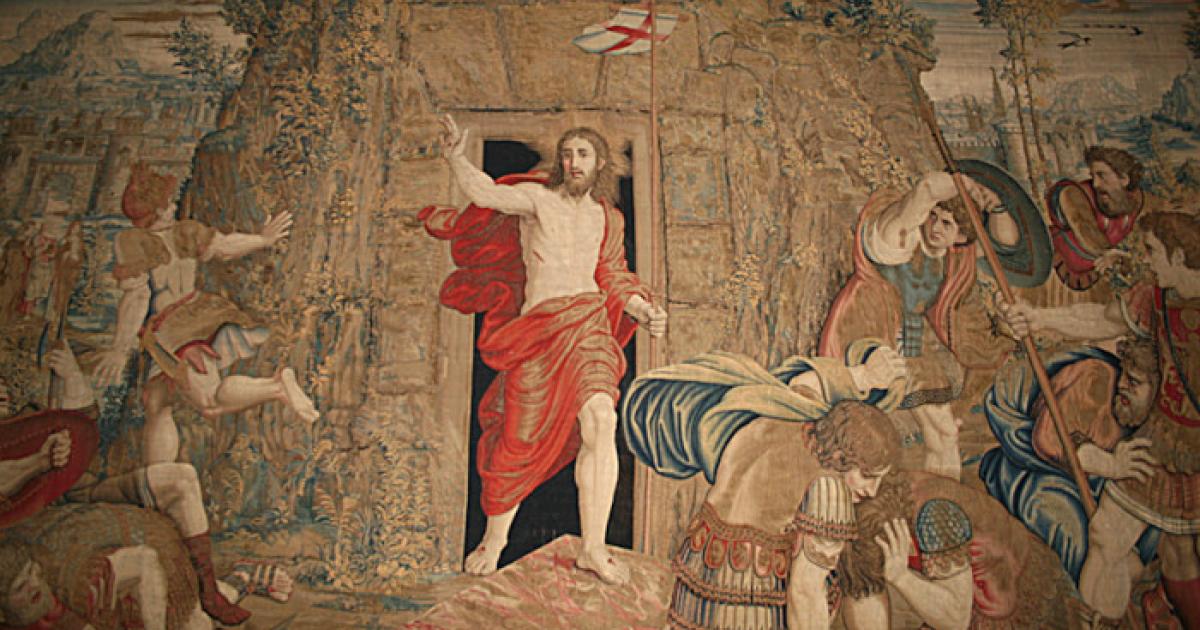
Fra Angelico's fresco 'Resurrection of Christ and Women at the Tomb' (c. 1440–1441), painted in Cell 8 of the Convent of San Marco, Florence.
Despite these arguments, the debate is far from settled. Critics and secular historians maintain that extraordinary claims require extraordinary evidence, and that the historical method cannot authenticate supernatural events. Prominent New Testament scholar Bart Ehrman has argued that the canonical accounts were written decades after the events by individuals who were not eyewitnesses and who held deep theological commitments. He contends that of the 115 billion human beings who have ever lived, if the resurrection happened, it was the only such occurrence, making it statistically far less probable than explanations rooted in legend, misidentification, or the sincere but mistaken beliefs of grieving followers.
A recent peer-reviewed article by John E. Thiel in the Scottish Journal of Theology acknowledged this tension, arguing that the resurrection should be understood as a historical event, but one whose full meaning is only accessible through a theological framework. Ultimately, the question of Jesus' resurrection remains a complex intersection of history, theology, and philosophy — and the evidence, as it stands, continues to be interpreted very differently depending on the worldview of the interpreter.
By Gary Manners
RELATED VIDEOS
{ https://www.ancient-origins.net/news-history-archaeology }
Is de ziel onsterfelijk? Misschien heeft de wetenschap het antwoordIs de ziel onsterfelijk? Misschien heeft de wetenschap het antwoord
©The Daily Digest
Een aloude vraag: Is de ziel onsterfelijk?
Het is een van de oudste vragen allertijden: is de menselijke ziel onsterfelijk of niet? Van oudsher hebben filosofie, wetenschap en godsdienst op de een of andere manier geprobeerd het juiste antwoord te geven, zonder ooit tot een absolute waarheid te zijn gekomen, waardoor de vraag open blijft voor vele interpretaties, afhankelijk van iemands geloofsovertuiging.
©The Daily Digest
Foto: Pixabay
Wat is een ziel?
Laten we echter eerst proberen te begrijpen wat men met ziel bedoelt. Het Latijnse woord voor ziel, anima, is verwant met het Griekse ànemos, dat 'adem' of 'wind' betekent. In veel spirituele en religieuze tradities is de ziel de 'essentie', 'geest' of 'ik' van de persoonlijkheid.
©The Daily Digest
Foto: Pixabay
De ziel of het bewustzijn
In meer recente tijden wordt de ziel echter opgevat als dat deel van het denkende zelf, dat net als het verstand of het bewustzijn, tot de grootste mysteries van de verschillende takken van wetenschap behoort. Toch werd enkele jaren geleden in samenwerking met een groot natuurkundige van onze tijd een nieuwe theorie ontwikkeld, die licht op deze zaak moet werpen.
©The Daily Digest
De Orch-OR-theorie
De theorie voor het onderzoek naar bewustzijn en dus de ziel heet 'Orch-OR' (wat staat voor 'ORCHestrated Objective Reduction') en werd in de jaren 90 ontwikkeld door de natuurkundigen Roger Penrose (foto) en Stuart Hameroff. Het is gebaseerd op het idee dat bewustzijn ontstaat binnen de neuronen en niet door interacties tussen die neuronen.
©The Daily Digest
Roger Penrose
Voor we ons verdiepen in deze intrigerende theorie die ons meer over onze ziel zou kunnen onthullen, is het goed om te weten dat Roger Penrose een vooraanstaand wiskundige, natuurkundige en kosmoloog is, die in 2020 de Nobelprijs voor Natuurkunde ontving.
©The Daily Digest
Nobelprijs voor Natuurkunde in 2020
Penrose behaalde een van de hoogste onderscheidingen in de wetenschap voor zijn werk over zwarte gaten. Tot zijn bijdragen behoort de ontdekking dat de vorming van zwarte gaten een gevolg is van de Einsteins algemene relativiteitstheorie.
©The Daily Digest
Bevriend met Stephen Hawking
Ook werkte Roger Penrose in Cambridge lange tijd samen met een andere grote natuurkundige die ons een paar jaar geleden heeft verlaten: Stephen Hawking. Met hem ontwikkelde hij enkele theorieën over zwarte gaten en de gravitationele singulariteit.
©The Daily Diges
Foto: Wikipedia
Stuart Hamerofft
De andere theoreticus die ons wil uitleggen wat de ziel is en of ze onsterfelijk is, is Stuart Hameroff, een anesthesioloog en docent aan de Universiteit van Arizona in de Verenigde Staten.
©The Daily Digest
Een theorie die getest moet worden
Opgemerkt moet worden dat 'Orch-OR' op dit moment nog slechts een theorie is, maar dat men meent dat hij toetsbaar is en dat er projecten worden opgezet om hem te testen en de geldigheid ervan te bevestigen.
©The Daily Digest
Foto: Pixabay
Ondersteuning van de Orch-OR-theorie
De basis van de door Penrose en Hameroff ontwikkelde Orch-OR-theorie is het idee dat de hersenen misschien niet door algoritmen bestuurd worden, zodat hun fysische eigenschappen niet door traditionele wiskundige formalismen bepaald worden, maar door de intrigerende (en soms merkwaardige) principes van de kwantummechanica kunnen worden verklaard.
©The Daily Digest
Een kwantumbenadering
De twee auteurs van de theorie hebben hun kennis gecombineerd: enerzijds wil Hameroff de biologische component van bewustzijn bestuderen. Volgens Hameroff bestaat de hoofdstructuur van het bewustzijn uit de microtubuli in de hersenen. Aan de andere kant hebben we de natuurkundige Penrose die een kwantumbenadering inbrengt.
©The Daily Digest
Het bewustzijn is een trillende golf
Volgens de Orch-OR-theorie is het bewustzijn een trillende golf in het universum van subatomaire deeltjes (kwantumfysica is deeltjesfysica) en fungeren de microtubuli als ware kwantumcomputers, die deze trillingen omzetten in bruikbare informatie.
©The Daily Digest
Foto: Pixabay
De hersenen als een kwantumcomputer
Een kwantumcomputer werkt anders dan een gewone computer. Een gewone computer verwerkt informatie in de vorm van bits, nul of één, terwijl een kwantumcomputer qubits verwerkt, die tegelijkertijd nul en één kunnen zijn, waardoor kwantumsuperpositie ontstaat, een paradox die moeilijk te bevatten is voor ons klassieke mechanische verstand.
©The Daily Digest
Foto: Pixabay
De veel-werelden-interpretatie van Everett
Deze superpositie van toestanden zou de meting of de waarneming kunnen zijn, in dit geval van het bewustzijn. Hier is een voorbeeld om beter te begrijpen waar we het over hebben: volgens sommige theoretische natuurkundigen wordt, wanneer iemand besluit een appel of een peer te eten, op het moment van de beslissing (bijv. voor de appel) de peer door die uitkomst losgekoppeld en blijft hij afzonderlijk bestaan in een andere wereld. (De veel-werelden-interpretatie van Everett).
©The Daily Digest
Foto: Wikipedia
We are the reality
Volgens de Orch-OR-theorie daarentegen wordt de niet gekozen uitkomst, dus de peer, losgemaakt, maar belandt hij in een onstabiele situatie, zodat hij na een tijdje ten onder gaat. Dit levert twee conclusies op: volgens de aanhangers van de veel-werelden-interpretatie van Everett zijn er vele andere werelden, maar slechts één heeft een bewustzijn (de wereld waarin wij bewust zijn), en dat is een volstrekt willekeurig feit. Volgens Penrose en Hameroff daarentegen zijn wij de enige werkelijkheid, want alternatieve werkelijkheden gaan ten onder omdat ze onstabiel zijn.
©The Daily Digest
Foto: Pixabay
Een nieuwe manier om de hersenen te begrijpen
Dit kwantumdenken wordt dan overgebracht op de hersenen, waar het bewustzijn eerder werd beschouwd als een reeks verbindingen tussen neuronen die functioneren als een gewone computer. Maar volgens Hameroff is het "een belediging voor het neuron zelf als je de hersencel - het neuron - beschouwt als een schakelaar die uit of aan gaat".
©The Daily Digest
Foto: Pixabay
Wat gebeurt er in het neuron?
Zoals de Amerikaanse hoogleraar al zei: "Denk eens in, een enkele cel als het pantoffeldiertje kan zwemmen, voedsel en een partner vinden, paren en kan leren. Als een eenvoudige pantoffeldiertje zo intelligent kan zijn, hoe kan een neuron dan zo dom zijn? Is het werkelijk een kwestie van aan- of uitzetten? Ik denk dat deze wetenschappers geen rekening houden met wat er zich binnenin het neuron afspeelt."
©The Daily Digest
Foto: Pixabay
Is de ziel dan onsterfelijk?
Op dit punt aangekomen is de terechte vraag echter: hoe kan de ziel, ofwel het bewustzijn, in dit verband onsterfelijk zijn? Hier is het antwoord volgens de Orch-OR-theorie.
©The Daily Digest
Foto: Pixabay
Informatie blijft behouden
In de toestand voorafgaand aan de dood verliezen de microtubuli volgens deze theorie hun kwantumtoestand, maar behouden ze de informatie die ze bevatten. Volgens Hameroff "stopt het hart met kloppen, het bloed stroomt niet langer, en de microtubuli verliezen hun kwantumtoestand. Maar de kwantuminformatie in de microtubuli wordt niet vernietigd, ze kan niet vernietigd worden, ze verspreidt zich gewoon en lost op in het universum. "
©The Daily Digest
Een intrigerende maar onbewezen theorie
Dit is uiteraard slechts één van de vele interessante theorieën die een verklaring proberen te geven voor wat bewustzijn is en of het ook werkelijk informatie van een mensenleven kan behouden. Het is echter belangrijk op te merken dat het een theorie blijft die nog niet door de wetenschap is bewezen.
White Disk Over Arnold, Missouri USA March 31, 2026, UFO Sightings Daily
100 mile long UFO rises off moon as Artimus approaches, UAP Paranormal Alien Sighting News.
60 Mile UFO appears in Earths orbit in NASA Artimus photo, April 3, 2026, UAP Paranormal Alien Sighting Breaking News.

Scientists hint at what US government UFO files may reveal©Source: Pixabay
Scientists Hint at What US Government UFO Files May Reveal
Curiosity about extraterrestrial life has long blurred the line between science, speculation, and storytelling. Now, renewed calls to release classified UFO files are reigniting that curiosity, raising a simple but powerful question, what does the government actually know, and what might finally come to light?
©Source: Shutterstock
Government Push Renews Interest In UFO Disclosure
A recent directive to begin reviewing and releasing government records related to unidentified aerial phenomena, UFOs, and possible extraterrestrial life has sparked widespread attention. The initiative suggests a shift toward greater transparency, potentially opening decades of classified material to public scrutiny and scientific evaluation.
©Source: Pexels
Political And Public Reactions Fuel Speculation
Public interest intensified following comments from political figures discussing the possibility of life beyond Earth. While some statements emphasized the vastness of the universe as a basis for believing in extraterrestrial life, others hinted at the existence of undisclosed information, further fueling debate and speculation.
©Source: Pexels
New Sightings Add Urgency To The Discussion
Recent reports documenting hundreds of new unidentified aerial sightings highlight the scale of the phenomenon. While many cases remain unexplained, the volume of data underscores the need for systematic analysis, especially as advanced detection technologies continue to capture unusual activity.
©Source: Pixabay
Former Investigator Urges Realistic Expectations
A former lead investigator of government UFO programs has cautioned that the public may not find definitive proof of alien life in the released files. His experience suggests that many incidents can be attributed to misinterpretations, experimental defense projects, or deliberate obfuscation rather than extraterrestrial encounters.
©Source: Unsplash
Scientific Perspective Emphasizes Probability Over Proof
From a scientific standpoint, experts widely agree that life beyond Earth is statistically plausible given the immense scale of the universe. However, they also stress that no current evidence confirms that such life has visited or interacted with our planet in any verifiable way.
©Source: Unsplash
Astronomers Highlight Limits Of Human Perception
Astronomers note that unfamiliarity with atmospheric, optical, and astronomical phenomena often leads people to misidentify what they observe in the sky. This gap in understanding can transform ordinary events into seemingly mysterious encounters, reinforcing the importance of scientific literacy.
©Source: Common Wikimedia
The Role Of Skepticism In Scientific Inquiry
Skepticism remains a cornerstone of scientific investigation. Researchers emphasize that extraordinary claims require equally strong evidence, and this standard is essential for separating credible findings from assumptions or misinformation in the study of unidentified phenomena.
©Source: Unsplash
Challenges Of Declassification And National Security
Experts anticipate that many documents may be heavily redacted due to national security concerns, particularly those involving advanced surveillance systems. Even so, older data could be released in a way that allows scientists to reanalyze past observations using modern tools and methodologies.
©Source: Commons Wikimedia
Search For Life Focuses On Microbial Evidence
Rather than expecting dramatic discoveries of intelligent beings, many scientists are focused on the possibility of microbial life. Since microorganisms were the foundation of life on Earth, finding similar evidence elsewhere would represent a major scientific breakthrough.
©Source: Unsplash
A Scientific Approach To The Unknown
Researchers studying these files aim to distinguish between explainable events and truly anomalous cases. While most sightings are likely to have conventional explanations, scientists remain open to the possibility that a small number of incidents could challenge current understanding, making careful, evidence-based analysis essential.
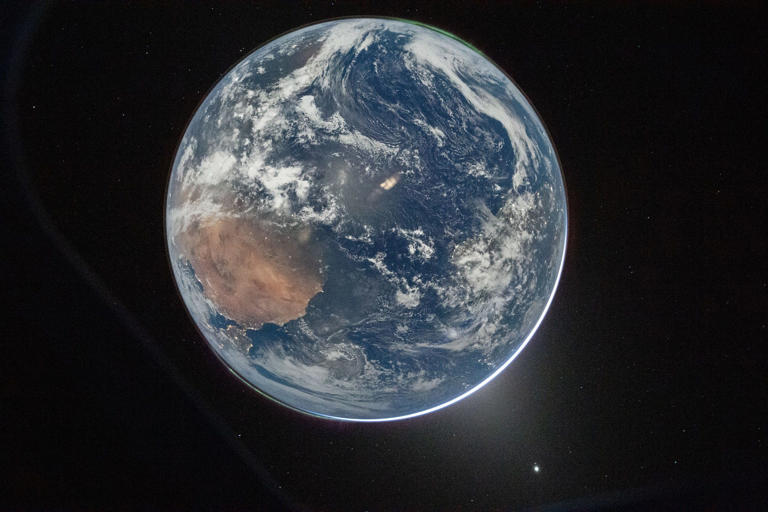
ArtemisII crew saw a life-changing view. The story of a viral photoAs the four astronauts on the 10-day Artemis II mission around the moon got their first clear glimpse of Earth, the view of their home planet in the distance stopped them in their tracks.
They captured a remarkable photo of Earth from the first crewed moon mission in 50 years. The photo, taken by Commander Reid Wiseman on April 2 from the Orion spacecraft's window, showed Earth from tens of thousands of miles away. It captured the "spectacular blues and browns" of the planet and even caught two auroras lighting up the atmosphere.
The image has dazzled those back on Earth who are following the Artemis II mission and may never get the chance to see our home planet from space for themselves. But the view has also had a profound impact on the crew, the first humans to leave Earth's orbit since 1972.
"There was a moment about an hour ago where Mission Control Houston reoriented our spacecraft as the sun was setting behind Earth, and I don't know what we all expected to see in that moment," Wiseman told reporters during a question-and-answer session from space on April 2, describing all the detail the crew could see of Earth. "It was the most spectacular moment, and it paused all four of us in our tracks."
Astronauts in the past have gotten to see glimpses of auroras, lightning strikes and metropolitan areas lit up as evidence of human life. Seeing Earth from above has had such a transformative influence on astronauts that there is an entire psychological phenomenon to describe it, called the overview effect. It can change an astronaut's entire perspective on Earth and life itself.
The astronauts will also get to see parts of the moon that nobody has ever laid eyes on before, the far side not viewable from Earth. That will happen during a roughly six-hour window on April 6 when the sun, moon and the Orion spacecraft will be aligned in just the right way so the astronauts can see about 20% of the far side of the moon, lit by the sun, NASA said.
The Artemis II crew members described the "breathtaking" view of Earth and the details of what they were seeing. From space, they can see the coastline of continents, rivers, thunder clouds and the South Pole lit up, said Artemis II Mission Specialist Christina Koch, reported NPR. The photo captured by Wiseman shows auroras on the poles, lit up in green.
There's nothing that prepares you for the breathtaking aspect of seeing your home planet both lit up bright as day and also the moon glow on it at night with the beautiful beam of the sunset," Koch told reporters in a live stream from space.
"You could see the entire globe from pole to pole, you could see Africa, Europe and if you looked really close, you could see the northern lights," Wiseman said.
Astronauts for decades have tried to put into words the experience of seeing Earth from various missions. Alan Shepard was the first American to view Earth from space in 1961 from the Freedom 7 Mercury Capsule during a 15-minute suborbital flight.
"If somebody'd said before the flight, 'Are you going to get carried away looking at the Earth from the moon?' I would have said, 'No, no way,'" Shepard said after walking on the moon during the Apollo 14 mission in 1971. "But yet, when I first looked back at the Earth, standing on the moon, I cried."
The International Space Station has a particularly good view of Earth from its seven-windowed cupola module. Former NASA astronaut Nicole Stott said she looked for her home state of Florida during her first trip to the ISS in 2009.
"I wanted to go to the window and see it, and then realized somewhere down the line that I wasn’t looking at Florida that same way anymore,” she said. “I still wanted to see Florida, but Florida had just become this special part of home, which is Earth. We’re all earthlings.”
The life-altering effects of viewing Earth from space have garnered psychological research. In 1987, it was dubbed the "overview effect" by space philosopher and author Frank White, who first considered the phenomenon while on a cross-country flight and decided to start interviewing astronauts. One of the most common experiences they shared was seeing the reality that there are no borders or boundaries separating people, he said.
"And what the astronauts were telling me was, I, I knew before I went into orbit, or went to the moon, that there weren’t any little dotted lines. But it’s knowing intellectually versus experiencing it," White said on a NASA podcast in 2019.
A common conclusion astronauts made from their observations, White said: "We are really all in this together. Our fate is bound up with people that we may think are really different from them. We may have different religions, we may have different politics. But ultimately, we are connected. Totally connected."
It's a difficult concept to convey, White said, "because all you have is words." To fully understand, you need to see it for yourself, he said.
Koch described the overview effect from the International Space Station this way, in a NASA publication from November 2025:
“The overview effect is when you’re looking through the cupola and you see the Earth as it exists with the whole universe in the background. You see the thin blue line of the atmosphere, and then when you’re on the dark side of the Earth, you actually see this very thin green line that shows you where the atmosphere is. What you realize is every single person that you know is sustained and inside of that green line and everything else outside of it is completely inhospitable. You don’t see borders, you don’t see religious lines, you don’t see political boundaries. All you see is Earth and you see that we are way more alike than we are different.”
"Are you going to try to live your life a little differently? Are you going to really choose to be a member of this community of Earth?" Artemis II Pilot Victor Glover previously said.
On April 2, when asked about division back on Earth, Glover said: "Trust us, you look amazing, you look beautiful. And from up here you also look like one thing. Homo sapiens, all of us, no matter where you're from or what you look like, we're all one people."
Two photos taken more than a half-century apart were compared side-by-side by NASA in a post to social media this week.
The first, the famous "blue marble" photo taken in December 1972, was captured by the crew of the Apollo 17 mission, the last crewed mission to land on the moon.
The second photo was taken April 2, 2026, during Artemis II, which won't include a lunar landing but paves the way for future landings and space exploration.
This article originally appeared on USA TODAY:
RELATED VIDEOS
What is alien disclosure? This answer may surprise you..
In a recent Substack essay, writer Dana Kippel tackles the often‑misunderstood concept of “alien disclosure.” Rather than focusing on declassified government files or sensational sightings, Kippel frames disclosure as a collective shift in consciousness that could redefine humanity’s relationship with any extraterrestrial intelligence. The piece, published in early 2026, weaves together references to UFO research, metaphysical theories of the “higher self,” and emerging fringe scientific models that treat consciousness as a fundamental component of reality.
Kippel argues that the conventional narrative—wherein a secretive agency releases proof of alien craft—misses the deeper purpose of disclosure. She writes that “the real unveiling is internal, a co‑creative plasma reality where human perception expands to recognize non‑human intelligences as part of a shared field.” The essay links this idea to recent discussions about plasma‑consciousness dynamics, a model suggesting that matter and mind are intertwined at a sub‑atomic level. According to Kippel, if humanity begins to experience reality as a mutable, fractal “Mandelbrot plasma,” the distinction between “us” and “them” dissolves, paving the way for authentic contact.
Mainstream scientists remain cautious about claims that consciousness can directly interface with extraterrestrial entities. The U.S. Office of the Director of National Intelligence’s 2021 UAP report, for instance, emphasized the need for rigorous data collection and warned against speculative interpretations. Nonetheless, a growing niche of researchers—often labeled “fringe”—explores parallels between quantum entanglement, information theory, and the possibility of non‑local communication. Kippel cites work from physicists investigating “co‑creative plasma” as a medium that could, in theory, support such exchanges, though she acknowledges that empirical validation is still pending.
The essay also highlights voices from the UFO and metaphysical communities who view disclosure as an evolutionary catalyst. Authors like Dr. Jacques Vallée have long suggested that UFO phenomena may be psychological or sociocultural mirrors, prompting humanity to confront unresolved aspects of its own consciousness. Kippel extends this line of thought, proposing that alien contact could act as a “mirror of the higher self,” encouraging individuals to transcend egoic limitations. She references a recent live discussion with fellow researcher Jonathan Cohen, noting that participants reported “heightened intuitive awareness” after meditative sessions focused on interstellar dialogue.
If Kippel’s interpretation gains traction, the policy implications could shift dramatically. Rather than preparing for a sudden release of classified footage, governments and scientific institutions might prioritize public education on consciousness research and interdisciplinary collaboration between physicists, neuroscientists, and philosophers. Critics caution that such a pivot risks blurring the line between evidence‑based inquiry and speculative mysticism. Yet Kippel maintains that “the surprise of true disclosure lies not in the arrival of alien ships, but in humanity’s readiness to recognize itself as part of a larger, self‑organizing cosmos.”
Review: In an Age of Disinformation, “Saucers, Spooks and Kooks” is the Real Disclosure Film

If you’re tired of never-ending promises of UFO disclosure that never arrive, then have I got a movie for you.
Based on the 2021 book by Adam Gorightly and directed by Christopher Graybill, Saucers, Spooks and Kooks digs into the origins of longstanding UFO myths that persist to this day. In a nostalgia fest for the paranoid UFOlogy of the 80s and 90s, the film provides more real answers on where the grey aliens come from than you can expect to find in any trove of government documents or collection of experiencers’ tales.
Unlike other recent UFO films, Saucers, Spooks and Kooks also doesn’t take itself too seriously. Even if that would turn off some of the more solemn pursuers of truth in our midst, soldiering through it will nonetheless offer a solid case that they, in fact, may be the ones taking the “disclosure” idea a bit too seriously. While modern advocates have claimed disclosure is right around the proverbial corner, the film highlights an uncomfortable reality: that others have been saying very similar things for many decades—and the specific time period that the film covers, spanning the late 1970s through the mid 1990s, helped set the stage for much of our present UFO mythology.
Over the course of the film, the amount of intentional disinformation, tall tales, and willingness to believe that have shaped UFOlogy becomes clear, providing essential context for where the topic stands today, as addressed (spoiler alert) at the end of the film. In short, the film offers a history lesson that may be strange and fascinating enough to surprise both the skeptic and believer, as it twists and turns through murky truths and strange characters that, at times, may seem every bit as incredible as UFOs themselves.
These ideas are traceable to specific people, whom the film follows through moments ranging from the “dark side” of the subject—as in the case of Paul Bennewitz, who was driven to madness, and reportedly with the help of UFO disinformation—to the absurd, as in the case of the strange prankster known as “TAL LeVesque,” who in one instance claimed to meet a reptilian alien in his bedroom. These, and many others, are the individuals who contributed to shaping UFOlogy as we know it, although as the film argues, UFOlogists who ignore the lessons these human stories teach are doomed to continue banging their heads against the wall into perpetuity.

Adam Gorightly hosts the documentary in-character, as a quirky, paranoid researcher surrounded by monitors.
Credit: Christopher Graybill
While some of the basic elements of the story presented also appeared in the 2013 documentary Mirage Men, Saucers, Spooks and Kooks vastly expands on that film. The main thrust of Mirage Men was the story of how Air Force Office of Special Investigations officer Richard Doty intentionally passed false information to UFO investigators in an alleged counterintelligence operation, events that ended up becoming a crucial part of the UFO mythos and culminating in Bill Moore’s fiery speech at the 1989 MUFON convention, which at the time tore the community apart.
Mirage Men, some historians might argue, could be seen as part of the “before times,” as it was released prior to the 2017 New York Times article, which revealed the existence of a previously secret U.S. government program that examined UFOs and related phenomena—a moment that has become viewed as a sort of dividing line for the modern era of UFOlogy. Mirage Men conveyed Doty as an individual who, decades after his “official” involvement with counterintelligence, was seemingly still up to his old tricks, attempting to pull one over on a dwindling audience of die-hard UFO buffs with the story of a secret US space program exchanging humans with aliens that became known as the SERPO affair.
Where Saucers, Spooks and Kooks expands the retelling is in highlighting not just the “spooks” like Doty and their side of the story, but also the many “kooks” who ran with the disinformation provided by them that helped build on the mythos. The result provides a more complete and satisfying account of UFOlogical history by exploring how these two elements play off of one another like a snowballing internet creepypasta, to produce an ever-evolving myth.
And that myth remains in motion to this day. The film ends with images of modern “whistleblowers” claiming to have insider information all over again. This time, wrapped in an air of respectability that the Bill Moores of the era never achieved, with congressional hearings and 20/20 interviews, yet the same mist of evidence that is perpetually out of reach, “cannot be discussed in this setting,” or simply remains unseen, but perpetually “imminent.” While Doty may still be out there somewhere on the internet, attempting to lay claim to his own stake in “disclosure,” the new faces that have emerged in recent years come with more impressive titles and from positions deeper inside the intelligence apparatus.

Unlike the bland graphic design on other recent UFO documentary covers, Saucers, Spooks and Kooks uses the Ghanaian film poster style for its promotional artwork. While those posters have become popular collectibles among schlock film fans, the reference may be lost on the typical UFO enthusiast.
Credit: Christopher Graybill
This is all helped along with a presentation that feels straight out of the period, transforming narrator Gorightly into a quirky character in this retelling, and combining Graybill’s Gen X memories of the Unsolved Mysteries television show with Gorightly’s knowledge of the field’s myriad characters as they appeared at the time. The intentional lo-fi vibe appeals to those who appreciate the earnestness of the underground UFO zines and VHS tapes of the era, into which UFOlogy’s forefathers poured their blood, sweat, and tears before the ease of Tweets, YouTube rants, and the all-too-tempting allure (and overuse, in many cases) of AI-generated content.
From Graybill’s synth music and animated reenactments, complete with CRT TV scan lines, to a host of well-researched period footage, Saucers, Spooks and Kooks transports one back to the era. Especially notable are the kitschy yet eerie live-action reenactments sourced from Japanese television of the time.
The Debrief spoke with the pair to find out how it all came together.
“I find a lot of the disclosure crowd, and what they’re producing—the content, the visuals, you know, using AI or whatever, to be pretty damn boring. And the old stuff I love,” Gorightly said. “I think it was my idea to use that. Chris spent a lot of time wrangling old footage. I like that sensibility.”
“It was a collaborative process, for sure. It evolved with both of our sensibilities, I guess,” Gorightly explained. “For instance, we called where I was at ‘Gorightly’s Lair,’ and I kind of came up with that concept of having a guy in his basement, you know? The set [was] in my garage. Since then, I’ve remodeled, and it’s a recording studio.”
“What we modeled that on was John Lear back in the day. I don’t know if you’ve seen any videos of him. He had all those television screens and stuff behind him,” Gorightly continued. “It was kind of a mishmash of John Lear and the conspiracy theorist who lives with his parents down in the basement. Chris and I put the set together, and the murder board. We collaborated in putting all those little elements together for the film.”
“[Initially] it was a bit too dry; I was reading it straight, so we kind of came up with a thing. If I was on Unsolved Mysteries … how would I be announcing that—a little bit more amped up, but also kind of quirky, and that throws some humor in there now and then,” Gorightly concluded.
“I think I’ve always approached it more as entertainment than anything,” Graybill told The Debrief, calling UFOlogy a “metafiction.”
“It could be true, but it’s more just fun to think about and entertain,” Graybill said.
“The documentary kind of TV shows, it was just like ‘we’re gonna get to the bottom of it,’ and they never do. But they’ll show you some great footage. You do wonder; it makes you really curious, I think. It made me really curious: what is the real story?”
And get to the “real” story is what Gorightly appears to have done. He spoke with many of the involved persons for the original book, and, along with Graybill, conducted another round of in-depth interviews for the film. Additionally, Graybill sourced footage from the National UFO Historical Records Center, including rare early footage of the two men most responsible for popularizing Roswell as the most well-known UFO case in the US: UFO researchers Stanton Friedman and Bill Moore.
However, not everyone from those days was eager to tell their story, as a few of the participants from that era don’t look back on those days fondly, offering something of a warning to the eager young UFOlogists of today.
“I put out feelers to talk to Bill Moore through Bishop. I think Greg Bishop is still in touch with him,” Gorightly said. “But it didn’t sound like Moore was interested, and he hasn’t really discussed it for many years now.
“Chris found the number of Jamie Shandera and called him, and the conversation went:
‘Is this Jamie Shandera?’
‘Yes.’
‘Jamie Shandera from UFO Cover-Up Live?’
‘Uh, yes.’
“Chris asked if he wanted to talk about them. He said, ‘No, I’m not interested,’ and hung up.”

Director Christopher Graybill conducted extensive research for the film. Credit: Christopher Graybill
We asked Gorightly when he first began to have suspicions of the ever-around-the-corner disclosure movement. His answer took him back two decades.
“Let’s see, this would be 2006, at the Roswell conference,” Gorightly said. “That was the 60th anniversary? A bunch of different researchers and ufologists were there, and I gave a talk I had at that time.”
“They had us stay at a hotel, and I was there with Greg Bishop and Nick Redfern,” Gorightly remembered. “We went down for the free breakfast, and down there were Stan Friedman, Bruce Maccabee, and Steven Bassett. I didn’t know who Stephen Bassett was at the time. I knew Maccabee and Stan Friedman; I think it was those three guys. So, you know, we’re just waking up, having coffee or whatever. Free cereal, your waffles that you’d make on the little thing there. Bassett’s going on and on about how Hillary’s gonna be the disclosure president, and this and that. It’s like, holy shit, who’s this guy?”
“And we got done with him, and I’m walking away, and I asked Greg Bishop, ‘Is that guy serious about all this?’ And he said, oh yeah, he’s quite serious. That’s Stephen Bassett,” Gorightly said, recalling that “he had this thing called the disclosure clock back then. It’s almost like the Doomsday Clock. It hit the midnight hour. We’re talking around 2000.”
“I was dubious when people started saying they have these unnamed sources in the government,” Gorightly said.
So, while history has shown that “disclosure” never quite seems to arrive, Saucers, Spooks and Kooks at least proves that understanding the history of UFOs and, perhaps more importantly, those who have been involved with their study, can offer a more viable way of discerning a degree of “truth” about the subject. In addition to their film, for even more in-depth information on all of this, be sure to also check out Gorightly and Graybill’s companion podcast, which is full of expanded interviews and deep dives.
RELATED VIDEOS
10 Weird Archaeological Facts That Will Blow Your Mind

Archaeology isn’t just about dusty ruins and ancient pottery—it’s full of bizarre discoveries that challenge what we think we know about the past. From mysterious artifacts to unusual burial practices, here are 10 of the strangest archaeological facts ever uncovered!
1. The Ancient Egyptians Used Honey to Treat Wounds
Over 4,000 years ago, Egyptian doctors used honey as an antiseptic to prevent infections. They believed it had magical healing properties, but modern science confirms they were onto something—honey is naturally antibacterial and still used in medicine today!

AI-generated image (provided by author).
While people in medieval Europe shivered in their castles, the ancient Romans were enjoying underfloor heating! They built a system called hypocaust, where hot air from a furnace flowed beneath raised floors—basically, ancient central heating.

AI-generated image (provided by author).
Some mummies have been found with terrifying, open-mouthed expressions, leading to myths of cursed souls trapped in eternal screams. But archaeologists say this happens because the jaw drops open after death—still creepy though!

AI-generated image (provided by author).
Archaeologists in Sweden found a piece of ancient chewing gum made from birch bark tar, complete with human teeth marks! It’s believed Stone Age people chewed it for fun, to clean their teeth, or as medicine—kind of like prehistoric bubble gum.

Graves from the Middle Ages reveal skeletons with stakes through their hearts, rocks in their mouths, or even decapitated heads. These were suspected vampires, buried in ways to prevent them from rising from the dead.

AI-generated image (provided by author).
In Pompeii, archaeologists found a well-preserved street food stall (thermopolium) with painted menus showing the food they served. Turns out, fast food isn’t a modern idea—Romans were grabbing quick bites over 2,000 years ago!

An ancient Roman fast food counter that was unearthed in Pompeii last year will open to the public.
(Luigi Spina / AFP).
Ancient skulls with unnaturally long shapes have been found worldwide, from South America to Asia. Some believe they’re proof of alien contact, but archaeologists explain they were intentionally reshaped using tight bindings, possibly as a status symbol.

One of the elongated skulls found in the Mayan cenote in Mexico.
(Bradley Russell / National Geographic).
Deep in the Honduran jungle, explorers uncovered ruins of a mysterious, forgotten civilization, which legends call "The White City" or "City of the Monkey God." Even weirder? Many of the researchers got sick after excavation, leading to rumors of an ancient curse.

AI-generated image (provided by author).
Ancient Roman concrete is stronger than modern concrete, especially in seawater. Scientists discovered it gets stronger over time due to a chemical reaction with seawater, making it almost indestructible—unlike today’s crumbling bridges!

AI-generated image (provided by author).
At Göbekli Tepe in Turkey, archaeologists found huge stone pillars covered in carvings of strange, humanoid figures. Built over 6,000 years before the Egyptian pyramids, the site has led some to speculate about lost civilizations—or even ancient giants!

Archaeological site of Göbeklitepe in Turkey.
Archaeology is full of mysteries, and every discovery raises new questions about our past. From vampire burials to unbreakable Roman concrete, history is weirder than we ever imagined! Which fact surprised you the most?
Nearly a century of wondering: The American UFO saga, in reality and in fiction
UFOs, or the notion of them, have been around a long time. Here´s a look at how the various iterations of the subject - from government investigations to sightings to movies and TV - have unfolded since World War II:
On June 24, private pilot Kenneth A. Arnold reports seeing nine objects flying near Mount Rainier in Washington state. His was the first widely reported UFO sighting in this country and set off a wave of other reported sightings. On July 2, A ranch foreman checking on sheep finds strange debris spread over a prairie near Roswell, New Mexico. Authorities initially say the material is from a flying disc, but later say it is from a weather balloon.
U.S. Air Force launches Project Sign, an investigation into UFOs; renamed Project Blue Book in 1953. More than 12,600 reported sightings were investigated between 1948 and 1969.
Release of the spy film "The Flying Saucer."
Radar operators, pilots and others pick up or see up to a dozen unexplained objects in the sky above Washington, D.C. in July.

FILE - A sign directs travelers to the "1947 UFO Crash Site Tours" in Roswell, N.M., on June 10, 1997. (AP Photo/Eric Draper, File)
Construction begins for what would become the Area 51 site northwest of Las Vegas as an Air Force facility. Area 51 becomes a hotspot for UFO conspiracy theories. In 2013, the CIA acknowledged the existence of the site.
In November, dozens of people in Levelland, Texas, west of Lubbock, report strange lights in the sky that interfered with their vehicles and lights.
In September, "Star Trek" premieres on NBC, launching the most enduring space drama in history.
Dec. 17: Air Force says it found no evidence of any UFO that was extraterrestrial in nature or that threatened national security; terminates Project Blue Book.
Steven Spielberg´s "Close Encounters of the Third Kind" released.
U.S. Air Force personnel stationed in Great Britain report seeing strange lights above Rendlesham Forest, northeast of London, in December. Officers reportedly see a metallic object in the forest after investigating the lights.
Spielberg´s "E.T. the Extraterrestrial" is released.
Roland Emmerich´s "Independence Day" is released.
Residents report seeing lights from a large flying object in the sky over or near Phoenix in March.
U.S. aviators track an unidentified blob which was dubbed "Gofast." In another video from that year, labeled "Gimbal," an unexplained object is tracked as it soars high along the clouds, traveling against the wind. "There´s a whole fleet of them," one naval aviator tells another, though only one indistinct object is shown. "It´s rotating." The videos are leaked and later released by the Pentagon.
Navy acknowledges the three clips of declassified military footage as unidentified aerial phenomena.
Pentagon announces a UAP (unidentified aerial phenomena) Task Force.
Investigators say in a U.S. government report that they did not find extraterrestrial links in reviewing 144 sightings of aircraft or other devices apparently flying at mysterious speeds or trajectories. They highlighted the need for better data collection.
Congress holds first hearing in 50 years on UFOs following reports of unexplained aerial phenomena by the military. Lawmakers from both parties say UFOs are a national security concern. NASA announces that it is launching a study of UFOs as part of a new push toward high-risk, high-impact science. The space agency says it´s setting up an independent team to see how much information is publicly available on the matter and how much more is needed. The agency releases its findings in 2023, saying the study of UFOs will require new scientific techniques, including advanced satellites as well as a shift in how unidentified flying objects are perceived. The All-Domain Anomaly Resolution Office (AARO) set up in the Pentagon to track reports of unidentified objects in the sky, under water and in space.
Former Air Force intelligence officer David Grusch testifies before a House Oversight subcommittee in July that the U.S. is concealing a longstanding program that retrieves and reverse-engineers unidentified flying objects. The Pentagon denies it´s concealing any such program.
New Pentagon study that examined reported sightings of UFOs over nearly the last century finds no evidence of aliens or extraterrestrial intelligence. The study from the Defense Department´s All-Domain Anomaly Resolution Office analyzed U.S. government investigations since 1945 of reported sightings of unidentified anomalous phenomena. It found no evidence that any of those claims were actually signs of alien life, or that the U.S. government and private companies had reverse-engineered extraterrestrial technology and were hiding it.
-Feb. 14: Former U.S. President Barack Obama, answering a question about "are aliens real" on a podcast, says, "They´re real. But I haven´t seen them. And, they´re not being kept in Area 51." Obama later released this statement on social media: "Statistically, the universe is so vast that the odds are good there´s life out there. But the distances between solar systems are so great that the chances we´ve been visited by aliens is low, and I saw no evidence during my presidency that extraterrestrials have made contact with us. Really!"
-Feb. 19: President Donald Trump announces on social media that he´s directing the Pentagon and other government agencies to identify and release files related to extraterrestrials and UFOs because of "tremendous interest." Trump accuses Obama of disclosing "classified information" and tells reporters that he doesn´t know if UFOs are "real or not."
-March 31: U.S. Rep. Anna Paulina Luna requests in a letter to Defense Secretary Pete Hegseth that the government release about four dozen videos related to UAP sightings to an oversight committee task force. "The presence of UAPs in and around the sensitive airspaces of U.S. military installations poses a threat to the security of the armed forces and their readiness," Luna writes.
RELATED VIDEOS
Hollywood's narrative on UFOs and ETs reaches back many decades
Before zombies shambled about, ghoulishly feasting on the flesh of those too slow to flee, aliens from outer space ruled movie theaters, drive-ins and late Saturday night creature features on television.
Even as Hollywood still drives how Americans envision little green men with big eyes and bigger heads, fiction soon could be separated from - or revealed as - fact if government agencies release secret files related to extraterrestrials and UFOs as called for in February by President Donald Trump.
The science fiction genre has shaped how people think about intelligent life elsewhere in the universe - "whether it´s invasion narratives or aliens coming to warn us that we´re on the wrong track or aliens just trying to come and make contact and help us with things or just say `hi,´" says Duke University professor Priscilla Wald, who teaches a class on science fiction and film.
Trump's announcement on social media followed former President Barack Obama suggesting in a podcast interview that aliens were real. Obama later clarified that he had not seen evidence that aliens had made contact, but said since the universe is so vast odds are good that life exists elsewhere.
Movies say they are nearly everywhere, from a Pennsylvania cornfield in 2002's "Signs" to Wyoming's Devil's Tower in 1977's "Close Encounters of the Third Kind" to a Central American jungle where 1987's "Predator" was set.
"Hollywood has basically been preparing the public for this," retired Navy Rear Adm. Timothy Gallaudet says of any revelation that intelligent life from outer space exists and has visited Earth. "I think people can handle it. It does, of course, depend on what information is released (by the government)."

FILE - Model ships hang at the entrance to the Star Trek Experience at the Las Vegas Hilton in Las Vegas on Aug. 25, 2008.
(AP Photo/Isaac Brekken, File)
Hollywood quickly latched on following the 1947 discovery of debris near Roswell, New Mexico. Authorities initially identified crash materials as a flying disc before quickly backtracking and saying they were from a high-altitude weather balloon.
About three years after Roswell, "The Flying Saucer" made it to theaters. That was followed by a some low-budget and mostly forgettable movies, while others continue to inspire sci-fi buffs like 1951´s "The Day the Earth Stood Still."
"If you think back to the flourishing of alien films, this starts really in the U.S. in the 1950s," Wald says.
"The aliens are gentle souls who come down and try to warn us after nuclear war," she says of "The Day the Earth Stood Still." "They´re trying to warn that we´re creating problems in the cosmos and that if we don´t stop, they are and have to do something about it."
Still others depict visitors arriving with more nefarious motives and intentions - to kill us, to take over the Earth, sometimes even to make us food.
"I think if we found out aliens were on the way, there would be a mix of responses," Wald says. "I think there would be a lot of people out there welcoming them. A lot of people would be going down to the cellars and stocking them with canned food."
A plethora of documentaries also have been released, including 2025´s "The Age of Disclosure," which details government knowledge of the existence of intelligent life outside of humans and attempts to reverse engineer alien technology.
Steven Spielberg has directed such box office hits as 1982's "E.T. The Extraterrestrial" and "Close Encounters of the Third Kind." His upcoming film "Disclosure Day" teases: "If you found out we weren´t alone, if someone showed you, proved it to you, would that frighten you?"
"My question is always, 'Well, what is that fear really about?'" Wald says. "It seems to me it´s a reflection on who we are, that we´re projecting onto aliens the way we treat each other. So, the aliens are coming down, they want to conquer us, they´re violent. Who does that sound like? It sounds like us."
De schokkende waarheid over Leviathan: de geheimen van oude religies ontleed

De schokkende waarheid over Leviathan: de geheimen van oude religies ontleed
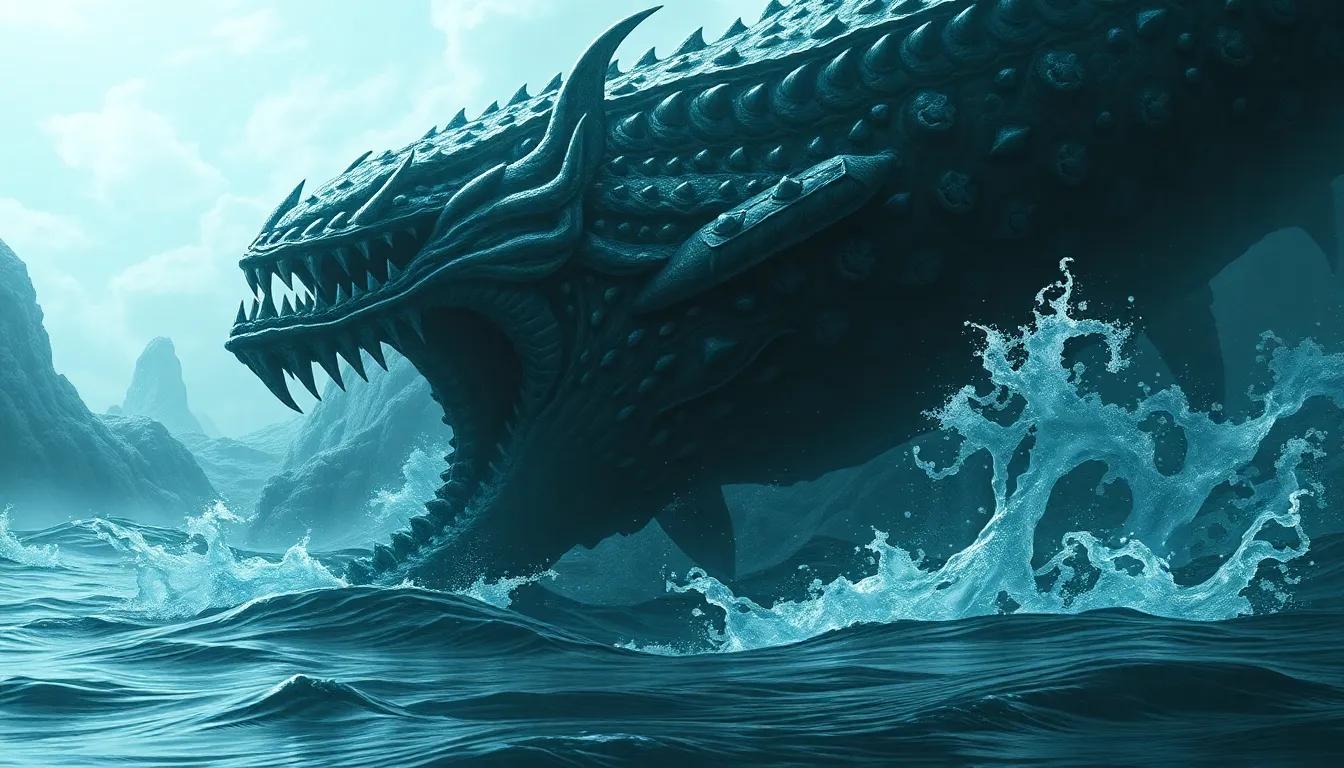
Heb je ooit gehoord van Leviathan? Het is een reusachtig zeemonster dat voorkomt in oude religieuze teksten en mythologieën over de hele wereld. Maar wat is Leviathan precies? En wat kunnen we leren over de overtuigingen en praktijken van onze voorouders door dit mysterieuze schepsel te bestuderen? In dit artikel duiken we diep in de wereld van Leviathan, de verborgen betekenissen die eraan verbonden zijn en de rol die het speelt in de ontwikkeling van religieuze en mythologische verhalen uit het verre verleden.
Het ontrafelen van de geheimen van het Bijbelse zeemonster en de invloed ervan op oude mythologieën
De mysterieuze Leviathan Leviathan is een mythisch zeemonster dat vooral bekend is uit de Bijbel. Het heeft de verbeelding van theologen, historici en leken al duizenden jaren gevangen gehouden. Sommige creationisten beschouwen Leviathan als een soort dinosaurus of prehistorisch reptiel, terwijl een diepere verkenning van dit mythische wezen laat zien dat het verband houdt met oude religies en mythologieën van de Proto-Indo-Europese volkeren en andere oude beschavingen. In dit artikel onderzoeken we de ware aard van Leviathan en wat het ons kan vertellen over de overtuigingen en verhalen die de oude wereld vormgaven.
De Bijbelse Leviathan: een monstrueus zeemonster
In de Hebreeuwse Bijbel wordt Leviathan zes keer genoemd, onder andere in het boek Job (Job 3:8 en Job 40:25–41:26), Psalmen (Psalm 74:14 en Psalm 104:26) en twee keer in Jesaja (Jesaja 27:1). In deze teksten wordt Leviathan beschreven als een gigantisch, angstaanjagend schepsel dat menselijke controle lijkt te weerstaan. Het wordt voorgesteld als een ontembaar zeemonster dat de kracht heeft om hele oceanen te verwoesten en dat de kracht van de natuursymboliek vertegenwoordigt. Hoewel sommigen speculeren dat Leviathan mogelijk gebaseerd is op reële dieren, zoals dinosaurussen of andere prehistorische reptielen, gaat de betekenis van Leviathan veel verder dan alleen zijn fysieke kenmerken. Het dient als een krachtig symbool binnen religieuze teksten en oude mythologieën.
Leviathan in de oude Nabije Oosterse mythologie
De oorsprong van Leviathan ligt in de oude mythologieën van het Nabije Oosten, waar het verwant is aan andere gigantische zeewezens zoals Tiamat uit de Babylonische mythologie en Lotan uit de Kanaänitische traditie. Deze wezens symboliseren vaak de chaos en de ontwrichting die bestaan vóór de schepping van de orde in het universum. Het verhaal van de strijd tussen de goden en deze monsters vertegenwoordigt de overwinning van orde op chaos. Zo verslaat Marduk de Tiamat en gebruikt haar lichaam om de hemel en de aarde te vormen. Deze mythologische verhalen tonen aan dat er een gemeenschappelijk culturele erfgoed bestond, dat vermoedelijk teruggaat tot de proto-Indo-Europese volkeren.
De Proto-Indo-Europeanen en hun mythologie
De Proto-Indo-Europeanen waren een prehistorisch volk dat duizenden jaren geleden leefde en een taal sprak die de basis vormt voor een groot aantal moderne talen, waaronder Engels, Duits, Hindi en vele anderen. Hoewel we weinig concrete documenten van hen hebben, laten archeologische vondsten en vergelijkingen tussen verschillende oude culturen zien dat zij een rijke mythologie en religie hadden. De overeenkomsten tussen Leviathan en andere oude zeemonsters uit verschillende culturen wijzen op een gedeeld mythologisch erfgoed dat teruggaat tot voor de schriftelijke geschiedenis. Dit gemeenschappelijke verhaal kan worden geïnterpreteerd als een universele verbeelding van de strijd tussen chaos en orde, die zich uitstrekt over verschillende tijdperken en regio’s.
Symboliek van zeewezens: chaos en orde
In veel oude culturen symboliseerden zeewezens zoals Leviathan de krachten van chaos die de gevestigde orde bedreigden. Het gevecht tussen de goden en deze monsters werd gezien als een strijd om de kosmos te herstellen en te behouden. Een bekend voorbeeld hiervan is het Babylonische scheppingsverhaal, waarin de god Marduk de Tiamat verslaat en haar lichaam gebruikt om de wereld te vormen. Dit verhaal onderstreept dat de overwinning op chaos niet alleen een kosmologisch verhaal is, maar ook een diepere symboliek bevat over het handhaven van orde in de samenleving en het universum. Het herinnert ons eraan dat oude beschavingen een universeel begrip hadden van de kracht van chaos en de noodzaak van een gestructureerd cosmos.
De erfenis van Leviathan in de moderne cultuur
De invloed van Leviathan en soortgelijke mythologische wezens is nog steeds voelbaar in onze hedendaagse cultuur. De term “leviathan” wordt vaak gebruikt om te verwijzen naar grote of machtige entiteiten, meestal met negatieve connotaties zoals onderdrukkende regeringen, grote bedrijven of oncontroleerbare systemen. Bijvoorbeeld, in politieke discussies wordt het woord gebruikt om een allesomvattend en overweldigend machtsmonopolie te beschrijven dat de vrijheid en autonomie van individuen ondermijnt. Deze symboliek krachtig herinnert ons aan de oude verhalen waarin de strijd tussen chaos en orde centraal stond, en toont aan dat de mythologieën van onze voorouders nog altijd invloed hebben op hoe we moderne problemen en machtssystemen begrijpen.

Het belang van het begrijpen van Leviathan en oude religies
Hoewel de ware aard van Leviathan nog steeds onderwerp van discussie is, is het onmiskenbaar dat deze mythische figuur een cruciale rol speelt in de ontwikkeling van religieuze en mythologische denkbeelden. Door de verbanden te bestuderen tussen Leviathan en andere oude zeewezens, kunnen we diepere inzichten krijgen in de overtuigingen en wereldbeelden van onze voorouders. Deze verhalen vormen de basis voor veel religieuze tradities en hebben bijgedragen aan de vormgeving van culturele normen en waarden.
Leviathan als venster op het verleden
De symboliek van Leviathan en gerelateerde monsters biedt ons een unieke blik op de manier waarop oude samenlevingen de wereld interpreteerden. Ze weerspiegelen de angsten, de hoop en de kosmologische ideeën die de basis vormden voor hun religieuze praktijken. Het bestuderen van deze mythes helpt ons niet alleen te begrijpen hoe onze voorouders de natuur en het universum zagen, maar ook hoe zij met de onvoorspelbare krachten van de natuur omgingen.
De rol van Leviathan in religieuze rituelen en cultuur
In veel oude culturen waren er rituelen en ceremonies die gericht waren op het omgaan met chaos en het herstellen van de orde. Bijvoorbeeld, het symbolische gevecht met een monster zoals Leviathan of Tiamat werd vaak uitgevoerd tijdens religieuze festivals of ceremoniële rituelen. Deze rituelen dienden niet alleen om de goden te eren, maar ook om de gemeenschap te beschermen tegen de destructieve krachten van chaos. Het geloof dat deze krachten konden worden bezworen door rituelen en offers was sterk aanwezig in verschillende beschavingen.
Leviathan en de evolutie van religieuze ideeën
Door de eeuwen heen evolueerden de ideeën over Leviathan en vergelijkbare wezens. In de loop van de tijd werden ze minder letterlijk genomen en meer symbolisch geïnterpreteerd. In de christelijke traditie bijvoorbeeld kreeg Leviathan een meer allegorische betekenis, waarin het staat voor de duistere krachten die overwonnen moeten worden door het geloof. Tegelijkertijd bleef de kracht van het symbool bestaan, en werd Leviathan een metafoor voor grote bedreigingen die de mensheid teisteren.
De invloed van Leviathan op literatuur en kunst
De mythes rond Leviathan hebben kunstenaars, schrijvers en dichters geïnspireerd door de eeuwen heen. Van de schilderijen van barokkunst tot moderne literatuur, het monster en de symboliek ervan worden vaak gebruikt om diepere thema’s van chaos, macht en het onbekende uit te beelden. Bijvoorbeeld, in de roman “Moby-Dick” wordt de zee en haar monsters gebruikt als metaforen voor de ongrijpbare en vaak gevaarlijke natuur van het bestaan. In de schilderkunst zijn er talloze werken die Leviathan afbeelden als een angstaanjagend wezen dat de menselijke verbeelding blijft prikkelen.
De psychologische interpretaties van Leviathan
Sommige psychologen en filosofen zien Leviathan ook als een symbool voor de onbewuste krachten binnen de mens. Het monster vertegenwoordigt onze angsten, onze onderdrukte emoties en de destructieve neigingen die we proberen te beheersen. In deze interpretatie wordt Leviathan niet alleen gezien als een fysiek wezen, maar ook als een metafoor voor de innerlijke strijd die iedere mens voert. Het confronteert ons met de oncontroleerbare aspecten van onszelf en herinnert ons eraan dat het overwinnen van deze krachten een voortdurende uitdaging is.
De wetenschap en Leviathan
Mythes en realiteit Hoewel veel wetenschappers sceptisch staan tegenover het idee dat Leviathan echt een bestaand dier was, blijft de mythe een krachtig symbool binnen menselijke cultuur. Sommige wetenschappelijke theorieën suggereren dat oude verhalen over grote zeewezens kunnen voortkomen uit de waarneming van grote walvissen, reuzeninktvissen of andere gigantische zeedieren die toen nog niet goed begrepen werden. Het is mogelijk dat de mythes ontstonden uit reële observaties, die vervolgens werden versterkt en verfijnd door culturele verhalen.
Conclusie
Leviathan als culturele en religieuze erfenis Leviathan is veel meer dan een mythisch zeemonster; het is een krachtig symbool dat door de eeuwen heen is gebleven en dat nog altijd invloed heeft op onze manier van denken. Het vertegenwoordigt de eeuwige strijd tussen chaos en orde, de kracht van het onbekende en de menselijke drang om te begrijpen en te beheersen. Door de studie van Leviathan en de oude religies waarin het voorkomt, krijgen we een waardevol inzicht in de wereldbeelden en overtuigingen van onze voorouders. Het is een venster op het verleden dat ons helpt de complexiteit van menselijke mythologieën en religieuze tradities te doorgronden, en ons eraan herinnert dat de zoektocht naar de waarheid altijd een reis is door de diepe wateren van de menselijke verbeelding.
{ PETER2011 }